Showing posts with label civilization. Show all posts

Tuesday, June 11, 2013

Shunyamurti - The Transcendental Party at the End of Time Is Now Officially Under Way

From Reality Sandwich, this is a partly interesting article and a partly misguided article. The analysis of the breakdown of society as it now exists is accurate. However, the notion that entheogenic consciousness is the only option to replace the current system is wishful and naive thinking.

Or maybe it's just been too many years since I last ingested an entheogen.

Emergence of the Entheopolitan

Shunyamurti


A mass transmutation is occurring on our planet, leading to the emergence of a new kind of transhuman being: the Entheopolitan. Consider this essay an outline of both the complex dissipative environment in which this rhizomatic interconnective supercharging shamanic shape shift is happening and some of the early, unintended consequences of this unpredictable event-in-process.
First, we need to examine the intersection of a number of factors and actants in the current sociopolitical level of reality that has served as the petri dish for the emergence of our new species. 

The main ones are the following:
1. The slo-mo collapse of global civilization and particularly of the capitalist empire that pulls its strings; 
2. Climate change acceleration, heightened seismic and volcanic activity and the distributive effects of drought, plagues, floods, and superstorms on global stability; 
3. The fall of the petro-citizen paradigm and its hobbling of conscious creativity and alienation from nature;
4. The loss of religious, ethical, and social paradigms that once channeled collective psychic energies into sublimating tendencies that served to contain the lower death drive; and simultaneously the almost ironic occurrence of a new wave of near-death experiences and other paranormal phenomena by neuroscientists and doctors, among other credible witnesses; 
5. The chaotic state of current science, with the lack of consensus on the meaning of quantum physics, and the return of the “hidden variables” theorists (those who refuse to give up obsolete paradigms, claiming that someday there will appear hidden variables that will prove their newtonian perspective to be correct); the credible challenge to neo-darwinism by some non-mythic form of intelligent design theory; and the discovery of new anomalies—requiring hypotheses such as dark energy and dark matter and alternatives to big bang cosmologies; plus the far more immediately disconcerting loss of consensus on the psychological, not to mention ontological foundations of human consciousness (thanks to the fall of the psychoanalytic establishment and the lack of any widely accepted alternative concepts of the unconscious and of human development and awareness—Jung, Deleuze, the Dalai Lama, and Ken Wilber notwithstanding); 
6. The massive disinformation campaigns led by government-controlled mass media, abetted by governmental and corporate corruption and not-so-secret plans for a new world order; the so-called austerity measures that are destroying the social fabric of the developed world; plus the irrational conspiratorial paranoia that inevitably surrounds such a situation; all this exacerbated by the growing awareness of the extraterrestrial presence and secret involvement in world affairs; 
7. The consequent loss of consensus in relation to discourse itself; the lack of common ground between different sub-cultures; the lack of trust among humans at all levels of organization; the hyper-politicization of psychiatry and diagnostic paradigms influenced greatly by the military-industrial phalanx led by the pharmaceutical industry; the accelerated fragmenting and destabilizing of individual ego consciousness, leading to a pandemic of psychosis; and thus to a new understanding of the unconscious mind and its relation to consciousness as well as to the long-denied reality of super-consciousness and the cosmic noosphere.
All of the above leaves us in the abyss, groundless, with nothing to hold onto in our relentless search for security and wisdom. For this reason, most people choose one of the following strategies:
• Denial—and submission to the system;
• Alcoholism or some other addiction or behavioral pathology or mental disorder, including psychosis;
• Despair, sometimes leading to suicide;
• Savage hyper-religiosity and/or extreme nationalism;
• Political activism and civil protest—which usually ends in violent repression;
• Weaponized survivalism;
• Transmutation into Entheopolitans.
The last-named alternative is the only path that leads through the oncoming singularity into the possibility of a new age of benign world structures and life-supportive existential conditions. The choosing of the Entheopolitan alternative is in itself only explicable as a karmic emergence of hyper-complexity through an individual’s traversal of hopelessness (rather than denial) and initiation into the dark knighthood of the soul, through courageous dedication of the power of consciousness to truth, love, and the unknowable potentialities that can arise through self-discipline and perseverance in the striving toward the highest possible destiny.

To break through pre-conceptions, even those of a religious dimensionality to the point of bringing about an ego death and rebirth into entheocentricity, requires infinite trust in the fundamental goodness of Being, openness to awe and wonder, and recognition of the unique importance of living as a psychonaut willing to enter into the depths of crazy wisdom without submitting to the paralyzing fear of going insane or being perceived by others as mad.

This crossing of the border between conventional sanity and the sublime madness of higher knowledge in order to bring back touchstones of the miraculous is the imperative that underlies our power to survive and thrive as beings of ontological centrality to the purpose of existence itself. The meme of survival of the fittest now reaches to the farther shore of shamanic magic and nirvanic Self-realization, if we are to leap the gap between imminent mass die-off and tantric creation of a new world aeon.

We have reached the tipping point in the psycho-spiritual development of consciousness, in which the complexity accumulated in our collective chronology is meeting the resistance of the deadlock of non-adaptive egocentricity; yet in those who can withstand the pressure, the kairos of clairvoyance is erupting as a change in our essential nature. A new type of consciousness is emerging, one foreshadowed by religion—and by such metaphors as coal into diamond, caterpillar into butterfly, snake shedding its skin, matter becoming light, and human morphing into angel.

The qualitative change that we are undergoing is accelerating most in those who have successfully traversed the ego’s event horizon, whether through the assistance of entheogenic substances and/or of entheonic practices, such as meditation or other techniques of sustained recognition of non-duality.

The transmutation is being accompanied, and furthered, by the creation of new works of art that bring the truth of the entheopolitan consciousness into the Real. Such artists as Alex Grey, Android Jones, and Pablo Amaringo open a visual portal into entheogenic reality, just as the writings of recent psychonauts like Terence McKenna and a host of others, not to mention all the great sages of superconsciousness from Ramana Maharshi back to the Buddha and Yeshua the Christed, kept open the cognitive portal to the Immanent Beyond for all of us throughout history.

What is different about this moment, and why it is indeed fair to call this the end time, is that not only are we pouring the ancient wine into new bottles, but now we are finally drinking it! We are not just keeping it in our wine cellars to be handed down to a future generation.

Once enough of us have drunk the divine nectar of entheogenic consciousness, the vibrational field that supports the current constructs of reality will be realized by one and all as demonic delusion. The intensification of full-spectrum consciousness will open us all to the gravity-less rainbow of infinite delight, boundless, weightless, timeless freedom, and pure insight from the mind of the Beingless God. The kingdom will only come when the kingly Samadhi of omnicentric unity has made royal again our raging egos, melting down desire into love supreme, through the zero point of raja yogic reinstatement of the Absolute as ruler of every soul.

This imminent moment, when the breakthrough of original memory, the vision of the future as our lost past, is our longshot bet on the long-promised eternal return, the omega point is our alpha bet, the decisive commitment to be that ultimate uncreated indestructible residue that remains after all the planet has imploded, to blossom again into a new world of unimaginable perfection.

The ego mind is now too loaded on death and fury, its nihilistic gnostics cannot imagine the luminous infinite, the intelligence that lies beyond the matrix, the ecstasy engineers who tape the edges of the tapestry of time by tapping into the archetypes of mathematics, hyper-dimensional topologies fleshed out with color, sound, and sublime living mandalas of beauty.

It was such a vision, far more than the concupiscence of conquistadors, which launched the thousand ships of longing for the goddess of the new world and brought us to the shores of our lost cause.

This was once the vision of Columbia, our statue to lost liberty, which brought Columbus and so many other pilgrims from around the world, to a district of Columbia inspired by founding fathers now foundering in a false-flag fascist fatalism and reduced now to a columbarium, and to the meme of Columbine, reiterated daily, now sandy hooked and (bo)stoned by a marathon of murders, including the assassination of hope. Long ago, we buried our heart at Wounded Knee. Now we murder our minds before the TV.

This is the message of the mainstream. Terror, TINA (There Is No Alternative), and titillation are the only reactions allowed. Those who turn away (becoming TINA turners, singing out their pain) too often take a path of violent resistance that only accelerates the trend toward totalitarian control, martial law, and concentration camps. Guantanamo was only an hors d’oeuvre to start the rollback of all movements of freedom since before the Magna Carta; the wars we have witnessed in recent years are only trifles to tempt the appetite for aggression to the mad max, total war to destroy every society once and for all time.

There is a logic to this madness. But to understand it requires a deeper madness, really a deeper sanity, that can see the full picture even with only a few of the dots connected. This is the significance of entheonic intelligence. To develop this level of mind power on a collective basis requires the creation of new kinds of communities, brainstorming rather than brainwashing communities, led by sages and seers of our true mindnature, willing and able to think outside every box, synthesizing the wisdom of the past, from all the world’s philosophic and spiritual traditions, with the most avant-garde, overlooked, marginalized and “minor” thinkers of the present day.

And of course we need the work of those who do more than think—those who dare to feel, those who risk heightened sensation and enhanced intuitive knowing, who open the gates of gnosis, who will bomb the inner censor with substances or the Shakti of Self-enquiry; those who invoke the benign interstellar presences and download their discourse; who bring about the elimination of the deepest repression barrier and accept the onslaught of akashic information overload that goes direct to heart of the Self.

But the Entheopolitan is not a naïve smiley-faced fool who smokes too much weed. One enters the new consciousness through the old hard work miracle, the discipline of self-transformation, the willingness to face the inner darkness, to struggle with the projections and distortions of one’s own ego, to recognize the il n’y a pas (there is no possibility of authentic relationship at the ego level); to pass through the field of unconscious phantasies and conventional standards of beauty and meaning to reach the core of the Supreme Real. The Entheopolitan goes through many rites of passage before attaining the goal; in fact, it is never attained, because the end is the Endless. But the passage goes through Absolute Nothingness, to numinous multiplicity to unitive noumenal fullness, and every stop in between.

The Entheopolitan is at home everywhere because the mind of God is everywhere. The within is also without. The intersubjective seeks the intergalactic. The noocosm is Indra’s net prophet from the exchange of vibrational currencies in the mana market of the many worlds. We are all implicated in the implicate order that is now explicating itself in the apocalyptic revelations ripping apart our world to reveal our unmanifest destiny. Let us accept the coup de grace with full grace.

The Entheopolitan is emerging. When the critical mass is reached, the Entheopolitans will create an authentic Entheopolis, a cosmic City of the All-One God-Self, inhabited by enlightened and magical beings of bodhisattvic beauty and joyous generosity and genius. The Entheopolitans are already morphing into egoless leaders, Entheopoliticians, and soon a sublime alternative cosmic order will be negotiated in a constituent assembly of buddhas and beatified ones, devas and dakinis, reminiscent of the Lankavatara Sutra and other Madhyamaka visions of the promised, pure land of Sukhavati, the same Satya Yuga alluded to in the most ancient Vedic texts.

The great shift, the new kalpa, the transcendental party at the end of time, is now officially under way. Please RSVP.

Namaste,
Shunyamurti


Image by Bill David Brooks, courtesy of Creative Commons license.

Monday, March 11, 2013

John Gray - The Silence of Animals: On progress and other modern myths


Philosopher John Gray stopped by The RSA last week to talk about his new book, The Silence of Animals: On Progress and Other Modern Myths (due in June in the U.S.). Gray is a political philosopher and author, formerly School Professor of European Thought at the London School of Economics. He has written several influential books on politics and philosophy, including 'False Dawn: The Delusions of Global Capitalism' (1998), 'Straw Dogs: Thoughts on Humans and Other Animals' (2003) and 'Black Mass: Apocalyptic Religion and the Death of Utopia' (2007).

The Silence of Animals: On progress and other modern myths

4th Mar 2013

Listen to the audio
(full recording including audience Q&A)

RSA Keynote


Are we all just 'deluded animals'?

John Gray, one of Britain's most provocative philosophers, visits the RSA to discuss the ideas raised in 'The Silence of Animals' - the much-anticipated sequel to 'Straw Dogs'.

Gray will discuss the religious origins of modern ideas of progress in civilisation and suggest that the prevailing belief in gradual improvement is a myth. Examining the lives of people who abandoned or never subscribed to it, he will ask what might replace the ruling myth.

Along the way he will consider Naples in 1944 and flying saucers...

Speaker: John Gray, political philosopher and author.
Chair: Jonathan Derbyshire, culture editor, New Statesman

Thursday, March 29, 2012

Film: The Crisis of Civilization

This film is strangely entertaining and depressing at the same time - some weird hybrid of mash-ups and facts that disturbs as it captivates. Or maybe I just need more sleep.


The Crisis of Civilization is a documentary feature film investigating how global crises like ecological disaster, financial meltdown, dwindling oil reserves, terrorism and food shortages are converging symptoms of a single, failed global system.


Weaving together archival film footage and animations, film-maker Dean Puckett, animator Lucca Benney and international security analyst Dr. Nafeez Mosaddeq Ahmed – author of A User’s Guide to the Crisis of Civilization: And How to Save It – offer a stunning wake-up call proving that ‘another world’ is not merely possible, but on its way.


Like the book on which it is based, the film consists of seven parts which explore the interconnected dynamic of global crises of Climate Catastrophe; Peak Energy; Peak Food; Economic Instability; International Terrorism; and the Militarization Tendency – with a final section on The Post-Peak World.

The film reveals how a failure to understand the systemic context of these crises, linked to neoliberal ideology, has generated a tendency to deal not with their root structural causes, but only with their symptoms. This has led to the proliferation of war, terror, and state-terror, including encroachment on civil liberties, while accelerating global crises rather than solving them.


The real solution, Nafeez argues, is to recognise the inevitability of civilizational change, and to work toward a fundamental systemic transformation based on more participatory forms of living, politically, economically and culturally.

Also featuring clowns, car crashes, explosions, acrobats, super heroes, xylophones and much, much more!
The links from the video on YouTube:
A dark comedy remix mash-up bonanza about the end of industrial civilization.
Support us! Get the DVD http://crisisofcivilization.com/buy
Listen to our response to some of the your comments here http://crisisofcivilization.com/podcast2/
Based on the Book by Nafeez Mosaddeq Ahmed - http://crisisofcivilization.com/book/
Directed by Dean Puckett
Animations by Lucca Benney
http://www.facebook.com/thecrisisfilm
http://twitter.com/crisisfilm

Friday, December 02, 2011

Authors@Google: Jeffrey Sachs, "The Price of Civilization"


Interesting talk from Jeffrey Sachs, Director of The Earth Institute at Columbia University. He is author of The Price of Civilization: Reawakening American Virtue and Prosperity.


"The Price of Civilization"

As he has done in dozens of countries around the world in the midst of economic crises, Sachs turns his unique diagnostic skills to what ails the American economy. He finds that both political parties—and many leading economists—have missed the big picture, offering shortsighted solutions such as stimulus spending or tax cuts to address complex economic problems that require deeper solutions. Sachs argues that we have profoundly underestimated globalization's long-term effects on our country, which create deep and largely unmet challenges with regard to jobs, incomes, poverty, and the environment. America's single biggest economic failure, Sachs argues, is its inability to come to grips with the new global economic realities.

Yet Sachs goes deeper than an economic diagnosis. By taking a broad, holistic approach—looking at domestic politics, geopolitics, social psychology, and the natural environment as well—Sachs reveals the larger fissures underlying our country's current crisis. He shows how Washington has consistently failed to address America's economic needs. He describes a political system that has lost its ethical moorings, in which ever-rising campaign contributions and lobbying outlays overpower the voice of the citizenry. He also looks at the crisis in our culture, in which an overstimulated and consumption-driven populace in a ferocious quest for wealth now suffers shortfalls of social trust, honesty, and compassion.

Finally, Sachs offers a plan to turn the crisis around. He argues persuasively that the problem is not America's abiding values, which remain generous and pragmatic, but the ease with which political spin and consumerism run circles around those values. He bids the reader to reclaim the virtues of good citizenship and mindfulness toward the economy and one another. Most important, he bids each of us to accept the price of civilization, so that together we can restore America to its great promise.

Friday, November 05, 2010

David Sloan Wilson - Evolving the City

Cool talk by David Sloan Wilson.
Roughly 50% of Americans don't believe the theory of evolution and nearly 100% worldwide don't appreciate its tremendous relevance to human affairs. In this University of Sydney talk, David Sloan Wilson shows how evolutionary theory can help to solve the problems of everyday life, from the quality of life in our cities to rethinking the fundamentals of economic theory and policy.

David Sloan Wilson is SUNY Distinguished Professor of Biology and Anthropology at Binghamton University. His books include Darwin’s Cathedral: Evolution, Religion, and the Nature of Society and Evolution for Everyone: How Darwin’s Theory Can Change the Way We Think About Our Lives. His next book is titled The Neighborhood Project: Using Evolution to Improve My City, One Block At A Time.

Presented by the Centre for Human Aspects of Science and Technology (CHAST), University of Sydney, September 2010
Part One:


Part Two:


Saturday, July 03, 2010

Empathic Civilization: Jeremy Rifkin - Empathy Documentary

In my opinion, Jeremy Rifkin's The Empathic Civilization: The Race to Global Consciousness in a World in Crisis is one of the most important books - and most important ideas - of this first decade in the 21st century. It offers a comprehensive look at the science of who we are as human beings - that we are hard-wired for empathy and compassion, not violence and greed.

This is a video of one of his lectures from the book tour earlier this year.

Empathic Civilization: Jeremy Rifkin - Empathy Documentary - 2010-01-24 from Edwin Rutsch on Vimeo.

ProgressiveSpirit.com/Empathy For more on empathy visit our website. This is part of a larger documentary project by Edwin Rutsch on the nature of empathy. I hope you'll connect and get involved.

The Jeremy Rifkin book tour for the Empathic Civilization: The Race to Global Consciousness in a World in Crisis - empathiccivilization.com

Video Taped at Praxis Peace Institute, January, 24, 2010 in Sonoma, CA.
http:/.praxispeace.org

Tags: , , , , , , , , , ,

Tuesday, June 08, 2010

Seed Magazine - Spencer Wells: Pandora's Seed, The Unforeseen Cost of Civilization

Cool article from Seed Magazine - what Buddhists have known and embraced for 2,500 years is now dawning on scientists and other people as well - change is the only constant. And, you know what, it's speeding up.

I think it's important to note that while we need to figure out ways to deal with the changes modern and postmodern civilization is bringing us, we should not seek the "return" to some kind of "golden age." There never was a golden age - unless disease, early death, and other forms of pre-industrial and pre-information age life seem like fun to you.

Pandora's Seed: The Unforeseen Cost of Civilization is the new book from Spencer Wells, being released today. Below the essay is a brief review of the book.

Pandora’s Seed

Guest Essay | by Spencer Wells | June 7, 2010

From obesity to chronique fatigue syndrome, jihadism to urban ennui, the costs of civilization are becoming ever more apparent. Spencer Wells explores adapting to a world where accelerating change is the new status quo.

During my work as a geneticist and anthropologist I’ve been lucky enough to work with people around the world, ranging from senior politicians and the heads of major corporations to hunter-gatherer tribesmen eking out a precarious existence in remote wilderness locations. What has struck me over and over again is the huge amount of change taking place in the world today, regardless of where one lives. Some of this change is good, such as the overall decrease in poverty during the course of my lifetime, or the drop in the birthrate in developing countries. Other things, though, like 9/11 and the 2008 terrorist attacks in Mumbai, have not been so welcome though.

Everywhere there is a feeling that the world is in flux, that we are on the brink of a historic transition, and that the world will be fundamentally changed somehow in the next few generations. The pace of technological change is accelerating, and we are all swept up in it. Think of all of the indispensable things in your daily life you have only learned to use in the past decade or so. Email, Google, instant messaging and mobile phones spring to mind immediately, but there’s also hybrid car technology, curbside recycling and social networking sites like Facebook. All have found widespread application only since the mid-1990s, and yet today we can’t imagine living without them. Trying to imagine what the world will be like at the close of the 21st century is nearly impossible.

With all of these amazing technological advances, though, has come a great deal of ancillary baggage. The unprecedented rise in chronic disease in westernized societies is perhaps the most obvious example. I say westernized, rather than western, because we are now well aware of the growing incidence of heart disease, diabetes and plain-old obesity in the developing world, particularly in places such as India and China. As they become more like us, they are taking on many of our worst attributes as well. Psychological disorders such as depression and anxiety are also on the rise, and drugs to treat these disorders are now the most widely prescribed in the United States. This seemingly inexorable march toward western unhealthiness made me wonder why it happened in the first place. Is there some sort of fatal mismatch between western culture and our biology that is making us ill? And if there is such a mismatch, how did our present culture come to dominate? Surely we are the masters of our own fate, and we created the culture that is best suited to us, rather than the other way around?

The answer to this was a long time in coming. It took me on a global quest to discover the similarities between what happened thousands of years ago and what is happening now, as we face what promises to be another turning apparent point in our evolution. During the course of researching of my first book, The Journey of Man, I was struck by the effects of the agricultural lifestyle on humans living 10,000 years ago in the Middle East. It turns out that early farmers were actually less healthy than the surrounding hunter-gatherer populations. So why did the farmers ‘win’ so resoundingly, to the extent that virtually no one on Earth today lives as a hunter-gatherer? The answer, like most insights into major historical events, is somewhat complicated, but reveals a simple pattern in human history that seems to repeat itself again and again: necessity is the mother of invention.

The changes as we settled down into villages and then cities wrought havoc on our biology, adapted as it was to millions of years of leading a semi-nomadic existence as hunter-gatherers. Instead of modifying the culture to suit our physiology, though, we seem to have adapted biologically to the prevailing culture. The signals of this are still visible in our DNA, and we are still in the process of adapting to it. It is likely that we have changed more at the DNA level in the past 10,000 years than we did in the previous 100,000. This acceleration in the rate of evolutionary change is unprecedented in the history of our species.

Of course, such enormous cultural changes have effects on far more than simply our biology. As we settled down into farming villages, and then towns and cities, society became more complicated. Hunter-gatherers, having fewer people in their groups, tend to have fairly simple and egalitarian social structures. A chief perhaps, but certainly not a specialized bureaucracy, a professional army, a priesthood and other trappings of what we call civilization. The existence of these things is a direct outcome of the decision to settle down and start growing food. As more food is planted, you can have more children, and they are actually useful to help tend the fields. Over time this iterative cycle leads to a literal explosion in population, and as a result the human population rose from a few million at the dawn of the Neolithic, 10,000 years ago, to over six and a half billion today. Modern society is so complex that it’s amazing that the whole system doesn’t seize up, or that terrorist acts aren’t more common.

So, how can a species that spent almost all of its evolutionary history adapting to hunting and gathering in small, fairly dispersed groups learn to cope with the challenges posed by this relatively new culture? In short, it’s time for us to grow up. Stewart Brand, paraphrasing Edmund Leach in the opening sentence of the first Whole Earth Catalog in 1969, said it well: we are as gods, it’s time we got good at it. The final section of the book deals with three critical challenges facing us in the next century – challenges that have come about through our actions over the past 10,000 years, and that threaten to be our undoing unless we address them.

The first is the growing power of genetic engineering. Over the past two decades our knowledge of human genetics has exploded. I still remember debating with fellow geneticists the summer before I started graduate school, in 1989, whether it was possible or even advisable to sequence an entire human genome. The costs/benefit ratio was unclear, and many felt that it was simply too expensive and would take too long to complete to yield anything of real value. That all changed in the late 1990s, when Craig Venter’s private company Celera and the publicly funded Human Genome Project competed to see who could finish the first complete genome sequence. It was declared a tie in March of 2000, and the race was then on to figure out what the billions of nucleotide bases actually meant. The rate at which this knowledge has accumulated in the past decade has been nothing short of breathtaking, and as a geneticist I feel lucky to have been able to practice my trade at this point in history. We now know so much more about how tiny variations in the genetic code can lead to the phenotypes that define us – physical appearance, personality, diseases – than we did only a few short years ago.

With this knowledge, of course, has come the desire to use the information to improve the human condition. Generating such knowledge is not simply an academic exercise for the benefit of the genetics community, after all – huge promises were made in order to obtain the billions of dollars of funding it took to sequence the first genome. Health would be improved, we would be better able to predict our abilities and predilections, and overall humanity would be better off. However, unlike other technologies that have witnessed explosive growth over the past couple of decades, from computers to nanotechnology, the applications of genetics have the potential to affect the biological identity of future generations, through our ability to choose the traits our children – and all subsequent generations – will carry. While Gattaca-like scenarios are still a long way off, the potential is there. How will we know if we are making genetic decisions that are best in the long run, for our children’s great, great, great-grandchildren? And what is at risk long-term as we make decisions based on proximal desires or threats?

The second enormous challenge that we need to face as a result of the events set in motion 10,000 years ago with the development of agriculture is climate change. It’s now commonplace to talk about global warming and carbon footprints, so much so that it’s easy to forget that until quite recently few thought it was even possible that the actions of our species could have a potentially catastrophic effect on the Earth’s climate. We’re just along for the ride, we seemed to be telling ourselves as we consumed ever more hydrocarbons, releasing the noxious cocktail of exhaust fumes into the atmosphere. Now we appear to have set in motion a series of events that, even if we can manage to bring our greenhouse gas production under control, threatens to change the very nature of the planet we live on. How we learn to deal with this will be an enormous technical and social challenge over the next century, and beyond. While it will likely spur us into action on the technologies required to reduce emissions, the effects of global warming will nonetheless still be felt by us, and by our descendants, for decades to come.

The final significant challenge, unlike the other two, is not fundamentally technological in nature, though some of the solutions will likely involve the application of technology. We have now evolved culturally to the point where the entire world is connected in a way it has never been before. Not only is it possible to jet off to Mumbai for a lecture over the course of a weekend, as I did in the aftermath of the 2008 attacks, but we use telecommunications technology to talk, email, SMS, instant message, videoconference and otherwise connect with each other in ways that were inconceivable only a century ago. Recall that when Alexander Graham Bell invented the telephone, the New York World (then a major US newspaper) famously asked ‘of what use is such an invention?’ In the past century our world has become ever more connected, to the extent that today what happens in Kansas or Calcutta is immediately transmitted via streams of electrons to people around the world. The effect of this connectivity has been the globalization of culture, and as the West is the in the hegemony at the moment, this means that more and more people are becoming ever more western. While to those of us in living in the West there are many good aspects to this, to many others our way of life is not all it’s meant to be. For secular rationality, read loss of faith and certainty. For improving living standards, read increased consumption. For increased social mobility, read loss of traditional roles and threats to vested interests. The rise of fundamentalism in the latter half of the 20th century reflects the very real loss of the traditions that guided much of humanity over the past several thousand years. What to replace those traditions with, especially for those not privy to the largesse of the modern world, is a difficult question. If you believe that you have a stake in the future, you are likely to embrace it; if you feel left out, this is much less likely. Providing an inclusive mythos for the modern age will be a significant challenge of the next century.

While all of these issues have their proximal causes in the modern world, ultimately the forces that created them were set in motion by the enormous changes that took place long before. The biggest revolution of the past 50,000 years was not the advent of the Internet, the growth of the industrial age out of the seeds of the Enlightenment, or the development of modern methods of long-distance navigation. Rather, it was a seemingly trivial event that happened rather quickly around 10,000 years ago – the dawn of the age of agriculture, when a few people living in several locations around the world decided to stop gathering their food from the land, abiding by limits set in place by nature, and grow their food. This desire has had more far-reaching consequences for our species than any other. With this change though, and the power we developed, we must also learn some humility. In today’s world, where small groups of terrorists can inflict such lasting damage on the psyche of nations, where simple decisions can affect the biological inheritance of generations far in the future, and more species are likely to go extinct as a result of our actions than at any point in the past 60 million years, it is necessary to take stock and realize that with great desires come great consequences.

About the author

Spencer Wells is an Explorer-in-Residence at the National Geographic Society and Frank H. T. Rhodes Class of ’56 Professor at Cornell University. He leads the Genographic Project, which is collecting and analyzing hundreds of thousands of DNA samples from people around the world in order to decipher how our ancestors populated the planet. Wells received his Ph.D. from Harvard University and conducted postdoctoral work at Stanford and Oxford. He has written two books, The Journey of Man and Deep Ancestry.

This essay is adapted from Spencer Wells’ new book Pandora’s Seed, which will be released nationwide today, June 8.Here is Seed Magazine's brief review. I'll post other reviews as I see them.
Pandora’s Seed: The Unforeseen Cost of Civilization
By Spencer Wells (Random House)

The World Wide Web and cell phones. Hybrid cars and curbside recycling. Google, the iPod, the LEED-certified building. None of these things were available just two decades ago, and yet today, it’s hard to imagine life without them. We live in a time of enormous technological and social change—one that geneticist Spencer Wells argues, “promises to be another turning point in our evolution.” But along with the many goods (overall decrease in poverty, declining birthrates in the developing world), have also come a bevy of evils. While developed societies no longer die of smallpox, polio, or cholera, they are now plagued by chronic disease, obesity, and depression. Why has Westernism has taken hold, and why does this culture seem so fatal a mismatch with our biology? The search for answers takes Wells on a geographic and history tour of the planet, back to a seminal event in human history: The advent of agriculture, when our hunter gatherer forbears decided to settle down and began putting seeds in the ground for food. The decision to control our own food supply, he argues, set in motion a chain of events that has not only transformed our species at the DNA level, but has transformed human culture, with downsides we are just beginning to recognize: with industrialization comes global climate change, with increased connectedness comes SARS and avian flu; with more social mobility comes loss of tradition. A broad-sweeping look at the genetic, anthropological, and technological changes that have defined human progress, the book offers a unique glimpse at the problems of modernity—and defines the key challenges for those who seek to overcome them.

Tuesday, May 25, 2010

Illustrating Rifkin's The Empathic Civilization

Very cool - via 21st Century Ecology of Life . . . on the interface between everything - even nothing, cool name for a blog (from my Facebook friend Mushin).

The Empathic Civilisation

A wonderfully illustrated talk – or better, fragment of a talk – by Jeremy Rifkin that I would love all my friends “world-change agents” to see and contemplate.

A good question to go with this is: “What is the most strategic contribution I can make?”


Saturday, May 15, 2010

Arts and Culture - The Dark Mountain Project


These folks are interesting. Their basic idea is that Western culture, as it now exists, is doomed to burn out - that we are right now witnessing it's end. All the ideas about the future being better versions of the present our foolish in their opinion.

But the end of the present does not mean the end of human beings. We need new stories (they take a narrative constructionist view from what I gather in their writings) and in making new stories through art we can make a new future.
The Project

These are precarious and unprecedented times. Our economies crumble, while beyond the chaos of markets, the ecological foundations of our way of living near collapse. Little that we have taken for granted is likely to come through this century intact.

We don’t believe that anyone – not politicians, not economists, not environmentalists, not writers – is really facing up to the scale of this. As a society, we are all still hooked on a vision of the future as an upgraded version of the present. Somehow, technology or political agreements or ethical shopping or mass protest are meant to save our civilisation from self-destruction.

Well, we don’t buy it. This project starts with our sense that civilisation as we have known it is coming to an end; brought down by a rapidly changing climate, a cancerous economic system and the ongoing mass destruction of the non-human world. But it is driven by our belief that this age of collapse – which is already beginning – could also offer a new start, if we are careful in our choices.

The end of the world as we know it is not the end of the world full stop.

Deeper than oil, steel or bullets, a civilisation is built on stories: on the myths that shape it and the tales told of its origins and destiny. We have herded ourselves to the edge of a precipice with the stories we have told ourselves about who we are: the stories of ‘progress’, of the conquest of ‘nature’, of the centrality and supremacy of the human species.

It is time for new stories. The Dark Mountain Project intends to conjure into being new ways of seeing and writing about the world. We call this Uncivilisation.

Our aim is to bring together writers and artists, thinkers and doers, to assault the established citadels of literature and thought, and to begin to redraw the maps by which we navigate the places and times in which we find ourselves.

What we are doing

The Dark Mountain manifesto is available to read on this site. It can also be purchased as a limited edition, hand-stitched pamphlet, printed by the unique Bracketpress. The manifesto lays out in more detail our thinking and our aims. Or, for the short version, you can read our eight principles of uncivilisation.

The Dark Mountain Project will bring together people who share these aims, and present their work, with the intention of changing the angles from which we view our world and the human story. At the moment, we have two vehicles for making this happen: the Dark Mountain journal and our public events.

This project is not a fixed thing, a campaign with a determined set of outcomes. We are always open to ideas, encounters, collaborations and suggestions for different approaches.

Who we are

The Dark Mountain Project was conceived and is curated by Paul Kingsnorth and Dougald Hine.

This website is the work of Steve Ounanian, Sangeet Gyawali and Pippa Buchanan.

These are their eight principles of uncivilisation, which I find interesting.

Eight Principles of Uncivilisation

‘We must unhumanise our views a little, and become confident
As the rock and ocean that we were made from.’

  1. We live in a time of social, economic and ecological unravelling. All around us are signs that our whole way of living is already passing into history. We will face this reality honestly and learn how to live with it.

  2. We reject the faith which holds that the converging crises of our times can be reduced to a set of‘problems’ in need of technological or political ‘solutions’.

  3. We believe that the roots of these crises lie in the stories we have been telling ourselves. We intend to challenge the stories which underpin our civilisation: the myth of progress, the myth of human centrality, and the myth of our separation from ‘nature’. These myths are more dangerous for the fact that we have forgotten they are myths.

  4. We will reassert the role of story-telling as more than mere entertainment. It is through stories that we weave reality.

  5. Humans are not the point and purpose of the planet. Our art will begin with the attempt to step outside the human bubble. By careful attention, we will reengage with the non-human world.

  6. We will celebrate writing and art which is grounded in a sense of place and of time. Our literature has been dominated for too long by those who inhabit the cosmopolitan citadels.

  7. We will not lose ourselves in the elaboration of theories or ideologies. Our words will be elemental. We write with dirt under our fingernails.

  8. The end of the world as we know it is not the end of the world full stop. Together, we will find the hope beyond hope, the paths which lead to the unknown world ahead of us.
You can read the manifesto online, or you can download the PDF version - it's quite long. Here is the beginning of the document.

The Dark Mountain manifesto can also be read as a PDF or purchased as a limited-edition, hand-stitched pamphlet.

UNCIVILISATION

THE DARK MOUNTAIN MANIFESTO

I. Walking on lava

The end of the human race will be that it will eventually die of civilisation
Ralph Waldo Emerson

Those who witness extreme social collapse at first hand seldom describe any deep revelation about the truths of human existence. What they do mention, if asked, is their surprise at how easy it is to die.

The pattern of ordinary life, in which so much stays the same from one day to the next, disguises the fragility of its fabric. How many of our activities are made possible by the impression of stability that pattern gives? So long as it repeats, or varies steadily enough, we are able to plan for tomorrow as if all the things we rely on and don’t think about too carefully will still be there. When the pattern is broken, by civil war or natural disaster or the smaller-scale tragedies that tear at its fabric, many of those activities become impossible or meaningless, while simply meeting needs we once took for granted may occupy much of our lives.

What war correspondents and relief workers report is not only the fragility of the fabric, but the speed with which it can unravel. As we write this, no one can say with certainty where the unravelling of the financial and commercial fabric of our economies will end. Meanwhile, beyond the cities, unchecked industrial exploitation frays the material basis of life in many parts of the world, and pulls at the ecological systems which sustain it.

Precarious as this moment may be, however, an awareness of the fragility of what we call civilisation is nothing new.

‘Few men realise,’ wrote Joseph Conrad in 1896, ‘that their life, the very essence of their character, their capabilities and their audacities, are only the expression of their belief in the safety of their surroundings.’ Conrad’s writings exposed the civilisation exported by European imperialists to be little more than a comforting illusion, not only in the dark, unconquerable heart of Africa, but in the whited sepulchres of their capital cities. The inhabitants of that civilisation believed ‘blindly in the irresistible force of its institutions and its morals, in the power of its police and of its opinion,’ but their confidence could be maintained only by the seeming solidity of the crowd of like-minded believers surrounding them. Outside the walls, the wild remained as close to the surface as blood under skin, but the city-dweller was no longer equipped to face it directly.

Bertrand Russell caught this vein in Conrad’s worldview, suggesting that Conrad ‘thought of civilised and morally tolerable human life as a dangerous walk on a thin crust of barely cooled lava which at any moment might break and let the unwary sink into fiery depths.’ What both Russell and Conrad were getting at was a simple fact which any historian could confirm: human civilisation is an intensely fragile construction. It is built on little more than belief: belief in the rightness of its values; belief in the strength of its system of law and order; belief in its currency; above all, perhaps, belief in its future.

Once that belief begins to crumble, the collapse of a civilisation may become unstoppable. That civilisations fall, sooner or later, is as much a law of history as gravity is a law of physics. What remains after the fall is a wild mixture of cultural debris, confused and angry people whose certainties have betrayed them, and those forces which were always there, deeper than the foundations of the city walls: the desire to survive and the desire for meaning.

It is, it seems, our civilisation’s turn to experience the inrush of the savage and the unseen; our turn to be brought up short by contact with untamed reality. There is a fall coming. We live in an age in which familiar restraints are being kicked away, and foundations snatched from under us. After a quarter century of complacency, in which we were invited to believe in bubbles that would never burst, prices that would never fall, the end of history, the crude repackaging of the triumphalism of Conrad’s Victorian twilight – Hubris has been introduced to Nemesis. Now a familiar human story is being played out. It is the story of an empire corroding from within. It is the story of a people who believed, for a long time, that their actions did not have consequences. It is the story of how that people will cope with the crumbling of their own myth. It is our story.

This time, the crumbling empire is the unassailable global economy, and the brave new world of consumer democracy being forged worldwide in its name. Upon the indestructibility of this edifice we have pinned the hopes of this latest phase of our civilisation. Now, its failure and fallibility exposed, the world’s elites are scrabbling frantically to buoy up an economic machine which, for decades, they told us needed little restraint, for restraint would be its undoing. Uncountable sums of money are being funnelled upwards in order to prevent an uncontrolled explosion. The machine is stuttering and the engineers are in panic. They are wondering if perhaps they do not understand it as well as they imagined. They are wondering whether they are controlling it at all or whether, perhaps, it is controlling them.

You can read more at the site, or download the PDF.


Wednesday, April 07, 2010

Peter Katzenstein: Why the Clash of Civilizations Theory Is Wrong

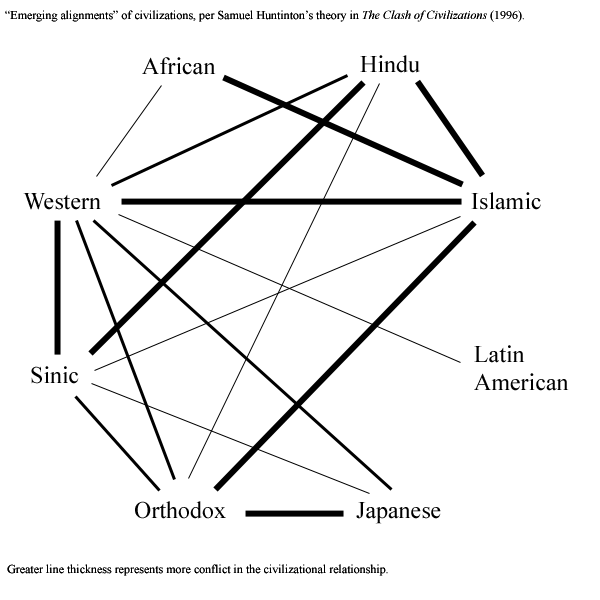
File:Huntington Clash of Civilizations chart.gif

Interesting perspective. See below the videos for an explanation of just what exactly Peter Katzenstein is arguing against here. Interesting that Samuel P. Huntington's "Clash of Civilizations?" is still a topic of discussion after 17 years.

The article became a book in 1998: The Clash of Civilizations and the Remaking of World Order.

I tend to agree with him for the most part (admittedly, I only skimmed the original article). His sense that cultures (or worldviews) will be the source of international conflict has proven true in many ways. It's more a clash of values than a clash of politics. The 9/11 attack and subsequent rise of various values-based terrorist groups (al-Qaeda is the most famous, but the Maoist rebels in Nepal and India, the Christian fundamentalists in the US, and the militant messianic Zionists in Israel all engage in ideological terrorism) have seemingly made Samuel P. Huntington quite the futurist.

In his lecture at Sydney Ideas, Peter Katzenstein, one of America’s leading political scientists, offers a critique of the Samuel Huntington’s Clash of Civilization theory (the theory that conflict between distinct groups based on religion and cultural identities (eg Western, Islamic, Sinic) is inevitable, and will dominate in the post cold–war period). Katzenstein argues that emphasis on the unity and uniformity of different civilizations and hence on sharp differences among civilizations is misguided, and that civilizations are better thought of in pluralist terms; We should concentrate on studying encounters and engagements among civilizations.

Peter J. Katzenstein is the Walter S. Carpenter, Jr. Professor of International Studies at Cornell University and President of the American Political Science Association.

Presented by Sydney Ideas and the United States Studies Centre, March 2010
Part One:


Part Two:


So what is Samuel P. Huntington's Clash of Civilizations Theory - Wikipedia offers a descent summary of the article and the controversy. Here is the beginning of the original article.
The Clash of Civilizations?
by Samuel P. Huntington
Foreign Affairs Summer 1993

SAMUEL P. HUNTINGTON is the Eaton Professor of the Science of Government and Director of the John M. Olin Institute for Strategic Studies at Harvard University. This article is the product of the Olin Institute's project on "The Changing Security Environment and American National Interests."

I. THE NEXT PATTERN OF CONFLICT
II. THE NATURE OF CIVILIZATIONS
III. WHY CIVILIZATIONS WILL CLASH
IV. THE FAULT LINES BETWEEN CIVILIZATIONS
V. CIVILIZATION RALLYING
VI. THE WEST VERSUS THE REST
VII. THE TORN COUNTRIES
VIII. THE CONFUCIAN-ISLAMIC CONNECTION
IX. IMPLICATIONS FOR THE WEST

I. THE NEXT PATTERN OF CONFLICT

WORLD POLITICS IS entering a new phase, and intellectuals have not hesitated to proliferate visions of what it will be -- the end of history, the return of traditional rivalries between nation states, and the decline of the nation state from the conflicting pulls of tribalism and globalism, among others. Each of these visions catches aspects of the emerging reality. Yet they all miss a crucial, indeed a central, aspect of what global politics is likely to be in the coming years.

It is my hypothesis that the fundamental source of conflict in this new world will not be primarily ideological or primarily economic. The great divisions among humankind and the dominating source of conflict will be cultural. Nation states will remain the most powerful actors in world affairs, but the principal conflicts of global politics will occur between nations and groups of different civilizations. The clash of civilizations will be the battle lines of the future.

Conflict between civilizations will be the latest phase of the evolution of conflict in the modern world. For a century and a half after the emergence of the modern international system of the Peace of Westphalia, the conflicts of the Western world were largely among princes -- emperors, absolute monarchs and constitutional monarchs attempting to expand their bureaucracies, their armies, their mercantilist economic strength and, most important, the territory they ruled. In the process they created nation states, and beginning with the French Revolution the principal lines of conflict were between nations rather than princes. In 1793, as R. R. Palmer put it, "The wars of kings were over; the ward of peoples had begun." This nineteenth-century pattern lasted until the end of World War I. Then, as a result of the Russian Revolution and the reaction against it, the conflict of nations yielded to the conflict of ideologies, first among communism, fascism-Nazism and liberal democracy, and then between communism and liberal democracy. During the Cold War, this latter conflict became embodied in the struggle between the two superpowers, neither of which was a nation state in the classical European sense and each of which defined its identity in terms of ideology.

These conflicts between princes, nation states and ideologies were primarily conflicts within Western civilization, "Western civil wars," as William Lind has labeled them. This was as true of the Cold War as it was of the world wars and the earlier wars of the seventeenth, eighteenth and nineteenth centuries. With the end of the Cold War, international politics moves out of its Western phase, and its center-piece becomes the interaction between the West and non-Western civilizations and among non-Western civilizations. In the politics of civilizations, the people and governments of non-Western civilizations no longer remain the objects of history as targets of Western colonialism but join the West as movers and shapers of history.

II. THE NATURE OF CIVILIZATIONS

DURING THE COLD WAR the world was divided into the First, Second and Third Worlds. Those divisions are no longer relevant. It is far more meaningful now to group countries not in terms of their political or economic systems or in terms of their level of economic development but rather in terms of their culture and civilization.

What do we mean when we talk of a civilization? A civilization is a cultural entity. Villages, regions, ethnic groups, nationalities, religious groups, all have distinct cultures at different levels of cultural heterogeneity. The culture of a village in southern Italy may be different from that of a village in northern Italy, but both will share in a common Italian culture that distinguishes them from German villages. European communities, in turn, will share cultural features that distinguish them from Arab or Chinese communities. Arabs, Chinese and Westerners, however, are not part of any broader cultural entity. They constitute civilizations. A civilization is thus the highest cultural grouping of people and the broadest level of cultural identity people have short of that which distinguishes humans from other species. It is defined both by common objective elements, such as language, history, religion, customs, institutions, and by the subjective self-identification of people. People have levels of identity: a resident of Rome may define himself with varying degrees of intensity as a Roman, an Italian, a Catholic, a Christian, a European, a Westerner. The civilization to which he belongs is the broadest level of identification with which he intensely identifies. People can and do redefine their identities and, as a result, the composition and boundaries of civilizations change.

Civilizations may involve a large number of people, as with China ("a civilization pretending to be a state," as Lucian Pye put it), or a very small number of people, such as the Anglophone Caribbean. A civilization may include several nation states, as is the case with Western, Latin American and Arab civilizations, or only one, as is the case with Japanese civilization. Civilizations obviously blend and overlap, and may include subcivilizations. Western civilization has two major variants, European and North American, and Islam has its Arab, Turkic and Malay subdivisions. Civilizations are nonetheless meaningful entities, and while the lines between them are seldom sharp, they are real. Civilizations are dynamic; they rise and fall; they divide and merge. And, as any student of history knows, civilizations disappear and are buried in the sands of time.

Westerners tend to think of nation states as the principal actors in global affairs. They have been that, however, for only a few centuries. The broader reaches of human history have been the history of civilizations. In A Study of History, Arnold Toynbee identified 21 major civilizations; only six of them exist in the contemporary world.

III. WHY CIVILIZATIONS WILL CLASH

CIVILIZATION IDENTITY will be increasingly important in the future, and the world will be shaped in large measure by the interactions among seven or eight major civilizations. These include Western, Confucian, Japanese, Islamic, Hindu, Slavic-Orthodox, Latin American and possibly African civilization. The most important conflicts of the future will occur along the cultural fault lines separating these civilizations from one another.

Why will this be the case?
Read the whole article.


Sunday, February 28, 2010

Huffingtion Post - The Empathic Civilization - Several Articles

http://www.tylerplace.com/assets/Uploads/Infants.jpg

A nice collection of articles on empathy in the modern world, featuring Alison Gopnik, one of the leading researchers in early child development. I'm posting her article in full, and providing links to the others, because she offers us a glimpse into the way we come into the world - we are born to be empathic creatures.

I'll probably post a couple more of these in the coming days, mostly so that I can find them easily.

'Empathic Civilization': Amazing Empathic Babies

Alison Gopnik | Posted 02.24.2010

One of the best ways of understanding human nature is to study children. After all, if we want understand who we are, we should find out how we got to be that way. Until recently most philosophers and psychologists thought that babies and young children were profoundly amoral creatures. They also thought that children were irrational and egocentric -- unable to think logically or take the perspective of others. Jean Piaget and later Lawrence Kohlberg, the founders of the study of moral development, argued that children did not have truly moral concepts until adolescence. Instead, children simply thought that whatever other people told them to do was right.

In the last thirty years scientists have completely overturned this view. Even the youngest babies imitate the facial expressions of other people and take on their emotions -- a kind of empathy. This ability is NOT just the result of the much-hyped "mirror neurons" since, for one thing, mirror neurons have been found in monkeys who rarely imitate others. But it does show that human babies, in particular, are tuned in to other people in an especially close way.

By 18 months, babies have gone beyond empathy to genuine altruism, After all empathy just means I feel your pain, altruism means I try to make you feel better even when I don't feel that way myself. Betty Repacholi and I did an experiment with 14 and 18-month-olds. We showed them two bowls of food, one of raw broccoli and one of goldfish crackers. All the babies, even in Berkeley, like the crackers and don't like the broccoli. Then the experimenter ate some food from each bowl. Half the time she acted as if she felt the same way as the babies. But for half the babies she acted as if she was disgusted by the crackers and loved the broccoli, just the opposite of the way the babies felt themselves. Then she gave the babies the two bowls, held out her hand and said "Could I have some?" The 14-month-olds gave her the crackers no matter what she did. But the 18-month-olds actually went beyond immediate empathy to something more like genuine altruism. They gave her the crackers of she liked he crackers and the broccoli if she preferred the broccoli, They understood that the other person might want something different from what they wanted themselves, and they acted to make her happy. Other experiments suggest the same thing. Felix Warneken and Mike Tomasello found that 18-month-olds will crawl across a set of cushions to get a pen for a an experimenter who drops it out of reach -- and strains to get it back. But they won't do that if he purposely throws the pen to the ground.

By the time they are three children have taken these basic impulses towards altruism and empathy and turned them into a deeper and more genuinely moral kind of understanding. Judith Smetana and her colleagues asked children as young as two and a half about two kinds of rules in the daycare -- a rule about not dropping your clothes on the floor and a rule about not hitting other kids. Children said that breaking both kinds of rules would be bad. But they also said that the teachers could simply decide to change the first rule. They could declare that a messy room was OK and then it would be OK. In contrast, even the youngest children thought that it would NEVER be OK to harm another child, no matter what the teachers said.

If children are so good, if empathy and altruism are such a deeply-rooted part of human nature, then why are adults so bad? The impulse to evil seems to be as deeply rooted as the will to do good. Early empathy and altruism emerge in the close face-to-face intimate encounters between babies and their caregivers -- the most intimate relationships we ever have. But for genuine global morality we need to extend those feelings beyond our intimates to the six billion other human beings out there.

In fact, some studies suggest that by the time they are four, children already discriminate their own group from that of others, even when the groups are as arbitrary as Hutu and Tutsi or Serb and Croat. Children who are given a blue t-shirt rather than a red one to wear will then say that that they prefer to play with other children with a blue shirt. The human impulse to depersonalize "the others" seems as deep as the impulse to care about the people closest to you. Reestablishing that sense of personal intimacy with the "others" may be one of the best ways of bringing about global moral change.

Here are links to the other articles:
Jeremy Rifkin

Jeremy Rifkin: 'Empathic Civilization': Is It Time To Replace The American Dream?

To suggest that the American Dream itself is misguided, outdated, and even damaging to the American psyche, would be considered almost treasonous. Yet, I would like to suggest just that.
Mary Gordon

Mary Gordon: 'Empathic Civilization': Building A New World One Child At A Time

Do we see children just as future breadwinners who will support us in our old age? Or do we see them as people who will lead us to a higher moral level of civilization?
Richard Restak

Richard Restak: 'Empathic Civilization': Our Brains Were Built For Feeling Each Other's Pain

In our culture we're taught to think of ourselves as independent and self-actualizing. In reality, our brain is uniquely constructed for experiencing other people's thoughts, emotions and actions as if they were our own.

'Empathic Civilization' in an Age of Trauma

Robert D. Stolorow | Posted 02.24.2010 | Books


Robert D. Stolorow

If we can help one another bear the darkness rather than evade it, perhaps one day we will be able to see the light.

'The Empathic Civilization': Can Limbaugh and Obama Both Be Right?

Robbie Vorhaus | Posted 02.11.2010 | Books

Robbie Vorhaus

The Native American Chippewa Indians say, "No tree has branches so foolish as to fight amongst themselves." And yet we choose to fight to be right.

'The Empathic Civilization": Narcissism Or Empathy? The Me Generation Or The We Generation?

Jean M. Twenge | Posted 02.10.2010 | Books

Jean M. Twenge

If we are to move forward as a culture and as a nation, America must stop being the Madly in Love With Me Civilization and start being the Empathic Civilization.

Read Post