Thursday, December 03, 2009

Seven Things You Need to Know About Carbs by Chris Shugart

7 Things You Need to Know About Carbs
Dr. Lonnie Lowery is an exercise physiologist, nutritionist, and hardcore musclehead.


Great article from Shugart at T-Muscle. I'm not a big fan of carbs in my own diet, with the exception of berries, apples, and colorful vegetables (ok, and some pumpkin here and there). But many of my clients need carbs for their sport, and some for their sanity. Low-carb and no-carb is easier for men than for women.

This article presents some good information, so you should read all of it, but I am only going to offer the points useful to the majority of readers.

Seven Things You Need to Know About Carbs

We all know it:

The right dietary fats are good.

Protein is very good.

Carbs are... well, tricky little bastards.

As a guy who wants to build muscle and avoid excess fat gain, I've been all over the board when it comes to carbohydrates. At one extreme, I've obsessed over the single carb you might find in an egg. On the other extreme, I'm stuffed myself with pancakes and syrup multiple times a day.

Carbs are the fiery redhead of the macronutrient world: so many possibilities, so many dangers.

So what's new in carbohydrate research? What's on the minds of today's top nutrition scientists? There's only one heavy-squattin', big-benchin' food expert to call: Dr. Lonnie Lowery.


1. Carbs, Freezing, and Toasting: A Funny Thing Happens...

Jacking up your insulin level at the wrong time is bad news for your physique. Yet jacking it up at the right time — around the time of your butt-whuppin' bodybuilding workout — can do damn near magical things when it comes to packing on muscle. This phenomenon has even been given a name: The 3rd Law of Muscle.

You know the deal: The glycemic index, or GI, is a measure of the effects of carbohydrates on blood sugar levels. Carbs that break down quickly during digestion, releasing glucose rapidly into the bloodstream, have a high GI. Carbs that break down more slowly release glucose more gradually into the bloodstream, so they have a low GI.

White bread eaten alone has always been a standard food reference for GI. But leave it to Dr. Lowery to find an interesting twist here.

"If you freeze or you toast a piece of white bread, it'll change its glycemic index," says Lowery. "Most people don't realize that."

In 2008, researchers fed test subjects white bread and did the standard glucose curve test. On other days, they had subjects eat white bread that had been frozen then thawed. Next, they toasted the bread, and finally they tried a combination of freezing and toasting. The result?

If you freeze white bread (then thaw it of course) and eat it, it has a 31% lower glycemic index. In other words, the carbs are slower acting. Basically, freezing starches seems to change things.

"But it gets better," adds Lowery. "If you toast white bread it has a 25% lower GI compared to plain white bread."

Okay, so what happens when you freeze then toast white bread? You get bread with a 39% lower glycemic index.

Very interesting, yes? But most of us probably aren't pounding back white bread anyway. So does this work with whole grain breads and, my personal favorite, Ezekiel bread? Well, the study was only performed on white bread, and Dr. Lowery would like to see this tested on other starches, but it might also be true for healthier bread products.

So, if you enjoy occasional white bread as a treat, toss the loaf in the freezer when you get it home. Or, if you're stuck at grandma's house during the holidays and being forced to eat a leftover turkey sandwich on Wonder bread, you can freeze and then toast it to reduce the GI and possibly reduce any abs-wrecking effects.


2. Once And For All: Beans Are Good Carbs!

Beans are so low when it comes to glycemic index that Dr. Lowery suggests that people eat them even when on low-carb diets. In fact, it may be time that we just come out and say it: Beans are like green vegetables: eat pretty much all you want... keeping gas issues in mind, please!

"If the glycemic index is at roughly 100 scale, then things in their teens and twenties enter your bloodstream so slowly that your glucose rises very gradually — so slowly that they're almost a non-issue," says Lowery. Indeed, the officially accepted definition of "low GI" is a GI range of 55 or less.

Dr. Lowery noted that when he competed in bodybuilding and was "jonesing for carbs," that beans became his out: a food he could get full on without wrecking his strict contest prep.

Now, you do have to be careful with beans' associated fart-producing effects, plus they're so high in fiber that you may want to "ease into" eating lots of beans. Still, there's simply no reason to fear beans, even if you're a low-carber.

By the way, Dr. Lowery also uses white bean flour in recipes to crank up the fiber and crank down the GI. You can replace around 25% of the regular flour called for in most recipes with bean flour without it tasting too "beany."

5. Excess Carb Calories = Fatness

"There's a lot of very solid biochemistry behind why excess carbohydrate calories are fattening," says Lowery. "I debate with certain dieticians who say that excess protein calories 'turn to fat,' but with carbs it's not even up for debate. The evidence is just that clear."

To prove this, Dr. Lowery will often wheel in a metabolic cart when he's teaching class. Students will come in fasted, get hooked up to the cart, and be able to see how they're burning 60 to 90% of all their calories from body fat. He'll then give them a sugary drink (no doubt with an accompanying maniacal laugh, perhaps punctuated with lightening crashes).

Within 20 minutes the students will have halted fat breakdown and started using carbs both for fuel and for lipogenesis or body fat creation. "It completely stops the fat-burning process and begins the fat creation process!" Lowery says.

Given this hard evidence, it's really no wonder that sugary colas get slammed as one of the big causes of the obesity epidemic. But Lowery notes that this can happen with all excess carbs, not just with the full-sugar Mountain Dew he uses to demonstrate this to his students.

Take home lesson: If you want to jack up insulin for bodybuilding purposes, if you're wanting to fill up your muscles with glycogen, then you simply can't do that all day long on a daily basis. Instead, slam the button down during the peri-workout window.

"A lot of that bad biochemistry that happens during rest doesn't happen during exercise. Your hormonal state changes. You're contracting large muscle groups. You're doing something with that blood sugar during training," says Lowery.

So, time carb intake right with exercise and you can get a lot of those muscle-building and glycogen-storing benefits of insulin. Then, back off the carbs.

If there's a Holy Grail of bodybuilding nutrition, it involves the tactically timed intake of the right kind of carbs. No doubt about it.


6. The Anti-Grain/Allergen Trend: "Overstated!"

Okay, so those of us who prefer to have visible abs know that bread and pasta are our boogeymen, But recently there's been a movement against all grains, even things like old-fashioned oatmeal and brown rice. The basic idea is that not only are these things allergenic to many people, they're also foods that human being just aren't made/evolved to eat.

So, are all grain-based carbs bad or are some people throwing the proverbial baby out with the bathwater?

"That's overstated sometimes," Lowery opines. "I think many of the anti-grain gurus in the industry get a little too excited about this whole allergen thing. It goes a little bit too far. Most prevalence data on food allergens suggests single-digit percentages in human populations."

But Dr. Lowery agrees that a grain-based diet is part of America's obesity problem. "What people have to understand is that grain-based diets are pushed on us because it's the only sustainable way to feed millions and millions of human beings. You can't do that with lean meats, fruits, and vegetables. But luckily we can seek out those things, especially in a country like America."

Dr. Lowery goes on to say that a lot of nutrition education and the nutritional choices that we're fed in this country aren't based on metabolism, but on subsidies.

"It's disturbing to think that the kinds of subsidies that corn growers get are vastly bigger than any subsidies that fruit and vegetable growers get," says Lowery. "And remember, we consume three times as much corn in the form of corn syrup than as whole corn, which is a grain. If you eat corn, eat if off the cob."

By the way, Dr. Lowery starts off every day with either oatmeal or oat bran made with berries and vanilla protein powder, or he has eggs and a low-glycemic carb like an apple. Always nice to know what these nutrition scientists do in their real lives based on all the info they have stored away in their big brains.


7. The Whole Grain Sham?

"Yes, there are some advantageous phytochemicals in 100% whole grains, plus some extra fiber. But again, this whole grain push is influenced by the lobbyists and the subsidy system to make grains seem really great," says Dr. Lowery.

He also notes that while some research shows that people who eat more whole grains have less body fat, who is this compared to? People chugging down colas and eating white bread?

"Be careful with these label claims," adds Lowery. "Think population specificity. We, bodybuilders and athletes, are a very specific population. Whole grains may indeed help someone who normally starts his day with greasy McDonald's hash browns. But our population, the physique-conscious crowd, is light years ahead of the regular population. What may be a step forward for them would be a step backward for us."

Preach on, LL. Preach on.


Final Words

Talking with Dr. Lowery is like reading a William Gibson novel: Every few sentences he drops a Big Idea on you that gets you to thinking. Here are three from our latest phone call:

"Do you want the secret? And I mean THE secret? Here it is: leans meats, fruits, and vegetables."

"There's a stigma against bodybuilders. People assume they're just big dumb muscleheads. But we are so far ahead of athletes in any other sport when it comes to nutritional knowledge that it's not even funny."

"Nutrition isn't that complex in theory, but it is in practice."

And with those words, our food expert said a mouthful.


Wednesday, December 02, 2009

Link Discovered Between The Nervous And Immune Systems - Might Lead To New Treatments For Autoimmune Disorders

https://www.bcbsri.com/BCBSRIWeb/images/image_popup/r7_immunesystem.jpg

This is HUGE breakthrough in the mind/body health relationship. This connection has always been suspected in stress-related diseases (for example, cancer often comes out of remission in response to extreme stress, which is what happened to my mother), and now we understand how it works.

Link Discovered Between The Nervous And Immune Systems - Might Lead To New Treatments For Autoimmune Disorders

If you ever thought the stress of seeing your extended family over the holidays was slowly killing you - bad news: a new research report in the December 2009 print issue of the Journal of Leukocyte Biology shows that you might be right. Here's the good news: results from the same study might lead to entirely new treatments that help keep autoimmune diseases like lupus, arthritis, and eczema under control. That's because researchers from the University of Connecticut Health Center have found that the same part of our nervous system that is responsible for the fight-or-flight response (called the sympathetic nervous system) also controls regulatory T cells, which are used by the body to end an immune response once a foreign invader has been removed or destroyed.

"We show for the first time that the nervous system controls the central immune police cells, called regulatory T cells," said Robert E. Cone, Ph.D., a senior researcher in whose laboratory the work was done at the University of Connecticut Health Center. "This further shows that it is imperative to concentrate on the neuro-immune interactions and to understand how these two different systems, the immune and nervous systems, interact."

To make this discovery, Cone, Sourojit Bhowmick and colleagues injected some mice with a drug called 6-hyroxydopamine (6-OHDA) that selectively removes sympathetic nerves located in different organs, or a saline solution. Mice injected with 6-OHDA, which effectively severed the link between the nervous system and the immune system had twice as many regulatory T cells as the control group in their spleens and lymph nodes. Further analysis showed that the increase in regulatory T cells resulted from an increase in a protein called "TGF-beta," which directs the development and survival of regulatory T cells. With this information in hand, Cone and colleagues then sought to see if 6-OHDA would prevent autoimmune disorders from developing. To do this, they injected 6-OHDA or a saline solution into mice before subjecting them and a control group to conditions known to cause an autoimmune disease similar to multiple sclerosis in humans. Unlike the control group, the mice treated with 6-OHDA did not develop the autoimmune disease, showing that not only can the sympathetic nervous system negatively affect the immune system, but it also shows how it might be possible to prevent or stop autoimmune disorders.

"Ever since Hans Seyle's groundbreaking work on stress, scientists have been trying to understand why stressful situations often exacerbate autoimmune diseases and cause re-emergence of latent infections," said John Wherry, Ph.D., Deputy Editor of the Journal of Leukocyte Biology. "In true fight or flight situations, stress can be a lifesaver, but understanding how the neurological response to the stress of everyday events such as seeing your family around the holidays impacts immune responses should provide opportunities for new therapies."

Details: Sourojit Bhowmick, Anurag Singh, Richard A. Flavell, Robert B. Clark, James O'Rourke, and Robert E. Cone. The sympathetic nervous system modulates CD4+FoxP3+ regulatory T cells via a TGF-β-dependent mechanism. J Leukoc Biol 2009 86: 1275. doi: 10.1189/jlb.0209107 ; http://www.jleukbio.org/cgi/content/abstract/86/6/1275

Source:
Cody Mooneyhan
Federation of American Societies for Experimental Biology

Bill Moyers & Jane Goodall: What Chimps Reveal About Human Brutality, Violence, Compassion and Hope

Via AlterNet, a very interesting discussion.

Bill Moyers & Jane Goodall: What Chimps Reveal About Human Brutality, Violence, Compassion and Hope

By Bill Moyers, Bill Moyers Journal. Posted December 1, 2009.

A fascinating and wide-ranging discussion with Jane Goodall on what chimps tell us about human beings and what we must do to save these animals from extinction.

The following is an adapted version of the transcript from Bill Moyers' recent interview with Jane Goodall from the most recent episode of the BIll Moyers Journal on PBS.

Bill Moyers: When Jane Goodall walked into our building this week, faces lit up. Our security chief told me she does animal rescue work after hours because of Jane Goodall. Our stage manager whispered into my ear, "She's been my hero for decades." And the nine-year-old daughter of our editor hurried to the studio because she's writing a school book report on Jane Goodall. Is there anyone who doesn't know who Jane Goodall is?

This pioneering woman, acclaimed the world over, has spent much of her life negotiating an intense and intimate relationship with the chimpanzees of the Gombe National Park in East Africa. Her research produced landmark studies of chimpanzee life and society and how they relate to our own. And of course, there have been all those wonderful television specials for PBS and National Geographic. It's as if we all grew up with her and the chimps. ... In closing the gap between the animal world and us, Jane Goodall helped us understand more clearly our own past. She inspired us to a deeper appreciation of our responsibility to the planet. In the course of her career, she herself evolved, from a youthful enthusiast of animals, to an observer of primates, to scientist and global activist for all of life on earth. ...

Her Jane Goodall Institute works for the worldwide protection of habitat. And her program "Roots and Shoots" is in 114 countries, teaching and training young people to create projects to improve and protect the environment. She travels more than 300 days a year, challenging audiences to see themselves as caretakers of the natural world. All is not yet lost, she says, and has a new book to prove it, written with Thane Maynard and Gail Hudson, entitled, "Hope for Animals and Their World." ...

[Jane Goodall,] the life you're living now is such a contrast between the life of the Jane Goodall we first met living virtually alone in the forest, in the company of chimpanzees, sitting for hours quietly taking notes, observing. And now, 300 days a year, you're on the road. You're speaking. You're lobbying. You're organizing. Why? What's driving you?

Goodall: It actually all began in 1986. You know, in 1986 in the beginning of the year, I was in a dream world. I was out there with these amazing chimpanzees. I was in the forests I dreamed about as a child. I was doing some writing and a little bit of teaching once a year. And then at this conference it brought together the people who were studying chimpanzees across Africa and a few who were working with captive chimps, non-invasively. It was in Chicago. And we were together for four days. And we had one session on conservation. And it was so shocking to see right across their range in Africa, forests were going, human populations growing, the beginning of the bush meat trade, the commercial hunting of wild animals for food, chimpanzees caught in snares, population plummeted from somewhere between one and two million at the turn of the last century to at that time about 400,000. So, I came out, well I couldn't go back to that old, beautiful wonderful life.

Moyers: My team and I were just looking the other day about that old great classic, National Geographic Special, which shows you meeting the chimps for the first time. Do you remember that?

Goodall: "Among the Wild Chimpanzees."

Moyers: Yes.

Goodall: That's still one of the best films. Hugo shot it, my first husband. I love that film. ...

Moyers: Were the animals not affected by the presence of a camera crew?

Goodall: Well, once they've got used to you, they seem to pay very little attention. It's something which has surprised visiting scientists, who felt that the chimps' behavior must be compromised by our presence. But they accept you. And they by and large ignore you.

Moyers: Do you miss them?

Goodall: I miss being out there. I miss being out in the forest. I do go back twice a year, not for very long. But a lot of my old friends or nearly all are gone. The very original ones have all gone. But they, you know, they lived over 60 years, but still. And, you know, we're now getting onto the great-grandchildren. And there's a research team following them. Learning about them.

Moyers: I've long wanted to ask you about the chimpanzee you loved best, David Greybeard. What was there about David Greybeard?

Goodall: Well, first of all, he was the very first chimpanzee who let me come close. Who lost his fear. And he helped to introduce me to this magic world out in the forest. With the other chimps would see David sitting there not running away, and so gradually they'd think, "Well, she can't be so scary, after all."

But he had a wonderful gentle disposition. He was really loved by other chimps, the low-ranking ones would go to him for protection. He wasn't terribly high-ranking. But he had a very high-ranking friend, Goliath. And there was just something about him. He has a very handsome face. His eyes wide apart. And this beautiful gray beard.

Moyers: When you and David Greybeard were communing, what language were you speaking?

Goodall: Well, we didn't. I tried always not to use chimp language in the wild because we really do try and look through a window. And now we know how dangerous it is to, you know, transmit disease from us to them. So we keep further away, which is sad for me.

Moyers: But I ask the question, because it seemed to me, watching the documentary, watching the films, is that there was some language being spoken, some prehistory language. Means of communication without words that communicated even feelings.

Goodall: This was this wonderful situation when right in the early days, I was following David Greybeard. And I thought I'd lost him in a tangle of undergrowth. And I found him sitting as though he was waiting, maybe he was. He was on his own. I don't know. And I picked up this red palm nut and held it out on my palm. And he turned his face away. So, I held my palm closer, and then he turned; he looked directly into my eyes. He reached out -- hold out your hand with a nut on it. He took it. He didn't want it. He dropped it. But at the same time, he very gently squeezed my fingers, which is how a chimp reassures. So, there was this communication. He understood that I was acting in good faith. He didn't want it, but he wanted me to reassure me that he understood. So, we understood each other without the use of words.

Moyers: And where in the long journey that we have made do you think this empathy comes from? Where does it come?

Goodall: It's the bond between mother and child, which is really for us and for chimps and other primates, it's the root of all the expressions of social behavior you can sort of see mirrored in the mother-child relationship.

Moyers: I know that you consider cruelty the worst human sin, right? I mean, you wrote, "Once we accept that a living creature has feelings and suffers pain. Then if we knowingly and deliberately inflict suffering on that creature, we are equally guilty. Whether it be human or animal, we brutalize ourselves." But you learn from the chimpanzees that animals can be cruel, too.

Goodall: Yes, but I think a chimpanzee doesn't have the intellectual ability, or I don't think it does, to deliberately inflict pain. You know, we can plan a torture, whether it's physical or mental. We plan it. And in cold blood we can execute it. The chimpanzee's brutality is always -- you know the spur of the moment. It's some trigger in the environment that causes this craze, almost, of violence.

Moyers: You saw gangs of males attacking single females.

Goodall: Yes. Yes.

Moyers: You saw cannibalism among--

Goodall: We've seen cannibalism.

Moyers: -- the chimps. I mean, including females who eat the newborn females of members of their own community although there's other food available. You describe primal warfare among the chimps. What do we take from that? Since you're looking at them to see what we can learn about us, and about our evolution, what conclusion do you reach about their aggression?

Goodall: Well, some people have reached the conclusion that war and violence is inevitable in ourselves. I reach the conclusion that I do believe we have brought aggressive tendencies with us through our long human evolutionary path. I mean, you can't look around the world and not realize that we can be, and often are, extremely brutal and aggressive. And equally, we have inherited tendencies of love, compassion, and altruism, because they're there in the chimp. So, we've brought those with us. So, it's like each one of us has this dark side and a more noble side. And I guess it's up to each one of us to push one down and develop the other.

Moyers: You even wrote once that it was your study of chimpanzees that crystallized your own belief in the ultimate destiny toward which humans are still evolving. What is that? What is that ultimate destiny? And how did the chimps contribute to your understanding?

Goodall: Because, when you have the thing that's more like us than any other living thing on the planet that helps you to realize the differences. You know, how are we different. And so, we have this kind of language. So, that's led to our intellectual development. That's led to refining of morals. And, you know, the questions about meaning and life and everything. So I think we've moving or should be moving towards some kind of spiritual evolution. Where we understand without having to ask why.

Moyers: But "why" is the fundamental question, isn't it? I mean, isn't that what one of the things that makes us human is we can ask why?

Goodall: Yeah, but maybe we ask too often. Maybe we should sometimes be content with just a knowing and being satisfied with the knowing, without saying, "Why do I know?"

Moyers: Where does your own composure come from?

Goodall: Possibly from months and months on my own in the wilderness. But I think I had it before.

Moyers: As a little girl? I have an image of you in my mind from reading about you, a little girl in Bournemouth, England reading relentlessly from "Doctor Dolittle" and "Tarzan" and those are true stories? That's what you did?

Goodall: Absolutely. I've still got all the books. They're still there in my room.

Moyers: Is that where the imagination was formed about Africa?

Goodall: Yes.
Go read the whole interview.


William Irwin Thompson - The Shift from an Industrial to a Planetary Civilization: Complex Dynamical Systems and Tricameral Legislatures

Interesting article from an alternate integral thinker, posted as always at Wild River Review.


I am indebted to Karen at Oddity Journal for this wonderful image of the tesseract.

"We Irish think otherwise" Bishop Berkeley
Our best model of a complex dynamical system is close to home and is the Earth itself. Our planet works through a Gaian system in which difference is energized in a linkage of opposites. Like the interpenetrating boxes in the tesseract that is the logo for this column, the Earth is composed of interpenetrating and recursive domains: 1) the radiant energy plasma that surrounds us with the solar wind and the magnetic field, 2) the gaseous atmosphere that both shields and steps down that solar energy to make it available for life, 3) the liquid oceanic system that creates the hydrological cycle of weather which runs on the thermodynamic differences between deep and surface circulations, and 4) the semi-solid state of the floating crust which operates at a different rate of time than the climate and serves to accelerate the rate of the evolution of life on its continental surfaces. The plate tectonics that terrify us with earthquakes also serve to preserve the atmosphere and geomagnetism and these in turn work to protect life and allow cellular cellular membranes to form. The lithosphere is therefore part of the biosphere, as Hutton and Vernadsky both realized long ago.

Ideological thinking would argue that only one form or state of being can be right, and so it would seek to unite plasma, gas, liquid, and solid in a planetary sludge that would shut the whole system down and spell the death of Gaia. This is how Republicans and Communists think: one ideology to rule them all, or in Tolkien's words: "One ring to rule them all, and in the darkness bind them."

The model for governance in the eighteenth century was the steam engine, with its system of heat chamber and governor, reflected in its bicameral legislature of a lower house of hot opinions and an upper house of cooler and wiser heads. The model for governance in the twenty-first century should be the planet, reflected in an executive council and a tricameral legislature of your normal hot air in the House, fluid stability in the Senate, and solid scientific facts in the Assembly. But just as the boxes jump around in the tesseract above, with the lines changing their membership in different configurations, so a recursive and Gaian system of governance would need to be a lively one in which gas, liquid, and solids interact and do not sit as fixed containers. A scientific fact is a cultural process and not an object, and just as a flame cannot exist without an atmosphere, so a scientific fact cannot exist without a theory. But to produce a theory is a long cultural and historical process.

So what would such a tricameral legislature look like? To take it from the top, let's start with the President. Instead of the single figure of our Imperial President, there should be an Executive Council of four: a popularly elected President to chair the Council of three other members, each elected by their chamber. The President of the Assembly would be elected to the council by the Assembly, with the President of the Senate elected by the Senators, and the President of the House elected by its members. All executive decisions and signings of legislature into law would require the assent of three of the four members of the Executive Council.

Below the Executive Council would be the Senate. The Senators would be expected to review the legislative proposals initiated by the House or the Assembly. To run the business of the Senate, the House, and Assembly, there would need to be a majority leader or Speaker who was not the elected President of the chamber serving in the Executive Council. If an act had a two-thirds majority of the House or the Assembly, it could go directly to the Executive Council and bypass the Senate—this to insure that the Senate does not become an obstructionist body where all good ideas go to die. The terms of office could be six years for the Senate and Assembly and four years for the House

There would be a Supreme Court, but unlike ours which is a political body masquerading as a judicial one, this Supreme Court would truly be above politics and would be composed of judges or professors of constitutional law chosen by the Assembly and ratified by the Executive Council. A justice should serve a term of twenty years and not for life.

To enact the laws of the land there would continue to be Ministers of Departments—Defense or Foreign Affairs—and these would be appointed by a three-fourths majority vote of the Executive Council. They would serve for the term of office of the popularly elected President, or four years.

As you can see, the purpose of such a constitution is to replace ideological opinions with scientific and philosophical thought, and to eliminate our present Imperial Presidency to replace it with a less powerful and monarchical figure. The popularly elected President could still serve as Head of State and Head of the Government, although one could make a case that the President should be Head of State and the President of the Senate should be the head of government. This division between the Head of Government and the Head of State is characteristic of parliamentary democracies like Ireland or Israel, or constitutional monarchies like Britain and Canada. The wisdom of our present American constitution in making the President the Commander-in-chief of the armed forces is that it insures a civilian control of the military in order to avoid military dictatorships. Were the President of the Senate—essentially our present Vice President—to be the Commander-in-Chief or the Head of the government, it would turn the Presidency into a ceremonial office and give the real power to the President of the Senate, who would then become de facto the real presiding power of the Executive Council, whereas the popularly elected President would be merely its de jure Chair.

There are arguments to be made for both arrangements, and a Constitutional Convention would be likely to debate them at length. Personally, I incline toward the popularly-elected President serving as Commander-in-Chief and both Head of State and Head of Government because it allows a changing Presidency to respond to rapidly changing times. Were the President of the Senate to be the Head of Government, then he and the Senate would become a great conservative force that would block the popular will of the House and the scientific knowledge of the Assembly.

Would such a new tricameral system be perfect? Of course not. Human depravity will find some new clever and amoral David Addington or John Yoo to figure out ways to subvert justice and good government to insinuate an evil cabal into power. What a tricameral legislature does is to institute a better system of checks and balances to make it harder to have what we have now in the USA: a plutocracy run by an invisible corporate directorate of executives from oil companies and defense industries that tell every president what his foreign policy is to be and what wars will be needed to protect their interests, and a visible government that is a TV set of hired political performers owned by their sponsors, the funders and lobbies. This is our present anti-intellectual American State of Entertainment with its celebrity distractions, spectator sports, reality TV, and fake news.
William Irwin Thompson:
(born July, 1938) is known primarily as a social philosopher and cultural critic, but he has also been writing and publishing poetry throughout his career and received the Oslo International Poetry Festival Award in 1986. He has made significant contributions to cultural history, social criticism, the philosophy of science, and the study of myth. He describes his writing and speaking style as "mind-jazz on ancient texts". He is an astute reader of science, social science, history, and literature. He is the founder of the Lindisfarne Association.
William Irwin Thompson


Cognitive Neuroscience of Mindfulness Meditation

Another cool 2008 Google Tech Talk.
ABSTRACT

Mindfulness meditation, one type of meditation technique, has been shown to enhance emotional awareness and psychological flexibility as well as induce well-being and emotional balance. Scientists have also begun to examine how meditation may influence brain functions. This talk will examine the effect of mindfulness meditation practice on the brain systems in which psychological functions such as attention, emotional reactivity, emotion regulation, and self-view are instantiated. We will also discuss how different forms of meditation practices are being studied using neuroscientific technologies and are being integrated into clinical practice to address symptoms of anxiety, depression, and stress.

Speaker: Philippe Goldin

Philippe is a research scientist and heads the Clinically Applied Affective Neuroscience group in the Department of Psychology at Stanford University.

He spent 6 years in India and Nepal studying various languages, Buddhist philosophy and debate at Namgyal Monastery and the Dialectic Monastic Institute, and serving as an interpreter for various Tibetan Buddhist lamas. He then returned to the U.S. to complete a Ph.D. in Clinical Psychology at Rutgers University. His NIH-funded clinical research focuses on (a) functional neuroimaging investigations of cognitive-affective mechanisms in adults with anxiety disorders, (b) comparing the effects of mindfulness meditation and cognitive-behavioral therapy on brain-behavior correlates of emotional reactivity and regulation, and (c) training children in family and elementary school settings in mindfulness skills to reduce anxiety and enhance compassion, self-esteem and quality of family interactions.


The Neuroscience of Emotions

Cool Google Tech Talk from 2008.
ABSTRACT

The ability to recognize and work with different emotions is fundamental to psychological flexibility and well-being. Neuroscience has contributed to the understanding of the neural bases of emotion, emotion regulation, and emotional intelligence, and has begun to elucidate the brain mechanisms involved in emotion processing. Of great interest is the degree to which these mechanisms demonstrate neuroplasticity in both anatomical and functional levels of the brain.

Speaker: Dr. Phillippe Goldin


Tuesday, December 01, 2009

Buddhist Geeks - Episode 149: A Crash Course in Applied NeuroDharma

Neurodharma - that's exactly what I am interested in - good stuff from the Geeks!

Buddhist Geeks - Episode 149: A Crash Course in Applied NeuroDharma

Listen Now
RSS: Subscribe

This week, we're joined by trained Neuropsychologist and Theravada Buddhist teacher, Rick Hanson, to explore what he calls "applied Neurodharma." We begin by exploring the 1st noble truth of suffering, but from the perspective of evolutionary neurobiology. In other words, why does it appear that we're hard-wired to suffer, and what are the mechanisms behind it?

And just as in the 4 noble truths, where we start with the diagnosis and end with a prescription, after exploring the 1st noble truth, Rick shares some suggestions for training the mind to overcome some of the hardwired tendencies we have to fixate on the negative. These suggestions come both from the Buddhist tradition, as well as directly from what we know of the distributed nervous system (and the Brain) from modern-day neuroscience.

This is part 1 of a two-part series. Listen to part 2 (airing next week).


Reginald Ray - Looking Inward, Seeing Outward

Nice article on embodiment in meditation from Reginald Ray, writing at Tricycle.

Looking Inward, Seeing Outward

As REGINALD RAY explains, finding embodiment in meditation is a social matter.

By Reginald Ray

It is just within this fathom-long body, with its perception and intellect, that I declare that there is the cosmos, the origination of the cosmos, the cessation of the cosmos, and the path of practice leading to the cessation of the cosmos.

—The Buddha, Anguttara Nikaya 4.45, translated by Thanissaro Bhikkhu

Sometimes modern people misunderstand Buddhism’s focus on the individual human journey as well as its injunction to people to find out who they are and to seek their own ultimate fulfillment. With our Western suspicions of meditation, of looking within— and, frankly, our fear of being alone—not infrequently, we tend to reject the inward looking of Buddhism as somehow disconnected from the social context and disloyal to it.

010209 Rami Efal
©Rami Efal

If Buddhism were a static tradition with an unchanging interpretation of what people are and of how they need to engage their world, such suspicions would have some merit. But Buddhism is nothing other than a set of practices to open up the mysteries of the human heart and the deepest realities of our human experience as those exist, uniquely in us, right at this moment. And the human heart is not personal: the more we fathom our own hearts, the more we find there the being of others and, beyond that, the very heart of the world itself.

It is undeniable that others and the larger world, so beleaguered at this moment in history, need everything that we have to give. But what to give is the problem. It seems finally clear that we cannot find out what to do simply by thinking about it. We need to gain our inspiration and our direction from much deeper sources. But what are they, and where are they to be found?

At least according to Buddhism, those resources lie fully ready at hand; they lie in the depths of our own bodies and our own hearts, in the secret precincts of our own lives. Rather than thinking endlessly about what might work and trying this and trying that, in a kind of trial-and-error method, perhaps we should try looking into the depths. If we do, I suggest that we will find not what we as individuals think; rather, we will come face-to-face with what the other suffering beings need, and we will uncover what the natural world itself knows is wanted and required for life on this planet to continue. But the ego must be dethroned, its arrogance must be dismantled, and we must begin, before it is too late, to listen to the ensuing silence. All of this is about becoming who we are in the deepest sense and about surrendering to what creation is asking of us and needing from us just now.

Buddhism is an inherently radical tradition. Through referring deeply to human experience as the final spiritual authority and through its willingness to call into question accepted norms and values, Buddhism—at least in its more meditative forms—has always been somewhat at odds with the cultures in which it has flourished. And, particularly in its meditative lineages, it has always given birth to a few heroic souls who followed the path to its end and did realize the kind of incomparable life first proclaimed by the Buddha. Thus, the lineage of authentic spirituality has been kept alive. ▼

From Touching Enlightenment: Finding Realization in the Body, ©2008 by Reginald A. Ray. Reprinted with permission of Sounds True, Inc.


Thomas Nagel - A Review of "Selves: An Essay in Revisionary Metaphysics" by Galen Strawson

Looks interesting - from the London Review of Books.

The I in Me

Thomas Nagel

  • Selves: An Essay in Revisionary Metaphysics by Galen Strawson
    Oxford, 448 pp, £32.50, ISBN 0 19 825006 1

What are you, really? To the rest of the world you appear as a particular human being, a publicly observable organism with a complex biological and social history and a name. But to yourself, more intimately, you appear as ‘I’, the mental subject of your experiences, thoughts, feelings, memories and emotions. This inner self is only indirectly observable by others, though they ordinarily have no doubt about its existence, as you have no doubt about their inner lives.

One of the enduring questions of philosophy is whether there really is such a thing as the self, and if so, what it is. Descartes famously thought that it was the thing of whose existence he could be most certain, even if he doubted the existence of the physical world and therefore of the human being called René Descartes – because in thinking, he was immediately aware of his own existence as the subject of his thought. Others have argued that this idea of the self is an illusion, due to a misunderstanding of how the word ‘I’ functions: in fact it refers to the human being who utters it, and it is you the publicly observable human being, and not anything else, that is the subject of all your experiences, thoughts and feelings.

Galen Strawson’s book Selves, a work of shameless metaphysics, argues that selves exist and that they are not human beings. However, Strawson is a materialist and does not think that your self could exist apart from your central nervous system. He holds that your experiences are events in your brain, and that if there is a self which is their subject it too must be in the brain. But he is a materialist of an unusual kind: a realist about experience and an anti-reductionist. Strawson believes that although experiences are events in the brain, experience cannot be analysed in terms of the physical properties of the material world, so the material world is much more than the world described by physics – at least in the case of brains, and perhaps quite generally.* This means that the conscious brain has a mental character that is not revealed by the physical sciences, including neurophysiology.

Strawson contends that there are two uses of the word ‘I’, or the grammatical first person, and that they are familiar to us all. One refers to the public human being, as when you say: ‘I’ll meet you in front of Carnegie Hall at a quarter to eight.’ The other refers to the subject of consciousness, as when you think, ‘I hear an oboe,’ or ‘cogito ergo sum.’ The argument of the book proceeds from phenomenology – an introspective examination of the subjective character of experience – to metaphysics, a conclusion about the existence and objective nature of selves. The results are radical and unexpected.

Strawson begins from the essential inner polarity of consciousness: all conscious experience is experience for a subject. It has been objected that Descartes was entitled only to observe that thinking was going on, and nothing more, but Strawson says this is wrong: there cannot be thinking without a subject. The character of an experience or conscious thought is what it is like subjectively for someone or something to have it, and this is as true for sea-snails, if they have experience, as it is for humans.

What is this subject? As presented in experience, it must be a single mental thing. (That does not exclude its also being physical, but phenomenology tells us nothing about that one way or the other.) However complicated the contents of my consciousness at any moment – if I am listening to Schubert, watching the sunset, drinking wine and trying to remember where I put the car keys – all of it is co-present to a single subject. If selves exist in reality, according to Strawson, they must be mental individuals of this kind, for which he coins the unappealing term sesmet – short for ‘subject-as-single-mental-thing’.

Suppose you are persuaded that in one sense you use the term ‘I’ to refer to such an inner thing. What else does phenomenological introspection tell you about it? For most of us, one of its conspicuous features is temporal extension. Even if you in this sense are not a human being, you as subject have existed approximately since the birth of the human being that you also are, and will continue to exist until his or her death. The question can also be posed whether you existed before that organism’s birth and whether you will survive its death. Experience presents us with a sense of the temporal extension of the self, through memory of the past and anticipation of the future. You remember ‘from the inside’ your past life, and apprehend those experiences as your own (think of the present shame or guilt that even a distant memory can produce). You anticipate future experiences as things that will happen to you, this self, not just to a later stage of the organism, and you fear your own future pain in a way that you don’t fear the future pain of others – because it will be yours.

Strawson contends, however, that this natural belief in the persistence of the self is probably an illusion. To begin with, if the self is a single mental thing, how can it persist across temporal gaps in consciousness? If, as most of us assume, we pass part of each night in dreamless sleep, what is it, apart from the human being, that loses consciousness late at night and regains it in the morning? How can there be a mental subject, persisting over such an interval, whose identity over time makes it the case that the subject who hears the alarm clock go off is the same one who saw the late news on television the night before? Strawson holds that the mere physical persistence of the brain is not enough. He agrees with Descartes’s surprising claim that the existence of the mind is inseparable from consciousness – that the self is always conscious. Strawson interprets this, plausibly, not as the claim that the self is a type of persisting substance that, in addition to its other properties, is necessarily also conscious, but rather that the self is nothing but persisting, unified consciousness. In Descartes’s vocabulary, its essence is thinking, and nothing else. This means that the persistence of the self over time must be mental persistence, and that it demands a specifically mental unity, a diachronic unity analogous to the synchronic mental unity of the subject of experience at any one time. This cannot be supplied either by the brain or by the existence of an immaterial soul, conceived as a persisting substratum in which experience inheres.

This leads Strawson to radical conclusions. Not only does the self not persist across gaps in consciousness; it also doesn’t persist across the shifts in the content of consciousness that occur constantly in the course of waking life. One might think that this attack on diachronic identity conflicts with the fact that consciousness always involves time. There can be no experience that lasts no time at all, and the content of any experience is always what is going on in some interval of subjective time – the hearing of a word, the sight of an oncoming bus, the feel of a blast of cold wind. In fact, the nature of the short temporal interval that is experientially present to consciousness at each moment – the specious present, as it is called – is one of the most puzzling things about the experience of time. But while Strawson grants that the self has some persistence over time in virtue of this diachronic unity of moment-to-moment experience, he believes the requisite mental unity does not extend very far.

Strawson holds that our selves are much more short-lived than we normally take them to be, and that the subjective experience of the self does not require that it persist beyond the lived present, which lasts for less than a second. That may be good enough for sea-snails, one might think, but what about us? Here Strawson offers his most startling observation: he himself does not have the sense of subjective persistence that, I assume, most people have. It does not seem to him that the self which is the subject of his present experience existed in the past, or will exist in the future. When he remembers something from the inside, it does not come with the sense that it is he who was the subject of the remembered experience. He claims that this is true even when he feels embarrassed at the memory. ‘The episode of consciousness is certainly apprehended from the inside, and so I take it for granted that it is mine, if I care to reflect: I take it for granted that it is an episode of consciousness of the human being that I am. But there is no sense, affective or otherwise, that it was consciousness on my* part.’ (The asterisk indicates the use of ‘my’ to refer to the subject of present consciousness.) ‘My past is mine* in the sense that it belongs to me*, but I don’t feel that I* was there in the past.’ And more:

When I consider myself in the whole-human-being way I fully endorse the conventional view that there is in my case – that I am – a single subject of experience – a person – with long-term diachronic continuity. But when I experience myself as an inner mental subject and consider the detailed character of conscious experience, my feeling is that I am – that the thing that I most essentially am is – continually completely new.

I do not understand what it would be like to live like this, to feel ‘that there simply isn’t any “I” or self that goes on through (let alone beyond) the waking day, even though there’s obviously and vividly an “I” or self at any given time.’ If Strawson experiences guilt or shame for episodes in the past, it must be very different from mine.

However, this strange phenomenology of impermanence makes palatable to him the equally strange metaphysics to which his arguments drive him. Because the diachronic unity of the self, like its synchronic unity, must be a purely experiential unity, he is led to the conclusion that the self is a ‘thin subject’ – something that exists only if experience exists of which it is the subject. Further, this thing cannot be distinguished from its properties, and those properties are exhausted by the experience, which is in turn identical with the experience’s contents. (Strawson maintains that no object can be distinguished from its properties – another piece of radical metaphysics.) The result is that the self which exists at any time is simply a unified experiential process or episode. In light of materialism, the self can be presumed also to be a neural process: ‘a synergy of neural activity which is either a part of or (somehow) identical with the synergy that constitutes the experience as a whole’. But even though it has physical features, it is single, and therefore a self, only in virtue of its experiential unity. Finally, by the standards of diachronic unity appropriate for the thin subject of an experiential process that is indistinguishable from its content, there is no reason to think any self outlasts the lived present of experience – let alone that it lasts as long as a human life.

If each self is as impermanent as that, it is also, as Strawson says, extremely superficial: it has no ‘ontic depth’. The self that is the subject of your present experience does not know algebra or French, or how to make an omelette, and it does not have political convictions. But such things, says Strawson, can find an adequate home not in the fleeting sequence of selves but in the persisting human being, with its persisting brain, which stores the capacities and dispositions that allow us to attribute these more stable properties. Materialists, he says, ‘take the mind – the mind-brain – to have non-experiential being in addition to experiential being, non-experiential being that provides all the ontic depth anyone could possibly want.’

‘Philosophy, like science,’ says Strawson, ‘aims to say how things are in reality, and conflict with ordinary thought and language is no more an objection to a philosophical theory than a scientific one.’ Yet his conclusions depart so far from the idea most people have of themselves that it seems natural to describe him as offering not a theory of the self, but rather the view that there is no such thing as the self, distinct from the human being. If he is right, there are only human beings, who persist in time, and who undergo a constantly changing sequence of experiences, each having the irreducible character of subjectivity. He asks us to give up the powerful conviction that the I who is the subject of my present experience has existed for a long time, that it was also the subject of the experiences I remember from the past, and that it will be the subject of the experiences that the human being who I am will undergo in the future. At the very least, we are convinced that this could be the case, so that it must make sense.

To sustain this conviction calls for a different metaphysics of the self, though I do not have one to offer. Philosophers have not been very successful in devising credible accounts of the identity of the self over time, and Strawson’s arguments help us to see why this is so. It seems to require that a single mental subject should be capable of existing without any consciousness and through vast changes of experiential content, but it is not clear that the mere physical existence of the brain is sufficient for this, and an immaterial substance may be no better.

Strawson is convincing as to the inadequacy of the deflationary strategy of arguing that the reference of ‘I’ is entirely parasitic on the public, third-person criteria of identity for human beings. I do not think we can resist his basic point that there are two uses of ‘I’, and that one of them refers to the inner subject. He illustrates it with a passage from A High Wind in Jamaica by Richard Hughes, in which a ten-year-old girl suddenly realises that she is she, ‘this Emily, born in such-and-such a year out of all the years in Time, and encased in this particular rather pleasing little casket of flesh’ – and again with a poem by Elizabeth Bishop about a similar experience just before her seventh birthday. I suspect that many children have experienced with amazement the realisation that the self with which they are so familiar inhabits a particular public human being.

The book is packed with valuable commentary on philosophers whose writings on this subject Strawson admires, and in whom he finds allies: Descartes, Kant, Hume and William James in particular. It is also peppered with frequent interruptions from an interlocutor – set off in different type – who makes most of the objections that will occur to a careful reader. This is extremely helpful in following what is often an exhaustingly lengthy line of argument, replete with stacks of numbered propositions, terminological abbreviations, and numerical cross-references; sometimes the book is like an obstacle course, though Strawson obligingly suggests from time to time what you might want to skip.

Selves is a work of profound philosophical reflection by a philosopher of intellectual power and exemplary integrity, qualities that are liable to take you far off the beaten track. The result displays the imagination and audacity we have come to expect of Strawson.

[*] He is drawn to panpsychism, and has argued for it elsewhere, though he sets it aside in the present book. See Jerry Fodor’s piece on Strawson in the LRB of 24 May 2007.


Monday, November 30, 2009

BBC: The Emerging Mind (2003 Conference Lectures)

These lectures were given as part of the BBC's Emerging Mind Conference in 2003. Still interesting stuff. You can also read/print the individual lectures by clicking the links.

The Emerging Mind

The Lectures


Lecture 1
Lecture 1: Phantoms in the Brain

Scientists need no longer be afraid to ask the big questions about what it means to be human with empirical evidence now answering ancient philosophical questions about meaning and existence.


Lecture 2

Lecture 2: Synapses and the Self

How does the activity of the 100 billion little wisps of protoplasm - the neurons in your brain - give rise to all the richness of our conscious experience, including the "redness" of red, the painfulness of pain or the exquisite flavour of Marmite or Vindaloo?


Lecture 3

Lecture 3: The Artful Brain

Professor Ramachandran draws on neurological case studies and work from ethology (animal behavior) to present a new framework for understanding how the brain creates and responds to art. He will use examples mainly from Indian art and Cubism to illustrate these ideas.


Lecture 4

Lecture 4: Purple Numbers and Sharp Cheese

Professor Ramachandran demonstrates experimentally that the phenomenon of synesthaesia is a genuine sensory effect. For example, some subjects literally "see" red every time they see the number 5 or green when they see 2.


Lecture 5

Lecture 5: Neuroscience - the New Philosophy

Professor Ramachandran argues that neuroscience, perhaps more than any other discipline, is capable of transforming man's understanding of himself and his place in the cosmos.


Upaya Dharma Podcasts - The Skandha of Feeling

Another good podcast - and you might also want to check out their current series featuring Roshi Joan and Sharon Salzberg - Radical Joy Part 1 of 8 (parts 1-5 have been posted).

The Skandha of Feeling

Speaker: Sensei Beate Genko Stolte

Sensei speaks about the skandha of feeling, where intuition arises. This is what is in our hearts and what shapes our lives, and so the more in tune we are with our feeling tones, the more we can relook at our personal history and transform our practice into realized awareness. The Buddha did not provide a book of revealed teachings; instead, we must study the “seeds” that rest in our own mind ground, and leave ourselves out of it in the processs.

Podcast: Play in new window [Play] | Download [Play]


Two Views on Who Created Major Hasan?

Interesting debate here between Robert Wright's Who Created Major Hasan? and Christopher Hitchens' Multicultural Masochism: The "war on terrorism" didn't cause the Fort Hood shootings. To be fair, Wright wrote first and Hitchens has replied. It would be nice if Wright addressed Hitchens' concerns in another article.

Who Created Major Hasan?

Published: November 21, 2009

Princeton, N.J.

IN the case of Maj. Nidal Malik Hasan and the Fort Hood massacre, the verdict has come in. The liberal news media have been found guilty — by the conservative news media — of coddling Major Hasan’s religion, Islam.

Liberals, according to the columnist Charles Krauthammer, wanted to medicalize Major Hasan’s crime — call it an act of insanity rather than of terrorism. They worked overtime, Mr. Krauthammer said on Fox News, to “avoid any implication that there was any connection between his Islamist beliefs ... and his actions.” The columnist Jonah Goldberg agrees. Admit it, he wrote in The Los Angeles Times, Major Hasan is “a Muslim fanatic, motivated by other Muslim fanatics.”

The good news for Mr. Krauthammer and Mr. Goldberg is that there is truth in their indictment. The bad news is that their case against the left-wing news media is the case against right-wing foreign policy. Seeing the Fort Hood shooting as an act of Islamist terrorism is the first step toward seeing how misguided a hawkish approach to fighting terrorism has been.

The American right and left reacted to 9/11 differently. Their respective responses were, to oversimplify a bit: “kill the terrorists” and “kill the terrorism meme.”

Conservatives backed war in Iraq, and they’re now backing an escalation of the war in Afghanistan. Liberals (at least, dovish liberals) have warned in both cases that killing terrorists is counterproductive if in the process you create even more terrorists; the object of the game isn’t to wipe out every last Islamist radical but rather to contain the virus of Islamist radicalism.

One reason killing terrorists can spread terrorism is that various technologies — notably the Internet and increasingly pervasive video — help emotionally powerful messages reach receptive audiences. When American wars kill lots of Muslims, inevitably including some civilians, incendiary images magically find their way to the people who will be most inflamed by them.

This calls into question our nearly obsessive focus on Al Qaeda — the deployment of whole armies to uproot the organization and to finally harpoon America’s white whale, Osama bin Laden. If you’re a Muslim teetering toward radicalism and you have a modem, it doesn’t take Mr. bin Laden to push you over the edge. All it takes is selected battlefield footage and a little ad hoc encouragement: a jihadist chat group here, a radical imam there — whether in your local mosque or on a Web site in your local computer.

This, at least, is the view from the left.

Exhibit A in this argument is Nidal Hasan. By all accounts he was pushed over the edge by his perception of the Iraq and Afghanistan wars. He also drew inspiration from a radical imam, Anwar al-Awlaki. Notably, it had been eight years since Major Hasan actually saw Mr. Awlaki, who moved from America to Yemen after 9/11. And for most of those years the two men don’t seem to have communicated at all. But as Major Hasan got more radicalized by two American wars and God knows what else, the Internet made it easy to reconnect via e-mail.

The Fort Hood shooting, then, is an example of Islamist terrorism being spread partly by the war on terrorism — or, actually, by two wars on terrorism, in Iraq and Afghanistan. And Fort Hood is the biggest data point we have — the most lethal Islamist terrorist attack on American soil since 9/11. It’s only one piece of evidence, but it’s a salient piece, and it supports the liberal, not the conservative, war-on-terrorism paradigm.

When the argument is framed like this, don’t be surprised if conservatives, having insisted that we not medicalize Major Hasan’s crime by calling him crazy, start underscoring his craziness. The Iraq and Afghanistan wars, they’ll note, aren’t wars against Islam or against Muslims; Major Hasan must have been deluded to think that they are! Surely we can’t give veto power over our foreign policy to a crazy ... well, not crazy, but, you know, not-entirely-sane person like Major Hasan.

It’s true that Major Hasan was unbalanced and alienated — and, by my lights, crazy. But what kind of people did conservatives think were susceptible to the terrorism meme? Like all viruses, terrorism infects people with low resistance. And surely Major Hasan isn’t the only American Muslim who, for reasons of personal history, has become unbalanced and thus vulnerable. Any religious or ethnic group includes people like that, and the post-9/11 environment hasn’t made it easier for American Muslims to keep their balance. That’s why the hawkish war-on-terrorism strategy — a global anti-jihad that creates nonstop imagery of Americans killing Muslims — is so dubious.

Central to the debate over Afghanistan is the question of whether terrorists need a “safe haven” from which to threaten America. If so, it is said, then we must work to keep every acre of Afghanistan (and Pakistan, Somalia, Sudan, etc.) out of the hands of groups like the Taliban. If not — if terrorists can orchestrate a 9/11 about as easily from apartments in Germany as from camps in Afghanistan — then maybe never-ending war isn’t essential.

However you come out on that argument, the case of Nidal Hasan shows one thing for sure: Homegrown American terrorists don’t need a safe haven. All they need is a place to buy a gun.

Concerns about homegrown terrorism may sound like wild extrapolation from limited data. After all, in the eight years since 9/11, none of America’s several million Muslims had committed violence on this scale.

That’s a reminder that, contrary to right-wing stereotype, Islam isn’t an intrinsically belligerent religion. Still, this sort of stereotyping won’t go away, and it’s among the factors that could make homegrown terrorism a slowly growing epidemic. The more Americans denigrate Islam and view Muslims in the workplace with suspicion, the more likely the virus is to spread — and each appearance of the virus in turn tempts more people to denigrate Islam and view Muslims with suspicion. Whenever you have a positive feedback system like this, an isolated incident can put you on a slippery slope.

And the Fort Hood shooting wasn’t the only recent step along that slope. Six months ago a 24-year-old American named Abdulhakim Mujahid Muhammad — Carlos Bledsoe before his teenage conversion to Islam — fatally shot a soldier outside a recruiting station in Little Rock, Ark. ABC News reported, “It was not known what path Muhammad ... had followed to radicalization.” Well, here’s a clue: After being arrested he started babbling to the police about the killing of Muslims in Iraq and Afghanistan.

Both the Afghanistan and Iraq wars were supposed to reduce the number of anti-American terrorists abroad. It’s hardly clear that they’ve succeeded, and they may have had the opposite effect. Meanwhile, on the other side of the ledger, they’ve inspired homegrown terrorism — a small-scale incident in June, a larger-scale incident this month. That’s only two data points, but I don’t like the slope of the line connecting them.

Sept. 11, 2001, though a success for Osama bin Laden, was in the scheme of things only a small tactical triumph; his grandiose aspirations go well beyond the killing of a few thousand people and the destruction of some buildings. Maybe he feels that our descent into the carnage of Iraq and Afghanistan has moved him a bit closer to his goal. But if he succeeds in tearing our country apart along religious and ethnic lines, he will truly be able to declare victory.

~ Robert Wright, a senior fellow at the New America Foundation, is the author, most recently, of “The Evolution of God” and the editor in chief of the blog The Progressive Realist.

And here is the response from Hitchens, writing at Slate.

Multicultural Masochism: The "war on terrorism" didn't cause the Fort Hood shootings

It's both amusing and educational to observe a consensus when it suddenly starts to give way at all points without yielding an inch. A couple of weeks ago, the consoling view was that Maj. Nidal Malik Hasan was a man more to be pitied than feared, a full-blown officer in the U.S. armed forces who was too shaken up by the stories of returned veterans to be able to function properly, and a physician too stressed-out to bear in mind that there was such a thing as a Hippocratic oath. Why, even the FBI had interpreted his e-mails to Anwar al-Awlaki as quite "consistent with research being conducted by Maj. Hasan in his position as a psychiatrist at the Walter Reed Medical Center."

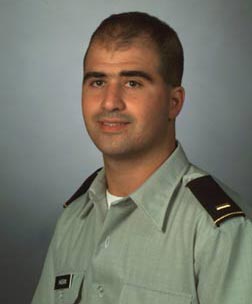
Maj. Nidal Malik Hasan. Click image to expand.

That latter finding does not stack up very well with the disclosure that the major was imploring Awlaki's spiritual advice some time before the online imam issued a finding of his own to the effect that bullets discharged at American soldiers were fired in a holy cause. The Washington Post and ABC News, which drew well ahead of the consensus in their reporting, also unearthed e-mails from Hasan to the Yemen-based preacher, asking when jihad tactics might be justified, what were the circumstances that would license the killing of innocent bystanders, and expressing the hope that the e-mailer and his respondent might one day be united in paradise. Since Awlaki was only in Yemen in the first place because he'd found the United States an inconvenient domicile (after having had direct contact with three of the 19 air pirates and mass murderers of Sept. 11, 2001, or "9/11 hijackers" as they are now euphemistically termed), we can apparently congratulate ourselves on paying for an FBI that lacks the nasty and suspicious mind that spoils so much police work in "the community."

Very well, then; the case for Maj. Hasan the overburdened caseworker seems to have evaporated. Robert Wright, among others, is big enough to admit as much. Wright, now emerging as the leading liberal apologist for the faith-based (see his intriguing new book The Evolution of God), now proposes an alternative theory of Maj. Hasan's eagerness to commit mass murder. "The Fort Hood shooting," says Wright, "is an example of Islamist terrorism being spread partly by the war on terrorism—or, actually, by two wars on terrorism, in Iraq and Afghanistan." I know that contributors to the New York Times op-ed page are not necessarily responsible for the headlines that appear over their work, but the title of this one—"Who Created Major Hasan?"—really does demand an answer, and the only one to be located anywhere in the ensuing text is "We did."

Everything in me revolts at this conclusion, which is echoed and underlined in another paragraph of the article. Why, six months ago, did "a 24-year-old-American named Abdulhakim Mujahid Muhammad—Carlos Bledsoe before his teenage conversion to Islam—fatally shoot a soldier outside a recruiting station in Little Rock, Ark.? ABC News reported, "It was not known what path Muhammad … had followed to radicalization." Well, here's a clue: After being arrested he started babbling to the police about the killing of Muslims in Iraq and Afghanistan." Wright describes this clue-based deduction of his as an illustration of the way that "an isolated incident can put you on a slippery slope." Though I can't find much beauty in his prose there, I want to agree with him.

For a start, did Hasan or Muhammad ever say what "killing" of which "Muslims in Iraq and Afghanistan" they had in mind? There isn't a day goes by without the brutal slaughter of Muslims in both countries by al-Qaida or the Taliban. And that's not just because most (though not all) civilians in both countries happen to be of the Islamic faith. The terrorists do not pause before deliberately blowing up the mosques and religious processions of those whose Muslim beliefs they deem insufficiently devout. Most of those now being tortured and raped and executed by the Islamic Republic of Iran are Muslim. All the women being scarred with acid and threatened with murder for the crime of going to school in Pakistan are Muslim. Many of those killed in London, Madrid, and New York were Muslim, and almost all the victims callously destroyed in similar atrocities in Istanbul, Cairo, Casablanca, and Algiers in the recent past were Muslim, too. It takes a true intellectual to survey this appalling picture and to say, as Wright does, that we invite attacks on our off-duty soldiers because "the hawkish war-on-terrorism strategy—a global anti-jihad that creates nonstop imagery of Americans killing Muslims—is so dubious." Dubious? The only thing dubious here is his command of language. When did the U.S. Army ever do what the jihadists do every day: deliberately murder Muslim civilians and brag on video about the fact? For shame. The slippery slope—actually the slimy slope—is the one down which Wright is skidding.

It is he, who I am taking as representative of a larger mentality here, who uses equally inert lingo to suggest that Maj. Hasan was "pushed over the edge by his perception of the Iraq and Afghanistan wars." That's a nice and shady use of the word "perception." Might it not be equally true to say that Hasan was all-too-easily pulled over the edge, having already signaled his devout eagerness for the dive, by a cleric who makes a living by justifying murder of Muslims and non-Muslims alike?

In many recent reports of this controversy one has seen reporters from respectable papers referring not just to generic, uniform "Muslims" but even to the places where they live as "Muslim lands." If you would object to seeing the absurd term "Christendom" in your newspaper as a description of Europe, let alone to reading about "Jewish land" on the West Bank, then please have the fortitude to complain next time violent theocracy is smuggled into the discourse under the increasingly feeble disguise of multicultural masochism.