Here are a few of my favorite images -- there are many more at the site.
See more of Brandt's photography.
Offering multiple perspectives from many fields of human inquiry that may move all of us toward a more integrated understanding of who we are as conscious beings.
Your Most Vital CommitmentGood advice.
Finding Time For You
Within each of there is a well of energy that must be regularly replenished. When we act as if this well is bottomless, scheduling a long list of activities that fit like puzzle pieces into every minute of every day, it becomes depleted and we feel exhausted, disconnected, and weak. Refilling this well is a matter of finding time to focus on, nurture, and care for ourselves, or "you time." Most of us are, at different times throughout the day, a spouse, a friend, a relative, an employee, a parent, or a volunteer, which means that down time, however relaxing in nature, is not necessarily "you time." Though some people will inevitably look upon "you time" as being selfish, it is actually the polar opposite of selfishness. We can only excel where our outer world affairs are concerned when our own spiritual, physical, and intellectual needs are fulfilled.
Recognizing the importance of "you time" is far easier than finding a place for it in an active, multifaceted lifestyle, however. Even if you find a spot for it in your agenda, you may be dismayed to discover that your thoughts continuously stray into worldly territory. To make the most of "you time," give yourself enough time on either side of the block of time you plan to spend on yourself to ensure that you do not feel rushed. Consider how you would like to pass the time, forgetting for the moment your obligations and embracing the notion of renewal. You may discover that you are energized by creative pursuits, guided meditation, relaxing activities during which your mind can wander, or modes of expression such as writing.
Even if you have achieved a functioning work-life balance, you may still be neglecting the most important part of that equation: you. "You time" prepares you for the next round of daily life, whether you are poised to immerse yourself in a professional project or chores around the home. It also affords you a unique opportunity to learn about yourself, your needs, and your tolerances in a concrete way. As unimportant as "you time" can sometimes seem, it truly is crucial to your wellbeing because it ensures that you are never left without the energy to give of yourself.
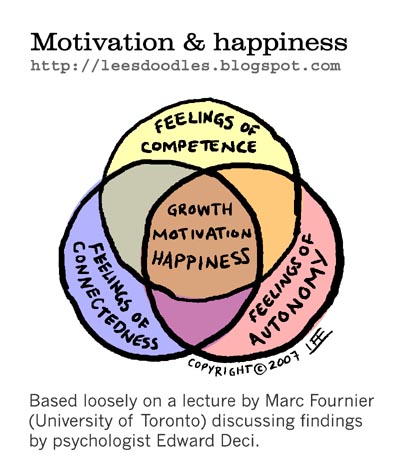
The coolest part, however, is this doodle Lee created based on that information:In his lecture, Fournier suggested that these are three universal psychological needs (to be choiceful, connected to others, to feel capable) shared by all people and that all three are of equal importance. If these needs are not met, it will impact:One of the foremost researchers in the area of motivation is psychologist Edward Deci at the University of Rochester. Deci's model suggests that students will be more motivated to learn when particular needs have been met. Deci articulates three such needs:
(a) to feel a sense of belonging and connectedness to the school (I would add the words "to feel welcome"),
(b) to feel a sense of autonomy and self-determination, and
(c) to feel competent (skillset and level of challenge must be appropriately matched).
- our ability to meet our full potential
- our capacity to grow
- our ability to flourish and thrive
- our ability to experience happiness
I think that this echoes something I remember from reading Flow by Mihaly Csikszentmihalyi. But then the book could have been using this research as part of its thesis -- I don't really remember.
So what is the remaining 40 percent? "Because nobody had put it together before, that's unexplained," Lyubomirsky says. But she believes that when you take away genes and circumstances, what is left besides error must be "intentional activity," mental and behavioral strategies to counteract adaptation's downward pull.And . . .
Lyubomirsky has been studying these activities in hopes of finding out whether and how people can stay above their set point. In theory, that is possible in much the same way regular diet and exercise can keep athletes' weight below their genetic set points. But before Lyubomirsky began, there was "a huge vacuum of research on how to increase happiness," she says. The lottery study in particular "made people shy away from interventions," explains eminent University of Pennsylvania psychologist Martin E. P. Seligman, the father of positive psychology and a mentor to Lyubomirsky. When science had scrutinized happiness at all, it was mainly through correlational studies, which cannot tell what came first--the happiness or what it is linked to--let alone determine the cause and effect. Finding out that individuals with strong social ties are more satisfied with their lives than loners, for example, begs the question of whether friends make us happier or whether happy people are simply likelier to seek and attract friends.
Investigators have no shortage of possible strategies to test, with happiness advice coming "from the Buddha to Tony Robbins," as Seligman puts it. So Lyubomirsky started with three promising strategies: kindness, gratitude and optimism--all of which past research had linked with happiness. Her aim is not merely to confirm the strategies' effectiveness but to gain insights into how happiness works. For example, conventional wisdom suggests keeping a daily gratitude journal. But one study revealed that those who had been assigned to do that ended up less happy than those who had to count their blessings only once a week. Lyubomirsky therefore confirmed her hunch that timing is important. So is variety, it turned out: a kindness intervention found that participants told to vary their good deeds ended up happier than those forced into a kindness rut. Lyubomirsky is also asking about mediators: Why, for example, does acting kind make you happier? "I'm a basic researcher, not an applied researcher, so I'm interested not so much in the strategies but in how they work and what goes on behind the scenes," she explains.Initial results with the interventions have been promising, but sustaining them is tough. Months after a study is over, the people who have stopped the exercises show a drop in happiness. Like a drug or a diet, the exercises work only if you stick with them. Instilling habits is crucial. Another key: "fit," or how well the exercise matches the person. If sitting down to imagine your best possible self (an optimism exercise) feels contrived, you will be less likely to do it.
The biggest factor may be getting over the idea that happiness is fixed--and realizing that sustained effort can boost it. "A lot of people don't apply the notion of effort to their emotional lives," Lyubomirsky declares, "but the effort it takes is enormous."
I'm a huge fan of any approach that can increase happiness. The issue I have had with positive psychology in the past is its unwillingness to look into the shadow of emotional distress, seeking rather to accent the positive. But if positive psychology and happiness research can be used in a more integral approach (using the right tool for the job at hand, which is determined by each individual client) then I think they are valuable contributions.
It is not only possible but necessary to change one's approach to love to ward off depression. Follow these action strategies to get more of what you want out of life—to love and be loved.
- Recognize the difference between limerance and love. Limerance is the psychological state of deep infatuation. It feels good but rarely lasts. Limerance is that first stage of mad attraction whereby all the hormones are flowing and things feel so right. Limerance lasts, on average, six months. It can progress to love. Love mostly starts out as limerance, but limerance doesn't always evolve into love.
- Know that love is a learned skill, not something that comes from hormones or emotion particularly. Erich Fromm called it "an act of will." If you don't learn the skills of love you virtually guarantee that you will be depressed, not only because you will not be connected enough but because you will have many failure experiences.
- Learn good communication skills. They are a means by which you develop trust and intensify connection. The more you can communicate the less depressed you will be because you will feel known and understood.
There are always core differences between two people, no matter how good or close you are, and if the relationship is going right those differences surface. The issue then is to identify the differences and negotiate them so that they don't distance you or kill the relationship.
You do that by understanding where the other person is coming from, who that person is, and by being able to represent yourself. When the differences are known you must be able to negotiate and compromise on them until you find a common ground that works for both.
- Focus on the other person. Rather than focus on what you are getting and how you are being treated, read your partner's need. What does this person really need for his/her own well-being? This is a very tough skill for people to learn in our narcissistic culture. Of course, you don't lose yourself in the process; you make sure you're also doing enough self-care.
- Help someone else. Depression keeps people so focused on themselves they don't get outside themselves enough to be able to learn to love. The more you can focus on others and learn to respond and meet their needs, the better you are going to do in love.
- Develop the ability to accommodate simultaneous reality. The loved one's reality is as important as your own, and you need to be as aware of it as of your own. What are they really saying, what are they really needing? Depressed people think the only reality is their own depressed reality.
- Actively dispute your internal messages of inadequacy. Sensitivity to rejection is a cardinal feature of depression. As a consequence of low self-esteem, every relationship blip is interpreted far too personally as evidence of inadequacy. Quick to feel rejected by a partner, you then believe it is the treatment you fundamentally deserve. But the rejection really originates in you, and the feelings of inadequacy are the depression speaking.
Recognize that the internal voice is strong but it's not real. Talk back to it. "I'm not really being rejected, this isn't really evidence of inadequacy. I made a mistake." Or "this isn't about me, this is something I just didn't know how to do and now I'll learn." When you reframe the situation to something more adequate, you can act again in an effective way and you can find and keep the love that you need.
Martie Haselton of UCLA and David Buss of the University of Texas, Austin, have empirically demonstrated the existence of these error-management strategies in men and women. Haselton likens a biased decision pathway to a smoke alarm that can make one of two errors. It can go off in the absence of fire—a false positive: irritating, but far from lethal. The more dangerous error is the false negative, which fails to signal a real fire. "Engineers can't minimize both errors, because there's a trade-off," explains Haselton. "If you lower the threshold for noting fires, you're going to have more false alarms. Natural selection created decision-making adaptations not to maximize accuracy but to minimize the more costly error." Faced with uncertainty about people and predators throughout human history, we again and again took the safe road.
Seeing the world through our own warped force field is standard operating procedure. "Biased mechanisms are not design defects of the human mind, but rather design features," says Haselton. We don't commit them just in mating mode. They're present in our everyday perceptions, protecting our egos and all types of relationships. We imbue the powerful and beautiful with personal and intellectual qualities that they likely don't possess, overestimate our own abilities, and downgrade the importance of skills that elude us. We're also paranoiacally primed to detect threats to our status, to our children—any domain in which the stakes are high. This is why women are fiercely protective of their newborns, why we agonize if the boss idly snaps at us.
Biases are human universals: A Park Avenue socialite may be as guarded around her suitors, or as worried about her husband's fidelity, as a Chinese field hand, though each woman will filter the concern through her own cultural prism. But the intensity of a bias may vary from person to person. Geher found that smart men are more likely to exhibit the "She Wants Me" bias. To discern this, Geher asked male subjects how they thought women would respond to personal ads in which men sought a short-term partner. He found that the most intelligent men grossly overestimated women's interest in ads offering explicit no-strings-attached sex. (Geher quips that among his research findings, this is the gem that his wife likes the least.)
And . . .
Men and women selectively tune into the noisy channel of opposite-sex interest depending on their own gender-specific needs: Men scan for sexiness and availability; women scavenge for clues to personality and commitment readiness. The errors of engagement we make in the early stages of courtship, before we're certain of opposite-sex intentions, might appear to set men and women on a permanent collision course. But each one of us is evidence that men and women do in fact connect. The sexes actually have overlapping, if not identical, goals: Men and women both want stable relationships in which to raise children. Women just tend to rally for an earlier commitment. The result: When our tracks finally converge in commitment, our biases overlap as well, because we now share important goals. The most important of these is preserving the relationship.
There is much more to this article, and I did find it pretty interesting in its own way. While many of us are trying to create and maintain more evolved relationships, there are still hard-wired patterns that influence how we act or feel. If we can recognize these biases -- becoming conscious of the ways they may be impacting our decisions or feelings -- we stand a better chance of rising above these generally unconscious motivations.
Still, this article, like the one that follows, offers a lower level look at people in relationships. Some of us are evolving beyond these simplistic views and biases. Yet, we are often not aware of them, so in that sense this is a useful discussion.
~ Great Expectations -- A look at how we have moved away from functional relationships, such as marriage for the sake of having a home and raising kids, and instead now look for the ideal partner, our "soul mate."
And . . .The pragmatic benefits of partnership used to be foremost in our minds. The idea of marriage as a vehicle for self-fulfillment and happiness is relatively new, says Paul Amato, professor of sociology, demography and family studies at Penn State University. Surveys of high school and college students 50 or 60 years ago found that most wanted to get married in order to have children or own a home. Now, most report that they plan to get married for love. This increased emphasis on emotional fulfillment within marriage leaves couples ill-prepared for the realities they will probably face.
Because the early phase of a relationship is marked by excitement and idealization, "many romantic, passionate couples expect to have that excitement forever," says Barry McCarthy, a clinical psychologist and coauthor—with his wife, Emily McCarthy—of Getting It Right the First Time: How to Build a Healthy Marriage. Longing for the charged energy of the early days, people look elsewhere or split up.
Flagging passion is often interpreted as the death knell of a relationship. You begin to wonder whether you're really right for each other after all. You're comfortable together, but you don't really connect the way you used to. Wouldn't it be more honest—and braver—to just admit that it's not working and call it off? "People are made to feel that remaining in a marriage that doesn't make you blissfully happy is an act of existential cowardice," says Joshua Coleman, a San Francisco psychologist.
Coleman says that the constant cultural pressure to have it all—a great sex life, a wonderful family—has made people ashamed of their less-than-perfect relationships and question whether such unions are worth hanging on to. Feelings of dissatisfaction or disappointment are natural, but they can seem intolerable when standards are sky-high. "It's a recent historical event that people expect to get so much from individual partners," says Coleman, author of Imperfect Harmony, in which he advises couples in lackluster marriages to stick it out—especially if they have kids. "There's an enormous amount of pressure on marriages to live up to an unrealistic ideal."
I think this article is a little dangerous in its tone and stance. There are a lot of couples who marry for the wrong reasons and do not discover that fact for many years. From the point of view of this article, these couples might be encouraged to stick it out when the best thing would be to move on in a new direction.In fact, argue psychologists and marital advocates, there's no such thing as true compatibility. "Marriage is a disagreement machine," says Diane Sollee, founder of the Coalition for Marriage, Family and Couples Education. "All couples disagree about all the same things. We have a highly romanticized notion that if we were with the right person, we wouldn't fight." Discord springs eternal over money, kids, sex and leisure time, but psychologist John Gottman has shown that long-term, happily married couples disagree about these things just as much as couples who divorce.
"There is a mythology of 'the wrong person,'" agrees Pittman. "All marriages are incompatible. All marriages are between people from different families, people who have a different view of things. The magic is to develop binocular vision, to see life through your partner's eyes as well as through your own."
The realization that we're not going to get everything we want from a partner is not just sobering, it's downright miserable. But it is also a necessary step in building a mature relationship, according to Real, who has written about the subject in How Can I Get Through to You: Closing the Intimacy Gap Between Men and Women. "The paradox of intimacy is that our ability to stay close rests on our ability to tolerate solitude inside a relationship," he says. "A central aspect of grown-up love is grief. All of us long for—and think we deserve—perfection." We can hardly be blamed for striving for bliss and self-fulfillment in our romantic lives—our inalienable right to the pursuit of happiness is guaranteed in the first blueprint of American society.

Your Allies On Life's Journey
Finding Your Tribe
Part of being human is the search for an individual identity. Bound to this strong need to establish a unique persona, however, is an equally intense desire for acceptance. It is when we find our individual tribes that both are satisfied. Our tribe members are those people who accept us as we are without reservation and gladly accompany us on our journeys of evolution. Among them, we feel free to be our imperfect selves, to engage unabashedly in the activities we enjoy, and to express our vulnerabilities by relying on our tribe for support. We feel comfortable investing our time and energy in the members of our tribe, and are equally comfortable allowing them to invest their resources in our development.
The individuals who eventually become members of your unique tribe are out there in the wide world waiting for you. You are destined to find them, one by one, as you move through life. Sometimes your own efforts will put you in contact with your future tribe members. At other times, circumstances beyond your control will play a role in helping you connect with your tribe. If you look about you and discover that you are already allied with a wonderful and supportive tribe, remember that there are likely many members of your tribe you have not yet met. On the other hand, if you feel you are still living outside of your tribe, broadening your horizons can help you find your tribe members.
However your life develops after you come together with your tribe, you can be assured that its members will stand at your side. On the surface, your tribe may seem to be nothing more than a loose-knit group of friends and acquaintances to whom you ally yourself. Yet when you look deeper, you will discover that your tribe grounds you and provides you with a sense of community that ultimately fulfills many of your most basic human needs.
Comments? Thoughts?Research tries to measure how we find life's meaning
By Ronald Kotulak
Tribune science reporter
Published March 26, 2007
The day after the Sept. 11 terror attacks, Harvard University psychologist Dan Wegner found himself dashing from store to store desperately trying to buy an American flag.
The developing field, called experimental existential psychology, or XXP, explores how people find meaning and purpose in their lives. A topic that was once the province of poets and philosophers can now be examined under the cold light of science, researchers say.
Then he realized with a start that what he was doing could be predicted by a new field of psychology that until then had been considered fringe science. His patriotic urge, Wegner realized, was an attempt to counterbalance the scary thought of his own mortality brought on by the attacks.
How people deal with existential concerns could help explain a broad spectrum of behavior, they believe, from political and religious leanings to altruism and the pursuit of riches to patriotism and terrorism.
Already, experiments have shown that when people are reminded of their own deaths, they become more patriotic, more conservative, more family-oriented, more security-minded.
The fear of death also provokes a need to feel connected to others, to have a clear sense of identity, to know how one fits into the world, and to feel one has free will.
Wegner said his experience in 2001 convinced him this line of thinking had merit.
"I never had that need for a flag before. It just suddenly came up," he said. "The response to the threat of terror gives you this feeling that you have to find value in your life. You have to find what it is that makes you worthwhile, and one of them is being a patriotic American."
Psychologists have long avoided studying how people find meaning in life, believing the subject could not be pinned down by experimental evidence. From 1920 to the 1970s, they exclusively studied behavior, something they could observe and compile data on, and most still do.
In the mid-1980s, three psychologists founded the field of XXP. They were inspired by "The Denial of Death," a 1973 book by cultural anthropologist Ernest Becker, who maintained that the unique human awareness of death, and its denial, motivated a lot of human behavior.
The book led the trio--Jeff Greenberg of the University of Arizona, Tom Pyszczynski of the University of Colorado and Sheldon Solomon of Skidmore College--to develop a terror management theory to explain how people deal with thoughts of their own demise.
"The basic idea that we're exploring is that people's concerns about their mortality underlie a lot of their strivings to sustain their sense of meaning, to defend their belief systems and to strive for self-worth," Greenberg said.
These thoughts are the result of a tug of war between a primitive instinct to survive at all costs and a brain that is not only conscious of its own existence but also is aware that in the long run survival is a losing battle.
What am I doing here? Am I alone in the universe? Is life meaningless? How will I be remembered? Did I do the right thing?
With other animals, said Northwestern University psychologist Dan McAdams, "it's not like they've got any kind of understanding that they're going to die. They react to the world in a way to survive, but they don't go to sleep at night thinking, `Oh my God, how many years do I have left?'"
The three psychologists set out to devise experiments to examine these kinds of thoughts, an effort that a recent psychology journal described as "Introducing Science to the Psychology of the Soul."
In one such study, when students were asked whether they supported using nuclear weapons against terrorists, the majority of both liberals and conservatives said no. But among students reminded of death, a majority of conservatives were in favor of using nuclear weapons. The majority of liberals still were against it.
Similar results were found in a study Greenberg conducted with an Iranian colleague. The majority of Iranian students favored peaceful approaches over suicide bombings as a strategy for dealing with international problems. But when their mortality became an issue, the results were the opposite.
Study subjects are reminded of mortality in various ways, including being asked to think about it, being walked past a funeral parlor and being shown a computer screen with the word "dead" flashed too fast to be consciously registered.
"What makes Greenberg and his colleagues special is that they're hell-bent on bringing this stuff into the lab in a very hard-nosed' experimental, quantitative sense," McAdams said. "That's what distinguishes them from a lot of other people who study meaning from a scientific standpoint."
The traumatic Sept. 11 attacks were the turning point for the field. The American Psychological Association asked Greenberg, Solomon and Pyszczynski to write up their research in a book that might help explain why some people engage in terrorism and how others respond.
Among the points made in their 2003 book, "In the Wake of 9/11: The Psychology of Terror," was that modern people are much more exposed to "alternative meaning systems" than in the past.
"We have different versions of God, different versions of evil," Greenberg said. "It's one of the things that contributes to some of the large-scale conflicts that exist in the world. With exposure to other people and other belief systems, there's a threat to our own sense of meaning."
Some of the things Americans do, for example, violate the belief system common among residents of the Middle East, and vice-versa. People in the Middle East tend to be less materialistic and more spiritual, Greenberg said. They think about death more consciously, and they consider people who die for their belief system to be martyrs.
"And because we don't understand their world view, we're angering them in a very deep way and we don't understand it sometimes," he said. "Our hope is that by understanding psychologically where people are coming from ... we can use education, communication and other diplomatic tools to try and change the way we're viewed."
In the United States, the threat of terrorism has made citizens feel more anxious for security. A study Greenberg and his colleagues conducted before the 2004 presidential election found that college students were slightly in favor of Democrat John Kerry. But when the students were reminded of their mortality, a fear that terrorism provokes, the majority favored his Republican opponent, George Bush.
"It's the psychology of the soul in the sense of looking at the deepest things we rely on in our lives," he said. "It is a sense of inner being that helps us function and feel secure in what's really a scary world.
"We all want a sense of continuance, a sense that we're more than just these temporary creatures on this dirt ball," Greenberg said. "We want to feel we're significant beings in a meaningful world."