Showing posts with label default mode network. Show all posts

Friday, October 24, 2014

What Schizophrenia Can Teach Us About Ourselves

This is a pretty good article on schizophrenia from PBS's Nova Next blog. However, they adhere to the standard "biological disease" model of schizophrenia, which is a partial truth, and one that prevents many researchers from looking into the interpersonal antecedents of schizophrenia.

I especially appreciate, however, the take on hearing voices presented in the article. They mention Intervoice, a mostly European organization that holds voice hallucinations to be a natural and non-frightening phenomenon.

I feel it's important to make another point here - a lot of people with PTSD hear voices and how we, as therapists, deal with that is much different (in my opinion) than how we handle the voices in schizophrenia, or even dissociative identity disorder. The voices are qualitatively different in PTSD.

What Schizophrenia Can Teach Us About Ourselves

By Allison Eck on Wed, 22 Oct 2014

“I don’t believe in anything. That’s my cardinal rule. I do it for my mental health. If I believe in God, then I start talking to God and God starts talking to me. As soon as I start believing in something, then it talks to me. So, I don’t believe in anything.”

Sara, whose name we changed to protect her identity, was diagnosed with schizophrenia at age 19 during her senior year at New York University. She had not experienced any trauma as a child—no abuse, no bouts of depression, nothing that would raise any red flags. She led a more or less happy life. But in high school she experimented with drugs, and upon travelling abroad around the same time, she experienced intense culture shock.

This series of events may have been Sara’s personalized recipe for mental illness, cooked up with all the flavors of her unique position in life, her temperament, and her family’s history. Her mind became a prison; she felt as though people were constantly laughing at her. She could no longer distinguish fantasy from reality. She assumed she wouldn’t go back to school.

“I thought that my life was over, that I would never be able to do anything,” she says. “Because that’s what the doctors told me.”

Then she began to hear voices.

The Schizophrenic Brain

Schizophrenia is a disease that afflicts almost all walks of life. Because it can be so debilitating, scientists have been feverishly searching for its genetic basis. In July, researchers affiliated with the Psychiatric Genomics Consortium compared the genomes of nearly 37,000 people with schizophrenia to the genomes of more than 113,000 people without the disease. In the end, they identified 108 locations where the DNA sequence in schizophrenic people tends to differ. The finding was a major advance in the field of psychiatric genomics, one that could ultimately help scientists understand who is susceptible and why.

Still, the biological markers aren’t always clear—often, a patient’s genes for schizophrenia can lay dormant until certain circumstances trigger their expression, making a diagnosis based on DNA alone less than clear-cut. And with no blood test or brain scan available to detect schizophrenia’s symptoms elsewhere in the body, diagnosis is based almost entirely on what the patient reports.

Treatment of mental illness is nested in confusion, too. Many therapists approach their practice from a different medical perspective than a cognitive psychologist or a geneticist. And while a geneticist might have access to the most current research, she isn’t going to have direct daily contact with a patient’s behavioral nuances like a psychiatrist. What’s going on in the lab, in other words, is often divorced from what’s being implemented “on the couch.”

But it doesn’t have to be that way.

Some scientists are arguing that our new understanding of a particular network in the brain is allowing neuroscientists, psychologists, and psychiatrists—even artists and writers—to understand each other in ways that wouldn’t have made sense ten years ago. Called the default mode network, or DMN, it’s a set of brain regions that are typically suppressed when a person is engaged in an external task (playing a sport, working on a budget), but activated during a so-called “resting state” (sitting quietly, day-dreaming).

“It’s an extremely important platform for any kind of thought that is disengaged from the ‘here-and-now,’" says Mary Helen Immordino-Yang, assistant professor of psychology at the University of Southern California’s Brain and Creativity Institute. That includes processing other people’s stories, reflecting on our own lives, planning for the future, or making important decisions. Immordino-Yang says the default mode network is “metabolically expensive.” In other words, when your head is lost in the clouds, your brain is hard at work.


The default mode network, which is hyperactive in schizophrenic people, plays an important role in self-reflection, identity, and mind-wandering.

Though not the only “resting state” network that’s active when we’re staring off into space, the DMN is unusual in that it is reliable and identifiable, making it easy for scientists to study. Like a web of taut ropes overlaying and intersecting one another, the regions of the DMN—which include the medial prefrontal cortex and the posterior cingulate, both of which are involved in self-awareness, self-reflection, and so on—light up in concert, despite any distance separating them.

When neurologist Marcus Raichle and his colleagues discovered the DMN in 2001, it took the scientific community by surprise. How could rest and self-reflection excite the same brain regions in us all? Why are those regions so intimately correlated? Wouldn’t a brain scan vary more from person to person depending on the content of an individual’s thoughts? It turned out that the DMN has nothing to do with content and everything to do with context. This network is functioning all the time—focusing on a task merely tempers and subdues it.

“This is first time we’ve found a neural system that actually reveals your inner self,” says Susan Whitfield-Gabrieli, a research scientist at MIT. In 2009, she and her colleagues found that in schizophrenic people, the DMN operates on overdrive. When clinically diagnosed patients enter an fMRI scanner and are asked to perform various tasks, the dial on their DMN doesn’t turn down like it should. And when the patients are at rest, their DMN is hyper-connected, buzzing with surplus energy. What’s more, they lack the ability to toggle out of the DMN, this highly self-referential state of being. “They’re actually stuck in their default mode network,” Whitfield-Gabrieli says.

So how does a schizophrenic person get unstuck? That’s a question hundreds of experts from diverse backgrounds are trying to answer.

Coping with Voices

One lens through which experts are studying schizophrenia is anthropology. If the default mode network is related to identity and self-reflection—and if schizophrenia, in turn, is associated with the default mode network—then considering culture may help us understand how psychosis manifests itself globally. After all, how you experience your inner world depends partly on where you live and how you’ve grown up. The same is true of mental illness. “When immigrant groups move to a new cultural group, they take on the mental illness liabilities of the culture where they are,” Immordino-Yang says. Because 60 to 80% of people diagnosed with schizophrenia hear voices, a good indicator of how a given culture views the disease might be how its people cope with its most well known but most misunderstood facets: auditory verbal hallucinations.

“Americans hate their voices. Their voices mean schizophrenia to them,” says Tanya Luhrmann, an anthropologist at Stanford University. By contrast, people in India and Africa don’t typically label their illnesses or their voices, she revealed in a study published in the British Journal of Psychiatry. “It’s not that they don’t recognize that they’re struggling,” she says. “But they talk about their experience as having much more of a natural role.” For example, they may think of their auditory hallucinations as benevolent or spiritual—like a friend or even the voice of God.

People not diagnosed with a mental illness, too, hear voices. In some cases, what they experience may be something that would be classified as a hallucination if reported by a clinically psychotic person. “If you ask someone, ‘have you ever heard a voice when you’re alone?’ the rate is somewhere between 15 to 80% depending on how you ask the question,” Luhrmann says. If you couple it with an example of what might be considered an auditory verbal hallucination, the percentage of people who say “yes” goes up.

Testimonies from people who experience varying kinds of auditory hallucinations support the idea that voice-hearing is complex and culturally-dependent. Their range of experiences is vast. Some say they hear audible, crystalline voices that emanate from inside their heads. Others report cacophonous screeches and bangs coming from outside their bodies. Still others sense murmurs and whispers that crawl over from the next room. Finally, some people describe a phenomenon similar to what cognitive psychologists call “inner speech,” the wordless soup of dialogue that you “hear” when deep in thought. For some, inner speech is acoustically more intense than it is for others. For example, they might say their mental landscape is made up of “loud thoughts” or “soundless voices.”

For Sara, the voices she heard began as disembodied, made-up personalities. Then, after about a year of taking a handful of different medications to varying degrees of success, her voices became solely associated with real people and their private thoughts. Sara is now 33—and though she’s been well enough to go without medication for 11 years, she still hears this latter type of voice.

“If I hear somebody psychically communicating with me—which I don’t believe in; I’m a complete atheist—then the sound will come from above their head or behind their hair…even from inside their stomach. It’s somewhere besides their actual mouth,” she says. “It’s not as loud as their real voice. It’s softer, but I don’t think the tone and quality of the voice is compromised.”

The reason why Sara can talk about her voices so intelligently is because she’s cultivated a relationship with them, in a sense. Though she tries not to engage too much with them, she’s learned to understand her voices and even use them to her advantage. If she’s bored, they’re sometimes entertaining. Occasionally she even asks them questions.

“Sometimes I’m worried about what people think of me,” she says. “And so I ask them [what they think of me] in the air above their head, and I hear their voice say it.”

Sara enjoys and even values some of her auditory hallucinations now, which is atypical of most American psychotic and post-psychotic patients. But that’s not the case everywhere. A simple internet search in her early 20s led Sara to Intervoice, a network established in the U.K. and now widely recognized in 29 (mostly European) countries. The organization’s central tenet is that hearing voices is a meaningful human experience and not necessarily a sign of mental illness. Members set up support groups where people can meet and talk about their experiences without fear of stigma.

Still, Intervoice has not caught on in the U.S. like it has in the U.K. and elsewhere. “There are real differences in the way Americans and Europeans think about voices,” Luhrmann says. In Europe, people are generally more comfortable with the ambiguity between psychosis and religion, and there’s more interest in applying humanities research to medicine.

For Sara, the idea that people could handle and live with their voices made the difference. “I decided I was going to be one of those people,” she says. “Just a small glimmer of hope was all I needed.”

Angela Woods, a medical humanities researcher at Durham University in the U.K., is leading a team of experts in a project called “Hearing the Voice,” which works closely with the broader Intervoice network. It aims to dispel some of the myths about voice-hearing and to see how cognitive neuroscientists can work with writers, artists, clinicians, theologians, and even philosophers to grasp the full spectrum of schizophrenia itself.


A "Voice Walk" in a U.K. cemetery earlier this year encouraged voice-hearers to tell their stories.

“We wanted to call for a more nuanced, richer account of what it is like to hear voices,” Woods says. An initial step in their research involved sending surveys to 158 people from around the world in an attempt to better understand what the experience is like. The team has hosted a number of different events to raise public awareness of schizophrenia and its many shades, including a “VoiceWalk” in a U.K. cemetery to bring people’s voice-hearing stories to the fore and an event at the Durham Book Festival to promote a better understanding of how writers cope with disparate inner voices—their characters, their muse, their narrators, and so on.

Another way people can learn to cope with their voices is by bringing them into the lab. Whitfield-Gabrieli, in collaboration with Margaret Niznikiewicz of Harvard University, is training patients to regulate their auditory hallucinations by consciously controlling activation in their auditory cortex. Participants attempt to push their cortex activation levels up and down, without receiving any auditory stimuli other than the background noise of the fMRI scanner. Meanwhile, they receive visual feedback from the fMRI on their progress. Whitfield-Gabrieli says the hope is that patients can learn to mitigate their voices by focusing on what’s going on in their own brain.

“Teaching people with psychosis to use their imagination to handle their voices is a promising tool,” Luhrmann says. As a society, we can encourage positive relationships with auditory hallucinations by helping patients—schizophrenic or not—better understand them. That means allowing people to tag their voices as “me” or “not me,” give the voices names, recognize what they’re saying and why, and discover what personal significance, if any, a particular voice might have.

Whatever the auditory input may be, Luhrmann says people can have positive or negative experiences depending on the attitude they adopt. “People attend to different pieces of that good-bad spectrum depending on the way their culture invites them to attend,” she says.

While there’s no evidence yet that a learning-based method will work, Whitfield-Gabrieli has reason to believe it’s possible. Research has linked increased DMN activity to the phenomenon of voice-hearing. While scientists still aren’t entirely certain how or why people hear voices, they think that auditory hallucinations may be a misattributed form of inner speech. A hyperactive DMN agitates the auditory cortex, resulting in what could be a fundamental confusion between what the brain “hears” inside itself and what it actually hears as a result of real, external stimuli. Many factors, though—including social isolation—contribute to the health of a person’s brain. Imagination can help with the healing process and reclaim a functioning relationship between the self, the auditory cortex, and inner speech.

Woods’ and Luhrmann’s work—as well as their colleagues’—dovetails with a study published about a month ago in the American Journal of Psychiatry, which concluded that the term “schizophrenia” actually encompasses eight genetically distinct disorders, not just one. The assertion, whether or not it holds up, suggests that mental well being comes in a variety of different “packages” depending on your genetic makeup. That goes for clinically diagnosed patients as well as healthy individuals.

“We should be wary of seeing a schizophrenic person as someone with a kind of deficiency,” Woods says. Rather, it may be just another part of what it means to be human. A person might simply process language differently or ruminate on social interactions for too long. His or her inner speech might be more fragmented or circuitous. Individual differences in DMN activity account for the diverse ways the human mind freely wanders.

Searching for Answers

The default mode network may sound like a gold mine to psychiatrists and neuroscientists alike. The reality, though, is somewhat more complicated. Brain imaging, while promising, has yet to definitively solve major mental health issues like schizophrenia, depression, anxiety, and bipolar disorder.

Daniel Margulies of the Max Planck Institute for Human Cognitive and Brain Sciences argues that even if our scientific understanding of the DMN evolves, its weight in the science world has “opened up a way of talking about the relationship between the self and these disorders.” The default mode network (and its relationship to voice-hearing), he says, can provide a gateway to understanding the full range of how people comprehend themselves—even if anomalies in the network aren’t proven to be a direct cause of schizophrenia.

That may be what matters most, since schizophrenia is not necessarily about neurons or synapses. It’s about the people it affects.

“Technology is giving us important information, but not the final answers,” says David Farb, professor and chair of the Department of Pharmacology and Experimental Therapeutics at the Boston University School of Medicine. He advocates an approach that views diseases and disorders as “vast and complex chimeras of symptoms that can be mixed and matched.” For example, depression may share symptoms with other disorders, like severe anxiety. It’s also possible, he says, that a person may develop an anxiety disorder as they grow increasingly self-conscious of their schizophrenia, for example. In that case, Farb says that schizophrenia may be made even more complex by “an expression of learned helplessness.”

By acquiring as much genetic and neurological information about a patient as possible, we may be able to intervene at an earlier stage and prevent schizophrenia before it develops. Whitfield-Gabrieli and Larry Seidman of Harvard University are studying at-risk people in Shanghai to find brain markers that predict whether or not someone will become schizophrenic. Interestingly, they’ve noticed a skew toward more female than male schizophrenic patients in China; in the U.S, schizophrenia is a predominantly male disorder, again pointing to the cultural element.

And that is what’s so striking to the U.K. researchers associated with Hearing the Voice. We shouldn’t assume that nature (rather than nurture) is the primary culprit when it comes to schizophrenia, they say. “If the default mode network is somehow connected with mind-wandering, self-referential cognition, you can’t simply use objective measures,” says Felicity Callard, another Durham University researcher involved in the project. “You have to get at what people think is going on in their own heads.” In other words, to find a cure, we might have to put ourselves in other peoples’ shoes.

“We should direct energy and funding and resources into exploring people’s lives—not just their chemistry, their neuroanatomy, or their genes,” Woods says. PSTD, for example, is a legitimate response to a traumatic event. Likewise, schizophrenia is a legitimate response to a lifetime of accumulated events, thoughts, interactions, and engrained beliefs. “We need to be able to ask, ‘What happened to you?’ That’s not ruling genetics out, but it’s taking things from another angle.”

Farb suspects the answer might be simpler than that. Drugs that target genes regulating DMN connectivity or surgery that modifies key points of DMN activity, for example, could resolve schizophrenic symptoms. He acknowledges, though, that there may be other factors at play. Schizophrenia—like PTSD or chronic pain—may have a cumulative effect on the brain that’s hard to anticipate. “While we may be able to correct the original deficit, we may still be left with others because they are a consequence of all of those years spent living with the disorder,” he says. “It’s really complicated to get a cure.”

As a patient, Sara believes that the process needs to be individualized. Doctors should ask patients questions about their experiences and how they want to go about getting better. Woods agrees. “The more we treat schizophrenia as a mysterious entity that we’re going to pin down in a piece of DNA,” she says, “the more we’ll miss the complicated, multifaceted aspects of existence that go into making someone have an experience of psychosis.”

“And if people don’t feel as though they’re able to tell stories about their experiences, then it’s hard to see that a cure would be particularly welcome, rich, or meaningful.”

Tell us what you think on Twitter #novanext, Facebook, or email.

Photo Credits: © Frederic Cirou/PhotoAlto/Corbis, Angela Woods


Allison Eck
Google+
Twitter

Allison Eck is a production assistant for NOVA Online.

Other posts from this contributor

Friday, August 22, 2014

What Can the Organization of the Brain’s Default Mode Network Tell Us About Self-Knowledge?


Here is the article referenced in the Nautilus article about silence (posted earlier this morning). It seems like a good piece of writing with some valuable insights.

Full Citation: 
Moran, JM, Kelley, WM, and Heatherton, TF. (2013, Jul 17). What can the organization of the brain’s default mode network tell us about self-knowledge? Frontiers in Human Neuroscience; 7:391. doi: 10.3389/fnhum.2013.00391

What can the organization of the brain’s default mode network tell us about self-knowledge?

Joseph M. Moran [1,2], William M. Kelley [3] and Todd F. Heatherton [3]
1. U.S. Army Natick Soldier Research, Development, and Engineering Center, Natick, MA, USA
2. Center for Brain Science, Harvard University, Cambridge, MA, USA
3. Psychological and Brain Sciences, Dartmouth College, Hanover, NH, USA
Abstract

Understanding ourselves has been a fundamental topic for psychologists and philosophers alike. In this paper we review the evidence linking specific brain structures to self-reflection. The brain regions most associated with self-reflection are the posterior cingulate and medial prefrontal (mPFC) cortices, together known as the cortical midline structures (CMSs). We review evidence arguing that self-reflection is special in memory, while noting that these brain regions are often engaged when we think about others in our social worlds. Based on the CMSs’ patterns of connectivity and activity, we speculate about three possible interpretations of their role in supporting self-reflection that are somewhat overlapping, and not intended to be mutually exclusive. First, self may be a powerful, but ordinary case for a cognitive system specialized for thinking about people. Second, mPFC may serve as a processing “hub,” binding together information from all sensory modalities with internally generated information. Third, mPFC may serve as a cortical director of thought, helping to guide moment-by-moment conscious processing. Suggestions are made for future research avenues aimed at testing such possibilities.

How do we know what we are like? How do we determine the boundaries between ourselves and the world around us? How do we know what is ours, and what is not? Questions like these have engaged philosophers for millennia, and psychological scientists throughout psychology’s relatively brief history. Great progress has been made by practitioners of these fields, who have recently been joined by neuroscientists bearing the promise of going beyond introspection, self-report, and behavior to the source of our sense of self, the brain. This work is theoretically useful in at least two ways. First, it enables characterization of how the brain implements the psychological process(es) of self-reflection, allowing for links between the neural and psychological levels of analysis. Second, it may suggest new ways to interpret and modify accounts of self-reflection at the psychological-level, allowing neural-level data to influence psychological-level theorizing. Wielding two major empirical breakthroughs, cognitive neuroscientists have made significant headway in understanding how the brain gives rise to a sense of self, revealing surprising knowledge about the organization of the neuronal networks responsible for self-reflection.

The Default Mode Network and Self-Reflection

In brief, these breakthroughs consisted first of the discovery of what has come to be known as the default mode network (Shulman et al., 1997; Raichle et al., 2001), and second of the independent identification that a subset of these brain regions are enlisted when we engage in self-reflection (Gusnard et al., 2001; Johnson et al., 2002; Kelley et al., 2002). To be clear, this network’s involvement is observed most closely during the psychological task of reflecting on one’s personalities and characteristics (self-reflection), rather than during self-recognition, thinking of the self-concept, or thinking about self-esteem, for example. As such, this paper will focus on self at the level of self-reflection and the neural networks responsible for this task. The set of regions contributing to self-reflection consists primarily of the medial prefrontal cortex (mPFC), encompassing the medial surface of the medial frontal gyrus [Brodmann’s Areas (BAs) 8 and 10], and the medial parietal cortex, roughly encompassing the retrosplenial and posterior aspects of the cingulate cortex, the area bounded at the anterior by the paracentral lobule, and at the posterior by the parieto-occipital sulcus (BAs 23, 31, 7). For ease of reference, we will refer to this medial parietal cluster together as posterior cingulate cortex (pCC). These regions have come to be known together as the cortical midline structures (CMSs) (Northoff and Bermpohl, 2004), and are the regions most closely associated with self-reflection in meta-analyses (e.g., Northoff et al., 2006; Qin and Northoff, 2011).

The default mode network concept arose to explain the puzzling observation that when subjects rest quietly with eyes closed, CMS activity is elevated (as measured by positron emission tomography), along with that of anterior temporal lobes and lateral parietal cortices (Shulman et al., 1997). This set of regions is more active when people rest than when they are engaged in goal-directed tasks, and display functional connectivity: these regions’ activity rises and falls together during the normal course of cognitive engagement and disengagement from the external world (Greicius et al., 2003; Fox et al., 2005). This led Raichle and colleagues to propose that this set of regions formed a default mode network; a network that may serve to generate internal mental stimuli and pay attention to our stream of consciousness, but whose activity is attenuated when we turn our attention to the outside world (as in goal-directed tasks) (Gusnard et al., 2001; Raichle et al., 2001). Following these observations, several labs demonstrated direct overlap between the brain regions engaged during rest and during self-reflection (Wicker et al., 2003; D’Argembeau et al., 2005; Schneider et al., 2008; Whitfield-Gabrieli et al., 2011). This relation is further supported by a meta-analysis (Qin and Northoff, 2011), which reported that the same finding occurred across many studies.

Medial Prefrontal Cortex

Several aspects of these regions’ neuroanatomy may support these well-characterized roles. mPFC is larger than any other prefrontal region in humans (Ongur et al., 2003). By proportion, it covers more of the cortex in humans and has more space available for connections with other supramodal areas than in other primates (Semendeferi et al., 2001). It has a greater density of dendritic spines (69% more on average than primary sensory cortex) and smaller density of cell bodies on the average than other cortical regions, suggesting more complex associative processing (Jacobs et al., 2001). Finally, mPFC is almost exclusively interconnected with other heteromodal processing regions in the prefrontal cortex (Barbas and Pandya, 1989; Petrides and Pandya, 1999), anterior temporal cortex (Amaral and Price, 1984; MorĂ¡n et al., 1987), and the cingulate gyrus (Morecraft and Van Hoesen, 1993; Arikuni et al., 1994). Most of these connections are reciprocal in nature (Passingham et al., 2002).

These regions are considered to be part of the “social brain”: a network implicated by neuroimaging and lesion work in representing the people that populate our social worlds (Adolphs, 2001; Heatherton, 2011; Lewis et al., 2011). mPFC’s enlargement in humans, preponderance of interconnections rather than cell bodies, and connections with other “social brain” nodes are all features that point toward a role in social abstraction, a skill for which humans are evidently selected (Dunbar, 2009). Indeed, humans form much larger social networks than do other animals (Dunbar, 1998). Lewis et al. (2011) showed further that the size of particular mPFC regions is correlated both with the degree to which we are able to represent multiple others’ viewpoints and the size of our social networks. Underscoring the role of mPFC in social processing in general, and self-processing in specific, a recent meta-analysis further subdivides mPFC into ventral and dorsal aspects (Denny et al., 2012; Wagner et al., 2012), showing that ventral mPFC responds more to self, and dorsal mPFC responds more to others.

Medial Parietal Cortex

Posterior cingulate cortex shares many reciprocal connections with mPFC. In addition, the subregions of pCC are reciprocally connected with one another in a bilateral manner (Cavanna and Trimble, 2006). Along with mPFC, pCC is disproportionately large in humans relative to non-human primates (Goldman-Rakic, 1987). pCC shares many connections with subcortical and cortical regions and serves as “association cortex,” allowing the brain to “integrate both external and self-generated information and to produce much of the mental activity that characterizes Homo sapiens” (Cavanna and Trimble, 2006, p. 568). This set of neuroanatomical features suggests that these regions would be good candidates for those able to perform the inward-focusing and self-generation of stimuli that constitute mental activity when we are not focused on the external world (Mason et al., 2007; Smallwood et al., 2008). That these regions are disproportionately developed in humans, and that humans congregate in the largest social networks, suggests that much of this mental activity at rest might be about ourselves and others.

If we were to plan to design a system that would be able to retain information about itself, to determine what is and is not self, and to update that store of information in a flexible and goal-dependent manner, we could do worse than to outfit it with the array of connections and features that are possessed by the CMS. While the neuroanatomical evidence is certainly suggestive of a set of regions that are specialized for self-reflection, stronger evidence has emerged in cognitive neuroscience. Work that we and others have done has repeatedly demonstrated that reflecting on the self engages the CMS relative to reflecting about (certain) other people, or non-social classes of stimuli (Craik et al., 1999; Johnson et al., 2002; Kelley et al., 2002; Heatherton et al., 2006; Moran et al., 2011; Whitfield-Gabrieli et al., 2011). This work has supported the idea that the self is a special cognitive structure, providing a superordinate means by which information can be encoded into memory (Fossati et al., 2004; Macrae et al., 2004). This position is further supported by neuropsychological work from Klein et al. (1999) that revealed a post-lesion dissociation in patients’ abilities to form memories about the self versus about general semantic categories. The theoretical position that self-is-special is in direct contrast to the notion that the self is a “powerful, but ordinary” structure in memory; a view which suggests that our improved memory for information encoded in reference to the self is simply a result of the greater familiarity of the self-concept (Greenwald and Banaji, 1989), but that the semantic structures of self are no different from the semantic structures of sailboats and silver jewelry. Even though the cognitive neuroscience evidence strongly supports the self-is-special view, Denny et al.’s (2012) meta-analytical finding of a dorsal-ventral axis along which mPFC appears to be differentiated for other- and self-representation appears contradictory. Why is it the case that, on the one hand, our neural representations of self and other are so closely allied, but on the other hand these representations occur in regions of the cortex distinct from (and largely anatomically disconnected from) those networks that are engaged when we reflect about non-social sources of information?

Why Does Self-Reflection Engage the Cortical Midline Structures?

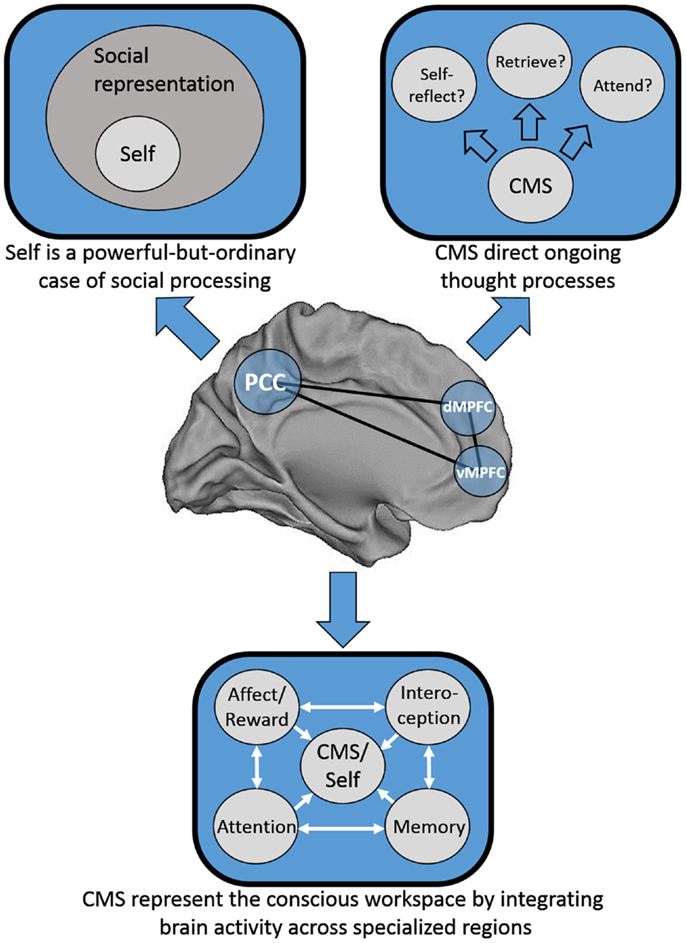
We consider three possible explanations for this pattern of results that are speculative, not intended to be mutually exclusive, and are at least partially overlapping. First, one possibility is that Greenwald and Banaji (1989) may have been half-right: it may be that social information is special, and that the self is a powerful-but-ordinary social knowledge structure. Second, Heatherton (2011) has proposed that mPFC serves as a “hub,” binding together heavily processed information from secondary sensory areas from each of the senses with internally generated information to represent the conscious “workspace.” Third, mPFC may act in a meta-cognitive fashion by guiding our moment-to-moment thought processes; in essence, in deciding what to think about next. See Figure 1 for a schematic representation of each of these models.
FIGURE 1
http://www.frontiersin.org/files/Articles/55238/fnhum-07-00391-HTML/image_m/fnhum-07-00391-g001.jpg

Figure 1. Schematic representation of three possible distinct, but not mutually exclusive models of cortical midline structure (CMS) function. Top left: the CMS are specialized for representing social information, of which the self is a powerful-but-ordinary subset. Top right: the CMS serve as a set of regions responsible for the direction of our thought processes on a moment-to-moment basis. Bottom: the CMS serve as a hub integrating information from disparate neural processing systems into a “conscious workspace.”

Is the Self a Powerful-But-Ordinary Social Construct?

On the self is a powerful-but-ordinary social construct view, the CMS could be seen as representing social information per se, and their seeming selectivity for self-relevant information might simply represent an extreme case of social information processing about a social target (the self) that by definition is more familiar than all other social targets. The overarching view of simulation theory (Gordon, 1986) is that in order to understand others we run a mental simulation of how we might act in given social situations. Conversely, the emerging discipline of neural hermeneutics (Gallotti and Frith, 2013) suggests that in order to understand ourselves, we pay close attention to the social behavior of others. Both of these viewpoints converge on the idea that the self might be a powerful, but ordinary social target.

One obvious prediction of this idea is that the CMS might be differentially engaged by the representation of (and processing about) social targets that are differentially familiar to us. Familiarity contains the concepts of both closeness and similarity: close individuals are those we feel close to (including family and friends), whereas similar individuals are those who share characteristics with us (like members of our race, political affiliation, or age group). Indeed, in Qin and Northoff’s (2011) meta-analysis, they observe that stimulus familiarity drives activation in a similar ventral mPFC region just as much as does self-reflection. In addition, Denny et al.’s (2012) meta-analysis shows that ventral aspects of mPFC are preferentially engaged by reflecting on the self versus others. If this region is sensitive to the familiarity (or “selfness”) of social information, then it should respond more to information that is more self-relevant than not. Several studies have found such a pattern of results (e.g., Phan et al., 2004; Moran et al., 2006). Indeed, Mitchell et al. (2006) observed that social targets manipulated to be similar to the self engaged this ventral mPFC region, whereas social targets manipulated to be dissimilar to the self engaged dorsal mPFC. Krienen et al. (2010) clarified Mitchell et al.’s findings by demonstrating that the driver of activation in mPFC was closeness rather than similarity per se, suggesting that the familiarity of repeated exposure to individuals drives their self-relevance.

Converging on this idea, a series of studies investigating self-reflection in different cultures have provided support for the notion that in individuals whose cultures are more interdependent, the same ventral mPFC region does not differentiate thinking about self from thinking about close family members (like participants’ own mothers) (Zhang et al., 2006; Zhu et al., 2007; Chen et al., 2013), but that this does not necessarily hold true in Western, more independent cultures (Kelley et al., 2002; Kjaer et al., 2002; Heatherton et al., 2006; Vanderwal et al., 2008). These cross-cultural findings are best interpreted in the context of recent criticisms suggesting that standard delineations between Western and Eastern cultures are not as clear-cut as has been suggested (Martinez Mateo et al., 2013). In this context, Moran et al. (2011) provide data that clarify the distinction between independent and interdependent cultures. In their paper, consideration of one’s mother’s personality traits, but not her physical characteristics produced activation levels midway between those of thinking about one’s own traits versus those of former US President, George W. Bush. To the degree that we represent the traits of a close other as being like our own (rather than their physical characteristics), this suggests again that “selfness” may be driving this difference in ventral mPFC). Considered as a unit, these lines of research reveal a quantitative dimension along which social targets of greater familiarity activate ventral mPFC to a greater degree, with the self sitting at the top as the most familiar social target of all.

A further prediction of the notion that the CMS are specialized for social processing (and that the self is a powerful subset of such processing) is that we might be able to differentiate their relative contributions along lines in which thinking about ourselves and thinking about others naturally cleave. To the degree that our representations of ourselves are first-person, and our representations of others are third-person, one would imagine that neural systems implicated in social processing that preferentially receive visual information would be more responsive to third-person representations. Based on the patterns of connectivity that we introduced at the beginning of this paper, it should be clear that the regions of pCC implicated in the default mode (and in self-reflection) are strongly linked to regions that create complex visual representations. Indeed, Raichle et al. (2001) advocate for a domain-general role for the pCC regions in providing complex visual representations to consciousness. Other work in cognitive neuroscience supports and extends this view, showing via meta-analysis that pCC regions participate in a network engaged in autobiographical memory, prospective future thinking, and navigation (Spreng et al., 2009). All such tasks require complex visual representation, and it is interesting that mPFC did not emerge in this meta-analysis. More direct evidence in support of the idea that pCC supports the third- rather than first-person representations more common in thinking about others rather than the self comes again from the meta-analysis of Denny et al. (2012). In their paper, they found across 107 studies that the precuneus was more active when participants thought about others than when they thought about themselves. Single-study evidence of the idea that visual rather than conceptual representations of people engage pCC comes from Moran et al. (2011), who showed that thinking about social targets’ appearance (e.g., Does George W. Bush have a beard?) versus thinking about their character traits (e.g., Is George W. Bush kind?) produces more activation in pCC. This relationship also held true when the social target was the self. Direct investigations of adopting third- versus first-person perspectives have also shown greater pCC involvement during third-person perspective taking (Ruby and Decety, 2001).

Is Medial Prefrontal Cortex a Hub for Integrating Internal and External Information?

Our second possibility is that the ventral mPFC region identified by Heatherton (2011) serves as a hub that integrates internal and external information into a conscious workspace. On this view, self-reflection would be the canonical task for such a region because it so strongly requires the flexible and ongoing integration of our own knowledge about ourselves with our ever-changing knowledge gained from our sense organs about how we are interacting with the environment, and about how social actors in our environment think about us. Thinking about those social actors independent from ourselves (theory of mind) would drive this machinery to a lesser degree (but still more than thinking about non-social aspects of the world) because rapid and complex integration of sensory, external, and non-sensory conceptual knowledge is required to understand others’ goals, intentions, and beliefs, whereas such dynamic processing is much less necessary for thinking about tools or cars or jewelry. This sort of integration into a conscious workspace is also a hallmark of the cognitive processes engaged during “rest,” and engendered by the default mode of brain functioning.

Is Medial Prefrontal Cortex Specialized for Directing Conscious Thought Processes?

Finally, our third possibility is that the ventral mPFC region identified in self-reflection tasks is specialized for helping to decide in which direction our thought processes should proceed. The convergence of heavily processed external sensory inputs with internally generated inputs would also support this view, which of course is not mutually exclusive with the view that mPFC serves as a hub for integration of information from disparate neural processing units. To the degree that deciding where our thoughts should go is a representational process, and that reflection on those thoughts (and our enduring personality traits) is a meta-representational version of the same process, one would imagine that a system with such functional-anatomic properties would be well-placed to perform both conscious direction of thoughts and self-reflection. That rest and self-reflection so consistently overlap (Qin and Northoff, 2011; Whitfield-Gabrieli et al., 2011) suggests that being free to direct our own thoughts (i.e., not responding directly to the environment or an experimenter-provided task) is a state that mimics the natural process observed when we are asked to reflect directly on our own selves. A prediction of this viewpoint is that decision-making might be tied to activity in the CMS, and indeed research shows that CMS activity predicts freely made decisions up to 7 s before participants indicate becoming aware of the decision having been made (Soon et al., 2008). This third possibility thus may account for the still-puzzling observation that the mPFC is perhaps the most important actor in the brain’s default mode network, which itself perhaps serves as a proxy for our ongoing conscious awareness of both our internal and external words. This conjecture awaits empirical investigation however, not least because sampling the ongoing representational processes of the default mode requires disrupting such processes.

Conclusion

In summary, we have speculated about several different explanations for the observation that the CMS are observed so consistently to participate in self-reflection. Neuroanatomical connectivity suggests that these regions are heteromodal association areas that derive much of their inputs from upstream regions associated with social information processing, and that pCC in particular gains its inputs from regions of the brain responsible for complex visual representations. Because these regions are associated with social processing, are developed strongly in humans relative to other animals, and humans travel in much larger social networks than do other animals, we speculate that they may form the basis of a special neurocognitive system evolved for social processing. More fundamental characterizations of this system suggest that the anterior midline structure, mPFC, is in fact a domain-general region dedicated as a hub of information processing about the internal and external worlds, and relatedly, that the purpose of such a confluence of representations is to direct our conscious awareness from one moment to the next, switching flexibly between representations of our internal mental life and of the world around us. On this view, mPFC’s seeming specialization for social information processing merely reflects its response to stimuli (self and others) that drive the integration of internal and external information sources more strongly than non-social stimuli.

Much research remains to be done to gain greater understanding of how and why the self, other social targets, and the default mode of thought are related to one another, and why they so reliably involve the CMS. Initial support for the idea that mPFC regions might be necessary for self-reflection comes from a study with patients with ventral mPFC damage at the site implicated by Kelley et al. (2002) as being maximally involved in self-reflection (Philippi et al., 2012). These patients did not show the self-reference effect in memory, suggesting that mPFC is necessary for encoding information in relation to oneself. Emerging advances in TMS may allow researchers to target more closely these regions for temporary, reversible lesions, or for theta-burst stimulation for temporary increases in excitability of these regions (Vernet et al., 2013). Such studies could provide more controlled evidence to determine whether these regions are necessary for reflection about self and other. In parallel, advances in real-time fMRI techniques (deCharms et al., 2004; Hinds et al., 2011) allow for the exquisite control of presentation parameters, such that we can manipulate when participants are asked to reflect on self and others to moments when activation in either mPFC or pCC are high or low, and determine with a great degree of accuracy what effects natural fluctuations in the default mode at any given moment might have on our abilities to accurately represent ourselves.

Conflict of Interest Statement

The authors declare that the research was conducted in the absence of any commercial or financial relationships that could be construed as a potential conflict of interest.

Acknowledgments

This work was supported by a grant from the National Institutes of Health (R01MH059282) to Todd F. Heatherton.

References available at the Frontiers site.

Friday, February 07, 2014

An Antidote for Mindlessness by Maria Konnikova (The New Yorker)

In this brief article for The New Yorker, psychologist and science author Maria Konnikova offers a quick overview of the origins of mindfulness in cognitive psychology, beginning with Ellen Langer (author of Mindfulness [1990], The Power of Mindful Learning [1998], and Counterclockwise: Mindful Health and the Power of Possibility [2009], among other books), who was one of the first cognitive psychologists to realize the potential of mindfulness as a therapeutic tool.

An Antidote for Mindlessness

Posted by Maria Konnikova
January 29, 2014 | The New Yorker


In the mid-nineteen-seventies, the cognitive psychologist Ellen Langer noticed that elderly people who envisioned themselves as younger versions of themselves often began to feel, and even think, like they had actually become younger. Men with trouble walking quickly were playing touch football. Memories were improving and blood pressure was dropping. The mind, Langer realized, could have a strong effect on the body. That realization led her to study the Buddhist principle of mindfulness, or awareness, which she characterizes as “a heightened state of involvement and wakefulness.”

But mindfulness is different from the hyperalert way you might feel after a great night’s sleep or a strong cup of coffee. Rather, Langer writes, it is “a state of conscious awareness in which the individual is implicitly aware of the context and content of information.” To illustrate the concept—or, rather, its opposite—Langer often recounts a shopping experience. Once, when Langer was paying for an item at a store, a clerk noticed that the back of her credit card wasn’t signed. After asking her to sign it, the clerk compared the scrawl on the receipt with the one on the card, to insure that no fraud was being committed. That, says Langer, is perfect mindlessness.

One of the first cognitive scientists to study mindfulness in an experimental setting, divorced from its spiritual trappings, Langer remained for years a lonely voice. But the past decade or so has seen a tremendous uptick in empirical research, as scientific collaborations with nontraditional schools, like the Dalai Lama’s Mind and Life Institute, have become more mainstream. We now know, for instance, that even brief mindfulness practice—typically, a kind of meditation that focuses on a particular aspect of the present moment, like your breath, your body, or a particular sensation—has a substantial positive effect on mental well-being and memory. It also appears to physically improve the brain, strengthening certain neural structures that are tied to heightened attention and focus, and bolstering connectivity in the brain’s default mode network, which is linked to self-monitoring and control.

When Amishi Jha, a neuroscientist who directs the University of Miami’s Contemplative Neuroscience, Mindfulness Research, and Practice Initiative, first began researching the effects of mindfulness on cognitive performance, in the early aughts, most of the existing studies focused on what could be easily tested: the effects of short bouts of intense practice on immediate cognitive performance. There had been comparatively little work done on the lasting impacts of mindfulness training, especially under conditions of high stress—the equivalent of evaluating the impact of a week of training on the results of a two-hundred-yard dash versus examining the effects of months of training on a marathon time. “The bulk of my work looks at high-stress cohorts, to see how mindfulness training can be protective against long-term stress,” Jha told me. It was also unclear how little meditation one could get away with and still emerge more mindful. “How low can you go? How little time can it take to sufficiently train people?” Jha said.

To test both the long-term impact of mindfulness and whether there might be a meditation equivalent of “Seven-Minute Abs,” Jha took a set of University of Miami students and split them into two groups, one that would receive mindfulness training and another that wouldn’t. “Their stress goes up throughout the semester, so you can really track performance over time—the natural decline caused by stress,” she said. The semester-long test would allow her to see whether mindfulness could benefit people in an increasingly hostile mental environment.

Jha designed a series of short, weekly training sessions, where students learned the basics of mindfulness theory and how to practice it—for instance, learning to focus on their breath while dismissing any intruding thoughts. In addition to a twenty-minute session with an instructor, they were asked to come in for two twenty-minute practice sessions each week, for seven weeks. The combined hour of instruction and practice each week was far less extreme than previous mindfulness-training courses that Jha had developed; one that she created for the military totaled twenty-four hours of practice.

About two weeks into the semester, before the training began, the students were asked to complete several tests. First, they performed a series of tasks that required sustained attention. In one, they watched a string of digits appear on a screen, and were told to press the keyboard’s space bar every time a new digit appeared, unless that digit was a “3.” At a few points in the study, the flow of digits was interrupted by questions about the participant’s attention span. In two subsequent tests, the students were assessed on their working memory capacity (how many letters in a list could they remember after solving an unrelated math problem?) and delayed-recognition working memory (could they quickly and accurately distinguish a face they had already seen from a set of new faces?). All of the students performed at roughly the same level.

Nine weeks later, when the students were tested again, large performance gaps had emerged: as the semester dragged on, the control group performed worse than they had originally, while the students who received mindfulness training became more accurate and focused. Jha’s regimen, it seemed, wasn’t just a way to get better; it was a way to keep from getting worse.

Mindfulness training, Jha hypothesizes, may work as a protective factor against the typical stresses of student life—or any stress, for that matter, since it improves emotional equilibrium and enables people to better handle distractions. “It’s similar to how physical exercise can change the body,” Jha said. “We know that physical activity helps our bodies, but we’re just coming to the understanding that mental exercise is also critical to promoting mental well-being. It’s a cultural shift.”

~ Maria Konnikova is the author of “Mastermind: How to Think Like Sherlock Holmes.”

Friday, January 03, 2014

Re-Conceptualizing Free Will for the 21st Century: Acting Independently with a Limited Role for Consciousness

http://c431376.r76.cf2.rackcdn.com/71195/fpsyg-04-00920-HTML/image_m/fpsyg-04-00920-g001.jpg

Yesterday I posted 5 scientific reasons to believe in free will, an article by Steven Handel at The Emotion Machine. But I wasn't content to stop there, so I also added in the excellent research of Dr. Jeffrey Schwartz and his work with self-directed neuroplasticity with those who have Obsessive Compulsive Disorder (OCD).

His work there is the best evidence for free will I have seen.

In this recent article from Frontiers in Psychology, Gregory Bonn proposes a modified version of free will that allows us to act independently with a limited role for consciousness. His model is not essentially different than my own - we have partial free will. Where we differ is in my conviction that free will can be increased through conscious, directed awareness of the automaticity of thoughts and feelings.

In reviewing the neuroscientific data against free will, Bonn sites the early work of Libet and then more recent functional magnetic resonance imaging:
Libet showed that readiness potentials or neural indications of an impulse to act were evident in participants' brains well before they reported any conscious intention to act. The conscious awareness of an intention to act in these experiments apparently came into being several 100 ms after the action had been set in motion within the brain. More recently, functional magnetic resonance imaging studies (e.g., Soon et al., 2008) have detected neural correlates of an intention to act many seconds before conscious awareness of that intention is reported. Conscious awareness of an impulse to act, thus, seems to be a neurological afterthought to the impulse itself.
He begins his discussion by defining terms, starting with free will and the position he takes in this paper.
The point of this discussion is to present psychological evidence pointing to the possibility of individual humans behaving in novel and creative ways, albeit within the constraints of whatever context they live in. The human brain, it is presumed, can only process information that it is exposed to. The argument here is that human brain functions allow for given sets of information to be combined in novel or creative ways, and furthermore, the integrative conceptions created through these processes can be used to direct action.
He then defines consciousness, an essential element of free will.
In most discussions of free will, the term consciousness refers to this type of narrative self-awareness it is used here in the same way, although it is with the assumption that the individual experiences and interacts with his surroundings on multiple levels, only some of which are accessible to conscious self-report (e.g., Morin, 2006 ).

From there he moves into memory issues and offers his definition of free will, as well as related topics, especially the role of the default mode network in all of this. Here is the crucial passage:
I have argued here for a broader conception of free will which is compatible with current neuroscientific understanding. This model is broadly outlined in Figure 1: Essentially, according to this model, the individual can generate novel concepts, translate those concepts into goals, and initiate and monitor activity toward achieving those goals. The model consists of two feedback loops which are largely anticorrelated. The first loop is made up of the default network and memory systems: The default network extracts elements of stored information from memory systems, integrates and combines information in various ways, and feeds the results back into memory. The second loop involves the executive control and motor networks: Executive regions establish and update goal priorities, while initiating and monitoring motor activities according to environmental feedback. These two loops are linked via a feed forward connection from the default network to the executive control network (e.g., Gerlach et al., 2011) which allows for output from simulations occurring within the default network to be uploaded into the executive control network and incorporated into the creation and maintenance of externally directed goals.
And this:
Though preliminary, this model provides an outline of how a practical form of free will, independently generated and controlled activity, can exist and be consistent with current findings from psychology and neuroscience. Those who adhere to particular definitions of “free will” could certainly take issue with these arguments. However, if one accepts that free will can exist in degrees limited by a person's knowledge and experiences; and, that decisions do not need to be entirely conscious in order to be owned by the individual. Then, I believe there is evidence to posit a level of will and independence within the person. Individuals can integrate information creatively to conceptualize multiple different scenarios or goals; they can choose between options; they can act according to goals; they can abort actions if they do not match current goal sets; and they can incorporate and integrate information from ongoing feedback into subsequent simulations and decisions.
This is well worth the read for those interested in this ttopic

Full Citation: 
Bonn, GB. (2013, Dec 9). Re-conceptualizing free will for the 21st century: acting independently with a limited role for consciousness. Frontiers in Theoretical and Philosophical Psychology; 4:920. doi: 10.3389/fpsyg.2013.00920

Re-conceptualizing free will for the 21st century: Acting independently with a limited role for consciousness

Gregory B. Bonn
  • Jeffrey Cheah School of Medicine and Health Sciences, Monash University, Bandar Sunway, Petaling Jaya, Malaysia

Abstract


This paper examines the concept of free will, or independent action, in light of recent research in psychology and neuroscience. Reviewing findings in memory, prospection, and mental simulation, as well as the neurological mechanisms underlying behavioral control, planning, and integration, it is suggested in accord with previous arguments (e.g., Wegner, 2003; Harris, 2012) that a folk conception of free will as entirely conscious control over behavior should be rejected. However, it is argued that, when taken together, these findings can also support an alternative conception of free will. The constructive nature of memory and an integrative “default network” provide the means for novel and creative combinations of information, such as the imagining of counterfactual scenarios and alternative courses of action. Considering recent findings of extensive functional connections between these systems and those that subsume motor control and goal maintenance, it is argued that individuals have the capability of producing novel ideas and translating them into actionable goals. Although most of these processes take place beneath conscious awareness, it is argued that they are unique to the individual and thus, can be considered a form of independent control over behavior, or free will.

Introduction


An identifying characteristic of human experience is a distinct, intuitive sense of volition. An inner voice existing within each of us insists that our actions result from personal will, telling us that we consciously choose our actions and rationally guide ourselves through life. Although intuitively satisfying, this notion has, deservedly, been the subject of much debate over the years. Recently, as neuroscience and psychology have expanded our understanding of the mind, a number of eminent scholars in these fields have provided evidence that contradicts such intuitive conceptions (e.g., Libet, 1985; Wegner, 2002; Wilson, 2002) leading some to argue that the notion of free will should be discarded entirely (e.g., Harris, 2012). Here I will argue that, although recent evidence does justify rejecting the idea that humans possess entirely conscious, reasoned self-control; if one moves away from simplistic notions of consciousness and its role in human decision making, findings from several areas, when taken together, suggest an alternative conception of free will: Humans can possess levels of autonomy even if the processes involved are not entirely accessible to conscious reason. This argument consists of several major components: In sections The Problem with Memory: Looking Backwards or Forwards? through Novel Conceptions I review evidence from multiple lines of research for novelty or creativity in human thought. Sections The Problem with Conscious Will and Why Consciousness? discuss findings regarding the limitations of conscious awareness as well as its potential value. Sections Internal Control of Behavior and Translating Simulations into Goals present evidence for the internal control of behavior as well as for functional connections between this control system and the systems involved with creative processing and counter-factual thinking. Finally, in sections Modeling Volitional Processes and Free Will with Limited Consciousness Awareness, I suggest a model for understanding how these systems interact and a more practically defensible model of free will: The creative integration of conceptual elements into novel, counter-factual simulations, and the use of these generative processes to guide behavior.
 

Scope and Limitations


The terms free will and consciousness both mean many things to many different people. For this reason it is important to first clarify some of the underlying assumptions that drive this argument. After establishing the gist of how these terms are used, as well as the intention of this paper, the line of thinking that follows should be clearer.


What is Meant by Free Will?


This paper is not meant as a philosophical treatise. As such, it does not address the more metaphysical issues, such as determinism, often invoked in free will debates. The point of this discussion is to present psychological evidence pointing to the possibility of individual humans behaving in novel and creative ways, albeit within the constraints of whatever context they live in. The human brain, it is presumed, can only process information that it is exposed to. The argument here is that human brain functions allow for given sets of information to be combined in novel or creative ways, and furthermore, the integrative conceptions created through these processes can be used to direct action.

Another point is that, although philosophers have significantly more nuanced ways of understanding the term, psychologists tend to operationalize free will by relating it to self-report (e.g., Libet et al., 1983; Wegner, 2008) which requires a form of self-reflective conscious awareness. The implicit condition is that one must be able to report upon all the processes leading up to a decision or behavior in order for it to be “free,” and conversely, if my brain generates an idea or initiates an action without my conscious awareness it is somehow not “me” doing the thinking or acting. The conception of freedom argued for here, on the other hand, merely requires that thoughts and resulting actions be novel and internally generated, that they result from a combination of experiences and characteristics which is unique to the individual. Unconscious, or implicit, processes are, in this view, essential components of how an individual processes information: Regardless of whether a particular process can be observed and narrated by the conscious, self-aware part of the brain, it can still make unique and important contributions toward thought and action, and thus, to the independence of the individual. The arguments here, thus, specifically reject the simplistic notion that free will requires complete conscious awareness of the processes involved.


What is Meant by Consciousness?


A separate, but closely related point should also be made about the term “consciousness” which is used rather haphazardly by both scientists and laypersons to refer to a range of different phenomena (Chalmers, 1995). A basic conception of consciousness is experiential awareness or alertness, which is defined in contrast to unconsciousness (e.g., being awake as opposed to being in a deep sleep or a coma). Consciousness, from this viewpoint, can exist on many levels and possess varying degrees of complexity, all of which are simply characterized by the presence of subjective or phenomenal experience (Velmans, 2009). For example, every person experiences many degrees of alertness, a variety of emotions, as well as many other subjective phenomena over the course of a given day. There is no one conscious state that can be defined, there are rather, many overlapping, but differentiable states, some simple and some quite complex; some describable and some inscrutable. By this definition, although their subjective “experience” would vary tremendously (see, for example, Nagel, 1974) most forms of animal life as well as very small children would possess consciousness in some form. Tononi's (2008) conceptualization of consciousness as integrated information is suggestive in this regard. By contrast, studies that are commonly cited as evidence against conscious free will (e.g., Libet et al., 1983; Wegner, 2003) tend to operationalize consciousness as an awareness of mental processes which is measured through self-report: Participants are asked to describe aspects of their experience after performing certain tasks. It should be obvious that, although they are often conflated, these conceptions of consciousness are far from equivalent. The latter is more accurately a form of metacognition (i.e., “thinking about thought”), or self-consciousness, which is a small, so far as we know distinctively human, subset of the former (e.g., Rochat, 2003). Nevertheless, since in most discussions of free will, the term consciousness refers to this type of narrative self-awareness it is used here in the same way, although it is with the assumption that the individual experiences and interacts with his surroundings on multiple levels, only some of which are accessible to conscious self-report (e.g., Morin, 2006). For the purpose of this discussion, internal processes belong to the individual regardless of where they fall on any continuum of consciousness to unconsciousness.
 

Memory, Prospection, and Creativity

Several areas of research have recently converged on a conception of memory as constructive, with the ability to combine elements of different remembered events in an integrative fashion. Evidence for processes that extract and recombine elements of multiple representations in generative, potentially novel, ways is discussed throughout the next six sections.


The Problem with Memory: Looking Backwards or Forwards?


Research has, over the years, pointed toward inaccuracies in the functioning of human memory (e.g., Schacter, 1999; Moscovitch et al., 2006; Addis et al., 2007). Remembering, it has been shown, is more of a creative, constructive process than the precise recall of past events. People, for example, often remember things that never happened (Roediger and McDermott, 1995), and conflate different episodes with each other, combining bits and pieces of various events into a single recalled instance (e.g., Tulving, 2002; Schacter and Addis, 2007a). Similarly, memories for specific events apparently change with each recollection, often incorporating current information with past impressions (Bridge and Paller, 2012). Having experienced problems stemming from such inaccuracies, it is not surprising that most people interpret such inaccuracies as “bugs,” or errors, in a memory system which should, intuitively, provide accurate information about the past.

Recent interpretations of such phenomena, however, (Dudai and Carruthers, 2005; Schacter and Addis, 2007b) speculate that the lack of factual accuracy in our recollections may instead be the signature of a system that evolved, not to store accurate representations of the past, but instead, to provide a means of flexibly imagining the future, as well as conceiving of other hypothetical scenarios. Surviving in the real world does not depend upon accurate recall of every past detail as much as an ability to predict future contingencies (Schacter et al., 2008). A system that can integrate details of multiple past events and is more sensitive to broad patterns and associations rather than accurately representing minutia would be well suited to this purpose.

The idea that memory systems play an important role in the creation of counter-factual scenarios, or formulating mental simulations, is supported by findings from several areas. Neurological studies find considerable overlap of brain systems used in memory and simulation (e.g., Buckner, 2010). Research on Construal Level Theory (Trope and Liberman, 2010) has identified similar patterns in how we conceptualize the past and the future. Also, studies of prospection, or predicting the future (Gilbert, 2006; Gilbert and Wilson, 2007), demonstrate that emotions and memory play an important role in imagining the future. These points are briefly reviewed in the following sections.


Neurobiology of Memory and Prospection

Patients with memory deficits have, for some time, been observed to have difficulty planning for and imagining the future (Tulving et al., 1988; Hassabis et al., 2007). This led to some early speculation about a relationship between memory and prospection (e.g., Fuster, 1989) which has only recently been confirmed by functional imaging studies (Addis et al., 2009). Growing evidence points to a core network of brain regions involved in remembering the past and imagining the future, as well as other forms of mental simulation (Arzy et al., 2009; Spreng and Grady, 2010). In broad terms, tasks related to “mental time travel” (i.e., remembering the past and predicting the future) incorporate memory systems in the medial temporal lobes, the lateral parietal lobes and the hippocampal formation (Wheeler and Buckner, 2004), in addition to areas in the medial frontal lobes which are involved in perspective taking and theory of mind, or understanding others' mental states (Gallagher and Frith, 2003). It seems that many forms of self-projection; imagining the past and future, navigation (imagining the self in different physical locations) and theory of mind (taking the perspective of other people) depend on this same core network of memory-related brain areas (Buckner and Carroll, 2007).


The Default Network: Integrating Information While at Rest

Particularly relevant for this discussion are findings (e.g., Buckner et al., 2008) noting increased activity in this core network of brain regions during periods of undirected mental function, or passive states—hence its common designation as the “default network.” This default network is broadly associated with many forms of stimulus-independent thinking or internally focused cognition (Spreng and Grady, 2010): Mind-wandering, daydreaming, imagining the future, reminiscing about the past, as well as thinking about the cognitive states of others are all subsumed within its functions (e.g., Hassabis and Maguire, 2007; Schacter et al., 2008). When the brain is not occupied with processing external stimuli, activity reverts to this area where stored impressions are consolidated and reorganized (Buckner, 2010). The default network seems to facilitate the internal experience of scenarios and perspectives that transcend simple recall, and it seems to do so automatically through making connections between, or recombining, elements of multiple memory traces.


Abstraction and the Extraction of Gist Elements

Evidence of how this reworking of stored memories operates can be seen in Trope and Liberman's (2010) research on mental representations (summarized as Construal Level Theory). They have shown that mental representations of objects and experience become reconstructed in different ways at various levels of abstraction. “Psychological distance,” for example spatial, temporal, or social separation, between a person and an object leads to representations of differing resolution. Objects, people, and situations that are imagined to be distant are represented with less resolution; their conceptions become more abstract and essentialized (Liberman et al., 2002). A chair, for example, could be imagined as a specific object one is sitting on now, or imagining various future or past scenarios representations can take on numerous forms. For example, imagining a chair in an office, a living room, a restaurant, a car, or a spaceship can result in many different images. All that remains constant is the essential quality of affording sitting (see Gibson, 1977). The mind changes how it represents objects based upon the imagined context (e.g., Smith, 1998), adding or removing non-essential elements to facilitate the formation of a sensible scene. Complementing the research on memory and the default network, Construal Level Theory illustrates how gist elements from numerous impressions can be combined to create mental simulations placing the self and others in various situations and contexts (Wakslak et al., 2008).


Emotions, Memory, and Imagining the Future

Similarly, the integration and fuzzy processing that seems to occur in the default network is evident in Gilbert's (2006) writings about prospection. Emotional aspects of memories and current states influence mental simulations in important ways. Current emotional states, for example, color our emotional feelings about future events (Gilbert and Wilson, 2007); so, for example, if we are in a good mood when imagining a future date we are more likely to imagine it going well. Also, as memories tend to be skewed toward emotional peaks and valleys (Morewedge et al., 2005); simulations become “over emotionalized.” They tend to focus on brief highlights (or lowlights): Thinking about a future trip to an amusement park, for example, we might just remember the thrill of riding a roller coaster, and the pleasure of eating ice cream from past visits; not so much the monotony of waiting in long lines.

Gilbert (2006) also points out that memories and predictions of the future are strongly influenced by cultural scripts or “memes” (e.g., Blackmore, 2000; Bonn and Tafarodi, 2013). Our memories of the past, as well as imaginings of the future, are given meaning and form by the narratives that predominate in our cultures. The stories that we observe and hear being told from day-to-day shape our expectations and evaluations of our own lives, leading us to reshape the way we remember experiences over time (Klaaren et al., 1994). Memories (and in turn our expectations about the future) get rewritten each time they are accessed. Thus, over time the way we remember our past and what we expect in the future tends to fall in line with the narrative zeitgeist.


Novel Conceptions

Evidence, thus, supports the notion that as processing becomes removed from current surroundings representations change in nature: Details fall away while meaning, feelings, and connecting relationships become more important. Elements of different scenarios, when stripped of context, mingle with one another, potentially combining in ways many steps removed from actual experience.

Regardless of where such connections appear on a spectrum of conscious awareness, the integrative systems that seem to center around the default network allow for a great deal of flexibility in imagining and simulating possible realities. Although such simulations can be deeply flawed in the sense of being factually inaccurate and susceptible to bias, they are unique to the individual in that they are based upon that person's specific set of experiences. Each mind has a specific store of knowledge to which it can “add value” by integrating that information in qualitatively new ways (e.g., Tononi, 2008). New formulations of knowledge, in theory, can subsequently be fed back into the processing system and form the bases for new phantasies (e.g., Kashima et al., 2007). Simulations thus, have the potential to build upon each other through a process of scaffolding, feeding back into memory and integrating with each other iteratively over time.

Buckner (2010) actually takes the potential for originality one step further by arguing that, not only can we extract and combine elemental properties of information in creative ways, but random variations in neural firings would almost certainly play a part in the flexibility of this sort of system. He observes that seemingly random properties of neural systems are observable in nature. Aronov et al. (2008), for example, has identified a specific brain structure in finches that seems to relate to random song patterns. Cisek and Kalaska (2005) observed apparently random variations in neural firing influencing behavioral choice in monkeys. Relatedly, Bim (2012) has noted that physiological noise, such as respiratory and cardiac fluctuations, can influence resting functional connectivity in the brain. Thus, intrinsic properties of neural systems combined with environmental variation could allow for novel leaps in connectivity or new combinatorial patterns. Again, this is not an argument for conscious control over how the mind produces concepts, but for a capacity of originality, generativity, or creativity, in how it processes information.


Consciousness: Limitations and Capabilities

The Problem with Conscious Will

The studies most commonly cited in neuropsychological arguments against the existence of free will began with a series of experiments conducted by Benjamin Libet and his colleagues (1983; 1985). Libet showed that readiness potentials or neural indications of an impulse to act were evident in participants' brains well before they reported any conscious intention to act. The conscious awareness of an intention to act in these experiments apparently came into being several 100 ms after the action had been set in motion within the brain. More recently, functional magnetic resonance imaging studies (e.g., Soon et al., 2008) have detected neural correlates of an intention to act many seconds before conscious awareness of that intention is reported. Conscious awareness of an impulse to act, thus, seems to be a neurological afterthought to the impulse itself.

Along similar lines, Wegner (2003) has collected extensive evidence indicating that, in many cases, our experience of conscious will is misleading. In some cases the feeling of causing or of willing an action does not exist after we have performed it (e.g., Geschwind et al., 1995) and in other cases we can be led to believe that we caused an action that we, in fact, did not (Ansfield and Wegner, 1996; Wegner and Wheatley, 1999). Wegner theorizes that the sense of having willed an action is inferred from various indicators: If we think a thought just prior to an action; the action is consistent with our thought; and there is no other obvious cause of the action; then, we tend to infer that we performed the action (Wegner, 2003). Even more, once we have inferred responsibility for an action we tend to rewrite our perceptions so that they are more consistent with this sense of authorship. Evidence shows, for example, that we estimate the gap between thought and action to be smaller for actions that we believe we have willed and longer for actions we do not feel responsible for (Ebert and Wegner, 2011). Again, the gist of these findings is that our feeling of having consciously willed an act is illusory in many ways. It seems that the conscious awareness of intention that we place so much weight upon, that we naively think of as causal, is, in fact, a narrative construction that is formed well after the train of causation has been set in motion.

What Wegner, Libet, and others have shown clearly is that the narrative awareness of a will to act arises after the actual impulse to perform a certain action. This does not mean, however, that the action is not owned by the person. It merely shows that action is not initiated by the narrative self. Only if our definition of the self is limited to narrative capability can we say that the person didn't initiate the action. One must acknowledge, based on the evidence, that the stories we create about our actions are misleading. They are subjective impressions, not factual accounts of all the processes involved. The argument can still be made, however, that the individual (i.e., the person in the broader, not necessarily self-conscious, sense) may initiate or control behavior on other, less explicit, levels.
Why Consciousness?

Libet (1999) himself pointed out that even if the conscious impression of will is merely corollary to and not the direct cause of an action it still occurs enough in advance of the action to allow for a conscious “veto” or a decision to not perform the action. Such late inhibitory decisions apparently involve an area in the frontomedian cortex (Brass and Haggard, 2007) and involve perceptual feedback (Moore et al., 2009). Consciousness, in this way, seems to have the potential to play some role in self-monitoring processes (Kuhn and Brass, 2009). Although we are not consciously aware of what is going on at every stage of the chain of neural events leading to action, there is room for a degree of conscious involvement if only to pull the emergency brake before it is too late. Thus, although it may not be the initial source of motivations and behavioral impulses, the part of the mind that is self-reflective; that can envision the self in causal and narrative contexts, may serve important monitoring and control functions.

Even Wegner, who has tirelessly argued that the folk understanding of conscious will is an illusion, has suggested that such an illusion probably serves some social purpose (Wegner, 2008). Being able to observe our behavior and its results in context, he suggests, allows individuals to better fit into complex social arrangements. Although illusory, the perspective of agency allows the brain to fine tune its behavioral impulses. “It tells us what we can and cannot do (Wegner, 2008; p. 241),” and further, the illusion of conscious will “makes behavior more open to modification (Wegner, 2008; p. 243).” So, for Wegner, the fact that conscious will is largely illusory does not completely rule out self-reflective capabilities from having some effect on behavior.

Consciousness may play an important role in monitoring the self and its behavior within contexts. Consciousness, in the sense of self-reflection, is closely entwined with the creation of narrative meaning (McAdams, 2008). Narrative meaning making involves processes such as conceptualizing the self in relation to higher-order or longer-term goals and social rules as well as imagining the consequences of actions and the reactions of others to those actions. This is all critical to understanding how the self relates to the surrounding world, and especially to integrating behavior with complex social contexts (Cozolino, 2002; Baumeister, 2008; Rochat, 2009). A monitoring function for the conscious self would, in theory, track behavioral impulses and their potential results, looking for conflicts between the actor and his longer term goals as they arise, with the potential for triggering inhibitory functions at various times. Consciousness, in this view, influences behavior by providing broad contextual input and inhibitory feedback into a complex planning system. Behavioral impulses, however, would be produced by mechanisms that are outside of direct conscious control. Consciousness per se is most useful because it can monitor behaviors, goals, and the changing environment in real-time watching for potential conflicts. The bulk of processing, however, must take place in other complex systems that operate largely beneath the surface. Consciousness seems most important for providing up-to-the-minute contextual integration and feedback to other systems. Self-reflective monitoring facilitates the fine-tuning of impulses and behaviors, and inhibitory control, necessary for high-level integration with dynamic physical and social environments.


Control and Planning of Behavior

Strictly conscious control over behavior seems to be ruled out by our improved understanding of the mind. Does this mean, however, that a person is not in control of their behavior? Again, keeping in mind a broad definition of the “person” as including both conscious and unconscious elements, recent discoveries can shed light on this issue. First, there is a separate motor control network dedicated to internally generated, voluntary, goal oriented behaviors as contrasted with externally-triggered and more habitual behaviors. Second, there appear to be connections between the default network, where novel ideas and counterfactual scenarios are produced, and this goal-oriented control network that allows for the internal generation of action.


Internal Control of Behavior

Two major sources provide activating input to the primary motor cortex, which is the initiator of muscle movement (Haggard, 2008). The first motor control system runs from the sensory cortices to the primary motor region via the pre-motor area: Activity in these areas relates to stimulus-driven, or reflexive, responses to sensory input as well as to habitual behaviors such as grasping, eating, and walking which are performed largely unconsciously (Prabhu et al., 2007). The second motor system involves multiple regions, including the cingulate, frontal cortices, and basal ganglia, which connect to the primary motor cortex via the pre-supplementary and supplementary motor areas. Behaviors that require planning and goal maintenance engage some or all of this system (Daw et al., 2006; Hirosaka, 2008). Processes mediated by pre-supplementary motor area (preSMA) connections generally allow for the flexible, online integration of goal states, decisions, and action priorities with feedback from the environment. Imaging studies, for example, show that the preSMA is consistently involved in task-focused activities and situations that require the preferential selection of certain behaviors over others (Nachev et al., 2007). Importantly, patients with damage to the preSMA are deficient in their ability to prioritize behaviors and suppress automatic behaviors (Pacherie, 2007): They might, for example, impulsively grasp, eat, or drink without reporting the intention or desire to do so (Della Salla et al., 1991), suggesting that the preSMA plays a role in inhibiting the habitual behaviors governed by the first motor control system.

This second motor control system plays a crucial role in tasks related to goals and decision making. The preSMA, along with the frontopolar cortex and the rostral cingulate, is active in tasks requiring decisions between multiple options, such as choosing between right or left hand key presses (Ammon and Gandevia, 2007; Mueller et al., 2007). The frontopolar cortex is also involved in maintaining goal states such as suppressing responses to immediate environmental demands (Koechlin and Hyafil, 2007; Dreher et al., 2008) and, along with the anterior cingulate (ACC), is seemingly involved in the production of goal-directed action sequences (Holroyd and Yeung, 2012). The ACC, through the preSMA, also seems capable of selecting and initiating action in the absence of external prompts, as well as monitoring and adjusting those actions in response to feedback (Rowe et al., 2010; Zhang et al., 2012). All told, there are extensive findings indicating that the preSMA is involved in interfacing multiple goal and decision-related subsystems with the primary motor cortex.

Most complex behaviors would involve an integration of these two motor systems, with the more automatic system triggering the basic movements and the decision and goal related system throwing in guidance and inhibitory impulses at important junctures. Although these relationships need further clarification, the pathways mediated by the supplementary and pre-supplementary motor areas do seem to allow for basic internally guided choice, selective inhibition, and “volition-like” control of behavior (Haggard, 2008), though probably not complex decision-making or reasoning (e.g., Koechlin and Hyafil, 2007). The next section will propose that these systems are capable of interfacing with the default network during planning tasks. In this way, output from integrative processes taking place in the default network could be incorporated into goal formation and behavioral control.


Translating Simulations into Goals

To this point we have established two important concepts. First, processing in the default network allows humans to create novel combinations of information. Information stored in memory is broken down to elemental form and connections made between elements during times of reduced sensory input. This allows for patterns and relationships among multiple impressions to be extracted and for the flexible generation of counterfactual simulations. Second, faculties exist for internally maintained goals to exert flexible control over behavior. Humans can replace automatic, reflexive behaviors with internally guided, goal-directed action.

Default network functioning, by definition, is most active when the external attention necessary for goal-oriented functioning is absent. Thus, the systems that produce novel ideas and those that maintain goals are usually thought of as contradictory, or negatively correlated (e.g., Fox et al., 2005; Carhart-Harris and Friston, 2010). Free will as it is conceptualized here, however, would require an interface between these two levels of operations. For behaviors to be called free, or independently generated, they would need to result not just from the complex training processes that reside within the goal maintenance system: They would need to incorporate elements that are unique to the individual; that are novel and creative, as well. The brain would need to be able to translate the abstract simulations and integrated information produced by the default network into actionable goals.

Recently, Spreng et al. (2010) found that tasks in which participants made goal-related plans activated default network regions as well as regions commonly associated with cognitive control (i.e., areas of the frontal cortex and the ACC). Similarly, other recent studies (Gerlach et al., 2011; Spreng and Schacter, 2012) have found that solving imagined future problems involved default network areas as well as control network areas. In particular, the dorsolateral prefrontal cortex, which is central to rule acquisition and goal maintenance functions (Badre and D'Esposito, 2009; Badre et al., 2009; Packer and Cunningham, 2009) has been implicated, along with default network regions, in planning tasks. Gerlach et al. (2011) have also found functional connections between the posterior cingulate cortex, which is thought to be the nexus of the default network, and the dorsolateral prefrontal cortex. The default network, then, is seemingly able to interface with goal maintenance and cognitive control functions when engaged in problem solving and future planning. This suggests that the generative capacity of the default network; the ability to extract elements of diverse memories and impressions and integrate them in novel ways, could be used to create concrete, actionable goals.
 

Reconceptualizing Free Will

Modeling Volitional Processes

Thus, although the folk conception of free will as entirely conscious self-control seems to be dead in the water (e.g., Wegner, 2008; Harris, 2012), I have argued here for a broader conception of free will which is compatible with current neuroscientific understanding. This model is broadly outlined in Figure 1: Essentially, according to this model, the individual can generate novel concepts, translate those concepts into goals, and initiate and monitor activity toward achieving those goals. The model consists of two feedback loops which are largely anticorrelated. The first loop is made up of the default network and memory systems: The default network extracts elements of stored information from memory systems, integrates and combines information in various ways, and feeds the results back into memory. The second loop involves the executive control and motor networks: Executive regions establish and update goal priorities, while initiating and monitoring motor activities according to environmental feedback. These two loops are linked via a feed forward connection from the default network to the executive control network (e.g., Gerlach et al., 2011) which allows for output from simulations occurring within the default network to be uploaded into the executive control network and incorporated into the creation and maintenance of externally directed goals. Additional information is continually fed back into the memory and control systems through sensory input from the environment. Each person's activities lead through their observed effect on the environment to a unique store of information in the individual memory system. The many impressions; sensory, emotional, or otherwise, that the individual has in memory are available to the default network during times of reduced input. During such periods, elements or traces of different memories are combined together in various ways with the results then stored and available for further processing.

FIGURE 1  
http://c431376.r76.cf2.rackcdn.com/71195/fpsyg-04-00920-HTML/image_m/fpsyg-04-00920-g001.jpg

Figure 1. Model showing interconnections among systems for memory, mental simulations, behavioral control, and conscious awareness.
Both loops are accessible to a limited degree by conscious awareness or self-reflective abilities and receive some feedback from this conscious level. Conscious awareness is mostly important here for online monitoring and the incorporation of current contextual information. Although most processing occurs beneath conscious awareness, the ability to direct attention both inwards and outwards could make conscious awareness especially useful for monitoring and minimizing conflicts between actions, intentions, and real-time, current context. In the case of the control/motor network loop, conscious awareness also possesses some veto-like inhibitory powers: It can interfere with certain impulses before action is initiated (e.g., Libet, 1999). In the context of the default network, conscious monitoring could integrate current contextual information with ongoing simulations, perhaps providing reality checking functions which keep simulations more in line with the external environment. In both systems conscious awareness need not be directly causal, but just provide monitoring and additional real time information as feedback into the system.

Though preliminary, this model provides an outline of how a practical form of free will, independently generated and controlled activity, can exist and be consistent with current findings from psychology and neuroscience. Those who adhere to particular definitions of “free will” could certainly take issue with these arguments. However, if one accepts that free will can exist in degrees limited by a person's knowledge and experiences; and, that decisions do not need to be entirely conscious in order to be owned by the individual. Then, I believe there is evidence to posit a level of will and independence within the person. Individuals can integrate information creatively to conceptualize multiple different scenarios or goals; they can choose between options; they can act according to goals; they can abort actions if they do not match current goal sets; and they can incorporate and integrate information from ongoing feedback into subsequent simulations and decisions.

Free Will with Limited Consciousness Awareness

As I have discussed, the role that consciousness, as it is commonly conceptualized, plays in these processes is limited. It is not, however, non-existent. There is a place in this model for conscious monitoring of simulations and goal states, the integration of sensory information with ongoing internal processes, and related inhibitory control. The vast majority of processing in this model does, however, take place beneath the level of conscious awareness and self-report. If one considers the degree to which unconscious processes are involved in every action that we undertake, this should become far less of a concern. For example, consider everyday acts like walking from one place to another, or speaking a sentence. These are incredibly complex behaviors requiring the coordinated operations of many thousands of neurons and muscles simultaneously. When we perform such acts we are not aware of exactly how we balance our bodies or shape our mouth and tongue at any particular moment. Our bodies just perform as we expect them to (normally) and we report via our conscious awareness a summary of what we did or what we intended to do: We just think “I walked to the cafĂ© and ordered a coffee,” for example. We don't notice exactly how every muscle moved along the way, where we placed our feet, or how we formed our words. Most people, however, would not claim a lack of control over their bodies. It is not irrational to believe that, yes; I took a walk and ordered coffee.

Cognitive psychology has shown over the years that large portions of mental processing take place beneath the level of consciousness awareness (e.g., Kahneman, 2011; Kihlstrom, 2013). Much of our mental processing involves energy- and time-saving shortcuts, and much of our behavior is, for similar reasons, habitual. This does not necessarily mean, however, that consciousness is entirely left out of the picture, but certainly the conception that we are in complete conscious control (or that we always behave rationally) has been proven to be illusory. What I have argued here is that if we abandon the ideas that human will needs to be completely explicit, and that conscious awareness and control of every process is required for an individual to be a decision maker, it is possible to see evidence of originality, individuality, and creative processes, as well as cognitive control, in the way that each person thinks and behaves. This type of individuality, I believe, can be called free will.


Conflict of Interest Statement

The author declares that the research was conducted in the absence of any commercial or financial relationships that could be construed as a potential conflict of interest.
 

Acknowledgments

This work was funded by a Fundamental Research Grant (FRGS) from the Ministry of Education, Malaysia.


References available at the Frontiers site.