Wednesday, April 07, 2010

Peter Katzenstein: Why the Clash of Civilizations Theory Is Wrong

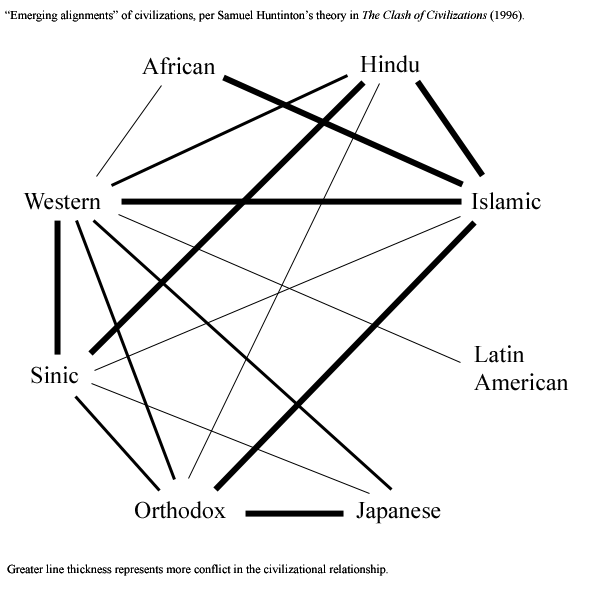
File:Huntington Clash of Civilizations chart.gif

Interesting perspective. See below the videos for an explanation of just what exactly Peter Katzenstein is arguing against here. Interesting that Samuel P. Huntington's "Clash of Civilizations?" is still a topic of discussion after 17 years.

The article became a book in 1998: The Clash of Civilizations and the Remaking of World Order.

I tend to agree with him for the most part (admittedly, I only skimmed the original article). His sense that cultures (or worldviews) will be the source of international conflict has proven true in many ways. It's more a clash of values than a clash of politics. The 9/11 attack and subsequent rise of various values-based terrorist groups (al-Qaeda is the most famous, but the Maoist rebels in Nepal and India, the Christian fundamentalists in the US, and the militant messianic Zionists in Israel all engage in ideological terrorism) have seemingly made Samuel P. Huntington quite the futurist.

In his lecture at Sydney Ideas, Peter Katzenstein, one of America’s leading political scientists, offers a critique of the Samuel Huntington’s Clash of Civilization theory (the theory that conflict between distinct groups based on religion and cultural identities (eg Western, Islamic, Sinic) is inevitable, and will dominate in the post cold–war period). Katzenstein argues that emphasis on the unity and uniformity of different civilizations and hence on sharp differences among civilizations is misguided, and that civilizations are better thought of in pluralist terms; We should concentrate on studying encounters and engagements among civilizations.

Peter J. Katzenstein is the Walter S. Carpenter, Jr. Professor of International Studies at Cornell University and President of the American Political Science Association.

Presented by Sydney Ideas and the United States Studies Centre, March 2010
Part One:


Part Two:


So what is Samuel P. Huntington's Clash of Civilizations Theory - Wikipedia offers a descent summary of the article and the controversy. Here is the beginning of the original article.
The Clash of Civilizations?
by Samuel P. Huntington
Foreign Affairs Summer 1993

SAMUEL P. HUNTINGTON is the Eaton Professor of the Science of Government and Director of the John M. Olin Institute for Strategic Studies at Harvard University. This article is the product of the Olin Institute's project on "The Changing Security Environment and American National Interests."

I. THE NEXT PATTERN OF CONFLICT
II. THE NATURE OF CIVILIZATIONS
III. WHY CIVILIZATIONS WILL CLASH
IV. THE FAULT LINES BETWEEN CIVILIZATIONS
V. CIVILIZATION RALLYING
VI. THE WEST VERSUS THE REST
VII. THE TORN COUNTRIES
VIII. THE CONFUCIAN-ISLAMIC CONNECTION
IX. IMPLICATIONS FOR THE WEST

I. THE NEXT PATTERN OF CONFLICT

WORLD POLITICS IS entering a new phase, and intellectuals have not hesitated to proliferate visions of what it will be -- the end of history, the return of traditional rivalries between nation states, and the decline of the nation state from the conflicting pulls of tribalism and globalism, among others. Each of these visions catches aspects of the emerging reality. Yet they all miss a crucial, indeed a central, aspect of what global politics is likely to be in the coming years.

It is my hypothesis that the fundamental source of conflict in this new world will not be primarily ideological or primarily economic. The great divisions among humankind and the dominating source of conflict will be cultural. Nation states will remain the most powerful actors in world affairs, but the principal conflicts of global politics will occur between nations and groups of different civilizations. The clash of civilizations will be the battle lines of the future.

Conflict between civilizations will be the latest phase of the evolution of conflict in the modern world. For a century and a half after the emergence of the modern international system of the Peace of Westphalia, the conflicts of the Western world were largely among princes -- emperors, absolute monarchs and constitutional monarchs attempting to expand their bureaucracies, their armies, their mercantilist economic strength and, most important, the territory they ruled. In the process they created nation states, and beginning with the French Revolution the principal lines of conflict were between nations rather than princes. In 1793, as R. R. Palmer put it, "The wars of kings were over; the ward of peoples had begun." This nineteenth-century pattern lasted until the end of World War I. Then, as a result of the Russian Revolution and the reaction against it, the conflict of nations yielded to the conflict of ideologies, first among communism, fascism-Nazism and liberal democracy, and then between communism and liberal democracy. During the Cold War, this latter conflict became embodied in the struggle between the two superpowers, neither of which was a nation state in the classical European sense and each of which defined its identity in terms of ideology.

These conflicts between princes, nation states and ideologies were primarily conflicts within Western civilization, "Western civil wars," as William Lind has labeled them. This was as true of the Cold War as it was of the world wars and the earlier wars of the seventeenth, eighteenth and nineteenth centuries. With the end of the Cold War, international politics moves out of its Western phase, and its center-piece becomes the interaction between the West and non-Western civilizations and among non-Western civilizations. In the politics of civilizations, the people and governments of non-Western civilizations no longer remain the objects of history as targets of Western colonialism but join the West as movers and shapers of history.

II. THE NATURE OF CIVILIZATIONS

DURING THE COLD WAR the world was divided into the First, Second and Third Worlds. Those divisions are no longer relevant. It is far more meaningful now to group countries not in terms of their political or economic systems or in terms of their level of economic development but rather in terms of their culture and civilization.

What do we mean when we talk of a civilization? A civilization is a cultural entity. Villages, regions, ethnic groups, nationalities, religious groups, all have distinct cultures at different levels of cultural heterogeneity. The culture of a village in southern Italy may be different from that of a village in northern Italy, but both will share in a common Italian culture that distinguishes them from German villages. European communities, in turn, will share cultural features that distinguish them from Arab or Chinese communities. Arabs, Chinese and Westerners, however, are not part of any broader cultural entity. They constitute civilizations. A civilization is thus the highest cultural grouping of people and the broadest level of cultural identity people have short of that which distinguishes humans from other species. It is defined both by common objective elements, such as language, history, religion, customs, institutions, and by the subjective self-identification of people. People have levels of identity: a resident of Rome may define himself with varying degrees of intensity as a Roman, an Italian, a Catholic, a Christian, a European, a Westerner. The civilization to which he belongs is the broadest level of identification with which he intensely identifies. People can and do redefine their identities and, as a result, the composition and boundaries of civilizations change.

Civilizations may involve a large number of people, as with China ("a civilization pretending to be a state," as Lucian Pye put it), or a very small number of people, such as the Anglophone Caribbean. A civilization may include several nation states, as is the case with Western, Latin American and Arab civilizations, or only one, as is the case with Japanese civilization. Civilizations obviously blend and overlap, and may include subcivilizations. Western civilization has two major variants, European and North American, and Islam has its Arab, Turkic and Malay subdivisions. Civilizations are nonetheless meaningful entities, and while the lines between them are seldom sharp, they are real. Civilizations are dynamic; they rise and fall; they divide and merge. And, as any student of history knows, civilizations disappear and are buried in the sands of time.

Westerners tend to think of nation states as the principal actors in global affairs. They have been that, however, for only a few centuries. The broader reaches of human history have been the history of civilizations. In A Study of History, Arnold Toynbee identified 21 major civilizations; only six of them exist in the contemporary world.

III. WHY CIVILIZATIONS WILL CLASH

CIVILIZATION IDENTITY will be increasingly important in the future, and the world will be shaped in large measure by the interactions among seven or eight major civilizations. These include Western, Confucian, Japanese, Islamic, Hindu, Slavic-Orthodox, Latin American and possibly African civilization. The most important conflicts of the future will occur along the cultural fault lines separating these civilizations from one another.

Why will this be the case?
Read the whole article.


Bodhipaksa - What You're Made Of (Reflection on the Six Elements)

Nice article from Wildmind Buddhist Meditation blogger Bodhipaksa over at Tricycle. Glad to see his work getting some press in one of the major Buddhist magazines.

What You're Made Of

Bodhipaksa guides us through the Buddha's powerful Six Element practice to equanimity, pure and bright. Photography by Susan Derges

By Bodhipaksa

Susan Derges

I first learned the reflection on the Six Elements thirteen years ago, on a four-month retreat in the mountains of southern Spain. It was my first introduction to insight meditation, and although at times since then the practice has given rise to uncomfortable experiences, it has more often brought a sense of lightness, freedom, and expansiveness as well as a greater sense of connectedness to the world.

The Six Element practice—a profound contemplation on interconnectedness, impermanence, and insubstantiality—is one of the most significant insight practices in the Pali canon. The Buddha recommended it as a way of "not neglecting wisdom," and taught it as a technique for developing equanimity and cultivating meditative absorption, or jhana. In the Six Element practice, we contemplate in turn earth, water, fire, air, space, and consciousness, noting how each element is an ever-changing process rather than a static thing.

One of the most striking features of this practice is the thorough way in which it deconstructs our experience. By contemplating every aspect of our physical and mental being, we begin to understand its true nature. In classic insight meditation, we notice the impermanence and insubstantiality of sensations, thoughts, and feelings. We do that in this practice, too, but we also develop a literally visceral sense of the body's impermanence and insubstantiality by contemplating the various processes by which its elements come into being and pass away. The Six Element practice is highly analytical, but it's also intensely poetic, bringing us into contact with the reality of our interconnectedness with the world. It is experiential, focusing on our present-moment experience, and it is imaginative, encouraging us to envision ourselves as part of a wider process of change and flow.

This isn't a meditation I do every day, although it frequently becomes the cornerstone of my practice while I'm on retreat. It's not a practice that I teach to complete beginners, as I believe that the Six Element practice needs both a reasonable grounding in tranquility practice (samatha) and a healthy sense of emotional positivity. Most often I teach it on retreat, to students who have at least a few months of solid practice behind them.

Simply reading this article will give you no more than a faint flavor of the practice. If you want to experience it more strongly, read through it again, pausing frequently and giving yourself time to turn the words into felt experiences. I do most of my meditation, including this practice, with my eyes closed. You may wish to do the same. As with any sitting practice, we need to find a posture that's comfortable yet dignified, and that allows the chest to be open so that we can remain alert and focused.

Usually I spend a few minutes cultivating lovingkindness (metta) before launching into the practice. I'll contact my heart, see how I'm feeling, and encourage a sense of acceptance for whatever emotions happen to be present at that time. Then I'll wish myself well by repeating phrases such as "May I be well. May I be happy. May I be at peace," before taking that well-wishing into the world, sensing that my lovingkindness is radiating outward. Although the Six Element practice is often affirming, it can also be challenging, and it's best to be in at least a minimally positive state of mind before we start reflecting in depth on our own impermanence.

Earth
First we call to mind the earth element within ourselves. The earth element is everything solid and resistant, everything that gives us form. Notice first of all those aspects of the body that you can directly experience: the physical presence and weight of the body, the feeling of the sitting bones pressing into the cushion or bench, the hands resting on the lap, the knees on the floor, the teeth. Simply notice these experiences of solidness.

Besides noticing our immediate sensations, we enter into an imaginative exploration of the whole of the body. Even though we can't experience all these objects directly, in sutta 140 of the Majjhima Nikaya the Buddha encourages his students to call to mind the flesh, sinews, bones, bone marrow, kidneys, heart, liver, diaphragm, and every other conceivable solid matter in the body, including the feces in our intestines. Rather than starting trains of thought about the various organs of the body, discursively talking to ourselves about our anatomy, we can think more in terms of visualizing the organs, or simply knowing that they are there and that they're composed of solid matter.

Untitled (no. 1)

Having reflected on the earth element within, we now call to mind the earth element externally - everything that is solid and resistant outside of ourselves—starting with the floor upon which we sit, then expanding outward to recall buildings, vehicles, roads, mountains, rocks, pebbles, soil, the bodies of other beings, trees, wild plants, and crops growing in fields. Again, we don't aim to start trains of thought, but simply aim to evoke memories in the form of sensory impressions, letting images, sounds, and tactile sensations come into consciousness, and mindfully experiencing them.

Then we reflect that everything solid within the body and everything solid externally is the same earth element. There's really no "me" earth element or "other" earth element - it's all the same stuff. We normally think of our form, our body, as being us, as being ourselves, but here we recollect how everything of the earth element that is within us comes from outside and returns to the outside.

Being of a scientific bent—and I think the Buddha was, too—I often call to mind the process of conception. My body started with the creation of one cell from the fusion of a sperm and an egg from my parents, who are not me. The fertilized ovum divided and grew into an embryo as it absorbed nutrients from the world outside—from my mother's bloodstream, but ultimately from the plants and animals she ate. Those foodstuffs weren't me, either. And from that point on in my life, every molecule that has contributed to the earth element in this body similarly has come from outside. We can visualize the flow of the earth element from fields and soil into the body, and know that there's not a single molecule of solid matter within this body that is self-originated. It's all borrowed.

And we have to give it back. In fact, we are giving it back, every moment of our lives. The earth element within us is returning to the outside world, right now. We shed hairs and skin cells, and we go to the bathroom and defecate. We visualize all this in the practice. Solid matter is combusting within the body and being exhaled. Even our bones, which we may think of as the most solid and enduring part of the body, are involved in a continuous process of dissolving and rebuilding. There are cells in your body that have no other function than to dissolve the surrounding bone, while other cells are involved in building it back up again. Even your bones are processes rather than things.

So the earth element within is borrowed, and it's always returning to the outside world, flowing through us like a river. And as we recollect the earth element flowing in this way, we can reflect: "This is not me, not mine, I am not this." There's not even any question of "letting go." The earth element never was "us." It never was "ours." We never were holding on to it, because how can we cling to something that's flowing?

The earth element provides the paradigm for the remaining physical elements, which are all treated in the same way - recollecting the element within us, recollecting the element outside of us, reflecting that everything that is "us" is really just borrowed from the outside world and constantly returning to it, and finally noting, as we contemplate the element flowing through us that this is not me, not mine, that I am not this.

Water
We started with the grossest element, and we will progress through the rest—water, fire, air, space, and consciousness - in order of increasing subtlety. So now we call to mind the water element within the body—that which is liquid. Starting with those manifestations that we can directly experience, we feel saliva in the mouth, mucus, the pulse of the blood, sweat, the feeling of moisture in the outbreath, the pressure of urine in the bladder. Then we move on to those things we can only experience more imaginatively: lymph, fat, synovial fluid in the joints, cerebrospinal fluid, and all the liquid that permeates and surrounds every cell in the body. Even though you can’t experience these things directly, you can know they’re there.

Then we contemplate the water element outside of ourselves: calling to mind the oceans and rivers and streams, the water that permeates the soil, the rain and clouds, the water inside plants and animals. We see, hear, and feel these things as we recall our experience of them. Then we recognize that all of the water within the body, which we think of as us, and ours, as ourselves, is in reality simply borrowed for a while from the outside world, that it’s quite literally flowing through us, and that we don’t own it. There is only one water element—there’s no “me” water and there’s no “other” water. And so we reflect: “This is not me. This is not mine. I am not this.”

Fire
The Buddha defined the fire element as “that by which one is warmed, ages, and is consumed, and that by which what is eaten . . . gets completely digested.” In other words, the fire element within is metabolism. It’s our energy. So sitting in meditation, we can experience the heat of the body, feeling the cooler air we inhale contrast with the warmth of the air as it leaves the body, feeling the heart pumping, and calling to mind the myriad chemical combustions taking place at the cellular level, sparks of electricity in the muscles, nerves, and brain. And knowing that all of this energy is borrowed from the fire element outside of us.
Read the rest of the article.


William Grassie - Resources and Problems in Whitehead's Metaphysics

http://serendip.brynmawr.edu/exchange/files/images/6a00d8341d9f5853ef01157231b78f970b-pi.400%20pixel%20width%20of%20page.jpeg

Excellent and interesting article from The Global Spiral on the philosophical issues with Alfred North Whitehead's version of metaphysics, generally known as process philosophy. Here is a passage from the Stanford Encyclopedia of Philosophy on Whitehead's metaphysical project, for those unfamiliar with his work - a needed context for the article to follow.

In Process and Reality, rather than assuming substance as the basic metaphysical category, Whitehead introduces a new metaphysically primitive notion that he calls an actual occasion. On Whitehead's view, an actual occasion is not an enduring substance, but a process of becoming. As Donald Sherburne points out, “It is customary to compare an actual occasion with a Leibnizian monad, with the caveat that whereas a monad is windowless, an actual occasion is ‘all window.’ It is as though one were to take Aristotle's system of categories and ask what would result if the category of substance were displaced from its preeminence by the category of relation …” (Sherburne 1995, 852). As Whitehead himself puts it, his “philosophy of organism is the inversion of Kant's philosophy … For Kant, the world emerges from the subject; for the philosophy of organism, the subject emerges from the world” (quoted in Sherburne 1995, 852).

Significantly, this view runs counter to more traditional views of material substance: “There persists,” says Whitehead, “[a] fixed scientific cosmology which presupposes the ultimate fact of an irreducible brute matter, or material, spread through space in a flux of configurations. In itself such a material is senseless, valueless, purposeless. It just does what it does do, following a fixed routine imposed by external relations which do not spring from the nature of its being. It is this assumption that I call ‘scientific materialism.’ Also it is an assumption which I shall challenge as being entirely unsuited to the scientific situation at which we have now arrived” (1925, 22).

The assumption of scientific materialism is effective in many contexts, says Whitehead, only because it directs our attention to a certain class of problems that lend themselves to analysis within this framework. However, scientific materialism is less successful when addressing issues of teleology and when trying to develop a comprehensive, integrated picture of the universe as a whole. According to Whitehead, recognition that the world is organic rather than materialistic is therefore essential for anyone wanting to develop a comprehensive account of nature, and this change in viewpoint can result as easily from attempts to understand modern physics as from attempts to understand human psychology and teleology. Says Whitehead, “Mathematical physics presumes in the first place an electromagnetic field of activity pervading space and time. The laws which condition this field are nothing else than the conditions observed by the general activity of the flux of the world, as it individualises itself in the events” (1925, 190). The end result is that “nature is a structure of evolving processes. The reality is the process” (1925, 90).

Whitehead's ultimate attempt to develop a metaphysical unification of space, time, matter, events and teleology has proved to be controversial. In part, this may be because of the connections Whitehead saw between his metaphysics and traditional theism. According to Whitehead, religion is concerned with permanence amid change, and can be found in the ordering we find within nature, something he sometimes called the “primordial nature of God” (1929c, Pt 5, Ch. 2, secs 1-7). Thus although not especially influential among contemporary Anglo-American secular philosophers, his metaphysical ideas continue to have significant influence among many theologians and philosophers of religion.
And here is a little bit about "process philosophy," also from Stanford:

The philosophy of process is a venture in metaphysics, the general theory of reality. Its concern is with what exists in the world and with the terms of reference in which this reality is to be understood and explained. The task of metaphysics is, after all, to provide a cogent and plausible account of the nature of reality at the broadest, most synoptic and comprehensive level. And it is to this mission of enabling us to characterize, describe, clarify and explain the most general features of the real that process philosophy addresses itself in its own characteristic way. The guiding idea of its approach is that natural existence consists in and is best understood in terms of processes rather than things — of modes of change rather than fixed stabilities. For processists, change of every sort — physical, organic, psychological — is the pervasive and predominant feature of the real.

Process philosophy diametrically opposes the view — as old as Parmenides and Zeno and the Atomists of Pre-Socratic Greece — that denies processes or downgrades them in the order of being or of understanding by subordinating them to substantial things. By contrast, process philosophy pivots on the thesis that the processual nature of existence is a fundamental fact with which any adequate metaphysic must come to terms.

Process philosophy puts processes at the forefront of philosophical and specifically of ontological concern. Process should here be construed in pretty much the usual way — as a sequentially structured sequence of successive stages or phases. Three factors accordingly come to the fore:

  1. That a process is a complex — a unity of distinct stages or phases. A process is always a matter of now this, now that.
  2. That this complex has a certain temporal coherence and unity, and that processes accordingly have an ineliminably temporal dimension.
  3. That a process has a structure, a formal generic format in virtue of which every concrete process is equipped with a shape or format.

From the time of Aristotle, Western metaphysics has had a marked bias in favor of things or substances. However, another variant line of thought was also current from the earliest times onward. After all, the concentration on perduring physical things as existents in nature slights the equally good claims of another ontological category, namely processes, events, occurrences — items better indicated by verbs than nouns. And, clearly, storms and heat-waves are every bit as real as dogs and oranges.

What is characteristically definitive of process philosophizing as a distinctive sector of philosophical tradition is not simply the commonplace recognition of natural process as the active initiator of what exists in nature, but an insistence on seeing process as constituting an essential aspect of everything that exists — a commitment to the fundamentally processual nature of the real. For the process philosopher is, effectively by definition, one who holds that what exists in nature is not just originated and sustained by processes but is in fact ongoingly and inexorably characterized by them. On such a view, process is both pervasive in nature and fundamental for its understanding.
Finally, here is the article from William Grassie, "Resources and Problems in Whitehead's Metaphysics" - from The Metanexus Institute's Global Spiral magazine.
Resources and Problems in Whitehead's Metaphysics

In 1927, British mathematician and philosopher Alfred North Whitehead was asked to give the prestigious Gifford Lectures on Natural Theology at the University of Edinburgh. His talks were published two years later as Process and Reality, the book that introduced Whitehead's process philosophy to the world and secured him a place in the canon of Western metaphysics. Today, Whitehead’s influence has not abated. One sees this, for instance, in the reliance on Whitehead’s thought by many of the luminaries in the field of religion and science including Ian Barbour, Holmes Rolston, and John Haught.1 Indeed, Whitehead’s signature can even be traced in the very name of Metanexus Institute. The key to Whitehead’s lasting consequence is that his process relational metaphysics solves many philosophical problems in understanding and interpreting contemporary science. However, I will argue that Whitehead’s process metaphysics tends to 1) depersonalize God to the extent of rendering theism irrelevant and 2) naturalize moral evil in the service of evolution. Once these points are established, it is then possible to seek a partial solution to these problems by synthesizing Whitehead’s thought with that of his successors.


Untitled, 29 x 23.5”, acrylic on canvas.

A Review of Process and Reality

When revisiting my studies of Whitehead from my days in graduate school at Temple University, I was quickly reminded of how difficult it can be to penetrate Whitehead’s language, especially in Process and Reality (1929), but also how rewarding the effort. Much of what I discuss below are well-worn arguments and have been written and debated many times by philosophers, theologians, and scholars. It is nevertheless useful and necessary to revisit such debates, so we do not forget the recurrence of problems and the reincarnation of ideas in our contemporary discourse.

Alfred North Whitehead (1861–1947) created a comprehensive metaphysical system for understanding science, society, and self. 2 Whitehead refers to this project as “speculative philosophy,” which he defines as,

the endeavor to frame a coherent, logical, necessary system of general ideas in terms of which every element of our experience can be interpreted. By this notion of “interpretation” I mean that everything of which we are conscious, as enjoyed, perceived, willed, or thought, shall have the character of a particular instance of the general scheme. Thus the philosophical scheme should be coherent, logical, and in respect to its interpretation, applicable and adequate…(Process and Reality, 3)

An adequate metaphysics, then, must apply in general terms to the whole of reality, including all human subjective experiences. Whitehead’s metaphysics is especially constructed with reference to the emerging objective scientific worldview, but not to the neglect of subjective human experience. Indeed, the metaphysics is such that the normal uses of the terms subjective and objective no longer apply. "Nothing must be omitted,” writes Whitehead, “experience drunk and experience sober" (Adventures of Ideas, 226). It is not adequate to construct a metaphysics that renders the full spectrum of the emotional and imaginative life invisible or insignificant. Whitehead warns that "[p]hilosophy may not neglect the multifariousness of the world—the fairies dance, and Christ is nailed to the cross" (Process and Reality, 338). Note that while Whitehead references fantastic inventions of human imagination, his objective is objectivity. A general description of reality is the goal.

What is fundamentally real, says Whitehead, are not things but events. All events are relational. They have causal antecedents and causal consequences in webs of varying complexity, significance, and intensity. All events also exhibit some modicum of internal self-creative freedom that is not fully determined by their causal antecedents nor is it predictable in their causal consequences.

Whitehead’s process metaphysics does not rely on the usual dualisms that have vexed previous metaphysical systems. We no longer need to be troubled about the distinctions between matter and mind, animate and inanimate, created and evolved, nature and nurture, or reductionism and emergence. The difference between atoms, animals, artifacts, and humans is in the degrees of complexity, the intensity of causal relationships, and the extent of self-creative freedom integrated in these various phenomena. The differences are not in any essentialized notions of natural kinds. Most philosophical problems in the metaphysics of contemporary science disappear with Whitehead’s event-centered process philosophy.

God is a category that Whitehead feels compelled to invoke in his process philosophy of every “actual occasion,” but it is God of all past realities and all future possibilities. The incarnate God is determined by the sum of all past actualities, and the transcendent God is limited within a matrix of future possibilities. Whitehead’s God also functions as a persuasive telos that draws the universe toward greater complexity, greater integration of these complexities in communion, and greater co-creative freedom within those relational webs. For Whitehead, the one become many and the many one as the universe and God evolve together. The goal of this evolution is realized beauty.

God in Whitehead’s view can be understood as the set of all relationships and all processes. In that sense, Whitehead’s God is radically transcendent and radically incarnate at the same time. Indeed, we might call it “god-in-universe” or “universe-in-god,” remembering that this is a gerund and not a noun, a verb and not a thing. God-in-universe is a complex distributed system. The technical term used is panentheism, to be distinguished from pantheism. Whiteheadean process metaphysics has given rise to various schools of process theology that have found devotees in numerous seminaries and departments of religion.3 Indeed, Whitehead can be seen as one of the patron saints of the modern dialogue between science and religion.

In Whitehead’s view, all being is causally related becoming. This does not mean all beings are equivalent in a flat, relativistic monism without significant distinctions, because being is spun within a web of asymmetrical, multivariable, hierarchically layered, and differentially valued relationships. While Whitehead does not develop an explicit epistemology to go along with his ontology, we may infer that all knowing is also causally related knowing within a web of asymmetrical, multivariable, hierarchically layered, and differentially valued relationships.

Whitehead’s process metaphysics can be understood as reviving Aristotle’s notion of natural kinds, albeit in a changing evolutionary context. A nexus of complexity, be it a proton, a protein, or a person, has a temporal “personality” that persists and thus achieves an emergent identity, a temporary “essence.” He combines this evolutionary Aristotelianism with a Platonic notion of an ideal horizon toward which all events tend in the complexification of the universe. This is the persuasive telos of god-in-universe. Finally, Whitehead adopts a Hegelian notion of history’s movement as a kind of progressive incarnation of spirit.

While Whitehead’s metaphysics is more wholesome and more compatible with recent scientific insights than all the other leading brands, it also has some problems, to which I will now turn.

Problem 1: The Language of Whitehead

Decoding the abstract terminology of Whitehead’s metaphysics is a real challenge. Whitehead not only uses common and philosophical language in idiosyncratic ways, but he also invents a series of neologisms, including terms like appetition, concrescence, comformal, formaliter, ingression, prehension, regnant society, and superject. This obtuse style is frustrating to even trained philosophers, let alone the unwary graduate student. The language is a nonstarter for most literally minded scientists, even though Whitehead aspires to a literal general description of reality.

Whitehead’s unusual nomenclature becomes a kind of secret language to those initiated in the discourse. This creates an in-group and out-group phenomenon, which has hampered the exploration of Whitehead among philosophers, theologians, scientists, and the general public. This is particularly tragic in the case of Process and Reality, because Whitehead’s other books and essays are generally accessible, witty, and profound. I keep quite a file of Whitehead quotes for ready use in papers and conversations.

Problem 2: The Concept of God

The concept of God in Whitehead is also 4 problematic. This is an extremely abstract and depersonalized God. It is not the least bit clear why anyone would worship this God. It ends up being a turn-off to philosophers and theologians alike.

Whitehead’s God has very little traction with traditional theologies, which may or may not be a good thing depending on one’s commitments and points of view. He does not draw on scriptural sources in theologizing about his new concept of God. Whitehead is disconnected from his own Christian tradition in this respect and will have little appeal to scripturally oriented religious traditionalists. Whiteheadeans can seem to be a new religious movement, as witnessed in part by the secret language and the cultish behavior of many of his disciples, who tend to frame every topic in terms of “Process Philosophy and…”

An advantage of Whitehead’s concept of God is that the theodicy problem disappears because God is no longer omnipotent. This god-in-universe suffers with the world because it is the world, marvels at its complexity, plays with us, loves with us, relates with us. God-in-universe is a presence all the way up and down the cosmic unfolding of time and scales of emergence. Rendering God no longer omnipotent, perhaps not even omniscient or omnibenevolent, may render God too emasculated and irrelevant for most traditionalists even to begin considering. Whitehead’s process metaphysics tends to render God impersonal and disconnected from traditional theistic accounts of religion.

Note that it is possible to accept evolutionary Aristotelianism as “self-evident,” while rejecting the concepts of telos and progress in Whitehead. Indeed, one could accept many of Whitehead’s insights and dispense entirely with the concept of God.

Problem 3: The Naturalization of Evil

The real problem that I want to address here is the tendency in Whitehead’s metaphysics to naturalize moral evil in the service of evolution. Whether it be the death of a single child due to disease, starvation, or violence or something on a larger scale like the Rwanda massacre, these past actualities are just part of the unfolding of evolution. There is no outside of history by which such pain, suffering, and death is “redeemed”. Moral and natural evil may provoke change, adaptation, and further evolution – that is progress – but at whose expense? Whitehead offers no salvation story outside of the hoped-for evolution of the universe toward the one, the many, and the beautiful. Thus, Whitehead offers no real solutions to the existential angst over death and injustice that motivates much of religious adherence.

Ethics for Whitehead is a subset of aesthetics. The purpose of the universe is to realize beauty. In Religion in the Making, Whitehead writes that “[a]ll order is… aesthetic order, the moral order is merely certain aspects of aesthetic order”(105). Moral conduct is directed at achieving greater beauty. In Adventures in Ideas, Whitehead writes “the real world is good when it is beautiful” (345). Realized beauty is the divine aim in process.

So what constitutes “beauty” becomes a critical question in evaluating Whitehead’s metaphysics and his implied ethics. In Modes of Thought, Whitehead defines beauty as the “union of harmony, intensity, and vividness which involves the perfection of importance for that occasion” (14). Progress in evolution is increased beauty, but in Process and Reality, we learn that progress is a “venture along the borders of chaos”(168). Apparently “intensity” and “vividness” are in tension with “harmony” and “order.” Too much of the latter results in unchanging monotony, while too much of the former results in destructive anarchy. So we have a kind of aesthetics and ethics of the golden mean between change and continuity, between order and novelty. We might also derive an ethics of maximized extremes, good and evil, high culture and sadism, as a way of increasing the “intensity” and “vividness” of aesthetic experience.5

Already we see that Whitehead’s ethics is not deontological. There are no universal moral laws, duties, and obligations, nor is there any essential and fixed human nature. The human person is not an enduring substance or soul, but rather a “nexus” or “society” of relationships. One advantage of this approach is that we can now talk of moral evolution in human history.

However, the disadvantage of Whitehead’s approach is that we lose the philosophical basis for human rights discourse upon which so much progress has been achieved in human history. On what grounds could a Whiteheadean argue for inviolable, individual human rights? With Whitehead, we have no fixed human nature and therefore no fixed boundaries and limitations that should restrain human behavior. There are no real criteria for restraining human creativity and destruction, except the vague concept of maximizing aesthetic experience. If beauty is in the eyes of the beholder, then so too might morality be merely the opinions of the beholden. Principles of environmental ethics, bioethics, and justice are difficult to establish in the Whiteheadean framework.

Why, for instance, should we assume that the earth’s environment, as presently constituted, is somehow worthy of preservation? Note that this is not just Whitehead’s problem, but very much a problem of any contemporary ethics and metaphysics based on modern science. E. O. Wilson loves nature, that is clear, but he can offer nothing more than utilitarian justifications for why we should love and preserve natural kinds, as they happen to be at this moment in evolution.6 We might just as easily consider human destructiveness as an engine of evolutionary creativity, wiping out ecosystems and species so that something new can evolve in the long arc of evolutionary time.

Relatedness, whether in the form of biocentrism or communitarian ethics, can be antithetical to the notion of individual rights. The Western moral tradition, encoded in the Declaration of Independence and the UN Universal Declaration of Human Rights, considers individuals to be irreducible centers of dignity and worth. This can be seen as an outgrowth and implication of the theological doctrine of Imago Dei.

Extreme individualism, however, is also found wanting. First, it is counterfactual but also inherently ethically dubious. The ethics of Ayn Rand’slibertarian objectivism, for instance, would simply not work as a system of ethics and is not an adequate description of real human nature. So we are left ambiguously between process and relationships, on the one side, and principles and individuals, on the other.

In Process and Reality, Whitehead famously calls all life a form of “robbery” and “coercion.” The more complex the entity is, the greater the robbery from other entities. Here, we have a basic statement of the Second Law of Thermodynamics. This “robbery” can be thought of in terms of energy density flows passing through a complex system over time measured as erg per seconds per gram (erg s-1 g -1). This turns out to be a rough measure of complexity in evolution. The earth’s climasphere, which consists of the atmosphere and oceans, has roughly a hundred times the energy density flow of a typical star or galaxy. Through photosynthesis, plants achieve an energy density flow roughly a thousand times more than that of a star. The human body is sustained by a daily food intake resulting in an energy density flow about 20,000 times more than that of a typical star. Remember that we are comparing the ratio of energy consumed to mass of the objects. So here is another way to think of this. If a human body could be scaled up to the mass of our sun, it would be 20,000 times more luminous (assuming it could obtain enough energy!). The human brain, which consumes about 20 percent of our energy intake while constituting about 2 percent of our body weight, has an energy density flow 150,000 times that of a typical star. And finally, modern human civilization has an energy density ratio some 500,000 times that of a typical star.7

Energy density flow turns out to be a useful way to think about emergent complexity and Whiteheadean “societies.” In Whitehead’s words, “all [societies] require interplay with their environment; and in the case of living societies this interplay takes the form of robbery” (Process and Reality, 105). Process metaphysics captures this scientific insight perfectly, but here enters the ethical dilemma: “It is at this point that with life morals become acute,” writes Whitehead. “The robber requires justification” (ibid.) The realization and increase of beauty in the universe are the teleological justification of this “robbery.”

The realized evolution of God, universe, and human history, however, is not necessarily good or beautiful. We see this in the examples of any number of natural and human tragedies. Within a Whiteheadean – or for that matter scientific – framework, we need a way to distinguish between the “is” of nature and the “ought” of morality. Past experience is not necessarily good or beautiful, noble or just.8 How do we make meaningful distinctions and apply them in our ethical debates?

A Partial Solution

I want to end by suggesting ways that process philosophy may yet offer partial solutions to these problems through (1) a new moral matrix and (2) a time-transcendent eschatology.

The new moral matrix I take from the writings of the late Thomas Berry (1914–2009), who recently passed away at the age of ninety-four.9 Berry was a Passionist priest and scholar, whose writings helped to inspire and guide an ecospiritual revival movement around the world. He advocated the incorporation and interpretation of the new scientific cosmology into our religious and moral systems. This is referred to as “the Epic of Evolution,” “the New Cosmology,” “the Great Story,” or simply “the New Story.” Thomas Berry synthesized the insights of Alfred North Whitehead and Pierre Teilhard de Chardin in the prose style of Loren Eisley.10

In his book with Brian Swimme, The Universe Story, Berry develops the metaphysics of Whitehead and Teilhard. The observed teleonomy of the universe is increased differentiation, increased communion, and increased autopoiesis. Taken together, these three principles would constitute what Whitehead means by realized beauty. Berry and Swimme explore numerous examples of these tendencies in the evolutionary narrative. For instance, differentiation is promoted by chance and mutation in the evolution of life. Communion is promoted by necessity and selection. Autopoiesis is promoted by niche creation and choice. They then move from description to prescription. Human actions and beliefs are true, good, and beautiful when they protect and increase differentiation, when they attend to and enjoy communion, and when they foster and enhance autopoiesis, that is, self-creative freedom. Evil is a corruption of these goods by disproportionately emphasizing one and neglecting the others. The dynamic balance between these tripartite goods constitutes beautiful and ethical behavior.11

I find this moral matrix helpful. It would be useful to explore some examples of how this might be applied in political philosophy, bioethics, and environmental ethics. While this framework is not going to give us simple answers to culture-war debates about abortion or homosexuality, national healthcare or energy policy, it does provide a context for a common moral conversation at least partly grounded in a scientific worldview. In the matrix itself we all see that real ethical problems are often not polar opposites but a conflict of goods that cannot all be maximized at the same time. The great philosophical and moral challenge of our time is to reconcile natural law philosophy (global ethics) with natural philosophy (contemporary science) in conversation with our received traditions (comparative religions).

The second partial solution to Whitehead’s problem with evil is in an eschatological vision that transcends time. There is some basis for this understanding of time in contemporary physics. The equations of the microcosmic physics all work the same backward, or forward, without respect to our common sense understanding of irreversible, linear time. It is only in the macrocosmic laws of thermodynamics that irreversible, linear time enters the equation. The laws of entropy need not have the last word in our metaphysics. Whitehead writes “All past actualities and all future possibilities intersect in the present moment, and that is eternity.”12 We can call this a realized eschatology, albeit a mystical one.

And in the end, we should not expect any easy answers or final resolutions of the problem of evil in the universe or the theodicy of God. The shift to a more mystical and less rational discourse is perhaps the best we can expect after all of our debates. It is hoped that this mystical move will not lessen our discomfort with pain, suffering, and injustice in the world, but will rather increase our efforts “to act justly, to love tenderly, and to walk humbly with your God" (Micah 6:8). This unreasonable expectation that the world should be better than it is and that we should be better people than we are is perhaps the ur-source of the religious, moral, and creative impulse of our restless species.

Let me end with another mystical quote from Whitehead’s Science and the Modern World:

[S]omething… stands beyond, behind, and within, the passing flux of immediate things; something which is real, and yet waiting to be realised; something which is a remote possibility, and yet the greatest present facts; something that gives meaning to all that passes, and yet eludes apprehension; something whose possession is the final good, and yet is beyond all reach; something which is the ultimate ideal, and the hopeless quest (191-192).13

Endnotes


1 See for instance, Ian Barbour, Religion in an Age of Science: The Gifford Lectures 1989-1991, vol. Volume One (San Francisco: Harper, 1990)., Holmes Rolston, Science and Religion: A Critical Survey (Philadelphia: Temple University Press, 1987)., and John Haught, God after Darwin: A Theology of Evolution (Boulder, CO: Westview, 2000).

2 This system is expounded in several of Whitehead’s works: Alfred North Whitehead, Process and Reality (New York: Free Press, [1929]1978)., ———, Science and the Modern World (New York: Free Press, [1925] 1967)., ———, Adventures of Ideas (New York: Free Press, [1933] 1967)., ———, Modes of Thought (New York: Capricorn, [1938] 1958 )., ———, Religion in the Making (New York: Macmillan, 1926). I will be quoting these works and citing the references in the text. For an introduction to Whitehead, see Victor Lowe, Understanding Whitehead (Baltimore: Johns Hopkins University Press, 1962). and C. Robert Mesle, Process-Relational Philosophy (West Conshohocken, PA: Templeton Foundation Press, 2008)..

3 Whitehead’s process philosophy has been very influential in theology. Claremont School of Theology, for instance, is host to the Center for Process Studies http://www.ctr4process.org/ . For an overview of process theology, go to http://en.wikipedia.org/wiki/Process_theology .

5 In this section, I am partly following the thoughts of Henry W. Clark, "Process Thought and Justice," in Process Philosophy and Social Thought, ed. Jr. Cobb, John B. and W. Widick Schroeder (Chicago: Center for the Scientific Study of Religion, 1981).

6 Edward O. Wilson, Biophillia: The Human Bond with Other Species (Cambridge, MA: Harvard University Press, 1984).

7 Eric Chaisson, Cosmic Evolution: The Rise of Complexity in Nature (Cambridge, MA: Harvard University Press, 2001), 139.; ———, Epic of Evolution : Seven Ages of the Cosmos (New York: Columbia University Press, 2006), 293 - 96.; David Christian, Maps of Time: An Introduction to Big History (Berkeley: University of California Press, 2004).

8 For an extended discussion of Whitehead and social ethics, see the essays in John B. Cobb Jr. and W. Widick Schroeder, eds., Process Philosophy and Social Thought (Chicago: Center for the Scientific Study of Religion,1981)..

9 Thomas Berry, "Thomas Berry Website," www.thomasberry.org.

10 This is Berry’s own description of his work in an interview I conducted with him on November 23, 1993 in Washington, D.C.

11 Thomas and Brian Swimme Berry, Universe Story, The: From the Primordial Flaring Forth to the Ecozoic Era (San Francisco, CA: Harper, 1992).. For my discussion of Berry and Swimme’s ethics see chapter five of my Ph.D. dissertation, William J. Grassie, Reinventing Nature: Science Narratives as Myths for an Endangered Planet (Philadelphia: Ph.D. Dissertation, Temple University Department of Religion, 1994).

12 This is perhaps an apocryphal quote from Whitehead that I picked-up some twenty-years ago. I have not been able to find the reference for it, although the quote is consistent with other statements by Whitehead. If any one can direct me to the citation, I would be grateful.

13 The actual quote begins “Religion is something which…” I have edited intentionally to be ambiguous, because the “something” might just as easily refer to God or Beauty as understood by Whitehead. The connotations of the word “religion” in our contemporary world carry too much baggage. The citation is more accurate without a definite object.

Bibliography

Barbour, Ian. Religion in an Age of Science: The Gifford Lectures 1989-1991. Vol. Volume One. San Francisco: Harper, 1990.
Berry, Thomas. "Thomas Berry Website." www.thomasberry.org.
Berry, Thomas and Brian Swimme. Universe Story, The: From the Primordial Flaring Forth to the Ecozoic Era. San Francisco, CA: Harper, 1992.
Chaisson, Eric. Cosmic Evolution: The Rise of Complexity in Nature. Cambridge, MA: Harvard University Press, 2001.
———. Epic of Evolution : Seven Ages of the Cosmos. New York: Columbia University Press, 2006.
Christian, David. Maps of Time: An Introduction to Big History. Berkeley: University of California Press, 2004.
Clark, Henry W. "Process Thought and Justice." In Process Philosophy and Social Thought, edited by Jr. Cobb, John B. and W. Widick Schroeder, 132-40. Chicago: Center for the Scientific Study of Religion, 1981.
Cobb Jr., John B., and W. Widick Schroeder, eds. Process Philosophy and Social Thought. Chicago: Center for the Scientific Study of Religion, 1981.
Grassie, William J. Reinventing Nature: Science Narratives as Myths for an Endangered Planet. Philadelphia: Ph.D. Dissertation, Temple University Department of Religion, 1994.
Haught, John. God after Darwin: A Theology of Evolution. Boulder, CO: Westview, 2000.
Lowe, Victor. Understanding Whitehead. Baltimore: Johns Hopkins University Press, 1962.
Mesle, C. Robert. Process-Relational Philosophy. West Conshohocken, PA: Templeton Foundation Press, 2008.
Rolston, Holmes. Science and Religion: A Critical Survey. Philadelphia: Temple University Press, 1987.
Whitehead, Alfred North. Adventures of Ideas. New York: Free Press, [1933] 1967.
———. Modes of Thought. New York: Capricorn, [1938] 1958
———. Process and Reality. New York: Free Press, [1929]1978.
———. Religion in the Making. New York: Macmillan, 1926.
———. Science and the Modern World. New York: Free Press, [1925] 1967.
Wilson, Edward O. Biophillia: The Human Bond with Other Species. Cambridge, MA: Harvard University Press, 1984.

Tags: , , , , , , , , , , , , ,

A Neuroethics Video Series from Penn State

Great series of videos from the Neuroethics Learning Collaborative (U Penn). Here are a few of the videos from the beginning of the series - more to come.
Neuroethics Learning Collaborative
The Neuroethics Learning Collaborative on the PENN LPS Commons provides you a unique opportunity to engage with leading faculty and fellow students on the most cutting edge topics in neuroscience and ethics today.
Welcome to the Neuroethics learning Collaborative from Martha Farah


1) Philosophical Ethics (Fiester)


2) Applied Ethics and Neuroethics (Fiester & Farah)


3) Animal Subjects, Human Subjects (Fiester)


4) Conflict of Interest (Merz)


Varadaraja V. Raman: "Transdisciplinarity as the Search for Unity behind Diversity"

The Metanexus Institute has put a lot of videos from their various events online (they use Vimeo to hose their material, which is a great video service) - very cool. I'll be sharing some of the ones I enjoy the most, but you can follow the link above to the collection and take a look for yourself.
Varadaraja V. Raman: "Transdisciplinarity as the Search for Unity behind Diversity"

The Senior Fellow Lecture

We all belong to the same biological species, or as we say in more humanistic terms, we are all members of the same large human family; religiously speaking, children of the same cosmic creative principle. An aspect of the human condition is that we form groups and subgroups which are sometimes mutually cooperative, sometimes mutually combative. The major factors that unite and divide us are race (a no longer acceptable term, but may refer simply to superficial skin-color distinctions), religion (a mighty force that has both noble and ignoble sides) and language (which is beautiful and endearing only to those who understand it). These three factors also form the basic elements of human culture. Culture is situated in Nature.

The world of nature is characterized by a plethora of elements which range from stones and sand to living organisms and stars and galaxies. All these are situated in the Cosmos.

The variety in the world, whether in the biological and human context, or in the physical and astronomical context, may well be a necessary condition for a universe to exist as a stable complex entity. And this variety also contributes to the aesthetic splendor of the world.

But the separateness that is inevitable in variety is also cause for unpleasantness and harshness sometimes, for humans in many ways and for other animals in other ways. It tends to cover up the commonalty that unites everything, and promotes feeding on one another. A more rewarding appraisal and appreciation of the world may be gained by regarding the world not as a seamless smooth entity (which it is in a larger metaphysical and even biological sense), nor by focusing always on the differences (which are there to stay), but rather as a colorful quilt woven together to create a wondrous whole. Transdiciplinarity may then be looked upon as the understanding of unity behind the diversity, an ancient uplifting theme. It seeks to explore the binding as well as the splintering features of the complex world of culture and nature.

This paper will examine transdisciplinarity from these considerations so as to make the human experience intellectually satisfying and spiritually fulfilling also.

~ Metanexus 2009 conference was held in Phoenix, AZ, July 18-21 (2009) on the theme of "Cosmos, Nature, and Culture."


Varadaraja V. Raman: "Transdisciplinarity as the Search for Unity behind Diversity" from Metanexus Institute on Vimeo.


Tuesday, April 06, 2010

Anatta-lakkhana Sutta: The Discourse on the Not-self Characteristic (Ñanamoli Thera Translation)

http://buddhagrams.com/wp-content/uploads/2009/11/buddha-full.jpg

In this second teaching of Siddhattha Gotama (you know, The Buddha) following his enlightenment, he reveals the Not-Self (anatta) of all perceptions, all feelings, all determinations, all forms. In fact, he includes consciousness in this list of what is Not-Self, which would contradict any of the teachings on karma and reincarnation.

His point is not about the nature of the self, but rather that we suffer as a result of these attachments to things we think of as "me" or "mine."

Thanissaro Bhikkhu sort of responds to this apparent contradiction, without actually answering the question at all.
One of the first stumbling blocks that Westerners often encounter when they learn about Buddhism is the teaching on anatta, often translated as no-self. This teaching is a stumbling block for two reasons. First, the idea of there being no self doesn't fit well with other Buddhist teachings, such as the doctrine of kamma and rebirth: If there's no self, what experiences the results of kamma and takes rebirth? Second, it doesn't fit well with our own Judeo-Christian background, which assumes the existence of an eternal soul or self as a basic presupposition: If there's no self, what's the purpose of a spiritual life? Many books try to answer these questions, but if you look at the Pali canon — the earliest extant record of the Buddha's teachings — you won't find them addressed at all. In fact, the one place where the Buddha was asked point-blank whether or not there was a self, he refused to answer. When later asked why, he said that to hold either that there is a self or that there is no self is to fall into extreme forms of wrong view that make the path of Buddhist practice impossible. Thus the question should be put aside.
He goes on to explain how the Buddha categorized questions to be answered, but does not address the contradiction that the Buddha himself apparently never addressed either.

Anyway, here is the Sutta (some more thought below).

SN 22.59, PTS: S iii 66, CDB i 901
translated from the Pali by Ñanamoli Thera

Thus I heard. On one occasion the Blessed One was living at Benares, in the Deer Park at Isipatana (the Resort of Seers). There he addressed the bhikkhus of the group of five: "Bhikkhus." — "Venerable sir," they replied. The Blessed One said this.

"Bhikkhus, form is not-self. Were form self, then this form would not lead to affliction, and one could have it of form: 'Let my form be thus, let my form be not thus.' And since form is not-self, so it leads to affliction, and none can have it of form: 'Let my form be thus, let my form be not thus.'

"Bhikkhus, feeling is not-self...

"Bhikkhus, perception is not-self...

"Bhikkhus, determinations are not-self...

"Bhikkhus, consciousness is not self. Were consciousness self, then this consciousness would not lead to affliction, and one could have it of consciousness: 'Let my consciousness be thus, let my consciousness be not thus.' And since consciousness is not-self, so it leads to affliction, and none can have it of consciousness: 'Let my consciousness be thus, let my consciousness be not thus.'

"Bhikkhus, how do you conceive it: is form permanent or impermanent?" — "Impermanent, venerable Sir." — "Now is what is impermanent painful or pleasant?" — "Painful, venerable Sir." — "Now is what is impermanent, what is painful since subject to change, fit to be regarded thus: 'This is mine, this is I, this is my self'"? — "No, venerable sir."

"Is feeling permanent or impermanent?...

"Is perception permanent or impermanent?...

"Are determinations permanent or impermanent?...

"Is consciousness permanent or impermanent?" — "Impermanent, venerable sir." — "Now is what is impermanent pleasant or painful?" — "Painful, venerable sir." — "Now is what is impermanent, what is painful since subject to change, fit to be regarded thus: 'This is mine, this is I, this is my self'"? — "No, venerable sir."

"So, bhikkhus any kind of form whatever, whether past, future or presently arisen, whether gross or subtle, whether in oneself or external, whether inferior or superior, whether far or near, must with right understanding how it is, be regarded thus: 'This is not mine, this is not I, this is not myself.'

"Any kind of feeling whatever...

"Any kind of perception whatever...

"Any kind of determination whatever...

"Any kind of consciousness whatever, whether past, future or presently arisen, whether gross or subtle, whether in oneself or external, whether inferior or superior, whether far or near must, with right understanding how it is, be regarded thus: 'This is not mine, this is not I, this is not my self.'

"Bhikkhus, when a noble follower who has heard (the truth) sees thus, he finds estrangement in form, he finds estrangement in feeling, he finds estrangement in perception, he finds estrangement in determinations, he finds estrangement in consciousness.

"When he finds estrangement, passion fades out. With the fading of passion, he is liberated. When liberated, there is knowledge that he is liberated. He understands: 'Birth is exhausted, the holy life has been lived out, what can be done is done, of this there is no more beyond.'"

That is what the Blessed One said. The bhikkhus were glad, and they approved his words.

Now during this utterance, the hearts of the bhikkhus of the group of five were liberated from taints through clinging no more.

Provenance:
©1981 Buddhist Publication Society.
From Three Cardinal Discourses of the Buddha (WH 17), translated from the Pali by Ñanamoli Thera (Kandy: Buddhist Publication Society, 1981). Copyright © 1981 Buddhist Publication Society. Used with permission. This Access to Insight edition is ©1993–2010 John T. Bullitt.

Terms of use: You may copy, reformat, reprint, republish, and redistribute this work in any medium whatsoever, provided that: (1) you only make such copies, etc. available free of charge and, in the case of reprinting, only in quantities of no more than 50 copies; (2) you clearly indicate that any derivatives of this work (including translations) are derived from this source document; and (3) you include the full text of this license in any copies or derivatives of this work. Otherwise, all rights reserved. For additional information about this license, see the FAQ.

How to cite this document (one suggested style): "Anatta-lakkhana Sutta: The Discourse on the Not-self Characteristic" (SN 22.59), translated from the Pali by Ñanamoli Thera. Access to Insight, June 7, 2009, http://www.accesstoinsight.org/tipitaka/sn/sn22/sn22.059.nymo.html.
The phrase in this text, "Birth is exhausted," can be argued to suggest multiple rebirths. But my sense is that he is talking about this birth, right here, right now.

This passage expresses my sense of "rebirth," which requires no self and no karma:
With respect to consciousness, in every temporal moment there is birth and in every moment there is death. The arising of one thought-moment means the passing away of another thought-moment and vice versa. In the course of one life-time there is momentary rebirth without the need for a soul.

However, it should not be understood that consciousness is chopped up in bits and joined together like a train or a chain. On the contrary, consciousness flows like a river receiving sensory input from various tributary streams and dispensing to the world the thoughts produced along its course. Consciousness has birth as its source and death for its mouth. The rapidity of the thought flow is such that is there no standard whereby it can be even approximately measured. However, some Theravada Buddhist commentators say that the time duration of one thought-moment is even less than the time occupied by a flash of lightning.

To the Buddha, consciousness should be envisioned as a juxtaposition of these fleeting mental states as opposed to a superposition of such mental states as many religions such as Hinduism appear to believe. No mental state once gone ever recurs nor is identical with what goes before. Thus, most humans, veiled by the web of their own illusions, mistake this apparent continuity to be something eternal and go to the extent of introducing an unchanging soul, the supposed doer and receptacle of all actions to this ever-changing consciousness.

Our ordinary perception of human consciousness is similar to the perception of a flash of lightning containing a succession of sparks that follow upon one another with such rapidity that the human retina cannot perceive them separately. Likewise, an ordinary person, without proper instruction, cannot perceive this rapid succession of separate mental states. Ordinary human consciousness is in being or alive only for one thought-moment at a time. This consciousness is always in the present, but is ever slipping into the irrevocable past. What we shall become is determined by this present thought-moment.

The author of this piece goes on to suggest that, "When life ceases, the kammic energy re-materializes itself in another form." Maybe; maybe not. I remain agnostic.

My current sense of kamma, if there is such a thing, is that it is confined to this life, this very present moment, and this one, and this one.

The definition of kamma offered by The Insight Meditation Society does nothing to change my position on this:

Karma/Kamma (Sanskrit/Pali)

Action, deed; the law of cause and effect; intentional action, either wholesome or unwholesome that brings either pleasant or unpleasant results respectively.
Many have suggested I am not a Buddhist because I do not firmly believe in rebirth and kamma, so this is my argument (with as little as I know) for why I believe as I do.


Dr. Mark Hyman - Resveratrol: Eat Whatever and Live to 120?

I am big fan of resveratrol, but it is not some kind of magic pill that allows us to neglect exercise and proper diet. It can help us be healthier in combination with other healthy practices, but it does nothing on its own, despite the rat studies.

When he suggests that limiting sugar is a much better way to extend our lives, he is telling us the straight up truth. Don't eat sugar and white flour, but do eat veggies and healthy fats with some lean protein and you'll be WAY healthier than the person who simply takes a supplement.

I agree with all ten of his recommendations at the end.

Resveratrol -- Eat Whatever and Live to 120?

Mark Hyman, MD

Posted: April 3, 2010 07:00 AM

"Live to 120 years old by eating as much as you want and drinking lots of red wine!"

That's the intriguing finding of a recent study from Harvard researcher David Sinclair and his group.

The only catch is that you'd have to drink about 1,500 bottles of wine a day to get those results. Of course, that would kill you pretty quickly -- before you'd have a chance to reach age 120! Still, those are important findings ...

In fact, Dr. Sinclair thinks they're so important that he started a company to produce a pharmaceutical derivative of the active compound in red wine, resveratrol.

Although his findings have merit, I think he is misguided in his attempt to find a "magic pill" that will allow you to eat whatever you want and live forever. The body is much more complex than that.

This week, I'm going to explain why a magic pill WON'T work -- and provide 10 tips that really WILL help you live longer and prevent all the diseases of aging.

Why "Magic Pills" Don't Work

Don't get me wrong. Dr. Sinclair is on the right track. But I believe he's focused on the wrong thing. In looking for that "magic pill," he's not taking into account the bigger picture.

That approach will always fail.

Sure, there has been a lot of fanfare about this new "drug" resveratrol that can extend your life span and let you eat whatever you want and have the fitness of a trained athlete without any exercise. But that's wrong on a couple of counts ...

First, resveratrol isn't a drug at all. It's a natural plant defense molecule, or "phytonutrient," that's found in grapes (and therefore red wine), as well as in peanuts, berries, and a Chinese herb called hu zhang.

Second, all the excitement reinforces the idea that a single molecule (whether from a drug or a plant) can solve all our health problems. In functional medicine we look at ALL the systems of the body. We need to consider resveratrol as just ONE of many healthful plant compounds.

You see, resveratrol is just one of thousands of polyphenols, which make up just one class of phytonutrients. These phytonutrients act in many ways, the most important of which is as a genetic control system, turning on and off genes that help us stay healthy.

This is the science of nutrigenomics -- which describes how food is information that tells our bodies what to do, not just a source of calories we need for energy.

I believe that all the excitement about resveratrol is misguided. Everyone is looking for a quick fix, and scientists (especially ones who start pharmaceutical companies to market their discoveries) are looking to make a quick buck.

There is nothing wrong with either. But in order to find the real secret to longevity and to healthy aging and fitness, we need to look at how this compound works and learn from that how to keep ourselves healthy.

The secret lies in our mitochondria.

Mitochondria: The Real Secret to Healthy Aging and Lifelong Fitness

Mitochondria are the little organs in every cell that turn oxygen and food into energy.

For now, let's examine two recent studies that shed light on these mighty little organs that hold the key to health, weight loss, and longevity.

In the first study, published in Nature, Dr. Sinclair and his colleagues gave one group of mice a diet high in fat (60 percent of calories). What happened then was interesting ...

In middle age they all became obese, got diabetes and fatty livers, and died early.

Another group of mice were fed the same diet, but also received resveratrol at a dose of 24 mg/kg of body weight. That's the equivalent of the amount of resveratrol found in about 750 to 1,500 bottles of wine a day! What happened to those mice was even more interesting ...

They still got fat -- but lived longer and did not develop diabetes. They were also more agile and had more endurance than the rats that didn't get the resveratrol. Interestingly, their cholesterol profiles didn't improve -- BUT they didn't get heart disease, showing that cholesterol is not the big evil we think it is.

Let's take a closer look at what these findings really mean.

In this study, resveratrol produced changes associated with longer lifespan and produced the following biologic effects:

• It increased insulin sensitivity, leading to better blood sugar control.

• It reduced levels of insulin-like growth factor-1 (IGF-I), a molecule related to the growth hormone that promotes cancer growth.

• It increased AMP-activated protein kinase (AMPK), a signaling system in the body that controls insulin sensitivity and can prevent diabetes.

• It increased peroxisome proliferator-activated receptor coactivator-1 (PGC-1) activity. This is a critical signaling system that turns on genes that improve blood sugar control and improve mitochondrial function.

• It increased the numbers of mitochondria, which boosts the capacity to turn food into energy and burn calories.

• It improved motor function, making the old rats more agile.

• And finally, the resveratrol helped prevent the effects of aging by modifying 144 out of 153 metabolic pathways that are controlled by genes.

This all sounds good. And it is! But the most important thing that these findings tell us is ignored by Sinclair and his colleagues.

They tell us that aging and disease are controlled in large part by SUGAR and insulin function in the body!

In a moment I will explain how you can use this information to reverse disease, lose weight, and live longer and healthier. But first, let me tell you about the second study, which in some ways was even more dramatic.

That study, which was published in Cell by Johan Auwerx from the Institute of Genetics and Molecular and Cell Biology in Illkirch, France, tested much higher doses of resveratrol in mice. These doses were 18 times higher than those in the first study. That's 400 mg/kg of resveratrol -- equal to about 360 daily capsules of resveratrol for a 130-pound person!

Imagine achieving the fitness of a trained athlete, staying thin, preventing diabetes and heart disease, and living to 120 years old -- all while eating a high-calorie, high-fat diet (and taking 360 pills a day of resveratrol)! That's the equivalent of what happened to the rats.

Specifically, the rats fed the high doses of resveratrol along with their high-calorie, high-fat diet showed the following effects:

• They did NOT gain weight, and reduced the size of fat cells.

• They didn't develop pre-diabetes or metabolic syndrome.

• They increased the number of energy-producing mitochondria in their muscle cells.

• Their metabolic thermostat was turned up and they increased fat burning by increasing thermogenesis.

• They increased their endurance and aerobic capacity (without exercise).

• They maintained their cells' sensitivity to insulin, resulting in better blood sugar control.

Plus, they had enhanced muscle strength, reduced muscle fatigue, and improved coordination. And resveratrol increased the activity of PGC-1 alpha, which in turn controls genes that affect blood sugar control -- with no bad effects on their organs.

This seems incredible! But it's all very plausible if you understand the root causes of obesity, aging, and disease. Those causes are blood sugar control and the health, number, and function of your mitochondria.

It's unlikely that taking ONLY resveratrol -- even at high doses -- will allow us to live a life of sloth and gluttony and be disease-free forever. But what these studies do tell us is VERY important.

When we view these findings from a systems perspective -- understanding ALL the influences on blood sugar control, insulin, and our mitochondrial function -- we can create a lifestyle and program that works to keep us healthy, thin, and young.

Recently, I was at a conference on longevity and aging and had a chance to converse with Dr. Leonard Guarente from the Massachusetts Institute of Technology. In 1995, Dr. Guarente discovered a gene called SIR-2 in yeast that controls longevity. He was a teacher of David Sinclair, who authored one of the recent studies on resveratrol I discussed above.

I asked Dr. Guarente what REALLY was at the root of the effects of this master gene that controls longevity (called SIRT-1 in humans). Resveratrol works through this gene. His answer was quite simple. It was ...

... SUGAR!

This gene has its master effects on aging by improving how the body controls sugar and insulin sensitivity.

This isn't really surprising. All the effects of aging are increased by worsening blood sugar control -- even before you get diabetes. People with diabetes have smaller and more poorly functioning mitochondria and get cancer, heart disease, and dementia at far greater rates than the general population.

So if we could fix our blood sugar control and boost our mitochondria, we could live longer and disease-free.

Considering this, let's look at the big picture again ...

Taking a magic pill just won't do the trick. That's especially true if you factor in all the other real-life insults that affect us, such as poor diet, stress, environmental toxins, and a sedentary lifestyle -- all of which affect blood sugar control and mitochondria.

Instead, you need to know ALL the factors that DAMAGE your blood sugar control and mitochondria. And you need to know ALL the factors that IMPROVE or boost your blood sugar control and mitochondria.

These are just the back-to-the-basics principles of functional medicine that I've been talking about for years -- identify the bad stuff and take it away; identify the good stuff and add it.

So what can you do to live longer and stay disease-free -- other than drink 1,500 bottles of wine or take 360 pills of resveratrol a day? Here is just a partial list!

Ten Tips to Help You Live a Longer and Healthier Life

1. Balance your blood sugar. I outline how in UltraMetabolism: increase your intake of whole foods that contain lots of fiber, such as beans, whole grains, vegetables, fruits, nuts, and seeds.

2. Eat protein with every meal. This helps balance your blood sugar. Include nuts, beans, fish, lean animal protein, and omega-3 eggs in your diet.

3. Increase your intake of omega-3 fats. These improve blood sugar control by working on the same cell-signaling mechanisms as resveratrol. Eat wild fish (salmon, sardines, black cod, and herring) or take omega-3 fatty acid pills (1,000 to 2,000 mg of EPA and DHA a day).

4. Eliminate or dramatically limit flour products. That means anything with sugar from any source.

5. Find ways to relax every day. This prevents diabetes and controls your blood sugar by reducing levels of cortisol, the stress hormone.

6. To boost your mitochondria, you will need to exercise and build muscle. Try interval training, a technique of exercising fast (like sprinting) for one minute and then more slowly (like fast walking) for three minutes. Repeat this in cycles totaling 30 minutes twice a week.

7. Eat foods with phytonutrients. There are many protective ones other than resveratrol, including those found in green tea, pomegranate, and all dark, colorful fruits and vegetables.

8. Consider supplements that help protect and boost your mitochondria. These include Coenzyme Q10 (100 to 200 mg a day), acetyl-l-carnitine (500 to 1,000 mg twice a day), alpha-lipoic acid (100 to 200 mg twice a day), D-ribose (5 g once or twice a day), magnesium (150 to 300 mg twice a day), B-complex vitamins (daily), and NADH (5 to 10 mg a day).

9. Live clean and green. Limit your exposure to heavy metals, pollution, and other environmental toxins -- all of which poison your mitochondria.

10. Learn how to detoxify. Support your body's detoxification system and your liver function.

This is just a start of what you can do.

Just remember -- you will need to take a comprehensive approach to health, leveraging the latest research to help you improve your metabolism, stay thin, and live longer. There are no quick fixes. But addressing your whole system will give you a huge advantage!

Now I'd like to hear from you ...

What do you think about the constant drive to find a "magic pill" to cure all our health woes?

Have you experienced any instances of looking at the big picture of your health versus trying to solve all your problems with a "magic pill"? What were the results?

Have you tried taking resveratrol supplements? Did you notice any effects?

What are you doing to improve your mitochondrial function?

Have you experienced any health or weight loss benefits by getting your own blood sugar and insulin under control?

Please let me know your thoughts by leaving a comment below.

To your good health,

Mark Hyman, M.D.

Mark Hyman, M.D. practicing physician and founder of The UltraWellness Center is a pioneer in functional medicine. Dr. Hyman is now sharing the 7 ways to tap into your body's natural ability to heal itself. You can follow him on Twitter, connect with him on LinkedIn, watch his videos on Youtube and become a fan on Facebook.