Showing posts with label skills. Show all posts

Friday, March 21, 2014

'Follow Your Passion' Is Wrong: Cal Newport speaks at World Domination Summit 2012


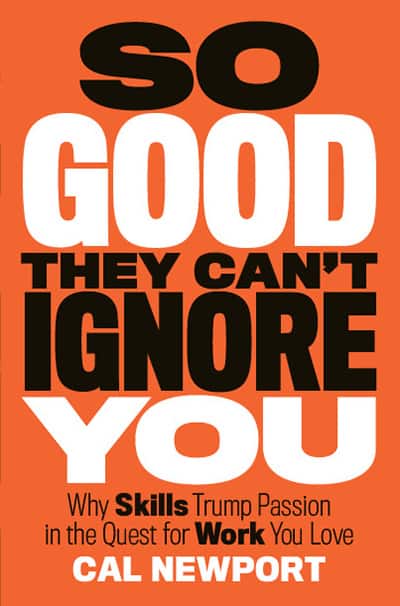
Cal Newport is the author of So Good They Can't Ignore You: Why Skills Trump Passion in the Quest for Work You Love (2012). In the video from the 2012 World Domination Summit, he dispels the "follow your passion" advice so many of us have been given and passed on to others. This video made the rounds on Facebook for a while - I am just now getting around to sharing it here.

Here is the blurb for his book:
In this eye-opening account, Cal Newport debunks the long-held belief that "follow your passion" is good advice. Not only is the cliché flawed-preexisting passions are rare and have little to do with how most people end up loving their work-but it can also be dangerous, leading to anxiety and chronic job hopping.

After making his case against passion, Newport sets out on a quest to discover the reality of how people end up loving what they do. Spending time with organic farmers, venture capitalists, screenwriters, freelance computer programmers, and others who admitted to deriving great satisfaction from their work, Newport uncovers the strategies they used and the pitfalls they avoided in developing their compelling careers.

Matching your job to a preexisting passion does not matter, he reveals. Passion comes after you put in the hard work to become excellent at something valuable, not before.
In other words, what you do for a living is much less important than how you do it.

With a title taken from the comedian Steve Martin, who once said his advice for aspiring entertainers was to "be so good they can't ignore you," Cal Newport's clearly written manifesto is mandatory reading for anyone fretting about what to do with their life, or frustrated by their current job situation and eager to find a fresh new way to take control of their livelihood. He provides an evidence-based blueprint for creating work you love.

SO GOOD THEY CAN'T IGNORE YOU will change the way we think about our careers, happiness, and the crafting of a remarkable life.
Cal Newport is an Assistant Professor of Computer Science at Georgetown University, who specializes in the theory of distributed algorithms. He previously earned his Ph.D. from MIT in 2009 and graduated from Dartmouth College in 2004.

In addition to his academic work, Newport is a writer who focuses on contrarian, evidence-based advice for building a successful and fulfilling life in school and after graduation.

'Follow Your Passion' Is Wrong: Cal Newport speaks at World Domination Summit 2012

Published on Jan 29, 2013


"The path to a passionate life is often way more complex than the simple advice 'follow your passion' would suggest."
You've been told you should follow your passion, to do what you love and the money will follow. But how sound is this advice? Cal Newport argues that it's astonishingly wrong.

You can find out more in his book, So Good They Can't Ignore You: Why Skills Trump Passion in the Quest for Work You Love.

Thursday, April 25, 2013

Steve Silberman - Neurodiversity Rewires Conventional Thinking About Brains

Not all brains are created equal, which is a good thing. But based on the pharmaceutical industry's desire to have us all taking pills that homogenize us, you would never be able to tell that neurodiversity is an evolutionary advantage.

This article from Wired Magazine looks at the origins and popularization of neurodiversity.

Neurodiversity Rewires Conventional Thinking About Brains


By Steve Silberman | April 16, 2013

ILLUSTRATION: MARK WEAVER

In the late 1990s, a sociologist named Judy Singer—who is on the autism spectrum herself—invented a new word to describe conditions like autism, dyslexia, and ADHD: neurodiversity. In a radical stroke, she hoped to shift the focus of discourse about atypical ways of thinking and learning away from the usual litany of deficits, disorders, and impairments. Echoing positive terms like biodiversity and cultural diversity, her neologism called attention to the fact that many atypical forms of brain wiring also convey unusual skills and aptitudes.

Autistic people, for instance, have prodigious memories for facts, are often highly intelligent in ways that don’t register on verbal IQ tests, and are capable of focusing for long periods on tasks that take advantage of their natural gift for detecting flaws in visual patterns. By autistic standards, the “normal” human brain is easily distractible, is obsessively social, and suffers from a deficit of attention to detail. “I was interested in the liberatory, activist aspects of it,” Singer explained to journalist Andrew Solomon in 2008, “to do for neurologically different people what feminism and gay rights had done for their constituencies.”

The new word first appeared in print in a 1998 Atlantic article about Wired magazine’s website, HotWired, by journalist Harvey Blume. “Neurodiversity may be every bit as crucial for the human race as biodiversity is for life in general,” he declared. “Who can say what form of wiring will prove best at any given moment? Cybernetics and computer culture, for example, may favor a somewhat autistic cast of mind.

Thinking this way is no mere exercise in postmodern relativism. One reason that the vast majority of autistic adults are chronically unemployed or underemployed, consigned to make-work jobs like assembling keychains in sheltered workshops, is because HR departments are hesitant to hire workers who look, act, or communicate in non-neurotypical ways—say, by using a keyboard and text-to-speech software to express themselves, rather than by chattering around the water cooler.

One way to understand neurodiversity is to remember that just because a PC is not running Windows doesn’t mean that it’s broken. Not all the features of atypical human operating systems are bugs. We owe many of the wonders of modern life to innovators who were brilliant in non-neurotypical ways. Herman Hollerith, who helped launch the age of computing by inventing a machine to tabulate and sort punch cards, once leaped out of a school window to escape his spelling lessons because he was dyslexic. So were Carver Mead, the father of very large scale integrated circuits, and William Dreyer, who designed one of the first protein sequencers.

Singer’s subversive meme has also become the rallying cry of the first new civil rights movement to take off in the 21st century. Empowered by the Internet, autistic self-advocates, proud dyslexics, unapologetic Touretters, and others who think differently are raising the rainbow banner of neurodiversity to encourage society to appreciate and celebrate cognitive differences, while demanding reasonable accommodations in schools, housing, and the workplace.

A nonprofit group called the Autistic Self Advocacy Network is working with the US Department of Labor to develop better employment opportunities for all people on the spectrum, including those who rely on screen-based devices to communicate (and who doesn’t these days?). “Trying to make someone ‘normal’ isn’t always the best way to improve their life,” says ASAN cofounder Ari Ne’eman, the first openly autistic White House appointee.

Neurodiversity is also gaining traction in special education, where experts are learning that helping students make the most of their native strengths and special interests, rather than focusing on trying to correct their deficits or normalize their behavior, is a more effective method of educating young people with atypical minds so they can make meaningful contributions to society. “We don’t pathologize a calla lily by saying it has a ‘petal deficit disorder,’” writes Thomas Armstrong, author of a new book called Neurodiversity in the Classroom. “Similarly, we ought not to pathologize children who have different kinds of brains and different ways of thinking and learning.”

In forests and tide pools, the value of biological diversity is resilience: the ability to withstand shifting conditions and resist attacks from predators. In a world changing faster than ever, honoring and nurturing neurodiversity is civilization’s best chance to thrive in an uncertain future.