Showing posts with label relativity theory. Show all posts

Monday, November 10, 2014

Why a Physics Revolution Might Be on Its Way (via Live Science)

Physicist Nima Arkani-Hamed believes we are on the verge of another revolution in physics, an opinion delivered during a live lecture from the Perimeter Institute for Theoretical Physics in Waterloo, Canada.

In essence, relativity and quantum mechanics have been unable to adequately explain the universe, both separately and together.

Why a Physics Revolution Might Be on Its Way


by Kelly Dickerson, Staff Writer | November 09, 2014 


Credit: agsandrew | Shutterstock.com

The field of physics may be turned on its head soon, said renowned physicist Nima Arkani-Hamed during a live lecture from the Perimeter Institute for Theoretical Physics in Waterloo, Canada.

For one, he said, the tried and true physics of relativity and quantum mechanics don't get along well. The problem is that in some sense, the principles behind these theories seem to be impossible when physicists dig a little deeper into them, Arkani-Hamed said. Scientists run into a lot of problems when they try to apply these theories to the entirety of space and time.

The two ideas are also incredibly constraining, and they make it challenging for physicists to think outside the box and develop new ideas and theories, Arkani-Hamed said. [The 9 Biggest Unsolved Mysteries in Physics] 


"It's almost impossible to monkey around with the rules and not be wrong immediately," Arkani-Hamed said.

Physicists have known about this disparity for a while, but progress on fundamental questions in physics takes a long time. Scientists proposed the existence of the Higgs boson particle, for example, decades before it was actually discovered.
An unexplained macroscopic universe

One problem is that conventional physics doesn't really account for why the universe is so large, Arkani-Hamed said.

Albert Einstein's theory of relativity showed that a huge amount of energy exists in the vacuum of space, and it should curve space and time. In fact, there should be so much curvature that the universe is a tiny, crumpled ball.

"That should make the universe horrendously different than what it is," Arkani-Hamed said.

But quantum mechanics also poses a problem. The theory is good at describing the very small realm of particle physics, but it breaks down when physicists try to apply it to the universe as a whole.

"Everything that quantum mechanics is, is violated by our universe because we're accelerating (referring to the idea that the universe is expanding) – we don't know what the rules are," Arkani-Hamed said. "When you try to apply quantum mechanics to the entire universe, quantum mechanics cries 'uncle.'"
Physics frontiers

One possible way to solve the problem is with an entirely new theory beyond the Standard Model, the reigning theory of particle physics, the physicist said. [Sparticles to Neutrinos: The Coolest Little Particles in the Universe]

One idea is called string theory, which proposes that particles aren't actually fundamentally particles. Instead, the particles and all the matter in the universe they make up are composed of tiny, vibrating strings. The equations that support string theory appear to work, but that doesn't mean there are no other viable formulas or explanations, Arkani-Hamed said.
Supersymmetry is another possible "new physics" explanation. Under this idea, all subatomic particles have a "superpartner" particle that physicists have yet to discover. Supersymmetry would also open up extra directions that the particles can move in. The discovery of supersymmetry would bolster the Standard Model of physics, scientists have said.

"It's the last thing nature can do to make itself compatible with the general principles of physics that already exist," Arkani-Hamed said.

When the world's largest atom smasher, the Large Hadron Collider (LHC), is up and running again next year, physicists will be looking for the extra particles that supersymmetry suggests should exist.

Either way, after a year or two of running the LHC, the question of whether supersymmetry exists should be answered, Arkani-Hamed said.

The experiments over the next few years will likely tell physicists if they need to fine-tune existing theories or if the field of physics is due for a much deeper and more dramatic paradigm shift.

The questions on the table now are the underpinnings of space and time, and the origin and fate of the universe, Arkani-Hamed said.

"Today we finally have the theoretical framework in place to ask these kinds of big questions," Arkani-Hamed said. "The next step will likely be a revolution."
Follow Kelly Dickerson on Twitter. Follow us @livescience, Facebook & Google+. Original article on Live Science.

Friday, September 19, 2014

Smithsonian - What Is the Universe? Real Physics Has Some Mind-Bending Answers

Fascinating . . . .

What Is the Universe? Real Physics Has Some Mind-Bending Answers

Science says the universe could be a hologram, a computer program, a black hole or a bubble—and there are ways to check


By
smithsonian.com
September 15, 2014

The questions are as big as the universe and (almost) as old as time: Where did I come from, and why am I here? That may sound like a query for a philosopher, but if you crave a more scientific response, try asking a cosmologist.

This branch of physics is hard at work trying to decode the nature of reality by matching mathematical theories with a bevy of evidence. Today most cosmologists think that the universe was created during the big bang about 13.8 billion years ago, and it is expanding at an ever-increasing rate. The cosmos is woven into a fabric we call space-time, which is embroidered with a cosmic web of brilliant galaxies and invisible dark matter.

It sounds a little strange, but piles of pictures, experimental data and models compiled over decades can back up this description. And as new information gets added to the picture, cosmologists are considering even wilder ways to describe the universe—including some outlandish proposals that are nevertheless rooted in solid science:


Will this collection of lasers and mirrors prove the universe is a 2D hologram? (Fermilab)

The universe is a hologram

Look at a standard hologram, printed on a 2D surface, and you’ll see a 3D projection of the image. Decrease the size of the individual dots that make up the image, and the hologram gets sharper. In the 1990s, physicists realized that something like this could be happening with our universe.

Classical physics describes the fabric of space-time as a four-dimensional structure, with three dimensions of space and one of time. Einstein’s theory of general relativity says that, at its most basic level, this fabric should be smooth and continuous. But that was before quantum mechanics leapt onto the scene. While relativity is great at describing the universe on visible scales, quantum physics tells us all about the way things work on the level of atoms and subatomic particles. According to quantum theories, if you examine the fabric of space-time close enough, it should be made of teeny-tiny grains of information, each a hundred billion billion times smaller than a proton.

Stanford physicist Leonard Susskind and Nobel prize winner Gerard ‘t Hooft have each presented calculations showing what happens when you try to combine quantum and relativistic descriptions of space-time. They found that, mathematically speaking, the fabric should be a 2D surface, and the grains should act like the dots in a vast cosmic image, defining the “resolution” of our 3D universe. Quantum mechanics also tells us that these grains should experience random jitters that might occasionally blur the projection and thus be detectable. Last month, physicists at the U.S. Department of Energy’s Fermi National Accelerator Laboratory started collecting data with a highly sensitive arrangement of lasers and mirrors called the Holometer. This instrument is finely tuned to pick up miniscule motion in space-time and reveal whether it is in fact grainy at the smallest scale. The experiment should gather data for at least a year, so we may know soon enough if we’re living in a hologram.

The universe is a computer simulation

Just like the plot of the Matrix, you may be living in a highly advanced computer program and not even know it. Some version of this thinking has been debated since long before Keanu uttered his first “whoa”. Plato wondered if the world as we perceive it is an illusion, and modern mathematicians grapple with the reason math is universal—why is it that no matter when or where you look, 2 + 2 must always equal 4? Maybe because that is a fundamental part of the way the universe was coded.

In 2012, physicists at the University of Washington in Seattle said that if we do live in a digital simulation, there might be a way to find out. Standard computer models are based on a 3D grid, and sometimes the grid itself generates specific anomalies in the data. If the universe is a vast grid, the motions and distributions of high-energy particles called cosmic rays may reveal similar anomalies—a glitch in the Matrix—and give us a peek at the grid’s structure. A 2013 paper by MIT engineer Seth Lloyd builds the case for an intriguing spin on the concept: If space-time is made of quantum bits, the universe must be one giant quantum computer. Of course, both notions raise a troubling quandary: If the universe is a computer program, who or what wrote the code?


An active supermassive black hole at the core of the Centaurus A galaxy blasts jets of radiation into space. (ESO/WFI (visible); MPIfR/ESO/APEX/A.Weiss et al. (microwave); NASA/CXC/CfA/R.Kraft et al. (X-ray))

The universe is a black hole

Any “Astronomy 101” book will tell you that the universe burst into being during the big bang. But what existed before that point, and what triggered the explosion? A 2010 paper by Nikodem Poplawski, then at Indiana University, made the case that our universe was forged inside a really big black hole.

While Stephen Hawking keeps changing his mind, the popular definition of a black hole is a region of space-time so dense that, past a certain point, nothing can escape its gravitational pull. Black holes are born when dense packets of matter collapse in on themselves, such as during the deaths of especially hefty stars. Some versions of the equations that describe black holes go on to say that the compressed matter does not fully collapse into a point—or singularity—but instead bounces back, spewing out hot, scrambled matter.

Poplawski crunched the numbers and found that observations of the shape and composition of the universe match the mathematical picture of a black hole being born. The initial collapse would equal the big bang, and everything in and around us would be made from the cooled, rearranged components of that scrambled matter. Even better, the theory suggests that all the black holes in our universe may themselves be the gateways to alternate realities. So how do we test it? This model is based on black holes that spin, because that rotation is part of what prevents the original matter from fully collapsing. Poplawski says we should be able to see an echo of the spin inherited from our “parent” black hole in surveys of galaxies, with vast clusters moving in a slight, but potentially detectable, preferred direction.

The universe is a bubble in an ocean of universes

Another cosmic puzzle comes up when you consider what happened in the first slivers of a second after the big bang. Maps of relic light emitted shortly after the universe was born tell us that baby space-time grew exponentially in the blink of an eye before settling into a more sedate rate of expansion. This process, called inflation, is pretty popular among cosmologists, and it got a further boost this year with the potential (but still unconfirmed) discovery of ripples in space-time called gravitational waves, which would have been products of the rapid growth spurt.

If inflation is confirmed, some theorists would argue that we must live in a frothy sea of multiple universes. Some of the earliest models of inflation say that before the big bang, space-time contained what’s known as a false vacuum, a high-energy field devoid of matter and radiation that is inherently unstable. To reach a stable state, the vacuum began to bubble like a pot of boiling water. With each bubble, a new universe was born, giving rise to an endless multiverse.

The trouble with testing this idea is that the cosmos is ridiculously huge—the observable universe stretches for about 46 billion light years in all directions—and even our best telescopes can’t hope to peer at the surface of a bubble this big. One option, then, is to look for any evidence of our bubble universe colliding with another. Today our best maps of the big bang’s relic light do show an unusual cold spot in the sky that could be a “bruise” from bumping into a cosmic neighbor. Or it could be a statistical fluke. So a team of researchers led by Carroll Wainwright at the University of California, Santa Cruz, has been running computer models to figure out what other sorts of traces a bubbly collision would leave in the big bang’s echo.

Saturday, November 02, 2013

Matthew Francis - Where Nature Hides the Darkest Mystery of All

From Nautilus Magazine, Facts So Romantic: on Matter, Matthew Francis offers up a brief tour of what we know about those mysteries of space, the back hole.

Where Nature Hides the Darkest Mystery of All


Posted By Matthew Francis on Oct 14, 2013
  
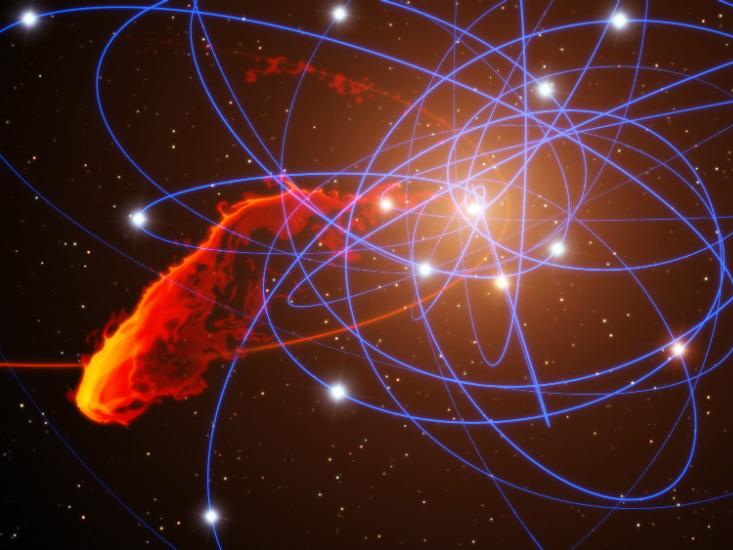
A computer simulation of a gas cloud passing near the supermassive black hole at the center of the Milky Way, and the gravitational effects on the cloud. ESO/MPE/Marc Schartmann

No known object in existence has as clear a division between “inside” and “outside” as a black hole. We live and see the outside, and no probe will bring us information about the inside. We can send radio messages or robotic spacecraft, but once they cross over into a black hole’s interior, we’ll never get back those emissaries…or any information about what happened to them.

The boundary of a black hole is its event horizon. It’s not a surface in the usual sense—there’s no physical barrier—but it’s very much a real thing. Outside the horizon, an object can escape the black hole’s gravitational pull if it’s moving sufficiently fast; inside, it would need to move faster than light-speed, something forbidden by the laws of nature.

In a meaningful sense, a black hole is its event horizon, since we can’t observe anything inside it by any method. The interior is nature’s biggest secret, enshrouded by a barrier that lets everything in but nothing out.

To make black holes even more enigmatic, they are also perfectly featureless, according to general relativity, our best explanation of how gravity works. They may be born from situations as different as the deaths of stars and the gravitational collapse of huge amounts of gas in the early Universe, but the result is the same. Even the chemical composition of what gets sucked into and forms it is irrelevant. The only properties a black hole exhibits to the wider cosmos are its mass and how fast it’s rotating.

This result is puckishly known as the “no-hair theorem”: Whatever is going on in the interior, no “hair” sticks out of the event horizon. (The name was coined by prominent physicist John Archibald Wheeler, obviously not a man sensitive about a receding hairline.) That theorem presents a challenging conundrum: We don’t know whether a black hole actually deletes its autobiography, “forgetting” its past and its progenitor’s composition, or preserves it somehow in a way we don’t know yet. If that information is destroyed, it’s a violation of one of the principles of quantum mechanics; if it’s preserved, it requires a theory beyond general relativity.

The interior of a black hole isn’t merely a an inaccessible region of the cosmos. It’s a laboratory for the most extreme physics: the strongest gravity and the most intense of quantum processes. For that reason, physicists are interested in understanding what goes on inside, even while they are frustrated by the lack of direct experiments or observations that could test their ideas.

We can’t penetrate the bald event horizon, but that doesn’t mean we know nothing about a black hole’s interior. We’re pretty sure black holes don’t contain a portal to another region of space (a wormhole) or another reality, whatever sci-fi may have told us. Most physicists are also reasonably certain that a full description of the interior of black holes will require quantum gravity, a theory unifying quantum physics and general relativity—or possibly a modified version of our current model of gravity. The full structure of such a theory is unknown, but researchers have some thumbnail sketches about what it might look like.

One hybrid approach was put together by Yakov Borisovich Zel’dovich, Jacob Bekenstein, and especially Stephen Hawking. Without a quantum theory of gravity, they used particle physics in combination with general relativity to show that the event horizon has a non-zero temperature and therefore glows, albeit very faintly. This glow is known as Hawking radiation; it arises when partnered particles—one electron and one positron, pairs of photons, etc.—are created in the intense gravitational field. One particle falls into the black hole, while the other escapes.

Since the energy from the black hole was the source of the newly created particles’ mass (via E = mc2), the black hole’s mass shrinks slightly with every escaped particle. Unfortunately, the event horizon temperature is low for black holes like the ones we see, so Hawking radiation is correspondingly much fainter than other sources of light. However, if very low-mass black holes exist, they would shine brightly by Hawking radiation, and decay relatively quickly, evaporating away to nothing. Watching such a black hole vanish might help answer the question of whether information is truly lost or just hidden from us by the event horizon.

Interestingly, Hawking himself thinks the problem has been solved, at least in principle: Black holes preserve the information they swallow, much as a hologram preserves information about three dimensions even though they are two-dimensional pictures. His hypothesis, based on an idea in string theory, doesn’t yet work in our four-dimensional cosmos (three spatial dimensions plus time), but rather for an abstract, higher-dimensional universe. As a result, not everyone is convinced by Hawking’s demonstration, even if they agree that black holes don’t forget their origins.

Hawking radiation presumably consists of all sorts of things, including exotic particles like dark matter and gravitons, which we’ve never seen in the lab. That’s an intriguing notion, though again nature cruelly interferes with our best efforts to study it, by making tiny black holes rare or perhaps nonexistent. We might be able to see Hawking radiation from a larger black hole, but only if it’s not actively feeding on matter and if the hole is very close by. (Another option would be to create a tiny black hole in the lab, but without some new, exotic kind of physics, the necessary energy is beyond our reach.)

The nearest known black hole to Earth, which carries the highly memorable name V404 Cygni, is about 8,000 light-years away. While that’s a mere hair’s breadth in cosmic terms, it’s far enough that we can’t study it up close. (For comparison, Voyager 1—the farthest human-built probe—is a little over 17 light-hours away at the time of writing.) The closest supermassive black hole (one that exceeds a 100,000 times the mass of the Sun) is even farther away: 26,000 light-years. That’s the monster at the center of the Milky Way, known as Sagittarius A* (pronounced “A star”).

We see black holes like V404 Cygni by the matter surrounding them: Material stripped off companion stars, for example, heats up as it orbits the black hole, emitting strong X-ray and radio radiation. Thanks to high-resolution observations made last year, astronomers have measured swirling gas at very close orbits to the giant black hole in the galaxy M87. And the dance of stars and plasma near Sagittarius A* reveals the presence of the black hole that helps keep our galaxy together.

With continued improvements, we’ll be able to get an even better view of black holes, drawing ever closer to the event horizon. Yet nature still hides the mystery of what lies inside a black hole, perhaps forever.


~ Matthew Francis is a physicist, science writer, public speaker, educator, and frequent wearer of jaunty hats. He’s currently writing a book on cosmology with the working title Back Roads, Dark Skies: A Cosmological Journey.