Showing posts with label black holes. Show all posts

Saturday, November 02, 2013

Matthew Francis - Where Nature Hides the Darkest Mystery of All

From Nautilus Magazine, Facts So Romantic: on Matter, Matthew Francis offers up a brief tour of what we know about those mysteries of space, the back hole.

Where Nature Hides the Darkest Mystery of All


Posted By Matthew Francis on Oct 14, 2013
  
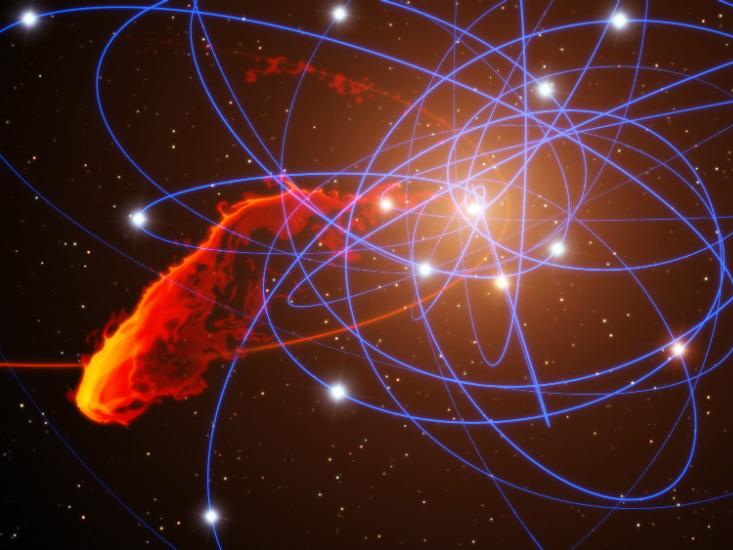
A computer simulation of a gas cloud passing near the supermassive black hole at the center of the Milky Way, and the gravitational effects on the cloud. ESO/MPE/Marc Schartmann

No known object in existence has as clear a division between “inside” and “outside” as a black hole. We live and see the outside, and no probe will bring us information about the inside. We can send radio messages or robotic spacecraft, but once they cross over into a black hole’s interior, we’ll never get back those emissaries…or any information about what happened to them.

The boundary of a black hole is its event horizon. It’s not a surface in the usual sense—there’s no physical barrier—but it’s very much a real thing. Outside the horizon, an object can escape the black hole’s gravitational pull if it’s moving sufficiently fast; inside, it would need to move faster than light-speed, something forbidden by the laws of nature.

In a meaningful sense, a black hole is its event horizon, since we can’t observe anything inside it by any method. The interior is nature’s biggest secret, enshrouded by a barrier that lets everything in but nothing out.

To make black holes even more enigmatic, they are also perfectly featureless, according to general relativity, our best explanation of how gravity works. They may be born from situations as different as the deaths of stars and the gravitational collapse of huge amounts of gas in the early Universe, but the result is the same. Even the chemical composition of what gets sucked into and forms it is irrelevant. The only properties a black hole exhibits to the wider cosmos are its mass and how fast it’s rotating.

This result is puckishly known as the “no-hair theorem”: Whatever is going on in the interior, no “hair” sticks out of the event horizon. (The name was coined by prominent physicist John Archibald Wheeler, obviously not a man sensitive about a receding hairline.) That theorem presents a challenging conundrum: We don’t know whether a black hole actually deletes its autobiography, “forgetting” its past and its progenitor’s composition, or preserves it somehow in a way we don’t know yet. If that information is destroyed, it’s a violation of one of the principles of quantum mechanics; if it’s preserved, it requires a theory beyond general relativity.

The interior of a black hole isn’t merely a an inaccessible region of the cosmos. It’s a laboratory for the most extreme physics: the strongest gravity and the most intense of quantum processes. For that reason, physicists are interested in understanding what goes on inside, even while they are frustrated by the lack of direct experiments or observations that could test their ideas.

We can’t penetrate the bald event horizon, but that doesn’t mean we know nothing about a black hole’s interior. We’re pretty sure black holes don’t contain a portal to another region of space (a wormhole) or another reality, whatever sci-fi may have told us. Most physicists are also reasonably certain that a full description of the interior of black holes will require quantum gravity, a theory unifying quantum physics and general relativity—or possibly a modified version of our current model of gravity. The full structure of such a theory is unknown, but researchers have some thumbnail sketches about what it might look like.

One hybrid approach was put together by Yakov Borisovich Zel’dovich, Jacob Bekenstein, and especially Stephen Hawking. Without a quantum theory of gravity, they used particle physics in combination with general relativity to show that the event horizon has a non-zero temperature and therefore glows, albeit very faintly. This glow is known as Hawking radiation; it arises when partnered particles—one electron and one positron, pairs of photons, etc.—are created in the intense gravitational field. One particle falls into the black hole, while the other escapes.

Since the energy from the black hole was the source of the newly created particles’ mass (via E = mc2), the black hole’s mass shrinks slightly with every escaped particle. Unfortunately, the event horizon temperature is low for black holes like the ones we see, so Hawking radiation is correspondingly much fainter than other sources of light. However, if very low-mass black holes exist, they would shine brightly by Hawking radiation, and decay relatively quickly, evaporating away to nothing. Watching such a black hole vanish might help answer the question of whether information is truly lost or just hidden from us by the event horizon.

Interestingly, Hawking himself thinks the problem has been solved, at least in principle: Black holes preserve the information they swallow, much as a hologram preserves information about three dimensions even though they are two-dimensional pictures. His hypothesis, based on an idea in string theory, doesn’t yet work in our four-dimensional cosmos (three spatial dimensions plus time), but rather for an abstract, higher-dimensional universe. As a result, not everyone is convinced by Hawking’s demonstration, even if they agree that black holes don’t forget their origins.

Hawking radiation presumably consists of all sorts of things, including exotic particles like dark matter and gravitons, which we’ve never seen in the lab. That’s an intriguing notion, though again nature cruelly interferes with our best efforts to study it, by making tiny black holes rare or perhaps nonexistent. We might be able to see Hawking radiation from a larger black hole, but only if it’s not actively feeding on matter and if the hole is very close by. (Another option would be to create a tiny black hole in the lab, but without some new, exotic kind of physics, the necessary energy is beyond our reach.)

The nearest known black hole to Earth, which carries the highly memorable name V404 Cygni, is about 8,000 light-years away. While that’s a mere hair’s breadth in cosmic terms, it’s far enough that we can’t study it up close. (For comparison, Voyager 1—the farthest human-built probe—is a little over 17 light-hours away at the time of writing.) The closest supermassive black hole (one that exceeds a 100,000 times the mass of the Sun) is even farther away: 26,000 light-years. That’s the monster at the center of the Milky Way, known as Sagittarius A* (pronounced “A star”).

We see black holes like V404 Cygni by the matter surrounding them: Material stripped off companion stars, for example, heats up as it orbits the black hole, emitting strong X-ray and radio radiation. Thanks to high-resolution observations made last year, astronomers have measured swirling gas at very close orbits to the giant black hole in the galaxy M87. And the dance of stars and plasma near Sagittarius A* reveals the presence of the black hole that helps keep our galaxy together.

With continued improvements, we’ll be able to get an even better view of black holes, drawing ever closer to the event horizon. Yet nature still hides the mystery of what lies inside a black hole, perhaps forever.


~ Matthew Francis is a physicist, science writer, public speaker, educator, and frequent wearer of jaunty hats. He’s currently writing a book on cosmology with the working title Back Roads, Dark Skies: A Cosmological Journey.
Tuesday, April 23, 2013

How to Build a Multiverse

From The Economist, a little lesson on "table-top astrophysics." Physicists are not able to bring black holes or white dwarfs to their labs, so they are recreating them at the molecular level to advance our knowledge of these phenomena.

How to build a multiverse


Small models of cosmic phenomena are shedding light on the real thing


Mar 16th 2013  |  From the Edition


THE heavens do not lend themselves to poking and prodding. Astronomers therefore have no choice but to rely on whatever data the cosmos deigns to throw at them. And they have learnt a lot this way. Thus you can even (see article) study chemistry in space that would be impossible in a laboratory. Some astronomers, though, are dissatisfied with being passive observers. Real scientists, they think, do experiments.

It is impossible—not to mention inadvisable—to get close enough to a star or a black hole to manipulate it experimentally. But some think it might be possible to make meaningful analogues of such things, and even of the universe itself, and experiment on those instead.

Ben Murdin of the University of Surrey, for example, has been making white dwarfs. A white dwarf is the stellar equivalent of a shrunken but feisty old-age pensioner. It has run out of fuel and is contracting and cooling as it heads towards oblivion—but taking its time about it. As they shrink white dwarfs pack a mass up to eight times the sun’s into a volume the size of Earth. A consequence of stuffing so much matter into so little space is that white dwarfs have powerful magnetic fields. Many aspects of a white dwarf’s mechanics, including how long it will last, are thought to depend on its magnetism. But it is hard to measure.

To make estimates, scientists examine the light a white dwarf emits for telltale patterns left by stellar ingredients like hydrogen. They then compare this spectrum with a theory, based on calculations from first principles, of how magnetic fields effect light emitted by hydrogen. The predictions agree with experiments up to the strongest fields mankind can muster—about 1,000 tesla, generated in a thermonuclear detonator. The problem is that the theory puts white dwarfs’ magnetic fields at 100,000 tesla or more, well beyond humanity’s reach.

Dr Murdin built his own little white dwarf to see if the theory looked good. It consists of a silicon crystal sprinkled with phosphorus atoms. A silicon atom has four electrons in its outer shell. In a crystal, all four are used to bind it to neighbouring atoms. Phosphorus has five outer electrons. Insert a phosphorus atom into the silicon lattice and you are left with an unused electron. Since phosphorus also has one more proton in its nucleus than silicon does, taken together the extra particles resemble a hydrogen atom: a single electron tethered to a single proton.

However, the extra electron is much less tightly held by the extra proton in this pseudo-hydrogen than it would be in real hydrogen. This weaker grasp means that it takes much less magnetism to make a given change in the pseudo-hydrogen’s spectrum than it would for real hydrogen. So when Dr Murdin placed the crystal in a 30-tesla magnet at Radboud University in the Netherlands (his lab in Guildford lacks the necessary kit), he was mimicking the conditions in a 100,000-tesla white dwarf. And the spectrum came out looking just the way the theory predicted.

A black hole in a bath…

Creating a star in a laboratory is small beer compared with creating a black hole. This is an object that is so massive and dense that not even light can flee its gravitational field. Looking inside one is therefore, by definition, impossible. All the more reason to try, says Silke Weinfurtner of the International School for Advanced Studies, in Trieste, Italy.

Dr Weinfurtner plans to make her black hole in the bath. The bath in question, properly called a flume, is a water-filled receptacle 3 metres by 1.5 metres and 50cm deep, across which carefully crafted trains of ripples can pass. In the middle of the tank is a plug hole. If the water going down the hole rotates faster than the ripples can propagate, the ripples which stray beyond the aqueous “event horizon” (a black hole’s point of no return) will not make it out. They are sucked down the drain.

Then the researchers will check whether the simulacrum affects water waves in a way analogous to that which general relativity predicts for light—itself a wave—approaching an astrophysical black hole. According to Albert Einstein’s theory, a region immediately outside the event horizon of a rotating black hole will be dragged round by the rotation. Any wave that enters this region but does not stray past the event horizon should be deflected and come out with more energy than it carried on the way in. To detect this super-radiant scattering, as the effect is called, Dr Weinfurtner will add fluorescent dye to the water and illuminate the surface waves with lasers. The waves, often no bigger than one millimetre, can then be detected using high-definition cameras.

Stefano Liberati, Dr Weinfurtner’s colleague in Trieste, reserves the greatest enthusiasm for another aspect of the experiment. It might, if the researchers are lucky enough, offer clues to the nature of space-time. Could the cosmic fabric be made up of discrete chunks, atoms of space if you like, rather than being continuous, as is assumed by relativity? This problem has perplexed physicists for decades. Many suspect black holes hold the answer, because they are sites where continuous relativity meets chunky quantum physics.

Waterborne holes serve as a proxy. Water is, after all, made up of just such discrete chunks: molecules of H₂O. As wavelengths fall—equivalent to rising energy—waves reach a point where the size of molecules may begin to influence how they behave. If Dr Weinfurtner and Dr Liberati observe some strange behaviour around their event horizons, theorists will be thrilled.

…and home-brewed universes

Even benchtop black holes, though, are nothing compared with the ambitions of Igor Smolyaninov of the University of Maryland. For Dr Smolyaninov wants to create entire universes.

The way light travels through the four dimensions of space-time is mathematically akin to how it moves through “metamaterial”. These are substances with features measured in nanometres, or billionths of a metre, which let them bend light in unusual ways. For example they can force light to skirt along the outside of an object, hiding it from view as if behind an invisibility cloak. Space-time, too, bends light, in ways that depend on how mass is distributed within it.

In principle, then, metamaterials ought to be able to mimic how light moves not just through the space-time scientists on Earth are familiar with, but also other possible space-times to which they do not, and never will, have access. Two years ago Dr Smolyaninov suggested an experiment with various metamaterials, corresponding to universes with different properties lashed together into a home-brewed multiverse. In a paper to be published inOptics Express, he and his colleagues report that they have succeeded.

Rather than fine-tune metamaterial to exact specifications, which is finicky and expensive, the researchers used nanoparticles of cobalt, which are relatively easy to get hold of, and suspended them in kerosene. They then applied a magnetic field which, thanks to cobalt’s ferromagnetic nature, arranged the particles into thin columns. In space-time terms the length of the columns is time and the two axes perpendicular to the length represent the three spatial dimensions in a real universe.

To build his multiverse, Dr Smolyaninov added slightly less cobalt to the kerosene, about 8% by volume, than was needed to maintain stable nanocolumns. Natural fluctuations in the density of the fluid then lead to the spontaneous erection of transient nanocolumns—equivalent to space-times popping up only to fizzle and re-emerge elsewhere in the multiverse. They could be detected by their effect on polarised light shone through the material.

Whether all this ingenuity unravels any cosmic truth is uncertain. Cliff Burgess, a theorist at Perimeter Institute for Theoretical Physics in Ontario, has his doubts. But he thinks that such experiments are nevertheless worth pursuing. “Like tap-dancing snakes,” he says, “the point is not that they do it well, it is that they do it at all.”

From the print edition: Science and technology

Friday, October 21, 2011

David Anthony Lowe - Our Universe May Exist Inside a Black Hole

Does our universe exist inside a black hole? How cool would that be - and what a great premise for a sci-fi novel. David Anthony Lowe is working with "a particular description of the holographic principle that shows that a certain kind of universe with gravity can be described, after dropping a dimension, by quantum field theory. (See "The Black Hole and the Babel Fish" for more about the holographic principle.)" Lowe's universe is one with no beginning and no end - and it also is one of many. I think I like his model . . . for now.


The End of Time?

Our universe may be housed inside a black hole. If so, we can map out how time—and physics—will end.
by Kate Becker
FQXi Awardees: David Lowe
June 28, 2011
Imagine strolling up to a very unusual department store. There are no windows, so you can’t see inside. But the external walls of the store list everything it contains: Every party dress, handbag, kitten-heel shoe, and silk scarf is inventoried; the exact size and color and shape is recorded; all the information about every thread of every stitch is emblazoned there on the brick wall.


Now imagine that the shop isn’t really a shop. It’s a black hole, and it contains our entire universe. Not just the stars and galaxies that we can see with telescopes, but many other regions of space, where the laws of physics operate differently. Our familiar universe, with its hundreds of billions of galaxies, is rather provincial, the cosmic equivalent of the Ladies’ Shoe department.


That’s a rough analogy for a new view of the universe being proposed by FQXi grant winner David Anthony Lowe, a physicist at Brown University, that will allow him to explore the "big questions" of cosmology: How big is the universe? Will it expand forever? Has it always existed? Will it always exist?


Lowe’s work builds on the holographic principle, the idea that all the information in our universe can be mathematically represented on a cosmic horizon like the surface of a black hole. Just like the two-dimensional hologram on your credit card, which appears to spring into a third dimension when you hold it just so, this cosmic hologram encodes information for one more dimension than it exists in itself. Lowe interprets the holographic principle as more than just a handy mathematical tool: "It means we’re inside a black hole," he says. "It is a physical reality."
Read the whole article.