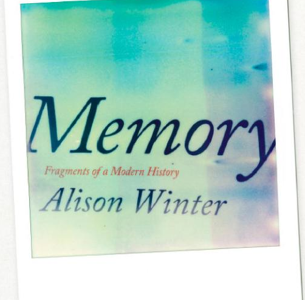
From All in the Mind, hosted by Lynne Malcolm, this episode of the podcast looks at memory with Alison Winter, a professor of history at the University of Chicago. They are discussing her recent book,
Memory: Fragments of a Modern History, which is described by the publisher as follows:
Picture your twenty-first birthday. Did you have a party? If so, do you remember who was there? Now step back: how clear are those memories? Should we trust them to be accurate, or is there a chance that you’re remembering incorrectly? And where have the many details you can no longer recall gone? Are they hidden somewhere in your brain, or are they gone forever?
Such questions have fascinated scientists for hundreds of years, and, as Alison Winter shows in Memory: Fragments of a Modern History, the answers have changed dramatically in just the past century. Tracing the cultural and scientific history of our understanding of memory, Winter explores early metaphors that likened memory to a filing cabinet; later, she shows, that cabinet was replaced by the image of a reel of film, ever available for playback. That model, too, was eventually superseded, replaced by the current understanding of memory as the result of an extremely complicated, brain-wide web of cells and systems that together assemble our pasts. Winter introduces us to innovative scientists and sensationalistic seekers, and, drawing on evidence ranging from scientific papers to diaries to movies, explores the way that new understandings from the laboratory have seeped out into psychiatrists' offices, courtrooms, and the culture at large. Along the way, she investigates the sensational battles over the validity of repressed memories that raged through the 1980s and shows us how changes in technology—such as the emergence of recording devices and computers—have again and again altered the way we conceptualize, and even try to study, the ways we remember.
Packed with fascinating details and curious episodes from the convoluted history of memory science, Memory is a book you'll remember long after you close its cover.
This podcast is a nice discussion of the book. Here is a snippet of the conversation (you can read the transcript, if you prefer,
at the site):
Lynne Malcolm: Does hearing some of those pivotal
moments in history trigger particular personal memories for you about
where you were and what you were doing when these events occurred?
Alison Winter’s historical account of our concept of memory also tells
us a lot about the history of information technology through the lens of
our changing understanding of memory. One example of this is what
became known as the flashbulb memory.
Alison Winter: One of the things that most interested me in my research is the
relationship between recording technologies on the one hand and how
they’ve been understood; and what you might call internal memory, memory
within our minds. Because researchers on memory have tended to compare
memory to whatever recording device was most exciting, or cutting edge
at the time. So the story about the flashbulb has to do with the way
that people took pictures with cameras in the 20th century.
During
my childhood there were many ads for cameras and film that talked about
the Kodak moment you could take a picture of a moment in your family’s
life that was on the one hand perfectly ordinary but on the other hand
it would be absolutely unique and there would be this one special moment
like the moment when a child takes a dive in a pool for the first
time. Something both mundane and superb and then if you don’t have the
camera with you you can’t capture that moment and it’s a split second.
Well
the national event that was related to this idea of a frozen moment was
the moment when people in America heard about the assassination of
President Kennedy and for years after that people would talk about where
they were and what they were doing at the moment when they heard about
the assassination. This is the early days of television so it was one of
the first times when something of this scale of shock was communicated
so quickly to so many people. And psychologists at Harvard Roger Brown
and James Kulik were intrigued by how vivid these descriptions were of
the moment. It was almost they thought like a photograph and they
weren’t the first people to make this comparison.
There was a
neuroscience researcher called Livingston, he had this theory that he
called ‘now print’ and what he claimed was that there was a moment like a
flashbulb moment when if something very, very important happened to
you, particularly something traumatic, you would almost print
neurologically. You would save a very, very rich amount of information
about what you were doing without filtering out little details. So for
instance right now I’m sitting in this sound room in front of a
microphone and if something cataclysmic happens I might remember the
particular shape of a tissue that’s poking out of a box on the table in
front of me. Some totally irrelevant details but completely preserved in
all their richness because according to Livingston at these moments of
extreme trauma you don’t know what might be important so you save
everything.
So Brown and Kulik ten years later looked back on
Livingston’s work as a way of explaining these memories that people had
of the Kennedy assassination and they, using the most appropriate
recording technology metaphor said this is a flashbulb memory, for just a
tiny moment your world is completely lit up by a flashbulb and it’s
saved. The example that I give of a flashbulb memory in my own life is I
remember exactly where I was on the stairs and which foot was about to
take the next step when I heard the news about planes flying into the
World Trade Centre, my right foot was about to take a downward step and I
remember everything, or so it feels to me.
Now there were many
people who disagreed with this and there’s been 20 years of research on
it but that was the claim that was made in the late 1970s.
For centuries scientists have grappled with the concept of memory—what is it, how does it work and can we really rely on it? US historian Alison Winter traces the history of the way we have conceptualised memory—from the use of truth serums and hypnotism to the science of forgetting. She describes the way memory has been compared to filing cabinets, flashbulbs and motion pictures over the past century.
This episode is only available to download and listen online
Guests
- Alison Winter: Author and Associate Professor of History at the University of Chicago


