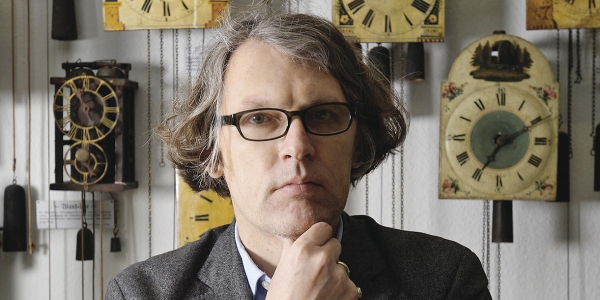
If I could study with any living therapist, Robert Stolorow is one of three people I would pay to learn from (the others are Donna Orange [a frequent Stolorow collaborator] and Diana Fosha). [Well, okay, there is a fourth one, another frequent Stolorow collaborator, George Atwood.] Throughout his career, he has emphasized the phenomenological experience of the client in psychotherapy, often invoking philosophers such as Heidegger or Gadamer, and the intersubjective space created in the therapeutic dyad.
I have read nearly all of his books, as well as a LOT of his articles. There is a near-full listing of his books in the introduction to the interview - of those (any one is a great read), I highly recommend World, Affectivity, Trauma: Heidegger and Post-Cartesian Psychoanalysis (2011), Working Intersubjectively: Contextualism in Psychoanalytic Practice (1997), Structures of Subjectivity: Explorations in Psychoanalytic Phenomenology (2014 [1984]. 2nd ed.), and The Intersubjective Perspective (1994), the latter being a collection of essays edited by Stolorow, George Atwood, and George Brandchaft.

Here is a passage from World, Affectivity, Trauma: Heidegger and Post-Cartesian Psychoanalysis (p. 44):
Trauma shatters the absolutisms of everyday life, which, like the illusions of the “they,” evade and cover up the finitude, contingency, and embeddedness of our existence and the indefiniteness of its certain extinction. Such shattering exposes what had been heretofore concealed, thereby plunging the traumatized person, in Heidegger’s terms, into a form of authentic Being-toward-death and into the anxiety—the loss of significance, the uncanniness—through which authentic Being-toward-death is disclosed. Trauma, like authentic Being-toward-death, individualizes us, but in a manner that manifests in an excruciating sense of singularity and solitude.And this (p. 55-56):
Trauma devastatingly disrupts the ordinary, average-everyday linearity and “ecstatical unity of temporality” (Heidegger, 1927, p. 416), the sense of “stretching-along” (p. 426) from the past to an open future. Experiences of emotional trauma become freezeframed into an eternal present in which one remains forever trapped, or to which one is condemned to be perpetually returned through the portkeys supplied by life’s slings and arrows. In the region of trauma, all duration or stretching along collapses; past becomes present, and future loses all meaning other than endless repetition. In this sense it is trauma, not, as Freud (1915) would have it, the unconscious that is timeless.
Because trauma so profoundly modifies the universal or shared structure of temporality, the traumatized person quite literally lives in another kind of reality, an experiential world felt to be incommensurable with those of others. This felt incommensurability, in turn, contributes to the sense of alienation and estrangement from other human beings that typically haunts the traumatized person. Torn from the communal fabric of being-in-time, trauma remains insulated from human dialogue.In the first paragraph, "portkeys" is a Harry Potter reference (that I was unaware of) and are defined as "objects that transported him instantly to other places, obliterating the duration ordinarily required for travel from one location to another."
Anyway, I could go on all day quoting Stolorow's texts and my appreciation for them.
All of this serves as an introduction to an interview of Stolorow from Figure/Ground back in 2011.
Interview with Robert D. Stolorow
© Robert D. Stolorow and Figure/Ground
Dr. Stolorow was interviewed by Laureano Ralón. June 13th, 2011.
Robert D. Stolorow, Ph.D., is a Founding Faculty Member and Training and Supervising Analyst at the Institute of Contemporary Psychoanalysis, Los Angeles; a Founding Faculty Member at the Institute for the Psychoanalytic Study of Subjectivity, New York City; and a Clinical Professor of Psychiatry at the UCLA School of Medicine. He is the author of World, Affectivity, Trauma: Heidegger and Post-Cartesian Psychoanalysis (2011) and Trauma and Human Existence: Autobiographical, Psychoanalytic, and Philosophical Reflections (2007), and co-author of Worlds of Experience: Interweaving Philosophical and Clinical Dimensions in Psychoanalysis (2002), Working Intersubjectively: Contextualism in Psychoanalytic Practice (1997), Contexts of Being: The Intersubjective Foundations of Psychological Life (1992), Psychoanalytic Treatment: An Intersubjective Approach (1987), Structures of Subjectivity: Explorations in Psychoanalytic Phenomenology (2014 [1984]. 2nd ed.), Psychoanalysis of Developmental Arrests: Theory and Treatment (1980), and Faces in a Cloud: Intersubjectivity in Personality Theory (1993 [1979], 2nd. ed.). He is also coeditor of The Intersubjective Perspective (1994) and has authored or coauthored more than two hundred articles on aspects of psychoanalytic theory and practice. He received his Ph.D. in Clinical Psychology from Harvard University in 1970 and his Certificate in Psychoanalysis and Psychotherapy from the Psychoanalytic Institute of the Postgraduate Center for Mental Health, New York City, in 1974. He also received a Ph.D. in Philosophy from the University of California at Riverside in 2007. He holds diplomas both in Clinical Psychology and in Psychoanalysis from the American Board of Professional Psychology (ABPP). In 1995 he received the Distinguished Scientific Award from the Division of Psychoanalysis of the American Psychological Association, in which he is a Fellow.
What would you define yourself as – an author, a thinker, a public intellectual?
Being a weird interdisciplinary creature, I have to define myself somewhat complexly. I definitely think of myself as a psychoanalytic and philosophical thinker and author. Additionally, I am a practitioner of psychoanalysis and a teacher of both philosophy and psychoanalysis. In recent times, I have also been publishing articles and blogs applying my ideas about collective trauma and defensive ideologies to the socio-political sphere, so I guess that might make me a public intellectual too.
Who were some of your mentors in university and what were some of the most important lessons you learned from them?
I earned a doctorate in clinical psychology at Harvard in 1970 and a doctorate in philosophy at the University of California, Riverside, in 2007, and I reaped rich benefits from mentors during both periods of graduate study. My principal mentor at Harvard was Robert White, from whom I acquired an abiding interest in and respect for the uniqueness of each individual’s world of experience. My principal mentor at Riverside was my dissertation chair, William Bracken, who, although relatively unpublished, is perhaps the most brilliant Heidegger scholar I have encountered. I owe him an enormous dept of gratitude for his contributions to my development as a Heideggerian philosopher. Other important mentors at Riverside from whom I learned a great deal were Kantian philosopher Andrews Reath, phenomenologist Charles Siewert, and another brilliant Heidegger scholar, Mark Wrathall.
You trained both as a philosopher and a psychoanalyst. How did the two careers reinforce each other?
Wow, I would have to write an intellectual memoir to address this question adequately! I’ll try to hit the highlights. I first became interested in the interface of psychoanalysis and philosophy as an undergraduate in the early 1960s when I encountered the writings of Ludwig Binswanger, Medard Boss, and Rollo May, early pioneers who recognized the relevance of Heidegger’s existential philosophy for psychotherapy and psychoanalysis. While a graduate student in clinical psychology, I became disillusioned with empirical psychological research, feeling that it stripped psychology of everything humanly meaningful, and toyed with the idea of doing a second doctorate in philosophy (an ambition that had to await several decades before coming to fruition), which at the time I thought could provide tools for cleaning up the mess that was psychoanalytic theory. However, during my clinical internship I found that I really enjoyed psychoanalytic work and, after completing my doctorate, decided to go to New York to pursue psychoanalytic training instead.
A nodal point in my intellectual career occurred in 1972 when, still in psychoanalytic training, I took a job as an assistant professor of psychology at Rutgers where I met George Atwood, who became my closest collaborator. George (an autodidact with an encyclopaedic knowledge of Continental philosophy) and I embarked upon a series of psycho-biographical studies of the personal, subjective origins of the theoretical systems of Freud, Jung, Rank, and Reich, studies that formed the basis of our first book, Faces in a Cloud: Subjectivity in Personality Theory (Aronson, 1979). From these studies, we concluded that since psychological theories derive to a significant degree from the subjective concerns of their creators, what psychoanalysis and personality psychology needed was a theory of subjectivity itself: a unifying framework capable of accounting not only for the psychological phenomena that other theories address, but also for the theories themselves. In the last chapter of Faces, we outlined a set of proposals for the creation of such a framework, which we called psychoanalytic phenomenology. We envisioned this framework as a depth psychology of personal experience, purified of the mechanistic reifications of Freudian meta-psychology. Our framework took the experiential world of the individual as its central theoretical construct. We assumed no impersonal psychical agencies or motivational prime movers in order to explain the experiential world. Instead, we assumed that this world evolves organically from the person’s encounter with the critical formative experiences that constitute his or her unique life history. Once established, it becomes discernible in the distinctive, recurrent patterns, themes, and invariant meanings that pre-reflectively organize the person’s experiences. Psychoanalytic phenomenology entailed a set of interpretative principles for investigating the nature, origins, purposes, and transformations of the configurations of self and other pervading a person’s experiential world. Importantly, our dedication to illuminating personal phenomenology had led us from Cartesian minds to emotional worlds and, thus, from intra-psychic mental contents to relational contexts. Phenomenology had led us inexorably to contextualism.
Once we had rethought psychoanalysis as a form of phenomenological inquiry, a focus on the mutually-enriching interface of psychoanalysis and Continental phenomenology became inescapable, and I began reading phenomenological philosophy voraciously. In 2000, I formed a leaderless philosophical study group in which we devoted a year to a close reading of Heidegger’s Being and Time and another year to Gadamer’s Truth and Method. Philosopher-psychoanalyst Donna Orange had joined the collaboration with Atwood, and she brought to our phenomenological contextualism a perspectivalist hermeneutic sensibility and a view of psychoanalytic practice as a form of phronesis rather than techne.
A second nodal point for me occurred when I turned my attention to the phenomenology of emotional trauma in the wake of the death of my late wife, Dede, in 1991—a massive trauma that shattered my world. The close study of Being and Time in 2000 proved to be critical. On one hand, Heidegger’s ontological contextualism (In-der-Welt-sein) seemed to provide a solid philosophical grounding for our psychoanalytic phenomenological contextualism. Even more important to me at the time, Heidegger’s phenomenological analysis of Angst, world-collapse, uncanniness, and thrownness into being-toward-death provided me with extraordinary philosophical tools for grasping the existential significance of emotional trauma. It was this latter discovery that motivated me to begin doctoral studies in philosophy and write a dissertation on trauma and Heidegger, which eventuated in my two most recent books, Trauma and Human Existence: Autobiographical, Psychoanalytic, and Philosophical Reflections (Routledge, 2007) and World, Affectivity, Trauma: Heidegger and Post-Cartesian Psychoanalysis (Routledge, 2011). In the last book, I showed both how Heidegger’s existential philosophy can ground and enrich post-Cartesian psychoanalysis and how post-Cartesian psychoanalysis, by relationalizing Heidegger’s conception of finitude and expanding Heidegger’s conception of relationality, can enrich his existential philosophy. I feel that in this book I have, in my sunset years, come into my own as a philosopher.
In your experience, how do you think the role of university professor might have evolved since you were an undergraduate student?
Perhaps partly because I have not been a university professor (in psychology) since 1984 when I moved to California, I have not noticed significant changes in the role of university professor. I was very struck by the enormous devotion to teaching, guiding, and mentoring shown by my philosophy professors at Riverside. Perhaps the biggest change for me as a graduate student was the current importance of the internet and the need for me to become computer-literate fast!
How do you manage to command attention during your talks and lectures in this “age of interruption” characterized by fractured attention and information overload?
When I first began lecturing and then presenting in the early 1970s, I learned to bring my affect into my speaking. This has served me well ever since. I have found that the affect-laden quality of my recent work has been especially appealing to young philosophers.
The following guest question was drafted by Professor Iain Thomson: “Do you think all resurrective ideologies necessarily deny human finitude? What about the later Heidegger’s postmodern idea that truly acknowledging human finitude can give us insight into the inexhaustible nature of being?”
This is a great question. There have been two contexts in which I have written about “resurrective ideology.” One has been my effort to extend my ideas about trauma to the socio-political sphere. In my 2007 book on trauma, I contended that the essence of emotional trauma lies in the shattering of what I called the “absolutisms of everyday life,” the system of illusory beliefs that allow us to function in the world, experienced as stable, predictable, and safe. Such shattering is a massive loss of innocence exposing the inescapable contingency of existence on a universe that is chaotic and unpredictable and in which no safety or continuity of being can be assured. Emotional trauma brings us face to face with our finitude and existential vulnerability and with death and loss as possibilities that define our existence and that loom as constant threats. Often traumatized people try to restore the lost illusions shattered by trauma through some form of resurrective ideology.
Consider, for example, the impact on Americans of the terrorist attack of September 11, 2001, a devastating collective trauma that inflicted a rip in the fabric of the American psyche. In horrifyingly demonstrating that even America can be assaulted on its native soil, the attack of 9/11 shattered Americans’ collective illusions of safety, inviolability, and grandiose invincibility, illusions that had long been mainstays of the American historical identity. In the wake of such shattering, Americans became much more susceptible to resurrective ideologies—e.g., that offered by the Bush administration—that promised to restore the grandiose illusions that have been lost.
The other context, actually the original one, was a psycho-biographical account of Heidegger’s fall into Nazism, which I wrote in collaboration with Atwood and Orange and incorporated into my 2011 book. There we contended that Heidegger’s enthusiastic embrace of his version of Nazism, whose grandiose quality was chillingly manifested in his Rector’s Address, “The Self-Assertion of the German University” (1933), represented his effort to resurrect his sense of agentic selfhood, which had been crushed by the combined emotionally annihilating impact of three circumstances: His muse and lover Hannah Arendt’s withdrawal from him; his magnum opus Being and Time’s being met by the academic world “by hopeless incomprehension”; and his mother’s essentially disowning him on her deathbed for his having broken with the Catholic Church.
After resigning as rector of Freiburg University in 1934 and disengaging from political involvement, Heidegger largely withdrew into a life of solitary philosophical and spiritual reflection, wherein the “turn” in his thinking gained momentum. I think Iain Thomson is right when he claims that the later Heidegger’s acknowledgment and acceptance of an aspect of human finitude—namely, the historically and temporally embedded limitedness of any understanding of being—gave him insight into “being as such,” the inexhaustible source of all intelligibility that resists any attempt to conceptualize it. And yet, do we not glimpse a trace of the old restorative grandiosity in Heidegger’s self-designation as the agent of a new “other beginning,” the initiator of a new epoch in the history of being?
Other emotional themes in Heidegger’s later philosophy are apparent to a psychoanalytic eye. Heidegger is often rightly criticized for never having openly expressed remorse about his Nazi involvement. Yet the whole tenor of his later philosophizing—wherein the grandiose, aggressive, goose-stepping self-assertiveness of the Rector’s Address is replaced by a view of the human being as the “constant receiver,” the “shepherd” and the protector, of the “gift” of being—can be seen to reflect his recognition of his dreadful, deplorable mistake.
Moreover, there is another dimension of human finitude—the finitude of human connectedness, of our “being-with-one-another”—that goes largely unnamed throughout Heidegger’s philosophizing. In my 2011 book, I claimed controversially (with Critchley and Derrida) that human finitude is relational, that being-toward-death always includes a being-toward-loss of loved others, and that death and loss are existentially equiprimordial. In the chapter on Heidegger’s Nazism, we contended that for Heidegger the threat of loss of connectedness with others was built into the quest for authentic individualized selfhood, as was shown vividly in his wrenching struggles to separate himself from the Catholic Church of his family and in his mother’s deathbed renunciation of him for doing just that. In the poetry of Holderlin, Heidegger found the powerful theme of returning—returning to being-at-home and to the lost god that had disappeared—imagery in which we discerned his longing to restore connections lost in his pursuit of individualized selfhood, such as those with his mother and the Catholic family of his childhood. The later Heidegger returned home.
Returning for a moment to your dual training as a philosopher/psychoanalyst, do you think any insights from the social sciences might help transform the philosophical profession for the better and vice versa? Should fields like philosophy and psychology/sociology remain separate, or are there advantages to bridging the existential and existentielle dimensions of human reality in the spirit of interdisciplinary studies and methodological pragmatism?
Clearly, as an interdisciplinary creature myself, I am an advocate of interdisciplinary cross-fertilization (of which my 2011 book is a clear instance), rather than disciplinary insularity. Heidegger’s Being and Time is filled with examples of the advantages of bridging the existential and the existentielle, the ontological and the ontical dimensions of human reality. It is my view that academic psychology made a big historical mistake when, caught in the grip of modern scientism, it separated itself from philosophy in order to become a “hard science.” I regard psychoanalysis, or at least my brand of it, as being neither a branch of medicine nor of psychology, but as applied philosophy.
You have defined your intersubjective-systems theory as a “phenomenological contextualism.” How is your own brand of contextualism similar and/or different from the relational model put forth by social constructionist thought?
There are of course many similarities, but I think there are subtle differences—differences in sensibility—as well. I would say that my brand of contextualism embraces a hermeneutic rather than a constructivist sensibility. Following Gadamer, I would say that all understanding involves interpretation, and this seems different to me from saying that all understanding is constructed. Interpreting something—i.e., understanding it from a particular perspective—seems different to me from constructing a narrative about it.
I assume you are familiar with Speculative Realism and Object-Oriented Ontology. Since your approach to psychiatry is both phenomenological and contextual, I will quote a passage from Graham Harman’s Guerrilla Metaphysics and ask you to reflect on it: “What I am advocating is a reversal of the familiar social pattern in which everyone proves their adequate philosophical training by jabbing a few more daggers into the corpse of realism. From the flintiest analytic philosopher to the most dashing Francophone icon, philosophy today is united through a shared contempt for any probing of a real world in itself. Like all broad fashions of any era, this disdain begins to take on the character of an automatic reflex, and like all mental reflexes soon decays into compulsion. Given this atmosphere, it is widely supposed that substances are championed only by reactionaries living in an irrelevant past, while innovation seems to be on the side of relations and contexts, not individual things. On a related front, it is supposed to be the reactionaries who believe in substances independent of our perceptions, while the self-proclaimed avant-garde delights in bursting this final bubble of the true believers – a tedious drama of canned iconoclasm playing out across the decades. The champions of wholes over parts and the doubters of independent realities can continue to mock the conservatism of their foes if they wish, but the fact is that they have now largely defeated those foes. Holism and antirealism, their days of novelty long past, have become the new philosophical dogmas of our time. The sole difference is that the old orthodoxies viewed their opponents as dangerous cutting-edge transgressors, while the new ones have so exhausted the field of critique and transgression that they are likely to view their challengers only as conservative throwbacks.” Is metaphysics a thing of the past in your view, or do you tend to agree more with Harman?
I don’t really know whether metaphysics is a thing of the past. Heidegger certainly thought that it was, or wished it to be so. What I would say is that metaphysical questions, like the debate between realism and anti-realism, fall outside the domain of phenomenological inquiry (except insofar as metaphysical systems can be historically contextualized and deconstructed, as Heidegger attempted to do). I think Husserl got it right when he characterized the intentional structure of consciousness phenomenologically as always as if directed toward an object, where the “as if” indicates that the metaphysical question about the reality of the intentional object is not to be asked by the phenomenological inquirer.
In agreement with Nietzsche, Heidegger, and Gadamer, my own phenomenological-contextualist viewpoint holds that all understandings of the “real world” are deeply perspectival. A passage from my 2011 book makes this claim very strongly: “Corresponding to its Cartesianism is traditional psychoanalysis’s objectivist epistemology. One isolated mind, the analyst, is claimed to make objective observations and interpretations of another isolated mind, the patient. A phenomenological contextualism … reunites the Cartesian isolated mind with its world…. Correspondingly, intersubjective-systems theory embraces a perspectivalist epistemology, insisting that analytic understanding is always from a perspective shaped by the organizing principles of the inquirer. Accordingly, there are no objective or neutral analysts, no immaculate perceptions (Nietzsche), no God’s-eye view (Putnam) of anyone or anything” (p.20).
What are you currently working on?
I’m planning a paper elaborating on Heidegger’s use of mood as a bridge between the ontical or psychological and the ontological, a bridge to the “truth of being.” In this paper, I want to counter two criticisms of Heidegger: (1) that he fails to distinguish sufficiently the phenomena of mood, emotion, and feeling, and (2) that he neglects the ontological significance of the body.