Showing posts with label 2013. Show all posts

Monday, December 30, 2013

The Year in Fitness and Nutrition


A lot of blogs and websites are doing their year in review pieces as we approach the beginning of 2014. Here are a few that have popped up on my radar.

From Pop Sugar:

The Headlines That Helped Us Drop Pounds in 2013


by Leta Shy December 26, 2013


Another year, another 365 days to unlock the secrets to sustainable weight loss — and in 2013, researchers did not disappoint. From finding the best time to eat a big meal to finding yet another reason to chow down on chocolate, here are the most interesting weight-loss news stories of the year!
 

1. More Sleep Decreases Junk-Food Cravings


We've been learning more and more about just how important sleep is for our waistlines; this year, researchers showed that lack of sleep can actually change how we respond to junk food. When sleep-deprived participants were shown photos of fatty foods like pizza and doughnuts, the reward centers in their brains lit up much more than those who had gotten enough sleep — proving that when you're sleep deprived, you're more likely to make less-than-optimal diet choices than when you're well rested.
 

2. Dark Chocolate Blocks Fat


Last year, it was red wine, and this year it's even more good news: a new study found that dark-chocolate eaters who ate more calories than non dark chocolate eaters still had lower BMIs. The study suggests that an antioxidant found in dark chocolate, epicatechin, may block your body's absorption of fats and sugars.
 

3. Eat More Protein, Lose More Weight


A small study published in September found that the optimal amount of protein for those trying to lose weight may be more than the recommended daily allowance (RDA) set by the Food and Drug Administration. Researchers put patients on specific diets that differed in protein — groups either ate the RDA of protein, double that amount, or triple that amount. Those who ate double the RDA of protein lost more fat than muscle, which is important for keeping metabolism levels up when you are trying to lose weight.
 

4. A Well-Timed Big Lunch Is Key


If you find it hard to schedule a midday meal break during your hectic work day, listen up: a recent study found that late lunchers (those who ate after 3 p.m.) ended up weighing more than those who ate a big lunch earlier. The study also found that late lunchers were more likely to skip breakfast — also a no-no if you're trying to drop pounds. Since the Spanish participants ate their biggest meal at lunch, the study also suggests that front-loading your filling meals during the day can be beneficial for your waistline.
 

5. Start With Exercise


Losing weight requires dedication to both a healthy diet and a consistent workout routine, but if you can't quite fit both into your schedule, start with exercise first, according to a study published earlier this year. The researchers tracked inactive participants as they either started a new diet and exercise routine at the same time, started a new exercise routine followed by a new diet later on, or started a new diet followed by an exercise routine later on. While the diet-and-exercise group fared the best, the study found that those who established a workout routine first (before dealing with their diet) were more successful at sticking to both a workout routine and healthy eating plan later on — which meant more weight loss in the long run.

Source: Thinkstock
* * * * 

Here are links to several useful articles from The Daily Beast:

Study: Exercise Could Be The Key to Mitigating the Christmas Weight Damage

Take away: regular exercise can help mitigate the effects of short-term overfeeding and inactivity, regardless of energy balance. Caveat: They studied young men, and the results may be different for women and for older adults (whose metabolism slows as they age).


Wheat Threatens All Humans, New Research Shows


Take away: Wheat is capable of producing 23,000 different proteins, and while 1 in 16 people seem to be intolerant to gluten, it is the other 22,999 proteins that may be the real issue, particularly wheat germ agglutinin (WGA), which is technically a lectin. WGA binds to gut proteins quite readily, which may leave these cells less well protected against the harmful effects of the gut contents.


These Are The 15 Supplements to Keep In Your Medicine Cabinet

By Ari Meisel
December 28th 2013

More Stories by Ari Meisel

As evidence mounts that multivitamins provide no nutritional benefit, it’s time to forget the ‘daily dose.’ Instead, turn to these 15 supplements and think of your medicine cabinet as your toolbox, taking only what you need.

A lot of people start their days by popping a multivitamin.

Unfortunately, there’s more than enough evidence to show that these “multis” provide absolutely no nutritional benefit. There’s even compelling research that shows they can even do harm to your body. It’s also very confusing since every supplement has different ratios of various vitamins which don’t take into account an individual’s diet or biological makeup. They tend to contain fillers like magnesium stearate, which you might think is a form of the mineral magnesium, when in fact it is an industrial lubricant, meant to keep the pills from sticking to machinery (and has been shown to reduce immune function).

Truth it, there are very few supplements that you should be taking every day.

In fact, when you see RDA values for various vitamins and minerals on a package, you might think that stands for Recommended Daily Amounts, when in actuality, its Recommended Dietary Amounts.

So if you want to take supplements, you need to think of your medicine cabinet as a toolbox, where you use what you need, when you need it, and throw out the idea of a daily dose.

These are the 15 “tools” I keep in my cabinet and what I use them for:

1. Probiotics—A lot of diseases of the industrialized worlds (like my personal favorite, Crohn’s Disease) are thought to be a result of our hyperclean environment with hand sanitizer stations around every corner. Probiotics are the beneficial bacteria that help regulate our digestion, strengthen our immune system and maintain sanity. Unless you are eating fermented foods like sauerkraut, natto, or kefir on a daily basis you should take a probiotic most days and double if you are taking antibiotics.

2. Vitamin D3—Most of you reading this are probably vitamin D deficient if you wear clothes and work indoors. In addition, if you’re diet doesn’t contain adequate amounts of fat then you won’t be able to properly process vitamin D (as well as A, E and K). Most people should be taking around 5,000 IU per day unless you get to spend a good amount of time outside and in the sun. Even those people should take some during the winter months. One more thing, take it in the morning otherwise it can disrupt your sleep since vitamin D and melatonin are inversely related.

3. Krill Oil - Krill Oil, like fish oils can help fight inflammation and lower cholesterol. In tests Krill seems to be better absorbed by the body so you’ll tend to get more bang for your buck and added benefits such as blood sugar regulation and even possible fat loss.

4. Astaxanthin
—The red pigment in salmon and a major skin protectant thought to aid in eye health and inflammation, I take this carotenoid mostly in the winter months when my skin tends to get dryer as the lips in Astaxanthin appear to help maintain elasticity.

5. Phenocane—Nature’s Tylenol, Phenocane’s main ingredient is Curcurmin with a couple added friends that make this an incredibly powerful anti inflammatory and pain killer.

6. Oil of Oregano Capsules—Oil of Oregano (different plant from the stuff on your pizza) contains Carvacrol, an incredibly potent bacteria killer. I take this anytime I travel, am exposed to people I know are sick, or feel a cold coming on.

7. Oil of Oregano Liquid
—in liquid form this stuff is really powerful and will burn a little but a couple drops in a glass of water gargled for a minute will stop a sore throat or sinus infection dead in its tracks.

8. Goat Colostrum—colostrum is the first two or three days of breast milk and contain the building blocks for a strong immune system and health body. Goats milk is the closest equivalent to human breast milk and I always take these in combination with oil of oregano capsules.

9. Xylitol Nasal Spray - xylitol is a sugar alcohol and has antibacterial properties. As a nasal spray it keeps the passages moist and bacteria free, ideal for travel or ducted heating systems.

10. MCT Oil - Medium Chain Triglycerides are the fat transport mechanisms you get when you put coconut oil in a centrifuge. It’s an odorless, tasteless oil that provides an immediate source of ketones (fat energy) to you blood stream and will actually help your cognitive function. I use it in salad dressings or yogurt when I want to up the fat content without adding any taste. If I’ve had a rough night with the kids I’ll add it along with so we grass fed butter to my coffee for a nice cup of Bulletproof Coffee(TM).

11. Digestech—We have different enzymes to help us digest fats, carbs, and protein. Digestech capsules contain those and then some. They help me digest large meals and extract more nutrition from the foods I eat.

12. Activated Charcoal Capsules—sometimes you eat or drink something and wish you Hsn. Don’t panic about the toxins mounting an attack against your body. Just pop a couple capsules of activated charcoal and let natures Brita filter (which actually contains charcoal) trap those toxins and take them out of your body.

13. Alpha Brain - Nootropics are substances which increase cognitive performance. On the pharmaceutical side think Adderall or Modafinil. I’m not one for taking drugs so I turn to Alpha Brain, which contains 11 natural, well studied compounds that will increase focus and memory while offering neuroprotective anti stressors. You can use this daily but I use it when I know I’ve got a big day or meetings or a client engagement ahead of me to help me break through some inner barriers. This won’t turn you into an Einstein, but if you know the answer to the question is inside you somewhere, this might help you find it.

14. Collagen and Whey Protein Powder—Unless you are a bodybuilder or trying to experiment with eating only specific amounts of protein, most people do not need to supplement with protein. Sometimes I’ll do a protein fast for a day or two where I’m limiting protein to 50 grams or less and the easiest way to do that is to eat a whole bunch of veggies and then have a serving of protein power. The two forms are pretty similar but the nice added benefit of collagen powder is that it’s heat stable so you can add it to your coffee if you want.

15. Greens Powder - I try to eat lots of dark leafy greens in my diets but somedays are more difficult than others. A green powder mix like Powerfood from Onnit acts like a dietary insurance policy and gives me things I might never get otherwise like camu for antioxidants or olive leaf for internal cleansing.


That’s what I use—but how about you? Tell me what supplements are in your medicine cabinet in the comments below.

* * * * 

From the Today Show:

Fitness fails: Workouts you need to stop doing in 2014

Take home: Pole dancing, stiletto workouts, gas mask training, backward running, stability ball stands, and yes, even Tough Mudder and warrior dash all need to go according to this piece. 
* * * * *

Another article from the Daily Beast:

The Busy Person’s Guide to Becoming a Fitness Minimalist
By DailyBurn
December 27th 2013

by Joe Vennare for Life by DailyBurn

Imagine a workout that can be done anywhere, anytime. This routine doesn’t require any equipment. There’s no instructor and no membership dues. Better still, completing this workout wouldn’t take all day. Heck, it wouldn’t even take up an entire lunch break.

What if this workout existed?

Well, it does. Call it the Rise of the Fitness Minimalist, or the realization that short, high-intensity workouts (even just seven minutes in length) might be better than slogging through longer exercise sessions. In fact, research shows that 20 to 30 minutes of high-intensity interval training can produce the same aerobic and anaerobic benefits as steady-state cardio workouts twice as long. Stripping away the excess and upping the intensity has also been shown to improve cardiovascular endurance and burn fat—not to mention boost the “afterburn effect.”

Do More With Less


Ready to opt for efficiency over exercise machines while saving precious time in the process? Try these simple strategies to skip the false starts and time-sucks, and start connecting with your inner fitness minimalist.

1. Keep it simple. Sometimes all you need is your own bodyweight to get great results. This workout, created by researchers at the Human Performance Institute in Orlando, Florida takes seven minutes to complete and only uses 12 bodyweight exercises, a wall and a chair. The result: a quick, high-intensity form of circuit training focused on building strength while burning maximum calories. (And who doesn’t love push-ups, wall-sits and high knees?)

2. Up the intensity. When it comes to exercise, we all know something is better than nothing. But when you’re short on time, the trick is thinking about exercise in terms of effort. So while another slow jog around the neighborhood might seem pretty tough, it’s by no means the fastest way to make progress, research suggests. Cram as much intensity into brief workouts as possible by supersetting burpees, mountain climbers or jump squats in between exercises. And if you need an extra push, take the Inferno challenge for a high-internsity program that’s available ’round the clock.

3. Set a timer. When time is short supply, rest periods should be, too (ideally kept to 30 seconds or less). Try this: Set a timer to reflect the length of the workout. Let’s pretend that’s 15 minutes. Now, create a circuit of three to five exercises. Then, start the clock and complete the circuit for as many rounds as possible (AMRAP) in 15 minutes. Of course, never compromise quality over quantity, but by the end of these workouts you should feel sufficiently spent.

4. Watch the clock. Another technique that utilizes the timer is the Tabata protocol. This interval workout only requires four minutes to complete, but can be repeated as part of a 15 or 20-minute routine. Start by selecting an exercise (think burpees, kettlebell swings or thrusters). Then, perform that move for 20 seconds, followed by 10 seconds of rest. Repeat that work-rest routine for eight rounds, clocking in at four minutes flat. On paper it might not seem like much, but these short, intense intervals have been shown to improve athletic capacity, conditioning and fat burning in less time than longer, less intense workouts. Need more guidance? Try these Tabata workouts.

5. Go all out. Jogging is a great way to get moving and stay healthy. But, since we’re aiming for greater results in less time, sprinting is better—specifically HIIT workouts, which alternate between periods of all-out effort and brief recovery. So grab that timer we’ve been using and set it for 60 seconds. Then, sprint, swim, bike, or row all-out for that minute. Take 60 to 90 seconds to rest before repeating at max effort again.

Stick with the Essentials


A great workout requires very few bells and whistles (sometimes none at all). But when the time comes to move beyond bodyweight training, mixing in the right tools can help take your training to new heights. Fitness minimalist and trainer Al Kavadlo, CSCS, recommends picking up a few pieces of versatile exercise equipment (check out what he can do with just a pull-up bar), and using movements like pull-ups, push-ups, dips and squats to get stronger before attempting more difficult moves like the muscle-up or pistol squat. Here’s the essential equipment even a fitness minimalist should consider investing in.

TRX. Set up shop in a doorframe and practice the basic moves, like the horizontal row and suspended push-ups, before moving on to single-leg exercises and explosive moves that require more strength and balance. This type of Total Body Resistance Exercise (TRX, get it?) is a form of suspension training that targets multiple muscle groups at once, limiting the length of workouts and the need for additional equipment.

Jump Rope. The perfect tool for warming up or working cardio into bodyweight routines, the jump rope is a fitness minimalist’s dream. Try fast-paced skips, single leg jumps, and double-unders to improve conditioning and coordination.

Kettlebells. This versatile training tool is the total package. Do cardio and strength train simultaneously while engaging every major body part. Now that’s efficiency at its finest!

Sandbags or SandBells. Make a DIY sandbag or spend a few bucks on a Hyperwear Sandbell and you’ll never have to worry about being bored with a workout, or going to the gym again. This versatile training tool allows for more creative and functional total-body workouts when the usual tools start feeling stale.

Skip the Time Sucks


So far we’ve managed to pack more work into less time. But before we can become true fitness minimalists, it’s important to steer clear of the time sucks that could derail our best efforts. As fitness authority Alwyn Cosgrove puts it, some equipment is a “nice to have, not a need to have.” Cosgrove goes on to state that, “your gains have nothing to do with what equipment you have access to, but everything to do with the work you put in.” If your current routine isn’t delivering results, take a closer look at how you’re using the following.

Exercise machines. Navigating a maze of machines, waiting in line, and wiping them down after each use takes a whole lot of time—time that could be better spent on a more effective workout routine. Plus, some machines like the leg extension and Smith machine might be doing harm than good. Take a page from Cosgrove’s playbook by sticking to workouts that use less equipment but are, “simple, time efficient and brutally effective.”

Cardio equipment. It’s nice to watch television while gliding effortlessly forward and backward on an elliptical, but it’s not effective, efficient and it’s certainly not necessary. Go for a trail run or bike ride instead.

Exercise balls. Sure, the guy balancing on the BOSU ball looks fancy, but research has shown that training on an unstable surface yields few benefits. Plus, the women performing chest press or shoulder press on the Swiss ball could be spending her time more wisely as well. In one study, the chest press and shoulder press were most effective when executed on a stable surface. Sometimes keeping things simple pays off.

No More Excuses


No time, no money, and no gym membership are no longer a reason not to exercise. Become a fitness minimalist and eliminate the excuses along with the excess. By upping the intensity of workouts and using the right equipment, if any, it’s possible to workout anywhere, anytime—even when you’re short on time.

MORE FROM DAILYBURN

2013 - The Year in Books (Off the Beaten Path)

This is my annual "best of" list for books in 2013 - accept this year a lot of what I read was not stuff you will see on best-seller lists or on other people's best of lists. I don't have time to write reviews for all of these, so I am including info from the publisher's page about the book, including contents.

Large Image

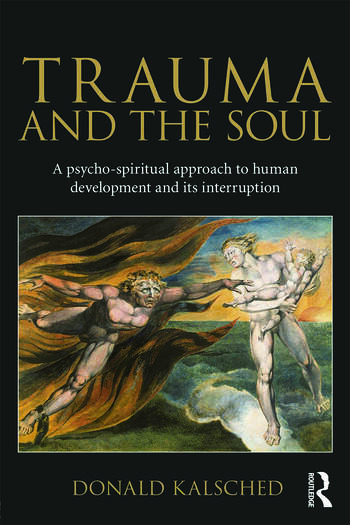
The first book in my collection of 2013 books you likely did not see reviewed anywhere in the mainstream press, if they have been reviewed at all, is also the best of the year, Trauma and the Soul, his follow-up to the well-loved The Inner World of Trauma.

Kalsched offers a rare interdisciplinary approach to psychotherapy, one that integrates psychoanalysis (the postmodern relational version), Jungian analytical psychology, trauma-focused models, somatic therapies, and even some cognitive approaches.

More than the previous book, this one has more of a spiritual depth and relies on the mytho-poetic realm of the imaginal. This adds depth and relevance to his work with trauma survivors.

Trauma and the Soul: A psycho-spiritual approach to human development and its interruption

by Donald Kalsched
Routledge, 2013

About the Book:

In Trauma and the Soul, Donald Kalsched continues the exploration he began in his first book, The Inner World of Trauma (1996)—this time going further into the mystical or spiritual moments that often occur around the intimacies of psychoanalytic work. Through extended clinical vignettes, including therapeutic dialogue and dreams, he shows how depth psychotherapy with trauma’s survivors can open both analytic partners to "another world" of non-ordinary reality in which daimonic powers reside, both light and dark. This mytho-poetic world, he suggests, is not simply a defensive product of our struggle with the harsh realities of living as Freud suggested, but is an everlasting fact of human experience—a mystery that is often at the very center of the healing process, and yet at other times, strangely resists it.

With these "two worlds" in focus, Kalsched explores a variety of themes as he builds, chapter by chapter, an integrated psycho-spiritual approach to trauma and its treatment including:
  • images of the lost soul-child in dreams and how this "child" represents an essential core of aliveness that is both protected and persecuted by the psyche’s defenses;
  • Dante’s guided descent into the Inferno of Hell as a paradigm for the psychotherapy process and its inevitable struggle with self-destructive energies;
  • childhood innocence and its central role in a person’s spiritual life seen through the story of St. Exupéry’s The Little Prince;
  • how clinical attention to implicit processes in the relational field, as well as discoveries in body-based affective neuroscience are making trauma treatment more effective;
  • the life of C.G. Jung as it portrays his early trauma, his soul’s retreat into an inner sanctuary, and his gradual recovery of wholeness through the integration of his divided self.
This is a book that restores the mystery to psychoanalytic work. It tells stories of ordinary patients and ordinary psychotherapists who, through working together, glimpse the reality of the human soul and the depth of the spirit, and are changed by the experience. Trauma and the Soul will be of particular interest to practicing psychotherapists, psychoanalysts, analytical psychologists, and expressive arts therapists, including those with a "spiritual" orientation.

Contents


Introduction.
1. Trauma and Life-Saving Encounters with the Numinous.
2. Loss and Recovery of the Soul-Child.
3. Dissociation and the Dark Side of the Defensive System: Dante's Encounter with "Dis" in the Inferno.
4. Trauma, Transformation and Transcendence: The Case of Mike.
5. Wholeness and Anti-Wholeness Defenses.
6. Psychoanalytic Approaches to the Inner World: Applying Theory to the Cases so Far.
7. Innocence, Its Loss and Recovery: Reflections on St. Exuperey's The Little Prince.
8. C. G. Jung Between the Worlds: Was Jung's Divided Self Pathological?
9. Dismemberment and Re-memberment: Reflections on a Case of Embodied Dream Work in Light of Grimm's Fairy Tale The Woman Without Hands.

* * * * *

This next book is new to me and I found it at the Evolution of Psychotherapy Conference. The author has been using Allan Schore's Affect Regulation and the Origin of the Self: The Neurobiology of Emotional Development (1994) in her graduate classes and wrote this book to bring that material into the clinical setting more easily.


Some of it feels pretty basic, but then I have read all of Allan Schore's books, so the material is not new to me. Where the book shines is in making the connections between brain science and psychological processes that we deal with in the therapy room.

Neurobiology Essentials for Clinicians: What Every Therapist Needs to Know

by


A primer on brain functionality as it relates to therapeutic work.

This book presents an overview of the latest theories of affect regulation and focuses on how these theories work in clinical settings and how therapists can be taught to implement them. The notion of teaching and learning will be extended by the theories themselves—the author presents methods of education that enact the theories being taught.

The book is divided into eight chapters, each one highlighting a particular structure or related structures of the brain. Suggestions for learning how to clinically apply the neurobiological/neuroanatomical information are offered. What is so unique about this book is that the bulk of the chapters are clinical dialogue, accompanied by neurobiological commentary. Thus, readers can see for themselves, during the course of parts of sessions, just how a “neurobiological outlook” can inform therapeutic understandings of what clients are doing and saying. The result is a very user-friendly learning experience for readers, as they are taken along a journey of understanding various brain systems and how they relate to psychotherapeutic principles.

Elegantly bridging the gap between the academic and clinical domains, this book is essential for anyone interested in the application of neurobiological principles to psychotherapy and wishes to learn about neurobiology without feeling overwhelmed or intimidated.


Contents:

Part I. Neurobiological Underpinnings of Selected Clinical Experiences
1. Affect Regulation and the Autonomic Nervous System
2. Defense Mechanisms and the Limbic System
3. Threat Management and the Amygdala
4. Therapeutic Engagement Issues and the Vagal System
5. Personality Disorders as Affect Management Strategies
 

Part II : Special Populations
6. Neurobiological Considerations in Working with Adolescents
7. Working with Groups: How Selected Principles of Regulation Theory can be Applied to Group Work
8. Integrating Selected Neurobiological Concepts into the Supervisory Process

* * * * *

You might be seeing a theme here - many of the books I read this year (the majority of them being much older and not included here) are therapy related, as is this one.

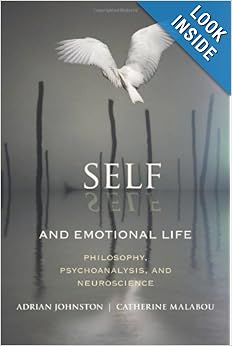
Self and Emotional Life: Philosophy, Psychoanalysis, and Neuroscience
by Adrian Johnston and Catherine Malabou
Columbia University Press, 2013

About the Book:

Adrian Johnston and Catherine Malabou defy theoretical humanities’ deeply-entrenched resistance to engagements with the life sciences. Rather than treat biology and its branches as hopelessly reductive and politically suspect, they view recent advances in neurobiology and its adjacent scientific fields as providing crucial catalysts to a radical rethinking of subjectivity.

Merging three distinct disciplines—European philosophy from Descartes to the present, Freudian-Lacanian psychoanalysis, and affective neuroscience—Johnston and Malabou triangulate the emotional life of affective subjects as conceptualized in philosophy and psychoanalysis with neuroscience. Their experiments yield different outcomes. Johnston finds psychoanalysis and neurobiology have the potential to enrich each other, though affective neuroscience demands a reconsideration of whether affects can be unconscious. Investigating this vexed issue has profound implications for theoretical and practical analysis, as well as philosophical understandings of the emotions.

Malabou believes scientific explorations of the brain seriously problematize established notions of affective subjectivity in Continental philosophy and Freudian-Lacanian analysis. She confronts philosophy and psychoanalysis with something neither field has seriously considered: the concept of wonder and the cold, disturbing visage of those who have been affected by disease or injury, such that they are no longer affected emotionally. At stake in this exchange are some of philosophy’s most important claims concerning the relationship between the subjective mind and the objective body, the structures and dynamics of the unconscious dimensions of mental life, the role emotion plays in making us human, and the functional differences between philosophy and science.


Contents:
Preface: From Nonfeeling to Misfeeling—Affects Between Trauma and the Unconscious
Acknowledgments

Part I. Go Wonder: Subjectivity and Affects in Neurobiological Times (Catherine Malabou)

Introduction: From the Passionate Soul to the Emotional Brain
1. What Does “of” Mean in Descartes’s Expression “The Passions of the Soul”?
2. A “Self-Touching You”: Derrida and Descartes
3. The Neural Self: Damasio Meets Descartes
4. Affects Are Always Affects of Essence: Book 3 of Spinoza’s Ethics
5. The Face and the Close-Up: Deleuze’s Spinozist Approach to Descartes
6. Damasio as a Reader of Spinoza
7. On Neural Plasticity, Trauma, and the Loss of Affects: The Two Meanings of Plasticity
Conclusion

Part II. Misfelt Feelings: Unconscious Affect Between Psychoanalysis, Neuroscience, and Philosophy (Adrian Johnston)

8. Guilt and the Feel of Feeling: Toward a New Conception of Affects
9. Feeling Without Feeling: Freud and the Unresolved Problem of Unconscious Guilt
10. Affects, Emotions, and Feelings: Freud's Metapsychologies of Affective Life
11. From Signifiers to Jouis-sens: Lacan’s Senti-ments and Affectuations
12. Emotional Life After Lacan: From Psychoanalysis to the Neurosciences
13. Affects Are Signifiers: The Infinite Judgment of a Lacanian Affective Neuroscience
Postface: The Paradoxes of the Principle of Constancy

* * * * *

This is one has only been out for the last month or two, and it's dated 2014, but I have a pdf review copy of it. It's a good overview of the ethical issues surrounding biotechnology.

Human Nature in an Age of Biotechnology: The Case for Mediated Posthumanism

by Tamar Sharon
Springer, 2014
Content Level: Research

About the Book:
  • Presents a comparison of models via an exploration of key issues, from human enhancement, to eugenics, and new configurations of biopower
  • Offers a new perspective on human-technology relations that evades the dichotomy of “protecting” ourselves from technology vs. embracing technology as progress
  • Includes a special chapter on molecular biomedicine and evolutionary biology links STS and philosophy of technology to current trends in biology
New biotechnologies have propelled the question of what it means to be human – or posthuman – to the forefront of societal and scientific consideration. This volume provides an accessible, critical overview of the main approaches in the debate on posthumanism, and argues that they do not adequately address the question of what it means to be human in an age of biotechnology. Not because they belong to rival political camps, but because they are grounded in a humanist ontology that presupposes a radical separation between human subjects and technological objects.

The volume offers a comprehensive mapping of posthumanist discourse divided into four broad approaches—two humanist-based approaches: dystopic and liberal posthumanism, and two non-humanist approaches: radical and methodological posthumanism. The author compares and contrasts these models via an exploration of key issues, from human enhancement, to eugenics, to new configurations of biopower, questioning what role technology plays in defining the boundaries of the human, the subject and nature for each.

Building on the contributions and limitations of radical and methodological posthumanism, the author develops a novel perspective, mediated posthumanism, that brings together insights in the philosophy of technology, the sociology of biomedicine, and Michel Foucault’s work on ethical subject constitution. In this framework, technology is neither a neutral tool nor a force that alienates humanity from itself, but something that is always already part of the experience of being human, and subjectivity is viewed as an emergent property that is constantly being shaped and transformed by its engagements with biotechnologies. Mediated posthumanism becomes a tool for identifying novel ethical modes of human experience that are richer and more multifaceted than current posthumanist perspectives allow for.

The book will be essential reading for students and scholars working on ethics and technology, philosophy of technology, poststructuralism, technology and the body, and medical ethics.

Table of Contents

Chapter 1. Introduction.
Chapter 2. A Cartography of the Posthuman.
Chapter 3. The Human Enhancement Debate: For, Against and from Human Nature.
Chapter 4. Towards a Non-Humanist Posthumanism: The Originary Prostheticity of Radical and Methodological Posthumanism.
Chapter 5. From Molar to Molecular Bodies: Posthumanist Frameworks in Contemporary Biology.
Chapter 6. Posthuman Subjectivity: Beyond Modern Metaphysics.
Chapter 7. Technologically Produced Nature: Nature Beyond Schizophrenia and Paranoia.
Chapter 8. New Modes of Ethical Selfhood: Geneticization and Genetically Responsible Subjectivity.
Chapter 9. Conclusion.

 * * * * *

Yes, a book by a Catholic contemplative is one of the best things I have read this year. I began reading his books to vet them for my clients who are Christian and who have never been introduced to nondual thinking or the Perennial Philosophy.

Immortal Diamond: The Search for Our True Self

by Richard Rohr
Jossey-Bass, 2013

About the Book:

Dissolve the distractions of ego to find our authentic selves in God

In his bestselling book Falling Upward, Richard Rohr talked about ego (or the False Self) and how it gets in the way of spiritual maturity. But if there's a False Self, is there also a True Self? What is it? How is it found? Why does it matter? And what does it have to do with the spiritual journey? This book likens True Self to a diamond, buried deep within us, formed under the intense pressure of our lives, that must be searched for, uncovered, separated from all the debris of ego that surrounds it. In a sense True Self must, like Jesus, be resurrected, and that process is not resuscitation but transformation.

  • Shows how to navigate spiritually difficult terrain with clear vision and tools to uncover our True Selves
  • Written by Father Richard Rohr, the bestselling author of Falling Upward
  • Examines the fundamental issues of who we are and helps us on our path of spiritual maturity
Immortal Diamond (whose title is taken from a line in a Gerard Manley Hopkins poem) explores the deepest questions of identity, spirituality, and meaning in Richard Rohr's inimitable style.

Contents:

Invitation: The Immortal Diamond of the True Self
Preface 

1 What Is ‘‘The True Self’’? 
2 What Is ‘‘The False Self’’?
3 What Dies and Who Lives?
4 The Knife Edge of Experience
5 Thou Art That
6 If It Is True, It Is True Everywhere
7 Enlightenment at Gunpoint
8 Intimate with Everything
9 Love Is Stronger Than Death
Epilogue 

Appendix A The True Self and the False Self
Appendix B A Mosaic of Metaphors
Appendix C Watching at the Tomb: Attitudes for Prayer
Appendix D Head into Heart: ‘‘The Sacred Heart’’
Appendix E Adam’s Breathing: Praying from the Clay
Appendix F Twelve Ways to Practice Resurrection Now

* * * * *

Science has a shadow as well as being the gift that has made our lives much easier - this book, originally published in Italy in 2010, takes a meta-perspective on this topic.

The Tree of Knowledge: The Bright and the Dark Sides of Science

by Claudio Ronchi
Springer, 2014 (original Italian publication was 2010)
Content Level: Popular/general

About the Book:
  • A fascinating long view of science by an author with extensive "insider" knowledge
  • Warns against the assumption that science equates with salvation
  • Paints plausible pictures of different futures, showing how they relate to our use and abuse of science
Whether considered a divine gift or a Promethean conquest, science has indisputably and indelibly marked the course of human history. A product of the intellectual elite, but always nourished by the many fruits of its applications, science appears today to be a perfect system, whose laws and discoveries guide all human activities. Yet the foundations of its authority remain an open question, entailing disquieting aspects that are also to be identified in modern science. Furthermore it is seen to be exerting an increasing power over mankind. Readers are invited to follow an itinerary through the history of science, a voyage which, in the end, enables them to catch a glimpse of two divergent futures: One in which science accelerates the downfall of Homo sapiens, and another in which it helps our species to engage in a new and positive adventure, whose outcome nobody can know.

Table of Contents:

1. Time of Growth
2. Birth and Floruit of Science in the Occident
3. Scientific Research as a Global Enterprise
4. The Crisis of Growth
5. Orthodoxy Versus Heresy
6. The Dissemination of Knowledge
7. Beyond Mankind
8. Artificial Intelligence and Post-Humanity
9. The Beginning and the ‘‘End’’
Epilogue
Appendix A: Glossary
* * * * *


This one is fun, and who doesn't love a superhero? But it's also a bit lame in places - however, it is worth the read.


Edited by Robin S. Rosenberg, PhD
Oxford University Press, 2013

About the Book:
  • Explores why children and adults are captivated by superheroes
  • Brief essays raise fascinating questions about human nature
Superhero fans are everywhere, from the teeming halls of Comic Con to suburban movie theaters, from young children captivated by their first comic books to the die-hard collectors of vintage memorabilia. Why are so many people fascinated by superheroes?

In this thoughtful, engaging, and at times eye-opening volume, Robin Rosenberg--a writer and well-known authority on the psychology of superheroes--offers readers a wealth of insight into superheroes, drawing on the contributions of a top group of psychologists and other scholars. The book ranges widely and tackles many intriguing questions. How do comic characters and stories reflect human nature? Do super powers alone make a hero super? Are superhero stories good for us? Most contributors answer that final question in the affirmative. Psychologist Robert J. Sternberg, for instance, argues that we all can learn a lot from superheroes-and what we can learn most of all is the value of wisdom and an ethical stance toward life. On the other hand, restorative justice scholar Mikhail Lyubansky decries the fact that justice in the comic-book world is almost entirely punitive, noting extreme examples such as "Rorschach" in The Watchmen and the aptly named "The Punisher, who embrace a strict eye-for-an-eye sense of justice, delivered instantly and without mercy.

In the end, the appeal of Superman, Batman, Spiderman, and legions of others is simple and elemental. Superheroes provide drama, excitement, suspense, and romance and their stories showcase moral dilemmas, villains we love to hate, and protagonists who inspire us. Perhaps as important, their stories allow us to recapture periods of our childhood when our imaginations were cranked up to the maximum--when we really believed we could fly, or knock down the bad guy, or save the city from disaster.

Table of Contents
Part I: Our Relationship with Superheroes
Introduction: Robin Rosenberg
Chapter 1. our fascination with superheroes: Robin Rosenberg
Chapter 2. Superhero comics as Moral Pornography: David Pizarro and Roy Baumeister
Chapter 3. Are Superhero Stories Good for Us?: Reflections from Clinical Practice: Lawrence Rubin
Chapter 4. Emotions in Comics: Why the Silver Age of comics made a difference: Peter Jordan
Chapter 5. The Effects of Superhero Sagas on Our Gendered Selves: Elizabeth Behm-Morawitz and Hillary Pennell

Part II: The Humanity of Superheroes
Chapter 6. Our Superheroes, Our Supervillains: Are They All That Different? Travis Langley
Chapter 7. Are Superheroes Just Supergifted? Robin Rosenberg and Ellen Winner
Chapter 8. The Very Real Work Lives of Superheroes: Illustrations of Work Psychology: Gary Burns
Chapter 9. How super are superheroes? Robert Sternberg
Chapter 10. Superhero Justice: Mikhail Lyubansky

* * * * *

This one is also new (out since October, but listed as 2014). ACT is a cognitive based therapy model developed by Steven C. Hayes (University of Nevada), who strangely does not have a chapter in this book. It adds a mindfulness component (as everything does these days), and this discusses how to use this model with the symptoms of psychosis.

Acceptance and Commitment Therapy and Mindfulness for Psychosis

Editors: Eric M. J. Morris, Louise C. Johns, Joseph E. Oliver
Wiley-Blackwell, 2013

About the Book:

Emerging from cognitive behavioural traditions, mindfulness and acceptance-based therapies hold promise as new evidence-based approaches for helping people distressed by the symptoms of psychosis. These therapies emphasise changing the relationship with unusual and troublesome experiences through cultivating experiential openness, awareness, and engagement in actions based on personal values. In this volume, leading international researchers and clinicians describe the major treatment models and research background of Acceptance and Commitment Therapy (ACT) and Person-Based Cognitive Therapy (PBCT), as well as the use of mindfulness, in individual and group therapeutic contexts. The book contains discrete chapters on developing experiential interventions for voices and paranoia, conducting assessment and case formulation, and a discussion of ways to work with spirituality from a metacognitive standpoint. Further chapters provide details of how clients view their experiences of ACT and PBCT, as well as offering clear protocols based on clinical practice. This practical and informative book will be of use to clinicians and researchers interested in understanding and implementing ACT and mindfulness interventions for people with psychosis. 

Table of Contents

Foreword: Acceptance, Mindfulness and Psychotic Disorders: Creating a New Place to Begin
1. Introduction to Mindfulness and Acceptance-based Therapies for Psychosis: Joseph E. Oliver, Candice Joseph, Majella Byrne, Louise C. Johns and Eric M. J. Morris
2. Theory on Voices: Fran Shawyer, Neil Thomas, Eric M. J. Morris and John Farhall
3. Emotional Processing and Metacognitive Awareness for Persecutory Delusions: Claire Hepworth, Helen Startup and Daniel Freeman
4. Clinical Assessment and Assessment Measures: John Farhall, Fran Shawyer, Neil Thomas and Eric M. J. Morris
5. Acceptance and Commitment Therapy Case Formulation: Patty Bach
6. Engaging People with Psychosis in Acceptance and Commitment Therapy and Mindfulness: Brandon A. Gaudiano and Andrew M. Busch
7. Acceptance and Commitment Therapy for Voices: Neil Thomas, Eric M. J. Morris, Fran Shawyer and John Farhall
8. Acceptance and Commitment Therapy for Delusions: José Manuel García Montes, Marino Pérez Álvarez and Salvador Perona Garcelán
9. Acceptance and Commitment Therapy for Emotional Dysfunction following Psychosis: Ross White
10. Person-based Cognitive Therapy for Distressing Psychosis: Lyn Ellett
11. Spirituality: A New Way into Understanding Psychosis: Isabel Clarke
12. The Service User Experience of Acceptance and Commitment Therapy and Person-based Cognitive Therapy: Joseph E. Oliver, Mark Hayward, Helena B. McGuiness and Clara Strauss
13. Acceptance and Commitment Therapy for First-episode Psychosis: Joseph E. Oliver and Eric M. J. Morris
14. Acceptance and Commitment Therapy for Psychosis in Acute Psychiatric Admission Settings
Gordon Mitchell and Amy McArthur
15. Developing Acceptance and Commitment Therapy for Psychosis as a Group-based Intervention: Amy McArthur, Gordon Mitchell and Louise C. Johns
16. Group Person-based Cognitive Therapy for Distressing Psychosis: Clara Strauss and Mark Hayward

Appendix A: Chessboard Metaphor
Appendix B: Leaves-on-the-Stream Metaphor 
Appendix C: Passengers-on-the-Bus Metaphor
Appendix D: Person-in-the-Hole Metaphor 
Appendix E: Polygraph Metaphor 
Appendix F: See the Wood for the Trees (And Other Helpful Advice for Living Life)
Appendix G: Skiing Metaphor
Appendix H: Tug-of-War-with-the-Monster Metaphor


Thursday, December 26, 2013

Scientific American - Highlights from Neuroscience 2013

Scientific American Magazine

Here are 5 of the more interesting research presentations at the recent annual meeting of the Society for Neuroscience, as determined by the editors of Scientific American. Access PDFs of the abstracts from this year's meeting or download them to your e-reader or mobile device.

Highlights from Neuroscience 2013

The massive annual meeting of the Society for Neuroscience brought together tens of thousands of researchers exploring the workings of mind and brain


By John Matson

Sunday, December 08, 2013

Project Censored - Top 25 Censored Stories from 2012-2013


Here is the list of censored and under-reported news stories from the last year from Project Censored - an effort that began in 1976 at Sonoma State College. Among the low-lights, Monsanto's GMO conspiracy, the impact of fracking on the food supply, 10 years of the Creative Commons, the "culture of cruelty" along the U.S.-Mexico border, the increasing wealth gap, the rise in hate groups, and Obama's war on whistle-blowers.

Top 25 Censored Stories from 2012-2013


The presentation of this year’s Top 25 stories extends the tradition originated by Professor Carl Jensen and his Sonoma State students in 1976, while reflecting how the expansion of the Project to include affiliate faculty and students from campuses across the country and around the world—initiated several years ago as outgoing director Peter Phillips passed the reins to current director Mickey Huff—has made the Project even more diverse and robust. During this year’s cycle, Project Censored reviewed 233 Validated Independent News stories (VINs) representing the collective efforts of 219 college students and 56 professors from 18 college and university campuses that participate in our affiliate program and 13 additional community evaluators.

25. Israel Gave Birth Control to Ethiopian Immigrants Without Their Consent


In January 2013, Israel acknowledged that medical authorities have been giving Ethiopian immigrants long-term birth-control injections, often without their knowledge or consent. Continue Reading…


24. Widespread GMO Contamination: Did Monsanto Plant GMOs Before USDA Approval?


Monsanto introduced genetically modified alfalfa in 2003—a full two years before it was deregulated, according to recently released evidence... Continue Reading…


23. Transaction Tax Helps Civilize Wall Street and Lower the National Debt


In February 2013, United States senators Tom Harkin (D-Iowa) and Peter DeFazio (D-Oregon) introduced a bill to implement a new tax of three basis points (that is, three pennies for every hundred dollars) on most nonconsumer stock trades. Continue Reading…


22. Pennsylvania Law Gags Doctors to Protect Big Oil’s “Proprietary Secrets”


In communities affected by hydraulic fracturing, or “fracking,” people understand that this process of drilling for natural gases puts the environment and their health at risk Continue Reading…


21. Monsanto and India’s “Suicide Economy”


Monsanto has a long history of contamination and cover-up and in India another Monsanto cover-up is ongoing Continue Reading…


20. Israel Counted Minimum Calorie Needs in Gaza Blockade


Declassified documents reveal that the Israeli military calculated how many calories a typical Gazan would need to survive, in order to determine how much food to supply the Gaza Strip during the 2007–2010 blockade. Continue Reading…


19. The Power of Peaceful Revolution in Iceland


After privatization of the national banking sector, private bankers borrowed billions of dollars or (ten times the size of Iceland’s economy), creating a huge economic bubble that doubled housing prices and made a small percentage of the population exceedingly wealthy Continue Reading…


18. Fracking Our Food Supply


The effects of hydraulic fracturing (or “fracking”) on food supply and the environment are slowly emerging Continue Reading…


17. The Creative Commons Celebrates Ten Years of Sharing and Cultural Creation


Creative Commons (CC) is celebrating ten years of helping writers, artists, technologists, and other creators share their knowledge and creativity with the world Continue Reading…


16. Journalism Under Attack Around the Globe


Journalists are increasingly at risk of being killed or imprisoned for doing their jobs, a situation that imperils press freedom. Continue Reading…


15. Food Riots: The New Normal?


Reduced land productivity, combined with elevated oil costs and population growth, threaten a systemic, global food crisis Continue Reading…


14. Wireless Technology a Looming Health Crisis


As a multitude of hazardous wireless technologies are deployed in homes, schools, and workplaces, government officials and industry representatives continue to insist on their safety despite growing evidence to the contrary. Continue Reading…


13. A Fifth of Americans Go Hungry


An August 2012 Gallup poll showed that 18.2 percent of Americans lacked sufficient money for needed food at least once over the previous year. Continue Reading…


12. The US Has Left Iraq with an Epidemic of Cancers and Birth Defects


High levels of lead, mercury, and depleted uranium are believed to be causing birth defects, miscarriages, and cancer for people living in the Iraqi cities of Basra and Fallujah. Continue Reading…


11. Bush Blocked Iran Nuclear Deal


According to a former top Iranian negotiator, Seyed Hossein Mousavian, in 2005 Iran offered a deal to the United States, France, Germany, and the United Kingdom that would have made it impossible for Iran to build nuclear weapons. Continue Reading…


10. A “Culture of Cruelty” along Mexico–US Border


Migrants crossing the Mexico–US border not only face dangers posed by an unforgiving desert but also abuse at the hands of the US Border Patrol Continue Reading…


9. Icelanders Vote to Include Commons in Their Constitution


In October 2012, Icelanders voted in an advisory referendum regarding six proposed policy changes to the 1944 Constitution Continue Reading…


8. Bank Interests Inflate Global Prices by 35 to 40 Percent


A stunning thirty-five to forty percent of everything we buy goes to interest. Continue Reading…


7. Merchants of Death and Nuclear Weapons


The Physicians for Social Responsibility released a study estimating that one billion people—one-seventh of the human race—could starve over the decade following a single nuclear detonation Continue Reading…


6. Billionaires’ Rising Wealth Intensifies Poverty and Inequality


As a direct result of existing financial policies, the world’s one hundred richest people grew to be $241 billion richer in 2012. Continue Reading…


5. Hate Groups and Antigovernment Groups on Rise across US


The Southern Poverty Law Center (SPLC), which monitors hate groups and antigovernment groups, released a report showing that 1,360 radical, antigovernment “patriot” groups and 321 militias actively operate within the United States Continue Reading…


4. Obama’s War on Whistleblowers


Obama signed both the Whistleblower Protection Enhancement Act, expanding whistleblower protections, in November 2012, and the National Defense Authorization Act (NDAA) furthering these protections in January 2013 Continue Reading…


3. Trans-Pacific Partnership Threatens a Regime of Corporate Global Governance


The Trans-Pacific Partnership (TPP), branded as a trade agreement and negotiated in unprecedented secrecy, is actually an enforceable transfer of sovereignty from nations and their people to foreign corporations. Continue Reading…


2. Richest Global 1 Percent Hide Trillions in Tax Havens


The global 1 percent hold twenty-one to thirty-two trillion dollars in offshore havens in order to evade taxes, according to James S. Henry, the former chief economist at the global management consulting firm, McKinsey & Company. Continue Reading…
 

1. Bradley Manning and the Failure of Corporate Media


In February 2013, United States military intelligence analyst Bradley Manning confessed in court to providing vast archives of military and diplomatic files to the anti-secrecy group WikiLeaks, saying he wanted the information to become public “to make the world a better place” and that he hoped to “spark a domestic debate on the role of the military in (US) foreign policy. Continue Reading…