Monday, September 07, 2009

Upaya Dharma Podcasts - Cultivating Calmness, Loving-kindness & Empathy

More podcast goodness from the Upaya Zen Center, featuring Geshe Kelsang Damdul.

Cultivating Calmness, Loving-kindness & Empathy

Speaker: Geshe Kelsang Damdul

The more we allow the mind to be disturbed or occupied by negative emotion, the more we must work to transform the mind into peace. This action is not only for ourselves; in this age of intricate and fast connection, anything we do will be felt in our community and world. If we meet each moment with a calm mind, we send this exact message into the world. Additionally, it is only through a calm mind that our true nature can be seen and that our negative emotions dissolve. Then, a strong sense of self-worth and love will extend into the greater community.

icon for podpress [Play] Cultivating Calmness, Loving-kindness & Empathy [56:38m]: Hide Player | Play in Popup | Download [Play]

Fairy tales have ancient origin

Very cool.

Fairy tales have ancient origin

Popular fairy tales and folk stories are more ancient than was previously thought, according research by biologists.

Fairy tales have ancient origin

They have been told as bedtime stories by generations of parents, but fairy tales such as Little Red Riding Hood may be even older than was previously thought.

A study by anthropologists has explored the origins of folk tales and traced the relationship between varients of the stories recounted by cultures around the world.

The researchers adopted techniques used by biologists to create the taxonomic tree of life, which shows how every species comes from a common ancestor.

Dr Jamie Tehrani, a cultural anthropologist at Durham University, studied 35 versions of Little Red Riding Hood from around the world.

Whilst the European version tells the story of a little girl who is tricked by a wolf masquerading as her grandmother, in the Chinese version a tiger replaces the wolf.

In Iran, where it would be considered odd for a young girl to roam alone, the story features a little boy.

Contrary to the view that the tale originated in France shortly before Charles Perrault produced the first written version in the 17th century, Dr Tehrani found that the varients shared a common ancestor dating back more than 2,600 years.

He said: “Over time these folk tales have been subtly changed and have evolved just like an biological organism. Because many of them were not written down until much later, they have been misremembered or reinvented through hundreds of generations.

“By looking at how these folk tales have spread and changed it tells us something about human psychology and what sort of things we find memorable.

“The oldest tale we found was an Aesopic fable that dated from about the sixth century BC, so the last common ancestor of all these tales certainly predated this. We are looking at a very ancient tale that evolved over time.”

Dr Tehrani, who will present his work on Tuesday at the British Science Festival in Guildford, Surrey, identified 70 variables in plot and characters between different versions of Little Red Riding Hood.

He found that the stories could be grouped into distinct families according to how they evolved over time.

The original ancestor is thought to be similar to another tale, The Wolf and the Kids, in which a wolf pretends to be a nanny goat to gain entry to a house full of young goats.

Stories in Africa are closely related to this original tale, whilst stories from Japan, Korea, China and Burma form a sister group. Tales told in Iran and Nigeria were the closest relations of the modern European version.

Perrault’s French version was retold by the Brothers Grimm in the 19th century. Dr Tehrani said: “We don’t know very much about the processes of transmission of these stories from culture to culture, but it is possible that they may being passed along trade routes or with the movement of people.”

Professor Jack Zipes, a retired professor of German at the University of Minnesota who is an expert on fairy tales and their origins, described the work as “exciting”. He believes folk tales may have helped people to pass on tips for survival to new generations.

He said: “Little Red Riding Hood is about violation or rape, and I suspect that humans were just as violent in 600BC as they are today, so they will have exchanged tales about all types of violent acts.

“I have tried to show that tales relevant to our adaptation to the environment and survival are stored in our brains and we consistently use them for all kinds of reference points.”


Ovi Magazine - Dreamscaping: The Dimensions of Dreams

http://www.genreonline.net/Genre_files/NightmaresDreamscapes2.JPG

Dream stuff is always fun. Some nice passages on here in the nature of dreams.
Dreamscaping: The Dimensions of Dreams
by David Sparenberg

THE DIMENSIONS OF DREAMS is encyclopedic. I mean this in the best use of the term. The book is thorough, with advantage. Unlike what is typically found in an encyclopedia, this volume maintains ongoing cross references and the author is astute enough to connect the dots throughout the history of many dream work schools and techniques. His process provides the reader with a depth and richness to stimulate the rational mind and imagination alike. The scholarship is backed up with years of experience in public and private practice. Indeed, I would rank Ole Vedfeld’s study as among the best of its kind; certainly a volume of reflective reference to be keep on hand by both professional and lay dream-culture worker.

The book ranges from Tantra through Freud and Jung to contemporary schools and practices developed by the likes of Fritz Perls, James Hillman, Arnold Mindell. Every reader will find their own affinities and mine include the several names now listed. Along these lines, let me invite you into a scant but enticing sampling of passages and pages from THE DIMENSIONS OF DREAMS.

Pgs. 50-51 (Jung, Archetypes & Amplification): “Jung found amplification with cross-cultural symbolic historical material particularly useful with archetypal dreams, in which the dreamer has no personal associations…. The reasons for comparing dream(s) with mythological symbolism from different cultures, is that fundamentally they derive from the same elemental substance: the archetypes” (dynamic forces forming patterns of universal structuring within the human psyche). “Knowledge of the archetypal parallels makes it possible to understand dreams and states of consciousness that are alien and terrifying for the dreamer and so could discourage him (or her) from going further with an inner development…. Archetypal amplifications must always be balanced against the cultural and personal.” For, we might add, the dynamos of the mundus archetypus wear Janus-masks of a near-distant approachability, as they emerge in disguised-revelations out of collective anamnesis, mapped by dreamscapes, articulate in the vocabulary of dreams. This is to say, in full paradoxical motion: these forces are, with patterns established before our arrival, and we are the pattern-makers who know not our sources. Yet each is charged with making of them the centerfold of our person.

Pg.59 (Jung & Alchemy): “When I woke up my first association was that the dragons devouring each other’s tails were Freud and Jung, but they are also an alchemical symbol. The symbolism is cosmic and archetypal. There is a suspension of time and space. There are two couples that together form an autonomy in a symbol of wholeness…. (pg.65) “Many of the alchemists understood that it wasn’t so much a matter of producing actual gold, but rather that the complicated processes which were supposed to refine base matter into noble metal were an expression of a refinement of personality.”

Now a flip back to pg. 59: “Jung was especially concerned with the development of the personality that is possible at a more mature age. He believed in an inborn development plan which observes a universal pattern but which within this framework gives to the individual his (and her) distinguishing character. The realization of this fulfillment plan he termed the individuation process. The individual has within, in embryonic form, a transcendent function that can unite the apparent psychic contradictions, consciousness and the unconscious. This ordering and balancing function can be developed through work with dreams.”

Pg.99 (Hillman): “An independent view of dreams is met with in James Hillman, who… (sees) dreams as an underworld in themselves, with their own objectives…. Contrary to ordinary interpretation procedure, where dream language is translated to the language of consciousness, Hillman proposes that the language of consciousness be translated into dream language… underscoring the experience that dreams contain something different in kind from consciousness, something fundamentally untranslatable into the latter’s language.” (Therein may await a discovery to raise eyebrows and suggestive of the title of a Joan Halifax book, THE FRUITFUL DARKNESS!)

Pgs. 205-206 (Mindell): “The Jungian Arnold Mindell, who for a period of years was himself seriously ill, has developed a method of working with somatic symptoms and dreams. In light of many years’ experience, he asserts that he has never encountered a case where a symptom’s process hasn’t been reflected in a dream. In his view a sickness is often part of a person’s individuation process and ‘the soul is expressing an important message through the sickness.’” … pg 207: “In itself, there is nothing revolutionary about the method. The technique originated with Wilhelm Reich…. What is new in Mindell is that he more perfectly applies the method in connection with dreams. (His) point of departure is the active imagination of Jung. But while Jung worked almost exclusively with mental ideation, visualizations, and inner dialogue, Mindell expands this to include body sensations and movements.”

Pg. 234 (Tantra): “It is fairly certain that meditation increases the number and length of remembered dreams…. Among the many different forms of meditation I will here be concerned with the so-called chakra system of Tantric yoga. This is because meditation according to this system has in recent years become rather widespread in the Western world and because associated with these meditations are symbols and psychic development stages that recur in dreams.”

Here it would appear we have come full circle. Yet, as always, the inevitable admittance arrives with us: Justice can never be done to so immense a volume within the reviewers little space. From hence, the reader must cease to follow and take the lead. Along the way, no doubt at a place where a favorite bookstore opens its doors, waits Ole Vedfelt, doctor of dreams and surveyor of dreamscapes.


Shambhala Sun - The Dzogchen Ponlop Rinpoche on Walking the Unerring Path

Great article excerpt from the current issue of Shambhala Sun.

The Dzogchen Ponlop Rinpoche on Walking the Unerring Path

dzpIf we use them as opportunities to work with our mind, all our mistakes, confusion, and difficulties become an unerring path of awakening.

This is the essence, says the Dzogchen Ponlop Rinpoche, of the Buddha’s wisdom for difficult times. An excerpt from our current issue.

From the point of view of our own journey, the practice of dharma is nothing more than the practice of working with our mind. And particularly in challenging times, we need to remember that the path is a mixed bag. On one hand, there is a process of transformation taking place: in some areas, we are indeed overcoming obstacles and experiencing some level of psychological liberation. In other areas, however, we are still struggling, still engaged in negative, unproductive actions, and therefore experiencing the negative results of that. We are not always perfect and our life includes blunders and burdens of various kinds. One of the greatest yogis of our time, Khenpo Tsultrim Gyamtso Rinpoche, says, “Erring and erring, we walk the unerring path.”

So, when we realize that we have made some mistakes in this life, or that we are caught up in a fit of emotion or fear, we should not take that to mean that we’re not progressing on the path or being successful in life. We are likely to feel that we’ve failed, but so long as we are working with our mind, applying the dharma in whatever way we can, that is regarded as a success. As long as you make an effort to recognize and work with your emotions, thoughts, and any tendency to commit negative actions, you are doing your work. Whether you fail or succeed in a particular instance, in either case you will actually have been successful. From this perspective, failure is part of what makes up our accomplishments. We usually don’t see this.

Success on the path and in life does not come only with being perfect. You cannot expect that each time a turbulent state of mind arises, the “normal” thing is to immediately realize its true nature. You cannot say it’s not possible at some point, but it is not the “norm” on the path. In the same way, if you expect that each year your income will increase and your business will grow, that your next home will be larger than your last, and that you are building toward a more and more secure and comfortable future, as befits the American Dream, you are mistaking the ideal for what’s normal. That is not only a mistake, it sounds somewhat boring, like a feel-good movie where you know from the beginning exactly what’s going to happen. In actual life, anything can and does happen. That is the truth of impermanence and change, and it is what makes our life such an adventure. Remembering this and taking it to heart allows us to be more pragmatic and courageous at the same time. We need to move away from chasing after an impossible ideal and connect as closely as possible to our life as a personal journey, one that is full of surprises and fresh opportunities to make it meaningful.

We need warrior-like courage to be able to face and accept defeat from time to time, and to transform our suffering and confusion into liberation and awakening. Like champions in boxing or the martial arts, we have to accept some defeats and be willing to learn from them in order to be victorious in the end. Sometimes, when we’re down, it feels like the world sees us as a punching bag, and we are taking hits from all sides. That is when we need to remember that loss, disappointment, sadness, and pain are part of our life, and the lives of everyone. We are no exception. Many others are in worse shape right now, and when we have some sense of guidance, when we have some skill in working with our mind, we are better off than most. Let that thought touch your heart and bring you the resolve to “work out your own liberation,” as the Buddha taught.

You make your own path. It is your journey to take, and how it goes and what it looks like is up to you. Be patient about getting to the fruition, however, and let the result come in its own time. You cannot see a minute-by-minute change in your heart or mind; it takes a little time. On the other hand, don’t think of success as being too far away. Then you might think, “I’ll never reach it, so forget it.”

It is helpful to remember, too, that as much as acute intelligence, insight, or prajna, is critical to our journey, we need to bring our understanding into the world with genuine compassion. It is only through compassion that we can manifest in the world what we know and understand in a way that will benefit others. No matter how sharp your intelligence is, don’t forget to filter it through the heart of compassion before you manifest it in the suffering world. Don’t push your wisdom onto others. It doesn’t work. If you really want to help someone, simply let your compassion blaze.

If you want to get something across to another person, whether it is the wisdom of enlightenment or how to do a job more efficiently, compassion seems to be the gateway to communication. When your heart is lit with compassion and you are beyond self-interest or self-gratification, your message will get through. Your colleague will listen to you. The world will understand you. Your aspiration to benefit others will actually be realized. That’s why compassion is often referred to as “a wish-fulfilling gem”—it can fulfill all your desires. When wisdom and compassion are together, it brings heart to your path and the path to your heart. Therefore, when the road gets rocky and your way uncertain, make your journey personal, not theoretical. Make it genuine, not philosophical. Make it ordinary, not religious. Then you can really embark on the path to enlightenment.

The Dzogchen Ponlop Rinpoche is a meditation master in the Kagyu and Nyingma schools of Tibetan Buddhism, as well as a visual artist and poet. He is the president of Nalandabodhi, which is a network of meditation centers, and the founder of the Nitartha Institute, a course of Buddhist study for Western students.

Excerpted from our current issue.

For more Wisdom for Difficult Times:

  • Visit our special page of Wisdom for Difficult Times
  • Complement those teachings with our selection of Practices for Difficult Times
  • …and join us Wisdom for Difficult Times: What the Buddhist Teach, a Shambhala Sun “urban retreat” featuring Sylvia Boorstein, Tsoknyi Rinpoche, and Norman Fischer.For information, to register, and read related teachings by all three teachings, click here.

Sunday, September 06, 2009

Henry Giroux - Living in a Culture of Cruelty: Democracy as Spectacle

Interesting article, and seemingly true in many ways. Though I am sure the right will say Giroux hates America. He seems to be documenting the viciousness of ethnocentrism raised to the status of being a virtue. Sad that America has been reduced to this.

Living in a Culture of Cruelty: Democracy as Spectacle

by: Henry A. Giroux, t r u t h o u t | Perspective

photo
Right-wing commentator Glenn Beck. (Photo: The New York Times)

Under the Bush administration, a seeping, sometimes galloping, authoritarianism began to reach into every vestige of the culture, giving free rein to those anti-democratic forces in which religious, market, military and political fundamentalism thrived, casting an ominous shadow over the fate of United States democracy. During the Bush-Cheney regime, power became an instrument of retribution and punishment was connected to and fueled by a repressive state. A bullying rhetoric of war, a ruthless consolidation of economic forces, and an all-embracing free-market apparatus and media driven pedagogy of fear supported and sustained a distinct culture of cruelty and inequality in the United States. In pointing to a culture of cruelty, I am not employing a form of left moralism that collapses matters of power and politics into the discourse of character. On the contrary, I think the notion of a culture of cruelty is useful in thinking through the convergence of everyday life and politics, of considering material relations of power - the disciplining of the body as an object of control - on the one hand, and the production of cultural meaning, especially the co-optation of popular culture to sanction official violence, on the other. The culture of cruelty is important for thinking through how life and death now converge in ways that fundamentally transform how we understand and imagine politics in the current historical moment - a moment when the most vital of safety nets, health care reform, is being undermined by right-wing ideologues. What is it about a culture of cruelty that provides the conditions for many Americans to believe that government is the enemy of health care reform and health care reform should be turned over to corporate and market-driven interests, further depriving millions of an essential right?

Increasingly, many individuals and groups now find themselves living in a society that measures the worth of human life in terms of cost-benefit analyzes. The central issue of life and politics is no longer about working to get ahead, but struggling simply to survive. And many groups, who are considered marginal because they are poor, unemployed, people of color, elderly or young, have not just been excluded from "the American dream," but have become utterly redundant and disposable, waste products of a society that not longer considers them of any value. How else to explain the zealousness in which social safety nets have been dismantled, the transition from welfare to workfare (offering little job training programs and no child care), and recent acrimony over health care reform's public option? What accounts for the passage of laws that criminalize the behavior of the 1.2 million homeless in the United States, often defining sleeping, sitting, soliciting, lying down or loitering in public places as a criminal offence rather than a behavior in need of compassionate good will and public assistance? Or, for that matter, the expulsions, suspensions, segregation, class discrimination and racism in the public schools as well as the more severe beatings, broken bones and damaged lives endured by young people in the juvenile justice system? Within these politics, largely fueled by market fundamentalism - one that substitutes the power of the social state with the power of the corporate state and only values wealth, money and consumers - there is a ruthless and hidden dimension of cruelty, one in which the powers of life and death are increasingly determined by punishing apparatuses, such as the criminal justice system for poor people of color and/or market forces that increasingly decide who may live and who may die.

The growing dominance of a right-wing media forged in a pedagogy of hate has become a crucial element providing numerous platforms for a culture of cruelty and is fundamental to how we understand the role of education in a range of sites outside of traditional forms of schooling. This educational apparatus and mode of public pedagogy is central to analyzing not just how power is exercised, rewarded and contested in a growing culture of cruelty, but also how particular identities, desires and needs are mobilized in support of an overt racism, hostility towards immigrants and utter disdain, coupled with the threat of mob violence toward any political figure supportive of the social contract and the welfare state. Citizens are increasingly constructed through a language of contempt for all noncommercial public spheres and a chilling indifference to the plight of others that is increasingly expressed in vicious tirades against big government and health care reform. There is a growing element of scorn on the part of the American public for those human beings caught in the web of misfortune, human suffering, dependency and deprivation. As Barbara Ehrenreich observes, "The pattern is to curtail financing for services that might help the poor while ramping up law enforcement: starve school and public transportation budgets, then make truancy illegal. Shut down public housing, then make it a crime to be homeless. Be sure to harass street vendors when there are few other opportunities for employment. The experience of the poor, and especially poor minorities, comes to resemble that of a rat in a cage scrambling to avoid erratically administered electric shocks." [1]

A right-wing spin machine, influenced by haters like Rush Limbaugh, Glenn Beck, Michael Savage and Ann Coulter, endlessly spews out a toxic rhetoric in which: all Muslims are defined as jihadists; the homeless are not victims of misfortune but lazy; blacks are not terrorized by a racist criminal justice system, but the main architects of a culture of criminality; the epidemic of obesity has nothing to do with corporations, big agriculture and advertisers selling junk food, but rather the result of "big" government giving people food stamps; the public sphere is largely for white people, which is being threatened by immigrants and people of color, and so it goes. Glenn Beck, the alleged voice of the common man, appearing on the "Fox & Friends" morning show, calls President Obama a "racist" and then accuses him of "having a deep-seated hatred for white people or the white culture." [2] Nationally syndicated radio host Rush Limbaugh unapologetically states that James Early Ray, the confessed killer of Martin Luther King Jr., should be given a posthumous Medal of Honor, [3] while his counterpart in right-wing hate, talk radio host Michael Savage, states on his show, "You know, when I see a woman walking around with a burqa, I see a Nazi. That's what I see - how do you like that? - a hateful Nazi who would like to cut your throat and kill your children." [4] He also claims that Obama is "surrounded by terrorists" and is "raping America." This is a variation of a crude theme established by Ann Coulter, who refers to Bill Clinton as a "very good rapist." [5] Even worse, Obama is a "neo-Marxist fascist dictator in the making," who plans to "force children into a paramilitary domestic army." [6] And this is just a small sampling of the kind of hate talk that permeates right-wing media. This could be dismissed as loony right-wing political theater if it were not for the low levels of civic literacy displayed by so many Americans who choose to believe and invest in this type of hate talk. [7] On the contrary, while it may be idiocy, it reveals a powerful set of political, economic and educational forces at work in miseducating the American public while at the same time extending the culture of cruelty. One central task of any viable form of politics is to analyze the culture of cruelty and its overt and covert dimensions of violence, often parading as entertainment.

Underlying the culture of cruelty that reached its apogee during the Bush administration, was the legalization of state violence, such that human suffering was now sanctioned by the law, which no longer served as a summons to justice. But if a legal culture emerged that made violence and human suffering socially acceptable, popular culture rendered such violence pleasurable by commodifying, aestheticizing and spectacularizing it. Rather than being unspoken and unseen, violence in American life had become both visible in its pervasiveness and normalized as a central feature of dominant and popular culture. Americans had grown accustomed to luxuriating in a warm bath of cinematic blood, as young people and adults alike were seduced with commercial and military video games such as "Grand Theft Auto" and "America's Army," [8] the television series "24" and its ongoing Bacchanalian fête of torture, the crude violence on display in World Wrestling Entertainment and Ultimate Fighting Championship, and an endless series of vigilante films such as "The Brave One" (2007) and "Death Sentence" (2007), in which the rule of law is suspended by the viscerally satisfying images of men and women seeking revenge as laudable killing machines - a nod to the permanent state of emergency and war in the United States. Symptomatically, there is the mindless glorification and aestheticization of brutal violence in the most celebrated Hollywood films, including many of Quentin Tarantino's films, especially the recent "Death Proof" (2007), "Kill Bill" 1 & 2 (2003, 2004), and "Inglorious Bastards" (2009). With the release of Tarantino's 2009 bloody war film, in fact, the press reported that Dianne Kruger, the co-star of "Inglorious Bastards," claimed that she "loved being tortured by Brad Pitt [though] she was frustrated she didn't get an opportunity to get frisky with her co-star, but admits being beaten by Pitt was a satisfying experience." [9] This is more than the aestheticization of violence, it is the normalization and glorification of torture itself.

If Hollywood has made gratuitous violence the main staple of its endless parade of blockbuster films, television has tapped into the culture of cruelty in a way that was unimaginable before the attack on the US on September 11. Prime-time television before the attacks had "fewer than four acts of torture" per year, but "now there are more than a hundred." [10] Moreover, the people who torture are no longer the villains, but the heroes of prime-time television. The most celebrated is, of course, Jack Bauer, the tragic-ethical hero of the wildly popular Fox TV thriller "24." Not only is torture the main thread of the plot, often presented "with gusto and no moral compunction," [11] but Bauer is portrayed as a patriot, rather than a depraved monster, who tortures in order to protect American lives and national security. Torture, in this scenario, takes society's ultimate betrayal of human dignity and legitimates the pain and fear it produces as normal, all the while making a "moral sadist" a television celebrity. [12] The show has over 15 million viewers, and its glamorization of torture has proven so successful that it appears to have not only numbed the public's reaction to the horrors of torture, but it is so overwhelmingly influential among the US military that the Pentagon sent Brig. Gen. Patrick Finnegan to California to meet with the producers of the show. "He told them that promoting illegal behavior in the series ... was having a damaging effect on young troops." [13] The pornographic glorification of gratuitous, sadistic violence is also on full display in the popular HBO television series "Dexter," which portrays a serial killer as a sympathetic, even lovable, character. Visual spectacles steeped in degradation and violence permeate the culture and can be found in various reality TV shows, professional wrestling and the infamous Jerry Springer Show. These programs all trade in fantasy, glamorized violence and escapism. And they share similar values. As Chris Hedges points out in his analysis of professional wrestling, they all mirror the worse dimensions of an unchecked and unregulated market society in which "winning is all that matters. Morality is irrelevant.... It is all about personal pain, vendettas, hedonism and fantasies of revenge, while inflicting pain on others. It is the cult of victimhood." [14]

The celebration of hyper-violence, moral sadism and torture travels easily from fiction to real life with the emergence in the past few years of a proliferation of "bum fight" videos on the Internet, "shot by young men and boys who are seen beating the homeless or who pay transients a few dollars to fight each other." [15] The culture of cruelty mimics cinematic violence as the agents of abuse both indulge in actual forms of violence and then further celebrate the barbarity by posting it on the web, mimicking the desire for fame and recognition, while voyeuristically consuming their own violent cultural productions. The National Coalition for the Homeless claims that "On YouTube in July 2009, people have posted 85,900 videos with 'bum' in the title [and] 5,690 videos can be found with the title 'bum fight,' representing ... an increase of 1,460 videos since April 2008." [16] Rather than problematize violence, popular culture increasingly normalizes it, often in ways that border on criminal intent. For instance, a recent issue of Maxim, a popular men's magazine, included "a blurb titled 'Hunt the Homeless' [focusing on] a coming 'hobo convention' in Iowa and says 'Kill one for fun. We're 87 percent sure it's legal.'" [17] In this context, violence is not simply being transformed into an utterly distasteful form of adolescent entertainment or spectacularized to attract readers and boost profits, it becomes a powerful pedagogical force in the culture of cruelty by both aligning itself and becoming complicit with the very real surge of violence against the homeless, often committed by young men and teenage boys looking for a thrill. Spurred on by the ever reassuring presence of violence and dehumanization in the wider culture, these young "thrill offenders" now search out the homeless and "punch, kick, shoot or set afire people living on the streets, frequently killing them, simply for the sport of it, their victims all but invisible to society." [19] All of these elements of popular culture speak stylishly and sadistically to new ways in which to maximize the pleasure of violence, giving it its hip (if fascist) edginess.

Needless to say, neither violent video games and television series nor Hollywood films and the Internet (or for that matter popular culture) cause in any direct sense real world violence and suffering, but they do not leave the real world behind either. That is too simplistic. What they do achieve is the execution of a well-funded and highly seductive public pedagogical enterprise that sexualizes and stylizes representations of violence, investing them with an intense pleasure quotient. I don't believe it is an exaggeration to claim that the violence of screen culture entertains and cleanses young people of the burden of ethical considerations when they, for instance, play video games that enabled them to "casually kill the simulated human beings whose world they control." [20] Hollywood films such as the "Saw" series offer up a form of torture porn in which the spectacle of the violence enhances not merely its attraction, but offers young viewers a space where questions of ethics and responsibility are gleefully suspended, enabling them to evade their complicity in a culture of cruelty. No warnings appear on the labels of these violent videos and films, suggesting that the line between catharsis and desensitization may become blurred, making it more difficult for them to raise questions about what it means "to live in a society that produces, markets, and supports such products." [21] But these hyper-violent cultural products also form part of a corrupt pedagogical assemblage that makes it all the more difficult to recognize the hard realities of power and material violence at work through militarism, a winner-take-all economy marked by punishing inequalities and a national security state that exhibits an utter disregard for human suffering. Even the suffering of children, we must note, as when government officials reduce the lives of babies and young children lost in Iraq and Afghanistan to collateral damage. Tragically, the crime here is much more than symbolic.

The ideology of hardness and cruelty runs through American culture like an electric current, sapping the strength of social relations and individual character, moral compassion and collective action, offering up crimes against humanity that become fodder for video games and spectacularized media infotainment, and constructing a culture of cruelty that promotes a "symbiosis of suffering and spectacle." [22] As Chris Hedges argues,

Sadism is as much a part of popular culture as it is of corporate culture. It dominates pornography, runs ... through reality television and trash-talk programs and is at the core of the compliant, corporate collective. Corporatism is about crushing the capacity for moral choice. And it has its logical fruition in Abu Ghraib, the wars in Iraq and Afghanistan, and our lack of compassion for the homeless, our poor, the mentally ill, the unemployed and the sick. [23]

Bailouts are not going to address the ways in which individual desires, values and identities are endlessly produced in the service of a culture of cruelty and inequality. Power is not merely material, it is also symbolic and is distributed through a society in ways we have never seen before. No longer is education about schooling. It now functions through the educational force of the larger culture in the media, Internet, electronic media and through a wide range of technologies and sites endlessly working to undo democratic values, compassion and any viable notion of justice and its accompanying social relations. What this suggests is a redefinition of both literacy and education. We need, as a society, to educate students and others to be literate in multiple ways, to reclaim the high ground of civic courage, and to be able to name, engage and transform those forms of public pedagogy that produce hate and cruelty as part of the discourse of common sense. Otherwise, democracy will lose the supportive institutions, social relations and culture that make it not only possible but even thinkable.

--------

Notes:

[1] Barbara Ehrenreich, "Is It now a Crime to Be Poor?," New York Times (August 9, 2009), p. wk9.

[2] David Bauder, "Fox's Glenn Beck: President Obama is a Racist," Associated Press (July 28, 2009).
Online at: http://www.google.com/hostednews/ap/article/ALeqM5imGTdQH8JbOAWo_yKxNHpAMTCq_gD99NO3TG0

[3] Limbaugh cited in Casey Gane-McCalla, "Top 10 Racist Limbaugh Quotes," NewsOne (October 20, 2008).
Online at: http://newsone.com/obama/top-10-racist-limbaugh-quotes/

[4] Savage quoted in Thinkers and Jokers (July 2, 2007).
Online at: http://thinkersandjokers.com/thinker.php?id=2688

[5] Coulter quoted in Don Hazen, "The Tall Blonde Woman in the Short Skirt With the Big Mouth," AlterNet (June 6, 2006).
Online at: http://www.alternet.org/module/printversion/37162

[6] These quotes are taken from an excellent article by Eric Boehlert in which he criticizes the soft peddling that many in the press give to right-wing fanatics such as Michael Savage. See Eric Boehlert, "The New Yorker raises a toast to birther nut Michael Savage," Media Matters for America (August 3, 2009).
Online at: http://mediamatters.org/print/columns/200908030038

[7] See Chris Hedges, "America the Illiterate," CommonDreams (November 10, 2008).
Online at: http://www.commondreams.org/view/2008/11/10-6

Terrence McNally, "How Anti-Intellectualism Is Destroying America," AlterNet (August 15, 2008).
Online at: http://www.alternet.org/module/printversion/95109

[8] For an excellent collection on military video games, see Nina B. Huntemann and Matthew Thomas Payne, eds. "Joystick Soldiers: The Politics of Play in Military Video Games" (New York: Routledge, 2010).

[9] Arts and Entertainment, "Torture Will Just Have to Do," The Hamilton Spectator (August 12, 2009), p. Go 3.

[10] Jane Mayer, "Whatever It Takes: The Politics of the Man Behind 24," The New Yorker (February 26, 2007), p. 68.

[11] Alessandra Stanley, "Suicide Bombers Strike, and America Is in Turmoil. Just Another Day in the Life of Jack Bauer," New York Times (January 12, 2007), p. B1.

[12] See Judith Butler, "Frames of War." Also, Slavoj Zizek, "The Depraved Heroes of 24 are the Himmlers of Hollywood," The Guardian (January 10, 2006).
Online at: http://www.guardian.co.uk/media/2006/jan/10/usnews.comment

[13] Faiz Shaker, "US Military: Television Series '24' is Promoting Torture in the Ranks," Think Progress (February 3, 2007).
Online at: http://thinkprogress.org/2007/02/13/torture-on-24/

[14] Chris Hedges, "Empire of Illusion: The End of Literacy and the Triumph of Spectacle" (New York: Knopf Canada, 2009). p. 10.

[15] Eric Lichtblau, "Attacks on Homeless Bring Push on Hate Crime Laws," New York Times (August 8, 2009), p. A1.

[16] National Coalition of the Homeless, "Hate, Violence, and Death on Main Street," 2008, (Washington, DC, National Coalition of the Homeless, 2009).
Online at: http://www.nationalhomeless.org/publications/hatecrimes/hate_report_2008.pdf, p. 34.

[17] Ibid., Eric Lichtblau, "Attacks on Homeless Bring Push on Hate Crime Laws."

[18] National Coalition of the Homeless, "Hate, Violence, and Death on Main Street," 2008, (Washington, D. C., National Coalition of the Homeless, 2009).
Online at: http://www.nationalhomeless.org/publications/hatecrimes/hate_report_2008.pdf

[19] Ibid., Eric Lichtblau, "Attacks on Homeless Bring Push on Hate Crime Laws."

[20] Mark Slouka, "Dehumanized: When Math and Science Rule the School," Harper's Magazine (September 5, 2009), p. 40.

[21] Ibid., Mark Slouka, "Dehumanized," p. 40.

[22] Mark Reinhardt and Holly Edwards, "Traffic in Pain," in "Beautiful Suffering: Photography and the Traffic in Pain," ed. Mark Reinhardt, Holly Edwards, and Erina Duganne (Chicago: University of Chicago Press, 2006), p.9.

[23] Chris Hedges, "America Is in Need of Moral Bailout," Truthdig (March 23, 2009).
Online at: http://www.truthdig.com/report/item/20090323_america_is_in_need_of_a_moral_bailout/


Henry A. Giroux holds the Global TV Network chair in English and Cultural Studies at McMaster University in Canada. Related work: Henry A. Giroux, "The Mouse that Roared: Disney and the End of Innocence" (Lanham: Rowman and Lilttlefield, 2001). His most recent books include "Take Back Higher Education" (co-authored with Susan Searls Giroux, 2006), "The University in Chains: Confronting the Military-Industrial-Academic Complex" (2007) and "Against the Terror of Neoliberalism: Politics Beyond the Age of Greed" (2008). His newest book, "Youth in a Suspect Society: Beyond the Politics of Disposability," will be published by Palgrave Mcmillan in 2009.


Dan Goleman - How to Cure 'Destructive Emotions'

Hmmm . . . not sure we can cure much of anything, but we can befriend destructive emotions, get to know them, and by doing so disable their ability to control our behavior.

How to Cure 'Destructive Emotions'

Best-selling author Daniel Goleman finds in Buddhism a possible cure-all for anger, depression, and more.

BY: Interview by Rebecca Phillips

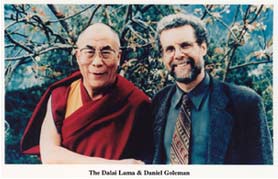
Daniel Goleman, author of the best-selling "Emotional Intelligence," attended a meeting of the Mind and Life Institute, a gathering of scientists and Buddhist thinkers, in Dharamsala, India in March 2000. His latest book, "Destructive Emotions: How Can We Overcome Them?" narrates the discussions that took place there between the Dalai Lama, other Buddhist scholars, and western psychologists and neuroscientists. The Buddhists and scientists worked together to review research and determine methods to conquer what they have termed "destructive emotions"--feelings like anger, depression, and fear. In an interview, Goleman explained the institute's findings, especially the effect of meditation on emotional health.

What exactly do you mean by 'destructive emotions'?

Destructive emotions refer to an emotion that leads us to do something that harms ourselves or someone else. The premise [of the meeting] was that there are helpful insights from both the deep spiritual wisdom of Buddhism and from modern findings in science, and that each might inform the other.

What emotions are included?

Almost any emotion can become destructive. Even too much happiness, if it's manic excitement, can lead us to do destructive things. But we're mainly talking about anger, paralyzing fear, and depression. Most of the discussions focused on anger, but we also had presentations on, for example, craving and addiction.


Are there times when some of those emotions can be positive?

Anger, from an evolutionary point of view, serves a purpose. It's helped us survive. Anger is quite appropriate in response to an injustice or a wrong that needs to be righted. But, as the Dalai Lama pointed out, if you're going to be effective in responding to what makes you angry, you need to keep the focus and energy of the anger, but drop the anger itself in order to act more skillfully.

So the point of this research is not necessarily that people won't experience these emotions, but that we'll be able to deal with them better?

Yes. The point is to find ways to help people--and not just Buddhists, but anybody--handle their destructive emotions more effectively.

The first chapter explains that researchers found, through studying a Buddhist monk, Öser, that meditation was a way to control these emotions. But Öser is someone who meditates all the time. How can a lay person benefit from meditation?

The research in the first chapter showed some extraordinary effects from long-term meditation. He is completely unresponsive, for example, when he hears a gun, or a sound like a gunshot. Everybody else startles. But Öser had amazing mastery over his emotional reactivity, and he can generate positive emotion. In fact, his baseline for emotion--his everyday baseline--is in the positive range.

But that doesn't mean this is only for people with time for huge, intensive practice. The other research underway now is looking at beginners. And now that we know what to look for, we're starting to see similar shifts in people who are just in the first two months of meditating. In another study of meditation, they taught it to highly stressed workers at a tech firm. The researchers found that they shifted the brain set-point for emotions from the "distressed zone" to the "good zone." That was after two months of an hour [of meditation] a day.

It has to be daily meditation?

Yes, daily meditation. Daily practice is key.

Other than meditation, are you aware of any other spiritual practices that might help achieve this shift in the brain?

The only one we know so far is mindfulness meditation. That's the only one that's been tested. We don't know what else of the many practices these lamas have done or have studied over the years might account for any of the specific effects we're seeing.

Will people be more skeptical about this method than they would about trying medication?

I think people are open to it. The Dalai Lama is quite smart in saying, 'Look at all this through a scientific lens, and if science validates the method then publish it and share that.'

In a recent book, "Why God Won't Go Away," Andrew Newberg, at the University of Pennsylvania, seemed to imply that his research on meditation proved that people have an impulse to believe in the divine. Did anything about the divine or transcendent come up in your discussion?

The Dalai Lama is immensely practical in his interests. And he really wants to see what there might be that would be of actual use to people to help them suffer less and be more happy.

So it wasn't a theological discussion. It was, however, in some places, theoretical because there is both a Buddhist psychology and a Western psychology. So there were very interesting presentations on the Buddhist version of the mind and how to work with it.

Were there some cases where Buddhism and science couldn't be reconciled?

We had friendly disagreements because the paradigms can be so different. For example, it turned out that in Buddhism there's an emotional state called sukha, which is an ongoing, imperturbable sense of joy that you feel regardless of what happens to you in life. What was remarkable in this dialogue is that there's no parallel in Western psychology and it made us wonder, 'What are we missing? What else are we missing?' He [the Dalai Lama] made another point which was that in Tibetan, and actually in all Asian Buddhist countries, the word for "compassion" means both compassion for yourself as well as other people. Whereas in English it only means for other people, not for yourself. He said, "You're missing a very important word." I thought that was a good insight.

What does this book about emotions have to do with your previous books about emotional intelligence?

It's not directly connected, but the themes of how we can be more aware of our emotion and what we can do that will help us manage our emotions better were touched on deeply in both books.

Have there been important findings about this since the book was finished?

Recently, at Columbia University, Richard Davidson reported new data with another lama, where he found that when he asked him to meditate on compassion, the activity in the part of the brain which is active during happiness--the left pre-frontal cortex, just behind the forehead--increased 800%. He said with an ordinary person, if you asked them to do something like that, the magnitude of change would be only 10-15%. So this is 80 times greater. That's remarkable.

You've been studying meditation since early on in your career. Has the way the world, or how Westerners at least, views meditation changed since when you started? Is there a greater interest among scientists in meditation now?

Absolutely. When I first did research on meditation it was at Harvard in the early 70's, and my professor thought I had gone crazy to be interested in such a thing. It was very fringe. But now it's part of the mainstream. People don't really blink much when you study meditation because it's understood that it's a valid set of methods and that it's a form of mind-training. Now we're interested in how far you can train the mind--what is the upside of human potential?

That's why the studies with the lamas are so fascinating and interesting. We're finding that, for example, on the ability to read other people's emotions from subtle, very quick facial changes, these lamas were getting perfect scores where most people do terribly on it. And it suggests that there's something in their training that enhances empathy and sharpens perception.

Or the fact that we're seeing the highest readings in the positive direction on the brain set-point for emotion as a result of spiritual practice. These are very important findings not just for scientists but for all of us--these methods can be of great benefit for any of us.

Did you discuss what effect Buddhist practice can have on constructive emotions?

Many of the practices are about generating positive emotions like compassion, lovingkindness, a sense of joy in other people's happiness. One of the points that was made was that American psychology should focus more on positive emotions and helping people learn how to reduce their quantity of negative, destructive emotions and experience more positive emotions day-to-day.

That seems to be happening with the positive psychology movement.

Of course, within the last few years we've had that whole movement toward positive psychology. But it turns out there's a very useful set of methods in Buddhism and other spiritual traditions for doing this that have been around for centuries. The Dalai Lama said, 'Look, study our methods and if you find anything that is of use to people, that will alleviate their suffering or make them happier, take it out of the Buddhist context and share it widely.'

How can you reach out to psychiatrists and psychologists about this?

The way to do that is through sound research and publishing in a psychiatry journal.

So you will keep it in the scientific realm. Are the participants in the 2000 meeting continuing this research?

Most of the scientists in the meeting have been inspired to go on and bring this back into their own work. Richard Davidson, for example, at the University of Wisconsin, is regularly bringing advanced practitioners into his lab to study their brains using state-of-the-art brain-imaging methods. Several of the other researchers are doing programs. Paul Ekman at the University of California, San Francisco, is now piloting a program with teachers and nurses to teach them 'mindfulness' as a way of helping them to manage their lives and work better and to have more positive emotions.

Do you think there would be fewer people on anti-depressants if more people meditated?

Yes, I do. That would be a great experiment to try.

Will people be more skeptical about this method than they would about trying medication?

I think people are open to it. The Dalai Lama is quite smart in saying, 'Look at all this through a scientific lens, and if science validates the method then publish it and share that.'

In a recent book, "Why God Won't Go Away," Andrew Newberg, at the University of Pennsylvania, seemed to imply that his research on meditation proved that people have an impulse to believe in the divine. Did anything about the divine or transcendent come up in your discussion?

The Dalai Lama is immensely practical in his interests. And he really wants to see what there might be that would be of actual use to people to help them suffer less and be more happy.

So it wasn't a theological discussion. It was, however, in some places, theoretical because there is both a Buddhist psychology and a Western psychology. So there were very interesting presentations on the Buddhist version of the mind and how to work with it.

Were there some cases where Buddhism and science couldn't be reconciled?

We had friendly disagreements because the paradigms can be so different. For example, it turned out that in Buddhism there's an emotional state called sukha, which is an ongoing, imperturbable sense of joy that you feel regardless of what happens to you in life. What was remarkable in this dialogue is that there's no parallel in Western psychology and it made us wonder, 'What are we missing? What else are we missing?' He [the Dalai Lama] made another point which was that in Tibetan, and actually in all Asian Buddhist countries, the word for "compassion" means both compassion for yourself as well as other people. Whereas in English it only means for other people, not for yourself. He said, "You're missing a very important word." I thought that was a good insight.

What does this book about emotions have to do with your previous books about emotional intelligence?

It's not directly connected, but the themes of how we can be more aware of our emotion and what we can do that will help us manage our emotions better were touched on deeply in both books.

Have there been important findings about this since the book was finished?

Recently, at Columbia University, Richard Davidson reported new data with another lama, where he found that when he asked him to meditate on compassion, the activity in the part of the brain which is active during happiness--the left pre-frontal cortex, just behind the forehead--increased 800%. He said with an ordinary person, if you asked them to do something like that, the magnitude of change would be only 10-15%. So this is 80 times greater. That's remarkable.

You've been studying meditation since early on in your career. Has the way the world, or how Westerners at least, views meditation changed since when you started? Is there a greater interest among scientists in meditation now?

Absolutely. When I first did research on meditation it was at Harvard in the early 70's, and my professor thought I had gone crazy to be interested in such a thing. It was very fringe. But now it's part of the mainstream. People don't really blink much when you study meditation because it's understood that it's a valid set of methods and that it's a form of mind-training. Now we're interested in how far you can train the mind--what is the upside of human potential?

That's why the studies with the lamas are so fascinating and interesting. We're finding that, for example, on the ability to read other people's emotions from subtle, very quick facial changes, these lamas were getting perfect scores where most people do terribly on it. And it suggests that there's something in their training that enhances empathy and sharpens perception.

Or the fact that we're seeing the highest readings in the positive direction on the brain set-point for emotion as a result of spiritual practice. These are very important findings not just for scientists but for all of us--these methods can be of great benefit for any of us.


WZEN - Dharma Talk: Ryushin Sensei - No Regrets Life

Cool.

Dharma Talk: Ryushin Sensei - No Regrets Life

This talk was recorded live at Zen Mountain Monastery in 2008. This and other talks are available for purchase online at www.dharma.net/monstore

© Dharma Communications

Get MP3 (9 MB | 40:00 min) [Play]

Saturday, September 05, 2009

Aaron Beck - The Man Who Made Freud Obsolete (sort of)

When Aaron Beck was in school, psychoanalysis was the dominant perspective in therapy. But as a professional working with clients, Beck (like Albert Ellis, Albert Bandura, and others educated in the Freudian tradition) found that the Freudian approach was at best a partial truth. Beck developed cognitive therapy (also known as cognitive-behavioral therapy, or CBT) as a response to his experience that it was often self-talk and cognitive beliefs that caused suffering as much (or more) than anything psychoanalysis might suggest. Not only that, but cognitive therapy didn't require a lifetime of analysis.

The following article pays tribute to and explicates Beck and his theories.

From The American Scholar.

The Doctor Is IN

At 88, Aaron Beck is now revered for an approach to psychotherapy that pushed Freudian analysis aside

In the basement of Aaron Beck’s house, nine miles northwest of downtown Philadelphia, in a dimly lit, dusty, concrete-walled room dedicated to his archives, there sits a pink plastic box containing patient notes from a 40-year-old case of psychotherapy. Beck, a professor emeritus of psychiatry at the University of Pennsylvania, has short-cropped white hair, sharp blue eyes, and, at 88, a hunched and shuffling gait. He has been a practicing psychiatrist for 59 years. Among the thousands of patients Beck has treated during this time, this case rates as persistent but uncomplicated. The patient was in his mid-40s and had a good career, a loving wife, four beautiful children, and a trove of close friends. Privately, however, he struggled with an acute tendency toward self-criticism. He was of the type that can’t help but interpret neutral events as harsh reflections on his personal worth. He was forever searching for approval, and forever anticipating disapproval.

When the patient’s treatment began—the earliest notes date from the mid-1960s—the dominant psychotherapeutic approach in the United States was psychoanalysis. Sigmund Freud had made his first and only visit to this country in 1909, and in the half century that followed, his approach to mental suffering took firm hold of American psychiatry, splintering into a multitude of camps but always retaining a focus on the unconscious mind, the central feature of Freudian analysis. Beck was trained in this tradition. He was a graduate of the Philadelphia Psychoanalytic Institute, and from 1950 to 1952 he worked at the Austen Riggs Center, a world-renowned psychoanalytic hospital in Stockbridge, Massachusetts. Beck was an eager student. “I have come to the conclusion,” he wrote to a colleague in 1958, “that there is one conceptual system that is peculiarly suitable for the needs of the medical student and physician-to-be: Psychoanalysis.”

Fewer than 10 years later, Beck’s case notes betray none of this confident enthusiasm and not a hint that he had applied his training to his patient’s complaints. In the treatment, nothing analytic has survived. Whereas psychoanalysis uncovers deeply buried impulses, Beck is interested in those thoughts that lie barely concealed beneath conscious awareness. Whereas psychoanalysis uncovers the historical motives behind troubling emotions, Beck scrutinizes the present-tense logic of his patient’s emotions. And whereas psychoanalysis is ultimately pessimistic, seeing disappointment as the price for existence, Beck’s approach is upbeat, conveying a sense that, with hard work and determined rationality, one could learn not only to tolerate but to stamp out neurotic tendencies.

The patient is none other than Beck himself. The notes, and the self-therapy they trace, date from a period of his life when he was working, to the disdain of his analytic colleagues and the indifference of most everyone else, to develop the system of psycho­therapy for which he is now revered in the field of mental health. Beck is the inventor of cognitive-behavior therapy (CBT), whose guiding principle is that the driving forces of mental dysfunction are habitual, unrealistic, self-defeating ideas—“automatic thoughts,” in the clinical parlance—that, like tinted lenses, color one’s perceptions of, and therefore one’s reactions to, the external world. Today CBT is the most well-funded, deeply researched, popular, and rapidly growing psychotherapy in existence. It is taught in nearly every clinical psychology and psychiatric residency program in America, and it is the cornerstone of a new, $117 million program implemented by the U.S. Army to foster mental resiliency in soldiers. Beck, in turn, is today arguably the most well-known psychotherapist alive. His personal appearance and style—high-pitched speaking voice, open New England vowels (he was born and raised in Providence), and signature bow tie—are as eminently recognizable to those in the profession as the Freudian cigar and beard. In 2006, Beck won the Lasker Award, the most prestigious scientific honor in the United States, often referred to as the “American Nobel.” In 2007, he was short-listed for the actual Nobel, in physiology or medicine, although unlike every laureate in the 105-year history of the prize, he has never conducted biological research or invented a physiological or biological tool.

Beck’s enormous success stems in large part from CBT’s pragmatism and efficiency, features as well suited to the age of neuroscience as Freud’s work was well suited to the age of modernism. In contrast to the slow-going passivity of analysis, which traditionally unfurls over the course of years, the cognitive-behavioral therapist operates via a sort of laser-guided rationality. He begins by identifying the thoughts responsible for a patient’s distress in specific situations, and proceeds by questioning those thoughts to uncover the more general “core beliefs” that lie underneath. If a patient reports that he felt a pang of anxiety when his wife failed to kiss him on her way out of the house, for example, the therapist might question the patient until he uncovers the precipitating thought, “Maybe she doesn’t love me anymore.” If the patient can be led to question the evidence for or against this thought, and perhaps identify a more logical explanation for the missed kiss (“She was just running late”), the anxiety should decrease. A pattern of such anxious thoughts might uncover the core belief, “I’m not worthy of love,” which, if similarly chipped away at with logic, should make the patient feel lastingly better. Often, this very rapidly happens. In run-of-the-mill cases of depression and anxiety, the complaints for which most people seek out therapy, patients usually report a lessening of their symptoms after only 12 to 16 sessions.

The power of this approach has led it to be adopted, in one form or another, by a vast number of mental-health professionals. “Most psychotherapists, consciously or unconsciously, are doing a lot of the things that Beck pushed,” says the Nobel Prize-winning neuroscientist Eric Kandel. “They’re more directly involved, they’re giving more suggestions, they’re pointing out thought processes. Whether they call it Beckian or not, and whether or not they’re doing other things as well, they’re doing Beckian kind of stuff.” And yet, as Kandel and others are quick to point out, Beck’s revolutionary impact does not emanate from his development of CBT, but from the methodical way in which he developed it. “The crucial point is, Beck took a form of psychotherapy and he did a series of systematic, empirical studies that showed that it’s more effective than placebo, and that it’s as effective as antidepressant drugs in mild and moderate depression,” Kandel says. “And he wrote a manual for the therapy, a cookbook, so that others could do studies as well.” His rigorous, scientific, data-driven approach to psychotherapy represented, Kandel says, a “major, major advance” for the profession.

To understand why the introduction of scientific standards into the field of psychotherapy was groundbreaking, it is necessary to know what the scene looked like prior to Beck’s arrival. “From the early 1900s through the 1950s, people didn’t know what worked in psychotherapy and what didn’t,” says Donald Freedheim, professor emeritus of psychology at Case Western Reserve University and editor of A History of Psychotherapy. “There was a rule of thumb: about a third of patients got better, about a third got worse, and about a third stayed the same.” Without a reliable gauge of efficacy, therapeutic notoriety was conferred on those clinicians who, by sheer force of personality and persuasiveness of rhetoric, were able to attract the most acolytes, adherents, and patients. This “guru model” was precisely what Beck found unacceptable, and what he has dedicated himself to dismantling. He hasn’t been the only person to insist that psychotherapy rest on a foundation of replicable data—he wasn’t even the first—but he has been the position’s most dogged, visible, sophisticated, and influential proponent.

As a consequence, psychotherapy has been moving steadily from a model that is “eminence-based,” as a rueful saying has it, to one that is “evidence-based”—a powerful watchword in the field. Over the past several years, federal and state agencies in the United States and government-based health-care systems abroad have been spending hundreds of millions of dollars to disseminate psychotherapies for which there is a solid core of scientific evidence, while insurance companies have been encouraging the clinicians within their systems to practice “empirically supported therapies” (EST) above others. In short, more and more, Freud’s world of subterranean drives is becoming Beck’s world of scientific accountability.

Psychotherapeutic leaders have always tended toward the eccentric and extravagant. Carl Jung, in the words of Psychotherapy Networker, “lit his farts on camping trips, danced with tribal people in Africa . . . , and installed his mistress in his house (breaking his wife’s heart)”; Irvin D. Yalom, a pioneer of group psychotherapy, favors fedoras and beatnik turtlenecks and published a best-selling novel featuring Nietzsche; Albert Ellis, the so-called “Lenny Bruce of psychotherapy,” routinely yelled at his patients and was ousted from his own institute.

Compared to these figures—compared to almost anyone—Beck is modest, meticulous, and professorial. “Other than his bow ties, Tim just isn’t flamboyant at all,” Robert DeRubeis, the chair of psychology at Penn, told me. (Beck’s friends call him Tim, a diminutive of Temkin, his middle name.) “He’s not larger than life like a lot of other psychotherapeutic leaders.” When Beck delivers speeches, they are generally composed of scientific information and theoretical propositions, as if he were rehearsing the draft of a forthcoming journal article, which he often is. In conversation, he exhibits an expert therapist’s facility for patient listening—cocked head, furrowed brow, dedicated gaze—and when he talks, he does so meticulously, qualifying general statements, backing up his claims with evidence, and avoiding speculation. In January, during a long interview in his sunny, book-filled home, I asked Beck whether he had actively avoided taking on the role of . . . “the Buddha?” he interrupted me. “I definitely don’t want that role. And I’m still researching things out, I still have research grants. Whatever I say is always based on empirical study.”

By most accounts, Beck’s desire for precision is deeply rooted in his personality, so that the great mystery of his biography would appear to be why he ever pursued psychoanalysis, which for all the richness of its ideas never had much in the way of data to back it up. After graduating from Yale Medical School, in 1946, Beck specialized in neurology, a discipline whose procedures he found attractively exact. But the hospital where he was assigned had a shortage of psychiatry residents, and his superiors instructed him to do a six-month rotation in that field. It was a terrible fit. To Beck, psychoanalysis’s emphasis on invisible psychic forces seemed soft-minded and esoteric, more a faith than a medical discipline. Yet this very attribute also lent the field an alluring power. “The psychoanalytic mystique was overwhelming,” he told me. “It was a little bit like the evangelical movement.” Everywhere he turned, there were brilliant minds spouting brilliant-sounding theories. The psychoanalysts, whom he began to befriend, “had theories for everything. They could understand psychosis, schizophrenia, neuroses. Every single condition that came in, they could get a good, sound—apparently sound—psychoanalytic interpretation for.” When Beck questioned whether these interpretations had evidence to back them up, his friends suggested that unconscious resistances were preventing him from realizing the truth. Outnumbered and drawn by the intellectual wattage of his colleagues, he gave in.

Beck’s transformation was thoroughgoing but idiosyncratic. He read deeply into psychoanalytic literature, encouraged his friends to take to the couch, and underwent an absorbingly enjoyable two-year training analysis. (“How could you go wrong lying down on a couch for five hours a week and talking about yourself?”) The dominant form his passion took, however, was a desire for evidence, evidence that would prove to those who had not yet seen the light that psychoanalysis was valid. That he had no training in research and that no rigorous scientific studies of psychoanalysis had been conducted before does not appear to have daunted him. He simply tracked down academic scientists at Penn, where he was hired in 1956, who could teach him about good experimental design, and went looking for a theory to verify.

He settled on depression, which psychoanalysis attributed to a process known as “retroflected hostility.” In short, a person’s anger toward a loved one is deemed unacceptable by the unconscious mind, blocked by a defense mechanism from upwelling into consciousness, and redirected inward. (Still shorter: depressives suffer because they have a need to suffer.) Beck theorized that this taboo hostility could be found, and the overlying theory proven, by scrutinizing the content of patients’ dreams—Freud’s “royal road to the unconscious.” His study was rudimentary. He compared the dreams of patients who were depressed with the dreams of patients who were not.

First study, first failure. The dreams of the depressed patients weren’t characterized by hostility—in fact, they were less hate-filled than the dreams of the nondepressed—but by deprivation, disappointment, hopelessness: exactly what they felt in real life. In analytic terms, this was a perplexing finding, even downright invalidating. But Beck’s faith was strong, and he contrived a way to bend the results to his belief. The theorized hostility, he reasoned, must simply be more deeply buried than anyone had thought. It must manifest itself obliquely, in the form of unpleasant dreams, suicidal thoughts, and self-deprecation: a systemic masochism.

Beck might have stopped here, and become one of the many innovative but fundamentally traditional analysts that the profession generated throughout its heyday. But the scientists whom he’d turned to for his experimental education spurred him on by noting that all he’d proved so far was that depressives suffered—a monumentally mundane discovery—not that they had a need to suffer. Challenged, Beck devised a set of more empirical experiments based on the premise that depressives would actively court unpleasant experiences. In one study, a researcher subtly expressed approval and disapproval based on the types of words a patient chose from a multiple-choice questionnaire. Beck had a harder time accommodating the results of these experiments to his faith. Rather than seeking out failure, the patients sought out encouragement. They seemed to hunger for improvement. It was, he told me, “the first crack in the shell.”

The second crack, when it happened, split everything wide open. For years, Beck had been detecting, in the free-associative monologues of his analysands, a stream of thought that seemed increasingly consequential. He usually describes this discovery by telling about a promiscuous young woman whom he had been treating for more than a year at the University of Pennsylvania clinic, and whose habit it was to spend her sessions describing her lurid sexual encounters in great detail while Beck sat impassively in a chair behind her, taking notes. At the close of a typical session one afternoon, Beck asked his patient, in classic analytic style, “How do you feel?”

“Very anxious, doctor,” she replied.

Of course, Beck told her. That was because she was being forced to confront her deepest sexual impulses. When these impulses rose to her consciousness, breaking through her ego’s defense systems, they caused anxiety.

“You’re right,” she said. “That’s brilliant.” But she sounded tentative. Beck told her so.

“Actually,” she said, “I was afraid I was boring you.”

Beck was surprised. Fear of boring one’s analyst is not uncommon, but this patient had never mentioned it before. He asked her how often she thought she was boring.

“Oh, all the time,” she said. “I think it when I’m here with you, and I think it when I’m with everyone else.”

This was nothing short of revelatory. As engaging as his patients’ monologues could be, and as much emphasis as analytic doctrine placed on them, it was their mundane, reflexive, almost forgotten thoughts that now seemed to hold the true explanatory power. In this patient, for instance, the insidious belief “I am boring” explained why she slept around (afraid that she had nothing else to offer, she jumped into bed), why she wove dramatic stories in session (anything else might seem tedious), and why she was anxious. Once Beck realized this, he began to uncover similar thoughts in all his patients, as well as in his friends, his family, and himself. Our daily lives, he concluded, unwind to the accompaniment of a quiet but constant self-talk, through which all external events are filtered.

When Beck pieced together his experimental and clinical findings, in the early 1960s, he drew two conclusions about psychoanalysis. The first was that it was cruelly glacial. Psychoanalysis takes years, at the end of which the analysand typically feels much wiser about the roots of her misery but no less miserable. By homing in on his patients’ self-defeating thoughts, Beck found that he could alleviate symptoms in as few as 10 sessions. And the progress stuck. The second conclusion he drew was that psychoanalysis was a theory built on sand. Beck had been duped. “I concluded that psychoanalysis was a faith-based therapy,” he has said, “and that if I was going to practice or teach therapy, it had to be empirically driven.”

Beck’s turn against psychoanalysis wasn’t aggressive; he’s never had much of a taste for professional combat. Still, his foray into clinical research hardly ingratiated him to his colleagues. Even before he left the fold, the powerful American Psychoanalytic Institute rejected his membership application on the grounds that his mere desire to conduct scientific studies signaled that he’d been improperly analyzed. (The decision still has the capacity to make him angry: “It was just the height of stupidity . . . total thought control.”) And his fellow psychiatrists, after he left, treated him with an air of pitying condescension. “I was considered one of the deviates,” he says. “People used to say, ‘Poor Tim. He’s a good guy, he just needs more time on the couch.’”

Yet Beck was not intellectually homeless. By the early 1960s, academic psychologists had already accepted the idea that basic science could yield clinical insights—specifically, that studies of how rats learned and unlearned fear could be used to treat anxiety and panic in humans. These thinkers embraced Beck as an ally. Even more, they embraced him as an asset. Much of the public viewed behavior therapy, as the treatment that grew out of animal learning theory is called, as cold and unfeeling, an icy manipulation of stimulus and response. With his analytic background and interest in how the human mind processes information, Beck brought a much-needed warmth and nuance to the movement. He also brought a medical doctor’s access to large clinical populations and an uncommon talent for feeding the raw, messy data of psychic suffering into the clarifying machine of medical research. In 1972, Beck was invited to speak at a national conference of behavior therapists; accustomed to indifference, he brought 30 copies of a handout. Hundreds of people packed the room. Before long, behavior therapy had morphed into cognitive-behavior therapy, the lexical order reflecting a hierarchy of influence that still reigns today.

Beck’s alliance with the behaviorists proved both a clinical and a scientific boon. From them he borrowed the ideas that a therapist should carefully structure sessions and evaluate a patient’s progress as he proceeds; toward the second of these ends, he developed several patient questionnaires to measure the waxing and waning of symptoms over the course of therapy. Meanwhile, highly skilled young researchers flocked to Beck’s evocatively titled Mood Clinic, a leaky, decrepit set of offices with tattered chairs in the now-defunct Philadelphia General Hospital. (“You can do therapy in a barn” is one of Beck’s characteristically pragmatic sayings.) In just a few years, the setup had yielded a study that markedly raised the standards of research in psychotherapy, and did more to make Beck’s name in the field than anything before.

At the time, psychotherapists were beleaguered by the rise of psychotropic drugs, whose manufacturers had the vast resources needed to conduct large-scale clinical studies. Beck’s audacious gambit was to take on this balance of power directly, using what is still the gold standard of biomedical research, the randomized controlled trial, in which two or more treatments are rigorously pitted against one another. The study, which was published in 1977, assigned 41 depressed patients to 12 weeks of either CBT or imipramine, the best antidepressant of the day. In the end, the patients who’d received CBT were less symptomatic, less likely to have dropped out of treatment, and, upon follow-up, less likely to have slipped back into depression. It was the first time in history a psychotherapy had been shown to be more effective than drugs.

“It took an act of courage, I think, to subject his ideas to empirical scrutiny,” Ruth Greenberg, one of Beck’s earliest employees, told me. “I know it took courage, and that he was scared of it. But he did it.” She added: “He’s really a kind of ruthless empiricist.” Of course, the problem with ruthless empiricism, as opposed to charismatic boosterism, is that if you live by data you can die by data. In studying the effects of psychotherapy on depression the variables are after all vast, even endless, and the tiniest alteration in study design or slip-up in delivery can fundamentally alter the outcome.

Beck learned this lesson well in 1985, when the first results of a multi-site, multi-million-dollar trial of CBT for depression, organized and funded by the National Institute of Mental Health, began to trickle out. That the NIMH would even be interested in such a study was a testament to the growing prominence of Beck’s ideas. But he was skeptical. He felt that there were not enough experienced therapists to perform so large an experiment, and he withdrew his support. “It reminded me of the song of the Valkyrie,” he told me. “You can hear the drum beats, you know there’s gonna be disaster.” When the numbers were crunched, CBT was shown to be no better than drugs for mild depression, worse than drugs for severe depression, and without any real lasting effect.

The most damning of the NIMH results were published in 1989. And yet, since then CBT has only increased in popularity and influence. There are three main reasons for this.

First, a commitment to scientific standards of validity requires that negative as well as positive findings be considered contingent, just another drop in the empirical ocean, and Beck’s ever-growing legion of trainees, and trainees of trainees, have been adept at the act of scientific reconsideration. In 1990, a paper published in the Journal of Clinical and Consulting Psychology reported evidence of a clear relationship between the competence of the psychotherapists who participated in the NIMH study and their success in treating patients, confirming Beck’s early suspicions. In 1999, DeRubeis, the psychologist at Penn, compared the NIMH findings with three other studies of CBT versus medication for severe depression and found that in the aggregate, CBT came out on top. And in 2005, in a pair of widely publicized papers in the Archives of General Psychiatry, DeRubeis and Steve Hollon, a psychologist at Vanderbilt University, reported the results of a large clinical trial that compared CBT to a placebo and the popular antidepressant Paxil in patients with depression. In the short term, CBT was shown to be as effective as medication and, presumably because it served as a kind of psychological inoculation, it guarded against relapse 69 percent of the time, as opposed to 24 percent for medication.

Second, the NIMH study only raised questions about CBT for depression, and even before the results were published Beck was expanding his model into other areas of psychopathology. Freud launched psychoanalysis outward, moving from the neuroses to religion, humor, and the strictures of civilization. Except for an ambitious 1999 book, Prisoners of Hate, which attempted, without much impact, to apply CBT to ethnic conflict and genocide, Beck has cleaved to the pathological plane of experience. His method has been unapologetically linear: choose a new disorder or problem, work out how thoughts and beliefs influence its development and perpetuation, tweak the therapy to apply to the new problem, write a detailed treatment manual, do research, publish a book. There are now studies that show CBT’s effectiveness in treating anxiety, post-traumatic stress disorder, obsessive-compulsive disorder, phobias, borderline personality disorder, bipolar disorder, anorexia, bulimia, and schizophrenia, as well as back pain, colitis, hypertension, chronic fatigue syndrome, marital distress, anger, and overeating. Beck has admitted, “I feel like a snake-oil salesman sometimes when people say, ‘What can it cure?’ and I reply, ‘What can’t it help?’”

Third, this accretion of data has spurred an insistence among the mental-health establishment that treatment decisions be based on solid scientific evidence, and this has in turn cemented CBT’s reputation as the most research-driven psychotherapy in existence. Indeed, the first formal expression of the “empirically supported therapies” movement—a 1993 task force report of a division of the American Psychological Association—was born out of a frustration that although scores of useful studies had been conducted, little of the resulting information had trickled down to psychotherapists in the field. As a remedy, the task force set out to develop a concise list of therapies that science had shown to be effective for specific disorders. In spirit, at least, the project was ecumenical: the task force members came from a range of theoretical backgrounds, including psychoanalytic, and the only allegiance the report avowed was a “commitment to empiricism.” But since the overwhelming majority of sophisticated clinical trials in the literature studied CBT, this ecumenicism was rhetorical. On the final list, 14 of 18 therapies given the gold stamp “well established” were cognitive behavioral. Cognitive-behavior therapy and “empirically supported therapies” were essentially synonymous.

Not surprisingly, psychotherapists who did not count themselves in the cognitive-behavioral camp weren’t pleased. Newly bristling under the thumb of managed care, they charged that the report was a devious attempt to convince insurance companies to fund only short-term treatments such as Beck’s. Others protested, more high-mindedly, that only philistines thought of psychotherapeutic change as something that could be measured, as though one were studying ferns or rocks and not the infinite human mind. (One indignant observer proclaimed that a therapist is “a disciplined improvisational artist, not a manual-driven technician.”) Still others pointed to their own scientific analyses that suggested that, for all the data gathered about specific therapies, there is no meaningful difference between types of treatment. In their view, the true engines of recovery are “nonspecific factors,” in particular the bond forged between therapist and patient.

The contentiousness sparked by the report has scarcely died down in the years since it was published. But, then, neither have efforts to implement the report’s findings and updates to those findings. In the past eight years, dozens of states have initiated programs to train mental-health professionals in empirically supported psychotherapies. In 2001, Congress created the National Child Trauma Stress Network, funded at more than $30 million a year, to disseminate empirically supported therapies to traumatized children and their families. Since 2005, the Veterans Administration, the closest thing America so far has to a nationalized healthcare system, has allocated more than $250 million a year to train therapists in ESTs in an effort to cope with the influx of traumatized veterans returning from Iraq and Afghanistan. All of these programs highlight CBT. The Army’s new resiliency program, meanwhile, will train more than one million active-duty soldiers, reservists, members of the National Guard, civilian employees, and military family members in Beck-inspired methods.

In England, the empirically supported therapies movement now benefits from full governmental support. In 2007, the British government announced it would be spending close to $300 million to train and employ 3,600 additional psychotherapists, primarily in CBT. This official endorsement has proved a powerful incentive for therapists not historically predisposed to empirical research to prove that what they do is valid. Peter Fonagy, one of England’s leading psychoanalysts and chief executive of the Anna Freud Centre, has called on his colleagues to end their “splendid isolation” from the mainstream and to adopt “a scientific attitude that celebrates the value of the replication of observations rather than their uniqueness.”

Beck keeps close watch on these developments, as he has throughout most of his career, from home, a bright clapboard colonial surrounded by a pale wooden fence. He operates from there, as he always has, like a general at headquarters—phoning instructions to his subordinates in the field, holding conference calls with foreign allies, drawing up bold plans for new projects, new disorders to conquer. His excursions from base occur less frequently than they once did, but one appointment he invariably keeps is a semi-regular meeting not far from his house at a training institute that holds his name, where he conducts a full session, broadcast on closed-circuit television, with a difficult or illuminating case. One late February afternoon, I was allowed to attend.

The client on the docket was a middle-aged woman who lived alone with her young son. As a child, she had been sexually assaulted; she had a string of failed relationships; her career had stalled; and, the previous November, her family had forced her to go to the hospital in reaction to a bout of aggressiveness and insomnia. “She still had fears that, based on a whim, they could commit her and take her son,” read a brief handed out to the assembled trainees.

The session was broadcast on a blank wall, the image small and fuzzy at the edges; the patient was equally anxious (“You’re big in the psychology field, so I’m a little bit nervous,” she told Beck) and brimming with excitement. When Beck asked her what she wanted to talk about, she responded, “God. And how God fits into psychology.” Tenderly, Beck coaxed her toward a more modest set of discussion topics. Together they assembled a list of five: her relationship with her son, her relationship with her family, her relationships with men, her dissatisfaction with her career, and her insomnia.

It was an ambitious slate to tackle in 50 minutes, but then this was more master class than focused lecture, and they moved through the subjects at a steady clip using Beck’s three-pronged approach. With each topic, he drew out the patient’s troubling thoughts with gentle but pointed questions, rephrased the often muddled response into a concise statement, and opened the assertion up to rational examination. Beck calls this process “collaborative empiricism,” but, of course, it has a more ancient precedent than the formally scientific. A cousin of mine, a psychiatric resident at the University of Pennsylvania, recently said to me, “Beck is the closest thing to Socrates I’ve ever met.” What he meant by this was something many people have observed: Beck’s passion is for ferreting out only those truths logical investigation will bear, nothing more.

Fewer people have observed what naturally follows from this comparison: a dedication to logic could be the seed of your own demise. Science is progressive, and already there is evidence to suggest that there may be more effective ways to treat mental illness than by scrutinizing thoughts. There is mounting interest, for instance, in how psychopathology can be mitigated by targeting the experience of emotion, a “low road” approach stemming from basic neuroscience research that contrasts with Beck’s cognitive “high road.” And in 2006, the results of a randomized controlled trial suggested that in CBT it is not the evaluation of thoughts but the changing of behavior that is doing the real therapeutic work.

Beck probably won’t live to see the day when these challenges supplant his work. A mountain of evidence will need to be gathered before CBT’s empirical altitude can be matched. But even his challengers believe that were he to see that day, he wouldn’t dispute it. David Barlow, a prominent anxiety researcher at Boston University, says of Beck: “He’d be the first person to put forth his theory and encourage that it be adopted, but he’s always accepted other people’s attempts to innovate. If, in fact, they could support their ideas with data.”

One thing that became apparent at the February case conference was how assiduously Beck has sought to inculcate this ideal not only in his field, but in the minds of his patients. After the session was completed, he shuffled into the room for a wide-ranging discussion. “What you might have noticed,” he said, in his tinny, sharp voice, “is that the approach I took during the session was to devise a hypothesis, gather data by way of experiments, see if the data confirms the hypothesis, and if necessary form new conclusions.” He paused and glanced around the room. “In a way, it’s really quite scientific.”

~ Daniel B. Smith is the author of Muses, Madmen and Prophets: Hearing Voices and the Borders of Sanity. His work has appeared in The Atlantic, Granta, and The New York Times Magazine.