Showing posts with label quarks. Show all posts

Saturday, April 12, 2014

Scientists Detect A Particle That Could Be A New Form Of Matter (the Tetraquark)


This was posted on io9 this morning, and it comes originally from Universe Today. Researchers at the
Large Hadron Collider have discovered a new particle that may be the theoretical tetraquark, and its discovery would mean that of a new form of matter. It also the raises a lot of new possibilities, including the "quark star," for both physics and cosmology.
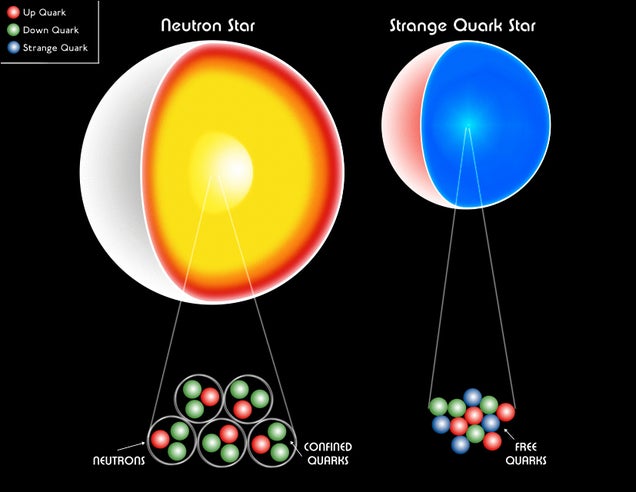
"Very simply, the traditional model of a neutron star is that it is made of neutrons. Neutrons consist of three quarks (two down and one up), but it is generally thought that particle interactions within a neutron star are interactions between neutrons. With the existence of tetraquarks, it is possible for neutrons within the core to interact strongly enough to create tetraquarks. This could even lead to the production of pentaquarks and hexaquarks, or even that quarks could interact individually without being bound into color neutral particles. This would produce a hypothetical object known as a quark star."
Very cool stuff.

Scientists Detect A Particle That Could Be A New Form Of Matter


Brian Koberlein — Universe Today

Physicists working at the Large Hadron Collider have spotted a long sought-after exotic particle that's the strongest evidence yet for a new form of matter called a tetraquark. Here's what the discovery could mean to astrophysics.


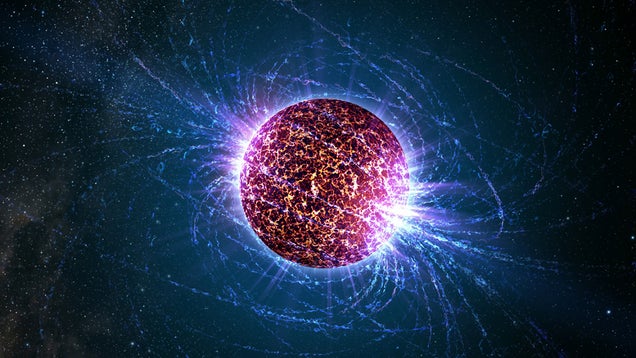
Above: A neutron star. Credit: Casey Reed/Penn State University.

You may have heard that CERN announced the discovery of a strange particle known as Z(4430). A paper summarizing the results has been published on the physics arxiv, which is a repository for preprint (not yet peer reviewed) physics papers.

The new particle is about four times more massive than a proton, has a negative charge, and appears to be a theoretical particle known as a tetraquark. The results are still young, but if this discovery holds up it could have implications for our understanding of neutron stars.

Image: Chandra.

A Horse Of A Different Color

The building blocks of matter are made of leptons (such as the electron and neutrinos) and quarks (which make up protons, neutrons, and other particles). Quarks are very different from other particles in that they have an electric charge that is 1/3 or 2/3 that of the electron and proton. They also possess a different kind of "charge" known as color. Just as electric charges interact through an electromagnetic force, color charges interact through the strong nuclear force. It is the color charge of quarks that works to hold the nuclei of atoms together. Color charge is much more complex than electric charge. With electric charge there is simply positive (+) and its opposite, negative (-). With color, there are three types (red, green, and blue) and their opposites (anti-red, anti-green, and anti-blue).

Because of the way the strong force works, we can never observe a free quark. The strong force requires that quarks always group together to form a particle that is color neutral. For example, a proton consists of three quarks (two up and one down), where each quark is a different color. With visible light, adding red, green and blue light gives you white light, which is colorless. In the same way, combining a red, green and blue quark gives you a particle which is color neutral. This similarity to the color properties of light is why quark charge is named after colors.
The Tetraquark

Combining a quark of each color into groups of three is one way to create a color neutral particle, and these are known as baryons. Protons and neutrons are the most common baryons. Another way to combine quarks is to pair a quark of a particular color with a quark of its anti-color. For example, a green quark and an anti-green quark could combine to form a color neutral particle. These two-quark particles are known as mesons, and were first discovered in 1947. For example, the positively charged pion consists of an up quark and an antiparticle down quark.

Under the rules of the strong force, there are other ways quarks could combine to form a neutral particle. One of these, the tetraquark, combines four quarks, where two particles have a particular color and the other two have the corresponding anti-colors. Others, such as the pentaquark (3 colors + a color anti-color pair) and the hexaquark (3 colors + 3 anti-colors) have been proposed. But so far all of these have been hypothetical. While such particles would be color neutral, it is also possible that they aren't stable and would simply decay into baryons and mesons.

The Quark Star

There has been some experimental hints of tetraquarks, but this latest result is the strongest evidence of four quarks forming a color neutral particle. This means that quarks can combine in much more complex ways than we originally expected, and this has implications for the internal structure of neutron stars.

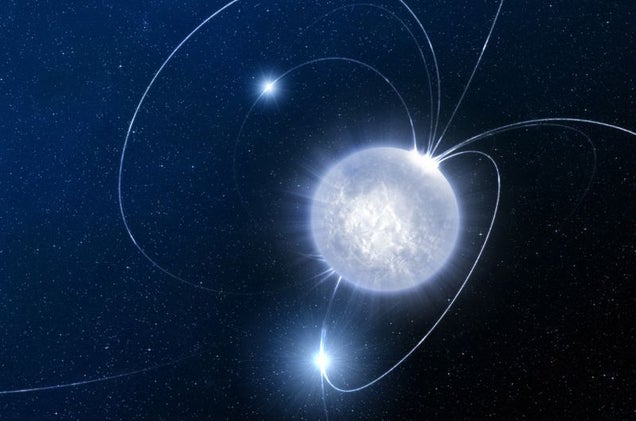
ESO/Luís Calçada.

Very simply, the traditional model of a neutron star is that it is made of neutrons. Neutrons consist of three quarks (two down and one up), but it is generally thought that particle interactions within a neutron star are interactions between neutrons. With the existence of tetraquarks, it is possible for neutrons within the core to interact strongly enough to create tetraquarks. This could even lead to the production of pentaquarks and hexaquarks, or even that quarks could interact individually without being bound into color neutral particles. This would produce a hypothetical object known as a quark star.

This is all hypothetical at this point, but verified evidence of tetraquarks will force astrophysicists to reexamine some the assumptions we have about the interiors of neutron stars.

This article originally appeared at Universe Today.
Tuesday, July 16, 2013

Mysterious Subatomic Particle May Represent Exotic New Form of Matter

This article appeared in WIRED last month, but I missed until just recently. Two groups of researchers, working independently, have both identified a previously unknown type of matter, the four-quark particle, otherwise known as Z(3900).
The experiments have now produced more than 460 of these strange Z(3900) particles, suggesting that they are real phenomena and not simply a statistical fluke in the data. The new exotic particle appears to have an electric charge and contains at least a charm quark and an anti-charm quark. The simplest explanation for the rest of the particle’s properties is that it also contains an up and anti-down quark for a total of four quarks.
There are multiple explanations for this discovery, some more exciting than others - read the article from WIRED to get the whole story.

Mysterious Subatomic Particle May Represent Exotic New Form of Matter


BY ADAM MANN
06.17.13

The BESIII detector, courtesy of the BESIII collaboration.

In the course of exploring the properties of a strange subatomic particle, physicists may have stumbled upon something even stranger: a mysterious and exotic new form of matter.

The intriguing discovery was made more or less simultaneously by two collaborations: the Belle experiment at the Japanese High Energy Accelerator Research Organization (KEK) and BESIII experiment run by the Institute of High Energy Physics (IHEP) in China.

Both teams were looking at a particle called Y(4260) that had been discovered in 2005 but whose nature has mystified researchers since. By smashing together electrons and their antiparticle, positrons, the experiments produced large numbers of Y(4260), which lives for only 10-23 seconds before falling apart into other particles. The teams noticed that their data had a peculiar bump around 3.9 gigaelectronvolts (GeV), an energy corresponding to roughly four times the weight of a proton.

“Inspired by this discovery, we decided to further study the Y(4260) decay, which indeed did not disappoint us,” said particle physicist Zhiqing Liu, lead author of a paper from the Belle experiment that appeared in Physical Review Letters on June 17. A second paper from BESIII, of which Liu is also a member, appears in the same issue.

The data bump from Belle and BESIII. Physical Review Letters

The teams have enough data to conclude they have discovered something new, a putative particle named Z(3900). But the scientists are still not entirely sure what to make of it. One possibility is that Z(3900) represents a subatomic structure made of four quarks, something that has never been solidly seen before.

Before we continue, let’s break things down for those who get cross-eyed whenever subatomic lingo starts getting thrown around. Much of the matter we see in our universe is made of itsy-bitsy units known as quarks. There are six known quark types — named up, down, strange, charm, bottom, and top quarks – and they can combine in various ways.

The matter most people are familiar with, namely protons and neutrons, is made when three quarks come together. Another class of particles can occur when two quarks are bound (technically, these are made from a quark and an antiquark). The most famous of these two-quark particles are kaons and pions. Though there have been hints of them in the past, no one has ever definitely discovered a particle with more than three quarks.

A special force called the strong force is responsible for gluing all these quarks together. The particle carrying this force is called the gluon and it is akin to the photon, which carries the electromagnetic force, except that it can only be found inside of atomic nuclei.

The Y(4260) particle is thought to be a certain exotic type of particle with two quarks and an extra gluon, though its exact characteristics are still unknown.

“In trying to explore the properties of this gluonic exotic, they found another exotic,” said particle physicist Eric Swanson of the University of Pittsburgh, who was not involved with the work.

The experiments have now produced more than 460 of these strange Z(3900) particles, suggesting that they are real phenomena and not simply a statistical fluke in the data. The new exotic particle appears to have an electric charge and contains at least a charm quark and an anti-charm quark. The simplest explanation for the rest of the particle’s properties is that it also contains an up and anti-down quark for a total of four quarks.

“We haven’t seen anything like that before and for that reason it’s exciting,” said Swanson. While previous experiments have detected hints of such particles, Belle and BESIII’s data is the cleanest and most experimentally solid to date, he added.

But there could still be other possible interpretations. Scientists already know that two-quark particles exist. So what looks like four quarks bound together could actually turn out to be two two-quark particles interacting so strongly that they look like a four-quark particle. Such a finding would be known as a “hadron molecule” – another strange object speculated to exist in the subatomic world but never definitively seen. This is the explanation that Liu is leaning towards.

“The hadron molecule is just my personal preference,” he said. “But the real nature could also be something else.”

Swanson points out that there is another, more prosaic interpretation: that Z(3900) is composed of two two-quark particles interacting but not really strongly enough to stick together. This explanation would fit the data but isn’t nearly as exciting.

The next step for both collaborations is to produce many new Z(3900) particles and watch how they decay, which should give some clues as to their properties. If the data shows they decay like ordinary, known particles, it could rule out the exotic interpretations. But if not, the scientists may have found something extremely interesting.

“We hope to reveal the nature of this particle in the following year,” said Liu.

The Belle detector in Japan. O3/Wikimedia