Showing posts with label gender roles. Show all posts

Friday, July 22, 2011

Alva Noë - Social By Nature (on Sex Differences)

http://webpages.scu.edu/ftp/mgaletto/wagons/Gender%20roles.JPG

In his most recent 13.7 Cosmos and Culture blog post, philosopher Alva Noë looks at the evidence for cognitively significant differences between men and women. Notice the title says "sex" differences, not gender - sex is biological, gender is social. Many of the differences discussed here are inborn, or quite possibly epigenetic (for example, women get PTSD more often and worse than men, but men are more likely to be ADHD or autistic). But then he goes back to his original thesis, that the largest differences are social and cultural - gender roles - not neurobiological.

This is a follow-up to an earlier post - Gender Is Dead! Long Live Gender! - in which he looked at the
known cognitive and psychological differences between men and women. But here he warns:

The question we need to take seriously is: Do the known sex differences in neurobiology go any way toward explaining the known cognitive and psychological differences that find expression in the lives of men and women?

The answer to this is a resounding no. This is so, even if it turns out, as work by Jacobs suggests, that female sex hormones modulate neurotransmitters that play a role in cognition.

You're looking in the wrong place if you look to the brain for an understanding of what makes us different.

What makes us different? We do. We don't just happen to be boys and girls, men and women; we identify with ourselves as such, and we shape ourselves to conform to the rigid matrix of ideas and values that make up our conception of what it is to be male and female.

Gender differences are partly based in sex differences, there is no escaping this, but there are also incredibly powerful cultural forces that force into gender boxes, through unconscious acculturation, social learning, shame, and even violence.
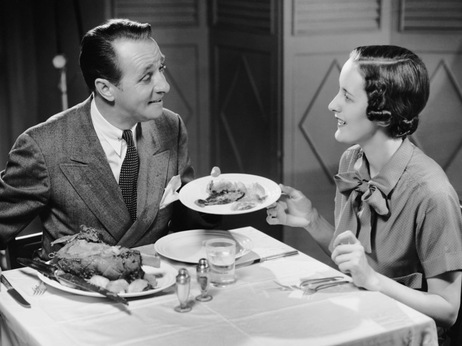
CIRCA 1950s:  Husband serving wife dinner.
Enlarge George Marks/Getty Images

Are there cognitively significant neurobiological differences between men and women? According to the best cognitive science, as I have suggested in recent posts, the answer is clearly no.

I've received a fair bit of friendly criticism from smart neuroscientists about this.

As a community, neuroscientists are a pretty progressive lot; they like the idea that there is no biological justification for gender stereotyping that has tended to be harmful to women. At the same time, they are rightly wary of letting this sort of political consideration obscure what is an undeniable fact: there are widespread and substantial differences between male and female brains.

The neural differences show up all over the place and go way beyond the effects on brain chemistry of estrous and menstrual cycles (effects which are not small). As UC Irvine's Larry Cahill explains, there are sex differences not only in the incidence but also the nature of a large number of diseases of the central nervous system, including, e.g. Alzheimer's, PTSD and other anxiety disorders, schizophrenia, stroke, multiple sclerosis, autism, addiction, fibromylagia, attention deficit disorder, irritable bowel syndrome, Tourette's syndrome, and eating disorders.

There may well be cognitively significant differences, too.

As neuroscientist Emily Jacobs (now at Harvard, then at Berkeley) has shown, there is reason to think estrogen may have a positive effect on neural activity in prefrontal cortex, an effect that translates directly into an improvement in working memory. Her research, and that of others, points in the direction that differences in male/female neurobiology may advantage women!

I agree one-hundred percent that we don't get to pick our findings to support our political beliefs. But I reject the idea that it might somehow be politically dangerous to admit that there are biological differences between men and women. After all, we know that there are such neurobiological differences (see above). Moreover, as I stressed in my first post, we know that there are cognitive and psychological differences between men and women, differences that show up in testing and performance.

The question we need to take seriously is: Do the known sex differences in neurobiology go any way toward explaining the known cognitive and psychological differences that find expression in the lives of men and women?

The answer to this is a resounding no. This is so, even if it turns out, as work by Jacobs suggests, that female sex hormones modulate neurotransmitters that play a role in cognition.

You're looking in the wrong place if you look to the brain for an understanding of what makes us different.

What makes us different? We do. We don't just happen to be boys and girls, men and women; we identify with ourselves as such, and we shape ourselves to conform to the rigid matrix of ideas and values that make up our conception of what it is to be male and female.

Why do girls do less well than boys on math tests? Because they understand that they are supposed to do less well. As the studies described earlier show, if you screen out gender by priming girls to self-identify not as girls but as, say, students at elite colleges, performance improves, just as if you prime boys for thinking of themselves as boys, rather than students, their performance on verbal tests drops.

Gender is real. People are men and women. And this makes a difference not only to how they live, to how much they earn, to how well they perform, but also to how they experience themselves, their bodies and their lives.

But gender doesn't happen in the brain, whatever sex differences on the brain there are. Gender, rather, is something we enact together in a social and political realm.

It is important to realize that this does not make it any less real or less natural for all that.

To understand human nature, we need to expand our conception of what the natural is.


Monday, November 15, 2010

At Elephant - Masculinities in Hollywood—Are We in the Middle of a Transition?

Check out my recent article article at Elephant Journal on the shifting nature of masculinities in Hollywood. Here is a taste to get you over there:

Masculinities in Hollywood—Are We in the Middle of a Transition?

In researching an essay for one of my psych classes, I came across an article posted at Big Hollywood, an Andrew Breitbart property (for those not familiar, he is an extreme right winger intent on creating a conservative empire to rival Huffington Post). While the article is too inane to be useful for an academic article, it did prompt the following response, which originally appeared, in a vaguely different form, at The Masculine Heart.

* * * * *

Ben Shapiro blogs at the Andrew Breitbart blog Big Hollywood, which offers a far right perspective on Hollywood and the entertainment industry (as you might guess, they’re not often fans). He likes his leading men to be manly men, not metrosexuals like Johnny Depp.

In his recent article, America Loves Manly Men Not Metrosexual Emos Shapiro laments the decline of traditionally masculine men in Hollywood films and as stars in the film industry. He refers to the current crop of male stars as “douchefaces” (an insult which he qualifies by adding, “in Greg Gutfeld’s terminology” – nice cop-out). Among those he singles out are Johnny Depp, Taylor Lautner, Jude Law, Leonardo DiCaprio, and Zach Braff. He says that Hollywood now prefers male leads who look like women.

Interestingly, he blames two of the most successful and influential actors of the last thirty years – Dustin Hoffman and Jack Nicholson – for the decline in testosterone-fueled male leads.

Go read the whole article and share your comments.


Monday, August 16, 2010

Agency and communion attributes in adults’ spontaneous self-representations

Integral folks talk an awful lot about agency and communion, and I am not always sure the terms are being used "correctly" - there is a tendency to suggest that men are primarily agentic and women are primarily communal. But these are socialized traits, to a large degree, and as such are available to either gender.

One of the findings in this article is that older adults are more communally oriented than young adults, so these are not simply sex-based traits: "the reduction in agency-related attributes with age was mostly due to a smaller number of negative agency words (e.g., angry, arrogant, aggressive, cynical, vindictive). In contrast, positive agency words (e.g., confident, creative, determined, forceful, self-reliant) were included with the same frequency across age groups." People seems to get nicer/more focused on "others" as they get older, and it's both sexes.

These definitions are from Appendix A:
Appendix A: Definition of agency and communion for rater training
According to the psychologist David Bakan (1966), agency and communion are two fundamental modalities that human beings display in their orientation toward the world around them. In the following, we are providing prototypical definitions of both terms. You need to use these definitions when you rate the attributes in study participants’ self-portrait displays. Please note that agency and communion can be expressed in a positive and a negative form.

Agency
Agency refers to a person’s striving to be separate from others, to master the environment, and to assert, protect, and expand the self. Individuals who score high on agency are usually powerful and autonomous “agents,” they are highly individualistic, they like to dominate and lead, they want to be a force to be reckoned with. In its positive form, high agency orientation is found in skillful leaders who enjoy challenging tasks, are ambitious, self-confident and creative, and can lead a project to success—even in the face of obstacles. In its negative form, high agency orientation is expressed by “hunger for power and dominance” and is often expressed by reckless, abrasive, and selfish/self-centred behaviour toward others.

Communion
Communion refers to a person’s striving to lose his or her own individuality by merging with others. Individuals who score high on communion enjoy participating in something that is larger than the self. They enjoy relating to other persons in warm, close, intimate, and loving ways. In its positive form, high communion orientation is found in persons who can easily give up or delay their individual needs and wishes for the common good. They are usually great team players and can collaborate with others smoothly and in constructive ways. Also, they are usually good in understanding others’ feelings and are able to respond with empathy and thoughtful understanding. In its negative form, high communion orientation is found in persons who always want to please others and are extremely dependent on the approval and opinion of others. These individuals are devastated if their needs for “union and merging with others” are not reciprocated by these others and they feel rejected and worthless. These individuals, in general, have given up any kind of sense of individuality and self-worth.

In Appendices B and C are lists of words that you can consult in rating the descriptors in study participants’ self-portrait diagrams. Although this list is not exhaustive, it contains the most frequent agency and communion words that we were able to identify in the relevant literature.
These are good orienting principles.

I would argue that men are socialized to be more agentic and women are socialized to be more communal (and I also acknowledge that hormonal and brain-wiring also create a tendency toward one or the other).

Manfred Diehl, Stephanie K. Owen, and Lise M. Youngblade

Int J Behav Dev. 2004; 28: 1–15. doi: 10.1080/01650250344000226.

This study investigated agency and communion attributes in adults’ spontaneous self-representations. The study sample consisted of 158 adults (80 men, 78 women) ranging in age from 20 to 88 years. Consistent with theorising, significant age and sex differences were found in terms of the number of agency and communion attributes. Young and middle-aged adults included significantly more agency attributes in their self-representations than older adults; men listed significantly more agency attributes than women. In contrast, older adults included significantly more communion attributes in their self-representations than young adults, and women listed significantly more communion attributes than men. Significant Age Group × Self-Portrait Display and Sex × Self-Portrait Display interactions were found for communion attributes, indicating that the importance of communion attributes differed across age groups and by sex. Correlational analyses showed significant associations of agency and communion attributes with personality traits and defence mechanisms. Communion attributes also showed significant correlations with four dimensions of psychological well-being.

Agency and communion as basic behavioural orientations
The concepts of agency and communion are frequently used to describe two basic styles of how individuals relate to their social world (Bakan, 1966; Guisinger & Blatt, 1994; McAdams, 1993). This study examined the implicit expression of agency and communion orientations in adults’ spontaneous self-representations. Specifically, this study had four objectives. First, we examined to what extent adults’ spontaneous self-representations could be categorised in terms of agency- and communion-related attributes. The second objective focused on the examination of age and sex differences in adults’ agency and communion orientations. Third, we examined the associations between adults’ agency- and communion-related attributes and other measures of personality and several dimensions of psychological well-being. Finally, the fourth objective examined the hypothesis that the expression of agency and communion attributes differs across age groups and by sex. Specifically, we examined whether age differences in the ratio between agency and communion attributes are different for women than for men.

Bakan (1966) proposed agency and communion as two fundamental modalities of human existence. Agency refers to an individual’s striving to master the environment, to assert the self, to experience competence, achievement, and power. In contrast, communion refers to a person’s desire to closely relate to and cooperate and merge with others (Bakan, 1966). Agency-oriented individuals experience fulfilment through their individual accomplishments and their sense of independence and separateness, whereas communion-oriented individuals experience fulfilment through their relationships with others and their sense of belonging (Guisinger & Blatt, 1994; McAdams, 1993).

Individuals’ agency and communion orientations have been related to a number of different psychological processes, including styles of reasoning, social status evaluations, personality traits, sex-role socialisation, and self-concept. For example, Woike (1994) showed in two studies that agency was associated with a differentiating style of thinking, whereas communion was associated with an integrating style of thinking. Subsequently, Woike, Gershkovich, Piorkowski, and Polo (1999) showed that agentic individuals structured their autobiographical memories using differentiation, whereas communal individuals structured their autobiographical memories in an integrating way.

Other researchers have pointed out that agentic and communal orientations are also expressed in individuals’ cognitive and moral reasoning (e.g., Belenky, Clinchy, Goldberger, & Tarule, 1986; Gilligan, 1982) and in social perception and group behaviour (e.g., Conway, Pizzamiglio, & Mount, 1996). Belenky et al., for example, described two distinct forms of knowing that depend on the person’s relationship to social objects. Specifically, separate knowing is a form of knowing in which the person distances him or herself from the social object through critical thinking and application of the rules of logic. In contrast, connected knowing refers to a style of understanding and knowing in which the person creates a connection to the social object by acknowledging perceiver-object similarities and taking into account the perspectives of the social object (see also Labouvie-Vief, 1994). Finally, Conway et al. showed in a series of experiments that agency and communion orientations are pervasive in persons’ social perceptions (e.g., perceptions of social status) and in the attribution of personality characteristics to high- and low-status individuals.

Agency and communion are also viewed as basic dimensions of personality (Baumeister & Leary, 1995; Ryan & Deci, 2000; Wiggins, 1991). Specifically, the development of a strong and independent self and the ability to relate in meaningful ways to others are central concerns of all major personality theories (Guisinger & Blatt, 1994; McAdams, 2000). For example, Bartholomew and Horowitz (1991) proposed a model of self and a model of others as the two basic dimensions of Bowlby’s (1988) internal working model of attachment relations. Several studies have shown that these two dimensions parsimoniously describe adults’ attachment styles (Bartholomew & Horowitz, 1991; Diehl, Elnick, Bourbeau, & Labouvie-Vief, 1998) and that they relate in meaningful ways to personality traits (Diehl et al., 1998; Shaver & Brennan, 1992). Moreover, trait theorists have acknowledged agency and communion as fundamental coordinates of personality (Wiggins, 1991), and most trait theories incorporate personality factors that are indicative of agency (e.g., dominance, independence, masculinity) or communion (e.g., extraversion, sociability, femininity; see Wiggins & Trapnell, 1996).

Agency and communion have also been strongly associated with sex-role socialisation (Bakan, 1966; Cross & Madson, 1997; Helgeson, 1994) and with self-concept formation (Cross & Madson, 1997; Markus & Kitayama, 1991). Helgeson (1994) reviewed the literature on sex-role socialisation and found consistent evidence that men are primarily socialised to be independent, self-sufficient, achievement oriented, adventurous, and risk taking, whereas women are primarily socialised to be nurturing, sensitive, relationship oriented, and help-seeking (see also Cross & Madson, 1997). These characteristics and associated behaviours define the masculine and feminine sex role in many cultures and are traditionally assessed with measures of masculinity and femininity, such as the Bem Sex-Role Inventory (BSRI; Bem, 1981) or the Personal Attributes Questionnaire (PAQ; Spence, Helmreich, & Stapp, 1974).

Helgeson (1994) also reviewed a large body of research showing that agency/masculinity and communion/femininity tend to be associated with different physical and mental health problems. For example, men show higher rates of externalising disorders (e.g., antisocial behaviour, substance abuse problems) and higher rates of mortality, whereas women show higher rates of internalising disorders (e.g., depression, neuroses) and higher rates of morbidity (see also Feingold, 1994; Gjerde, 1995; Helgeson, 1994; Nolen-Hoeksema, Larson, & Grayson, 1999; Verbrugge, 1985). This evidence is consistent with findings showing significant sex differences in adults’ coping strategies and defence mechanisms (Diehl, Coyle, & Labouvie-Vief, 1996). Moreover, research has shown that men and women react differently to agency and communion stressors (Smith, Gallo, Goble, Ngu, & Stark, 1998) and that extreme forms of agency and communion, defined as unmitigated agency and unmitigated communion, are related to different physical and mental health problems in men and women (Helgeson & Fritz, 1999, 2000).

In summary, agency and communion are fundamental modalities of human behaviour that influence individuals’ styles of reasoning, their social relationships, personality, and self-concept. Thus, the first objective of the study examined whether adults’ spontaneous self-representations could be categorised in terms of agency and communion. Furthermore, because agency and communion are closely associated with sex-role socialisation, we examined whether agency and communion attributes were differently represented in men’s and women’s self-representations.

Traditional views of personality development have put a primary emphasis on agency, individuation, and independence as the hallmark of healthy personality development (Franz & White, 1985). For example, Freud’s (1905/1953) and Erikson’s (1950) stage theories include separation and autonomy as an important step in personality development (Guisinger & Blatt, 1994; Labouvie-Vief, 1994). Moreover, being independent-minded and autonomous in one’s social-emotional reasoning has been defined as a high level of ego development (Loevinger, 1976).

Although agency and independence are valuable goals of individual development, some theorists have argued that being both independent and able to relate in fulfilling ways to others constitutes a more advanced level of development (Blatt & Blass, 1996; Gilligan, 1982; Guisinger & Blatt, 1994). Blatt and Blass, for example, advocate that healthy and mature personality development includes both the development of stable, enduring, and mutually satisfying relationships with others and the development of a differentiated, stable, realistic, and integrated self-concept. Indeed, recent theories of human motivation (Ryan & Deci, 2000), personality development (Baumeister & Leary, 1995; Blatt & Blass, 1996), and psychological well-being suggest that autonomy and self-acceptance as well as positive relations with others are essential components of a comprehensive conceptualisation of positive psychological health (Ryff & Singer, 1998).

Some theorists (e.g., Gutmann, 1994; Jung, 1933/1962; Labouvie-Vief, 1994) have also suggested that with increasing age and maturation the dialectic tension between agency/individuation and communion/relatedness may change, resulting in a more balanced relationship between the two orientations and perhaps a more androgynous and overall more communal orientation. In particular, Gutmann (1994) suggested that with increasing age men incorporate more feminine characteristics into their behaviour, whereas women show an increasing shift toward masculine behaviours. Although empirical evidence for this suggestion is limited, several studies have reported findings that are consistent with this proposition. Helson and Moane (1987) and Haan (1977), for example, reported longitudinal findings showing that women who changed in a positive way during early and middle adulthood showed increases in agency-related behaviours (e.g., independence, social assertiveness) and simultaneous decreases in communion-related behaviours (e.g., femininity). In a complementary fashion, Haan (1977), Levinson, Darrow, Klein, Levinson, and McKee (1978), and Livson (1981) reported findings for male samples showing that positive changes during the middle years often involved the re-evaluation of agentic/masculine behaviours and goals and the adoption of more communal/feminine behaviours such as nurturance and self-exploration. Other studies, however, have failed to provide similar support and suggest that overall adults may become more communal as they age (Diehl et al., 1996). Although the exact reasons are mostly unexplored, theorists like Labouvie-Vief (1994) seem to suggest that an age-related decline in agentic cognitive abilities may be responsible for the increased communal orientation in older men and women.

Agency and communion and the balance between the two orientations have also been studied in the context of generativity (Ackerman, Zuroff, & Moskowitz, 2000; MacDermid, Franz, & DeReus, 1998), because theories of generativity (Erikson, 1950, 1982; McAdams & de St. Aubin, 1992) suggest that agentic and communal motives are essential for generative behaviour. Thus, from a life-span developmental perspective it is of interest to examine whether older adults show a greater balance between agency and communion than young adults. The present study investigated this question and tested whether there were sex-specific age differences in the ratio between agency- and communion-related attributes. In a cross-sectional study such as the present one, sex-specific age differences in the ratio between agency- and communion-related attributes should result in a significant Age Group × Sex interaction.
Read the whole article over at The Masculine Heart.


Friday, July 30, 2010

Integral Masculinity Panel: Are Deida & Farrell Integral? Mark Forman, Bert Parlee, Diane Hamilton, Pelle Billing, Gilles Herrada & Me #itc2010

http://integralecology.org/integralresearchcenter/sites/default/files/images/integral-theory-conference.jpg

Wow, that was fun. And that comes from someone with social anxiety who watched the room fill up and became increasingly terrified.

I had no idea so many people would attend, but then Diane Hamilton and Bert Parlee fall into the category of integral rock stars, so I should have guessed that might happen. And, Luke Fullager was missed - as he was unable to make the trip from Australia.

We really didn't talk that much about Deida and Farrell, aside from using them as touchstones for various issues. The general consensus is that they are not AQAL-integral, but that they are perhaps working from an integral perspective. In fact, Diane called David before the conference and asked him - his response was, "Of course I am not integral, integral is a map." He basically went on to say that he helps people untie spiritual and sexual knots in their lives - that is his mission.

OK now, time to be brutally honest.

When I am in situation such as that (feeling anxious and a bit overwhelmed), I try to be as present in the moment as humanly possible, which means I end up with very little recall of what happened. There is a way that I have learned to get out of the way and let whatever is going to come out, to come out . . . which maybe takes my short-term memory offline or something.

So, in reality, Sean and Mark should have asked someone else to do this session.

We began with a question from Mark on "Do we need an integral masculinity, and if so, what does that look like?" From there we were off - as I said, I have very little memory for what happened or what was said. But I'll take a stab at it.

Diane made a good point in observing that we had a woman on the panel (her), but that the women's panel felt no need to have a man on theirs. That says a lot about where men are in our development of masculine identity - it's almost like we feel we need a woman's perspective so that we don't piss anyone off, especially feminists.

We talked a little about mentoring - this is a topic I like. Pelle and I agreed that mentoring is good and often important, in that boys do not learn to be men in a vacuum. My perspective is that we do not need to TEACH boys how to be men, but rather, we need to create a safe space for them to discover their own sense of what it means to be a man.

We also talked about how to respond to the feminist attacks on men as dominaters and oppressors. Bert used some humor and an audience poll (I think it was on this question) to suggest that there is a little more openness to talk about the feminine shadow than their used to be, and that it may part of our community. I suggested that we not take a stand on this issue, but that we take a stance, that we remain open and fluid to the criticisms rather than become defensive or go on the offensive,

Gilles - whom I had never met before, or even heard of, but is someone I quite like and feel a kindred sense with - brought a gay man's perspective to the panel, which was excellent - he also brought humor. He talked about being ostracized by the "boy's club" for not being a good athlete and all of that when he was young, so that he learned a great deal about masculinity and agency from powerful women. It turned out that many of the guys in the room, mostly younger, had also had the influence of a strong woman in their lives. As someone who through his teen years in a household of women, with a weak mother, that's interesting to me.

One of Farrell's ideas that we did touch on was the "expendable male," with both Bert (I believe) and Pelle making good points. This is one area where a lot of men resonate with Farrell. We are seen historically as oppressors of women, which is only partly true (there was no choice in gender roles and actions until about the 1,600s or so), but we were dying in wars, in the fields, or whatever to support families, or to pay taxes, or whatever.

We made the income, women made the home and the babies. Women were freed from making babies with birth control (a point Gilles made very well), and from there they had many more options to explore their roles, while men still made the income. This is a main point of Farrell, as well.

In the audience Q&A portion, a young man asked about integral role models, and where we should look. Pelle made the excellent point that working with peers to tease out what our ideal might look like is a good way to go about it. My sense is that we do not one or two role models - what we need is a willingness to figure out how it works best for each of us to manifest our unique masculinity in an "integral" way, whatever that means. We might want to try on traits of various people we admire and assemble an integrated perspective that is our own.

All in all, that was a blast - I hope the attendees had a good time as well.


Friday, November 07, 2008

Silverton, Oregon elects nations first transgender mayor

Very cool - a step forward in gender identity issues.
Silverton, Oregon elects nations first transgender mayor

Barack Obama being elected America’s first African-American President wasn’t the only first this year, as Silveron, Oregon has now entered the record books as the first place in America to ever elect a transgender mayor.

Stu Rasmussen was elected mayor of Silverton, Oregon by a handsome margin of 13%. Rasmussen had previously had 2 terms as mayor in the 1990’s, but as a man, before he had breast implants and wore high heels.

“I indentify mostly as a heterosexual male,” Rasmussen said. “But I just like to look like a female.”

He attributes his victory to his knowledge of the issues. “The first 30 seconds they think, am I in a freak show? Is there a camera behind me? What’s going on here?” said Rasmussen. “And then we get down to discussing whatever the issue is — city business or whatever — and they figure out this guy’s different, but he knows what he’s talking about.”

Saturday, August 09, 2008

Dr. Helen - Where have all the Vikings Gone?

[Cross-posted from The Masculine Heart.]


The most recent issue of What Is Enlightenment? is focused on masculinity, as I have already blogged. Apparently, Dr. Helen's husband (?) Glenn picked up the new issue while shopping at a "crunchy organic healthfood store," and she read a couple of the articles.
Uh, okay, I thought, this can't be good, it's a magazine from a crunchy organic healthfood store with what I assumed would be a somewhat biased picture of the male gender complete with articles describing how men should be more like women. I was mildly surprised to find out that the articles were actually somewhat enlightened themselves. While I didn't exactly love them, I didn't hate them either. The articles were not too bad.

Due to time constraints, I will tell you about the main article that caught my eye--the one on men acting like women in Scandinavia. The author, Elizabeth Debold, sets out to Scandinavia to find out how "gender equality" is playing itself out in that culture. She starts out the article describing how in Sweden, for a man to pee standing up is increasingly considered to be "the height of vulgarity and possibly suggestive of violence." Debold seems surprised to find out that gender equality is not all it's cracked up to be, especially when she discovers that the new equality is nothing more than "patriarchy in drag." Despite progressive sources that suggest that Scandinavians, particularly Danes, are the happiest people in the world, possibly because they are so egalitarian, Debold finds out that men there are not doing so well.
She goes to describe the article and its findings, which are quite disturbing (I hadn't read this article yet) -- especially that thing about peeing sitting down. What the hell is that about?

Anyway, go read her article -- the comments are interesting, too. For what it's worth, I agree with her opinion and her conclusion:
Let's hope the US never goes the way of Scandinavia--for all the talk about equality, it sounds like the men there are nothing but second class citizens who are lost, lonely and victimized.
I think there are some things we can learn from Scandinavia, but how the men are treated is not one of them. This smells a lot like the Mean Green Meme of integral theory.

One of the downsides of post-modern liberalism is that there has been a rejection of hierarchy and differences -- all people, all ideas, all religions, and so on, are equal in a relativistic world. Those who hold these views -- like the Scandinavian nations, Western Europe in general, and an increasing number of Americans -- want to break down all cultural and social structures that recognize difference or hierarchy.

This is a double-edged sword. Certainly, equal rights, environmentalism, the end of racism, and so on, have all been good things brought about by this worldview. But the efforts to make men and women essentially equal in all ways is so misguided as to be silly, as Dr. Helen's review of the article points out. Biology dictates that men stand when they urinate, and that we are physically stronger, and that we have different intellectual and emotional patterns, and on and on.

Any attempt to eliminate those differences is going to victimize either men or women for no good reason. It seems that women have reversed the victimization pattern in Sweden and other Scandinavian countries -- hopefully that will work out itself out before masculinity there is extinguished.