Saturday, November 05, 2005

Further Observations on the Ego

A while a back I posted a piece on working with the ego and promised a follow-up -- this isn't it. But what I am posting is a nice excerpt from Spectrum of Ecstasy: Embracing the Five Wisdom Emotions of Vajrayana Buddhism, by Ngakpa Chogyam and Khandro Dechen. [Punctuation is as it is in the book -- apologies for any difficulty this presents.]
Ego can be said to be a condition of duality; a false sense of separateness. But the words "ego" and "egolessness" have developed too many connotations to be of any real use in a Buddhist context; so, instead, we will use the term "distracted-being" for "ego"; and "liberated-being" for the even more confusing term "egolessness". The term "distracted-being" carries the idea that our enlightenment and "unenlightenment" are not separate. They are not heaven and hell. They are not God and Devil. We have never been separated from enlightenment -- we only seem to be separated. But this apparent separation is what we ourselves have fabricated through our dualistic perspective. It is this dualistic perspective which causes us to generate obsessive attempts to divide our experience into perception and field of perception. However, because it is not possible to divide experience in this way, we put ourselves in an impossible situation, in which we imagine that this division occurs naturally. This is what is known as illusion or indirect experience -- living in a waking dream world that is loosely based on direct experience.

In western psychology, ego arises as a necessary process of child development. Before ego develops (between the ages of 12 and 36 months), the child lives in an undifferentiated world where there is no distinction between self and other -- this is the essence of the narcissistic state. A true narcissist never develops the distinction that allows an understanding that what he feels, wants, and thinks isn't what everyone else in the room feels, wants, and thinks.

In healthy ego development, however, the sense of self becomes distinct from the environment. As the child grows older, the sense of self becomes more and more concrete, capable of making endless distinctions about self and the world. This is necessary and healthy. At the higher stages of adult development, especially if one undertakes a spiritual path, the goal then becomes the lessening of ego's grip on the world.

Buddhism often doesn't acknowledge the necessity of a healthy ego. Most Buddhist writings detail ways to undo the ego, which is great if one has developed a healthy ego without any glitches at any of the developmental levels. Few of us have made it to adulthood without some damage to our egos.

So the attempt to break down or transcend the ego should not be undertaken until and unless one has a reasonably healthy ego structure with which to begin. Those who are lacking in this area should be advised to enter into therapy as a prerequisite for higher-order work.

That said, the point of this whole rambling post is that many people read the statement "we have never been separated from enlightenment" as suggesting that any effort to reduce the ego's clinging to differentiated perception is tantamount to a "return to the primordial oneness of birth," before we were "corrupted by the development of ego." Many western psychologists who are otherwise brilliant men and women have made this mistake -- most notably Mark Epstein (Thoughts Without a Thinker) and Michael Washburn (The Ego and the Dynamic Ground).

This isn't the case. The predifferentiated state of the infant is completely prepersonal, prerational, and pre-egoic. The transdifferentiated state of the spiritual master is transpersonal, transrational, and transegoic. You cannot transcend an ego that has not developed. This is the major thesis of Wilber's The Atman Project.

In order to transcend ego and reach states of nondual consciousness, we must develop an ego in the first place. Otherwise, we are nothing more than narcissistic infants unable to distinguish ourselves from the arms in which we are being held.

That said, we are never separate from our enlightenment. We are at all times living in nondual consciousness -- it is not something we have to earn, work our way toward, or ascend a hierarchy to experience. All we ever have to do is drop the curtain of ego to experience this nondual state. Learning to do this simple task is the hardest thing most of us will ever do.

Wednesday, November 02, 2005

The Political Spectrum From a Spiral Viewpoint


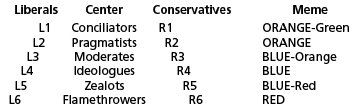
Don Beck developed this template to help us understand how both sides in the political debate can be either peacemakers (conciliators) or totally single-minded aggressors (flamethrowers). This is a useful tool as the premise for an integral politics.

The bottom three levels (4-6) are blocked systems, unable to hear other points of view or alter their positions based on new information. The top three levels (1-3) are open systems, fully able to hear other positions and alter their own positions in light of new information. It feels as though politics is dominated by the bottom three levels on both sides of the political aisle.

For those of you who know a little about Spiral Dynamics, the important vMemes are listed on the right of the chart. Each viewpoint is based in a unique worldview that shapes how it responds to its particular life conditions.

The problem on both sides of the divide is that the "stuck" viewpoints can make enemies of their allies. For example, an R5 zealot (maybe Focus on the Family) can see R3 through R1 as too liberal, making enemies of its own party members. The same thing can happen to liberals, where extremists (perhaps Earth First members) may see moderates who try to work within the system as traitors to the cause.

An integral politics must work to unite the top three levels on both sides to form something equivalent to the "Gang of 14" (7 Democrats and 7 Republicans) who ended the threat of the nuclear option (ending the filibuster option for the minority party in the Senate). Only the highest vMemes are capable of working to create consensus, or of finding ways to compromise that allow both sides to feel as though they get their needs met.

If you have insights or ideas on how to create a more integral politics, please send me a message at Integral Options for Life. I will post the best ideas on the site. I would like this to become a place, a true Ideas Café, where other people can share their ideas and create a multilogue on topics that matter.

Sunday, October 30, 2005

SDi in Boulder Is Over

The SDi Level II certification in Boulder for 2005 has ended. I'm sitting here in the Denver airport reflecting on everything I learned and am grateful for the experience. The people I met and got to know over this last week are all remarkable human beings.

Jean Houston seems to have been a very welcome teacher for the Level II days. I am probably alone in my reservations about her teachings, but then I have always been a cynic. I admire the breadth of her knowledge and her ability to think on her feet in profound ways. However, I think she mistakenly elevates a lot of prepersonal Purple vMeme stuff to transpersonal Turquoise vMeme status. Having made the pre/trans fallacy so often in my life, I am hypersensitive to it when it comes up. Jean seems to make this mistake a lot and then dismisses any questioning of her position. I don't know if this is hubris or false certainty, but it's disconcerting. She's too brilliant to haphazardly make category errors.

I found Don Beck to be amazingly down-to-earth and humble. It's refreshing to meet a master teacher who is not full of himself. Don doesn't take himself too seriously, even when he is very serious about Spiral Dynamics. Any Texan who can repeatedly dis his own state is fine by me.


I have to admit I came into this week afraid I wouldn't learn anything I hadn't already absorbed from the book. I am glad to have been so terribly wrong. More than anything else, I have a new appreciation for how each of the vMemes comes into existence to correct an imbalance -- and how crucial each vMeme is to the whole Spiral. I am also grateful to Don for being so clear that we are not about "growing" people. We can best serve the Spiral by working to create life conditions that will effectively bring forth new vMemes in people who are ready for transformation.

Evangelical Christians & Intelligent Design

On NBC's Dateline Friday night, Tom Brokaw spent the hour exploring the world of evangelical Christianity. The episode, "In God They Trust," focused on one of America's newly emergent mega-churches in Colorado Springs, CO -- Ted Haggard's New Life Church.


Brokaw: Most of the churches that I know of, and certainly the ones I attended, at some point, you out loud acknowledge that you were a sinner or that you came face-to-face to guilt that you may feel.

Haggard: Right.

Brokaw: I didn’t see any of that here.

Haggard: Well, we do talk about sin. But, see, the issue is Jesus took care of our sin. And Jesus removes guilt from our life. So the emphasis in our church isn’t how to get your sins removed because that’s pretty easy to do. Jesus did that on the cross. The emphasis in our church is how to fulfill the destiny that God’s called you
to.

____

Along with other religious conservative leaders, Haggard belongs to an association called the Arlington Group, the members push for common goals such as banning gay marriage and restricting abortion.

Brokaw: Let me read you what Senator John Danforth, an ordained Episcopal priest, a Republican says, “Many conservative Christians approach politics with a certainty that they know God’s mind and they can advance God’s will through government.” Is he talking about you?

Ted Haggard: Well, I think all of us have a responsibility to advance God’s will through government. But we are in a pluralistic society. We’re not talking about theocracy. We’re not talking about some group of religious leaders dictating to the government how to write law.

While it's easy for some of us to look at these people as fundamentalists and radicals, especially considering that they hold a literal interpretation of the Bible, there is more to the movement than a strict religious vision. They want their government to reflect their views -- and this is where many of us feel uncomfortable -- so it is important that we understand the source of their views and how we might change them.

In the language of Spiral Dynamics, evangelicals are Blue to the core [a mini-course on the Spiral is available here]. The Blue Meme emerges in response to the previous Red Meme, which is egoic and power-driven. Red is unstructured, violent, and lacking any guilt in the satisfaction of its needs. Blue rises to provide boundaries to that egoic drive, to sublimate egoic needs into culturally agreed-upon values.

To provide a foundation for this set of collective values, Blue invokes a divine power and the threat of eternal punishment, as well as the promise of eternal bliss if you simply follow the rules. However, the emphasis should not be on the divinity -- it should be on the need for order and meaning that religion offers. This is where we can talk to Blue and expand its worldview.

One of the reasons evangelicals reject science is because they sense that it removes meaning and order from the world -- science killed God in their eyes. One of the most disturbing things to a Blue person is a world without order and meaning; as long as they believe science removes those values from their world, they will reject science and remain ensconced in their evangelical worldview. This viewpoint is precisely why conservatives, especially evangelicals, despise postmodernism's relativism -- it makes all things equal and in doing so removes meaning from the world (as they see it).

What would happen if science and religion could peacefully coexist? I have been harshly critical of "intelligent design" and still maintain that it is faith and not science, but we should be encouraging evangelicals to adopt the intelligent design (ID) worldview and to reject strict creationism. We also should fight to the death all attempts to teach ID as science.

Intelligent design offers a new set of life conditions that can open the possibility of Blue moving toward Orange, resulting in a BLUE-orange transitional Meme. In an ID world, science will no longer be seen by evangelicals as a value system that rejects God and an ordered, meaningful universe.

If we want to create an integral world, and particularly if we want to create an integral politics, we will need to find new ways to alter the existing life conditions to facilitate change and emergence. As much as it might pain us, ID is one of the ways we can create life conditions that will allow some evangelicals to move toward a more expansive worldview.

Saturday, October 29, 2005

Ritual Is a Process, Not a Content

In The Marriage of Sense and Soul, Ken Wilber argues that religion stripped of its cultural baggage can offer transformative technologies for elevating consciousness. He is making a distinction between the technology of religion and its content. I believe this is an important distinction.

In today's session of SDi Level II, Jean Houston -- well-known New Age teacher, psychologist, and anthropologist -- talked about the need for ritual when dealing with periods of transformation in our lives, those time when we are betwixt and between. These in-between times are known as liminal space in religious studies and in anthropology. The initiation stage of ritual is a period of liminality.

Houston feels that when we are in the liminality associated with change we should return to the ritual forms of the Purple vMeme. She feels that the myths and rituals from that archaic stage of human development hold the keys to helping us navigate the change process. I disagree.

Ritual is a process, not a content. We do not need to regress to prepersonal rituals in order to deal with transformational change, for example, the movement from Orange to Green. These are distinctly personal stages. Purple is prepersonal. Unless there is some kind of blockage or pathology at the Purple level, regressing to that stage is only going to confuse the situation.

However, we can use the tools of that stage, including myth and ritual, to navigate change at these higher levels. In essence, ritual is a technology involving the separation from where we were, the initiation into a new way of being, and the return to our lives with new knowledge and a larger perspective. This is the also the monomyth that Joseph Campbell made popular through his books (see The Hero With a Thousand Faces).

If we can reframe the change process as a personal ritual in the monomyth of our lives, we can work with the process instead of being subject to its action on us. We can take advantage of liminality, while honoring its power and its risks, to work with the dissolution of identity inherent in any form of initiation. During a period of liminality, we are free to redefine boundaries and explore new conceptions of who we might become.

None of this requires regression to the undifferentiated fusion with tribe and nature that comprises the Purple vMeme. One of the marks of the Spiral Wizard is the wisdom to use the tools of each of the vMemes in ways that can facilitate Spiral evolution.

Meditation Is Necessary But Not Sufficient For Global Meme Change in the Individual

On the first day of SDi Level II certification, physicist and erstwhile politician Dr. John Hagelin spoke to the group via livewire on his favorite topic, transcendental meditation (TM). He argued persuasively for the many ways TM can improve the lives of criminals, children, and spiritual seekers.

However, Hagelin stated repeatedly that one can attain "enlightenment" via regular practice of TM. I can't disprove his statements, but I can suggest that the evidence doesn't support such assertions. Buddhists and Hindus have been practicing meditation for centuries, and in fact TM is based on Vedantic principles. If it were possible to attain enlightenment so easily, I doubt that so many practitioners in both traditions would be working so hard to end their attachment to samsara.

Hagelin mentioned at other times that TM can produce nondual consciousness, which I surmise is what he considers enlightenment. The problem is that he is confusing a state with a stage. Nondual consciousness is available to all sentient beings as a state of consciousness, although it isn't as easy as it might seem to engage that experience. As a stage of consciousness, however, few people have ever reached that level of development -- those who did are considered Buddhas and bodhisattvas.

In order for a person to be considered enlightened, s/he must live from the level of nondual consciousness, which amounts to having a continual awareness of that state as an aspect of consciousness. Obviously, one cannot function while in a state of blissful nonduality, but that awareness can be the foundation of all other consciousness. This is a stage conception of enlightenment as opposed to a state conception. [Ken Wilber discusses states and stages in this sidebar to Boomeritis.]

The question that is worth exploring is this: Can regular but transient exposure to nondual consciousness change brain structure and personality structure sufficiently to spark global meme change in an individual?

Using an integral model, meditation or spiritual development is simply one developmental line among many. It is generally assumed that the status of one line is not enough to change the status of all the other lines. In Wilber-speak, elevation of the spiritual line is necessary but not sufficient to promote change among the other lines.

A secondary problem is that when one has a peak experience of a higher state of consciousness, it will necessarily be interpreted through the dominant lens (i.e., vMeme or developmental level). When one returns to everyday consciousness, the peak state, no matter how spectacular, can only be understood within the context of the current worldview. So, for example, when a person whose center of gravity is in the Blue vMeme (e.g., a devout Catholic) has an experience of nondual consciousness during a session of centering prayer, s/he will almost certainly experience that state of consciousness as a union with his/her notion of God (think Saint Theresa of Avila).

From Wilber:


You can have an altered state or temporary peak experience of any of the three great realms of being--gross, subtle, and causal--and you can do so at virtually any stage or level of development. Why? Because even an infant wakes, dreams, and sleeps. And because the infant has access to these three great states (waking, dreaming, sleeping), the infant has access to the three great realms of being (gross, subtle, causal)-- and that can happen at any stage of development (because at every stage, infants and children and adults all wake, dream, and sleep). But as for the levels or stages themselves, they unfold and develop over time; that is the very meaning of a stage of development. Thus, although the infant has access to the three great states, the infant does not have access to all the levels or stages that can occur in those states, because those have to develop and unfold in its own case. Is that clear? Yes?

For example, using this simple 3-state, 5-stage model, a human being can be at 'level/stage/sheath 2'--that is, their general center of gravity is at the emotional-sexual wave of development (in early childhood)--and they can still have a temporary peak experience of the subtle and the causal realms--because they have perfect access to dream and deep-sleep states, and thus they can 'peek' experience them. But they--the child at level 2, in this case--will not be able to experience all the stages of the mind level, such as formal operational thinking, because those have not yet emerged and developed.

Precisely because the basic levels or stages have not yet emerged and stabilized, the altered states of a subtle or causal nature are not permanent. They are merely peak experiences; they come and they go quickly; they cannot be permanently contained--there is, so to speak, nothing to hold them in place, no structures or stable patterns in the psyche that can maintain access to these higher states, which are therefore always temporary and passing. So anybody at virtually any stage can have a profound, authentic, genuine state-experience of a subtle or causal realm, but they will not be able to experience those subtle or causal realms in a permanent fashion--the peak experience or altered state will come and go.

What is needed to make these peak experiences a permanent part of consciousness is that all blocks to moving up the Spiral be removed. This entails what has been termed "regression in service of transcendence." It's worth noting that Michael Washburn's version of this process violates the pre/trans fallacy in that he views infantile undifferentiated consciousness as the same as nondual completely differentiated consciousness.

Washburn, in his own words:

When it is very young, the emerging ego finds itself both attracted to the Dynamic Ground and fearfully dependent on it. This relationship is mirrored in the young toddler's external reliance upon the mother as both the primary source of love and the primary source of frustration when the child is not fed, held or otherwise cared for. In order to achieve some measure of independence from these prodigious, awesome experiences, the young ego inevitably seeks to buffer or separate itself. It does that by reducing both its interpersonal intimacy with the mother (or primary caregiver) and its acceptance of the internal flows of feeling that I call the Dynamic Ground. It creates a Primal (or Original) Repression. Repression is not a sin when committed at this age. It is a necessary part of the development of the ego. It adds something positive to our overall development. It gives the ego an independent space in which to grow. It's not a crime, it is a developmental necessity.

Washburn argues that his "regression in service of transcendence" is needed to regain the "Dynamic Ground" that we were born into but that ego development pushed us away from. Classic Jungian pre/trans confusion.

A more appropriate approach is to use therapy as way to go back and heal the inevitable wounds of childhood that have blocked development in certain areas of our lives. Various approaches work quite well, though I am fond of psychosynthesis and its work with subpersonalities. The most common hindrance to development is emotional blockage -- these blockages, which are often a form of wounding, must be addressed for movement up the Spiral to be possible.

The best overall approach to elevating vMemes is to engage in some form of a unified program of development. Integral Transformative Practice, which incorporates body, heart, mind, and soul into a single program, fits that agenda.

Meditation practice is good -- and necessary -- but it is not sufficient to achieving global vMeme change or enlightenment.

Friday, October 28, 2005

The Physiology of Change

Day One of SDi Level II, Personal Emergence, focused on the physiology of change.

Dr. Bruce Lipton presented his views on how perception, or more precisely belief (the environment), shapes the function of our cells. His central premise is that thought patterns generate our health status. If we think we are going to get sick, we create the environment necessary to become sick. He was very clear on how cells respond to various signals, but he allowed thought and beliefs to remain abstract forms of energy, as though our thoughts don't create specific chemical environments in the body.

Lipton made some good points, but he left out the whole field of psychoneuroimmunology, a field pioneered by Candace Pert (Molecules of Emotion). Essentially, PNI states that our thoughts and emotions create specific chemical reactions in the body, some of which are healthy and some of which are toxic. The connection between perception and health isn't as abstract as Lipton intimated.

In arguing that the human body operates in much the same way as its individual cells, he made the point that the skin is the major organ influencing our health status because it is the organ that receives info from the environment. This idea is based on the fact that cells can exist for days or weeks without their nucleus, the supposed brain of the cell. Obviously, humans can't survive without brains, but Lipton argues that they are simply processors, and that the skin is the true center of our environmental intelligence.

Howard Bloom (The Lucifer Principle, Global Brain) wrapped up the day with a short presentation. He did, however, talk about the primary chemicals in the brain/body that generate change (serotonin, testosterone, and dopamine). This fills in part of what Lipton didn't cover.

Okay, here is my take on all this.

Several years ago I stumbled across something called biophotons while researching DNA as an intelligence locus. Essentially, biophotons are light particles (photons) emitted from living DNA (bio). What makes this fact interesting is that biophotons are coherent, meaning that they carry information. Every DNA molecule on the planet is emitting biophotons into the environment. Although it has not yet been proven (as far as I know -- info in this country is lacking), it stands to reason that DNA must also be able to receive and process biophotonic information.

The Germans are already using biophotons to assess cell health. An unhealthy cell emits incoherent patterns, while healthy cells emit coherent patterns. The frequency and coherence of biophotons reveal a great deal about the health of the given cells. The Germans have successfully used this technology to diagnose cancer. ("While normal tissue follows this optimization principle, tumor tissue has lost this capacity by a critical loss of coherence," according to Fritz-Albert Popp.)

So, how does this relate to change?

The human body is sending out and receiving billions of biophoton signals every moment. It is a constant means of communication with our environment. As the environment changes, thereby changing our life conditions (the primary factor in changing a system within the Spiral Dynamic framework), our bodies pick up this information and respond accordingly with neurochemical responses that can, as Lipton points out, alter our genetic code. This may be the single most important contributing factor in biological evolution.

Once we understand how this works, it gives a whole new significance to the idea that how we treat our environment is how we treat ourselves. As we destroy our environment, we change our life conditions for the worse. Over time, maybe over decades or centuries, this will change us, our health, and perhaps even our evolutionary arc.

It is likely to be proven crucial to our continued evolution that we STOP DESTROYING OUR ENVIRONMENT. Every detrimental change to our environment will eventually produce a unique biological response in our bodies and in our genetic code.

Okay, off my soapbox.

On a more practical level: Introducing a person into nature has been shown to have a calming effect on the body, improve the status of depressed persons, and help realign biological patterns that have been corrupted by a lack of exposure to nature (E.O. Wilson's Biophilia Hypothesis and here -- or here for Howard Bloom's take on how environment influences evolution).

To fully understand and engage the change process, we must understand how our exposure to other living things changes us at the microbiological level. While this focus of research only engages one quadrant of the change process, it is one that has been mostly neglected until recently. We need to change that.

Thursday, October 27, 2005

Don Beck: I Don't Know How to "Grow" People

I must sheepishly admit that I came to the SDi Personal Emergence confab with the thought that I might learn some tools or techniques for helping people progress along the Spiral. After completing the Level I certification, I have been completely disabused of that notion.

I know that "global" change is rare and difficult to attain, but I had hoped that I could learn to promote growth within specific developmental lines (such as self-worth, emotional intelligence, or kinesthetic intelligence).

Don Beck is adamant in his belief that it is not his role to "grow" people. At best, he tries to create a "habitat" in which the life conditions are such that growth becomes possible. This is a hugely valuable lesson for me.

As a trainer, I spend most of my time working with people in the upper right quadrant of their lives (exterior-individual), focusing on nutrition, exercise, and behavior. While I also pay attention to the upper left quadrant (interior-individual), focusing on emotional blocks or self-talk that defeats efforts in the upper right, neither of these areas really creates a habitat that can promote change -- of any kind.

There are some ways that I do promote that habitat -- structure, accountability, safety, encouragement -- but I think I can do more to help create the life conditions that can promote change. I'm not looking for global change anymore, or even movement up the Spiral -- I simply want to create the conditions in which my clients can achieve first-order change (adjustments in lifestyle, habits, or beliefs).

I will be exploring this idea in more depth when I am back in the world -- look for an SDi-based update to The Integral Fitness Solution, coming soon.

Wednesday, October 26, 2005

The Mean Meme War

Fellow blogger and integral enthusiast coolmel alerted me to an ongoing war between Cowan and Wilber -- mostly it's Cowan hating on Wilber/Beck. Cowan has hurt his argument by descending to name-calling, but he raises some valid points before doing so.

Here are links to the relevant articles. I leave it to the reader to form an opinion based on evidence and personal experience.

"The Missing Links" of Spiral Dynamics and Ken Wilber: The Mean Orange Meme (MOM)and the Healthy Green Meme (HGM) by Bill Moyer

Wilber's reply: On the mean memes in general: Red to blue to orange to green to yellow by Ken Wilber

Cowan's reply to Wilber: Response to Ken Wilber's Response to "The Missing Links" of Spiral Dynamics and Ken Wilber, a posting by Bill Moyer on the Post-Conventional Politics (Post-Con Pol) discussion list, reproduced on The World of Ken Wilber website by Chris Cowan


For additional rejection from Cowan's camp of the Beck/Wilber work, see The Mean Green Hypothesis: Fact or Fiction? by Dr. Natasha Todorovic.

Defining Integral

There is a bit of a war (see The Mean Meme War) between Chris Cowan co-author of the original Spiral Dynamics book) and the Wilber/Beck integral camp. A recent article from Cowan's NVC Consulting group, entitled "Premature Integral," argues that much of what is discussed as integral really isn't.

Considering that I am currently taking Beck's SDi certification course, I'd have to respectfully disagree with Cowan's assessment of the integral camp. I do believe he has some valid points in objecting to how SD has been used by Wilber, but my experience of Beck suggests that he is trying to stay true to Graves' original work, while presenting it in a marketable "integral" wrapper.

From the article:

“You’ve got to differentiate before you can integrate,” commented Ed Edwards - futurist, physicist and businessman - during a discussion at our SD certification training in Santa Barbara. (The next is April 18-24, 2005.) This remark sheds light on an idea some Spiral Dynamics enthusiasts find compelling. The word “integral” is playing large and loud for many who have come to Dr. Graves’s work via the Wilber-oriented route. Indeed, it’s been tacked onto Spiral Dynamics to market a separated branch of the work from ours by slight rebranding. (The differences go far beyond mere labeling at this point, but that’s another story.) What’s going on?

Integration has a number of meanings and usages depending on what is being integrated and in which field: philosophical ideas, people, mathematics, electronics, social categories, business units or departments (i.e., manufacturing integrated with distribution), political systems, economic interest groups, consciousness, spirituality, etc. Thus, for many people “integral” is merely an adjective describing connectedness and openness to drawing together a range of parts, functions, information/insight. The word “integrative” has been part of Spiral Dynamics for years as a synonym for systemic-type thinking, one of the variations of conception within the open-ended SD model.

For others, though, the adjective “integral” has taken on metaphysical significance and become a noun. It’s an organizing principle to rally their thinking – the flag that flies over their lives. Much as a religion provides the answers for righteous living to True Believers who have adopted other spiritual philosophies, integral becomes a goal of life. This form of integral becomes a state of being, an existential condition: “I am integral!” “Proud to be an integral!” “My child is integral at Thomas Edison Elementary School.” SD turns into articles of faith.

In our experience, many of the people using the word thusly are following a fashion trend, tossing it around without thinking through the implications. The idea that everything connects is alluring; coalescing an eclectic mix of fields into a laser-like focus sounds intriguing; and pulling all the fragmented chunks together and replacing them with holism or a unified field that explains everything has been a dream for many thinkers, including Graves. The catch is, as Ed pointed out, one must also be able to differentiate clearly. It’s not a matter of integral OR differential – both are important. However, the concentration on integral has blinded many to a broader range of possibilities.

Read the rest here.

Tuesday, October 25, 2005

Thought for the Day

"The important thing in Spiral Dynamics is not the Spiral, it's the dynamics." --Don Beck

Too many of us get bogged down in the Spiral colors and ignore the dynamics of how the colors operate.

Personal Emergence and Spiral Dynamics

Many of us have assumed that personal emergence along the Spiral moves step by step, from one vMeme to the next. However, during yesterday's session Beck suggested that many people move along in a much more focused way. There are two possible tracts that people can take: warm colors, with an external, individual focus (beige, red, orange, yellow) or cool colors, with an internal, communal focus (purple, blue, green, turquoise). People who progress in this way will only experience the opposing colors as much as necessary to create dissonance in order to move to the next stage along their track.

However, part of the emergence into second tier for these people will require that they go back and "pick up" the vMemes that were only minimally experienced in order to create a healthy stack of first-tier vMemes. So, for example, a cool-color person may end up spending a lot time at yellow in an effort to flesh out the lower vMemes.

This adds new info to my understanding of the Spiral and how it works in people's lives. It is especially important for the book I am writing on Personal Emergence -- more to come on that in the near future.

Monday, October 24, 2005

Democracy in Iraq Will Fail

I've tried to talk about this issue before on Raven's View, but it's hard to use the language of Spiral Dynamics with those who are not familiar with it. Here, some of you are already on board, and the others have at least a passing interest or curiosity.

Today Don Beck talked about how the higher vMemes have a tendency to impose their own values on the lower vMemes and expect a positive outcome. For example, many early efforts in South Africa to end apartheid failed due to the types of solutions being offered. When he began working with the various factions, his first priority was to assess which vMemes were being represented. The solutions were tailored to the Memes.

In essence, you cannot end Red Meme power quests with Green Meme communal respect.

This is the situation we face in having destroyed the power balance in Iraq through our invasion. The dominant vMemes in Iraq are Purple (tribalistic, kin centered), Red (egocentric, power driven), and Blue (absolutist, order driven). The center of gravity is Red.

We come in with our Orange Meme multi-party democratic ideals, with a strong dose of Green Meme egalitarianism (women's rights), and expect to be able to impose that system on a tribal people who are most concerned with power and religious control of power (RED-blue). It won't work. The minute we leave, the whole thing will collapse into tribal warfare.

If we really wanted to create order in Iraq, the goal would be to create a healthy version of Blue, especially a strong Islamic Blue, that can tame the "will to power" inherent in the Red tribal worldview. The result would likely be an Islamic government, but if the Blue Meme were healthy, it could rule peacefully and provide the boundaries necessary to bring Red into the Blue worldview -- which is the only way to tame Red.

As it stands now, we will either be in Iraq as peacekeepers for the foreseeable future, or we will leave and the whole thing will collapse.