Why Do Zombies Lumber?
Two neuroscientists explain why zombies have so much trouble walking.
By Timothy Verstynen and Bradley Voytek
October 30, 2014
 Drawing by Anne Karetnikov
Excerpted from Do Zombies Dream of Undead Sheep?: A Neuroscientific View of the Zombie Brain by Timothy Verstynen and Bradley Voytek. Out now from Princeton University Press.
In the movie Dawn of the Dead (1978) there is a scene when anarchist outlaws break into the mall that the movie’s heroes had secured and lived in for weeks. This invasion subsequently allows the horde of zombies—which had been aggregating outside—free range of the place. The humans are zipping around playing games while the zombies lumber along slowly and clumsily. The humans easily dispatch the threat of individual zombies because the undead are just too darn slow; there’s no real threat until the humans are outnumbered.
The slow and uncoordinated movements of zombies are perhaps the most identifiable feature of their behavior (next to the whole biting and flesh-eating thing of course). Ask anyone to impersonate a zombie and the first thing she’ll do is hold her arms out, widen her stance, stiffen her legs, and utter a low, guttural moan. That’s because, in the movies, as soon as zombies rise from the dead, they begin walking. Well not walking ... more like lumbering. Each step is slow and arduous. Their stance is wide and stiff. This presents us with a very important clue about what’s happened to their brains.
So what does it take to turn the normally smooth, fast, coordinated movements of a healthy person into the traditional zombie lumber? First, let’s consider the pathways in the brain that give rise to our movements.
While “higher” cognitive functions (aka thinking) tend to get all the glory in neuroscience, before the brain did a lot of deep thinking it did a lot of moving. In fact, some scientists have argued that the entire reason we have a brain is to get us moving around in the environment.
The logic for this argument arises from observations of a little ocean creature called the sea squirt. Seriously, that’s its name. The sea squirt is a small and evolutionarily old animal of the phylum Chordata (when scientists say “evolutionarily old,” we mean that the life form has been in a relatively unchanged state for millions and millions of years). In its young life, the sea squirt is a little larval creature that has a very primitive brain and sensory organs. Its goal during its larval stage of development is to swim around and find a rock to perch on. Once it has found a suitable home, like, say, a nice secure rock with plenty of organic food just flowing by, the sea squirt will attach itself with its head facing out. Then it basically just sits there catching food as it floats by. As it matures into a full-grown adult creature the sea squirt does something quite strange: It digests its own brain.
Yeah, you read that right. Let that sink in. It digests its own brain.
Biologists and neuroscientists have argued that this is evolutionarily advantageous. See, the brain is really expensive, from a metabolic standpoint. Meaning that it takes a lot of energy to keep the brain going, and energy (food) is pretty hard to come by when you’re little more than a stick on a rock with a mouth attached. So when you no longer need a metabolically expensive organ like the brain, it is better to just get rid of it. Thus, no longer needing to navigate around its environment, the sea squirt simply has lost the need for its brain and does away with it. But waste not, want not, in nature. So “doing away with it” means “eating it.” And thus the sea squirt digests its own brain.
Now luckily for us, we humans are more than mouth-sticks attached to rocks. We need to keep moving. We can’t just sit around and digest away our own brain, because food doesn’t just come to us. No, we still have to go out and get our food, even if it is just by driving to the local fast-food chain down the block. This means we get to keep our brains because, for the brain, movement is life.
Unfortunately, the same is true for zombies. Because humans rarely run to zombies, the walking dead have to go to their food source. Which means the zombies also still need their brains. Well, at least part of their brains.
If we presume that the primary function of the brain is to get us moving around in the world, then it’s not surprising that a lot of neural real estate is devoted to the planning and execution of actions. In fact, the computations required to simply move around our environment are distributed across vast swaths of both cortical and subcortical areas. So let’s take a walk through the multitude of brain systems that move us around, shall we?
Most of our voluntary movements start in the neocortex, in two of the four major lobes: the frontal and parietal lobes. Neurons in the parietal lobe that primarily maintain spatial awareness, and those in the frontal lobe that control decision making, are constantly negotiating with one another as to what action we should do next. We might imagine the dialogue going something like this:
In our silly little sketch here, the parietal lobe tells us where to attend to things that are in the environment while the frontal cortex in the front of the head decides what to do. Then the motor areas, in the back part of the frontal cortex, make the movement happen.
- PARIETAL LOBE: “Hey, there’s a tasty piece of broccoli 30 degrees to the left.”
- FRONTAL LOBE: “Broccoli??? No way! I want something more awesome!”
- PARIETAL LOBE: [sigh] “OK, how about that doughnut 10 degrees to the right?”
- FRONTAL LOBE: “Now you’re talking. Hey! Right arm! Attention, right arm! Prepare the triceps, deltoids, and hand muscles for action. We’re going to make a reach.”
- MOTOR CORTEX: “Jawohl, Lord Frontal Cortex!”
Contrary to what you may have heard, there’s not just a single motor cortex. In fact, there are several “motor” areas that are spread out across the frontal lobe and provide the groundwork for planning your movements. You can think of these as the middle management of motor planning. They take the decisions handed down from frontal areas and turn them into plans that the heavy lifters in the arms, legs, and other muscles know what to do with. Which isn’t as easy as it sounds.
Let’s consider the following scenario: You’re a zombie sitting very patiently on the examination table, hand resting on your desiccated, disgusting lap. The nerdy scientists in their awkward lab coats then place a tasty chunk of human flesh right in front of you. What remains of your undead frontal lobes will immediately say “GO GET THAT!” because, hey, free thigh.
Before you can actually grab that tasty piece of meat, however, the motor planning areas in your undead brain, called premotor regions, have to figure out how to get your hand from your lap to the yummy flesh. Now remember, while you can see the tasty morsel, the process of getting your hand off of your lap and to the chunk of meat is pretty complicated. Somehow your brain has to convert a map of the world that’s being projected from the back of your eyeballs to a plan of muscle contractions that uses your bones as levers, much as a puppet master has to coordinate the strings of a marionette doll to make it dance—except here the puppet master is your own brain.
Let’s return our attention to that horde of walking dead outside. While zombie movements are slow, stiff, and uncoordinated, zombies do seem to be able to plan movements in the right direction. That is, when a zombie wants to lunge toward you, it mostly gets the direction right. Once it gets its hands on you, it has no problem grasping and holding on. Therefore it would appear that the cortical motor systems are all intact. So what could be wrong? The only real neural culprits left as plausible candidates for the motor dysfunction seen in zombies are the basal ganglia and the cerebellum.
Given this restriction, let’s consider what happens when the basal ganglia are malfunctioning and compare that with when something goes wrong with the cerebellum. In both cases, people have trouble walking and coordinating their movements, but in dramatically different ways. For example, in Parkinson’s disease, people develop a slouched posture and walk by taking short, shuffling steps. They also have difficulty generating actions without a very obvious goal (they tend to freeze up). In contrast, people with spinocerebellar ataxia develop a stiff, wide-legged stance and take big, lumbering steps. And unlike those afflicted with Parkinson’s disease, these patients have no problem initiating movements.
How can we use this information to diagnose a zombie’s brain? We know that the walking dead are shown in movies as having a stiff, wide-legged stance and a big, lumbering walk. They tend to move slowly (most of the time) and lack smooth, coordinated actions. Yet they don’t seem to have trouble initiating movements. In fact, zombies are almost constantly on the move, they never have problems starting a movement (say reaching for a new victim), and they don’t stall in the middle of movements. They also don’t shuffle or have curvature in their posture.
For these reasons we argue that the cluster of symptoms seen in zombies, the wide stance, lumbering walk, lack of freezing, ease in general planning and execution of actions, reflects a pattern of cerebellar degeneration. That is, cerebellar dysfunction would lead to many of the motor symptoms of the zombie infection. However, cortical motor areas and basal ganglia pathways should be relatively intact.
At about this point, the really astute zombie movie fan will ask, “What about fast zombies?” For those who haven’t seen movies like World War Z, 28 Days Later, or the 2004 remake of Dawn of the Dead, “fast zombies” don’t appear to have any motor dysfunctions. They can move quickly and don’t appear to have any coordination problems. Given the terrifyingly coordinated movements that “fast zombies” exhibit, it is our belief that their cerebellums are likely intact. Any difficulty fast zombies may have moving are likely more to do with the fact that their arms and legs are rotting than any sort of neural damage.
In fact, this difference in presentation may allow us to develop neurological classifications of different subtypes of the disorder that may give important clues to the etiology of the zombie epidemic.
Hey folks ... sometimes diseases mutate. Why wouldn’t zombism?
- Subtype I (slow-moving subtype): First observed variant of the disease.
- Subtype II (fast-moving subtype): Distinguished from Subtype I variant by healthy motor coordination.
Truth be told, when we had the opportunity to ask George Romero why he made his ghouls walk the way they did in the Living Dead movies, he responded, “They’re supposed to be dead. They’re stiff. That’s how you’d walk if you were dead.” Not quite the answer that appeals to our neuroscience instincts, but a good alternative hypotheses to test in the next zombie apocalypse.
____
Excerpted from Do Zombies Dream of Undead Sheep?: A Neuroscientific View of the Zombie Brain by Timothy Verstynen and Bradley Voytek © 2014 by Princeton University Press. Reprinted by permission.
Timothy Verstynen is an assistant professor in the department of psychology and at the Center for the Neural Basis of Cognition at Carnegie Mellon University.
Bradley Voytek is an assistant professor of computational cognitive science and neuroscience at the University of California–San Diego.
Showing posts with label Halloween. Show all posts
Showing posts with label Halloween. Show all posts
Saturday, November 01, 2014
Why Do Zombies Lumber?
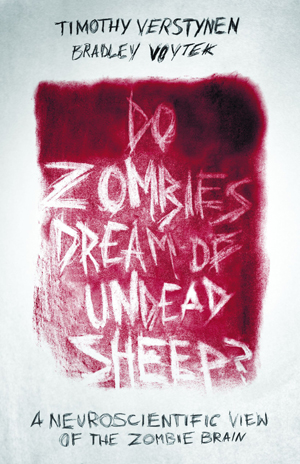
In the spirit of the Halloween weekend, here is a cool article from Slate on why zombies lumber when they walk. The article is an excerpt from the new book Timothy Verstynen and Bradley Voytek, Do Zombies Dream of Undead Sheep?: A Neuroscientific View of the Zombie Brain (2014). Not only is it a good explainer for zombie walking patterns, but it also introduces some basic neuroscience.


Friday, October 31, 2014
C. Nathan DeWall - Magic May Lurk Inside Us All
From the New York Times, here is a nice essay in the spirit of the season. DeWall looks at the persistence of magical thinking in adults, all of whom would likely deny their thinking is magical.
We typically associate this type of thinking with children, for example, believing that if their parents are fighting it must be because they are bad kids. Another example, from my own childhood, is "step on a crack [in the sidewalk] and break your mother's back." I was really young when I learned that this did not work as advertised.
However, as DeWall illustrates, magical thinking often persists into adulthood. Think of The Secret, as a recent adult example of believing ones thoughts can alter reality. Might as well place your intent on making it rain or generating world peace. Ain't gonna happen.
We typically associate this type of thinking with children, for example, believing that if their parents are fighting it must be because they are bad kids. Another example, from my own childhood, is "step on a crack [in the sidewalk] and break your mother's back." I was really young when I learned that this did not work as advertised.
However, as DeWall illustrates, magical thinking often persists into adulthood. Think of The Secret, as a recent adult example of believing ones thoughts can alter reality. Might as well place your intent on making it rain or generating world peace. Ain't gonna happen.
Magic may Lurk Inside Us All
C. Nathan DeWall | Oct. 27, 2014
How many words does it take to know you’re talking to an adult? In “Peter Pan,” J. M. Barrie needed just five: “Do you believe in fairies?”
Such belief requires magical thinking. Children suspend disbelief. They trust that events happen with no physical explanation, and they equate an image of something with its existence. Magical thinking was Peter Pan’s key to eternal youth.
The ghouls and goblins that will haunt All Hallows’ Eve on Friday also require people to take a leap of faith. Zombies wreak terror because children believe that the once-dead can reappear. At haunted houses, children dip their hands in buckets of cold noodles and spaghetti sauce. Even if you tell them what they touched, they know they felt guts. And children surmise that with the right Halloween makeup, costume and demeanor, they can frighten even the most skeptical adult.
We do grow up. We get jobs. We have children of our own. Along the way, we lose our tendencies toward magical thinking. Or at least we think we do. Several streams of research in psychology, neuroscience and philosophy are converging on an uncomfortable truth: We’re more susceptible to magical thinking than we’d like to admit. Consider the quandary facing college students in a clever demonstration of magical thinking. An experimenter hands you several darts and instructs you to throw them at different pictures. Some depict likable objects (for example, a baby), others are neutral (for example, a face-shaped circle). Would your performance differ if you lobbed darts at a baby?
It would. Performance plummeted when people threw the darts at the baby. Laura A. King, the psychologist at the University of Missouri who led this investigation, notes that research participants have a “baseless concern that a picture of an object shares an essential relationship with the object itself.”
Paul Rozin, a psychology professor at the University of Pennsylvania, argues that these studies demonstrate the magical law of similarity. Our minds subconsciously associate an image with an object. When something happens to the image, we experience a gut-level intuition that the object has changed as well.
Put yourself in the place of those poor college students. What would it feel like to take aim at the baby, seeking to impale it through its bright blue eye? We can skewer a picture of a baby face. We can stab a voodoo doll. Even as our conscious minds know we caused no harm, our primitive reaction thinks we tempted fate.
How can well-educated people — those who ought to know better — struggle to throw a dart at a piece of paper? Some philosophers argue that magical thinking is, in some ways, adaptive. Tamar Gendler, a philosopher at Yale University, has coined the term “aliefs” to refer to innate and habitual reactions that may be at odds with our conscious beliefs — as when pictures of vipers, snarling dogs or crashing airplanes make our hearts race.
Aliefs motivate us to take or withhold action. You might enjoy sweets, but would you eat a chocolate bar shaped like feces? Dr. Rozin and his colleagues showed that college students would not, though they knew it would not harm them. Our conscious beliefs tell us to shape up, use our wits and act rationally. But our subconscious aliefs set off deeply ingrained reactions that protect us from disease. The alief often wins.
We may have evolved to be this way — and that is not always a bad thing. We enter the world with innate knowledge that helped our evolutionary ancestors survive and reproduce. Babies know mother from stranger, scalding heat from soothing warmth. When we grow up, our minds cling to that knowledge and, without our awareness, use it to try to make sense of the world.
Can magical beliefs offer a window into the aggressive mind? My colleagues and I examined this idea in recent research published in the journal Aggressive Behavior. In one illustrative study, 529 married Americans were shown a picture of a doll and were told that it represented their spouse. They could insert as many pins into the doll as they wished, from zero to 51. Participants also reported how often they had perpetrated intimate partner violence, which included psychological aggression and physical assault.
Voodoo dolls can measure whether your romantic partner is “hangry”— that dangerous combination of hunger and anger. If we let our blood sugar drop, it becomes harder to put the brakes on our aggressive urges. In a study published in Proceedings of the National Academy of Sciences, we showed that on days when their blood sugar dropped, married people stabbed the voodoo doll with more pins.
Do people take the voodoo doll seriously? If they don’t, their responses should not relate to actual violent behavior. But they do. The more pins people used to stab the voodoo doll, the more psychological and physical aggression they perpetrated.
Stabbing a voodoo doll can also satisfy the desire for vengeance, another study found. When German students imagined an upsetting situation, they began to see the world through blood-colored glasses, increasing their tendency to ruminate on aggression-related thoughts. Stabbing a voodoo doll that represented the provocateur returned their glasses to their normal hue. By quenching their aggressive appetite, magical beliefs enabled provoked students to satisfy their aggressive goal without harming anyone.
Yes, children believe in magic because they don’t know any better. Peter Pan never grew up because he embraced magical beliefs. But such beliefs make for more than happy Halloweeners and children’s books. They give a glimpse into how the mind makes sense of the world.
We can’t overcome magical thinking. It is part of our evolved psychology. Our minds may fool us into thinking we are immune to magical thoughts. But we are only fooling ourselves. That’s the neatest trick of all.
~ C. Nathan DeWall is a professor of psychology at the University of Kentucky. With David G. Myers, he is co-author of the forthcoming book, Psychology (11th Edition).

Thursday, October 31, 2013
The Cabinet of Dr. Caligari - See the Restored Version of the 1920 Horror Classic with Its Original Color Tinting
Happy Halloween!
The Cabinet of Dr. Caligari: See the Restored Version of the 1920 Horror Classic with Its Original Color Tinting
October 31st, 2013

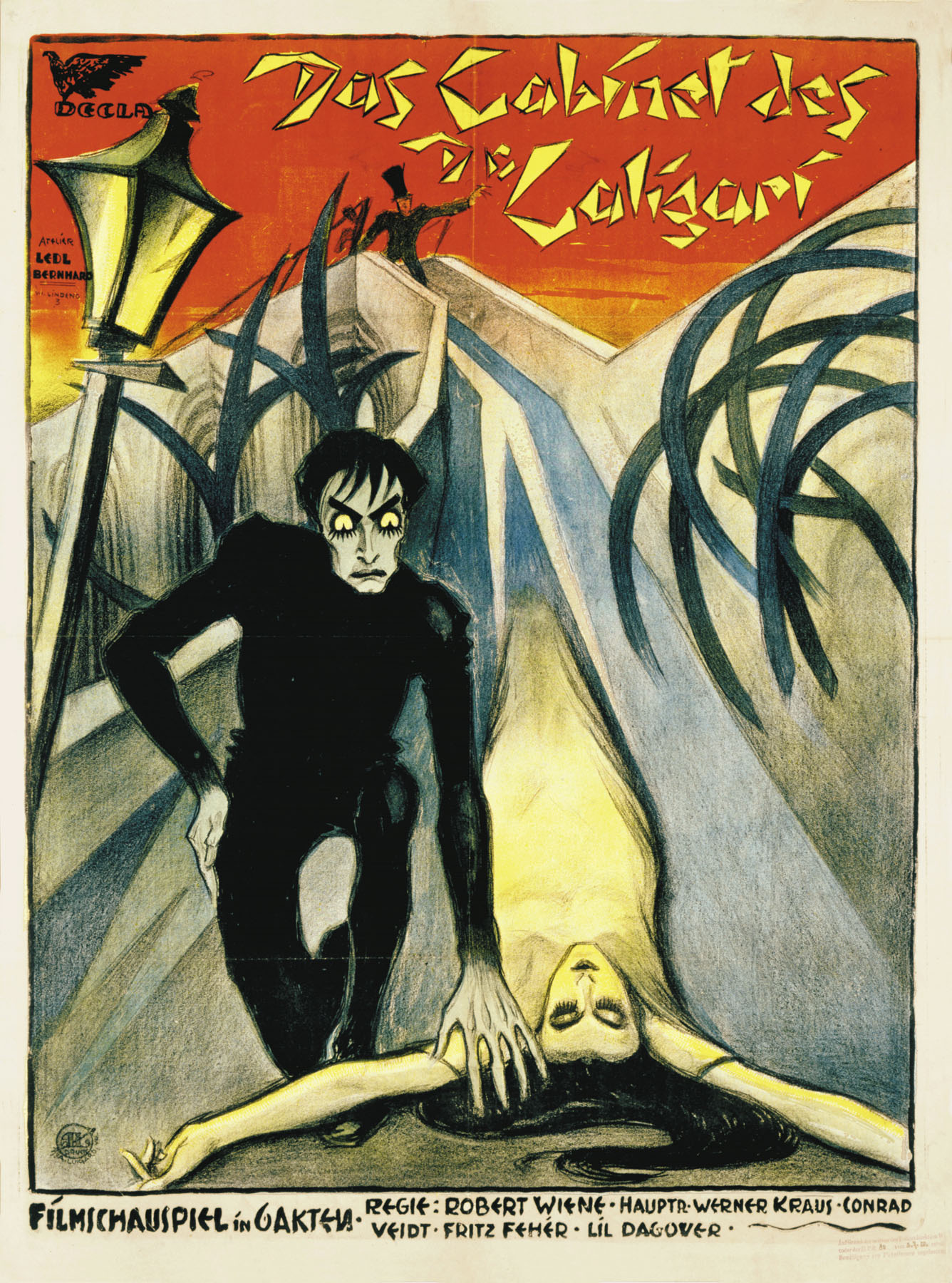
In early 1920, posters began appearing all over Berlin with a hypnotic spiral and the mysterious command Du musst Caligari werden — “You must become Caligari.”
The posters were part of an innovative advertising campaign for an upcoming movie by Robert Wiene called The Cabinet of Dr. Caligari. When the film appeared, audiences were mesmerized by Wiene’s surreal tale of mystery and horror. Almost a century later, The Cabinet of Dr. Caligari is still celebrated for its rare blending of lowbrow entertainment and avant-garde art. It is frequently cited as the quintessential cinematic example of German Expressionism, with its distorted perspectives and pervasive sense of dread.
Like many nightmares, Caligari had its origin in real-life events. Screenwriter Hans Janowitz had been walking late one night through a fair in Hamburg’s red-light district when he heard laughter. Turning, he saw an attractive young woman disappear behind some bushes in a park. A short time later a man emerged from the shadows and walked away. The next morning, Janowitz read in the newspapers that a young woman matching the description of the one he had seen had been murdered overnight at that very location.
Haunted by the incident, Janowitz told the story to fellow writer Carl Mayer. Together they set to work writing a screenplay based on the incident, drawing also on Mayer’s unsettling experience with a psychiatrist. They imagined a strange, bespectacled man named Dr. Caligari who arrives in a small town to demonstrate his powers of hypnotism over Cesare, a sleep walker, at the local fair. A series of mysterious murders follows.
Janowitz and Mayer sold their screenplay to Erich Pommer at Decla-Film. Pommer at first wanted Fritz Lang to direct the film, but Lang was busy with another project, so he gave the job to Wiene. One of the most critical decisions Pommer made was to hire Expressionist art director Hermann Warm to design the production, along with painters Walter Reimann and Walter Röhrig. As R. Barton Palmer writes at Film Reference:
The principle of Warm’s conception is the Expressionist notion of Ballung, that crystallization of the inner reality of objects, concepts, and people through an artistic expression that cuts through and discards a false exterior. Warm’s sets for the film correspondingly evoke the twists and turnings of a small German medieval town, but in a patently unrealistic fashion (e.g., streets cut across one another at impossible angles and paths are impossibly steep). The roofs that Cesare the somnambulist crosses during his nighttime depredations rise at unlikely angles to one another, yet still afford him passage so that he can reach his victims. In other words, the world of Caligari remains “real” in the sense that it is not offered as an alternative one to what actually exists. On the contrary, Warm’s design is meant to evoke the essence of German social life, offering a penetrating critique of semiofficial authority (the psychiatrist) that is softened by the addition of a framing story. As a practicing artist with a deep commitment to the political and intellectual program of Expressionism, Warm was the ideal technician to do the art design for the film, which bears out Warm’s famous manifesto that “the cinema image must become an engraving.”The screenwriters were disappointed with Wiene’s decision to frame the story as a flashback told by a patient in a psychiatric hospital. Janowitz, in particular, had meant Caligari to be an indictment of the German government that had recently sent millions of men to kill or be killed in the trenches of World War I. “While the original story exposed authority,” writes Siegfried Kracauer in From Caligari to Hitler: A Psychological History of the German Film, “Wiene’s Caligari glorified authority and convicted its antagonist of madness. A revolutionary film was thus turned into a conformist one — following the much-used pattern of declaring some normal but troublesome individual insane and sending him to a lunatic asylum.”
In a purely cinematic sense, of course, The Cabinet of Dr. Caligari remains a revolutionary work. You can watch the complete film above, made from a 35mm print restored by the Bundesarchiv-Filmarchiv of Germany and featuring the original color tinting.
The film is included in our collection of 575 Free Movies Online.
Related content:
Wednesday, October 31, 2012
It's the Great Pumpkin, Charlie Brown!
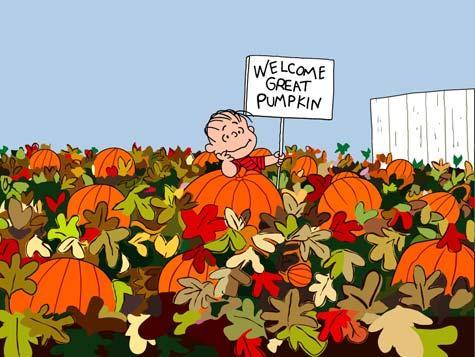
What would Halloween be without the Linus and the Great Pumpkin, Snoopy's happy dance with a falling leaf, Lucy pulling away the football from Charlie Brown, and on and on.
Somehow, even at 45 years of age, the holidays are empty without the classic Charlie Brown cartoons. I guess I'm nostalgic for the world the Charles Schulz imagined.
Watch Nosferatu Online - The Perfect Halloween Vampire Film

Nosferatu is one of my favorite horror films - ever - and also one of the greatest silent films ever made. You can watch it online for free this Halloween.
Watch the Quintessential Vampire Film Nosferatu Free Online as Halloween Approaches
October 26th, 2012
What, you haven’t seen Nosferatu yet? But you’re in luck: not only do you still have a few days left to fit this seminal classic of vampiric cinema into your Halloween viewing rotation, but when the 31st comes, you can watch it free online yet again. An inspiration for countless vampire films that would follow over the next ninety years, F.W. Murnau’s 1922 silent feature adapts Bram Stoker’s Dracula, but just loosely enough so that it could put its own stamp on the myth and not actually have to pay for rights to the novel. Jonathan and Mina Harker? Now Thomas and Ellen Hutter. Jonathan’s boss Renfield? Now a fellow named Knock. Count Dracula, to whose vast and crumbling estate Renfield sends the hapless Jonathan? Now Count Orlok — and unforgettably so. We can post no more relevant endorsement of Nosferatu‘s enduring value than to say that it remains scary, or at least eerie, to this day. I defy any sophisticated modern viewer to spend All Hallows’ eve with this picture and not come away feeling faintly unsettled.
Part of it has to do with sheer age: while some visual effects haven’t held up — get a load of Orlok escaping his coffin in the ship’s cargo hold, employing a technique trusted by every nine-year-old with a video camera — the deeply worn look and feel seems, at moments, to mark the film as coming from a distant past when aristocratic blood-sucking living corpses may as well have existed. This same process has, over four decades, imbued with a patina of menace every horror film made in the seventies. Fans of the 1979 Werner Herzog-Klaus Kinski collaboration Nosferatu the Vampyre, a companion piece obviously worth viewing in any case, can attest to this. You might also consider incorporating in your Halloween night viewing E. Elias Merhige’s Shadow of the Vampire, a satire of the 1920s film industry’s collision of eccentric old-world craftsmanship and savage commercial buffoonery which imagines Orlok as having been played by a geniune vampire. As for Francis Ford Coppola’s rights-having 1992 adaptation Bram Stoker’s Dracula… well, its chief point of interest is still Gary Oldman’s hairstyle.
You can always find Nosferatu listed in our collection of 500 Free Movies Online.
Related content:
Colin Marshall hosts and produces Notebook on Cities and Culture. Follow him on Twitter at @colinmarshall.
UTNE Reader - The Meaning of Halloween and a History of Witchcraft
In the spirit of the day. These two article comes from the UTNE Reader. Happy Halloween!
10/29/2012

Editor’s Note: A reader's recent tip reminded us about a collection of articles from the October/November 1986 issue of Utne Reader about Halloween, contemporary witchcraft, and feminist spirituality. In celebration of the holiday, we’ll be posting a few of our favorites online until the 31st.
Witches celebrate eight festivals each year, known as sabbats, which coincide with the changes in the seasons. The solstices (December 21 and June 21) mark the days when winter and summer, respectively, begin. The spring and fall equinoxes (March 21 and September 23) mark the two days of the year when the hours of the day are equally divided between day and night. These four days were very important to ancient agricultural societies and were occasions for great celebrations.
The four other sabbats are known as cross-quarter days and represent festivals that were important to herding societies: Candlemas on February 2; Beltane on May 1; Lughnasad on August 1; and Samhain, or Halloween, on October 31. Of the four cross-quarter days, Halloween is probably best known by nonpagans. In herding societies, Halloween marks the new year. It signifies the time of year when herdsmen thinned out their livestock for the winter, killing for their meat those animals that looked as if they wouldn’t survive the colder weather. Thus, Halloween is the Witch’s new year.
Halloween also marks the late harvest—the time of year when vegetation dies off and days grow shorter and darker.
“Halloween is the time when we are going into the dark,” says Antiga, a Minneapolis Witch, “and one thing about Witchcraft is that darkness is not necessarily associated with evil. The seed lies in darkness under the earth and is quiet all winter before it comes to life in the spring. In societies not as industrial as ours, people rested during the dark. It’s a whole different energy in the winter than in the summer.
“According to pagan legend, Halloween is also the time when the veil between the two worlds, the world of the dead and the living, is thought to be the thinnest. The reason people dressed up on Halloween was that they thought the spirits were all around them, and they were afraid the spirits might take them along with them. The people dressed up as spirits so the [visiting] spirits would think they too were spirits and wouldn’t take them to the world of the dead.”
Excerpted from the Twin Cities Reader (Oct. 30, 1985) and reprinted in Utne Reader (Oct./Nov. 1986).
Image: A Halloween trick-or-treater in Redford, Michigan, 1979. Photo by Don Scarbrough, licensed under Creative Commons.

Monday, October 29, 2012
Download a Free, New Halloween Story by Neil Gaiman (and Help Charities Along the Way)

From Open Culture (of course), a new Halloween story from Neil Gaiman (Click-Clack, the Rattlebag) is free to download, and each download generates money ($1) to charity (one in the Us and one in the UK):
We chose our charities with pride and with care:This offer, through Audible.com, is only good through Halloween, so act now. If enough people do the download, he will make a 2nd story available as well (it's already recorded). You can read more at Gaimon's blog. Links to the Audible sites (US and UK) are in the article below and at Gaimon's blog.
we picked Donors Choose -- http://www.donorschoose.org/ * - for the US;
we picked Booktrust - http://www.booktrust.org.uk/ ** - for the UK.
Download a Free, New Halloween Story by Neil Gaiman (and Help Charities Along the Way)
We’ve previously featured the free, downloadable stories and novels by author Neil Gaiman available online in video, audio, and text format. This is a wonderful thing, to be sure; Gaiman’s a fantastic writer of dark fantasy for children and adults alike, so who better to inaugurate this year’s Halloween celebrations with a new free story, available for download through Audible.com and read by Neil himself?
Gaiman’s new story, entitled “Click-Clack the Rattlebag,” is creepy, for sure, but that’s all I’m going say about it. You’ll need to download it yourself to find out more, and you really should because for every download of the story, Audible has agreed to donate a dollar to one of two charities that Neil has chosen—one for the U.S. and one for the U.K.. Gaiman has more information on his personal website, where he describes his negotiations with Audible in setting up the donations and the process of recording the story. He writes:
The story is unpublished (it will be published in a forthcoming anthology called Impossible Monsters, edited by Kasey Lansdale and coming out from Subterranean Press). It’s funny, a little bit, and it’s scary, just enough for Hallowe’en, I hope.
Gaiman also has a few requests: first, you need to download the story by Halloween in order to make the donation; second, please don’t give the story away—encourage people to go download it for themselves; and lastly, “wait to listen to it until after dark.” Atmosphere matters.
You do not need an Audible account to download the story, but you do need to give them your email address to prove you’re a human. U.S. readers should go to www.audible.com/ScareUs and U.K. readers to www.audible.co.uk/ScareUs. (Gaiman provides no instructions for readers in other countries; I suppose they could go to either site). So don’t wait—help Audible raise money for some worthy educational charities and get in the spirit with some great new fiction from one of the most imaginative writers working today. Finally, if you’re looking for more scary reads this Halloween, download Gaiman’s “All Hallow’s Read” book recommendations in a .pdf.
Note: Do you want to listen to other free audio books by Neil Gaiman? Just head over to Audible.com and register for a 30-day free trial. You can download any audiobook for free. Then, when the trial is over, you can continue your Audible subscription, or cancel it, and still keep the audio book. The choice is entirely yours. And, in full disclosure, let me tell you that we have a nice arrangement with Audible. Whenever someone signs up for a free trial, it helps support Open Culture.
Finally, we also suggest that you explore our collection of 450 Free Audio Books. It’s loaded with great classics.
Josh Jones is a doctoral candidate in English at Fordham University and a co-founder and former managing editor of Guernica / A Magazine of Arts and Politics.
Saturday, October 31, 2009
Subscribe to:
Comments (Atom)