Showing posts with label magical thinking. Show all posts

Friday, October 31, 2014

C. Nathan DeWall - Magic May Lurk Inside Us All

From the New York Times, here is a nice essay in the spirit of the season. DeWall looks at the persistence of magical thinking in adults, all of whom would likely deny their thinking is magical.

We typically associate this type of thinking with children, for example, believing that if their parents are fighting it must be because they are bad kids. Another example, from my own childhood, is "step on a crack [in the sidewalk] and break your mother's back." I was really young when I learned that this did not work as advertised.

However, as DeWall illustrates, magical thinking often persists into adulthood. Think of The Secret, as a recent adult example of believing ones thoughts can alter reality. Might as well place your intent on making it rain or generating world peace. Ain't gonna happen.

Magic may Lurk Inside Us All

C. Nathan DeWall | Oct. 27, 2014


How many words does it take to know you’re talking to an adult? In “Peter Pan,” J. M. Barrie needed just five: “Do you believe in fairies?”

Such belief requires magical thinking. Children suspend disbelief. They trust that events happen with no physical explanation, and they equate an image of something with its existence. Magical thinking was Peter Pan’s key to eternal youth.

The ghouls and goblins that will haunt All Hallows’ Eve on Friday also require people to take a leap of faith. Zombies wreak terror because children believe that the once-dead can reappear. At haunted houses, children dip their hands in buckets of cold noodles and spaghetti sauce. Even if you tell them what they touched, they know they felt guts. And children surmise that with the right Halloween makeup, costume and demeanor, they can frighten even the most skeptical adult.

We do grow up. We get jobs. We have children of our own. Along the way, we lose our tendencies toward magical thinking. Or at least we think we do. Several streams of research in psychology, neuroscience and philosophy are converging on an uncomfortable truth: We’re more susceptible to magical thinking than we’d like to admit. Consider the quandary facing college students in a clever demonstration of magical thinking. An experimenter hands you several darts and instructs you to throw them at different pictures. Some depict likable objects (for example, a baby), others are neutral (for example, a face-shaped circle). Would your performance differ if you lobbed darts at a baby?

It would. Performance plummeted when people threw the darts at the baby. Laura A. King, the psychologist at the University of Missouri who led this investigation, notes that research participants have a “baseless concern that a picture of an object shares an essential relationship with the object itself.”

Paul Rozin, a psychology professor at the University of Pennsylvania, argues that these studies demonstrate the magical law of similarity. Our minds subconsciously associate an image with an object. When something happens to the image, we experience a gut-level intuition that the object has changed as well.

Put yourself in the place of those poor college students. What would it feel like to take aim at the baby, seeking to impale it through its bright blue eye? We can skewer a picture of a baby face. We can stab a voodoo doll. Even as our conscious minds know we caused no harm, our primitive reaction thinks we tempted fate.

How can well-educated people — those who ought to know better — struggle to throw a dart at a piece of paper? Some philosophers argue that magical thinking is, in some ways, adaptive. Tamar Gendler, a philosopher at Yale University, has coined the term “aliefs” to refer to innate and habitual reactions that may be at odds with our conscious beliefs — as when pictures of vipers, snarling dogs or crashing airplanes make our hearts race.

Aliefs motivate us to take or withhold action. You might enjoy sweets, but would you eat a chocolate bar shaped like feces? Dr. Rozin and his colleagues showed that college students would not, though they knew it would not harm them. Our conscious beliefs tell us to shape up, use our wits and act rationally. But our subconscious aliefs set off deeply ingrained reactions that protect us from disease. The alief often wins.

We may have evolved to be this way — and that is not always a bad thing. We enter the world with innate knowledge that helped our evolutionary ancestors survive and reproduce. Babies know mother from stranger, scalding heat from soothing warmth. When we grow up, our minds cling to that knowledge and, without our awareness, use it to try to make sense of the world.

Can magical beliefs offer a window into the aggressive mind? My colleagues and I examined this idea in recent research published in the journal Aggressive Behavior. In one illustrative study, 529 married Americans were shown a picture of a doll and were told that it represented their spouse. They could insert as many pins into the doll as they wished, from zero to 51. Participants also reported how often they had perpetrated intimate partner violence, which included psychological aggression and physical assault.

Voodoo dolls can measure whether your romantic partner is “hangry”— that dangerous combination of hunger and anger. If we let our blood sugar drop, it becomes harder to put the brakes on our aggressive urges. In a study published in Proceedings of the National Academy of Sciences, we showed that on days when their blood sugar dropped, married people stabbed the voodoo doll with more pins.

Do people take the voodoo doll seriously? If they don’t, their responses should not relate to actual violent behavior. But they do. The more pins people used to stab the voodoo doll, the more psychological and physical aggression they perpetrated.

Stabbing a voodoo doll can also satisfy the desire for vengeance, another study found. When German students imagined an upsetting situation, they began to see the world through blood-colored glasses, increasing their tendency to ruminate on aggression-related thoughts. Stabbing a voodoo doll that represented the provocateur returned their glasses to their normal hue. By quenching their aggressive appetite, magical beliefs enabled provoked students to satisfy their aggressive goal without harming anyone.

Yes, children believe in magic because they don’t know any better. Peter Pan never grew up because he embraced magical beliefs. But such beliefs make for more than happy Halloweeners and children’s books. They give a glimpse into how the mind makes sense of the world.

We can’t overcome magical thinking. It is part of our evolved psychology. Our minds may fool us into thinking we are immune to magical thoughts. But we are only fooling ourselves. That’s the neatest trick of all.

~ C. Nathan DeWall is a professor of psychology at the University of Kentucky. With David G. Myers, he is co-author of the forthcoming book, Psychology (11th Edition).

Sunday, May 20, 2012

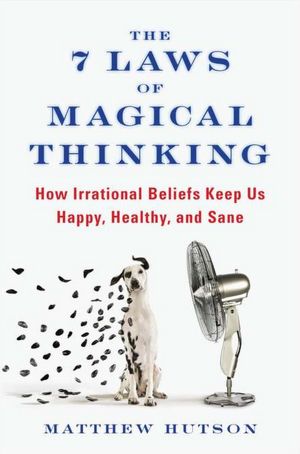
The Wright Show - Robert Wright and Matthew Hutson - The 7 Laws of Magical Thinking


This is a nice discussion - wide ranging - on Matthew Hutson's new book, The 7 Laws of Magical Thinking: How Irrational Beliefs Keep Us Happy, Healthy, and Sane - from this week's edition of
The Wright Show on BloggingHeads.tv.

Here is the publisher's description of the book:
What is so special about touching a piano John Lennon once owned? Why do we yell at our laptops? What drove the Yankees to dig up the Red Sox jersey secretly buried beneath their new stadium? And what's up with the phrase "Everything happens for a reason"?

Psychologists have documented a litany of cognitive biases—misperceptions of reality—and explained their positive functions. Now, Matthew Hutson shows that all of us, even the staunchest skeptics, engage in magical thinking all the time—and that we can use it to our advantage, if we know how to outsmart it.

Drawing on cognitive science, neuroscience, psychology, and anthropology, Hutson shows us that magical thinking has been so useful to us that it's hardwired into our brains. It encourages us to think that we actually have free will. It helps us believe that we have an underlying purpose in the world. It can even protect us from the paralyzing awareness of our own mortality. In other words, magical thinking is a completely irrational way of making our lives make sense.

With wonderfully entertaining stories, personal reflections, and sharp observations, Hutson has written a book that is entertaining, useful, and ever so slightly alarming.
Wright and Hutson engage in a lively and entertaining conversation.


Robert Wright (Bloggingheads.tv, The Evolution of God, Nonzero) and Matthew Hutson (The 7 Laws of Magical Thinking)

Recorded: May 11 — Posted: May 19

Tuesday, April 17, 2012

Matthew Hutson - What Doesn't Kill You (in Salon)

The 7 Laws of Magical Thinking: How Irrational Beliefs Keep Us Happy, Healthy, and Sane

What do we mean when we talk about luck? Karl Teigen, a psychologist at the University of Tromsø in Norway, has concluded that, most of the time, “lucky” events are not terribly pleasant. When we feel lucky to be alive, it's generally because something really bad just happened and, somehow, we did not die (as odds might suggest we should have).

In this article from Matthew Hutson (writing at Salon),he takes a look at the neuroscience of luck - it's an interesting excerpt from his new book, The 7 Laws of Magical Thinking: How Irrational Beliefs Keep Us Happy, Healthy, and Sane.

What doesn’t kill you

When we escape death, we feel lucky and purposeful. Now science is explaining why.

near_death
 (Credit: Sven Bannuscher via Shutterstock)
This article was adapted from the new book "The 7 Laws of Magical Thinking", from Hudson Street Press. 
One morning in August 1944, a German Doodlebug exploded in London, disturbing a butterfly and causing it to flap its wings. No one seemed to notice the tiny breeze.

A year later, on the morning of August 9, 1945, the wings of Bockscar lifted it into the air. The B-29, loaded with a five-ton atomic bomb named “Fat Man,” took off from Tinian, an island 1,500 miles southeast of Japan. The United States had dropped “Little Boy” over Hiroshima on August 6, immediately killing tens of thousands of people, but Japan had not yet surrendered World War II. Around 9:30 a.m., the weather scout plane Up an’ Atom reported a few clouds but decent conditions over the next target. Clear for bombing.

Oh, but what’s that? The year-old turbulence of a butterfly halfway around the world? By the time Bockscar passed over its target at 10:44 a.m., the city was covered in haze. According to the pilot’s flight log, “Two additional runs were made, hoping that the target might be picked up after closer observation. However, at no time was the aiming point seen.” So the crew left the city of Kokura and made their way over to their second choice, Nagasaki.


Matthew Hutson, a former editor at Psychology Today, has a B.S. in cognitive neuroscience from Brown University and an M.S. in science writing from MIT. He has written for Wired, Discover, Popular Mechanics, Scientific American Mind, the Boston Globe and the New York Times Magazine. He lives in New York City.   More Matthew Hutson

Wednesday, December 07, 2011

Authors@Google: Penn Jillette


Penn Jillette visited Google's Santa Monica office on August 19, 2011 to discuss his book God No! Signs You Already May Be an Atheist and Other Magical Tales. This talk took place as part of the Authors@Google series. Warning: This talk contains adult language.


Sunday, October 31, 2010

NPR - Keep Your Fingers Crossed: Can 'Magical Thinking' Actually Work?

The idea that belief in the good luck charms can help us perform better is magical thinking, and it's also true. Simply believing in the efficacy of the charm can be enough to improve performance.

horseshoe
istockphoto.com

Do good luck charms actually work?

You know people like this, they're the ones with their lucky socks, or their rabbits foot, or their superstitions about throwing salt over their shoulders when it spills, or not stepping on cracks in the sidewalk. And you've mocked them. It's silly you say, wearing dirty socks won't end a hitting slump, your good luck shirt won't help you land the job. It's hogwash.

Turns out you're wrong. A new study by some Danish scientists measured people's performance with "lucky" charms. Here's how they did it, the Scientific American says, they invited some people in do some golfing:

...when experimenters handed the golf ball to the participant they either mentioned that the ball “has turned out to be a lucky ball” in previous trials, or that the ball was simply the one “everyone had used so far”. Remarkably, the mere suggestion that the ball was lucky significantly influenced performance, causing participants to make almost two more putts on average.

And then they had people bring in their lucky objects, and then tested them doing memorization tasks with and without the objects in the room. They did better with the rabbit's foot. Why?

...researchers hypothesized that this kind of magical thinking can actually increase participants’ confidence in their own capabilities. That is, believing in lucky charms would increase participants’ “self-efficacy,” and it is this feeling of “I can do this,” not any magical properties of the object itself, that predict success.

Before you run out and de-limb some poor rabbit you should know one more thing. If you believed that last paragraph? It won't work. It's like in Peter Pan, you have to really believe.