Showing posts with label cinema. Show all posts

Sunday, June 08, 2014

Alva Noë - 'Rosemary's Baby' Thrills With Unfathomable Mystery


This is a very cool article in which philosopher Alva Noë looks at one of my favorite films through a perspective I  have never taken or even considered - the film is about the act of coming to realize that something is wrong. It's clear something is wrong long before Rosemary is able to accept that the people she trusts are not who they say they are.

And that realization brings in the more important theme of "can we ever truly know another person?" In essence, this is about theory of mind. Except that here, as in reality, we know that others have an interior world to which we are not privy, we "can't get inside their heads to learn what they really think and feel. We are always at a remove from the other."

This article comes from NPR's 13.7 Cosmos and Culture blog.

'Rosemary's Baby' Thrills With Unfathomable Mystery

by ALVA NOË | June 07, 2014

I watched Rosemary's Baby, by Roman Polanksi, again last night. It is a monster movie. And like the best movies in this genre, you could call it a skepticism movie. It is philosophical. And, remarkably, it is terrifying because it is philosophical.


Mia Farrow in Rosemary's Baby. The Kobal Collection/Paramount

Things aren't going right with young Rosemary. Her husband is distant, removed, self-centered; he is unkind and even brutal with her; he spends his free time with their new neighbors, an odd, elderly couple next door. Rosemary's pregnancy is difficult; she has pains continually and is losing weight; neither her doctor nor her husband seem to be interested in helping. Rosemary is in a stupor, as if she were under the influence of drugs.

She has their new apartment painted brightly to lighten it up. But this does little to dispel the dark in its halls and rooms. The only bright spot in this dim scenario is that Guy, who is an actor, has had a turn of good luck at work. His rival woke up blind and Guy got the big part. Professional success is around the corner.

Rosemary's Baby is a story about coming to recognize that something is wrong. At first Rosemary resists this conclusion. What could be wrong? Occasionally pregnancies are painful. Husbands get caught up with pressures and demands at work. Life isn't supposed to play out like a fairy tale. She resolves herself to be a better wife, to reach out to Guy and help him be more open in their relationship.

Now the character of the movie's skepticism shifts to one of philosophy's enduring skeptical concerns: the very possibility of knowing other people and what they think and feel.

Philosophers have long noticed that that there is room for doubt in this domain: all we ever really know, when it comes to others, is what they say and do. We can't get inside their heads to learn what they really think and feel. We are always at a remove from the other. It is also clear, to philosophy and to us all, that this intellectual worry can be safely set aside in the course of our ordinary lives. Questions about what those around us are thinking and feeling and doing, let alone questions about whether they have inner lives at all, don't seriously arise. Which itself raises a philosophical question: if the basis of our knowledge is so sleight, why is our confidence in other minds so robust? (I explore this in my book Out of Our Heads: Why You Are Not Your Brain, and Other Lessons from the Biology of Consciousness.)

Sometimes these sorts of theoretical worries achieve practical prominence in the setting of neurological trauma when we are confronted by, for example, persistent vegetative state, and must make decisions about what is going on inside the mind of an badly injured person.

But Rosemary's Baby addresses these questions in, what, if possible, is an even more terrifying way. It gradually becomes clear, to Rosemary, and to us, the audience, that we can no longer trust Guy, or the neighbors, or the doctor, or just about anyone else in Rosemary's life. Skepticism about the thoughts and feelings of those around Rosemary is now a hypothesis that must be taken seriously. Her life, and that of her baby, depends on it. She is the victim, it seems, of an elaborate plot. And (almost everyone), even those most close to her, is in on it.

Is this not madness? It certainly has that look and feel. How could everyone be in on it? This, then, ratchets the movie's skeptical theme up a notch: could it be that she is hallucinating or confabulating the whole thing? Could this be some sort of pre-partem hysteria? Can she, do we, know what is real?

But Rosemary's Baby is not just a psychological thriller. It is a monster movie. And what makes Rosemary's predicament so very difficult is the fact that what is really going on, so we come to believe, what is really driving events in this film, is so unlikely, so impossible, so unthinkable, as to rule out the possibility of anything like a straight forward "figuring out" of what's happening.

Satan himself has come to Earth and raped Rosemary, with the assistance of her husband and almost everyone else she knows. This is too far-fetched to be true. It is too far-fetched to be even thinkable.

The distinctive charms and fascinations of horror films arise at this kind of juncture, according to the noted philosopher of art Noël Carroll. It is the hallmark of all narrative forms they they supply us with cognitive delights. Plot intrigues; we are curious; curiosity motivates us to follow the story, to figure out what's going on, to understand how forces at play in a situation drive the action inexorably forward. Plot is cognitive and the pleasure of story arises from the achievement getting it.

I think Carroll is right about this. The basic idea was anticipated already in Aristotle's treatment of tragedy. Plot, Aristotle argued, is the life and soul of tragedy. And plot is concerned not with mere event, not with one thing happening after another. But with human action. So to tell a good story, or to enjoy one in the audience, you need to be sensitive to what makes an action significant in the setting of a human life. You need to be a student of human nature and experience.

It is because the meaning and importance of a work of dramatic fiction comes in the exploration of ideas about human experience that it is possible to enjoy a play just by reading it. It isn't spectacle that moves us; for Aristotle, it's understanding. Which doesn't mean that one does not also enjoy felt or emotional responses to the story. A tragedy, Aristotle thought, always aims to arouse fear and pity. But it doesn't aim to produce emotion the way a ride on a roller coaster produces a sense of danger. Fear is not merely an effect on us or in us. It is an expression of our sensitivity to what is playing out in the story and so it is itself an achievement of understanding and insight.

Now the distinctive difference between horror and other genres — this is Carroll's argument — is that the heart of the horror genre is a monstrous phenomenon that actually, truly, makes no sense. Monsters are unfathomable. They are unknowable. They are betwixt and between. Neither alive nor dead, neither human or animal, neither natural nor, really, unnatural. They are, as Carroll puts it, interstitial. The point is that there is no understanding of the monstrous. There is no genuine satisfaction of our curiosity.

A good horror movie, I would say, then, is a kind of paradox in itself. It engages you in a mystery whose intrinsic character rules out, or threatens to rule out, its resolution. And it is the distinct feature of art horror — as opposed to what might horrify us in real life — that it affords the opportunity for philosophical engagement with the unresolvable. From this point of view, the fact that we find the monster scary is secondary. We don't like horror movies because we like to feel negative emotions. It is, rather, that the negative emotions are outweighed by the philosophical delights.

I'm not sure whether this account does justice to Rosemary's Baby. Perhaps its real fright stems from its suggestion that the philosopher's unresolved skeptical puzzles about the limits of knowledge of others and the world around us reveal the underlying reality of our condition, the fact of our total, absolute, abject, terrifying isolation. But is that something we take pleasure in discovering?

~ You can keep up with more of what Alva Noë is thinking on Facebook and on Twitter: @alvanoe.

Wednesday, April 16, 2014

Samuel Beckett’s Only Movie, "Film," Starring Buster Keaton


Samuel Beckett is one of my favorite authors in both the fiction and drama genres. I did not until now know that he had also made a film. It is called, simply enough, Film.

Thanks to Open Culture for unearthing this gem of inscrutability.

Watch Film, Samuel Beckett’s Only Movie, Starring Buster Keaton


April 15th, 2014


Fresh off the international success of his play Waiting For Godot, Samuel Beckett made a film, called aptly enough Film. It came out in 1965 and proved to be the only motion picture the soon-to-be Nobel Prize winner would ever make. As you might expect, it is enigmatic, bleakly funny and very, very odd. You can check it out above.

The 17-minute silent short is essentially a chase movie between the camera and the main character O – as in object. Film opens with O cowering from the gaze of a couple he passes on the street. Meanwhile, the camera looms just behind his head. At his stark, typically Beckettesque flat, O covers the mirror, throws his cat and his chihuahua outside and even trashes a picture — the only piece of decoration in the flat — that seems to be staring back at him. Yet try as he might, O ultimately can’t quite evade being observed by the gaze of the camera.

Barney Rosset, editor of Grove Press, commissioned the movie and regular Beckett collaborator Alan Schneider was tapped to direct. As Schneider recalled, the first draft of the screenplay was unorthodox.
The script appeared in the spring of 1963 as a fairly baffling when not downright inscrutable six-page outline. Along with pages of addenda in Sam’s inimitable informal style: explanatory notes, a philosophical supplement, modest production suggestions, a series of hand-drawn diagrams.
It took almost a year of discussion to bring the movie’s themes and story into focus.

For the lead character Beckett wanted to hire Charlie Chaplin until he was informed by an officious secretary that Chaplin doesn’t read scripts. Beckett then suggested Buster Keaton. The playwright was a longtime fan of the silent film legend. Keaton was even offered the role of Lucky on the original American production of Godot, though the actor declined. This time around, though, Keaton signed on, even if he couldn’t make heads or tales of the script.

And he wasn’t the only one. Ever since it came out, critics have been puzzling what Film is really about. Is it a statement on voyeurism in cinema? On human consciousness? On death? Beckett gave his take on the movie to the New Yorker: “It’s a movie about the perceiving eye, about the perceived and the perceiver — two aspects of the same man. The perceiver desires like mad to perceive and the perceived tries desperately to hide. Then, in the end, one wins.”

Keaton himself defined the movie even more succinctly, “A man may keep away from everybody but he can’t get away from himself.”

Related Content:

~ Jonathan Crow is a Los Angeles-based writer and filmmaker whose work has appeared in Yahoo!, The Hollywood Reporter, and other publications. You can follow him at @jonccrow.

Thursday, March 27, 2014

J Hoberman Reviews Lars von Trier’s "Nymphomaniac" (New York Review of Books)

Lars von Trier has created yet another strange and sexually outrageous film. And yes, as you have no doubt read, the sex IS real, but there are body doubles (porn stars) and prosthetics to protect the big-name talent in this film. 

Making return engagements to von Trier's sexual wonderland is Charlotte Gainsbourg and Willem Dafoe, both of 2009's Antichrist, a very strange and mesmerizing film.

Sex: The Terror and the Boredom

By J. Hoberman
March 26, 2014 | New York Review of Books


Christian Geisnaes/Magnolia Pictures | A scene from Lars von Trier’s Nymphomaniac
The Danish director Lars von Trier has made several great films (Dogville, Melancholia). He has also orchestrated a number of provocations, the strongest of which is The Idiots (1998), a movie that anticipates Borat, Jackass, and other recent movies in pushing regressive behavior beyond all acceptable limits. His newest film, Nymphomaniac, belongs with these audience-baiters—it’s similar, but less ghastly in its various affronts than Antichrist (2009), which also centered on the dour, ascetic Charlotte Gainsbourg.

In Antichrist (2011), Gainsbourg played a woman driven mad by grief; in Nymphomaniac she is the eponymous case study, known simply as Joe. A middle-aged good Samaritan named Seligman (Stellan Skarsgård) finds her lying beaten and bleeding in a back alley and, as she refuses his offer to call the police or get an ambulance, brings her back to recover in his monastic apartment. There she lies on a narrow bed, he sits by her side and, after describing herself as “bad person” (a category that he reflexively rejects), she proceeds to tell him her story from the very beginning: “I discovered my cunt as a two-year-old.”

For a child, as we know, all is sex. Joe’s colorful (if gravely recounted) picaresque career as a sexual being and a sexual adventuress—set in an abstract, unidentified region of England—is punctuated by Seligman’s well-meaning, post-Freudian comments and woolly digressions. Joe’s tale also features a vast array of sex acts, both simulated and actual. (The credits list a half dozen “sex doubles.”) The movie is, then, a two-handed version of the Marquis de Sade’s Philosophy in the Bedroom with Seligman, the erudite lover of the arts and stereotypical liberal—tolerant, secular, feminist, hypocritical—attempting to understand Joe’s self-identified nymphomania as she oscillates between pride and self-loathing and also between present-day battered Joe and her dewy younger self (Stacy Martin).

Like Joe or the sadist she solicits in the movie’s second half, Nymphomaniac is at once excessive and withholding. Although the film is said to exist in a five-and-a-half-hour director’s cut, its distributor has released a shorter “international version” in two parts of 117 and 123 minutes each; the film is further subdivided into eight more-or-less chronological chapters. This two-stage delivery may or may not be a valid economic strategy, but it is a dubious aesthetic one. For what it’s worth, Nymphomaniac demands to be endured in a single sitting. As with Melancholia (2011), which represented the run-up to the end of the world, it’s experiential.

Although too capricious (or should we say promiscuous?) to be a taxonomy, the movie is designed to illustrate and exhaust every popular theory of nymphomania, including, of course, the idea that the condition exists only as a male fantasy—My Secret Garden or The Sexual Life of Catherine M notwithstanding. In various chapters, Joe’s motivations are variously ascribed to her sexual curiosity, desire to exercise traditional male sexual prerogatives, rejection of love, unresolved oedipal feelings, narcissism, loneliness, pathological low self-esteem, depression, frigidity, guilt, and masochism.
At least initially, Joe subscribes to the Sadean notion that she is simply “selfish”—that is, motivated by absolute egotism and a desire for absolute pleasure—although, unlike the Marquis, she does not see this as a virtue. Nor is she bound by logic, explaining at one point that she became a nymphomaniac by choice (“I was an addict of lust rather than need”) and refusing at another, in a memorable set piece, to accept the label “sex addict.”
Christian Geisnaes/Magnolia Pictures Charlotte Gainsbourg in Nymphomaniac
Von Trier declines to judge his protagonist. Unlike Steve McQueen, whose hellish portrait of a male sex addict was called Shame, or the didactic moralist Michael Haneke (who, in his adaptation of The Piano Teacher, completely missed the comic elements in Elfriede Jelinek’s novel of nymphomaniacal compulsion), von Trier has a sense of humor. However lumpy and tasteless it may be, his gruel is not without its raisins. There is a very funny montage in which young Joe tells a succession of lovers that they have given her her first orgasm; a tumultuous sequence in which an abandoned wife (Uma Thurman), accompanied by her young children, confronts the home-wrecking young Joe, volubly and at great length; a charming religious vision that, among other things, satirizes von Trier’s erstwhile model, Andrei Tarkovsky; and a scurrilously farcical scene in which mature Joe is sandwiched between two squabbling slices of male bread.

Much of the time, however, Nymphomaniac is dogged in its pursuit of what the academic film theorists of the 1970s used to call “unpleasure.” Or at least, that is how it seemed to me. Writing in The New Yorker, David Denby, not hitherto an admirer of von Trier, praised the movie as a “pornographic work of art” which means, I suppose, that it was some sort of turn-on.

Alienation, or the absence of feelings, is for von Trier a source of anxiety. But so is empathy. Antichrist which, above all, strove to make pain visceral, was ultimately only numbing; Grace, the scapegoat protagonist of Dogville (2003), suffered in part because of her generosity: she felt too deeply and wreaked a terrible vengeance as a result. Nymphomaniac’s most graphic sequence is not sexual but rather the miserable circumstances in which Joe’s father, hospitalized, delirious, and incontinent, meets his end. “When he died, I had no feelings left,” she tells Seligman—and not for the last time. The movie’s first part concludes with her loss of sexual sensation. “I can’t feel anything,” she wails after a long, unsatisfying bout of intercourse with her ardent and loving husband (Shia LeBeouf).

Von Trier is frequently accused of abusing his female protagonists. Joe gets more than her share, not least in a particularly graphic form of self-abuse, but essentially von Trier respects her as an enemy of society—her punishment, as well as her philosophy, is really a way of punishing the spectator. Like Alfred Hitchcock, von Trier enjoys directing his audience. He is however far less efficient and far more fretful than Hitch; rather than manipulate viewers he pranks them, as when, in one sequence of Nymphomaniac, he teases fans by threatening to restage a catastrophe out of Antichrist complete with Handel aria.

Despite a common monotony, Nymphomaniac’s two halves are quite different. With one large exception, the first part is consecrated to spectator enjoyment—derived either from the spectacle of the sexual antics involving the beautiful, frequently naked Stacy Martin (a twenty-four-year-old Franco-English actress who has the great good fortune or catastrophic luck of making her debut as a featured act in the von Trier circus) or else from the spectacle of Joe successfully defending her erotic rights in a man’s world or, possibly, from both. But the fun is paid for with interest in the movie’s second half by the debasing sexual escapades endured by the more mature and less conventionally appealing Gainsbourg.

Although variously a parody of Freudian analysis or a gloss on the Arabian Nights, Nymphomaniac most closely resembles an eighteenth-century novel about a young woman’s sexually-driven rise and fall or fall and rise; indeed, the first scientific study of female hypersexuality, Nymphomania, or a Dissertation Concerning the Furor Uterinus, was published by a French doctor in the late eighteenth century. Joe, however, is neither De Sade’s oft-violated Justine (for whom the protagonist of Melancholia is named) nor her sister, the sexual terrorist Juliette (although she shares some of her traits). Neither is she Pamela, Clarissa, or Moll Flanders.

In the end, she is the artist. Von Trier is proud of his provocations yet concerned that the audience may too easily indulge him or, pace David Denby, actually become aroused. Indeed, that, in a sense, is the movie’s punchline. Anxious that he will no longer be able to top himself, von Trier is willing to end Nymphomaniac—if not his career—with a cheap stunt meant to rebuke his admirers, as if to prove that he still can.


Nymphomaniac is in theaters now.

Saturday, January 11, 2014

Watch "The Trial" (1962), Orson Welles’ Worst or Best Film, Adapted From Kafka’s Classic Work


Via the internet's curators of cool, Open Culture, here is Orson Welles' film version of Franz Kafka's brilliant novel, The Trial.

Watch The Trial (1962), Orson Welles’ Worst or Best Film, Adapted From Kafka’s Classic Work

January 10th, 2014


Earlier this week, we featured the Internet Archive’s audio of conversations between Orson Welles and Peter Bogdanovich. According to the Archive’s description, Welles’ “defense of his controversial adaptation of Kafka’s The Trial is so fascinating that listeners might want to rush out and rent the film.” But hang on — you need neither rush out nor rent it, since Welles’ The Trial has fallen into the public domain, or rather, it never had a copyright filed in the first place. The full movie, a visually inventive tale of unspecified crime, extreme punishment, and the procedural vortex in between, appears above for you to watch and judge, as it were, for yourself. You’ll have to, since the picture has long divided critics, including some of Welles’ strongest adherents. Even Welles biographer Charles Higham considers it “a dead thing, like some tablet found among the dust of forgotten men.”


“Say what you like,” Welles himself would tell the BBC in the year of the film’s premiere, “but The Trial is the best film I have ever made.” When Bogdanovich went to interview Anthony Perkins (best known, surely, for Hitchcock’s Psycho), who stars as the beleaguered Josef K., the actor spoke of the pride he felt performing for Welles. Perkins also mentioned Welles’ stated intent to make his adaptation a black comedy, a tricky sensibility to pull off for filmmakers in any league. Just as Welles wanted to “set the record straight” by recording his interviews with Bogdanovich, so he must have wanted to do with the 1981 footage just above, in which he speaks about the process of filming The Trial to an audience at the University of Southern California. He’d meant to shoot a whole documentary on the subject, which ultimately wound up on his heap of unfinished projects. Still, we should feel lucky that we have The Trial itself (which, in its prolonged creation, even missed its own Venice Film Festival premiere) to watch, debate, and either convict or exonerate of its alleged cinematic crimes.

Related Content:

~ Colin Marshall hosts and produces Notebook on Cities and Culture and writes essays on cities, Asia, film, literature, and aesthetics. He’s at work on a book about Los Angeles, A Los Angeles Primer. Follow him on Twitter at @colinmarshall or on his brand new Facebook page.

Thursday, October 31, 2013

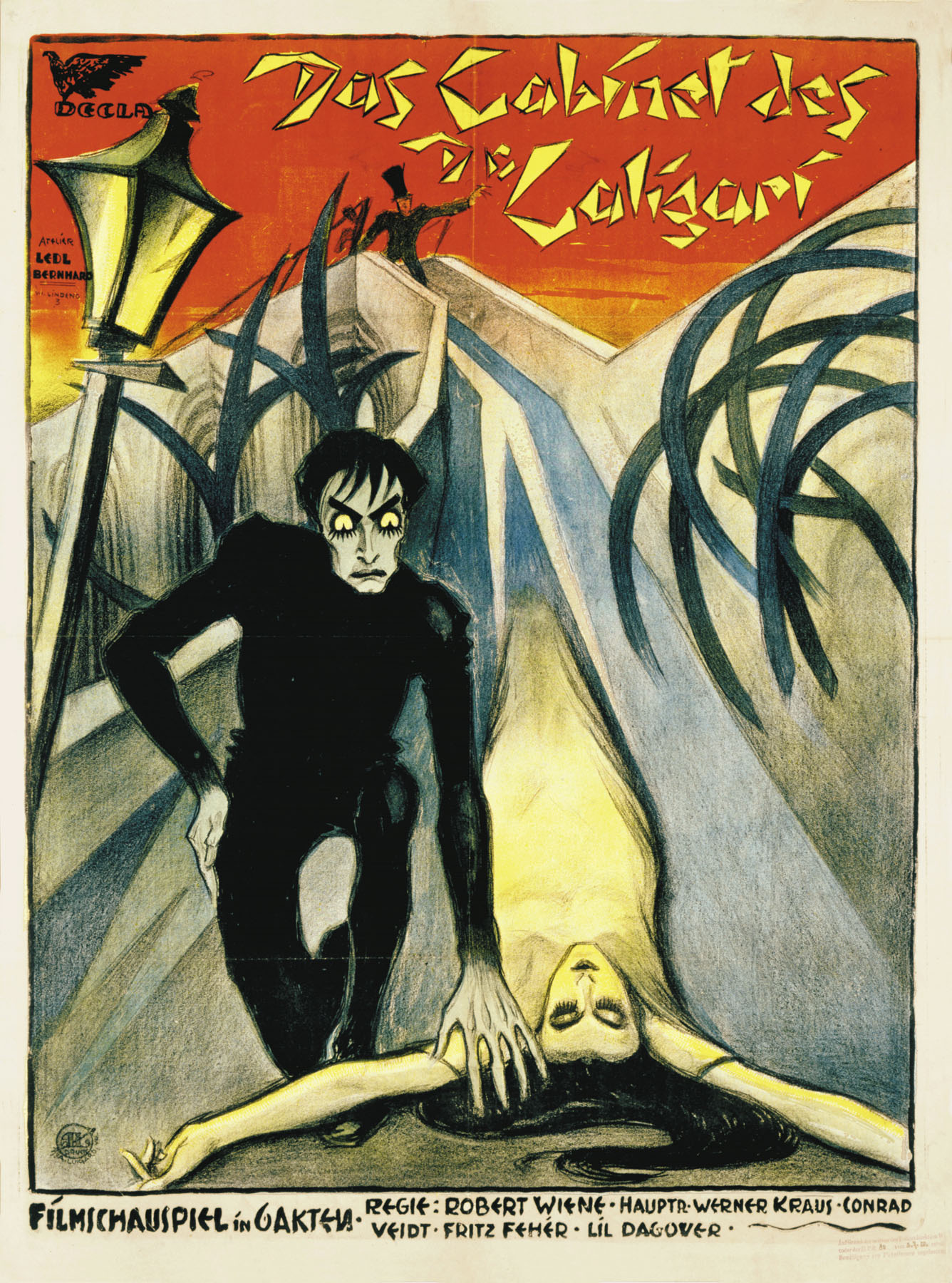
The Cabinet of Dr. Caligari - See the Restored Version of the 1920 Horror Classic with Its Original Color Tinting

Happy Halloween!

The Cabinet of Dr. Caligari: See the Restored Version of the 1920 Horror Classic with Its Original Color Tinting

October 31st, 2013

In early 1920, posters began appearing all over Berlin with a hypnotic spiral and the mysterious command Du musst Caligari werden — “You must become Caligari.”

The posters were part of an innovative advertising campaign for an upcoming movie by Robert Wiene called The Cabinet of Dr. Caligari. When the film appeared, audiences were mesmerized by Wiene’s surreal tale of mystery and horror. Almost a century later, The Cabinet of Dr. Caligari is still celebrated for its rare blending of lowbrow entertainment and avant-garde art. It is frequently cited as the quintessential cinematic example of German Expressionism, with its distorted perspectives and pervasive sense of dread.


Like many nightmares, Caligari had its origin in real-life events. Screenwriter Hans Janowitz had been walking late one night through a fair in Hamburg’s red-light district when he heard laughter. Turning, he saw an attractive young woman disappear behind some bushes in a park. A short time later a man emerged from the shadows and walked away. The next morning, Janowitz read in the newspapers that a young woman matching the description of the one he had seen had been murdered overnight at that very location.

Haunted by the incident, Janowitz told the story to fellow writer Carl Mayer. Together they set to work writing a screenplay based on the incident, drawing also on Mayer’s unsettling experience with a psychiatrist. They imagined a strange, bespectacled man named Dr. Caligari who arrives in a small town to demonstrate his powers of hypnotism over Cesare, a sleep walker, at the local fair. A series of mysterious murders follows.

Janowitz and Mayer sold their screenplay to Erich Pommer at Decla-Film. Pommer at first wanted Fritz Lang to direct the film, but Lang was busy with another project, so he gave the job to Wiene. One of the most critical decisions Pommer made was to hire Expressionist art director Hermann Warm to design the production, along with painters Walter Reimann and Walter Röhrig. As R. Barton Palmer writes at Film Reference:
The principle of Warm’s conception is the Expressionist notion of Ballung, that crystallization of the inner reality of objects, concepts, and people through an artistic expression that cuts through and discards a false exterior. Warm’s sets for the film correspondingly evoke the twists and turnings of a small German medieval town, but in a patently unrealistic fashion (e.g., streets cut across one another at impossible angles and paths are impossibly steep). The roofs that Cesare the somnambulist crosses during his nighttime depredations rise at unlikely angles to one another, yet still afford him passage so that he can reach his victims. In other words, the world of Caligari remains “real” in the sense that it is not offered as an alternative one to what actually exists. On the contrary, Warm’s design is meant to evoke the essence of German social life, offering a penetrating critique of semiofficial authority (the psychiatrist) that is softened by the addition of a framing story. As a practicing artist with a deep commitment to the political and intellectual program of Expressionism, Warm was the ideal technician to do the art design for the film, which bears out Warm’s famous manifesto that “the cinema image must become an engraving.”
The screenwriters were disappointed with Wiene’s decision to frame the story as a flashback told by a patient in a psychiatric hospital. Janowitz, in particular, had meant Caligari to be an indictment of the German government that had recently sent millions of men to kill or be killed in the trenches of World War I. “While the original story exposed authority,” writes Siegfried Kracauer in From Caligari to Hitler: A Psychological History of the German Film, “Wiene’s Caligari glorified authority and convicted its antagonist of madness. A revolutionary film was thus turned into a conformist one — following the much-used pattern of declaring some normal but troublesome individual insane and sending him to a lunatic asylum.”

In a purely cinematic sense, of course, The Cabinet of Dr. Caligari remains a revolutionary work. You can watch the complete film above, made from a 35mm print restored by the Bundesarchiv-Filmarchiv of Germany and featuring the original color tinting.

The film is included in our collection of 575 Free Movies Online.

Related content:

Thursday, August 29, 2013

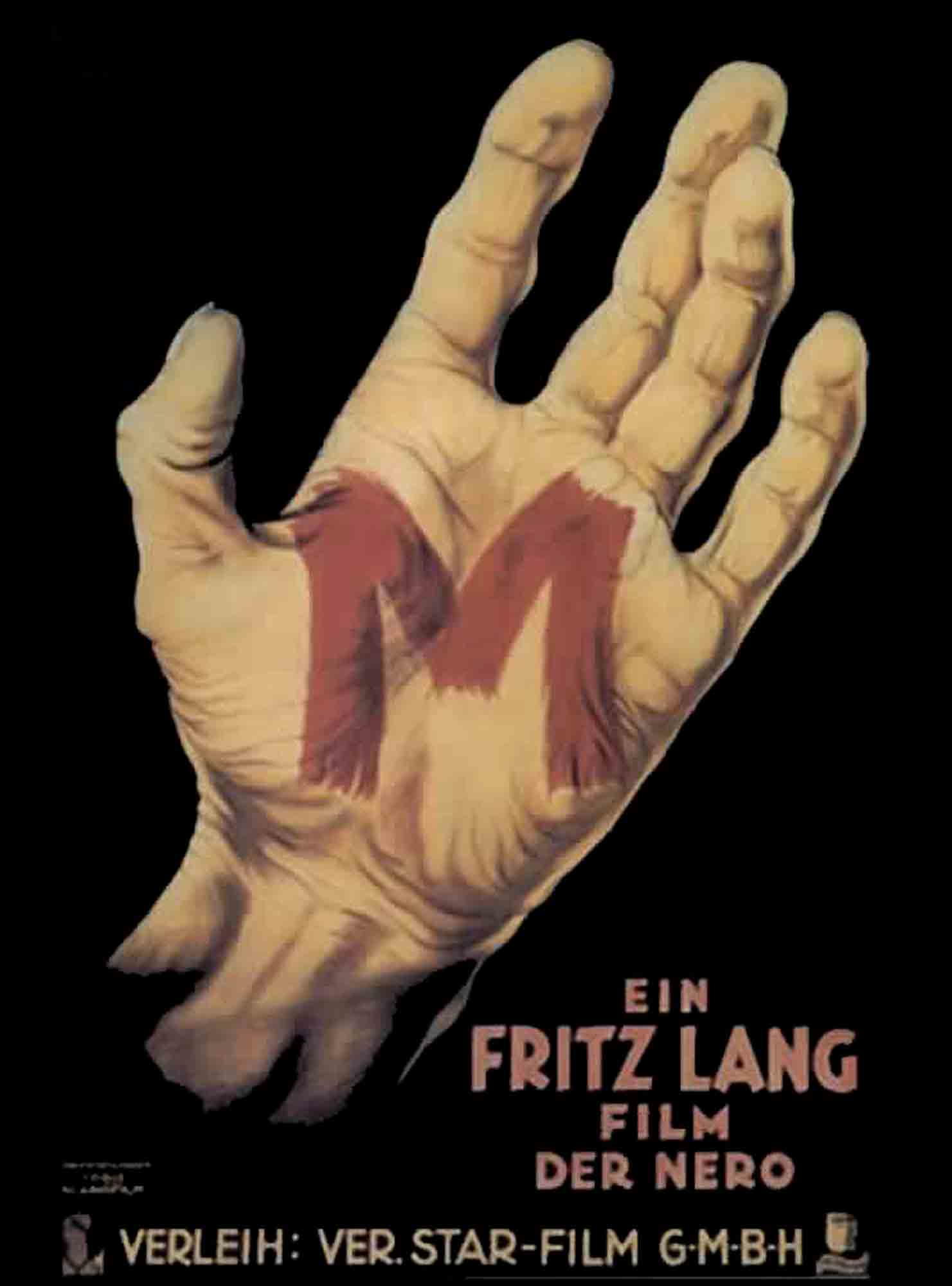
Fritz Lang’s M: Watch the Restored Version of the Classic 1931 Film


Very cool - gotta love all the excellent finds brought to us by Open Culture. Having not been a big box office success with its original release, M was re-released in 1959 in a shorter (butchered?) 89-minute version. The restored 109-minute version below is closer to Lang’s original film and was the product of a restoration project mounted in the 1990s.


Fritz Lang’s M: Watch the Restored Version of the Classic 1931 Film


August 25th, 2013

When Jean-Luc Godard asked the Austrian filmmaker Fritz Lang in 1961 to name his greatest film, the one most likely to last, Lang did not hesitate. “M,” he said.

Made in 1931, near the end of the Weimar Republic, M is Lang’s brilliant link between silent film and talkies, and between German Expressionism and what would eventually be called Film Noir. It tells the story of a Berlin society caught up in hysteria over a series of child murders, and of the massive mobilization — by police and criminals alike — to catch the killer.

The Hungarian actor Peter Lorre plays Hans Beckert, the mentally disturbed murderer. Lorre worked on the film in the daytime while performing on the stage in Bertolt Brecht’s own production of Mann ist Mann in the evenings. His striking performance in M would catapult him to international stardom.

The script was written by Lang and his wife, Thea Von Harbou. It was inspired by a series of mass murders, culminating in a sensational case of serial child killings in Düsseldorf. In a 1931 article, Lang wrote:

The epidemic series of mass murders of the last decade with their manifold and dark side effects had constantly absorbed me, as unappealing as their study may have been. It made me think of demonstrating, within the framework of a film story, the typical characteristics of this immense danger for the daily order and the ways of effectively fighting them. I found the prototype in the person of the Düsseldorf serial murderer and I also saw how here the side effects exactly repeated themselves, i.e. how they took on a typical form. I have distilled all typical events from the plethora of materials and combined them with the help of my wife into a self-contained film story. The film M should be a document and an extract of facts and in that way an authentic representation of a mass murder complex.

Although M was not a great box office success when it was released in Germany in 1931, the film gradually grew in stature and is now firmly established as one of the masterpieces of 20th century cinema. The formal brilliance of the film’s narrative structure, its classic visual images — the killer’s shadow appearing on a poster announcing a reward for his capture, a child’s balloon caught in a power line, Lorre’s bulging eyes as he discovers a chalk “M” on his shoulder — and its inventive use of sound — for example in the serial killer’s ominous whistling of Grieg’s Peer Gynt — have made M one of the most studied and imitated films ever made.

In 1959 M was re-released in truncated form, and for several decades afterward audiences were shown a badly altered 89-minute version. A restoration project was mounted in the 1990s. The 109-minute version above is closer to Lang’s original film. It’s now housed in our collection of 550 Free Movies Online.

Related content:

Wednesday, July 31, 2013

Martin Scorsese and Stanley Kubrick Pick Their 10 Favorite Films

From Open Culture, here are two "top ten" lists from two of America's most important filmmakers of the last 50 years. First up is Stanley Kubrick, who made his list in 1963. It would be interesting to see how that might have changed if he had done it in the last decade of his life.

The other list comes from one of my favorite directors, Martin Scorsese, who made his list earlier this year. Scorsese includes Kubrick's 2001: A Space Odyssey on his list - I wonder if Kubrick in his later years would have included Taxi Driver or Raging Bull or Mean Streets?

Stanley Kubrick’s List of Top 10 Films (The First and Only List He Ever Created)


July 30th, 2013


When, over the past weekend, I noticed the words “Stanley Kubrick” had risen into Twitter’s trending-topics list, I got excited. I figured someone had discovered, in the back of a long-neglected studio vault, the last extant print of a Kubrick masterpiece we’d somehow all forgotten. No suck luck, of course; Kubrick scholars, given how much they still talk about even the auteur’s never-realized projects like Napoleon, surely wouldn’t let an entire movie slip into obscurity. The burst of tweets actually came in honor of Kubrick’s 85th birthday, and hey, any chance to celebrate a director whose filmography includes the likes of Dr. Strangelove, The Shining, and 2001: A Space Odyssey, I’ll seize. The British Film Institute marked the occasion by posting a little-seen list of Kubrick’s top ten films.

“The first and only (as far as we know) Top 10 list Kubrick submitted to anyone was in 1963 to a fledgling American magazine named Cinema (which had been founded the previous year and ceased publication in 1976),” writes the BFI’s Nick Wrigley. It runs as follows:

1. I Vitelloni (Fellini, 1953)
2. Wild Strawberries (Bergman, 1957)
3. Citizen Kane (Welles, 1941)
4. The Treasure of the Sierra Madre (Huston, 1948)
5. City Lights (Chaplin, 1931)
6. Henry V (Olivier, 1944)
7. La notte (Antonioni, 1961)
8. The Bank Dick (Fields, 1940—above)
9. Roxie Hart (Wellman, 1942)
10. Hell’s Angels (Hughes, 1930)

But seeing as Kubrick still had 36 years to live and watch movies after making the list, it naturally provides something less than the final word on his preferences. Wrigley quotes Kubrick confidant Jan Harlan as saying that “Stanley would have seriously revised this 1963 list in later years, though Wild Strawberries, Citizen Kane and City Lights would remain, but he liked Kenneth Branagh’s Henry V much better than the old and old-fashioned Olivier version.” He also quotes Kubrick himself as calling Max Ophuls the “highest of all” and “possessed of every possible quality,” calling Elia Kazan “without question the best director we have in America,” and praising heartily David Lean, Vittorio de Sica, and François Truffaut. This all comes in handy for true cinephiles, who can never find satisfaction watching only the filmmakers they admire; they must also watch the filmmakers the filmmakers they admire admire.

Related Content:

* * * * * * *

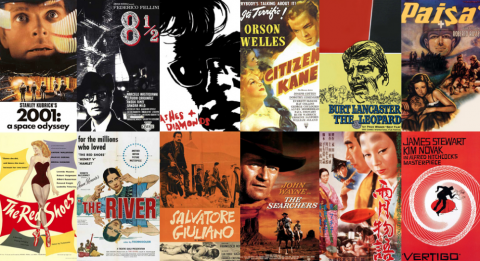
Martin Scorsese Reveals His 10 Favorite Movies (and Writes a New Essay on Film Preservation)


July 31st, 2013


Cinema as we’ve almost always known it — “Edison, the Lumière brothers, Méliès, Porter, all the way through Griffith and on to Kubrick” — has “really almost gone.” So writes Martin Scorsese in his recent essay for the New York Review of Books, “The Persisting Vision: Reading the Language of Cinema.” He argues that traditional film forms have “been overwhelmed by moving images coming at us all the time and absolutely everywhere, even faster than the visions coming at the astronaut” in Kubrick’s 2001: A Space Odyssey. “We have no choice but to treat all these moving images coming at us as a language. We need to be able to understand what we’re seeing and find the tools to sort it all out.” Only natural that Scorsese, as one of the best-known, highest-profile auteurs alive, would reference Kubrick, his generational predecessor in the untiring furtherance of cinematic vision and craft.

We just yesterday featured a post about Kubrick’s 1963 list of ten favorite films. Scorsese, for his part, has impressed many as one of the most enthusiastically cinephilic directors working in America today: his essays about and appearances on the DVDs of his favorite movies stand as evidence for the surprising breadth of his appreciation. Today, why not have a look at Scorsese’s list, which he put together for Sight and Sound magazine, and which begins with the Kubrick selection you might expect:

2001: A Space Odyssey (1968) – Stanley Kubrick
(1963) – Federico Fellini
Ashes and Diamonds (1958) – Andrzej Wajda
Citizen Kane (1941) – Orson Welles
The Leopard (1963) – Luchino Visconti
Paisan (1946) – Roberto Rossellini
The Red Shoes (1948) – Michael Powell/Emeric Pressburger
The River (1951) – Jean Renoir
Salvatore Giuliano (1962) – Francesco Rosi
The Searchers (1956) – John Ford
Ugetsu Monogatari (1953) – Mizoguchi Kenji
Vertigo (1958) – Alfred Hitchcock

In “The Persisting Vision,” he champions comprehensive film preservation, citing the case of Hitchcock’s Vertigo, the final entry on his list, now named the greatest film of all time by Sight and Sound‘s critics poll. “When the film came out some people liked it, some didn’t, and then it just went away.” When, after decades of obscurity, Vertigo came back into circulation, the color was completely wrong,” and “the elements — the original picture and sound negatives — needed serious attention.” A restoration of the “decaying and severely damaged” film eventually happened, and “more and more people saw Vertigo and came to appreciate its hypnotic beauty and very strange, obsessive focus.” I, personally, couldn’t imagine the world of cinema without it — nor without any of the other pictures Scorsese calls his favorites.

Related Content:

~ Colin Marshall hosts and produces Notebook on Cities and Culture and writes essays on literature, film, cities, Asia, and aesthetics. He’s at work on a book about Los Angeles, A Los Angeles Primer. Follow him on Twitter at @colinmarshall.

Monday, April 01, 2013

Classic Film - Fritz Lang's Metropolis


Metropolis is one of the classic silent films, and one of the 100 Best Films of All Time on most of the lists you will find. Fritz Lang creates a dystopian future on a grand scale, and his vision is not too far from where we are now, aside from the forced separation.

Metropolis

(1927) 118 mins


Metropolis Synopsis

It is the future and humans are divided into two groups; the thinkers, who make plans, and the workers, who achieve goals. Completely separate, neither group is complete, but together they make a whole. One man from the "thinkers" dares to visit the underground where the workers toil; and is astonished by what he sees.

Starring: Brigitte Helm, Alfred Abel, Gustav Frohlich
Director: Fritz Lang
Producers: Giorgio Moroder, Erich Pommer
Writers: Thea von Harbou, Fritz Lang

Wednesday, March 20, 2013

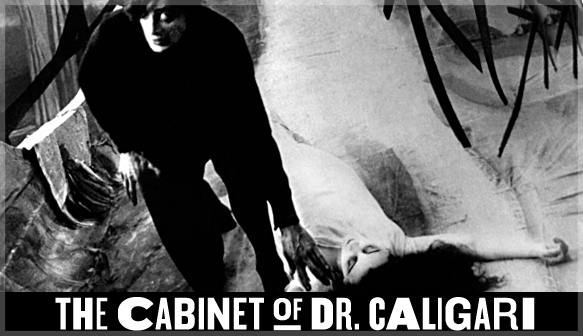
The Cabinet of Dr. Caligari


Via Snag Films, a classic of the silent film era.


The Cabinet of Dr. Caligari


Synopsis

In this silent, classic example of early German expressionism, this cinematic landmark relates the stylized tale of a Dr. Caligari, a fairground showman who hypnotizes an innocent villager--turning him into a sleepwalking "zombie"--and compels him to carry out fiendish murders.

Film Credits
  • Director: Robert Wiene
  • Writers: Hans Janowitz, Carl Mayer
  • Starring: Werner Krauss, Conrad Veidt

Friday, March 15, 2013

Wittgenstein: Derek Jarman’s Tribute to the Philosopher (1993)


Another interesting piece from Open Culture. All 7 segments of the Derek Jarman film on Wittgenstein are embedded in the video below. For those unfamiliar with Wittgenstein, here is a very brief bio sketch from Wikipedia:
Ludwig Josef Johann Wittgenstein (26 April 1889 – 29 April 1951) was an Austrian-British philosopher who worked primarily in logic, the philosophy of mathematics, the philosophy of mind, and the philosophy of language.[1] He was professor in philosophy at the University of Cambridge from 1939 until 1947.[2] In his lifetime, he published just one book review, one article, a children's dictionary, and the 75-page Tractatus Logico-Philosophicus (1921).[3] In 1999, his posthumously published Philosophical Investigations (1953) was ranked as the most important book of 20th-century philosophy by the Baruch Poll, standing out as "...the one crossover masterpiece in twentieth-century philosophy, appealing across diverse specializations and philosophical orientations".[4] Philosopher Bertrand Russell described him as "the most perfect example I have ever known of genius as traditionally conceived, passionate, profound, intense, and dominating".[5]
Enjoy!

Wittgenstein: Watch Derek Jarman’s Tribute to the Philosopher, Featuring Tilda Swinton (1993)


March 14th, 2013


When last week we featured Bertrand Russell telling a story about his philosophical disciple Ludwig Wittgenstein, I mentioned in passing a film about the latter by Derek Jarman. An English director known for his unconventional choices of theme, form, and medium, Jarman passed away from AIDS-related illness in 1994, the year after making Blue, an autobiographical film that plays out entirely on a solid, unchanging blue screen. He also released in 1993 a less discussed, seemingly less experimental picture: Wittgenstein. Casting Karl Johnson as the philosopher (with Clancy Chassay as his younger self), frequent collaborator Tilda Swinton as noted aristocrat Lady Ottoline Morrell, and Michael Gough (well known as Batman’s butler Alfred) as Russell, Jarman set about telling Wittgenstein’s life story, all on his own aesthetic terms.


The result comes off as an only slightly less radical cinematic act than Blue. Drawing on his stage background, Jarman reduces Wittgenstein‘s visuals to a bare but bold minimum. Watch the clip up top of Johnson as Wittgenstein lecturing at Cambridge under Russell’s watchful eye, and you’ll see what this means: no backdrops at all; just people, things, thoughts, and language. You can see the entire film in seven segments (one, two, three, four, fivesix, seven), beginning with the first just above. Though far from Jarman’s most famous work, Wittgenstein has been claimed by several film traditions: philosophical, experimental, theatrical, queer, even educational. Yet it has eluded them all, creating for itself an environment of both obvious stage-and-screen make-believe — that black void, those dramatic line deliveries — and the disciplined starkness of reality.

Related Content:

~ Colin Marshall hosts and produces Notebook on Cities and Culture and writes essays on literature, film, cities, Asia, and aesthetics. He’s at work on a book about Los Angeles, A Los Angeles Primer. Follow him on Twitter at @colinmarshall.

Sunday, November 11, 2012

Jean Cocteau’s Avante-Garde Film - The Blood of a Poet (1930)


Way weird and ultra cool, although my tastes run to the surreal, symbolic, and non-rational.

Jean Cocteau’s Avante-Garde Film From 1930, The Blood of a Poet


November 8th, 2012

In a 1946 essay Jean Cocteau cautions against making a quick interpretation of his first film, The Blood of a Poet, with a quote from Montaigne:
Most of Aesop’s fables have many different levels and meanings. There are those who make myths of them by choosing some feature that fits in well with the fable. But for most of the fables this is only the first and most superficial aspect. There are others that are more vital, more essential and profound, that they have not been able to reach.
Cocteau conceived The Blood of a Poet (Le Sang d’un Poète) in late 1929, soon after the publication of his novel Les Enfants Terribles. He had just kicked his opium habit and was entering one of the most prolific periods of his career. The film is often called a surrealist work, but Cocteau rejected the association, saying that he had set out “to avoid the deliberate manifestations of the unconscious in favor of a kind of half-sleep through which I wandered as though in a labyrinth.” He goes on:
The Blood of a Poet draws nothing from either dreams or symbols. As far as the former are concerned, it initiates their mechanism, and by letting the mind relax, as in sleep, it lets memories entwine, move and express themselves freely. As for the latter, it rejects them, and substitutes acts, or allegories of these acts, that the spectator can make symbols of if he wishes.
Many of its first spectators saw anti-Christian symbolism in the film. Although production ended in September of 1930, Cocteau was not able to get his film shown publicly until January of 1932. The Blood of a Poet features the only film appearance by Lee Miller, a noted photographer and model of Man Ray. (She plays a statue.) The film is now considered a classic of experimental cinema and is the first in what came to be known as Cocteau’s “Orphic Trilogy,” which includes Orphée (1950) and Testament of Orpheus (1959). The Blood of a Poet will be added to our collection of free movies online.
Related content:

Wednesday, October 31, 2012

Watch Nosferatu Online - The Perfect Halloween Vampire Film


Nosferatu is one of my favorite horror films - ever - and also one of the greatest silent films ever made. You can watch it online for free this Halloween.

Watch the Quintessential Vampire Film Nosferatu Free Online as Halloween Approaches

October 26th, 2012


What, you haven’t seen Nosferatu yet? But you’re in luck: not only do you still have a few days left to fit this seminal classic of vampiric cinema into your Halloween viewing rotation, but when the 31st comes, you can watch it free online yet again. An inspiration for countless vampire films that would follow over the next ninety years, F.W. Murnau’s 1922 silent feature adapts Bram Stoker’s Dracula, but just loosely enough so that it could put its own stamp on the myth and not actually have to pay for rights to the novel. Jonathan and Mina Harker? Now Thomas and Ellen Hutter. Jonathan’s boss Renfield? Now a fellow named Knock. Count Dracula, to whose vast and crumbling estate Renfield sends the hapless Jonathan? Now Count Orlok — and unforgettably so. We can post no more relevant endorsement of Nosferatu‘s enduring value than to say that it remains scary, or at least eerie, to this day. I defy any sophisticated modern viewer to spend All Hallows’ eve with this picture and not come away feeling faintly unsettled.

Part of it has to do with sheer age: while some visual effects haven’t held up — get a load of Orlok escaping his coffin in the ship’s cargo hold, employing a technique trusted by every nine-year-old with a video camera — the deeply worn look and feel seems, at moments, to mark the film as coming from a distant past when aristocratic blood-sucking living corpses may as well have existed. This same process has, over four decades, imbued with a patina of menace every horror film made in the seventies. Fans of the 1979 Werner Herzog-Klaus Kinski collaboration Nosferatu the Vampyre, a companion piece obviously worth viewing in any case, can attest to this. You might also consider incorporating in your Halloween night viewing E. Elias Merhige’s Shadow of the Vampire, a satire of the 1920s film industry’s collision of eccentric old-world craftsmanship and savage commercial buffoonery which imagines Orlok as having been played by a geniune vampire. As for Francis Ford Coppola’s rights-having 1992 adaptation Bram Stoker’s Dracula… well, its chief point of interest is still Gary Oldman’s hairstyle.

You can always find Nosferatu listed in our collection of 500 Free Movies Online.

Related content:

Colin Marshall hosts and produces Notebook on Cities and Culture. Follow him on Twitter at @colinmarshall.

Friday, October 05, 2012

Film Junk - Tarantino, Scorsese and Other Directors Reveal Their Top 10 Movies of All Time

Very interesting selections by these directors - with only a handful of titles showing more than once or twice, including Raging Bull (Scorsese), The Apartment (Wilder), and 8 1/2 (Fellini).

I'm sharing the directors who I admire - a few of them I have never heard of or seen before. See all of the selections at the link below.

Tarantino, Scorsese and Other Directors Reveal Their Top 10 Movies of All Time

Posted by Sean on August 6th, 2012


There was plenty of discussion across the movie blogosphere following last week’s announcement that Vertigo had dethroned Citizen Kane as the greatest film of all time according to Sight & Sound’s decennial poll. In addition to revealing the top 50 as determined by critics, they also provided a top 10 based on a separate poll for directors only. In the print version of the magazine, they have taken it a step further by reprinting some of the individual top 10 lists from the filmmakers who participated, and we now have some of them here for your perusal.

Among them, we have lists from legends like Martin Scorsese, Francis Ford Coppola and Quentin Tarantino, but there are also some unexpected newcomers who took part including Richard Ayoade (Submarine), Miranda July (Me and You and Everyone We Know) and Sean Durkin (Martha Marcy May Marlene). Some of these lists aren’t all that surprising (both Quentin Tarantino and Edgar Wright have given versions of their top 10s before), but hey, who knew that Michael Mann liked both Avatar and Biutiful so much? There’s plenty to chew on here, so check out the lists after the jump and then tell us who is on point and who is simply off their rocker.


Woody Allen

  • Bicycle Thieves (1948, dir. Vittorio De Sica)
  • The Seventh Seal (1957, dir. Ingmar Bergman)
  • Citizen Kane (1941, dir. Orson Welles)
  • Amarcord (1973, dir. Federico Fellini)
  • 8 1/2 (1963, dir. Federico Fellini)
  • The 400 Blows (1959, dir. Francois Truffaut)
  • Rashomon (1950, dir. Akira Kurosawa)
  • La Grande Illusion (1937, dir. Jean Renoir)
  • The Discreet Charm of the Bourgeoisie (1972, dir. Luis Bunuel)
  • Paths of Glory (1957, dir. Stanley Kubrick) 

Bong Joon-Ho

  • A City of Sadness (1989, dir. Hou Hsiao-hsien)
  • Cure (1997, dir. Kiyoshi Kurosawa)
  • The Housemaid (1960, dir. Kim Ki-young)
  • Fargo (1996, dir. the Coen Brothers)
  • Psycho (1960, dir. Alfred Hitchcock)
  • Raging Bull (1980, dir. Martin Scorsese)
  • Touch of Evil (1958, dir. Orson Welles)
  • Vengeance Is Mine (1973, dir. Shohei Imamura)
  • The Wages of Fear (1953, dir. Henri-Georges Clouzot)
  • Zodiac (2007, dir. David Fincher)

Francis Ford Coppola

  • Ashes and Diamonds (1958, dir. Andrzej Wajda)
  • The Best Years of Our Lives (1946, dir William Wyler)
  • I Vitteloni (1953, dir. Federico Fellini)
  • The Bad Sleep Well (1960, dir. Akira Kurosawa)
  • Yojimbo (1961, dir. Akira Kurosawa)
  • Singin’ in the Rain (1952, dir. Stanley Donen and Gene Kelly)
  • The King of Comedy (1983, dir Martin Scorsese)
  • Raging Bull (1980, dir. Martin Scorsese)
  • The Apartment (1960s, dir. Billy Wilder)
  • Sunrise (1927, dir. F.W. Murnau)

Guillermo Del Toro

  • Frankenstein (1931, dir. James Whale)
  • Freaks (1932, dir. Todd Browning)
  • Shadow of a Doubt (1943, dir. Alfred Hitchcock)
  • Greed (1925, dir. Erich Von Stroheim)
  • Modern Times (1936, dir. Charlie Chaplin)
  • La Belle Et La Bete (1946, dir. Jean Cocteau)
  • Goodfellas (1990, dir. Martin Scorsese)
  • Los Olvidados (1950, dir. Luis Bunuel)
  • Nosferatu (1922, dir. F.W. Murnau)
  • 8 1/2 (1963, dir. Federico Fellini)

Miranda July (Me and You and Everyone We Know)

  • Blind (1987, dir. Frederick Wiseman)
  • Smooth Talk (1985, dir. Joyce Chopra)
  • Vertigo (1958, dir. Alfred Hitchcock)
  • After Life (1998, dir. Hirokazu Koreeda)
  • Somewhere in Time (1980, dir. Jeannot Szwarc)
  • Cheese (2007, dir. Mika Rottenberg)
  • Punch Drunk Love (2002, dir. Paul Thomas Anderson)
  • The Red Balloon (1956, dir. Albert Lamorisse)
  • A Room With a View (1985, dir. James Ivory)
  • Fish Tank (2009, dir. Andrea Arnold)

Mike Leigh

  • American Madness (1932, dir. Frank Capra)
  • Andrei Rublev (1966, dir. Andrei Tarkovsky)
  • I Am Cuba (1964, dir. Mikhai Kalatozov)
  • The Emigrants (1971, dir. Jan Troell)
  • How a Mosquito Operates (1912, dir. Winsor McCay)
  • Jules Et Jim (1962, dir. Francois Truffaut)
  • Radio Days (1987, dir. Woody Allen)
  • Songs From the Second Floor (2000, dir. Roy Andersson)
  • Tokyo Story (1953, dir. Yasujiro Ozu)

Michael Mann

  • Apocalypse Now (1979, dir. Francis Ford Coppola)
  • Battleship Potemkin (1925, dir. Sergei Eisenstein)
  • Citizen Kane (1941, dir. Orson Welles)
  • Avatar (2009, dir. James Cameron)
  • Dr. Strangelove (1964, dir. Stanley Kubrick)
  • Biutiful (2010, dir. Alejandro Gonzalez Inarritu)
  • My Darling Clementine (1946, dir. John Ford)
  • The Passion of Joan of Arc (1928, dir. Carl theodor Dreyer)
  • Raging Bull (1980, dir. Martin Scorsese)
  • The Wild Bunch (1969, dir. Sam Peckinpah)

Steve McQueen (Shame)

  • The Battle of Algiers (1966, dir. Gillo Pontecorvo)
  • Zero de Conduite (1933, dir. Jean Vigo)
  • La Regle du Jeu (1939, dir. Jean Renoir)
  • Tokyo Story (1953, dir. Yasujiro Ozu)
  • Couch (1964, dir. Andy Warhol)
  • Le Mepris (1963, dir. Jean-Luc Godard)
  • Beau Travail (1998, dir. Claire Denis)
  • Once Upon a Time in America (1984, dir. Sergio Leone)
  • The Wages of Fear (1953, dir. Henri-Georges Clouzot)
  • Do the Right Thing (1989, dir. Spike Lee)

Jeff Nichols (Take Shelter)

  • Cool Hand Luke (1967, dir. Stuart Rosenberg)
  • Badlands (1973, dir. Terrence Malick)
  • Hud (1963, dir. Martin Ritt)
  • The Hustler (1961, dir. Robert Rossen)
  • Lawrence of Arabia (1962, dir. David Lean)
  • Butch Cassidy and the Sundance Kid (1969, dir. George Roy Hill)
  • Jaws (1975, dir. Steven Spielberg)
  • North By Northwest (1959, dir. Alfred Hitchcock)
  • Stagecoach (1939, dir. John Ford)
  • Fletch (1985, dir. Michael Ritchie)