Showing posts with label horror films. Show all posts

Thursday, October 31, 2013

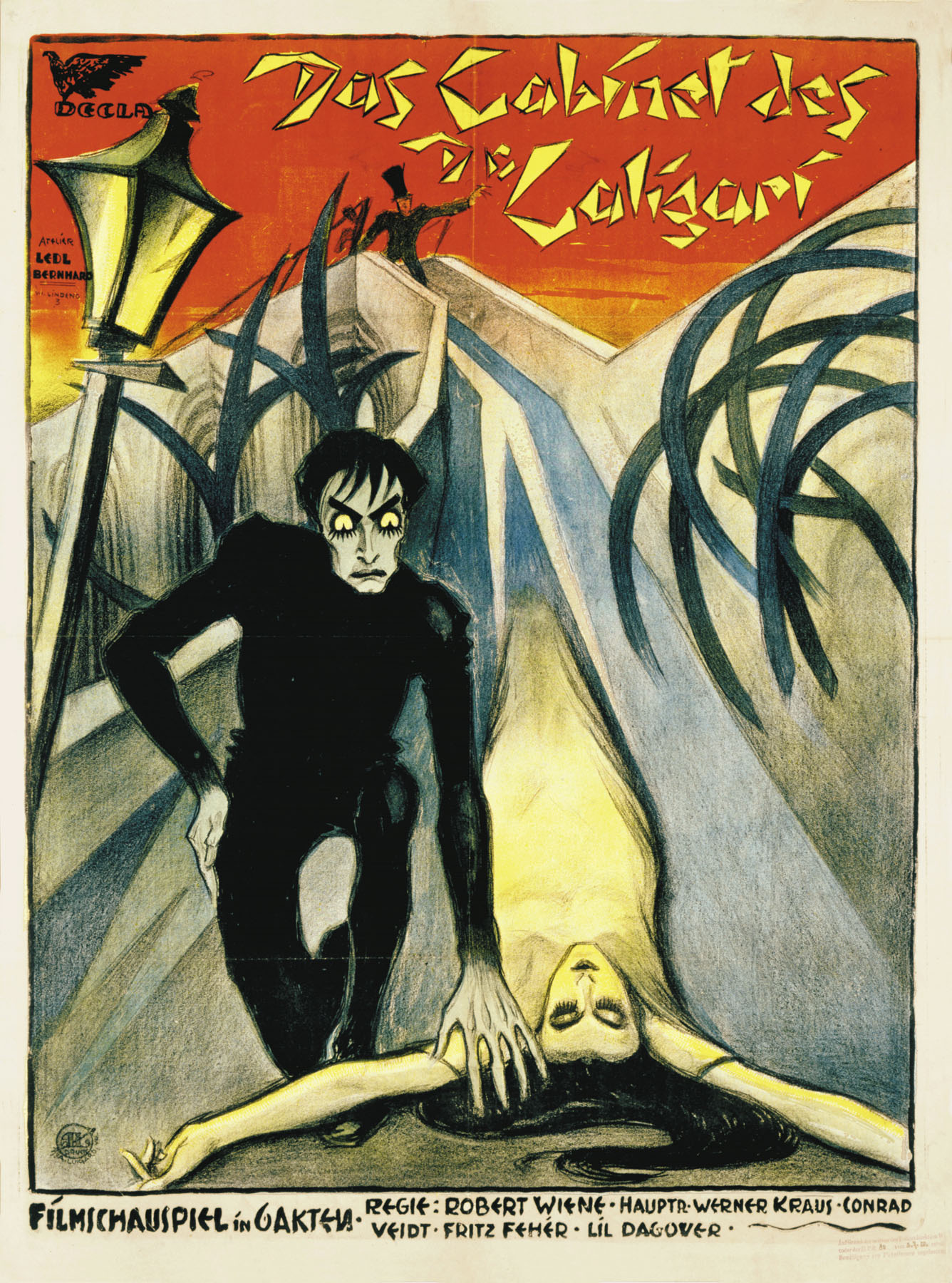
The Cabinet of Dr. Caligari - See the Restored Version of the 1920 Horror Classic with Its Original Color Tinting

Happy Halloween!

The Cabinet of Dr. Caligari: See the Restored Version of the 1920 Horror Classic with Its Original Color Tinting

October 31st, 2013

In early 1920, posters began appearing all over Berlin with a hypnotic spiral and the mysterious command Du musst Caligari werden — “You must become Caligari.”

The posters were part of an innovative advertising campaign for an upcoming movie by Robert Wiene called The Cabinet of Dr. Caligari. When the film appeared, audiences were mesmerized by Wiene’s surreal tale of mystery and horror. Almost a century later, The Cabinet of Dr. Caligari is still celebrated for its rare blending of lowbrow entertainment and avant-garde art. It is frequently cited as the quintessential cinematic example of German Expressionism, with its distorted perspectives and pervasive sense of dread.


Like many nightmares, Caligari had its origin in real-life events. Screenwriter Hans Janowitz had been walking late one night through a fair in Hamburg’s red-light district when he heard laughter. Turning, he saw an attractive young woman disappear behind some bushes in a park. A short time later a man emerged from the shadows and walked away. The next morning, Janowitz read in the newspapers that a young woman matching the description of the one he had seen had been murdered overnight at that very location.

Haunted by the incident, Janowitz told the story to fellow writer Carl Mayer. Together they set to work writing a screenplay based on the incident, drawing also on Mayer’s unsettling experience with a psychiatrist. They imagined a strange, bespectacled man named Dr. Caligari who arrives in a small town to demonstrate his powers of hypnotism over Cesare, a sleep walker, at the local fair. A series of mysterious murders follows.

Janowitz and Mayer sold their screenplay to Erich Pommer at Decla-Film. Pommer at first wanted Fritz Lang to direct the film, but Lang was busy with another project, so he gave the job to Wiene. One of the most critical decisions Pommer made was to hire Expressionist art director Hermann Warm to design the production, along with painters Walter Reimann and Walter Röhrig. As R. Barton Palmer writes at Film Reference:
The principle of Warm’s conception is the Expressionist notion of Ballung, that crystallization of the inner reality of objects, concepts, and people through an artistic expression that cuts through and discards a false exterior. Warm’s sets for the film correspondingly evoke the twists and turnings of a small German medieval town, but in a patently unrealistic fashion (e.g., streets cut across one another at impossible angles and paths are impossibly steep). The roofs that Cesare the somnambulist crosses during his nighttime depredations rise at unlikely angles to one another, yet still afford him passage so that he can reach his victims. In other words, the world of Caligari remains “real” in the sense that it is not offered as an alternative one to what actually exists. On the contrary, Warm’s design is meant to evoke the essence of German social life, offering a penetrating critique of semiofficial authority (the psychiatrist) that is softened by the addition of a framing story. As a practicing artist with a deep commitment to the political and intellectual program of Expressionism, Warm was the ideal technician to do the art design for the film, which bears out Warm’s famous manifesto that “the cinema image must become an engraving.”
The screenwriters were disappointed with Wiene’s decision to frame the story as a flashback told by a patient in a psychiatric hospital. Janowitz, in particular, had meant Caligari to be an indictment of the German government that had recently sent millions of men to kill or be killed in the trenches of World War I. “While the original story exposed authority,” writes Siegfried Kracauer in From Caligari to Hitler: A Psychological History of the German Film, “Wiene’s Caligari glorified authority and convicted its antagonist of madness. A revolutionary film was thus turned into a conformist one — following the much-used pattern of declaring some normal but troublesome individual insane and sending him to a lunatic asylum.”

In a purely cinematic sense, of course, The Cabinet of Dr. Caligari remains a revolutionary work. You can watch the complete film above, made from a 35mm print restored by the Bundesarchiv-Filmarchiv of Germany and featuring the original color tinting.

The film is included in our collection of 575 Free Movies Online.

Related content:

Wednesday, November 14, 2012

Animation: Suckablood Comes for Children Who Still Suck Their Thumbs


Creepy. This is definitely not for young children - too likely to induce nightmares and scare the shit out of them. But for adults this is a fun and well-done short animated horror film.


Children who suck their thumbs get a terrifying visitor in the short horror film Suckablood

Lauren Davis

Parents tell their children all sorts of terrifying tales to break them of unwanted habits. When the monstrous mother of the young protagonist of Ben Tillett & Jake Cuddihy's Suckblood can't beat the thumbsucking habit out of her, she calls upon the vile creature who murders children who can't keep their fingers out of their mouths. Now the little girl must spend a terrified night without sucking her thumb for comfort.

This short is part of the Bloody Cuts anthology series of short horror films. This one has a dark fairytale feel and a gorgeous gothic sensibility to match. The tale even comes with its own grisly moral. Sweet dreams, thumbsuckers.

[via GeekTyrant]

Wednesday, October 31, 2012

Watch Nosferatu Online - The Perfect Halloween Vampire Film


Nosferatu is one of my favorite horror films - ever - and also one of the greatest silent films ever made. You can watch it online for free this Halloween.

Watch the Quintessential Vampire Film Nosferatu Free Online as Halloween Approaches

October 26th, 2012


What, you haven’t seen Nosferatu yet? But you’re in luck: not only do you still have a few days left to fit this seminal classic of vampiric cinema into your Halloween viewing rotation, but when the 31st comes, you can watch it free online yet again. An inspiration for countless vampire films that would follow over the next ninety years, F.W. Murnau’s 1922 silent feature adapts Bram Stoker’s Dracula, but just loosely enough so that it could put its own stamp on the myth and not actually have to pay for rights to the novel. Jonathan and Mina Harker? Now Thomas and Ellen Hutter. Jonathan’s boss Renfield? Now a fellow named Knock. Count Dracula, to whose vast and crumbling estate Renfield sends the hapless Jonathan? Now Count Orlok — and unforgettably so. We can post no more relevant endorsement of Nosferatu‘s enduring value than to say that it remains scary, or at least eerie, to this day. I defy any sophisticated modern viewer to spend All Hallows’ eve with this picture and not come away feeling faintly unsettled.

Part of it has to do with sheer age: while some visual effects haven’t held up — get a load of Orlok escaping his coffin in the ship’s cargo hold, employing a technique trusted by every nine-year-old with a video camera — the deeply worn look and feel seems, at moments, to mark the film as coming from a distant past when aristocratic blood-sucking living corpses may as well have existed. This same process has, over four decades, imbued with a patina of menace every horror film made in the seventies. Fans of the 1979 Werner Herzog-Klaus Kinski collaboration Nosferatu the Vampyre, a companion piece obviously worth viewing in any case, can attest to this. You might also consider incorporating in your Halloween night viewing E. Elias Merhige’s Shadow of the Vampire, a satire of the 1920s film industry’s collision of eccentric old-world craftsmanship and savage commercial buffoonery which imagines Orlok as having been played by a geniune vampire. As for Francis Ford Coppola’s rights-having 1992 adaptation Bram Stoker’s Dracula… well, its chief point of interest is still Gary Oldman’s hairstyle.

You can always find Nosferatu listed in our collection of 500 Free Movies Online.

Related content:

Colin Marshall hosts and produces Notebook on Cities and Culture. Follow him on Twitter at @colinmarshall.

Saturday, September 01, 2012

Troma Movies Releases 150 Movies on YouTube


Troma Movies has released 150 films from it's nearly 40 year history on YouTube. Troma is known for their low-budget independent movies that play on 1950s horror with tongue firmly implanted in cheek - and even better, many of their films contain social commentary.

A little history from Wikipedia:
Troma films are B-movies known for their surrealistic or automatistic nature, along with their use of shocking imagery; some would categorize them as "shock exploitation films". They typically contain overt sexuality, nudity, and intentionally sadistic, gory, and blatant graphic violence, so much that the term "Troma film" has become synonymous with these characteristics. Troma's slogan is Movies of the Future. Troma reuses the same props, actors, and scenes repeatedly, sometimes to save money. At a certain point, however, this became another hallmark of Troma. Examples include a severed leg, a penis monster, and the flipping and exploding car filmed for the movie Sgt. Kabukiman, NYPD, which is used in place of any other car that needs to crash and explode.

Troma produced or acquired early films featuring several rising talents, such as Carmen Electra (The Chosen One), Billy Bob Thornton (Chopper Chicks in Zombietown), Vanna White (Graduation Day), Kevin Costner (Sizzle Beach, U.S.A.), Samuel L. Jackson (Def by Temptation), Marisa Tomei (The Toxic Avenger), Vincent D'Onofrio (The First Turn-On!), David Boreanaz (Macabre Pair of Shorts), Paul Sorvino (Cry Uncle!), James Gunn (Tromeo and Juliet), Trey Parker and Matt Stone (Cannibal! The Musical), before they were discovered. Another Academy Award winning director, Oliver Stone, made his debut as an actor in The Battle of Love's Return.

Their latest production, Poultrygeist: Night of the Chicken Dead, was released in late 2006.[2]
These are some classic titles from their catalog:

Sunday, March 25, 2012

Open Culture - Dementia 13 - Francis Ford Coppola's First "Real" Film


Dementia 13 also happens to be the name of an early band featuring Zen Buddhist lineage holder Brad Warner (the band's eventual failure was sad, but I tried to help - I bought the first two albums at my local head shop and loved "Mirror Mind"). If the band hadn't failed, Warner may never have moved to Japan and become a Soto Zen Priest. But I digress.

Dementia 13, the film, is an early Roger Corman film (king of schlock!) but as cheesy as it feels, you can see the formation of the style that made Coppola one of the two or three most important U.S. filmmakers in the 1970s. Unfortunately, the released version was not Coppola's vision - Corman hated it and wanted changes made, so he brought in someone else to film additional scenes.

The commentary below comes from Open Culture, the always wonderful curator of cool videos.

Dementia 13: The Film That Took Francis Ford Coppola From Schlockster to Auteur


The Conversation, Apocalypse Now, The Godfather — Francis Ford Coppola’s movies come so big that even the most casual cinephiles vividly remember their first experiences with them. Of course, Coppola made all of those in the seventies, when he held down the position of one of the leading lights of the New Hollywood movement, when major American studios grew willing to tap the unconventional but ultimately formidable cinematic talents of a variety of young auteurs. They backed everyone from Coppola to Martin Scorsese to Peter Bogdanovich to Michael Cimino, and we enjoy the fruits of their gamble even today. Enthusiasts of American cinema remember that period — along with its echo, the Sundance-Miramax-driven “indie” boom of the nineties — as a golden age. Coppola hasn’t stopped making films, and even if his latter-day projects like Youth Without Youth and Tetro haven’t gained such iconic stature in the culture, something in them nevertheless lodges in your mind, demanding further viewing and reflection.

You’ll find an equally fascinating example of Coppola’s work if you look before the New Hollywood era, all the way back to a 75-minute piece of black-and-white psychological horror called Dementia 13. Watch it in its entirety on YouTube for both the formative piece of Coppola’s art and the 1963 piece of Roger Corman-produced junk that it somehow is. The picture represents a transition point between the young Coppola, sound technician and director of “nudie” films, and the mature Coppola, lauded with critical and commercial acclaim but subject to an almost self-destructive grandness of ambition. Corman, who had $22,000 laying around after his last production, asked Coppola for a Psycho knockoff. Coppola proceeded to round up a few of his UCLA pals and shoot Dementia 13 in Ireland, returning with an altogether more subtle and subdued movie than Corman could have expected. (Not that it’s particularly hard to overshoot Roger Corman-style expectations in those departments.)

To watch Dementia 13 now is to witness Coppola’s control of tension and darkness in its embryonic — but still impressive — form. Nobody involved in the production could have deluded themselves about its goal of shooting a few maximally gruesome axe murders as quickly and cheaply as possible, but even such straitened circumstances allow for pockets of artistry to bubble through. Emerging from the school of cheap thrills into ultimate respectability wasn’t an unknown story for Coppola’s cinematic generation. Today’s serious young directors seem to prefer honing their chops with now-inexpensive video gear, making films that cost far less than $22,000 and thus avoiding compromising their sensibilities. That strikes me as a step forward, but watching movies in the class of this unlikely Corman-Coppola partnership will always make you wonder what we’ve lost now that our best filmmakers don’t have to pay their dues in the wild world of schlock.

Colin Marshall hosts and produces Notebook on Cities and Culture. Follow him on Twitter at @colinmarshall.