Showing posts with label science fiction. Show all posts

Wednesday, May 20, 2015

Arthur Gillard Interviews the Creators of the SF / Lucid Dreaming Web Series "Anamnesis"

http://www.world-of-lucid-dreaming.com/image-files/anamnesis-the-lucid-dreaming-web-series.jpg

The following is a guest post from my friend Arthur Gillard. He recently interviewed the creators of the science fiction/lucid dreaming web series, Anamnesis. Here is a brief synopsis of the series, from the website:
When a woman dreams of her boyfriend’s death on the same night he’s murdered, she and a group of strangers begin to unravel a greater mystery by journeying into their subconscious.
An abbreviated version of this interview will appear soon in Lucid Dreaming Experience, a free online journal.

Enjoy the FULL interview!

Photo original

* * * * *

Interview with the Creators of the SF/ Lucid Dreaming Web Series Anamnesis by Arthur Gillard

Anamnesis is a science fiction web series about lucid dreaming based on an original short film of the same name. It has been getting a great deal of positive attention in the lucid dreaming community based on its accurate and realistic portrayal of lucid dreaming, as well as its compelling storyline, good acting, professional production values, and gorgeous cinematography. I had a chance recently to interview Alex Calleros, writer and director of the original short, and Michael Tucker, who co-wrote and co-directed the web series with Alex. 

The following interview may contain some spoilers, so I recommend watching the original short and the five episode web series before reading the interview. You can see the original short here, and the web series here. Altogether it takes a little over an hour to watch. 

You can find out more about the series by following them on Google Plus, Twitter [@AnamnesisSeries], or Facebook, or via email at info@finite-films.com

(Disclosure: I've agreed to manage the Anamnesis Google Plus page on a volunteer basis, without compensation.)

Arthur Gillard: Why did you decide to make a film/web series about lucid dreaming? Was it inspired by your own experiences with lucidity, or did you simply find the subject intriguing?

Alex Calleros: I’ve always been intrigued by the relationship between cinema and dreams. The experience of watching a film is often thought of as entering a sort of dream-state, and many of my favorite films play with questions of reality, consciousness, etc. The Matrix, Inception, Eternal Sunshine of the Spotless Mind—these films were huge influences for me as a filmmaker and I had always wanted to play in the world of dreams using cinema. So, when I had the opportunity to write and direct the short film in 2012, it was a chance to finally make a film that essentially takes place entirely in the dream world. One of my favorite films is The Fountain, which explores the theme of death in an incredibly profound way, and that was also a huge influence on the short film.

Michael Tucker: When we began thinking of how to continue the short film (which has a pretty definite conclusion), we played around with a lot of ideas. Alex’s close friend Gary Ruiz was very into lucid dreaming and had talked to Alex about it. The idea of becoming lucid within a dream world and being able to manipulate your surroundings fascinated us and seemed like a great concept to play with cinematically, as well as an idea we hadn’t seen done before. So we spent time researching lucid dreaming techniques and experiences, and grew attached to the idea of trying to portray the sensation of dreaming as accurately as possible. We didn’t want it to be blurry and fuzzy like how dreaming is often shown in TV shows, but we also didn’t want it to be as rigid and straight-forward as Inception. So finding that balance was our guiding light, and hopefully we achieved that to some degree.

Arthur: Could you explain the meaning of the word “anamnesis,” and how that relates to the themes explored in the series and the original short film?

Alex: The Google definition of anamnesis is:
1) recollection, in particular
2) the remembering of things from a supposed previous existence

I first discovered the word being used in a philosophical / spiritual context—anamnesis was used to describe the process of “awakening to” or “remembering” one’s true nature or identity. The original short film explores the theme of identity—who are you, really? That’s the question being asked of the main character, Adam, throughout the short. His process of remembering what he had forgotten forms the arc of the story, and I thought the word “anamnesis” represented that arc perfectly.

Arthur: How does the web series relate to the original short? Is it a straightforward continuation, or is it more like a reboot, a variation on a theme?

Michael: We wanted the web series to stand on its own for anyone who hadn’t seen the original short, but we also wanted people that had seen the short to be able to watch it as a continuation. So even though stylistically-speaking there are differences between them, story-wise we tried to make it as directly connected as we could.

Arthur: I understand that lucid dreaming expert and author Daniel Love consulted on the show. How did he get involved, and how closely did he work with you? Did he review scenes in the script and suggest changes? Did he suggest any details or scenes to include?

Michael: Daniel Love contacted us after he stumbled upon our Kickstarter campaign. He had just finished his book on lucid dreaming, “Are You Dreaming?” and sent us free copies to check out. We also took him up on his offer to look over the scripts as we were finalizing them, and he made several suggestions of how to tweak things so that they would be more accurate. He explained some reality tests that we hadn’t heard of, and helped us pinpoint exactly where and when the characters might use them. And since the series has released, he’s connected us with a lot of the lucid dreaming community, which has been amazing. So overall Daniel Love was a really big help.

Arthur: Who among the cast and crew of Anamnesis is a lucid dreamer? Could you share some of your own lucid dreams? Please go into as much detail as you are willing. To what extent did lucid dreams of the cast and crew influence how dreams are portrayed? Did working on Anamnesis influence your dreams?

Alex: Brad C. Wilcox, who plays Noah, had frequent lucid dreams for a period of his life. In fact, they had gotten so constant that he had to “cut back,” as he wasn’t feeling properly rested in the morning.

Michael: Zach Brown plays Sean, the show’s expert lucid dreamer. To prepare for the role, Zach researched lucid dreaming and practiced it in his daily life. He would actually draw the letter “A” on his hand, as Sean does in the show, as a reminder to ask himself, “Am I awake?” He told us about a lucid dream he had in which Whoopi Goldberg was his dream guide. It sounded pretty awesome.

Alex: I had a really striking wake-induced lucid dream during the production of Anamnesis. I had woken up extra-early one morning, and as I was falling back asleep I managed to maintain awareness. I’ll never forget the moment I passed into the dream state: all at once, I felt my body launch off the bed and hover for a moment near the ceiling of my bedroom. I passed through some sort of portal and found myself floating above the swimming pool in my childhood backyard in Arizona. I didn’t really have any control over what was happening; I was just along for the ride. My dream body plunged into the pool, where I was delighted to find I could breathe underwater. I looked up and watched in awe as raindrops created thousands of intricate ripples on the surface of the water. A red Arizona dust storm colored the sunlight filtering into the water. It was one of the most vibrant, beautiful visions I’ve ever had...so beautiful that I got excited and promptly woke up. But that one really stuck with me.

Michael: The only lucid dream that I can for sure say was me becoming lucid happened during the midst of shooting the series. Between researching lucid dreaming, and writing the scripts, and then filming all the scenes, all of that information was swirling around in my head all the time. In my dream, I was in my high school cafeteria, looking around, when suddenly I remembered one of the reality tests that the character Hannah does in the show. She pinches her nose with her fingers in such a way that she shouldn’t be able to breathe in—but she can. So I thought, “eh, may as well give it a try and see what happens.” So I pinched my nose and then breathed in—and it worked! I suddenly realized I was dreaming, and immediately did a slow-motion backflip into the air and started to fly. I remember I knew exactly how to control my body in flight, how to turn, spin, everything. Unfortunately I became really overwhelmed by the excitement of it all. I tried to calm myself down so I wouldn’t wake up, but it was all too much and I woke up almost immediately after I started flying. It was a pretty awesome experience.

Arthur: I found the original short film particularly moving. The repeated inquiries into Adam's true identity and the suggestion that he was now “who he had always been” were suggestive and yet open to interpretation by the viewer—almost like a Zen koan, inviting a deeper look at one's own ultimate identity. Did any particular spiritual tradition or school of thought inform the original short film?

Alex: We made the short film as part of this year-long project where we asked our audience to send us 1-sentence constraints that we’d have to follow in our next film. One of the constraints for Anamnesis was: “The dialogue from one scene must be exactly the same in one scene as it is in another,” which fortuitously led to the idea of posing this question “Who are you?” to Adam throughout the movie. I definitely wanted to tap into a “Zen koan” feel with those repeated inquiries. Only at the end does he understand the at-first puzzling answer, “You’re who you’ve always been.”

Over the past several years, I’ve been really interested in Western-born philosophers who take the deep wisdom embedded in Eastern religions (Buddhism in particular) and translate/update them for the modern age. Alan Watts was one of the first to do this in the 50’s and 60’s, and hundreds of audio recordings of his wonderful lectures are widely available online today. Listening to him speak is both enlightening and incredibly fun (he’s got a delightful British accent and a sharp sense of humor). I’m also very interested in the work of American philosopher Ken Wilber, who has pioneered a movement to see the world “integrally,” integrating the truths of science, psychology, art, spirituality, etc. I believe I actually discovered the word “anamnesis” while reading an article by Wilber.

Arthur: In the original short, Hannah is seemingly portrayed as a powerful lucid dreamer, for example creating portals from one dream scene to another. “I know my way around in here,” she remarks to Adam at one point. In the series, it's less clear that she's lucid dreaming. Based on the short film I see her in the series as dreaming lucidly, probably assuming that Sean is a character in her dreams. Is that an accurate interpretation? Will we see Hannah coming forth again as a powerful lucid dreamer in her own right in future episodes?

Alex: I’ll be honest, when we made the short film, we weren’t even sure Hannah was a “real” character or simply a figment of Adam’s imagination fashioned after his memory of Hannah. Once we had the opportunity to create a web series based on the short, we came up with the premise that it was actually the real Hannah, and that she was somehow sharing a dream with Adam.

All that said, I’d argue that Hannah wasn’t particularly lucid in the short film. She “knew her way around” and kind of went with the flow, but really it was Adam’s subconscious driving the whole dream forward, she was just along for the ride. When she wakes up in Episode 01 of the web series, Hannah has a very foggy memory of the dream, and only remembers it in flashes when she comes across dream signs in her waking life (the water glass spilling, the copy shop, etc.), which further suggests she wasn’t fully lucid.

The first time I think Hannah actually becomes lucid in the series is Episode 04, when Sean calls to her attention that they’re in a dream and teaches her about reality tests. In a lot of ways, the long-term trajectory we see for the characters in Anamnesis is a journey from being “asleep” to becoming “lucid” or “awake”—in more ways than one.

Arthur: I've recently finished re-reading Patricia Garfield's excellent book The Dream Messenger: How Dreams of the Departed Bring Healing Gifts, which explores the various kinds of dreams people have after a loved one has died, and the role such dreams play in the healing process. This seems like a rich potential territory to explore in Anamnesis. Might Adam start showing up in Hannah's or Vera's dreams in future episodes?

Alex: We’ve definitely talked about this as a possibility. We’d love to bring Adam back in some fashion. If Hannah continues to become more lucid in the dream world, it’s kind of inevitable that he’ll show up in some form or another.

Arthur: Is there any significance to the names of the characters? “Vera,” for example, reminded me of veritas, truth, the idea that “the truth shall set you free.” She certainly seems happy to break rules in an attempt to uncover the truth.

Michael: In general we didn’t choose the character names specifically because of their meanings. For the most part, we based it on which names sounded good and felt like they matched the characters. Vera is a name I’ve always liked, both because of how it sounds and because of its meaning, and I think it fits Vera’s character really well for exactly the reason you mentioned. Noah’s name is also an obvious reference, but that wasn’t the only reason we chose it for him. We love it when elements of a story can have deeper meanings, but I also think you can go overboard with that to the point that it’s hitting the audience over the head with it. Inception, for instance, is not subtle at all when it comes to character names having deeper meanings—which while cool, I found more distracting than anything else.

Arthur: Whereas the original short is completely self-contained, the series continues to get more complex and mysterious episode-by-episode, leaving the viewer hungry for more. Are you planning to make more episodes? If so, do you have an overall story arc in mind for the show? Can you say anything about specific ideas or themes you'd like to explore in future episodes?

Alex: When we were brainstorming what we wanted to do with the web series, one of our main inspirations was Lost, which unraveled an incredibly intricate mystery over several seasons. We wanted to see if we could pull off the same kind of science-fiction mystery in the world of lucid dreaming—but actually know where it was all going, from the very first episode. So yes, we definitely have an overall story arc in mind for the show. It will probably change and evolve if we get to make more episodes, but there are clues hidden as early as Episode 01 as to what’s coming next.

Arthur: You explore a number of dream themes in the series—lucid dreaming, of course, but also night terrors and out-of-body experiences. In future episodes, do you plan to explore a greater variety of dream and dreamlike states, such as false awakenings, sleep paralysis, hypnagogia?

Michael: If we get to make more episodes we would absolutely want to explore more of these dream / dreamlike states. I get excited about there being so many interesting experiences to be played with, that they all lend themselves so well to film. The medium of film can convey the dream experience better than any other, in my opinion, and we have a lot of fun as filmmakers coming up with ways to translate these dream experiences to the screen. In particular, I find the idea of sleep paralysis terrifying...so it’d be fun to play with that on screen.

Arthur: The first season of Anamnesis was made possible through a highly successful Kickstarter campaign, in which you raised 151% of the money you were asking for. If you make more episodes, how do you plan to finance them? How can fans of the series support you in making more episodes?

Michael: Figuring out how to finance more episodes is the main challenge we’re facing right now. It blew us away that we surpassed our funding goal on Kickstarter, and we combined that with funding from FilmSkillet.com, whose founder, Jeremy Norris, reached out to us and essentially convinced us to make the web series in the first place. But even with these combined funds, Anamnesis was primarily a labor of love. We didn’t have enough to pay most of the cast and crew, and almost all of the money went to locations, food, and equipment rentals.

If we were to make more, we would have to be able to pay all the cast and crew for the excellent work that they do. And considering the first five episodes are about 70 minutes long, each season is essentially a feature film. So we would need the budget of an indie feature film. Crowdfunding a next season would definitely be an option, but we’re also trying to reach out to websites like Vimeo, for example, who are getting into the original content market. Having a distributor for the series that could also help fund another season would be absolutely great. So the best thing fans can do to help us make more episodes is share the series with anyone and everyone. The more we can show that we have a large group of dedicated fans, the more likely we can raise money via crowdfunding and the easier it would be to convince a potential distribution partner.

Arthur: What do you think of YouTube's plan to start offering an ad-free subscription service? How might that affect Finite Films?

Michael: I understand that YouTube has been trying to figure out how to make a profit since they first began, but this feels somewhat like a betrayal of what has made YouTube so popular in the first place. There is a freedom and accessibility that YouTube has (which admittedly comes with some chaos and a lot of junk) that I think may be tainted by a subscription fee. Especially if they keep forcing unskippable ads onto every video to make the viewing experience more unpleasant in order to convince people to pay the subscription fee.

On the other hand, if it means that they’re helping content creators like ourselves get something more out of it (financially speaking), then perhaps they’re incentivizing and enabling people to make more quality content. Ultimately I think it will depend largely on how much the subscription fee is, and how optional they make it feel. If it’s $2.99 a month, maybe that’s an okay deal that feels worthwhile; if it’s $19.99 a month and every YouTube video has a 2-minute unskippable ad—then I think that will be bad for views, for content creators, and for YouTube. I guess we’ll just have to wait and see.

Arthur: What has been the reaction of the lucid dreaming community to Anamnesis? How do people without prior experience with lucid dreaming react to the show?

Alex: Honestly, we’ve been blown away by the reception we’ve had in the lucid dreaming community. We wanted Anamnesis to represent the experience of lucid dreaming in a more accurate way than we’d seen in other films and TV shows, and so to have such a positive response from the community has been incredible. Our fans in the lucid dreaming community really are the primary reason we want to find a way to finance and produce more episodes. We’ve also had great responses from our non-lucid-dreamer fans, and we’re now looking to try to expand our audience beyond the lucid dreaming niche into communities that value thoughtful science fiction / drama storytelling.

Arthur: Are there any particular resources—books, websites, etc.—that you would recommend to people wanting to more deeply explore lucid dreaming?

Alex: Are You Dreaming by Daniel Love provides a great introduction to the world of lucid dreaming. He developed the CAT (Cycle Adjustment Technique) for generating frequent lucid dreams, which he outlines in his book. Our friend Jay Mutzafi (aka Lucid Sage and host of The Lucid Dreaming Podcast) highly recommends Stephen LaBerge’s Lucid Dreaming: AConcise Guide to Awakening in Your Dreams and in Your Life as a great place to start one’s lucid dreaming practice. And finally, www.world-of-lucid-dreaming.com has a ton of resources for anyone looking to lucid dream.

Arthur: Thank you for producing such an excellent short film and web series, and in particular for the realistic portrayal of lucid dreaming. I wish you great success and will certainly be doing my part to help spread the word. Is there anything we haven't covered in the interview that you would like to add?

Alex: We’ve had a lot of people ask us if they can buy Season One of the series on DVD, and we’re currently putting together a DVD / Digital Download package that will include some exclusive special features. For updates on all things Anamnesis, people can follow us on Facebook, Twitter [@AnamnesisSeries], and Google Plus (and subscribe to our channel, Finite Films, on YouTube).

From the very beginning, Anamnesis has been a true labor of love and we’ve only made it this far because of the support of our fans. If anyone has any ideas or suggestions for how we can continue to reach out to the lucid dreaming community and rally support for future seasons, don’t hesitate to shoot us an email at info@finite-films.com.

Thursday, June 05, 2014

Cyberpunk Short Film About An Addictive Drug Called "Mech"


Very cool . . . and soon to be a full-length feature film it seems. This comes via io9. This could be a very awesome series for the Sci-Fi network, too.

Must Watch: Cyberpunk Short Film About An Addictive Drug Called Mech


Charlie Jane Anders


It's well worth checking out this five-minute short film, Mech: Human Trials. Not only has it been picked up to become a full-length movie (something there's plenty of scope for), but it's also packing enough excitement and cool ideas into five minutes to keep you rewatching and rewinding.

In Mech: Human Trials, a mysterious drug not only fixes damage to your body, it makes you stronger and gives you superpowers. But it also slowly takes away your humanity, and turns you into something... else. Here's the official synopsis for the film, written, directed and produced by Patrick Kalyn:
After a serious accident, a man is introduced to a designer street drug promising to restore his ravaged body. Desperate to mend himself, he becomes consumed by the drug - only to discover it is threatening his humanity.
The short film was first teased by an anti-drug PSA over at Don'tDoMech.com, and then posted in its entirety online. And according to The Wrap, IAM Entertainment is already developing the movie as a full-length feature, directed by Kalyn and written by Mike Le, whose script Patient Zero made the Black List of unproduced screenplays in 2013.

[via First Showing]

Saturday, April 05, 2014

David Brin, "Existence" | Talks at Google


Science Fiction author David Brin has a new book called Existence (2014) in which he speculates on the existence of life elsewhere in the universe. He recently stopped by Google to talk about the book - here is a summary:
Bestselling, award-winning futurist David Brin returns to globe-spanning, high concept SF with Existence.

Gerald Livingston is an orbital garbage collector. For a hundred years, people have been abandoning things in space, and someone has to clean it up. But there’s something spinning a little bit higher than he expects, something that isn’t on the decades’ old orbital maps. An hour after he grabs it and brings it in, rumors fill Earth’s infomesh about an “alien artifact.”

Thrown into the maelstrom of worldwide shared experience, the Artifact is a game-changer. A message in a bottle; an alien capsule that wants to communicate. The world reacts as humans always do: with fear and hope and selfishness and love and violence. And insatiable curiosity.
Brin is the author of several classic sci-fi novels, including Earth (1991), The Postman (1997), and Otherness (1994).

David Brin, "Existence" | Talks at Google

Published on Apr 1, 2014


David Brin is a scientist, best-selling author and tech-futurist. His novels include Earth, The Postman (filmed in 1997) and Hugo Award winners Startide Rising and The Uplift War. A leading commentator and speaker on modern trends, his nonfiction book The Transparent Society won the Freedom of Speech Award of the American Library Association.

Brin's newest novel Existence explores the ultimate question: billions of planets are ripe for life. So where is Everybody? David's main thread: how will we shape the days and years ahead -- and how will tomorrow shape us?

David's books are available on Google Play: http://goo.gl/iiv9Qk

Thursday, March 13, 2014

Kevin Kelly - Why You Should Embrace Surveillance, Not Fight It

In this opinion piece for Wired, Kevin Kelly argues that we should embrace surveillance because it is a necessary piece of the new technological world we are creating. But there are two kinds of surveillance, and only one of them is workable.
[O]ur central choice now is whether this surveillance is a secret, one-way panopticon — or a mutual, transparent kind of “coveillance” that involves watching the watchers. The first option is hell, the second redeemable.
The answer, he says, is coveillance, creating symmetry and transparency in how we are being watched, and in watching the watchers. Sounds about right.

Still, I cringe at the thought of how little privacy we now have in the technological present. Anybody and everybody can know your business - it's like living in a small town all over again.

Why You Should Embrace Surveillance, Not Fight It


By Kevin Kelly
03.10.14


Image: Twentieth Century Fox & Dreamworks

I once worked with Steven Spielberg on the development of Minority Report, derived from the short story by Philip K. Dick featuring a future society that uses surveillance to arrest criminals before they commit a crime. I have to admit I thought Dick’s idea of “pre-crime” to be unrealistic back then. I don’t anymore.

Most likely, 50 years from now ubiquitous monitoring and surveillance will be the norm. The internet is a tracking machine. It is engineered to track. We will ceaselessly self-track and be tracked by the greater network, corporations, and governments. Everything that can be measured is already tracked, and all that was previously unmeasureable is becoming quantified, digitized, and trackable.
If today’s social media has taught us anything about ourselves as a species it is that the human impulse to share trumps the human impulse for privacy.

We’re expanding the data sphere to sci-fi levels and there’s no stopping it. Too many of the benefits we covet derive from it. So our central choice now is whether this surveillance is a secret, one-way panopticon — or a mutual, transparent kind of “coveillance” that involves watching the watchers. The first option is hell, the second redeemable.

We can see both scenarios beginning today. We have the trade-secret algorithms of Google and Facebook on one hand and the secret-obsessed NSA on the other. Networks require an immune system to remain healthy, and intense monitoring and occasional secrets are part of that hygiene to minimize the bad stuff. But in larger doses secrecy becomes toxic; more secrecy requires more secrets to manage and it sets up a debilitating auto-immune disease. This pathology is extremely difficult to stop, since by its own internal logic it must be stopped in secret.

The remedy for over-secrecy is to think in terms of coveillance, so that we make tracking and monitoring as symmetrical — and transparent — as possible. That way the monitoring can be regulated, mistakes appealed and corrected, specific boundaries set and enforced. A massively surveilled world is not a world I would design (or even desire), but massive surveillance is coming either way because that is the bias of digital technology and we might as well surveil well and civilly.

In this version of surveillance — a transparent coveillance where everyone sees each other — a sense of entitlement can emerge: Every person has a human right to access, and benefit from, the data about themselves. The commercial giants running the networks have to spread the economic benefits of tracing people’s behavior to the people themselves, simply to keep going. They will pay you to track yourself. Citizens film the cops, while the cops film the citizens. The business of monitoring (including those who monitor other monitors) will be a big business. The flow of money, too, is made more visible even as it gets more complex.

Much of this scenario will be made possible by the algorithmic regulation of information as pioneered by open source projects. For instance, while a system like Bitcoin makes anonymous bank accounts possible, it does so by transparently logging every transaction in its economy, therefore making all financial transactions public. PGP encryption relies on code that anyone can inspect, and therefore trust and verify. It generates “public privacy”, so to speak.

Encoding visible systems open to all eyes makes gaming them for secret ends more difficult.

Every large system of governance — especially a digital society — is racked by an inherent tension between rigid fairness and flexible personalization. The cloud sees all: The cold justice of every tiny infraction by a citizen, whether knowingly or inadvertent, would be as inescapable as the logic of a software program. Yet we need the humanity of motive and context. One solution is to personalize justice to the context of that particular infraction. A symmetrically surveilled world needs a robust and flexible government — and transparency — to enforce adaptable fairness.

But if today’s social media has taught us anything about ourselves as a species it is that the human impulse to share trumps the human impulse for privacy. So far, at every juncture that offers a technological choice between privacy or sharing, we’ve tilted, on average, towards more sharing, more disclosure. We shouldn’t be surprised by this bias because transparency is truly ancient. For eons humans have lived in tribes and clans where every act was open and visible and there were no secrets. We evolved with constant co-monitoring. Contrary to our modern suspicions, there wouldn’t be a backlash against a circular world where we constantly spy on each other because we lived like this for a million years, and — if truly equitable and symmetrical — it can feel comfortable.
Bitcoin generates ‘public privacy’, so to speak.

Yet cities have “civilized” us with modern habits such as privacy. It is no coincidence that the glories of progress in the past 300 years parallel the emergence of the private self and challenges to the authority of society. Civilization is a mechanism to nudge us out of old habits. There would be no modernity without a triumphant self.

So while a world of total surveillance seems inevitable, we don’t know if such a mode will nurture a strong sense of self, which is the engine of innovation and creativity — and thus all future progress. How would an individual maintain the boundaries of self when their every thought, utterance, and action is captured, archived, analyzed, and eventually anticipated by others?

The self forged by previous centuries will no longer suffice. We are now remaking the self with technology. We’ve broadened our circle of empathy, from clan to race, race to species, and soon beyond that. We’ve extended our bodies and minds with tools and hardware. We are now expanding our self by inhabiting virtual spaces, linking up to billions of other minds, and trillions of other mechanical intelligences. We are wider than we were, and as we offload our memories to infinite machines, deeper in some ways.

Amplified coveillance will shift society to become even more social; more importantly it will change how we define ourselves as humans.


Kevin Kelly is Senior Maverick at WIRED. He co-founded Wired in 1993, and served as its Executive Editor from its inception until 1999. Kelly is the author of What Technology Wants (2010), Cool Tools: A Catalog of Possibilities (2013), and other books. He was involved with the launch of the pioneering online community The WELL (1985) and also co-founded the ongoing Hackers’ Conference. 

Tuesday, September 03, 2013

Podcast on Transrealism vs. Hyperrealism (w/ Transrealist Rudy Rucker)

Rudyrucker.jpg

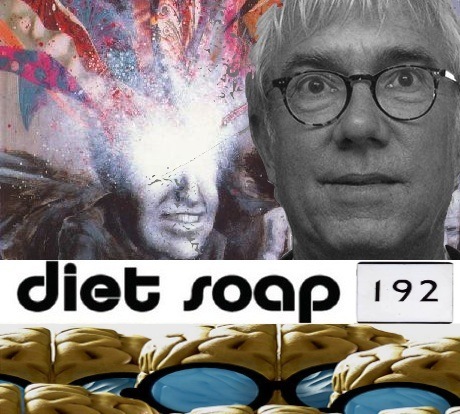
This interesting piece comes from the Diet Soap podcast on the Critical Theory site. For a lot of people, mathematician, computer scientist, philosopher, and sci-fi author Rudy Rucker (Rudolf von Bitter Rucker) is best known as the author of the four cyberpunk novels comprising the Ware Tetralogy (the first two of which won the Philip K Dick Award). But he is also the author of several non-fiction books, most notably Infinity and the Mind: The Science and Philosophy of the Infinite (2004), as well as The Fourth Dimension: A Guided Tour of the Higher Universes (1985), Mind Tools: The Five Levels of Mathematical Reality (1988) and The Lifebox, the Seashell, and the Soul: What Gnarly Computation Taught Me About Ultimate Reality, the Meaning of Life, and How to Be Happy (2006), among many other books.

As a fiction author, Rucker identifies himself as a transrealist (from Wikipedia):
Transrealism is a literary mode that mixes the techniques of incorporating fantastic elements used in science fiction with the techniques of describing immediate perceptions from naturalistic realism. While combining the strengths of the two approaches, it is largely a reaction to their perceived weaknesses. Transrealism addresses the escapism and disconnect with reality of science fiction by providing for superior characterization through autobiographical features and simulation of the author's acquaintances. It addresses the tiredness and boundaries of realism by using fantastic elements to create new metaphors for psychological change and to incorporate the author's perception of a higher reality in which life is embedded. One possible source for this higher reality is the increasingly strange models of the universe put forward in theoretical astrophysics.

Its main proponent and prominent figure is science fiction author Rudy Rucker. Rucker coined the term "transrealism" after reading Philip K Dick's A Scanner Darkly described as "transcendental autobiography," and expounded the principles of transrealism in a short essay titled "A Transrealist Manifesto" in 1983. Rucker applied many of these principles in his short stories and novels, notably White Light and Saucer Wisdom. Damien Broderick has identified some other authors that have at some time utilized transrealist tropes to include Martin Amis, Margaret Atwood, Iain Banks, John Barth, J.G. Ballard, John Calvin Batchelor, Jonathan Carroll, Philip K. Dick especially, Karen Joy Fowler, Lisa Goldstein, James Morrow, Thomas Pynchon, Joanna Russ and James Tiptree Jr. [1]
While the Wikipedia entry sees transrealism as part of the slipstream literature genre, it sounds an awful lot like a form of postmodernist story-telling. Interested readers can check out Rucker's Transrealist Manifesto (1983).

Listen: Podcast on Transrealism vs. Hyperrealism


August 30th, 2013 | by


460-_8680038

Rudy Rucker is a cyberpunk author, a mathematician, and a Transrealist. Known for his book Ware Tetralogy (four novels in one volume), Rucker’s most current book is “The Big Aha.” In this episode of the philosophy podcast Diet Soap the ideas of Transrealism and Baudrillard’s Hyperrealism are juxtaposed through sound clips and audio collage.

Rudy Rucker on Transrealism:
The Transrealist writes about immediate perceptions in a fantastic way. Any literature which is not about actual reality is weak and enervated. But the genre of straight realism is all burnt out. Who needs more straight novels? The tools of fantasy and SF offer a means to thicken and intensify realistic fiction. By using fantastic devices it is actually possible to manipulate subtext. The familiar tools of SF — time travel, antigravity, alternate worlds, telepathy, etc. — are in fact symbolic of archetypal modes of perception. Time travel is memory, flight is enlightenment, alternate worlds symbolize the great variety of individual world-views, and telepathy stands for the ability to communicate fully. This is the “Trans” aspect. The “realism” aspect has to do with the fact that a valid work of art should deal with the world the way it actually is. Transrealism tries to treat not only immediate reality, but also the higher reality in which life is embedded.
Listen below.

Monday, March 11, 2013

Bookforum Omnivore - About Transhumanism

From Bookforum's Omnivore blog, a collection of links on transhumanism, from the technological singularity, to multiple singularities (then wouldn't that mean they are not singular?), to biological enhanced soldiers, to philosopher Colin McGinn dismantling the ideas and presumptions of the new book from Ray Kurzweil.


About transhumanism

MAR 8 2013 
12:00PM


Friday, March 08, 2013

God, the Universe, and Everything Else: Carl Sagan, Stephen Hawking, and Arthur C. Clarke Talk in Conversation


io9 posted this cool video of Carl Sagan, Stephen Hawking, and Arthur C. Clarke having a conversation about the Big Bang theory, the connection between science and science fiction, the rise of computer science, extraterrestrial intelligence, and the puzzle that is human existence (among other things).

Awesome.

Imagine Carl Sagan, Stephen Hawking and Arthur C. Clarke together in conversation. It happened.

George Dvorsky
March 6, 2013

Back in 1988, Magnus Magnusson (best name ever) somehow managed to bring three of the 20th Century's most fascinating personalities together to discuss God, the Universe, and Everything Else. In the hour-long program, the three talked about the Big Bang theory, the connection between science and scifi, the rise of computer science, extraterrestrial intelligence, and the puzzle that is human existence.

The remarkable program featured a spry 46 year-old Stephen Hawking who was already having to rely on his speech synthesizer — but his wit and deadpan humor was firmly established. Carl Sagan, who appeared via satellite, passed away only eight years later, with scifi author Arthur C. Clarke dying in 2008.

We were alerted to this video by Open Culture, who writes:
With minds like these, you can rest assured that the conversation won't stray far from what Sagan calls "the fundamental questions," nor will it come untethered from established human knowledge and float into the realms of wild speculation and wishful thinking. And of course, in such conversations, a sense of humor like Hawking's — a man who, not expected to reach age thirty, would nevertheless live to see more advancement in human knowledge than anyone else on the broadcast — never goes amiss.
Magnusson was the longtime host of BBC's Mastermind program. Props to him for putting this together back in the day.

Tuesday, March 20, 2012

Social Text - Special Issue on Speculation


Some interesting articles in this new issue of Social Text - all of the articles focused in some way on speculation. Here are links and abstracts for the articles.

Speculative Life: An Introduction

In our dystopian present, the term speculation is associated with an epistemology of greed, a sanctioned terrorism, and a new dimension of imperialism no longer based in production but in abstract futures. But speculation means something else for those who refuse to give its logic over to power and profit. >>
"What will you do when the apocalypse comes??" he asked me urgently. My first reaction was to laugh derisively. But a friend made me think twice. "Who knows, maybe he's right," she said. Then came the Tsunami that devastated South Asia in 2004. And the levees that breached during Hurricane Katrina in 2005. Who's to say what's real?>>
Science fictions never present the future, only "a significant distortion of the present," as Delany wrote in 1984. But they also distort the present of anyone reading at any time, even the text's own future. The contours of Dhalgren's disintegrating city belong to the wake of 1960s countercultures and social movements, to a sexual and racial moment whose history uninformed new generations of readers will learn as they read, even if they fail to recognize it. Sexual pleasure in Delany's work links the past and present and lets a different future feel possible, even when it takes place within structuring limitations. >>
Chinese-Canadian author Larissa Lai imaginatively interrogates the boundaries of the human, alchemizes myths of origin, and embraces the impurity of the cyborg while foregrounding the politics of racialization, animality, and sexuality. Lai builds on the rich tradition of women of color writing in sf/speculative fiction by splicing together cultural theory and current events with a panoply of intertexts. Traversing past, present, and future, Lai maps the permeability of the human through the vectors of animal, creator-goddess, cyborg, and transgenic procreation. Her distinctive métissage of Chinese legend, EuroAmerican culture, Orientalist archetypes, Western popular music, and science fiction disrupts cycles of institutionalized exploitation, corporatized amnesia, and multicultural assimilation.[1] Akin to the work of Octavia Butler, Karen Tei Yamashita, and Nalo Hopkinson, Lai's...>>
China Miéville is the recipient of multiple awards for his speculative/science/weird fiction novels, and the only author ever to win three Arthur C. Clarke Awards.  His most recent novel, Embassytown, came out in May 2011 and has received enthusiastic reviews. As well as writing fiction, Miéville earned his Ph.D. at London School of Economics in International Law and is the author of Between Equal Rights, A Marxist Theory of International Law (2006).      Known for his radical fictive speculation, China Miéville is also fiercely engaged with radical politics--he stood for the House of Commons as candidate for the Socialist Alliance in the 2001 UK general election--and so is often asked about the relationship between his politics and his writing. He...>>

Race for Life

The short film accompanying musician and designer M.I.A.'s (Maya Arulpragasam, who is British of Sri Lankan Tamil descent) song "Born Free" was released in April of 2010 and immediately banned from YouTube. Arulpragasam is no stranger to controversy, since she has drawn attention to the violence perpetrated against the Tamil minority in Sri Lanka, while her music and accompanying visual work is replete with references to different forms of political violence and identification with non-western persecuted populations.One of the few female artists in contemporary popular music that fuse explicit political content with cutting edge sounds, Arulpragasam has often been accused of toying with radical chic and being politically naïve, rather than associated with a long tradition of women of color...>>

So Say We All

Race is an illusion. So say we all! But what do we intend by this saying, this performative? Denise Ferreira da Silva is but the most recent of scholars to note that, in dispelling race from its improper place in the order of the human sciences, casting it into disrespectability along with sorcery, alchemy, and other bait for the credulous, we consolidate that much more firmly the protocols of scientific rationality. But the protocols of science gave us race as an invidious distinction in the first place. Reason giveth, and reason taketh away, seems to be the faith animating the claim "Race is an illusion." But what if were to suspend such faith in the subject of Enlightenment rationality? What...>>
When it comes to dealing with misfortune and injustice, the most effective tool to use if we want to make sure that troubles will persist without relief is a simple sentence: That's water under the bridge. No use crying over spilled milk. The past is over and done with. The goose is cooked. What's done is done.Whenever people have their attention called to injuries that occurred in the past, it is almost certain that someone will pipe up with a demand that everyone cut short the desire to improve the world and, instead, to defer to the water-under-the-bridge school of history.[1]There are is perhaps no better example of the water-under-the-bridge school of thought in the settler-colonial imagination, than Orson Scott...>>
The Natives should have died off by now. To still be alive is a miracle. Can you taste two billion year old air on your breath or the remnants of primordial seas in your sweat? Do you feel e-coli breaking bread in your bowels? Does your heart synch up with these words, these poetic echoes of ancient ancestors? Self and other, simultaneously...>>