Showing posts with label Google Talks. Show all posts

Thursday, October 30, 2014

Daniel Levitin: "The Organized Mind: Thinking Straight in an Age of Information Overload"

https://gallery.mailchimp.com/f64149d518f47ed9cd8b89911/images/96a73506-1881-4d2f-9240-eafadd5b85d9.jpg

Daniel Levitin is the author of The Organized Mind: Thinking Straight in the Age of Information Overload (2014), as you may have guessed by the title of this post. From the Amazon page for the book (linked to in previous sentence), here is the ad copy:
New York Times bestselling author and neuroscientist Daniel J. Levitin shifts his keen insights from your brain on music to your brain in a sea of details.

The information age is drowning us with an unprecedented deluge of data. At the same time, we’re expected to make more—and faster—decisions about our lives than ever before. No wonder, then, that the average American reports frequently losing car keys or reading glasses, missing appointments, and feeling worn out by the effort required just to keep up.

But somehow some people become quite accomplished at managing information flow. In The Organized Mind, Daniel J. Levitin, PhD, uses the latest brain science to demonstrate how those people excel—and how readers can use their methods to regain a sense of mastery over the way they organize their homes, workplaces, and time.

With lively, entertaining chapters on everything from the kitchen junk drawer to health care to executive office workflow, Levitin reveals how new research into the cognitive neuroscience of attention and memory can be applied to the challenges of our daily lives. This Is Your Brain on Music showed how to better play and appreciate music through an understanding of how the brain works. The Organized Mind shows how to navigate the churning flood of information in the twenty-first century with the same neuroscientific perspective.
Levitin stopped by Google recently to talk about his new book.

Daniel Levitin: "The Organized Mind: Thinking Straight in an Age of Information Overload"

Published on Oct 28, 2014


The information age is drowning us with an unprecedented deluge of data. At the same time, we’re expected to make more—and faster—decisions about our lives than ever before. No wonder, then, that the average American reports frequently losing car keys or reading glasses, missing appointments, and feeling worn out by the effort required just to keep up.

But somehow some people become quite accomplished at managing information flow. In The Organized Mind, Daniel J. Levitin, PhD, uses the latest brain science to demonstrate how those people excel—and how readers can use their methods to regain a sense of mastery over the way they organize their homes, workplaces, and time.

Sunday, October 26, 2014

Marc Abrahams, "Annals of Improbable Research" - The Ig Noble Awards

http://www.gannett-cdn.com/-mm-/cdccd04ac9a1a7b4f5412b9731613e0504647700/c=0-219-1000-969&r=x383&c=540x380/local/-/media/USATODAY/GenericImages/2014/07/30/1406761786000-book-cover.jpg

Marc Abrahams is the founder of the Annals of Improbable Research (A.I.R.), and the Ig Noble Prize. His new book is This is Improbable Too: Synchronized Cows, Speedy Brain Extractors and More WTF Research. He recently spoke at the TED Convention, and he also stopped by Google tlo talk about his book.

Marc Abrahams: A science award that makes you laugh, then think

Published on Oct 24, 2014


As founder of the Ig Nobel awards, Marc Abrahams explores the world’s most improbable research. In this thought-provoking (and occasionally side-splitting) talk, he tells stories of truly weird science — and makes the case that silliness is critical to boosting public interest in science.

* * * * *

Talks at Google: Marc Abrahams, "Annals of Improbable Research"

Published on Oct 23, 2014


Marc Abrahams visited Google's office in Cambridge, MA to discuss his new book This is Improbable Too: Synchronized Cows, Speedy Brain Extractors and More WTF Research and the Ig Nobel Prizes.

He has long collected odd, imaginative, and brilliantly improbable scientific discoveries from around the world. In his new book, he investigates research on the ins and outs of the very improbable evolutionary innovation that is the human body (brain included):
  • What’s the best way to get a monkey to floss regularly?
  • How much dandruff do soldiers in Pakistan’s army have?
  • What is the real meaning of the finger?
Marc Abrahams is the editor and co-founder of the science humor magazine Annals of Improbable Research, a weekly columnist for the Guardian, and author of This Is Improbable: Cheese String Theory, Magnetic Chickens, and Other WTF Research. He is the founder of the Ig Nobel Prizes ceremony, which are presented annually at Harvard.

@MarcAbrahams | www.improbable.com

Tuesday, October 21, 2014

Alan Lightman, "The Accidental Universe" | Talks at Google

http://www.constablerobinson.com/images/book/large/9781472109187.jpg

Alan Lightman (MIT) is the author of several books, and he is among my favorite science writers. His new book is The Accidental Universe: The World You Thought You Knew (2014), and some of his previous work includes Einstein's Dreams (1992), Great Ideas in Physics (2000), and A Sense of the Mysterious: Science and the Human Spirit (2005).

Recently, he stopped by Google to discuss his new book.

Alan Lightman, "The Accidental Universe" | Talks at Google

Published on Oct 20, 2014


Prof. Alan Lightman of M.I.T. visited Google's office in Cambridge, MA to discuss his book, "The Accidental Universe: The World You Thought You Knew."

“Alan Lightman brings a light touch to heavy questions. Here is a book about nesting ospreys, multiple universes, atheism, spiritualism, and the arrow of time. Throughout, Lightman takes us back and forth between ordinary occurrences—old shoes and entropy, sailing far out at sea and the infinite expanse of space .... In this slight volume, Lightman looks toward the universe and captures aspects of it in a series of beautifully written essays, each offering a glimpse at the whole from a different perspective: here time, there symmetry, not least God. It is a meditation by a remarkable humanist-physicist, a book worth reading by anyone entranced by big ideas grounded in the physical world.” — Peter L. Galison, Professor, Harvard University

Alan Lightman is a novelist, essayist, physicist, and educator. Currently, he is Professor of the Practice of the Humanities at the Massachusetts Institute of Technology (MIT). http://cmsw.mit.edu/alan-lightman/

Thursday, October 16, 2014

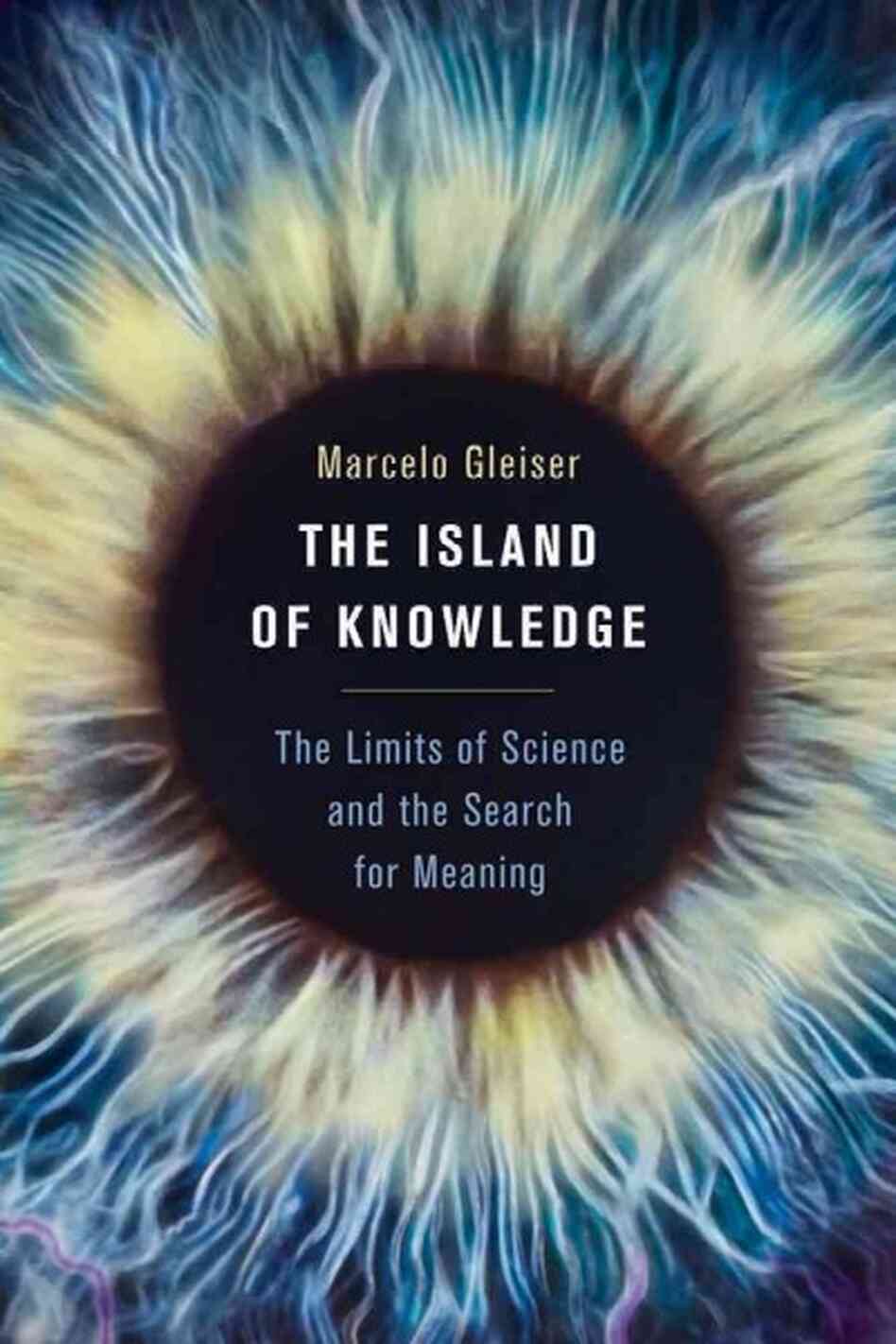
Marcelo Gleiser: "The Island of Knowledge" (Talks at Google)

http://media.npr.org/assets/bakertaylor/covers/t/the-island-of-knowledge/9780465031719_custom-ba4b9eed077161ba335114b225768736fcf4297c-s6-c30.jpg

Marcelo Gleiser stopped by Google recently to discuss his new book, The Island of Knowledge: The Limits of Science and the Search for Meaning (2014). His previous books are The Dancing Universe: From Creation Myths to the Big Bang (2005), The Prophet and the Astronomer: Apocalyptic Science and the End of the World (2002), and A Tear at the Edge of Creation: A Radical New Vision for Life in an Imperfect Universe (2010).

Here is the publisher's ad copy for the new book from Amazon:
Do all questions have answers? How much can we know about the world? Is there such a thing as an ultimate truth?

To be human is to want to know, but what we are able to observe is only a tiny portion of what’s “out there.” In The Island of Knowledge, physicist Marcelo Gleiser traces our search for answers to the most fundamental questions of existence. In so doing, he reaches a provocative conclusion: science, the main tool we use to find answers, is fundamentally limited.

These limits to our knowledge arise both from our tools of exploration and from the nature of physical reality: the speed of light, the uncertainty principle, the impossibility of seeing beyond the cosmic horizon, the incompleteness theorem, and our own limitations as an intelligent species. Recognizing limits in this way, Gleiser argues, is not a deterrent to progress or a surrendering to religion. Rather, it frees us to question the meaning and nature of the universe while affirming the central role of life and ourselves in it. Science can and must go on, but recognizing its limits reveals its true mission: to know the universe is to know ourselves.

Telling the dramatic story of our quest for understanding, The Island of Knowledge offers a highly original exploration of the ideas of some of the greatest thinkers in history, from Plato to Einstein, and how they affect us today. An authoritative, broad-ranging intellectual history of our search for knowledge and meaning, The Island of Knowledge is a unique view of what it means to be human in a universe filled with mystery.
Gleiser is a smart and entertaining guy, so this is likely a fun read.

Marcelo Gleiser: "The Island of Knowledge"


Talks at Google
Published on Oct 15, 2014


In The Island of Knowledge: The Limits of Science and the Search for Meaning (2014), he traces our search for answers to some of the most fundamental questions of existence and reaches a provocative conclusion: the main tool we use to find answers – science – is fundamentally limited. Yet recognizing science’s limits, Gleiser argues, is not a deterrent to progress or a surrendering to religion. Instead, it frees us to question the meaning and nature of the universe while affirming the central role of life and ourselves in it.

Marcelo Gleiser is Appleton Professor of Natural Philosophy and Professor of Physics and Astronomy at Dartmouth College and the author of three previous books, The Dancing Universe: From Creation Myths to the Big Bang (2005), The Prophet and the Astronomer: Apocalyptic Science and the End of the World (2002), and A Tear at the Edge of Creation: A Radical New Vision for Life in an Imperfect Universe (2010).

Nicholas Carr | The Glass Cage: Automation and Us (Talks at Google)

http://www.vancouversun.com/cms/binary/10248737.jpg

Technology writer Nicholas Carr has a new book out, The Glass Cage: Automation and Us, that both celebrates technology and offers more warnings about the impact of technology of human beings. his previous books include The Big Switch: Rewiring the World, from Edison to Google (2008) and The Shallows: What the Internet Is Doing to Our Brains (2010).

Here is the publisher's ad copy from Amazon:
At once a celebration of technology and a warning about its misuse, The Glass Cage will change the way you think about the tools you use every day.

In The Glass Cage, best-selling author Nicholas Carr digs behind the headlines about factory robots and self-driving cars, wearable computers and digitized medicine, as he explores the hidden costs of granting software dominion over our work and our leisure. Even as they bring ease to our lives, these programs are stealing something essential from us. 
Drawing on psychological and neurological studies that underscore how tightly people’s happiness and satisfaction are tied to performing hard work in the real world, Carr reveals something we already suspect: shifting our attention to computer screens can leave us disengaged and discontented.

From nineteenth-century textile mills to the cockpits of modern jets, from the frozen hunting grounds of Inuit tribes to the sterile landscapes of GPS maps, The Glass Cage explores the impact of automation from a deeply human perspective, examining the personal as well as the economic consequences of our growing dependence on computers.

With a characteristic blend of history and philosophy, poetry and science, Carr takes us on a journey from the work and early theory of Adam Smith and Alfred North Whitehead to the latest research into human attention, memory, and happiness, culminating in a moving meditation on how we can use technology to expand the human experience.
Carr stopped by Google recently to discuss his new book, which seems kind of like stepping into a Hell's Angels chapter meeting to discuss the perils of drugs and violence (he is also the author of Is Google Making Us Stupid?).

Nicholas Carr | The Glass Cage: Automation and Us


Talks at Google
Published on Oct 14, 2014


Nicholas Carr writes about technology and culture. His latest book, The Glass Cage: Automation and Us, asks:

What kind of world are we building for ourselves? That’s the question bestselling author Nicholas Carr tackles in this urgent, absorbing book on the human consequences of automation. At once a celebration of technology and a warning about its misuse, The Glass Cage will change the way you think about the tools you use every day.

With a characteristic blend of history and philosophy, poetry and science, Carr takes us on a journey from the work and early theory of Adam Smith and Alfred North Whitehead to the latest research into human attention, memory, and happiness, culminating in a moving meditation on how we can use technology to expand the human experience.

Wednesday, October 15, 2014

Chris Guillebeau | "The Happiness of Pursuit" (Talks at Google)

http://chrisguillebeau.com/files/2014/07/hop6-1.jpg

Chris Guillebeau is the author of The Happiness of Pursuit: Finding the Quest That Will Bring Purpose to Your Life (2014) and he recently stopped by Google to talk about his new book. Here is the publisher's ad copy for the book:
A remarkable book that will both guide and inspire, The Happiness of Pursuit reveals how anyone can bring meaning into their life by undertaking a quest.

When he set out to visit all of the planet’s countries by age thirty-five, compulsive goal seeker Chris Guillebeau never imagined that his journey’s biggest revelation would be how many people like himself exist – each pursuing a challenging quest.  And, interestingly, these quests aren’t just travel-oriented.  On the contrary, they’re as diverse as humanity itself.  Some involve exploration; others the pursuit of athletic or artistic excellence; still others a battle against injustice or poverty or threats to the environment.

Everywhere that Chris visited he found ordinary people working toward extraordinary goals, making daily down payments on their dream.  These “questers” included a suburban mom pursuing a wildly ambitious culinary project, a DJ producing the world’s largest symphony, a young widower completing the tasks his wife would never accomplish, and a teenager crossing an entire ocean alone - as well as a do-it-yourselfer tackling M.I.T.’s computer-science course, a nerd turning himself into real-life James Bond, and scores of others writing themselves into the record books.

The more Chris spoke with these strivers, the more he began to appreciate the direct link between questing and long-term happiness -- how going after something in a methodical way enriches our lives -- and he was compelled to complete a comprehensive study of the phenomenon and extract the best advice.  In The Happiness of Pursuit he draws on interviews with hundreds of questers, revealing their secret motivations, their selection criteria, the role played by friends and family, their tricks for solving logistics, and the importance of documentation.

Equally fascinating is Chris’ examination of questing’s other side, including questers’ acute awareness of mortality, their struggle against monotony, and their wistful feelings once a quest has succeeded. What happens after the summit is climbed, the painting hung, the endurance record broken, the “at risk” community saved? 

A book that challenges each of us to take control – to make our lives be about something while at the same time remaining clear-eyed about the commitment -- The Happiness of Pursuit will inspire readers of every age and aspiration.  It’s a playbook for making your life count.
With that, here is the talk.

Chris Guillebeau | "The Happiness of Pursuit" (Talks at Google)


Talks at Google
Published on Oct 15, 2014


Chris discusses his latest book, The Happiness of Pursuit: Finding the Quest That Will Bring Purpose to Your Life (2014), a remarkable book that reveals how anyone can bring meaning into their life by undertaking a quest.

In this intimate gathering Chris highlights, among other things:
  • His own personal journey to every country in the world.
  • Other amazing journeys, including a man who took a 17-year vow of silence and the young woman who lived in a tree for a year as a form of social protest.
  • How quests and big adventures can bring purpose to our lives
More about the book:
A book that challenges each of us to take control – to make our lives be about something while at the same time remaining clear-eyed about the commitment -- The Happiness of Pursuit will inspire readers of every age and aspiration. It’s a playbook for making your life count.

About Chris:
Chris Guillebeau is the New York Times bestselling author of The $100 Startup and The Happiness of Pursuit. Chris travels the world and writes for a small army of remarkable people at ChrisGuillebeau.com. Follow his live updates from every country in the world at www.twitter.com/chrisguillebeau.

Every summer in Portland, Oregon, Chris hosts the World Domination Summit, a gathering of creative, remarkable people with thousands in attendance.

Friday, September 26, 2014

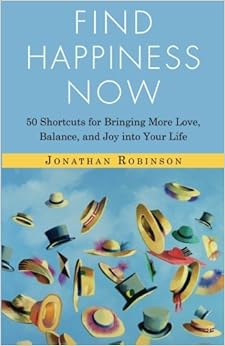
Jonathan Robinson: Finding Happiness Now...and in the Future (Talks at Google)

http://ecx.images-amazon.com/images/I/51prI5wrCML._SY344_BO1,204,203,200_.jpg

Psychologist Jonathan Robinson is the author of Find Happiness Now: 50 Shortcuts for Bringing More Love, Balance, and Joy Into Your Life (March, 2014), as well as several other books, including Communication Miracles for Couples: Easy and Effective Tools to Create More Love and Less Conflict (2012).

Robinson recently stopped by Google to talk about his book on happiness.

Jonathan Robinson: "Finding Happiness Now...and in the Future"

Published on Sept 3, 2014


Jonathan Robinson is a psychotherapist, best-selling author of ten books, and a professional speaker from Northern California. He has reached over 250 million people around the world with his practical methods, and his work has been translated into 47 languages. Articles about Jonathan have appeared in USA TODAY, Newsweek, and the Los Angeles Times, as well as dozens of other publications. In addition, Mr. Robinson has made numerous appearances on the Oprah show and CNN, as well as other national TV talk shows. He has spent over 35 years studying the most practical and powerful methods for personal and professional development.

More about Jonathan

Thursday, September 25, 2014

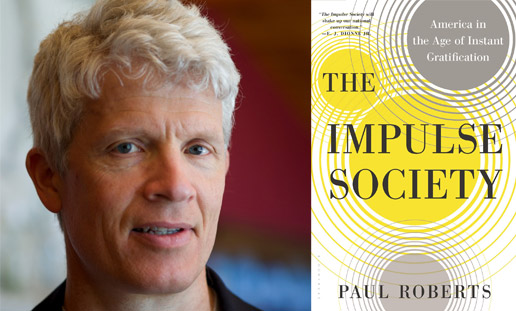
Talks at Google: Paul Roberts, "The Impulse Society"

http://www.92y.org/92streety/media/headshots/m_r/lg/h_robertspaul.jpg

Paul Roberts is the author, most recently, of The Impulse Society: America in the Age of Instant Gratification (September, 2014). Recently, he stopped by Google to talk about his book. According to the publisher's ad copy for the book:
It's something most of us have sensed for years—the rise of a world defined only by “mine” and “now.” A world where business shamelessly seeks the fastest reward, regardless of the long-term social consequences; where political leaders reflexively choose short-term fixes over broad, sustainable social progress; where individuals feel increasingly exploited by a marketplace obsessed with our private cravings yet oblivious to our spiritual well-being or the larger needs of our families and communities.

At the heart of The Impulse Society is an urgent, powerful story: how the pursuit of short-term self-gratification, once scorned as a sign of personal weakness, became the default principle not only for individuals, but for all sectors of our society. Drawing on the latest research in economics, psychology, political philosophy, and business management, Paul Roberts shows how a potent combination of rapidly advancing technologies, corrupted ideologies, and bottom-line business ethics has pushed us across a threshold to an unprecedented state: a virtual merging of the market and the self. The result is a socioeconomic system ruled by impulse, by the reflexive, id-like drive for the largest, quickest, most “efficient” reward, without regard for long-term costs to ourselves or to broader society.

More than thirty years ago, Christopher Lasch hinted at this bleak world in his landmark book, The Culture of Narcissism. In The Impulse Society, Roberts shows how that self-destructive pattern has grown so pervasive that anxiety and emptiness are becoming embedded in our national character. Yet it is in this unease that Roberts finds clear signs of change—and broad revolt as millions of Americans try step off the self-defeating treadmill of gratification and restore a sense of balance. Fresh, vital, and free of ideological, right-wing/left-wing formulations, The Impulse Society shows the way back to a world of real and lasting good.
Sounds like an accurate assessment. The question, then, is how do we change this core aspect of our culture? Roberts believes that change is already beginning . . . . .

Talks at Google: Paul Roberts, "The Impulse Society"

Published on Sept 14, 2014


Journalist Paul Roberts visited Google's Cambridge, MA office to discuss his book, The Impulse Society. In it, he claims that our entire socioeconomic system has become one giant engine devoted to the selfish, short-term impulses of individuals, CEOs and politicians—while ignoring the pressing, long-term needs of society. He draws on economics, psychology, history, and political philosophy to show how we have become so obsessed with "maximizing returns" that we embrace virtually any means — any technology, personal tactic, or corporate strategy — that can deliver, regardless of consequences. He lays out the history and geography of this new social order, and charts a clear pathway toward a different and brighter future.

Paul Roberts is a journalist specializing in resource economics. The Impulse Society is his third book, following The End of Oil (2005) and The End of Food (2009).

Wednesday, September 24, 2014

Nick Bostrom: Superintelligence - Authors@Google


Nick Bostrom is the author of Superintelligence: Paths, Dangers, Strategies (September, 2014). Bostrom is Professor in the Faculty of Philosophy at Oxford University. He is the founding Director of the Future of Humanity Institute, a multidisciplinary research center which enables a few exceptional mathematicians, philosophers, and scientists to think carefully about global priorities and big questions for humanity.
Bostrom has a background in physics, computational neuroscience, and mathematical logic as well as philosophy. He is the author of some 200 publications, including Anthropic Bias (Routledge, 2002), Global Catastrophic Risks (ed., OUP, 2008), and Human Enhancement (ed., OUP, 2009), and the groundbreaking Superintelligence: Paths, Dangers, Strategies (OUP, 2014). He is best known for his work in five areas: (i) existential risk; (ii) the simulation argument; (iii) anthropics (developing the first mathematically explicit theory of observation selection effects); (iv) impacts of future technology; and (v) implications of consequentialism for global strategy.

He is recipient of a Eugene R. Gannon Award (one person selected annually worldwide from the fields of philosophy, mathematics, the arts and other humanities, and the natural sciences). Earlier this year he was included on Prospect magazine's World Thinkers list, the youngest person in the top 15 from all fields and the highest-ranked analytic philosopher. His writings have been translated into 22 languages. There have been more than 100 translations and reprints of his works.

For more, see www.nickbostrom.com
This is an excellent talk.

Nick Bostrom: Superintelligence - Authors@Google

Published on Sept 22, 2014


Superintelligence asks the questions: What happens when machines surpass humans in general intelligence? Will artificial agents save or destroy us? Nick Bostrom lays the foundation for understanding the future of humanity and intelligent life.

The human brain has some capabilities that the brains of other animals lack. It is to these distinctive capabilities that our species owes its dominant position. If machine brains surpassed human brains in general intelligence, then this new superintelligence could become extremely powerful - possibly beyond our control. As the fate of the gorillas now depends more on humans than on the species itself, so would the fate of humankind depend on the actions of the machine superintelligence.

But we have one advantage: we get to make the first move. Will it be possible to construct a seed Artificial Intelligence, to engineer initial conditions so as to make an intelligence explosion survivable? How could one achieve a controlled detonation?

This profoundly ambitious and original book breaks down a vast track of difficult intellectual terrain. After an utterly engrossing journey that takes us to the frontiers of thinking about the human condition and the future of intelligent life, we find in Nick Bostrom's work nothing less than a reconceptualization of the essential task of our time.

This talk was hosted by Boris Debic.

Thursday, July 31, 2014

Emily Fletcher - Why Meditation is the New Caffeine (Google Talks)


Emily Fletcher is the founder of Ziva Meditation and the creator of zivaMIND, the first online meditation training program. She spoke recently at Google.

Emily Fletcher, Why Meditation is the New Caffeine

Published on Jul 30, 2014


Emily Fletcher, one of the world's leading experts on meditation, will explain the differences between the two most popular styles of meditation, how they affect the brain differently and the impact of stress on performance. Emily will also lead you through a simple breathing technique and guided visualization that will help balance the right and left sides of the brain.

This talk will cover:
  • How the fight or flight reaction can work for you or against you
  • Why emotional intelligence is so important for not only personal happiness, but professional success and how anyone can learn it
  • How to not let goals get in the way of success

About the Speaker:

Emily Fletcher is the founder of Ziva Meditation and the creator of zivaMIND, the first online meditation training program. She began her meditation training in Rishikesh, India and was inspired to become a meditation teacher after experiencing the profound physical and mental benefits it provided her during her 10-year career on Broadway, which included roles in Chicago, The Producers, A Chorus Line, and many others.

With her high performance background and eight years of meditation experience, Emily is perfectly suited to teach busy people how to incorporate this simple and effective practice into their lives. Emily has taught meditation to a wide range of individuals and companies including Coca Cola, Relativity Media, Colbeck Capitol, Ogilvy & Mather and in public schools in the Bronx. She is a regular guest on Huffington Post LIVE and has been a speaker on the Dr. Lisa show and with Eckhart Tolle at the Global Alliance for Transformational Entertainment.

Sunday, July 13, 2014

The Neuroscience of Emotions


Dr. Phillippe Goldin is known for his work on mindfulness and the brain. In this older lecture (from 2008) Dr. Goldin talks about why emotions are so important and the meaning of emotional intelligence. He goes on to explain the interplay of emotions and brain activity, including the implications of extreme emotions and how this leads to disease. The lecture unfolds into what happens to us emotionally and mentally when we develop empathy and compassion as a way of life. It's an older lecture, but it's still informative.

The Neuroscience of Emotions

Uploaded on Oct 13, 2008
Google Tech Talks
September 16, 2008


ABSTRACT

The ability to recognize and work with different emotions is fundamental to psychological flexibility and well-being. Neuroscience has contributed to the understanding of the neural bases of emotion, emotion regulation, and emotional intelligence, and has begun to elucidate the brain mechanisms involved in emotion processing. Of great interest is the degree to which these mechanisms demonstrate neuroplasticity in both anatomical and functional levels of the brain.

Speaker: Dr. Phillippe Goldin

Monday, June 30, 2014

David Burkus | The Myths of Creativity


As one might gather from the title of this Google Talk, David Burkus is the author of The Myths of Creativity: The Truth About How Innovative Companies and People Generate Great Ideas (2013). Back around the beginning of June (the 9th), Burkus stopped by Google to talk about his book (which is described below the video).

David Burkus | The Myths of Creativity

Published on Jun 13, 2014


We tend to think of creativity in terms reminiscent of the ancient muses: divinely-inspired, unpredictable, and bestowed upon a lucky few. But when our jobs challenge us to be creative on demand, we must develop novel, useful ideas that will keep our organizations competitive. The Myths of Creativity demystifies the processes that drive innovation. Based on the latest research into how creative individuals and firms succeed, David Burkus highlights the mistaken ideas that hold us back and shows us how anyone can embrace a practical approach, grounded in reality, to finding the best new ideas, projects, processes, and programs.

Answers questions such as: What causes us to be creative in one moment and void in the next? What makes someone more or less creative than his or her peers? Where do our flashes of creative insight come from, and how can we generate more of them?

Debunks 10 common myths, including: the Eureka Myth; the Lone Creator Myth; the Incentive Myth; and The Brainstorming Myth.

David Burkus | The Myths of Creativity: The Truth About How Innovative Companies and People Generate Great Ideas

For anyone who struggles with creativity, or who makes excuses for delaying the work of innovation, The Myths of Creativity will help you overcome your obstacles to finding new ideas.