Showing posts with label humanity. Show all posts

Saturday, October 25, 2014

Kat McGowan - Cooperation Is What Makes Us Human

http://ecx.images-amazon.com/images/I/31YEfyHQ-2L.jpg

This is a re-post of an older article from Nautilus, but it's worth the (re)read even if you saew it originally. Michael Tomasello is the primary expert here, and his book is listed below, along with a few others that are related and interesting reads.

Michael Tomasello, Why We Cooperate (2009)
Samuel Bowles, A Cooperative Species: Human Reciprocity and Its Evolution (2013)
Robert Axelrod, The Evolution of Cooperation: Revised Edition (2006)
Martin Nowak and Roger Highfield, SuperCooperators: Altruism, Evolution, and Why We Need Each Other to Succeed (2012)

Cooperation Is What Makes Us Human

Where we part ways with our ape cousins 

http://static.nautil.us/82_9778d5d219c5080b9a6a17bef029331c.jpg


TALES about the origins of our species always start off like this: A small band of hunter-gatherers roams the savannah, loving, warring, and struggling for survival under the African sun. They do not start like this: A fat guy falls off a New York City subway platform onto the tracks. 
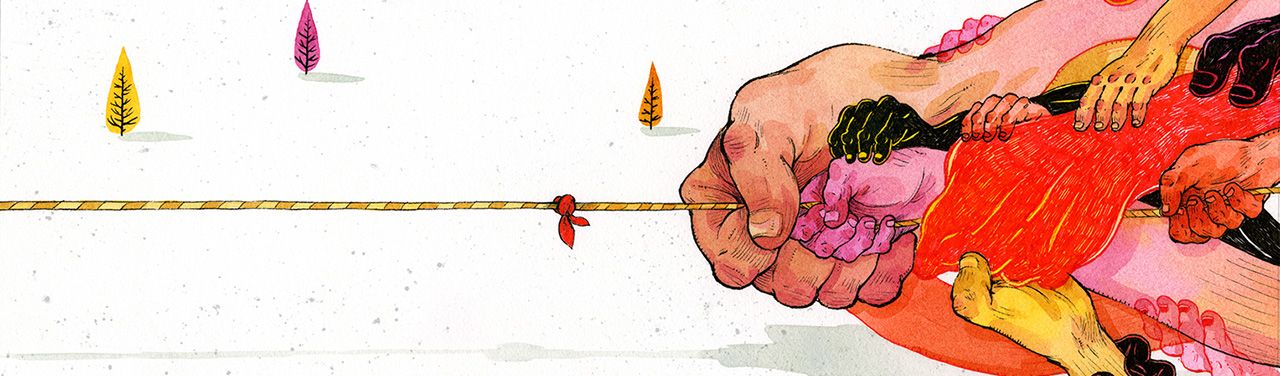
But what happens next is a quintessential story of who we are as human beings.

On Feb. 17, 2013, around 2:30 a.m., Garrett O’Hanlon, a U.S. Air Force Academy cadet third class, was out celebrating his 22nd birthday in New York City. He and his sister were in the subway waiting for a train when a sudden silence came over the platform, followed by a shriek. People pointed down to the tracks.

O’Hanlon turned and saw a man sprawled facedown on the tracks. “The next thing that happened, I was on the tracks, running toward him,” he says. “I honestly didn’t have a thought process.”

O’Hanlon grabbed the unconscious man by the shoulders, lifting his upper body off the tracks, but struggled to move him. He was deadweight. According to the station clock, the train would arrive in less than two minutes. From the platform, O’Hanlon’s sister was screaming at him to save himself.
Suddenly other arms were there: Personal trainer Dennis Codrington Jr. and his friend Matt Foley had also jumped down to help. “We grabbed him, one by the legs, one by the shoulders, one by the chest,” O’Hanlon says. They got the man to the edge of the platform, where a dozen or more people muscled him up and over. More hands seized the rescuers’ arms and shoulders, helping them up to safety as well.

In the aftermath of the rescue, O’Hanlon says he has been surprised that so many people have asked him why he did it. “I get stunned by the question,” he says. In his view, anybody else would’ve done the same thing. “I feel like it’s a normal reaction,” he says. “To me that’s just what people do.”
More precisely, it is something only people do, according to developmental psychologist Michael Tomasello, codirector of the Max Planck Institute for Evolutionary Anthropology.

For decades Tomasello has explored what makes humans distinctive. His conclusion? We cooperate. Many species, from ants to orcas to our primate cousins, cooperate in the wild. But Tomasello has identified a special form of cooperation. In his view, humans alone are capable of shared intentionality—they intuitively grasp what another person is thinking and act toward a common goal, as the subway rescuers did. This supremely human cognitive ability, Tomasello says, launched our species on its extraordinary trajectory. It forged language, tools, and cultures—stepping-stones to our colonization of every corner of the planet.

In his most recent research, Tomasello has begun to look at the dark side of cooperation. “We are primates, and primates compete with one another,” Tomasello says. He explains cooperation evolved on top of a deep-seated competitive drive. “In many ways, this is the human dilemma,” he says.

In conversation, Tomasello, 63, is both passionate and circumspect. Even as he overturns entrenched views in primatology and anthropology he treads carefully, backing up his theories by citing his experiments in human and primate behavior. He is aware of criticism from primatologists such as Frans de Waal, director of Living Links, a division of the Yerkes National Primate Research Center at Emory University in Atlanta, who has said Tomasello underestimates the minds of chimps and overestimates the uniqueness of human cooperation.

Nonetheless, Tomasello’s fellow scientists credit him with brave experiments and ingenious insights. Carol Dweck, a professor of psychology at Stanford University, who has done seminal research in child psychology and intelligence, has called Tomasello “a pioneer.” Herbert Gintis, an economist and behavioral scientist at the Santa Fe Institute, an interdisciplinary science research institution, agrees. “His work is fabulous,” Gintis says. “It has made clear certain things about what it means to be human.”

Every Chimp for Himself

Tomasello calls his theory of cooperation the Vygotskian Intelligence Hypothesis. It is named for Russian psychologist Lev Vygotsky, who argued in the 1920s that children’s minds do not automatically acquire skills, but develop full human intelligence only through cooperative teaching and social interactions. Tomasello applies this idea to the evolution of our species. He proposes that as many as 2 million years ago, as climate swings altered the availability and competition for food, our ancestors were forced to put their heads together to survive.

Tomasello began his research career at Emory University, working with apes at the Yerkes primate center. He acknowledges that chimpanzees, like humans, manage complex social lives, solve problems flexibly, and create and deploy tools. Nonetheless, “I take it as given that something is different,” he says. “Humans are doing something on a different level.”

As Tomasello began to study the cognition of chimpanzees and other great apes, he was influenced by pioneering child psychologist Jean Piaget, who recognized that children see the world differently. “He looked at children as if they were another species,” Tomasello says. “That’s the guiding image I started with.”

At the Yerkes primate center, Tomasello adopted an experimental method that he would develop throughout his career: systematically comparing the cognition of great apes and young children in head-to-head tests. Since the use of language is an obvious difference between humans and chimps, he began by looking at the precursors of speech. Great apes often communicate with gestures. Babies point before they talk. Presumably our hominid ancestors also gesticulated before they developed language. So Tomasello focused on pointing, devising dozens of studies to explore how and when chimps and children point.

He found a major difference between the two species. By the time a baby begins to point, at about nine months of age, she has already made several sophisticated cognitive leaps. When she points at a puppy and looks at you, she knows that her perspective may be different from yours (you haven’t noticed the pup), and she wants to share her information—doggie!—with you.

“We naturally inform people of things that are interesting or useful to them,” Tomasello says. “That’s unusual. Other animals don’t do that.” Pointing is an attempt to change your mental state. It is also a request for a joint experience: She wants you to look at the dog with her.

Chimps, by contrast, do not point things out to each other. Captive chimps will point for humans, but it’s to make a demand rather than to share information: I want that! Open the door! They do not understand informational human pointing, because they do not expect anyone to share information with them. In one of Tomasello’s experiments, food is hidden in one of two buckets. Even if the experimenter points to where it is, the chimp still chooses randomly. “It’s absolutely surprising,” Tomasello says. “They just don’t seem to get it."

In parallel experiments, children as young as 12 months have no trouble understanding an adult pointing a finger at a hidden reward. To understand pointing, Tomasello posits, you must form a “we intention,” a shared goal that both of you will pay attention to the same thing. Chimps don’t point because they don’t think in terms of “we.” They think in terms of “me.” “Cooperatively informing them of the location of food does not compute,” he says. The chimpanzee world is egocentric: Every chimp for himself.

The idea that chimps don’t work together appeared at first to contradict what some biologists had observed in the wild. Chimps take turns grooming one another, for example. They also form group hunting parties to encircle and kill red colobus monkeys, a favorite food. But these behaviors don’t require the kind of we intention that Tomasello was finding in even the youngest humans. Grooming is a tit-for-tat activity that merely requires two animals to alternate: Literally, I scratch your back, you scratch mine. There’s no need to jointly focus attention.

Chimps can also hunt together without deliberately coordinating, Tomasello reasons. If, during the chase, each chimp simply maximizes his own chances of catching the prey, each will position himself where he thinks the monkey will try to break out of the circle of predators. “This kind of hunting event is clearly a group activity of some complexity,” Tomasello writes in his book Why We Cooperate. “But wolves and lions do something very similar, and most researchers do not attribute to them any kind of joint goals or plans. The apes are engaged in a group activity in ‘I’ mode, not in ‘we’ mode.”


Michael TomaselloPhoto: Jacobs Foundation

Alone Together

Still, it was hard to tell exactly what was going on from watching wild animals. Lab experiments, where multiple animals can be tested in controlled situations and their responses measured and quantified, could clarify whether chimps even have a collaborative mode. Since collaboration requires that you understand what someone else wants and thinks, Tomasello explored whether chimps have what psychologists call “theory of mind,” or insight into what another individual might be thinking.

The consensus was that apes did not have this mental ability, but Tomasello and his team, including then undergraduate student Brian Hare, began devising ape-centric experiments to test whether that was truly the case. Rather than using psychology tests developed for human beings, as many ape researchers did, they invented new tests that were more relevant to the chimpanzee world.

Chimps are hierarchical with an alpha chimp getting priority in feeding. One experiment set a high-ranking chimp against a low-ranking one to compete for food. The researchers hid snacks in such a way that only the subordinate animal could see all the hiding places. When both animals were freed to go after the food, the subordinate dove for the snacks that had been hidden out of the high-ranking chimp’s line of sight. (Control experiments showed that if both animals saw where the food was hidden, the subordinate animal didn’t bother to approach the food.) The reasonable explanation was that the low-ranking chimp modeled his rival’s thought process in order to exploit his blind spots. He had a concept of what the other chimp saw and believed—the basic definition of theory of mind.

This study and others like it in 2000 and 2001 led the group to conclude that chimps do actually have insight into other individuals’ thoughts. But they don’t use this ability to cooperate, as humans often do. They use it to win.

“If you try to do something cooperative with a chimp—point out something, show them where some food is—their attention wanders all over the place,” says Tomasello. “But if you compete with them over food, they are zeroed in like a laser. All their cognitive skills are on.” (If chimps had a self-help bestseller, it would be titled, How to Outwit Rivals and Get More Fruit.)

It’s not that chimpanzees are incapable of helping. De Waal describes one instance in which chimps boosted an arthritic elderly troupe mate up to a joint perch and used their own mouths to carry water to her so that she could drink. De Waal says this is one of many examples of animal cooperation. He predicts the claim that humans are unique because they collaborate to solve problems “will drop by the wayside.”

Tomasello agrees that chimps sometimes assist each other and help each other get food, under specific conditions that eliminate all possibility of competition. In one of his experiments, conducted with wild-born chimps in a Ugandan sanctuary, two chimps entered separate cages, with fruit placed in a third. The first chimp knew from previous experience that he could not open his own cage door to get to the food, but he could help the other animal by pulling a chain that opened the door of the other cage. Here, with nothing to gain and nothing to lose, eight out of nine animals pulled the chain so that the other animal could get the fruit.

“It was a huge surprise to me,” Tomasello says. “My initial reaction was: Damn. That doesn’t fit very well.” But the more he thought about it, the more he realized that chimps, again, are acting individually, not in cooperation with each other. “To help, you just need to know what the goal is, and then if you’re motivated, you can help,” he says. “It’s not cognitively very complicated.” Human cooperation, meanwhile, requires two or more people to have insight into each other’s intentions, formulate a joint goal, assume specific roles, and then coordinate their efforts. It demands cognitive capacities that even the most helpful chimpanzees don’t possess.

In this case, the term “helpful” may be a little generous. Alicia Melis, a former postdoc in Tomasello’s lab, explains that chimps work together only grudgingly when it comes to obtaining food. In one of her experiments, a board laden with food is placed beyond the reach of two chimps; they can get the food only if each grabs one end of a rope attached to the board and they jointly pull it. In her experiment, the animals worked together only if the food was already evenly divided so that they did not have to compete over the spoils. It also helped if they already got along.

“The motivation does not seem to be, ‘Let’s do this together,’ ” says Melis, now an assistant professor of behavioral science at Warwick Business School in the U.K. “It’s, ‘Let me try to do this alone, and if I can’t, we’ll do it together.’ ”

Tomasello has discovered that young children, by contrast, find that working together can be a reward all its own. When adults deliberately drop objects in his experiments, babies of 14 months will crawl over to pick them up and hand them back. Toddlers open doors for experimenters whose hands are full. They do it without being asked and without being rewarded. Once they get the idea that they are partnering, they commit to joint intentionality. If a partner is having trouble, they stop and help. They share the spoils equally. “They really understand that we’re doing this together, and we have to divide it together,” Tomasello says.

Evolution of Collaboration

There are no fossils of ancient hominid brains or other physical evidence that might tell us when and how our ancestors first put their minds together to collaborate. Without such clues, the question of why we alone became a collaborative species is difficult to answer, says Hare, who is now a professor at the Center for Cognitive Neuroscience at Duke University. “Figuring out what makes us unique is hard as hell,” he says. “But it’s much easier than the next question, which is the real issue, the Higgs boson of evolutionary anthropology: How did we get that way?”

In the absence of physical evidence, Tomasello proposes one possible scenario. During the Pleistocene, about 1.5 million years ago, the climate became very bumpy, with frequent temperature swings that forced our ancestors to work together to access new sources of food. Perhaps we became scavengers, joining forces to ward off bigger, tougher meat-eating competitors. Under these circumstances, any genetic variation that made it easier to collaborate—maybe by more accurately reading someone else’s intentions, seeing the whites of their eyes, or simply being more relaxed about sharing food—presumably would have helped those individuals survive, and would have spread through the population.

Hints as to how this might have happened emerge from a surprising place: a fox-breeding farm in Siberia. In the 1950s the Russian biologist Dmitri Belyaev was interested in how dogs might first have been domesticated. He paired the most docile, friendly foxes he could find, then chose the gentlest from each litter and bred them. In a mere 10 generations, the young foxes acted like puppy dogs. The first time they met a human, they wagged their tails and tried to leap into people’s arms to lick their faces.

The descendants of those foxes still live in a facility in Siberia, where Hare, Tomasello’s former student, traveled in 2003 to test their cognition. He found that fox kits that had spent less than 20 minutes total around a person already understood human gestures, such as following a pointing finger to find food. They did not have to be taught. “That blew me away,” Hare says. His experiments suggested that as the foxes lost their fear of humans, they became able to repurpose their cognitive abilities to a new human-focused agenda: relating to us.

The foxes’ ability to read human social cues was now under strong artificial evolutionary pressure, since only the friendliest animals got the chance to breed. With Belyaev calling the shots, the foxes were competing against each other to be more socially perceptive. The outcome, a few dozen generations later, is a fox that understands human pointing. The small change in temperament permitted a big advance in social intelligence.

Hare and Tomasello suspect our ancestors went through a similar process. Basically, we domesticated ourselves. When collaborating to find food became essential because of changes in the climate or changes in the competition, we became less aggressive and more willing to share. Aggressive individuals, unwilling to cooperate, would starve and die out. Now that our temperaments allowed us to put our minds together, we were able to develop communal inventions like language and culture, and sustain these innovations by teaching and imitating one another. The ability to crystallize knowledge in inventions and traditions, Tomasello says, is what turned the ordinary primate mind into an extraordinary human one.

“Through our collaborative efforts, we have built our cultural worlds, and we are constantly adapting to them,” he writes in Why We Cooperate.

Us and Them

Today Tomasello is also looking through the prism of collaboration and beginning to explain some of the uniquely dark and nasty things that humans do. Maintaining a collaborative social structure encourages us to shun outsiders and discipline nonconformists. It fosters groupthink—the urge to stifle dissenting opinions in the interest of harmony and loyalty. Here, his research connects with that of anthropologists and economists who study social norms and other psychological underpinnings of group behavior.

Game theory models, which forecast how people behave when their interests are in conflict, suggest that cooperation can only be sustained in large groups if members punish anybody who freeloads or behaves selfishly. This prediction was borne out in 2005 by an anthropological study of 15 societies, mostly traditional small-scale communities, scattered around the globe.

But our tendency to enforce standards goes beyond simply ensuring justice. The impulse to formulate social rules and punish rule breakers applies to all kinds of situations, from whom we marry to how we dress. One possible benefit of these social norms is that they help us quickly identify who is part of our in-group and who is not; they also make it easier to collaborate more effectively. (If you hunt the same way I do, it’s going to be easier for us to work together, and it’s also a sign that you are a member of my group, someone I can presumably rely upon.)

The downside is that we also tend to blindly adopt arbitrary social conventions. Unlike other great apes, we are fundamentally conformists, Tomasello says. We form groups in which everybody dresses and talks the same way, “and anybody who intentionally doesn’t conform, we wonder: What’s wrong with them—do they not want to be one of us?” From this perspective, laws, morals, and religious rules are simply larger and more institutional versions of the impulse to police social norms, he says: “Human societies are just one layer of cooperation, or incentives for cooperation, on top of another.”

The open question is whether being natural-born collaborators also condemns us to be small-minded conformists who fear and distrust outsiders. Tomasello is now exploring how children understand group membership, testing how they act while wearing uniforms or being asked to work together. Kids absorb social norms quickly, he has found, and they enforce them enthusiastically. They can be little martinets. In one recent experiment, 3-year-olds are shown a game of pretend in which a pen is supposed to be used as an imaginary toothbrush. A puppet held by a researcher then asks to join the game, but draws with the pen instead. One child is outraged, barking, No! You must brush the teeth! The child’s reaction demonstrates the basic urge to impose social rules even when they are meaningless.

Ultimately, Tomasello’s research on human nature arrives at a paradox: our minds are the product of competitive intelligence and cooperative wisdom, our behavior a blend of brotherly love and hostility toward out-groups. Confronted by this paradox, the ugly side—the fact that humans compete, fight, and kill each other in wars—dismays most people, Tomasello says. And he agrees that our tendency to distrust outsiders—lending itself to prejudice, violence, and hate—should not be discounted or underestimated. But he says he is optimistic. In the end, what stands out more is our exceptional capacity for generosity and mutual trust, those moments in which we act like no species that has ever come before us.

Kat McGowan is a contributing editor at Discover magazine and independent journalist based in Berkeley, Calif., and New York City. She writes about neuroscience, genetics, and other science that affects how we understand ourselves.

This article was originally published in our “What Makes You So Special” issue in April, 2013.
Friday, October 03, 2014

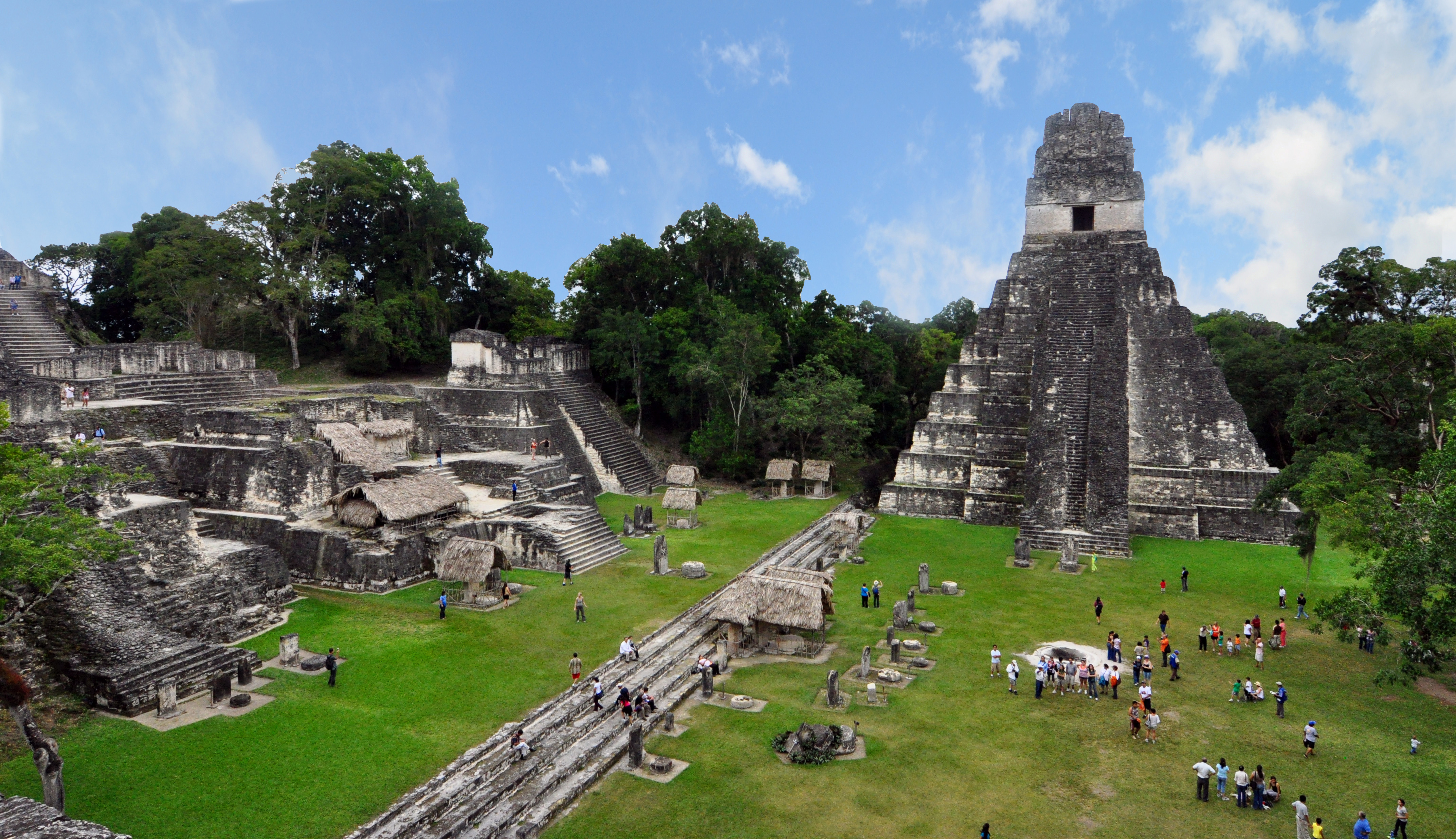
Maya Archaeology and Its Relevance to the Modern World (Santa Fe Institute)

http://upload.wikimedia.org/wikipedia/commons/e/e7/Tikal_mayan_ruins_2009.jpg

Here are two interesting lectures from Santa Fe Institute President Jeremy Sabloff on the topic of archeology and its importance to how we understand our world and how it might help us shape our future.

How Insights from Archaeology Might Help Shape Our Future

Published on Sep 28, 2014


Jeremy Sabloff, President, Santa Fe Institute
September 9, 2014

Stanislaw Ulam Lecture Series: Seeing the Future in Our Past: Why Archaeology Matters

Despite its popularity, archaeology’s public perception is not as accurate as it could be. Archaeologists do not have their collective heads immersed in the past, as is often supposed, but are very much concerned with both the present and future, too. SFI President Jerry Sabloff explores how, even in the face of overwhelming data recovery and interpretive hurdles, archaeologists have developed a host of approaches that can provide new perspectives on modern problems and concerns.

* * * * *

Maya Archaeology and Its Relevance to the Modern World

Published on Sept 28, 2014


Jeremy Sabloff, President, Santa Fe Institute
September 10, 2014

Stanislaw Ulam Lecture Series: Seeing the Future in Our Past: Why Archaeology Matters

While the great architectural, artistic, and intellectual achievements of Pre-Columbian Maya peoples continue to bedazzle us for their richness, an understanding of the arc of ancient Maya civilization has relevance to problems facing the world today. SFI President Jerry Sabloff focuses on lessons about sustainability and societal resilience gleaned from new evidence relating to the decline of many major cities in the southern Maya Lowlands in the ninth century CE. He also explores heritage education and tourism in today’s Maya world, among other topics.

Wednesday, May 21, 2014

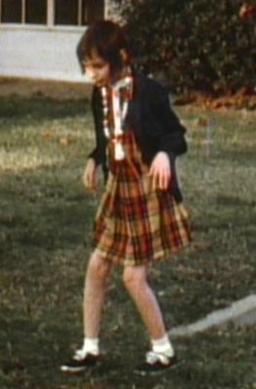
Genie: Secret of the Wild Child


This is an old (1997) NOVA documentary from PBS on one of the classic cases of a feral child. "Genie" was isolated and neglected in every possible way (other than barely enough food and water to keep her alive), and when discovered she was unable to speak and presented more as a wild animal than a 13-year-old girl.

Her case, and a handful of others, revealed that there is an age "cap" of socialization and language, after which it is nearly impossible to alter the brain and behavior. It also demonstrates how important the attachment system is in allowing infants to become human beings - in many ways, Genie was never fully human. 

File:Genie (feral child).jpg

Her case highlights the degree to which extreme neglect can destroy a human being. I have seen this film several times over the years, and it tears my heart each time I see it.

Genie: Secret of the Wild Child

NOVA Documentary | 1997 | Transcript


This is an Emmy Award-winning documentary about a girl who spent her early life chained in a bedroom. Brought up in confinement, "Genie" was primitive, brutish, and hardly capable of walking or talking. NOVA follows the contentious attempts to unbolt the secret of the wild child who has reached near maturity in an agonizing seclusion with almost no human contact.

The story begins in Los Angeles on November 4, 1970, when authorities have taken under protection a thirteen-year-old girl that was kept in such solitude imposed by her parents that she never even learned to talk. The parents have been accused of child abuse.

Genie was imprisoned in a bedroom and bound to a potty chair for the most of her early life. Fully kept under control, she was made to sit alone every day and night. She had almost nothing to look at and no one to talk to for more than a decade. The girl allegedly was emitting immature noises and was still in diapers when social workers found out about the case, but the officials were anticipating she may still possess a normal ability to learn.

The girl who gave an impression of an infant would be well known as "Genie." She was transported to Children's Hospital in Los Angeles where she instantly gained the affection of doctors and scientists. She was delicate, lovely and poignant... and Genie was about to put on trial an idea paramount to science and society: that caring, encouraging and affectionate environment could make up for even the most brutal past.

Genie had an awkward walk and other almost non-human features. She continuously spat, sniffed, and clawed. She hardly articulated anything or produced any noises. Investigation showed that she was abused for making noise and as a consequence, had learned, basically, not to vocalize. And she really didn't speak at all. She was mute most of the time.
Watch the full documentary now

Tuesday, May 06, 2014

E.O. Wilson On Humanity, Survival, and Nature - His New Book about Gorongosa National Park in Mozambique


From NPR's On Point with Tom Ashbrook, two-time Pulitzer Prize winning biologist and proponent of sociobiology, E.O. Wilson was this week's guest on the show. Wilson discusses his new book, A Window On Eternity: A Biologist’s Walk Through Gorongosa National Park. The images available of Gorongosa National Park in Mozambique that are available in Google Images are stunning - this is certainly one of the most beautiful places on Earth.


This is the publisher's ad copy for the book:
A Window on Eternity is a stunning book of splendid prose and gorgeous photography about one of the biologically richest places in Africa and perhaps in the world. Gorongosa National Park in Mozambique was nearly destroyed in a brutal civil war, then was reborn and is now evolving back to its original state. Edward O. Wilson’s personal, luminous description of the wonders of Gorongosa is beautifully complemented by Piotr Naskrecki’s extraordinary photographs of the park’s exquisite natural beauty. A bonus DVD of Academy Award–winning director Jessica Yu’s documentary, The Guide, is also included with the book. 
Wilson takes readers to the summit of Mount Gorongosa, sacred to the local people and the park’s vital watershed. From the forests of the mountain he brings us to the deep gorges on the edge of the Rift Valley, previously unexplored by biologists, to search for new species and assess their ancient origins. He describes amazing animal encounters from huge colonies of agricultural termites to spe­cialized raider ants that feed on them to giant spi­ders, a battle between an eagle and a black mamba, “conversations” with traumatized elephants that survived the slaughter of the park’s large animals, and more. He pleads for Gorongosa—and other wild places—to be allowed to exist and evolve in its time­less way uninterrupted into the future. 
As he examines the near destruction and rebirth of Gorongosa, Wilson analyzes the balance of nature, which, he observes, teeters on a razor’s edge. Loss of even a single species can have serious ramifications throughout an ecosystem, and yet we are carelessly destroying complex biodiverse ecosystems with unknown consequences. The wildlands in which these ecosystems flourish gave birth to humanity, and it is this natural world, still evolving, that may outlast us and become our leg­acy, our window on eternity.
Great conversation with an always entertaining and thoughtful man. There is also an excerpt from the book and links to a few articles/excerpts published in other magazines (The Atlantic, Christian Science Monitor, The Wall Street Journal).

E.O. Wilson On Humanity, Survival, and Nature

Famed biologist E.O. Wilson says the way to save mankind is for the Age of Man to come to a close with a new respect for the rest of life. He joins us.


May 5, 2014
With guest host Jessica Yellin.


A giant spider in Mozambique’s Gorongosa National Park. (Piotr Naskrecki)

Imagine wandering into a house overrun with fang-toothed spiders. Riding a helicopter deep into an unexplored gorge of granite and limestone to find new species. World-famous naturalist and biologist E.O. Wilson did all that — in his 80s. In one of Africa’s most biologically diverse nature preserves in Mozambique. And he says the wilfife there has powerful lessons for us humans. This hour, On Point, two-time Pulitzer Prize winning biologist E.O. Wilson on what he learned about mankind in Mozambique’s Gorongosa National Park.

Guests

E.O. Wilson, biologist, researcher and naturalist. Winner of the Pulitzer Prize. Author of many books, including the new A Window On Eternity: A Biologist’s Walk Through Gorongosa National Park.

From Tom’s Reading List

The Atlantic: E. O. Wilson’s Theory of Everything — “If one had to give E. O. Wilson a single label, evolutionary biologist would be as good as any. Sociobiologist, lifelong naturalist, prolific author, committed educator, and high-profile public intellectual might all also serve. But amidst his astonishing range and volume of intellectual output, Wilson’s reputation, and most of his big ideas, have been founded primarily on his study of ants, most famously his discoveries involving ant communication and the social organization of ant communities. ”

Christian Science Monitor: A Window on Eternity — “Wilson tells the story of Gorongosa National Park in Mozambique, which boasts one of the densest wildlife populations in Africa. During a civil war that lasted from 1978 to 1992, much of the park ecosystem was destroyed, and its future seemed bleak. Some animal populations within the park declined by 90 percent or more. But then a wealthy American entrepreneur, Gregory C. Carr, launched an audacious effort to bring the park back to life. Slowly, the park is returning to its original state.”

The Wall Street Journal: E.O. Wilson Tells It Like It Is — “Dr. Wilson has a boy’s enthusiasm, and he revels in discovering new species at Gorongosa. But as the power of science and technology grows exponentially, he worries that people are giving up on preserving nature. Many seem to have resigned themselves to the idea that ‘we’ve already overrun the world,’ he says.”

Read An Excerpt Of “A Window On Eternity” By E.O. Wilson

Wednesday, December 04, 2013

The Uniqueness of Humanity: Is Evolution Progress?


From The Institute of Art and Ideas (IAI) and their ongoing series of debates on compelling topics, evolutionary psychologist Nicholas Humphrey and evolutionary game theorist Ken Binmore square off with cultural critic Eva Aldea and philosopher of science Nick Maxwell on the uniqueness of humanity and the purpose of evolution - is it blind change, or is it, as the name implies, a progression (toward something)?

Good stuff.

The Uniqueness of Humanity: Is Evolution Progress?


Darwin's Origin of Species appears to ally evolution with advance, and as humans we place ourselves at the top of the tree. But is evolution progress or simply change for good or ill? Have we transcended our animal nature, or is this a dangerous illusion?

The Panel

Evolutionary psychologist Nicholas Humphrey and evolutionary game theorist Ken Binmore clash with cultural critic Eva Aldea and philosopher of science Nick Maxwell. David Malone hosts.

Saturday, August 24, 2013

The Wisdom of Tenderness: Jean Vanier on Lived Compassion, L'Arche, and Becoming Human

From NPR's On Being with Krista Tippett, this is a replay of an engaging and uplifiting conversation with Jean Vanier, a Canadian Catholic philosopher turned theologian, humanitarian, and the founder of L'Arche, an international federation of group homes for people with developmental disabilities and those who assist them.

Via Wikipedia:
In recognition of his contributions and humanness to the marginalized, Jean Vanier has received numerous distinctions and awards including the Companion of the Order of Canada, the Legion of Honour (France) and many awards from faith groups, among them the Paul VI International Prize, the Community of Christ International Peace Award, the Rabbi Gunther Plaut Humanitarian Award and the Gaudium et Spes Award. The asteroid 8604 was officially named Vanier in his honour in 2010.[6] He received the Pacem in Terris Peace and Freedom Award in 2013.[7]
Enjoy.

The Wisdom of Tenderness: Jean Vanier on Lived Compassion, L'Arche, and Becoming Human

August 22, 2013


Considered by some to be a living saint, Jean Vanier created L'Arche, a model of community for people with mental disabilities that celebrates power in smallness and light in the darkness of human existence. The French Canadian philosopher and Catholic social innovator speaks about his understanding of humanity and God that has been shaped by Aristotle, Mother Teresa, and people who would once have been locked away from society.

Listen
Recommended Reading

Heart of L'Arche: A Spirituality for Every Day (L'Arche Collection)
Author: Jean Vanier
Publisher: Crossroad Publishing Company (1995)
Binding: Paperback, 96 pages


Becoming Human
Author: Jean Vanier
Publisher: Paulist Pr (1999)

Becoming Human is one of Jean Vanier's most beloved books, providing insight into his theology, anthropology, and spirit. And, The Heart of L'Arche (out of print but available used) is his lovely, slim history and introduction to L'Arche.

Links and Resources


L'Arche Internationale
This multilingual site serves as a great introduction to the mission, vision, and scope of the the worldwide movement that Vanier founded and now has roots in 131 communities. 
L'Arche USA
The central Web site for the 16 L'Arche communities in the United States. Pay attention to the photo gallery and letters to the communities from Jean Vanier, which are particularly compelling. 
Faith and Light (Foi et Lumiere)
Vanier also co-founded this worldwide association of organizations working to encourage people with disabilities in their spiritual lives.

"Journey to L’Arche"
Dutch Catholic priest and prolific spiritual author Henri Nouwen spent his professional life teaching at Notre Dame, Yale, and Harvard. But in the last decade of his life he lived at L'Arche Daybreak, near Toronto, Canada. Here's a sermon he gave on "meeting God in a whole new way" through being a member of this community.


VIDEO INTERVIEWS WITH KRISTA TIPPETT 

In the Room with Jean Vanier

From a converted farmhouse at the Bishop Claggett Center in rural Maryland, a rare interview with Jean Vanier. Watch his conversation with Krista Tippett and observe how he speaks with his whole body, especially his hands.

Friday, March 29, 2013

Frans de Waal - The Brains of the Animal Kingdom


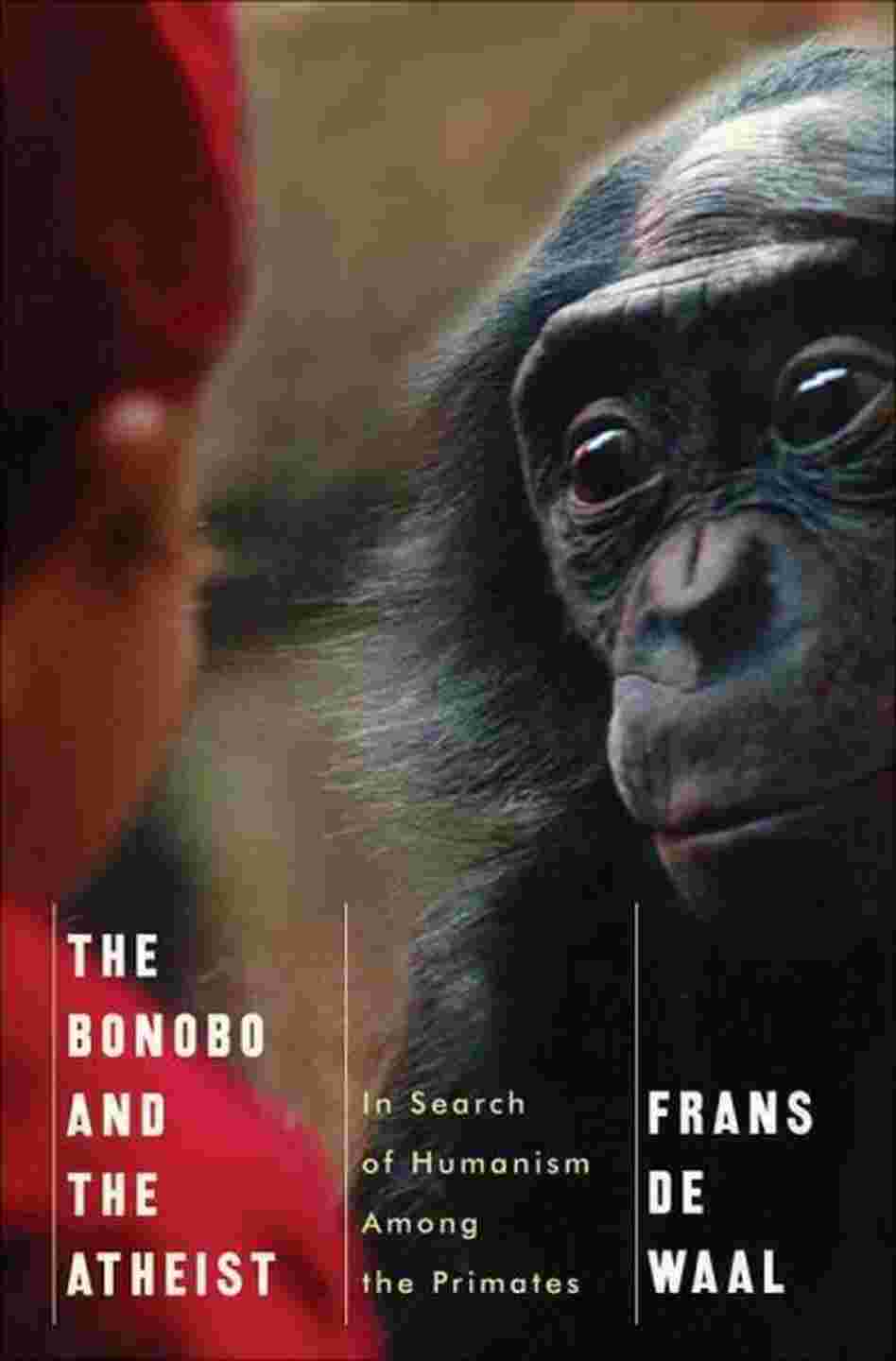
Esteemed primatologist Frans de Waal's latest book is The Bonobo and the Atheist: In Search of Humanism Among the Primates, published by Norton on Monday. In this new book, which clarifies and expands his ground-breaking research with bonobos, de Waal argues that morality is generated by God(s), nor is it the strict realm of religion. Rather, morality is something that comes from within our primate history, developed and refined through evolution.

Here is the publisher's synopsis of the book:
Book Description
Publication Date: March 25, 2013 | ISBN-10: 0393073777 | 12 Illustrations | Edition: 1st

In this lively and illuminating discussion of his landmark research, esteemed primatologist Frans de Waal argues that human morality is not imposed from above but instead comes from within. Moral behavior does not begin and end with religion but is in fact a product of evolution. For many years, de Waal has observed chimpanzees soothe distressed neighbors and bonobos share their food. Now he delivers fascinating fresh evidence for the seeds of ethical behavior in primate societies that further cements the case for the biological origins of human fairness. Interweaving vivid tales from the animal kingdom with thoughtful philosophical analysis, de Waal seeks a bottom-up explanation of morality that emphasizes our connection with animals. In doing so, de Waal explores for the first time the implications of his work for our understanding of modern religion. Whatever the role of religious moral imperatives, he sees it as a “Johnny-come-lately” role that emerged only as an addition to our natural instincts for cooperation and empathy.

But unlike the dogmatic neo-atheist of his book’s title, de Waal does not scorn religion per se. Instead, he draws on the long tradition of humanism exemplified by the painter Hieronymus Bosch and asks reflective readers to consider these issues from a positive perspective: What role, if any, does religion play for a well-functioning society today? And where can believers and nonbelievers alike find the inspiration to lead a good life?

Rich with cultural references and anecdotes of primate behavior, The Bonobo and the Atheist engagingly builds a unique argument grounded in evolutionary biology and moral philosophy. Ever a pioneering thinker, de Waal delivers a heartening and inclusive new perspective on human nature and our struggle to find purpose in our lives.
What follows below is an adapted excerpt from the book that was published in the weekend edition of the Wall Street Journal last Saturday. The book has received a LOT of good reviews already, including Scientific American, Publisher's Weekly, and The New Prospect (although they ding him for being too gentle on religion).

The Brains of the Animal Kingdom

By FRANS DE WAAL

THE SATURDAY ESSAY
March 22, 2013

New research shows that we have grossly underestimated both the scope and the scale of animal intelligence. Primatologist Frans de Waal on memory-champ chimps, tool-using elephants and rats capable of empathy.

Associated Press


A herd of African elephants drink water at a dam inside the Addo Elephant National Park near Port Elizabeth, South Africa.

Who is smarter: a person or an ape? Well, it depends on the task. Consider Ayumu, a young male chimpanzee at Kyoto University who, in a 2007 study, put human memory to shame. Trained on a touch screen, Ayumu could recall a random series of nine numbers, from 1 to 9, and tap them in the right order, even though the numbers had been displayed for just a fraction of a second and then replaced with white squares.

I tried the task myself and could not keep track of more than five numbers—and I was given much more time than the brainy ape. In the study, Ayumu outperformed a group of university students by a wide margin. The next year, he took on the British memory champion Ben Pridmore and emerged the "chimpion."

How do you give a chimp—or an elephant or an octopus or a horse—an IQ test? It may sound like the setup to a joke, but it is actually one of the thorniest questions facing science today. Over the past decade, researchers on animal cognition have come up with some ingenious solutions to the testing problem. Their findings have started to upend a view of humankind's unique place in the universe that dates back at least to ancient Greece.

Aristotle's idea of the scala naturae, the ladder of nature, put all life-forms in rank order, from low to high, with humans closest to the angels. During the Enlightenment, the French philosopher René Descartes, a founder of modern science, declared that animals were soulless automatons. In the 20th century, the American psychologist B.F. Skinner and his followers took up the same theme, painting animals as little more than stimulus-response machines. Animals might be capable of learning, they argued, but surely not of thinking and feeling. The term"animal cognition" remained an oxymoron.

A growing body of evidence shows, however, that we have grossly underestimated both the scope and the scale of animal intelligence. Can an octopus use tools? Do chimpanzees have a sense of fairness? Can birds guess what others know? Do rats feel empathy for their friends? Just a few decades ago we would have answered "no" to all such questions. Now we're not so sure.

Experiments with animals have long been handicapped by our anthropocentric attitude: We often test them in ways that work fine with humans but not so well with other species. Scientists are now finally meeting animals on their own terms instead of treating them like furry (or feathery) humans, and this shift is fundamentally reshaping our understanding.

Elephants are a perfect example. For years, scientists believed them incapable of using tools. At most, an elephant might pick up a stick to scratch its itchy behind. In earlier studies, the pachyderms were offered a long stick while food was placed outside their reach to see if they would use the stick to retrieve it. This setup worked well with primates, but elephants left the stick alone. From this, researchers concluded that the elephants didn't understand the problem. It occurred to no one that perhaps we, the investigators, didn't understand the elephants.

Think about the test from the animal's perspective. Unlike the primate hand, the elephant's grasping organ is also its nose. Elephants use their trunks not only to reach food but also to sniff and touch it. With their unparalleled sense of smell, the animals know exactly what they are going for. Vision is secondary.

But as soon as an elephant picks up a stick, its nasal passages are blocked. Even when the stick is close to the food, it impedes feeling and smelling. It is like sending a blindfolded child on an Easter egg hunt.

What sort of experiment, then, would do justice to the animal's special anatomy and abilities?

On a recent visit to the National Zoo in Washington, I met with Preston Foerder and Diana Reiss of Hunter College, who showed me what Kandula, a young elephant bull, can do if the problem is presented differently. The scientists hung fruit high up above the enclosure, just out of Kandula's reach. The elephant was given several sticks and a sturdy square box.

Kandula ignored the sticks but, after a while, began kicking the box with his foot. He kicked it many times in a straight line until it was right underneath the branch. He then stood on the box with his front legs, which enabled him to reach the food with his trunk. An elephant, it turns out, can use tools—if they are the right ones.

While Kandula munched his reward, the investigators explained how they had varied the setup, making life more difficult for the elephant. They had put the box in a different section of the yard, out of view, so that when Kandula looked up at the tempting food he would need to recall the solution and walk away from his goal to fetch the tool. Apart from a few large-brained species, such as humans, apes and dolphins, not many animals will do this, but Kandula did it without hesitation, fetching the box from great distances.

Another failed experiment with elephants involved the mirror test—a classic evaluation of whether an animal recognizes its own reflection. In the early going, scientists placed a mirror on the ground outside the elephant's cage, but the mirror was (unsurprisingly) much smaller than the largest of land animals. All that the elephant could possibly see was four legs behind two layers of bars (since the mirror doubled them). When the animal received a mark on its body visible only with the assistance of the mirror, it failed to notice or touch the mark. The verdict was that the species lacked self-awareness.

But Joshua Plotnik of the Think Elephant International Foundation modified the test. He gave the elephants access to an 8-by-8-foot mirror and allowed them to feel it, smell it and look behind it. With this larger mirror, they fared much better. One Asian elephant recognized herself. Standing in front of the mirror, she repeatedly rubbed a white cross on her forehead, an action that she could only have performed by connecting her reflected image with her own body.

A similar experimental problem was behind the mistaken belief, prevalent until two decades ago, that our species has a unique system of facial recognition, since we are so much better at identifying faces than any other primate. Other primates had been tested, but they had been tested on human faces—based on the assumption that ours are the easiest to tell apart.

When Lisa Parr, one of my co-workers at Emory University, tested chimpanzees on portraits of their own species, they excelled at it. Selecting portraits on a computer screen, they could even tell which juveniles were born to which females. Having been trained to detect similarities among images, the apes were shown a female's portrait and then given a choice between two other faces, one of which showed her offspring. They preferred the latter based purely on family resemblance since they did not know any of the depicted apes.

We also may need to rethink the physiology of intelligence. Take the octopus. In captivity, these animals recognize their caretakers and learn to open pill bottles protected by childproof caps—a task with which many humans struggle. Their brains are indeed the largest among invertebrates, but the explanation for their extraordinary skills may lie elsewhere. It seems that these animals think, literally, outside the box of the brain.

Octopuses have hundreds of suckers, each one equipped with its own ganglion with thousands of neurons. These "mini-brains" are interconnected, making for a widely distributed nervous system. That is why a severed octopus arm may crawl on its own and even pick up food.

Similarly, when an octopus changes skin color in self-defense, such as by mimicking a poisonous sea snake, the decision may come not from central command but from the skin itself. A 2010 study found gene sequences in the skin of cuttlefish similar to those in the eye's retina. Could it be: an organism with a seeing skin and eight thinking arms?

A note of caution, however: At times we also have overestimated the capacities of animals. About a century ago, a German horse named "Kluger Hans" (Clever Hans) was thought to be capable of addition and subtraction. His owner would ask him the product of multiplying four by three, and Hans would happily tap his hoof 12 times. People were flabbergasted, and Hans became an international sensation.

That is, until Oskar Pfungst, a psychologist, investigated the horse's abilities. Pfungst found that Hans was only successful if his owner knew the answer to the question and was visible to the horse. Apparently, the owner subtly shifted his position or straightened his back when Hans reached the correct number of taps. (The owner did so unknowingly, so there was no fraud involved.)

Some look at this historic revelation as a downgrading of Hans's intelligence, but I would argue that the horse was in fact very smart. His abilities at arithmetic may have been flawed, but his understanding of human body language was remarkable. And isn't that the skill a horse needs most?

Awareness of the "Clever Hans Effect," as it is now known, has greatly improved animal experimentation. Unfortunately, it is often ignored in comparable research with humans. Whereas every dog lab now tests the cognition of its animals while their human owners are blindfolded or asked to face away, young children are still presented with cognitive tasks while sitting on their mothers' laps. The assumption is that mothers are like furniture, but every mother wants her child to succeed, and nothing guarantees that her sighs, head turns and subtle changes in position don't serve as cues for the child.

This is especially relevant when we try to establish how smart apes are relative to children. To see how their cognitive skills compare, scientists present both species with identical problems, treating them exactly the same. At least this is the idea. But the children are held by their parents and talked to ("Watch this!" "Where is the bunny?"), and they are dealing with members of their own kind. The apes, by contrast, sit behind bars, don't benefit from language or a nearby parent who knows the answers, and are facing members of a different species. The odds are massively stacked against the apes, but if they fail to perform like the children, the invariable conclusion is that they lack the mental capacities under investigation.

A recent study, tracking the pupil movements of chimpanzees, found that they followed the gaze of members of their own species far better than that of humans. This simple finding has huge implications for tests in which chimpanzees need to pay attention to human experimenters. The species barrier they face may fully explain the difference in performance compared with children.

Underlying many of our mistaken beliefs about animal intelligence is the problem of negative evidence. If I walk through a forest in Georgia, where I live, and fail to see or hear the pileated woodpecker, am I permitted to conclude that the bird is absent? Of course not. We know how easily these splendid woodpeckers hop around tree trunks to stay out of sight. All I can say is that I lack evidence.

It is quite puzzling, therefore, why the field of animal cognition has such a long history of claims about the absence of capacities based on just a few strolls through the forest. Such conclusions contradict the famous dictum of experimental psychology according to which "absence of evidence is not evidence of absence."

Take the question of whether we are the only species to care about the well-being of others. It is well known that apes in the wild offer spontaneous assistance to each other, defending against leopards, say, or consoling distressed companions with tender embraces. But for decades, these observations were ignored, and more attention was paid to experiments according to which the apes were entirely selfish. They had been tested with an apparatus to see if one chimpanzee was willing to push food toward another. But perhaps the apes failed to understand the apparatus. When we instead used a simple choice between tokens they could exchange for food—one kind of token rewarded only the chooser, the other kind rewarded both apes—lo and behold, they preferred outcomes that rewarded both of them.

Such generosity, moreover, may not be restricted to apes. In a recent study, rats freed a trapped companion even when a container with chocolate had been put right next to it. Many rats first liberated the other, after which both rodents happily shared the treat.

The one historical constant in my field is that each time a claim of human uniqueness bites the dust, other claims quickly take its place. Meanwhile, science keeps chipping away at the wall that separates us from the other animals. We have moved from viewing animals as instinct-driven stimulus-response machines to seeing them as sophisticated decision makers.

Aristotle's ladder of nature is not just being flattened; it is being transformed into a bush with many branches. This is no insult to human superiority. It is long-overdue recognition that intelligent life is not something for us to seek in the outer reaches of space but is abundant right here on earth, under our noses. 
—Mr. de Waal is C.H. Candler Professor at Emory University and director of the Living Links Center at the Yerkes National Primate Research Center, both in Atlanta. His latest book, "The Bonobo and the Atheist: In Search of Humanism among the Primates," will be published by Norton on Monday.

~ A version of this article appeared March 23, 2013, on page C1 in the U.S. edition of The Wall Street Journal, with the headline: The Brains of Animal Kingdom.

Friday, March 08, 2013

God, the Universe, and Everything Else: Carl Sagan, Stephen Hawking, and Arthur C. Clarke Talk in Conversation


io9 posted this cool video of Carl Sagan, Stephen Hawking, and Arthur C. Clarke having a conversation about the Big Bang theory, the connection between science and science fiction, the rise of computer science, extraterrestrial intelligence, and the puzzle that is human existence (among other things).

Awesome.

Imagine Carl Sagan, Stephen Hawking and Arthur C. Clarke together in conversation. It happened.

George Dvorsky
March 6, 2013

Back in 1988, Magnus Magnusson (best name ever) somehow managed to bring three of the 20th Century's most fascinating personalities together to discuss God, the Universe, and Everything Else. In the hour-long program, the three talked about the Big Bang theory, the connection between science and scifi, the rise of computer science, extraterrestrial intelligence, and the puzzle that is human existence.

The remarkable program featured a spry 46 year-old Stephen Hawking who was already having to rely on his speech synthesizer — but his wit and deadpan humor was firmly established. Carl Sagan, who appeared via satellite, passed away only eight years later, with scifi author Arthur C. Clarke dying in 2008.

We were alerted to this video by Open Culture, who writes:
With minds like these, you can rest assured that the conversation won't stray far from what Sagan calls "the fundamental questions," nor will it come untethered from established human knowledge and float into the realms of wild speculation and wishful thinking. And of course, in such conversations, a sense of humor like Hawking's — a man who, not expected to reach age thirty, would nevertheless live to see more advancement in human knowledge than anyone else on the broadcast — never goes amiss.
Magnusson was the longtime host of BBC's Mastermind program. Props to him for putting this together back in the day.

Friday, May 11, 2012

Ugo Pagano - Love, War and Cultures: An Institutional Approach to Human Evolution


This paper looks at the roles of love, war, and culture in the evolution of human culture. According to Pagano, all three are inter-related. The paper deals with evolution from the collective perspective - culture and institutions.


Ugo Pagano


University of Siena - Department of Economics; Central European University (CEU)


Journal of Bioeconomics, Forthcoming

Abstract:     
Love, War and Culture have all played an important role in the evolution of human institutions and they have been characterized by complex relationships. War can select unselfish groups ready to sacrifice themselves for the love of their communities that they recognize to be culturally different from the others. At the same time, horizontal cultural differentiation cannot be taken for granted. Culture is the outcome of long evolutionary processes. It requires some human specific characteristics, including a large brain, that are likely to have been influenced by sexual selection and by the peculiar structure of human love affairs. Thus, if war may have generated love, also the reverse may be true: by favoring the development of human culture, love may have produced the conditions for war among culturally differentiated groups. In turn, war may have co-evolved with group solidarity only under the prevailing social arrangements of hunting and gathering economies. In general, human relations have been influenced by the prevailing features of the goods (private, public and positional) that have characterized production in different stages of history. They have been embedded in institutions involving very different levels of inequality, ranging from mostly egalitarian hunting and gathering societies to typically hierarchical agrarian societies and to wealth-differentiated industrial societies. The perspectives of the present-day knowledge-intensive economy can also be seen through the same institutional approach to human evolution. The different nature of contemporary production processes involves a new set of alternative possible arrangements that have different implications for social (in)equality and different capabilities to satisfy basic human needs.
 
Download This Paper

Suggested Citation:
Pagano, U. (April 10, 2012). Love, War and Cultures: An Institutional Approach to Human Evolution. Journal of Bioeconomics, Forthcoming. Available at SSRN: http://ssrn.com/abstract=2037706

Friday, March 02, 2012

The RSA - Humanity 2.0

FORA.tv presents this video from The RSA - a discussion on the place of humanity in a post-human world.


Humanity 2.0 from The RSA on FORA.tv

Humanity 2.0

Join Steve Fuller, Rachel Armstrong, China Mieville and Andy Miah as they ask: how will we ascribe status to human life in a ‘post-human’ world?

Our high-profile panel of speakers explore the hidden agendas behind our values and attitudes toward the place of ‘the human’ in today’s societies, and debate what must now be a key issue for the 21st century.

Rachel Armstrong

Dr Armstrong is an interdisciplinary researcher who has trained as a medical doctor and tutors fifth year MArch students in the modification of biological systems for their technical dissertations at The Bartlett School of Architecture, UCL.

She has also collaborated with international artists such as Helen Chadwick, Orlan and Stelarc who engaged with the technologies of extreme body modification and the impact of extreme environments on biological systems in projects that exemplified her broader interest in the way in which the environment can directly shape organisms through biotechnological interventions.

Her work currently focuses on the development of Metabolic Materials for Living Buildings where she works in collaboration with international architects and scientists.

Steve Fuller

Steve Fuller holds the Auguste Comte Chair in Social Epistemology in the Department of Sociology at the University of Warwick, UK.

He is acknowledged with founding social epistemology and has published over 17 books including Kuhn vs Popper and The Intellectual. His latest book is Humanity 2.0: What it Means to be Human Past, Present and Future (Palgrave Macmillan, 2011).

Andy Miah

Andy Miah, BA, MPhil, PhD, is Chair of Ethics and Emerging Technologies in the Faculty of Business & Creative Industries at the University of the West of Scotland, Fellow of the Institute for Ethics and Emerging Technologies, USA and Fellow at FACT, the Foundation for Art and Creative Technology, UK.

He is author of "Genetically Modified Athletes" (2004 Routledge) and co-author with Dr Emma Rich of "˜The Medicalization of Cyberspace" (2008, Routledge) and Editor of "Human Futures: Art in an Age of Uncertainty" (2008, Liverpool University Press and FACT). Professor Miah's research discusses the intersections of art, ethics, technology and culture and he has published broadly in areas of emerging technologies, particularly related to human enhancement and the philosophical and ethical issues concerning technology in society.

China Mieville

China Miéville is the author of several works of fiction and non-fiction. 

His novels, which have won the Arthur C Clarke, Hugo, World Fantasy, British Science Fiction and British Fantasy Awards, include Embassytown, The City & the City, and Perdido Street Station.  His non-fiction includes Between Equal Rights, a study of international law. He teaches Creative Writing at Warwick University.

Wednesday, February 29, 2012

What makes us human? An Economist, Philosopher, Evolutionary Biologist, and Two Psychologists Offer Answers in Recent Books


From the Times Higher Education blog (UK), Matthew Reisz reviews five new books that try to answer the question of What Makes Us Human?
Those are some seriously heavyweight authors for a brief article of this type.

Here is the meat of the article, called Hearts and Minds:
In all of these books, one can point to moments of stridency and showmanship, even a pleasure in polemic, which occasionally leads the authors to try to convince us that black is white. Yet all are dazzling displays of impassioned scholarship. All combine first-hand research evidence with jokes, personal anecdotes and references to popular culture in a way that manages to be entertaining as well as informative. Kahneman has described Thinking, Fast and Slow as the first of his books aimed at a mass audience, and all five publications demonstrate how well many leading academics can communicate with a broad readership when neither constrained by the research assessment exercise nor unduly plagued by self-doubt. Read one of them and it is almost impossible not to be carried away by a sense that one has now grasped some fundamental truths. The only problem is that they can't all be right.

Both Kahneman and Trivers believe we are in some fundamental sense divided against ourselves. The former notes, for example, that the "heuristics that guide citizens' beliefs and attitudes are inevitably biased" and can only be overcome by tremendous effort. Yet he seems fairly relaxed and forgiving about these flaws: "Considering how little we know, the confidence we have in our beliefs is preposterous - and it is also essential." Furthermore, his is a strikingly chaste book, which probably devotes more space to our choice of insurance policies than our choice of sexual partners.

Trivers has a much more tormented view of the world, offers woeful tales of his women troubles and seems wryly pessimistic about the chances of self-improvement: "As individuals, we can choose whether to fight our own self-deceptions or to indulge them. I choose to oppose my own - with very limited success so far." Furthermore, since he is keen to relate everything to the core evolutionary issues of survival and reproduction, he keeps returning to the battle of the sexes. He suspects that the genes we have inherited from our mothers and those that come from our fathers are at war with each other - an idea that he confesses first occurred to him "when I was trying to poison the minds of my three daughters against their mother's people". Such elaborate arguments about genes slugging it out within us are precisely the sort of thing that Prinz is determined to discredit.

Trivers' book is a million miles away from the can-do spirit of Baumeister and Tierney's, which argues that "willpower, like a muscle, becomes fatigued from overuse but can also be strengthened over the long term through exercise" (even a shot of glucose can usually help). And if they believe that individuals can dramatically improve the quality of their lives, Pinker thinks that the human race has already done so. Although evolution has implanted in us the "demons" of revenge, sadism and evil as well as the "angels" of reason, self-control and empathy, the angels have been firmly in the ascendant since the end of the Second World War, and particularly since the collapse of the Soviet Union - and he has the statistics to prove it.

It is perhaps inevitable that a big book on human nature also ends up as a kind of self-portrait, and it is not difficult to discern major differences between the authors' temperaments, values and politics.
Baumeister is a conservative in outlook, who hopes to "combine the best of modern social science with some of the practical wisdom of the Victorians". The secret of child-rearing is apparently: "Forget about self-esteem. Work on self-control."

Trivers is a born member of the awkward squad who feels that a book on deceit is as good a place as any to lash out at Nazis, Israelis and US foreign policy. With the Soviet Union no longer around to "provide a counterweight to rapacious capitalism", the post-Cold War era has "seen intense American wars, an accelerated shift of wealth to the already wealthy...and gross thievery by the wealthy and their agents leading to near economic collapse". Pinker, meanwhile, sees the same period, with its decline in violence, as one of unprecedented good fortune.

Several of these authors offer theories about why serious scholars often disagree so fundamentally (or, more cynically, why their opponents keep getting things wrong).

Kahneman suggests that "a weakness of the scholarly mind" is "theory-induced blindness: once you have accepted a theory and used it as a tool in your thinking, it is extraordinarily difficult to notice its flaws". Successful scientists require "the ability to exaggerate the importance of what he or she is doing", which can blind them to alternative perspectives. Disciplinary divisions impose further blinkers, so that economists and psychologists often seem "to be studying different species".

Trivers is far more outspoken. As he has got older, he explains, he has begun to "care less about appearing the fool, so I am willing to live with a higher ratio of foolish thought to true insight in my statements". He seems equally unconcerned about who he might offend, dismissing whole disciplines in a couple of sentences.

Pinker also thinks he knows why many people find it hard to believe his positive narrative. In much of the world, he points out, "customs such as slavery, serfdom, breaking on the wheel, disembowelling, bearbaiting, cat-burning, heretic-burning, witch-drowning, thief-hanging, public executions, the display of rotting corpses on gibbets" and so on have "passed from unexceptionable to controversial to immoral to unthinkable to not-thought-about" during what he calls the post-Enlightenment "Humanitarian Revolution". The good news is that most of us are unlikely to be hanged, drawn and quartered. But it can be hard for people to believe that humans have made any progress when they watch atrocities every night on the television and the horrors of the past are largely forgotten.

The social sciences, Trivers tells us, would benefit from "an explicit, well-tested (biological) theory of self-interest" - which is why we find only "a few honest historians". Economics is not a true science, although it "acts like a science and quacks like one", since its vague notion of "utility" is not rooted in biology. Most psychology consists of "competing guesses about what [is] important in human development, none with any foundation".

But more interesting than this disciplinary one-upmanship is the general point that Trivers makes about human arguments. They "feel so effortless because by the time the arguing starts, the work has already been done. The argument may appear to burst forth spontaneously, with little or no preview, yet as it rolls along, two whole landscapes of information lie already organised, waiting only for the lightning of anger to reveal them."

Reading all these books gives one the exhilarating and disorienting sense of visiting five different intellectual landscapes. All are fascinating, although everyone will find some more familiar and congenial than others. But where do they give an accurate picture of the world and where are they distorted by disciplinary tunnel vision or by their authors' prejudices?

Perhaps someone will eventually produce an even bigger book, offering an aerial view of all the separate mountain plains. Until then, we might as well enjoy the scenery.
 Read the whole article.