Showing posts with label dystopia. Show all posts

Wednesday, September 17, 2014

Terry Gilliam Talks About The Message Of Zero Theorem: "Wake Up!"

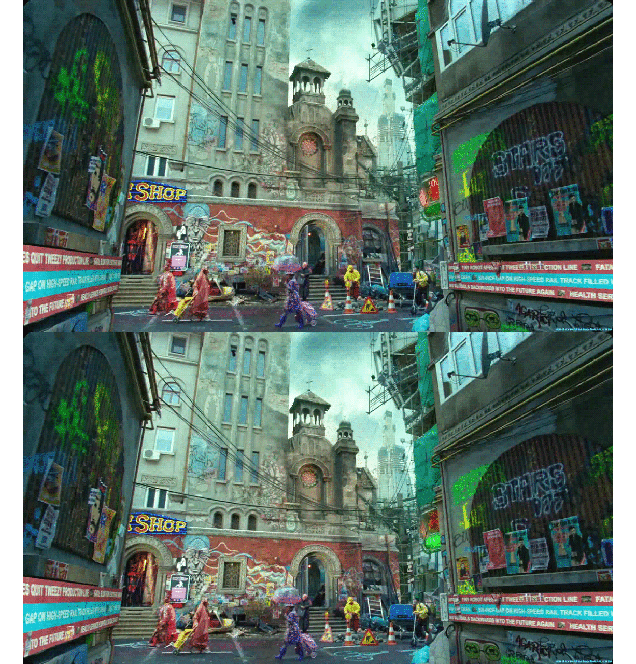
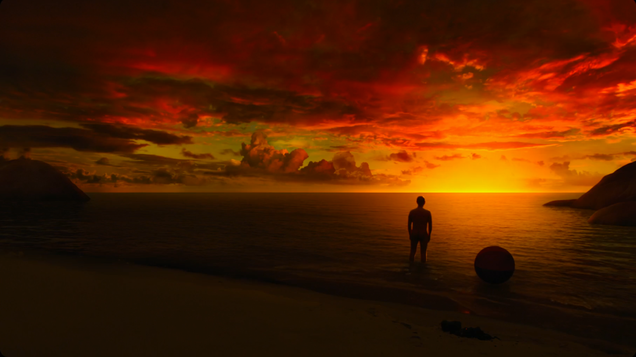
I always look forward to a new Terry Gilliam film, and this new one sounds very cool. The Zero Theorem will be in U.S. theaters this Friday.

In this interview posted at Space io9,  Gilliam talks about the new film, films that shaped him, and what he things about 12 Monkeys becoming a television series, among other topics.

Terry Gilliam Talks About The Message Of Zero Theorem: "Wake Up!"


Mika McKinnon

We caught up with Terry Gilliam recently to talk about his new film, Zero Theorem, a one size fits all, full gate, semi-vinyl motion picture on searching for the meaning in the face of impotence. He also told us which films left shrapnel in his soul, and why you should be fucking honest and cut the end off your story.


I was braced to forcefully interject questions in a mob of loud, rude journalists, but instead we were so dazed in our pre-coffee state that Gilliam teased that our gathering was a pajama party without the pajamas, all of us sleepy, quiet, and far too polite. He waded into the scrum of journalists with good humour, poking fun at himself, the world around him, and all of us huddled indoors so early on a Saturday morning while everyone else was outside gawking at Dragon Con's costume parade. We in offered him rambling, unfocused questions that have been paraphrased for clarity in this transcription, while keeping his sharply clever responses intact verbatim.

What is Zero Theorem about?
I never define depression, clinical or otherwise. It's the basis of most life. It seems to be the modern world: we all are depressed.

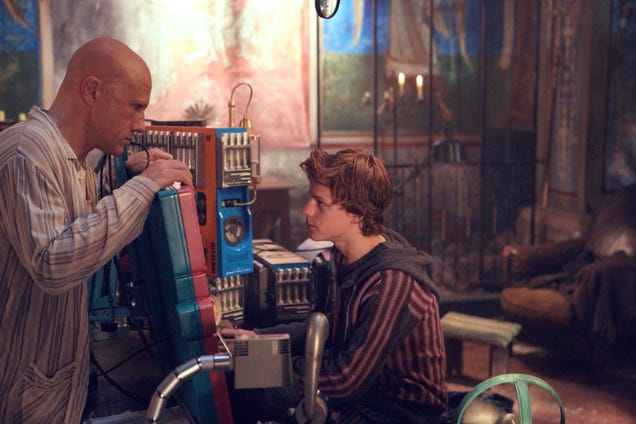
In a sense, [the movie is about] a guy who felt if only he had meaning for his life, it'd be okay. He's so busy waiting for someone to tell him rather than finding it himself or living it. I find the character [of Qohen] interesting because he's been so damaged by life in advance of the time we get to know him. To me, the real heart [of the movie] was him trying to reclaim his humanity, his ability to care, to love, and actually get outside of himself.

The world around it is my invention. That's just fun; it's a beautiful place.

The most important decision to me, and the most dooming thing, is when Bainsley says "Come away with me," and he can't do it! And yet, even after that the boy brings some paternal instinct out. He cares about him. And even that's taken away. Impotence is the heart of it.

Those of us who pay attention to the world [we live in], who read the news, feel we can do something about it. Then you realize how impotent you are to change things. And that's the sad thing. I talk about all these other things, but that's the heart of [the movie]. I created the world around him, but that's not really the movie, that's the stuff around it.

Some people get it immediately: some people identify or feel something for Qohen, understand where he is. Other people are just confused by it. [When looking at ratings for the film], fives are great and zeros are great, the middle is very vague and I like that because I know [they're] experiencing something. That's all I've tried to do — leave bits of shrapnel in them like I've had bits of shrapnel left in me from other films. We entertain as best we can, but we also try to reach people.
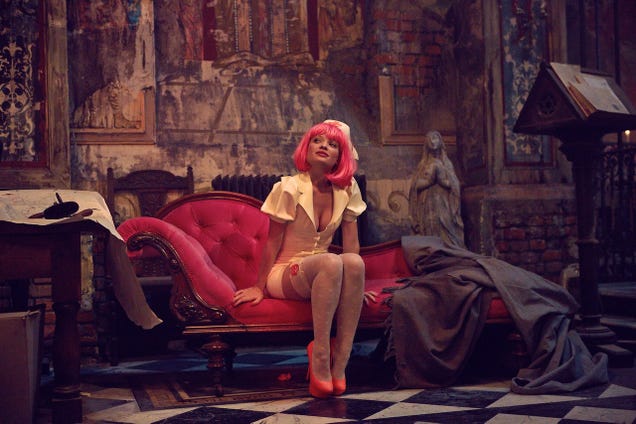

What is it about the meeting of reality and fantasy that fascinates you, and how does it play out in Zero Theorem?

Reality and fantasy — we need both of those to survive. If we don't have fantasy and dreams and all of those things, what's the point of carrying on? You need to watch out for reality because a buses come when you cross the street; be careful!

All those things are necessary, and I find so often they're split into two different categories. "Oh, we're doing a fantasy film. Oh, we're doing a realistic film." I try to mix the two because I find the battle or the bounds between the two aspects is what makes life interesting.

I never thought necessarily that I do fantasy because I always thought I'm actually dealing l with reality, it just happens to be through the eyes of a cartoonist. I'm a cartoonist; that's what I am at heart. In cartoons, you take reality and deform it, you make it grotesque, you make it funny. You alter it, but it works because it's based upon reality. That's what I try to do.

Zero Theorem is really a kind of satirical version of the world we're living in. It's just a little aspect of the world that has to do with the connected world we live in, or those who chose not to be connected to that world.

[We were in] this beautiful Georgian house, all designed to be almost in the 18th century. It was quiet, it was peaceful. We'd been there for a few hours, and we opened the door and outside was light and noise! In Zero Theorem, it's the shock of the world if you allow yourself to disconnect, and to forget it's out there, how noisy it is, how busy it is, how invasive it is. I was playing with all those things and basically the fact that I've been intrigued for so long about trying to disconnect from the connected world.

Within the movie, why do people want to solve the Zero Theorem?

People do. It's why people want to understand the meaning of life, or in the case of Mancon, if you can prove that everything is nothing, that's really important information! That's what advertising feeds on. Advertising feeds on your incomplete life, your frustrations, your dreams are never fulfilled! The more incomplete you are, the more things we can get you to buy! It's just good business. I don't really know what Mancon's up to except, "Get a lot of information together, and then we can start controlling people."

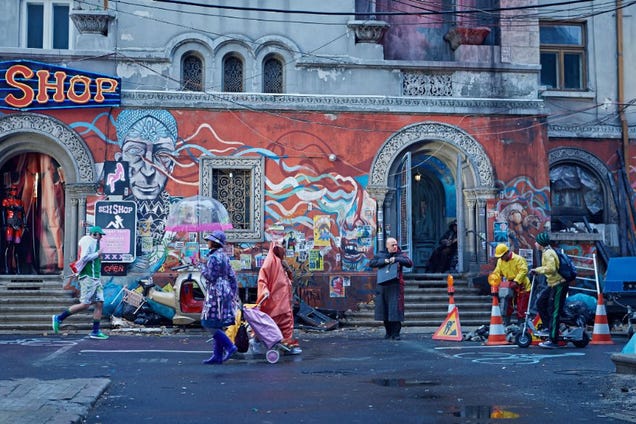
It's an interesting thing: when we first started showing the film, people would call it a dystopia. I don't think it's a dystopia. I think it's the world that's out there in colourful clothes having a good time shopping! Com'on, let's go! There's only one miserable guy in the whole thing, everyone else is having a fine time out there in a utopia!

They thought it was about big government again, about power of the state, is what Mancon was. No, it's not about governments anymore, it's about corporations! That's why it's "Corporations Sans Frontières." Who's really running the world, folks? Wake up! The government is just doing the show. You think that living in a democracy means that we have control. It's a corporate world we're living in, folks! Lack of control. I love my iPhone!


The format of the film is unusual in size and with rounded corners. Why?

That's why we call it a one size fits all, full gate, semi-vinyl motion picture. (Please write that down!)

In my perverseness, we shot it [so] the proportions are 16:9, not 1.85:1, or 2.39:1. It's what you see on your television screen now, and so it's "one size fits all." I thought since people are going to watch it anyway on their phones and their iPads and all, I want them to see exactly the same thing as you see in the cinema. So that's it. No cropping when you get to the tv format or anything.

"Full gate" is because it is. What you see is the full gate in the camera, and it has the little rounded edges because that's what is! Within most films — all films — there's a safety area inside which how normally you see the whole film. We went for the whole thing, so you see the full gate. If there were hairs in the gate, you would see them. There are hairs in the gate, and a little funny scratch down one side! The last time people had seen that was in silent movies, because subsequently we don't show that. So, I thought that was more fun as well.

It's "vinyl" because [the movie is] analogue and shot on film. However, there were 216 digital effects shots, so I couldn't lie and say it was "full" vinyl. So, it's semi-vinyl.

It was interesting — the rounded corners [caused] huge problems because the producers and even some of the quality-control guys for the distributers were saying, "No, we won't accept this. This is wrong! It's rounded corners!" What happens in 16:9 is little black strips down the sides because we don't go full width. But how many times have you gone to the cinema and seen the side curtains pulled, and half the film on the side curtains? It doesn't matter!

But there were all these people who were frightened by this new idea, and were resisting it! So I had to write a letter saying, "This is my creative choice. It was a creative decision, and blah blah blah." [Now the film is released], no one has ever complained, but you had to go through this gauntlet of people who are hired to make sure that no one complains!

Which films have left bits of shrapnel in you?

I remember as a kid, Thief of Bagdad, the great Korda and Powell film, the scene where the kid is in the big spiderweb and the spider is coming out... That I used to wake up in the middle of the night trapped in that spiderweb, all my bedclothes wrapped around me, strangling me. That's a kind of shrapnel.

The one that sort of woke me up to the power of movie-making and ideas is Paths of Glory. I'd never seen such injustice on the big film. It was the first time I was aware of the camera, the tracking shots shooting the trenches. It woke me up.

That's the kind of thing I'm talking about: things that stick with me, and inform the way I see the world.

There was a lawyer who saw Brazil. He didn't know what happened. He went back to his office, and locked himself in for three days. There is this publicist from Universal. She said when she saw the film, she went back home, and was taking a shower, and just started weeping and couldn't stop. Dave Crosby, of Crosby, Stills, and Nash, he had been in an accident the year before, and his wife died. He couldn't come to terms with it. He saw The Fisher King, and like Robin [Williams], at the end there's a catharsis, and said he could live again. Now, that's interesting, when a film does that for someone. There's a woman who saw the film lived in New York, and afterwards, walked home 20 blocks, then realized she'd walked 20 blocks in the wrong direction.

That's what so many films have done for me, and that's what I am trying to do. When that works, you feel you pulled something off here that's worth it. Hopefully it's attitudes or ideas or views of the world that are different than the straight, mainstream road.

What have you watched recently that you really like?

Not much.


If Brazil, Twelve Monkeys, and Zero Theorem are a triptych of dystopia, are you finished exploring that type of world?

I'm not the one that said that!

I don't even think I'm dealing with dystopias. It's just versions of what I see the world is now. Brazil was about then; it just happens to be that now is even more like Brazil than the world was then! I do take full responsibility for the creation of Homeland Security.

[Zero Theorem] is really about now. Because the film takes place almost entirely inside this church, my only moment to deal with what I thought was now was out on the streets the few times we get out there. Just the overload of images and stuff is out there! It's my chance to nail advertisers. We turn Occupy Wall Street into Occupy Mall Street: Shoppers of the world unite! That's the side I get to be more satirical, then inside is this other story that's hopefully interesting.

How do you feel Twelve Monkeys will translate into a television series?

I no idea! I don't have a fucking clue! No one even contacted me. My producer never even contacted me to say we're going to do this. I never heard anything other than what I read in the press. But I do think Jeffrey — Brad Pitt's character — being a woman is such a major breakthrough that I think that's why it's going to work.

...I have no idea. What they've got is basically a time-travel movie. It won't have much to do with the film. But my ex-agent was quite impressed by the lack of decency or politeness on the part of those who are going to make money off it.

How do you interpret Chrétien de Troyes' Perceval myth, the basis of The Fisher King?

The chief thing with Perceval is that here is this young, bright guy. He actually gets to where he's supposed to go, but doesn't ask the right question. He then spends the rest of his life trying to get to where he already had got to. It's asking questions rather than accepting things. In Perceval's case, he's polite. That's his great sin: he's polite and doesn't ask the right question! Don't be polite!

Right now, we live in a world where everyone is terrified of offending. Fuck that! Offence is important, folks! I mean, if we'd have behaved like that, there wouldn't have been Monty Python. We went out of our way to offend and to shock people. It's not to offend in a cheap way. Don't do cheap racial jokes or ethnic jokes. Some are really funny, but just too many are just too easy. But a good one? Wow, that's good! It's like when we were in college, we did practical jokes. The joker had to put more effort in than what the jokee had to go through. It's about that, and trying to get people to think.

That's all I'm really saying. Some of that is shocking them, saying rude things. When my daughter says, "That's rude!" [I say,] "I am? Am I causing harm, or am I doing or saying something someone might react to and start thinking about things?" I think that's it. I'm don't know if that's exactly the way Chrétien de Troyes meant his Perceval, but that's my translation!

But I do think we're frightened of saying things: it might be the wrong thing and cause offence. Enough people aren't being honest. They're not speaking honestly. They're speaking with all sorts of self-censorship going on. Writers will be self-censoring before it even gets to studio executives, because they know a film won't get through that gauntlet. Because they want to get their films made, they censor it.

When I first read Richard [LaGravenese]'s script [for The Fisher King], I thought it was fantastic, except there were certain elements in there that I just didn't buy. They were stupid. I started talking to him, and he said well, he's under pressure from producers to do these things so it's more likely the film gets financed. And I said, "Rich, let me see your first script." We went basically from that because it was there, it was pure, it was honest.

To bring Perceval into the Zero Theorem, the ending of Zero Theorem was not in the script. There were three scenes that follow that moment. The ending that was in the script was a crap Hollywood ending. It just violated the world we created, but it was there because obviously the producers thought we'd get it funded more easily. Now, when I cut the film together, I just couldn't stand that. I just [went] chop, chop, chop off, and left it where it was. Pat Rushin, who wrote it, said, "Thank you for that."

Again, it's how you want to succeed, you want to achieve and get your work done, and you make these little compromises all the way. By the end, you've violated what you set out to do. It's a very hard balance, how to play this game and get films made because they're expensive. With most of the work, it's is self-censorship by the writer is where the problem begins. I wish... I don't know how to get around it, frankly, besides do what we did: film a happy ending, but cut it off.


The Zero Theorem will be in U.S. theaters this Friday.
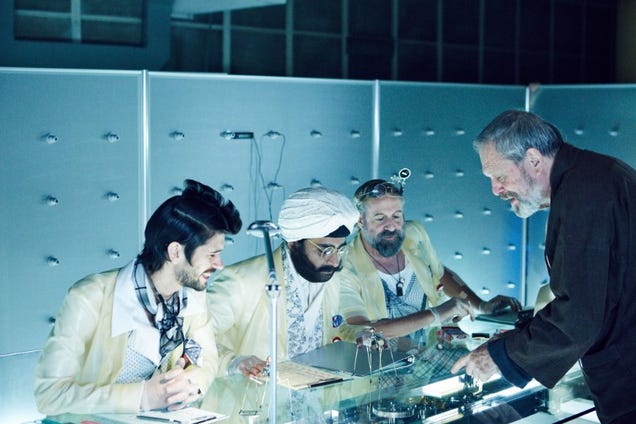
Saturday, January 11, 2014

Watch "The Trial" (1962), Orson Welles’ Worst or Best Film, Adapted From Kafka’s Classic Work


Via the internet's curators of cool, Open Culture, here is Orson Welles' film version of Franz Kafka's brilliant novel, The Trial.

Watch The Trial (1962), Orson Welles’ Worst or Best Film, Adapted From Kafka’s Classic Work

January 10th, 2014


Earlier this week, we featured the Internet Archive’s audio of conversations between Orson Welles and Peter Bogdanovich. According to the Archive’s description, Welles’ “defense of his controversial adaptation of Kafka’s The Trial is so fascinating that listeners might want to rush out and rent the film.” But hang on — you need neither rush out nor rent it, since Welles’ The Trial has fallen into the public domain, or rather, it never had a copyright filed in the first place. The full movie, a visually inventive tale of unspecified crime, extreme punishment, and the procedural vortex in between, appears above for you to watch and judge, as it were, for yourself. You’ll have to, since the picture has long divided critics, including some of Welles’ strongest adherents. Even Welles biographer Charles Higham considers it “a dead thing, like some tablet found among the dust of forgotten men.”


“Say what you like,” Welles himself would tell the BBC in the year of the film’s premiere, “but The Trial is the best film I have ever made.” When Bogdanovich went to interview Anthony Perkins (best known, surely, for Hitchcock’s Psycho), who stars as the beleaguered Josef K., the actor spoke of the pride he felt performing for Welles. Perkins also mentioned Welles’ stated intent to make his adaptation a black comedy, a tricky sensibility to pull off for filmmakers in any league. Just as Welles wanted to “set the record straight” by recording his interviews with Bogdanovich, so he must have wanted to do with the 1981 footage just above, in which he speaks about the process of filming The Trial to an audience at the University of Southern California. He’d meant to shoot a whole documentary on the subject, which ultimately wound up on his heap of unfinished projects. Still, we should feel lucky that we have The Trial itself (which, in its prolonged creation, even missed its own Venice Film Festival premiere) to watch, debate, and either convict or exonerate of its alleged cinematic crimes.

Related Content:

~ Colin Marshall hosts and produces Notebook on Cities and Culture and writes essays on cities, Asia, film, literature, and aesthetics. He’s at work on a book about Los Angeles, A Los Angeles Primer. Follow him on Twitter at @colinmarshall or on his brand new Facebook page.

Monday, April 01, 2013

Classic Film - Fritz Lang's Metropolis


Metropolis is one of the classic silent films, and one of the 100 Best Films of All Time on most of the lists you will find. Fritz Lang creates a dystopian future on a grand scale, and his vision is not too far from where we are now, aside from the forced separation.

Metropolis

(1927) 118 mins


Metropolis Synopsis

It is the future and humans are divided into two groups; the thinkers, who make plans, and the workers, who achieve goals. Completely separate, neither group is complete, but together they make a whole. One man from the "thinkers" dares to visit the underground where the workers toil; and is astonished by what he sees.

Starring: Brigitte Helm, Alfred Abel, Gustav Frohlich
Director: Fritz Lang
Producers: Giorgio Moroder, Erich Pommer
Writers: Thea von Harbou, Fritz Lang

Tuesday, February 19, 2013

The BBC Presents a New Dramatization of Orwell’s 1984, with Christopher Eccleston as Winston Smith


Via Open Culture, the curators of cool on the internets. As a bonus, I have included a 1954 film version of the book at the bottom (starring Peter Cushing and Yvonne Mitchell.)

The BBC Presents a New Dramatization of Orwell’s 1984, with Christopher Eccleston as Winston Smith

February 15th, 2013


Like the idea of totalitarianism, perhaps best articulated by Hannah Arendt in her post-war Origins of Totalitarianism, George Orwell’s post-war scrutiny of repressive governments has become a staple, catch-all reference for pundits on either side of the political spectrum, particularly the concepts of doublespeak, doublethink, historical revisionism, and the hyper-intrusive Big Brother, all from the 1949 novel 1984. In fact, few adjectives seem to get deployed with more frequency in urgent political discourse of all kinds than “Orwellian.” But the name George Orwell, pen name of journalist Eric Blair, hides an enigma: Orwell identified himself explicitly as a Democratic Socialist of a particularly English bent (most notably in his essay “The Lion and the Unicorn”), but his scathing critiques of nearly every existing institution sometimes make it hard to pin him down as a partisan of anything but the kind of freedom and openness that everyone vaguely wants to advocate. That ambiguity is a strength; despite his steadfast leftist roots, Orwell would not be a partisan hack—where he saw stupidity, avarice, and brutal inhumanity, he called it out, no matter the source.

The seeming contradictions and ironies that permeate Orwell’s thought and fiction are also what keep his work perennially interesting and worth rereading and revisiting. He was a probing and unsentimental critic of the motives of propagandists of all stripes, both left and right. Beginning in late January, BBC Radio 4 launched a month-long series on Orwell, with the avowedly ironic name, “The Real George Orwell.” Part of the irony comes from the fact that Orwell (or Blair) once worked as a propagandist for the BBC during WWII, and later based the torture area in 1984, Room 101, on a meeting room he recalled from his time there. His experiences with the state broadcasting network were not pleasant in his memory. Nonetheless, his former employer honors him this month with an extensive retrospective, including readings and dramatizations of his essays and journalism, his semi-autobiographical accounts Down and Out in Paris and London and Homage to Catalonia, and his novels Animal Farm and 1984.


In this latest dramatization of Orwell’s most famous novel, protagonist Winston Smith is voiced by actor Christopher Eccleston, who has inhabited another key post-war character in English fiction, Dr. Who (Pippa Nixonvoices Julia). In a brief discussion of what he takes away from the novel, Eccleston (above) draws out some of the reasons that 1984 appeals to so many people who might agree on almost nothing else. At the heart of the novel is the kind of humanist individualism that Orwell never abandoned and that he championed against Soviet-style state communism and hard-right imperialist authoritarianism both. Winston Smith is an embodiment of human dignity, celebrated for his struggle to “love, remember, and enjoy life,” as Eccleston says. “It’s the human story that means that we keep coming back to it and that keeps it relevant.” Listen to a brief clip of the1984 dramatization at the top of this post, and visit BBC Radio 4’s site to hear parts one and two of the full broadcast, which is available online for the next year. When Europe and America both seem rent in two by competing and incompatible social and political visions, it’s at least some comfort to know that no one wants to live in the world Orwell foresaw. Despite his novel’s deeply pessimistic ending, Orwell’s own career of fierce resistance to oppressive regimes offers a model for action against the dystopian future he imagined.

For other free, online readings of Orwell’s work, you can visit our archives of Free Audio Books, where you’ll find:
Related Content:
Also find major works by Orwell in our collection of Free eBooks

Josh Jones is a writer, editor, and musician based in Washington, DC. Follow him @jdmagness
By the way, you can watch an older version of 1984 online (a 1954 production of the novel):

Tuesday, March 20, 2012

Social Text - Special Issue on Speculation


Some interesting articles in this new issue of Social Text - all of the articles focused in some way on speculation. Here are links and abstracts for the articles.

Speculative Life: An Introduction

In our dystopian present, the term speculation is associated with an epistemology of greed, a sanctioned terrorism, and a new dimension of imperialism no longer based in production but in abstract futures. But speculation means something else for those who refuse to give its logic over to power and profit. >>
"What will you do when the apocalypse comes??" he asked me urgently. My first reaction was to laugh derisively. But a friend made me think twice. "Who knows, maybe he's right," she said. Then came the Tsunami that devastated South Asia in 2004. And the levees that breached during Hurricane Katrina in 2005. Who's to say what's real?>>
Science fictions never present the future, only "a significant distortion of the present," as Delany wrote in 1984. But they also distort the present of anyone reading at any time, even the text's own future. The contours of Dhalgren's disintegrating city belong to the wake of 1960s countercultures and social movements, to a sexual and racial moment whose history uninformed new generations of readers will learn as they read, even if they fail to recognize it. Sexual pleasure in Delany's work links the past and present and lets a different future feel possible, even when it takes place within structuring limitations. >>
Chinese-Canadian author Larissa Lai imaginatively interrogates the boundaries of the human, alchemizes myths of origin, and embraces the impurity of the cyborg while foregrounding the politics of racialization, animality, and sexuality. Lai builds on the rich tradition of women of color writing in sf/speculative fiction by splicing together cultural theory and current events with a panoply of intertexts. Traversing past, present, and future, Lai maps the permeability of the human through the vectors of animal, creator-goddess, cyborg, and transgenic procreation. Her distinctive métissage of Chinese legend, EuroAmerican culture, Orientalist archetypes, Western popular music, and science fiction disrupts cycles of institutionalized exploitation, corporatized amnesia, and multicultural assimilation.[1] Akin to the work of Octavia Butler, Karen Tei Yamashita, and Nalo Hopkinson, Lai's...>>
China Miéville is the recipient of multiple awards for his speculative/science/weird fiction novels, and the only author ever to win three Arthur C. Clarke Awards.  His most recent novel, Embassytown, came out in May 2011 and has received enthusiastic reviews. As well as writing fiction, Miéville earned his Ph.D. at London School of Economics in International Law and is the author of Between Equal Rights, A Marxist Theory of International Law (2006).      Known for his radical fictive speculation, China Miéville is also fiercely engaged with radical politics--he stood for the House of Commons as candidate for the Socialist Alliance in the 2001 UK general election--and so is often asked about the relationship between his politics and his writing. He...>>

Race for Life

The short film accompanying musician and designer M.I.A.'s (Maya Arulpragasam, who is British of Sri Lankan Tamil descent) song "Born Free" was released in April of 2010 and immediately banned from YouTube. Arulpragasam is no stranger to controversy, since she has drawn attention to the violence perpetrated against the Tamil minority in Sri Lanka, while her music and accompanying visual work is replete with references to different forms of political violence and identification with non-western persecuted populations.One of the few female artists in contemporary popular music that fuse explicit political content with cutting edge sounds, Arulpragasam has often been accused of toying with radical chic and being politically naïve, rather than associated with a long tradition of women of color...>>

So Say We All

Race is an illusion. So say we all! But what do we intend by this saying, this performative? Denise Ferreira da Silva is but the most recent of scholars to note that, in dispelling race from its improper place in the order of the human sciences, casting it into disrespectability along with sorcery, alchemy, and other bait for the credulous, we consolidate that much more firmly the protocols of scientific rationality. But the protocols of science gave us race as an invidious distinction in the first place. Reason giveth, and reason taketh away, seems to be the faith animating the claim "Race is an illusion." But what if were to suspend such faith in the subject of Enlightenment rationality? What...>>
When it comes to dealing with misfortune and injustice, the most effective tool to use if we want to make sure that troubles will persist without relief is a simple sentence: That's water under the bridge. No use crying over spilled milk. The past is over and done with. The goose is cooked. What's done is done.Whenever people have their attention called to injuries that occurred in the past, it is almost certain that someone will pipe up with a demand that everyone cut short the desire to improve the world and, instead, to defer to the water-under-the-bridge school of history.[1]There are is perhaps no better example of the water-under-the-bridge school of thought in the settler-colonial imagination, than Orson Scott...>>
The Natives should have died off by now. To still be alive is a miracle. Can you taste two billion year old air on your breath or the remnants of primordial seas in your sweat? Do you feel e-coli breaking bread in your bowels? Does your heart synch up with these words, these poetic echoes of ancient ancestors? Self and other, simultaneously...>>

Thursday, November 24, 2011

William S. Burroughs’ “The Thanksgiving Prayer,” Shot by Gus Van Sant

William Burroughs was not someone to pull his punches - he always said what he was thinking, especially in his novels and other writing.


William S. Burroughs’ “The Thanksgiving Prayer,” Shot by Gus Van Sant

November 24th, 2011

Thanksgiving Day, Nov. 28, 1986” first appeared in print in Tornado Alley, a chapbook published by William S. Burroughs in 1989. Two years later, Gus Van Sant (Good Will Hunting, My Own Private Idaho, Milk) shot a montage that brought the poem to film, making it at least the second time the director adapted the beat writer to film.

If you’ve seen Burroughs use Shakepseare’s face for target practice, or if you’ve watched The Junky’s Christmas, you’ll know that he wasn’t kind to convention or tradition. And there are no prisoners taken here, as you’ll see above. This clip will be added to our Cultural Icons collection. Now time for a little Thanksgiving dinner….

h/t BoingBoing

Related Content:
Gus Van Sant Adapts William S. Burroughs: An Early 16mm Short
William S. Burroughs Reads His First Novel, Junky