Showing posts with label Tibetan Buddhism. Show all posts

Tuesday, June 17, 2014

B. Alan Wallace - Settling The Mind In Its Natural State Series : All 8 Parts


From Upaya Zen Center, this is an 8-part series of podcasts featuring B Alan Wallace, one of the foremost scholars of Tibetan Buddhism. The series of talks is focused on the meditative practice of “settling the mind in its natural state,” which is foundational for both the Mahamudra and Dzogchen traditions of Tibetan Buddhism. These practices are centrally focused on realizing the nature of consciousness, occupying a middle space between shamatha (the cultivation of highly focused attention) and vipashyana (the cultivation of contemplative insight). "Settling the mind" consists essentially in focusing single-pointedly on the space of the mind and on whatever thoughts, images, and other mental events arise within that field of experience.

Enjoy!

Settling the Mind in its Natural State (Part 1)

Speaker: B. Alan Wallace
Recorded: Friday May 2, 2014

Play

Series Description: The meditative practice of “settling the mind in its natural state” is foundational for both the Mahamudra and Dzogchen traditions of Tibetan Buddhism, which are centrally focused on realizing the nature of consciousness. This practice lies right at the cusp between shamatha (the cultivation of highly focused attention) and vipashyana (the cultivation of contemplative insight). It consists essentially of focusing single-pointedly on the space of the mind and on whatever thoughts, images, and other mental events arise within that field of experience. The quality of mindfulness cultivated in this practice is focused, spacious, discerning, and non-reactive. Through such practice, the activities of the mind gradually subside so that the mind comes to settle in its “natural state,” which manifests three core qualities: bliss, luminosity, and nonconceptuality. We explore this practice with teachings and commentary from B. Alan Wallace, as well as experientially through guided meditations and daily group practice.

Episode Description: In this first session of the program, Alan introduces participants to the practice of “settling the body, speech, and mind in their natural states” through a guided meditation. He then discusses his views of what “practicing Dharma” and being “on a path” to liberation mean in terms of a long-term spiritual aspiration. He also touches briefly upon the idea of continuity of consciousness. Finally, Alan introduces and delves into the root text from which he will teach during the program: Taking Aspects of the Mind as the Path, from the Sharp Vajra of Conscious Awareness Tantra, by Dzogchen master Dudjom Lingpa (19th C).

B. Alan Wallace began his studies of Tibetan Buddhism, language, and culture in 1970 at the University of Göttingen in Germany and then continued his studies over the next fourteen years in India, Switzerland, and the United States. Ordained as a Buddhist monk by H. H. the Dalai Lama in 1975, he has taught Buddhist meditation and philosophy worldwide since 1976 and has served as interpreter for numerous Tibetan scholars and contemplatives, including the Dalai Lama. After graduating summa cum laude from Amherst College, where he studied physics and the philosophy of science, he returned his monastic vows and went on to earn his Ph.D. in religious studies at Stanford University. He then taught for four years in the Department of Religious Studies at the University of California at Santa Barbara, and is now the founder and president of the Santa Barbara Institute for Consciousness Studies. He has edited, translated, authored, and contributed to more than thirty books on Tibetan Buddhism, medicine, language, and culture, and the interface between science and religion.”

Here are the rest of the episodes in this series.

Thursday, June 20, 2013

Werner Herzog's "Wheel of Time" (Tibetan Buddhism)


Werner Herzog's Wheel of Time, a documentary film ostensibly about the two Kalachakra initiation ceremonies in 2002, has a 94% fresh rating on Rotten Tomatoes, and a 7.1 rating at IMDb . . . with good reason. The film is as quirky as are all of Herzog's documentaries, and beautifully filmed, as is also true of his work over the last 20 years.

Enjoy!

Wheel of Time (2003) - A Film by Werner Herzog


Wheel of Time is a 2003 documentary film by German director Werner Herzog about Tibetan Buddhism. The title refers to the Kalachakra sand mandala that provides a recurring image for the film.
The film documents the two Kalachakra initiations of 2002, presided over by the fourteenth Dalai Lama. The first, in Bodhgaya India, was disrupted by the Dalai Lama’s illness. Later that same year, the event was held again, this time without disruption, in Graz, Austria. The film’s first location is the Bodhgaya, the site of the Mahabodhi Temple and the Bodhi tree. Herzog then turns to the pilgrimage at Mount Kailash, after which the film then focuses on the second gathering in Graz.

Herzog includes a personal interview with the Dalai Lama, as well as Tibetan former political prisoner Takna Jigme Zangpo, who served 37 years in a Chinese prison for his support of the International Tibet Independence Movement.

Wednesday, March 27, 2013

His Holiness the Dalai Lama: In Conversation with the Dalai Lama

From Snag Films, a documentary about Western Buddhist teachers in conference with the His Holiness the Dalai Lama back in 1993.


H.H. Dalai Lama: In Conversation with the Dalai Lama

(2011) 165 mins

H.H. Dalai Lama: In Conversation with the Dalai Lama Synopsis

In March 1993 a group of western Buddhist teachers went to Dharamsala for a conference with H.H. the Dalai Lama. For the first time western Buddhists of all the major traditions and from several different countries met with one of the most highly revered spiritual leaders in the world today.

Film Credits

Presented by Gonzo Distribution

Sunday, March 03, 2013

The Tibetan Book of the Dead - Narration by Leonard Cohen


The Tibetan Book of the Dead: The Great Liberation Through Hearing In The Bardo (Shambhala Classics) [Chogyam Trungpa commentary] is one of the classic books of Tibetan culture and the Buddhist religion. The book is more properly known as the Bardo Thodol. There are many different translations and commentaries, as well as a public domain version.

This text is traditionally read aloud to the dying to help them attain liberation. During the counter-cultural 1960s, many users of hallucinogens read this book (at the urging of Timothy Leary) because it views death and rebirth as a process that provides an opportunity to recognize the true nature of mind. 

The narrator in this two-part video of the Tibetan Book of the Dead is none other than music icon and Zen monk (who keeps the Sabbath and is religiously Jewish), Leonard Cohen. You can purchase a DVD of these videos through Amazon.com.
Death is real, it comes without warning and it cannot be escaped. An ancient source of strength and guidance, The Tibetan Book of the Dead remains an essential teaching in the Buddhist cultures of the Himalayas. Narrated by Leonard Cohen, this enlightening two-part series explores the sacred text and boldly visualizes the afterlife according to its profound wisdom. 
Part 1: A Way of Life reveals the history of The Tibetan Book of the Dead and examines its traditional use in northern India, as well as its acceptance in Western hospices. Shot over a four-month period, the film contains footage of the rites and liturgies for a deceased Ladakhi elder and includes an interview with the Dalai Lama, who shares his views on the book's meaning and importance. 
Part 2: The Great Liberation follows an old lama and his novice monk as they guide a Himalayan villager into the afterlife using readings from The Tibetan Book of the Dead. The soul's 49-day journey towards rebirth is envisioned through actual photography of rarely seen Buddhist rituals, interwoven with groundbreaking animation by internationally acclaimed filmmaker Ishu Patel.

The Tibetan Book of the Dead Part 1: A Way of Life


The Tibetan Book of the Dead Part 2: The Great Liberation

Tuesday, October 30, 2012

Dr. Charles Raison - Cognitively-Based Compassion Training

Dr. Raison (on our right from the Dalai Lama) and his Emory team meeting the Dalai Lama
 
This video comes from the Arizona Meditation Research Interest Group (AMRIG) at the University of Arizona. Dr. Charles Raison (CNN health's mental health expert) is new to the U of A, having previously been at Emory University, where he was part of a team that developed Cognitive-Based Compassion Training (CBCT), along with Geshe Lobsang Tenzin Negi, Ph.D. (founder and director of Drepung Loseling Monastery, in Atlanta), Brooke Dodson-Lavelle, M.A., and Brendan Ozawa-de Silva, Ph.D. At the U of A he is part of both the medical school and the department of psychiatry (Barry and Janet Lang Associate Professor of Integrative Mental Health).

Here is their explanation of CBCT model, which is based in part in the Tibetan lojong tradition.

Cognitive-Based Compassion Training (CBCT)

There are doubtless many methods one could employ to enhance compassion beyond the biological level to an impartial altruism, and in fact many religious traditions contain methods for such cultivation. In our studies, we use a protocol for the cultivation of compassion developed by Geshe Lobsang Tenzin Negi, drawn from the lojong tradition of Tibetan Buddhism but rendered into secular form for use by individuals of any, or no, religious inclination. The term lojong means "mind training" or "thought transformation" and refers to a systematic practice of gradually training the mind in compassion until altruism becomes spontaneous. 

Lojong is based on the view that self-centered thinking and behavior cause suffering for oneself and others, while other-centered, altruistic thoughts, emotions, and behaviors ultimately benefit both oneself and others. Compassion is the heartfelt wish that others be free from suffering and the readiness to act on their behalf. It arises from a deep sense of endearment for others, coupled with empathy for and sensitivity to their pain. This empathy arises both from a sense of closeness or connectedness to others as well as a recognition of the causes of their and one’s own suffering. 

The CBCT program therefore aims to help practitioners progressively cultivate other-centered thoughts and behaviors while overcoming maladaptive, self-focused thoughts and behaviors by moving systematically through eight sequential steps. These are: (1) developing attention and stability of mind through focused attention training; (2) cultivating insight into the nature of mental experience; (3) cultivating self-compassion; (4) developing equanimity; (5) developing appreciation and gratitude; (6) developing affection and empathy; (7) realizing aspirational compassion; and (8) realizing active compassion. The adult CBCT program is an 8-week intervention that meets for two hours a week. Each session contains pedagogical material presented by the instructors, a guided meditation of around twenty to thirty minutes, and group discussion, with subjects being asked to meditate daily for the duration of the program using guided meditation recordings. Our team has expertise in adapting CBCT to meet the needs of diverse populations, including elementary schoolchildren, adolescents in foster care and survivors of trauma. Visit our Research page for more information about our ongoing projects.
That should be more than enough background. I had hoped to see this talk in person, but had to miss it due to work obligations, so I grateful to the AMRIG staff for recording and posting this talk.

Dr. Charles Raison - Cognitively-Based Compassion Training

Thursday, October 11, 2012

Secular Buddhist Podcast, Episode 137- Stephen Schettini: Secular Practice One-On-One


Here is another interesting episode of the Secular Buddhist Podcast. This week Ted Meissner spoke with "The Naked Monk," Stephen Schettini, about his personal evolution from religious Buddhism to secular practice. He was ordained as a Buddhist monk in the Tibetan Gelug tradition and became a founding member of Tharpa Choeling Centre d'hautes etudes Tibetaines in Mont Pelerin, Switzerland. For eight years he trained there and in Asia as a translator and instructor of Buddhism, and began teaching in 1980. After eight years he returned to secular life and pursued education in the Theravada tradition before striking out on his own and eventually creating his Quiet Mind Seminars.

Secular Buddhist Podcast, Episode 137 :: Stephen Schettini :: Secular Practice One-On-One

| October 6, 2012


Stephen Schettini

The Naked Monk Stephen Schettini joins us to speak about personal evolution from religious Buddhism to secular practice.
It’s interesting, isn’t it, how things change and yet so much remains the same? We have in our world, for example, not only ongoing lineages of religious Buddhism, but these traditions are growing alongside new non-traditional forms. The development of secular Buddhism doesn’t take away from or ruin tradition, it simply opens up new fields of exploration.
And what an opportunity this is for us to learn! Our practice doesn’t have to remain in one place, bound by the constraints of convention. We can and should investigate our options, and understand that in different times and circumstances of our lives, we’re going to incline to different approaches to engagement with moment by moment existence. In other words, what we do evolves.
Stephen is the founder and director of Quiet Mind Seminars. He’s led hundreds of meditation workshops in the Montreal area since 2003 through www.thequietmind.org, and has contributed columns regularly to local newspapers and to The Suburban, Quebec’s largest English-language weekly. He also freelanced for the Montreal Gazette. Stephen made a living in print communications and over the next 20 years authored, co-authored, illustrated, and designed dozens of books on information technology and health science.
So, sit back, relax, and have a nice light roast coffee, with a dash of hazelnut creamer.
 

Books


Web Links

Music for This Episode Courtesy of Rodrigo Rodriguez

The music heard in the middle of the podcast is from Rodrigo Rodriguez. The track used in this episode is “Shika no Tone” from his CD, Traditional and Modern Pieces: Shakuhachi.

Monday, September 24, 2012

Secular Buddhist Podcast #135: Charles Prebish, Sarah Haynes, Justin Whitaker, Danny Fisher - Two Buddhisms Today

This is a very cool episode of the Secular Buddhist Podcast, a round-table discussion with Charles Prebish, Sarah Haynes, Justin Whitaker, and Rev. Danny Fisher on the current changes in the American Buddhist world.

In this discussion, they look at the increasing divide between traditional Buddhist practice in the U.S. and the widening circles of secular Buddhist practice.

I'm happy to add, on a personal note, that I have been reading Justin Whitaker and Danny Fisher for many years now, their blogs being among the elite Buddhist blogs on the internets.

Episode 135 :: Charles Prebish, Sarah Haynes, Justin Whitaker, Danny Fisher :: Two Buddhisms Today


Today we have a round table discussion with Charles Prebish, Sarah Haynes, Justin Whitaker, and Danny Fisher on the changes in the American Buddhist landscape.

Our cultural landscape is changing, and it seems the rate of change is more rapid than ever. We’ve seen tremendous progress in civil rights, diversity issues, and of particular interest to Buddhists, our communities of practice. There is now a much wider representation in America of traditional Buddhism, and increasingly secular groups. Whatever you find most helpful to you in your practice, it’s likely out there somewhere, or on the way. But, that wasn’t always the case. Buddhism has grown through the pioneering efforts of those from particular traditional backgrounds, and their sanghas reflected that.

Today, we’re going to have a round table discussion that’s a response. Not to the cultural landscape’s change, but to criticisms about past efforts to understand that landscape at the time. Understanding that this is a controversial topic, we’ve invited the participation of four Buddhist scholars to discuss it, and provide their insight and point of view.


Charles Prebish

Charles Prebish is among the most prominent scholars in studying the forms that Buddhist tradition has taken in the United States. Dr. Prebish has been an officer in the International Association of Buddhist Studies, and was co-founder of the Buddhism Section of the American Academy of Religion. In 1994, he co-founded the online Journal of Buddhist Ethics, which was the first online peer-reviewed journal in the field of Buddhist Studies. Prebish has also served as editor of the Journal of Global Buddhism and Critical Review of Books in Religion. In 1996, he co-founded the Routledge “Critical Studies in Buddhism” series, and currently co-edits the Routledge “World Religions” series of textbooks. He is also co-editor of the Routeldge Encyclopedia of Buddhism project.

Sarah Haynes

Sarah Haynes is assistant professor in the Department of Philosophy & Religious Studies at Western Illinois University. Her primary area of research is Tibetan Buddhism, specifically Tibetan Buddhist ritual and its manifestations in North America. She has also conducted research on Jodo Shinshu communities in North America and their relationship to Mormon communities in Utah and Alberta. Her publications include: A Relationship of Reciprocity: Globalization, Skilful Means, and Tibetan Buddhism in Canada, in Wild Geese: Studies of Buddhism in Canada; An Exploration of Jack Kerouac’s Buddhism: Text and Life Journal of Contemporary Buddhism; and the forthcoming collection of essays “Wading into the Stream of Wisdom: Essays in Honor of Leslie Kawamura”.


Justin Whitaker

Justin Whitaker is a student of Damien Keown and a PhD candidate at Goldsmiths, University of London. There he is working on a thesis comparing early Buddhist ethics and the work of the German philosopher Immanuel Kant. Mr Whitaker holds a BA (with Honours) in Philosophy from The University of Montana and an MA (with Distinction) in Buddhist Studies from Bristol University. He has extensive experience teaching Buddhist Studies and Philosophy as an Instructor and Teaching Assistant at The University of Montana as well as Antioch University’s Education Abroad programme based in Bodhgaya, India, and currently works as a Distance Education Instructor in Comparative World Religions for Mohave Community College, Arizona. He has presented papers at several academic conferences including “Meditation’s Ethics: Ignatian Spiritual Exercises and Buddhist Metta-Bhavana” at the American Academy of Religion’s 2009 international conference in Montreal as well as “Wriggling Eels in the Wilderness of Views: Studies in Buddhist Ethics” for the Oxford Centre for Buddhist Studies, and “Warnings from the Past, Hope for the Future: The Ethical-Philosophical Unity of Buddhist Traditions” at the International Association of Buddhist Universities UN Day of Vesak, both in 2012.


Danny Fisher

Reverend Danny Fisher is the author of the Patheos blog Off the Cushion, maintains an official website, and writes for Shambhala Sun, Buddhadharma: The Practitioner’s Quarterly, and elephantjournal.com. Rev. Fisher’s commentary on Buddhism in the United States has been featured on CNN, the Religion News Service, E! Entertainment Television, and others. Rev. Fisher earned his Master of Divinity from Naropa University and his Doctorate in Buddhist Studies from University of the West. He is also a professor and Coordinator of the Buddhist Chaplaincy Program at University of the West. He was ordained as a lay Buddhist minister by the Buddhist Sangha Council of Southern California in 2008 and is certified as a mindfulness meditation instructor by Naropa University in association with Shambhala International. He also serves on the advisory council for the Upaya Buddhist Chaplaincy Program, and in 2009 became the first-ever Buddhist member of the National Association of College and University Chaplains.

So, sit back, relax, and have a nice white grape juice.
 
:: Discuss this episode ::
 

Web Links


Friday, September 07, 2012

The Dalai Lama's 3-Day Teaching on Shantideva's "A Guide to the Bodhisattva's Way of LIfe"


The first video is the morning session of the first day of His Holiness the Dalai Lama's three-day teaching on Shantideva's "A Guide to the Bodhisattva's Way of LIfe" given at the Main Tibetan Temple in Dharamsala, India, on September 4-6, 2012.

Each of the following videos continue from there - covering the three day series of lectures.

Day One - Morning


Day One - Afternoon


Day Two - Morning


Day Two - Afternoon


Day Three - Morning


Day Three - Afternoon Q and A

Sunday, August 19, 2012

My Reincarnation - The Life of Yeshi Namkhai

Excellent film -I've included the first chapter of five below. You can watch the whole film until September 20 at the POV site from PBS.

Watch My Reincarnation on PBS. See more from POV.

My Reincarnation

My Reincarnation tells of the tireless work of exiled Tibetan Buddhist Master Namkhai Norbu to transmit the highest path of Tibetan Buddhism — called Dzogchen — around the world. Namkhai Norbu Rinpoche ("Rinpoche" is a Tibetan honorific title for Reincarnate Teachers meaning "precious one") feels enormous responsibility for keeping an ancient spiritual and cultural tradition alive in the face of a 50-year long diaspora that threatens Tibetan identity.

But Fox's film goes beyond reporting on the state of Tibetan Buddhism in exile. It enters Namkhai Norbu's story in unprecedented fashion. Filmed over 20 years, My Reincarnation follows a long, gentle, sometimes amusing, yet intense struggle between him and his Italian-born son, Yeshi. Namkhai Norbu, along with the Tibetan Buddhist community, is convinced Yeshi is the reincarnation of his own master and destined to take up Namkhai Norbu's work. Yeshi, however, was raised in Italy and feels and looks more like an up-and-coming young businessman than anybody's spiritual master. Yet he can't quite turn away from his father's legacy. There are physical proofs of his reincarnation according to Buddhist tradition and his own spiritual yearnings. And there is the quiet, implacable determination of his father.

Yeshi Namkhai being brought to the monastery of his previous reincarnation
Yeshi Namkhai being brought to the monastery of his previous reincarnation where he will be enthroned during a large ceremony. Credit: Luigi Ottaviani

Fox began filming Namkhai Norbu in 1988 when, as a filmmaker and student of the Dzogchen tradition of Tibetan Buddhism, she took a four-year sabbatical from filmmaking and worked as his secretary. She started out recording his everyday life, including his work, family and travels, intent on documenting a spiritual life to which she'd been given unusual access. She returned 13 years later, and periodically after that, until 2009, amassing more than 1,000 hours of footage from Italy and the family's travels all over the world, including Venezuela, Russia and the United States (in Massachusetts and New York).

Using this footage plus archival material, My Reincarnation achieves a remarkably intimate and vivid account of Namkhai Norbu's life and work. Fleeing Tibet in 1959 in the wake of the Chinese takeover, along with thousands of other Tibetans including the H.H. the Dalai Lama, he settled in Italy, married an Italian woman, Rosa, had two children and began the work that brought him worldwide recognition as a Spiritual Master and Scholar. The film shows 20 years of constant travel as he lectures, counsels, leads ritual Buddhist observances and Tibetan gatherings and hosts the Dalai Lama. He ages, of course, but also appears to take on an extra burdens — not only the hopes, fears and challenges of spiritual seekers and Tibetans scattered in foreign lands, but also the survival of Tibetan Buddhism itself.

And so a movie-within-the-movie unfolds, because the struggle to preserve Tibetan Buddhism — to pass it on as a living legacy — extends to Namkhai Norbu's family. Tibetan Buddhism depends greatly on unbroken lines of reincarnated lamas, who continue to teach and interpret the scriptures. Namkhai Norbu is himself a reincarnate master, and Yeshi, his first-born son, was recognized from birth as the reincarnation of his great-uncle, another famous Buddhist master, who died imprisoned by the Chinese after their invasion of Tibet. Various traditional proofs of reincarnation, particularly involving a child's familiarity with the late lama's objects, convinced not only Namkhai Norbu but also other Tibetans that Yeshi is a reincarnate master. The only one who isn't convinced is Yeshi himself.

Chögyal Namkhai Norbu in his favorite pastime, swimming in the water
Chögyal Namkhai Norbu in his favorite pastime, swimming in the water. Credit: Zohe Film Productions, Inc. 

Yeshi is first seen in My Reincarnation as an intense, intelligent 18-year-old (he ages to 39 and Namkhai Norbu ages from 49 to 70 in the film) listening to his father's teaching or helping with ceremonies, but hanging on the margins of events. Later, he's an intense, intelligent young man on a fast-track to business success and all the things this can bring in Western society. Alternately amused and awe-struck by his Tibetan status, he can't quite shake the overwhelming implications of it. He's drawn along in his father's wake but resists all the way. He doesn't want to take up Buddhist study or teaching or to go to Tibet, as his father urges. Yeshi is especially unnerved by the idea of visiting the very monastery where his great-uncle had been master and where students await Yeshi as their master's reincarnation.

One of the delights of My Reincarnation is sharing Yeshi's views of his father and thoughts about the spiritual legacy to which he is heir. Even more striking is witnessing Yeshi's spiritual evolution, the highlight of which is his visit to the Tibetan monastery of his great uncle, where the local monks and villagers greet him with ancient ceremony and respect as their reincarnate Master. Such a profound demonstration of faith and spiritual continuity cannot help but have a great impact on Yeshi, and begins to awaken the heir to Namkhai Norbu's great mission.  

My Reincarnation will be streaming in its entirety through September 20, 2012. It is only available in the United States.  

Meet the film's protagonist and Tibetan Buddhist Master — Namkhai Norbu Rinpoche — in-person during his 2012 U.S. Summer Teaching Tour! For more information: www.tsegyalgar.org.

Read more: The Crystal and the Way of Light by Namkhai Norbu Rinpoche (Shambhala Publications www.shambhala.com). 


Monday, July 09, 2012

Stanford Neuroeconomist Brian Knutson Studies Monks in Tonglen Compassion Meditation

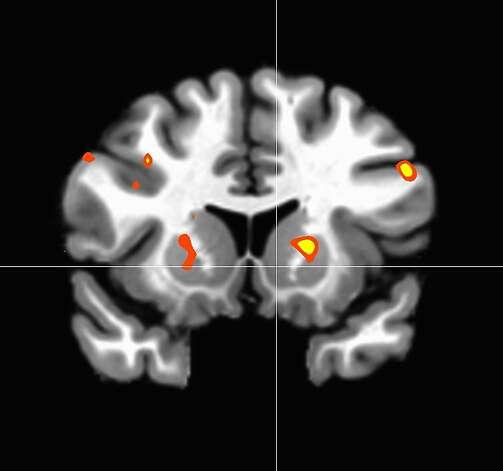
A brain scan of a monk actively extending compassion shows activity in the striatum, an area of the brain associated with reward processing. Photo: SPAN Lab, Stanford University / SF

It's always cool to see more research on meditative states and brain function - but we need to be a little more careful than we have been with brain imaging studies. We see associations and correlations - at best - but there are always other brain regions active. Just as important as seeing which brain areas or circuits are active is seeing which ones are not active - dampening has a lot to do with functional experience as well.

Stanford studies monks' meditation, compassion

Meredith May

Saturday, July 7, 2012

Stanford neuroeconomist Brian Knutson is an expert in the pleasure center of the brain that works in tandem with our financial decisions - the biology behind why we bypass the kitchen coffeemaker to buy the $4 Starbucks coffee every day.

He can hook you up to a brain scanner, take you on a simulated shopping spree and tell by looking at your nucleus accumbens - an area deep inside your brain associated with fight, flight, eating and fornicating - how you process risk and reward, whether you're a spendthrift or a tightwad.

So when his colleagues saw him putting Tibetan Buddhist monks and nuns into the MRI machine in the basement of the Stanford psychology building, he drew a few double-takes.

Knutson is still interested in the nucleus accumbens, which receives a dopamine hit when a person anticipates something pleasant, like winning at blackjack.

Only now he wants to know if the same area of the brain can light up for altruistic reasons. Can extending compassion to another person look the same in the brain as anticipating something good for oneself? And who better to test than Tibetan monks, who have spent their lives pursuing a state of selfless nonattachment?

Meditation science

The "monk study" at Stanford is part of an emerging field of meditation science that has taken off in the last decade with advancements in brain image technology, and popular interest.

"There are many neuroscientists out there looking at mindfulness, but not a lot who are studying compassion," Knutson said. "The Buddhist view of the world can provide some potentially interesting information about the subcortical reward circuits involved in motivation."

By looking at expert meditators, neuroscientists hope to get a better picture of what compassion looks like in the brain. Does a monk's brain behave differently than another person's brain when the two are both extending compassion? Is selflessness innate, or can it be learned?

Looking to the future, neuroscientists wonder whether compassion can be neurologically isolated, if one day it could be harnessed to help people overcome depression, to settle children with hyperactivity, or even to rewire a psychopath. 

"Right now we're trying to first develop the measurement of compassion, so then one day we can develop the science around it," Knutson said.

Stress reduction

Thirty years ago, medical Professor Jon Kabat-Zinn used meditation as the basis for his revolutionary "Mindfulness-Based Stress Reduction Program." He put people with chronic pain and depression through a six-week meditation practice in the basement of the University of Massachusetts Medical School and became one of the first practitioners to record meditation-related health improvements in patients with intractable pain. His stress-reduction techniques are now used in hospitals, clinics and by HMOs.
"In the last 25 years there's been a tidal shift in the field, and now there are 300 scientific papers on mindfulness," said Emiliana Simon-Thomas, science director for the Greater Good Science Center at UC Berkeley.
People who meditate show more left-brain hemisphere dominance, according to meditation studies done at the Center for Investigating Healthy Minds at the University of Wisconsin-Madison.
"Essentially when you spend a lot of time meditating, the brain shows a pattern of feeling safe in the world and more comfortable in approaching people and situations, and less vigilant and afraid, which is more associated with the right hemisphere," she said.

Effect on aging

The most comprehensive scientific study of meditation, the Shamantha Project led by scientists at UC Davis, indicates meditation leads to improved perception and may even have some effect on cellular aging. 

Volunteers who spent an average of 500 hours in focused-attention meditation during a three-month retreat in 2007 were better than the control group at detecting slight differences in the length of lines flashed on a screen.

When researchers compared blood samples between the two groups, they found the retreat population had 30 percent more telomerase - the enzyme in cells that repairs the shortening of chromosomes that occurs throughout life. This could have implications for the tiny protective caps on the ends of DNA known as telomeres, which have been linked to longevity.

"This does not mean that if you meditate, you're going to live longer," said Clifford Saron, a research neuroscientist leading the study at the UC Davis Center for Mind and Brain.

"It's an empirical question at this point, but it's remarkable that a sense of purpose in life, a belief that your goals and values are coming more into alignment with your past and projected future is likely affecting something at the level of your molecular biology," Saron said. 

Knutson's monk study at Stanford is in its early stages. He has some data collected from Stanford undergrads to use as part of the control group, but he still needs more novice meditators and monks to go into the MRI machine. It's an expensive proposition. Subjects are in the machine for eight to 12 hours a day, for three days, at $500 an hour.

Dalai Lama donation

Knutson's study is funded by Stanford's Center for Compassion and Altruism Research and Education, which was started with a sizable donation of seed money from the Dalai Lama after his 2005 campus visit to discuss fostering scientific study of human emotion.
Knutson and his team asked the monks and nuns to lie down in the MRI scanner and look at a series of human faces projected above their eyes. He asked them to withhold emotion and look at some of the faces neutrally, and for others, to look and show compassion by feeling their suffering. 

Next he flashed a series of abstract paintings and asked his subjects to rate how much they liked the art. What the monks and nuns didn't know was that Knutson was also flashing subliminal photos of the same faces before the pictures of the art.

"Reliably they like the art more if the faces they showed compassion to came before it," Knutson said, "Which leads to a hypothesis that there is some sort of compassion carryover happening."

Extending compassion

Next Knutson asked the Buddhists to practice a style of meditation called "tonglen," in which the person extends compassion outward from their inner circle, first to their parent, then to a good friend, then to a stranger and last to all sentient beings. He wants to see whether brain activity changes depending on different types of compassion. 

"There's a concern that scientists might be 'trying to prove meditation,' but we are scientists trying to understand the brain," said Matthew Sacchet, a neuroscience doctoral student at Stanford working with Knutson.

"The research has important possibilities for medicine, and also it could get rid of some of the fuzz and help make meditation more empirically grounded," he said. "If there is some kind of underlying structure to be understood scientifically, it could make things more clear for everyone."

Meredith May is a San Francisco Chronicle staff writer. E-mail: mmay@sfchronicle.com

Wednesday, May 02, 2012

Crazy Wisdom - The Life and Times of Chogyam Trungpa Rinpoche - Full Movie (2011)


I don't know how long this will be available on YouTube, but here is the whole film of Crazy Wisdom - The Life and Times of Chogyam Trungpa Rinpoche. I very much enjoyed this when I saw it last year.
Crazy Wisdom is the long-awaited feature documentary to explore the life, teachings, and "crazy wisdom" of Chogyam Trungpa, Rinpoche, a pivotal figure in bringing Tibetan Buddhism to the West. Called a genius, rascal, and social visionary; 'one of the greatest spiritual teachers of the 20th century,' and 'the bad boy of Buddhism,' Trungpa defied categorization. Raised and trained in the rigorous Tibetan monastic tradition, Trungpa came to the West and shattered our preconceived notions about how an enlightened teacher should behave - he openly smoked, drank, and had intimate relations with students - yet his teachings are recognized as authentic, vast, and influential. Twenty years after his death, with unprecedented access and exclusive archival material, Crazy Wisdom looks at the man and the myths about him, and attempts to set the record straight. Written by Lisa Leeman, Producer.


Sunday, March 11, 2012

Tricycle Talks: Lama Surya Das

This is a nice discussion with Lama Surya Das from the good folks at Tricycle magazine.

Tricycle Talks: Lama Surya Das

in
Listen to other Tricycle Talks with Buddhists of note here.