Showing posts with label secularism. Show all posts

Friday, March 28, 2014

Omnivore - Religion in Contemporary World

From Bookforum's Omnivore blog, another cool collection of links, this time on the state of religion in the world today. Some good stuff in this collection.

Religion in contemporary world

Mar 27 2014
9:00AM

  • Alison Greig (Wales): Heaven in the Early History of Western Religions
  • From Cognition and Culture, a webinar on Big Gods: How Religion Transformed Cooperation and Conflict by Ara Norenzayan. 
  • Terry D. Goddard reviews Before Religion: a History of a Modern Concept by Brent Nongbri. 
  • Religion in contemporary world: Octavia Domide and Larisa Bianca Pirjol review The Everyday Sacred: Symbols, Rituals, Mythologies by Cristina Gavriluta and The Sociology of Religions: Beliefs, Rituals, Ideologies by Nicu Gavriluta. 
  • The introduction to A History of Jewish-Muslim Relations: From the Origins to the Present Day, ed. Abdelwahab Meddeb and Benjamin Stora. 
  • Rosemary Joyce on women as leaders in early Christianity: Fairy tales? 
  • From The Atlantic, Richard J. Miller on religion as a product of psychotropic drug use: How much of religious history was influenced by mind-altering substances? 
  • From Student Pulse, is paganism a religion? Betsy C. Chadbourn on exploring the historical and contemporary relevance of paganism. 
  • Was Nietzsche right about religion? John Gray reviews The Age of Nothing by Peter Watson and Culture and the Death of God by Terry Eagleton. 
  • Secularisation, myth or menace? Melvin Tinker on an assessment of modern “worldliness”. 
  • God and Man in the Machine: Peter Moons on religion in the transhumanist environment
  • Laura Leibman on clothing and religion
  • An interview with Dan W. Clanton, Jr., author of Understanding Religion and Popular Culture
  • An excerpt from The Age of Atheists by Peter Watson. 
  • Pseudo-scientists are still trying to convince you that the Shroud of Turin is real — don't believe them.

Friday, December 06, 2013

Omnivore - Can You Have Religion Without God?

From Bookforum's Omnivore blog, a collection of links on all things religious - from Satan to Jesus, and from evolution to a religious worldview for secularists. A particularly good read is an article from Scientific American, The Psychological Power of Satan.


Can you have religion without God?

Dec 5 2013
9:00AM

Wednesday, July 10, 2013

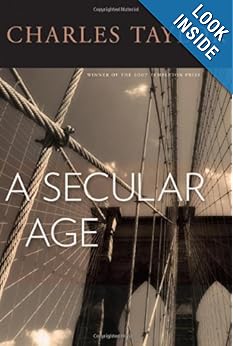
David Brooks - The Secular Society (Charles Taylor)


Charles Taylor is one of the giants of contemporary philosophy. Two of his books, A Secular Age (2007) and Sources of the Self: The Making of the Modern Identity (1992), are contemporary classics.

From Wikipedia, here is a brief summary of some of the ideas in Part IV: Narratives of Secularization:
The last half century has seen a cultural revolution in the North Atlantic civilization. "As well as moral/spiritual and instrumental individualisms, we now have a widespread "expressive" individualism"(p. 473). Taylor calls this a culture of "authenticity," from the Romantic expressivism that erupted in the late 18th century elite, "that each one of us has his/her own way of realizing our humanity, and that it is important to find and live out one's own"(p. 475). 
This affects the social imaginary. To the "horizontal" notion of "the economy, the public sphere, and the sovereign people"(p. 481) is added a space of fashion, a culture of mutual display. The modern moral order of mutual benefit has been strengthened, mutual respect requires that "we shouldn't criticize each other's 'values'"(p. 484) in particular on sexual matters. Since "my" religious life or practice is my personal choice, my "link to the sacred" may not be embedded in "nation" or "church." This is a continuation of the Romantic move away from reason towards a "subtler language" (Shelley) to understand individual "spiritual insight/feeling." "Only accept what rings true to your own inner Self"(p. 489). This has "undermined the link between Christian faith and civilizational order"(p. 492).  
The revolution in sexual behavior has broken the culture of "moralism" that dominated most of the last half millennium. Developing individualism was bound to come into conflict with moralism, but in the mid 20th century the dam broke. Thinkers started to think of sexual gratification as good, or at least unstoppable, especially as "in cities, young people could pair off without supervision"(p. 501). Now people are not bound by moralism: "they form, break, then reform relationships"(p. 496); they experiment.
It is a tragedy, however that "the codes which churches want to urge on people" still suffer from "the denigration of sexuality, horror at the Dionysian, fixed gender roles, or a refusal to discuss identity issues"(p. 503). 
Today, the "neo-Durkheimian embedding of religion in a state"(p. 505) and a "close interweaving of religion, life-style and patriotism"(p. 506) has been called into question. People are asking, like Peggy Lee, "Is that all there is?" They are heirs of the expressive revolution, "seeking a kind of unity and wholeness of the self... of the body and its pleasures... The stress is on unity, integrity, holism, individuality."(p. 507). This is often termed "spirituality" as opposed to "organized religion." 
This has caused a breaking down of barriers between religious groups but also a decline in active practice and a loosening of commitment to orthodox dogmas. A move from an Age of Mobilization to an Age of Authenticity, it is a "retreat of Christendom." Fewer people will be "kept within a faith by some strong political or group identity"(p. 514), although a core (vast in the US) will remain in neo-Durkheimian identities, with its potential for manipulation by such as "Milosevic, and the BJP"(p. 515). 
Assuming that "the human aspiration to religion will [not] flag"(p. 515) spiritual practice will extend beyond ordinary church practice to involve meditation, charitable work, study group, pilgrimage, special prayer, etc. It will be "unhooked" from the paleo-Durkheimian sacralized society, the neo-Durkheimian national identity or center of "civilizational order" but still collective. "One develops a religious life"(p. 518). 
While religious life continues many people retain a nominal tie with the church, particularly in Western Europe. This "penumbra" seems to have diminished since 1960. More people stand outside belief, and no longer participate in rites of passage like church baptism and marriage. Yet people respond to, e.g. in France the 1500th anniversary of the baptism of Clovis, or in Sweden the loss of a trans-Baltic ferry. Religion "remains powerful in memory; but also as a kind of reserve fund of spiritual force or consolation"(p. 522). 
This distancing is not experienced in the United States. This may be (1) because immigrants used church membership as a way to establish themselves: "Go to the church of your choice, but go"(p. 524) Or (2) it may be the difficulty that the secular elite has in imposing its "social imaginary" on the rest of society vis-a-vis hierarchical Europe. Also (3) the US never had an ancien rĂ©gime, so there has never been a reaction against the state church. Next (4) the groups in the US have reacted strongly against the post-1960s culture, unlike Europe. A majority of Americans remain happy in "one Nation under God." There are less skeletons in the family closet, and "it is easier to be unreservedly confident in your own rightness when you are the hegemonic power"(p. 528). Finally (5) the US has provided experimental models of post-Durkheimian religion at least for a century. 
After summarizing his argument, Taylor looks to the future, which might follow the slow reemergence of religion in Russia in people raised in the "wasteland" of militant atheism, but suddenly grabbed by God, or it might follow the "spiritual but not religious" phenomenon in the west. "In any case, we are just at the beginning of a new age of religious searching, whose outcome no one can foresee."
And here is more from the summary of Part V: Conditions of Belief:
We live in an immanent frame. That is the consequence of the story Taylor has told, in disenchantment and the creation of the buffered self and the inner self, the invention of privacy and intimacy, the disciplined self, individualism. Then Reform, the breakup of the cosmic order and higher time in secular, making the best of clock time as a limited resource. The immanent frame can be open, allowing for the possibility of the transcendent, or closed. Taylor argues that both arguments are "spin" and "involve a step beyond available reasons into the realm of anticipatory confidence"(p. 551) or faith. 
There are several Closed World Structures that assume the immanent frame. One is the idea of the rational agent of modern epistemology. Another is the idea that religion is childish, so "An unbeliever has the courage to take up an adult stance and face reality"(p. 562). Taylor argues that the Closed World Structures do not really argue their world views, they "function as unchallenged axioms"(p. 590) and it just becomes very hard to understand why anyone would believe in God. 
Living in the immanent frame "The whole culture experiences cross pressures, between the draw of the narratives of closed immanence on one side, and the sense of their inadequacy on the other"(p. 595). Materialists respond to the aesthetic experience of poetry. Theists agree with the Modern Moral Order and its agenda of universal human rights and welfare. Romantics "react against the disciplined, buffered self"(p. 609) that seems to sacrifice something essential with regard to feelings and bodily existence. 
To resolve the modern cross pressures and dilemmas Taylor proposes a "maximal demand" that we define our moral aspirations in terms that do not "crush, mutilate or deny what is essential to our humanity"(p. 640). It aspires to wholeness and transcendence yet also tries to "fully respect ordinary human flourishing"(p. 641).
Taylor imagines a two-dimensional moral space. The horizontal gives you a "point of resolution, the fair award"(p. 706). The vertical hopes to rise higher, to reestablish trust, "to overcome fear by offering oneself to it; responding with love and forgiveness, thereby tapping a source of goodness, and healing"(p. 708). and forgoing the satisfaction of moral victory over evil in sacred violence, religious or secular.
In his New York Times column on Monday, David Brooks identifies with the idea that secularism, through the breakdown of religious identity, is creating more isolated and insular individuals:
Individuals don’t live embedded in tight social orders; they live in buffered worlds of private choices. Common action, Taylor writes, gives way to mutual display. Many people suffer from a malaise. They remember that many people used to feel connected to an enchanted, transcendent order, but they feel trapped in a flat landscape, with diminished dignity: Is this all there is?
I disagree with this perspective as a final outcome of secularism, seeing it instead as a transitional moment. If people feel they are trapped in a "flat landscape, with diminished dignity," this is in itself an example of being embedded in a social order (tight or otherwise) in which meaning is felt to be absent.

BUT, and this is the BIG BUT I pose in opposition to Taylor's argument (as much as I admire him and his work), people are finding communities of seekers with similar paths outside of the mainstream and dying religious traditions. More to the point, people are finding their own "tribes" or "families" that have nothing to do with blood or heritage and much more to do with commonality and similarity in values and purpose.

I think Brooks get the gist of Taylor's perspective, and agrees with it, but I counter that both are wrong, or at the least, short-sighted.

The Secular Society

By DAVID BROOKS
Published: July 8, 2013

I might as well tell you upfront that this column is a book report. Since 2007, when it was published, academics have been raving to me about Charles Taylor’s “A Secular Age.” Courses, conferences and symposia have been organized around it, but it is almost invisible outside the academic world because the text is nearly 800 pages of dense, jargon-filled prose.

As someone who tries to report on the world of ideas, I’m going to try to summarize Taylor’s description of what it feels like to live in an age like ours, without, I hope, totally butchering it.

Taylor’s investigation begins with this question: “Why was it virtually impossible not to believe in God in, say 1500, in our Western society, while in 2000 many of us find this not only easy but even inescapable?” That is, how did we move from the all encompassing sacred cosmos, to our current world in which faith is a choice, in which some people believe, others don’t and a lot are in the middle?

This story is usually told as a subtraction story. Science came into the picture, exposed the world for the way it really is and people started shedding the illusions of faith. Religious spirit gave way to scientific fact.

Taylor rejects this story. He sees secularization as, by and large, a mottled accomplishment, for both science and faith.

Advances in human understanding — not only in science but also in art, literature, manners, philosophy and, yes, theology and religious practice — give us a richer understanding of our natures. Shakespeare helped us see character in more intricate ways. An improvement in mores means we take less pleasure from bear-baiting, hanging and other forms of public cruelty. We have a greater understanding of how nature works.

These achievements did make it possible to construct a purely humanistic account of the meaningful life. It became possible for people to conceive of meaningful lives in God-free ways — as painters in the service of art, as scientists in the service of knowledge.

But, Taylor continues, these achievements also led to more morally demanding lives for everybody, believer and nonbeliever. Instead of just fitting docilely into a place in the cosmos, the good person in secular society is called upon to construct a life in the universe. She’s called on to exercise all her strength.

People are called to greater activism, to engage in more reform. Religious faith or nonfaith becomes more a matter of personal choice as part of a quest for personal development.

This shift in consciousness leads to some serious downsides. When faith is a matter of personal choice, even believers experience much more doubt. As James K.A. Smith of Comment Magazine, who was generous enough to share his superb manuscript of a book on Taylor, put it, “We don’t believe instead of doubting; we believe while doubting. We’re all Thomas now.”

Individuals don’t live embedded in tight social orders; they live in buffered worlds of private choices. Common action, Taylor writes, gives way to mutual display. Many people suffer from a malaise. They remember that many people used to feel connected to an enchanted, transcendent order, but they feel trapped in a flat landscape, with diminished dignity: Is this all there is?

But these downsides are more than made up for by the upsides. Taylor can be extremely critical of our society, but he is grateful and upbeat. We are not moving to a spiritually dead wasteland as, say, the fundamentalists imagine. Most people, he observes, are incapable of being indifferent to the transcendent realm. “The yearning for eternity is not the trivial and childish thing it is painted as,” Taylor writes.

People are now able to pursue fullness in an amazing diversity of different ways. But Taylor observes a general pattern. They tend not to want to live in a world closed off from the transcendent, reliant exclusively on the material world. We are not, Taylor suggests, sliding toward pure materialism.

We are, instead, moving toward what he calls a galloping spiritual pluralism. People in search of fullness are able to harvest the intellectual, cultural and spiritual gains of the past 500 years. Poetry and music can alert people to the realms beyond the ordinary.

Orthodox believers now live with a different tension: how to combine the masterpieces of humanism with the central mysteries of their own faiths. This pluralism can produce fragmentations and shallow options, and Taylor can eviscerate them, but, over all, this secular age beats the conformity and stultification of the age of fundamentalism, and it allows for magnificent spiritual achievement.

I’m vastly oversimplifying a rich, complex book, but what I most appreciate is his vision of a “secular” future that is both open and also contains at least pockets of spiritual rigor, and that is propelled by religious motivation, a strong and enduring piece of our nature.


A version of this op-ed appeared in print on July 9, 2013, on page A21 of the New York edition with the headline: The Secular Society.

Sunday, June 09, 2013

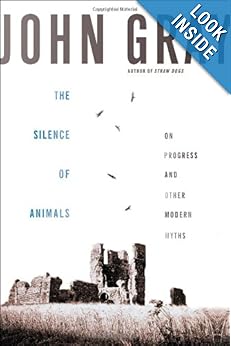
Simon Critchley on John Gray’s Godless Mysticism in "The Silence of Animals"


Philosopher John Gray's new book, The Silence of Animals: On Progress and Other Modern Myths (Jiune, 2013) [the third book in a sequence beginning with False Dawn: The Delusions of Global Capitalism (2000) and then Straw Dogs: Thoughts on Humans and Other Animals (2007)], is reviewed within the context of the whole sequence in this article from The Los Angeles Review of Books.

Key quotes:
The radical core of Gray’s work, unfashionable as it might seem, is a strident defense of the ideal of contemplation against action, whether the bios theoretikos of Aristotle or the ataraxia of the Epicureans. As Gray says in the final words of Straw Dogs, “Can we not think of the aim of life as being simply to see?”
Gray’s godless mysticism would retain the forms of askesis common to religious forms of mystical practice (fasting, concentration and prayer) that attempt to nullify the self. But this would be done not in order to attain a higher experience of “Self” [sic] or some union with god, but rather to occasion a turn towards the nonhuman world in its mere being. A godless mysticism would not redeem us, but would redeem us from the need for redemption, the very need for meaning. A redemption from redemption, then. Meaninglessness would here be the achievement of the ordinary, the life of the senses. This line of thought gets very close to what the philosopher Eugene Thacker has called a mysticism of the inhuman, a climatological mysticism expressed in the dust of the planet.
 This is an in-depth and interesting review, as well as critical in a productive way - makes me want to go back and read the three books in order, especially since I have only read a handful of essays.

Simon Critchley on The Silence of Animals

John Gray’s Godless Mysticism: On "The Silence of Animals"

Simon Critchley

June 2nd, 2013

The Silence of Animals : On Progress and Other Modern Myths

Triptych image: Mariechen Danz, "Ye (3)," 2006
Photo: Andrea Huyoff. Courtesy of the artist and Galerie Tanja Wagner, Berlin

HUMAN BEINGS DO NOT just make killer apps. We are killer apes. We are nasty, aggressive, violent, rapacious hominids, what John Gray calls in his widely read 2002 book, Straw Dogs, homo rapiens. But wait, it gets worse. We are a killer species with a metaphysical longing, ceaselessly trying to find some meaning to life, which invariably drives us into the arms of religion. Today’s metaphysics is called “liberal humanism,” with a quasi-religious faith in progress, the power of reason and the perfectibility of humankind. The quintessential contemporary liberal humanists are those Obamaists, with their grotesque endless conversations about engagement in the world and their conviction that history has two sides, right and wrong, and they are naturally on the right side of it.

Gray’s most acute loathing is for the idea of progress, which has been his target in a number of books, and which is continued in the rather uneventful first 80 pages or so of The Silence of Animals. He allows that progress in the realm of science is a fact. (And also a good: as Thomas De Quincey remarked, a quarter of human misery results from toothache, so the discovery of anesthetic dentistry is a fine thing.) But faith in progress, Gray argues, is a superstition we should do without. He cites, among others, Conrad on colonialism in the Congo and Koestler on Soviet Communism (the Cold War continues to cast a long shadow over Gray’s writing) as evidence of the sheer perniciousness of a belief in progress. He contends, contra Descartes, that human irrationality is the thing most evenly shared in the world. To deny reality in order to sustain faith in a delusion is properly human. For Gray, the liberal humanist’s assurance in the reality of progress is a barely secularized version of the Christian belief in Providence.

With the Nazi jurist Carl Schmitt in mind, Gray writes in Black Mass (2007): “Modern politics is a chapter in the history of religion.” Politics has become a hideous surrogate for religious salvation, and secularism is itself a religious myth. In The Silence of Animals, he writes, “Unbelief today should begin by questioning not religion but secular faith.” What most disturbs Gray are utopian political projects based on some faith that concerted human action in the world can allow for the realization of seemingly impossible political ends and bring about the perfection of humanity. As he makes explicit in Black Mass, he derives his critique of utopianism from Norman Cohn’s 1957 book, The Pursuit of the Millennium. What Cohn implied but Gray loudly declares is that Western civilization can be defined in terms of the central role of millenarian thinking. Salvation is collective, terrestrial, imminent, total, and miraculous. What takes root with early Christian belief, and massively accelerates in medieval Europe, finds its modern continuation in a sequence of bloody utopian political projects, from Jacobinism to Bolshevism, Stalinism, Nazism, and different varieties of Marxist-Leninist, anarchist, or Situationist ideologies. They all promised to build heaven on earth and left us with hell instead.

In Black Mass, Gray persuasively attempted to show how the energy of such utopian political projects has drifted from the left to the right. Bush, Blair, and the rest framed the war on terror as an apocalyptic struggle that would forge the new American century of untrammeled personal freedom and free markets. During the first years of the new millennium, a religious fervor energized the project of what we might call “military neoliberalism”: violence was the means for realizing liberal democratic heaven on earth. The picture of a world at war where purportedly democratic regimes, like the USA, deploy terror in their alleged attempts to confront it is still very much with us, even if full-scale, classical military invasions have given way to the calculated cowardice of drone strikes and targeted assassinations.

Carl Schmitt’s critique of parliamentary democracy led him towards an argument for dictatorship. Where does Gray’s loathing of liberalism leave him? He identifies the poison in liberal humanism, but what’s the antidote? It is what Gray calls “political realism”: we have to accept, as many ancient societies did and many non-Western societies still do, that the world is in a state of ceaseless conflict. Periods of war are followed by periods of peace, only to be followed by war again. What goes around comes around. And around. History makes more sense as a cycle than as a line of development or even decline.

In the face of such ceaseless conflict, Gray counsels that we have to abandon the belief in utopia and accept the tragic contingencies of life: there are moral and political dilemmas for which there are simply no solutions. We have to learn to abandon pernicious daydreams such as a new cosmopolitan world order governed by universal human rights, or that history has a teleological, providential purpose that underwrites human action. We even have to renounce the Obamaesque (in essence, crypto-Comtian or crypto-Saint-Simonian) delusion that one’s life is a narrative that is an episode in some universal story of progress. It is not.

Against the grotesque distortion of conservatism into the millenarian military neoliberalism, Gray wants to defend the core belief of traditional Burkean Toryism. The latter begins in a realistic acceptance of human imperfection and frailty. As such, the best that flawed and potentially wicked human creatures can hope for is a commitment to civilized constraints that will prevent the very worst from happening: a politics of the least worst. Sadly, no one in political life seems prepared to present this argument, least of all those contemporary conservatives who have become more utopian than their cynical pragmatist left-liberal counterparts, such as the British Labor Party.

* * *

The most extreme expression of human arrogance, for Gray, is the idea that human beings can save the planet from environmental devastation. Because they are killer apes who will always deploy violence, force, and terror in the name of some longed-for metaphysical project, human beings cannot be trusted to save their environment. Furthermore — and this is an extraordinarily delicious twist — the earth doesn’t need saving. Here Gray borrows from James Lovelock’s Gaia hypothesis. The ever-warming earth is suffering from disseminated primatemaia, a plague of people. Homo rapiens is savagely ravaging the planet like a filthy pest that has infested a once beautiful, well-appointed, and spacious house. In 1600, the human population was about half a billion. In the 1990s it increased by the same amount. And the acceleration continues. What Gray takes from the Gaia hypothesis is that this plague cannot be solved by the very people who are its cause. It can only be solved by a large-scale decline in human numbers back down to manageable levels. Let’s go back to 1600!

Such is the exhilaratingly anti-humanist, dystopian, indeed Ballardesque, vision of a drowned world at the heart of Gray’s work: when the earth is done with humans, it will recover and the blip of human civilization will be forgotten forever. Global warming is simply one of the periodic fevers that the earth has suffered during its long, nonhuman history. It will recover and carry on. But we cannot and will not.

* * *

Where does this leave us? Although Gray is critical of Heidegger’s residual humanism (animals are poor in world and rocks and stone are worldless, Martin insists), he is very close to a line of thought in a collection of Heidegger’s fragments published as Overcoming Metaphysics. Written between 1936 and 1946, these are Heidegger’s bleakest and most revealing ruminations, in my view. At their center stands an all-too-oblique critical engagement with National Socialism filtered through the lens of his willful reading of Nietzsche. Heidegger concludes his meditations with the words, “No mere action will change the world.” 
The statement finds its rejoinder in the title of Heidegger’s posthumously published 1966 interview with Der Spiegel: “Only a god can save us.” For Heidegger and Gray, there is no god, unfortunately, and we cannot save ourselves. It’s the belief that we can save ourselves that got us into our current mess. If political voluntarism is the motor of modernity’s distress, then the task becomes how we might think without the will.

This takes us to the compelling critique of the concept of action in Gray’s work. Whether Arendtian fantasies of idealized praxis, liberal ideas of public engagement and intervention, or leftist delusions about the propaganda of the deed, action provides consolation for killer apes like us by momentarily staving off the threat of meaninglessness. The radical core of Gray’s work, unfashionable as it might seem, is a strident defense of the ideal of contemplation against action, whether the bios theoretikos of Aristotle or the ataraxia of the Epicureans. As Gray says in the final words of Straw Dogs, “Can we not think of the aim of life as being simply to see?” 
But Gray’s ideological masterstroke is the fusion of his quasi-Burkean critique of liberalism, underpinned as it is by a deep pessimism about human nature, with a certain strand of Taoism. More particularly, what engages Gray is the ultra-skeptical illusionism of Chuang-Tzu, magnificently expressed in the subtle paradoxes of The Inner Chapters. Chuang-Tzu writes, “How do I know that to take pleasure in life is not a delusion?” The answer is that I do not know and furthermore it doesn’t matter. Pushing much further than the furtive Descartes in his Dutch oven, Chuang-Tzu writes, “While we dream we do not know that we are dreaming, and in the middle of a dream interpret a dream within it.” He concludes, “You and Confucius are both dreams, and I who call you a dream am also a dream.” There is no way out of the dream and what has to be given up is the desperate metaphysical longing to find some anchor in a purported reality. 
Homo rapiens must learn to give up the destructive and pointless search for meaning and learn to see that the aim of life is the release from meaning. What interests Gray in the mind-bending paradoxes of Chuang-Tzu is the acceptance of the fact that life is a dream without the possibility, or even the desire, to awaken from the dream. If we cannot be free of illusions, if illusions are part and parcel of our natural constitution, then why not simply accept them? In the final pages of Black Mass Gray writes: “Taoists taught that freedom lies in freeing oneself from personal narratives by identifying with cosmic processes of death and renewal.” Rather than seek the company of utopian thinkers, we should find consolation in the words of “mystics, poets and pleasure-lovers. 
Such is the consoling company Gray keeps in The Silence of Animals. There is much here that is familiar to readers of Gray, such as the critique of progress and the constant tilting at liberal humanism. There is also much that is welcome, such as the robust defense of Freud as a moralist based on Philip Rieff’s classic interpretation, which is wielded against Jungian obscurantism, the triumph of the therapeutic, and the desire to fill the Freudian void with grisly specters like the collective unconscious. But what’s new in The Silence of Animals is Gray’s argument for what he calls “godless mysticism” based largely on a reading of Wallace Stevens (it’s true that Stevens makes a couple of cameo appearances in Gray’s The Immortalization Commission from 2011). Stevens is the still point around which the world turns in The Silence of Animals. 
Each of the three parts of The Silence of Animals is framed and guided by quotations from Stevens; what seems to draw Gray’s attention is the sheer austerity of his late verse, for example the 25 poems included under the title “The Rock” in the Collected Poems in 1954, the year before Stevens’s death. Stevens’s poetry self-consciously moves between the poles of reality and the imagination. In his most Wordsworthian mood, as in “The Idea of Order at Key West,” the two poles would appear to fuse or be held in a creative balance: imagination grasps and transfigures reality. But in the very late poems, a hard, cold, contracted reality takes center stage. The power of imagination appears to be impoverished. The season of these late poems — always important for Stevens — changes from the florid and Floridian landscapes of the earlier verse to the harsh, unending cold of the Connecticut winter. 
In the final poem in The Palm at the End of the Mind, “Of Mere Being,” Stevens speaks of that which is “Beyond the last thought,” namely a bird that sings “Without human meaning, / Without human feeling, a foreign song.” Stevens seems to be saying that things merely are: the tree, the bird, its song, its feathers, the wind moving in the branches. One can say no more. For Gray, “The mere being of which Stevens speaks is the pure emptiness to which our fictions may sometimes point.” That is to say, in accepting that the world is without meaning, a path is indicated that takes us beyond the meaning we have made. 
Paradoxically, for Gray, the highest value in existence is to know that there is nothing of substance in the world. Nothing is more real than nothing. It is the nothingness beyond us, the emptiness behind words, that Gray wants us to contemplate. His is a radical nominalism behind which stands the void. In this, as he is well aware, Gray is close to Beckett. We are condemned to words, but language is a prison house from which we constantly seek to escape. Rather than any comforting dogma of the linguistic turn, Gray is trying to imagine a turn away from the linguistic. Human language should be pointed towards a nonhuman silence. 
In his very last poems, Stevens comes about as close as one can get to giving up poetry in poetry. It is poetry of the antipodes of the poetry; the hard, alien reality that we stare at, unknowing. All we have are ideas about the thing, but not the thing itself. Desire contracts, the mind empties, the floors of memory are wiped clean and nothingness flows over us without meaning. In a very late lyric that Gray does not cite but which he might, “A Clear Day and No Memories,” Stevens writes:
Today the air is clear of everything.
It has no knowledge except of nothingness
And it flows over us without meanings,
As if none of us had ever been here before
And are not now: in this shallow spectacle,
This invisible activity, this sense.
It is “this sense” that Gray wants to cultivate in us, this turning of the self away from itself and its endless meaning-making and toward things in their variousness and particularity. The point is to undergo a kind of movement from the limitations of the human towards a greater inhuman realm of experience that can be had in the observation of plants, birds, landscapes, and even cityscapes. Stevens continues, with another “as if” (and whole books have been written on his use of hypothetical conjunctions):
As if nothingness contained a métier,
A vital assumption, an impermanence
In its permanent cold, an illusion so desired.
Poems are words chosen out of desire, but words that don’t create anything permanent. In creating illusion, they assume impermanence. This is what Stevens sees as the mĂ©tier of nothingness: its work, its craft, its supreme fictiveness. It is abstract. It must change. It must give pleasure. 
Gray’s godless mysticism would retain the forms of askesis common to religious forms of mystical practice (fasting, concentration and prayer) that attempt to nullify the self. But this would be done not in order to attain a higher experience of “Self” [sic] or some union with god, but rather to occasion a turn towards the nonhuman world in its mere being. A godless mysticism would not redeem us, but would redeem us from the need for redemption, the very need for meaning. A redemption from redemption, then. Meaninglessness would here be the achievement of the ordinary, the life of the senses. This line of thought gets very close to what the philosopher Eugene Thacker has called a mysticism of the inhuman, a climatological mysticism expressed in the dust of the planet. 
* * *

There’s an unexpected local hero in The Silence of Animals: J.A. Baker (1926–1987), author of The Peregrine, a book that, to my shame, I didn’t know prior to reading Gray. It is the record of 10 years spent watching peregrine falcons in a narrow stretch of Essex countryside between Chelmsford and the coast. I happen to know that landscape quite well, or once knew it. It’s a minimal, flat landscape of neat fields, mudbanks, estuarial systems, and vast skies with huge clouds shuttling from west to east. In intense lyrical descriptions, Baker sought to escape the human perspective and look at the world through the eyes of this predatory bird, “Looking down, the hawk saw the big orchard beneath him shrink into dark, twiggy lines and green strips […] saw the estuary lifting up its blue and silver mouth, tongued with green islands.”

Baker was not crazy. He knew that there is no way out of the human world, and no way he could become a peregrine falcon. What interests Gray is the discipline (for Baker, an askesis of time, place and repetition: many days, months, and years spent returning to the same small strip of countryside) involved in peeling enough of oneself away in order to try to look outwards and upwards. Contemplation here is not some Hamlet-like, inward-facing attempt at stilling the self’s commotion. It’s the outward-facing decreation of the self through a cultivation of the senses. What’s being attempted is a non-anthropomorphic relation to animals and nature as a whole, where the falcon cannot hear the falconer. Gray’s godless mysticism asks us to look outside ourselves and simply see. This is a lot more difficult than it sounds.

* * *

Schopenhauer, usually read in abridged, aphoristic form, was the most popular philosopher of the 19th century. Epigrammatic pessimism of his sort gives readers reasons for their misery and words to buttress their sense of hopelessness and impotence. Few things offer more refined intellectual pleasure than backing oneself into an impregnably defended conceptual cul-de-sac and sitting there, knowing and immovable. It’s the thrill of reading Adorno or, in a certain light, Agamben. Such is what Nietzsche called “European Buddhism.”

Sometimes I think John Gray is the great Schopenhauerian European Buddhist of our age. What he offers is a gloriously pessimistic cultural analysis, which rightly reduces to rubble the false idols of the cave of liberal humanism. Counter to the upbeat progressivist evangelical atheism of the last decade, Gray provides a powerful argument in favor of human wickedness that’s still consistent with Darwinian naturalism. It leads to passive nihilism: an extremely tempting worldview, even if I think the temptation must ultimately be refused. 
The passive nihilist looks at the world with a highly cultivated detachment and finds it meaningless. Rather than trying to act in the world, which is pointless, the passive nihilist withdraws to a safe contemplative distance and cultivates his acute aesthetic sensibility by pursuing the pleasures of poetry, peregrine-watching, or perhaps botany, as was the case with the aged Rousseau (“Botany is the ideal study for the idle, unoccupied solitary,” Jean-Jacques said). Lest it be forgotten, John Stuart Mill also ended up a botanist. 
In a world that is rushing to destroy itself through capitalist exploitation or military crusades — two arms of the same Homo rapiens — the passive nihilist resigns himself to a small island where the mystery of existence can be seen for what it is without distilling it into a meaning. The passive nihilist learns to see, to strip away the deadening horror of habitual, human life and inhale the void that lies behind our words. 
What will define the coming decades? I would wager the following: the political violence of faith, the certainty of environmental devastation, the decline of existing public institutions, ever-growing inequality, and yet more Simon Cowell TV shows. In the face of this horror, Gray offers a cool but safe temporary refuge. 
Truth to tell, the world of Gray’s passive nihilist can be a lonely place, seemingly stripped of intense, passionate, and ecstatic human relations. It is an almost autistic universe, like J.A. Baker’s. It is also a world where mostly male authors and poets seem to be read, although Elizabeth Bishop comes to mind. As Stevens writes in his Adagia, “Life is an affair of people not of places. But for me life is an affair of places and that is the trouble.” Gray, like Stevens, seems preoccupied with place but, unlike Stevens, appears untroubled. What Gray says is undeniable: we are cracked vessels glued to ourselves in endless, narcissistic twittering. We are like moths wheeling around the one true flame: vanity. Who doesn’t long to escape into an animal silence? 
Of course, love is the name of the counter-movement to that longing. Love — erotic, limb-loosening and bittersweet — is another way of pointing outwards and upwards, but this time towards people and not places. But that, as they say, is another story.

Author’s Note: This essay builds from certain formulations that the reader can find in The Faith of the Faithless (Verso, London and New York, 2012). See Chapter 2, pp.109-117.

Simon Critchley's last book was The Mattering of Matter. Documents from the Archive of the International Necronautical Society (with Tom McCarthy, Sternberg, Berlin, 2012) and his next book is Stay, Illusion! The Hamlet Doctrine (Pantheon, New York, 2013).
Wednesday, March 20, 2013

Ronald Dworkin - Religion Without God (New York Review of Books)


Via The New York Review of Books, this is excerpt from the late Ronald Dworkin's last manuscript, Religion Without God, which will be published later this year by Harvard University Press. He died in February, 2013, at the age of 81.
Ronald Myles Dworkin, FBA (December 11, 1931 – February 14, 2013)[1] was an American philosopher and scholar of constitutional law. He was Frank Henry Sommer Professor of Law and Philosophy at New York University and Emeritus Professor of Jurisprudence at University College London, and had taught previously at Yale Law School and the University of Oxford. An influential contributor to both philosophy of law and political philosophy, Dworkin received the 2007 Holberg International Memorial Prize in the Humanities for "his pioneering scholarly work" of "worldwide impact."[2]According to a survey in The Journal of Legal Studies, Dworkin was the second most-cited American legal scholar of the twentieth century.[3] 
His theory of law as integrity, in which judges interpret the law in terms of consistent and communal moral principles, especially justice and fairness, is among the most influential contemporary theories about the nature of law. Dworkin advocated a "moral reading" of the United States Constitution,[4] and an interpretivist approach to law and morality. He was a frequent commentator on contemporary political and legal issues, particularly those concerning the Supreme Court of the United States, often in the pages of The New York Review of Books.
Here is the whole excerpt.

Religion Without God

APRIL 4, 2013
Ronald Dworkin

Before he died on February 14, Ronald Dworkin sent to The New York Review a text of his new book, Religion Without God, to be published by Harvard University Press later this year. We publish here an excerpt from the first chapter. —The Editors


The familiar stark divide between people of religion and without religion is too crude. Many millions of people who count themselves atheists have convictions and experiences very like and just as profound as those that believers count as religious. They say that though they do not believe in a “personal” god, they nevertheless believe in a “force” in the universe “greater than we are.” They feel an inescapable responsibility to live their lives well, with due respect for the lives of others; they take pride in a life they think well lived and suffer sometimes inconsolable regret at a life they think, in retrospect, wasted. They find the Grand Canyon not just arresting but breathtakingly and eerily wonderful. They are not simply interested in the latest discoveries about the vast universe but enthralled by them. These are not, for them, just a matter of immediate sensuous and otherwise inexplicable response. They express a conviction that the force and wonder they sense are real, just as real as planets or pain, that moral truth and natural wonder do not simply evoke awe but call for it.

There are famous and poetic expressions of the same set of attitudes. Albert Einstein said that though an atheist he was a deeply religious man:
To know that what is impenetrable to us really exists, manifesting itself as the highest wisdom and the most radiant beauty which our dull faculties can comprehend only in their most primitive forms—this knowledge, this feeling, is at the center of true religiousness. In this sense, and in this sense only, I belong in the ranks of devoutly religious men.1
Percy Bysshe Shelley declared himself an atheist who nevertheless felt that “The awful shadow of some unseen Power/Floats though unseen among us….”2 Philosophers, historians, and sociologists of religion have insisted on an account of religious experience that finds a place for religious atheism. William James said that one of the two essentials of religion is a sense of fundamentality: that there are “things in the universe,” as he put it, “that throw the last stone.”3 Theists have a god for that role, but an atheist can think that the importance of living well throws the last stone, that there is nothing more basic on which that responsibility rests or needs to rest.

Judges often have to decide what “religion” means for legal purposes. For example, the American Supreme Court had to decide whether, when Congress provided a “conscientious objection” exemption from military service for men whose religion would not allow them to serve, an atheist whose moral convictions also prohibited service qualified for the objection. It decided that he did qualify.4 The Court, called upon to interpret the Constitution’s guarantee of “free exercise of religion” in another case, declared that many religions flourish in the United States that do not recognize a god, including something the Court called “secular humanism.”5 Ordinary people, moreover, have come to use “religion” in contexts having nothing to do with either gods or ineffable forces. They say that Americans make a religion of their Constitution, and that for some people baseball is a religion. These latter uses of “religion” are only metaphorical, to be sure, but they seem parasitic not on beliefs about God but rather on deep commitments more generally.

So the phrase “religious atheism,” however surprising, is not an oxymoron; religion is not restricted to theism just as a matter of what words mean. But the phrase might still be thought confusing. Would it not be better, for the sake of clarity, to reserve “religion” for theism and then to say that Einstein, Shelley, and the others are “sensitive” or “spiritual” atheists? But on a second look, expanding the territory of religion improves clarity by making plain the importance of what is shared across that territory. Richard Dawkins says that Einstein’s language is “destructively misleading” because clarity demands a sharp distinction between a belief that the universe is governed by fundamental physical laws, which Dawkins thought Einstein meant, and a belief that it is governed by something “supernatural,” which Dawkins thinks the word “religion” suggests.

But Einstein meant much more than that the universe is organized around fundamental physical laws; indeed his view I quoted is, in one important sense, an endorsement of the supernatural. The beauty and sublimity he said we could reach only as a feeble reflection are not part of nature; they are something beyond nature that cannot be grasped even by finally understanding the most fundamental of physical laws. It was Einstein’s faith that some transcendental and objective value permeates the universe, value that is neither a natural phenomenon nor a subjective reaction to natural phenomena. That is what led him to insist on his own religiosity. No other description, he thought, could better capture the character of his faith.

So we should let Einstein have his self-description, the scholars their broad categories, the judges their interpretations. Religion, we should say, does not necessarily mean a belief in God. But then, granted that someone can be religious without believing in a god, what does being religious mean? What is the difference between a religious attitude toward the world and a nonreligious attitude? That is hard to answer because “religion” is an interpretive concept. That is, people who use the concept do not agree about precisely what it means: when they use it they are taking a stand about what it should mean. Einstein may well have had something different in mind when he called himself religious than William James did when he classified certain experiences as religious or the Supreme Court justices did when they said that atheistic beliefs could qualify as religious. So we should consider our question in that spirit. What account of religion would it be most revealing to adopt?

We must turn to this challenge almost immediately. But we should pause to notice the background against which we consider the issue. Religious war is, like cancer, a curse of our species. People kill each other, around the world, because they hate each other’s gods. In less violent places like America they fight mainly in politics, at every level from national elections to local school board meetings. The fiercest battles are then not between different sects of godly religion but between zealous believers and those atheists they regard as immoral heathens who cannot be trusted and whose growing numbers threaten the moral health and integrity of the political community.

The zealots have great political power in America now, at least for the present. The so-called religious right is a voting bloc still eagerly courted. The political power of religion has provoked, predictably, an opposite—though hardly equal—reaction. Militant atheism, though politically inert, is now a great commercial success. No one who called himself an atheist could be elected to any important office in America, but Richard Dawkins’s book The God Delusion (2006) has sold millions of copies here, and dozens of other books that condemn religion as superstition crowd bookstores. Books ridiculing God were once, decades ago, rare. Religion meant a Bible and no one thought it worth the trouble to point out the endless errors of the biblical account of creation. No more. Scholars devote careers to refuting what once seemed, among those who enthusiastically buy their books, too silly to refute.

If we can separate God from religion—if we can come to understand what the religious point of view really is and why it does not require or assume a supernatural person—then we may be able to lower, at least, the temperature of these battles by separating questions of science from questions of value. The new religious wars are now really culture wars. They are not just about scientific history—about what best accounts for the development of the human species, for instance—but more fundamentally about the meaning of human life and what living well means.

As we shall see, logic requires a separation between the scientific and value parts of orthodox godly religion. When we separate these properly we discover that they are fully independent: the value part does not depend—cannot depend—on any god’s existence or history. If we accept this, then we formidably shrink both the size and the importance of the wars. They would no longer be culture wars. This ambition is utopian: violent and nonviolent religious wars reflect hatreds deeper than philosophy can address. But a little philosophy might help.


What Is Religion? The Metaphysical Core


What, then, should we count as a religious attitude? I will try to provide a reasonably abstract and hence ecumenical account. The religious attitude accepts the full, independent reality of value. It accepts the objective truth of two central judgments about value. The first holds that human life has objective meaning or importance. Each person has an innate and inescapable responsibility to try to make his life a successful one: that means living well, accepting ethical responsibilities to oneself as well as moral responsibilities to others, not just if we happen to think this important but because it is in itself important whether we think so or not.

The second holds that what we call “nature”—the universe as a whole and in all its parts—is not just a matter of fact but is itself sublime: something of intrinsic value and wonder. Together these two comprehensive value judgments declare inherent value in both dimensions of human life: biological and biographical. We are part of nature because we have a physical being and duration: nature is the locus and nutrient of our physical lives. We are apart from nature because we are conscious of ourselves as making a life and must make decisions that, taken together, determine what life we have made.

For many people religion includes much more than those two values: for many theists it also includes obligations of worship, for instance. But I shall take these two—life’s intrinsic meaning and nature’s intrinsic beauty—as paradigms of a fully religious attitude to life. These are not convictions that one can isolate from the rest of one’s life. They engage a whole personality. They permeate experience: they generate pride, remorse, and thrill. Mystery is an important part of that thrill. William James said that
like love, like wrath, like hope, ambition, jealousy, like every other instinctive eagerness and impulse, [religion] adds to life an enchantment which is not rationally or logically deducible from anything else.6
The enchantment is the discovery of transcendental value in what seems otherwise transient and dead.

But how can religious atheists know what they claim about the various values they embrace? How can they be in touch with the world of value to check the perhaps fanciful claim in which they invest so much emotion? Believers have the authority of a god for their convictions; atheists seem to pluck theirs out of the air. We need to explore a bit the metaphysics of value.

The religious attitude rejects naturalism, which is one name for the very popular metaphysical theory that nothing is real except what can be studied by the natural sciences, including psychology. That is, nothing exists that is neither matter nor mind; there is really, fundamentally, no such thing as a good life or justice or cruelty or beauty. Richard Dawkins spoke for naturalists when he suggested the scientists’ proper reply to people who, criticizing naturalism, endlessly quote Hamlet: “There are more things in heaven and earth, Horatio, than are dreamt of in your philosophy.” “Yes,” Dawkins replied, “but we’re working on it.”7

Some naturalists are nihilists: they say that values are only illusions. Other naturalists accept that in some sense values exist, but they define them so as to deny them any independent existence: they make them depend entirely on people’s thoughts or reactions. They say, for instance, that describing someone’s behavior as good or right only means that, as a matter of fact, the lives of more people will be pleasant if everyone behaves in that way. Or that saying a painting is beautiful only means that in general people take pleasure in looking at it.

The religious attitude rejects all forms of naturalism. It insists that values are real and fundamental, not just manifestations of something else; they are as real as trees or pain. It also rejects a very different theory we might call grounded realism. This position, also popular among philosophers, holds that values are real and that our value judgments can be objectively true—but only on the assumption, which might be wrong, that we have good reason, apart from our own confidence in our value judgments, to think that we have the capacity to discover truths about value.

There are many forms of grounded realism: one is a form of theism that traces our capacity for value judgment to a god. (I shall shortly argue that this supposed grounding goes in the wrong direction.) They all agree that, if value judgment can ever be sound, there must be some independent reason to think that people have a capacity for sound moral judgment—independent because it does not itself rely on that capacity. That makes the status of value hostage to biology or metaphysics. Suppose we find undeniable evidence that we hold the moral convictions we do only because they were evolutionarily adaptive, which certainly did not require them to be true. Then, on this view, we would have no reason to think that cruelty is really wrong. If we think it is, then we must think we have some other way of being “in touch with” moral truth.

The religious attitude insists on a much more fundamental divorce between the world of value and facts about our natural history or our psychological susceptibilities. Nothing could impeach our judgment that cruelty is wrong except a good moral argument that cruelty is not after all wrong. We ask: What reason do we have for supposing that we have the capacity for sound value judgment? Ungrounded realism answers: the only possible reason we could have—we reflect responsibly on our moral convictions and find them persuasive. We think them true, and we therefore think we have the capacity to find the truth. How can we reject the hypothesis that all our convictions about value are only mutually supporting illusions? Ungrounded realism answers: we understand that hypothesis in the only way that makes it intelligible. It suggests that we do not have an adequate moral case for any of our moral judgments. We refute that suggestion by making moral arguments for some of our moral judgments.

The religious attitude, to repeat, insists on the full independence of value: the world of value is self-contained and self-certifying. Does that disqualify the religious attitude on grounds of circularity? Notice that there is no finally noncircular way to certify our capacity to find truth of any kind in any intellectual domain. We rely on experiment and observation to certify our judgments in science. But experiment and observation are reliable only in virtue of the truth of basic assumptions about causation and optics that we rely on science itself, and nothing more basic, to certify. And of course our judgments about the nature of the external world all depend, even more fundamentally, on a universally shared assumption that there is an external world, an assumption that science cannot itself certify.

We find it impossible not to believe the elementary truths of mathematics and, when we understand them, the astonishingly complex truths that mathematicians have proved. But we cannot demonstrate either the elementary truths or the methods of mathematical demonstration from outside mathematics. We feel that we do not need any independent certification: we know we have an innate capacity for logic and mathematical truth. But how do we know we have that capacity? Only because we form beliefs in these domains that we simply cannot, however we try, disown. So we must have such a capacity.

We might say: we accept our most basic scientific and mathematical capacities finally as a matter of faith. The religious attitude insists that we embrace our values in the same way: finally as a matter of faith as well. There is a striking difference. We have generally agreed standards of good scientific argument and valid mathematical demonstration; but we have no agreed standards for moral or other forms of reasoning about value. On the contrary, we disagree markedly about goodness, right, beauty, and justice. Does that mean that we have an external certification of our capacities for science and mathematics that we lack in the domain of value?

No, because interpersonal agreement is not an external certification in any domain. The principles of scientific method, including the need for interpersonal confirmation of observation, are justified only by the science these methods have produced. As I said, everything in science, including the importance of shared observation, hangs together: it rests on nothing outside science itself. Logic and mathematics are different still. Consensus about the validity of a complex mathematical argument is in no way evidence of that validity. What if—unimaginable horror—the human race ceased to agree about valid mathematical or logical arguments? It would fall into terminal decline, but no one would have any good reason, along the way, to doubt that five and seven make twelve. Value is different still. If value is objective, then consensus about a particular value judgment is irrelevant to its truth or anyone’s responsibility in thinking it true, and experience shows, for better or worse, that the human community can survive great discord about moral or ethical or aesthetic truth. For the religious attitude, disagreement is a red herring.

I said, just now, that the religious attitude rests finally on faith. I said that mainly to point out that science and mathematics are, in the same way, matters of faith as well. In each domain we accept felt, inescapable conviction rather than the benediction of some independent means of verification as the final arbiter of what we are entitled responsibly to believe. This kind of faith is not just passive acceptance of the conceptual truth that we cannot justify our science or our logic or our values without appealing to science or logic or value. It is a positive affirmation of the reality of these worlds and of our confidence that though each of our judgments may be wrong we are entitled to think them right if we have reflected on them responsibly enough.

In the special case of value, however, faith means something more, because our convictions about value are emotional commitments as well and, whatever tests of coherence and internal support they survive, they must feel right in an emotional way as well. They must have a grip on one’s whole personality. Theologians often say that religious faith is a sui generis experience of conviction. Rudolf Otto, in his markedly influential book, The Idea of the Holy, called the experience “numinous” and said it was a kind of “faith-knowledge.”8 I mean to suggest that convictions of value are also complex, sui generis, emotional experiences. As we will see [in a later section of the new book, Religion Without God], when scientists confront the unimaginable vastness of space and the astounding complexity of atomic particles they have an emotional reaction that matches Otto’s description surprisingly well. Indeed many of them use the very term “numinous” to describe what they feel. They find the universe awe-inspiring and deserving of a kind of emotional response that at least borders on trembling.

But of course I do not mean, in speaking of faith, that the fact that a moral conviction survives reflection is itself an argument for that conviction. A conviction of truth is a psychological fact and only a value judgment can argue for the conviction’s truth. And of course I do not mean that value judgments are in the end only subjective. Our felt conviction that cruelty is wrong is a conviction that cruelty is really wrong; we cannot have that conviction without thinking that it is objectively true. Acknowledging the role of felt, irresistible conviction in our experience of value just recognizes the fact that we have such convictions, that they can survive responsible reflection, and that we then have no reason at all, short of further evidence or argument, to doubt their truth.

You may think that if all we can do to defend value judgments is appeal to other value judgments, and then finally to declare faith in the whole set of judgments, then our claims to objective truth are just whistles in the dark. But this challenge, however familiar, is not an argument against the religious worldview. It is only a rejection of that worldview. It denies the basic tenets of the religious attitude: it produces, at best, a standoff. You just do not have the religious point of view.


Religious Science and Religious Value


I have already suggested reasons why we should treat the attitude I have been describing as religious and recognize the possibility of religious atheism. We hope better to understand why so many people declare that they have a sense of value, mystery, and purpose in life in spite of their atheism rather than in addition to their atheism: why they associate their values with those of conventional religion in that way. We also hope to produce an account of religion that we can use to interpret the widespread conviction that people have special rights to religious freedom. [That is one of the projects of the new book.]

I want now to explore another, more complex, reason for treating the attitude I describe as religious. Theists assume that their value realism is grounded realism. God, they think, has provided and certifies their perception of value: of the responsibilities of life and the wonders of the universe. In fact, however, their realism must finally be ungrounded. It is the radical independence of value from history, including divine history, that makes their faith defensible.

The heart of my argument is the following assumption. The conventional, theistic religions with which most of us are most familiar—Judaism, Christianity, and Islam—have two parts: a science part and a value part. The science part offers answers to important factual questions about the birth and history of the universe, the origin of human life, and whether or not people survive their own death. That part declares that an all-powerful and all-knowing god created the universe, judges human lives, guarantees an afterlife, and responds to prayer.

Of course I do not mean that these religions offer what we count as scientific arguments for the existence and career of their god. I mean only that this part of many religions makes claims about matters of fact and about historical and contemporary causes and effects. Some believers do defend these claims with what they take to be scientific arguments; others profess to believe them as a matter of faith or through the evidence of sacred texts. I call them all scientific in virtue of their content, not their defense.

The value part of a conventional theistic religion offers a variety of convictions about how people should live and what they should value. Some of these are godly commitments, that is, commitments that are parasitic on and make no sense without the assumption of a god. Godly convictions declare duties of worship, prayer, and obedience to the god the religion endorses. But other religious values are not, in that way, godly: they are at least formally independent of any god. The two paradigm religious values I identified are in that way independent. Religious atheists do not believe in a god and so reject the science of conventional religions and the godly commitments, like a duty of ritual worship, that are parasitic on that part. But they accept that it matters objectively how a human life goes and that everyone has an innate, inalienable ethical responsibility to try to live as well as possible in his circumstances. They accept that nature is not just a matter of particles thrown together in a very long history but something of intrinsic wonder and beauty.

The science part of conventional religion cannot ground the value part because—to put it briefly at first—these are conceptually independent. Human life cannot have any kind of meaning or value just because a loving god exists. The universe cannot be intrinsically beautiful just because it was created to be beautiful. Any judgment about meaning in human life or wonder in nature relies ultimately not only on descriptive truth, no matter how exalted or mysterious, but finally on more fundamental value judgments. There is no direct bridge from any story about the creation of the firmament, or the heavens and earth, or the animals of the sea and the land, or the delights of Heaven, or the fires of Hell, or the parting of any sea or the raising of any dead, to the enduring value of friendship and family or the importance of charity or the sublimity of a sunset or the appropriateness of awe in the face of the universe or even a duty of reverence for a creator god.

I am not arguing, against the science of the traditional Abrahamic religions, that there is no personal god who made the heavens and loves its creatures. I claim only that such a god’s existence cannot in itself make a difference to the truth of any religious values. If a god exists, perhaps he can send people to Heaven or Hell. But he cannot of his own will create right answers to moral questions or instill the universe with a glory it would not otherwise have. A god’s existence or character can only figure in the defense of such values as a fact that makes some different, independent background value judgment pertinent; it can only figure, that is, as a minor premise. Of course, a belief in a god can shape a person’s life dramatically. Whether and how it does this depends on the character of the supposed god and the depth of commitment to that god. An obvious and crude case: someone who believes he will go to Hell if he displeases a god will very likely lead a different life from someone who does not have any such belief. But whether what displeases a god is morally wrong is not up to that god.

I am now relying on an important conceptual principle that we might call “Hume’s principle” because it was defended by that eighteenth-century Scottish philosopher. This principle insists that one cannot support a value judgment—an ethical or moral or aesthetic claim—just by establishing some scientific fact about how the world is or was or will be. Something else is always necessary: a background value judgment that shows why the scientific fact is relevant and has that consequence. Yes, whenever I see that someone is in pain, or threatened with danger, I have a moral responsibility to help if I can. Just the plain fact of pain or danger appears to generate, all by itself, a moral duty. But the appearance is deceptive: the pain and danger would not generate a moral duty unless it was also true, as a matter of background moral truth, that people have a general duty to relieve or prevent suffering. Very often, as in this case, the background principle is too obvious to need stating or even thinking. But it must still be there, and it must still really connect the ordinary judgment with the more concrete moral or ethical or aesthetic judgment it is supposed to support.

I agree that the existence of a personal god—a supernatural, all-powerful, omniscient, and loving being—is a very exotic kind of scientific fact. But it is still a scientific fact and it still requires a pertinent background moral principle to have any impact on value judgments. That is important because those background value judgments can only themselves be defended—to the extent they can be defended at all—by locating them in a larger network of values each of which draws on and justifies the others. They can only be defended, as my account of the religious attitude insists, within the overall scheme of value.

So a god’s existence can be shown to be either necessary or sufficient to justify a particular conviction of value only if some independent background principle explains why. We might well be convinced of some such principle. We might think, for instance, that the sacrifice of God’s son on the Cross gives us a responsibility of gratitude to honor the principles for which He died. Or that we owe the deference to the god who created us that we owe a parent, except that our deference to that god must be unlimited and unstinting. Believers will have no trouble constructing other such principles. But the principles they cite, whatever they are, must have independent force seen only as claims of morality or some other department of value. Theists must have an independent faith in some such principle; it is that principle, rather than just the divine events or other facts they claim pertinent, that they must find they cannot but believe. What divides godly and godless religion—the science of godly religion—is not as important as the faith in value that unites them.

Copyright ©2013 by Ronald Dworkin

1 Albert Einstein, in Living Philosophies: The Reflections of Some Eminent Men and Women of Our Time, edited by Clifton Fadiman (Doubleday, 1990), p. 6.
2 “Hymn to Intellectual Beauty” (1816).
3 William James, The Will to Believe and Other Essays in Popular Philosophy (Longmans, Green, and Co., 1896), p. 25.
4 United States v. Seeger, 380 US 163 (1965).
5 Torcaso v. Watkins, 367 US 488 (1961), fn. 11: “Among religions in this country which do not teach what would generally be considered a belief in the existence of God are Buddhism, Taoism, Ethical Culture, Secular Humanism and others. SeeWashington Ethical Society v. District of Columbia, 101 US App. D.C. 371, 249 F. 2d 127; Fellowship of Humanity v. County of Alameda, 153 Cal. App. 2d 673, 315 P. 2d 394; II Encyclopaedia of the Social Sciences 293; 4 Encyclopaedia Britannica(1957 ed.) 325–327; 21 id., at 797; Archer, Faiths Men Live By (2d ed. revised by Purinton) 120–138, 254–313; 1961 World Almanac 695, 712; Year Book of American Churches for 1961, at 29, 47.”
6 William James, The Varieties of Religious Experience (The Modern Library, 1902), p. 47.
7 Richard Dawkins, Unweaving the Rainbow: Science, Delusion and the Appetite for Wonder (Houghton Mifflin, 1998), p. xi.
8 Rudolf Otto, The Idea of the Holy, translated by John W. Harvey (Oxford University Press, 1923). Originally published in German in 1917.

Friday, November 09, 2012

Documentary - Secular Morality


This is an interesting 3-part series (45 mins. total) on secular morality from Qualia Soup. Part one is Good Without Gods, part two is Not-So-Good Books, and part three is Of Objectivity and Oughtness.

Secular Morality

Secular MoralitySome say that if we live in a godless universe there’s no basis for morality, that is principles concerned with the distinction between right from wrong, or good and bad behavior, or character.

However for many others religion is the problem. Their rejection of religion, far from being motivated by which to escape moral accountability that some claim, reflects a conviction that it’s only through abandoning certain widespread religious ideas the progress towards a truly just and consistent morality is possible.

This video series highlight some of the flaws in popular religious moral arguments and teachings and offers a moral outlook that makes no use of god concepts and is thus available to theists and a atheists alike, refuting the profound misconception that gods are needed for morality. So on what do we base morality?

We know it’s not power. The one with a gun might have the means to impose their wishes but this tells us nothing about their principles.

We know it’s not majority preference. If the spectacle of human sacrifices is the preferred entertainment of the majority this doesn’t make human sacrifice right.

We know it’s not tradition. The fact that a practice might have endured for generations tells us nothing about its virtue, and although what’s written in law may largely reflect what the society thinks about right or wrong.

We know lord doesn’t determine morality. Laws can be unjust. When asking this question it can be useful to consider how we go about assessing moral problems.

Watch the full documentary now (playlist – 45 minutes)