This is part one of three parts to this series on initiation - it looks like this could be an interesting book if these are the excerpts. I waited until all three parts were up to post this, so if you like this entry, the next two parts are linked to at the beginning of the article.
, by the way, a great site for those interested in a wide range of ideas and explorations. You can check out
, where all of these sections and a lot of other material are posted.
The following is the first part of a three-part series. These are in-progress excerpts from the upcoming Immanence of Myth anthology. Read Part 2 here; Part 3 here.
"I tell you: one must have chaos in one, to give birth to a dancing star." -- Frederich Nietzche.
Initiation is such a constant in the cultural body that it is evident in one form or another in nearly every human culture that has ever existed before the industrial age, at which point it became notably absent, at least on the surface. This absence has produced a very real psychological crisis on a cultural scale, although as we will see in many ways the initiatory impulse has merely transferred itself, oftentimes to behaviors and beliefs which only shallowly fulfill that impulse. (Or perhaps it is a symptom of a psychological crisis; it is probably the same, either way.)
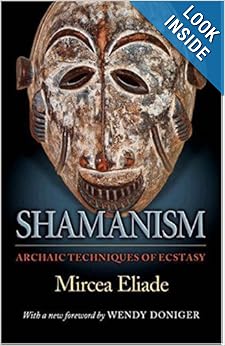
There are many works available that systematically explore the vicissitudes of initiation within tribal and so-called primitive or archaic cultures. At the forefront of the works that deal with this subject within archaic culture is Mircea Eliade's Rites and Symbols of Initiation, which covers the various functions which initiation can serve, and provides elaborate examples of all of them, from the shamanic process of rebirth to that of the men's rites whereby a boy becomes a man. Similarly, his tome Shamanism goes into even greater depth of the specifically shamanic current of the cultural trend of initiation, Though a sketch of these ideas will serve us in regard to dealing with the main issue of this chapter, I will avoid elaborate restatement for the sake of brevity. In fact, much of the picture I'm going to create for you is generalized: the point here is to cut to the heart of what initiation is, what the proposed "initiatory crisis" is in modern life, and explore issues tied directly to that. It is not to compare the slightly different practices of Tungus or Yakut shamans.
This impulse is not merely the need to belong to a social group, although that is one of its exogenetic outcroppings. Lying submerged under such conscious needs is its prefiguring function: to forge our being, almost like a tool, for a specific purpose. It is a tool that in equal amounts -- depending on the nature of the initiation -- indoctrinates and confers meaning and knowledge appropriate with that transformation. Regardless of the specifics, initiation is always a tool of psychological transformation.
For instance, one of the most common forms that the initiatory ceremony takes is that of the adolescent transformation. Before the ritual, whatever it might be, one exists in the world of childhood concern, and afterwards, the initiate is both individuated, in a specific, culturally prescribed manner, and consigned to the service of a particular role, offered by the symbolism of the ceremony. "Indoctrination" has a certain feeling-tone to many of us, especially in light of the dystopian future so many seem to predict and fear, but devoid of intent it is essentially neutral. Feral children are rarely able to be brought back into the fold, if found too late. On pg. 86 of Masks of God: Creative Mythology, Joseph Campbell has some very interesting things to say on this subject,
"The intent of old mythologies to integrate the individual into his group, to imprint on his mind the ideals of that group, to fashion him according to one or another orthodox stereotype, and to convert him thus into an absolutely dependable cliché, has become assumed in the modern world by an increasingly officious array of ostensibly permissive, but actually coercive, demythologized secular institutions. A new anxiety in relation to this development is now becoming evident, however, for with this increase, on one hand, of our efficiencies in mass indoctrination and, on the other, of our uniquely modern Occidental interest in the fostering of authentic individuals, there is dawning upon many a new and painful realization of the depth to which the imprints, stereotypes, and archetypes of the social sphere determined our personal sentiments, deeds, thoughts, and even capacities for experience."
There are actually several general types of initiation: those that arrange ones role in society, those that confer knowledge, and the similar but slightly unique phenomenon of shamanic initiations. However, they all share many things in common, so I will speak at times of all three, hopefully without causing too much confusion.
One can be transformed by way of initiation into a soldier, into a priest, or into most anything else that a culture dreams up not just as a profession but as a way of life. To really be a soldier one must be a soldier. Such ceremonies are only truly effective when they make such a shock on the organism that the psychology is quite literally transfigured. In these cases, the symbolism usually involves death and rebirth: death to the old life, and the birth of the new. This must occur for transference of roles and models to occur. In some cultures, children are ripped away from their parents, tortured, or otherwise terrified in the name of the transformation. A boy enters a cave a boy, and leaves a man. This is simply a matter of attaining the social status that accompanies such a transformation; they are enacted instead for the very real, long lasting psychological shift that must result for it to be truly called an "initiation." This comes along with the archaic recognition of the sacrifice: the need to lose in order to gain. Death and rebirth is the formula of initiation. We'll look at that more closely in a moment.
Such transfiguration can hardly be a possibility for most modern individuals. For one, we are already individuated, even at the expense of our own in-born needs. Our submission to the needs of the society tend to be more through the guise of necessary concessions -- "I must work this job to pay the bills" -- rather than such a conscious, concerted dedication of ones self to a role in life or society. The initiatory ceremonies that persist are, by and large, pale imitations of those that came before. Modern baptism does not truly re-consecrate the individual, neither does the bar mitzvah or induction ceremony when joining an academy or a new career. Strangely, the closest thing that most Americans experience to the adolescent initiation are the bastardized rites of the fraternity. Yet, though they may approach the extremes requisite for psychological transformation, these pranks are so devoid of effective symbolism that at best they can only hope to enhance a feeling of belonging to the group, which as we already discussed is a mere outcropping of the initiatory complex.
Though many are able to find "initiations" in their own experience, which mark the transition from one phase of life to another, we are as a whole stumbling about in the dark. Those of us willing to actively consecrate ourselves to a spiritual or social task may not feel this absence, but those psychologies which require the imposition of an external force to bring about this change are likely to be forever lost, adrift from situation to situation, ever struggling to find a truly elusive meaning or purpose. These are the very types who are most at risk for indoctrination in cults, in the military, etc. because that psychological need can be so great that it strangles out the voice of reason. Because of all of this, an initiatory formula more appropriate as a model for the "modern psyche" as a whole is the heroic or shamanistic initiation. (Although it isn't universal, one general distinction between the otherwise similar shamanistic and heroic initiations come in whether that quest is rendered internally, or externally. The hero has the symbols rendered upon the external world, the shaman, the interior. Yet, dealing as we are with symbols in either case, it is difficult to say if this distinction is a truly worthwhile one, and if there is, in the final evaluation, a distinction between the shaman and hero in this regard.)
Joseph Campbell was well aware of this, and dedicated a majority of his life to clothing this message in various forms and disseminating it. For this, he has received a lot of flak in the academic community, yet I would suggest that often the academic insistence on restraint is in fact a symptom of a form of creative sterility, which could never effect an initiation of any kind. In my humble opinion, we need more teachers like Joseph Campbell, and fewer scholars.
Be that as it may, the model of heroic or shamanistic initiation is more relevant because it is either willed by the individual, taken on as a task or a test, or it is conferred by the very energies of life -- one is thrust into the initiatory crisis and must either muddle through it, or drown. In the case of the shamanistic mode, it is well recognized that a psychological illness, or "otherness," is requisite. However, the shaman gains the title precisely because he has been rendered whole by the trials and ultimate re-consecration of the self as a shaman. In this way the shamanistic worldview and experience, though superficially similar to what we consider mental illness, is in fact its diametrical opposite. It might be considered no different than molding of the self into a policeman, soldier, etc. as but of course, in a sense it is - and in our society, it is an entirely moot point as we have no such profession, and no such societal role as "shaman." And while it is inarguable that all the mentally ill of our society are most certainly not would-be shamans who never gained the training and insight that would have made them beneficial members of society in their queer way, it is equally unlikely to say that none of them would.
Let's distill, or simplify, this initiatory formula as it relates to our exploration here: first, crisis and the plunge into the "sub-conscious," then self exploration, and ultimately self knowledge or mastery. The nature of the crisis differs from individual to individual, however the first two steps of this process are easiest to express as the ancient Greek aphorism: "know thyself."
For most, this is easier said than done. It has been acknowledged by many social scientists that most Westerners are almost neurotically afraid of self analysis. The inner world, to many of us, is a complete mystery, terrifying and absolute darkness. There are some of us, to be sure, who can't help but go spelunking in there, fewer still who live there all the time.
There are no absolute guides in this path, and without any sort of shamanic or heroic tradition, there are few true mentors or teachers. Psychologists of past generations began to open these doors, only to have them slammed shut when the institution, indeed the industry, went pharmaceutical. The experiential practitioners went private. Many went underground, and consequently we are forced to sort the wheat from the chaff by trial and error or word of mouth alone. Artists, too, are natural explorers of the interior psychological spaces, but in our mass market culture, many of them are forced to either pander to the outside, surface world of fashion and appearance, or languish in dark caves themselves. When an artist expresses psychological truths, they commonly seem to fall on deaf ears with an audience so obsessed with plot, action, and everything else external.
To many other cultures, this "fear of the mirror" is more than a psychological affliction: it is a spiritual one. It is a condition that shamans, yogis and the like have long served to help cure. Yet to the indigenous practitioners of these arts, how strange we must seem -- coming to their lands in khakis, asking for a brief tour of ourselves, so that we can return to the Village and tell our friends about our Ayahuasca visions over sushi. We obsess, and ask whether the contents of such visions could be "real." Cracking open our heads must be a true challenge for them when dealing with us. As a civilization, we have come so far in terms of capability in the outside world, and as a result have left ourselves far behind.
Thankfully, we needn't merely resort to the tribal method of shamanism: it is fairly likely that those songs and symbols no longer truly reach us, and if they do, it can have a regressive result. The true value is in the formula, which -- I know from personal experience -- can be effective and transformative without requiring a trip to the Amazon.
Another element of the shamanic initiatory formula is that ecstacy becomes a transformative tool, and in many ways fear becomes that which must be overcome, rather than a tool unto itself. Truly, many of the trials faced in this sort of initiation are terrifying; but in the shamanic mode, success, (in the form of transformation), is acquired through overcoming fear, whereas in many adolescent rites the fear is in fact the transformative force.
As we move into personal mythology, we will see some examples of how initiations can and do occur within even a culture such as ours, devoid of a singular mythic fabric or initiatory system. The fact is that this absence is also a great boon: we get to choose, to a far greater degree, what course to take. However, none are offered to us, and for the majority of us, we aren't even made aware that the possibility for such psychological transformation even exists. Without a tradition, without a social mechanism for training let alone sustaining the individuals that would keep such a tradition alive, we are all on our own; and more often than not it is the charlatans, motivated by personal greed or ego, that are the most likely to attempt to peck around the edges of the initiatory traditions of other cultures, in an attempt to further their own ends. Worse yet, others experiment with the pieces of these traditions that they can glean from National Geographic, with potentially dangerous results.
An example from my own life pops to mind the moment I say this. I was at a Psytrance Festival somewhere just outside of Pennsylvania. As many of these events are, it was a mashup of neo-hippy, trans-humanist, and other neo-this and post-that movements in music, art and culture; most with good intentions, and many (though not all) without any clear sense of where to go with those intentions. I noticed someone standing next to me had tribal scarring, all up and down his legs. So without thinking much about it, I asked him what tradition he had been initiated into: regardless of the specific culture, these scars are almost always a symbol of having gone from one stage of life to another, within the context of a particular tribe. He seemed confused, and then talked for many minutes about how much it hurt, and about how proud he was to have gone through that level of excruciating agony. "How did you change?" I asked. Again, he seemed perplexed, as if the question had never entered his mind. "The point of an initiation is that you come into it from one phase of life, and leave it another -- it's an external way of symbolizing an internal transformation," I said. Or something along those lines. He explained that he had done it because he had seen other people doing it, and he wanted to go through something that intense.
I can't think of a more clear example of the initiatory crisis now facing the youth of today. Yearning for intensity of experience, born from a culture that allows them more freedom than most other cultures in the history of mankind, and yet absolutely no idea to do with it, and no idea why they feel so damn listless. I say this not from a position of superiority but more, if anything, of understanding and pity. My friends and I were a great deal more likely to research what we were doing than most, but aside from a sort of intellectual predilection, we were subject to the exact same conundrum as we grew up in the suburbian haze of the United States in the 1990s. I can only imagine that the situation is worse, rather than better, today.
Initiation is directly connected to the primary phases of transformation in life. Some are arranged for by the society: marriage, for instance. But most of them are ongoing processes that are set in motion by forces far greater than ourselves. Death. Sex. The recapitulation of life through the cycles of time. These are the things that it attempts to put us back into accord with.
The dismemberment of the God or hero, and spreading of his remains into the water is a re-occurring theme in myths with an initiatory quality. We see it with Orpheus, torn asunder by Dionysus' Bacchante long after the relative failure of his journey into the underworld; we of course see it with Osiris, slain by his brother and re-assembled like some kind of Vegetative Frankenstein by his wife, Isis; we see echoes of it in the myth of Jesus on the Christ and his rebirth, and on, and on, and on. Entire books have been dedicated to exploring the subtle elements of these connections; it is sufficient to say that they are a common, indeed an essential, quality to the initiatory myth. So we can move forward and say why? What does it mean?
The initiatory ritual is an attempt to enter sacred time and space, to recapitulate the death and rebirth of personified by these symbols, so that we can attain a psychological unity ourselves. This is admittedly a very Jungian reading of the initiatory formula -- to Jung the purpose of psychotherapy is individuation and unity -- but in my experience this is the right, which is to say the most useful, reading of these myths. In a successful initiation, the elements of the ritual reference events within ones own life; that of the dismemberment of the animal nature or ego, a hope for rebirth through redemption from those "binding" forces, the demons that we cling to, which keep us stuck in the "karmic rung" that we presently exist within.
This brings some of the ideas from the Bardo Thodal, the Tibetan Book of the Dead, to play. This book was ostensibly written as something to be read as an individual lies dying, to help them let go of their attachments to this world and ascend to the plane most properly aligned with their own psychological stage of development. I do not challenge this interpretation, but offer that it is an ongoing process. That is, it isn't limited just to a death and dying process, unless if you want to take the step and say that all of our life is a process of letting go of attachments, until that point when they are ripped from us if we haven't yet learned to live with them without clinging. The initiation attempts to prepare us for this -- it attempts us to recognize our true condition in life as transient beings, to let go, open up, and hopefully experience some of the true bliss and joy that is only allowed to the Gods simply because they are not tethered to the world of the senses which we, falsely, think of as the totality of the world. Far from forcing us to renounce these things, a successful initiation attempts to allow us to live with them without being controlled by them, and to be able to see beyond them. There is only so much that can be said about this because words simply aren't powerful enough to create the break necessary to truly come to this realization. Thus, the need for initiation.
Some paths attempt to steer us along a more ascetic path of renunciation, but I believe this is more because they simply feel that we are not strong enough to take the other path -- the path of initiation and moksha within the world, whether through the "blissful participation in the sorrows of the world" of a Bodhi-Satva path, the extremism of the Aghori's, or really any other path which allows an individual to attain liberation from the world while remaining within it. This smacks somewhat of the Zen koan, "How do you get the goose out of the bottle?" (An example of this can be found in The Book of Serenity, translated by Thomas Cleary, Lindisfarne 1990, case 91: "Nanquan's Peony." However, it is an oft repeated koan.) How can we be liberated from the elements of participation in the world that bind us to it, without simply renouncing it? A question worthy of consideration, and one that is more connected to initiation than most might at first assume -- but certainly not a question that can be answered in an essay!
Moving on, the exact meaning of the death and rebirth symbol is disputable, and thus the nature of this redemption differs somewhat from tradition to tradition. It is mutable. In the standard Christian interpretation that we are familiar with, it is a redemption in the hereafter, as these symbols are taken more or less as signs of historic facts. Heaven is a place that will happen at a specific time. In the mythology of Dionysus, the dismemberment occurs to Pentheus at the hands of the Bacchante. (And to Orpheus as well, at another point.) Pentheus, being the stand-in for the patriarchal, domineering, male ego, the dismemberment can be interpreted as the conflict between the systems of the mind and the needs and energies of the body. When the mind comes out of accord with the body, when it insists, like Yahweh, that "I AM IT," the other organs revolt. The sword turns upon itself.
Without going through a case-by-case analysis, an overview of Gnostic and Orphic cults demonstrate that the death and rebirth occurs in a series of ritualized stages which are meant to bring the neophyte into contact with his eternal nature. The same is seen in Masonic rituals and symbolism, and in fact most of the rituals that have become the core of Western Esotericism. Yet again, a side-by-side comparison of the variety of initiatory rights presented by the several thousand years of history which runs, either broken or unbroken, from ancient Egyptian mystery schools to the present would lead us very far off task, even though it is precisely what most scholars would insist that we do.
A single example of the rites of Eleusis is given in Arkon Daraul's History of Secret Societies which serves as a good model of what might occur at such an event,
"...the candidate had to undergo fasting and abstinence from certain foods. There were processions, with sacred statues carried from Athens to Eleusis. Those who were initiated waited for long periods of time outside the hall in the temple where the rites were being held. Eventually a torchbearer led them within the precincts. The ceremonies included a ritualistic meal; one or two dramas; the exhibition of sacred objects; the ‘giving of the word'; an address by the hierophant; and oddly enough, closure with the Sanskrit words ‘Cansha om pacsha.' The elements included the clashing of cymbals, tensions and a certain degree of debilitation, eating something, plus conditions which were awe-inspiring, strange. The candidate was in the hands of, and guided by, the priesthood. Other factors were: drinking a soporific drought; symbolic sentence of death; whirling in a circle... The effect of certain experiences was a carefully worked program of mind training which is familiar in modern times as that which is used in certain totalitarian states to ‘condition' or reshape the thinking of an individual... This process produces a state in which the mind is pliant enough to have certain ideas implanted: ideas which resist a great deal of counter-influence... the orgiastic side of the mysteries, too, has a place in the sphere of psychology. The catharsis which the secret cult of the Cathari experienced after ecstasy is paralleled by the modern therapist's procedure in bringing his patient to a state of excitement and collapse before implanting what he considers to be more suitable ideas into his mind."
Rather than belabor the comparison of various initiation practices, I want to help you cut to the quick in regard to the function and apparent cultural necessity of initiation. Just a few examples will do. In the myth of Orpheus, he is slain by the women of Dionysus. As the tale relates, his head, severed from his body, floats away to sea, still singing. Much could be made of this symbolically, as we think of Orpheus, patron of the artists, who attempted to resurrect the past (his beloved Euridyce) with his art, destroyed by women that serve a divinity who in many ways is a symbol of the present; the head, the rational function, floating off downstream, into the water, the unconscious, still singing... However, the point of initiation is experience, not analysis. One cannot know what the symbol refers to without having lived through it, at least in ritualized form, and only if the ritual was actually successful at creating the psychological shock or arrest necessary to generate the kind of intense experience we need to truly begin anew. The symbols are guides, but they won't take us there alone.
There's another element of death and dying worthy of considering in light of myths of initiation. Death is forgetting. A central motive in myth-making is the creation of meaning that counters both the meaninglessness of boundless existence, (literally existing without meaning, not as a reaction to meaning), and also the forgetfulness which is a symptom of the passage of time, of entropy -- death, which reduces the very edifices of meaning recollection to ash. Myth is an agent of an-entropy, all myth-making is in some sense heroic and Promethean, though perhaps also in the long run ultimately futile, as boundless existence and endless time is a realm where the eternal continuity of thought and meaning itself seems unthinkable. Initiation seeks to deal with this very dilemma, whether it is through a participation with what are seen as eternal principles, becoming a member of a sacred or immortal brotherhood (or, more rarely, sisterhood), or any of the other countless examples of secret society or mystical rite initiations that claim to provide experiential knowledge of immortal life. It is not surprising that, for instance, Hermes in his role as psychopomp is a very common image within the Greek-influenced Gnostic mysteries. (A psychopomp is a mediator or guide between the realms below and those above, which is to say, between consciousness and the unconscious, between life and death, and so on. Shamans, in their role as initiators, are psychopomps themselves.)
There are two general paths one may take to bring about this kind of experience. These opposites are fear / abstinence, and pleasure / excess, presented alongside symbolic representations of the transformation that is taking place. These methods of excess or trial are used to bring the mind, and the energies of the body as well, into direct contact with those energies referred to by the symbols. The symbols in themselves are powerless to create this change, and so we see so many devotees of traditions, as well as academics of these subjects who haven't at all opened themselves up to the references, at which point it seems almost a futile joke. Mythic symbols are only meaningful when they are connected with, not when they are collected and annotated, and the powers they represent are only powers at all if they are unleashed through that connection.
Of course, there are many levels of cultural difference between even the camps that might be seen as more less the same; for example, as Eliade comments on pg. 388 of Shamanism, "The Dionysiac mystical current appears to have a completely different structure; Bacchic enthusiasm does not resemble shamanic ecstacy." However, Eliade's comment relates more towards distinguishing variants of shamanistic practice, rather than identifying the initiatory complex as a whole. It remains fact that the dual current to initiation remains fear, pain, and or abstinence on one hand, and pleasure, ecstacy, and other forms of sensory overload on the other.
A powerful initiation allows us access to a new model of the world which may, based on our intentions and character, be experienced as heaven or hell. These are the kinds of experiences that most mythic artists I know work so very hard to bring about in a public that have been so trained to experience art with a sense of distance, that even the most extreme shock techniques often no longer work. It is somewhat ironic that, while the tools available to create these kind of mythic experiences nowadays certainly outpace the simple drug and light show of the Greek oracles, for instance, it is far more difficult to actually bring about some kind of psychological transformation in an audience fixated so firmly in the "myths of modernity" that we will be looking at in a moment. The challenge of creating such a personal experience in the audience remains the biggest challenge to artists such as myself, those that I regularly work with, and the many other thousands of mythic artists world-wide. It is my present opinion that sometimes what cannot be accomplished with a sledgehammer may be arrived at with a tuning hammer. But time will tell.
Rather than belabor the symbolic intricacies of rituals in times past, I would like to take a look at a movie that came out over a decade ago now that used the Bardo Thodal, and the interpretation of initiation that I've been talking about, to create an experience that was, in my opinion, a perfect example of what I am talking about here. To the general public it was a horror movie, that made them feel uncomfortable in a way they couldn't quite place. And to those a little more familiar with psychological symbols and the idea of non-linear narrative, it was something much more: a road-map of the final, eternal moments of all of our lives, and how an understanding of that can help us really appreciate just how vital, and just how fragile our e-ternal moment here on Earth truly is. The movie I'm referring to is Jacob's Ladder.