Showing posts with label delusions. Show all posts

Sunday, November 02, 2014

Is Modern Culture Making Us Crazier?

From The New Republic, author and psychologist Martha Stout (The Sociopath Next Door, The Myth of Sanity, The Paranoia Switch) reviews the new book from brothers Joel and Ian Gold, Suspicious Minds: How Culture Shapes Madness.

This looks like an excellent and important book - we too often neglect the cultural context of "madness."

Is Modern Culture Making Us Crazier?

The science behind America's deepening disturbance


By Martha Stout
July 31, 2014 | The New Republic

A young friend recently shared with me her experience of being stopped by the police on an otherwise uneventful Tuesday morning. With one arm protectively wrapped around her shoulder bag because it had a broken latch, she’d been walking along a city street. Unbeknownst to her at the time, a shooting had occurred the previous day in the same neighborhood. Three police officers, two male and one female, approached her. They demanded to know whether she had a gun under her arm, took her bag from her, and looked inside. No gun. They checked her identification. No record. (As far as I know, this young woman hasn’t so much as a traffic ticket.) She was completely cooperative throughout.

The female officer then patted her down, which my friend said she tolerated by deliberately becoming a little dissociative—“spacing out”—until the stranger’s hands finally finished their journey over her body. Then, though there was no gun in it, the two male officers decided to search her shoulder bag again, item by item. Riffling through her wallet, they found a condom, and that discovery grabbed their attention.

“Oh look. We’ve got a young slut here,” said one, waving the condom. All three officers laughed.

My friend, very scared by now, said nothing.

Finally, they let her go. As she walked away, the female officer called after her, “Guess you came here ready to fuck anyone you wanted to, didn’t you?”

I find this officer’s parting salvo grimacingly ironic.

These days, mind-spinning stories of misogyny assail us from all over our country, and indeed, this account is hardly the worst. But knowing the victim personally, and understanding that she will carry the hateful essence of this ridicule with her for a long time to come, I was especially saddened. And for me, one of the most disheartening features of this incident was the fact that the young woman who endured it was not even taken aback. Far from being shocked and outraged, she was not even surprised. When I asked her about her reaction, she explained, “I was very upset, but no, I wasn’t surprised. If you walk around alone, you kind of expect this sort of thing to happen. It’s really only a matter of time.”

Is this frightening belief about the world a symptom of paranoia on her part? And, as the old saw goes, are you paranoid when they’re really out to get you? Most of her twenty-something years have been spent in a nation beset by furious cultural and political forces on a course to push back the legal standing and social status of women by half a century. As but two illustrations, there are Supreme Court actions such as the recent Hobby Lobby ruling and state-level abortion-restriction laws that are designed to make certain of women’s medical procedures as costly and humiliating as possible.

How much of an influence has the traumatized and reactive culture of a post-September 11 United States had on the mental status of this young citizen—and for that matter, on the mental status of the police officers who bullied her? And in general, how much, and in what ways, do events in the wider world affect our individual personalities? Societal factors clearly influence our observable behavior—what we will and won’t do in public on a day-to-day basis—but can societal, cultural, political, and even technological factors soak into our very psyches, infiltrate our inner cores and make lasting changes to who we are? This is a fascinating and in some cases alarming question, and is the basis of Joel and Ian Gold’s book, Suspicious Minds: How Culture Shapes Madness.


Suspicious Minds: How Culture Shapes Madness,
by Joel Gold and Ian Gold. Free Press.

Joel Gold, MD, Clinical Associate Professor of Psychiatry at the NYU School of Medicine, and his brother, Ian Gold, Ph.D., Associate Professor of Philosophy and Psychiatry at McGill University, discuss a number of psychotic patients who all have the same delusion—that the people in their lives are acting out a script, much like the family and friends of Jim Carrey’s character in the 1998 movie, The Truman Show. Juxtaposing recent research on schizophrenia with page-turning case studies of these paranoid patients, the Golds argue that psychotic delusions (not to mention mesmeric movie plots) are the result of interactions between the brain and the sociocultural world, and they bring to light the discipline-altering fact that culture has a role to play in the development of psychopathology generally.

If you happen not to be a psychiatrist or a psychologist, you might reasonably imagine that mental health professionals have written many other books on this crucial and intriguing question: Can zeitgeist have an enduring negative effect on the individual psyche? But the startling fact is that most of the relevant scholarly writings by psychopathologists are quite new (post-2001), and discussions for nonprofessionals are rare. Over the past 40 years or so, psychology has attempted to divvy up the causes of pathological conditions between two now-famous categories, “nature” (as transmitted genetically) and “nurture” (environmental influences). For various psychopathologies, including paranoid schizophrenia, and also normal “personality traits” (introversion/extraversion, conservatism/liberalism, rigidity/adaptability, and several dozen more), research has yielded remarkably consistent results, indicating that these differences among human beings are accounted for by genetic and environmental factors in more or less equal measure, with genetics sometimes edging out environment by a point or two (51 versus 49 percent, in some instances). This research has been indispensable to our growing appreciation of the role of genetics both in normal personality and in the mental illnesses.

Contrastingly, our conception of environmental influences has been biased and narrow. We have tended to think of “nurture” only in the familial sense: In mental health research, “environment” tends to mean child-rearing factors, which is to say the personalities and actions of parents and, to a lesser degree, siblings. That an individual’s personality or mental illness might be affected by environmental factors outside the home has been largely overlooked. Take the study of sociopathy, which is another profound form of psychopathology—this one characterized not by delusions but by the complete absence of conscience. Research indicates that the factors involved in sociopathy, like those in many other mental illnesses, are about 50 percent genetic and 50 percent environmental. But researchers have been perplexed because they have been unable to find specific child-rearing variables that would consistently account for the environment’s half in cultivating sociopaths. I maintain (in my book The Sociopath Next Door) that this half consists primarily of larger societal factors, and this idea would seem to be supported by the fact that the incidence of diagnosed sociopathy is significantly lower in certain East Asian countries (most notably Taiwan and Japan) than in North America. It seems likely that, in the United States especially, any genetic predisposition to sociopathy will be nurtured and shaped by a single-mindedly competitive and individualistic culture that regards “winning” and domination as the ultimate goods.

Why have psychologists who study pathology tried to divide up the causality universe between inborn tendencies and the family environment, and turned a mostly blind eye to influences from the wider world? One answer is that a cultural hypothesis frustrates prevention: Though correcting the child-rearing practices of a large group of people would be a tall order, setting out to alter the entrenched belief systems of an entire society is even more daunting and might eventually involve taking a political stance, something many clinical psychologists and psychiatrists are loathe to do.

Gold and Gold make it clear that psychiatry is dispensing with the possibility of cultural factors in mental disorder even more summarily than psychology has done. They write, “The social world is at the heart of our theory of delusions, and this puts us at odds with much of mainstream psychiatry.” Mental illness, they explain, “at least severe mental illness—is nothing more than genetic and neural dysfunction,” according to psychiatric dogma. They point to the large and growing number of psychiatrists who aspire to understand and treat mental disorders as brain disorders, and convincingly illuminate the losses that psychiatry may suffer on account of this new reductionism.

The central argument in Suspicious Minds derives from the increasingly accepted “social brain hypothesis,” the idea that the primary function of enlarged primate (and therefore human) brains is to deal with the cognitive challenges of living in groups. In reference to paranoid disorders in particular, Gold and Gold ask the question—“What sort of cognitive system is required to enable one to be sensitive to social threats?” In answer, they propose that the human brain contains an adaptive “Suspicion System,” which is “the solution that evolution came up with to enable us to pick up evidence of infidelity and other social threats for the purpose of early detection and defense.” In other words, courtesy of natural selection, we are all biologically prepared to be leery. They hypothesize that a healthy Suspicion System makes social life safer through “heightened responses to subtle, uncertain, and ambiguous signs of social danger,” but that a malfunctioning or overloaded Suspicion System “will sound the alarm without good reason and detect evidence poorly—that is, see malign intent where there is none.” Over time, an overreactive Suspicion System may inaugurate “an idiosyncratic belief that is firmly maintained despite rational argument or evidence to the contrary”—i.e., a paranoid delusion. The authors point out that the persecutory delusions of clinical paranoia are by far the most prevalent form of delusion the world over.


Paramount Pictures

The delusions of psychotic patients—that their lives are scripted, and that their friends are mere actors—recall the plot of The Truman Show.

Gold and Gold conclude that the “Truman Show delusions” of their paranoid patients express those patients’ fears of being controlled by what other people know about them: “Truman Show is a delusion of control in the age of surveillance.” They declare, “Reductionism in psychiatry constrains theory to operate within the skull or the skin. Our bet is that the outside world is going to matter as well.”

Suspicious Minds is a contrarian, insightful, and important book. Gold and Gold do not take on the more politically involved and incendiary aspects of our society, such as run-amok individualism—or the abuse of power and the national upsurge in misogyny that plagued my young friend on that demoralizing Tuesday morning. Nonetheless, their analysis of culture-linked paranoia comprises an effective argument that our seemingly endless struggle to align our society with our more enlightened ideals may be a fight for our very minds.


~ Martha Stout, Ph.D., is the author of The Myth of Sanity: Divided Consciousness and the Promise of Awareness, The Paranoia Switch: How Terror Rewires Our Brains and Reshapes Our Behavior--and How We Can Reclaim Our Courage, The Sociopath Next Door, and an upcoming book, The Sociopath Files.

Monday, October 27, 2014

Ann Reitan - Psychotherapy for Paranoid Schizophrenia

http://www.psychologynoteshq.com/wp-content/uploads/2012/09/paranoidschizophrenia-550x380.jpg

Interesting that this was posted today. A friend on Facebook who is in school to become a psychotherapist asked about the difference between how schizophrenia is viewed in France (where he is) and in America, and whether or not it can be cured. In France schizophrenia is an issue that can be treated successfully with psychotherapy; in America it is a chronic illness likely to last for the remainder of one's life.

I left this comment (edited for privacy and for clarity, because, you know, Facebook):
A BIG pile of research has shown that schizophrenia is a chronic illness in the U.S., but it often lasts less than 10-15 years in other parts of the world, meaning it can be cured.

I think there are two reasons for this: (1) the medications we administer here don't allow the person to go through the experience and heal, (2) U.S. culture defines schizophrenia as a chronic disease, which shapes how it is experienced, while other parts of the world see it much differently, sometimes as a calling to be a healer (Mircea Eliade noted this among various shamanic cultures).
Research suggests that 70-80% of those with schizophrenia have clear trauma histories (for schizophrenia, neglect and/or emotional abandonment are the most common antecedent traumas). There are other factors as well, including failed attachment, exposure to toxins in utero, hormonal irregularities, and so on.
In my opinion, the majority of psychoses are more clearly conceptualized as extreme dissociation - not dissociating from thoughts, or feelings, or ego states, or memories, but dissociating from one's life in whole. In this model, life becomes so intolerable for the individual that s/he dissociates from their actual life and into an unconsciously generated reality where they might have a different identity, a different family, where they might become so important (compensating for feeling entirely worthless) that their thoughts and actions are being monitored and recorded.

The key to healing this split, in my opinion, is getting the client to feel the feelings of pain and loss that made life so unbearable. In psychoses, the affect of the individual is flat or blunted and there is no expression of affective states (in general, not always).

The article below suggests some other strategies based in cognitive-relational psychotherapy, in other words, CBT with the therapist showing empathy and communicating his or her subjective experience.

Psychotherapy for Paranoid Schizophrenia


shutterstock_129044909

Often psychotherapy is not considered to be effective with individuals dealing with schizophrenia spectrum disorders. But a cognitive-relational psychotherapy approach helps form a warm, trusting and detached relationship, conveys an understanding and concern for one’s client, and involves the therapist telling that individual their own empathic views about what that individual is dealing with.

Often clinicians assume that psychotherapy does not work well with persons manifesting what are called “thought disorders” – conceived to be irrational, unrealistic and factually inaccurate. Again, clinicians fail to understand, empathically, the circumstances of the psychotic individual. It should be noted that schizophrenics deal with non-normative experience that, in terms of hallucinations, is visceral in nature. This experience entrenches them in delusions based on hallucinations that are highly convincing.

One idea that may help schizophrenics is reflected in this line from a poem I wrote: “May you walk beyond the empty sudden blindness of existence.” To schizophrenics in crisis and even those not in crisis, the future may seem to be extremely uncertain and perhaps treacherous. They may perceive both the mental and the material worlds as incredibly dangerous. And in many ways, they are dangerous, due to the amount of suffering experienced by the paranoid schizophrenic that seems to her to be inflicted on her by these worlds.

No knowledge about knowledge
A non-epistemological stance regarding no knowledge about knowledge may help a schizophrenic replace her delusions. Essentially, the non-epistemological view represents deconstruction of knowledge with an assertion that relies on the fact that all “knowledge” is subjective. While schizophrenics have subjective views regarding their own knowledge, and although this may be communicated to them, they may be able to understand, in a similar sense, that nobody really has any kind of certain knowledge.

In terms of non-epistemology, it may not be possible to live in the world on these terms. Moreover, it may not be possible to tolerate an awareness that anything may happen to us at any time that will catapult us into crisis. The sudden death of a loved one may be an example of this.

Typically, we reside in faith that things will go normally and as planned, and they generally do so. However, the schizophrenic lacks such faith. If the therapist can communicate to the schizophrenic that she should try to get as comfortable as possible with simply “not knowing,” this may help the schizophrenic. There is a basis for “not knowing” that corresponds to everyone’s subjective experiences of the world, and this is reflected in all individuals’ perspectives on the mental and the material worlds. Realistically, it might be more threatening to the schizophrenic to “not know”, as opposed to clasping her delusional beliefs.

In terms of addressing the idea of “not knowing” with the paranoid schizophrenic, the psychotherapist may say the following: “Nobody knows what the future may bring. If you buy a lottery ticket, even if the chances are small, you may win the lottery. If you have sex, even with birth control, you may become a parent. Most events in are life happen by chance. You don’t really know what will happen, even if you fear with certainty that bad things will happen to you. Your condition of schizophrenia really causes you to suffer mostly because of your fear of bad things happening to you, rather than these things actually happening to you. Maybe the thing you should fear in your life is the fear itself. By realizing that you do not know what the future will bring, you may feel safer.”

Context matters?

Another aspect of dealing with schizophrenia is encompassed in the idea, stated by Ralph Ellison in The Invisible Man: “If you don’t know where you are, you don’t know who you are.”

This statement implies that one needs to know her context in order to know her self and her identity. Often schizophrenics fail to know their contexts. They have confused and distorted ideas about context, based on the fact that their contexts, in their minds as well as in the material world, may reflect delusions and hallucinations. This leads to ambiguity as perceived by the schizophrenic in her mental and material environments as threatening, simply because the schizophrenic may be dealing with non-normative experience.

The clinician may convey to the schizophrenic the idea of not knowing her context by stating: “It’s hard to know what you think of yourself when you don’t really know what you are dealing with in the world. This may be what causes you to be afraid of the world. And this means that you are afraid of both your voices in your mind, (for example), and the people outside in the world.”

The schizophrenic may adhere to her delusional beliefs due to the fact that she, as well as virtually everyone else in the world, thinks that knowing one’s context allows them to be safer than they would be if they did not “know what they know”, even when “knowing what they know” may be delusional. Again, the assertion that the client does not really know what her worlds signify can replace delusional ideas.

One way of communicating this idea to a paranoid schizophrenic would be constituted by saying: “You might think that being a schizophrenic makes people prejudiced towards you, and it may, but also the world we live in makes you into a schizophrenic. Your context in the world – and how the world views you – may be determined by the situation that you are in. You may believe that this is false, that you really know more than other people about the world, but you still do not know what you are in the world, perhaps because believing you are schizophrenic may be unacceptable and may not make sense to you. Nevertheless, you do not know for certain what the world is. That is why it is scary. And you don’t know who and what you really are, because you may believe one thing and others believe differently.”

Treating life as normal

Another idea for dealing with hallucinations and delusions stems from a novel by Carrie Fisher, Postcards from the Edge, which states the idea that: “Perhaps if we treat life as normal, a sense of normalcy will follow.”

This idea is highly salient to dealing with one’s hallucinations and delusions. The schizophrenic may be perhaps traumatized by her experience, but treating life as normal may lead to a gradually acquired feeling of safety.

The idea embedded in this statement from Fisher reflects the advantages of the act of challenging the delusions of a schizophrenic by the schizophrenic. Living one’s life normally in terms of habits and faith in the normative view of reality may allow the schizophrenic to experience the decay of her fears, her paranoia and her delusions. Not obsessing about one’s hallucinations and delusions, by trusting life to proceed normally, combats the punitive experience of schizophrenia and paranoid schizophrenia, in particular.

It should be noted that the ideas contained within this article represent an intellectualized framework of how the clinician or the psychotherapist may approach therapy with a paranoid schizophrenic. They may also be applicable to those who are high functioning, but may be suffering to an extreme extent.

A belief in the scientific bases for the effectiveness of psychiatric medications may be a belief that can be cultivated or even spontaneously adhered to by the schizophrenic. Nevertheless, non-normative experience may lead to non-normative thought, and the deep communication by an empathic therapist who is able to accurately imagine and recapitulate to the schizophrenic what she is dealing with may be in some sense curative.

I have applied these ideas to psychotherapy with paranoid schizophrenics with some success. One client, a paranoid schizophrenic, was struck by the idea that “if you don’t know where you are, you don’t know who you are.” She asked for a restatement of that idea based upon the connection she had established with it. Another schizophrenic stated humorously that he wanted to write a book entitled, The Fallacy of Truth.” He was able to understand a non-epistemological stance. Lastly, one client tried diligently to treat her life as normal and routine even though she was hyper-vigilant and paranoid. The trauma that she experienced precluded her from entirely benefiting from this perspective, but she became extremely high functioning.

Overall, these ideas for psychotherapy, from a cognitive relational perspective, may be of some help to some people, especially paranoid schizophrenics. However, it should be noted that the different types of schizophrenia may correspond with different interventions and treatment.

Image via Diez Artwork / Shutterstock.

Wednesday, March 19, 2014

George Atwood - The Abyss of Madness

[NOTE: I originally posted this in August of 2012. However, I am seeing clients who would fall into the definition Atwood uses for "madness."]


I am reading George Atwood's The Abyss of Madness (Psychoanalytic Inquiry Book Series) (2011) as part of an intersubjective, relational psychoanalytic study group I have been a part of for the last two and a half years. Aside from a few essays, this is is the first work I have read that is specifically Atwood's own thinking (most of the other books he had co-authored with Robert Stolorow).

Here is the description of the book from Amazon:
Despite the many ways in which the so-called psychoses can become manifest, they are ultimately human events arising out of human contexts. As such, they can be understood in an intersubjective manner, removing the stigmatizing boundary between madness and sanity. Utilizing the post-Cartesian psychoanalytic approach of phenomenological contextualism, as well as almost 50 years of clinical experience, George Atwood presents detailed case studies depicting individuals in crisis and the successes and failures that occurred in their treatment. Topics range from depression to schizophrenia, bipolar disorder to dreams, dissociative states to suicidality. Throughout is an emphasis on the underlying essence of humanity demonstrated in even the most extreme cases of psychological and emotional disturbance, and both the surprising highs and tragic lows of the search for the inner truth of a life – that of the analyst as well as the patient.
I very much like the way he conceptualizes these issues, even when I do not agree with his perspective on the mind. The way he talks about mental illness feels right in terms of how the client experiences it, and in the relational/intersubjective model, meeting the client in his or her own reality is essential.

When he speaks of madness in these passages, he is referring to psychosis and schizophrenia, or even bipolar disorder in its manic stage. These are not cases of simple depression, although there is certainly some similarity at a much lower intensity. And all these terms are things that he rejects as scientific defense mechanisms against our own fears of the abyss and what that means for our shared sense of being human.

It's worth bearing in mind that the psychoanalytic school refused to treat the "psychotics" for decades following Freud based on his assumption that they were not amenable to treatment. Harry Stack Sullivan, in the late 1920s, was one of the first psychoanalytically trained therapists to work with schizophrenics, and he did so based on his "problems with living" definition of mental illness. Sullivan was also one of the first psychoanalysts to focus on the "self system" as the outcome of relational patterns in the child's life (eventually giving rise to attachment theory). Atwood is definitely a lineage holder in the tradition Sullivan created that has been expanded upon by Stolorow, Donna Orange, and others.

Here a few quotes that I have highlighted in the text that I think are illustrative of his thinking.
Phenomenologically, going mad is a matter of the fragmentation of the soul, of a fall into nonbeing, of becoming subject to a sense of erasure and annihilation. The fall into the abyss of madness, when it occurs, is felt as something infinite and eternal. One falls away, limitlessly, from being itself,  into utter nonbeing.  (p. 40)

* * * *

Madness is not an illness, and it is not a disorder. Madness is the abyss. It is the experience of utter annihilation. Calling it a disease and distinguishing its forms, arranging its manifestations in carefully assembled lists and charts, creating scientific-sounding pseudo-explanations for it--all of these are intellectually indefensible, and I think they occur because of the terror. What is the terror I am speaking of? It is the terror of madness itself, which is the anxiety that one may fall into nonbeing.

The abyss lies on or just beyond the horizon of every person's world, and there is nothing more frightening. Even death does not hold a terror for us comparable to the one associated with the abyss. (p. 41)
He suggests that death offers a potential reunion with loved ones, or conversely, a release or relief from the sorrows and pains of our lives. We can rage against the dying of the light, or marvel at our capacity to contemplate our own demise, or even imagine the world without us.

But the descent into madness, into the abyss, offers no such relief.
It is the end of all possible responses and meanings, the erasure of a world in which there is anything coherent to respond to, the melting away of anyone to engage in a response. It is much more scary than death, and this proven by the fact that people in fear of annihilation--the terror of madness--so often commit suicide rather than continue with it. (p. 42)

* * * *

People often fall not because the bad happens, but rather because the good stops happening. Sanity is sustained by a network of validating, affirming connections that exist in a person's life: connections to other beings. If those connections fail, one falls. The beings on whom one relies include, obviously, other people, sometimes animals, often beings known only through memory and creative imagination. It some instances it is the connection to God that protects a person against madness. Strip any person of his or her sustaining links to others, and that person falls. No one is immune, because madness is a possibility of every human life. (p. 43)

* * * *

What a person in the grip of annihilation needs, above all else, is someone's understanding of the horror, which will include a human response assisting in the journey back to some sort of psychological survival. A person undergoing an experience of the total meltdown of the universe, when told that his or her suffering stems from a mental illness, will generally feel confused, invalidated, and undermined. Because there are no resources to fight against such a view, its power will have a petrifying effect on subjectivity and deepen the fall into the abyss. (p. 45)
Atwood contends that an objectified psychiatric diagnosis is the antithesis of what is needed - essentially mirroring and validation. He offers a thought experiment: Imagine a young man, maybe in his early 20s, who is in the midst of a fall into the abyss. This young man finds himself committed to an in-patient psych ward where he is given the diagnosis of a brain disease called schizophrenia.
The annihilating impact of such a view then becomes symbolized in the patient's unfolding experience that vicious, destructive voices are speaking to him over invisible wires and saying repeatedly that he should die. In this way a spiraling effect occurs, wherein the operation of the medical model further injures the already devastated patient, whose reactions to the new injuries in turn reconfirm the correctness of the diagnosis. (p. 45-46)
He prefers to be with the client in whatever space they inhabit, to show them that he is listening and trying to comprehend their experiences as much as he is able - and, above all else, that he is prepared to do whatever is necessary to help.

I have had clients in the past who I felt unable to help, because I was unable to be with them in their abyss, to extend my empathy into what I experiences as their delusional states. I failed them. Even as I sat with them and tried to understand what they were telling me, I did not understand that their delusions were their psychic organizing principles, were their symbolic truth of how the world has betrayed them.

Atwood, in the many case studies he presents, is revealed as someone who can feel into the annihilation his clients present him with, but he also acknowledges how challenging it is:
Working in the territory of annihilated souls is never easy. To really listen to someone, anyone, to hear the depth of what he or she may have felt, to work one's way into realms of experience never before perceived by anyone and therefore never articulated--all of this is as hard a task as one may undertake. (p. 51)
It is indeed. And it is also rewarding when the therapist can do so successfully and allow the client to feel heard and validated - maybe for the first tine in their lives.

I want to wrap up this post with a few more passages that deal with etiology. I posted some thoughts recently on a more relationally based diagnostic manual for counselors and therapists - Atwood conceptualizes cases in a way that fits with what I would like to see.
Those who feel they are not present, and who affirm the existence of machine that controls their minds and bodies, are often the products of profound enmeshment with their caregivers in childhood. An accommodation has taken place at a very young age in which the agenda of the caregiver--it can be the mother, the father, or both--becomes the supreme principle defining the child's developing sense of personal identity. The experience of the child as an independent person in his or her own right is nullified, so that they child the parents wish for can be brought into being. Very often thee are no outward signs of anything amiss, as family life unfolds in a seeming harmony. Somewhere along the way, however , the false self begins to crumble, and a sense of the degree to which the child has been absent from life arises. This emerging sense of never having been there, of having been controlled and regulated by outside forces, is so unstable and fragmentary that it is given concrete form. What is seen from the viewpoint of others as a delusion then begins to crystallize, for example in the image of an influencing machine (Tausk, 1917; Orange et al., 1997, chap. 4). Within the world of the child, now perhaps chronologically an adult, the so-called delusion is a carrier of truth that has up until then been entirely hidden and erased. What looks like a breakdown into psychosis and delusion thus may represent an attempted breakthrough, but the inchoate "I" does require an understanding and responsive "Thou" in order to have a chance to consolidate itself. (p. 60-61)
 That last sentence is the essence of the relational model - we are relational beings, the damage to our sense of self that we experience is nearly always relational, and if there is to be healing of that damage, that too much be relational - it requires mirroring, validation, and the sense of human connection that is vital to sanity for all of us.

Sunday, March 16, 2014

The Itch Nobody Can Scratch - Disease or Psychosis?

In this lengthy by riveting article from Matter, Will Storr investigates morgellons, a syndrome that is either a terribly infectious disease involving itching and lesions, or it is a form of psychosis called delusions of parasitosis (DOP). Storr is the author of The Unpersuadables: Adventures with the Enemies of Science (2014), from which this is an excerpt.

The itch nobody can scratch

A new disease is plaguing thousands, but experts are in conflict over its origins—and whether it exists at all.

Will Storr in Matter

IT BEGAN THE WAY IT SO OFTEN BEGINS, so those that tell of it say: with an explosion of crawling, itching and biting, his skin suddenly alive, roaring, teeming, inhabited. A metropolis of activity on his body.

This is not what fifty-five-year-old IT executives from Birmingham expect to happen to them on fly-drive breaks to New England. But there it was and there he was, in an out-of-town multiscreen cinema in a mall somewhere near Boston, writhing, scratching, rubbing, cursing. His legs, arms, torso — God, it was everywhere. He tried not to disturb his wife and two sons as they gazed up, obliviously, at Harry Potter and the Order of the Phoenix. It must be fleas, he decided. Fleas in the seat.

That night, in his hotel, Paul could not sleep.

“You’re crazy, Dad,” said the boys.

It must be ticks, mites, something like that. But none of the creams worked, nor the sprays. Within days, odd marks began to appear, in the areas where his skin was soft. Red ones. Little round things, raised from his skin. Paul ran his fingertips gently over them. There was something growing inside them, like splinters or spines. He could feel their sharp points catching. Back home, he told his doctor, “I think it’s something strange.”

Paul had tests.

It wasn’t scabies. It wasn’t an allergy or fungus. It wasn’t any of the obvious infestations. Whatever it was, it had a kind of cycle. The creeping and the crawling was the first thing. Then the burrowing and then biting, as if he was being stabbed with compass needles. Then the red marks would come and, inside them, the growing spines.

One evening, nearly a year after his first attack, Paul’s wife was soothing his back with surgical spirit when she noticed that the cotton swab had gathered a bizarre blue-black haze from his skin. Paul dressed quickly, drove as fast as he could to Maplin’s, bought a microscope and placed the cotton beneath the lens. He focused. He frowned. He focused again. His mouth dropped open.

Dear God, what were they? Those weird, curling, colored fibers? He opened his laptop and Googled: ‘Fibers. Itch. Sting. Skin.’ And there it was — it must be! All the symptoms fit. He had a disease called Morgellons. A new disease.

According to the website, the fibers were the product of creatures, unknown to science, that breed in the body. Paul felt the strong arms of relief lift the worry away. Everything was answered, the crucial mystery solved. But as he pored gratefully through the information on that laptop screen, he had no idea that Morgellons would actually turn out to be the worst kind of answer imaginable.


Morgellons was named in 2002, by American mom Mary Leitao, after she learned of a similar-sounding (but actually unrelated) condition that was reported in the seventeenth century, in which children sprouted hairs on their backs.

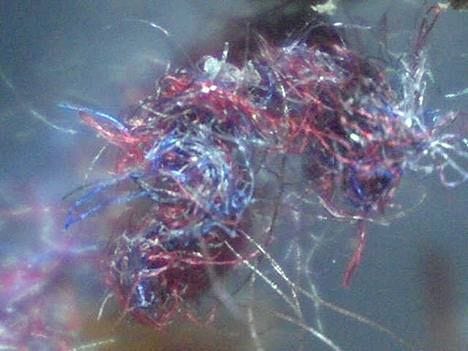
Leitao’s son had been complaining of sores around his mouth and the sensation of ‘bugs’. Using a microscope, she found him to be covered in red, blue, black and white fibers. Since then, experts at Leitao’s Morgellons Research Foundation say they have been contacted by over twelve thousand affected families. Educational and support group The Charles E. Holman Foundation claim there are patients in “every continent except Antarctica.”

Even folk singer Joni Mitchell has been affected, complaining to the LA Times about “this weird incurable disease that seems like it’s from outer space . . . Fibers in a variety of colors protrude out of my skin . . . they cannot be forensically identified as animal, vegetable or mineral. Morgellons is a slow, unpredictable killer — a terrorist disease. It will blow up one of your organs, leaving you in bed for a year.”

Since Leitao began drawing attention to the problem, thousands of sufferers in the US have written to members of Congress, demanding action. In response, more than forty senators, including Hillary Clinton, John McCain and a pre-presidential Barack Obama, pressured the government agency the Centers for Disease Control (CDC), to investigate. In 2008, the CDC established a special task force in collaboration with the US Armed Forces Institute of Pathology, with an initial budget of one million dollars. At a 2008 press conference, held to update the media on the agreed protocol for a scientific study, principal investigator Dr Michele Pearson admitted, “We don’t know what it is.”

So, it is new and it is frightening and it is profoundly peculiar. But if you were to seek the view of the medical establishment, you would find the strangest fact of all about the disease.

Morgellons doesn’t exist.


I have met Paul in a Tudor-fronted coaching inn, in a comfy executive suburb west of Birmingham. He arrived in a black Audi with leather seats, his suit jacket hanging on a hook over a rear window. There is chill-out music, a wood-fired pizza oven and, in the sunny garden, a flock of cyclists supping soft drinks from ice-clinking glasses. Paul is showing me pictures that he has collected of his fibers. A grim parade of jpegs flicks past on his screen — sores and scabs and nasal hairs, all magnified by a factor of two hundred. In each photo, a tiny colored fiber on or in his skin.

“Is it an excrement?” he asks. “A byproduct? A structure they live in?” A waitress passes with a bowl of salad as he gestures towards an oozing wound. “Is it a breathing pipe?” He shakes his head. “It’s just like something from science fiction. It’s something that you’d see in a movie or in a book on aliens from another planet. It’s out of this world.”


I nod and scratch my neck while Paul absentmindedly digs his nails into a lesion just below the hem of his khaki shorts. They visibly pepper his legs and arms — little red welts, some dulled to a waxy maroon, older ones now just plasticky-white scar tissue.

Paul has seen an array of experts — allergy doctors, tropical-and infectious-disease specialists, dermatologists. He has visited his doctor more times than he can remember. None of them have given him an answer that satisfies him, or offered an end to the itching. His most recent attempt was at a local teaching hospital. “I thought, Teaching hospital! They might want to do a study on me. Last week, I took them some samples of the fibers on a piece of cotton wool. But they discharged me. They said there was nothing they could do.”

Everywhere Paul goes, he carries a pot of alcohol hand-gel, which he has spiked with a traditional Middle Eastern parasite-killer called neem oil. In between his four daily showers, he steam cleans his clothes. The stress of it all leaves him exhausted, short-tempered. He has difficulty concentrating; applying himself at work. “It affects my performance a bit,” he says.

“What does your wife think?” I ask.

His voice cracks.

“Frustrated,” he says. “Sick of me being depressed and irritated. She wants her normal life back. And sometimes, without any progress coming along, I get depressed. Very depressed.”

“When was your lowest moment?”

He breaks eye contact.
“I don’t want to go into that.”
He stares into his half of ale, scratches his wrist and says, eventually, “Pretty much feeling like ending it. Thinking, could I go through with it? Probably. It’s associated with the times the medical profession have dismissed me. It’s just — I can’t see myself living forever with this.”

“Have you mentioned these thoughts to your doctor?”

“No, because talking about suic—” He stops himself. “Things like that . . .” Another pause. “Well, it adds a mental angle.”

Paul is referring to the pathology that clinicians and Skeptics alike claim is actually at the root of Morgellons. They say that what people like him are really suffering from is a form of psychosis called delusions of parasitosis, or DOP. He is, in other words, crazy.

It is a view typified by academics such as Jeffrey Meffert, an associate professor of dermatology at the University of Texas in San Antonio, who has created a special presentation devoted to debunking Morgellons that he regularly presents to doctors and who told the Washington Post, “Any fibers that I have ever been presented with by one of my patients have always been textile fibers.”

It is thought that it is spread, not by otherworldy creatures but by the Internet. As Dr Mary Seeman, Emeritus Professor of Psychiatry at the University of Toronto, explained to the New York Times, “When a person has something bothering him these days, the first thing he does is go online.”

Dr Steven Novella of The Skeptics’ Guide to the Universe agrees: “It is a combination of a cultural phenomenon spreading mostly online, giving specific manifestation to an underlying psychological condition. I am willing to be convinced that there is a biological process going on, but so far no compelling evidence to support this hypothesis has been put forward.”

But Paul is convinced. “It is absolutely a physical condition,” he insists. “I mean, look!”

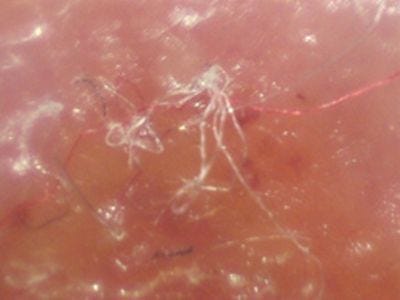
Indeed, the evidence of his jpegs does seem undeniable. Much thinner than his body hair, the fibers bask expansively in craterous sores, hide deep in trench-like wrinkles and peer tentatively from follicles. They are indisputably there. Morgellons seems to represent a mystery even deeper than that of homeopathy. Its adherents offer physical evidence. Just for once, I wonder, perhaps the Skeptics might turn out to be wrong.

In an attempt to find out, I am traveling to the fourth Annual Morgellons Conference in Austin, Texas, to meet a molecular biologist who doesn’t believe the medical consensus. Rather, the forensic tests he has commissioned on the fibers point to something altogether more alien.


IN THE SPRING OF 2005, Randy Wymore, an associate professor of pharmacology at Oklahoma State University, accidentally stumbled across a report about Morgellons.

Reading about the fibers that patients believed were the byproduct of some weird parasite, but which were typically dismissed by disbelieving dermatologists as textile fragments, he thought, “But this should be easy to figure out.” He emailed sufferers, requesting samples, then compared them to bits of cotton and nylon and carpets and curtains that he had found about the place. When he peered down the microscope’s dark tunnel for the first time, he got a shock. The Morgellons fibers looked utterly different.

Wymore arranged for specialist fiber analysts at the Tulsa Police Department’s forensic laboratory to have a look. Twenty seconds into their tests, Wymore heard a detective with 28 years’ experience of doing exactly this sort of work murmur, “I don’t think I’ve ever seen anything like this.” As the day wound on, they discovered that the Morgellons samples didn’t match any of the 800 fibers they had on their database, nor the 85,000 known organic compounds. He heated one fiber to 600°C and was astonished to find that it didn’t burn. By the day’s end, Wymore had concluded, “There’s something real going on here. Something that we don’t understand at all.”

In downtime from teaching, Wymore still works on the mystery. In 2011, he approached a number of commercial laboratories and attempted to hire them to tease apart the elements which make the fibers up. But the moment they discovered the job was related to Morgellons, firm after firm backed out. Finally, Wymore found a laboratory that was prepared to take the work. Their initial analyses are now in, but the conclusions unannounced. More than anything else, it is this that I am hoping to hear about over the coming days.


It all begins an hour south of Austin, Texas, in the lobby of the Westoak Woods Church convention center. Morgellons sufferers are gathering around the Continental breakfast buffet. From the UK, Spain, Germany, Mexico and 22 US states, they dig greedily into the sticky array — Krispie Treats, Strawberry Cheese-flavor Danish pastries, and Mrs Spunkmeyer blueberry muffins — as loose threads of conversation rise from the hubbub:

“I mix Vaseline with sulfur and cover my entire body to suffocate them”; “The more you try to prove you’re not crazy, the more crazy they think you are”; “The whole medical community is part of this. I wouldn’t say it’s a conspiracy but…” At a nearby trestle table, a man sells pots of “Mor Gone gel” (“Until There Is A Cure… There Is Mor Gone”).

Many of the attendees that are moving slowly towards the conference hall will have been diagnosed with DOP, a subject that possesses a day-one speaker, paediatrician Greg Smith, with a fury that bounces him about the stage, all eyes and spit and jabbing fingers.

“Excuse me, people!” he says. “This is morally and ethically wrong! So let me make a political statement, boys and girls.”

He dramatically pulls off his jumper, to reveal a T-shirt: ‘DOP’ with a red line through it.

“No more!” he shouts above the whoops and applause. “No more!”

Out in the car park, Smith tells me that he has been a sufferer since 2004. “I put a sweatshirt I’d been wearing in the garden over my arm and there was this intense burning, sticking sensation. I thought it was cactus spines. I began picking to get them out, but it wasn’t long before it was all over my body.” He describes “almost an obsession. You just can’t stop picking. You feel the sensation of something that’s trying to come out of your skin. You’ve just got to get in there. And there’s this sense of incredible release when you get something out of it.”
“What are they?” I ask.
“Little particles and things,” he says, his eyes shining. “You feel the sensation of something that’s trying to come out of your skin.” He is pacing back and forth now. He is becoming breathless. “You feel that. And when you try to start picking, sometimes it’s a little fiber, sometimes it’s a little hard lump, sometimes little black specks or pearl-like objects that are round and maybe half a millimeter across. When it comes out, you feel instant relief. It’s something in all my experience that I had never heard of. It made no sense. But I saw it over and over again.”

Sometimes, these fibers can behave in ways that Smith describes as “bizarre.” He tells me of one occasion in which he felt a sharp pain in his eye. “I took off my glasses and looked in the mirror,” he says. “And there was a fiber there. It was white and really, really tiny. I was trying to get it out with my finger, and all of a sudden it moved across the surface of my eye and tried to dig in. I got tweezers and started to pick the thing out of eyeball. I was in terrible pain.”

I am horrified.

“Did it bleed?”

“I’ve still got the scar,” he nods. “When I went to the emergency room and told the story of what had been going on — they called a psychiatrist in! I was like, “Wait a minute, what the heck is going on here?” Fortunately, he didn’t commit me and after another consultation with him he became convinced I was not crazy.”

“So, it was a Morgellons fiber?” I say. “And it moved?”

‘Of course it was a fiber!’ he says. ‘It honest-to-God moved.’

Smith tells me that a Morgellons patient who finds unusual fibers in their skin will typically bring a sample to show their doctor. But when they do this, they’re unknowingly falling into a terrible trap. It is a behavior that is known among medical professionals as ‘the matchbox sign’ and it is used as evidence against them, to prove that they are mentally ill.

“The matchbox sign was first described in about 1930,” he says. “They say it’s an indicator that you have DOP. This is something that infuriates me. It has absolutely zero relevance to anything.”

Back in the UK, of course, Paul received his diagnosis of DOP after taking fiber-smeared cotton to his dermatologist. I tell Greg Smith that, were I to find unexplained particles in my skin, I would probably do exactly the same.

“Of course!” he says. “It’s what anyone would do if they had any sense at all. But the dermatologist will stand ten feet away and diagnose you as delusional.”

“But surely they can see the fibers?”

“They can if they look. But they will not look!”

“And if you try to show them the fibers, that makes you delusional?”

“You’re crazy! You brought this in for them to look at? First step — bang.”

“But this is madness!” I say.

“It’s total madness! It’s inexcusable. Unconscionable.”

We speak about the CDC study. Like almost everyone here, Smith is suspicious of it. There is a widespread acceptance at this conference that the American authorities have already decided that Morgellons is psychological and — in classic hominin style — are merely looking for evidence to reinforce their hunch. Both Smith and Randy Wymore, the molecular biologist who arranged the forensic examination in Tulsa, have repeatedly offered to assist in finding patients, and have been ignored.

“Have you heard of the phrase “Garbage In Garbage Out”?” he says. “It doesn’t matter what conclusion that study comes to, even if it is totally favorable to the Morgellons community. It’s not well designed. It’s trash.”

As he speaks I notice Smith’s exposed skin shows a waxy galaxy of scars. Although he still itches, all of his lesions appear to have healed. It is a remarkable thing. Skeptics believe that Morgellons sores are not made by burrowing parasites but by obsessive scratchers eroding the skin away. If Smith is correct, though, and the creatures are responsible for the sores, how has he managed to stop those creatures creating them?

“I absolutely positively stopped picking,” he tells me.

“And that was it?”

“Sure,” he replies, shrugging somewhat bemusedly, as if what he has just said doesn’t run counter to everything that he is supposed to believe.


That evening, the Morgellons sufferers are enjoying a celebratory enchilada buffet at a suburban Mexican restaurant. Over the lukewarm feast, I have a long conversation with a British conventioneer — a midwife from Ramsgate named Margot.

Earlier in the day, when I first met Margot, she said something that has been loitering in my mind ever since, wanting my attention but not quite sure why or what it is doing there. We were at a cafe, waiting for the man to pass us our change and our lunch. He dropped the coins into our hands and turned to wrap our sandwiches. As he did so, Margot sighed theatrically and gave me a look as if to say, ‘Unbelievable! Did you see that?!’

I had no idea what she meant.

She rolled her eyes and explained, “He touches the money, then he touches our food…”

Tonight, Margot describes a scene which ends up proving no less memorable: her, sat naked in a bath full of bleach, behind a locked door, wearing times-three magnification spectacles, holding a magnifying glass and a nit comb, scraping her face onto sticky office labels and examining the ‘black specks’ that were falling out. Perhaps sensing my reaction, she tries to reassure me: “I was just being analytical,” she insists.

When bathing in bleach all night didn’t help, Margot brought her dermatologist samples of her sticky labels. Shaking his head, he told her, “I can’t tell you how many people bring me specimens of lint and black specks in matchboxes.” She was diagnosed with DOP. Her employment was terminated. “I’m a midwife,” she says, in her defense. “I take urine and blood samples — specimens. So I was taking them a specimen. And that’s what wrecked my life and career.”

As I am talking with Margot, I notice Randy Wymore, the molecular biologist I have been desperate to speak with, sitting at a nearby table. He is a slim, neat man wearing a charcoal shirt, orange tie and tidily squared goatee. When I sit with him, I find him to be incorrigibly bright, light and happy, even when delivering wholly discouraging news.

The first two samples that Wymore sent to the laboratory were not from Morgellons patients, but test fibers gathered from a barn and a cotton bud and then some debris from the filter in an air-conditioning unit. When the technicians correctly identified what they were, Wymore felt confident enough to submit the real things. And, so far, he says, ‘We have not yet exactly replicated the exact results of the forensics people in Tulsa.’

Indeed, the laboratory has found Wymore’s various Morgellons fibers to be: nylon; cotton; a blonde human hair; a fungal residue; a rodent hair; and down, likely from geese or ducks.

“That’s disappointing,” I say.

He leans his head to one side and smiles.

“It is for the most part disappointing,” he says. “But there was a bunch of cellulose that didn’t make sense on one. And another was unknown.”

“Really?”

“Well, they said it was a ‘big fungal fiber.’ But they weren’t completely convinced.”

 
Image courtesy of Charles E Holman Foundation

The next day, nursing practitioner Dr Ginger Savely — who claims to have treated over 500 Morgellons patients — leads an informal discussion in the hotel conference room. Around large circular tables they sit: the oozing and the itchy, the dismissed and the angry. “I’ve seen a fiber go into my glasses,” says one. “I’ve seen one burrow into a pad”; “One of my doctors thinks it’s nanotechnology”; “Check your clothing from China for nematodes”; “Never put your suitcase on the floor of a train”; “I was attacked by a swarm of some type of tiny wasps that seemed to inject parts of their bodies under my skin.”

I am writing the words ‘tiny wasps’ into my notepad when a furious woman with a terrifying itch-scar on her jaw says, “I have Erin Brockovich’s lawyer’s number in my purse. Don’t you think I’m not going to use it.”

“But who are you going to sue?” asks a frail elderly lady two tables away.

We all look expectantly at her. There is a moment of tense quiet.

“I don’t know,” she says.

In a far corner, a woman with a round plaster on a dry, dusty, pinkly scrubbed cheek weeps gently.

Ten minutes later, I am alone in the lobby, attempting to focus my thoughts. My task here is straightforward. Has Paul been failed by his medics, or is he crazy? Are these people infested with uncommon parasites or uncommon beliefs? Over at the reception desk, a conventioneer is complaining loudly, hammering her finger on the counter.

“It’s disgusting! Bugs! In. The. Bed. I’ve already been in two rooms. I had to drive to Walmart to buy fresh linen at 5 a.m. There’s this white stuff all over the counter…”

When she has gone, I approach the desk and ask the receptionist if the weekend has seen a surge in complaints about cleanliness.

“Oh yeah.” She nods towards the conference room. “And they’re all coming from those people.” She leans forward and whispers conspiratorially. “I think it’s part of their condition.”

Satisfied, I retire to the lobby to await my allotted chat with Dr Savely.

“So, what do you think,” I ask her, “about these tiny wasps?”

“Hmmm, no,” she says. “But I haven’t totally dismissed the whole genetically modified organisms thing. Something may have gone amuck.”

“Nanotechnology?” I ask. “Some defense experiment gone awry?”

“If something like that went wrong and got out to the public…”

I decide to confess to Dr Savely my conclusion: that these people are, in fact, crazy.

“These people are not crazy,” she insists. “They’re good, solid people who have been dealt a bad lot.”

A woman approaches the vending machine behind the doctor. Between her palm and the top of her walking stick, there is a layer of tissue paper. We sit there as she creaks slowly past us.

“There’s definitely an element of craziness here,” I say.

“But I truly believe it’s understandable,” she says. “For people to say you’re delusional is very anxiety-provoking. Then they get depressed. Who wouldn’t? Hello! The next stage is usually an obsessive-compulsive thing — paying attention to the body in great detail. But, again, I feel this is understandable in the circumstances.”

Not wholly convinced, I slip back into the conference room, where Margot is using her $1,100 WiFi iPad telescope to examine herself. Suddenly, I have an idea.

“Can I have a go?”

Pushing the lens into my palm, I immediately see a fiber. The group falls into a hush. “Did you clean your hand?” asks Margot. She fetches an anti-bacterial wet-wipe. I scrub and try again. I find an even bigger fiber. I wipe for a second time.

And find another one. Margot looks up at me with wet, sorry eyes. “Are you worried?” She puts a kind, comforting hand on my arm. “Oh, don’t be worried, Will. I’m sure you haven’t got it.”


Back in London, I find a 2008 paper on Morgellons in a journal called Dermatologic Therapy. It describes Morgellons patients picking “at their skin continuously in order to “extract” an organism”; “obsessive cleaning rituals, showering often” and individuals going “to many physicians, such as infectious disease specialists and dermatologists” — all behaviors that are “consistent with DOP” and also consistent with Paul. (For treatment, the authors recommend prescribing a benign anti-parasitic ointment to build trust, then topping it up with an anti-psychotic.) After finding fibers on my own hand, I am satisfied that Morgellons is some 21 century genre of OCD that’s spread like an Internet meme, and the fibers are — just as Dr Wymore’s labs are reporting — particles of everyday, miscellaneous stuff: cotton, human hair, rat hair and so on.

I am finalizing my research when I decide to check one final point that has been niggling maddeningly. The itch. Both Paul and Greg’s Morgellons began with an explosion of it. It is even affecting me: the night following my meeting with Paul, I couldn’t sleep for itching. I had two showers before bed and another in the morning. All through the convention — even as I write these words — I am tormented; driven to senseless scratching.

Why is itch so infectious?

For background, I contact Dr Anne Louise Oaklander, an associate professor at Harvard Medical School and probably the only neurologist in the world to specialize in itch. I email her describing Morgellons, carefully acknowledging that it is some form of DOP. But when we speak, Dr Oaklander tells me she knows all about Morgellons already. And then she says something that stuns me.

“In my experience, Morgellons patients are doing the best they can to make sense of symptoms that are real. These people have been maltreated by the medical establishment. And you’re very welcome to quote me on that. They’re suffering from a chronic itch disorder that’s undiagnosed.”

To understand all this, it is first necessary to grasp some remarkable facts about itch. In 1987 a team of German researchers found itch wasn’t simply the weak form of pain it had always been assumed to be. Rather, they concluded that itch has its own separate and dedicated network of nerves. And remarkably sensitive things they turned out to be: whereas a pain nerve has sensory jurisdiction of roughly a millimeter, an itch nerve can pick up disturbances on the skin over seventy-five millimeters away.

Dr Oaklander surmises that itch evolved as a way for humans to automatically rid themselves of dangerous insects. When a mosquito lands on our arm and it tickles, this sensation is not, as you might assume, the straightforward feeling of its legs pressing on our skin. That crawling, grubbing, tickling sensation is, in fact, a neurological alarm system that is wailing madly, begging for a scratch.

This alarm system can go wrong for a variety of reasons — shingles, sciatica, spinal-cord tumors or lesions, to name a few. It can ring suddenly, severely and without anything touching the skin. This, Oaklander believes, is what is happening to Morgellons patients.

“That they have insects on them is a very reasonable conclusion to reach, because, to them, it feels no different to how it would if there were insects on them. To your brain, it’s exactly the same. So you need to look at what’s going on with their nerves. Unfortunately, what can happen is a dermatologist fails to find an explanation and jumps to a psychiatric one.”

Of the obsessive investigations that Morgellons patients conduct on themselves, Oaklander says: “When you feel an itch, what do you do? You look. That’s the natural response. They may become fixated on the insect explanation for lack of a better one.”

But, she adds, that is not to say there aren’t some patients whose major problem is psychiatric. Others still might suffer delusions in addition to their undiagnosed neuropathic illness. Nevertheless, “It’s not up to some primary-care physician to conclude that a patient has a major psychiatric disorder.”

If Oaklander turns out to be correct, it makes sense of the fact that Greg Smith’s lesions healed when he stopped scratching. If the fibers are picked up by the environment, it explains how I found them on my hand. And if Morgellons is not actually a disease, but rather a witchbag of symptoms that might all have nerve-related maladies as its source, it squares something that Dr Savely said she is “constantly perplexed” about: “When I find a treatment that helps one person, it doesn’t help the next at all. Every patient is a whole new ballgame.”

Thrilled at this development, I phone Paul and explain the itch-nerve theory. But he doesn’t seem very excited.

“I can’t see how that relates to my condition,” he sighs. “I’ve got marks on my back that I can’t even reach. I’ve not created those by scratching.”

It is a good point, perhaps, but one that I quietly dismiss. It now seems so likely that Paul is either delusional, or has some undiagnosed itch disorder, that I judge that he is merely looking for reasons not to believe this elegant and compelling solution.


Weeks later, I receive an unexpected email from a stranger in east London. Nick Mann has heard about my research into Morgellons and he wonders if I might be curious to hear about his experiences. When I arrive at his house, on a warm Tuesday night, and settle in his small kitchen with a mug of tea, I am doubting the wisdom of my visit. Probably, I think, I am wasting my time.

But Nick doesn’t appear to be the kind of conspiracy-fixated, talking-too-fast, fiddling-with-their-fingers individual who usually gets in touch. Rather, he is a calm and friendly father of two who, he tells me, went for a walk a couple of years ago in the grounds of Abney Park Cemetery, just down the road from his home, when something unsavory took place. It had been a sunny day and he had been wearing shorts and sandals. That evening, his legs began itching. Marks sprang up on his body. ‘I was convinced something was on me,’ he tells me. ‘Something digging into my skin. Burrowing.’

Over the coming days, lesions began to open up on his skin. Running his fingertips over them, he could feel something inside: spines or fibers. He stripped naked in his kitchen and tried to dig one out.

“I stood there for three or four hours, waiting for one to bite,” he says. “As soon as it did, I went for it with a hypodermic needle. There was one on my nipple.” He pales slightly. “You know, I can’t get that out of my head. It was so painful. I dug the needle in and felt it flicking against something that wasn’t me. And I just carried on digging and scooping.” He carried on like this for nearly four hours. “At one point my wife came in and saw blood dripping down from my leg and scrotum.”

By the end of the day, Nick had dug three of the ‘things’ from his body. They were so small, he says, “You could only see them when they moved.” Tipping them from a Rizla paper into a specimen jar, he showed his wife, Karen. She peered into the pot. She looked worriedly at her husband. Karen could see nothing.

I put my pen down and rub my brow. Poor Nick Mann, I think. Just like Greg Smith, madly attacking his own body, trying to remove bits of fluff. And just like Paul — so convinced by the illusion of his own itch response that he became fixated on the fantasy that he had been invaded by invisible monsters. To get some general sense of how unstable this man could turn out to be, I try to discover a bit more about him.

“What did you say you did for a living?” I ask.

“I’m a GP,” he says.

I sit up. “You’re a GP?”

“Yes,” he says, brightly. “I’m a doctor. A GP. At a practice in Hackney.”

“Right,” I say. “Okay. Right. So then what happened?”

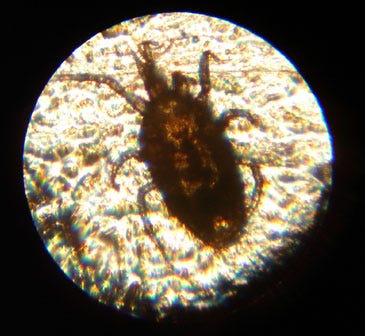
“I took the three mites I’d caught to the Homerton Hospital in east London,” he says. “A technician there mounted one on a slide, put it under a microscope and said “Beautiful.” Everyone gathered around saying, “Ooh, look at that.” They had no idea what it was. They sent it over to the Natural History Museum, who identified it within a day. It was a tropical rat mite. What they do is go in through the hair follicles and find a blood vessel at the bottom. That’s where they sit and that’s what the fibers are — their legs folded back.”


It is astonishing. It seems to explain it all — the sudden itch, the fibers, even the lesions in unscratchable places. I discuss with Nick the sorry experiences that Paul had trying to get anyone to take him seriously. Nick admits that he was only able to have his samples examined by experts because he was acting as his own doctor. And if that hadn’t happened, he says, “I would have received exactly the same treatment that he did. Delusions of parasitosis.”

“Paul had the impression that his doctors were working from a kind of checklist,” I say, “and if his symptoms weren’t on it, he was just dismissed as crazy.”

“I’m afraid that’s true,” says Nick. “If none of the medical models fit, they’re dismissed. The immediate conclusion is “medically unexplained symptom”, which is a euphemism for nuts. It’s a sad indictment of my own profession but I’ve experienced it first-hand. There used to be a culture of getting to the bottom of the problem. There isn’t that now. I find that really sad. And the idea that people with Morgellons are nutty — I really did nearly go mad with the itch. It was disturbing my sleep, there was barely a minute where I wasn’t having to scratch or resist the urge to scratch. It’s this constant feeling of being infested. It freaked me out.”

As for the weird reasons that patients come up with for their condition — the nanotechnology, the tiny wasps — Nick is unsurprised. “Of course, you look for answers, don’t you?” he says. “We need to find explanations for things.”


WE NEED EXPLANATIONS. We need certainty. And certainty is precisely what I have been seeking over the last few weeks. Are Morgellons sufferers mad? Are they sane? Are they the one? Or the other? I never considered the possibility that they might be both. And, in this, I wonder if I can detect another clue, another soft point in our faulty thinking about beliefs and who we are.

This compulsion to separate everyone into absolute types is the first lesson of Christianity that I can remember learning: kind people go to heaven, unkind people go to hell. There will come a day of judgment and that judgment will be simple, sliced, clean, merciless. In boyhood, the law of the playground dictates that you mentally divide your cohorts into people that you like and people that you don’t — in-groups and out. This doesn’t change much in adulthood. The Skeptics that I met in Manchester thrived on this kind of binary division — and the combative homeopaths did, too. They both told their story, and cast each other as villain. We are a tribal animal. It is who we are and it is how we are.

The urge is to reduce others to simplified positions. We define what they are, and then use these definitions as weapons of a war. Nobody enjoys the restless unpleasantness of doubt. It is uncomfortable, floating between poles, being pulled by invisible forces towards one or the other. We need definitions. We need decisions. We need finality if we are to heal the dissonance.

When my father told me that I had misunderstood faith — that it was not a matter of certainty, but a journey — I was instinctively hostile to the idea. Perhaps it suited me better to think that Christians are foolishly convinced by childish beliefs; that they are stupid. It is a reassuring story that I told myself because, according to the models of my brain, Christians are Bad.

Journalism, too, encourages just this kind of certainty. Facts, assessed and checked. Liars exposed, truth-tellers elevated. Good guys and bad guys. The satisfaction of firm conclusions, of nuance erased, of reality tamed. In my younger years, I was driven to the ends of my own sanity by the desire for this form of truth — an unthreatening, finished article that is cauterized and stitched and does not bleed. Does she love me? Is she faithful? Will she love me next week? Next year? Did she love him more? Does she desire him more? Will we stay in love for ever?

In my mid-twenties, I attended weekly group therapy sessions in north London with people who were much older than me. One evening, a woman in her mid-forties was talking contemptuously about her father, a university lecturer who, she said, had ‘a crush’ on one of his teenage students. I was scandalized.

“But he’s married!” I said.

She looked baffled. What was my point?

“I mean, doesn’t he love your mum any more?” I said. “Are they getting a divorce?”

The adults around me shared a moment. Glances were exchanged. Sniggers were muted. As I write this, I can tell you that the shame is still alive. I can feel it slithering out from underneath the memory and into my skin.

I used to hold a fierce belief in binary love, of the kind that is promised in music, film and literature. You are in love, or you are not. They were absolute modes of being, like Christian or non-Christian, right or wrong, sane or insane. Today, my marriage is happy because I understand that true love is a mess. It is like my father’s belief in God: a journey, sometimes blissful, often fraught. It is not the ultimate goal that was promised by all those pop songs. It lacks the promise of certainty. But it is its very difficulties that give love its value. If you didn’t have to fight for it — if it was just there, reliable, steady, ever-present, like a cardboard box over your head — what would be its worth?

I used to expect love to be solid, sure, overpowering, decided. That is how we declare ourselves. When we get married, we promise faithfulness for ever. When priests talk about God, they say, “He exists.” When the Skeptics talk about homeopathy, they say, “There is no evidence.” When the medical establishment talk about Swami Ramdev’s pranayama, they say, “It doesn’t work”; when they judge Morgellons sufferers, they say, “They are delusional.”

But what if pranayama works like homeopathy works, by brilliantly triggering various powerful placebo effects? What if these Morgellons sufferers are crazy, but they have been driven to these ends by itching caused by a variety of undiagnosed conditions and rejection by lazy doctors?


As I leave the home of Dr Mann, he kindly offers to see Paul so that he can check if his is an infestation of tropical rat mite. After their meeting, a few weeks later, Nick emails me to say that he found no evidence of it, but that “he’s certainly not delusional.” He sends some fiber pictures and one of Paul’s videos to the experts at the Natural History Museum. They reply, “It is our opinion that the fiber is a fabric fiber and it is only its curvature, and consequent variation in focus, that makes it appear to be arising from under the skin. The specimen in the video does look like a mite. It is not clear enough to be certain, but the most likely candidate is a member of the suborder Astigmata, for example, a species of the family Acaridae or Glycyphagidae. These mites are typically found in stored foods, but also occur in house dust.”

Theirs is a conclusion that will be echoed when the CDC study is finally published.

“No parasites or mycobacteria were detected,” it reports. “Most materials collected from participants’ skin were composed of cellulose, likely of cotton origin. No common underlying medical condition or infectious source was identified, similar to more commonly recognized conditions such as delusional infestation.”

Commenting on the work, Steven Novella writes, “The evidence strongly suggests that a psychological cause of Morgellons is most likely, and there is no case to be made for any other alternative . . . It is entirely consistent with delusional parasitosis.”

And Paul is back where he began.


The last time I speak with him, he sighs deeply down the phone.

“Are you all right?” I ask.

“Pretty crap actually. I’ve been forced out of my job. They said it’s based on my “engagement level” and that’s down to the lack of energy I’ve got at work. I can’t sign myself off sick because Morgellons is not a diagnosis. There’s no legitimate reason for me not to be operating at full speed. But, you know, I’m a fighter. I’m trying to rally against it but it’s . . . quite upsetting, really.”

“How are you coping?”

“Well . . . lurching along the parapet of depression, I suppose. But I’m all right. You can put another line in your book — my job is another thing that has been destroyed by this disease. And all because Morgellons isn’t supposed to exist.”

//.

This is an excerpt from The Unpersuadables: Adventures With The Enemies of Science by Will Storr. If you’d like to purchase the entire book, it’s available on Amazon.