Showing posts with label mythology. Show all posts

Friday, September 06, 2013

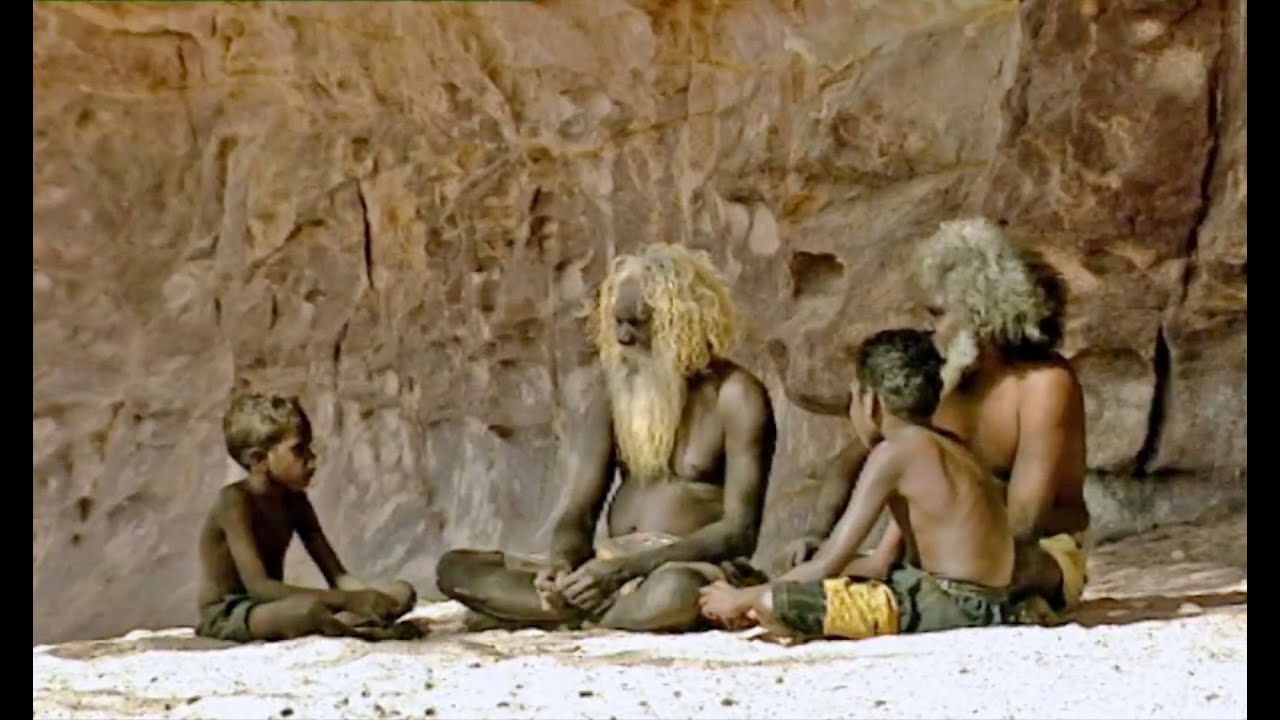
Documentary - The Men of the Fifth World (Australian Aboriginals)


The idea of the "Fifth World," strangely, comes from Native American tradition (Navajo and Hopi of the American Southwest - and before them the Aztecs of Central America), not from Australia Aboriginal tradition, as might be suggested by the title of this documentary from 2000.

The synopsis of the 52-minute film offered at the Top Documentary site, where I found this, is seriously effusive and poetic. On the other hand, it is a beautiful film of an intriguing people. Like Canada, Australia does a lot more to support the aboriginal cultures than does the United States. Still these people and their unique culture - a link to our shared human history - are in danger of fading away.


The Men of the Fifth World

They are the original inhabitants of the land called Australia by the white man. They have been there since the beginning of time, since the dream time, when everything they know was created. Their people know how to sing each and every place of this sacred country, while they contemplate Gee, the Sun God. Each song is a living map, which describes a specific path, the course of a river, a mountain or forest. If you brought together all these songs, which are passed down from generation to generation, and which come from dreams, they would compose the map of Australia.

At twilight, the humming of the Didgeridoo, their religious instrument, reminds them who they are and what they are doing there. It is the beat of their tradition, which keeps them united and attached to the land. Yaka Garimala, an Australian aborigine as foreigners call them, is going to tell you what their world is like.

His country is enormous. It is the most beautiful country in the world. They have deserts, jungles, savanna, plateaus and mountains with deep canyons carved by furious torrents. The sea is all around. Along their coast, there are bays and inlets and sacred cliffs like the one of Bickerton Island. This is where he lives.

The elders have the important task of initiating the young into their customs, explaining their history to them and teaching them to respect the traditional laws. They were already there thousands of years ago. They were around at the same time as what the white man call Homo sapiens. In the caves and caverns, they can feel the influence of the spirits of their ancestors. If you sleep there, you can see them in your dreams and receive their messages. They come and fill you with their strength, and when you wake, you feel very good.

These are sacred places for them. In the past, people lived in caves and natural shelters like those. Across all their territory, you can find paintings made by their forefathers in which they speak of the dreamtime, the creation and how they lived 50,000 years ago. In the Kakadu National Park lies a block where the rainbow serpents stopped after creating the world, and was painted on a rock so that people could see her. Over time, their forefathers left on the rocks a complete collection of images which depict their way of life and their beliefs.

Sunday, January 01, 2012

Mircea Eliade - Templum-Tempus: New Year's Day in Sacred Time


Today is New Year's Day and a lot of people around the world, from the most primal cultures to the postmodern technological cultures, see this day as a fresh start on a new year.

While we still enact many of the ritual behaviors of the new year, we have lost our sense of what this day means in the mythic history of our consciousness. For example, millions of people still engage in a wild night of drinking and celebrating on New Year's Eve, an activity that was once associated with a last symbolic night of debauchery before the fresh start of a New Year.

In many belief systems, the New Year is equivalent to the rebirth of the world. It is no coincidence that the early Christians chose a day close to the New Year to celebrate the birth of Jesus, the day in which the word of God was made flesh - a new beginning for a symbolic new world, a life of Heaven on Earth.

In his classic book, The Sacred and the Profane, Mircea Eliade examines the world of traditional myths and symbolic practice. In chapter two, Sacred Time and Myths, Elaide looks at the nature of sacred time, including mythology of the New Year.

The templum and tempus of this section are seen as an intersection between space and time: "templum designates the spatial, tempus the temporal aspect of the motion of the horizon in space and time." The templum is embodied by the temple, the sacred space, the image of the world. In many early cultures, the temple was round, symbolizing the circular nature of time.

With each New Year, the cycle of time is begun anew - each New Year's Day is the first day. And with this rebirth, we, too, are reborn anew, cleansed of the previous year.

In the annual peyote ceremony of the Huichol people in Mexico, the group who make the pilgrimage to the part of the desert where the peyote is found spend a night in a circle becoming purified of the previous year's "sins," everyone confesses transgressions, including affairs or crimes, free from retribution. It is believed that they musty be pure to enter the land of the peyote and bring back the sacred plant. The yearly pilgrimage marks their new year, a renewal for the community.

Eliade offers other tales here that repeat this motif. [This text is copied from a PDF, so apologies for any errors I did not catch and correct.]

TEMPLUM-TEMPUS
We shall begin our investigation by presenting certain facts that have the advantage of immediately revealing religious man's behavior in respect to time. First of all, an observation that is not without importance: in a number of North American Indian languages the term world (= Cosmos) is also used in the sense of year. The Yokuts say "the world has passed," meaning "a year has gone by." For the Yuki, the year is expressed by the words for earth or world. Like the Yokuts, they say "the world has passed" when a year has passed. This vocabulary reveals the intimate religious connection between the world and cosmic time. The cosmos is conceived as a living unity that is born, develops, and dies on the last day of the year, to be reborn on New Year's Day. We shall see that this rebirth is a birth, that the cosmos is reborn each year because, at every New Year, time begins ab initio.

The intimate connection between the cosmos and time is religious in nature: the cosmos is homologizable to cosmic time (= the Year) because they are both sacred realities, divine creations. Among some North American peoples this cosmic-temporal connection is revealed even in the structure of sacred buildings. Since the temple presents the image of the world, it can also comprise a symbolism. We find this, for example, among Algonquins and the Sioux. As we saw, their sacred lodge represents the universe; but at the same time it symbolizes the year. For the year is conceived as a journey through the four cardinal directions, signified by the four doors and four windows of the lodge. The Dakotas say: "The Year is a circle around the world" - that is, around their sacred lodge, which is an imago mundi.

A still clearer example is found in India. We saw that the erection of an altar is equivalent to a repetition of the cosmogony. The texts add that "the fire altar is the year" and explain its temporal system as follows: the 360 bricks of the enclosure correspond to the 360 nights of the year, and the 360 yajusmati bricks to the 360 days (Shatapatha Brahmama, X, 5, 4, 10; etc.). This is as much as to say that, with the building of each fire alter, not only is the world remade but the year is built too; in other words, time is regenerated by being created anew. But then, too, the year is assimilated to Prajiipati, the cosmic god; consequently, with each new altar Prajzpati is reanimated-that is, the sanctity of the world is strengthened. It is not a matter of profane time, of mere temporal duration, but of the sanctification of cosmic time. What is sought by the erection of the fire altar is to sanctify the world, hence to place it in a sacred time.

We find a similar temporal symbolism as part of cosmological symbolism of the Temple at Jerusalem. According to Flavius Josephus (Ant. Jud., 111, 7, 7), the twelve loaves of bread on the table signified the 12 months of the year and the candelabrum with seventy branches represented the decans (the zodiacal division of the seven planets into tens). The Temple was an imago mundi; being at the Center of the World, at Jerusalem, it sanctified not only the entire cosmos but also cosmic life-that is, time.

Hermann Usener has the distinction of having been the first to explain the etymological kinship between templum and tempus by interpreting the two terms through the concept of "intersection," (Schneidmg, Kreuzung). Later studies have refined the discovery; "templum designates the spatial, tempus the temporal aspect of the motion of the horizon in space and time."

The underlying meaning of all these facts seems to be the following: for religious man of the archaic cultures, the world is renewed annually; in other words, with each year it recovers its original sanctity, the sanctity that it possessed when it came from the Creator's hands. This symbolism is clearly indicated in the architectonic structure of sanctuaries. Since the temple is at once the place par excellence and the image of the world, it sanctifies the entire cosmos and also sanctifies cosmic life. This cosmic life was imagined in the form of a circular course; it was identified with the year. The year was a closed circle; it had a beginning and an end, but it also had the peculiarity that it could be reborn in the form of a new year. With each New Year, a time that was "new," "pure," "holy" -- because not yet worn -- came into existence.

But time was reborn, began again, because with each New Year the world was created anew. In the preceding chapter we noted the considerable importance of the cosmogonic myth as paradigmatic model for every kind of creation and construction. We will now add that the cosmogony equally implies the creation of time. Nor is this all. For just as the cosmogony is the archetype of all creation, cosmic time, which the cosmogony brings forth, is the paradigmatic model for all other times that is, for the times specifically belonging to the various categories of existing things. To explain this further: for religious man of the archaic cultures, every creation, every existence begins in time; before a thing exists, its particular time could not exist. Before the cosmos came into existence, there was no cosmic time. Before a particular vegetable species was created, the time that now causes it to grow, bear fruit, and die did not exist. It is for this reason that every creation is imagined as having taken place at the beginning of time, in principio. Time gushes forth with the first appearance of a new category of existents. This is why myth lays such an important role; as we shall show later, the way in which a reality came into existence is revealed by its myth.

ANNUAL REPETITION OF THE CREATION
It is the cosmogonic myth that tells how the cosmos came into existence. At Babylon during the course of the akitu ceremony, which was performed during the last days of the year that was ending and the first days of the New Year, the Poem of Creation, the Enuma elish, was solemnly recited. This ritual recitation reactualized the combat between Marduk and the marine monster Tiamat, a combat that took place ab origine and put an end to chaos by the final victroy of the god. Marduk created the cosmos from Tiamat's dismembered body and created man from the blood of the demon Kingu, Tiamat's chief ally. That this commemoration of the Creation was in fact a reactualization of the cosmogonic act is shown both by the rituals and in the formulas recited during the ceremony.

The combat between Tiamat and Marduk, that is, was mimed by a battle between two groups of actors, a ceremonial that we find again among the Hittites (again in the frame of the dramatic scenario of the New Year), among the Egyptians, and at Ras Shamra. The battle between two groups of actors repeated the passage from chaos to cosmos, actualized the cosmogony. The mythical event became present once again. "May he continue to conquer Tiamat and shorten his days!" the priest cried. The combat, the victory, and the Creation took place at that instant, hic et nunc.

Since the New Year is a reactualization of the cosmogony, it implies starting time over again at its beginning, that is, restoration of the primordial time, the "pure" time, that existed at the moment of Creation. This is why the New Year is the occasion for "purifications," for the expulsion of sins, of demons, or merely of a scapegoat. For it is not a matter merely of a certain temporal interval coming to its end and the beginning of another (as a modem man, for example, thinks) ; it is also a matter of abolishing the past year and past time. Indeed, this is the meaning of ritual purifications; there is more than a mere "purification"; the sins and faults of the individual and of the community as a whole are annulled, consumed as by fire.

The Nawroz -- the Persian New Year -- commemorates the day that witnessed the creation of the world and man. It was on the day of Nawroz that the "renewal of the Creation" was accomplished, as the Arabic historian a1-Biriini expressed it. The king proclaimed: "Here is a new day of a new month of a new year; what time has worn must be renewed." Time had worn the human being, society, the cosmos-and this destructive time was profane time, duration strictly speaking; it had to be abolished in order to reintegrate the mythical moment in which the world had come into existence, bathed in a it pure," "strong," and sacred time. The abolition of profane past time was accomplished by rituals that signified a sort of "end of the world." The extinction of fires, the return of the souls of the dead, social confusion of the type exemplified by the Saturnalia, erotic license, orgies, and so on, symbolized the retrogression of the cosmos into chaos. On the last day of the year the universe was dissolved in the primordial waters. The marine monster Tiamet -- symbol of darkness, of the formless, the nonmanifested -- revived and once again threatened. The world that had existed for a whole year really disappeared. Since Tiamat was again present, the cosmos was and Marduk was obliged to create it once again, after having once again conquered Tiamet.

The meaning of this periodical retrogression of the world into a chaotic modality was this: all the "sins" of the year, everything that time had soiled and worn, was annihilated in the physical sense of the word. By symbolically participating in the annihilation and re-creation of the world, man too was created anew; he was reborn, for he began a new life. With each New Year, man felt freer and purer, for he was delivered from the burden of his sins and failings. He had reintegrated the fabulous time of Creation, hence a sacred and strong time -- sacred because transfigured by the presence of the gods, strong because it was the time that belonged, and belonged only, to the most gigantic creation ever accomplished, that of the universe. Symbolically, man became contemporary with the cosmogony, he was present at the creation of the world. In the ancient Near East, he even participated actively in its creation (cf. the two opposed groups, representing the god and the marine monster).

It is easy to understand why the memory of that marvelous time haunted religious man, why he periodically sought to return to it. In illo tempore the gods had displayed their greatest powers. The cosmogony is the supreme divine manifestation, the paradigmatic act of strength, superabundance, and creativity. Religious man thirsts for the real. By every means at his disposal, he seeks to reside at the very source of primordial reality, when the world was in statu nascendi.
Mircea Eliade, The Sacred and the Profane, p. 73-80.

Friday, December 30, 2011

Dr. James Hillman Live at Mythic Journeys

Dr. James Hillman discusses myth and the world around us at one of the Mythic Journeys conferences. To find out more information, please go to: www.mythicimagination.org

Part One:


Part Two:


Part Three:


Tuesday, October 25, 2011

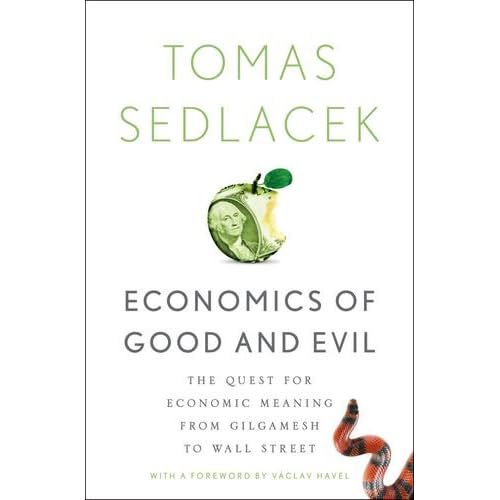
Authors@Google - Tomas Sedlacek: The Economics of Good and Evil


This is an interesting talk - framing economics as a choice between good and evil? Wait, didn't Google do that already? And how is their stock doing? Maybe Sedlacek has a point - his book is The Economics of Good and Evil: The Quest for Economic Meaning from Gilgamesh to Wall Street.


From the description: "Even the most sophisticated mathematical model," Sedlacek writes, "is, de facto, a story, a parable, our effort to (rationally) grasp the world around us." Compelling argument for a relativist perspective on economics.


Authors@Google - Tomas Sedlacek: The Economics of Good and Evil


Tomas Sedlacek has shaken the study of economics as few ever have. Named one of the "Young Guns" and one of the "five hot minds in economics" by the Yale Economic Review, he serves on the National Economic Council in Prague, where his provocative writing has achieved bestseller status. How has he done it? By arguing a simple, almost heretical proposition: economics is ultimately about good and evil.


In The Economics of Good and Evil, Sedlacek radically rethinks his field, challenging our assumptions about the world. Economics is touted as a science, a value-free mathematical inquiry, he writes, but it's actually a cultural phenomenon, a product of our civilization. It began within philosophy--Adam Smith himself not only wrote The Wealth of Nations, but also The Theory of Moral Sentiments--and economics, as Sedlacek shows, is woven out of history, myth, religion, and ethics. "Even the most sophisticated mathematical model," Sedlacek writes, "is, de facto, a story, a parable, our effort to (rationally) grasp the world around us." Economics not only describes the world, but establishes normative standards, identifying ideal conditions. Science, he claims, is a system of beliefs to which we are committed. To grasp the beliefs underlying economics, he breaks out of the field's confines with a tour de force exploration of economic thinking, broadly defined, over the millennia. He ranges from the epic of Gilgamesh and the Old Testament to the emergence of Christianity, from Descartes and Adam Smith to the consumerism in Fight Club. Throughout, he asks searching meta-economic questions: What is the meaning and the point of economics? Can we do ethically all that we can do technically? Does it pay to be good?


Placing the wisdom of philosophers and poets over strict mathematical models of human behavior, Sedlacek's groundbreaking work promises to change the way we calculate economic value.


Friday, May 20, 2011

Open Culture - The Legend of Bluesman Robert Johnson Animated

Awesome.

The Legend of Bluesman RobertJohnson Animated

Robert Johnson: Devilish Detail on Nowness.com.

Robert Johnson, the legendary bluesman, would have turned 100 this week. That’s well beyond the age he actually lived to – a very young 27. During his short life (1911-1938), Johnson recorded 29 individual songs. But they could not have been more influential. Songs like Cross Road Blues, Sweet Home Chicago, and Kind Hearted Woman Blues (all found in this newly-released Centennial Collection) had a remarkable influence on musicians growing up generations later. Keith Richards, Eric Clapton, Robert Plant – they all acknowledge a deep debt to Johnson.

Speaking of debts, you can’t talk about Robert Johnson without talking about the famous devil legend. The legend holds that Johnson made a Faustian bargain with the devil, selling his soul in exchange for boundless musical talent. It’s a great tale, and it all gets brought back to life in “Devilish Detail,” a new animated film (above) featuring illustrations by Christopher Darling. You can view it in a larger format on Nowness.com.
Illustrator Christopher Darling Brings the Myth of the Legendary Blues Musician to Life.

Friday, February 11, 2011

Alva Noë - An Appreciation For 'All Things Shining'

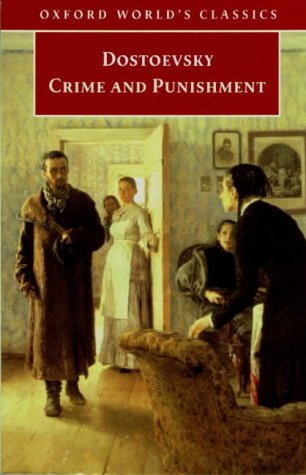
http://distantwindow.files.wordpress.com/2008/06/crimeandpunishment.jpg

In his new post for NPR's 13.7 Cosmos and Culture, philosopher Alva Noë talks about All Things Shining: Reading the Western Classics to Find Meaning in a Secular Age, the new book from Hubert Dreyfus and Sean Kelly.

The profound messages and meanings in great literature are why I switched majors from psychology to English when I was in college the first time (way back in the last century). I found more understanding of - and compassion for - human suffering and human striving in Isabelle Allende, Kurt Vonnegut, Ralph Ellison, Faulkner, Woolf, Dostoevsky, Dickinson, Shakespeare, Homer, and Sappho than I ever found in Freud, Aaron Beck, or CBT.

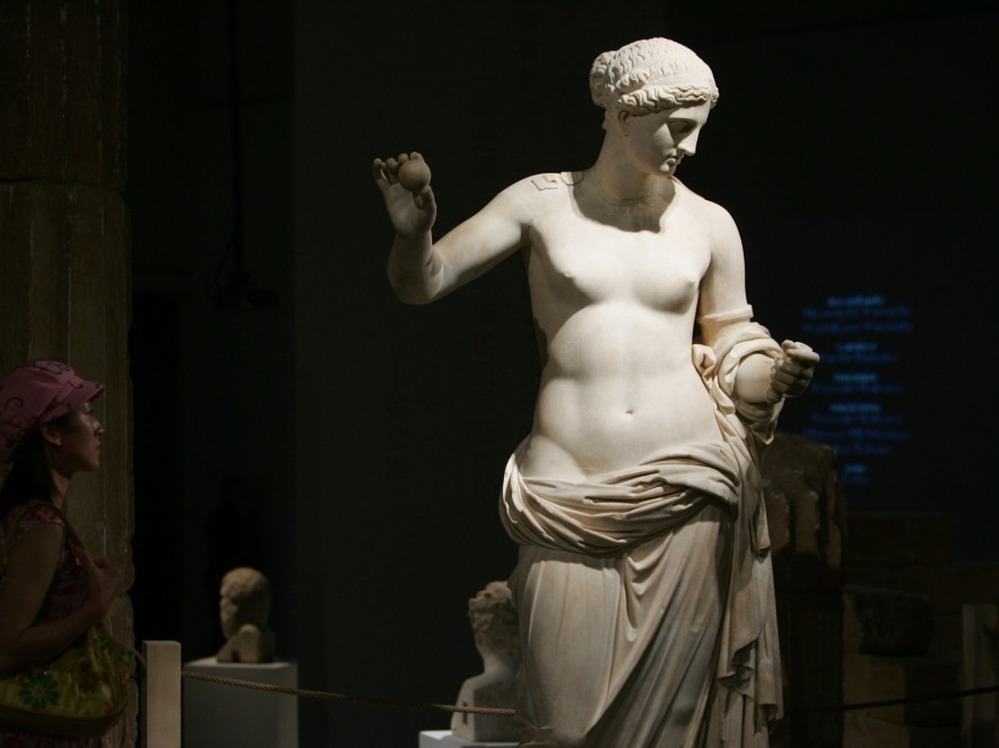
Aphrodite, an embodiment of erotic love's untrammeled power.

In Ridley Scott's movie Blade Runner, discussed here not long ago, Deckard (played by Harrison Ford) is a blade runner, a cop charged with capturing rebel androids (replicants). To find out whether a suspected replicant is a replicant, he deploys a sort of lie-detector test: He poses emotionally loaded questions to would-be replicants and uses a device to measure a tell-tale physiological response.

Deckard's hard-cop detachment is deeply incompatible with the kinds of relationships — even romantic ones — that he himself carries on with replicants. This brings us to the argument of the movie: in treating others as if a physiological response is called for to decide if they count or not — in taking up a detached attitude that is willing to call their very humanity into question — Deckard convincingly puts his own humanity in jeopardy. This is driven home when we learn that Deckard himself, unbeknownst to him, is probably a replicant. (I discuss this in Out of Our Heads. My understanding of the film is indebted to Stephen Mulhall's marvelous writings on the subject. See his On Film, and here.)

Although Hubert Dreyfus and Sean Kelly don't discuss Blade Runner in their important new book All Things Shining, they might have. Deckard's is just the sort of perversion they investigate.

Physicists Steven Hawking and Leonard Mlodinow, in their book The Grand Design, suggest that the Greek gods, like all gods, were posits of ignorant people to explain phenomena they didn't understand. All Things Shining offer a very different picture. Homer's Gods stand for meanings in the world around us, and also for the moods or moments when we are most drawn to or sensitive to those meanings. Aphrodite, for example, marks the untrammeled power of erotic love, a force that can be overwhelming when one is in the right mood.

Homer doesn't suggest that the goddess actually causes lust! The point rather is that erotic love is not something we decide to find compelling. It confronts us with the full force. And then there's this: it isn't easy to be open to the full force of things, not erotic love, not anything else. This is why Helen, who abandons her husband and infant baby to run off with Paris, eventuating in the Trojan War and terrible suffering, is celebrated in Homer as no less a hero than Odysseus himself. She allows herself to be open to one of life's unstoppable forces.

We can find this sort of openness to the living values in the world around us everywhere, in the large and in the small. Think of the way a soldier is drawn to perform a great deed. He may not decide to be brave. He just acts. Or think of the way a skilled craftsperson handles tools and materials. In cases such as this, skillful atunement to what a situation requires takes over. No need for contemplation. It is as if a god carries us along.

Neither Homer, nor Dreyfus and Kelly, are recommending that we abandon our families to chase sexual satisfaction. Nor do Dreyfus and Kelly naively suppose that all Ancient Greeks led meaningful and intense lives. A successful openness to what calls, after all, is not something any of us get for free. It is a blessing of the gods, available to slave and free person alike.

Unless we actively resist it. Which, in a way, is the besetting sin of the modern age. Our nihilism comes before skepticism about God (or gods). It arises from the fact that we position ourselves before the world as if we were new arrivals who are in charge of our own agendas. We stand back and apart and we try to figure out what we should believe, what we should value, what kind of people we should be. In our earnest, hyper-intellectualized thoughtfulness, we are like Deckard in Blade Runner, so alienated from what really matters that we think we need a test to find out who (or what) is real.

Indeed, this has been a central commitment of main swathes of modern philosophy. To be a human being, is to be a legislator; or perhaps it is to be a fact-finder and policy wonk.

Suppose two ships are sinking and you can only save one. Sound reason dictates that you save the ship with the most people in it.

But when this question was put by her hard-headed teacher to Sissy Jupe, the young girl in Charles Dickens' Hard Times, she could only burst into tears and run away. Sissy was unable to take up the standpoint from which this question could even be asked. For to take up this standpoint is already to have become blind — as Deckard is blind — to life shining, to its sacredness.

Dreyfus and Kelly don't argue that we return to Homeric values; critics who have suggested otherwise haven't read the book. But they warn us not only of the dangers of our hubris, but of its basic incoherence. We cannot decide what moves us.

I have a criticism of All Things Shining. Stay tuned!


Friday, May 07, 2010

James Curcio - Initiation, Part 1: The Masks of Identity

This is part one of three parts to this series on initiation - it looks like this could be an interesting book if these are the excerpts. I waited until all three parts were up to post this, so if you like this entry, the next two parts are linked to at the beginning of the article.

This is from Reality Sandwich, by the way, a great site for those interested in a wide range of ideas and explorations. You can check out James' blog, where all of these sections and a lot of other material are posted.

Initiation, Part 1: The Masks of Identity

curciobig.jpg

The following is the first part of a three-part series. These are in-progress excerpts from the upcoming Immanence of Myth anthology. Read Part 2 here; Part 3 here.

"I tell you: one must have chaos in one, to give birth to a dancing star." -- Frederich Nietzche.

Initiation is such a constant in the cultural body that it is evident in one form or another in nearly every human culture that has ever existed before the industrial age, at which point it became notably absent, at least on the surface. This absence has produced a very real psychological crisis on a cultural scale, although as we will see in many ways the initiatory impulse has merely transferred itself, oftentimes to behaviors and beliefs which only shallowly fulfill that impulse. (Or perhaps it is a symptom of a psychological crisis; it is probably the same, either way.)

There are many works available that systematically explore the vicissitudes of initiation within tribal and so-called primitive or archaic cultures. At the forefront of the works that deal with this subject within archaic culture is Mircea Eliade's Rites and Symbols of Initiation, which covers the various functions which initiation can serve, and provides elaborate examples of all of them, from the shamanic process of rebirth to that of the men's rites whereby a boy becomes a man. Similarly, his tome Shamanism goes into even greater depth of the specifically shamanic current of the cultural trend of initiation, Though a sketch of these ideas will serve us in regard to dealing with the main issue of this chapter, I will avoid elaborate restatement for the sake of brevity. In fact, much of the picture I'm going to create for you is generalized: the point here is to cut to the heart of what initiation is, what the proposed "initiatory crisis" is in modern life, and explore issues tied directly to that. It is not to compare the slightly different practices of Tungus or Yakut shamans.

This impulse is not merely the need to belong to a social group, although that is one of its exogenetic outcroppings. Lying submerged under such conscious needs is its prefiguring function: to forge our being, almost like a tool, for a specific purpose. It is a tool that in equal amounts -- depending on the nature of the initiation -- indoctrinates and confers meaning and knowledge appropriate with that transformation. Regardless of the specifics, initiation is always a tool of psychological transformation.

For instance, one of the most common forms that the initiatory ceremony takes is that of the adolescent transformation. Before the ritual, whatever it might be, one exists in the world of childhood concern, and afterwards, the initiate is both individuated, in a specific, culturally prescribed manner, and consigned to the service of a particular role, offered by the symbolism of the ceremony. "Indoctrination" has a certain feeling-tone to many of us, especially in light of the dystopian future so many seem to predict and fear, but devoid of intent it is essentially neutral. Feral children are rarely able to be brought back into the fold, if found too late. On pg. 86 of Masks of God: Creative Mythology, Joseph Campbell has some very interesting things to say on this subject,

"The intent of old mythologies to integrate the individual into his group, to imprint on his mind the ideals of that group, to fashion him according to one or another orthodox stereotype, and to convert him thus into an absolutely dependable cliché, has become assumed in the modern world by an increasingly officious array of ostensibly permissive, but actually coercive, demythologized secular institutions. A new anxiety in relation to this development is now becoming evident, however, for with this increase, on one hand, of our efficiencies in mass indoctrination and, on the other, of our uniquely modern Occidental interest in the fostering of authentic individuals, there is dawning upon many a new and painful realization of the depth to which the imprints, stereotypes, and archetypes of the social sphere determined our personal sentiments, deeds, thoughts, and even capacities for experience."

There are actually several general types of initiation: those that arrange ones role in society, those that confer knowledge, and the similar but slightly unique phenomenon of shamanic initiations. However, they all share many things in common, so I will speak at times of all three, hopefully without causing too much confusion.

One can be transformed by way of initiation into a soldier, into a priest, or into most anything else that a culture dreams up not just as a profession but as a way of life. To really be a soldier one must be a soldier. Such ceremonies are only truly effective when they make such a shock on the organism that the psychology is quite literally transfigured. In these cases, the symbolism usually involves death and rebirth: death to the old life, and the birth of the new. This must occur for transference of roles and models to occur. In some cultures, children are ripped away from their parents, tortured, or otherwise terrified in the name of the transformation. A boy enters a cave a boy, and leaves a man. This is simply a matter of attaining the social status that accompanies such a transformation; they are enacted instead for the very real, long lasting psychological shift that must result for it to be truly called an "initiation." This comes along with the archaic recognition of the sacrifice: the need to lose in order to gain. Death and rebirth is the formula of initiation. We'll look at that more closely in a moment.

Such transfiguration can hardly be a possibility for most modern individuals. For one, we are already individuated, even at the expense of our own in-born needs. Our submission to the needs of the society tend to be more through the guise of necessary concessions -- "I must work this job to pay the bills" -- rather than such a conscious, concerted dedication of ones self to a role in life or society. The initiatory ceremonies that persist are, by and large, pale imitations of those that came before. Modern baptism does not truly re-consecrate the individual, neither does the bar mitzvah or induction ceremony when joining an academy or a new career. Strangely, the closest thing that most Americans experience to the adolescent initiation are the bastardized rites of the fraternity. Yet, though they may approach the extremes requisite for psychological transformation, these pranks are so devoid of effective symbolism that at best they can only hope to enhance a feeling of belonging to the group, which as we already discussed is a mere outcropping of the initiatory complex.

Though many are able to find "initiations" in their own experience, which mark the transition from one phase of life to another, we are as a whole stumbling about in the dark. Those of us willing to actively consecrate ourselves to a spiritual or social task may not feel this absence, but those psychologies which require the imposition of an external force to bring about this change are likely to be forever lost, adrift from situation to situation, ever struggling to find a truly elusive meaning or purpose. These are the very types who are most at risk for indoctrination in cults, in the military, etc. because that psychological need can be so great that it strangles out the voice of reason. Because of all of this, an initiatory formula more appropriate as a model for the "modern psyche" as a whole is the heroic or shamanistic initiation. (Although it isn't universal, one general distinction between the otherwise similar shamanistic and heroic initiations come in whether that quest is rendered internally, or externally. The hero has the symbols rendered upon the external world, the shaman, the interior. Yet, dealing as we are with symbols in either case, it is difficult to say if this distinction is a truly worthwhile one, and if there is, in the final evaluation, a distinction between the shaman and hero in this regard.)

Joseph Campbell was well aware of this, and dedicated a majority of his life to clothing this message in various forms and disseminating it. For this, he has received a lot of flak in the academic community, yet I would suggest that often the academic insistence on restraint is in fact a symptom of a form of creative sterility, which could never effect an initiation of any kind. In my humble opinion, we need more teachers like Joseph Campbell, and fewer scholars.

Be that as it may, the model of heroic or shamanistic initiation is more relevant because it is either willed by the individual, taken on as a task or a test, or it is conferred by the very energies of life -- one is thrust into the initiatory crisis and must either muddle through it, or drown. In the case of the shamanistic mode, it is well recognized that a psychological illness, or "otherness," is requisite. However, the shaman gains the title precisely because he has been rendered whole by the trials and ultimate re-consecration of the self as a shaman. In this way the shamanistic worldview and experience, though superficially similar to what we consider mental illness, is in fact its diametrical opposite. It might be considered no different than molding of the self into a policeman, soldier, etc. as but of course, in a sense it is - and in our society, it is an entirely moot point as we have no such profession, and no such societal role as "shaman." And while it is inarguable that all the mentally ill of our society are most certainly not would-be shamans who never gained the training and insight that would have made them beneficial members of society in their queer way, it is equally unlikely to say that none of them would.

Let's distill, or simplify, this initiatory formula as it relates to our exploration here: first, crisis and the plunge into the "sub-conscious," then self exploration, and ultimately self knowledge or mastery. The nature of the crisis differs from individual to individual, however the first two steps of this process are easiest to express as the ancient Greek aphorism: "know thyself."

For most, this is easier said than done. It has been acknowledged by many social scientists that most Westerners are almost neurotically afraid of self analysis. The inner world, to many of us, is a complete mystery, terrifying and absolute darkness. There are some of us, to be sure, who can't help but go spelunking in there, fewer still who live there all the time.

There are no absolute guides in this path, and without any sort of shamanic or heroic tradition, there are few true mentors or teachers. Psychologists of past generations began to open these doors, only to have them slammed shut when the institution, indeed the industry, went pharmaceutical. The experiential practitioners went private. Many went underground, and consequently we are forced to sort the wheat from the chaff by trial and error or word of mouth alone. Artists, too, are natural explorers of the interior psychological spaces, but in our mass market culture, many of them are forced to either pander to the outside, surface world of fashion and appearance, or languish in dark caves themselves. When an artist expresses psychological truths, they commonly seem to fall on deaf ears with an audience so obsessed with plot, action, and everything else external.

To many other cultures, this "fear of the mirror" is more than a psychological affliction: it is a spiritual one. It is a condition that shamans, yogis and the like have long served to help cure. Yet to the indigenous practitioners of these arts, how strange we must seem -- coming to their lands in khakis, asking for a brief tour of ourselves, so that we can return to the Village and tell our friends about our Ayahuasca visions over sushi. We obsess, and ask whether the contents of such visions could be "real." Cracking open our heads must be a true challenge for them when dealing with us. As a civilization, we have come so far in terms of capability in the outside world, and as a result have left ourselves far behind.

Thankfully, we needn't merely resort to the tribal method of shamanism: it is fairly likely that those songs and symbols no longer truly reach us, and if they do, it can have a regressive result. The true value is in the formula, which -- I know from personal experience -- can be effective and transformative without requiring a trip to the Amazon.

Another element of the shamanic initiatory formula is that ecstacy becomes a transformative tool, and in many ways fear becomes that which must be overcome, rather than a tool unto itself. Truly, many of the trials faced in this sort of initiation are terrifying; but in the shamanic mode, success, (in the form of transformation), is acquired through overcoming fear, whereas in many adolescent rites the fear is in fact the transformative force.

As we move into personal mythology, we will see some examples of how initiations can and do occur within even a culture such as ours, devoid of a singular mythic fabric or initiatory system. The fact is that this absence is also a great boon: we get to choose, to a far greater degree, what course to take. However, none are offered to us, and for the majority of us, we aren't even made aware that the possibility for such psychological transformation even exists. Without a tradition, without a social mechanism for training let alone sustaining the individuals that would keep such a tradition alive, we are all on our own; and more often than not it is the charlatans, motivated by personal greed or ego, that are the most likely to attempt to peck around the edges of the initiatory traditions of other cultures, in an attempt to further their own ends. Worse yet, others experiment with the pieces of these traditions that they can glean from National Geographic, with potentially dangerous results.

An example from my own life pops to mind the moment I say this. I was at a Psytrance Festival somewhere just outside of Pennsylvania. As many of these events are, it was a mashup of neo-hippy, trans-humanist, and other neo-this and post-that movements in music, art and culture; most with good intentions, and many (though not all) without any clear sense of where to go with those intentions. I noticed someone standing next to me had tribal scarring, all up and down his legs. So without thinking much about it, I asked him what tradition he had been initiated into: regardless of the specific culture, these scars are almost always a symbol of having gone from one stage of life to another, within the context of a particular tribe. He seemed confused, and then talked for many minutes about how much it hurt, and about how proud he was to have gone through that level of excruciating agony. "How did you change?" I asked. Again, he seemed perplexed, as if the question had never entered his mind. "The point of an initiation is that you come into it from one phase of life, and leave it another -- it's an external way of symbolizing an internal transformation," I said. Or something along those lines. He explained that he had done it because he had seen other people doing it, and he wanted to go through something that intense.

I can't think of a more clear example of the initiatory crisis now facing the youth of today. Yearning for intensity of experience, born from a culture that allows them more freedom than most other cultures in the history of mankind, and yet absolutely no idea to do with it, and no idea why they feel so damn listless. I say this not from a position of superiority but more, if anything, of understanding and pity. My friends and I were a great deal more likely to research what we were doing than most, but aside from a sort of intellectual predilection, we were subject to the exact same conundrum as we grew up in the suburbian haze of the United States in the 1990s. I can only imagine that the situation is worse, rather than better, today.

Initiation is directly connected to the primary phases of transformation in life. Some are arranged for by the society: marriage, for instance. But most of them are ongoing processes that are set in motion by forces far greater than ourselves. Death. Sex. The recapitulation of life through the cycles of time. These are the things that it attempts to put us back into accord with.

The dismemberment of the God or hero, and spreading of his remains into the water is a re-occurring theme in myths with an initiatory quality. We see it with Orpheus, torn asunder by Dionysus' Bacchante long after the relative failure of his journey into the underworld; we of course see it with Osiris, slain by his brother and re-assembled like some kind of Vegetative Frankenstein by his wife, Isis; we see echoes of it in the myth of Jesus on the Christ and his rebirth, and on, and on, and on. Entire books have been dedicated to exploring the subtle elements of these connections; it is sufficient to say that they are a common, indeed an essential, quality to the initiatory myth. So we can move forward and say why? What does it mean?

The initiatory ritual is an attempt to enter sacred time and space, to recapitulate the death and rebirth of personified by these symbols, so that we can attain a psychological unity ourselves. This is admittedly a very Jungian reading of the initiatory formula -- to Jung the purpose of psychotherapy is individuation and unity -- but in my experience this is the right, which is to say the most useful, reading of these myths. In a successful initiation, the elements of the ritual reference events within ones own life; that of the dismemberment of the animal nature or ego, a hope for rebirth through redemption from those "binding" forces, the demons that we cling to, which keep us stuck in the "karmic rung" that we presently exist within.

This brings some of the ideas from the Bardo Thodal, the Tibetan Book of the Dead, to play. This book was ostensibly written as something to be read as an individual lies dying, to help them let go of their attachments to this world and ascend to the plane most properly aligned with their own psychological stage of development. I do not challenge this interpretation, but offer that it is an ongoing process. That is, it isn't limited just to a death and dying process, unless if you want to take the step and say that all of our life is a process of letting go of attachments, until that point when they are ripped from us if we haven't yet learned to live with them without clinging. The initiation attempts to prepare us for this -- it attempts us to recognize our true condition in life as transient beings, to let go, open up, and hopefully experience some of the true bliss and joy that is only allowed to the Gods simply because they are not tethered to the world of the senses which we, falsely, think of as the totality of the world. Far from forcing us to renounce these things, a successful initiation attempts to allow us to live with them without being controlled by them, and to be able to see beyond them. There is only so much that can be said about this because words simply aren't powerful enough to create the break necessary to truly come to this realization. Thus, the need for initiation.

Some paths attempt to steer us along a more ascetic path of renunciation, but I believe this is more because they simply feel that we are not strong enough to take the other path -- the path of initiation and moksha within the world, whether through the "blissful participation in the sorrows of the world" of a Bodhi-Satva path, the extremism of the Aghori's, or really any other path which allows an individual to attain liberation from the world while remaining within it. This smacks somewhat of the Zen koan, "How do you get the goose out of the bottle?" (An example of this can be found in The Book of Serenity, translated by Thomas Cleary, Lindisfarne 1990, case 91: "Nanquan's Peony." However, it is an oft repeated koan.) How can we be liberated from the elements of participation in the world that bind us to it, without simply renouncing it? A question worthy of consideration, and one that is more connected to initiation than most might at first assume -- but certainly not a question that can be answered in an essay!

Moving on, the exact meaning of the death and rebirth symbol is disputable, and thus the nature of this redemption differs somewhat from tradition to tradition. It is mutable. In the standard Christian interpretation that we are familiar with, it is a redemption in the hereafter, as these symbols are taken more or less as signs of historic facts. Heaven is a place that will happen at a specific time. In the mythology of Dionysus, the dismemberment occurs to Pentheus at the hands of the Bacchante. (And to Orpheus as well, at another point.) Pentheus, being the stand-in for the patriarchal, domineering, male ego, the dismemberment can be interpreted as the conflict between the systems of the mind and the needs and energies of the body. When the mind comes out of accord with the body, when it insists, like Yahweh, that "I AM IT," the other organs revolt. The sword turns upon itself.

Without going through a case-by-case analysis, an overview of Gnostic and Orphic cults demonstrate that the death and rebirth occurs in a series of ritualized stages which are meant to bring the neophyte into contact with his eternal nature. The same is seen in Masonic rituals and symbolism, and in fact most of the rituals that have become the core of Western Esotericism. Yet again, a side-by-side comparison of the variety of initiatory rights presented by the several thousand years of history which runs, either broken or unbroken, from ancient Egyptian mystery schools to the present would lead us very far off task, even though it is precisely what most scholars would insist that we do.

A single example of the rites of Eleusis is given in Arkon Daraul's History of Secret Societies which serves as a good model of what might occur at such an event,

"...the candidate had to undergo fasting and abstinence from certain foods. There were processions, with sacred statues carried from Athens to Eleusis. Those who were initiated waited for long periods of time outside the hall in the temple where the rites were being held. Eventually a torchbearer led them within the precincts. The ceremonies included a ritualistic meal; one or two dramas; the exhibition of sacred objects; the ‘giving of the word'; an address by the hierophant; and oddly enough, closure with the Sanskrit words ‘Cansha om pacsha.' The elements included the clashing of cymbals, tensions and a certain degree of debilitation, eating something, plus conditions which were awe-inspiring, strange. The candidate was in the hands of, and guided by, the priesthood. Other factors were: drinking a soporific drought; symbolic sentence of death; whirling in a circle... The effect of certain experiences was a carefully worked program of mind training which is familiar in modern times as that which is used in certain totalitarian states to ‘condition' or reshape the thinking of an individual... This process produces a state in which the mind is pliant enough to have certain ideas implanted: ideas which resist a great deal of counter-influence... the orgiastic side of the mysteries, too, has a place in the sphere of psychology. The catharsis which the secret cult of the Cathari experienced after ecstasy is paralleled by the modern therapist's procedure in bringing his patient to a state of excitement and collapse before implanting what he considers to be more suitable ideas into his mind."

Rather than belabor the comparison of various initiation practices, I want to help you cut to the quick in regard to the function and apparent cultural necessity of initiation. Just a few examples will do. In the myth of Orpheus, he is slain by the women of Dionysus. As the tale relates, his head, severed from his body, floats away to sea, still singing. Much could be made of this symbolically, as we think of Orpheus, patron of the artists, who attempted to resurrect the past (his beloved Euridyce) with his art, destroyed by women that serve a divinity who in many ways is a symbol of the present; the head, the rational function, floating off downstream, into the water, the unconscious, still singing... However, the point of initiation is experience, not analysis. One cannot know what the symbol refers to without having lived through it, at least in ritualized form, and only if the ritual was actually successful at creating the psychological shock or arrest necessary to generate the kind of intense experience we need to truly begin anew. The symbols are guides, but they won't take us there alone.

There's another element of death and dying worthy of considering in light of myths of initiation. Death is forgetting. A central motive in myth-making is the creation of meaning that counters both the meaninglessness of boundless existence, (literally existing without meaning, not as a reaction to meaning), and also the forgetfulness which is a symptom of the passage of time, of entropy -- death, which reduces the very edifices of meaning recollection to ash. Myth is an agent of an-entropy, all myth-making is in some sense heroic and Promethean, though perhaps also in the long run ultimately futile, as boundless existence and endless time is a realm where the eternal continuity of thought and meaning itself seems unthinkable. Initiation seeks to deal with this very dilemma, whether it is through a participation with what are seen as eternal principles, becoming a member of a sacred or immortal brotherhood (or, more rarely, sisterhood), or any of the other countless examples of secret society or mystical rite initiations that claim to provide experiential knowledge of immortal life. It is not surprising that, for instance, Hermes in his role as psychopomp is a very common image within the Greek-influenced Gnostic mysteries. (A psychopomp is a mediator or guide between the realms below and those above, which is to say, between consciousness and the unconscious, between life and death, and so on. Shamans, in their role as initiators, are psychopomps themselves.)

There are two general paths one may take to bring about this kind of experience. These opposites are fear / abstinence, and pleasure / excess, presented alongside symbolic representations of the transformation that is taking place. These methods of excess or trial are used to bring the mind, and the energies of the body as well, into direct contact with those energies referred to by the symbols. The symbols in themselves are powerless to create this change, and so we see so many devotees of traditions, as well as academics of these subjects who haven't at all opened themselves up to the references, at which point it seems almost a futile joke. Mythic symbols are only meaningful when they are connected with, not when they are collected and annotated, and the powers they represent are only powers at all if they are unleashed through that connection.

Of course, there are many levels of cultural difference between even the camps that might be seen as more less the same; for example, as Eliade comments on pg. 388 of Shamanism, "The Dionysiac mystical current appears to have a completely different structure; Bacchic enthusiasm does not resemble shamanic ecstacy." However, Eliade's comment relates more towards distinguishing variants of shamanistic practice, rather than identifying the initiatory complex as a whole. It remains fact that the dual current to initiation remains fear, pain, and or abstinence on one hand, and pleasure, ecstacy, and other forms of sensory overload on the other.

A powerful initiation allows us access to a new model of the world which may, based on our intentions and character, be experienced as heaven or hell. These are the kinds of experiences that most mythic artists I know work so very hard to bring about in a public that have been so trained to experience art with a sense of distance, that even the most extreme shock techniques often no longer work. It is somewhat ironic that, while the tools available to create these kind of mythic experiences nowadays certainly outpace the simple drug and light show of the Greek oracles, for instance, it is far more difficult to actually bring about some kind of psychological transformation in an audience fixated so firmly in the "myths of modernity" that we will be looking at in a moment. The challenge of creating such a personal experience in the audience remains the biggest challenge to artists such as myself, those that I regularly work with, and the many other thousands of mythic artists world-wide. It is my present opinion that sometimes what cannot be accomplished with a sledgehammer may be arrived at with a tuning hammer. But time will tell.

Rather than belabor the symbolic intricacies of rituals in times past, I would like to take a look at a movie that came out over a decade ago now that used the Bardo Thodal, and the interpretation of initiation that I've been talking about, to create an experience that was, in my opinion, a perfect example of what I am talking about here. To the general public it was a horror movie, that made them feel uncomfortable in a way they couldn't quite place. And to those a little more familiar with psychological symbols and the idea of non-linear narrative, it was something much more: a road-map of the final, eternal moments of all of our lives, and how an understanding of that can help us really appreciate just how vital, and just how fragile our e-ternal moment here on Earth truly is. The movie I'm referring to is Jacob's Ladder.

Wednesday, February 03, 2010

Adbusters - Glimpsing the Apocalypse

Very interesting article by Richard Bruce Anderson, a leader in the voluntary simplicity movement.

Glimpsing the Apocalypse

Richard Bruce Anderson
15 Dec 2009
Glimpsing the Apocalypse

MAURO GUZMÁN (ROSARIO, ARGENTINA – 1977)

We live in a mythical era, a time that surpasses legend. We’re witnessing a dazzling triumph of technology, an archetypal summoning of powers that are indistinguishable from true magic. But that triumph is hollow and destructive to much of what we value. The more we humans use our powers to impose order on the world, the more disorder there is. There are wars, and premonitory shadows of wars to come, as the world economy becomes ever more leveraged and dependent on scarce and finite resources. In the background there’s a steady slippage toward irreversible climate change and ecological collapse. And the astounding material success of the human endeavor hasn’t brought happiness, wisdom or enlightenment; instead there’s a profound disturbance in our collective human psyche. The best evidence of that disturbance is to be found in our suicidal abuse of nature, but we can also see its effects in the narcissism and desperation that are endemic in our society. Something is wrong at a very fundamental level – something that’s causing us to behave maladaptively.

What could have caused this imbalance? Given our brilliance and our accomplishments, what makes us behave so stupidly? Our innate human failings, our pride and greed and narcissism, must have a major part in it. But that’s not necessarily the whole story. In addition to human nature there’s another causal force at work, a force that we ourselves created: the industrial machine.

We humans have organized our economic affairs in a variety of ways in the past, but the way we make our living now is new in human history. Over the past five decades we’ve created an economy based on ever-increasing consumption, an economy that does not simply satisfy needs, but sets out to create them. We’ve left necessity and restraint behind to enter a world in which gross excess is the norm. This way of organizing life originated in the United States, but it’s spreading rapidly all over the world. It’s the principal threat to the natural world that sustains us and to the health of our culture our minds and our souls.

A self-organizing system, the consumer economy is a force all its own, an entity separate from ourselves. We built it, but we don’t control it. As the Dalai Lama remarked in Ethics for the New Millennium, “Modern industrial society often strikes me as being like a huge self-propelled machine. Instead of human beings in charge, each individual is a tiny, insignificant component with no choice but to move when the machine moves.” The machine operates by its own rules, rules that only indirectly involve humans.

The first rule is that the economy as a whole must grow. A steady-state economy might be possible in a physical sense, but when growth slows, problems like unemployment emerge, and so far no one’s been willing to undertake the tinkering that would be necessary to correct the problems. At present there’s no room in our way of thinking for anything but growth. Economist John Kenneth Galbraith wrote in A Journey Through Economic Time: “In modern times growth … has become the accepted test of economic performance. An economy, like a healthy adolescent, is assumed to have an inherent commitment thereto … For economists and many others, the rate of growth is the dynamic of modern capitalism.”

The second rule is that the purpose of economic activity must be to maximize profit for nonhuman entities. The primary actors in the consumer economy are not people but corporations. Corporations are “fictitious persons,” having all the rights of individuals to own property and transact business. But corporations are not human; they don’t suffer and bleed, they don’t have consciences or souls, they don’t go to jail. They are legal fictions. Nevertheless they act as if they were individuals, individuals possessing immense wealth and power – and tunnel vision. A corporation is governed by a “fiduciary duty,” which requires that every act must have the aim of maximizing profit. Stop, halt, end of story. So by law, ethics and moral responsibility are irrelevant in matters of corporate policy. Profit is all that matters. The corporation is mechanical, a simplistic construct without a human capacity for nuanced choice. Think of a ratchet and pawl or a conveyor belt – the degrees of freedom within the system are few, relative to the complexity of the living world.

The imperatives for growth and profit drive the behavior of the whole system. Like a machine, the economy has all the awesome power of mechanism but also its inhuman indifference to consequence. The machine isn’t evil, any more than a shovel or a hammer is evil, but it is complex enough to have its own agenda, which is not a human agenda. Because it’s inhuman and because it has amassed so much power, it is, in mythic terms, the Juggernaut, beyond control, growing ever more vast and more destructive.

The machine has a reflexive quality that gives it power over mind and soul. This artifact, our creation, acts on us and changes us. To fulfill its simple imperatives for growth and profit, the machine must create insatiable desire. It must cause us to want more than we need, more than we’ve ever wanted before, and it must continue to do this forever in order to grow and generate profit. As a result, the machine, through its human agents, exerts an enormous influence on our individual thoughts and beliefs. We are constantly subject to a bedlam of manipulation, slogans and images, tales and fancies whose only objective is to stimulate desire. As years pass we bend to the constant barrage; we become “consumers,” assuming our place in the machine, performing our industrial function.

The influence of the machine is responsible for much of the psychic pain and dysfunction we encounter. Logic and reason have little effect on how it operates. To change our minds and hearts, the machine appeals to the worst aspects of human nature. Greed, pride, fear, sloth, lust – the deadly sins – are the openings, the doors to demand for more products. The machine exaggerates the normal human tendency toward materialism. It encourages narcissism and self-indulgence. It displaces and subtly discredits healthy human attributes and practices such as compassion and thrift. This influence is more than sufficient to account for the malaise in society, in the same way that the physical effects of the machine’s operation are sufficient to explain the destruction of the natural world.

Ecology derives from adaptation. An ecology is an interrelated community of organisms that have adapted together to life in a specific habitat. The nature of adaptation affects the success of an ecology, whether in a specific place or on the whole planet. The psychology of ecology, or ecopsychology, should study and understand the nature and effects of our adaptation to the machine. The consumer-industrial economy is the elephant in the human living room – omnipresent, almost omnipotent, yet almost invisible because it’s simply taken for granted. Yet it affects the whole physical environment and the psychic environment as well, from spirituality and ethics to therapeutic practice. This is the frontier of psychology, the place for inquiry that will yield the deepest insights.

An example of the utility of this idea of the machine can be found in its implications for therapeutic practice. Counseling professionals are used to considering their clients as individuals or families, often without regard for the larger human-generated and natural contexts in which they are embedded. But considering the nature of the machine and the way it affects us, it seems inevitable that there are deleterious effects on psychological health and that those effects are most marked on the weakest and most disordered individuals. We often ask how much of the dysfunction we observe is due to past life experience alone or to endogenous causes. But it may be equally important to consider how much mental and emotional disturbance is in fact the product of living in an alien environment – of stress, anxiety, time pressure and the relentless pressure to have and to earn, to “succeed,” which are the bedrock realities of life within the industrial machine. It may be impossible to parse this question, to determine what caused what, but it seems certain that whatever problems clients present must to some degree be caused or exacerbated by our present specific context, by the circumstance of being embedded in a world that is ruled by an inhuman and unnatural logic.

The whole of ecopsychology is connected to context in a similar fashion. Every discipline – therapy, psychological theory, spirituality, ethics – and every human concern is in play with the machine. The Juggernaut is pervasive, comprehensive, inescapable and definitive. Its fate is our own. It is present on the freeway, in the airport, at the mall. To live with eyes open to this objective reality can be terrifying, but it’s necessary to understanding most of the things we care about.

To confront this overwhelming reality with open eyes is to glimpse the apocalypse. No wonder we behave blindly and maladaptively, when the alternative is to watch the mythic force of the machine bearing down on us. But psychologists, especially therapists, are familiar with the challenges of living with bad situations, and we know that it’s possible to live authentically and with some measure of pride and pleasure even when confronted with the most difficult realities. And who’s to say that nothing can be done, that we’re helpless in the face of the Juggernaut? Our challenge in this time is to live with integrity, to face reality and to save and heal whatever we can.

Richard Bruce Anderson is a leader in the voluntary simplicity movement and a senior fellow at the sustainability think tank For the Future. The essay “Resisting the Juggernaut: The Wild Frontier of Ecopsychology,” copyright (c) 2009 by Richard Bruce Anderson is from Ecotherapy: Healing with Nature in Mind, edited by Linda Buzzell and Craig Chalquist. Reprinted by permission of Sierra Club Books.

Tags: , , , , , , , , , ,

Thursday, November 12, 2009

Marina Warner - On Myth

Cool article from The Liberal (what a brave name for a journal in this political climate).

On Myth

by Marina Warner

WRITERS don’t make up myths; they take them over and recast them. Even Homer was telling stories that his audience already knew. If some individuals present weren’t acquainted with Odysseus’s wanderings or the Trojan War, and were listening in for the first time (as I was when a child, enthralled by the gods and goddesses in H.A. Guerber’s classic retelling), they were still aware that this was a common inheritance that belonged to everyone. Its single author – if Homer was one at all – acted as a conduit of collective knowledge, picking up the thread and telling it anew.

In an inspired essay on ‘The Translators of The Arabian Nights’, Jorge Luis Borges praises the murmuring exchanges of writers across time and cultures, and points out that the more literature talks to other literatures, and reweaves the figures in the carpet, the richer languages and expression, metaphors and stories become. Borges wasn’t a believer in anything – not even magic – but he couldn’t do without the fantastic and the mythological. He compiled a wonderfully quixotic and useful bestiary, The Book of Imaginary Beings, to include the fauna of world literature: chimeras and dragons, mermaids and the head-lolling catoblepas whose misfortune is to scorch the earth on which he tries to graze with his pestilential breath. But Borges also included some of his own inventions – The Creatures who Live in Mirrors, for example, a marvelous twist on the idea of the ghostly double.

Borges liked myth because he believed in the principle of ‘reasoned imagination’: that knowing old stories, and retrieving and reworking them, brought about illumination in a different way from rational inquiry. Myths aren’t lies or delusions: as Hippolyta the Amazon queen responds to Theseus’ disparaging remarks about enchantment: ‘But all the story of the night told o’er, / And all their minds transfigured so together, / More witnesseth than fancy’s images / And grows to something of great constancy’ (A Midsummer Night’s Dream, V.i.24-7). One of Borges’s famous stories, ‘The Circular Ruins’, unfolds a pitch-perfect fable of riddling existence in the twentieth century: a magician dreams a child into being, and then discovers, as he walks unscathed through fire in the closing lines of the tale, that he himself has been dreamed.

Borges here annexed and revisioned accounts of shamanic trance voyaging that had been noted down in the depths of the Siberian winter wastelands and transmitted by ethnographers to the great Parisian school of scholars of the sacred (Georges Dumézil, Marcel Mauss, Marcel Granet). Borges translates his protagonist to a ruined temple in a South American jungle, thus grafting the shamans from Siberia onto closer, Latin American Indian counterparts who also held that men and women could metamorphose in their sleep and travel out of their bodies and out of time. Myths are not only held in common; they connect disparate communities over great distances through our common fabulist mental powers – what Henri Bergson called the ‘fonction fabulatrice’: the myth-making faculty.

The word ‘myth’ is usually used to evoke a dead religion (the Greeks’ Olympians, the Norse pantheon) but it’s also applied rather heedlessly to the sacred stories of peoples who are still unconsciously counted as primitive, and therefore somehow unadulteratedly ancient (the Sanskrit epics of the Hindus, Australian aborigines’ tales, Brazilian Indians’ myths). Both Jung and Freud’s diagnostic uses of myth make this assumption – that pure, pre-historical human tendencies, drives and fears, will be detectable through myths. For Freud, the savage story of Zeus castrating and deposing Kronos to become ruler of Olympus illuminated the conflict that besets all fathers and sons in historical time. The way Freud told and retold this story has become so entrenched that few people still know that the same myth also relates how Kronos’s own father Ouranos was deposed without any bloodshed – he went glumly, cast out of heaven by his son as a punishment for exceeding his authority. In the months following Brown’s coming into his own after Blair’s stuttering abdication, the Greek story again demonstrates myth’s inexhaustible illuminating powers. As the Roman poet Sallust wrote about such tales: “These things never happened but are always”. The question is only which story to pick.

“Myths are definitely not guardrails, set up at each dangerous curve to prolong the life of the individual or of the human species”, wrote Roger Caillois, a friend of Borges. Yet very occasionally, a writer like Mary Shelley seizes upon a story and issues a warning that spreads from the page to the world almost instantly. Her Dr. Frankenstein takes up on the myth of Faust, himself a figure of human presumption from the lineage of Prometheus and Lucifer and other rebels against gods and the limits they impose. But in a brilliant innovation of compassionate thinking, Shelley focused instead on the Creature, and her Creature – especially through the pathos of Boris Karloff’s’ filmic incarnation – has migrated into ever more popular festivities and rituals (fancy dress parties, horror video sleepovers, Hallowe’en), as well as into dozens of nightmares about genetic engineering. But if Frankenstein’s Creature embodied for the early Romantics the victims of unchained rational science, what myth could be re-awakened and re-cast as a warning by reasoning imaginations today?

It seems to me that Erichsychthon makes a strong candidate in the world of eco-disaster: he’s the tycoon in Ovid who cuts down a whole forest even after he has been warned of the consequences, and is then cursed by the outraged goddess of nature with unappeasable hunger; he ends up selling his daughter for food, and when that no longer works, consuming himself bite by bite.

Other myths of our time could be the wanderers and fugitives – Io chased from country to country; Leto forbidden from resting anywhere to give birth to her children; Aeneas leaving Troy in burning ruins with his father on his back, like Dido leaving Tyre, both of them fleeing westwards.

Last year, the most recently discovered planet, ‘2003-UB313’, was renamed Eris after the Goddess of Strife, whose actions catalyse the Trojan War. The matter of Troy never goes away. However, it turns out that astronomers weren’t inspired to this choice by the state of the world, but by the state of their profession. In a spirit of resistance to Eris’s planetary hold, I hope another body is orbiting into view, dreamed up by a fabulist’s reasoned imagination and bringing with it new creatures out of the mirror of myth.

Marina Warner is a mythographer and cultural historian.

Her most recent book, Phantasmagoria: Spirit Visions, Metaphors, and Media,

is published by Oxford University Press.


Monday, September 07, 2009

Fairy tales have ancient origin

Very cool.

Fairy tales have ancient origin

Popular fairy tales and folk stories are more ancient than was previously thought, according research by biologists.

Fairy tales have ancient origin

They have been told as bedtime stories by generations of parents, but fairy tales such as Little Red Riding Hood may be even older than was previously thought.

A study by anthropologists has explored the origins of folk tales and traced the relationship between varients of the stories recounted by cultures around the world.

The researchers adopted techniques used by biologists to create the taxonomic tree of life, which shows how every species comes from a common ancestor.

Dr Jamie Tehrani, a cultural anthropologist at Durham University, studied 35 versions of Little Red Riding Hood from around the world.

Whilst the European version tells the story of a little girl who is tricked by a wolf masquerading as her grandmother, in the Chinese version a tiger replaces the wolf.

In Iran, where it would be considered odd for a young girl to roam alone, the story features a little boy.

Contrary to the view that the tale originated in France shortly before Charles Perrault produced the first written version in the 17th century, Dr Tehrani found that the varients shared a common ancestor dating back more than 2,600 years.

He said: “Over time these folk tales have been subtly changed and have evolved just like an biological organism. Because many of them were not written down until much later, they have been misremembered or reinvented through hundreds of generations.

“By looking at how these folk tales have spread and changed it tells us something about human psychology and what sort of things we find memorable.

“The oldest tale we found was an Aesopic fable that dated from about the sixth century BC, so the last common ancestor of all these tales certainly predated this. We are looking at a very ancient tale that evolved over time.”

Dr Tehrani, who will present his work on Tuesday at the British Science Festival in Guildford, Surrey, identified 70 variables in plot and characters between different versions of Little Red Riding Hood.

He found that the stories could be grouped into distinct families according to how they evolved over time.

The original ancestor is thought to be similar to another tale, The Wolf and the Kids, in which a wolf pretends to be a nanny goat to gain entry to a house full of young goats.

Stories in Africa are closely related to this original tale, whilst stories from Japan, Korea, China and Burma form a sister group. Tales told in Iran and Nigeria were the closest relations of the modern European version.

Perrault’s French version was retold by the Brothers Grimm in the 19th century. Dr Tehrani said: “We don’t know very much about the processes of transmission of these stories from culture to culture, but it is possible that they may being passed along trade routes or with the movement of people.”

Professor Jack Zipes, a retired professor of German at the University of Minnesota who is an expert on fairy tales and their origins, described the work as “exciting”. He believes folk tales may have helped people to pass on tips for survival to new generations.

He said: “Little Red Riding Hood is about violation or rape, and I suspect that humans were just as violent in 600BC as they are today, so they will have exchanged tales about all types of violent acts.

“I have tried to show that tales relevant to our adaptation to the environment and survival are stored in our brains and we consistently use them for all kinds of reference points.”