Showing posts with label community. Show all posts

Monday, November 25, 2013

Nozomi Hayase - The Crisis of Representation and the Liberation of the Self

From RoarMag.org, Nozomii Hayase has written an excellent and important article on the only real approach to changing our failed political structure. She advocates for, and I agree with her, a change in how we as individuals live in this culture - less mindless consumerism and conformity and more  community and interpersonal connection.

In Constructing the Self, Constructing America, psychoanalyst Phillip Cushman described “the empty self” — “the bounded, masterful self” — and described how this empty self “has specific psychological boundaries, a sense of personal agency that is located within, and a wish to manipulate the external world for its own personal ends.”. It is this empty self that has made consumer culture possible.
Cushman further characterized this empty self as one that “experiences a significant absence of community, tradition and shared meaning — a self that experiences these social absences and their consequences ‘interiorally’ as a lack of personal conviction and worth; a self that embodies the absences, loneliness, and disappointments of life as a chronic, undifferentiated emotional hunger.”
This shift to the empty self following WWII has resulted in a shift in our personal identity from citizen to consumer.

This is good stuff.

The crisis of representation and the liberation of the self


by Nozomi Hayase on October 11, 2013 
 

To overcome the crisis of democracy and reaffirm our autonomy, we first of all need to liberate our empty self from mindless consumerism and conformity.

Half a year into Obama’s second term, it has become clear what has been done under his watch. He brought to the world massive banking fraud, drone attacks, indefinite detention, assassination of US citizens and an unprecedented war on whistleblowers. The rhetoric of hope and change has finally and undeniably revealed its true colors. Prominent dissident intellectual Noam Chomsky has remarked how Obama’s assault on civil liberties has progressed beyond anything he could have imagined. All of these tell-tale signs mark the slippery slide toward totalitarianism that seems to now be escalating.

Edward Snowden’s NSA files unveiled to the world mass global surveillance and the fact that the USA has become the United Stasi of America. The decay of democracy in the United States is now undeniable, as all branches of the federal government have begun to betray the very ideals this country was founded on. The exposed NSA stories have had a serious global impact, challenging the credibility of the US on all levels. Under a relentless secrecy regime, the criminalization of journalism and any true dissent has become the new norm.

In recent months, a pattern of attacks on journalism has unfolded. Examples include the APA scandal of the Department of Justice’s seizure of telephone records, the tapping of Fox News reporter James Rosen’s private emails and the British government’s detention of David Miranda, partner of the Glenn Greenwald, the primary journalist breaking the NSA story. On top of these recent developments, a media shield law has moved forward in Washington. The Senate Judiciary Committee passed a bill that narrowly defines what a journalist can be, thus taking away First Amendment protections from new forms of media. All of this points not only towards deep threats to press freedom, but to a general trend toward excessive state control and a centralization of power.

The American corporate media takes all this in stride with a business-as-usual attitude that carries the meme of “Keep Calm and Carry On”. After the NSA revelations, author Ted Rall posed the question on everyone’s lips: “Why are Americans so passive”? Obama’s blatant violations of the Fourth Amendment have reached far beyond Richard Nixon’s Watergate scandal in 1974 that led him to resign under threat of impeachment. In the midst of Obama’s aggressive persecution of those who shine light on government crimes, where are all the courageous Americans? How have the people allowed such egregious acts by the government against the Constitution?

As scandals of the NSA continue to shed light on a further subversion of basic privacy within the internet, the drumbeat of war — as Obama prepared for an attack on Syria — seemed to be no coincidence. Although Snowden’s revelations began to stir up debate and efforts for reform across the country, compared with mass protests breaking out in countries like Turkey and Brazil, the scale of the response has been relatively small and hasn’t reached the full swing needed for meaningful change. One can ask: do Americans even care or are they so defeated and disempowered by a corporatized war machine they feel there is nothing they can do at all?

The Slowly Boiling Frog and the ‘Good American’

One of the reasons for public passivity is the normalization over time of radical politics. The metaphor of the slowly boiling frog comes to mind. A frog would not jump out of a hot pot if the temperature slowly rises over time. The frog’s instinctual reaction to boiling water can be compared to an innate sense within us that detects dangerous, radical or controlling agendas and blatant unconstitutional and illegal actions of governments or corporations. Our sense to feel the changes of temperature in the habitat of this supposedly democratic society has been rendered dull and has eventually been incapacitated altogether by subversion and perception management.

This control of perception is seen most blatantly in US politics, with the manufactured pendulum between a faux right and left. For instance, the handling of the issue of raising the federal debt ceiling in 2011 illustrates this machination of perception control. Michael Hudson, President of the Institute for the Study of Long-Term Economic Trends, spoke of how the rhetoric of crisis is used to rush through profoundly unpopular and otherwise impossible agendas:

Just like after 9/11, the Pentagon pulled out a plan for Iraq’s oil fields, Wall Street has a plan to really clean up now, to really put the class war back in business … They’re pushing for a crisis to let Mr. Obama rush through the Republican plan. Now, in order for him to do it, the Republicans have to play good cop, bad cop. They have to have the Tea Party move so far to the right, take so crazy a position, that Mr. Obama seems reasonable by comparison. And, of course, he is not reasonable. He’s a Wall Street Democrat, which we used to call Republicans.
The definition of liberal can move as opponents shift views. There is a false partisanship that slowly makes the public feel comfortable with what are actually quite radical and inhumane ideas and actions. This subversive form of perception management appears to have reached its height with the current presidency. This administration, with its crafted image of the ‘progressive Obama’, has successfully co-opted the left and marched it into supporting neoconservative policies that they once claimed to reject.

Glenn Greenwald, for instance, has described Obama as much more effective in institutionalizing abusive and exploitative policies than any Republican president could ever dream of being. He points out, for instance, how “Mitt Romney never would have been able to cut Social Security or target Medicare, because there would have been an enormous eruption of anger and intense, sustained opposition by Democrats and progressives accusing him of all sorts of things.” On the contrary, Greenwald continues, Obama would “bring Democrats and progressives along with him and to lead them to support and get on board with things that they have sworn they would never, ever be able to support.”

In his Death of the Liberal Class, Chris Hedges called the election of Obama a “triumph of illusion over substance”, and “a skillful manipulation and betrayal of the public by a corporate power elite.” Hedges points out how Obama was chosen as the Advertising Age’s marketer of the year in 2008 and that “the goal of a branded Obama, as with all brands, was to make passive consumers mistake a brand for an experience.”

This subversive form of control seems to have evolved beyond the political tactics of the past. During the Bush era, manipulation was much more blunt. Naomi Klein, author of The Shock Doctrine: The Rise of Disaster Capitalism, outlined the state’s use of public disorientation during crises and catastrophes for purposes of manipulation. Klein shows how, from natural disasters to terrorists attacks, the state exploits crises by taking advantage of the public’s psychologically vulnerable state to push through its own radical pro-market agenda.

A prime example of this Shock Doctrine was the lead-up to the invasion of Iraq. After the 9/11 implosions of the Twin Towers, a climate of fear was manufactured using the rhetoric of a “war on terror”, accompanied by the repeated images of those towers collapsing. This, in turn, was followed by Secretary of State Colin Powell’s shameful performance of deceit at the UN Security Council about Iraq’s supposed weapons of mass destruction. Before the public recovered from the horrendous tragedy, the nation was rail-roaded into an illegal war.

Obama’s manufactured brand has until now been quite effective in hiding its real intentions and those of its corporate overlords. The late comedian George Carlin pointed to the emergence of creeping total government control, saying that “when fascism comes to America, it will not be in brown and black shirts. It will not be with Jack-boots. It will be with Nike sneakers and smiley shirts.” Under this guise of a liberal president, a Nobel Peace Prize laureate and constitutional scholar, Obama seems able to get away with policies unheard of since the last attempt at building up an imperial totalitarian state. The pretence of liberalism normalizes the most extreme policies with glib rhetoric of national security, thus neutralizing any oppositional force. In responding to recent NSA leaks, Obama justified the state’s espionage campaign as a vital part of the government’s counter-terrorism efforts, remarking that privacy is a necessary sacrifice for assuring security.

What has unfolded in the US political and social landscape is a kind of numbing of the senses. The machinations of public relations, tawdry distractions and manufactured desires create an artificial social fabric. It is as if a layer of skin has been added around the body that prevents us from having direct contact with the real fabric of our immediate environment. Entertainment and corporate ads desensitize us. They create a lukewarm feel-good political bath replacing authentic human experience with pseudo-reality. This artificially installed skin intermediates our experience of actual events. It misinforms those inside the boiling pan, and prevents them from getting to know the world through direct experience.

Martin Luther King, Jr. once said that “history will have to record that the greatest tragedy of this period of social transition was not the strident clamor of the bad people, but the appalling silence of good people.” History has shown how many people remain silent while witnessing the most egregious crimes against humanity. During the rise of Hitler in Germany, it was the ‘Good Germans’ who became bystanders, supporting by default the horrendous acts of one man and allowing him to dictate life and death within an entire nation.

At the ceremony of the prestigious German whistleblower prize in Germany, the acceptance speech from Edward Snowden was read by security researcher and activist Jacob Appelbaum. Appelbaum spoke to the audience of how he now lives in Berlin because in his home country of the United States, true journalism has become a dangerous trade. He conveyed the importance of not forgetting history and asked all Germans to share with Americans their history and experience with totalitarianism.

Numbed people of nations in the grip of fear easily lose connection with reality. Once we are divorced from our own senses, we come to rely on these signals from outside and regard them as our own. This creates a blind obedience to perceived outside authority, and in face of abuses and injustice it is all too easy to become passive and silent. No one person or nation is immune from this and the American people are far from an exception. As Snowden put it, we now live in a global turnkey tyranny. The key to overt fascism has not yet been turned, but smiley faces are everywhere. In the slowly boiling water of the United States of Amnesia, it may be that many are now becoming the ‘Good Americans’ who won’t speak up before it’s too late.

The Empty Self and Representation As a New Authority

How have the American people lost touch with reality? What made them so vulnerable to manipulation and political and media misinformation? No doubt the corporate media played a large role in the controlling of perception, yet there is something deeper at work. The root causes of the passivity and apathy of the populace can be better understood by looking into a particular configuration of self that has emerged in Western history.

In Constructing the Self, Constructing America, psychoanalyst Phillip Cushman analyzed how in the post-WWII United States, modern industrialization broke down the traditional social bonds and restructured the reality of community. Out of this, he argues, a specific configuration of self emerged. Cushman called it “the empty self” — “the bounded, masterful self” — and described how this empty self “has specific psychological boundaries, a sense of personal agency that is located within, and a wish to manipulate the external world for its own personal ends”. Cushman further characterized this empty self as one that “experiences a significant absence of community, tradition and shared meaning — a self that experiences these social absences and their consequences ‘interiority’ as a lack of personal conviction and worth; a self that embodies the absences, loneliness, and disappointments of life as a chronic, undifferentiated emotional hunger.”

Cushman argued how this new configuration of self and its emotional hunger was indispensable to the development of US consumer culture. Stuart Ewen, in his classic, Captains of Consciousness, explored how modern advertising was used as a direct response to the needs of industrial capitalism through its functioning as an instrument for the “the creation of desires and habits”: “The vision of freedom which was being offered to Americans was one which continually relegated people to consumption, passivity and spectatorship.” Ewen saw this in the economic shift from production to consumption and in the personal identity shift from citizens to consumers.

It did not take long for this covert manipulation of desires to be widely used for advancing certain economic or political agendas. Through unpacking his uncle Freud’s study of the unconscious, the father of modern corporate advertising — Edward Bernays — gained insight into the power of subterranean desires as a tool for manipulation. In Propaganda, Bernays put forth the idea that “the conscious and intelligent manipulation of the organized habits and opinions of the masses is an important element in democratic society. Those who manipulate this unseen mechanism of society constitute an invisible government which is the true ruling power of our country.” This deliberate work of controlling perception came to be understood as propaganda, and has been identified as “the executive arm of the invisible government.”

How does this invisible force of governance work? How is such an effective manipulation of desires on such a mass scale accomplished? It has to do with mechanisms of the unconscious; desires and drives that most people don’t even know exist. Psychoanalyst Carl Jung took Freud’s discovery of the unconscious and examined the phenomena he identified as projection. Jung described how one meets one’s repressed materials in the form of projections outside and that this projecting is carried out unconsciously.

The marketing and PR industries channel our psychological needs, then convert them into specific desires for certain products or political candidates. This manipulation of desires relies on the ability to craft effective images of products that would induce the involuntary process of projection from the individual. Whether it is images of elected officials or celebrities, the latest laundry soap or high definition TV screens, images outside present themselves as something that speaks to internal desires. They quickly appear before us as desirable objects and the representation of unconscious desires. Representation thus becomes simply an externalization of those unconscious and internal desires and emotions that are mostly unknown to us.

The manipulation of desires in a form of representation squashes our capacity to create images. Instead, images are imposed upon us from the outside. We lose connection with our own desires and, not knowing the real roots of our emotions and drives, we are cheated in the act of determining our own actions. Activity of imagining is interrupted and short-circuited to a finished product as multiple ways of manifesting our desires are narrowed down to the simple act of consuming. We become passive and end up carrying out the will of others.

Representation places the source of legitimacy outside of oneself. Whether it is a corporate brand name, political party, an ideology or slogan, one looks for objects of representation through which something inside can be projected out onto the world. A good example is seen in the US political system, in the so-called representative form of government: the system of electing officials to whom power is delegated to enact changes on behalf of the people. Another example can be found in the operation of corporations, where individuals, through the purchase of company stock, become shareholders and supposedly indirectly influence the direction of the corporation. The theory is that the corporation as an entity could represent their economic interests.

Many began to regard these outer forms as possessing intrinsic authority, giving them power to govern and influence their own lives, when in reality what underlies both cases is simply something that represents what lives in us unconsciously. The mechanism of representation harvests a mindset that makes people believe real solutions to problems can only come from somewhere outside, often from those very people who are divorced from and not really affected by any of those problems.

With the advent of consumer culture and the apparatus of image manufacturing that further reinforced the conditions of the empty self, the notion of representation has come to form a new authority. Unlike the traditional authority of churches and the nuclear family, in representation an authority is internalized and its force of control becomes more unrecognizable to those under its governance. Cushman noted that “Tte only way corporate capitalism and the state could influence and control the population was by making their control invisible, that is, by making it appear as though various feelings and opinions originate solely from within the individual.”

This is seen most clearly in electoral politics, where candidates are pre-approved and outcomes are manipulated, yet we are made to believe we are actually making rational, independent and individual decisions about who best represents our common interest — when in reality there is no real choice and we often end up voting against our own self-interest.

Beneath the universally celebrated idea of freedom lies the false freedom of an illusion of choice. We no longer connect with the source of our desires. Our human needs have become intermediated and manipulated by corporate interests. What is engineered in the guise of individualism is actually a new form of conformity. When the forces of control became invisible through the merging with the self, it became much more difficult for us to challenge the legitimacy of unequal power relations, or even to recognize them for what they are.

Crisis of Representation and Autonomy of Self


The centralized control and coercive power of the state and corporations lies in their ability to sustain the image of representation through careful manipulation, by creating a strong emotional bond within individuals. This bond of representation gives those in power access to unconscious desires. Those who control the image of representation can then generate motives and impulses and govern the will of a mass of people seemingly without exercising direct control over them. The media have played a crucial role in the control and distortion of these images of representation, hiding the real actions of those who claim to represent us. TV commercials allure us with images of perfect products and suitable political candidates — products and politicians are sold as a solution to everyday problems.

Yet some signs of deep change are arising. Images of representation are no longer so easily held. Many who use social media and who are used to sharing information are suddenly beginning to challenge the monopolized image and single-message echo chamber of the consolidated media. When one is surrounded by a multiplicity of images that are not produced by or mediated through outside powers, the projection that once mesmerized us can no longer exercise its traditional power. As a result, the legitimacy of these external forms of authority is now being challenged. Waves of whistleblowing have emerged in recent years, from Chelsea Manning to Edward Snowden, combined with the power of social media and courageous journalist like those at WikiLeaks, who continue to counteract the propaganda.

Recent protest movements around the world have been challenging the perception of authority of the nation state and its governance models as well. The year 2011 marked the beginning of worldwide uprisings. Movements from abroad found resonance in North America. Inspired by people’s struggles overseas, the disfranchised American rose up, taking to the streets at the centers of wealth and corruption. Occupy Wall Street, which began in the fall of 2011, captured the imagination of the public. From Brazil to Turkey, Egypt to Bosnia and Bulgaria, new insurgencies are still rolling in, challenging the legitimacy of “representative” governments worldwide. What these movements from below reveal is how in virtually every corner of the globe, democracy — as we have known it so far — is in crisis.

Jerome Roos, a PhD researcher at the European University Institute, synthesized the waves of revolutions since the Arab Spring of 2011 and sees them as a symptom of the global legitimation crisis of representative institutions. Pointing out a number of characteristics commonly shared in those seemingly isolated events — such as disengagement from the existing power structures and the end of political parties — he suggests that “only radical autonomy from the state can take the revolution forward.”

People are moving more and more outside of electoral politics. A call is arising for a new type of governance, for a real democracy where each person participates directly and manifests their own voice. This is a political act, but it is also much more. The current crisis of democracy is a crisis of representation. Images that perpetuate illusions about ourselves can no longer sustain our humanity. From Mubarak to Morsi, from Bush to Obama, the false images and masks of leadership are beginning to fall away as people begin to disengage with the charlatan faces of recycled puppet leaders. The mirror that has for too long reflected back false promises is now being shattered. What happens when people’s faith in institutions crumble? We are seeing chaos and destruction as never before.

In this crisis of representation, for the first time we are left with ourselves, empty and hollow, yet truly with ourselves. In this nakedness lies the possibility for true freedom. Only when our emptiness is fully confronted and accepted can we find our true autonomy. Only with emotions and desires that are truly our own can we guide the world into a future that springs from the depth of our imagination. Who am I? Who are we? What do we want? The rejection of false representation is a rejection of artificially imposed identity. Around the world, the message is loud and clear. People are saying we are no longer to be mere consumers, passively accepting the commercialized visions of a future handed down to us, with corporate values and political candidates sold to us like many brands of toothpaste. This is a voice resonating in all these movements around the world and calling for deep systemic change.

The thirst for real democracy is a thirst to be free. It is the spirit that drives us to find our true aspirations within. Our self is empty. When society loses its grip and leaders become devoid of morals and compassion for humanity, we need to declare autonomy from all those outside who try to allure us and who promise to fulfill our dreams. By connecting back with our own desires and passions we can fulfill the void of the empty self and transform empty slogans into real action. Only then will it be possible for us to become the authors of our own lives, transform history and take charge of our common destiny.

Nozomi Hayase is a contributing writer to Culture Unplugged. She brings out deeper dimensions of socio-cultural events at the intersection between politics and psychology to share insight on future social evolution. Her Twitter is @nozomimagine.

Wednesday, July 10, 2013

David Brooks - The Secular Society (Charles Taylor)


Charles Taylor is one of the giants of contemporary philosophy. Two of his books, A Secular Age (2007) and Sources of the Self: The Making of the Modern Identity (1992), are contemporary classics.

From Wikipedia, here is a brief summary of some of the ideas in Part IV: Narratives of Secularization:
The last half century has seen a cultural revolution in the North Atlantic civilization. "As well as moral/spiritual and instrumental individualisms, we now have a widespread "expressive" individualism"(p. 473). Taylor calls this a culture of "authenticity," from the Romantic expressivism that erupted in the late 18th century elite, "that each one of us has his/her own way of realizing our humanity, and that it is important to find and live out one's own"(p. 475). 
This affects the social imaginary. To the "horizontal" notion of "the economy, the public sphere, and the sovereign people"(p. 481) is added a space of fashion, a culture of mutual display. The modern moral order of mutual benefit has been strengthened, mutual respect requires that "we shouldn't criticize each other's 'values'"(p. 484) in particular on sexual matters. Since "my" religious life or practice is my personal choice, my "link to the sacred" may not be embedded in "nation" or "church." This is a continuation of the Romantic move away from reason towards a "subtler language" (Shelley) to understand individual "spiritual insight/feeling." "Only accept what rings true to your own inner Self"(p. 489). This has "undermined the link between Christian faith and civilizational order"(p. 492).  
The revolution in sexual behavior has broken the culture of "moralism" that dominated most of the last half millennium. Developing individualism was bound to come into conflict with moralism, but in the mid 20th century the dam broke. Thinkers started to think of sexual gratification as good, or at least unstoppable, especially as "in cities, young people could pair off without supervision"(p. 501). Now people are not bound by moralism: "they form, break, then reform relationships"(p. 496); they experiment.
It is a tragedy, however that "the codes which churches want to urge on people" still suffer from "the denigration of sexuality, horror at the Dionysian, fixed gender roles, or a refusal to discuss identity issues"(p. 503). 
Today, the "neo-Durkheimian embedding of religion in a state"(p. 505) and a "close interweaving of religion, life-style and patriotism"(p. 506) has been called into question. People are asking, like Peggy Lee, "Is that all there is?" They are heirs of the expressive revolution, "seeking a kind of unity and wholeness of the self... of the body and its pleasures... The stress is on unity, integrity, holism, individuality."(p. 507). This is often termed "spirituality" as opposed to "organized religion." 
This has caused a breaking down of barriers between religious groups but also a decline in active practice and a loosening of commitment to orthodox dogmas. A move from an Age of Mobilization to an Age of Authenticity, it is a "retreat of Christendom." Fewer people will be "kept within a faith by some strong political or group identity"(p. 514), although a core (vast in the US) will remain in neo-Durkheimian identities, with its potential for manipulation by such as "Milosevic, and the BJP"(p. 515). 
Assuming that "the human aspiration to religion will [not] flag"(p. 515) spiritual practice will extend beyond ordinary church practice to involve meditation, charitable work, study group, pilgrimage, special prayer, etc. It will be "unhooked" from the paleo-Durkheimian sacralized society, the neo-Durkheimian national identity or center of "civilizational order" but still collective. "One develops a religious life"(p. 518). 
While religious life continues many people retain a nominal tie with the church, particularly in Western Europe. This "penumbra" seems to have diminished since 1960. More people stand outside belief, and no longer participate in rites of passage like church baptism and marriage. Yet people respond to, e.g. in France the 1500th anniversary of the baptism of Clovis, or in Sweden the loss of a trans-Baltic ferry. Religion "remains powerful in memory; but also as a kind of reserve fund of spiritual force or consolation"(p. 522). 
This distancing is not experienced in the United States. This may be (1) because immigrants used church membership as a way to establish themselves: "Go to the church of your choice, but go"(p. 524) Or (2) it may be the difficulty that the secular elite has in imposing its "social imaginary" on the rest of society vis-a-vis hierarchical Europe. Also (3) the US never had an ancien rĂ©gime, so there has never been a reaction against the state church. Next (4) the groups in the US have reacted strongly against the post-1960s culture, unlike Europe. A majority of Americans remain happy in "one Nation under God." There are less skeletons in the family closet, and "it is easier to be unreservedly confident in your own rightness when you are the hegemonic power"(p. 528). Finally (5) the US has provided experimental models of post-Durkheimian religion at least for a century. 
After summarizing his argument, Taylor looks to the future, which might follow the slow reemergence of religion in Russia in people raised in the "wasteland" of militant atheism, but suddenly grabbed by God, or it might follow the "spiritual but not religious" phenomenon in the west. "In any case, we are just at the beginning of a new age of religious searching, whose outcome no one can foresee."
And here is more from the summary of Part V: Conditions of Belief:
We live in an immanent frame. That is the consequence of the story Taylor has told, in disenchantment and the creation of the buffered self and the inner self, the invention of privacy and intimacy, the disciplined self, individualism. Then Reform, the breakup of the cosmic order and higher time in secular, making the best of clock time as a limited resource. The immanent frame can be open, allowing for the possibility of the transcendent, or closed. Taylor argues that both arguments are "spin" and "involve a step beyond available reasons into the realm of anticipatory confidence"(p. 551) or faith. 
There are several Closed World Structures that assume the immanent frame. One is the idea of the rational agent of modern epistemology. Another is the idea that religion is childish, so "An unbeliever has the courage to take up an adult stance and face reality"(p. 562). Taylor argues that the Closed World Structures do not really argue their world views, they "function as unchallenged axioms"(p. 590) and it just becomes very hard to understand why anyone would believe in God. 
Living in the immanent frame "The whole culture experiences cross pressures, between the draw of the narratives of closed immanence on one side, and the sense of their inadequacy on the other"(p. 595). Materialists respond to the aesthetic experience of poetry. Theists agree with the Modern Moral Order and its agenda of universal human rights and welfare. Romantics "react against the disciplined, buffered self"(p. 609) that seems to sacrifice something essential with regard to feelings and bodily existence. 
To resolve the modern cross pressures and dilemmas Taylor proposes a "maximal demand" that we define our moral aspirations in terms that do not "crush, mutilate or deny what is essential to our humanity"(p. 640). It aspires to wholeness and transcendence yet also tries to "fully respect ordinary human flourishing"(p. 641).
Taylor imagines a two-dimensional moral space. The horizontal gives you a "point of resolution, the fair award"(p. 706). The vertical hopes to rise higher, to reestablish trust, "to overcome fear by offering oneself to it; responding with love and forgiveness, thereby tapping a source of goodness, and healing"(p. 708). and forgoing the satisfaction of moral victory over evil in sacred violence, religious or secular.
In his New York Times column on Monday, David Brooks identifies with the idea that secularism, through the breakdown of religious identity, is creating more isolated and insular individuals:
Individuals don’t live embedded in tight social orders; they live in buffered worlds of private choices. Common action, Taylor writes, gives way to mutual display. Many people suffer from a malaise. They remember that many people used to feel connected to an enchanted, transcendent order, but they feel trapped in a flat landscape, with diminished dignity: Is this all there is?
I disagree with this perspective as a final outcome of secularism, seeing it instead as a transitional moment. If people feel they are trapped in a "flat landscape, with diminished dignity," this is in itself an example of being embedded in a social order (tight or otherwise) in which meaning is felt to be absent.

BUT, and this is the BIG BUT I pose in opposition to Taylor's argument (as much as I admire him and his work), people are finding communities of seekers with similar paths outside of the mainstream and dying religious traditions. More to the point, people are finding their own "tribes" or "families" that have nothing to do with blood or heritage and much more to do with commonality and similarity in values and purpose.

I think Brooks get the gist of Taylor's perspective, and agrees with it, but I counter that both are wrong, or at the least, short-sighted.

The Secular Society

By DAVID BROOKS
Published: July 8, 2013

I might as well tell you upfront that this column is a book report. Since 2007, when it was published, academics have been raving to me about Charles Taylor’s “A Secular Age.” Courses, conferences and symposia have been organized around it, but it is almost invisible outside the academic world because the text is nearly 800 pages of dense, jargon-filled prose.

As someone who tries to report on the world of ideas, I’m going to try to summarize Taylor’s description of what it feels like to live in an age like ours, without, I hope, totally butchering it.

Taylor’s investigation begins with this question: “Why was it virtually impossible not to believe in God in, say 1500, in our Western society, while in 2000 many of us find this not only easy but even inescapable?” That is, how did we move from the all encompassing sacred cosmos, to our current world in which faith is a choice, in which some people believe, others don’t and a lot are in the middle?

This story is usually told as a subtraction story. Science came into the picture, exposed the world for the way it really is and people started shedding the illusions of faith. Religious spirit gave way to scientific fact.

Taylor rejects this story. He sees secularization as, by and large, a mottled accomplishment, for both science and faith.

Advances in human understanding — not only in science but also in art, literature, manners, philosophy and, yes, theology and religious practice — give us a richer understanding of our natures. Shakespeare helped us see character in more intricate ways. An improvement in mores means we take less pleasure from bear-baiting, hanging and other forms of public cruelty. We have a greater understanding of how nature works.

These achievements did make it possible to construct a purely humanistic account of the meaningful life. It became possible for people to conceive of meaningful lives in God-free ways — as painters in the service of art, as scientists in the service of knowledge.

But, Taylor continues, these achievements also led to more morally demanding lives for everybody, believer and nonbeliever. Instead of just fitting docilely into a place in the cosmos, the good person in secular society is called upon to construct a life in the universe. She’s called on to exercise all her strength.

People are called to greater activism, to engage in more reform. Religious faith or nonfaith becomes more a matter of personal choice as part of a quest for personal development.

This shift in consciousness leads to some serious downsides. When faith is a matter of personal choice, even believers experience much more doubt. As James K.A. Smith of Comment Magazine, who was generous enough to share his superb manuscript of a book on Taylor, put it, “We don’t believe instead of doubting; we believe while doubting. We’re all Thomas now.”

Individuals don’t live embedded in tight social orders; they live in buffered worlds of private choices. Common action, Taylor writes, gives way to mutual display. Many people suffer from a malaise. They remember that many people used to feel connected to an enchanted, transcendent order, but they feel trapped in a flat landscape, with diminished dignity: Is this all there is?

But these downsides are more than made up for by the upsides. Taylor can be extremely critical of our society, but he is grateful and upbeat. We are not moving to a spiritually dead wasteland as, say, the fundamentalists imagine. Most people, he observes, are incapable of being indifferent to the transcendent realm. “The yearning for eternity is not the trivial and childish thing it is painted as,” Taylor writes.

People are now able to pursue fullness in an amazing diversity of different ways. But Taylor observes a general pattern. They tend not to want to live in a world closed off from the transcendent, reliant exclusively on the material world. We are not, Taylor suggests, sliding toward pure materialism.

We are, instead, moving toward what he calls a galloping spiritual pluralism. People in search of fullness are able to harvest the intellectual, cultural and spiritual gains of the past 500 years. Poetry and music can alert people to the realms beyond the ordinary.

Orthodox believers now live with a different tension: how to combine the masterpieces of humanism with the central mysteries of their own faiths. This pluralism can produce fragmentations and shallow options, and Taylor can eviscerate them, but, over all, this secular age beats the conformity and stultification of the age of fundamentalism, and it allows for magnificent spiritual achievement.

I’m vastly oversimplifying a rich, complex book, but what I most appreciate is his vision of a “secular” future that is both open and also contains at least pockets of spiritual rigor, and that is propelled by religious motivation, a strong and enduring piece of our nature.


A version of this op-ed appeared in print on July 9, 2013, on page A21 of the New York edition with the headline: The Secular Society.

Thursday, November 15, 2012

Alva Noë - An American Family

Philosopher Alva Noë posted this article a couple of days ago at the NPR 13.7 Cosmos and Culture blog in response to the presidential election. He identifies a deeper issue than demographics, the economy, or most of the other talking points we hear from the pundits - a shift in our sense of community.

According to Noë [in reference to the "You didn't build that" speech that the GOP tried to twist into the message that Obama was anti-success], Obama's point was "not just that we are all in this together, the point is that the fact that we are all in this together makes us what we are."

An American Family

by Alva Noë
November 12, 2012


A sea of self-motivated individuals or a web of interdependent talents? Both, of course.

A sea of self-motivated individuals or a web of interdependent talents? Both, of course. Jewel Samad AFP/Getty Images
... we are an American family and we rise or fall together as one nation and as one people.
... our destiny is shared ...
... this country only works when we accept certain obligations to one another and to future generations. The freedom which so many Americans have fought for and died for come with responsibilities as well as rights. And among these are love and charity and duty and patriotism.
The President delivered these words last week after securing re-election. They offer, I think, a clear and an honest statement of the central value at stake in this past election, and beyond.

One of the abiding myths that shapes our understanding of ourselves is the idea that each of us is a kind of island and that we are only truly responsible for that which flows from our inner selves without any external influence.

We need to be done with this myth.

I think Star Trek: "to boldly go where no one has gone before." Yes, but not alone. We go forth as members of a ship's crew, representing a vast civilization, and dependent on a web of technology that requires the existence of uncountably many people, ideas, inventions and institutions.

In this election President Obama took clear aim at the myth:
If you were successful, somebody along the line gave you some help. There was a great teacher somewhere in your life. Somebody helped to create this unbelievable American system that we have that allowed you to thrive. Somebody invested in roads and bridges. If you've got a business — you didn't build that. Somebody else made that happen. The Internet didn't get invented on its own. Government research created the Internet so that all the companies could make money off the Internet.
The point is, is that when we succeed, we succeed because of our individual initiative, but also because we do things together.
Truer words have never been spoken.

Indeed, it was a telling failure of Romney's campaign, back in July, to have chosen just these words of the president to distort and criticize. The Romney campaign said:
Mitt Romney understands that we have to celebrate people who start enterprises and employ other people rather than devalue them. Success is not the result of government, it is the result of hard-working people who take risks, create dreams, and build lives for themselves and for their families.
The point, of course, is that Obama was not devaluing success, or denying that successful business people build their own businesses. He was calling attention to the conditions that make it possible for them to do this. That's not to attack successful people, it is to acknowledge, and then to celebrate, the fact that each of us is situated in a community and that our situation enables us to act and to achieve success, in very much the way that a race track allows a driver to test his limits.

Obama took clear aim at the myth. The point is not just that we are all in this together. The point is that the fact that we are all in this together makes us what we are.

The hand-wringing among Republicans has given rise to lots of talk about changing demographics, sensitivity to women and the like. But Romney's failure ran deeper, I think. He played on the myth, but without defending it, and certainly without offering an alternative. He failed to engage what may be the defining issue for our time.

Friday, February 24, 2012

Dave Pollard - Collective Mindfulness Practices

 
This is an interesting post from Dave Pollard at How to Save the World (his blog is under the Creative Commons License: some rights reserved). However, I think he is missing a huge piece of the puzzle as to why the effects of violence, addiction, and abuse are so much more visible now - namely, that we are moving into more of a post-modern cultural perspective that honors feelings and experience, whereas many our parents were born into a world that was still largely devoted to rules and roles, which are defined by religion or some other "higher" power.

That is no longer true. Large parts of our society now honor feelings even more than rational thought - with sometimes disastrous results. But it has created an atmosphere where it is not only okay to seek treatment for these childhood traumas, it's actually encouraged, and it's also encouraged to talk about them in public, in magazine interviews, in books/memoirs, and in movies and television.

As far as I can see, this is mostly a good thing.

Later in the article, however, when he talks about collective mindfulness practices, I think he's on to something. Here are some of the practices he has come up with through discussions with Michael and other friends:
  1. Ask open, interesting questions, and enable the group to explore them without expecting to find answers.
  2. Bohm/Bohmian Dialogue:
    • Bohm dialogue is a way of being together in a group. Twenty to forty participants sit in a circle, for a few hours during regular meetings, or for a few days in a workshop environment. This is done with no predefined purpose, no agenda, other than that of inquiring into the movement of thought, and exploring the process of ‘thinking together’ collectively. This activity can allow group participants to examine their preconceptions and prejudices, as well as to explore the more general movement of thought.” (Thanks to Seb Paquet for this link)
    • Participants of such Dialogues (the etymological meaning of the word is ‘speaking among’ and the ‘dia-’ means ‘across or among’ not ‘two’ as many think) are urged (a) to suspend judgements and expectations, (b) not to make any group decisions during or at the conclusion of the dialogue (the process is emergent), (c) to practice total honesty, openness and transparency, and (d) to build on rather than challenging or contradicting what has been said before.
    • Rather than being action-oriented (although some users of the approach have coopted it for making decisions and agreeing upon actions), this approach seems to be all about increasing understanding of who we (collectively) are, and appreciation of how our thoughts align and differ, our worldviews and belief systems overlap and diverge, how our minds work, imagine and create, and how we “change” our minds.
  3. Karl Weick’s Simplicity Beyond Complexity Sense-making approach:
    • Encourage unstructured conversations to enable shared meaning and understanding to emerge.
    • Enable people to move beyond fixed self-identities, to learn about themselves and see themselves differently and more empowered, more flexible.
    • Appreciate that we often act even before we “make up our minds” and then rationalize what we did, and facilitate a deep understanding of what actually underlies our actions and decisions.
    • Encourage suspension of decisions and avoidance of confirmation bias (hearing what we want to hear and disregarding what doesn’t fit with our worldviews and beliefs).
    • Help people understand that complex processes are dynamic and ongoing and that rigorous analysis, forecasts, predictions, causal certainty, defined goals, ends and mandates are inherently simplistic and unrealistic ways to deal with them.
    • Dig deeper beyond what seems to make ‘perfect’ sense, with the knowledge that the truth is always more profound and complex than we can every fully understand.
    • Iterate and try lots of “safe-fail” explorations and experiments to avoid being locked in to one way of thinking or one course of action.
  4. Make music, art, theatre, quilts, or barns together, improvisationally and cohesively.
  5. Nature walks, watching the sunrise/sunset/storm/stars, and similar unstructured shared observation and exploration experiences. By this I mean peaceful, silent, reflective activities, not White Mile character-building or cult indoctrination activities. I also don’t mean watching movies or theatre together — such activities, like reading (even while in each other’s arms), take our attention away from the others we attend with, instead of engaging us together as part of a larger whole.
  6. Playing together, either collaboratively or, if not, then without intense competition or keeping score. Role-playing games, cooperative board games, ultimate frisbee — it doesn’t really matter what you play.
  7. Eating together, without outside distractions.
Be sure to read the whole article - these suggestions make only minimal sense out of context.

Collective Mindfulness Practices

Dave Pollard - Feb. 16, 2012
 
The other day I had lunch with Michael Nenonen, a Vancouver social worker and freelance journalist (and a new friend). Michael has written a lot about the malaise of our modern culture and the damage it has done to us individually and collectively. One of the things we discussed was why, when there is plenty of evidence that physical and psychological abuse (in families, in the workplace, and in institutions) was at least as common in previous generations of our modern industrial civilization as it is today, the evidence of the trauma that abuse causes seems so much more visible today. Were previous generations just more stoic than ours in accepting this? Were they somehow more resilient, less affected by it than we are?

Michael’s view is that, in the first place, the damage done in previous generations was just as great — the extent of alcoholism, incarceration of the “mentally ill”, and the consequent abuse these previous generations have in turn inflicted on ours, all attest to that. The fact that it’s more visible today, he thinks, is due to the evolution of our society in recent generations from a “producer” society to a “consumer” society. My parents’ generation was expected to work hard and produce, and were assessed by their peers (and probably self-assessed as well) by how successful and effective they were at producing. There was considerably less tolerance for or consideration of behaviours of conspicuous consumption, or in fact any “weak”, unproductive, unexemplary or disobedient behaviour. One was expected to behave oneself, and, when one felt bad, buck it up, for the good of all.

By contrast, we are now judged largely by what we consume, and it is relatively unimportant how we came by the means to consume it (hard work, theft or inheritance). As a result, a much broader range of visible behaviour is tolerated, and responsibility for what we do and how we act has been substantially left to our discretion (or lack thereof). The “insane asylums” and hospitals for the poor have mostly been emptied and closed, their previous residents for the most part thrown into the streets. From schools to workplaces to religious observances, our culture has been socially deregulated, and the result is that our personal and collective trauma is on display, untreated (for better or worse), unconcealed and made our own personal responsibility. It is even, when sufficiently entertaining, celebrated, in an endless orgy of schadenfreude on Reality TV.

We are left to heal ourselves, and our homes and communities have now become the prisons and hospitals in which we seek to do it. Mental illness has become a huge and profitable industry for Big Pharma to exploit; giant pill-pushing corporations now relentlessly press us to “ask your doctor if X is right for you” (and challenge him or her if the answer is “no”).
Read more.

Tuesday, February 21, 2012

TEDxUHowest - Fabien Pinckaers - Open source as a mature example of emergent collectives

Open Source is the future of cooperative learning, business, research, and community - nice talk.

Open source as a mature example of emergent collectives
Fabien Pinckaers is the founder and CEO of OpenERP, an open source business applications company. His talk is about how open source communities can leverage their cooperative business model to compete in a market that is crowded with commercial players. Open source collaboration gives an edge to innovative early market players.

Sunday, February 19, 2012

TEDxMileHighSalon - Cesar Gonzalez - What Others Think Does Matter

Excellent lecture - we all need to find ourselves a community that focuses on our strengths, that treats each other as though each of us is a potential Bodhisattva (because we are).

TEDxMileHighSalon - Cesar Gonzalez - What Others Think Does Matter
By age 16, Cesar Gonzalez had lived on four continents. He later found himself with a degree from Caltech and a tremendous opportunity as an Unreasonable Fellow. Today, he is a permanent member of that extraordinary team. In this TEDxMileHighSalon Talk, he illustrates the power of community and our expectations to deliver extraordinary results. He doesn't have all the answers, but does have something unexpected to share at the end of his Talk.


Saturday, February 04, 2012

Perspectives on Alain De Botton's "Religion for Atheists"

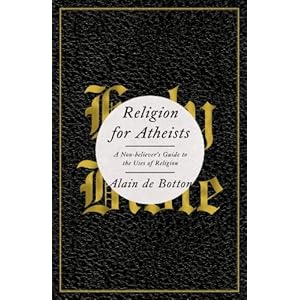
To begin, here is a podcast of De Botton in conversation with RSA Chief Executive Matthew Taylor. They discuss De Botton's book, Religion for Atheists: A Non-Believer's Guide to the Uses of Religions.

Religion for Atheists

26th Jan 2012

Listen to the audio
(full recording including audience Q&A)

RSA Thursday

Has the endless debate between believers and non-believers finally hit a brick wall? Are secularists in danger of throwing the baby out with the bathwater when they reject religion and its trappings, or is it possible for non-believers to find consolation and beauty in ritual and tradition too?

Renowned philosopher Alain de Botton argues that despite the falsity of supernatural claims of religion, they still have very important things to teach the secular world.

Rather than mocking or deriding religions, agnostics and atheists should instead steal from them - because they're packed with good ideas on how to live and arrange our societies. De Botton proposes that we should look to the religious tradition for insights into how to build a sense of community, make our relationships last, get more out of art, overcome feelings of envy and inadequacy, and much more.

Chair: Matthew Taylor, chief executive, RSA.
* * * * * * * 
In response to the above conversation, Jonathan Rowson offers a criticism of De Botton's thesis. This also comes from the RSA - and Rowson also includes my all-time favorite parable from The West Wing.

Religion for Atheists: What is the ‘it’ that De Botton doesn’t seem to ‘get’ ?

February 2, 2012 by
 
I have been a big fan of Alain De Botton for a number of years, and have enjoyed many of his books. As an undergraduate I was excited by the very title ‘How Proust can Change your Life‘, before I had even heard of ‘Prooost’, and I remember a diagram on the improbability of a couple meeting on an aeroplane, I think in ‘Essays in Love‘, that made me ponder the idea of fate more deeply than I ever had before. I am also a fan of The School of Life, which he inspired, and broadly support his considerable efforts to make philosophy, non-academically conceived, more engaging, accessible, and, frankly, enjoyable.

I believe Status Anxiety was by far his most powerful contribution. He gave name and form to a pervasive felt sense that constantly eats away at people, and elucidated the individual craving for ‘love from the world’ which pervades almost every aspect of modern life. (On a personal level, I related to the idea as a chess Grandmaster because the chess rating system functions as such a tangible status metric).

I didn’t get much out of The Pleasures and Sorrows of Work although it was such a beautifully designed and produced book that I kept expecting to, and enjoyed travelling hopefully. And now I am struggling a bit with Religion for Atheists, which he spoke about at the RSA last week.

Richard Holloway, one of the wisest thinkers in the country, seemed to value the book, which gave me pause, especially because he felt it would be most appreciated by “uneasy believers” who would “welcome it like a well of water in a dry place.” In other words De Botton’s reappraisal of religion is thought to be deep and sophisticated enough to revitalise moribund traditions, by reminding them that the true sources of their value are not, and never have been, wedded to doctrine. (Karen Armstrong makes a similar point in The Case for God).

So what’s the problem? Why do I feel, as I recently tweeted, that De Botton doesn’t ‘get it’? As Emma recently wrote, and Cognitive Media beautifully illustrated ”Without a properly articulated framework of values, his arguments for why atheists should grab a bit of religion just don’t stand up.” But that’s just part of the story. Something deeper is bugging me.

I felt a similar dissatisfaction when he interviewed Chief Rabbi Jonathan Sacks (about eight and a half minutes in) and it was related to De Botton’s somewhat promiscuous attitude to ideas. In essence he argues that the value in not subscribing to any particular tradition is that an individual can freely ‘pick and mix’ from all the available ideas and thereby come upon those ideas that suit their needs and interests at a given point in time.

This is not a religious position, but you might call it De Botton’s ‘Life stance’  which is an increasingly popular term used to describe people’s spiritual position, or perspective on how the way they live their lives relates to matters of fundamental concern. (‘a properly articulated framework of values’, even).

My concern for this position is that it doesn’t acknowledge the positional nature of depth, of the need to stick with something even when you don’t like it and it’s not working for you.

De Botton is surely right that you can experience depth in a variety of settings without religious commitment- there is depth in art, architecture, music, literature etc. But I wonder if the kinds of existential challenges we face can be adequately dealt with in this relatively piecemeal fashion. For instance, why read the Bible for insight into human experience when you could read Shakespeare? Why pray to an unknowable God when you could just enjoy the aesthetic power of the sunset?

I think there is an answer, and it relates to a  story I came upon from a less revered but much enjoyed cultural resource, the WestWing:
“This guy’s walking down the street when he falls in a hole. The walls are so steep he can’t get out.”

A doctor passes by and the guy shouts up, ‘Hey you. Can you help me out?’ The doctor writes a prescription, throws it down in the hole and moves on.

“Then a priest comes along and the guy shouts up, ‘Father, I’m down in this hole can you help me out?’ The priest writes out a prayer, throws it down in the hole and moves on.

“Then a friend walks by, ‘Hey, Joe, it’s me can you help me out?’ And the friend jumps in the hole.

Our guy says, ‘Are you stupid? Now we’re both down here.’

The friend says, ‘Yeah, but I’ve been down here before and I know the way out.’”

The idea that ‘I have been here before’ and ‘I know the way out’ is what I mean by positional depth in this context. In the context of a shared tradition we recognise similar human needs that are culturally embedded and socially constituted, in a way we cannot by a personal pick and mix approach.

The integrity of a religious tradition is that it places obstacles in your path that you are obliged to overcome on that path if you want to grow, and cannot eschew by casually rejecting the path and going on to another. I don’t quite feel I have nailed it, but I think this might be the ‘it’ that De Botton doesn’t seem to ‘get’.
* * * * * * *
Finally, here is an article from The Guardian (UK), the article is based on an interview.

Alain de Botton: a life in writing

'The nirvana would be if the questions raised by Oprah Winfrey would be answered by the faculty at Harvard'
 
guardian.co.uk, Friday 20 January 2012 

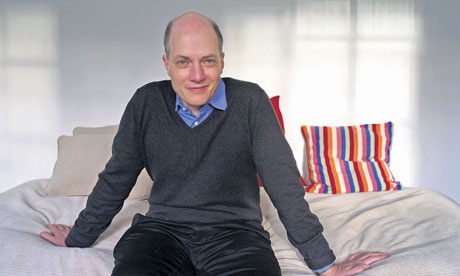
Alain de Botton
De Botton: 'Is the purpose of rocket science to ask questions about rockets?' 
Photograph: Eamonn McCabe
"My dad was a slightly stricter version of Richard Dawkins," says Alain de Botton. "The worldview was that there are idiots out there who believe in Santa Claus and fairies and magic and elves and we're not joining that nonsense." In his new book, Religion for Atheists, he recalls his father reducing his sister Miel to tears by "trying to dislodge her modestly held notion that a reclusive god might dwell somewhere in the universe. She was eight at the time." It's one of few passages in his unremittingly mellifluous and genteel oeuvre that sticks out with something like anger.

Before the interview, his publicists warned that De Botton didn't want to talk about Gilbert de Botton, Egyptian-born secular Jew and multimillionaire banker. He was especially keen not to discuss his father's business dealings and the repeated suggestion that his literary career was bankrolled with daddy's money.

But asking about De Botton's father is irresistible because Religion for Atheists is, he readily concedes, an oedipal book. "I'm rebelling," he says. "I'm trying to find my way back to the babies that have been thrown out with the bathwater." He's elsewhere described his father as "a cruel tyrant as a domestic figure, hugely overbearing". He was also surely crushingly impressive – the former head of Rothschild Bank who established Global Asset Management in 1983 with £1m capital and sold it to UBS in 1999 for £420m, a collector of late Picassos, the austere figure depicted in portraits by both Lucian Freud and Francis Bacon and an atheist who thrived without religion's crutch.

"He was extreme. I think it was a generational thing." And yet Gilbert, who died in 2000, now lies beneath a Hebrew headstone in a Jewish cemetery in Willesden, north-west London because, as his son writes pointedly, "he had, intriguingly, omitted to make more secular arrangements".

Disappointingly, Alain doesn't explore in book or interview what intrigued him about that omission.

Instead, he connects his father's militant atheism to the affliction that he reckons made Dawkins and Christopher Hitchens so caustic in their bestselling attacks on religion. "I've got a generational theory about this. Particularly if you're a man over 55 or so, perhaps something bad happened to you at the hands of religion – you came across a corrupt priest, you were bored at school, your parents forced it down your throat. Few of the younger generation feel that way. By the time I came around – I'm 42 – religion was a joke.

"I don't think I would have written this book if I'd grown up in Saudi Arabia as a woman. It's a European book in the sense that we're living in a society where religion is on the back foot. It rarely intruded on my life."

This isn't quite true. In his mid 20s, De Botton had a crisis of faithlessness when exposed to Bach's cantatas, Bellini's Madonnas and Zen architecture. What was the crisis about? "It was guilt about my father. I was disturbed by the intensity of the feeling. Bach was moving, but not just because of music but because this guy was talking in a tremulous voice about death. Secular culture tells us to respect Bach, but it doesn't tell us that we're going to be moved. I felt like I might go to the other side."

He didn't. Rather, in Religion for Atheists, he writes as a non-believer cherry-picking the world's religions. "I guess my insight was: 'What is there here that's useful, that we can steal?'" 
Read the whole article.

There's more to read at The Guardian on De Botton.

Research - Being ignored hurts, even by a stranger


This research summary (a press release from the Association for Psychological Science) looks at how humans need to feel included - even something as simple as eye contact from a stranger can help meet that need, or when it is absent, make us feel less connected.

If we can feel that bad when strangers do not acknowledge us, imagine then how bad it feels when our partners or friends ignore us.

Imagine even more so how much damage is done when we grow up families where we are ignored, dismissed, and otherwise not validated. A LOT of the people I see in counseling have grown up in families like this, and the damage to the sense of self is tremendous.

(Medical Xpress) -- Feeling like you’re part of the gang is crucial to the human experience. All people get stressed out when we’re left out. A new study published in Psychological Science, a journal of the Association for Psychological Science, finds that a feeling of inclusion can come from something as simple as eye contact from a stranger.

Psychologists already know that humans have to feel connected to each other to be happy. A knitting circle, a church choir, or a friendly neighbor can all feed that need for connection. Eric D. Wesselmann of Purdue University wanted to know just how small a cue could help someone feel connected. He cowrote the study with Florencia D. Cardoso of the Universidad Nacional de Mar del Plata in Argentina, Samantha Slater of Ohio University, and Kipling D. Williams of Purdue. “Some of my coauthors have found, for example, that people have reported that they felt bothered sometimes even when a stranger hasn’t acknowledged them,” Wesselmann says. He and his authors came up with an experiment to test that.

The study was carried out with the cooperation of people on campus at Purdue University. A research assistant walked along a well-populated path, picked a subject, and either met that person’s eyes, met their eyes and smiled, or looked in the direction of the person’s eyes, but past them—past an ear, for example, “looking at them as if they were air,” Wesselmann says. When the assistant had passed the person, he or she gave a thumbs-up behind the back to indicate that another experimenter should stop that person. The second experimenter asked, “Within the last minute, how disconnected do you feel from others?”

People who had gotten eye contact from the research assistant, with or without a smile, felt less disconnected than people who had been looked at as if they weren’t there.

“These are people that you don’t know, just walking by you, but them looking at you or giving you the air gaze—looking through you—seemed to have at least momentary effect,” Wesselmann says. Other research has found that even being ostracized by a group you want nothing to do with, like the Ku Klux Klan, can make people feel left out, so it’s not surprising that being pointedly ignored can have the same effect. “What we find so interesting about this is that now we can further speak to the power of human social connection,” Wesselmann says. “It seems to be a very strong phenomenon.”

Provided by the Association for Psychological Science

Thursday, September 29, 2011

#OCCUPYWALLSTREET - America's Real Tea Party

This loosely organized protest has grown day by day to become a serious grassroots rebellion against the financial elite - proof that Americans are not as apathetic as I, for one, have tended to believe.

Here is some of the coverage that is finally making it into the mainstream media. But first, I want to give credit to Adbusters Magazine - this was their idea and their project, and it started back in July.

#OCCUPYWALLSTREET

#OCCUPYWALLSTREET

A shift in revolutionary tactics.

Alright you 90,000 redeemers, rebels and radicals out there, A worldwide shift in revolutionary tactics is underway right now that bodes well for the future. The spirit of this fresh tactic, a fusion of Tahrir with the acampadas of Spain, is captured in this quote:
"The antiglobalization movement was the first step on the road. Back then our model was to attack the system like a pack of wolves. There was an alpha male, a wolf who led the pack, and those who followed behind. Now the model has evolved. Today we are one big swarm of people."
— Raimundo Viejo, Pompeu Fabra University
Barcelona, Spain
The beauty of this new formula, and what makes this novel tactic exciting, is its pragmatic simplicity: we talk to each other in various physical gatherings and virtual people's assemblies … we zero in on what our one demand will be, a demand that awakens the imagination and, if achieved, would propel us toward the radical democracy of the future … and then we go out and seize a square of singular symbolic significance and put our asses on the line to make it happen.
The time has come to deploy this emerging stratagem against the greatest corrupter of our democracy: Wall Street, the financial Gomorrah of America.
On September 17, we want to see 20,000 people flood into lower Manhattan, set up tents, kitchens, peaceful barricades and occupy Wall Street for a few months. Once there, we shall incessantly repeat one simple demand in a plurality of voices.
Tahrir succeeded in large part because the people of Egypt made a straightforward ultimatum – that Mubarak must go – over and over again until they won. Following this model, what is our equally uncomplicated demand?
The most exciting candidate that we've heard so far is one that gets at the core of why the American political establishment is currently unworthy of being called a democracy: we demand that Barack Obama ordain a Presidential Commission tasked with ending the influence money has over our representatives in Washington. It's time for DEMOCRACY NOT CORPORATOCRACY, we're doomed without it.
Read the whole post.

Get Involved

Here is their update site:
#OCCUPYWALLSTREET is a people powered movement for democracy that began in America on September 17 with an encampment in the financial district of New York City. Inspired by the Egyptian Tahrir Square uprising and the Spanish acampadas, we vow to end the monied corruption of our democracy … join us! We're now in DAY 13.
You can catch come videos of the protests here.

Here is Matt Taibbi's recent article from Rolling Stone.

'Occupy Wall Street': Drawing the Battle Lines

by Matt Taibbi

occupy wall street new york city police
I was speaking at a conference in Boston yesterday when one of the attendees asked me, "How come the media isn't covering the protests on Wall Street?"
I was about to give a pithy answer about how the press doesn't cover marches unless someone sets a car on fire or someone throws a rock through the window of a Starbucks, when I realized that I myself hadn't even written anything about it.
I don't know a whole lot about Occupy Wall Street, although I'm going to check it out when I return to New York. There are times when one wonders how effective marches are – one of the lessons that the other side learned from the Vietnam era is that you can often ignore even really big protests without consequence – but in this case demonstrations could be very important just in terms of educating people about the fact that there is, in fact, a well-defined conflict out there with two sides to it.
Here is a video from the scene with Scott Spinucci:


In this video clip, MSNBC's Lawrence O'Donnell equates the violent attacks on protesters by a small number of NYPD with the Rodney King protests - his arguments are a little specious to me, but the footage of the police becoming violent with nonviolent citizens exercising their rights to assemble in a public space is disturbing at best - and illegal in essence.
To Watch The Wall Street Protesters- Live Streaming Video and Chat Go To: http://www.livestream.com/globalrevolution 

To contact MSNBC reporter Lawrence O'Donnell and give him feedback for this spot on report --please email at thelastword@msnbc.com


If you feel the NYPD deserves FEEDBACK on this behaviour you can call them at (718) 520 9311