Showing posts with label leadership. Show all posts

Thursday, August 28, 2014

Metaintegral Academy - Vital Skills for Thriving in a Wild, Complex World: A Free Online Mini-Course for Change Leaders

Passing this along for those who may be interested - The topic is interesting and there are some good people presenting.
 
We are excited to announce a new—free—four-session online course:

Vital Skills for Thriving in a Wild, Complex World A Free Online Mini-Course for Change Leaders October 13-16, 2014

It’s a truism that the world and its problems are growing more complex every day. It’s also true that effective solutions aren’t keeping pace and that it’s harder than ever for change leaders to have impact. Ominously, the gap is widening. What does this portend for the future?

Since its founding in 2011, MetaIntegral Academy has devoted itself to this question with a big YES. Yes to the perspective that our future is bright. Yes to our ability to create solutions to our challenges. And yes to our ability to nurture future leaders and new leadership capacities.

MetaIntegral Academy creates programs that help change leaders unleashed their deeper potentials and in order to really become the change they want to see in the world. As a result of the success of our EPC program we have been looking for ways to share some of its essence with a wider audience. We've had many requests to share this material so we came up with this mini-course as a way of doing just that.

Here’s a brief description of the course modules:
  1. Power and Grace: Using Complexity Thinking and Intuitive Inquiry to Navigate These Turbulent Times, with Barrett C. Brown
  2. Thriving in the Flow through Action Inquiry, with Jesse McKay and Danielle Conroy
  3. From Taking a Stand to Inspiring Shared Action: The Art of Integral Enrollment, with Sean Esbjörn-Hargens and Dana Carman
  4. Integration: Putting It All Together to Thrive in a Wild, Complex World, with faculty from Modules 1-3. This course is for change leaders at any level—local, national, global—who want to enact a vision, express their unique talents more effectively, and enact their potential to do more and be more.
For course details and to register for free, click here.

Help us get the word out!

Wednesday, April 02, 2014

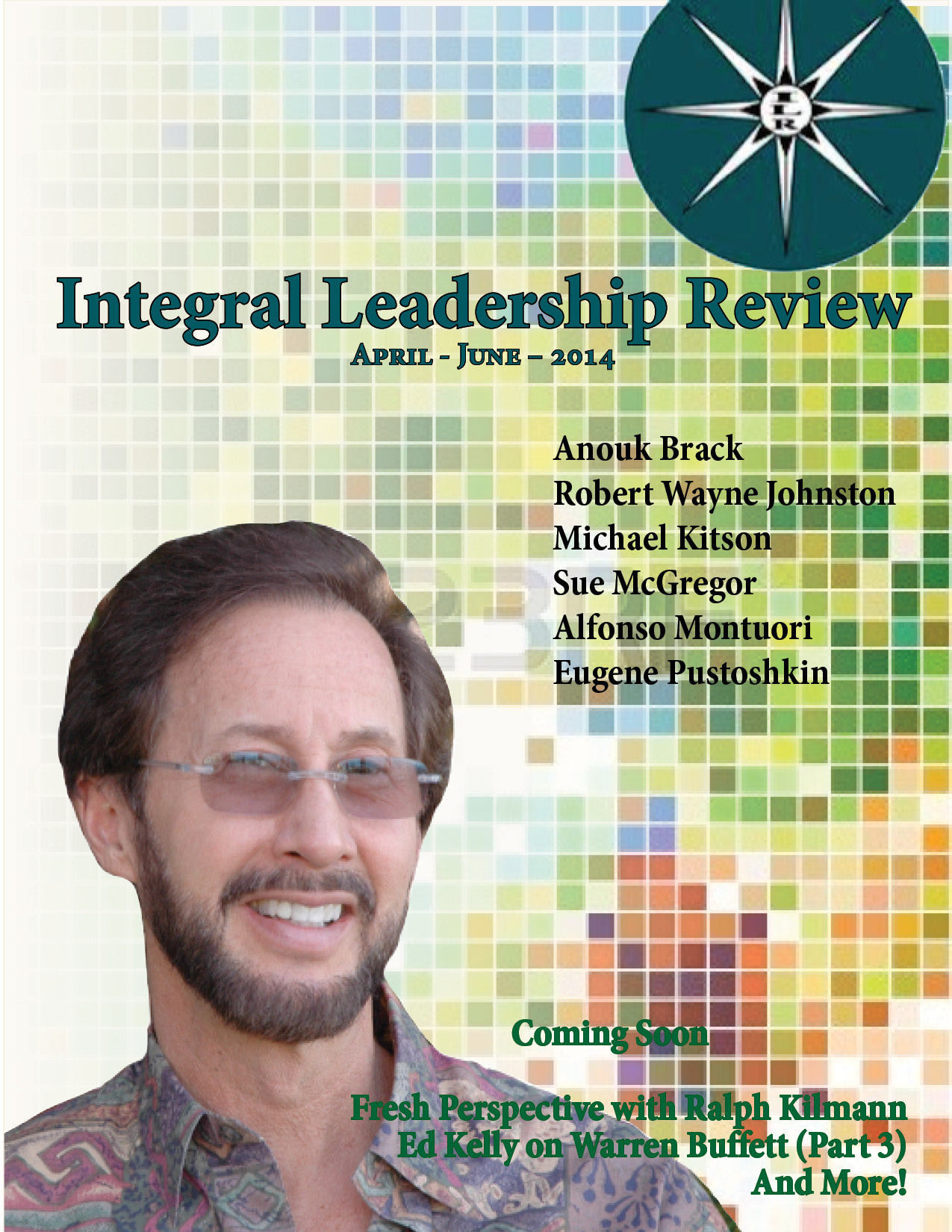
Integral Leadership Review, April – June 2014

A new issue of the Integral Leadership Review is online now, the first installment of the April through June edition. Table of contents is below.

ilrcover-4.14.2 

April-June 2014
Table of Contents

Leading Comments
4/1 – April-June 2014 Issue
Mark McCaslin
 
Leadership Quote
4/1 Leadership Quote
Russ Volckmann
 
Leadership Coaching Tips
4/1 – Leaders Who Can Be Led, Truly Lead
Rajkumari Neogy
 
Fresh Perspective
Forthcoming: Ralph H. Kilmann Awakening Society, Systems and Souls
Russ Volckmann
 
Feature Articles
4/1 – Foundation For Integral Self-Management: A ‘Working Hypothesis’
4/1 – Insights on 3-D Leadership Development and Enactment
4/1 – Leadership and Complexity
4/1 – The Adventures of Integral Consciousness in Russia: An Interview with Eugene Pustoshkin
4/1 – The Transdisciplinary Meme
Forthcoming: Ed Kelly on Warren Buffett, Part 3
Column
4/1 – Reflections on the Complexity of Integral Theorizing: Towards an Agenda for Self-reflection
Alfonso Montuori
 
Notes from the Field
4/1 – Tim Winton’s PatternDynamics
Russ Volckmann
 
Announcements
4/1 –Coming Events
 
Leadership Emerging
4/1 – Dana Ardi, The Fall of the Alphas
4/1 – Kai Hammerich and Richard D. Lewis Fish Can’t See Water: How National Cultures can Make or Break Your Corporate Strategy.

Friday, October 25, 2013

Empowering A Generation: An Educational Outreach Video for Young Leaders

This new video features the Spiral Dynamics model (Don Beck version), as well as the work of integral theorist Ervin Laszlo. It was posted by Mary Ann Thompson-Frenk, Co-Founder/President of The Memnosyne Institute, Executive Committee Member of NEXUS Global Youth Summit, President of John Philp Thompson Foundation, and Vice-Chair of Giordano Bruno University. Thompson-Frenk helped negotiate the first alliance in 300 years between the Hopi/Navajo nations.

Empowering A Generation: an educational outreach video for young leaders


Published on Oct 18, 2013


OFFERED FOR FREE FOR EDUCATIONAL PURPOSES ONLY

"Empowering A Generation" is a FREE educational outreach video designed to empower young 20something/30something leaders created by The Memnosyne Foundation, Nexus: Global Youth Summit, and The Club of Budapest - Americas (COBA) for the members of Nexus Youth Summit, but provides material relevant for anyone interested in learning how they can make a difference in an increasingly interconnected world.

A special thanks goes to Don E. Beck, Ervin Laszlo, Mitch Fine, and Michael Gosney for their expertise and to Tina Hui, Javier I. Kinney, and Mikuak Rai for their participation in making this video a reality!

Wednesday, October 23, 2013

"Profit from the Positive" - Margaret Greenberg & Senia Maymin | Talks at Google


Margaret Greenberg & Senia Maymin stopped by Talks at Google to promote their new book, Profit from the Positive: Proven Leadership Strategies to Boost Productivity and Transform Your Business. Their book translates scientific research on positive psychology into practical tools we can apply to how we manage ourselves, how we lead, and how we influence our colleagues. Sounds interesting.

Margaret Greenberg & Senia Maymin, "Profit from the Positive" | Talks at Google


Published on Oct 21, 2013


Think back to a moment when you got a piece of really good news.

You felt unstoppable, productive, elated.

Now imagine that feeling at work. Imagine bringing that positivity to your teams and unlocking new heights of productivity and satisfaction.

Join us for translation of scientific research on positive psychology into practical tools we can apply to how we manage ourselves, how we lead, and how we influence our colleagues.

Margaret H. Greenberg and Senia Maymin, Ph.D., will discuss their new book, Profit from the Positive: Proven Leadership Strategies to Boost Productivity and Transform Your Business (McGraw-Hill).

In this session, the authors will share memorable tools that are ingeniously fast and simple. You will walk out saying, "Why didn't I know this before?"
  • Introduction by Mary Kate Stimmler of Pi Lab
  • Hosted by Debbie Newhouse and Dolores Bernardo
  • Authors@Google and Google Manager Programs
~ "Greenberg and Maymin--pioneers in the application of Positive Psychology to organizations--have built an exciting and important bridge...." — Adam Grant, Wharton professor and New York Times bestselling author of Give and Take

Sunday, August 25, 2013

Susan Cain: The Power of Introverts (Why Introverts Just Might Be the Best Leaders)


From FORA.tv: Citing the leadership of hesitant leaders like Mahatma Gandhi, Eleanor Roosevelt, and Rosa Parks, Susan Cain, author of Quiet: The Power of Introverts in a World That Can't Stop Talking, shares why she believes introverts just might be the best leaders.

About the book:
At least one-third of the people we know are introverts. They are the ones who prefer listening to speaking; who innovate and create but dislike self-promotion; who favor working on their own over working in teams. It is to introverts—Rosa Parks, Chopin, Dr. Seuss, Steve Wozniak—that we owe many of the great contributions to society.

In Quiet, Susan Cain argues that we dramatically undervalue introverts and shows how much we lose in doing so. She charts the rise of the Extrovert Ideal throughout the twentieth century and explores how deeply it has come to permeate our culture. She also introduces us to successful introverts—from a witty, high-octane public speaker who recharges in solitude after his talks, to a record-breaking salesman who quietly taps into the power of questions. Passionately argued, superbly researched, and filled with indelible stories of real people, Quiet has the power to permanently change how we see introverts and, equally important, how they see themselves.
Nice talk.


Susan Cain: The Power of Introverts from InnoTown on FORA.tv

Susan Cain: The Power of Introverts

Did you know that introverted leaders often deliver better results than extroverts? That the most spectacularly creative people tend to be introverts? That the most innovative thinking happens alone, and not in teams? One of the central challenges of any business is to bring out the best in its employees. Yet when it comes to introverts--who make up a third to a half of the workforce--our leadership strategy mainly consists of asking them to act like extroverts. This is a serious waste of talent and energy. In an enlightening, relatable, and practical talk, Susan Cain shows us that introverts think and work in ways that are crucial to the survival of today's organizations.

Bio:

Susan Cain Susan Cain is a writer whose work on introversion and shyness has appeared in the New York Times, Time, O Magazine, and PsychologyToday.com. She has taught negotiation skills at corporations, law firms, and universities and practiced corporate law for seven years. She was selected to speak at the TED2012 conference in Long Beach, California. An honors graduate of Princeton and Harvard Law School, Susan lives in the Hudson River Valley with her husband and two sons.

Wednesday, August 21, 2013

Adam Grant: "Give and Take" - Authors at Google


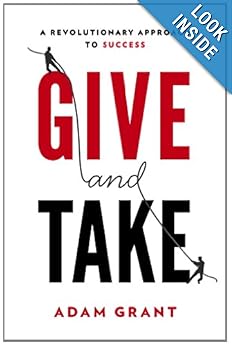
Adam Grant, the youngest tenured professor at Wharton, stopped by the Googleplex to discuss his new book, Give and Take: A Revolutionary Approach to Success. Seems like an interesting new book.


Adam Grant: "Give and Take", Authors at Google


Published on Apr 30, 2013

Adam Grant stops by the Googleplex to discuss his latest work, Give and Take: A Revolutionary Approach to Success.

From the publicist:

Give and Take changes our fundamental ideas about how to succeed—at work and in life. For generations, we have focused on the individual drivers of success: passion, hard work, talent, and luck. But in today's dramatically reconfigured world, success is increasingly dependent on how we interact with others. Give and Take illuminates what effective networking, collaboration, influence, negotiation, and leadership skills have in common.

Using his own groundbreaking research as the youngest tenured professor at Wharton, Grant examines the surprising forces that shape why some people rise to the top of the success ladder while others sink to the bottom. In professional interactions, it turns out that most people operate as either takers, matchers, or givers. Whereas takers strive to get as much as possible from others and matchers aim to trade evenly, givers are the rare breed of people who contribute to others without expecting anything in return.

These styles have a dramatic impact on success. Although some givers get exploited and burn out, the rest achieve extraordinary results across a wide range of industries. Combining cutting-edge evidence with captivating stories, this landmark book shows how one of America's best networkers developed his connections, why the creative genius behind one of the most popular shows in television history toiled for years in anonymity, how a basketball executive responsible for multiple draft busts transformed his franchise into a winner, and how we could have anticipated Enron's demise four years before the company collapsed—without ever looking at a single number.

Saturday, June 22, 2013

Controversial Spiritual Teacher Andrew Cohen Stepping Down from Role as Guru and Leader of EnlightenNext


Where the title reads "controversial spiritual teacher," please read abusive guru, the designation he has had on this blog for as long as I have been following the integral community and its assortment of associated male perpetrators. Andrew Cohen has been one of the most overt abusers through his use of authoritarian control over followers, much of which is documented on the blog What Enlightenment??! and EnlightenNixt, the compendium/companion site where many of the older posts are archived.

See also William Yenner's American Guru: A Story of Love, Betrayal and Healing-former students of Andrew Cohen speak out and Luna Tarlo's The Mother of God (Tarlo is Cohen's mother, a former follower, and a cogent observer of Cohen's controlling and manipulative tactics).

There has been growing issues around Cohen and his EnlightenNext organization over the past several years.

A few years ago (2010), they put up for sale their Fox Hollow compound in the Berkshires (MA). Although they maintained that the sale was in response to a more international presence of the organization, there were rumors floating around the Web that they had fewer devoted students, which meant less money coming in.

In 2011, EnlightenNext (the magazine formerly known as What Is Enlightenment?) ended its publication run of over 19 years and 47 issues, due to the "widespread financial challenges of the print industry."

Both of these events seem more serious in retrospect than they did at the time. According to information posted yesterday at What Enlightenment??!,
Sources close to EnlightenNext have since told us that criticism of Cohen began in the upper echelons over four years ago. Sometime over a year ago, some of these senior students were ordered by Cohen to meet together in London, apparently to attempt to purge themselves of their rebelliousness. Instead, at their meetings their questioning of Cohen’s authoritarian style of leadership deepened. They eventually stopped sending Cohen notes of their meetings, as expected and required. Soon they were joined in their dissent by other EnlightenNext leadership. A united front formed. As if this were not shocking enough, we heard that things had recently come to a head in a meeting between senior students and Cohen in Europe. A line was drawn in the sand, it was said. Not being satisfied with Cohen's response, a number of leaders left the community. Many other members followed suit.
And of course, Cohen's PR team is trying to spin the defections - and the fact that Cohen is steping away from his role as Guru and as leader of EnlightenNext - as simply the next progression of the organization's evolution.
EnlightenNext appears to be attempting to explain the changes as part of a natural evolution away from the authoritarian-mythic “blue meme” guru model, using terminology originated by Don Beck and Chris Cowan in their Spiral Dynamics model of human development, a model which has been widely adopted by Integral Theory teachers and thinkers, such as Ken Wilber. The PR Plan also identifies the need to address “Founder’s Syndrome,” a situation where the founder of an organization impedes its development. These theoretical explanations, with no mention of the harm Cohen and his organization have done to students and with no inkling of empathy for the suffering those students endured, make one wonder whether EnlightenNext’s culture of authoritarianism and abuse will really change. 
And what to make of the silence of those in the leadership who reportedly parted from Cohen? Although supposedly disaffected with Cohen, Jeff Careirra taught an on-line EnlightenNext program as recently as last weekend. Carter Phipps, who has been living in the Bay Area of California for almost a year, promoting his book “Evolutionaries” and participating in Integral community-related activities, has not publicly disclosed his split from Cohen or his future plans. Other students and EnlightenNext leaders have publicly remained similarly silent.
If you doubt the people around Cohen are well-trained in manipulated their public message, the good folks at What Enlightenment??! posted the PR plan being implemented around the coup d'etat led by Cohen's senior students.

It makes for interesting reading: 
From: Rosalind Bennett <rosb@enlightennext.org>
Date: June 15, 2013, 7:09:43 PM EDT
To: Rosalind Bennett <rosb@enlightennext.org>
Subject: PR & Communications plan for Andrew

Hello there, 
I just sent out the email below to the current Core students (Defining, Resolute and Committed Core) and also wanted you all to hear about our PR communications plan for Andrew. I'm sending this to everyone who I know is involved in the current programs and who I've personally spoken to, please feel free to forward this email on to others involved who would like to hear the messaging going forward. 
Thanks so much, 
Love,
Ros
--------------------------------------------------------------------------------------------------------- 
Dear All, 
I wanted to let you know the PR communications plan for Andrew that will roll out in the next few weeks. 
As most of you know Joel Pitney and I are responsible for Andrew's PR and media platform and we have been working on a message to the broader public regarding the situation we are in the midst of with Andrew, and all the subsequent changes. 
Many of you have contacted us sharing your urgency around making a public statement, and we thank you all for your input! We have taken everything you have said into consideration and come up with a plan that we are very happy with. 
Before I go any further I want to point out that while we're working very closely with Mary, Aterah, Morgan and the Education Department in our communications, what Joel and I are specifically responsible for (and what we've outlined in this email) has to do with communications from the Andrew Stream (to the broader public, Andrew's personal relationships, etc), and not the communications for the education programs and long retreats. 
GENERAL STRATEGY: 
We felt it was imperative to get an "outside perspective" on our PR communications as, being close students of Andrew in this emotionally charged situation, it's very difficult to envision the right message for the public at large. Our primary consultant has been our PR advisor Nate Winstanley. Nate is not only an excellent PR consultant, but he also trained in crisis management. He has been working with us for the last several years, and is fully appraised of Andrew's history, the history of EnlightenNext, and the current situation. Given his experience and his friendship with Andrew, we feel that he is the perfect person to help us with this messaging now, and his input has been invaluable. 
Nate has helped us to see that the most important point to consider in relationship to our PR strategy is that there is a tremendous difference between communicating to our "internal" audience of past and present students, and our "external" audience of people who follow Andrew's work, but are not part of any formal structures or communities (see a breakdown/description of our audiences at the end of this email). Nate also stressed how important it is that our public messaging be appropriate to our external audience, and that this should not be expected to address the issues that pertain to our "internal" audience of past and present students. 
He made it very clear that from an outside perspective, what is currently happening represents an evolution of both our organization/movement and Andrew's work. The fact that Andrew is acknowledging his mistakes, has stepped down from his role as Guru, and will be stepping down as head of the organization, is a reflection of the fact that our movement is changing and growing, and that Andrew is taking the necessary time off to reflect, respond, and take the next step in his own development. 
For the internal group of past and present students, Andrew must find a different and appropriate way to make peace; and, as most of you know, this internal process has already begun. He has already stepped down from his Guru role, which is on hiatus until spring 2014, and he is in the midst of responding appropriately to many past and present students. 
STEPPING DOWN FROM LEADERSHIP: 
Another very important distinction in our messaging that Nate helped us to understand has to do with how to announce Andrew's "sabbatical." He clarified that to frame the time that Andrew will be taking to reflect and respond as a sabbatical is not accurate. Given that Andrew will be doing a minimum of teaching work during this period, (the retreats and French forum) and that our many programs and content streams will continue in some form, from an outside perspective calling this time period a "sabbatical" would be confusing. Instead he suggested we emphasize in our public messaging that Andrew is stepping down from leadership, both within the organization and the spiritual community, and will be taking time to reflect and respond. 
So in our public statements, which will launch on Andrew's blog on June 28th (see Blog Themes below for more detail), we will announce that Andrew is "stepping down from leadership" rather than "taking a sabbatical." We feel that this is also more authentic as to what is actually happening, so please consider this in your own communications. 
BLOG THEMES: 
Our public messaging will center around a series of blog posts which will be published on all of the sites where Andrew writes (BigThink, HuffPo, etc) in addition to AC.org. They will be on two themes outlined below. The first blog will also be accompanied by an email to our list announcing Andrew's decision to step down from leadership and offer some description of how the EnlightenNext programs will be continuing forward: 
Confronting Founder's Syndrome: In this initial post, Andrew lays out what is happening for him right now in the context of "Founder's Syndrome," which is a common phase that organizations go through when due to a lack of willingness to give up control its visionary Founder gets in the way of the further evolution of the organization. He'll announce in this post that to address this situation, he's stepping down from leadership of both the organization and the spiritual community, and will radically reduce his teaching engagements to take time to reflect and respond. 
The Death of A Mythic Guru: In this second post (which may end up in multiple parts), Andrew will speak about his own development as a Guru and how he created a "mythic" Guru model within the postmodern world, outlining the negative and positive consequences of that. He'll talk about how difficult it has been for him to recognize the mythic structures within himself, and how he's going to now take the time necessary to develop both himself and the teachings. 
COMMUNICATIONS CALENDAR: 
Below is a list of the various communications that will go out to our different audiences over the next month:
  • Today: Overview of communications strategy/plan to the Defining, Resolute, Committed, and Past students (this email!)
  • 
Next few weeks: Series of calls/emails to various donors.

  • 6/28: Blog #1 on Founder's Syndrome will go up on BigThink

  • 6/28: Accompanying the blog will be an email to our email list announcing that Andrew is stepping down from leadership and giving a brief overview of what kinds of offerings they will continue to get from both Andrew and EnlightenNext.

  • 7/6: Guru & Pandit Virtual Broadcast on the theme of The Death of A Mythic Guru

  • 7/12: Blog #2 on The Death of A Mythic Guru goes up on BigThink

Thank you all for taking the time to read this. I apologize for the length of this email, but we felt it was important that we keep everyone informed as much as we can during this challenging period of our lives.

Also, when we have an approved plan of how Andrew's business line will be going forward, I'll send out another email. 
Best wishes all,
Ros & Joel 

AUDIENCE BREAKDOWN: 
Below is a description of the various audiences that we're reaching out to and an overview of the basic messaging strategy for each: 
"INTERNAL AUDIENCES":

Past and Present Students:
 Includes all Defining, Resolute, and Committed Core students and people who have been close students in the past. We are the people who are the most affected by what is happening and have the most investment in the whole situation and subsequent changes. These communications have several dimensions: First and foremost, Andrew is following up personally with people, both current and past students. Second, we as his communications team want to keep everyone abreast of our overall communications, so that everyone knows why we're saying what we're saying.


Donors: 
This audience has a significant overlap with past and present students. Since they have all committed financial support to Andrew and EnlightenNext, it is important for us to communicate how the current situation will affect Andrew's and the organization's short and long-term future, and the financial implications of this. We will be reaching out to communicate directly with our current donors within the next few weeks.


"EXTERNAL AUDIENCES": 
Blog Readers:
 This is our broadest audience and consists of people who engage with Andrew's content on a wide variety of external platforms (BigThink, Speaking Tree, HuffPost, etc). This audience is least familiar with Andrew and sees him more as a spiritual thought leader and less as a Guru with a community of students. This audience is the least interested in hearing about the details of our current situation, and our plan to communicate with them is through a series of blogs in which Andrew will speak about the current situation in more of a philosophical/cultural context (outlined in the Blog Themes section).


Email List:
 This is a group of about 35K people (~12K of which are very active) who receive consistent communications from us about new content, events, and products. This audience is a mix of people, but generally has more familiarity with Andrew's role as a teacher and also leader of our organization. Our primary communications to them will draw upon themes in Andrew's blog, but speak specifically about how we as an organization plan to respond to this situation and how that will affect the content and programs that they are used to hearing about.


Integral/Evolutionary Community: 
This is the segment of our public audience that is most familiar with the deeper dimensions of Andrew's work as a Guru and spiritual innovator. This audience has been following Andrew's work through the magazine, through the Guru & Pandit dialogues, and through other platforms like Craig Hamilton's, and is more familiar with the spiritual and philosophical stands that Andrew has taken in the post-traditional spiritual world. Our plan for this audience is for Andrew to use some of the remaining Guru & Pandit Virtual dialogues with Ken this year to explore some of the "Mythic-to-Post-Mythic-Guru" themes that are at the heart of the current situation.

Rosalind Bennett

Monday, June 17, 2013

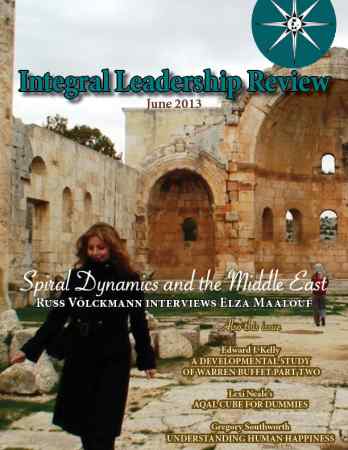
Integral Leadership Review, June 2013 Online Now


A new issue of the Integral Leadership Review is now online and, as always, open access under a Creative Commons license.

Here is the table of contents for the new issue - looks like there is a lot of good stuff to read.


Integral Leadership Review


June 2013 -Table of Contents

Leading Comments
Mark McCaslin
Leadership Quote
Leadership Coaching Tips
Darius Sebalius
Fresh Perspective
Russ Volckmann
Feature Articles
Maretha Prinsloo and Paul Barrett
Angela H. Pfaffenberger 
Exploring the Pathways to Postconventional Personality Development                                                 
Tatiana Bachkirova and Nick Shannon
John Quinlan 
Lexi Neale 
Greg Southworth
Warren Buffet’s Transformation in Leadership: Part 2                  Edward Kelly
Book Reviews
Russ Volckmann
Column
Lisa Norton
Alfonso Montuori 
Leadership Cartoon
Notes from the Field
Brian Van der Horst
Barbara N. Brown 
Pam Fuhrmann 
Vancouver, B.C., Canada: The Next Stage Facilitation                Chela Davison
Announcements
Leadership Emerging
Mark Harman
Integral Crossword
Coda  
Mark McCaslin

Thursday, May 02, 2013

New Book: Integral Leadership: The Next Half-Step, by John Forman and Laurel Ross


Yesterday's mail brought me another new book from SUNY Press's Series in Integral Theory, edited by Sean Esbjorn-Hargens - Integral Leadership: The Next Half-Step, by John Forman and Laurel Ross.

I look forward to reading this and getting a review posted here.

Summary


A groundbreaking book that brings the insights of Integral Theory to business and organizational development.

This groundbreaking book offers leaders a way to determine what theories, models, and tools best meet the needs of their organizations. Authors and organizational consultants John P. Forman and Laurel A. Ross know leaders are awash in business theory, often coming from well-thumbed bestsellers. But how do you match promising theories to real people and circumstances? Using the insights of Integral Theory, particularly Ken Wilber’s AQAL framework, the authors provide a simple yet elegant outline that appreciates and engages a wide range of leadership theories and techniques. Four major leadership styles emerge: the Impulsive, Diplomatic, Achiever, and Pluralistic approaches. The authors describe the presuppositions, characteristics, advantages, and disadvantages of each using a variety of real-life examples of individual leaders and organizations. Forman and Ross propose an emerging Integral perspective and suggest integral modes of performance management, change management, and teamwork. Ultimately, the Integral perspective gives leaders the insight and flexibility to use a range of resources to meet organizational needs in a rapidly changing world.

“Integral Leadership is perhaps the best of the plethora of revolutionary books now appearing that apply Integral Theory to business leadership, to provide the first comprehensive approach to leadership consulting and coaching. A must read for anyone in business or anyone interested in leadership in general.” — Ken Wilber, author of The Integral Vision: A Very Short Introduction to the Revolutionary Integral Approach to Life, God, the Universe, and Everything

Table of Contents


List of Illustrations
Acknowledgments
Introduction

1. The Foundations of Perspective
2. The Four-Dimensional Lens
3. Intelligent Performance
4. The Individual Making of Meaning
5. Collective Meaning-Making
6. Integral Meaning-Making: Individual and Collective
7. The Next Half-Step

Notes
References
Index

Saturday, March 16, 2013

Eric Storm and Beth Meredith - Beyond Complexity (Integral Leadership Review)


There is a new issue of the Integral Leadership Review online - free as always - and this was the first article that struck me in the table of contents. This is a very introductory level introduction to the integral approach to coping with complexity - the need to develop "transrational capabilities" and "become fluent in a number of relevant processes and frameworks."

To do this, they advocate building a "foundation of diverse competences and a transpersonal perspective" so that "we can open up to reality and engage in transrational ways of knowing that take us beyond complexity."

I would argue - and perhaps I will do so more completely in a future article - that we cannot go beyond complexity. Rather, we need to develop the skills to approach complexity with a multiperspectival awareness and learn to meet complexity on its own terms.

When we begin to grasp complex situations, we discover that complexity is not chaos, but has its own internal organizational structures that can be apprehended and worked with directly.

Beyond Complexity

Download article as PDF

Eric Storm and Beth Meredith


It is common wisdom that leaders today must grapple with increasing amounts of complexity. This seems inevitable given our access to ever more information and our expanding awareness of and the connections between psychological, social, organizational, and technological factors. This is particularly true for integral leaders who are actively developing their mental models and related practices. As our cognitive complexity develops so too does our ability to perceive greater complexity. In other words our complexity is becoming ever more complex.

To address this phenomenon, integral theorists have stretched for increasingly sophisticated meta-frameworks in order to capture additional layers of reality. This approach has led to many insights and contributed to our expanding awareness. However this type of extensive analysis requires significant time and effort to produce, and often requires equally demanding resources to apply. This level of investigation also runs the risk of increasing the complexity such that it is no longer clarifying but is at times overwhelming, inhibiting our ability to perceive, analyze, and act.

What is an integral leader to do when faced with a complicated decision but limited time and resources for thorough study? How does an integral consultant help a client avoid the overwhelm of complex analysis? One common strategy for dealing with complexity is to simplify. We squint our eyes and select what we perceive as the critical factors from the heaps of data. By choosing to emphasize some parts we can then set aside others, prioritizing for manageability. The disadvantages of this type of reduction are obvious: there is a risk of loosing important information and understandings, and reducing the quality of the outcome in the process.

While simplifying is often a practical necessity, ideally we want a way to consider all of the significant information and benefit from the richness of complexity while overcoming the time and resource burdens of detailed analysis. Fortunately it appears there is a third way of grappling with masses of information, a way that goesbeyond complexity. This third way comes about through a transcend and include process by which we can incorporate the complexity through both rational and intuitive means and arrive at a new level of understanding without the mental effort of consciously juggling a million data points simultaneously. In this paper we will describe what we see as the precursors and transpersonal foundation for this process, and our own experience working this way.

Many theorists have described transpersonal levels of awareness in their models of consciousness development. Jean Gebser, Jane Loevinger, William Torbert, Robert Kegan, Susanne Cook-Greuter, Clare Graves, Don Beck, Chris Cowan, and Ken Wilber varyingly describe these transpersonal stages as Magician, Alchemist, Synergist, second tier, yellow, teal, and integral. These theorists and others have also identified transrational ways of knowing that are accessible at transpersonal stages of development. These involve a very conscious use of intuitive modalities interwoven with rational thinking and frameworks.

In his thesis on sustainability leaders who hold post-conventional consciousness Barrett Brown identifies fifteen competencies “to help cultivate leaders who can handle complex global issues” (209). One such competency is “ways of knowing other than rational analysis to harvest profound insights and make rapid decisions” (Brown 212). Similarly, in their book on leadership skills for dealing with change, Bill Joiner and Stephen Josephs describe the benefits of developing “synergistic intuitions” to “resolve apparently irreconcilable conflicts” (243).

We can find the precursors to these transrational ways of knowing in things we all do every day. These alternative ways of knowing are familiar to many of us and help us handle complexity more effectively. For example most of us have had the experience of suddenly noticing that we have driven for miles with no memory of having navigated the intricacies of the road. What had once required a lot of conscious effort checking mirrors, speed, and traffic over time has become a largely unconscious process. This ability to relinquish our awareness of some things, like the mechanics of driving, to our unconscious allows us to manage even greater complexity, like listening to the radio or talking with someone – up to a point!

At other times we may choose for our awareness of the complexity to remain conscious and to inform our decision making. Such is the case when we are in a flow stateand are fully present and positively engaged on a deep level with the task at hand. Yet we manage to do this without much effort and our actions feel automatic and appropriate. We are able to enter the zone and feel the ease of being at one with events as they unfold.

Another common experience of functioning outside of rational analysis is the aha experience when we suddenly have an insight or realize the solution to a problem while doing something unrelated such as taking a shower or waking from sleep. These flashes of understanding arise after we have spent time with the complexity of the issue but are currently not making an effort or focused on it. The aha experience arises from and reflects our understanding of the intricacies of an issue, but in a way that offers a newly crystallized comprehension.

Finally, there is what is known as soft focus or soft eyes, when we are able to better perceive the whole by being generally aware and not too keenly focused on any one thing. This enables us to perceive a situation on many levels simultaneously including noticing things that might initially appear as anomalies or insignificant. With a soft focus we are able to perceive the whole in all its complexity, and as necessary shift focus to elements we deem significant.

The examples above are alternative ways of knowing that are commonly, if not frequently, experienced. At transpersonal stages of development we can build upon these capacities along with our rational understandings to arrive at transrational capacities to go beyond complexity. Through this transcend and include process we become able to engage with complexity with the efficiency described in the driving example, the power and consciousness of a flow state, the quick synthesis of the aha experience, and the awareness of the whole of soft focus.

In their respective dissertations, both Barrett Brown and Jonathan Reams posit that it is possible to cultivate these transrational capacities in leaders to go beyond complexity. In fact, one purpose of Reams’ study was “to develop a curriculum to facilitate the development of these qualities and characteristics” (8).

To build the foundation for these transrational capabilities it is important to first become fluent in a number of relevant processes and frameworks. As in the driving example, we first need to know how to change lanes, pass another vehicle, and judge merging speeds. This type of knowledge and skill building expands our ability to perceive and process information. We need this level of fluency in order to comprehend what we perceive through transrational processes and to rationally evaluate and discuss these new understandings with others.

Our foundation is further strengthened as we make the subject-object shift from identifying with our personality to observing it. As we are able to see our selves and to see all of our assumptions, values, shadows, blind spots, etc., we take a significant step into the transpersonal realm. In our position as observer we begin to have more control over our reactions and behavior. When we no longer identify with our mental models, we can shift from our own perspective to comprehending the world from a variety of other lenses. We become capable of stepping outside ourselves and inhabiting a kind of openness that is essential for transrational ways of knowing.

In his book Power vs Force, David Hawkins observes, “A mind which is being watched becomes more humble and begins to relinquish its claims to omniscience … and increasingly [we are] less the victim of the mind and more its master. From thinking that we ‘are’ our minds, we begin to see that we have minds … Eventually we may arrive at the insight that all our thoughts are merely borrowed from the great database of consciousness and were never really our own”(205).

Once we have this foundation of diverse competences and a transpersonal perspective we can open up to reality and engage in transrational ways of knowing that take us beyond complexity.

Lately we, the authors, have been exploring the edges beyond complexity in our work helping our clients address their problems. Increasingly we use transrational methods to search for the underlying sources of the issue, to determine if there is permission and support for change, and to identify the most effective levers for moving forward.

When we consider why our work has evolved in a transrational direction there seem to be several factors. We have worked together for over ten years and now share a wide range of mental models and tools as well as experience applying them. It happens that one of us is more analytical and the other more empathetic by nature. Our differing styles together give us a stereoscopic view of our clients and their issues. We have come to value each other’s perceptions and to trust each other in the moment, not unlike improvisation where we build upon what the other puts forward. In the moment we often feel in touch with something that is beyond either one of us.

The more analytical of us has reached a point of being able to accumulate way more information, perspectives, and processes than he can reasonably apply at any given moment. Out of necessity, and now preference, he has found himself increasingly relying on transrational ways of knowing. A combination of exposure to somatic and intuitive practices and a growing body of personal experiences in which he had to respond to clients in a matter of minutes has led to his growing comfort with his transrational process. While he does at times revisit the issue through the lens of various models to glean additional insights, he now finds using transrational ways of perceiving and knowing easier and more effective in many situations.

The more empathetic of us developed her intuition early in life as a way to navigate complexity and to focus on what is most critical and relevant. She has learned to analyze her perceptions retroactively in order to communicate in information-based contexts and as a way to hone the accuracy of her perceptions. The more she has access to a transpersonal perspective, the clearer her perceptions have become, less clouded by personal agenda or blind spots.

In practice we begin by quieting our minds, becoming present and open to what is happening. Our intent is to be in service to what wants to emerge, and we try to hold no agenda beyond that – even to the point of not needing to fix things or find an answer. We begin by asking the client a general question such as “What’s going on?” or “What’s working and what’s not?”

As the client begins speaking we shift into soft focus. We let the data wash over and we seek to attune with the client and the moment, seeing through their eyes as well as sensing shifts in their body language and emotions.

Almost immediately we are also informed by our mental models including our personal judgments, preferences, etc. We seek to hold all of these as so many lenses of perception. We may temporarily adopt a hypotheses or framework and check to see if it opens up some additional information or thoughts. We shift somewhat effortlessly between our theories, our personal thoughts and reactions, and our observations of what is happening. It is very important that at the center of all this we hold a place of not-knowing. From here we can return to a state of soft focus, blurring the boundaries between subject and object, and staying open to what is, our intuition, and emerging understandings.

Joiner and Josephs describe a similar process of “surrendering to a direct experience of the impasse, the ‘not-knowing,’ where feelings oppose each other and nothing seems possible. Attending to this experience in a conscious, patient, and caring way liberates energy and opens the way for new, synergistic possibilities” (Joiner, Josephs 185).

We have realized that the more we trust our process the better it works. Eventually something begins to take shape out of our conversation with the client. It may emerge as a whole, or it may take shape more slowly revealing itself in bits and pieces. In some cases what emerges is very familiar to us, and in others it is a notion outside our usual understanding. It may arise as a general concept, or as a series of quite specific and detailed thoughts. In any case, we recognize it because it resonates with a solidity and firmness we associate with truth and as something that is relevant, a priority, or a useful entry or leverage point. We test out our perceptions and refine our sense of this truth with one another and the client through a series of questions and statements.

Through out this process the client is a co-creator in the experience, though with varying degrees of awareness about the mechanics of what is happening. For the most part it appears to them as if we are having a conversation, a conversation in which they are initially doing a lot of the talking. Eventually as we get clearer on what is emerging, the conversation begins to turn. Sometimes this occurs as a shift and other times as a leap. What is still surprising to us is how easily this occurs with no overt discussion or agreement by any of us. We may voice an insight or simply allow it to inform what we say. The more we are able to align our comments and actions with what is emerging and where the client is in the moment, the more they are able to share the new insights and understanding. Often it feels like our collective understanding is opening a flow of energy like a tiny acupuncture needle in just the right place.

This is the place we call beyond complexity.

Later if the situation allows, we may engage with our client or ourselves in a more rational and thorough analysis. However we do so from the perspective of knowing what lies beyond the complexity which makes the task much easier as we come from a place of knowing. This after-the-fact checking also helps us to hone our process and reflect on our role in it. What we are finding is that the process works best the more self aware we are of our own assumptions, preferences, and expectations and the more open we are to what emerges.

Learning to work this way has greatly helped us with our clients who are frequently organizational, business, and community leaders facing the typical issues of overwhelm and analysis paralysis. Even though intuitive processes are frequently dismissed in conventional settings as woo-woo, we find the outwardly unremarkable nature of this practice along with its relative speed and effectiveness help to side step most objections. Also while a transpersonal foundation seems to be necessary to consciously use transrational processes, our experience is that the fruits of this process appear to be meaningful and useful when shared with people at varying levels of awareness.

We believe these transrational ways of knowing will become increasingly common as a natural outgrowth of transpersonal consciousness. We can imagine these transrational processes beginning to take their place along side financial statements, organizational charts, and other tools of leadership, decision making, and organizational development. There is much to be explored and documented in terms of how to develop these abilities, how to apply them, and what their limitations are. We are excited by the possibilities and the potential as integral leaders and practioners share their insights and understandings of going beyond complexity.

References

Brown, Barrett (2011), Conscious Leadership For Sustainability: How Leaders with a Late-Stage Action-Logic Design and Engage in Sustainability Initiatives, Doctoral Dissertation, Fielding Graduate University, Retrieved January 12, 2013, http://integralthinkers.com/wp-content/uploads/Brown_2011_Conscious-leadership-for-sustainability_Full-dissertation_v491.pdf.

Hawkins, David (1995), Power vs. Force: The Hidden Determinants of Human Behavior, Sedona: Veritas. Retrieved January 12, 2013,http://images.1radine.multiply.multiplycontent.com/attachment/0/R@xIYAoKCC4AADe4IL41/David%20R%20Hawkins%20-%20Power%20vs%20Force.pdf?nmid=88358873.

Joiner, Bill & Josephs, Stephen (2007), Leadership Agility: Five Levels of Mastery for Anticipating and Initiating Change, San Francisco: Jossey-Bass.

Reams, Jonathan (2002), The Consciousness of Transpersonal Leadership, Doctoral Dissertation, Gonzaga University, Retrieved January 12, 2013,http://jonathanreams.squarespace.com/downloads/articles/The%20Consciousness%20of%20Transpersonal%20Leadership.pdf.

About the Authors

Eric Storm and Beth Meredith run Create The Good Life which promotes personal and organizational change through building awareness, designing for well being, and creating sustainable practices. Eric has a background in fine art, education, sustainability, and green building. He has worked in Japan and in the U.S. leading cross-cultural education programs. Beth’s background is in social psychology, art, architecture and design. She also has an M.A. is Policy Studies from the Monterey Institute of International Studies and has designed and led educational programs internationally and in the U.S. In addition they have trained in Permaculture Design, home energy modeling, mediation, the Enneagram, and Systemic Constellation. Beth and Eric now live slowly in Petaluma, California, where they create the good life for themselves and others. Email: info@Create-The-Good-Life.com.