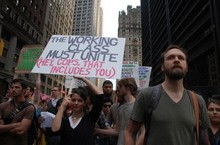
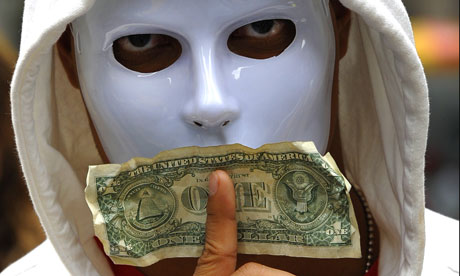
Showing posts with label #occupywallstreet. Show all posts

Saturday, September 08, 2012

Slavoj Žižek: The Politics of Batman


Slavoj Žižek has lost some of the star-status he enjoyed a year or two ago when he seemed to translated and profiled nearly weekly in U.S. journals. His rise to fame began with the 1989 translation into English of The Sublime Object of Ideology and continued to increase over the next two decades, perhaps peaking in 2009-2010 when he was reportedly hanging out with Lady Gaga.

From my perspective it seemed he was seeking controversy and probably hoped to generate discussion, but generally came to be regarded as something of a buffoon by more serious authors and critics. Maybe that is for the best - he does not feel the philosopher or social critic should pretend to have answers in the first place.

Here is a brief summary of his "thinking" from Wikipedia:
Ian Parker claims that there is no "Žižekian" system of philosophy because Žižek, with all his inconsistencies, is trying to make us think much harder about what we are willing to believe and accept from a single writer (Parker, 2004). Indeed, Žižek himself defends Jacques Lacan for constantly updating his theories, arguing that it is not the task of the philosopher to act as the Big Other who tells us about the world but rather to challenge our own ideological presuppositions. The philosopher, for Žižek, is more someone engaged in critique than someone who tries to answer questions.[24]

However, this claim about the role of the philosopher/theorist is complicated by how Žižek frequently derides the consumerist fashionability of postmodern cultural criticism while affirming his universal emancipatory stance and love for "grand explanations" (Žižek, 2008). In contrast to Parker, Adrian Johnston's book Zizek's Ontology: A Transcendental Materialist Theory of Subjectivity argues against the position that Žižek's thought has no consistency or underlying project. Specifically, Johnston claims in his Preface that beneath "what could be called 'the cultural studies Žižek'" is a singular "philosophical trajectory that runs like a continuous, bisecting diagonal line through the entire span of his writing (i.e. the retroactive Lacanian reconstruction of the chain Kant-Schelling-Hegel)." Žižek's affirmation of this claim suggests that like his predecessor Hegel, Žižek's work is better described as rigorous in the sense of systematic rather than as comprising a single, all-encompassing "system."

One thing Žižek has always done well is film criticism. He brings the same bastardized hybrid of Lacanian psychoanalysis, Hegelian phenomenology, and Marxist social theory to film that he generally brings to discussions of social and political issues.

In this recent article from New Statesman, he looks at the politics of Batman as revealed in the final Chris­topher Nolan installment, The Dark Knight Rises. The article contains spoilers for those who have not yet seen the film - read at your own risk.

Slavoj Žižek: The politics of Batman

From the repression of unruly citizens to the celebration of the “good capitalist”, The Dark Knight Rises reflects our age of anxiety. 


Batman
Fear city: the director Christopher Nolan's latest Batman film consciously explores modern anxieties about "economic fairness". Image: Warner Brothers Extended Artwork 

The Dark Knight Rises shows that Hollywood blockbusters are precise indicators of the ideological predicaments of our societies. Here is the storyline. Eight years after the events of The Dark Knight, the previous installment of Chris­topher Nolan’s Batman series, law and order prevail in Gotham City. Under the extraordinary powers granted by the Dent Act, Commissioner Gordon has nearly eradicated violent and organised crime. He nonetheless feels guilty about the cover-up of the crimes of Harvey Dent and plans to confess to the conspiracy at a public event – but he decides that the city is not ready to hear the truth.

No longer active as Batman, Bruce Wayne lives isolated in his manor. His company is crumbling after he invested in a clean-energy project designed to harness fusion power but then shut it down, on learning that the core could be modified to become a nuclear weapon. The beautiful Miranda Tate, a member of the Wayne Enterprises executive board, encourages Wayne to rejoin society and continue his philanthropic good works.

Here enters the first villain of the film. Bane, a terrorist leader who was a member of the League of Shadows, gets hold of a copy of the commissioner’s speech. After Bane’s financial machinations bring Wayne’s company close to bankruptcy, Wayne entrusts control of his enterprise to Miranda and also has a brief love affair with her. Learning that Bane has also got hold of his fusion core, Wayne returns as Batman and confronts Bane. Crippling Batman in close combat, Bane detains him in a prison from which escape is almost impossible. While the imprisoned Wayne recovers from his injuries and retrains himself to be Batman, Bane succeeds in turning Gotham City into an isolated city state. He first lures most of Gotham’s police force underground and traps them there; then he sets off explosions that destroy most of the bridges connecting Gotham to the mainland and announces that any attempt to leave the city will result in the detonation of Wayne’s fusion core, which has been converted into a bomb.

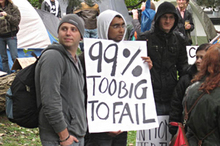
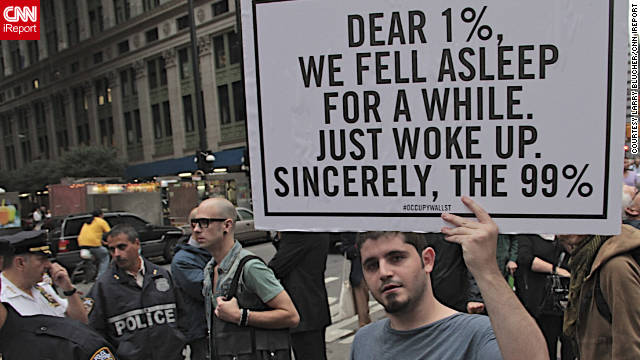
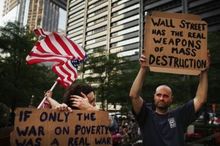
Now we reach the crucial moment of the film: Bane’s takeover is accompanied by a vast politico-ideological offensive. He publicly exposes the cover-up of Dent’s death and releases the prisoners locked up under the Dent Act. Condemning the rich and powerful, he promises to restore the power of the people, calling on citizens, “Take your city back.” Bane reveals himself, as the critic Tyler O’Neil has put it, to be “the ultimate Wall Street Occupier, calling on the 99 per cent to band together and overthrow societal elites”. What follows is the film’s idea of people power – summary show trials and executions of the rich, the streets surrendered to crime and villainy.

A couple of months later, while Gotham City continues to suffer under popular terror, Wayne escapes from prison, returns as Batman and enlists his friends to help liberate the city and disable the fusion bomb before it explodes. Batman confronts and subdues Bane but Mir­anda intervenes and stabs Batman. She reveals herself to be Talia al-Ghul, daughter of Ra’s al-Ghul, the former leader of the League of Shadows (the villains in Batman Begins). After announcing her plan to complete her father’s work in destroying Gotham City, Talia escapes.

In the ensuing mayhem, Commissioner Gordon cuts off the bomb’s remote detonation function, while a benevolent cat burglar named Selina Kyle kills Bane, freeing Batman to chase Talia. He tries to force her to take the bomb to the fusion chamber where it can be stabilised, but she floods the chamber. Talia dies, confident that the bomb cannot be stopped, when her truck is knocked off the road and crashes. Using a special helicopter, Batman hauls the bomb beyond the city limits, where it detonates over the ocean and pre­sumably kills him. Batman is now celebrated as a hero whose sacrifice saved Gotham City. Wayne is believed to have died in the riots. While his estate is being divided up, his butler, Alfred, sees Wayne and Selina together alive in a café in Florence. Blake, a young and honest policeman who knew about Batman’s identity, inherits the Batcave. The first clue to the ideological underpinnings of this ending is provided by Alfred, who, at Wayne’s apparent burial, reads the last lines from Dickens’s A Tale of Two Cities: “It is a far, far better thing that I do, than I have ever done; it is a far, far better rest that I go to than I have ever known.” Some reviewers took this as an indication that, in O’Neil’s words, the film “rises to the noblest level of western art . . . The film appeals to the centre of America’s tradition – the ideal of noble sacrifice for the common people . . . An ultimate Christ-figure, Batman sacrifices himself to save others.”

Seen from this perspective, the storyline is a short step back from Dickens to Christ at Calvary. But isn’t the idea of Batman’s sacrifice as a repetition of Christ’s death not compromised by the film’s last scene (Wayne with Selina in the café)? Is the religious counterpart of this ending not, instead, the well-known blasphemous idea that Christ survived his crucifixion and lived a long, peaceful life in India or, as some sources have it, Tibet? The only way to redeem this final scene would be to read it as a daydream or hallucination of Alfred’s.

A further Dickensian feature of the film is a depoliticised complaint about the gap between rich and poor. Early in the film, Selina whispers to Wayne as they are dancing at an exclusive, upper-class gala: “A storm is coming, Mr Wayne. You and your friends better batten down the hatches. Because when it hits, you’re all going to wonder how you thought you could live so large and leave so little for the rest of us.” Nolan, like any good liberal, is “worried” about the disparity and has said that this worry permeates the film: “The notion of economic fairness creeps into the film . . . I don’t feel there’s a left or right perspective in the film. What is there is just an honest assessment or honest exploration of the world we live in – things that worry us.”

Although viewers know Wayne is mega-rich, they often forget where his wealth comes from: arms manufacturing plus stock-market speculation, which is why Bane’s games on the stock exchange can destroy his empire. Arms dealer and speculator – this is the secret beneath the Batman mask. How does the film deal with it? By resuscitating the archetypal Dickensian theme of a good capitalist who finances orphanages (Wayne) versus a bad, greedy capitalist (Stryver, as in Dickens). As Nolan’s brother, Jonathan, who co-wrote the screenplay, has said: “A Tale of Two Cities, to me, was the most . . . harrowing portrait of a relatable, recognisable civilisation that had completely fallen to pieces. You look at the Terror in Paris, in France in that period, and it’s hard to imagine that things could go that bad and wrong.” The scenes of the vengeful populist uprising in the film (a mob that thirsts for the blood of the rich who have neglected and exploited them) evoke Dickens’s description of the Reign of Terror, so that, although the film has nothing to do with politics, it follows Dickens’s novel in “honestly” portraying revolutionaries as possessed fanatics.

The good terrorist

An interesting thing about Bane is that the source of his revolutionary hardness is unconditional love. In one touching scene, he tells Wayne how, in an act of love amid terrible suffering, he saved the child Talia, not caring about the consequences and paying a terrible price for it (Bane was beaten to within an inch of his life while defending her).

Another critic, R M Karthick, locates The Dark Knight Rises in a long tradition stretching from Christ to Che Guevara which extols violence as a “work of love”, as Che does in his diary:
Let me say, with the risk of appearing ridiculous, that the true revolutionary is guided by strong feelings of love. It is impossible to think of an authentic revolutionary without this quality.
What we encounter here is not so much the “christification of Che” but rather a “che­isation” of Christ – the Christ whose “scandalous” words from Luke (“If anyone comes to me and does not hate his father and his mother, his wife and children, his brothers and sisters – yes, even his own life – he cannot be my disciple”) point in the same direction as these ones from Che: “You may have to be tough but do not lose your tenderness.” The statement that “the true revolutionary is guided by a strong feeling of love” should be read together with Guevara’s much more problematic description of revolutionaries as “killing machines”:
Hatred is an element of struggle; relentless hatred of the enemy that impels us over and beyond the natural limitations of man and transforms us into effective, violent, selective and cold killing machines. Our soldiers must be thus; a people without hatred cannot vanquish a brutal enemy.
Guevara here is paraphrasing Christ’s declarations on the unity of love and the sword – in both cases, the underlying paradox is that what makes love angelic, what elevates it over mere sentimentality, is its cruelty, its link with violence. And it is this link that places love beyond the natural limitations of man and thus transforms it into an unconditional drive. This is why, to turn back to The Dark Knight Rises, the only authentic love portrayed in the film is Bane’s, the terrorist’s, in clear contrast to Batman’s.

The figure of Ra’s, Talia’s father, also deserves a closer look. Ra’s has a mixture of Arab and oriental features and is an agent of virtuous terror, fighting to correct a corrupted western civilisation. He is played by Liam Neeson, an actor whose screen persona usually radiates dignified goodness and wisdom – he is Zeus in Clash of the Titans and also plays Qui-Gon Jinn in The Phantom Menace, the first episode of the Star Wars series. Qui-Gon is a Jedi knight, the mentor of Obi-Wan Kenobi as well as the one who discovers Anakin Skywalker, believing that Anakin is the chosen one who will restore the balance of the universe, and ignores Yoda’s warnings about Anakin’s unstable nature. At the end of The Phantom Menace, Qui-Gon is killed by the assassin Darth Maul.

In the Batman trilogy, Ra’s is the teacher of the young Wayne. In Batman Begins, he finds him in a prison in Bhutan. Introducing himself as Henri Ducard, he offers the boy a “path”. After Wayne is freed, he climbs to the home of the League of Shadows where Ra’s is waiting. At the end of a lengthy and painful period of training, Ra’s explains that Wayne must do what is necessary to fight evil, and that the league has trained Wayne to lead it in its mission to destroy Gotham City, which the league believes has become hopelessly corrupt.

Ra’s is thus not a simple embodiment of evil. He stands for the combination of virtue and terror, for egalitarian discipline fighting a corrupted empire, and thus belongs to a line that stretches in recent fiction from Paul Atreides in Frank Herbert’s Dune to Leonidas in Frank Miller’s graphic novel 300. It is crucial that Wayne was a disciple of Ra’s: Wayne was made into Batman by his mentor.

At this point, two common-sense objections suggest themselves. The first is that there were monstrous mass killings and violence in real-life revolutions, from the rise of Stalin to the rule of the Khmer Rouge, so the film is clearly not just engaging in reactionary imagination. The second objection is that the Occupy Wall Street (OWS) movement in reality was not violent – its goal was definitely not a new Reign of Terror. In so far as Bane’s revolt is supposed to extrapolate the immanent tendency of OWS, the film absurdly misrepresents its aims and strategies. The ongoing anti-capitalist protests are the opposite of Bane: he stands for the mirror image of state terror, for a murderous fundamentalism that takes over and rules by fear, not for the overcoming of state power through popular self-organisation. What both objections share, however, is the rejection of the figure of Bane.

The reply to these two objections has several parts. First, one should make the scope of violence clear. The best answer to the claim that the violent mob reaction to oppression is worse than the original oppression was the one provided by Mark Twain in his novel A Connecticut Yankee in King Arthur’s Court:
There were two “Reigns of Terror” if we would remember it and consider it; the one wrought in hot passion, the other in heartless cold blood . . . Our shudders are all for the “horrors” of the minor Terror, the momentary Terror, so to speak, whereas, what is the horror of swift death by the axe compared with lifelong death from hunger, cold, insult, cruelty, and heartbreak? . . . A city cemetery could contain the coffins filled by that brief Terror which we have all been so diligently taught to shiver at and mourn over; but all France could hardly contain the coffins filled by that older and real Terror, that unspeakably bitter and awful Terror, which none of us have been taught to see in its vastness or pity as it deserves.
Then, one should demystify the problem of violence, rejecting simplistic claims that 20th- century communism used too much extreme murderous violence. We should be careful not to fall into this trap again. As a fact, this is terrifyingly true. Yet such a direct focus on violence obfuscates the underlying question: what was wrong with the communist project as such? What internal weakness of that project was it that pushed communists towards unrestrained violence? It is not enough to say that communists neglected the “problem of violence”; it was a deeper, sociopolitical failure that pushed them to violence. It is thus not only Nolan’s film that is unable to imagine authentic people’s power. The “real” radical-emancipatory movements couldn’t do it, either; they remained caught in the co-ordinates of the old society, in which actual “people power” was often such a violent horror.

Finally, it is all too simplistic to claim that there is no violent potential in OWS and similar movements – there is a violence at work in every authentic emancipatory process. The problem with The Dark Knight Rises is that it has wrongly translated this violence into murderous terror. Let us take a brief detour here through José Saramago’s novel Seeing, which tells the story of strange events in the unnamed capital city of an unidentified democratic country. When election day dawns with torrential rain, the voter turnout is disturbingly low. But the weather turns by mid-afternoon and the population heads en masse to the polling stations. The government’s relief is short-lived, however: the count shows that more than 70 per cent of the ballots cast in the capital have been left blank. Baffled, the government gives the people a chance to make amends a week later at another election.

The results are worse. Now 83 per cent of the ballots are blank. The two major political parties – the ruling party of the right and its chief adversary, the party of the middle – are in a panic, while the marginalised party of the left produces an analysis claiming that the blank ballots are a vote for its progressive agenda. Unsure how to respond to a benign protest but certain that an anti-democratic conspiracy is afoot, the government quickly labels the movement “terrorism, pure and unadulterated” and declares a state of emergency.

Citizens are seized at random and disappear into secret interrogation sites; the police and seat of government are withdrawn from the capital; all entrances to the city are sealed, as are the exits. The city continues to function almost normally throughout, the people parrying each of the government’s thrusts in unison and with a Gandhian level of non-violent resistance. This, the voters’ abstention, is a case of authentically radical “divine violence” that prompts panic reactions from those in power.

Back to Nolan. The trilogy of Batman films follows an internal logic. In Batman Begins, the hero remains within the constraints of a liberal order: the system can be defended with morally acceptable methods. The Dark Knight is, in effect, a new version of two John Ford western classics, Fort Apache and The Man Who Shot Liberty Valance, which show how, to civilise the Wild West, one has to “print the legend” and ignore the truth. They show, in short, how our civilisation has to be grounded in a lie – one has to break the rules in order to defend the system.

In Batman Begins, the hero is simply the classic urban vigilante who punishes the criminals when the police can’t. The problem is that the police, the official law-enforcement agency, respond ambivalently to Batman’s help. They see him as a threat to their monopoly on power and therefore as evidence of their inefficiency. However, his transgression here is purely formal: it lies in acting on behalf of the law without being legitimised to do so. In his acts, he never violates the law. The Dark Knight changes these co-ordinates. Batman’s true rival is not his ostensible opponent, the Joker, but Harvey Dent, the “white knight”, the aggressive new district attorney, a kind of official vigilante whose fanatical battle against crime leads to the killing of innocent people and ultimately destroys him. It is as if Dent were the legal order’s reply to the threat posed by Batman: against Batman’s vigilantism, the system generates its own illegal excess in a vigilante much more violent than Batman.

There is poetic justice, therefore, when Wayne plans to reveal his identity as Batman and Dent jumps in and names himself as Batman – he is more Batman than Batman, actualising the temptation to break the law that Wayne was able to resist. When, at the end of the film, Batman assumes responsibility for the crimes committed by Dent to save the reputation of the popular hero who embodies hope for ordinary people, his act is a gesture of symbolic exchange: first Dent takes upon himself the identity of Batman, then Wayne – the real Batman – takes Dent’s crimes upon himself.
The Dark Knight Rises pushes things even further. Is Bane not Dent taken to an extreme? Dent draws the conclusion that the system is unjust, so that, to fight injustice effectively, one has to turn directly against the system and destroy it. Dent loses his remaining inhibitions and is ready to use all manner of methods to achieve this goal. The rise of such a figure changes things entirely. For all the characters, Batman included, morality is relativised and becomes a matter of convenience, something determined by circumstances. It’s open class warfare – everything is permitted in defence of the system when we are dealing not just with mad gangsters, but with a popular uprising.

Should the film be rejected by those engaged in emancipatory struggles? Things aren’t quite so simple. We should approach the film in the way one has to interpret a Chinese political poem. Absences and surprising presences count. Recall the old French story about a wife who complains that her husband’s best friend is making illicit sexual advances towards her. It takes some time until the surprised friend gets the point: in this twisted way, she is inviting him to seduce her. It is like the Freudian unconscious that knows no negation; what matters is not a negative judgement of something but that this something is mentioned at all. In The Dark Knight Rises, people power is here, staged as an event, in a significant development from the usual Batman opponents (criminal mega-capitalists, gangsters and terrorists).

Strange attraction


The prospect of the Occupy Wall Street movement taking power and establishing a people’s democracy on the island of Manhattan is so patently absurd, so utterly unrealistic, that one cannot avoid asking the following question – why does a Hollywood blockbuster dream about it? Why does it evoke this spectre? Why does it even fantasise about OWS exploding into a violent takeover? The obvious answer – that it does so to taint OWS with the accusation that it harbours a terrorist or totalitarian potential – is not enough to account for the strange attraction exerted by the prospect of “people power”. No wonder the proper functioning of this power remains blank, absent; no details are given about how the people power functions or what the mobilised people are doing. Bane tells the people they can do what they want – he is not imposing his own order on them. This is why external critique of the film (claiming that its depiction of OWS is a ridi­culous caricature) is not enough. The critique has to be immanent; it has to locate inside the film a multitude of signs that point towards the authentic event. (Recall, for instance, that Bane is not just a bloodthirsty terrorist but a person of deep love, with a spirit of sacrifice.)

In short, pure ideology isn’t possible. Bane’s authenticity has to leave traces in the film’s texture. This is why The Dark Knight Rises deserves close reading. The event – the “People’s Republic of Gotham City”, a dictatorship of the proletariat in Manhattan – is immanent to the film. It is its absent centre.

~ Slavoj Žižek’s latest book is “Less Than Nothing: Hegel and the Shadow of Dialectical Materialism” (Verso, £50)

Thursday, February 02, 2012

Bookforum - Social contract theory for Occupiers

Another collection of links related to the #Occupy movement from the folks at Bookforum.

Saturday, January 21, 2012

Bookforum - What Has Happened to Occupy Wall Street?


Occupy Wall Street, and all its local manifestations, has fallen off the media radar in recent weeks and months. America's short attention span is partly to blame (or at least the media's encouragement of it), but there was also the movement's own tendency toward hippie extravagance (hacky sack, Frisbee, drugs, and other nonsense).

But the people who really care about change, who want to make a more equitable system, have been continuing the work behind the scenes. This collection of articles - assembled by Bookforum - checks in with where the movement is now.

What has happened to Occupy Wall Street?

JAN 19 2012 9:00AM


Friday, January 06, 2012

William Irwin Thompson Interview: Consciousness, Occupy Movement and Planetary Culture

Very cool interview that Jeremy got with William Irwin Thompson for his new project, EvoLandscapes.


William Irwin Thompson Interview: Consciousness, Occupy Movement and Planetary Culture

Jeremy Johnson of EL interviews cultural historian William Irwin Thompson for a fascinating discussion about the Arab Spring, Occupy Wall Street, digital culture and planetary crisis.

Thompson is the author of many books including The Time Falling Bodies Take to Light, Coming into Being: Artifacts and Texts in the Evolution of Consciousness, and Self and Society.

He is the founder of the Lindisfarne Association, a fellowship of scientists, economists, poets and scholars dedicated to articulating the emerging planetary human society.

Lindisfarne Wiki: http://en.wikipedia.org/wiki/Lindisfarne_Association

Check out his column at Wild River Review, Thinking Otherwise: http://www.wildriverreview.com/user/63

Wednesday, December 14, 2011

Time's Person of the Year: The Protester

Time magazine has named it's annual person of the year, and after the Arab Spring and the Occupy movements, they have chosen The Protester as the Person of the Year for 2011.

The Protester


"Mohammed suffered a lot. He worked hard. But when he set fire to himself, it wasn't about his scales being confiscated. It was about his dignity." —Mannoubia Bouazizi, Tunisia
Photograph by Peter Hapak for TIME

Once upon a time, when major news events were chronicled strictly by professionals and printed on paper or transmitted through the air by the few for the masses, protesters were prime makers of history. Back then, when citizen multitudes took to the streets without weapons to declare themselves opposed, it was the very definition of news — vivid, important, often consequential. In the 1960s in America they marched for civil rights and against the Vietnam War; in the '70s, they rose up in Iran and Portugal; in the '80s, they spoke out against nuclear weapons in the U.S. and Europe, against Israeli occupation of the West Bank and Gaza, against communist tyranny in Tiananmen Square and Eastern Europe. Protest was the natural continuation of politics by other means.

And then came the End of History, summed up by Francis Fukuyama's influential 1989 essay declaring that mankind had arrived at the "end point of ... ideological evolution" in globally triumphant "Western liberalism." The two decades beginning in 1991 witnessed the greatest rise in living standards that the world has ever known. Credit was easy, complacency and apathy were rife, and street protests looked like pointless emotional sideshows — obsolete, quaint, the equivalent of cavalry to mid-20th-century war. The rare large demonstrations in the rich world seemed ineffectual and irrelevant. (See the Battle of Seattle, 1999.)

There were a few exceptions, like the protests that, along with sanctions, helped end apartheid in South Africa in 1994. But for young people, radical critiques and protests against the system were mostly confined to pop-culture fantasy: "Fight the Power" was a song on a platinum-selling album, Rage Against the Machine was a platinum-selling band, and the beloved brave rebels fighting the all-encompassing global oppressors were just a bunch of characters in The Matrix.

(See pictures of protesters around the world.)

"Massive and effective street protest" was a global oxymoron until — suddenly, shockingly — starting exactly a year ago, it became the defining trope of our times. And the protester once again became a maker of history.

Prelude to the Revolutions
It began in Tunisia, where the dictator's power grabbing and high living crossed a line of shamelessness, and a commonplace bit of government callousness against an ordinary citizen — a 26-year-old street vendor named Mohamed Bouazizi — became the final straw. Bouazizi lived in the charmless Tunisian town of Sidi Bouzid, 125 miles south of Tunis. On a Friday morning almost exactly a year ago, he set out for work, selling produce from a cart. Police had hassled Bouazizi routinely for years, his family says, fining him, making him jump through bureaucratic hoops. On Dec. 17, 2010, a cop started giving him grief yet again. She confiscated his scale and allegedly slapped him. He walked straight to the provincial-capital building to complain and got no response. At the gate, he drenched himself in paint thinner and lit a match.

(See pictures of Sidi Bouzid.)

"My son set himself on fire for dignity," Mannoubia Bouazizi told me when I visited her.

"In Tunisia," added her 16-year-old daughter Basma, "dignity is more important than bread."

In Egypt the incitements were a preposterously fraudulent 2010 national election and, as in Tunisia, a not uncommon act of unforgivable brutality by security agents. In the U.S., three acute and overlapping money crises — tanked economy, systemic financial recklessness, gigantic public debt — along with ongoing revelations of double dealing by banks, new state laws making certain public-employee-union demands illegal and the refusal of Congress to consider even slightly higher taxes on the very highest incomes mobilized Occupy Wall Street and its millions of supporters. In Russia it was the realization that another six (or 12) years of Vladimir Putin might not lead to greater prosperity and democratic normality.

In Sidi Bouzid and Tunis, in Alexandria and Cairo; in Arab cities and towns across the 6,000 miles from the Persian Gulf to the Atlantic Ocean; in Madrid and Athens and London and Tel Aviv; in Mexico and India and Chile, where citizens mobilized against crime and corruption; in New York and Moscow and dozens of other U.S. and Russian cities, the loathing and anger at governments and their cronies became uncontainable and fed on itself.

The stakes are very different in different places. In North America and most of Europe, there are no dictators, and dissidents don't get tortured. Any day that Tunisians, Egyptians or Syrians occupy streets and squares, they know that some of them might be beaten or shot, not just pepper-sprayed or flex-cuffed. The protesters in the Middle East and North Africa are literally dying to get political systems that roughly resemble the ones that seem intolerably undemocratic to protesters in Madrid, Athens, London and New York City. "I think other parts of the world," says Frank Castro, 53, a Teamster who drives a cement mixer for a living and helped occupy Oakland, Calif., "have more balls than we do."

In Egypt and Tunisia, I talked with revolutionaries who were M.B.A.s, physicians and filmmakers as well as the young daughters of a provincial olive picker and a supergeeky 29-year-old Muslim Brotherhood member carrying a Tigger notebook. The Occupy movement in the U.S. was set in motion by a couple of magazine editors — a 69-year-old Canadian, a 29-year-old African American — and a 50-year-old anthropologist, but airline pilots and grandmas and shop clerks and dishwashers have been part of the throngs.
Read more: There are many more pages in the story.

Monday, December 05, 2011

Upaya Dharma Podcasts - Enkyo O'Hara: Occupy the Heart

From the Upaya Zen Center, Enkyo O'Hara muses on the occupy movement from a Buddhist perspective, but she makes it much more personal.

Enkyo O'Hara: 11-30-2011: Occupy the Heart

Speaker: Enkyo O'Hara
Recorded: Wednesday Nov 30, 2011

Enkyo Roshi has come to see the term “occupy” as being present, as bearing witness to what is happening. She cites the classic zen koan response: “Moment to moment, non-stop flow.” Enkyo concludes with a Rohatsu-inspired gatha.

Enkyo Roshi’s focus is on true self-expression, peacemaking, and HIV/AIDS activism. She holds a Ph.D. in Media Ecology and taught Multi-media at New York University for over 20 years.

Play

Thursday, November 17, 2011

Chris Hedges - This Is What Revolution Looks Like

From Truthout, Chris Hedges gets up on his soapbox and preaches to the (liberal) masses who are watching the #OWS crowds and wondering what all the fuss is about. After all, they are all mostly boomers now and they had REAL protests back in the 1960s, about wars and shit.

Okay, so maybe that is just my "reframe" of his article . . . .

This Is What Revolution Looks Like

Posted on Nov 15, 2011
AP / Seth Wenig

Occupy Wall Street protesters rally in a small park on Canal Street in New York on Tuesday.

Welcome to the revolution. Our elites have exposed their hand. They have nothing to offer. They can destroy but they cannot build. They can repress but they cannot lead. They can steal but they cannot share. They can talk but they cannot speak. They are as dead and useless to us as the water-soaked books, tents, sleeping bags, suitcases, food boxes and clothes that were tossed by sanitation workers Tuesday morning into garbage trucks in New York City. They have no ideas, no plans and no vision for the future.

Our decaying corporate regime has strutted in Portland, Oakland and New York with their baton-wielding cops into a fool’s paradise. They think they can clean up “the mess”—always employing the language of personal hygiene and public security—by making us disappear. They think we will all go home and accept their corporate nation, a nation where crime and government policy have become indistinguishable, where nothing in America, including the ordinary citizen, is deemed by those in power worth protecting or preserving, where corporate oligarchs awash in hundreds of millions of dollars are permitted to loot and pillage the last shreds of collective wealth, human capital and natural resources, a nation where the poor do not eat and workers do not work, a nation where the sick die and children go hungry, a nation where the consent of the governed and the voice of the people is a cruel joke.

Get back into your cages, they are telling us. Return to watching the lies, absurdities, trivia and celebrity gossip we feed you in 24-hour cycles on television. Invest your emotional energy in the vast system of popular entertainment. Run up your credit card debt. Pay your loans. Be thankful for the scraps we toss. Chant back to us our phrases about democracy, greatness and freedom. Vote in our rigged political theater. Send your young men and women to fight and die in useless, unwinnable wars that provide corporations with huge profits. Stand by mutely as our bipartisan congressional supercommittee, either through consensus or cynical dysfunction, plunges you into a society without basic social services including unemployment benefits. Pay for the crimes of Wall Street.

The rogues’ gallery of Wall Street crooks, such as Lloyd Blankfein at Goldman Sachs, Howard Milstein at New York Private Bank & Trust, the media tycoon Rupert Murdoch, the Koch brothers and Jamie Dimon at JPMorgan Chase & Co., no doubt think it’s over. They think it is back to the business of harvesting what is left of America to swell their personal and corporate fortunes. But they no longer have any concept of what is happening around them. They are as mystified and clueless about these uprisings as the courtiers at Versailles or in the Forbidden City who never understood until the very end that their world was collapsing. The billionaire mayor of New York, enriched by a deregulated Wall Street, is unable to grasp why people would spend two months sleeping in an open park and marching on banks. He says he understands that the Occupy protests are “cathartic” and “entertaining,” as if demonstrating against the pain of being homeless and unemployed is a form of therapy or diversion, but that it is time to let the adults handle the affairs of state. Democratic and Republican mayors, along with their parties, have sold us out. But for them this is the beginning of the end.

The historian Crane Brinton in his book “Anatomy of a Revolution” laid out the common route to revolution. The preconditions for successful revolution, Brinton argued, are discontent that affects nearly all social classes, widespread feelings of entrapment and despair, unfulfilled expectations, a unified solidarity in opposition to a tiny power elite, a refusal by scholars and thinkers to continue to defend the actions of the ruling class, an inability of government to respond to the basic needs of citizens, a steady loss of will within the power elite itself and defections from the inner circle, a crippling isolation that leaves the power elite without any allies or outside support and, finally, a financial crisis. Our corporate elite, as far as Brinton was concerned, has amply fulfilled these preconditions. But it is Brinton’s next observation that is most worth remembering. Revolutions always begin, he wrote, by making impossible demands that if the government met would mean the end of the old configurations of power. The second stage, the one we have entered now, is the unsuccessful attempt by the power elite to quell the unrest and discontent through physical acts of repression.

I have seen my share of revolts, insurgencies and revolutions, from the guerrilla conflicts in the 1980s in Central America to the civil wars in Algeria, the Sudan and Yemen, to the Palestinian uprising to the revolutions in East Germany, Czechoslovakia and Romania as well as the wars in the former Yugoslavia. George Orwell wrote that all tyrannies rule through fraud and force, but that once the fraud is exposed they must rely exclusively on force. We have now entered the era of naked force. The vast million-person bureaucracy of the internal security and surveillance state will not be used to stop terrorism but to try and stop us.

Despotic regimes in the end collapse internally. Once the foot soldiers who are ordered to carry out acts of repression, such as the clearing of parks or arresting or even shooting demonstrators, no longer obey orders, the old regime swiftly crumbles. When the aging East German dictator Erich Honecker was unable to get paratroopers to fire on protesting crowds in Leipzig, the regime was finished. The same refusal to employ violence doomed the communist governments in Prague and Bucharest. I watched in December 1989 as the army general that the dictator Nicolae Ceausescu had depended on to crush protests condemned him to death on Christmas Day. Tunisia’s Ben Ali and Egypt’s Hosni Mubarak lost power once they could no longer count on the security forces to fire into crowds.

The process of defection among the ruling class and security forces is slow and often imperceptible. These defections are advanced through a rigid adherence to nonviolence, a refusal to respond to police provocation and a verbal respect for the blue-uniformed police, no matter how awful they can be while wading into a crowd and using batons as battering rams against human bodies. The resignations of Oakland Mayor Jean Quan’s deputy, Sharon Cornu, and the mayor’s legal adviser and longtime friend, Dan Siegel, in protest over the clearing of the Oakland encampment are some of the first cracks in the edifice. “Support Occupy Oakland, not the 1% and its government facilitators,” Siegel tweeted after his resignation.

There were times when I entered the ring as a boxer and knew, as did the spectators, that I was woefully mismatched. Ringers, experienced boxers in need of a tuneup or a little practice, would go to the clubs where semi-pros fought, lie about their long professional fight records, and toy with us. Those fights became about something other than winning. They became about dignity and self-respect. You fought to say something about who you were as a human being. These bouts were punishing, physically brutal and demoralizing. You would get knocked down and stagger back up. You would reel backward from a blow that felt like a cement block. You would taste the saltiness of your blood on your lips. Your vision would blur. Your ribs, the back of your neck and your abdomen would ache. Your legs would feel like lead. But the longer you held on, the more the crowd in the club turned in your favor. No one, even you, thought you could win. But then, every once in a while, the ringer would get overconfident. He would get careless. He would become a victim of his own hubris. And you would find deep within yourself some new burst of energy, some untapped strength and, with the fury of the dispossessed, bring him down. I have not put on a pair of boxing gloves for 30 years. But I felt this twinge of euphoria again in my stomach this morning, this utter certainty that the impossible is possible, this realization that the mighty will fall.


Tuesday, November 15, 2011

Bookforum - Occupying the Nation

Just in case you have not been exposed to enough different perspectives on the #OWS movement, here are some more, via Bookforum. I'm curious to see if this will turn into an action other than protesting - but I don't see big business caving to few thousand protesters, especially with the police and the government mostly siding with Wall Street and the status quo. But, I am a pessimist when it comes to meaningful change.

Occupying the nation


From the latest issue of Logos, Christine Kelly on Generation Threat: Why the youth of America are occupying the nation; and a special section on the Occupy Wall Street movement, with essays by Stanley AronowitzBenjamin Barber,Stephen Eric BronnerJeff MadrickRichard Wolin, and more. From Harper's, an interview with Slavoj Zizek. What would Emma do? An interview with Vivian Gornick, author of Emma Goldman: Revolution As a Way of Life, on the psychology of radicals and the OWS protests. From the John Birch Society's The New American, Jack Kerwick on two libertarianisms and OWS. Is the Vatican about to Occupy Wall Street? Peter Berger wonders. Jeff Sharlet on how the OWS movement discovered its bliss. The all-consuming presidential election season looms — how will Occupy respond? Tom Joad on why the 100% should support the Occupy movement. Sarah Leonard on OWS and the downfall of the smartest guys in the room. Whatever happened to discipline and hard work? America’s traditional, pro-wealth cultural vision is showing wear and tear, which may explain why criticisms made by OWS protesters have resonance. Kids Today: OWS is part of a major shift in ethical behavior among young people. Occupy Your Block: Protest without ever stepping foot in Zuccotti Park. A look at how the Occupy movement is inspiring unions to embrace bold tactics. Jeffrey Sachs on the new progressive movement: As before in history, the moment has arrived when people just can’t take it anymore. Will Occupy Wall Street lead to a new culture war? Arthur Brisbane on how OWS has proved to be a difficult, sprawling story to report. An article on Occupy Wall Street as a source of diverse editorial content. The branding of OWS: The director of the first Occupy TV ads talks to Salon about the battle over the protest movement's brand. Meet the ad men behind Occupy Wall Street.

Saturday, November 12, 2011

#OWS Teach-In with Douglas Rushkoff

Rushkoff seems to be transforming from a popular author to an activism leader - a Gen X Ralph Nader, only smarter and more aware. Glad to see it, we need someone like him.

OWS Teach-In with Douglas Rushkoff
by Douglas Rushkoff


OWS Teach-In with Douglas Rushkoff from Douglas Rushkoff on Vimeo.


Footage by the Life Inc. media crew.

Tuesday, November 01, 2011

Of American Revolutionaries and American Occupiers - Or . . . We Are All Occupiers Now

Bookforum posted two big collections of links yesterday on the #occupy movements - from a wide spectrum of perspectives. Some of it is not new here (Zizek on Charlie Rose), but much of it is new. Enjoy picking through the links to find the good stuff.

Everything you need to know about Occupy Wall Street: David Weigel and Lauren Hepler on a timeline of the movement, from February to today. David Graeber, the anti-leader of Occupy Wall Street: How the anthropologist, activist, and anarchist helped transform a hapless rally into a global protest movement. Dahlia Lithwick on how OWS confuses and ignores Fox News and the pundit class. Occupy and Evolve: Kelly Heresy has been with OWS since Day 1 and was part of the first group to live and work in Liberty Plaza. Matt Taibbi on how Wall Street isn't winning — it's cheating. We are all Occupiers now: Katha Pollitt on the mainstreaming of OWS. Alex Aums and James Broulard on the strange case of #OccupyPhoenix and the search for civic life in the exurbs. The newspaper of Occupy London, The Occupied Times of London, has been launched. Meet the 0.01 Percent: War profiteers. It really, really is 99 vs. 1. Charlie Rose interviews Slavoj Zizek. Democracy is the enemy: Slavoj Zizek on how, so far, the protesters have done well to avoid exposing themselves to the criticism that Lacan levelled at the students of '68 (and more). The stunning victory that OWS has already achieved: In just one month, the protesters have shifted the national dialogue from a relentless focus on the deficit to a discussion of the real issues facing Main Street. How Paul Ryan tried to answer the supercommittee and OWS protesters at the same time. An interview with Doug Henwood on the socially useless Wall Street class. David Harvey on how the party of Wall Street meets its nemesis. "I Am Wall Street": Here is a samizdat anti-Occupy one-pager, first found at Occupy Chicago. Gotcha interviewer portrays OWS as drug-addled farce. Don't diss the drum circles: Danny Goldberg writes in defense of hippies. We’re hoping General Assembly votes MC Moneypenney’s hot new single to be the official anthem of Occupy Wall Street. Here is sex advice from Occupy Wall Street protesters.

* * * * * * *

The latest issue of The Occupied Wall Street Journal is out. Justin Elliot on the future of Occupy: Four key questions. Amy Dean on OWS and America’s democratic tradition. Objecting or objectified? At Occupy Wall Street women get attention, but not always for their message. Jonathan Topaz on why Occupy Wall Street isn’t particularly revolutionary. What would James Madison do: Would the framers support the OWS movement? How to deal with the police is a point of dispute between Social Democratic Anarchists and Communist Anarchists. Occupy Judaism: The Jews who held a Yom Kippur service at OWS were upholding an American tradition of invoking religion to spur progressive action. The Occupy movement is the latest example of the impact radical action and ideas can have when the system is weak. A look at what the #OccupyTogether encampments can teach society about sustainability. It’s not a hippie thing: Don’t be fooled by the drum circles — today’s protests have more in common with the anti-Hoover 1930s than the antiwar ’60s and ’70s (and more). Jennifer Mercieca writes of American revolutionaries and American occupiers. It has been quite some time after Georges Sorel has proposed the idea of General Strike: Irakli Zurab Kakabadze on OWS and a polyphonic general strike. The 99 Percenters have brought their protest to the Navy. The Vatican confounds conservatives: Will we soon see a distinguished-looking older man in long white robes walking among the OWS demonstrators in Zuccotti Park? From Tea Party Review, here is a conservative lesson from Occupy Wall Street. The American Society for the Defense of Tradition, Family and Property “occupies” 7,500 public squares — and goes unreported; and John Ritchie on what he saw at Occupy Wall Street. From the Mises Institute, George Reisman writes in praise of the capitalist 1 percent; and Llewellyn Rockwell on how the state is the 1 percent. Get a Job! Working is (usually) more admirable than protesting.

Saturday, October 29, 2011

Slavoj Zizek Interviewed (sort of) by Charlie Rose

Charlie Rose did the right thing for the most part and allowed the Slavoj Zizek to engage in his usual monologue - it would have been better if Rose would have simply allowed him to go - the few times Rose interrupted seemed like an effort to show his own intelligence or knowledge, which is always a bad thing in an interviewer.


Slovenian philosopher and critical theorist Slavoj Zizek on Occupy Wall Street, capitalism, Western culture and global politics - [Click the image above to go to the interview at Charlie Rose's site]

Friday, October 28, 2011

Slavoj Žižek - Occupy first. Demands come later

In The Guardian UK, philosopher and social critic Slavoj Žižek offers some advice for the #occupywallstreet movement - he advises them (us) not to fall into some quick definition of purpose, citing Bill Clinton's suggestion that the #OWS movement get behind Obama's job plan so as to be for something rather than against the system as it currently operates.

He also addresses and refutes the conservative attacks on the protesters as un-American, as violent, as communists, as dreamers, as losers - all simple-minded ways to discredit the sense of fairness that gave rise to the cause.

And returning to the main point, they should also be wary of false friends who will try to dilute their motives and energy:
What one should resist at this stage is precisely such a quick translation of the energy of the protest into a set of concrete pragmatic demands. Yes, the protests did create a vacuum – a vacuum in the field of hegemonic ideology, and time is needed to fill this vacuum in a proper way, as it is a pregnant vacuum, an opening for the truly new.
Here is the whole article:

Occupy first. Demands come later

Critics say the Occupy cause is nebulous. Protesters will need to address what comes next – but beware a debate on enemy turf
Occupy protester
'The protesters should fall in love with hard and patient work – they are the beginning, not the end.' Photograph: Timothy A Clary/AFP/Getty Images
What to do after the occupations of Wall Street and beyond – the protests that started far away, reached the centre and are now, reinforced, rolling back around the world? One of the great dangers the protesters face is that they will fall in love with themselves. In a San Francisco echo of the Wall Street occupation this week, a man addressed the crowd with an invitation to participate as if it was a happening in the hippy style of the 60s: "They are asking us what is our programme. We have no programme. We are here to have a good time."
Carnivals come cheap – the true test of their worth is what remains the day after, how our normal daily life will be changed. The protesters should fall in love with hard and patient work – they are the beginning, not the end. Their basic message is: the taboo is broken; we do not live in the best possible world; we are allowed, obliged even, to think about alternatives.
In a kind of Hegelian triad, the western left has come full circle: after abandoning the so-called "class struggle essentialism" for the plurality of anti-racist, feminist, and other struggles, capitalism is now clearly re-emerging as the name of the problem. So the first lesson to be taken is: do not blame people and their attitudes. The problem is not corruption or greed, the problem is the system that pushes you to be corrupt. The solution is not "Main Street, not Wall Street", but to change the system where Main Street cannot function without Wall Street.
There is a long road ahead, and soon we will have to address the truly difficult questions – not questions of what we do not want, but about what we do want. What social organisation can replace the existing capitalism? What type of new leaders do we need? What organs, including those of control and repression? The 20th-century alternatives obviously did not work.
While it is thrilling to enjoy the pleasures of the "horizontal organisation" of protesting crowds with egalitarian solidarity and open-ended free debates, we should also bear in mind what GK Chesterton wrote: "Merely having an open mind is nothing; the object of opening the mind, as of opening the mouth, is to shut it again on something solid." This holds also for politics in times of uncertainty: the open-ended debates will have to coalesce not only in some new master-signifiers, but also in concrete answers to the old Leninist question, "What is to be done?"
The direct conservative attacks are easy to answer. Are the protests un-American? When conservative fundamentalists claim that America is a Christian nation, one should remember what Christianity is: the Holy Spirit, the free egalitarian community of believers united by love. It is the protesters who are the Holy Spirit, while on Wall Street pagans worship false idols.
Are the protesters violent? True, their very language may appear violent (occupation, and so on), but they are violent only in the sense in which Mahatma Gandhi was violent. They are violent because they want to put a stop to the way things are – but what is this violence compared with the violence needed to sustain the smooth functioning of the global capitalist system?
They are called losers – but are the true losers not there on Wall Street, who received massive bailouts? They are called socialists – but in the US, there already is socialism for the rich. They are accused of not respecting private property – but the Wall Street speculations that led to the crash of 2008 erased more hard-earned private property than if the protesters were to be destroying it night and day – just think of thousands of homes repossessed.
They are not communists, if communism means the system that deservedly collapsed in 1990 – and remember that communists who are still in power run today the most ruthless capitalism. The success of Chinese communist-run capitalism is an ominous sign that the marriage between capitalism and democracy is approaching a divorce. The only sense in which the protesters are communists is that they care for the commons – the commons of nature, of knowledge – which are threatened by the system.
They are dismissed as dreamers, but the true dreamers are those who think things can go on indefinitely the way they are, just with some cosmetic changes. They are not dreamers; they are the awakening from a dream that is turning into a nightmare. They are not destroying anything, but reacting to how the system is gradually destroying itself. We all know the classic scene from cartoons: the cat reaches a precipice but goes on walking; it starts to fall only when it looks down and notices the abyss. The protesters are just reminding those in power to look down.
This is the easy part. The protesters should beware not only of enemies, but also of false friends who pretend to support them but are already working hard to dilute the protest. In the same way we get coffee without caffeine, beer without alcohol, ice-cream without fat, those in power will try to make the protests into a harmless moralistic gesture.
In boxing, to clinch means to hold the opponent's body with one or both arms in order to prevent or hinder punches. Bill Clinton's reaction to the Wall Street protests is a perfect case of political clinching. Clinton thinks that the protests are "on balance … a positive thing", but he is worried about the nebulousness of the cause: "They need to be for something specific, and not just against something because if you're just against something, someone else will fill the vacuum you create," he said. Clinton suggested the protesters get behind President Obama's jobs plan, which he claimed would create "a couple million jobs in the next year and a half".
What one should resist at this stage is precisely such a quick translation of the energy of the protest into a set of concrete pragmatic demands. Yes, the protests did create a vacuum – a vacuum in the field of hegemonic ideology, and time is needed to fill this vacuum in a proper way, as it is a pregnant vacuum, an opening for the truly new.
The reason protesters went out is that they had enough of the world where recycling your Coke cans, giving a couple of dollars to charity, or buying a cappuccino where 1% goes towards developing world troubles, is enough to make them feel good. After outsourcing work and torture, after the marriage agencies started to outsource even our dating, they saw that for a long time they were also allowing their political engagements to be outsourced – and they want them back.
The art of politics is also to insist on a particular demand that, while thoroughly "realist", disturbs the very core of the hegemonic ideology: ie one that, while definitely feasible and legitimate, is de facto impossible (universal healthcare in the US was such a case). In the aftermath of the Wall Street protests, we should definitely mobilise people to make such demands – however, it is no less important to simultaneously remain subtracted from the pragmatic field of negotiations and "realist" proposals.
What one should always bear in mind is that any debate here and now necessarily remains a debate on enemy's turf; time is needed to deploy the new content. All we say now can be taken from us – everything except our silence. This silence, this rejection of dialogue, of all forms of clinching, is our "terror", ominous and threatening as it should be.