Showing posts with label biography. Show all posts

Tuesday, May 20, 2014

A Visionary Madness: The Case of James Tilly Matthews and the Influencing Machine (My Review)


Mike Jay is the author of A Visionary Madness: The Case of James Tilly Matthews and the Influencing Machine (2003/2014), an in-depth case study of one of the first and best documented cases of what the Diagnostic and Statistic Manual of the American Psychiatric Association (DSM) would eventually name paranoid schizophrenia.

[NOTE: This post goes with an earlier post of a BBC documentary on the history of "madhouses" that appeared here earlier today.]

Here is the ad copy for the book from Amazon:
Confined in Bedlam in 1797 as an incurable lunatic, James Tilly Matthews is one of the most bizarre case studies in the annals of psychiatry. Often cited as the first thorough case study of what we would today call paranoid schizophrenia, Matthews drew intricate diagrams of the "influencing machine" that he believed to be reading and controlling his mind. But his case was even stranger than his doctors realized: many of the incredible conspiracies in which he claimed to be involved were entirely real.

A Visionary Madness traces the story of antiwar advocate James Tilly Matthews through the political and social upheaval of the late eighteenth century, providing a vivid account of the unraveling of Matthews's mind, a snapshot of late eighteenth-century psychiatry, and its relevance to current narratives of madness, conspiracy theories, mind control, and political manipulation. Digging deep into historical records and primary sources, author Mike Jay carefully untangles truth from delusion, providing evidence that Matthews was a political prisoner as much as a madman: he had been working as a double agent in the French Revolution and was privy to political secrets the British government feared he might expose. In the process, Jay illuminates the murky revolutionary politics of the 1790s and situates Matthews' visionary madness within the wider cultural upheavals of a world on the brink of modernity. The details of Matthews' treatment in Bedlam reveals the birth-pangs of early psychiatry and its struggle to free its patients from the harsh regimes of the eighteenth-century madhouse. A fascinating and fast-paced narrative history, A Visionary Madness raises profound questions about the nature of madness and the birth of the modern world.
Matthews had believed he was brokering a peace treaty between England and France, and went to France in 1793, but the Girondists he was speaking with were removed and frequently executed by the Jacobins. Matthews quickly fell under suspicion for his Girondist associations and was suspected of being a double agent. 

Matthews suffered three years of confinement in France following the Jacobin coup d'etat (during what would later be known as "The Reign of Terror"). The French released him in 1796 believing him to be a harmless lunatic. By the point, after three years of nearly constant pleading for his release, which was generally met by silence, he was well on his way to losing his mind (and in fact, it was during this confinement that the first obvious symptoms began to appear).

When he returned to England in 1796, he was locked up in Bethlem Hospital, commonly known as Bedlam, after disrupting a debate in the House of Commons. He was committed as an incurable "lunatic."

Not long after his admission, and as part of a review process in which he sought his release, Matthews became forever entwined with Dr. John Haslam, a physician with an interest in the "insane," and a younger man with a lot of ambition. After the hearing for Matthews' release ended, Haslam saw in his patient a unique opportunity for a case study.

In 1810, Haslam produced the book, Illustrations of Madness (original title: Illustrations of Madness: Exhibiting a Singular Case of Insanity, And a No Less Remarkable Difference in Medical Opinions: Developing the Nature of An Assailment, And the Manner of Working Events; with a Description of Tortures Experienced by Bomb-Bursting, Lobster-Cracking and Lengthening the Brain. Embellished with a Curious Plate." Haslam's book grew out of the release hearing and from his need to dispute the two doctors who testified to Matthews' sanity. The book contains verbatim accounts of Matthew's beliefs and hallucinatory experiences and is the first full study of a single psychiatric patient in medical history.

The special brilliance of this book is that Jay, more than 300 years after the events described took place, is able to contextualize Matthews' life and experience in such a way that we can see how the events he lived through helped shape and define his particular and unique form of mental illness. For those of us who work in the field, the way we understand psychosis could be completely reframed by this book.

It becomes clear as we read that psychosis is not random, is not purely organic (genetics), and is not lacking an internal logic. Matthews was "driven crazy" by circumstances and temperament, and even in the depths of paranoid delusions about "influencing machines," he comes across as rational and lacks the thought disorder characteristic of schizophrenia. After all, he was able to convince family and friends, as well as the two doctors who testified that he was completely sane.

Perhaps the most interesting aspect of this case study is that it marks a transition in how mental illness is experienced by the individual. Until this case, most if not all records of psychosis involve influence and control by God, demons, spirits, and other supernatural forces. But Matthews, and millions of people after him, there is now the influencing machine. The rise of science in the Enlightenment created a new source for fear and paranoia - technology.

Jay does a remarkable job of explicating the "air loom" that Matthews believed was controlling him and many other people (if not all people). Here is a brief description of the "air loom" from Wikipedia:
Matthews believed that a gang of criminals and spies skilled in pneumatic chemistry had taken up residence at London Wall in Moorfields (close to Bethlem) and were tormenting him by means of rays emitted by a machine called the "Air Loom". The torments induced by the rays included "Lobster-cracking", during which the circulation of the blood was prevented by a magnetic field; "Stomach-skinning"; and "Apoplexy-working with the nutmeg grater" which involved the introduction of fluids into the skull. His persecutors bore such names as "the Middleman" (who operated the Air Loom), "the Glove Woman" and "Sir Archy" (who acted as "repeaters" or "active worriers" to enhance Matthews' torment or record the machine's activities) and their leader, a man called "Bill, or the King".

Matthews' delusions had a definite political slant: he claimed that the purpose of this gang was espionage, and that there were many other such gangs armed with Air Looms all over London, using "pneumatic practitioners" to "premagnetize" potential victims with "volatile magnetic fluid". According to Matthews, their chief targets (apart from himself) were leading government figures. By means of their "rays" they could influence ministers' thoughts and read their minds. Matthews declared that William Pitt was "not half" susceptible to these attacks[3] and held that these gangs were responsible for the British military disasters at Buenos Aires in 1807 and Walcheren in 1809 and also for the Nore Mutiny of 1797.

In 1814 Matthews was moved to "Fox's London House", a private asylum in Hackney, where he became a popular and trusted patient. The asylum's owner, Dr. Fox, regarded him as sane. Matthews assisted with bookkeeping and gardening until his death on 10 January 1815.[4]
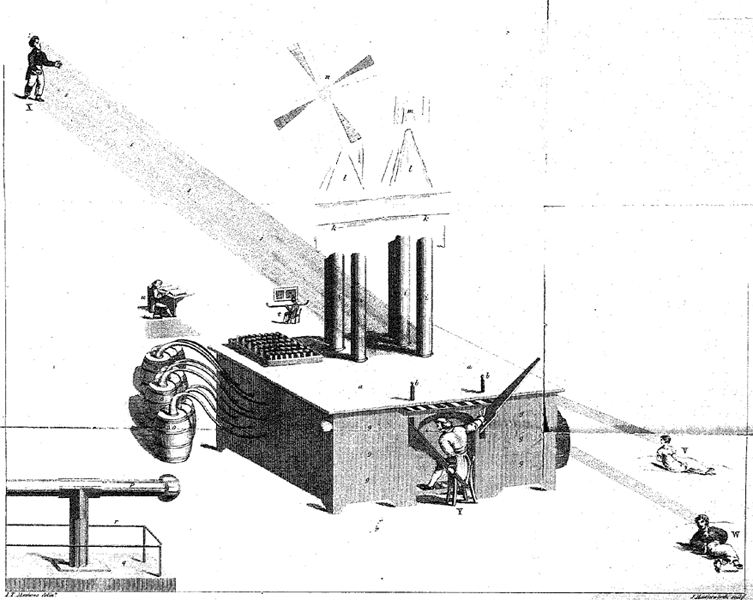
Here is Matthews' incredibly detailed illustration of the "air loom":

File:Airloom.gif

Interestingly, in addition to the notes Haslem kept on Matthews, Matthews kept notes of Haslem and how he conducted himself, as well as his treatment in Bethlem. These notes became evidence looked at by a Select Committee of the House of Commons in 1815, following Matthews death. The hearings led to Haslam's dismissal and to reform of the treatment of patients in the Bethlem Hospital.

It's a fascinating and captivating narrative, and it is told without a lot of jargon. This books is highly recommended for therapists and for those who know someone suffering from psychosis. 

Tuesday, March 18, 2014

Song of the Reed: The Poetry of Rumi


The 2014 AWP Conference and Bookfair was held in Seattle, WA, from February 27 - March 1, 2014. Among the panel discussions, one focused and the life and poetry of Rumi, featuring Coleman Barks (one of the best known translators), Brad Gooch (author of a forthcoming Rumi biography), and Buddhist poet Anne Waldman (another of my favorites poets).

Song of the Reed: The Poetry of Rumi

Event Date: 03.01.14
Speakers: Coleman Barks, Brad Gooch, Anne Waldman


Song of the Reed: The Poetry of Rumi from Association of Writers and Writing Programs on FORA.tv

Thirteenth-century Persian poet Rumi is now the most popular poet in the United States. In this event, leading Rumi interpreter, Coleman Barks, reads his beloved versions of the Sufi poet’s verse, biographer Brad Gooch shares research into Rumi’s lived experience, and poet Anne Waldman reflects on Rumi’s contribution to poetry’s ecstatic tradition.

Bio


Coleman Barks has taught poetry and creative writing at the University of Georgia for thirty years. He is the author of numerous Rumi translations. His work with Rumi was the subject of an hour-long segment in Bill Moyers' Language of Life series on PBS, and he is a featured poet and translator in Bill Moyers' poetry special, "Fooling with Words." His own books of poetry include Winter Sky: Poems 1968-2008.

Brad Gooch’s Flannery: A Biography of Flannery O’Connor was a 2010 National Book Critics Circle Award finalist and a New York Times notable book. His short story collection Jailbait and Other Stories won the 1985 Writer’s Choice Award, sponsored by the Pushcart Foundation and National Endowment for the Arts. A Guggenheim fellow in biography, he has received a National Endowment for the Humanities fellowship and is a professor of English at William Paterson University. He is currently at work on a biography and translations of Rumi.

Anne Waldman
is the author of more than forty books, including Fast Speaking Woman and Vow to Poetry, a collection of essays, and The Iovis Trilogy: Colors in the Mechanism of Concealment, an epic poem and twenty-five-year project. With Allen Ginsberg she co-founded the Jack Kerouac School of Disembodied Poetics at Naropa University, where she is a Distinguished Professor of Poetics. She received a 2013 Guggenheim Fellowship, the Poetry Society of America’s Shelley Memorial Award, and has recently been appointed a Chancellor of the Academy of American Poets.

Thursday, January 16, 2014

John Brockman - The World Mind That Came In From the Counterculture

From Germany's Frankfurter Allgemeine , this is an interesting profile of Edge founder John Brockman on the occasion of this year's Edge Annual Question.

John Brockman: A Portrait

The World Mind That Came In From the Counterculture

Be imaginative, exciting, compelling, inspiring: That’s what John Brockman expects of himself and others. Arguably, the planet’s most important literary agent, Brockman brings its cyber elite together in his Internet salon "Edge." We paid a visit to the man from the Third Culture.


01.10.2014 · Von Jordan Mejias, New York

 
At the age of three John Brockman announced: „I want to go to New York!“ For decades he has been a leading light behind the scenes in the city’s intellectual life.

THE INTERNET had yet to be born but the talk still revolved around it. In New York, that was, half a century ago. "Cage," as John Brockman recalls, "always spoke about the mind we all share. That wasn’t some kind of holistic nonsense. He was talking about profound cybernetic ideas." He got to hear about them on one of the occasions when John Cage, the music revolutionary, Zen master and mushroom collector, cooked mushroom dishes for him and a few friends. At some point Cage packed him off home with a book. "That’s for you," were his parting words. After which he never exchanged another word with Brockman. Something that he couldn’t understand for a long time. "John, that’s Zen," a friend finally explained to him. "You no longer need him."

Norbert Wiener was the name of the author, Cybernetics: Or Control and Communication in the Animal and the Machine the name of the book. Page by page Brockman battled his way through the academic text, together with Stewart Brand, his friend, who was about to publish the Whole Earth Catalog, the shopping primer and bible of the environmentally-driven counterculture. For both readers, physics and mathematics expanded into an infinite space that no longer distinguished between the natural and human sciences, mind and matter, searching and finding.

Like the idea of the Internet—which was slowly acquiring contours during these rambling 1960s discussions—the idea of Edge, the Internet salon around which Brockman’s life now revolves, was also taking shape. Edge is the meeting place for the cyber elite, the most illustrious minds who are shaping the emergence of the latest developments in the natural and social sciences, whether they be digital, genetic, psychological, cosmological or neurological. Digerati from the computer universe of Silicon Valley aren’t alone in giving voice to their ideas in Brockman’s salon. They are joined in equal measure by other eminent experts, including the evolutionary biologists Richard Dawkins and Steven Pinker, the philosopher Daniel Dennett, the cosmologist Martin Rees, the biological anthropologist Helen Fisher, the economist, psychologist and Nobel Prize winner Daniel Kahneman, the quantum physicist David Deutsch, the computer scientist Marvin Minsky, and the social theorist Anthony Giddens. Ranging from the co-founder of Apple Steve Wozniak to the decoder of genomes Craig Venter, his guest list is almost unparalleled even in the boundless realm of the Internet. Even the actor Alan Alda and writer Ian McEwan can be found in his forum.

The bridge of the third culture


A question is sent out to all salon members at the start of every year. This year it is: "What scientific idea ready to be retired?" The "editorial marching orders," written by Brockman, reveal the heart of Edge: "Go deeper than the news. Tell me something I don’t know. You are writing for your fellow Edgies, a sophisticated bunch, and not the general public. Stick to ideas, theories, systems of thought, disciplines, not people. Come up with something new, be exciting, inspiring, compelling. Tell us a great story. Amaze, delight, surprise us!"

Does he really need to spell all that out so clearly? After all, quite a few of the authors number among his clients. He markets them and their works globally, and they know exactly what he expects of them and what they can expect of him. As their literary agent, he never misses a business opportunity. Indeed, he has built a reputation for negotiating mind-boggling prices for individual works that, in contrast to Edge, adopt a more populist approach to the sciences. But above all, it’s his concept of The Third Culture that glitters, the miraculous formula that Brockman evokes to secure the supremacy of the so called hard sciences, even in the instances when the world and our place in it is surveyed in quasi-philosophical mode. As physicist, politician, and the novelist C. P. Snow lament, there is a chasm separating the twin cultures of the natural and human sciences; and the enterprising Brockman fills this divide with bestsellers from his Third Culture.

Business isn’t just blossoming, he says, it has never been better. Anyone harboring any doubts should pay him a visit on Fifth Avenue, where Brockman, Inc. has been spreading its wings of late in premises that are awash with light and where gravity seems to have been suspended. The two glass corner offices are a testament to transparency. The one for the company’s founder allows the Empire State Building to peek over his shoulder as he works at his paper-free desk; the other is for his son Max, the company’s brand new CEO, who can admire the perpetually breathtaking silhouette of the Flatiron Building though the gigantic windows. Between them Katinka Matson, the co-founder of Edge, President of Brockman Inc., mother of Max, and business and life partner of John—has stylishly set up shop. As the daughter of a literary agent, the profession is in her DNA. In her spare time she now brightens up the office with multi-colored, larger-than-life scans of floral images.

Brockman, who was born in 1941, could comfortably retire and devote himself completely to Edge, his intellectual hobby. But Edge is no mere hobby for him, no pastime pursued at times when the demands of work abate. "I have never thought of money. I have only ever done what interested me, and that always brought in enough to get me by." Before opening his Internet salon, he had published a newsletter with the same title and philosophical outlook. This evolved out of the Reality Club. "Trippy stuff" topped the agenda when a group of people started meeting in New York during the 1980s, a group whose fluctuating composition included the physicist Freeman Dyson, the feminist Betty Friedan, the social revolutionary Abbie Hoffman and the film stars Ellen Burstyn and Dennis Hopper. They were charged with asking each other the questions that they asked themselves. No instant answers were expected. The focus was on asking the questions. In literary New York Brockman had never glimpsed the prospect of this type of exchange of ideas, the adventure that he wanted for himself and to share with others. He preferred the empirical study of our cosmos, on both micro and macro scales, to the imagined world. Not that this forced him to relinquish story-telling. With the frequently spectacular experiences they describe, the books and authors he represents offer him more suspense and excitement than he can find in any novel. And his own life? As he describes it, that too emerges as a collection of gripping stories that veer off in numerous different directions while always following a clear, very personal line. From Day One he was curious and hungry for knowledge, and had an appetite for excitement and new experiences.

A blueprint for the Internet


Brockman’s life-story begins with the proclamation: "I want to go to New York." He was three years old at the time, lying in a Boston hospital, seriously ill with cerebrospinal meningitis, and these are said to have been the first words he spoke when he woke up from a six-week coma. He finally made it to New York at the age of 20—enrolling as a graduate student at Columbia University where he completed a degree in business. After this he worked within the financial services industry, not that his life revolved exclusively around money and transactions at the time. The crazy 1960s burst into life and Brockman felt compelled to immerse himself in the vibrant cultural mix. He experienced the New York underground for himself on the stage of the Living Theater. It was culture shock, a call to action, an invitation to engage. But Brockman didn’t participate in the avant-garde experiments with his banjo and guitar, but with his gift for organization. Today we would probably call him a cultural impresario.

New York gave him confidence, telling him "You can be free." He didn’t need to be told twice. With Sam Shepard, who was still working as a waiter, he discussed ideas for "intermedia" stage performances. In no time he had become an indispensable part of the multimedia theater and film scene. He was entrusted by Jonas Mekas, the great father of experimental film in the U.S., with commissioning films from Nam June Paik and Robert Rauschenberg for an "expanded" film festival. His organizational skills even got him into the Lincoln Center Film Festival where he presented the work of newcomers like Martin Scorsese when he wasn’t escorting European guests—with names like Federico Fellini and Jean-Luc Godard—out to dinners. Even Jackie Kennedy, still not an Onassis, makes an appearance in the background during this period.

While the stars of Allen Ginsberg, William Burroughs and the Beatniks were slowly fading, and the folk scene around Bob Dylan dawning, Brockman was spending time working with Andy Warhol. But the drug-sodden collective in the Factory wasn’t for him. He needed to be his own master. For the same reason, things didn’t work out with the countercultural Yippies, after his friend Abbie Hoffman recruited him for the founding meetings of the movement. Brockman had no interest in revolution. However: "The ideas behind it interested me." Cage taught him how to perceive the non-linear structure of reality using cybernetics. With hindsight he came to feel this was "like a construction diagram for the Internet." He wrote a book with the title By the Late John Brockman, an aphoristic volume of his various insights and experiences.

In the circle of elites


And then, at MIT in 1965, he finally came face to face with a computer. There is precisely one example of this type of computer, a humungous contraption, surrounded by busy men in white lab coats, and secured behind a glass screen against which he pressed his nose. "I fell in love on the spot. It was pure magic." Brockman had no more doubts whatsoever that everything was interconnected: the arts and the sciences and the psychedelic shows with their flashing strobes, through whose cacophony of sound Marshall McLuhan trumpeted his theory of communications.

At the Esalen Institute, the personal growth laboratory on California’s Pacific coast, he listened to talks by scientists and madcap geniuses whose names hardly anyone on the East Coast knew. A treasure trove just waiting to be opened. An awakening. In 1973 this gave rise to his literary agency, albeit circuitously. Once again he found himself promoting something that interested him. Slowly but surely he realized that he had struck gold. Or, as he prefers to say, he discovered an oil well that has never stopped bubbling. Since then Brockman has been keyed to the Third Culture from head to foot. Famous scientists, researchers, entrepreneurs and sponsors are drawn to him like moths to a light bulb. At his desk in New York he clicks on the invitation to a party he is flying to in San Francisco the following day. The hosts include the co-founder of Google Sergey Brin, the Russian billionaire Yuri Miner, the co-founder of Facebook Mark Zuckerberg, and Art Levinson, Chairman of the Board of Apple Inc. and the former CEO of the biotech company Genentech. It is safe to assume that Brockman also enjoys get-togethers with such distinguished names.

But even more he evidently enjoys the gatherings at his picturesque farm in Connecticut with its numerous nooks and crannies. For one day or weekend every summer, he affords himself the intellectual pleasure of transforming his New England idyll into a swap meet for the latest scientific research and ideas. From Princeton and Yale, Harvard and MIT, Silicon Valley and New York’s executive suites, he invites thinkers, movers, shakers and clients—all of them friends—to discuss the hottest topics in their various fields. The most recent edition of these bucolic conferences held beneath ancient maple trees began with an up-to-date tour d’horizon by the economist Sendhil Mullainathan, who mused that the excessive volumes of data might threaten the qualitative character of science. The social scientist Fiery Cushman reported on the failure of algorithms in complex calculations, the experimental philosopher Joshua Knobe on the elusively ephemeral nature of the self, the psychologist June Gruber on the problem of positive emotion and the initial solutions.

In total 10 scientists gave talks on this perfect summer’s day, which now, thanks to Edge, no longer has to end. Since November Brockman has been posting the videos of the contributions on the Web. By February the day’s entire program should be accessible. Those online, however, can only guess at the pleasure John Brockman feels as he observes the mind games he has staged. "Edge," says its creator, "for me that means ideas, for me that means culture."

Sunday, November 10, 2013

Watch Jimi Hendrix: Hear My Train A Comin’, the New PBS Documentary (Free for a Limited Time)


Thanks to Open Culture for finding the good stuff.

Jimi Hendrix: Hear My Train A Comin’, the New PBS Documentary

Tuesday, September 17, 2013

Carl Jung: The Wisdom of the Dream - A Three-Part Documentary on the Psychologist’s Life & Ideas

File:Jung 1910-crop.jpg

These videos comprise a three-part series, produced by PBS, on the life and works of the great thinker and psychiatrist Carl Gustav Jung (born July 26, 1875, Switzerland). Jung became interested in psychiatry during his medical studies and soon joined the group around Sigmund Freud (a relationship that lasted six tumultuous years).

Jung believed that the minds of mentally ill persons all had similar contents, much of which he recognized from his own interior life, described in his autobiography Memories, Dreams, Reflections and in The Red Book (cheaper reader's version). He spent his life trying to understand the workings of the psyche, a project that led him to develop the methods of analytical psychiatry. Jung's model looked at the role in his patients' lives of what he termed the personal and collective unconscious, as expressed through dreams, myths, and outer events (synchronicity).

Jung created some of the best known psychological concepts including the archetype, the collective unconscious, the complex, and synchronicity. The Myers-Briggs Type Indicator (MBTI), a popular psychometric instrument, was developed from Jung's theory of personality typology.


Watch Carl Jung: The Wisdom of the Dream: A Three-Part Documentary on the Psychologist’s Life & Ideas


September 16th, 2013

Volume 1, ‘A Life of Dreams:


“The interpretation of dreams,” Sigmund Freud famously said, “is the royal road to a knowledge of the unconscious activities of the mind.” Freud’s younger colleague Carl Gustav Jung agreed with him, but with important differences.

Whereas Freud saw dreams as manifestations of repressed sexual wishes disguised in a form drawn exclusively from the residue of the memories of events from the previous day and from childhood, Jung believed dreams deal with a much wider range of human concerns and are drawn not just from personal memory but from a range of universal psychological archetypes he called the “collective unconscious.”

In this fascinating three-hour documentary series from 1989, The Wisdom of the Dream, we learn about Jung’s life and ideas. Produced and directed by Stephen Segaller, the films draw on rare interviews and footage of Jung, as well as interviews by prominent psychologists, including some who knew Jung personally. Advocates of Jung’s theories explain the basis of his ideas and their continuing influence. The films are narrated by writer Sarah Dunant. Passages from Jung’s writings are read by actor Max Von Sydow.

Volume 2, ‘Inheritance of Dreams’:


Volume 3, ‘A World of Dreams’:


via Partially Examined Life

Related content:

Saturday, August 31, 2013

$1.99 Kindle Book - OBSESSED: The Compulsions and Creations of Dr. Jeffrey Schwartz


This looks good (just downloaded my copy). Dr. Jeffrey Schwartz has changed the way we treat obsessive-compulsive disorder (OCD) for the better. Some older treatments, as described in Brain Lock: Free Yourself from Obsessive-Compulsive Behavior [1997] and The Mind and the Brain: Neuroplasticity and the Power of Mental Force [2003], were essentially humiliating and not helpful.

This book from Steven Volk looks at his life and work as the background that shaped his innovations.

In OBSESSED: The Compulsions and Creations of Dr. Jeffrey Schwartz, author Steve Volk ventures deep into the mind of Jeffrey Schwartz, a controversial, often combative psychiatrist and expert on obsessive-compulsive disorder (OCD).

Schwartz is best known to the public as the man who coached Leonardo DiCaprio for his Oscar-nominated role as the OCD-afflicted billionaire Howard Hughes in The Aviator. But his extraordinary professional contribution, achieved through a lifetime of obsessive work, is a breakthrough therapy that has helped free thousands of OCD sufferers from their habitual behaviors, compulsions and irrational fears.

Considered a pariah among his academic peers, Schwartz’s unconventional treatment methods draw on his fascination with the Holocaust, his experience with Buddhist meditation and his pioneering work documenting the neural circuitry of OCD. By teaching his adult patients to willfully rewire their brains and reverse their disease, Schwartz has challenged the prevailing view in neuroscience that free will is dead.

Veteran journalist Steve Volk, a senior writer at Philadelphia Magazine, skillfully balances the groundbreaking research of a philosopher-scientist with the story of a man battling demons of his own. Schwartz’s most pressing battle may actually be the one he fights against his compulsions and social awkwardness in his quest to find some accurate, workable definition of humanity that can help us overcome our darkest, most primitive selves.

Monday, August 26, 2013

Documentary: A Profile of Elon Musk, Founder of Tesla Motors and SpaceX


Elon Musk is the personification of the wunderkind. After completing undergraduate degrees in economic and physics at the University of Pennsylvania, he then moved to the Silicon Valley to pursue a Ph.D. in applied physics and materials science at Stanford.

After only two days he left the program. Drawing inspiration from innovators such as Nikola Tesla, Bill Gates, Steve Jobs, and Walt Disney, Musk then focused his energies on three areas he felt were "important problems that would most affect the future of humanity," the Internet, clean energy, and space.

He co-founded PayPal, co-founded Tesla Motors, and founded SpaceX (the only private space program competitive with NASA), and he is worth $7.7 billion, as of August 2013. Oh yeah, he's only 40 years old.

He estimates he spends 100 hours a week on Tesla and SpaceX, a fact that likely accounts for his two failed marriages.

Elon Musk Profiled


This film profiles Elon Musk, the entrepreneur who helped create PayPal, built America’s first viable fully electric car company, started the nation’s biggest solar energy supplier, and may make commercial space travel a reality in our lifetime. And he’s only 40.

Elson Musk is a lot like the kid in the comic book, whose fantasies turn into reality. But not as a magician, he did as an engineer. Musk’s fantasies and companies have transformed the way we live. He founded his first company at age 23 and sold it a few years later for 300 million dollars. He helped pave the way for online commerce with PayPal. He made solar energy affordable and jump-started the electric car industry. Plus he his competing NASA to outer space.

Wednesday, August 14, 2013

Michel Foucault’s Life and Philosophy Explored in 1993 Documentary - "Michel Foucault: Beyond Good and Evil"


From 1993, Michel Foucault: Beyond Good and Evil explores the life and philosophy of one of the 20th century's most influential and controversial post-structural philosophers. From the Stanford Encyclopedia of Philosophy, here is some intellectual background on Foucault and his influences:
Michel Foucault entered the École Normale Supérieure (the standard launching pad for major French philosophers) in 1946, during the heyday of existential phenomenology. Merleau-Ponty, whose lectures he attended, and Heidegger were particularly important. Hegel and Marx were also major concerns, the first through the interpretation of his work offered by Jean Hyppolite and the latter through the structuralist reading of Louis Althusser—both teachers who had a strong impact on Foucault at the École Normale. It is, accordingly, not surprising that Foucault's earliest works (his long “Introduction” to Dream and Existence by Ludwig Binswanger, a Heideggerian psychiatrist, and Maladie mentale et personalité, a short book on mental illness) were written in the grip of, respectively, existentialism and Marxism. But he soon turned away quite decisively from both. 
Although Jean-Paul Sartre, living and working outside the University system, had no personal influence on Foucault, the thought of him, as the French master-thinker preceding Foucault, is always in the background. Like Sartre, Foucault began from a relentless hatred of bourgeois society and culture and with a spontaneous sympathy for groups at the margins of the bourgeoisie (artists, homosexuals, prisoners, etc.). They were also similar in their interests in literature and psychology, as well as philosophy, and both, after an early relative lack of political interest, became strong activists. But in the end, Foucault seemed to insist on defining himself in contradiction to Sartre. Philosophically, he rejected what he saw as Sartre's centralization of the subject (which he mocked as “transcendental narcissism”). Personally and politically, he rejected Sartre's role as what Foucault called the “universal intellectual”, judging a society in terms of transcendent principles. There is, however, a tincture of protesting too much in Foucault's separation of himself from Sartre, and the question of the relation of their work remains a fertile one. 
Three other factors were of much more positive significance for the young Foucault. First, there was the French tradition of history and philosophy of science, particularly as represented by Georges Canguilhem, a powerful figure in the French University establishment, whose work in the history and philosophy of biology provided a model for much of what Foucault was later to do in the history of the human sciences. Canguilhem sponsored Foucault's doctoral thesis on the history of madness and, throughout Foucault's career, remained one of his most important and effective supporters. Canguilhem's approach to the history of science (an approach developed from the work of Gaston Bachelard), provided Foucault with a strong sense (Kuhnian avant la lettre) of the discontinuities in scientific history, along with a “rationalist” understanding of the historical role of concepts that made them independent of the phenomenologists' transcendental consciousness. Foucault found this understanding reinforced in the structuralist linguistics and psychology developed, respectively, by Ferdinand de Saussure and Jacques Lacan, as well as in Georges Dumézil's proto-structuralist work on comparative religion. These anti-subjective standpoints provide the context for Foucault's marginalization of the subject in his “structuralist histories”, The Birth of the Clinic (on the origins of modern medicine) and The Order of Things (on the origins of the modern human sciences). 
In a quite different vein, Foucault was enthralled by French avant-garde literature, especially the writings of Georges Bataille and Maurice Blanchot, where he found the experiential concreteness of existential phenomenology without what he came to see as dubious philosophical assumptions about subjectivity. Of particular interest was this literature's evocation of “limit-experiences”, which push us to extremes where conventional categories of intelligibility begin to break down. 
This philosophical milieu provided materials for the critique of subjectivity and the corresponding “archaeological” and “genealogical” methods of writing history that inform Foucault's projects of historical critique.
Enjoy the documentary.


Michel Foucault’s Controversial Life and Philosophy Explored in a Revealing 1993 Documentary


August 14th, 2013


Complete with a bald Foucault re-enactor and dramatic readings of Foucault’s texts, this documentary titled “Beyond Good and Evil” explores the life and work of French poststructuralist Michel Foucault.

Foucault, who is famous for, among other works, “Madness and Civilization,” battled with mental illness himself. The documentary reveals that Foucault attempted suicide multiple times, at one point slashing his chest in the hallway of the École Normale Supérieure. Foucault also had morbid tastes, and adorned his room with Fransisco Goya pieces that depicted torture and war.

Other highlights include a recounting of Foucault dropping LSD in Death Valley (which he claimed was one of the most transformative events in his life) and Foucault referring to his near death experience after being hit by a car (arguably ironically) as “blissful.” Foucault also grew fond of America, where he could escape his French celebrity status and enjoy the sexual experimentation and drug use of San Francisco. 
Michel Foucault’s colorful life and hugely influential work were both struggles against limitation—the limits of language, of social structures and stultifying historical identities. As such, he managed to provoke scholars of every possible persuasion, since he called into question all positive programs—the ancient imperial, feudal, and liberal humanist—while steadfastly refusing to replace them with comprehensive alternative systems. And yet systems, social institutions of power and domination, were precisely the problem in Foucault’s estimation. Through his technique of raiding archives to produce an “archaeology of knowledge,” Foucault showed how every institution is shot through with what William E. Connolly calls “arbitrary… systemic cruelty.”

The film explores the philosopher and his complex and controversial life through interviews with colleagues and biographers and re-enactments of Foucault’s storied exploits in the American counterculture. Biographer James Miller points out that Foucault was “preoccupied with exploring states that were beyond normal everyday experience… drugs, certain forms of eroticism,” as a way to “reconfigure the world and his place in it.” In this, says anthropologist Paul Rabinow, Foucault sought to resurrect the questions that sober analytic philosophy had largely abandoned: questions about what it means to be human, beyond the social categories we take as natural and given.

via Critical Theory

Related Content:

Josh Jones is a writer and musician based in Washington, DC. Follow him at @jdmagness

Friday, March 15, 2013

Wittgenstein: Derek Jarman’s Tribute to the Philosopher (1993)


Another interesting piece from Open Culture. All 7 segments of the Derek Jarman film on Wittgenstein are embedded in the video below. For those unfamiliar with Wittgenstein, here is a very brief bio sketch from Wikipedia:
Ludwig Josef Johann Wittgenstein (26 April 1889 – 29 April 1951) was an Austrian-British philosopher who worked primarily in logic, the philosophy of mathematics, the philosophy of mind, and the philosophy of language.[1] He was professor in philosophy at the University of Cambridge from 1939 until 1947.[2] In his lifetime, he published just one book review, one article, a children's dictionary, and the 75-page Tractatus Logico-Philosophicus (1921).[3] In 1999, his posthumously published Philosophical Investigations (1953) was ranked as the most important book of 20th-century philosophy by the Baruch Poll, standing out as "...the one crossover masterpiece in twentieth-century philosophy, appealing across diverse specializations and philosophical orientations".[4] Philosopher Bertrand Russell described him as "the most perfect example I have ever known of genius as traditionally conceived, passionate, profound, intense, and dominating".[5]
Enjoy!

Wittgenstein: Watch Derek Jarman’s Tribute to the Philosopher, Featuring Tilda Swinton (1993)


March 14th, 2013


When last week we featured Bertrand Russell telling a story about his philosophical disciple Ludwig Wittgenstein, I mentioned in passing a film about the latter by Derek Jarman. An English director known for his unconventional choices of theme, form, and medium, Jarman passed away from AIDS-related illness in 1994, the year after making Blue, an autobiographical film that plays out entirely on a solid, unchanging blue screen. He also released in 1993 a less discussed, seemingly less experimental picture: Wittgenstein. Casting Karl Johnson as the philosopher (with Clancy Chassay as his younger self), frequent collaborator Tilda Swinton as noted aristocrat Lady Ottoline Morrell, and Michael Gough (well known as Batman’s butler Alfred) as Russell, Jarman set about telling Wittgenstein’s life story, all on his own aesthetic terms.


The result comes off as an only slightly less radical cinematic act than Blue. Drawing on his stage background, Jarman reduces Wittgenstein‘s visuals to a bare but bold minimum. Watch the clip up top of Johnson as Wittgenstein lecturing at Cambridge under Russell’s watchful eye, and you’ll see what this means: no backdrops at all; just people, things, thoughts, and language. You can see the entire film in seven segments (one, two, three, four, fivesix, seven), beginning with the first just above. Though far from Jarman’s most famous work, Wittgenstein has been claimed by several film traditions: philosophical, experimental, theatrical, queer, even educational. Yet it has eluded them all, creating for itself an environment of both obvious stage-and-screen make-believe — that black void, those dramatic line deliveries — and the disciplined starkness of reality.

Related Content:

~ Colin Marshall hosts and produces Notebook on Cities and Culture and writes essays on literature, film, cities, Asia, and aesthetics. He’s at work on a book about Los Angeles, A Los Angeles Primer. Follow him on Twitter at @colinmarshall.

Wednesday, January 02, 2013

Only Known Footage of the Legendary Bluesman Lead Belly (1935 and 1945)


Open Culture offers up this wonderful treat for fans of the original blues music and one of its legendary, larger-than-life figures, Lead Belly.

Essential Recordings from the Rock and Roll Hall of Fame:

Listen "Where Did You Sleep Last Night"
Listen "Goodnight Irene"

Watch the Only Known Footage of the Legendary Bluesman Lead Belly (1935 and 1945)

January 2nd, 2013


Huddie Ledbetter, better known by his nickname “Lead Belly,” was one of the greatest blues musicians of all time. His songs have been covered by hundreds of artists, ranging from Frank Sinatra to Led Zeppelin. Lead Belly is also famous for what his biography at the Rock and Roll Hall of Fame describes as “the mythic outline of his life”:
Born circa 1885 in rural northwest Louisiana, Lead Belly rambled across the Deep South from the age of 16. While working in the fields, he absorbed a vast repertoire of songs and styles. He mastered primordial blues, spirituals, reels, cowboy songs, folk ballads and prison hollers. In 1917, Lead Belly served as Blind Lemon Jefferson’s “lead boy”–i.e., his guide, companion and protégé–on the streets of Dallas. A man possessed with a hot temper and enormous strength, Lead Belly spent his share of time in Southern prisons. Convicted on charges of murder (1917) and attempted murder (1930), Lead Belly literally sang his way to freedom, receiving pardons from the governors of Texas and Louisiana. The second of his releases was largely obtained through the intervention of John and Alan Lomax, who first heard Lead Belly at Angola State Prison while recording indigenous Southern musicians for the library of Congress.
In 1935 the March of Time newsreel company told the story of Lead Belly’s discovery by John Lomax in the short film above. Although the scripted film will strike modern viewers as dubious in some respects (March of Time founder Henry Luce described the series as “fakery in allegiance to the truth”), the newsreel is nevertheless a fascinating document of Lead Belly, who was about 50 years old at the time, along with Lomax and Lead Belly’s wife, Martha Promise. At one point Lead Belly sings his classic song,“Goodnight, Irene.” According to Sharon R. Sherman in Documenting Ourselves: Film, Video, and Culture, the 1935 Lead Belly newsreel is the earliest celluloid document of American folklore. Lead Belly did work for Lomax after his second release from prison, as the newsreel says, following him back to the East Coast and serving as his chauffeur. In New York Lead Belly played in Harlem and also came into contact with leftist folk singers like Woody Guthrie and Pete Seeger. Lead Belly became known as the “King of the Twelve-String Guitar.”


Three Songs by Leadbelly, the only other film known to exist of the great bluesman, was made ten years after the newsreel. It was photographed by Blanding Sloan and assisted by Wah Mong Chang and edited two decades later by Pete Seeger. It begins with scenes of the graveyard in Mooringsport, Louisiana, where Lead Belly was buried after his death in 1949, accompanied by an instrumental version (with humming) of “Where Did You Sleep Last Night?” Lead Belly actually performed six songs for the film, but only three could be salvaged. Seeger is quoted by Charles Wolfe and Kip Lornell in The Life and Legend of Leadbelly as describing Sloan’s film as “pretty amateurish”:
I think that he recorded Leadbelly in a studio the day before, then he played the record back while Leadbelly moved his hands and lips in synch with the record. He’d taken a few seconds from one direction and a few seconds from another direction, which is the only reason I was able to edit it. I spent three weeks with a Moveiola, up in my barn, snipping one frame off here and one frame off there and juggliing things around. I was able to synch up three songs: “Grey Goose,” “Take This Hammer,” and “Pick a Bale of Cotton.”

Related content:

Tuesday, December 11, 2012

A Colorfully Animated Biography of Bluesman Skip Pitts

Nice . . . from Open Culture, of course.

A Colorfully Animated Biography of Bluesman Skip Pitts


December 5th, 2012

Earlier this year, the blues guitarist Charles ‘Skip’ Pitts passed away after a bout of lung cancer. He had a musical career that spanned many decades. But, he’s best remembered for his riffs on one song — Isaac Hayes’ theme song for the 1971 film Shaft. (Catch it below.) Pitts’ licks have been sampled by countless younger musicians, everyone from Snoop Dogg and the Beastie Boys to Dr. Dre and Massive Attack. Starting in the late 90s, the bluesman began playing with a band called The Bo-Keys, which became the subject of a mini documentary in 2011. The short film yielded some insightful interviews with Pitts. And, once he departed from our world, the conversations became the basis for the “animated interpretation” you’re hopefully now watching above. It’s the work of Loaded Pictures, a studio based in Seattle, Washington.

Related Content: The Legend of Bluesman Robert Johnson Animated

Friday, October 26, 2012

Open Culture - The Miles Davis Story, the Definitive Film Biography of a Jazz Legend


If you are a jazz fan, and especially if you are a Miles Davis fan, this offering from Open Culture is very cool - a definitive biography of one of the great jazz musicians of all time.

The Miles Davis Story, the Definitive Film Biography of a Jazz Legend


Miles Davis was indisputably one of the greatest musicians in jazz history. This 2001 documentary from BBC Four traces the outline of Davis’s extraordinary life: his musically precocious childhood in St. Louis; his move to New York City after graduating from high school in 1944 (ostensibly to attend Julliard, but really to immerse himself in the jazz club scene and connect with his idols Dizzy Gillespie and Charlie Parker); his early bebop period; The Birth of Cool and his masterpiece, Kind of Blue; and his continued reinvention of himself in the 1960s and 1970s, when he incorporated rock and funk influences into his music.  
The Miles Davis Story features interviews with many of the people who knew Davis best, including his wives and some of the great musicians who worked with him, like Jimmy Cobb, Shirley Horn, Clark Terry and Keith Jarrett. The film also includes older interviews with Dizzy Gillespie and with Davis himself, who died a decade earlier. The Miles Davis Story runs just over two hours, and will be added to our growing archive of Free Movies Online. It’s a great way to learn about the life of Davis, but to actually hear his music we recommend you revisit our earlier post, ‘The Sound of Miles Davis’: Classic 1959 Performance with John Coltrane.
Related Content:

Wednesday, October 03, 2012

Will We Ever Really Understand Kafka?


In the Times Literary Supplement (UK), Gabriel Josipovici reviews several recent books about Franz Kafka, one of the singularly great Modernist authors of the 20th Century. Those of us who have read his fiction (and most students read "The Metamorphosis" at some point in high school or college), know that his writing is challenging - and it seems that the life of the author is as well. Despite the growing body of work about his writing and his life, he remains somewhat of an enigma.

As it should be.


Why we don’t understand Kafka

Gabriel Josipovici

June O. Leavitt
THE MYSTICAL LIFE OF FRANZ KAFKA
Theosophy, Cabala, and the modern spiritual revival
212pp. Oxford University Press. £40 (US $65).
978 0 19 982783 1

Stanley Corngold and Ruth V. Gross, editors
KAFKA FOR THE TWENTY-FIRST CENTURY
286pp. Camden House. $75.
978 1 57113 482 0

Stanley Corngold and Benno Wagner
FRANZ KAFKA
The ghosts in the machine
273pp. Northwestern University Press. $34.95.
978 0 8101 2769 2

David Suchoff
KAFKA’S JEWISH LANGUAGES
The hidden openness of tradition
267pp. University of Pennsylvania Press. $65.
978 0 8122 4371 0

Shachar M. Pinsker
LITERARY PASSPORTS
The making of modernist Hebrew fiction in Europe
487pp. Stanford University Press. $60.
978 0 8047 7064 4
 

Published: 5 September 2012
Franz Kafka by Andy Warhol (detail), 1980
 
On September 23 it will be 100 years exactly since Franz Kafka wrote his breakthrough story, “The Judgement”. We are probably no nearer to understanding that or any other of his works today than his first readers were, nor should we expect to be. These books help to show us why. 

Eighteen months earlier, on March 26, 1911, Kafka noted in his diary: “Theosophical lectures by Dr Rudolf Steiner, Berlin”. After commenting on Steiner’s rhetorical strategy of giving full weight to the views of his opponents, so that “the listener now considers any refutation to be completely impossible and is more than satisfied with a cursory description of the possibility of a defence”, he goes on:
“Continual looking at the palm of the extended hand. – Omission of the period. In general, the spoken sentence starts off from the speaker with its initial capital letter, curves in its course, as far as it can, out to the audience, and returns with the period to the speaker. But if the period is omitted then the sentence, no longer held in check, falls upon the listener immediately with full force.” 

Only Kafka could experience language with such intensity and express his response in such a strange and striking way. Two days later he comes back to Steiner in his diary, either to another or to the same lecture, which he proceeds to paraphrase in deadpan fashion, interspersing this with comments about his neighbour: 
“Dr Steiner is so very much taken up with his absent disciples. At the lecture the dead press so about him. Hunger for knowledge? But do they really need it? . . . Löwy Simon, soap dealer on Quai Moncey, Paris, got the best business advice from him . . . . The wife of the Hofrat therefore has in her notebook, How does One Achieve Knowledge of the Higher Worlds? At S. Löwy’s in Paris.”
(How Does One Achieve Knowledge of the Higher Worlds? was the tantalizing title of one of Steiner’s books.) Yet Kafka is sufficiently impressed to make an appointment to see Steiner in his hotel. “In his room I try to show my humility, which I cannot feel, by seeking out a ridiculous place for my hat. I lay it down on a small wooden stand for lacing boots.” Steiner is gracious, however, and tries to put the young man at his ease by asking if he has been interested in theosophy long. Kafka pushes on with his prepared speech: A great part of his being seems to be striving towards theosophy, while at the same time he greatly fears it. “I have, to be sure, experienced states (not many) which in my opinion correspond very closely to the clairvoyant states described by you, Herr Doktor.” However, he is also aware that in those states he did not write at his best, and since “my happiness, my abilities, and every possibility of being useful in any way have always been in the literary field”, he is terribly torn.

We never hear how Steiner responds to what Kafka has told him. Instead, this:
“He listened very attentively without apparently looking at me at all, entirely devoted to my words. He nodded from time to time, which he seems to consider an aid to strict concentration. At first a quiet head cold disturbed him, his nose ran, he kept working his handkerchief deep into his nose, one finger in each nostril.”
And with that Steiner disappears from the diaries.

June O. Leavitt, who begins her book with this episode, describes Kafka here as “ridiculing” Steiner’s claims and “satirizing” his psychic powers and self-appointed mission of enlightening humanity, describing the last paragraph as “facetious”. However, she argues, “Kafka’s yearning for transcendental mind continued despite his disappointing meeting with Steiner”. Throughout his life, she maintains, Kafka was torn between his desire to write and his experience of out-of-body states, which he longed for yet dreaded.

This brings out well how even the most learned and well-meaning critics, if they are not very careful, will start with a slight misreading and end in the further reaches of absurdity. For Kafka’s description of Steiner’s lecture and of their meeting follows the same pattern as everything else in the diary: he notes everything he sees and that happens to him with puzzled and scrupulous detachment. Pace Leavitt, he is not satirizing Steiner or the Frau Hofrat (or himself for the comedy with the hat), but merely noting it all, as though trying to pierce a mystery which is immediately comprehensible to everyone but himself.

Leavitt is surely right to remind us of the enormous popularity of theosophy and related notions in the European fin de siècle. Not only Steiner but Mme Blavatsky seemed, for many thinking people in the West, who had lost faith in organized religion, to provide the answer to their spiritual yearnings. W. B. Yeats, Maurice Maeterlinck, Vassily Kandinsky and Piet Mondrian were all adepts and excited proselytizers at one time or another, and T. S. Eliot introduced a “famous clairvoyante” into The Waste Land. It’s not at all surprising that Kafka should have been interested in and knowledgeable about theosophy, and Leavitt is right to suggest that his apparent fascination with Jewish mysticism, which scholars have made much of in recent decades, probably came to him via Christian (and debased) sources. Eliot’s take on Mme Sosostris was, of course, at the opposite pole from Yeats’s or Kandinsky’s. Where does Kafka stand? He was, we know, a notorious faddist, solemnly subjecting himself to nature therapy, raw food diets and gymnastics, Mazdazanism, Fletcherism and the rest. But what of his writing, which is surely the important thing? Leavitt trawls his oeuvre to find examples of mystical experiences and out-of-body states, but her insensitivity to context and nuance grows more pronounced with every page.

She examines in detail the long, abandoned story, “Description of a Struggle”, written around 1904. The narrator here seems able merely to wish something for it to happen: “So I happily spread out my arms in order to fully enjoy the moon. And by making swimming movements with my weary arms it was easy for me to advance without pain or difficulty . . . . My head lay in the cool air”. This indeed seems to be an example of levitation, and Leavitt, enlisting Steiner and Blavatsky, explains that we are in the presence of an “ether-body”, which is the true body, not the physical body we carry around with us. Now this may be theosophical doctrine. But one wonders if the main reason why Kafka abandoned the work was that it was too easy to do this sort of thing in fiction: if you can make the body fly merely by wishing it, you can do anything – but by the same token you have done nothing. Kafka was looking for a form of art that would be true to all our desires – including the desire to escape the body – but would also be ready to examine these desires. That is why when he did finally agree to let Max Brod find a publisher for his early work he ignored the long and complex but ultimately unsatisfactory “Description of a Struggle” and selected instead tiny fragments that seemed to him more “true”.

Later Leavitt examines one of Kafka’s last stories, “The Bucket Rider”, written when he had finally escaped Prague and gone to Berlin with Dora Diamant, to endure there a terrible winter of freezing conditions and dreadful food scarcity. “To grasp the inverted perspective of ‘The Bucket Rider’”, says Leavitt, “it is necessary to penetrate the narrative façade, which Kafka critics have not done.” These kinds of sentences usually herald a total misreading, and this is indeed what we get here. “Coal all spent, the bucket empty; the shovel useless; the stove breathing out cold, the room freezing; I must have coal; I cannot freeze to death; behind me is the pitiless stove, before me the pitiless sky.” This is a terrifying evocation of human destitution and desperation. The narrator goes on: “So I ride off on the bucket. Seated on the bucket, my hands on the handle, the simplest kind of bridle, I propel myself with difficulty down the stairs; but once downstairs, my bucket ascends . . . . And at last I float an extraordinary height above the vaulted cellar of the dealer”. 

Alerted by the idea of flying, Leavitt is away: “Mystical logic allows expansion of perspective beyond the conceptual framework of time and space. I claim that the narrator has already frozen to death; he is a disembodied spirit. The narrative concerns a soul in crisis”. The story ends: “And with that I ascend into the regions of the ice Mountains and am lost forever”. Leavitt fastens on the expression Nimmerwiedersehen, literally “never to be seen again”, and concludes: “This bucket rider has relinquished his craving for materiality to migrate to a higher world”. All the pain of the story’s realism is dissolved into a cosy mysticism which may bring comfort to some but does a gross disservice to a painfully honest writer.

The book grows more dotty as it progresses. The pity is that Leavitt has a good though modest point: that Kafka’s interest in theosophy and other forms of fin-de-siècle religiosity aligns him with a great many of the major artists of the period, and that dismissing this as due to personal fads, or placing an exclusive emphasis on Jewish mysticism, distort the picture. But as so often in Kafka studies, an initial insight is ruined by insensitivity to the way language works in the texts and to the overall evidence of the diaries, the letters and the rest of the fiction. 

Stanley Corngold seems to have established himself as the doyen of American Kafkaists. Ruth V. Gross’s preface to Kafka for the Twenty-First Century, co-edited with Corngold, sets the tone. The idea, she explains, was “to assemble a number of distinguished Kafka researchers from North America and Europe to examine together the ways in which this extraordinary writer, who so decisively shaped our conception of the twentieth century, might suggest fruitful strategies for coping with the twenty-first”. But who ever imagined that writers should give us “fruitful strategies for coping”? They have quite enough on their plates trying to say what they feel they have it in them to say. She goes on: “How do we compose a complete and coherent account of a personality with so many often contradictory aspects?”. Again, this sounds good, but what on earth would a “complete and coherent account” of anything be like? Should we even aim for that?
Read the rest of the lengthy review.

Metamorphose: 1999 Documentary Reveals the Life and Work of Artist M.C. Escher


If you are an MC Escher fan this is pretty rad - if not, it's still pretty cool. As is usually the case, this comes from Open Culture.

Metamorphose: 1999 Documentary Reveals the Life and Work of Artist M.C. Escher

October 2nd, 2012


Made in 1999 by Dutch director Jan Bosdriesz, the documentary Metamorphose: M.C. Escher, 1898-1972 takes its title from one of Escher’s more well-known prints in which the word “metamorphose” transforms itself into patterns of abstract shapes and animals. It’s one of those college-dorm prints one thinks of when one thinks of M.C. Escher, and it’s wonderful in its own way. But the documentary reveals other sides of the artist—his art-school days, his sojourn in Italy—that produced a very different kind of work. Escher began as a student of architecture, enrolled in the School for Architecture and Decorative arts in Haarlem by his parents, who struggled to help him find his way after he failed his high school exams.

Once in Haarlem, the lonely and somewhat morose Escher finds himself drawn to graphic art instead. One of his teachers, accomplished Dutch artist Samuel Jessurun de Mesquita, whose influence is evident in Escher’s work and life, sees some of Escher’s linocuts and likes them. In archival footage of an interview with Escher, the artist says that Jessurun de Mesquita asked him, “Wouldn’t you rather be a graphic artist instead of an architect?” Escher admits, “I wasn’t all that interested in architecture.” It’s a little bit of a surprising admission given Escher’s wild architectural imagination, but perhaps what he meant was that he wasn’t interested in the conventional, but rather in the architecture of the fantastic, the impossible spaces he imagined in much of his work.

We learn other things about Escher: One of his woodcuts from this period is titled “Never Think before You Begin,” showing a lonely figure on a dark and treacherous path with only a tiny light to guide him, a representation of Escher’s decision to pursue graphic art. The narrator informs us that “it took more than thirty years for him to earn enough from his work to live on.” Luckily, as with many artists who struggle for years, Escher had rich parents. We can thank them for their patronage.  To give you some idea of Escher’s morbid character, we learn that he chose the topic “Dance of Death” for a three-hour lecture to his fellow art students in Haarlem. Escher told them, “The dance of death and life are two expressions with the same meaning. What else do we do other than dance death into our souls?”

Metamorphose is an impressive documentary, beautifully shot and edited, with a balance of stock footage of the period, interviews with the artist himself, and long, lingering shots of his work. The film covers Escher’s entire artistic life, ending with footage of the artist at work. These “last images” of Escher, the narrator says, “are not gloomy. We see an artist in his studio, doing the things he enjoys,” a man “proud of his success.” At the end of his life, he still honored his teacher, de Mesquita, and the South Italian coast that sheltered him during his formative years.

Related Content:

Josh Jones is a doctoral candidate in English at Fordham University and a co-founder and former managing editor of Guernica / A Magazine of Arts and Politics.

Saturday, August 11, 2012

BBC - Fear and Loathing on the Road to Hollywood: A Portrait of Hunter S. Thompson


Open Culture has posted this 1978 documentary from the BBC on Hunter S. Thompson, who even by then had lost himself in the myth of himself. It's revealing and interesting.

Fear and Loathing on the Road to Hollywood: The BBC’s 1978 Portrait of Hunter S. Thompson

August 10th, 2012


“It’s been four years, maybe five,” mutters artist Ralph Steadman as his flight descends into Colorado. “I don’t know what the man has done since then. He may have terrible brain damage.” He speaks of a famous collaborator, a writer whose verbal style the culture has linked forever with Steadman’s own visual style. “He has these mace guns and CO2 fire extinguishers, which he usually just aims at people,” Steadman’s voiceover continues, and we know this collaborator could be none other than Hunter S. Thompson, the impulsive, drug- and firearm-loving chronicler of an American Dream gone sour.  Many of Steadman’s fans no doubt found their way into his blotchy and grotesque but nevertheless precisely observed artistic world in the pages of Thompson’s best-known book, 1971′s Fear and Loathing in Las Vegas — or in those of its follow-up Fear and Loathing on the Campaign Trail ’72, or alongside his “gonzo” ground-breaking article “The Kentucky Derby is Decadent and Depraved.” Fear and Loathing on the Road to Hollywood, the BBC Omnibus documentary above, finds the men reuniting in 1978 to take a journey into the heart of, if not the American Dream, then at least the ostensible American “Dream Factory.”

As Steadman’s British, middle-aged stolidness may seem surprising given the out-and-out insanity some see in his imagery, so Thompson’s famously erratic behavior belies his words’ sober (as it were) indictment of America. He wrote of Thomas Jefferson’s belief in America as “a chance to start again [ .. ] a fantastic monument to all the best instincts of the human race.” But alas, “instead, we just moved in here and destroyed the place from coast to coast like killer snails.” We see him cruise the Vegas strip, suffer a fit of paranoia by Grauman’s Chinese Theater (though I myself react similarly to Hollywood Boulevard), and take a meeting about the film that may or may not have become Where the Buffalo Roam, which featured Bill Murray in the Thompsonian persona. We see archival footage of Murray helping Thompson out with his sardonic “Re-elect Nixon in 1980″ campaign. We even see Thompson have a hotel-room sit-down with Nixon’s White House Counsel John Dean, who testified against the President in the Watergate trial. Between these segments, Thompson reflects on the wild, substance-fueled persona he created, and how it had gotten away from him even then: “I’m really in the way, as a person. The myth has taken over.” But he always had an eye on the next phase: at the documentary’s end, he draws up plans for the memorial mount and cannon that would, 27 years later, fire his ashes high into the air.

[NOTE: Fear and Loathing on the Road to Hollywood's narrator refers to Thompson as a former Hell's Angel. In fact, he only rode alongside the Hell's Angels, collecting material for the book Hell's Angels: The Strange and Terrible Saga of the Outlaw Motorcycle Gangs. Remaining a non-member all the while, he even bought a British bike to distinguish himself from the Harley-Davidson-dedicated gang.]

Look for Fear and Loathing on the Road to Hollywood in our collection of Free Movies Online, under Documentaries.

Related Content:
Colin Marshall hosts and produces Notebook on Cities and Culture. Follow him on Twitter at @colinmarshall.