Wednesday, August 29, 2012

Interview: Patricia Churchland, The Really Nice Guy Materialist

Julian Baggini interviews neurophilosopher Patricia Churchland in The Philosophers' Magazine, Issue 57, 2nd Quarter 2012. I rather enjoyed her low opinion of Sam Harris's faux neuromorality.

Her most recent book is Braintrust: What Neuroscience Tells Us about Morality (2011) - the paperback comes out September 1.

Cover Image

Interview: Patricia Churchland, the really nice guy materialist


Julian Baggini

Abstract

Julian Baggini interviews Patricia Churchland.

Download Media - PDF

* * * * * * *
 
“Brian McLaughlin wrote the entry on consciousness for the Cambridge Encyclopedia of Consciousness. He said the Churchlands don’t believe in consciousness. And it was so interesting because we had studiously avoided saying any such thing about consciousness. So I phoned Brian after I read this and I said, ‘Well, what the fuck?’”

PATRICIA CHURCHLAND, THE REALLY NICE GUY MATERIALIST

Interview by Julian Baggini

Read most introductions to contemporary philosophy and you might spot something odd. In amongst the carefully drawn pen-portraits of the discipline’s current leading lights are two little cartoon caricatures, there to demonstrate Cicero’s claim that “There is nothing so absurd that some philosopher has not already said it.” In the best cartoon tradition of the Flintstones and the Simpsons, these characters are known simply by their family name: the Churchlands.

Patricia and Paul Churchland’s comedy double-act is not based around funny one-liners, although as I discovered when I caught up with her in Madrid, Patricia is an often very funny conversationalist. The laughs come from the position for which they have become famous: eliminative materialism. Most people who have heard about it believe this entails the denial that we have any thoughts, feelings, emotions or perceptions at all. Churchland recalled one all-too typical example of how this misconception gets around.

“Brian McLaughlin from Rutgers wrote the entry on consciousness for the Cambridge Encyclopedia of Consciousness. He said the Churchlands don’t believe in consciousness. And it was so interesting because we had (a) studiously avoided saying any such thing about consciousness and (b) had some actual ideas worked out with Rudolph Llinás in NYU, who was a physiologist, about what might actually be involved in the brain. So we were, to use the old vocabulary, identity theorists about consciousness. So why would we deny the existence of one of the relata?

“So I phoned Brian after I read this and I said, ‘Well, what the fuck?’ And he said ‘Well, you’re eliminativists,’ and I said, ‘But Brian, have you ever read anything of ours when we say that?” She pauses. “‘Well no.’ And he was very gracious and said ‘I’ll take it out of the next edition,’ which he did.”

Churchland puts some of this down to the sociological fact that “we were these funny little nobodies in this backwards, nothing place in Canada, and I was working in neuroscience, and people thought that this just made for wonderful combination, where really all you had to do was laugh at it, and it would go away.”

We cleared up these misconceptions later, but given how widespread they are, you can understand the trepidation felt by many at the thought of Patricia tackling the issue of morality head-on. But her recent book, Braintrust: What Neuroscience Tells Us about Morality defies such expectations, due largely to the fact that the answer to the question implied by the subtitle is very far from everything. This contrasts starkly with what many see as the scientific hubris of Sam Harris in his recent The Moral Landscape.

“Sam Harris has this vision that once neuroscience is much more developed then neuroscientists will be able to tell us what things are right or wrong, or at least what things are conducive to well-being and not. But even if you cast it in that way, that’s pretty optimistic – or pessimistic, depending on your point of view. Different people even within a culture, even within a family, have different views about what constitutes their own well-being. Some people like to live out in the bush like hermits and dig in the ground and shoot deer for resources, and other people can’t countenance a life that isn’t in the city, in the mix of cultural wonderfulness. So people have fundamentally different ideas about what constitutes well-being.

“I think Sam is just a child when it comes addressing morality. I think he hasn’t got a clue. And I think part of the reason that he kind of ran amuck on all this is that, as you and I well know, trashing religion is like shooting fish in a barrel. If Chris Hitchens can just sort of slap it off in an afternoon then any moderately sensible person can do the same. He wrote that book in a very clear way although there were lots of very disturbing things in it. I think he thought that, heck, it’s not that hard to figure these things out. Morality: how hard can that be? Religion was dead easy. And it’s just many orders of magnitude more difficult.”

What Churchland believes science can do is describe the “neural platform” for ethics. What does she mean by this? It’s perhaps made clearest by looking first at what sits on top of that platform. Moral problems, says Churchland, are essentially “constraint satisfaction problems”.

“For many of the social problems that people have to address, problems of scarcity of resources or what have you, they have to come together, and negotiate, and figure out an amicable solution so that they can carry on. And sometimes those solutions work out fairly well in the short run, and then they have to modify them so they can work out in the longer run. I conceive of that as problem-solving, aka reasoning. And I don’t think neuroscience has anything to say about those things.”

What it does have something to say about is the neural basis which makes such problem solving possible. This “neural platform” is “the basis for sociality, it’s the circuitry in place that makes us want to be with others, that makes us sometimes sacrifice our own interests because we want to be with others, and feel pain when we’re excluded or when we’re ostracized, enjoy the company of others, enjoy the feelings of satisfaction when we co-operate. All those things are the platform. And out of the platform emerges very different social practices, and they’re influenced by many things. History is of course one, but there’s also the ecological conditions. So we can see that certain social practices amongst the Inuit are different from social practices amongst people who are living in Polynesia, and that’s at least partly owing to the fact that life is really, really, really hard in the Arctic.  
Read the whole interview.

Elisha Goldstein - Neuroscience and Compassion Training Predict a Better World

This is a nice article from Elisha Goldstein from his blog at Psych Central, Mindfulness and Psychotherapy. He takes a brief look at the work of neuroscientist Richie Davidson in mindfulness and offers his own 5-minute meditation at the end.

Neuroscience and Compassion Training Predict a Better World

By

mindfulness and neuroscience

In 2000, Dr. Richie Davidson brought over a number of monks, who practiced a form of compassion meditation, to his lab in Madison, Wisconsin for at least 10,000 hours to find out what was happening in their brains.

He hooked them up to brain imaging machines and found that when exposed to a sound of human pain, their brains weren’t disturbed, but areas of the brain involved with empathy and compassion lit up. That obviously has implications for how we can train our minds to develop compassion and regulate in the face of difficulty, but who is going to practice for 10,000 hours?

The natural question arose, what difference will compassion meditation make for the rest of us?
Here is one thing Richie and his colleagues found:

In a 2009 study, Richie Davidson and Helen Weng did another study that took meditation naïve individuals and split them up into two groups. One group was taught a common compassion practice, the loving-kindness practice, and the other was taught a cognitive reappraisal method meant to help people reframe difficulty in a more positive light.

Both methods were delivered online for 30 minutes a day and they measured participants’ brains prior to the mediation, at two weeks and then again at four weeks.

The researchers then gave participants a series of tests around fairness and giving money away to a charity. The results showed that those who did compassion practice were fairer than those who did not, but that two to four weeks wasn’t enough to make a difference in how much they donated their money earned from the study to a charity. In other words, fairness was affected, but not altruism.

However, the brain imagining piece found that participants in the compassion group showed more activity in a particular area of the brain called the nucleus accumbens, and the brain imaging studies found that the higher the activation in this area of the brain, the more money was donated. So there is some neuroscientific connection between compassion and altruism.

What does all this mean to you and me?

Compassion has been linked to activating areas of the brain that are involved with positive emotion, self-regulation and resiliency. There is a link between compassion and altruism, and altruism has been linked to feeling good in life. But maybe two to four weeks of training in compassion isn’t enough time.

Just think, wouldn’t our lives and the world be enhanced if there was a bit more compassion and altruism?

Why not start practicing today? Do your own experiment; just because it doesn’t show up in a brain imaging machine doesn’t mean it’s not so. At the end of the day let your experience be your teacher.

Here is my gift to you. A five minute meditation version of the meditation they used in the study from The Now Effect to get started. As always, please share your thoughts, stories and questions below. Your interaction creates a living wisdom for us all to benefit from.

Monk photo available from Shutterstock

Paiden Gyal - The Problem of Personal Identity

Paiden Gyal is a new contributor to the Institute for Ethics and Emerging Technologies (IEET), a Tibetan (Buddhist?) and a student at Duke University, majoring in philosophy and political science.

The Problem of Personal Identity


Paiden Gyal
Paiden Gyal
Merabsarpa

Posted: Aug 19, 2012

Is there a “self”? Or not?  A new - Tibetan - IEET contributor examines the notion of “personal identity” via both Western and Eastern philosophies. 

The notion of personal identity invites two major questions: First, what is it to be a person? The most contested notions that the self is simply the mind, the body, and the how they interact. Thus, selfhood can be seen as the mind, the body and how they interact with each other. Second, what is it for a person to be the same person over different times? In other words, what is it that persists the continuity of personal identity over different times?


It is the second question this paper attempts to wrestle with by critically examining and deconstructing different theories of the personal identity while defending the position of no-self theorists like David Hume and Mahayana Buddhists.

The question of what is it for a person to be the ‘same’ person is misleading as nothing remains exactly the same over time. Therefore properties, physical or mental, are qualitatively similar or numerically identical can be considered. Compare a man at adulthood to the early years of his life. Natural growth and the development of a personality mean the grown up man is qualitatively dissimilar and numerically not identical. This leads us back to the question of what exactly it is that constitutes a person? What is it that counts as criteria for judging personal identity? Let’s look at the Lockean view of the self; Locke’s notion of memory is founded on the Cartesian view of the person as distinct from other sentient beings.

Locke argues in his An Essay Concerning Human Understanding: Volume 1, “a person stands for; — which, I think, is a thinking intelligent being, that has reason and reflection, and can consider itself as itself, the same thinking thing in different times and places” (Locke, An Essay Concerning Human Understanding ). He famously puts it being impossible for anyone to perceive without perceiving that he does perceive and therefore it is this consciousness that is inseparable from thinking (Locke). Apparently, Locke’s criterion for judging personal identity is the continuity of consciousness, or memory of a person over different times and places. A person is a rational thinking thing whose identity over time is preserved by the continuity of consciousness as mediated by memory (Locke).

However, there is a serious problem with the notion of consciousness as the defining characteristic of personal identity. Thomas Reid argues how this might lead to some strange consequences. The consciousness of person A can be transferred to person B through brain transplantation. The question, then, is that who is this person who has person B’s memory and vice-versa? This implies that bodily continuity is essential in retain personal identity. A quintessential example of this problem is presented in Franz Kafka’s novel The Metamorphosis, in which the main protagonist, the salesman Mr. Gregor, wakes up one day to find himself transformed into a giant bug. Kafka tries to express the relationship between bodily integrity and personhood, by displaying the deficiency of consciousness as the criterion for personal identity.

If neither the body nor the consciousness is a valid condition for judging the persistence of personal identity, what is there for a person to relate to himself as himself over different times and places? Then, is the notion of self just an illusion? This question brings us to the Scottish philosopher, David Hume’s notion of self from the illusion theory. The illusion theorists of personal identity hold that there is no self that persists through time and space. Our personal identity is in a constant flux. To think that we persist through time is an illusion (Rauhut: 109). Hume argues in his A Treatise on Human Nature; “…when I enter most intimately into what I call myself, I always stumble on some particular perception or other, of heat or cold, light or shade, love or hatred, pain or pleasure. I never can catch myself at any time without a perception, and never can observe anything but the perception. This provides an objection to Locke’s consciousness theory and also refutes all attempts of philosophers to present a fixed self.


Hume’s argument makes the case that there is nothing that exits as a constant or persists through time but a continuous fluctuation of perceptions that we encounter if we immerse ourselves in deep contemplation about the self. To put is more precisely, Hume argues that the “mind is a theatre, where perceptions successively make their appearances; pass, repass, glide away and mingle in an infinite variety of posture and situations (Hume)” and it is those successive perceptions what constitute the mind. Thus, a person is nothing but a bundle or collection of different perceptions, which are in a perpetual flux and movement. Hume denies the existence of self by claiming it as a mere illusion.

A possible objection to Hume’s bundle theory is the lack of exposition on the relation of the perceptions and how these are bundled together. This seems to be a major loophole in Hume’s argument for nonexistence of the self. However, Buddhism gets around this problem for it also makes an argument for no-self. Buddha, in the first sermon, dhammacakkappavattana sutta, explains that the individual is nothing beyond a composite of ‘five aggregates’ or ‘five heaps’: form, feelings, perceptions, mental formations and consciousness. None of these five heaps can be seen as eternally substantial (Rauhut: 144).

However, it is important to note that Buddha’s notion of no-self (anatman) is rooted in the ontological doctrine of the Middle Path which rejects both views of existence and nonexistence by pursuing a mean between the two extremes. The most celebrated paradox in Buddhist philosophy argues that “emptiness is form, form is emptiness (Bigview)”. It means that there is nothing that exists inherently on its own aside from mere mental projections and the forms that we ourselves project. It is a relational phenomenon.

This is same with the notion of self as it is composed of the ‘five heaps’, which are mere forms and the form is emptiness; whatever is a form, that is emptiness, the same is true with feelings, perceptions, impulses and consciousness (Bigview). Along this reductionist argument, the Indian Buddhist philosopher, Nagarjuna illustrates the concept of impermanence with the analogy of fire. This raises the question of self and how it is consistent with the concept of change. He asks about a burning log, where does the wood end and the flame begin? He argues that it is in a constant state of change and this applies to all ‘things’ including the ‘self’ which are in this constant state of flux (Rauhut: 2010, 151).

However, the Prasangika Madhyamaka tradition of Buddhism objects to this reductionism of the Buddhist essentialists who posit the aggregates as the mind or the self. It argues that the reduction of a person into aggregates is tantamount to the denial of a person’s conventional existence (Jinpa, 112). The Tibetan philosopher, Tsongkapa argues that the notion of self-identity cannot be conceived of as an autonomous entity nor can it be considered as the aggregates alone. He postulates the self or the I-consciousness as a mere construct, albeit one based on our conception of the physical and mental constituents that together constitute our existence (Jinpa, 116).

Though the reductionist standpoint is attractive, it is counter-intuitive and the argument is based on the fundamental metaphysical view of the emptiness, which is problematic to see it refuting both existence and nonexistence of all phenomena. The Prasangika Madhyamaka tradition posits self-identity as a ‘mere I’ in the name and form based on the supposition of conventional and ultimate reality of Madhyamaka metaphysis (Jinpa, 117). The conclusion seems similar to what the illusion theorists of personal identity might argue, as it holds self-identity as a mere construct, however the arguments leading to this conclusion differ from the illusion theory.

Works Cited


  • Hume, David (2011). A Treatise of Human Nature, Kindle Locations 1-2). Kindle Edition.
  • Jinpa, Thupten
 (2002). Self, Reality and Reason in Tibetan Philosophy: Tsongkhapa’s Quest for The Middle Way, New York RoutledgeCurzon, Taylor & Francis Group.
  • Locke, John (2004). An Essay Concerning Humane Understanding, Volume 1MDCXC, Based on the 2nd Edition, Books 1 and 2 (Kindle Locations 1-2). Public Domain Books. Kindle Edition.
  • Kafka, Franz (2008). The Metamorphosis (Kindle Locations 4-8). LeClue 22. Kindle Edition.
  • Rauhut, Nils CH.
2001 Ultimate Questions: Thinking About Philosophy, Library of Congress, Cataloging-in-Publications Date, New Jersey.
  • Rauhut, Nils CH.
 (2010). Readings on the Ultimate Questions, An Introduction to Philosophy, Library of Congress, Cataloging-in-Publications Date, New Jersey.
  • Internet references
The Big View:
http://thebigview.com/buddhism/emptiness.html (accessed: 11/8/2011)
  • Stanford Encyclopedia of Philosophy:
http://plato.stanford.edu/entries/reid-memory-identity/ (accessed 12/28/2011)

Tuesday, August 28, 2012

Joshua Hammer - Aung San Suu Kyi, Burma's Revolutionary Leader


An article in the recent issue of the Smithsonian Magazine looks at how meditation and Buddhist practice helped Aung San Suu Kyi survive house arrest, and how they help her now as a legislator. It's an excellent article, offering a little overview of Buddhism along with the content on Burma and its culture.

Aung San Suu Kyi, Burma's Revolutionary Leader

The Nobel Peace Prize winner talks about the secret weapon in her decades of struggle—the power of Buddhism

  • By Joshua Hammer
  • Smithsonian magazine, September 2012


Here is a little bit of the article:
I ask her whether, as I’ve heard, she is meditating for an hour every morning, following the Buddhist practice that kept her calm during nearly two decades of house arrest. “Not mornings,” she corrects me. “But yes, I’m meditating every day.” Then her security team nudges her away and she mounts the steep staircase leading to the third-floor headquarters.

She and I had first met, only 16 months before, in more tranquil circumstances, before the international frenzy surrounding her escalated exponentially. The setting was the temporary NLD headquarters a few blocks from here, a dilapidated, garage-like structure watched round-the-clock by security agents. In a sparsely furnished lounge on the second floor, she had told me that she took up vipassana, or insight meditation, at Oxford University, where she studied philosophy and politics during the 1960s. The 2,500-year-old technique of self-observation is intended to focus the mind on physical sensation and to liberate the practitioner from impatience, anger and discontent.

Aung San Suu Kyi found meditation difficult at first, she acknowledged. It wasn’t until her first period of house arrest, between 1989 and 1995, she said, that “I gained control of my thoughts” and became an avid practitioner. Meditation helped confer the clarity to make key decisions. “It heightens your awareness,” she told me. “If you’re aware of what you are doing, you become aware of the pros and cons of each act. That helps you to control not just what you do, but what you think and what you say.”

As she evolves from prisoner of conscience into legislator, Buddhist beliefs and practices continue to sustain her. “If you see her diet, you realize that she takes very good care of herself, but in fact it is her mind that keeps her healthy,” I’m told by Tin Myo Win, Aung San Suu Kyi’s personal physician. Indeed, a growing number of neuroscientists believe that regular meditation actually changes the way the brain is wired—shifting brain activity from the stress-prone right frontal cortex to the calmer left frontal cortex. “Only meditation can help her withstand all this physical and mental pressure,” says Tin Myo Win.

It is impossible to understand Aung San Suu Kyi, or Myanmar, without understanding Buddhism. Yet this underlying story has often been eclipsed as the world has focused instead on military brutality, economic sanctions and, in recent months, a raft of political reforms transforming the country.

Buddhists constitute 89 percent of Myanmar’s population, and—along with the ruthless military dictatorship that misruled the country for decades—Buddhism is the most defining aspect of Burmese life.

The golden spires and stupas of Buddhist temples soar above jungle, plains and urbanscapes. Red-robed monks—there are nearly 400,000 of them in Myanmar—are the most revered members of society. Pursuing lives of purity, austerity and self-discipline, they collect alms daily, forging a sacred religious bond with those who dispense charity. Nearly every Burmese adolescent boy dons robes and lives in a monastery for periods of between a few weeks and several years, practicing vipassana. As adults, Burmese return to the monastery to reconnect with Buddhist values and escape from daily pressures. And Buddhism has shaped the politics of Myanmar for generations.

The Problem with Life - Is it Solved by Merging with Machines?

Here are two strangely related collections of links from yesterday's Bookforum Omnivore - one on the challenges of life, and the other on the coming singularity, when we will merge with machines (thus solving many of the problems of biological life).

The problem with life

Aug 27 2012

 And the solution?


Upaya Dharma Podcasts - Laurie Leitch & Loree Sutton: Embodying Risk, Embracing Failure

Nice teaching from the Upaya Zen Center.


Laurie Leitch & Loree Sutton: 8-22-2012: Embodying Risk, Embracing Failure


Speakers: Laurie Leitch & Loree Sutton

Recorded: Wednesday Aug 22, 2012

Special Announcement: Please watch for our upcoming podcast survey … will be launched in the next 7-10 days … exact date will be announced shortly. We would greatly appreciate your participation in this survey.

Episode Description: Laurie Leitch, PhD, reflects on how we know when we’re ready for a risk and what it means to fail or succeed, to live “without anxiety about imperfection.” She invites us to listen to the whole body, rather than just the mind, about how and when to risk. Loree Sutton, MD, then looks at resilience, not merely on the individual but on the social level, and how as a society we can create systems to facilitate wholeness.

Note: Due to technical difficulties; during Loree Sutton’s 10 minute talk, the microphone occasionally cuts out, however the talks is still understandable. Please accept our apologies for any inconvenience.

Teacher Biographies:

Laurie Leitch, PhD, cofounder of the Trauma Resource Institute, has been in psychotherapy practice and health consultation for more than 25 years.

Laurie worked with individuals following the September 11th terrorist attacks, was on a team to assist survivors of the tsunami in Thailand, traveled to Louisiana in response to Hurricane Katrina, and recently returned from Rwanda where she introduced the Trauma Resiliency Model to community aid workers. She is also co-project director for the China Earthquake Relief Project, a project sponsored by the World Health Organization to provide aid to Sichuan Province, China following the May 12, 2008 earthquake.

Laurie has conducted clinical trainings at hospitals, social service agencies, conferences, and grassroots agencies. She has extensive experience in cross-cultural research and practice, and conducts training and research internationally on restoring resiliency after trauma.

Retired Army Brigadier General Loree Sutton, MD is a psychiatrist who served as Founding Director of the Defense Centers of Excellence for Psychological Health and Traumatic Brain Injury (DCoE) from 2007 to 2010. Committed to empowering others, Sutton has more than 20 years of leadership experience encompassing a diverse mix of domains: civilian and military; combat and peacekeeping; command and staff; clinical and academic; organizational design and development; transmedia strategic communications; public policy; global health; education, technology and training.
During this past year, Sutton has engaged with numerous community-based organizations to catalyze and accelerate peer-to-peer neurobiologically-based training for veterans, service members, families and caregivers. Organizations include the Trauma Resource Institute, Homeward Bound USA, Coming Home Project, American Foundation for Suicide Prevention, Center for a New American Security, Paws and Stripes, Equus Medendi, and Soldier’s Heart. Recognized nationally by the American Psychiatric Association, Sutton has been featured on NBC Dateline and an upcoming documentary on military sexual trauma.

Further, the Rockefeller Foundation selected Sutton and Laurie Leitch, PhD, as co-recipients of the Bellagio Fellowship; their proposal is titled “Global Leadership Meets Emerging Neuroscience: Building Resiliency in a Weary World.” Sutton currently serves as an adjunct faculty member at New York University and the Uniformed Services University of the Health Sciences. Looking ahead, Sutton will continue to focus on community-based approaches to building resiliency, maximizing recovery and fostering reintegration in support of our nation’s veterans, service members and their loved ones. Her interest in resiliency extends from individuals, families and communities to the realm of global leadership and national security. She remains passionately devoted to the public health imperative of leading sustainable cultural change and advocating strength-based and resiliency- informed approaches to leadership, based upon emerging advances in neuroscience.


Play

Monday, August 27, 2012

The Emerging Field of Post-traumatic Growth


Richard G. Tedeschi and Lawrence G. Calhoun, from UNC Charlotte, are the principle architects of the emerging field of "post-traumatic growth." It's actually not a new idea - they've been working on this for a couple of decades now - but it seems to be getting more attention and recognition over the past five years or so.

Here is their definition of what PTG is, and is not:
What is posttraumatic growth? It is positive change experienced as a result of the struggle with a major life crisis or a traumatic event. Although we coined the term posttraumatic growth, the idea that human beings can be changed by their encounters with life challenges, sometimes in radically positive ways, is not new. The theme is present in ancient spiritual and religious traditions, literature, and philosophy. What is reasonably new is the systematic study of this phenomenon by psychologists, social workers, counselors, and scholars in other traditions of clinical practice and scientific investigation.

What forms does posttraumatic growth take? Posttraumatic growth tends to occur in five general areas. Sometimes people who must face major life crises develop a sense that new opportunities have emerged from the struggle, opening up possibilities that were not present before. A second area is a change in relationships with others. Some people experience closer relationships with some specific people, and they can also experience an increased sense of connection to others who suffer. A third area of possible change is an increased sense of one’s own strength – “if I lived through that, I can face anything”. A fourth aspect of posttraumatic growth experienced by some people is a greater appreciation for life in general. The fifth area involves the spiritual or religious domain. Some individuals experience a deepening of their spiritual lives, however, this deepening can also involve a significant change in one’s belief system.

Some Clarifications
Most of us, when we face very difficult losses or great suffering, will have a variety of highly distressing psychological reactions. Just because individuals experience growth does not mean that they will not suffer. Distress is typical when we face traumatic events.

We most definitely are not implying that traumatic events are good – they are not. But for many of us, life crises are inevitable and we are not given the choice between suffering and growth on the one hand, and no suffering and no change, on the other.

Posttraumatic growth is not universal. It is not uncommon, but neither does everybody who faces a traumatic event experience growth.

Our hope is that you never face a major loss or crisis, but most of us eventually do, and perhaps you may also experience an encounter with posttraumatic growth.
Several of their papers are available free online through their website. I highly recommend Posttraumatic Growth: Conceptual Foundations and Empirical Evidence (Psychological Inquiry, 2004) as a good introduction to their work and the research supporting it.

Calhoun and Tedeschi have also published a handful of books for those who want a more in-depth, clinically useful understanding of PTG: The Handbook of Posttraumatic Growth: Research and Practice (2006, as editors), Facilitating Posttraumatic Growth: A Clinician's Guide (1999), and Posttraumatic Growth: Positive Changes in the Aftermath of Crisis (1998).

For now, here is a brief overview of the basic ideas by at Pick the Brain.

Post-traumatic Growth: What Research Says About Why Some Grow While Others Break In The Face of Adversity


Have you ever heard of inspiring stories where people rise to impossible challenges and triumph? I’ve always wondered what gave them the resilience few others possess.

Lindsay Fox, Australia’s 10th richest person, grew up with an abusive father. So did Christina Aguilera (celebrity), Tina Turner (celebrity), Gloria Steinem (writer), Billy Hudson (entrepreneur & Professor), Maya Angelou (author and poet) and of course, the most famous example, Oprah Winfrey.

Yet we hear very little of what psychologists call “posttraumatic growth”. For example, a casual survey by Martin Seligman from the University of Pennsylvania, found that only 10% of his respondents are aware of the term. What is more widely known (97%) is its evil twin: post-traumatic disorder.

And that, he said, is the first problem: if you are aware only of the bad consequences of adversity, you’ll assume that’s where you are headed. This is why most people live life to avoid traumas.

When an awful event does happen – some of which, of course, are inevitable – they’ll actually talk themselves into depression. It is, after all, the only reaction you know of.

What more people need to be aware of is that growth, or at least resilience, is actually the normal reaction. If you experience anger, bitterness, grief and/or bursts into tears when something awful happens, that doesn’t mean you’re “going under”.

It just means you’re human.

7 More Factors of Posttraumatic Growth

Recognizing the growth potential of adversity is but one factor of posttraumatic growth. A number of research studies have since been conducted and here are 6 more factors that may explain why some grow while others break:

1. Spirituality
A study published in 2008 by psychologists O’Rourke, Tallman and Altmaier found that spirituality is highly correlated with posttraumatic growth. There are a few “common sense” explanations, but your guess is as good as mine.

So they did a follow up study and found that forgiveness predicted posttraumatic growth. Want to grow out of a trauma? Let go revenge and hatred.

2. Social Support
Those who suffer alone are more likely to break, researchers have found. But unfortunately, males tend to grieve alone in an effort to hide vulnerability – making them less likely to grow after a trauma.

Those who surround themselves with supportive people, on the other hand, are more likely to come out stronger when an adversity hits. And if you think only friends and families can do that for you, think again.

Support from those who have had your experience can be just as helpful – even if those people are strangers. Back in the day, this takes the form of bereavement groups. Today, it can be a Facebook group or an online community.


3. Opportunity For Emotional Disclosure
A peculiar thing pops out when you read stories about those who thrive after an abuse. Almost always, there’s someone in their life they can talk to. For Oprah, it was her mother (who was also being abused by her husband). For others, it was a sibling, a neighbour or a best friend.

As it turns out, the opportunity for emotional disclosure is a huge factor in post-traumatic growth. Being able to “let it out”, matters big time.

But here’s the surprising finding that comes out of the studies: you don’t even need another person for emotional disclosure. You can write in a diary or talk into a recorder. And all you need is 30 minutes a day.

4. Narrative Changes
Whether you grow or you break after an adversity depends largely on how you view it. For example, if you think being fired is a rite of passage to your destiny, you’ll naturally feel better about it.

The people around you are the most common source of such narrative changes. When people are facing an adversity, they are usually too busy to see another point of view – it takes a third party to point it out.

Other common sources of narrative changes: books. For example, if you read about how Colonel Sanders failed to sell his chicken recipe for years, it can make you feel better about losing your job. Who needs those greedy jerks, right?

5. Take Decisive Actions
People who take decisive actions are more likely to grow out of trauma. Decisive action means they do something about their situation.

For example, disaster survivors who become actively involved in rebuilding the community are more likely to grow out of the experience than those who wallow on their losses. This is also true for cancer survivors who begin to live a healthier lifestyle and the unemployed who starts his/her own business.

So what’s the decisive action to take when you lose someone close? Grieve! There’s this unspoken expectation in the society about grief: people should recover after a certain period of time, men shouldn’t cry, you should keep it private, etc.

These expectations often prevent decisive actions and thus lower the likelihood of posttraumatic growth.


6. Avoid Substance Abuse
Last but not least, avoid substance abuse at all cost post trauma. Substance abuse is not restricted to illegal drugs, alcohol or otherwise obviously harmful substances. It can be something as simple as sugar.

Contrary to popular belief, eating ice cream after a break up doesn’t lift you out of depression. If anything, it keeps you in.

There are a couple of reasons why: not only does sugar uses up mood enhancing B vitamins, it also drains your body of chromium, which is crucial in keep your blood sugar level stable. A crash in your blood sugar level would make you feel… well, depressed.

And if you can’t FEEL good, you simply can’t grow.

Andrianes Pinantoan is part of the team behind Open Colleges. When not working, he can be found on Cerebral Hacks, where he blogs about psychology and neuroscience.

Photo credit: ‘Flower in Asphalt’ by Big Stock

An Animated Explanation of the Vastness of Infinity

Maria Popova authors the very cool Brain Pickings blog, which should be in most feed readers if it isn't already. She is consistently entertaining and educational. In this post she features a TED video that attempts to explain the size of infinity, offer insight into the "genius and limitations of mathematics."

How Big Is Infinity? An Animated Explanation from TED

 
On the whimsy and limitations of mathematics.

Beloved novelist Umberto Eco believed that we use lists to make infinity comprehensible. Quantum computation pioneer David Deutsch teased apart the beginning and unboundedness of infinity. But what, exactly, is “infinity” and how big is it?

The fine folks at TED-Ed have teamed up with educator Dennis Wildfogel and animation studio Augenblick to explore the dimensions of infinity through this stimulatingly mind-bending lesson on legacies of mathematicians Georg Cantor, David Hilbet, Kurt Gödel, and Paul J. Cohen, exposing both the genius and limitations of mathematics.


For more on this fascinating subject, see George Gamow’s 1961 gem One Two Three . . . Infinity: Facts and Speculations of Science, which features more than 120 pen-and-ink illustrations by the author himself, such as this:

Sunday, August 26, 2012

Best Link Summary on a Single Topic . . . Ever


Every week, Ed Yong, who authors the Not Exactly Rocket Science blog for Discover Magazine, posts a collection of interesting links from the week before in a series he calls "I've Got Your Missing Links Right Here (date)."  In the August 25 edition (yesterday), he offered up this gem of a summary:
Behold this cascade of crap science. Last year, a paper said that countries w/ more Toxoplamsa gondii infection (a brain parasite transmitted through cat faeces) have more brain cancer, which is a completely useless result for the reasons I outlined here. Now, a 2nd team refutes it by saying brain cancer rates are same in cat owners and non-cat owners. Which it itself pointless, since cat ownership doesn’t actually correlate well with T.gondii infection – eating contaminated meat is more important. So this is a case of refuting a useless study with an irrelevant study. Everyone punches themselves in the face. I facepalm.
 Brilliant.

Karuna Cayton: The Misleading Mind, Authors at Google


Nice talk. Karuna Cayton is the author of The Misleading Mind: How We Create Our Own Problems and How Buddhist Psychology Can Help Us Solve Them.

Google has disabled embedding (how annoying is that?), so you can watch the video at their YouTube page.

Karuna Cayton: The Misleading Mind, Authors at Google

Psychotherapist and author Karuna Cayton talks about his book The MIsleading Mind: How We Create Our Own Problems and How Buddhist Psychology Can Help Us Solve Them. He introduces a process for working with, rather than against, depression, anxiety, and stress by recognizing the habitual ways our minds perceive, react, and ultimately mislead us. He also presents practical exercises for stepping onto the path of a radically liberating self-understanding. While the essence of the wisdom he presents is central to Buddhism, he covers it in a way that is accessible to all.

KARUNA CAYTON is the author of The Misleading Mind. He's a psychotherapist who spent twelve years working with Tibetan refugees in Nepal and studying with Buddhist masters. His Karuna Group practice applies Buddhist psychology to individual and organizational clients. You can visit him online at http://www.karunagroup.com

Marc Lewis, Ph.D. - Addiction as Self-Medication

This brief post at the Psychology Today blog, Addicted Brains (A neuroscientist examines life on drugs) by Marc Lewis, Ph.D., looks at the "self-medication" model of addiction, the perspective that most addictions are based in efforts to numb feelings that are perceived as too overwhelming to experience. This is a model to which I adhere, mostly based on my own experience.

Lewis is the author of Memoirs of an Addicted Brain: A Neuroscientist Examines his Former Life on Drugs and co-editor of Emotion, Development, and Self-Organization: Dynamic Systems Approaches to Emotional Development.
 
Brain patterns formed by trauma sometimes need fixing—at any price

A while back I promised to survey the three most common models of addiction—disease, choice, and self-medication—and say something about the advantages and disadvantages of each. I got hung up on the choice model for a few posts: there’s so much there to think about. But now let’s look at self-medication as the essence of addiction.

The self-medication model seems to be the kindest of the three. It has the advantage of the disease model, in absolving the addict of excessive blame, but it has the additional advantage of avoiding the stigma of “disease” and all that goes with it. In fact, it gives control (agency) back to the addict, who is, after all, acting as his or her own physician. Whereas the disease model places agency in the hands of others and casts the addict as a passive victim. Furthermore, the self-medication model just might be the most accurate of the three.


The idea is simple: trauma is the root cause. Trauma includes abuse, neglect, medical emergencies, and other familiar categories, but it also includes emotional abuse, and above all loss. Loss of a parent during childhood or adolescence can take many forms, including divorce, being sent away from home (in my case) or the shutting down of one or both parents due to depression or other psychiatric problems. Trauma is often followed by post-traumatic stress disorder (PTSD), which includes partial memory loss, intrusive thoughts, anxiety and panic attacks, avoidance of particular places, people, or contexts, emotional numbing or a sense of deadness, and overwhelming feelings of guilt or shame. But if that’s not bad enough, PTSD is about 80% comorbid with other psychiatric conditions—depression and anxiety disorders being chief among them.

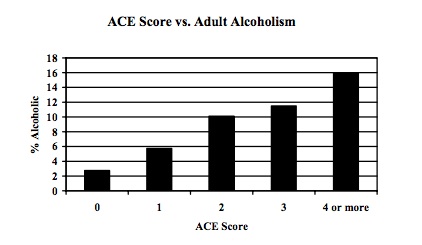
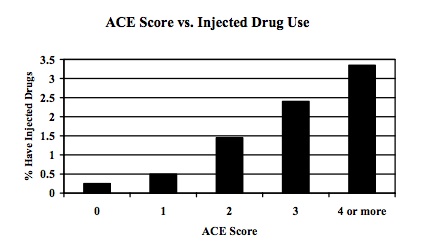
A famous study using a huge sample (17,000) looked at Adverse Childhood Experiences (ACEs) in relation to subsequent physical and mental problems. The results of the study are nicely summarized in the Sept. 25/2011 issue of The Fix. Take-home message: the relationship between trauma and addiction is unquestionable. An ACE score was calculated for each participant, based on the number of types of adverse experience they reported during childhood or adolescence. The higher the ACE score, the more likely people were to end up an alcoholic, drug-user, food-addict, or smoker (among other things). Here are two graphic examples:


These figures, which are likely to be low estimates, show a 500% increase in the incidence of adult alcoholism, and a 4,600% increase in the incidence of IV drug use, predicted by early adverse experiences. Despite criticisms of the study, based mostly on retrospective self-reporting, these correlations are huge and they are meaningful, and follow-up prospective studies are finding similar results.

So how does self-medication work? There must be something about PTSD, depression, and anxiety that gets soothed by drugs, booze, binge-eating, and other addictive hobbies. Again, it’s not complicated. PTSD, depression, and anxiety disorders all hinge on an overactive amygdala—one that is not controlled or “re-oriented” by more sophisticated (and realistic) appraisals coming from the prefrontal cortex and anterior cingulate cortex (ACC). That traumatized amygdala keeps signalling the likelihood of harm, threat, rejection, or disapproval, even when there is nothing in the environment of immediate concern. In fact, this gyrating amygdala lassos the prefrontal cortex, foisting its interpretation on the orbitofrontal cortex (and ventral ACC) rather than the other way around (which we might loosely call emotion regulation). The whole brain is dominated by limbic imperialism—making it a less-than-optimal neighbourhood in which to reside.

At the very least, drugs, booze, gambling and so forth take you out of yourself. They focus your attention elsewhere. They may rev up your excitement and anticipation of reward (in the case of speed, coke, or gambling) or they may quell anxiety directly by lowering amygdala activation (in the case of downers, opiates, booze, and maybe food). The mechanisms by which this happens are various and complex. But addicts and ex-addicts (like me) know what it feels like. If we find something that relieves the gnawing sense of wrongness, we take it, we do it, and then we do it again.

So, according to the self-medication model, addictive behaviours “medicate” depression, anxiety, and related feelings. But is that the whole story? I don’t think so, and I’ll get into why in my next post.

Saturday, August 25, 2012

Documentary - Stress: Portrait of a Killer (with Stanford Biologist Robert Sapolsky)


Open Culture posted this, and I may have posted it here before, but it's good stuff and well-worth the time to watch. Stress is gaining recognition (along with the inflammation it causes) as a primary source of many diseases, so learning to control stress will offer us a better quality of life - and a longer life.

This was a National Geographic documentary, so it's well done and a good use of 52 minutes of your life.

Do Yourself a Favor and Watch Stress: Portrait of a Killer (with Stanford Biologist Robert Sapolsky)


August 22nd, 2012


Intelligence comes at a price. The human species, despite its talent for solving problems, has managed over the millennia to turn one of its most basic survival mechanisms–the stress response–against itself. “Essentially,” says Stanford University neurobiologist Robert Sapolsky, “we’ve evolved to be smart enough to make ourselves sick.”

In the 2008 National Geographic documentary Stress: Portrait of a Killer (above), Sapolsky and fellow scientists explain the deadly consequences of prolonged stress. “If you’re a normal mammal,” Sapolsky says, “what stress is about is three minutes of screaming terror on the savannah, after which either it’s over with or you’re over with.” During those three minutes of terror the body responds to imminent danger by deploying stress hormones that stimulate the heart rate and blood pressure while inhibiting other functions, like digestion, growth and reproduction.

The problem is, human beings tend to secrete these hormones constantly in response to the pressures of everyday life. “If you turn on the stress response chronically for purely psychological reasons,” Sapolsky told Mark Shwartz in a 2007 interview for the Stanford News Service, “you increase your risk of adult onset diabetes and high blood pressure. If you’re chronically shutting down the digestive system, there’s a bunch of gastrointestinal disorders you’re more at risk for as well.”

Chronic stress has also been shown in scientific studies to diminish brain cells needed for memory and learning, and to adversely affect the way fat is distributed in the body. It has even been shown to measurably accelerate the aging process in chromosomes, a result that confirms our intuitive sense that people who live stressful lives grow old faster.

By studying baboon populations in East Africa, Sapolsky has found that individuals lower down in the social hierarchy suffer more stress, and consequently more stress-related health problems, than dominant individuals. The same trend in human populations was discovered in the British Whitehall Study. People with more control in work environments have lower stress, and better health, than subordinates.

Stress: Portrait of a Killer is a fascinating and important documentary–well worth the 52 minutes it takes to watch.

Related content:

Pema Chödrön - Stay With Your Broken Heart

This wisdom quote from Pema Chödrön was posted at Tricycle's Brief Teachings page - this is a hard one to master, but it is also one of the most important skills we can develop. When we can learn to stay with the pain, or sadness, or whatever - rather than stuff it down or try to escape it through addictions - we become more present in our lives, present to others, and less likely to be reactive or defensive. This has been for me a path toward happiness.


Stay with Your Broken Heart

Pema Chödrön

When anyone asks me how I got involved in Buddhism, I always say it was because I was so angry with my husband. The truth is that he saved my life. When that marriage fell apart, I tried hard—very, very hard—to go back to some kind of comfort, some kind of security, some kind of familiar resting place. Fortunately for me, I could never pull it off. Instinctively I knew that annihilation of my old dependent, clinging self was the only way to go. . . .

Life is a good teacher and a good friend. Things are always in transition, if we could only realize it. Nothing ever sums itself up in the way that we like to dream about. The off-center, in-between state is an ideal situation, a situation in which we don’t get caught and we can open our hearts and minds beyond limit. It’s a very tender, nonaggressive, open-ended state of affairs.

To stay with that shakiness—to stay with a broken heart, with a rumbling stomach, with the feeling of hopelessness and wanting to get revenge—that is the path of true awakening. Sticking with that uncertainty, getting the knack of relaxing in the midst of chaos, learning not to panic—this is the spiritual path. Getting the knack of catching ourselves, of gently and compassionately catching ourselves, is the path of the warrior. We catch ourselves one zillion times as once again, whether we like it or not, we harden into resentment, bitterness, righteous indignation— harden in any way, even into a sense of relief, a sense of inspiration.

Every day we could think about the aggression in the world, in New York, Los Angeles, Halifax, Taiwan, Beirut, Kuwait, Somalia, Iraq, everywhere. All over the world, everybody always strikes out at the enemy, and the pain escalates forever. Every day we could reflect on this and ask ourselves, “Am I going to add to the aggression in the world?” Every day, at the moment when things get edgy, we can just ask ourselves, “Am I going to practice peace, or am I going to war?”

From
The Buddha Is Still Teaching, selected and edited by Jack Kornfield, © 2010. Reprinted with permission of Shambhala Publications, Inc., Boston. www.shambhala.com.