Showing posts with label Spirituality. Show all posts

Tuesday, November 04, 2014

Richard Davidson, Ph.D. - The Emergence of Contemplative Neuroscience

The Center for Compassion and Altruism Research and Education

Richard Davidson, Ph.D. is the author of The Emotional Life of Your Brain: How Its Unique Patterns Affect the Way You Think, Feel, and Live—and How You Can Change Them. This talk is from 2 years ago, but it's still relevant - and it was delivered at the Center for Compassion and Altruism Research and Education (CCARE) at Stanford University.

Meng Wu Lecture: Richard Davidson, Ph.D.

Published on Oct 29, 2012


Richard Davidson, Ph.D., presenting his talk, The Emergence of Contemplative Neuroscience, at a Meng Wu Lecture on October 2nd, 2012


From Amazon on The Emotional Life of Your Brain: How Its Unique Patterns Affect the Way You Think, Feel, and Live—and How You Can Change Them:

What is your emotional fingerprint?

Why are some people so quick to recover from setbacks? Why are some so attuned to others that they seem psychic? Why are some people always up and others always down? In his thirty-year quest to answer these questions, pioneering neuroscientist Richard J. Davidson discovered that each of us has an Emotional Style, composed of Resilience, Outlook, Social Intuition, Self-Awareness, Sensitivity to Context, and Attention. Where we fall on these six continuums determines our own “emotional fingerprint.”

Sharing Dr. Davidson’s fascinating case histories and experiments, The Emotional Life of Your Brain offers a new model for treating conditions like autism and depression as it empowers us all to better understand ourselves—and live more meaningful lives.

Tuesday, September 30, 2014

P2P Truth: A Map of Deepest Values by Andrius Kulikauskas

This comes from the P2P Foundation blog. Andrius Kulikauskas offers a unique values of P2P.

photo of Michel Bauwens
Michel Bauwens
27th September 2014

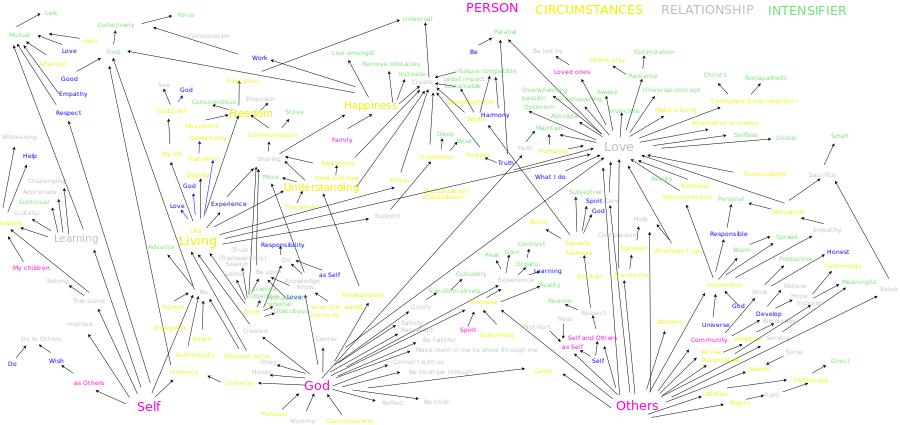
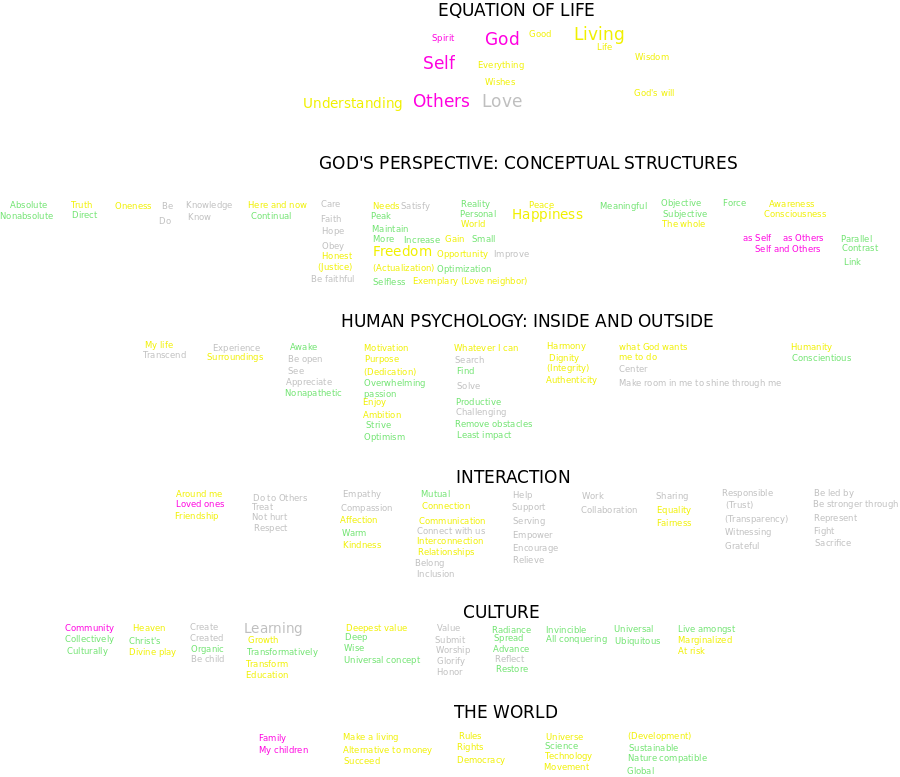
Today we have something a little different, a very nicely illustrated mapping project reflecting on p2p values and spirituality by Andrius Kulikauskas.

P2PTruthAMapOfDeepestValues_html_m224820d0

The peer-to-peer movement values relative truth with a passion that is practically absolute. I believe that individual perspectives have the potential to discover the universal truth, at least enough of it so as to make the peer-to-peer movement viable. The path from relative to absolute truth is the subject of my e-book, The Truth, from Relative to Absolute.

P2PTruthAMapOfDeepestValues_html_m4f793294

I think the most practical concept from my book is a person’s deepest value. In 2004, I wondered how my online laboratory Minciu Sodas might organize a Yahoo! group around Franz Nahrada and openly support his many projects. We needed a single concept that summarized what he cared about. For him, it was Global Villages. He later expressed his deepest value in life as optimal interplay. From 2004 to 2010, I organized more than twenty such discussion groups, including Janet Feldman’s Holistic Helping, Pamela McLean’s Learning From Each Other, Samwel Kongere’s Mendenyo (“men without food”, motivation through sacrifice), John Roger’s Cyfranogi (“participate”, participatory society) and my own group Living by Truth. Here is an excerpt from my book:

Truth is inside of us, deeper than words. Ask people what they know firsthand:
What do they value? What is their deepest value in life which includes all of their other values?

They may not have an answer. Or they may feel it but not yet have words for it. Or they may have already thought it through. As the ancient Greeks would say, they know themselves.

Their values are all uniquely beautiful: Holistic Helping, Learning From Each Other, Participatory Society, Serving Others, Fighting Peacefully, Synergy, Freedom, Faith, Family, Unity, Love…

P2PTruthAMapOfDeepestValues_html_cf6370e

If two people give the same answer such as Family, and you ask them what they mean by that, they will give you different answers.

Their deepest value is their spiritual name, like a Native American name. They will almost always let you share it.

P2PTruthAMapOfDeepestValues_html_m1704f389

It is how they hope to think of themselves. In practice, it is their strong point but also their blind spot. It is what we should have them be in charge of.

It is how they are happy to be categorized, how you can empathize with them and hold them accountable.

It is their soul, the essence of their personality, their principle which they substitute for themselves, their name which is written in the Book of Life, what is truly eternal.

woman

They are thus like stars in the sky, seeing the entire sky from their particular position. As Jesus says, they are born again of the Spirit. They are Allah’s holy names.

Their deepest values are all aspects of love, which is surely God’s deepest value. They address what they each think is the problem with this world, the lack of love they feel. It is how they integrate their many values as they clash in daily life.

P2PTruthAMapOfDeepestValues_html_m45c36d64

They invest themselves in their deepest value, which does not change but rather grows ever more clear to them. As they know themselves, they dare to go beyond themselves and ask what they do not know.

What do they seek to know? What is a question that they don’t know the answer to, but wish to answer?

In 10 years, I collected deepest values and investigatory questions from hundreds of people. I think it would be very fruitful to work together to collect many more. They might serve as the basis for appreciating the greatest variety of perspectives and discovering what amongst them might actually be universal. 

map
I am working on a map of deepest values and related concepts. I’ve noticed that often a value such as my own “living by absolute truth” breaks do wn into one concept that is given (in my case, “the absolute truth”), and another concept that depends on my choice (“living” that truth). Others value “living by harmony”, “living as a creation of God” and such variations are the basis for my map.

P2PTruthAMapOfDeepestValues_html_25cc2b10
I’ve noticed that some values presume very little and might make sense from an abstract God’s point of view. Others, however, are psychological and distinguish internal thinking and external actions as with motivations, obstacles and solutions. There are values which presume two or more beings as with empathy and collaboration. Community, education, glory suppose an entire culture. Family, children, technology, democracy, money, making a living, sustainability and the Bible all depend on the details of the world as we know it. I’d love to work together to sort through the underlying presumptions. I’m also interested in related art projects. I share a letter about my research in English and I’m working on it in Lithuanian.

Monday, August 25, 2014

The State of Faith in America Panel with Larry King

gB63bseo62r1aT3piIr1SsxJhtXRpSf37t_xkmUHhNo.jpg

In this episode of Larry King Live, Gus Holwerda (film maker) Dr. Lawrence Krauss (American theoretical physicist) - who created the film The Unbelievers - were joined by Michael Beckwith (American new thought minister & author), Christian actor David A. R. White, and Jay Bakker (pastor, speaker and author).

Nothing new here - but it's interesting to hear Beckwith spar with Krauss. It's also interesting to hear Jay, the son of Jim and Tammy Faye Bakker, talk about faith vs. belief (dude has some serious tats).  I'd like to see the film Krauss helped make, The Unbelievers: What Are You Willing to Believe?

http://www.psr.edu/files_psr/u6/JayBakkerSmall2.jpg

This aired on August 20, 2014.

The State of Faith in America Panel with Larry King


According to a recent Pew Research Center poll, religious disaffiliation in the U.S. is at an all-time high. A panel of religious leaders and nonbelievers joined Larry King on his Emmy Nominated show Larry King Now to discuss this trend and what it means for the future of faith in America.

The Unbelievers is a film directed by Gus Holwerda featuring Lawrence Krauss (American theoretical physicist) where they traveled across the globe speaking publicly about the importance of science and reason as opposed to religion and superstition. Both Gus and Lawrence were joined by Michael Beckwith (American new thought minister & author), Christian actor David A. R. White & Jay Bakker (pastor, speaker and author) on this recent episode of Larry King Now.

During the panel the religious leaders and nonbelievers evaluated the presence of religion, or lack thereof in Hollywood. "Sex, violence, and religion. Those will sell, and I think Hollywood cares about what’s going to sell. I don’t think they have an agenda, except making money. Religion is a guaranteed way of making money in Hollywood," Lawrence Krauss remarked.

Physicist Dr. Lawrence Krauss also discussed the public's perception of atheists and claims that a research study finds that atheists are viewed in the same vein as rapists. Whereas American New Thought Minister Dr. Michael Beckwith weighed in on why much of the world’s unrest is derived from religion.
  • The episode is now LIVE on Ora.tv and Hulu.com (episodes premiere daily 5pm EST)
  • To watch the interview, click here: http://on.ora.tv/1pbUUyl

Clips:


Are Atheists Viewed In The Same Vein As Rapists?
Physicist Dr. Lawrence Krauss discusses the public's perception of atheists, and claims that a research study finds that atheists are viewed in the same vein as rapists.

I’d Call Myself A Christian Agnostic
Jay Bakker, son of famed televangelists Tammy Faye & Jim Bakker, discusses his progressive outlook on religion & what his popular “Emerging Church Movement” stands for.

Why The Decline In Religion?
Larry’s panel of believers and nonbelievers analyzes a recent Pew Study that says religious disaffiliation is at an all-time high in America.

Surface Level Believers Are Those Who Fight
American New Thought Minister Dr. Michael Beckwith weighs in on why much of the world’s unrest is derived from religion.

Religion Is A Guaranteed Way Of Making Money In Hollywood
Larry’s panel of religious leaders and nonbelievers evaluates the presence of religion, or lack thereof, in Hollywood.

Quotes:


LAWRENCE KRAUSS
"I just ask questions and I want people to think for themselves. And just asking, 'Maybe we don't need a god'—you get called a strident atheist. And somehow that's viewed in our society as a bad thing, for asking questions. But asking questions is what it's all about." — on society being quick to label and write off atheists

"This cosmic Saddam Hussein—if you do something he doesn't like, it's not as if he just tortures you for a few years. It's for all eternity. That doesn't seem to be love." — on the Christian god being a "loving" god

"You cannot, in this current time, say you're an atheist." — on the impossibility of electing an openly atheist president

"The Bible was written, basically, before people knew anything." — on whether the Bible is reputable

GUS HOLWERDA
"I could never buy into it. It was never something I could believe in, so I cast it off at an early age." — on choosing to be atheist

"You can't, with one hand, use science and reason to defend your position about god, and with the other hand, say that the laws of nature can be suspended any time there's a miracle."

MICHAEL BECKWITH
"I had the record for converting Christians to atheism on our college campus."

"I had an encounter with what I call 'love-beauty.' I didn't call it 'god' because I didn't believe in god. The presence was so profound and so real that it altered my character. I can use the word 'god' again, but it's not the god you read about in the Quran or the Bible."

"When I use the word 'spirituality,' I'm speaking of verities like love and peace and harmony and beauty. Those are spiritual qualities. [...] when they become active in you, your character changes."

"If you remain at the surface of just being a believer, a zealot, 'I just believe this' on the surface, then you think that your religion is better than another person’s religion. You’ll fight for religion. But if you actually practice your religion, you don’t end up fighting or thinking yours is better." — on truly practicing religion versus accepting it on the surface

"The Bible, to me, is an evolution of human consciousness. We don't call it the word of god. We call it people who were inspired by the presence of god."

DAVID A. R. WHITE
"I've never wavered from knowing, at the end of the day, where I'm going and is there a god." — on his faith

"I gain my faith, my belief, from what the Bible says about god. Ultimately, Christianity is about a personal relationship with Jesus Christ. That's what it's really about."

JAY BAKKER
"Christians are doing enough to destroy themselves just by going against each other over theologies. [...] I'm not really worried about the new atheists as much as I am other Christians."

Saturday, August 02, 2014

John Hagelin - Consciousness, a Quantum Physics Perspective


John Hagelin is a particle physicist and director of the Transcendental Meditation movement for the United States. When he was still a serious physicist, he was a researcher at the European Organization for Nuclear Research (CERN) (1981–1982) and the Stanford Linear Accelerator Center (SLAC) (1982–1983).

Hagelin is now Professor of Physics and Director of the Institute of Science, Technology and Public Policy at Maharishi University of Management (MUM). In recent years, his research has focused on connecting consciousness and the unified field theory. His ideas are considered fringe by the physics community and by cognitive scientists.

Despite this (or maybe because of this), he is widely cited by those who believe consciousness is primary to the existence of the universe, a position I have often criticized here. For example, he was featured in two of the most popular New Age "woo" movies, What the Bleep Do We Know? and The Secret - the first an example of how failing to understand science allows one to make all kinds of silly claims (as well as being a front for JZ Knight's Ramtha nonsense), and the second an example of how materialism and narcissism can be made to appear spiritual.

This summary is from Wikipedia:
Efforts to link consciousness to the unified field

Hagelin has attempted to combine his two area of expertise, linking Transcendental Meditation's view of consciousness with physical cosmology. Science writer Chris Andersen, Dallas Observer political reporter Jonathan Fox and physicist Peter Woit have written critically about Hagelin's research and publications in this area.[14][16][20]

In a 1992 news article for Nature about Hagelin's first presidential campaign, Anderson wrote that Hagelin, was "by all accounts a gifted researcher well known and respected by his colleagues" but that his effort to link grand unified theories of physics to Transcendental Meditation "infuriates his former collaborators."[20] He cited physicist John Ellis' fear that "people might regard [Hagelin's assertions] as rather flaky, and that might rub off on the theory or on us."[20] Fox observed that, while "once considered a top scientist, Hagelin's former academic peers ostracized him after the candidate attempted to shoehorn Eastern metaphysical musings into the realm of quantum physics."[16] In his book, Not Even Wrong: The Failure of String Theory and The Search for Unity In Physical Law, Woit acknowledged that Hagelin had published papers in prestigious journals that would eventually be cited in over a hundred other papers, but that identification of a unified field of consciousness with a unified field of superstring theory was wishful thinking and that most physicists thought Hagelin's views on this topic were nonsense.[14]

Hagelin's linkage of quantum mechanics and unified field theory with consciousness was also critiqued by University of Iowa philosophy and sociology professors Evan Fales and Barry Markovsky in 1997, in the journal Social Forces. They wrote that the connection relied on similarity between properties of quantum mechanical fields and consciousness, but that the parallels Hagelin highlighted between unified field theories and the Vedas rested on ambiguity, obscurity and vague analogy supported by the construction of arbitrary similarities.[26]

Hagelin was featured in the movies What the Bleep Do We Know!?,[27] and The Secret.[28] What the Bleep Do We Know? was described by Michael Shermer, writing in Scientific American, as being filled with "New Age scientists whose jargon-laden sound bites amount to little more than what California Institute of Technology physicist and Nobel laureate Murray Gell-Mann once described as 'quantum flapdoodle.'"[29]
In a sense, it's sad that Hagelin is where he is now. Prior to leaving the Stanford Linear Accelerator Center in 1983, he had authored a couple a very highly cited papers in particle physics. One wonders what may have been possible if he had not gone off into the wilderness.

This talk was given at Stanford University, interestingly enough.

John Hagelin - Consciousness, a Quantum Physics Perspective

Published on Aug 1, 2014


Renowned quantum physicist, John Hagelin (PhD, Harvard), presents the thesis that consciousness is a unified field that contains nature's programming code and transcending through meditation is a pathway to hack / access consciousness.

Wednesday, July 23, 2014

RSA - What Kind of Love Do We Need?


This is a video/talk from The RSA's series on reconceptualizing spirituality for the 21st Century. Previously in the series, they have looked at what it might mean to 'take spirituality seriously', the role of the body in spiritual experience, what sense can be made of the soul in a scientific age, and the importance of reflecting on our mortality. 

In this penultimate event in this series, Simon May, Devorah Baum, Mark Vernon, moderator Jonathan Rowson examine an experience and ideal that many believe has to be at the heart of any reappraisal of the spiritual: Love.

What Kind of Love Do We Need?

17th Jul 2014

Listen to the audio

(full recording including audience Q&A)
Please right-click link and choose "Save Link As..." to download audio file onto your computer.


All you need is love, said the Beatles, but is that right? And if it is, what kind of love do we need? Popular culture is awash with the excitement and drama of romantic love, but psychology, philosophy and other forms of inquiry reveal a much richer, broader, deeper and sometimes challenging notion of love.

For instance, many believe the global reach of Christianity is related to the central importance it places on love, but Simon May has written that we have inverted 'God is Love' to create a world in which 'Love is God'.

Are we now, in what Rowan Williams recently called a Post-Christian Society, still striving for a certain kind of love? And if so, what might it feel like to find it?

In this series on reconceiving spirituality, we have explored what it might mean to 'take spirituality seriously', the role of the body in spiritual experience, what sense we can make of the soul in a scientific age, and the importance of reflecting on our mortality. Join us for the penultimate event in this series, when we examine an experience and ideal that many believe has to be at the heart of any reappraisal of the spiritual: Love.

http://www.markvernon.com/Images/Love%20ATM%20cover.jpg

Speakers:  

Simon May, visiting professor of philosophy, Kings College London and author of 'Love: A History'
Mark Vernon, writer, journalist and author of 'Love: All That Matters'
Dr Devorah Baum, lecturer in English, University of Southampton.

Chair: Jonathan Rowson, director, RSA Social Brain Centre.

Get the latest RSA Audio

Subscribe to RSA Audio iTunes Podcast iTunes | RSA Audio RSS Feed RSS | RSA Mixcloud page Mixcloud
You are welcome to link to, download, save or distribute our audio/video files electronically. Find out more about our open access licence.

Speakers

Friday, June 20, 2014

Ceremonial PTSD Therapies Favored by Native American Veterans


This is interesting, and it confirms a growing trend I have seen in aboriginal peoples seeking to return to the spiritual traditions that once nourished their people. One of the best books I have seen on the subject is Healing the Soul Wound: Counseling with American Indians and Other Native Peoples (2006) by Eduardo Duran.


Ceremonial PTSD therapies favored by Native American veterans

Medical News Today | Friday 20 June 2014

Native American veterans battling Post Traumatic Stress Disorder find relief and healing through an alternative treatment called the Sweat Lodge ceremony offered at the Spokane Veterans Administration Hospital.

In the Arizona desert, wounded warriors from the Hopi Nation can join in a ceremony called Wiping Away the Tears. The traditional cleansing ritual helps dispel a chronic "ghost sickness" that can haunt survivors of battle.

These and other traditional healing therapies are the treatment of choice for many Native American veterans, - half of whom say usual PTSD treatments don't work - according to a recent survey conducted at Washington State University. The findings will be presented at the American Psychological Association conference in Washington D.C. this August.

The study is available online at https://www.surveymonkey.com/s/nativeveterans.

Led by Greg Urquhart and Matthew Hale, both Native veterans and graduate students in the WSU College of Education, the ongoing study examines the attitudes, perceptions, and beliefs of Native American veterans concerning PTSD and its various treatment options. Their goal is to give Native veterans a voice in shaping the types of therapies available in future programs.

"Across the board, Native vets don't feel represented. Their voices have been silenced and ignored for so long that they were happy to provide feedback on our survey," said Hale.

Historically, Native Americans have served in the military at higher rates than all other U.S. populations. Veterans are traditionally honored as warriors and esteemed in the tribal community. A 2012 report by the Department of Veterans Affairs showed that the percentage of Native veterans under age 65 outnumbers similar percentages for veterans of all other racial groups combined.

The WSU survey provides a first-hand look at the veterans' needs, but more importantly, reveals the unique preferences they have as Native American veterans, said Phyllis Erdman, executive associate dean for academic affairs at the college and mentor for the study.

Cultural worldview

Urquhart said many Native veterans are reluctant to seek treatment for PTSD because typical western therapy options don't represent the Native cultural worldview.

"The traditional Native view of health and spirituality is intertwined," he explained. "Spirit, mind, and body are all one - you can't parcel one out from the other - so spirituality is a huge component of healing and one not often included in western medicine, although there have been a few studies on the positive effects of prayer."

For many years, the U.S. government banned Native religious ceremonies, which subsequently limited their use in PTSD programs, said Urquhart. Seeking to remedy the situation, many Veterans Administration hospitals now offer traditional Native practices including talking circles, vision quests, songs, drumming, stories, sweat lodge ceremonies, gourd dances and more. Elders or traditional medicine men are also on staff to help patients process their physical and emotional trauma.

"PTSD is a big issue and it's not going away anytime soon," said Hale who identifies as Cherokee and was a mental health technician in the Air Force.

Urquhart, who is also Cherokee and developed mild symptoms of PTSD after a tour as a cavalry scout in Iraq, said there have been very few studies on Native veterans and PTSD. He and Hale designed their survey to be broader and more inclusive than any previous assessments. It is the first to address the use of equine therapy as a possible adjunct to both western treatments and Native ceremonial approaches.

Standard treatments disappointing

So far, 253 veterans from all five branches of the military have completed the survey, which includes 40 questions, most of them yes or no answers. It also includes an open-ended section where participants can add comments. The views reflect a diverse Native population ranging from those living on reservations to others who live in cities.

The majority of survey takers felt that "most people who suffer from PTSD do not receive adequate treatment," said Urquhart. For Native veterans who did seek standard treatment, the results were often disappointing. Sixty percent of survey respondents who had attempted PTSD therapy reported "no improvement" or "very unsatisfied."

Individual counseling reportedly had no impact on their PTSD or made the symptoms worse for 49 percent of participants. On the other hand, spiritual or religious guidance was seen as successful or highly successful by 72 percent of Native respondents. Animal assisted therapy - equine, canine, or other animals - was also highly endorsed.

"The unique thing about equine therapy is that it's not a traditional western, sit-down-with-a-therapist type program. It's therapeutic but doesn't have the stigma of many therapies previously imposed on Native Americans," said Urquhart.

Strongly supportive of such efforts, Erdman is expanding the long-running WSU Palouse Area Therapeutic Horsemanship (PATH) program to include a section open to all veterans called PATH to Success: A Warrior's Journey.

Giving veterans a voice

Urquhart, Hale, and teammate, Nasreen Shah say their research is gaining wide support in Native communities throughout the nation.

The team plans to distribute the survey results to all U.S. tribes, tribal governments, Native urban groups, and veteran warrior societies. They also hope the departments of Veterans Affairs and Indian Health Services will take notice and continue to incorporate more traditional healing methods into their programs.

As one Iroquois Navy veteran commented on the survey, "Traditional/spiritual healing can be very effective together with in depth education and background in modern treatment methods."

A Nahua Army veteran agreed, writing, "Healing ceremonies are absolutely essential, as is story telling in front of supportive audiences. We need rituals to welcome back the warriors."

Sunday, June 08, 2014

Nathan A. Thompson - True Secrets of Psychedelics: Are They Everything They’re Cracked Up to Be?

On the heals of the Sam Harris article on hallucinogens I posted earlier today, here is a similar article from Salon. This article, however, focuses on psychedelics as a vehicle to open us up to the spiritual. But once we get a taste, the recommendation is to take up a practice that can provide continuous spiritual openness, not just for a few hours, until the drug wears off. In many ways, this too is what Sam Harris was suggesting.

True secrets of psychedelics: Are they everything they’re cracked up to be?

Mind-altering drugs can open us up to the amazing possibilities of the universe — but true self-discovery is harder

Sunday, Jun 8, 2014 | Nathan A. Thompson


A still from the movie "Enter the Void" of a DMT hallucination. (Credit: IFC Films)

The cactus skin arrived in the mail in a packet marked “for botanical examination only.” We whizzed it up in a blender. Two truant teenagers in an empty kitchen. We tried mixing the resulting green powder with water and drinking it. The taste was so foul it was all we could do to stop ourselves vomiting. In the end we mixed it with Cherry Coke to ameliorate the flavor and then we drank it all up.

The skin contained a naturally occurring psychedelic drug called mescaline. Soon, everything seemed to vibrate. It was as if the walls, windows, even the chairs were humming a low, beautiful melody. Then I noticed that we were speaking in colors. My friend’s words were blue swirls and mine were green. Our conversation curled and twisted in front of my eyes like smoke in a vacuum chamber. Later I held a glass of water, gazing at it for what seemed like an immensely long time, its utility swallowed up in its beauty and it seemed that the whole Earth existed within that glass and the thought occurred to me: “I’m in the presence of God.”

Ten years later I was staying in a tiny monastery deep in a Thai forest. I had been living and meditating there for close to a month. My mind was still — still in the way a tuning fork rests after being struck for a long time. I sat outside watching the fading light graze the trees, feeling egoless and empty of thought. Butterflies erupted from the green foliage in a movement that seemed so excessively beautiful I was thunderstruck and as I looked, I thought: “Damn, this is exactly like mescaline.”

It’s not just me who has made the link between psychedelic drugs and meditation. Indeed, the link between psychedelics and spiritual experience was the first line of inquiry Timothy Leary and his cohorts pursued in their 1960s Harvard experiments. In the 1990s, Dr. Rick Strassman ran a series of experiments using a powerful psychedelic known as DMT, and he too noticed the similarity: “[The effect of] DMT has a similarity with experiences that are possible with a lot of meditation,” he said.

Scientists are currently conducting separate studies on psychedelics and meditation — both are being trialed to treat the same conditions. A review study by the Journal of the American Medical Association, released in March this year, found that meditation may be as effective as medication in treating conditions such as depression and anxiety. Hot on the heels of this study was the Psilocybin Cancer Anxiety Study at NYU’s Bluestone Center for Clinical Research, which found that Psilocybin (the active drug in “magic mushrooms”) was effective in treating anxiety and depression in terminal cancer patients. There are now dozens of studies that document how both meditation and psychedelics can treat depression, addiction, anxiety and PTSD.

So if psychedelics produce similar effects to long periods of meditation and other austere religious practices, could we have stumbled upon what Strassman calls “the spirit molecule”? Are psychedelics an alternative to spiritual practices?

Hardly, say the Buddhists. The second noble truth of the Buddha is that “the origin of suffering is the attachment to desire.” Psychedelics are by their nature an experience, a strange and beautiful one but often elusive. This creates a craving to have the experience again. It is this craving that is the Buddhist definition of discontent. Rather than freeing the mind from attachment, psychedelics create more.

Perhaps the gold standard to measure whether psychedelics are a good substitute for meditation is to see whether fundamental changes in character occur. A meditation instructor once told me: “When I took LSD in the ’60s, it was profound, but it didn’t help me develop the character to live from that truth day by day – without grounding in morality and mindfulness it was merely a flash of insight.”

Richard Alpert, who was one of the first psychologists to study LSD, and later became the spiritual teacher Ram Dass, has a similar view, “I see them [psychedelics] as a door opener and a catalyst and a facilitator; I don’t see them as a full path.” Alpert also describes what his Indian guru told him after trying LSD himself: “Your drug is useful. It would allow you to come in and have the darshan [vision] of Christ, but you can only stay for two hours and then you’ve got to leave. It would be better to become Christ than visit him, but your medicine won’t do that, because it’s not the true samadhi [enlightenment].”

But psychedelics are a catalyst for change, according to writer Graham Hancock. According to Hancock, the means you use to gain insight (whether they are psychedelics or meditation) are the least important aspect; “what matters is what you do with visionary experiences once you have had them, how you integrate them into your life, what lessons you learn from them and how you act on those lessons.” Indeed, according to follow-up studies from the scientific literature, the effect of the psychedelic experience does seem to sustain a positive change without the need to repeat it. Researchers at New York University reported in the Archives of General Psychiatry that their subjects reported a significant improvement in mood and outlook after six months.

This may be true of those individuals who have taken medical-grade psychedelics in a clinical setting, but what of the thousands of people who are doing so haphazardly, procuring them from the black market? Personally, I had a hard time integrating my visionary experiences with my real life. I was sometimes confused and frightened by what I saw. It was a relief then to find the well-trodden Buddhist path. Indeed, most mystical traditions have detailed maps covering the kind of mental and metaphysical spaces you pass through on the way to God. Buddhism has the “Jhanas,” yoga has stages of “Samhadi” and Sufism has “four stages”. These maps allow a teacher to help you process what comes up in your spiritual practice. Strict morality is always a prerequisite to walk such paths or they won’t teach you. These kind of healthy boundaries are what is lacking when you take psychedelics.

But supposing you don’t have the time to pursue rigorous meditation? Why spend years and (some would say) lifetimes rotting our butts on the meditation cushion when we can take the red pill and get it all at once?

I heard Zen priest Kokyo Henkel describe it this way: Imagine spiritual development is a mountain. Psychedelics will take you on a helicopter ride to the top, you will see tumbling clouds and vast craggy distances but when the ride is over you are back where you started. Meditation is a way to climb the mountain, slowly, sometimes painfully, but when you reach the summit it is completely different from the summit-top you saw on your helicopter ride, because the journey has transformed you.

Perhaps this is idealistic, and I certainly wouldn’t deny anyone the use of psychedelics for medical reasons or for spiritual advancement, if done so with wisdom and respect. Indeed, given the dire state of the biosphere and the ecological crisis, perhaps the human race is out of time to meditate ourselves into the enlightened consciousness needed to instigate change. Given that psychedelics tend to assure people of the fact that we are part of nature and connected to every person, plant and animal on Earth, perhaps we should be using them to create happier, more responsible citizens now.

Meditation and yoga have a long history of creating such people, and both have the advantage of being legal and safe as any intense religious activity can be. The immediacy of the psychedelic experience and its profound effects make these substances deserving of interest and study but we can’t yet say they are a viable alternative to the tried and tested spiritual paths.

When I look back on that mescaline-laced afternoon when I was a teenager, I remember a life-altering experience, something the mystics would call an “awakening.” But it was meditation that allowed me to begin to awaken permanently. Alan Watts summed it up when he said:
“The psychedelic experience is only a glimpse of genuine mystical insight, but a glimpse which can be matured and deepened by the various ways of meditation in which drugs are no longer necessary or useful. If you get the message, hang up the phone.”

Read more from Nathan A. Thompson.

Thursday, May 15, 2014

Chris Hedges - The Power of Imagination

This is an interesting article from Chris Hedges - posted at TruthDig. Rather than the usual political analysis and criticism, here he waxes somewhat philosophical. However, he demonstrates a bit of the pre/trans fallacy that is an aspect of integral theory. Here is the key quote:
Only this premodern ethic can save us as we enter a future of economic uncertainty and endure the catastrophe of climate change. Social and economic life will again have to be communal. The lusts of capitalism will have to be tamed or destroyed. And there will have to be a recovery of reverence for the sacred, the bedrock of premodern society, so we can see each other and the earth not as objects to exploit but as living beings to be revered and protected. This means inculcating a very different vision of human society.
Yes, we need a deeper and more embodied sense of the sacred, but we do NOT need a return to the premodern ethic. The premodern worldview is characterized by magical thinking, superstition, and the lack of an essential, rational consciousness capable of post-formal thinking (symbolic thought as opposed to belief in power gods and correlations between human actions and forces of nature).

The best known example of this is the difference in how God is depicted in the Old Testament (wrathful, jealous, angry, punitive) and the God of the New Testament, as embodied in Jesus (loving, centered in justice, inclusive). The first is pre-rational, the later is rational.

What we need is a transpersonal, post-rational model of the sacred as a way to embody purpose in meaning in nature as something other than physical material to be exploited.

The Power of Imagination

Posted on May 11, 2014
By Chris Hedges
 

John William Waterhouse’s painting “Miranda—The Tempest.”

Those in the premodern world who hoarded possessions and refused to redistribute supplies and food, who turned their backs on the weak and the sick, who lived exclusively for hedonism and their own power, were despised. Those in modern society who are shunned as odd, neurotic or eccentric, who are disconnected from the prosaic world of objective phenomena and fact, would have been valued in premodern cultures for their ability to see what others could not see. Dreams and visions—considered ways to connect with the wisdom of ancestors—were integral to existence in distant times. Property was communal then. Status was conferred by personal heroism and providing for the weak and the indigent. And economic exchanges carried the potential for malice, hatred and evil: When wampum was exchanged by Native Americans the transaction had to include “medicine” that protected each party against “spiritual infection.”

Only this premodern ethic can save us as we enter a future of economic uncertainty and endure the catastrophe of climate change. Social and economic life will again have to be communal. The lusts of capitalism will have to be tamed or destroyed. And there will have to be a recovery of reverence for the sacred, the bedrock of premodern society, so we can see each other and the earth not as objects to exploit but as living beings to be revered and protected. This means inculcating a very different vision of human society.

Our greatest oracles have sought to impart this wisdom. William Shakespeare lamented the loss of the pagan rituals eradicated by the Reformation. When Shakespeare was a boy, the critic Harold Goddard pointed out, he experienced the religious pageants, morality plays, church festivals, cycle plays, feast and saint days, displays of relics, bawdy May Day celebrations and tales of miracles that made up the belief system during the reign of the medieval Catholic Church. The Puritans, the ideological vanguard of the technological order, would eventually ban or greatly weaken all of these, and they made war on the Elizabethan and Jacobean theaters for celebrating these premodern practices. The London authorities in 1596 prohibited the public presentation of plays within city limits. Theaters had to relocate to the south side of the River Thames. The Puritans, in power under Cromwell in 1642, closed the London theaters. In Puritan New England at about the same time the authorities banned games, revels and “harlotry plays.” In 1644 the Puritans tore down Shakespeare’s Globe Theatre. Within four years all other theaters in and around London had been destroyed. The Puritans understood, in a way that is perhaps lost to us today, that Shakespeare subverts modernity.

Shakespeare portrays the tension between the premodern and the modern. He sees the rise of the modern as dangerous. The premodern reserved a place in the cosmos for human imagination. The new, modern, Machiavellian ethic of self-promotion, manipulation, bureaucracy and deceit—personified by Iago, Richard III and Lady Macbeth—deformed human society. Shakespeare lived during a moment when the modern world—whose technology allowed it to acquire weapons of such unrivaled force that it could conquer whole empires, including the Americas and later China—instilled through violence this new secular religion. He feared its demonic power.

Oracles were revered in premodern societies. These oracles were in touch with realities and forces that lay beyond the empirical. All societies have oracles—such as Thomas Paine, Emma Goldman, W.E.B. Du Bois and James Baldwin in the United States—but in a modern society they are pushed to the margins, ridiculed and often persecuted. Those who spoke out of their vision quests in Native American society, or from Delphi in ancient Greece, did not employ the cold, clinical language of science and reason. They spoke, rather, in the nebulous language of love, tenderness, patience, justice, redemption and forgiveness. They paid homage, and called on us to pay homage, to the mysterious incongruities of human existence. A society that loses its respect for the sacred, that ignores its oracles and severs itself from the power of human imagination, ensures its obliteration.

Reason makes possible the calculations, science and technological advances of industrial civilization. But reason does not lift us upward to the heavens. It does not bring us into contact with the sacred. It does not permit us to curb our self-destructive urges. Herman Melville, Fyodor Dostoevsky, Emily Dickinson, Marcel Proust, William Faulkner, James Joyce, Samuel Beckett, Lorraine Hansberry and August Wilson mocked the myth of human progress and the folly of hubris. They, like Shakespeare, warned that conflating technological advancement with human progress deforms us.

Prospero in Shakespeare’s “The Tempest” is master of an enchanted island where he has absolute power. He keeps the primitive Caliban and the spirit Ariel as his slaves. The play is about liberty, love and the capacity for awe. It reminds us that the power unleashed in the wilderness can prompt us to good if we honor the sacred but to monstrous evil if we do not. There are few constraints in the wilderness, a theme that would later be explored by the novelist Joseph Conrad. Imagination triumphed in “The Tempest” because those who were bound to their senses and lusts were subjugated. However, overseas in the American colonies, as Shakespeare knew, the poison of dark passions embodied by the Calibans and evil dukes of the world had unleashed an orgy of greed, theft and genocide.

Those who worship themselves, the essence of the modern, commit spiritual suicide. In love with himself after seeing his reflection in a pond, Narcissus is doomed, as many in the modern world are, by vanity, celebrity and the need for admirers and sycophants. Narcissists master the arts of manipulation, seduction, power and control. They eschew empathy, honesty, trust and transparency. It is a form of mental illness.

It is through imagination that we can reach the dark regions of the human psyche and face our mortality and the brevity of existence. It is through imagination that we can recover reverence and kinship. It is through imagination that we can see ourselves in our neighbors and the other living organisms of the earth. It is through imagination that we can envision other ways to form a society. The triumph of modern utilitarianism, implanted by violence, crushed the primacy of the human imagination. It enslaved us to the cult of the self. And with this enslavement came an inability to see, the central theme of “King Lear.” Imagination, as Goddard wrote, “is neither the language of nature nor the language of man, but both at once, the medium of communion between the two—as if the birds, unable to understand the speech of man, and man, unable to understand the songs of birds, yet longing to communicate, were to agree on a tongue made up of sounds they both could comprehend—the voice of running water perhaps or the wind in the trees. Imagination is the elemental speech in all senses, the first and the last, of primitive man and of the poets.”

All of the great visionaries and leaders of the Indian tribes, from medicine men like Black Elk and Sitting Bull to warriors such as Crazy Horse, in the presence of the natural world heard it speak to them, in the same way it spoke to Shakespeare, Dickinson or Walt Whitman. All elements of life, especially those that lie beyond articulation, infuse the human imagination. The communion—accentuated by vision quests, the sanctity of dreams, odd occurrences, miracles and the wonder of nature, as well as rituals that take place within a communal society—blurs the lines between the self and the world. This ability to connect with the sacred is what Percy Shelley meant when he wrote that poetry “lifts the veil from the hidden beauty of the world and makes familiar things as if they were not familiar.” We are reminded at that moment of the wonder of life and our insignificance in the vastness of the cosmos, reminded that, as Prospero said, “we are such stuff as dreams are made on.” Too often this wisdom comes too late, as it does when Othello stands over the dead Desdemona or Lear over his executed daughter, Cordelia. This wisdom makes grace possible. Songs, poetry, music, theater, dance, sculpture, art, fiction and ritual move human beings toward the sacred. They clear the way for transformation. The prosaic world of facts, data, science, news, technology, business and the military is cut off from the mysteries of creation and existence. We will recover this imagination, this capacity for the sacred, or we will vanish as a species. 


The World As It Is: Dispatches on the Myth of Human Progress

A collection of Truthdig Columns by Chris Hedges

Keep up with Chris Hedges’ latest columns, interviews, tour dates and more at www.truthdig.com/chris_hedges.

Sunday, May 04, 2014

Self, Ego, and the Absence of Clear Definitions in Western Buddhism


This is today's Daily Dharma quote from Tricycle.
"Our fundamental problems are our ignorance and ego-grasping. We grasp at our identity as being our personality, memories, opinions, judgments, hopes, fears, chattering away—all revolving around this me me me me. This creates the idea of an unchanging permanent self at the center of our being, which we have to satisfy and protect. This is an illusion." — Jetsunma Tenzin Palmo, “No Excuses”
Here is another wonderful Buddhist teacher, and this one a Westerner, who confuses ego and self.

The last piece of her quote is exactly right, grasping or attachment "creates the idea of an unchanging permanent self at the center of our being, which we have to satisfy and protect. This is an illusion." But the initial comment on "ego-grasping" misunderstands ego and - I'm willing to suggest - represents issues in translation of the original texts into English by people who do not understand the distinctions between ego and self.

Let's start with the self.

"Nobody ever was or had a self"


The self is an illusion, as Bruce Hood so eloquently described in his 2002 book, The Self Illusion: How the Social Brain Creates Identity. Here is a quote from his interview with Sam Harris in 2012:
For most of us, the sense of our self is as an integrated individual inhabiting a body. I think it is helpful to distinguish between the two ways of thinking about the self that William James talked about. There is conscious awareness of the present moment that he called the “I,” but there is also a self that reflects upon who we are in terms of our history, our current activities and our future plans. James called this aspect of the self, “me” which most of us would recognize as our personal identity—who we think we are. However, I think that both the “I” and the “me” are actually ever-changing narratives generated by our brain to provide a coherent framework to organize the output of all the factors that contribute to our thoughts and behaviors. 
In Integral Psychology (Wilber, 2000), the experience of an "I" is known as the proximate self (the self from which we view the world) and the "me" is known as the distal self (the self upon which the proximate self reflects).


Here is another quote from Hood in that interview:
I do not think there are many cognitive scientists who would doubt that the experience of I is constructed from a multitude of unconscious mechanisms and processes. Me is similarly constructed, though we may be more aware of the events that have shaped it over our lifetime. But neither is cast in stone and both are open to all manner of reinterpretation. As artists, illusionists, movie makers, and more recently experimental psychologists have repeatedly shown, conscious experience is highly manipulatable and context dependent. Our memories are also largely abstracted reinterpretations of events – we all hold distorted memories of past experiences.
What Hood is discussing is the lack of a concrete, unitary self. Self is more accurately understood as a process, not as a static "thing." This is the fundamental error of Buddhist psychology as interpreted in the West.

Before moving on to the ego, here is Thomas Metzinger (Being No One: The Self-Model Theory of Subjectivity, 2003) on the self:
[My] main thesis is that no such things as selves exist in the world: Nobody ever was or had a self. All that ever existed were conscious self-models that could not be recognized as models. The phenomenal self is not a thing, but a process—and the subjective experience of being someone emerges if a conscious information-processing system operates under a transparent self-model.
Again, Metzinger's concept of a self-model is roughly the same as the proximate self, the constantly changing and illusory "I" of consciousness.

In more contemporary conceptions, self is seen as a process, as on-going experiencing and narrative of thoughts, feelings, senses, and so on. There is an absence of evaluation, but attention is focused on the content, observing thoughts and feelings and watching them come and go.

Stephen Hayes' Acceptance and Commitment Therapy model (1999/2011) recognizes three types of self: "the conceptualized self, ongoing self-awareness, and self as perspective." Each of these has its role, but one of them keeps as trapped in ideas and perceptions that are usually outdated and/or distorted.


People tell stories, narrate life histories, define their best attributes, evaluated themselves, compare their attributes to those of others, create cause and effect theories between their narrative memories and their experiences (and reflected) attributes. This is the conceptualized self (the distal self), and it can frequently be our own personally constructed prison. From Hayes:
Often consistency can be maintained more easily simply by distorting or reinterpreting events if they are inconsistent with our conceptualized self. If a person believes him- or herself to be kind, for example, there is less room to deal directly and openly with instances of behavior that could more readily be called cruel. In this way, a conceptualized self becomes resistant to change and variation and fosters self-deception.
Hayes also points out that many modern therapies (especially cognitive behavioral therapy, CBT, and dialectical behavioral therapy, DBT) focus almost exclusively on this conceptualized self, identifying healthy emotion from destructive emotions, rational thoughts from irrational, self-affirming beliefs from self-negating beliefs, and so on. This is what most of us are doing to ourselves already.

Ongoing self-awareness encourages people to see what they see (in their minds or their experience) as they see it, without objectifying, concretizing, or justifying what was felt or seen. If we do not objectify experience, we cease to need lies or self-deception to feel okay. When the specific content of our ongoing self-awareness becomes less of an issue, a "fluid and useful self-knowledge is more likely to be fostered" (Hayes, 1999).  

This aspect of self leads inherently to psychological flexibility because on-going experience is ever-changing, always creating itself anew with each passing moment.

Self as perspective, or self as context, can also be thought of as the observing self. The the observing self is a core capacity often equated with the higher self, the soul, the Atman, Buddhanature, or Christ Consciousness. For a more psychoanalytic variation, see Arthur Deikman's The Observing Self (1983). Hayes argues that "a sense of self as locus or context cannot change once it emerges, because it is so basic and fundamental." As organisms, all of us have a locus, context, or perspective, and at the same time, "awareness of an experiential locus feels transcendent." He places the spirit/matter duality in this "paradox" (his word).

When self is contextualized and process-focused, we are as close as we will get to being in the present moment, which can be equated with 2 of the four types of samadhi identified by the Buddha:
Few of us live in this state for very long, if at all.

Even if we could live in this state, it would not be conducive to paying bills, going to work, building something, writing a blog post, or much of anything else that requires we interact intentionally with the world, including awareness of past and future events.

Certainly, the more time we spend in that state, the less attached we become to our thoughts, feelings, and beliefs - we realize they are as transient as clouds in the sky. But we need Metzinger's self-model to negotiate daily life.

To be clear, none of what we have described thus far is the ego, at least not in the model of the mind I am presenting here.

[NOTE: this all might be just my theory, although it is cobbled together from years of reading and practice.] 

And so what of ego?


Sigmund Freud coined the term ego as the psychological mechanism to mediate sexual and aggression drives and reconcile the tension between id-level drives and the internalized rules and mores of society (the super ego). From Wikipedia:
The ego is the organized part of the personality structure that includes defensive, perceptual, intellectual-cognitive, and executive functions. Conscious awareness resides in the ego, although not all of the operations of the ego are conscious. Originally, Freud used the word ego to mean a sense of self, but later revised it to mean a set of psychic functions such as judgment, tolerance, reality testing, control, planning, defense, synthesis of information, intellectual functioning, and memory.[1] The ego separates out what is real. It helps us to organize our thoughts and make sense of them and the world around us.[1]
Few professionals (aside form a handful of psychoanalytic originalists) still adhere to this model. The advent of ego psychology in the early to middle part of the last century began the redefinition process. Later proponents of ego psychology
emphasized the importance of early-childhood experiences and socio-cultural influences on ego development. René Spitz (1965), Margaret Mahler (1968), Edith Jacobson (1964), and Erik Erikson studied infant and child behavior and their observations were integrated into ego psychology. Their observational and empirical research described and explained early attachment issues, successful and faulty ego development, and psychological development through interpersonal interactions.
Ego psychology has since waned in influence and popularity.


More contemporary definitions conceptualize ego not as our sense of self-importance ("man, he sure has a large ego!"), but as our adaptation(s) to experience through which we navigate the world. In the Ego States: Theory and Therapy model of John and Helen Watkins (1997), we are not born with parts or ego states--they are learned through repetition over time.
Our ego states are formed when we do something over and over again. This 'over and over again' learning creates a physical neural pathway in the brain that has its own level of emotion, abilities, and experience of living. As stated by the Watkins in their book, "Another characteristic of an ego state is that it was probably developed to enhance the individual's ability to adapt and cope with a specific problem or situation" (Watkins & Watkins, p. 29, 1997).
Once these neural pathways become wired into the brain, they are ego states, and we can be overtaken by an ego state whenever a need for that particular state occurs, or when a memory or a trigger for a specific injury is activated, an ego state may come out in an attempt to gain some resolution (repetition of the trauma). Our experience of this may feel like we were hijacked by a whole different self, and to the extent that the wounding was longitudinal there is some truth to this. In the same way that Jung defined complexes as semi-autonomous parts of the self that have been split off, the same is true of ego states.

The most extreme form of this is called dissociative identity disorder (formerly multiple personality disorder). In this condition, the parts or ego states are so adapted and structurally embeded in the mind/brain that they are autonomous, at least until the person enters therapy.

Another way of understanding this process is that ego states develop out of an attachment to or avoidance of (which is still an attachment, but to its supposed opposite) a particular experiential state. For example, as an infant and toddler, whenever I am scared or in discomfort, I would cry, a baby's only means of getting its needs met. But my hypothetical mother would yell at me to stop crying, or even spank me when I cry for too long. After a few repetitions of this, I have learned not to display overt signs of fear or pain, and I no longer cry.

As I grow up, this message is repeated frequently - boys don't cry, only wusses cry. So on top of the fear of being punished (or more accurately, to an infant, annihilated) for crying or showing fear/pain, now such expressions of healthy human emotions are equated with being a girl, and as a little boy, being a girl is about the worst thing possible (obvious nonsense, but many boys are raised this way). So I learn an adaptation--whenever I am scared or in pain/fear, I hit myself on the chest with my fist once or twice to remind me not to show my feelings.

By the time I am 8-10 years old, I have learned how to stuff down those feelings so that I don't even consciously acknowledge them. However, when something that should scare me or cause me pain does happen, I feel certain I am going to be punished, and I am filled with shame. That is the ego state that arises. The shame is sourced in that earliest experience--mommy doesn't love me when I cry, so something must be wrong with me that some things make me cry. To feel ashamed is to believe that one is defective and worthless. We will go to any lengths not to feel that shame and, especially, not let anyone else know about it. It's not rational logic, it's relational logic.

From the perspective I just outlined, ego grasping is holding onto and defending our adaptive strategies that keep us stuck in an emotional and behavioral box--our ego states. These behaviors have at one time served us well, and kept us safe, but now they are no longer adaptive and may, in fact, be harmful. Yet we cling to these strategies until we learn something better. That's one layer of ego-grasping.

A second layer of ego grasping is identifying with and internalizing our conceptualized self. We often do this, in part, as a response to triggering of an ego state. When that shame state gets triggered, we cannot tolerate the feeling so we puff ourselves up and act as if we are self-confident and secure. This may be a distorted version of self we have created and concretized, but it is dishonest and does not serve us in alleviating or removing the shame.

This gets to the heart of ego grasping: When we are attached to ego states or to the conceptualized self (the me), we continue to live within the prison of samsara, which is the source of our suffering. As long as well allow those attachments, there is no way to unlock and release the negative feelings/emotions they conceal.

Definitions


I often find myself at odds with the Western Buddhist definitions of ego and self. Too often they are confused, conflated, and seen as unnecessary, something to be shed through dedicated practice.

I prefer my own model - although it is most certainly not mine in that it is based on the work of many other people from diverse fields.

After several hours working on this post, my main point is that there needs to be some form of agreement within the Buddhist and psychological words as to what these words mean. With so many teachers from so many disciplines using this terminology now, the lack of an agreed-upon glossary of terms is confusing at best, and sometimes just plain frustrating.