Showing posts with label Buddhism. Show all posts

Monday, August 17, 2015

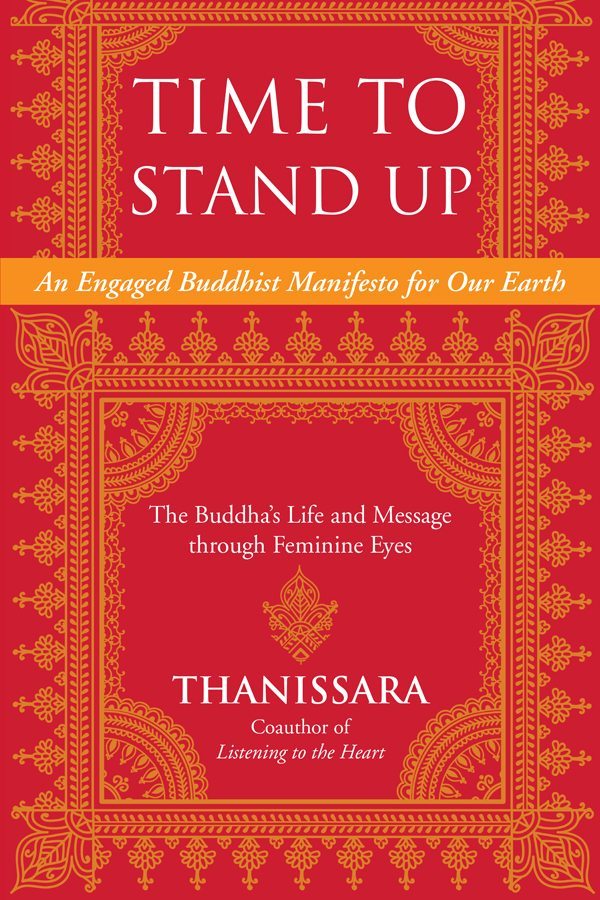
Thanissara - Time to Stand Up: An Engaged Buddhist Manifesto for Our Earth (A Review)

https://www.northatlanticbooks.com/wp-content/uploads/2015/08/TimeToStandUp_cover.jpg

Thanissara - Time to Stand Up: An Engaged Buddhist Manifesto for Our Earth -- The Buddha's Life and Message through Feminine Eyes

(To be published on August 18, 2015 - Pre-order at the Amazon link above for $7.47)

About the Author
Thanissara and her husband Kittisaro (Harry Randolph Weinberg) are the founders of Dharmagiri Hermitage in South Africa, from where they support several HIV/AIDS Outreach Programs and help guide and fund-raise for Kulungile Care Center for orphaned and vulnerable children and teenagers.  Thanisarra and Kittisaro are authors of Listening to the Heart: A Contemplative Journey to Engaged Buddhism (2014).

Thanissara grew up in an extended Anglo-Irish family in London, attending Southampton College of Art and traveling extensively in Asia in the 1970s. Also inspired by Ajahn Chah, she spent 12 years as a Buddhist nun in Thailand. She holds an MA in Mindfulness-Based Psychotherapy Practice from Middlesex University and the Karuna Institute in the U.K. and co-facilitates the Community Dharma Leader Program at Spirit Rock Meditation Center in California.
[NOTE: This book was sent to me by the publisher (free) with the hope that I would review it, favorably. I never make any promises in that regard. When I do review a book sent to me, it's because I think it is a good book.]

The life of the Buddha has been told so many times by so many people, and in so many different ways, from mythic and magical versions to a very secular version (from Stephen Batchelor), but never has it been told in the context of environmental change and from a feminine perspective.

In the Buddha's time, women were included among his followers and students, but in the following centuries, women were often excluded from those schools erected to perpetuate the Buddha's teachings.

From the Introduction:
This is a book I would have preferred not to write. I would have liked to write something lighter, happier, and more innocent. I would have liked to walk you through a serene wooded landscape, but instead I ask you to look with me at a burnt and tortured Earth and its polluted rivers, dying oceans, razed forests, devastated wastelands, and its litany of extinct species.
This is a book about awakening to the reality of the planet we live on, the pain, the suffering, the devastation, and not blinking, not looking away, not putting it off for the next generation to deal with. It is a book about reality.
The journey of awakening is not an incense-scented walk through a bed of roses--it wasn't for the Buddha, and it's not for us. It's a demanding look at reality. The reality we now face is climate chaos and devastation, an edge that is increasingly hard to move back from. (p. 45)
Buddhism has long had a reputation of being little more than navel gazing. Perhaps that has been fair, perhaps it has not been fully accurate. After all, the Bodhisattva Vow promises to save all beings.
Beings are numberless, I vow to save them
Desires are inexhaustible, I vow to end them
Dharma gates are boundless, I vow to enter them
Buddha's way is unsurpassable, I vow to become it.
In our time, we know that animals are also sentient beings, however great or small. For this reason, most Buddhists are vegetarian. In Seven Years in Tibet, we see Tibetan Buddhist Monks breaking ground for a building and they worry about harming the worms. They too are beings.

An engaged Buddhist approach to saving our planet may rightfully claim that vegetarianism is a necessary part of that agenda. Approximately 36 football fields worth of forest is cut down every minute, and we have lost 17% of the Amazonian Rainforest over the last 50 years, primarily to convert the land to cattle farming.

The meat industry, according to a 2006 report by the United Nations Food and Agriculture Organization (FAO), causes more greenhouse gases - carbon dioxide (CO2), methane, nitrous oxide, and the like - to spew into the atmosphere than either transportation or industry. According to the Environmental Protection Agency (EPA),
livestock burping, flatulence and manure was the source of more than 13 million tons of methane gas in 2004, compared with the EPA’s estimate of 9.7 million tons, according to a study published last month in the Journal of Geophysical Research: Atmospheres. 

SCIMACHY measurements showed oil and gas industries released 7 million tons of methane gas into the atmosphere, compared to the EPA’s estimate of 9.9 million tons.
Methane gas is the second most common gas that is associated with global warming, after CO2.

Not only does the meat industry destroy our environment but, as mentioned above, animals are sentient creatures. Buddhists vow to cause no suffering and, in fact, to alleviate suffering as much as we are able.
The most painful, the very worst of our madness, is the utterly sadistic and callous treatment of billions of animals and sea creatures caught in our consumer machinery. Animals are sentient, feeling beings with family structures, intelligence, emotions, memories, and needs, just like us. (p. 122)
I eat meat. I have struggle from time to time with this practice, but I have rationalized it in light of humans being omnivores. I have also rationalized it in terms of my protein needs as an active male who lifts weights seriously and often. I have tried to switch to grass-fed, organically raised, and locally sourced meat, in an effort to limit the damage my diet produces.

However, having read this book, and in light of who I feel I am becoming in my life, I am seriously questioning my lifestyle. Meat is a lifestyle choice, since there are many ways to get adequate protein without eating meat.

But, then, do I give up cottage cheese, Greek yogurt, eggs, and whey protein? Do I stop consuming all products sourced from animals? This is a much harder choice, but maybe it is the only moral choice.

To be fair, this is a First World problem, in as much as so many others in this world barely get enough food, let alone protein, to survive. It's easy to be blind to our own privilege. 
As practitioners and Sanghas following the great inclusiveness at the heart of the Buddha's Sangha, we must understand, particularly in the U.S. and Europe, how our colonial histories have set the stage for white privilege and class entitlement to permeate our communities and permit us to develop many blind spots. In making the invisible, visible, we can learn how we subtly perpetuate a dynamic that excludes or diminishes participation of people of color and those who are economically marginalized. (p. 156)
Thanisarra outlines four domains in which we must work together as one people to save our planet: (1) Keep carbon in the ground, (2) Sequester the remaining carbon in favor of alternative energy sources, (3) Massive investment in and education about renewable energy sources, and (4) Move toward a plant-based diet (p. 158-159).
We now need a collaborative global movement on a scale never before seen in the history of humankind to ensure these outcomes. We are not only advocating climate action, but also recognizing that this is the moment to actualize a truly more equitable and just society. ... The intensity of our times invites us to shift our way of thinking, the choices we make as "consumers," and the awareness we bring to each part of our personal lives. 
___

The Buddhist way isn't to tell people what they should do, but to lead by example. (p. 159)
This is a book that forced me to look at my choices, and quite possibly to make profound changes in my life. Perhaps it will do the same for you.

About the Book (from the publisher)

Time to Stand Up retells the story of the historical Buddha, one of the greatest sacred activists of all time, as a practical human being whose teachings of freedom from suffering are more relevant than ever in this time of global peril. Evolving onward from the patriarchal template of spiritual warriors and their quests, former nun Thanissara explores awakening from within a feminine view where the archetypes of lover and nurturer are placed as central and essential for a sustainable world.

Vital is an investigation into the pinnacle of Buddhist practice, the realization of the "liberated heart." Thanissara questions the narrative of "transcendence" and invites us into the lived reality of our deepest heart as it guides our journey of healing, reclamation, and redemption. As the book unfolds, the author examines traditional Buddhism--often fraught with gender discrimination--and asks the important question, "Can Buddhist schools, overly attached to hierarchal power structures, and often divorced from the radical and free inquiry exemplified by the Buddha, truly offer the ground for maturing awakening without undertaking a fundamental review of their own shadows?"

Chapter by chapter, the book relates Siddhartha Gautama's awakening to the sea-change occurring on Earth in present time as we as a civilization become aware of the ethical bankruptcy of the nuclear and fossil fuel industry and the psychopathic corporate and military abuse of power currently terrorizing our planet. Thanissara relates the Buddha's story to real-life individuals who are living through these transitional times, such as Iraq war veterans, First Nation People, and the Dalai Lama. Time to Stand Up gives examples of the Buddha's activism, such as challenging a racist caste system and violence against animals, stopping war, transforming a serial killer, and laying down a nonhierarchical structure of community governance, actions that would seem radical even today.

Thanissara explores ways forward, deepening our understanding of meditation and mindfulness, probing its use to pacify ourselves as the cogs in the corporate world by helping people be more functional in a dysfunctional systems--and shows how these core Buddhist practices can inspire a wake-up call for action for our sick and suffering planet Earth.
This book is part of the Scared Activism series from North Atlantic Books.

Thursday, February 05, 2015

Brain Science Podcast 115: Eastern Philosophy and Western Neuroscience (w/ Evan Thompson)

The new episode of Dr. Ginger Campbell's Brain Science Podcast features a conversation with philosopher Evan Thompson, PhD, about his new book, Waking, Dreaming, Being: Self and Consciousness in Neuroscience, Meditation, and Philosophy.

Thompson is one of the leading figures in bridging the gap between Eastern philosophy (specifically Buddhism and the Advaita Vedanta school of Hinduism) and Western neuroscience. In this book, he examines the connects and disconnects between Dream Yoga (both Buddhist and Vedanta) and neuroscience and neurobiology.

BSP 115: Eastern Philosophy and Western Neuroscience

January 29, 2015 / Ginger Campbell, MD
Brain Science Podcast


Scientific interest in the Mind and Consciousness is relatively new, but both Western and Eastern Philosophy have a long tradition of exploring these topics. In his new book Waking, Dreaming, Being: Self and Consciousness in Neuroscience, Meditation, and Philosophy, Evan Thompson explores how these diverse traditions can inform and enrich one another.

Thompson goes beyond a narrow view of consciousness, which focuses only on the waking state. Instead he considers how dreaming, lucid dreaming, and even near death experiences can advance our understanding of how our brain's generate both consciousness and our sense of Self.

Ginger Campbell, MD

How to get this episode:

Related Episodes:

  • BSP 5: Very brief introduction to Philosophy of Mind.
  • BSP 55:  Patricia Churchland, PhD, discusses Neurophilosophy.
  • BSP 58: Alva Noë, PhD, discusses Out of Our Heads: Why You Are Not Your Brain, and Other Lessons from the Biology of Consciousness.
  • BSP 67: Thomas Metzinger discusses The Ego Tunnel: The Science of the Mind and the Myth of the Self.
  • BSP 73: Embodied Cognition with Lawrence Shapiro, PhD.
  • BSP 81: Patricia Churchland discusses Braintrust: What Neuroscience Tells Us about Morality.
  • BSP 89: Evan Thompson discusses Mind in Life: Biology, Phenomenology, and the Sciences of Mind.
  • BSP 96: Robert Burton, MD discusses A Skeptic's Guide to the Mind: What Neuroscience Can and Cannot Tell Us About Ourselves.

Announcements:

  • This month's Audible recommendation: The Teenage Brain: A Neuroscientist's Survival Guide to Raising Adolescents and Young Adults by Frances E. Jensen, MD
  • The next episode of the Brain Science Podcast will feature Dr. Norman Doidge talking about his new book The Brain's Way of Healing: Remarkable Discoveries and Recoveries from the Frontiers of Neuroplasticity.
  • Reminder: the 25 most recent episodes of the Brain Science Podcast are always free, but Premium subscribers have unlimited access to all back episodes and transcripts. The Brain Science Podcast Mobile App is FREE. It is a great way to consume both free and premium content (since this will not appear in iTunes or other podcasting apps).
  • Please share your feedback about this episode by sending email to brainsciencepodcast@gmail.com or going to the Brain Science Podcast Discussion Forum at http://brainscienceforum.com. You can also post to our fan pages on Facebook or Google+. I am looking for help with these community pages so please email me at brainsciencepodcast@gmail.com if you are interested.

Sunday, January 11, 2015

Dr. Jeffrey B. Rubin - The McMindfulness Craze: The Shadow Side of the Mindfulness Revolution

Dr. Jeffrey B. Rubin emailed me and suggested I might like to share his recent article, "The McMindfulness Craze: The Shadow Side of the Mindfulness Revolution" (which originally appeared at Truthout).

While I tend to agree with Dr. Rubin, in part, I also have some issues about the generalizations in this article. A quote:
Meditation can lessen distractedness, quiet the inner pandemonium, reduce self-criticism and cultivate the capacity to tolerate a greater range of feelings. But emotions such as greed and hatred are viewed in some meditative traditions, such as classical Buddhism, as "defilements" and obstacles that interfere with experiencing a deeper reality. Meditators often try to quiet their minds so as to transcend or get rid of upsetting thoughts and feelings, rather than learn what they might teach us. [italics mine]
If ANY teacher, therapist, doctor, or whoever, is teaching mindfulness as a way to "get rid of upsetting thoughts and feelings" s/he have totally missed the point. The REAL point of meditation and mindfulness (thank you Pema Chödrön) is to learn how to sit with our suffering, to turn toward it and not away from it. That is how I learned it and how I teach it to my clients.

This is from Pema Chödrön's essay, "How to Tap into the Natural Warmth of Your Heart," which is included in A Pema Chödrön Primer, from The Shambhala Sun magazine.
The natural warmth that emerges when we experience pain includes all the heart qualities: love, compassion, gratitude, tenderness in any form. It also includes loneliness, sorrow, and the shakiness of fear. Before these vulnerable feelings harden, before the storylines kick in, these generally unwanted feelings are pregnant with kindness, with openness and caring. These feelings that we’ve become so accomplished at avoiding can soften us, can transform us. The openheartedness of natural warmth is sometimes pleasant, sometimes unpleasant—as “I want, I like,” and as the opposite. The practice is to train in not automatically fleeing from uncomfortable tenderness when it arises. With time we can embrace it just as we would the comfortable tenderness of loving-kindness and genuine appreciation. [italics mine]
Anyone who is teaching mindfulness and meditation as anything other than a way to turn toward and embrace our most difficult feelings and thoughts is not teaching a Buddhist practice. This is the essential difference between Buddhist meditation and meditation as a tool for stress reduction - confusing the two is a serious mistake.

It's also a mistake to assume (as many Buddhists have) that meditation and mindfulness is all we need to heal our psychological wounds. This is nothing but a form of spiritual bypassing.

Buddhism offers some valuable insights and tools that can be a powerful adjunct to psychotherapeutic interventions, but they cannot replace the healing power of the intersubjective relationship with a good therapist. And, quite often, it can do nothing to heal the preverbal, somatic-level traumas of attachment failures.

That said, here is the article from Dr. Rubin.
Sunday, 04 January 2015 | By Jeffrey B. Rubin, Truthout | Op-Ed 

Shadow Side of the Mindfulness Revolution
In case we had any doubt after watching Anderson Cooper on "60 Minutes," mindfulness is the new yoga - and we are in the midst of a mindfulness revolution. It's been embraced by celebrities, business leaders, politicians and athletes; and recommended by doctors, clergy, psychotherapists and prison wardens. Apps and bestselling books touting the benefits of meditation proliferate. Google "mindfulness" and you'll get over 24 million hits.

It's not surprising that with unbridled enthusiasm about mindfulness come exaggerated claims and problems that are eclipsed. Jon Kabat-Zinn, one of the architects of the mindfulness revolution, claims mindfulness "has the potential to ignite a universal or global renaissance that . . . would put even the European and Italian Renaissance into the shade . . . [and] that may actually be the only promise the species and the planet have for making it through the next couple hundred years."

Backlash was inevitable. Critics are beginning to highlight the shaky foundations of the scientific claims of meditation's seemingly miraculous efficacy. After reviewing 18,000 scientific articles on meditation, the Association for Health and Research Quality at the National Institutes of Health (NIH), a governmental organization that manages standards of research, declared in 2007 that future studies must be "more rigorous." In other words, the scientific evidence for the efficacy of meditation has been overstated and does not support the claims from evangelists of mindfulness about its benefits.

Buddhists have also pushed back, arguing that the mindfulness vogue has divorced meditation from its grounding in traditional Buddhist teachings.

But focusing on these problems with the McMindfulness craze obscures a more profound one - meditation neglects meaning. This not only opens the door to grave dangers, but also compromises meditation's radical potential.

I'm both a psychoanalyst and a long-time student - and now a teacher - of meditation. Over the years, I've witnessed the capacity of meditation to increase awareness, deepen compassion and cultivate wisdom. This is an immense gift for Western culture in general and psychotherapy in particular. But I've also seen how students and teachers of meditation alike grapple with unresolved emotional and interpersonal conflicts that meditation by itself sometimes doesn't touch, and in some cases hides.

The research of Jack Kornfield, a psychologist and one of the United States' most beloved Buddhist teachers, who interviewed nearly a hundred Buddhist teachers from a variety of traditions, supports this. He discovered that a significant number used psychotherapy to deal with psychological issues that meditation could not resolve. "Even the best meditators have old wounds to heal," Kornfield wrote in Bringing the Dharma Home: Awakening Right Where You Are. What he noticed in other Buddhist teachers, himself and his students, in over 40 years of teaching and practice, was that "meditation practice doesn't 'do it all.'" While wonderful, it often left untouched childhood wounds, unconscious fears, loneliness, poor self-care, troubles at work, and difficulties handling feelings and intimate relationships.

Meditation can transform our lives in powerful ways. But even after years of meditating, we may still be saddled with many of the same conflicts and inhibitions that plagued us before we began meditating. We may still be attracted to what is not good for us. We may still not have compassion for ourselves. We may still fear intimacy.

One explanation for this is that we are to blame. If only we would increase our dedication to meditation, learn to focus, and overcome our personal inadequacies, then perhaps we could change those things about ourselves that disturb us. Could this self-blaming explanation have reinforced the sense of inferiority that may have brought us to meditate in the first place - a troubling irony that perhaps too few Buddhists may contemplate?

A more accurate explanation for why meditators remain trapped within the same psychological conflicts after years of dedicated practice is that Buddhist meditation, like all techniques, is a tool that arose in particular contexts designed to handle specific challenges and not other ones. "I teach one thing and one thing only: suffering and the end of suffering," the Buddha is reputed to have said. Buddhist meditation was the technique the Buddha developed to handle the existential suffering he encountered when he escaped from his sheltered life within the palace compound in his mid-20s and witnessed, for the first time, old age, suffering and death. Profoundly distressed, even haunted, by the reality and inevitability of aging, misery and mortality, he abandoned his wife and child and initiated a spiritual quest that produced a set of teachings and practices whose central focus was eliminating the agonizing suffering that traumatized him.

We like to believe that the Buddha's teachings are timeless truths. Suffering seems like a universal aspect of the human condition, rather than a relic of a particular cultural or historical age. But anthropologists and cross-cultural psychologists teach us that there are fundamental differences as well as similarities in individuals and cultures. His Holiness the Fourteenth Dalai Lama was shocked to hear that Americans suffered from "self-directed contempt," as Daniel Goleman wrote in Healing Emotions: Conversations with the Dalai Lama on Mindfulness, Emotions, and Health. The Dalai Lama told a group of US scientists and mental health professionals that this experience was absent from Tibetan culture.

We believe, without sufficient evidence, that mindfulness is good for everything from stress to sleep. And we ignore that it originated in a particular sociocultural context very different than our own - 5th century BCE India - with purposes often at odds with the way most people in the contemporary world use it. No one seems to ask whether meditation techniques designed to eliminate the misery of monks in ancient India would be wholly sufficient for cognitively oversaturated lay people in the West in the 21st century who want to raise self-esteem, heal emotional traumas or be more productive in a frenzied world.

Meditation can lessen distractedness, quiet the inner pandemonium, reduce self-criticism and cultivate the capacity to tolerate a greater range of feelings. But emotions such as greed and hatred are viewed in some meditative traditions, such as classical Buddhism, as "defilements" and obstacles that interfere with experiencing a deeper reality. Meditators often try to quiet their minds so as to transcend or get rid of upsetting thoughts and feelings, rather than learn what they might teach us. Peter, a long-term practitioner of Buddhist meditation, was raised by highly critical, perfectionist parents, who pushed him to be the sort of person they needed him to be. He felt essentially unloved for who he actually was, yet highly critical of himself. When he first discovered Buddhist teachings on "purifying" the mind of "defilements," he felt right at home. Some years later in psychoanalysis, he realized that the whole project of purification created an unconscious judgment and aversion toward parts of himself that needed to be embraced, explored and understood - not eliminated.

At the first meditation retreat that I ever attended, in the late 1970s, I asked one of the teachers in an interview what to do with the wealth of unconscious perceptions and insights that arose during my meditations. "Don't do anything," he advised me, "just let go of it." I later learned this was a central dimension of the Buddhist method.

This can be tremendously useful advice. Most people spend an inordinate amount of time obsessing about the past and fearfully anticipating the future. Letting go has value when someone is hyper-vigilant and over controlled, or caught in obsessive thinking or excessive worrying. But there can be negative consequences when we "let go" of experience.

A well-known writer on meditation told me some years ago that after his divorce, meditation helped him anesthetize his pain and grief. Concentrating his mind during meditation kept his loss and sadness at bay, which he recognized unnecessarily prolonged the mourning process; because he never grieved his loss, it took longer to get over it.

If the way meditation is ordinarily practiced can lead to numbing detachment and self-avoidance, what would a meditation that valued self-engagement and self-discovery look like?

Emancipatory meditation - which involves intimacy with oneself - is an extraordinarily vital and alive activity in which one attends to whatever one is experiencing without any preconceived conclusions about it and without trying to get rid of it. To return to the example of the meditator who was undergoing a painful divorce: In emancipatory meditation, he would be more interested in truly experiencing and learning from his sadness, loneliness and fear, rather than anesthetizing himself or getting rid of his feelings by prematurely detaching from them.

We need to investigate the content and meaning of what we become aware of in meditation instead of attempting to transcend it or reduce it to what we already believe based on Buddhism, psychotherapy or any doctrine. Practicing meditation in an emancipatory way could be a powerful ally in our efforts in the 21st century to live with greater awareness and sanity, intimacy and passion.
Posted with permission of the author.

Saturday, November 01, 2014

Buddhist Geeks 336: How to HEAL the Brain’s Negativity Bias (w/ Rick Hanson)

A while ago I posted part one of this Buddhist Geeks Conference keynote address by Dr. Rick Hanson, and now the second part is available.

Rick Hanson, Ph.D., is a neuropsychologist and New York Times best-selling author of Hardwiring Happiness: The New Brain Science of Contentment, Calm, and Confidence (2013), Buddha's Brain: The Practical Neuroscience of Happiness, Love, and Wisdom (2009), Just One Thing: Developing a Buddha Brain One Simple Practice at a Time (2011), and Mother Nurture: A Mother's Guide to Health in Body, Mind, and Intimate Relationships (2002). Hansom is also Founder of the Wellspring Institute for Neuroscience and Contemplative Wisdom.

BG 336: How to HEAL the Brain’s Negativity Bias


by


Episode Description:


Rick Hanson, Ph.D., is a neuropsychologist, Senior Fellow of the Greater Good Science Center at UC Berkeley, and New York Times best-selling author. He’s been an invited speaker at Oxford, Stanford, and Harvard, and taught in meditation centers worldwide.

In the conclusion to his 2013 Buddhist Geeks Conference keynote address, Rick answers questions from the audience and leads them through the HEAL exercise, a process which trains the brain to reprogram its natural negativity bias towards the positive.
This is part two of a two part series.

Listen to part one BG 335: Practicing with the Brain in Mind.

Episode Links:

Rick Hanson
 
Rick Hanson, Ph.D., is a neuropsychologist and New York Times best-selling author. His books include Hardwiring Happiness, Buddha's Brain, Just One Thing, and Mother Nurture. Founder of the Wellspring Institute for Neuroscience and Contemplative Wisdom, and on the Advisory Board of the Greater Good Science Center at UC Berkeley, he's been an invited speaker at Oxford, Stanford, and Harvard, and taught in meditation centers worldwide. He has several audio programs and his free Just One Thing newsletter has over 100,000 subscribers.

Website: RickHanson.net

Monday, October 20, 2014

Chris Dierkes - Sam Harris’ Buddhist Bullshit

Read this, it's good, and it's worth your time.

Sam Harris’ Buddhist Bullshit


Posted by Chris Dierkes in Mystics, Spirituality
October 16, 2014


Sam Harris, one of the so-called New Atheists, has been making waves recently with his new book Waking Up: A Guide to Spirituality Without Religion. In it Harris talks openly about his meditation practice and spiritual experience–something he has done before but doesn’t seem to have gained as much interest or notice as it has now. (Harris is also in the news recently for his statements on Islam, but I’m not going to focus on those here.)

The video above begins with Harris making an important point about the nature of consciousness. Contrary to most philosophy and science (particularly in North America), Harris argues that human consciousness can’t be reduced to states of the brain. Harris mentions a few other philosophers who have made similar arguments recently, e.g. David Chalmers, John Searle, and Thomas Nagel. In so doing Harris adds his voice to the conversation and places himself squarely on the minority side of the debate within atheism and the wider secular philosophical world.

The basic premise here is that the felt sense of having an inner world complete with thoughts, emotions, and sensations can’t be reduced solely to material events (e.g. changes in neurons or brain states). As Harris points out the best science can do is correlate certain brain states with states of consciousness, states like anger, fear, sadness, or calm meditative repose. There’s a strong interest in mapping brain states for meditators–it’s important research but it’s research is about correlation not causation, a point too often missed in the literature itself, not to mention in wider public discourse. As Harris correctly notes we still have to trust the reported subjective experiences of individuals because no matter how many physical experiments a scientist may do, none of them gain access to the inner world of 1st person, subjective experience. The methods of science are 3rd person, objective measurements, whereas the inner world is one of 1st person, subjective experience.

Therefore, in order to gain individual access to the data of 1st person, inner, subjective experience one has to take up some an inner practice like meditation, describing one’s feelings, and the like. Human subjectivity is qualitative not quantitative.

So far so good. It’s a sad commentary on the status of Western philosophy that Harris’ point is seen as controversial. It should be an absolute no brainer (bad pun not intended), but unfortunately it’s actually a hugely disputed point. So hats off to Harris for making this point in a straightforward, clear manner.

This takes us up to the 2:50 mark in the video. And here’s where the problems arise.
Keep reading . . . there's much more.

Monday, October 06, 2014

Buddhist Geeks 335: Practicing with the Brain in Mind (by Rick Hanson)

http://powerupproductions.tv/wp-content/uploads/2013/03/Buddhist-Geeks-Discover-the-Emerging-Faces-of-BuddhismBuddhist-Geeks-20130307.png

Here is part one of the Buddhist Geeks interview with Buddhist neuropsychologist Dr. Rick Hanson. Ever since the publication of Buddha's Brain: The Practical Neuroscience of Happiness, Love, and Wisdom (2009), Hanson has been one of the prolific and popular authors and teachers in the Buddhist world.

BG 335: Practicing with the Brain in Mind

by


Episode Description:

Rick Hanson, Ph.D., is a neuropsychologist, Senior Fellow of the Greater Good Science Center at UC Berkeley, and New York Times best-selling author. He’s been an invited speaker at Oxford, Stanford, and Harvard, and taught in meditation centers worldwide.

In this first part of the keynote address Rick presented at the 2013 Buddhist Geeks Conference, he explores the intersection between dharma practice and neuroscience. Rick explains the basic mechanisms of brain change, the power of mindfulness, how to activate the neural networks of self-compassion, how to tap the hidden power of everyday experiences to grow happiness and other inner strengths in your brain, and why our planet needs us to take charge of our Stone Age brains in the 21st century.

This is part one of a two part series.

Episode Links:
Transcript coming soon…


Rick Hanson

Rick Hanson, Ph.D., is a neuropsychologist and New York Times best-selling author. His books include Hardwiring Happiness, Buddha's Brain, Just One Thing, and Mother Nurture. Founder of the Wellspring Institute for Neuroscience and Contemplative Wisdom, and on the Advisory Board of the Greater Good Science Center at UC Berkeley, he's been an invited speaker at Oxford, Stanford, and Harvard, and taught in meditation centers worldwide. He has several audio programs and his free Just One Thing newsletter has over 100,000 subscribers.

Website: RickHanson.net

Saturday, September 27, 2014

Pema Chödrön: Staying Present in Difficult Situations (Sounds True Producer's Pick)

This week's Sounds True Director's Pick is an excerpt from Pema Chödrön's Walking the Walk: Putting the Teachings into Practice When It Matters Most. Nice bit of wisdom

Pema Chödrön: Staying Present in Difficult Situations


As one of the most beloved voices of American Buddhism, Pema Chödrön shares traditional wisdom with openness, warmth, and spritely good humor. In the words of Sounds True producer Randy Roark, “It’s as if all that’s left of Pema is compassion, no matter what subject she’s addressing.” In this excerpt drawn from the new audio program Walking the Walk: Putting the Teachings into Practice When It Matters Most, Ani Pema relates a practice intended to help you grapple with troubling emotions during the most difficult periods of your life.

Play


Download »

You might also enjoy:


When Pain is the Doorway
$13.37


Getting Unstuck
$16.72


Learning to Stay Present
$4.99


Coming Closer to Ourselves
Making Everything the Path of Awakening - How to use curiosity and compassion to befriend your most challenging emotions.
CD: US $23.42 (33% Off)
Audio Download: US $18.35 (25% Off)
CE Credits: US $20.00

Wednesday, September 03, 2014

The Embodied Mind - The Tricycle Interview with Philosopher Evan Thompson

Via Tricycle Magazine, this is a cool interview with philosopher Evan Thompson (best known as a co-author of The Embodied Mind: Cognitive Science and Human Experience, with Francisco Varela and Eleanor Rosch). Thompson's eagerly awaited new book is Waking, Dreaming, Being: Self and Consciousness in Neuroscience, Meditation, and Philosophy, scheduled to be released on November 11, 2014.

The Embodied Mind

An interview with philosopher Evan Thompson


To be fruitful, the encounter between Buddhism and science demands intellectual boundary crossers—rare scholars who are expert in both realms, who can translate ideas across the divide and identify and critically appraise assumptions each side brings to the table. The philosopher and cognitive scientist Evan Thompson is one of these. Thoroughly grounded in Western and Buddhist philosophy and learned in science, Thompson has been dedicated to cross-cultural and interdisciplinary dialogue between Buddhism and cognitive science for over two decades.

Bringing clashing points of view into conversation is a calling Thompson was born into. He is the son of the social philosopher and cultural critic William Irwin Thompson, who founded the Lindisfarne Association—an Esalen-like think tank and retreat devoted to “the study and realization of new planetary culture.” Thompson grew up and was homeschooled at Lindisfarne, so from the time he was young—“a little kid gripped by philosophical questions”—he was surrounded by what he describes as the “passionate and sophisticated debate” of diverse thinkers from very different spiritual and academic backgrounds.

It was at Lindisfarne that Thompson met the renowned scholar of Tibetan Buddhism Robert Thurman. Thompson was so inspired by Thurman’s vision of philosophy (as “a transformative path of rational liberation with a global heritage,” Thompson wrote in a tribute to Thurman) that he entered Amherst College at the age of 16 to study with him. It was also at Lindisfarne that Thompson met the Chilean biologist, philosopher, and neuroscientist Francisco Varela, now recognized as the founding father of the dialogue between Buddhism and cognitive science. Varela lived for several months at Lindisfarne as a Scholar-in-Residence and became a Lindisfarne Fellow and a family friend. Later, when Thompson was a graduate student, he studied with Varela at the École Polytechnique in Paris and in 1991 coauthored with Varela and the psychologist Eleanor Rosch The Embodied Mind: Cognitive Science and Human Experience. This was the first academic book to explore what Buddhist philosophy and meditation practices could offer cognitive science and to promote an “embodied” or “enactive” view of cognition; in tandem with Varela’s Mind and Life meetings with the Dalai Lama, which had begun in 1987, their book launched the Buddhism-cognitive science dialogue. The Embodied Mind has since been translated into seven languages and will be published in a second edition in 2015.

Thompson is now a professor of philosophy at the University of British Columbia. His other books include Mind in Life: Biology, Phenomenology, and the Sciences of Mind and the forthcoming Waking, Dreaming, Being: Self and Consciousness in Neuroscience, Meditation, and Philosophy.
Tricycle spoke with Thompson at a conference that he co-organized at the University of California at Berkeley, where 15 top scholars from the field of Buddhism and science gathered to tackle the question “Given the current critiques of the Buddhism and cognitive science encounter, how might we proceed?” Thompson is among those who are steering the conversation toward not only compatibilities but also differences, even contradictions, because that is where the partners in dialogue have most to learn from each other—and where, if given the chance, they may even find surprising complementarity.
—Linda Heuman, Contributing Editor

Almost two and a half decades ago, in The Embodied Mind, you critiqued a notion of mind that was already prevalent then and that continues to frame much of the current neuroscience research on meditation. What is that view, and what is wrong with it? 
We criticized the view that the mind is made up of representations inside the head. The cognitive science version says that the mind is a computer—the representations are the software, and the brain is the hardware. Although cognitive scientists today don’t think the brain works the way a digital computer does, many of them, especially if they’re neuroscientists, still think the mind is something in the head or the brain. And this idea shows up in the neuroscience of meditation. But this idea is confused. It’s like saying that flight is inside the wings of a bird. The mind is relational. It’s a way of being in relation to the world. You need a brain, just as the bird needs wings, but the mind exists at a different level—the level of embodied being in the world.

What’s your alternative view of the mind? 
The alternative view we put forward is that cognition is a form of embodied action. “Embodied” means that the rest of the body, not just the brain, is crucial; “action” means that agency—the capacity to act in the world—is central. Cognition is an expression of our bodily agency. We inhabit a meaningful world because we bring forth or enact meaning. We called this view “enaction” or the “enactive approach.”

In the enactive approach, being human is a matter of inhabiting the human world of culture and shared bodily practices. Of course we need our brain to do this, but we also need that world to be in place in order for the human brain to develop properly. The brain is what philosophers call a necessary “enabling condition” for mind and meaning, while enculturation is a necessary enabling condition for the brain. What’s important is not just what is inside the brain but what the brain is inside of—the larger space of the body and culture. That is where we find mind and meaning.

It was early in your career—you were a doctoral student—when you cowrote The Embodied Mind. Looking back, do you have any regrets—things you would have changed, knowing now what you didn’t know then?
There was a certain way we talked about mindfulness that I now think is wrong. Sometimes we described it as a special kind of inner observation that lets you see the way your mind really is apart from being mindful—as if your mind were a box and your looking into it revealed what was there all along.

Do you mean the notion that in meditation you see “what really is there”?
Yes, where “see” means looking inside to see how your mind really is apart from such looking. For example, we said that Buddhist meditation lets you see that your experience is really discontinuous and momentary, rather than a continuous flow. But one could just as well argue that certain kinds of meditation make experience gappy and then reinforce that gappiness by giving you a theoretical system that says that’s how things really are, as the Buddhist Abhidharma philosophical systems do.

If we go back to the neuroscience of meditation, the idea that mindfulness is a kind of inner observation reinforces the mistaken idea that the mind is in the head. It leads to thinking of mindfulness as a special kind of inner monitoring that scientists using brain imaging tools can identify with the activity of neural networks. This is a mistake. Mindfulness depends on the brain but isn’t inside the brain. Certain neural networks may be necessary for mindfulness, but mindfulness itself consists in a whole host of integrated mind-body skills in ethically directed action in the world. It’s not a neural network but how you live your life in the world.

Is the problem you are getting at the widespread assumption that mindfulness meditation is not mediated by concepts?
Experience and concepts are interdependent. Whether there are nonconceptual modes of experience is a complicated matter that both Buddhist and Western philosophers have argued about a lot. But in most cases of human experience you can’t have one without the other. Take science. Here you observe things, of course, but you can’t see them properly unless you have the right concepts. If you just look through a microscope with no guidance on how to look at what you see, you have no clue what you’re looking at. Even if you’re doing high school biology, you need to have concepts like “cell wall” or “organelle”—to say nothing of what’s happening at the edge of scientific discovery, where you’re using new imaging technologies and learning to see things. So observation is happening there, of course. But also a lot of conceptualizing.

Similarly, if you go on a Vipassana retreat, you may spend the first day or so watching your breath, but then you’re given a system of concepts for practicing mindfulness—concepts like “moment-to-moment arising,” “pleasant versus unpleasant,” “sensation,” “intention,” “attention,” and maybe some categories from the list of elements, or dhammas, in Theravada Buddhist philosophy. It’s a silent retreat, so this is the only thing you hear, and everyone else around you is doing the same thing, so this shapes how and what you experience. You get a powerful and socially reinforced conceptual system for making sense of what you experience. That system in that context may help to bring about certain nonconceptual experiences, but the minute you start thinking about them—which there’s no way to avoid doing—you’re back in the land of concepts.


Practitioners might hear something like this and wonder, “If I’m not turning inward and seeing things as they are in and of themselves independently of my observing them, then what is my practice about?” 
I’d say it’s about commitment to a certain way of life and participation in a community (sangha) that supports that way of life. It’s about cultivating what we think are beneficial qualities of mind and body, and beneficial ways of acting or being in the world, as in the eightfold path. I’d say that practice in this full sense of the term, which goes well beyond sitting meditation, is its own purpose or goal and is itself the expression of a noble way of life. It’s what philosophers and psychologists call autotelic, an end in itself, not a tool or instrument for something else.

I object when people reduce practice in this rich sense to a tool or instrument. Some people use the analogy that meditation is like an inner telescope: Outer science uses physical telescopes for looking at the stars, and inner science uses meditation for looking at the mind. I don’t like that analogy. It makes you think of your relationship to your own mind in an instrumental way. Your relationship to yourself is precisely not an instrumental one. A telescope is a tool for looking at something separate and distant. Meditation isn’t like that. If you think that awareness is an instrument that enables you to look within, on that analogy you’re thinking of the inner realm as one of objectivity—except it’s not, because it’s subjectivity. If you think of meditation that way, you can’t help turning your mind into an object, which is precisely what the mind is not. So here I think there is an important difference between meditation and scientific observation, despite the importance of concepts for making sense of both. Meditation can be very powerful and transformative: it can be very generative of insight, deep understanding, and connectedness. But not because it’s an instrument or tool that enables you to see a hidden inner realm.

You mentioned that the appropriation of mindfulness as an object of scientific scrutiny and research has created new forms of self-understanding for Western meditators, so that meditators start to identify themselves in terms of their inner life and their subjectivity in terms of mindfulness. How does that happen?
The ideas I’m working with here come from the Canadian philosopher Ian Hacking. He calls them “looping effects” and “making up people.” When we categorize people—as poor, homeless, obese, gifted, and so on—we also change them as a result of how we interact with them based on these categories and how they come to think of themselves in terms of those categories. This is the “looping effect.” Sometimes we even create new kinds of people who didn’t exist before. This is “making up people.” Take the category “citizen.” We categorize ourselves as citizens, but there weren’t any citizens before there were legal criteria and government procedures for applying this category. Hacking argues that this happens especially with medical and clinical categories.

I wonder whether this is happening with “mindfulness.” An originally Buddhist notion is adapted for secular clinical programs like MBSR (Mindfulness Based Stress Reduction) and MBCT (Mindfulness Based Cognitive Therapy). To assess the efficacy of such programs, specifically the idea that there’s a distinct “mindfulness” component, we need a way to scientifically define and delimit that concept. This leads to various scales for measuring mindfulness—based on what people report about themselves in response to questionnaires—and efforts to assess mindfulness behaviorally. Also, some scientists think there may be biological markers of mindfulness, such as the activation of certain brain networks. I’ve even heard some scientists and Buddhist teachers say that if we knew what these biomarkers were, we could use them to help people become more mindful. So we already have looping effects: We interact with people differently and they think of themselves differently because of this new version of mindfulness that our culture—which is to say, we—is creating. We seem to be making up a new kind of “mindful person.” Think of the mindful education movement and mindful parenting, or mindful eating and mindful sex, or mindfulness-based mind fitness training in the military—the list goes on.

Why is it important to recognize that this process is occurring in the popularization of mindfulness?
It sets up a dichotomy between “mindful” and “unmindful,” where we fixate on mindfulness so that it becomes a kind of fetish, and that blinds us to how the concept or category gets used, especially socially and politically. One of Hacking’s points—and here he’s really taking his lead from Michel Foucault—is that there are always social and political interests and power dynamics at work in looping effects and in making up people. People always get organized in certain ways for certain ends. Why should we think that it’s any different in the case of the modern mindfulness movement? The Slovenian philosopher Slavoj Zizek has argued that the current fetishizing of mindfulness fits perfectly into a consumerist corporate culture that needs to pacify itself from the endless stress of modern capitalism. My way of doing philosophy is very different from Zizek’s, but I have to agree with him on this point. Those of us who work in this area have a responsibility to keep these looping effects and their social and political ramifications in critical focus. We need to know what we’re gaining—and for the record, I do think that MBSR and MBCT are very beneficial—and what we’re losing, or what we’re creating that isn’t beneficial. Buddhist scholars are contributing to this critical project by tracing the historical and philosophical evolution of the concept of mindfulness so that we can see how the Buddhist modernist and secular versions get generated. I try to contribute from the perspectives of cognitive science and philosophy by showing why it’s not right to think of mindfulness as being in the head or brain, so we can see that it’s social, relational, and ethical.

In 1996, Francis Crick stated that consciousness is now largely a scientific problem. As a philosopher, do you agree? If not, why not?
No, I don’t agree. There are important conceptual or philosophical issues that shape how we think about consciousness and how we investigate it. Crick’s viewpoint, which most neuroscientists share, is that consciousness is in the brain, so the problem comes down to finding the neural correlates of consciousness. That’s another expression of the mind-is-in-the-head idea. It’s like saying a cathedral is in the stones. You need stones, of course, and you need them to be connected in the right way. But what makes something a cathedral is also iconography, tradition, and its being a place of worship. In other words, the larger context in which the structure is embedded helps constitute it as a cathedral. In an analogous way, consciousness isn’t in the neurons or their connections. Here the larger context that constitutes consciousness—in the sense of sentience, or felt awareness—is biological: consciousness is a life-regulation process of the whole body in which the brain is embedded. In the case of human consciousness, the context is also psychological and social. So even if we suppose—as I think it’s reasonable to do, though some Buddhists will disagree—that the brain is necessary for consciousness, it doesn’t follow that consciousness is in the brain. There are many scientific questions about how the brain enables consciousness, but those questions are miscast if they’re made into the problem of how to locate consciousness in the brain in terms of its neural correlates.

It’s also worth pointing out that Crick thought we might have a solution to the scientific problem of consciousness by the year 2000! And we still don’t have one.

So you don’t think progress in understanding consciousness is necessarily about doing more experiments?
No. I mean, experiments are great, but we need conceptual work, theoretical work. We may need to radically change how we think about things in ways that are still not clear to us.

You have said that in seeking a way forward for the Buddhism and cognitive science dialogue, philosophy should take the lead. Why?
Buddhism has very sophisticated and technical traditions of philosophy, every bit as sophisticated and technical as Western philosophy. Here we enter the arena of concepts, analysis, abstraction, models, and arguments, all of which bring us closer to science. Buddhist philosophy is very concerned with analyzing cognition, concepts, and consciousness—the subject matter of cognitive science. So this is the arena where I see Buddhism and science as having a lot to say to each other.

I also want to foreground problems of meaning—how these different traditions conceptualize the mind and what’s at stake for them in doing so. It’s really the humanities that need to take the lead in this discussion now, not neuroscience. I think science is really important, so this is not an anti-science point; it’s an anti-scientistic point. When you’re concerned with meaning, you enter into a different space of discussion, where scientific methods are not sufficient.

I am particularly concerned to deploy that thought against the idea that the neuroscience of meditation should lead the way in this dialogue, because that’s very much what the Buddhism-science discussion has been about for the past five or ten years now.

Has there been too much focus on the neuroscience of meditation?
Yes, if we mistake this work to be a genuine Buddhism-cognitive science dialogue about the mind. Buddhism isn’t reducible to meditation—most Buddhists throughout history haven’t practiced sitting meditation. And cognitive science isn’t the same as neuroscience; it’s a broader endeavor concerned with a comprehensive scientific understanding of the mind and includes not just neuroscience but psychology, linguistics, computer science and AI, cognitive anthropology, and philosophy.

A cognitive science approach to meditation is concerned not with meditation per se but with using meditation to cast new light on basic cognitive phenomena like attention or consciousness. This means using meditation to generate new data and to test rival theories and models of the mind or to devise new ones. This can be especially valuable for the neuroscience of consciousness in conjunction with psychology and cognitive anthropology.

There is a widespread assumption that once certain metaphysical commitments are taken off the table—karma, rebirth, and the possibility of enlightenment on the side of Buddhism; physicalism, reductionism, and the causal closure principle on the side of science—Buddhism and science are well-matched enterprises because they are both empirical systems interested in investigating the nature of reality. University of Michigan professor Donald Lopez has argued that such bracketing doesn’t actually work to produce compatibility, because it takes out of play the most foundational topics on both sides, topics that are both regulative principles and the site of intractable differences. Do you think this strategy works?
I think it has worked sometimes. In some way, the Mind and Life dialogues have been a paradigm of that bracketing strategy. But the most interesting moments in those dialogues are when the brackets come off. For example, to my mind, the richest of those dialogues is one of the early ones that was about the states of sleeping, dreaming, and dying, seen both from the Tibetan Buddhist perspective and from the perspective of Western science, so you have the neuroscientific viewpoint about the nature of consciousness confronting the Buddhist viewpoint. There’s a moment when the Dalai Lama gives an explanation of his view of the dying process and of the subsequent bardos, a traditional Tibetan teaching, in the presence of the scientists. And the scientists push back against the idea that there is a consciousness that could somehow have a life apart from the brain. So the brackets are off and these views are confronting each other. Those are the moments I always look for.

Are there other strategies that might be more effective than bracketing for a meaningful Buddhism-science encounter?
A different strategy, the one I use, is to conduct the dialogue in the arena of cross-cultural philosophy. Here the dialogue partner on the Buddhist side is Buddhist philosophy. In philosophy, everything can be up for grabs, but any move you make needs argumentative justification. Philosophy is concerned with issues of meaning. Science must always presuppose a space of meaningfulness that it can’t fully account for, and philosophy is concerned with that. Philosophy can show the limitations of certain scientific viewpoints—as I was doing just now with Crick’s view of consciousness—so we can see more clearly the phenomena we’re trying to understand. The Buddhist philosophical tradition becomes very important here, because it has original insights and arguments to offer.

From this cross-cultural philosophical perspective, we can’t take science for granted; we have to remember that it operates within a human community of shared norms and values and practices—what phenomenologists call the “lifeworld.” Science itself is a social practice that has the force and meaning it has because of its place in our lifeworld. Science can change the lifeworld, but it can never step completely outside it and provide some absolutely neutral perspective. To put the point another way, philosophy is concerned with the meaning of science—something that science on its own can’t tell us. And Buddhist philosophy is as relevant as Western philosophy for thinking about the meaning of science.

This perspective can also help us to remember that there are different individuals and communities in the Buddhism-science encounter, and they have different things at stake. The Dalai Lama is a Tibetan refugee and a political figure, and so he’s going to speak from a particular perspective; he has certain interests—intellectual and political and personal—that are motivating his participation in the dialogue. Buddhists like B. Alan Wallace and Matthieu Ricard are scientifically educated Westerners who have become Buddhists, so they’re going to have a different stake in the dialogue. Tibetans like Thupten Jinpa, who was brought up in the refugee community and then was educated at a Western university, are going to have another perspective. Or take Francisco Varela, the founding scientist of the Mind and Life Institute, who was a brilliant neuroscientist and became a Buddhist through a charismatic Tibetan Buddhist modernist teacher. In my own case, I grew up in the 1970s at the Lindisfarne Association, an institute that brought together scientists (including Varela), philosophers, and contemplative teachers, and this made me want to study Asian and Western philosophy in college and graduate school. So we’re all participating in a shared discussion, but we have different backgrounds and histories. Our lifeworlds are shared, but we also have our particular emergence into them from our own places. Those kinds of things are not commented on very much, but they’re actually at the heart of the encounter. After all, it’s not really Buddhism and cognitive science that are encountering each other; it’s Buddhists and cognitive scientists.

What do you see as the way forward for Buddhism and cognitive science?
What I’d like to see is a collaborative effort to develop a much richer understanding of the human mind—a cognitive science of wisdom, for lack of a better term. For example, although self-knowledge is a topic of cognitive science research, it has yet to be informed by the kind of ethical and contemplative perspective that Buddhism upholds. We need to bring into cognitive science the recognition that the human mind can cultivate mature emotional and ethical capacities of benevolence along with cognitive capacities of deep insight and understanding. Right now cognitive science has a view of the mind that’s rather narrow, where the database for mental function is mostly college students. Also, informed by that kind of cognitive science endeavor, I’d like to see a much more critical perspective on what’s happening with the commodification of mindfulness and the social looping effects I was talking about before.

Do you feel that your community of researchers, who have developed and been engaged in this dialogue between Buddhism and cognitive science, have any responsibility for how that research has been appropriated?
Yes, definitely. I think it’s very important, as I was saying before, that we draw on Buddhist studies, philosophy, and cognitive science—and I would add the history of science—to keep critically in view the larger social and political context in which we’re working and how we may be contributing to deleterious kinds of looping effects. I’ve become very concerned about the growing fetishization of mindfulness I was talking about and how this is being appropriated by the corporate elite, including very right-wing elements. I was very dismayed to see the Mind and Life Institute co-sponsor an event with the American Enterprise Institute—a conservative think tank that helped give us the Iraq War—on “Happiness, Free Enterprise, and Human Flourishing.” “Free enterprise” is a contradiction in terms that has caused a huge amount of suffering in the world. It disturbs me to see what appear as dumbed-down versions of mindfulness and hyped-up science being advertised at the World Economic Forum in Davos. Some of my Buddhist and scientist friends will say that participating in such events is skillful means, but I think that’s naive. Social philosophy and policy aren’t my areas of expertise, so I don’t have readily available recommendations, but it’s become increasingly important for me to think about these matters. My hope is that Buddhist studies, cognitive science, and philosophy can work together to analyze what’s going on in ways that can be useful to activists and socially engaged Buddhists in their efforts to challenge consumerist appropriations of mindfulness and work for positive social, political, and environmental change.

Linda Heuman is a Tricycle contributing editor.
Photographs by Preston Schlebusch

Monday, September 01, 2014

Rick Hanson - The Mechanisms of Upset and Emotional Hijacking

Here are two cool posts from Dr. Rick Hanson (Buddhist neuroscientist) on "The Machinery of Upset" and "Emotional Hijacking." Both of these posts deal with the survival mode of the brain, essentially the limbic system and brain stem, the parts of the brain that take over when we are triggered by a traumatic memory/experience.

At the bottom, there is also a definition of the amygdala hijack, a term coined by Daniel Goleman.

When the amygdala takes over, we become our fear. Making that fear an object of awareness is one way to break that fear trance.

The Machinery of Upset

posted on: August 4th, 2014 
(Emotional) life is great when we feel enthusiastic, contented, peaceful, happy, interested, loving, etc. But when we’re upset, or aroused to go looking for trouble, life ain’t so great.

To address this problem, let’s turn to a strategy used widely in science (and Buddhism, interestingly): analyze things into their fundamental elements, such as the quarks and other subatomic particles that form an atom or the Five Aggregates in Buddhism of form, feeling (the “hedonic tone” of experience as pleasant-neutral-unpleasant), perception, volitional formations, and consciousness.

We’ll apply that strategy to the machinery of getting upset. Here is a summary of the eight major “gears” of that machine – somewhat based on how they unfold in time, though they actually often happen in circular or simultaneous ways, intertwining with and co-determining each other.

The point of this close analysis, this deconstruction, is not intellectual understanding or theory, but increasing your own mindfulness into your experience, and creating more points of intervention within it to reduce the suffering you cause for yourself – and other people.

This will be more real for you if you first imagine a recent upset or two, and replay it in your mind in slow motion.

Appraisals
  • What do we focus on, what do we pick out of the larger mosaic?
  • What meaning do we give the event? How do we frame it?
  • How significant do we make it? (Is it a 2 on the Ugh scale . . . Or a 10?)
  • What intentions do we attribute to others?
  • What are the embedded beliefs about other people? The world? The past? The future?
  • In sum, what views are we attached to? -> Mainly frontal lobe and language circuits of left temporal lobe.
Self-Referencing
  • Upsets arise within the perspective of “I.”
  • What is the sense of “I” that is running at the time? Strong? Weak? Mistreated?
  • Are you taking things personally?
  • How does the sense of self change over the course of the upset (often intensifying)? -> Circuits of “self” are distributed throughout the brain.
Vulnerabilities
  • We all have vulnerabilities, which challenges penetrate through and/or get amplified by (moderated by inner and outer resources).
  • Physiological: Pain, fatigue, hunger, lack of sleep, biochemical imbalances, illness.
  • Temperamental: Anxious, rigid, angry, melancholic, spirited/ADHD.
  • Psychological: Personality, culture, effects of gender, race, sexual orientation, etc. -> Depending on its nature, a vulnerability can be embodied or represented in many ways.
Memory
  • Stimuli are interpreted in terms of episodic memories of similar experiences.
  • And in terms of implicit, emotional memories or other, unconscious associations. (Especially trauma)
  • These shade, distort, and amplify stimuli, packaging them with “spin” and sending them off to the rest of the brain. -> Hippocampus, with other memory circuits.
Aversion
  • The feeling tone of “unpleasant” is in full swing at this point, though present in the previous “gears” of survival reactivity.
  • In primitive organisms – and thus the primitive circuits of our own brain – the unpleasant/ aversion circuit is more primary than the pleasant/approach circuit since aversion often calls for all the animal’s resources and approaching does not.
  • Aversion can also be a temperamental tendency.
  • The Buddha paid much attention to aversion – such as to ill will – in his teachings, because it is so fundamental, and such a source of suffering. -> Involves the limbic system, especially the amygdala.
Bodily Activation
  • The body energizes to respond; getting upset activates the stress machinery just like getting chased by a lion.
  • Sympathetic nervous system (fight-or-flight).
  • Hypothalamus-pituitary-adrenal (HPA) axis.
  • All this triggers blood to the large muscles (hit or run), dilates pupils (see better in darkness), cascades cortisol and adrenaline, increases heart rate, etc.
  • These systems activate quickly, but their effects fade away slowly.
  • There is much collateral damage in the body and mind from chronically “going to war.”
Negative Emotions
  • Emotions are a fantastic evolutionary achievement for promoting grandchildren.
  • Both the prosocial bonding emotions of caring, compassion, love, sympathetic joy . . .
  • And the fight-or-flight emotions of fear, anger, sorrow, shame.
  • Emotions organize, mobilize the whole brain.
  • They also shade our perceptions and thoughts in self-reinforcing ways.
Loss of Executive Control
  • The survival machine is designed to make you identify yourself with your body and your emotional reactions. That identification is highly motivating for keeping yourself alive!
  • So, in an upset, there is typically a loss of “observing ego” detachment, and instead a kind of emotional hijacking – all facilitated by neural circuits in which amygdala-shaped information gets fast-tracked throughout the brain, ahead of slower frontal lobe interpretations.
  • With maturation (sometimes into the mid-twenties) and with experience, the frontal (especially prefrontal) cortices can comment on and direct emotional reactions more effectively.
* * * * *

Emotional Hijacking

posted on: September 1st, 2014 
* * * * *

Here is a definition of the "amygdala hijack" that Daniel Goleman outlined in his seminal book, Emotional Intelligence.

Amygdala hijack


From Wikipedia, the free encyclopedia

Amygdala hijack - fear caused by optical stimulus
Amygdala hijack is a term coined by Daniel Goleman in his 1996 book Emotional Intelligence: Why It Can Matter More Than IQ.[1] Drawing on the work of Joseph E. LeDoux, Goleman uses the term to describe emotional responses from people which are immediate and overwhelming, and out of measure with the actual stimulus because it has triggered a much more significant emotional threat.[2]

Definition

From the thalamus, a part of the stimulus goes directly to the amygdala while another part is sent to the neocortex or "thinking brain". If the amygdala perceives a match to the stimulus, i.e., if the record of experiences in the hippocampus tells the amygdala that it is a fight, flight or freeze situation, then the amygdala triggers the HPA (hypothalmic-pituitary-adrenal) axis and hijacks the rational brain. This emotional brain activity processes information milliseconds earlier than the rational brain, so in case of a match, the amygdala acts before any possible direction from the neocortex can be received. If, however, the amygdala does not find any match to the stimulus received with its recorded threatening situations, then it acts according to the directions received from the neo-cortex. When the amygdala perceives a threat, it can lead that person to react irrationally and destructively.[3]

Goleman states that "[e]motions make us pay attention right now — this is urgent - and gives us an immediate action plan without having to think twice. The emotional component evolved very early: Do I eat it, or does it eat me?" The emotional response "can take over the rest of the brain in a millisecond if threatened."[4][5] An amygdala hijack exhibits three signs: strong emotional reaction, sudden onset, and post-episode realization if the reaction was inappropriate.[4]

Goleman later emphasised that "self-control is crucial ...when facing someone who is in the throes of an amygdala hijack"[6] so as to avoid a complementary hijacking - whether in work situations, or in private life. Thus for example 'one key marital competence is for partners to learn to soothe their own distressed feelings...nothing gets resolved positively when husband or wife is in the midst of an emotional hijacking.'[7] The danger is that "when our partner becomes, in effect, our enemy, we are in the grip of an 'amygdala hijack' in which our emotional memory, lodged in the limbic center of our brain, rules our reactions without the benefit of logic or reason...which causes our bodies to go into a 'fight or flight' response."[8]

Positive hijacks

Goleman points out that "'not all limbic hijackings are distressing. When a joke strikes someone as so uproarious that their laughter is almost explosive, that, too, is a limbic response. It is at work also in moments of intense joy."[9]

He also cites the case of a man strolling by a canal when he saw a girl staring petrified at the water. "[B]efore he knew quite why, he had jumped into the water — in his coat and tie. Only once he was in the water did he realize that the girl was staring in shock at a toddler who had fallen in — whom he was able to rescue."[10]

Emotional relearning

LeDoux was positive about the possibility of learning to control the amygdala's hair-trigger role in emotional outbursts. "Once your emotional system learns something, it seems you never let it go. What therapy does is teach you how to control it — it teaches your neocortex how to inhibit your amygdala. The propensity to act is suppressed, while your basic emotion about it remains in a subdued form."[11]

References

  1. Nadler, Relly. "What Was I Thinking? Handling the Hijack". Retrieved 2010-04-06.
  2. "Conflict and Your Brain aka "The Amygdala Hijacking"". Retrieved 2010-04-06.
  3. Freedman, Joshua. "Hijacking of the Amygdala". Retrieved 2010-04-06.[dead link]
  4. Horowitz, Shell. "Emotional Intelligence - Stop Amygdala Hijackings". Retrieved 2010-04-06.
  5. Hughes, Dennis. "Interview with Daniel Goleman". Retrieved 2010-04-06.
  6. Daniel Goleman, Working with Emotional Intelligence (1999) p. 87
  7. Goleman, Emotional Intelligence p. 144
  8. Rita DeMaria et al., Building Intimate Relationships (2003) p. 57
  9. Goleman, Emotional Intelligence p. 14
  10. Goleman, Emotional Intelligence p. 17
  11. Goleman, Emotional Intelligence p. 213