Showing posts with label conversation. Show all posts

Thursday, October 09, 2014

Salon Culture: Network of Ideas - A Conversation with Andrian Kreye

http://upload.wikimedia.org/wikipedia/commons/c/c6/Abraham_Bosse_Salon_de_dames.jpg

In 2001, the LA Times wrote about the emergence of a new salon culture in Los Angeles, frequented by writers, filmmakers, and actors. This phenomenon is the re-emergence of a salon culture, which began originally in the 16the century in Italy, but is most often associated with the 17th and 18th century literary culture of France.

In 2011, both Alternet (US) and The Telegraph (UK) did articles on salon culture. This is a bit of the history of American salons from the Alternet article:
The modern salon formally emerged in New York during the early 20th century. Edith Wharton, who loathed the American literary scene and resettled in Paris in 1907, likely attended the intellectual gatherings hosted by her sister-in-law, Mary Cadwalader Jones, on East 11th Street. In 1900, Jones gained national prominence championing the role of nurses in public health, fiercely arguing for the professionalization of a traditionally female vocation. She enjoyed intellectual life and hosted "Mary Cadwal's parlor” at which many leading intellectual lights of the day were regulars, including the writers Henry James, Henry Adams and F. Marion Crawford, the painters John LaFarge and John Singer Sargent, and the sculptor Augustus Saint-Gaudens.

However, it was Mabel Dodge’s famous “Evenings,” hosted at her townhouse at 23 Fifth Avenue during the 1910s, that made salons part of the city’s social life. Dodge was a classic Gilded Age “poor little rich girl,” a spoiled dilettante and libertine who, until she found her calling, attached herself to the latest fad and male celebrity. In 1913 she helped organize the controversial International Show of Modern Art, popularly known as the Armory Show, which launched modern art in America. That same year, she joined John Reed, “Big Bill” Hayward and Emma Goldman in support of the IWW-backed silk workers strike in Paterson, NJ, playing a leading role organizing the controversial, “Pageant of the Paterson Strike,” held at Madison Square Garden.

Dodge’s salons were organized along the lines of the traditional discussion-group format known as the General Conversation. An appointed leader, normally a specialist in an artistic, academic or political subject, offered a brief introductory commentary focusing the discussion and then invited those in attendance to jump into the discussion. Salon leaders ranged from A. A. Brill on Sigmund Freud and psychoanalysis, Reed on Pancho Villa and the Mexican Revolution, Margaret Sanger on birth control and women’s rights and even African-American entertainers from Harlem.

As the scholar Andrea Barnet reminds us, “Dodge’s salon was where black Harlem first met Greenwich Village bohemia and, conversely, where white bohemia got its first taste of a parallel black culture that it would soon not only glorify but actively try to emulate.”
I wish there were something like this in Tucson today. It would be awesome to meet up with a group of intelligent and educated people to exchange ideas, explore new topics, and generally hear new ideas or new perspectives.

I said this out loud the other night, so my girlfriend immediately mentioned to a friend on Facebook, and he and his wife like the idea, so maybe it will happen. And as tradition holds, the salon is often hosted by a female, the Salonnière.

The article below is about one of the major ongoing salons in the 20th-21st century - the Edge Salons hosted by John Brockman.

Salon Culture: Network of Ideas

A Conversation with Andrian Kreye [10.2.14]


Despite their intense scientific depth, John Brockman runs these gatherings with the cool of an old school bohemian. A lot of these meetings indeed mark the beginning of a new phase in science history. One such example was a few years back, when he brought together the luminaries on behavioral economics, just before the financial crisis plunged mainstream economics into a massive identity crisis. Or the meeting of researchers on the new science of morality, when it was noted that the widening political divides were signs of the disintegration of American society. Organizing these gatherings over summer weekends at his country farm he assumes a role that actually dates from the 17th and 18th century, when the ladies of the big salons held morning and evening meetings in their living rooms under the guise of sociability, while they were actually fostering the convergence of the key ideas of the Enlightenment.


Salon Culture
NETWORK OF IDEAS


The Salon was the engine of enlightenment. Now it's coming back. In the digital era the question might be different from the ones in the European cities of the 17th century. The rules are the same. Why is there such a great desire to spend some hours with likeminded peers in this age of the internet?

by Andrian Kreye, Editor, The Feuilleton (Arts & Essays), Süddeutsche Zeitung, Munich.

The salon, which marked a entire era: Duchess Anna Amalia of Saxe-Weimar with her guests, including Goethe (third from left) and Herder (far right).

For more than a century now the salon as a gathering to exchange ideas has been a footnote of the history of ideas. With the advent of truly mass media this exchange had first been democratized, then in rapid and parallel changes diluted, radicalized, toned down, turned up, upside and down again. It has only been recently that a longing emerged for those afternoons in the grand suites of the socialites in the Paris, Vienna, Berlin or Weimar of centuries past, where streams of thought turned into tides of history, where refined social gatherings of the cultured elites became the engine of the Enlightenment.

Just like back then, today's new salons are mostly exclusive if not closed circles. If you do happen to be invited though you will swiftly notice the intellectual force of those gatherings. On a summer's day on Eastover Farm in Connecticut for example, in the middle of green rolling hills with horse paddocks and orchards under the sunny skies of New England. This is where New York literary agent John Brockman spends his weekends. Once a year, he invites a small group of scientists, artists and intellectuals who form the backbone of what is called the Third Culture. Which is less of a new culture, but a new form of debate across all disciplines traditionally divided into the humanities and the natural sciences, i.e.,  the first and second culture.

On that weekend, for example, he had invited a half-dozen men. Each of whom had a large footprint in their respective disciplines: the gene researcher Craig Venter, who was the first to sequence the human genome; his colleague George Church, Robert Shapiro, who explored the chemistry of DNA, the astronomer Dimitar Sasselov, quantum physicist Seth Lloyd, and the physicist Freeman Dyson, who sees in his his role as scientist the need to continually question universally accepted truths. A few science writers were also present, along with Deborah Triesman, literary editor at the New Yorker.

At some of his other meetings, the number of Nobel Laureates might have been higher, but the question under discussion in the warm summer wind among rustling tops of maple trees with jugs full of freshly made lemonade, carried utmost weight: "What is life?" Seth Lloyd formulated the problem right at the start: science knows everything about the origin of the universe, but almost nothing about the origin of life. Without this knowledge, the sciences, on the threshold of the biological age, are groping in the dark.

Brockman had deliberately chosen the invited scientists as representatives of different fields, who, for years, had understood the need to think across the scientific disciplines. But even then, you could feel like an outsider, as was the case when Robert Shapiro made a joke about ribonucleic acids, which was greeted with boisterous laughter by the scientists.

Despite their intense scientific depth, John Brockman runs these gatherings with the cool of an old school bohemian. A lot of these meetings indeed mark the beginning of a new phase in science history. One such example was a few years back, when he brought together the luminaries on behavioral economics, just before the financial crisis plunged mainstream economics into a massive identity crisis. Or the meeting of researchers on the new science of morality, when it was noted that the widening political divides were signs of the disintegration of American society.  Organizing these gatherings over summer weekends at his country farm he assumes a role that actually dates from the 17th and 18th century, when the ladies of the big salons held morning and evening meetings in their living rooms under the guise of sociability, while they were actually fostering the convergence of the key ideas of the Enlightenment.


Not all salonnières were content to play the host role—Johanna Schopenhauer (the mother of the philosopher Arthur, here with her daughter Adele) was a significant writer with an extensive oeuvre.

The salon is still regarded as a mysterious world of thoughts and ideas, a world in which the participants soon were consigned to the role of historical figures in history books. In the early days of the salon culture these meetings were incubators of new ideas as well as the first form an urban and bourgeois culture. The first salons were formed in Paris in the early 17th century, when the nobles left their estates and are gathered in the capital around the King. Initially, they cemented these early manifestations of bourgeois culture such as music and literature. But soon philosophers such as Voltaire and Diderot appeared in the 18th century and prepared the intellectual ground for the French revolution.

In all major cities in Europe, it soon was common for ladies of high society to gather influential thinkers around them. Often, these were for their time radical gatherings, because those salons dissolved the rigid boundaries between social classes. With rational thinking of the Enlightenment, the reputation enjoyed by a person was measured in terms of intellect, not status or wealth. Berlin and Vienna were established, next to Paris, as cities of culture of the salon. But in small towns too, the intellectual life soon revolved around salons. The salons in Weimar were legendary, where Johanna Schopenhauer, the mother of the future philosopher, Arthur, and the Duchess Anna Amalia of Saxe-Weimar-Eisenach, counted Johann Wolfgang von Goethe and Friedrich Schiller among their guests.


At the end of the 18th century, the revolutionary spirit was present in the salons of Caroline Schelling in Mainz. The Prussian military arrested Schelling in 1793 for her links to the Jacobins.

At the same time England developed the first coffee house culture. In 1650, the first English cafe, called Grand Café, opened in Oxford. The open structure of the cafés had a tremendous effect on the culture of debate, but so did coffee and tea, the new drinks from the colonies. In a country in which the entire population at any time of day was drinking alcohol, the stimulant of caffeine acted as fertilizer for the burgeoning idea cultures. But it was mostly the lounges and cafes in Europe (and later America) that gave birth to the fundamental principle of progress and innovation, namely the network. Indeed, it was rarely the sudden Eureka-moments in the solitude of the laboratory of the study, that scientists and thinkers brought humanity from the dark times of the pre-modern era into the light of reason.  It was the fierce debates held in the lounges and cafes that allowed the ideas behind these Eureka-moments to mature.


The salon of the Duchess Anna Amalia  was called "Garden of the Muses." In addition to her role as salonnière, the Duchess was also generous patron of Goethe and Schiller.

No wonder that the nostalgia for these meetings between big thinkers is so strong today. With his 2010 film "Midnight in Paris", Woody Allen, the greatest of the urban romantics, created a cinematic monument to this nostalgia. As the American author Gil Pender roams the nighttime streets and alleys of Paris, he accidentally falls into a time portal and lands in the Paris of the 1920s. There, in the rooms of the writer and collector Gertrude Stein with walls covered in works of art, he meets Pablo Picasso, F. Scott Fitzgerald, Ernest Hemingway, Salvador Dalí and Luis Buñuel. This is a tribute to the small world of bohemians who gave birth to so many great things in the history of culture.

This nostalgia fits perfectly in an age when the mass media abandon models of publications and programs to turn into networks with an infinite number of nodes. Facebook, Twitter and countless blogs and forums perfectly simulate this exciting exchange of ideas for an audience of billions. In terms of today's digital Weltgeist, there is already talk about the global salon, and a universal brain. Could it be that nostalgic interest in the salons of the past is a desire for more clarity to face the complexity of the networked future?

In the digital era we might very well witness once again the phenomenon that Jürgen Habermas has called "structural transformation of the public sphere", the rise of a new bourgeoisie and mass society that began with the salons. There is no across-the-board answer to this question, that's impossible when the structural transformation of the digital age affects various spheres of the international community differently. In Europe and America, digital media always leads to new cul-de-sacs and roundabouts of communication. Social networks claim to be not only the successors of salons, they evoke the ominous metaphysical principle of the Weltgeist (global mind), while they actually reduce the principle of intellectual eruptions in salons to a de-intellectualized white noise.


Salon of the 21st century: the literary agent John Brockman (Center, with Hat) in the circle of the scientists of the Edge network during one of his legendary weekends at Eastover Farm in Connecticut.

In emerging and developing countries on the other hand, the use of digital media has indeed made Habermas's structural transformation of the public possible, in much the same way as in the Europe of the Enlightenment in terms of the salons and the early mass media. In countries like Iran, Egypt or the Ukraine, each change begins with dangerous ideas, because if ideas are to make a difference, they must be dangerous.

This was no different in the early salons. If the great intellectuals and artists of the time met in the literary salons, it was by no means solely to discuss questions of aesthetics or literary forms. In the late 18th century salons of the woman of letters Caroline Schelling, for example, in Mainz and Göttingen, were collecting revolutionary spirits who took a stand in Paris, at the dawn of a new era that brought the demise of the monarchy. Caroline Schelling was arrested, slandered, vilified, but it did not change the fact that, under her leadership, the Jacobins eventually formed in Germany as well as a force opposing the monarchy and empire.

This is the very reason that an autocracy such as China uses its power to promote the social concept of the individual, because a single individual cannot spread dangerous ideas. This fear of the power of networks also explains the unusually harsh persecution of religious communities. It's bad enough that faith calls into question the sovereignty of the party on thinking. However there is a danger for power is also lurking in the networks of churches and monasteries. Faith calls into questions the sovereignty of the party line of thinking and thoughts. Danger lurks for those in power in the networks of churches and monasteries.

In the birthplaces of the enlightenment, in America and Europe, the current struggle for sovereignty over interpretation is not a political fight though—this has dissolved since the end of ideologies in countless, often regional micro-conflicts. Similarly, the battle between religion and science has been in play for a long time. Yet it is science that challenges the certainties.


The Internet has the possibility to enlarge the circle of great minds that exchange ideas ad infinitum. To not get lost in the vastness of cyberspace, thinkers and creators have started to meet again on a regular basis for various new forms of salons like DLD; the Aspen Ideas Forum or the TED Conference. What started as an elite gathering of Silicon Valley pioneers thirty years ago has turned into a global forum of ideas, which are spread via internet videos of lectures and talks. Twice a year about a thousand scientists, artists, activist and entrepreneur come together in one place like Monterey, Vancouver, Oxford or Rio, to learn about new ideas "worth spreading" to quote the motto of the conference. In a lot of cases, such ideas will have an impact on the world for years on end.

At this point, the memory of that summer day in Connecticut comes into focus, and the moment when the scientists asking questions about the origin of life talked about their research and projects. Craig Venter told of his plans to develop bacteria that could supplant fossil fuels as an energy source. George Church described the sequencing of the genome of the Mammoth. Dimitar Sasselov reported by his search for Earth-like planets. Seth Lloyd explained the unprecedented opportunities of the quantum computer.  What, for the onlookers under the maple trees only a few years ago sounded like science fiction, is today, to a large extent, scientific reality.


In the New York of the 1960s, hardly anyone understood the network of eccentric artist Andy Warhol, as seen here with John Brockman (left) and Bob Dylan (right) in the "Factory", a hybrid of salon, studio, and party room.

Of course, John Brockman long ago put his salon online. Leading scientists, artists, prominent intellectuals, regularly meet on his edge.org website to have a conversation about the issues of our time. Annually, there is a concerted action in which he asks the entire network a big question. Eight years ago, the following was central issue for this salon culture: "What is your most dangerous idea?" More than a hundred responses were submitted and published. It reads like intellectual fireworks. In your own head, you quickly feel for yourself how ideas clash, release energy and generate new ideas. It is then that you experience the intellectual thrill that has always inspired the salons.
In the meantime, Brockman's arena of ideas has sparked countless likeminded gatherings of all scales and fields. Conferences have been established as a distinct independent form of communication, because the network tends to be significantly more effective and fruitful beyond the Internet. Other than the observable external format, events such as the TED Conferences, the Aspen Ideas Festival, PopTech, or the Digital Life Design (DLD), have little in common with the congresses and meetings of old. They have long since become the new crucibles in the history of ideas. Especially the American TED Conference has shown in recent years the way in the salon of the 21st century can evolve. What started in 1984 as a meeting of Silicon Valley elites under the banner "Technology, Entertainment, Design", is now a global network that utilizes all channels of communication—conferences, online videos, books, TV, radio, blogs to make ideas blossom and develop on a global scale. Twice a year, a small circle from this large network meets in a cosmopolitan city ... in the spirit of the salons of yesteryear.

Tuesday, April 29, 2014

A Conversation with Noam Chomsky (UCSB)


From UCTV (UC Santa Barbara), Jan Nederveen Pieterse, professor of Global Studies and Sociology at UCSB, interviews linguist and social/political activist. As always, Chomsky is interesting and erudite.

A Conversation with Noam Chomsky

Published on Apr 28, 2014


Jan Nederveen Pieterse in conversation with Noam Chomsky, linguist, philosopher and political commentator. Chomsky is Emeritus professor of linguistics at MIT. Jan Nederveen Pieterse is professor of Global Studies and Sociology at University of California, Santa Barbara. Series: "Carsey-Wolf Center" [5/2014] - (Visit: http://www.uctv.tv/)

Sunday, March 09, 2014

In Conversation with… Steven Pinker (via Mosaic)

Mosaic is a new open access online science magazine produced by the Wellcome Trust. In the first collection of stories they have posted, one is an interview with the always interesting (and sometimes infuriating) Steven Pinker of Harvard University - and author of How the Mind Works (1997) and The Blank Slate: The modern denial of human nature (2002) [both nominated for the Pulitzer Prize], and The Better Angels of Our Nature: Why Violence Has Declined (2011).

Those who follow Pinker's writing will find little new here, but for those who do not this article/interview provides an excellent overview of the man and his career.

In Conversation with… Steven Pinker

Oliver Burkeman explores human nature, violence, feminism and religion with one of the world’s most controversial cognitive scientists. Can he dent Steven Pinker’s optimism?

March 4, 2014

Stephen Pinker holding a piece of the Berlin Wall

In the week that I interview the cognitive psychologist and bestselling author Steven Pinker in his office at Harvard, police release the agonising recordings of emergency calls made during the Sandy Hook school shootings. In Yemen, a suicide attack on the defence ministry kills more than 50 people. An American teacher is shot dead as he goes jogging in Libya. Several people are killed in riots between political factions in Thailand, and peacekeepers have to be dispatched to the Central African Republic.

In short, it’s not hard to find anecdotes that seem to contradict a guiding principle behind much of Pinker’s work – which is that science and human reason are, slowly but unmistakably, making the world a better place.

Repeatedly during our conversation, I seek to puncture the silver-haired professor’s quietly relentless optimism. If the ongoing tolls of war and violence can’t do it, what about the prevalence in America of unscientific beliefs about the origins of life? Or the devastating potential impacts of climate change, paired with the news – also released in the week we meet – that 23 per cent of Americans don’t believe it’s happening, up seven percentage points in just eight months?

I try. But it proves far from easy.

At first glance Pinker’s implacable optimism, though in keeping with his sunny demeanour and stereotypically Canadian friendliness, presents a puzzle. His stellar career – which includes two Pulitzer Prize nominations for his books How the Mind Works (1997) and The Blank Slate: The modern denial of human nature (2002) – has been defined, above all, by support for the fraught notion of human nature: the contention that genetic predispositions account in hugely significant ways for how we think, feel and act, why we behave towards others as we do, and why we excel in certain areas rather than others.

This has frequently drawn Pinker into controversy – as in 2005, when he offered a defence of Larry Summers, then Harvard’s President, who had suggested that the under-representation of women in science and maths careers might be down to innate sex differences.

“The possibility that men and women might differ for reasons other than socialisation, expectations, hidden biases and barriers is very close to an absolute taboo,” Pinker tells me. He faults books such as Lean In, by Facebook’s chief operating officer, Sheryl Sandberg, for not entertaining the notion that men and women might not have “identical life desires”. But he also insists that taking the possibility of such differences seriously need not lend any justification to policies or prejudices that exclude women from positions of expertise or power.

“Even if there are sex differences, they’re differences in the means of two overlapping populations, so for any [stereotypically female] trait you care to name, there’ll be many men who are more extreme than most women, and vice versa. So as a matter of both efficiency and of fairness, you should treat every individual as an individual, and not prejudge them.”

It is generally assumed that anyone who takes human nature seriously will be a fatalist, and probably politically conservative. If we’re pre-wired to be how we are, the reasoning goes, we might as well accept it and give up on hopes of any change. One way of interpreting Pinker’s most recent book, The Better Angels of Our Nature, is as an 800-page doorstopper of a riposte to this idea. Not only can we change, but when it comes to arguably the most important measure of improvement – the violence we inflict on each other – we actually have changed, to an almost incredible degree.


“I had very often come across the objection that if human nature exists – including some ugly motives like revenge, dominance, greed and lust – then that would imply it’s pointless to try to improve the human condition, because humans are innately depraved,” says the 59-year-old, whose distinctive appearance – today he is sporting black cowboy boots – frequently gets him stopped in the street. “Or there’s an alternative objection: that we ought to improve our lot, and therefore, it cannot be the case that human nature exists.”

Pinker puts all this down to “a fear that acknowledging human nature would subvert any attempt to improve the human condition”. Better Angels argues that this is a misunderstanding of what human nature means. It shouldn’t be identified with a certain set of behaviours; rather, we have a complex variety of predispositions, violent and peaceful, that can be activated in different ways by different environments. The book’s title, drawn from Abraham Lincoln’s first inaugural address, is “a poetic allusion to the parts of human nature that can overcome the nastier parts,” he explains.

But Better Angels is notable above all for the sheer weight of evidence it amasses, culled from forensic archaeology, government statistics, town records, and studies by ‘atrocitologists’ of historical genocides and other mass killings. The book demonstrates that homicides, calculated as a proportion of the world’s population at any given point, have plummeted; when you look at the numbers this way, World War II wasn’t the worst single atrocity in history, but more like the tenth.

Pinker dwells, in sometimes unnerving detail, on horrifying methods of torture once considered routine. “The Heretic’s Fork had a pair of sharp spikes at each end,” he writes, in what is definitely not the most appalling passage. “One end was propped under the victim’s jaw and the other at the base of his neck, so that as his muscles became exhausted he would impale himself in both places.”

“Human nature or no human nature,” Pinker says, “it’s just a brute fact that we don’t throw virgins into volcanoes any more. We don’t execute people for shoplifting a cabbage. And we used to.”

He offers a multi-pronged explanation for this decline, from the rise of the state and of cities, to literacy, trade and democracy. Whether this constitutes an across-the-board endorsement of scientific rationality may be debated. (“Like other latter-day partisans of ‘Enlightenment values’,” the critic John Gray wrote, “Pinker prefers to ignore the fact that many Enlightenment thinkers have been doctrinally anti-liberal, while quite a few have favoured the large-scale use of political violence”.) But it’s hard to question the basic finding that your chances of meeting a sticky end, all else being equal, are vastly lower in 2014 than they were in 1014.

If Pinker’s message has proved hard for some to swallow, that may be because our standards are improving even faster than our actual behaviour, giving the misleading impression that things are getting worse. “Hate attacks on Muslims are deplorable, and they ought to be combated, and it reflects well that we’re concerned when they do occur,” Pinker says. “But by the standards of past pogroms and ethnic cleansings, they’re in the noise: this is not a phenomenon of the same magnitude as the ethnic expulsions of decades past.”

We’ve even witnessed the emergence of whole new categories of condemnable acts. Take bullying, says Pinker: “The President of the United States gave a speech denouncing bullying! When I was a child, this would have been worthy of satire.” As we continue to construct a social environment that activates more and more of our peaceable dispositions, and fewer and fewer of our aggressive ones, the remaining instances of bad behaviour stick out like ever-sorer thumbs.

What’s more, evolutionary psychology, one of Pinker’s several specialisms, can explain why. For reasons that long ago made excellent sense, our brains are adapted to focus on bad news over good, vivid threats over vague ones, and recent horrors over historically distant atrocities. Our elevated levels of anxiety about the future might actually be a sign of reason’s triumph.

“It could be interpreted as a sign of our growing up,” Pinker says. “We worry about more things, because we know that there are more things to worry about. Every time we go to a restaurant, we worry we might be ingesting saturated fats, or carcinogens. For my parents’ generation, the main concern about food was: ‘Does it taste delicious?’”

§

Many of Pinker’s most ambitious ideas about science and human morality have their origins in a seemingly trivial observation about irregular verbs. Building on the groundbreaking linguistic ideas of Noam Chomsky, Pinker proposed that certain simple language errors committed by young children “capture the essence of language” itself.

When a three-year-old says “I eated the ice cream” or “we holded the kittens”, she is, Pinker observes, following a grammar rule correctly, and making a mistake only because we happen to suspend the rule for those verbs in English. Since she couldn’t have learned “eated” or “holded” by simply imitating adult speakers, this points to the presence of innate cognitive machinery – a “language instinct”, to quote the title of Pinker’s 1994 book – that enables a young child to construct novel linguistic forms by following rules.

(Irregular verbs have an even more intimate role in Pinker’s life: he met his wife, the philosopher Rebecca Goldstein, through an email exchange after he mentioned her correct use of the past participle ‘stridden’ in his book Words and Rules.)

Years later, in 2007’s The Stuff of Thought, he extended this reasoning to the structures of “mentalese”, the wordless “language of thought” that he argues we use to think in. When, for example, we use spatial language to talk about time – as in “a long day”, or bringing a meeting “forward” – might we be relying on an in-built, pre-linguistic tendency to think about the abstract notion of time by analogy to space, something far more concretely graspable to an early human concerned with food, shelter and survival?

This view of the mind – as a set of modules evolved to confront specific cognitive challenges on the Pleistocene savannah – is most ambitiously on display in How the Mind Works, a dazzling effort to “reverse engineer” all of our mental capacities, asking for what purposes each might have been selected. Love, humour, war, jealousy, the disgust we feel at the idea of eating certain animals but not others, religous food taboos, compulsive lying: none of them escape the blade of Pinker’s rationalist scalpel.

Assuming you buy the book’s general approach, it is almost impossible after reading it to cling to the romantic notion that there might be more to our inner lives than the brute facts of biology and natural selection. The notable exception is how the brain causes sentience, or conscious awareness: after a long discussion on the topic, Pinker finally concludes: “Beats me!” There’s reason to believe, he argues, that humans may simply lack the mental capacity ever to solve the mind–body problem.

But the broader philosophical question – how far science can, or should, reach into the life of the mind – got a disputatious airing last year, when Pinker wrote an essay for the New Republic entitled ‘Science is not your enemy’. It was motivated in part by reports on both sides of the Atlantic about declining student enrolments in humanities subjects, and was Pinker’s intervention in the long-running debate over ‘scientism’: are science and scientists guilty of attempting to colonise areas of intellectual life where they don’t belong?

Rather than denying that this was a real phenomenon, as numerous scientists have, Pinker audaciously claimed it was a good thing – providing you defined ‘scientism’ correctly. Humanities scholars had themselves to blame, he implied, for the decline of their fields: by insisting on remaining inside departmental silos, resistant to new approaches, they’d helped guarantee their growing irrelevance. Science was not engaged upon “an imperialistic drive to occupy the humanities,” he wrote. “The promise of science is to enrich and diversify the intellectual tools of humanistic scholarship, not to obliterate them.”

In a furious response, entitled ‘Crimes against humanities’, the New Republic’s literary editor, Leon Wieseltier, accused Pinker of denying the very possibility of valid yet non-scientific knowledge. How absurd, he argued, to imagine that a scientific analysis of a painting – a chemical breakdown of its pigments and textures, and so on – could be the only thing worth saying about it. Pinker calls this a “paranoid” interpretation of his argument. “How could an understanding of perception of colour, of form, of lighting, of shading, of content such as faces and landscapes not enrich our understanding of art?”

Yet if Wieseltier’s retort was overheated, he may still have a point. Pinker wasn’t – and isn’t – merely calling on scholars from different disciplines to talk to each other more. His argument is that any scholar committed to the idea that “the world is intelligible” is doing science. “The great thinkers of the Age of Reason and the Enlightenment were scientists,” he wrote, naming various philosophers.

It seems to follow from this that non-scientific scholarship doesn’t help make the world intelligible, but Pinker will have none of it. “I’m married to a humanities scholar. I collaborate with humanities scholars. I’m in fields like linguistics, where deans don’t know whether it’s the humanities or not,” he says. “Many humanities scholars – particularly here at Harvard and MIT, but elsewhere too – find it very exciting that there might be new ways of approaching old problems, and an influx of new ideas. I mean, who in their right mind could defend insularity as a principle for excellence in anything?”

Of course there are ways of studying a painting, he concedes, that result in worthwhile insights that can’t be described as scientific. But, he tells me, “I think the humanities would do themselves a favour by not insisting on staying in a silo. If they are wanting to attract the smartest minds from the next generation, it would be wise to hold out the promise that there will be new ways of understanding things – the same expansive mindset that attracts smart, ambitious people to the sciences could also attract them to the humanities.

“That it isn’t just a question of reinterpreting the same works of art, with the same methods, over and over again,” he concludes. “I don’t see why humanistic scholarship can’t make progress. Wieseltier seemed to insist that it can’t, but I don’t think most people in the humanities would agree with this. He claims to speak for the humanities. But I can imagine a lot of people in the humanities saying: ‘Speak for yourself!’”

§

Pinker was born in 1954 in Montréal, and raised in that bilingual city’s English-speaking Jewish community (his sister, Susan, is also a psychologist, of the clinical rather than research variety). It’s tempting to try to attribute his subsequent intellectual interests to the milieu of his upbringing. Did his focus on language emerge from having grown up in a linguistic battleground? Did his conception of the mind as a complex assemblage of modules, each designed for specific purposes, arise from inspecting the machines his grandfather used as a garment manufacturer? Was it growing up in the 1960s, when many progressives embraced a ‘blank slate’ model of humans as a precondition for radical change, that prompted him to rebel against that notion in his work?

Such speculation can be hazardous when it concerns an evolutionary psychologist who believes that genetic heritage is more important than parenting or peer-group influence. But how far, really, does Pinker believes his career trajectory was influenced by his genes, and how far by his upbringing?

“There are parallel universes to this one [in which] I wouldn’t have written The Better Angels of Our Nature or The Language Instinct,” he says. “But I’d probably be in the sciences of something human. I probably wouldn’t have been a physicist: I’m too much of a yenta, too interested in humans.” On the other hand, “I probably wouldn’t have been a literary critic.”

In this universe, Pinker studied experimental psychology at McGill University in Montréal, then did his PhD in the same field at Harvard; he has spent the rest of his career there and at MIT, just down the street.

Wherever he got them from, Pinker’s dispositions include a prodigious appetite for work. As well as being a self-confessed micromanager in his teaching work, as Harvard’s Johnstone Family Professor of Psychology, he’s usually either pursuing a full schedule of research, speaking and article-writing, or plunging into months-long marathons of book-writing.

“When I write a book, it’s almost all-consuming,” he says, recalling the year he spent in his house on Cape Cod writing The Better Angels, seven days a week, and sometimes until three in the morning. (He’d spent the previous year doing little but reading in preparation for it.) “I do try to exercise. I try to spend some time being a human being with my wife” – as recreation, he and Goldstein ride a tandem bicycle and paddle a tandem kayak. “Fortunately, she’s also a very intense writer, so she sympathises.”

The couple do not have children, a fact Pinker sometimes uses to illustrate the non-determinative nature of genetic predispositions. (He might be predisposed, thanks to natural selection, to reproduce, but he’s used his frontal lobe, a crucial part of his evolutionary inheritance, to decide not to.) “Some things have to give,” Pinker says. “I’m not on Facebook, I don’t see a whole lot of movies, I don’t watch much TV – not because I consider myself above TV, I just don’t have time. And I don’t have a whole lot of face-to-face meetings.” The Pinker–Goldstein house is sometimes almost silent, except for keyboard-tapping, for days and weeks on end.

Both partners are self-described, out-and-proud atheists. Yet while Pinker has received awards from atheist organisations for his support for their cause, it’s notable that he opts not to focus on religion, or its opponents, in his work. A Pinker book on the topic would surely have sold impressively, anointing him the fifth horseman of New Atheism – but “there’s just not enough intellectual content in there, at least on mind, for me to explore,” he says. “I think [Richard] Dawkins has done a fine job; I don’t think I have anything to add to that.”

Pinker’s relative lack of engagement in the modern wars over belief shouldn’t be taken as any endorsement of Stephen Jay Gould’s argument that religion and science are “non-overlapping magisteria”, each a legitimate domain of authority that should keep out of the other’s business. “As a matter of fact,” Pinker says, “religions have concerned themselves with the subject-matter of science… All the world’s major religions have origin myths, they have theories of psychology, of what animates a body that allows it to make decisions. And I think science has competed on that territory successfully: it has shown that those explanations are factually incorrect.”


Nor, in his eyes, should religion have any franchise on morality: “That’s not to say that morality is going to be determined by biology – it could be – but rather that it’s the subject-matter of secular moral philosophy.”

Does any kind of spirituality, however non-religiously defined, play a role in his life?

“I’m afraid of using the word ‘spiritual’,” he says. “I mean, I have a sense of awe and wonder – a sense of intellectual vertigo in pondering certain questions. I hesitate to use the word ‘spiritual’ just because it comes with so much baggage about the supernatural.”

Pinker’s next book, The Sense of Style, will be a style manual for writers incorporating insights from cognitive psychology and linguistics. For example, it will offer advice on how to get around “the curse of knowledge” – the difficulty writers face in being unable to place themselves in the mind of a reader who doesn’t already know as much as the writer knows. Or the question of how to relate to one’s imagined reader: insights from psychology, Pinker will argue, show that the appropriate metaphor to keep in mind is one of vision – that “the stance you take as a writer ought to be to pretend that you’re pointing out something in the world that your reader could see with his own eyes if only he were given an unobstructed view”.

To the extent that these, or any other findings, rely on explanations from evolutionary psychology, they’re vulnerable to a recurrent criticism: aren’t evolutionary psychologists guilty of simply constructing retrospectively satisfying ‘just-so stories’, with no way of showing whether or not they’re the truth?

In one memorable passage in How the Mind Works, Pinker suggests that our cultural tendency to reward successful executives (and Harvard academics) with high-floor offices might result from an adaptive preference for good views of the surrounding territory, the better to defend against attackers. But in an alternative world where we rewarded executives with offices in the basement, couldn’t you construct a mirror-image explanation, about the benefits of being able to hide out of sight?

For Pinker, the crucial question is whether a hypothesis can be tested. First, he says, you’d have to establish – by means of psychology experiments, or surveys of property prices – that there was indeed a culturally widespread, present-day preference for high floors with good views. Then you’d have to scour the historical evidence: for example, data from studies of “tribal warfare, on whether there’s been a historically continued preference for high vantage points over bunkers and burrows”. Sufficient data showing a preference through history and across cultures, and in contexts of life and death, might amount to good reason to accept your hypothesis.

Once more, Pinker navigates his way through my critique with ease. All attempts to puncture his unique brand of rational optimism – his confidence that careful scientific thinking, consistently applied, will carry humanity towards a future of reason, peace and flourishing – end in failure.

Even climate change, that archetypal case of humanity remaining inert in the face of scientific knowledge, doesn’t do it. “I think it would be foolhardy to say we’ll solve it, but I don’t think it’s foolhardy to say we can solve it,” Pinker says. “History tells us there have been cases in which the global community has adopted agreements to better collective welfare: the ban on atmospheric nuclear testing would be an example. The ban on commercial whaling. The end of piracy and privateering as a legitimate form of international competition. The banning of chlorofluorocarbons.”

In this domain as elsewhere, in Pinker’s judgement, science plus judicious optimism may yet win the day. Or, as he puts it: “We’re not on a trolley-track to oblivion.”

Monday, February 17, 2014

Rediscovering the Unconscious with Daniel Kahneman

Princeton psychologist and 2002 Nobel Prize winner Daniel Khaneman recently was in conversation with Walmsley University (Harvard law School) Professor Cass Sunstein at Harvard University. I haven't found any video of it, but here is a summary from Harvard magazine. Kahneman is the author most recently of Thinking, Fast and Slow (2011); Sunstein is co-author of Nudge: Improving Decisions About Health, Wealth, and Happiness (2009) and more recently is the author of Simpler: The Future of Government (2013)

Rediscovering the Unconscious


From left: Daniel Kahneman and Cass Sunstein

Posted 2.3.14

Intuition, happiness, and memory were the topics on the table Monday night as Princeton psychologist Daniel Kahneman, LL.D. ’04, discussed his work on human judgment and cognitive bias, which won him a share of the 2002 Nobel Prize in economics. In conversation with Walmsley University Professor Cass Sunstein, Kahneman considered implications of and modifications to his theory of heuristics—the trial-and-error process of learning—popularized in his 2011 bestseller, Thinking, Fast and Slow.

The work began, said Kahneman, as “a series of accidents.” At Hebrew University of Jerusalem, fellow researcher Amos Tversky told Kahneman about some research on decisionmaking that suggested human behavior was reasonably rational, displaying a good intuitive grasp of statistics—a conclusion that seemed to contradict Kahneman’s own experiences. The ensuing discussion led to a lengthy collaboration, as the two delved into the realities of how people assign probabilities to events and think when facing uncertainty. That research would prove formative for the modern field of behavioral economics. (Tversky, who died in 1996, was ineligible to share the Nobel Prize.)

“When you try to answer a question,” said Kahneman, “you sometimes answer a different question.” In a seminal 1979 paper, he and Tversky described a series of experiments that questioned the classical economic assumption of “homo economicus,” a rational actor motivated by self-interest. In its place, they defined what they termed prospect theory, a description of the mental shortcuts, or heuristics, that guide people’s everyday decisions, as well as the systematic biases that could result from them. “A heuristic,” Kahneman explained, “is just answering a difficult question by answering an easy one.” When asked, for instance, the number of divorces at one’s university, one might substitute the question of how easy it is to think of examples of divorces, a heuristic Kahneman and Tversky dubbed “availability.” “Evaluation happens in a fraction of a second,” Kahneman said. Reflecting on this theory’s place in the history of psychology, he noted, “In the last 20 years, [psychologists] have rediscovered the unconscious…but it didn’t come from Freud. It came from experimental psychology.”

Kahneman added several new heuristics to the original three—availability, representativeness, and framing—that he and Tversky had initially defined. The “affect” heuristic, a measure of emotion, is central to how people make decisions regarding issues like genetically modified organisms or endangered wildlife: emotions circumvent rational cost-benefit analysis. He also called into question the “framing” heuristic, which describes how people’s answers can be influenced by irrelevant numbers; for instance, he and Tversky had observed that subjects who were asked whether the tallest redwood was taller or shorter than 1,200 feet gave different answers when the reference point was changed to 80 feet. While acknowledging that the exact classification of the “framing” phenomenon was a matter of “inside baseball,” Kahneman said his own thinking had changed. He argued that framing was a more deliberate, strategic mechanism than the genuinely intuitive heuristics; it “doesn’t fit the description of substituting something for something else.”

Similar heuristics affect people’s perceptions of happiness, Kahneman continued. Rather than remembering the entirety of an experience, he said, people rate their overall happiness based on their moment of peak happiness and their emotional state at the experience’s end. Early on, he sought to explore this conundrum; he used “experience sampling” techniques developed in other fields to ask subjects to rate their happiness in real time—using, for instance, phone surveys asking, “How happy are you right now?”—rather than relying on retrospective evaluations. “I thought this was really the most important,” he recalled. “Whether people are happy in their life is more important than how happy they are when they think about their life.” But his opinion has changed; he now thinks that retrospective impressions also influence decisionmaking. “It turns out that when people make plans for the future, they’re not trying to maximize the quality of their [actual] experience,” he said. “In a way, when you think about the future, you’re maximizing the quality of your anticipated memories.”

In response to audience questions—several hundred people filled Harvard Business School’s Burden Auditorium to hear the psychologist speak—Kahneman affirmed his support for applying behavioral economics to public policy, an approach championed by Sunstein and University of Chicago economist Richard Thaler in their book Nudge: Improving Decisions about Health, Wealth, and Happiness. “We don’t know much,” Kahneman acknowledged, “but we know a few things, and we know a few things that can be good to use.”

In his own life, though, the scholar admitted that he is as prone to cognitive biases and errors of judgment as anyone else. “When we were studying biases and errors of judgment, we were studying our own,” he said. With humorous regret, he added, “I’ve been doing that for 25 years now, and I think I haven’t improved at all.”

Wednesday, March 27, 2013

His Holiness the Dalai Lama: In Conversation with the Dalai Lama

From Snag Films, a documentary about Western Buddhist teachers in conference with the His Holiness the Dalai Lama back in 1993.


H.H. Dalai Lama: In Conversation with the Dalai Lama

(2011) 165 mins

H.H. Dalai Lama: In Conversation with the Dalai Lama Synopsis

In March 1993 a group of western Buddhist teachers went to Dharamsala for a conference with H.H. the Dalai Lama. For the first time western Buddhists of all the major traditions and from several different countries met with one of the most highly revered spiritual leaders in the world today.

Film Credits

Presented by Gonzo Distribution

Friday, March 08, 2013

God, the Universe, and Everything Else: Carl Sagan, Stephen Hawking, and Arthur C. Clarke Talk in Conversation


io9 posted this cool video of Carl Sagan, Stephen Hawking, and Arthur C. Clarke having a conversation about the Big Bang theory, the connection between science and science fiction, the rise of computer science, extraterrestrial intelligence, and the puzzle that is human existence (among other things).

Awesome.

Imagine Carl Sagan, Stephen Hawking and Arthur C. Clarke together in conversation. It happened.

George Dvorsky
March 6, 2013

Back in 1988, Magnus Magnusson (best name ever) somehow managed to bring three of the 20th Century's most fascinating personalities together to discuss God, the Universe, and Everything Else. In the hour-long program, the three talked about the Big Bang theory, the connection between science and scifi, the rise of computer science, extraterrestrial intelligence, and the puzzle that is human existence.

The remarkable program featured a spry 46 year-old Stephen Hawking who was already having to rely on his speech synthesizer — but his wit and deadpan humor was firmly established. Carl Sagan, who appeared via satellite, passed away only eight years later, with scifi author Arthur C. Clarke dying in 2008.

We were alerted to this video by Open Culture, who writes:
With minds like these, you can rest assured that the conversation won't stray far from what Sagan calls "the fundamental questions," nor will it come untethered from established human knowledge and float into the realms of wild speculation and wishful thinking. And of course, in such conversations, a sense of humor like Hawking's — a man who, not expected to reach age thirty, would nevertheless live to see more advancement in human knowledge than anyone else on the broadcast — never goes amiss.
Magnusson was the longtime host of BBC's Mastermind program. Props to him for putting this together back in the day.

Tuesday, December 04, 2012

RSA Animate - The Power of Outrospection


The RSA has released a new RSA Animate on the power of outrospection. Below the video is a summary of the full talk and a download link to listen to the original podcast. The animation is based on Roman Krnaric's book, The Wonderbox: Curious Histories of How to Live.

Introspection is out, and outrospection is in. Philosopher and author Roman Krznaric explains how we can help drive social change by stepping outside ourselves. Taken from a lecture given by Roman Krznaric as part of the RSA's free public events programme.

Download RSA Animate - The Six Habits of Highly Empathic People 


The Six Habits of Highly Empathic People

February 16, 2012 by
 
At lunchtime I chaired an event with Roman Krznaric that will soon be available to download from our website. In light of the event’s intriguing title, and my current oppressive workload, I wanted just to list the six habits(from scribbles of shifting slides, so not verbatim), and add a little thoughtlet on each of them.

1) Develop curiosity about strangers
Who are all these people? Roman mentioned that people inclined towards empathy typically look for things that bring people together, rather than those that separate them. The next time you see a stranger who looks like a radically different creature, consider the abundance of things you must have in common, by virtue of being human, but also allow yourself to be pleasantly surprised by the differences.

2) Move beyond limiting assumptions
As my mother in law once told me: When we assume, we make an ‘ass’ out of ‘u’ and ‘me’.

3) Play ‘extreme sports’ i.e. take time to experience the lives of others.
As my mother in law once told me: When we assume, we make an ‘ass’ out of ‘u’ and ‘me’.
 
Roman gave examples of people who had taken extreme measures to learn what it might feel like to be others. Once recent example, close to my heart, is what it feels like to be diabetic.

Another, not mentioned by Roman, was the eighties film ‘Soul Man‘ in which a white student takes tanning pills in order to become eligible for a scholarship reserved for Black students to get into Harvard Law School. There is a great scene near the end, when the whole charade has blown up in which the (Black) professor says: “You have learnt something I could never teach you. You have learnt what it is like to be Black.” To which the chastened student says: “No sir, I don’t really know what it’s like. If I didn’t like it, I could always get out.” To which the professor says: “You have learnt a great deal more than I thought.” I watched that scene over and over when I was about 12 and it made a big impression on me.

4) Cultivate the art of conversation
It’s not completely straightforward to talk to people you don’t know, but I agree that there is an ‘art’ to it…a way of creating a shared adventure without being too intrusive. As with most forms of expertise, practice is no doubt important- the more we do it, the easier it becomes.

5) Inspire Mass Action and Social Change
Roman seemed to be saying that empathy is no mere afterthought, but something that should be at the heart of our social, economic and political decisions. One example he used was climate change, where empathy with those more immediately and directly effected was urgently needed.

6) Be Ambitiously Imaginative.
I forget the heart of this point, but I think it was about not limiting yourself to cultivating empathy in safe and predictable ways e.g. with neighbours or colleagues, but rather to challenge yourself and try to do it with people who are radically different and whom you may not particularly like.

It was a great talk, and well worth a listen when it becomes available. 
 * * * * *

The Six Habits of Highly Empathic People

16th Feb 2012

Listen to the audio

(full recording including audience Q&A)
Please right-click link and choose "Save Link As..." to download audio file onto your computer.

Watch the video (edited highlights)

RSA Thursday

Drawing on his new book, 'The Wonderbox: Curious Histories of How to Live', cultural thinker Roman Krznaric reveals how empathy - the art of stepping into the shoes of another person and seeing the world from their perspective - can not only enrich your own life but also help create social change by helping us challenge prejudices and overcome social divides.

Drawing on everything from the empathy experiments of George Orwell to developments in industrial design, from the struggle against slavery in the eighteenth century to the Middle East crisis today, Roman explores six different ways we can expand our empathic potential.

Chair: Dr Jonathan Rowson, the RSA Social Brain project.

Friday, September 14, 2012

Conversations on Compassion: Jon Kabat-Zinn


Conversations on Compassion with Dr. James Doty and Jon Kabat-Zinn, hosted by CCARE (The Center for Compassion and Altruism Research and Education) at Stanford University on December 14, 2011.

Monday, July 23, 2012

Chris Hedges In Conversation With Bill Moyers

Truthdig posted this Bill Moyers interview Chris Hedges - two generations of journalists who have made or are making careers of speaking truths others in the media are not often willing to take on. The interview marks the release of Hedges newest book, Days of Destruction, Days of Revolt, which he co-authored with fellow reporter and artist Joe Sacco

Chris Hedges Sits Down With Bill Moyers

Posted on July 22, 2012


In one of the most pointed, sweeping and personal public conversations about Chris Hedges’ life and work yet, Bill Moyers speaks with the journalist after the release of “Days of Destruction, Days of Revolt,” the book Hedges co-authored with fellow reporter and artist Joe Sacco.

The 50-minute conversation is followed by a segment on Sacco, who talks about the thinking and experiences that moved him to become a “comics journalist.”

For a transcript of the program, go here and click the ‘Full Transcript’ button immediately beneath the video.

—Posted by Alexander Reed Kelly. Follow him on Twitter: @areedkelly.

Moyers and Company:


Friday, July 20, 2012

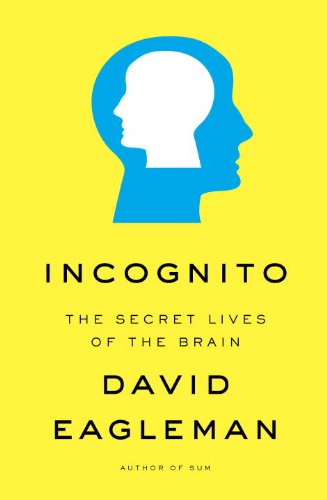
Neuroscientist David Eagleman on Incognito: The Secret Lives of the Brain


Back in 2011, neuroscientist David Eagleman spoke with Wired's David Rowan about his then-new book, Incognito: The Secret Lives of the Brain. I seriously enjoyed this book as an excellent complementary text to Daniel Kahneman's Thinking, Fast and Slow.

Here is the text from the dust jacket:
If the conscious mind--the part you consider you--is just the tip of the iceberg in the brain, what is all the rest doing?  Neuroscientist David Eagleman plumbs the depths of the subconscious brain to illuminate surprising questions: Why can your foot jump halfway to the brake pedal before you become consciously aware of danger ahead?  Why do strippers make more money at certain times of month, even while no one is consciously aware of their fertility level?  Is there a true Mel Gibson? What do Odysseus and the subprime mortgage meltdown have in common?  How is your brain like a conflicted democracy engaged in civil war?  Why are people whose name begins with J more likely to marry other people whose name begins with J? Why is it so difficult to keep a secret? Why did Supreme Court Justice William Douglas deny that he was paralyzed? The subsurface exploration includes waystops in brain damage, drugs, infidelity, synesthesia, criminal law, the future of artificial intelligence, and visual illusions--all highlighting how our perception of the world is a hidden and awe-inspiring construction of the brain.

At The Hospital Club on 6 April 2011, Wired magazine's editor David Rowan sat down in conversation with David Eagleman, neuroscientist and author of Incognito: The SecretLives of The Brain, who spoke at length about some of the fascinating insights contained within it. The invite-only conversation is now available to all in the video below.


Wednesday, July 18, 2012

Spiritual Bypassing ~ Dialogue with Robert Augustus Masters and John Dupuy


This talk was brought to my attention by Arthur Gillard, a friend on Google + and other virtual locations. Masters and Dupuy are both psychotherapists and they are both integrally oriented, but their versions differ from the mainstream Wilberian integral crowd, so it's an interesting dialogue.

I reviewed Masters' Spiritual Bypassing when it came out. Click the image above to get the book at Amazon, or click this link - I highly recommend the book.

In the interest of full clarity, this dialogue is posted on the Profound Meditation Program site, a program designed to compete with Bill Harris's Holosync stuff. I don't know anything about these programs, and I don't go that route anyway. For me, mindfulness and simply trying to be "present" in my life are my meditation practices.

Spiritual Bypassing ~ Dialogue with Robert Augustus Masters and John Dupuy

In this dialog we discuss Robert Augustus Master's book, Spiritual Bypassing, and the idea that one must embrace the darkness and the suffering in order to transform and if one doesn't it causes manifold pathologies…this has been a key in developing Integral Recovery, as well as in my own personal healing and transformation. We also get very personal and talk about our prospective lives and experiences, as well as addressing some of the elephants in the halls of the Integral world. I hope you find it as helpful and compelling as I did. Robert also shares his first experience with PMP!

------------------------

At a recent Enneagram workshop with Helen Palmer and Leslie Hershberger, I heard the book, Spirital Bypassing, by Robert Augustus Masters, referenced several times and the intuitive voice said "get it." I had been aware of Robert Augustus Masters work and presence in the Integral world and beyond for some time. Robert had also made some supportive comments on my work in Integral Recovery early on. 

A couple of weeks after the Eneagram workshop I purchased a copy of Spiritual Bypassing and began reading it. OMG! What an amazing read and what profound and absolutely essential wisdom is being brought forward in this volume. I immediately started recommending it to all my students and clients. On a whim I looked up Robert's website and found his telephone number. I called Robert and left a message. A couple of hours later, as I was perusing our local Walmart, Robert called back. Leaning against an island of highly discounted Pepsicola cases, we had our first conversation. And as my friend, David Hollday once said, you can find God in Walmart. He's right near the children's tennis shoe section.
We immediately clicked and I suggested that we have this conversation again, soon, and get it out to all of you. Robert readily agreed and a week later we did, and here are the results. I hope you find it as inspiring and helpful as I did. God bless you all and keep up the deep work.

Love, John
June 17, 2012
___________________

Spiritual Bypassing
with Robert Augustus Masters and John Dupuy
6/17/12

To download the dialogue right-click or control-click here, then choose "save file" or "download linked file"

Tuesday, May 08, 2012

David Eagleman and Raymond Tallis - Who's in Charge, You or Your Brain?


This is a cool dialogue between David Eagleman (neuroscientist at Baylor College of Medicine in Texas and bestselling author) and Raymond Tallis (former professor of geriatric medicine at Manchester University and author) on the nature of free will, or rather, on the existence of free will.

Eagleman's Incognito: The Secret Lives of the Brain, which features in this discussion, will be released in paper on May 15.

The brain… it makes you think. Doesn't it?

Are we governed by unconscious processes? Neuroscience believes so – but isn't the human condition more complicated than that? Two experts offer different views.
MRI
Does this 3lb of tissue govern our actions without our even knowing? Photograph: Phanie/Rex Features

David Eagleman, neuroscientist at Baylor College of Medicine in Texas and bestselling author

It is clear at this point that we are irrevocably tied to the 3lb of strange computational material found within our skulls. The brain is utterly alien to us, and yet our personalities, hopes, fears and aspirations all depend on the integrity of this biological tissue. How do we know this? Because when the brain changes, we change. Our personality, decision-making, risk-aversion, the capacity to see colours or name animals – all these can change, in very specific ways, when the brain is altered by tumours, strokes, drugs, disease or trauma. As much as we like to think about the body and mind living separate existences, the mental is not separable from the physical.

This clarifies some aspects of our existence while deepening the mystery and the awe of others.

For example, take the vast, unconscious, automated processes that run under the hood of conscious awareness. We have discovered that the large majority of the brain's activity takes place at this low level: the conscious part – the "me" that flickers to life when you wake up in the morning – is only a tiny bit of the operations. This understanding has given us a better understanding of the complex multiplicity that makes a person. A person is not a single entity of a single mind: a human is built of several parts, all of which compete to steer the ship of state. As a consequence, people are nuanced, complicated, contradictory. We act in ways that are sometimes difficult to detect by simple introspection. To know ourselves increasingly requires careful studies of the neural substrate of which we are composed.

Raymond Tallis, former professor of geriatric medicine at Manchester University and author

Yes, of course, everything about us, from the simplest sensation to the most elaborately constructed sense of self, requires a brain in some kind of working order. Remove your brain and bang goes your IQ. It does not follow that our brains are pretty well the whole story of us, nor that the best way to understand ourselves is to stare at "the neural substrate of which we are composed".

This is because we are not stand-alone brains. We are part of community of minds, a human world, that is remote in many respects from what can be observed in brains. Even if that community ultimately originated from brains, this was the work of trillions of brains over hundreds of thousands of years: individual, present-day brains are merely the entrance ticket to the drama of social life, not the drama itself. Trying to understand the community of minds in which we participate by imaging neural tissue is like trying to hear the whispering of woods by applying a stethoscope to an acorn.

Of course brain activity is automated and, as you say, runs "under the hood of conscious awareness", but this doesn't mean that we are automatons or that we are largely unconscious of the reasons we do things. If, as you put it in Incognito, "the conscious you is the smallest bit-player in the brain" to the point that even our most important and personal decisions – such as choice of spouse, where to live, or occupation – are directed by brain mechanisms of which we are unaware, how would you have become sufficiently aware of this unawareness to write about it in your book Incognito (which incidentally shows little evidence of having been written by an automaton)?

David Eagleman

The uses of neuroscience depend on the question being asked. Inquiries about economies, customs, or religious wars require an examination of what transpires between minds, not just within them. Indeed, brains and culture operate in a feedback loop, each influencing the other.

Nonetheless, culture does leave its signature in the circuitry of the individual brain. If you were to examine an acorn by itself, it could tell you a great deal about its surroundings – from moisture to microbes to the sunlight conditions of the larger forest. By analogy, an individual brain reflects its culture. Our opinions on normality, custom, dress codes and local superstitions are absorbed into our neural circuitry from the social forest around us. To a surprising extent, one can glimpse a culture by studying a brain. Moral attitudes toward cows, pigs, crosses and burkas can be read from the physiological responses of brains in different cultures.

Beyond culture, there are fruitful questions to be asked about individual experience. Your experience of being human – from thoughts to actions to pathologies to sensations – can be studied in your individual brain with some benefit. With such study, we can come to understand how we see the world, why we argue with ourselves, how we fall prey to cognitive illusions, and the unconscious data-streams of information that influence our opinions.

How did I become aware enough about unawareness to write about it in Incognito? It was an unlikely feat that required millennia of scientific observation by my predecessors. An understanding of the limitations of consciousness is difficult to achieve simply by consulting our intuition. It is revealed only by study.

To be clear, this limitation does not make us equivalent to automatons. But it does give a richer understanding of the wellspring of our ideas, moral intuitions, biases and beliefs. Sometimes these internal drives are genetically embedded, other times they are culturally instructed – but in all cases their mark ends up written into the fabric of the brain.

Raymond Tallis

Some of what you have just said sounds like common sense and a retreat from the radical thesis advanced in Incognito. There you put unconscious brain mechanisms in the driving seat – which is why your book has attracted such attention – and argue that important life decisions are strongly influenced by "the covert machinery of the unconscious".

You cite startling studies that show how choice of marital partner, place to live, and occupation are shaped by an implicit egoism built into the brain, such that if your name begins with D you are more likely to marry a person, live in a town, and pursue an occupation beginning with "D". I think the stats are wobbly – there are a disproportionate number of lawyers as well as dentists called Dennis – but this illustrates your position.

But now you row back from your radical position and suggest that the brain doesn't call so many shots and is just one player.

That which is acted out in the public space (maintained by conscious human beings) that we call "culture" is at least as important. Once this is granted, then brain science will have a more modest role in explaining why we do things, and an even smaller one in framing social policy. It will tell us little about our "moral attitudes towards … crosses and burkas". Our moral attitude to anything depends upon many things we are conscious of (which is why it is so variable) as well as things we are not. A burka or a cross isn't just a stimulus triggering automated responses, even ones conditioned by culture. Think of the (very conscious) argument about the law governing wearing these items in public.

Even when you concede in Incognito that "consciousness is the long-term planner", you still can't let go of the idea of the largely unconscious brain being in charge. This is because you want to privilege brain science. Your case is assisted by personifying the brain, as when you say things like "the brain cares about social interaction".

But we haven't finished with self-contradictions yet. May we talk about umwelt and illusions?

David Eagleman

We should probably agree that there is no contradiction between the fact that the unconscious brain can be in the driver's seat, and also influenced both from the inside (genetic) and outside (the larger society). Of course culture is important, and neurobiology should never aim to divert funding away from social research. But this is like advising an author of a book about planets that he should have written about galaxies instead. My interest in Incognito is to understand individual human experience – our cognitive illusions, where our ideas come from, how come we can move our arm with no sense of the musculature, how we effortlessly recognise a friend's face better than the best computer programs, why we can argue with ourselves, why it is difficult to keep a secret.

As an example of these individual experiences, I'm glad you brought up illusions and the umwelt. Visual illusions reveal that perceptions generated by the brain do not necessarily correlate with reality. Hallucinations, dreams, and delusions illustrate the same point.

And the story goes even deeper. We don't have a strong grasp of what reality "out there" even is, because we detect such an unbearably small slice of it. That small slice is called the umwelt.

Each organism presumably assumes its umwelt to be the entirety of objective reality. Until a child learns that honeybees enjoy ultraviolet signals and rattlesnakes see infrared, it is not obvious that plenty of information is riding on channels to which we have no natural access. In fact, the part of the electromagnetic spectrum visible to us is less than a ten-trillionth of it. Our sensorium is enough to get by in our ecosystem, but no better.

The concept of the umwelt neatly captures the idea of limited knowledge, of unobtainable information, and of unimagined possibilities. I think it's a good starting point for our intuitions about our own experience.

Raymond Tallis

If the unconscious brain and its response to "influences" such as genes and society really is "in the driver's seat", there is no difference between driving and passenger seats. Incognito presents us as more helpless, ignorant and zombie-like than is compatible with the kinds of lives we actually live and, what's more, with doing brain science.

While you are not as imperialistic on behalf of brain science as many of your contemporaries, you still maintain that examining neural tissue (the acorn) can tell us more about ourselves as social beings and the society we inhabit and create together (the whispering woods) than is, or in my opinion ever will be, the case.

Ultimately, your position is either a truism (we are sometimes deceived about the nature of reality and why we do things) or self-contradictory (we are usually or always deceived about the nature of reality and why we do things). Yes, there are illusions, dreams, delusions and hallucinations; but we could not recognise them for what they are unless the vast majority of our experiences were not illusions, delusions, dreams or hallucinations.

Your claim that we are sealed off from most of reality is even more clearly self-contradictory. Because our awareness is mediated through the evolved brain, you argue, our mental life is "built to range over a certain territory". We are therefore confined to an umwelt – "an unbearably small slice of reality". If this were the whole story of our condition, how would we know it? We would have as little inkling of the limitations of our consciousness as other animals do of their own. Or have researcher bees demonstrated to their gob-smacked hive-mates that rattlesnakes see infrared?

Knowledge transcends immediate experience and corrects some of our intuitions about ourselves. But this knowledge is a part – a huge part – of our conscious (repeat, conscious) mental life. Without it, we could not do the weekly shopping – never mind engage in a correspondence such as this.

David Eagleman

It is not contradictory to recognise that we are sealed off from most of reality, and that we can discover more of it by a process of careful experimentation. That is the endeavour of science. For example, you cannot see, hear or touch radio waves, but you can build machines to translate the waves into the biologically delimited language in which you can understand them. You can build such machines only because science reaches beyond what we know to discover new realms.

Neuroscience is uncovering a bracing view of what's happening below the radar of our conscious awareness, but that makes your life no more "helpless, ignorant, and zombie-like" than whatever your life is now. If you were to read a cardiology book to learn how your heart pumps, would you feel less alive and more despondently mechanical? I wouldn't. Understanding the details of our own biological processes does not diminish the awe, it enhances it. Like flowers, brains are more beautiful when you can glimpse the vast, intricate, exotic mechanisms behind them.