Showing posts with label madness. Show all posts

Sunday, November 02, 2014

Is Modern Culture Making Us Crazier?

From The New Republic, author and psychologist Martha Stout (The Sociopath Next Door, The Myth of Sanity, The Paranoia Switch) reviews the new book from brothers Joel and Ian Gold, Suspicious Minds: How Culture Shapes Madness.

This looks like an excellent and important book - we too often neglect the cultural context of "madness."

Is Modern Culture Making Us Crazier?

The science behind America's deepening disturbance


By Martha Stout
July 31, 2014 | The New Republic

A young friend recently shared with me her experience of being stopped by the police on an otherwise uneventful Tuesday morning. With one arm protectively wrapped around her shoulder bag because it had a broken latch, she’d been walking along a city street. Unbeknownst to her at the time, a shooting had occurred the previous day in the same neighborhood. Three police officers, two male and one female, approached her. They demanded to know whether she had a gun under her arm, took her bag from her, and looked inside. No gun. They checked her identification. No record. (As far as I know, this young woman hasn’t so much as a traffic ticket.) She was completely cooperative throughout.

The female officer then patted her down, which my friend said she tolerated by deliberately becoming a little dissociative—“spacing out”—until the stranger’s hands finally finished their journey over her body. Then, though there was no gun in it, the two male officers decided to search her shoulder bag again, item by item. Riffling through her wallet, they found a condom, and that discovery grabbed their attention.

“Oh look. We’ve got a young slut here,” said one, waving the condom. All three officers laughed.

My friend, very scared by now, said nothing.

Finally, they let her go. As she walked away, the female officer called after her, “Guess you came here ready to fuck anyone you wanted to, didn’t you?”

I find this officer’s parting salvo grimacingly ironic.

These days, mind-spinning stories of misogyny assail us from all over our country, and indeed, this account is hardly the worst. But knowing the victim personally, and understanding that she will carry the hateful essence of this ridicule with her for a long time to come, I was especially saddened. And for me, one of the most disheartening features of this incident was the fact that the young woman who endured it was not even taken aback. Far from being shocked and outraged, she was not even surprised. When I asked her about her reaction, she explained, “I was very upset, but no, I wasn’t surprised. If you walk around alone, you kind of expect this sort of thing to happen. It’s really only a matter of time.”

Is this frightening belief about the world a symptom of paranoia on her part? And, as the old saw goes, are you paranoid when they’re really out to get you? Most of her twenty-something years have been spent in a nation beset by furious cultural and political forces on a course to push back the legal standing and social status of women by half a century. As but two illustrations, there are Supreme Court actions such as the recent Hobby Lobby ruling and state-level abortion-restriction laws that are designed to make certain of women’s medical procedures as costly and humiliating as possible.

How much of an influence has the traumatized and reactive culture of a post-September 11 United States had on the mental status of this young citizen—and for that matter, on the mental status of the police officers who bullied her? And in general, how much, and in what ways, do events in the wider world affect our individual personalities? Societal factors clearly influence our observable behavior—what we will and won’t do in public on a day-to-day basis—but can societal, cultural, political, and even technological factors soak into our very psyches, infiltrate our inner cores and make lasting changes to who we are? This is a fascinating and in some cases alarming question, and is the basis of Joel and Ian Gold’s book, Suspicious Minds: How Culture Shapes Madness.


Suspicious Minds: How Culture Shapes Madness,
by Joel Gold and Ian Gold. Free Press.

Joel Gold, MD, Clinical Associate Professor of Psychiatry at the NYU School of Medicine, and his brother, Ian Gold, Ph.D., Associate Professor of Philosophy and Psychiatry at McGill University, discuss a number of psychotic patients who all have the same delusion—that the people in their lives are acting out a script, much like the family and friends of Jim Carrey’s character in the 1998 movie, The Truman Show. Juxtaposing recent research on schizophrenia with page-turning case studies of these paranoid patients, the Golds argue that psychotic delusions (not to mention mesmeric movie plots) are the result of interactions between the brain and the sociocultural world, and they bring to light the discipline-altering fact that culture has a role to play in the development of psychopathology generally.

If you happen not to be a psychiatrist or a psychologist, you might reasonably imagine that mental health professionals have written many other books on this crucial and intriguing question: Can zeitgeist have an enduring negative effect on the individual psyche? But the startling fact is that most of the relevant scholarly writings by psychopathologists are quite new (post-2001), and discussions for nonprofessionals are rare. Over the past 40 years or so, psychology has attempted to divvy up the causes of pathological conditions between two now-famous categories, “nature” (as transmitted genetically) and “nurture” (environmental influences). For various psychopathologies, including paranoid schizophrenia, and also normal “personality traits” (introversion/extraversion, conservatism/liberalism, rigidity/adaptability, and several dozen more), research has yielded remarkably consistent results, indicating that these differences among human beings are accounted for by genetic and environmental factors in more or less equal measure, with genetics sometimes edging out environment by a point or two (51 versus 49 percent, in some instances). This research has been indispensable to our growing appreciation of the role of genetics both in normal personality and in the mental illnesses.

Contrastingly, our conception of environmental influences has been biased and narrow. We have tended to think of “nurture” only in the familial sense: In mental health research, “environment” tends to mean child-rearing factors, which is to say the personalities and actions of parents and, to a lesser degree, siblings. That an individual’s personality or mental illness might be affected by environmental factors outside the home has been largely overlooked. Take the study of sociopathy, which is another profound form of psychopathology—this one characterized not by delusions but by the complete absence of conscience. Research indicates that the factors involved in sociopathy, like those in many other mental illnesses, are about 50 percent genetic and 50 percent environmental. But researchers have been perplexed because they have been unable to find specific child-rearing variables that would consistently account for the environment’s half in cultivating sociopaths. I maintain (in my book The Sociopath Next Door) that this half consists primarily of larger societal factors, and this idea would seem to be supported by the fact that the incidence of diagnosed sociopathy is significantly lower in certain East Asian countries (most notably Taiwan and Japan) than in North America. It seems likely that, in the United States especially, any genetic predisposition to sociopathy will be nurtured and shaped by a single-mindedly competitive and individualistic culture that regards “winning” and domination as the ultimate goods.

Why have psychologists who study pathology tried to divide up the causality universe between inborn tendencies and the family environment, and turned a mostly blind eye to influences from the wider world? One answer is that a cultural hypothesis frustrates prevention: Though correcting the child-rearing practices of a large group of people would be a tall order, setting out to alter the entrenched belief systems of an entire society is even more daunting and might eventually involve taking a political stance, something many clinical psychologists and psychiatrists are loathe to do.

Gold and Gold make it clear that psychiatry is dispensing with the possibility of cultural factors in mental disorder even more summarily than psychology has done. They write, “The social world is at the heart of our theory of delusions, and this puts us at odds with much of mainstream psychiatry.” Mental illness, they explain, “at least severe mental illness—is nothing more than genetic and neural dysfunction,” according to psychiatric dogma. They point to the large and growing number of psychiatrists who aspire to understand and treat mental disorders as brain disorders, and convincingly illuminate the losses that psychiatry may suffer on account of this new reductionism.

The central argument in Suspicious Minds derives from the increasingly accepted “social brain hypothesis,” the idea that the primary function of enlarged primate (and therefore human) brains is to deal with the cognitive challenges of living in groups. In reference to paranoid disorders in particular, Gold and Gold ask the question—“What sort of cognitive system is required to enable one to be sensitive to social threats?” In answer, they propose that the human brain contains an adaptive “Suspicion System,” which is “the solution that evolution came up with to enable us to pick up evidence of infidelity and other social threats for the purpose of early detection and defense.” In other words, courtesy of natural selection, we are all biologically prepared to be leery. They hypothesize that a healthy Suspicion System makes social life safer through “heightened responses to subtle, uncertain, and ambiguous signs of social danger,” but that a malfunctioning or overloaded Suspicion System “will sound the alarm without good reason and detect evidence poorly—that is, see malign intent where there is none.” Over time, an overreactive Suspicion System may inaugurate “an idiosyncratic belief that is firmly maintained despite rational argument or evidence to the contrary”—i.e., a paranoid delusion. The authors point out that the persecutory delusions of clinical paranoia are by far the most prevalent form of delusion the world over.


Paramount Pictures

The delusions of psychotic patients—that their lives are scripted, and that their friends are mere actors—recall the plot of The Truman Show.

Gold and Gold conclude that the “Truman Show delusions” of their paranoid patients express those patients’ fears of being controlled by what other people know about them: “Truman Show is a delusion of control in the age of surveillance.” They declare, “Reductionism in psychiatry constrains theory to operate within the skull or the skin. Our bet is that the outside world is going to matter as well.”

Suspicious Minds is a contrarian, insightful, and important book. Gold and Gold do not take on the more politically involved and incendiary aspects of our society, such as run-amok individualism—or the abuse of power and the national upsurge in misogyny that plagued my young friend on that demoralizing Tuesday morning. Nonetheless, their analysis of culture-linked paranoia comprises an effective argument that our seemingly endless struggle to align our society with our more enlightened ideals may be a fight for our very minds.


~ Martha Stout, Ph.D., is the author of The Myth of Sanity: Divided Consciousness and the Promise of Awareness, The Paranoia Switch: How Terror Rewires Our Brains and Reshapes Our Behavior--and How We Can Reclaim Our Courage, The Sociopath Next Door, and an upcoming book, The Sociopath Files.

Saturday, July 26, 2014

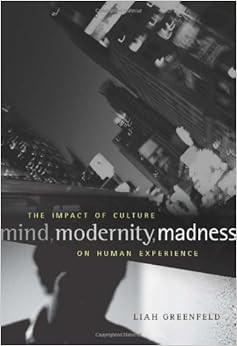
Book - "Mind, Modernity, Madness: The Impact of Culture on Human Experience" by Liah Greenfeld

http://ecx.images-amazon.com/images/I/41gs8XWQihL._SY344_BO1,204,203,200_.jpg

Allan Young reviews Liah Greenfeld's final installment in her Nationalism trilogy, Mind, Modernity, Madness: The Impact of Culture on Human Experience (2013) for the summer issue of The Hedgehog Review.

This appears to be a very interesting book - although Young doesn't feel there is too much true innovation here. Here is a passage from the review below:


Greenfeld argues that culture is simultaneously a source of madness and a source of self-medication that attenuates the severity of madness. As pathogenic forces strengthen, she writes, self-medication grows equally more desperate and socially disruptive in an era of globalization:
“Paradoxically, the rate of severe (clinical) mental disturbance should, in general, be proportional to the possibility of engaging in ideologically motivated collective activism; that is, the rate of disturbance should necessarily be highest in individualistic nations, and higher in collectivistic civic nations than in ones organized on the basis of ethnicity. The most aggressive and xenophobic strains of nationalism—the worst kind for international comity—would be the best for the mental health of individual citizens in states where such virulence held sway.”
Based on the brief review, this book, having not read it yet, seems like the intellectual heir of Wilhelm Reich's The Mass Psychology of Facism. If so, it is an important book.

Mind, Modernity, Madness: The Impact of Culture on Human Experience

Liah Greenfeld
Cambridge, MA: Harvard University Press, 2013.

Reprinted from The Hedgehog Review; 16.2 (Summer 2014). This essay may not be resold, reprinted, or redistributed for compensation of any kind without prior written permission. Please contact The Hedgehog Review for further details.


Liah Greenfeld, a professor of sociology at Boston University, describes Mind, Modernity, Madness as the product of “a new—radically different—approach that has never been tried.” At 688 pages, it is a long book that ranges in its “interdisciplinarity” from the clinical epidemiology of bipolar depression to the historiography of romantic love in Shakespeare. But it has a clear, bold thesis: that the advent of madness is connected, as both cause and effect, to the rise of nations and nationalism.

More specifically, Greenfeld contends, the historical conditions that gave rise to the nation—a community of equals; a measure of individual autonomy, liberty, and mobility; and a declining acknowledgment of divine authority—make madness not only possible but inevitable. As the value of human life grows and becomes of paramount concern, self-invention and romantic love become popular ideals, and even common people are driven by ambition, aspiration, and the pursuit of happiness. “Modern culture,” Greenfeld writes, “leaves us free to decide what to be and to make ourselves. It is this cultural laxity that is anomie—the inability of a culture to provide the individuals within it with consistent guidance.”

The author’s evidence is historical and biographical. Her conceptual framework is sociological, inspired by Émile Durkheim’s 1897 book Suicide. Indeed, Greenfeld’s vision of modernity restates and broadens Durkheim’s view that social disintegration produces the anomie and alienation that can lead to self-destructive behavior and acts, including the taking of one’s own life. While Durkheim adduced higher rates of suicide in the anomic nations of later-nineteenth-century Protestant Europe, Greenfeld focuses on the worldwide epidemiology of schizophrenia, bipolar disorder, and major depression, which she regards as an overwhelming threat to Western civilization.

Greenfeld rejects the “constructivist” approach that she believes is prevalent “among Western social scientists—anthropologists, sociologists, and historians studying psychiatry—who conclude that madness is largely an invented problem… analogous to the equally false ‘social constructions’ of witchcraft and possession of other cultures, but dressed in a scientific garb and unjustifiably enjoying the authority of science in ours.” She derides the “poetic” excesses of Michel Foucault’s Madness and Civilization, but ignores constructivist conceptualizations of greater consequence, notably “idioms of distress” and “bio-looping,” which circulate freely within clinical psychiatry and can be found in the Diagnostic and Statistical Manual on Mental Disorders in appendixes on somatization syndromes and cultural psychiatry.

When Greenfeld accuses anthropologists of creating “false social constructions” of witchcraft and possession and repeating this effect on Western madness, she means that anthropologists have misconstrued how culture, mind, consciousness, brain, and madness are connected. Culture, in her view, is an ideational, symbolic, non-material phenomenon. Human consciousness is an emergent phenomenon, “logically consistent with the biological and physical laws but autonomous,” and irreducible to organic reality. The human mind comprises or contains a form of collective consciousness she calls “culture in the brain.”

These conceptions, Greenfeld says, run counter to the dominant “dual mind/body view of reality,” which attributes causal primacy to the “material” (the central nervous system) over the “spiritual” (consciousness, mind, culture). Culture and consciousness, in this paradigm, are epiphenomena of the material world: causation proceeds from brain to mind via identifiable mechanisms. In other words, culture can disguise the material nature of madness but cannot interfere with it. Constructionists are said to share these conventions.

Greenfeld emphatically rejects the dualist paradigm, contending that culture can and does cause biologically real (material) diseases, including madness. She believes that her thesis, being both counterintuitive and empirically proven, has revolutionary implications for how we understand and address the increasing prevalence of madness in our current era and culture. Furthermore, she believes that her thesis enables her to advance additional, counterintuitive claims concerning the historical origins and epidemiology of madness.

Yet it is unclear to me whether Greenfeld’s thesis is truly revolutionary. The difficulty comes in her proposal that culture causes biologically real diseases. There are two ways to interpret this claim. She could mean that “culture in the brain” is a source of distressful dilemmas, contradictions, and emotions that precipitate chains of physiological, molecular, neurological, and anatomical effects; that these changes in turn undermine the homeostasis underpinning normal functioning; and that, as a result, a pathogenic loop is created and sustained. This interpretation seems consistent with the process Greenfeld is proposing, and it is consistent with what she says about clinical psychiatry and research. This is a credible thesis, but it is far from being counterintuitive or revolutionary. Indeed, it is the prevailing approach among anthropologists and other social scientists interested in mind, brain, and psychopathology.

But Greenfeld may have something far more original in mind: “So long as there remains the unresolved philosophical mind-body problem, no significant advance in human neuroscience and, therefore, psychiatry would be possible.… The first order of the business is, therefore, to escape the mind-body quagmire.” If, in this book, she has found a way out of this 400-year-old problem, however, it is not at all obvious to this reader what it is.

Such matters occupy only two chapters. The remaining 500 pages are devoted to “madness.” According to Greenfeld, the term was coined in England in the early modern period (fifteenth and sixteenth centuries), then spread to France and Germany. Between 1880 and 1900, “madness” bracketed the maladies we know today as schizophrenia and bipolar disorder. (In psychiatry, there is currently renewed interest in reconnecting the two disorders on a single diagnostic spectrum.) The author further describes the history of the term in separate chapters on Europe and America.

In a brief but provocative epilogue, Greenfeld argues that culture is simultaneously a source of madness and a source of self-medication that attenuates the severity of madness. As pathogenic forces strengthen, she writes, self-medication grows equally more desperate and socially disruptive in an era of globalization:

“Paradoxically, the rate of severe (clinical) mental disturbance should, in general, be proportional to the possibility of engaging in ideologically motivated collective activism; that is, the rate of disturbance should necessarily be highest in individualistic nations, and higher in collectivistic civic nations than in ones organized on the basis of ethnicity. The most aggressive and xenophobic strains of nationalism—the worst kind for international comity—would be the best for the mental health of individual citizens in states where such virulence held sway.”

Mind, Modernity, Madness is the final volume in Greenfeld’s trilogy on nationalism. It provides readers with a provocative commentary on the sociocultural origins and psychopathological consequences of modernity. And it is a splendid antidote to the reckless application of the term “madness,” by both pundits and politicians, to the policies and persons of America's political opponents and the excesses of their nationalisms.


~ Allan Young, professor of anthropology at McGill University and author of The Harmony of Illusions: Inventing Posttraumatic Stress Disorder (1995), is completing a book on the social brain, psychopathology, and myths of empathy.

Wednesday, March 19, 2014

George Atwood - The Abyss of Madness

[NOTE: I originally posted this in August of 2012. However, I am seeing clients who would fall into the definition Atwood uses for "madness."]


I am reading George Atwood's The Abyss of Madness (Psychoanalytic Inquiry Book Series) (2011) as part of an intersubjective, relational psychoanalytic study group I have been a part of for the last two and a half years. Aside from a few essays, this is is the first work I have read that is specifically Atwood's own thinking (most of the other books he had co-authored with Robert Stolorow).

Here is the description of the book from Amazon:
Despite the many ways in which the so-called psychoses can become manifest, they are ultimately human events arising out of human contexts. As such, they can be understood in an intersubjective manner, removing the stigmatizing boundary between madness and sanity. Utilizing the post-Cartesian psychoanalytic approach of phenomenological contextualism, as well as almost 50 years of clinical experience, George Atwood presents detailed case studies depicting individuals in crisis and the successes and failures that occurred in their treatment. Topics range from depression to schizophrenia, bipolar disorder to dreams, dissociative states to suicidality. Throughout is an emphasis on the underlying essence of humanity demonstrated in even the most extreme cases of psychological and emotional disturbance, and both the surprising highs and tragic lows of the search for the inner truth of a life – that of the analyst as well as the patient.
I very much like the way he conceptualizes these issues, even when I do not agree with his perspective on the mind. The way he talks about mental illness feels right in terms of how the client experiences it, and in the relational/intersubjective model, meeting the client in his or her own reality is essential.

When he speaks of madness in these passages, he is referring to psychosis and schizophrenia, or even bipolar disorder in its manic stage. These are not cases of simple depression, although there is certainly some similarity at a much lower intensity. And all these terms are things that he rejects as scientific defense mechanisms against our own fears of the abyss and what that means for our shared sense of being human.

It's worth bearing in mind that the psychoanalytic school refused to treat the "psychotics" for decades following Freud based on his assumption that they were not amenable to treatment. Harry Stack Sullivan, in the late 1920s, was one of the first psychoanalytically trained therapists to work with schizophrenics, and he did so based on his "problems with living" definition of mental illness. Sullivan was also one of the first psychoanalysts to focus on the "self system" as the outcome of relational patterns in the child's life (eventually giving rise to attachment theory). Atwood is definitely a lineage holder in the tradition Sullivan created that has been expanded upon by Stolorow, Donna Orange, and others.

Here a few quotes that I have highlighted in the text that I think are illustrative of his thinking.
Phenomenologically, going mad is a matter of the fragmentation of the soul, of a fall into nonbeing, of becoming subject to a sense of erasure and annihilation. The fall into the abyss of madness, when it occurs, is felt as something infinite and eternal. One falls away, limitlessly, from being itself,  into utter nonbeing.  (p. 40)

* * * *

Madness is not an illness, and it is not a disorder. Madness is the abyss. It is the experience of utter annihilation. Calling it a disease and distinguishing its forms, arranging its manifestations in carefully assembled lists and charts, creating scientific-sounding pseudo-explanations for it--all of these are intellectually indefensible, and I think they occur because of the terror. What is the terror I am speaking of? It is the terror of madness itself, which is the anxiety that one may fall into nonbeing.

The abyss lies on or just beyond the horizon of every person's world, and there is nothing more frightening. Even death does not hold a terror for us comparable to the one associated with the abyss. (p. 41)
He suggests that death offers a potential reunion with loved ones, or conversely, a release or relief from the sorrows and pains of our lives. We can rage against the dying of the light, or marvel at our capacity to contemplate our own demise, or even imagine the world without us.

But the descent into madness, into the abyss, offers no such relief.
It is the end of all possible responses and meanings, the erasure of a world in which there is anything coherent to respond to, the melting away of anyone to engage in a response. It is much more scary than death, and this proven by the fact that people in fear of annihilation--the terror of madness--so often commit suicide rather than continue with it. (p. 42)

* * * *

People often fall not because the bad happens, but rather because the good stops happening. Sanity is sustained by a network of validating, affirming connections that exist in a person's life: connections to other beings. If those connections fail, one falls. The beings on whom one relies include, obviously, other people, sometimes animals, often beings known only through memory and creative imagination. It some instances it is the connection to God that protects a person against madness. Strip any person of his or her sustaining links to others, and that person falls. No one is immune, because madness is a possibility of every human life. (p. 43)

* * * *

What a person in the grip of annihilation needs, above all else, is someone's understanding of the horror, which will include a human response assisting in the journey back to some sort of psychological survival. A person undergoing an experience of the total meltdown of the universe, when told that his or her suffering stems from a mental illness, will generally feel confused, invalidated, and undermined. Because there are no resources to fight against such a view, its power will have a petrifying effect on subjectivity and deepen the fall into the abyss. (p. 45)
Atwood contends that an objectified psychiatric diagnosis is the antithesis of what is needed - essentially mirroring and validation. He offers a thought experiment: Imagine a young man, maybe in his early 20s, who is in the midst of a fall into the abyss. This young man finds himself committed to an in-patient psych ward where he is given the diagnosis of a brain disease called schizophrenia.
The annihilating impact of such a view then becomes symbolized in the patient's unfolding experience that vicious, destructive voices are speaking to him over invisible wires and saying repeatedly that he should die. In this way a spiraling effect occurs, wherein the operation of the medical model further injures the already devastated patient, whose reactions to the new injuries in turn reconfirm the correctness of the diagnosis. (p. 45-46)
He prefers to be with the client in whatever space they inhabit, to show them that he is listening and trying to comprehend their experiences as much as he is able - and, above all else, that he is prepared to do whatever is necessary to help.

I have had clients in the past who I felt unable to help, because I was unable to be with them in their abyss, to extend my empathy into what I experiences as their delusional states. I failed them. Even as I sat with them and tried to understand what they were telling me, I did not understand that their delusions were their psychic organizing principles, were their symbolic truth of how the world has betrayed them.

Atwood, in the many case studies he presents, is revealed as someone who can feel into the annihilation his clients present him with, but he also acknowledges how challenging it is:
Working in the territory of annihilated souls is never easy. To really listen to someone, anyone, to hear the depth of what he or she may have felt, to work one's way into realms of experience never before perceived by anyone and therefore never articulated--all of this is as hard a task as one may undertake. (p. 51)
It is indeed. And it is also rewarding when the therapist can do so successfully and allow the client to feel heard and validated - maybe for the first tine in their lives.

I want to wrap up this post with a few more passages that deal with etiology. I posted some thoughts recently on a more relationally based diagnostic manual for counselors and therapists - Atwood conceptualizes cases in a way that fits with what I would like to see.
Those who feel they are not present, and who affirm the existence of machine that controls their minds and bodies, are often the products of profound enmeshment with their caregivers in childhood. An accommodation has taken place at a very young age in which the agenda of the caregiver--it can be the mother, the father, or both--becomes the supreme principle defining the child's developing sense of personal identity. The experience of the child as an independent person in his or her own right is nullified, so that they child the parents wish for can be brought into being. Very often thee are no outward signs of anything amiss, as family life unfolds in a seeming harmony. Somewhere along the way, however , the false self begins to crumble, and a sense of the degree to which the child has been absent from life arises. This emerging sense of never having been there, of having been controlled and regulated by outside forces, is so unstable and fragmentary that it is given concrete form. What is seen from the viewpoint of others as a delusion then begins to crystallize, for example in the image of an influencing machine (Tausk, 1917; Orange et al., 1997, chap. 4). Within the world of the child, now perhaps chronologically an adult, the so-called delusion is a carrier of truth that has up until then been entirely hidden and erased. What looks like a breakdown into psychosis and delusion thus may represent an attempted breakthrough, but the inchoate "I" does require an understanding and responsive "Thou" in order to have a chance to consolidate itself. (p. 60-61)
 That last sentence is the essence of the relational model - we are relational beings, the damage to our sense of self that we experience is nearly always relational, and if there is to be healing of that damage, that too much be relational - it requires mirroring, validation, and the sense of human connection that is vital to sanity for all of us.

Tuesday, April 16, 2013

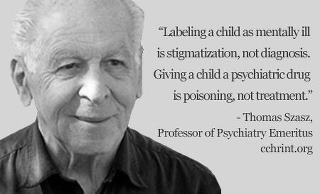
Mad or Bad - Thomas Szasz


Thomas Szasz first presented his attack on the legal usage of the term "mental illness" in a 1958 Columbia Law Review article. He argued that mental illness has no more bearing on a person's guilt than possession by the devil.

In 1961, Szasz testified before a United States Senate committee, arguing that the use of mental hospitals to incarcerate people defined as insane violated the general assumptions of patient-and-doctor relationships and turned the doctor into a warden and a keeper of a prison. (1)
(1) Summarized from Wikipedia.
The article is long, but very interesting - here are the first two sections, which largely serve as an introduction.

Mad, or Bad?


Even in the decade of dissent, Thomas Szasz stood alone when he attacked the concept of madness from the political right


by Holly Case

Stir crazy: Jack Nicholson in the 1975 film of Ken Kesey's book One Flew Over the Cuckoo's Nest.
Photo by Rex

Holly Case is associate professor of history at Cornell University and the author of Between States: The Transylvanian Question and the European Idea during the Second World War (2009).


In 1961, a young psychiatrist initiated a one-man insurgency against his own profession. ‘Psychiatry is conventionally defined as a medical specialty concerned with the diagnosis and treatment of mental diseases,’ he wrote. ‘I submit that this definition, which is still widely accepted, places psychiatry in the company of alchemy and astrology and commits it to the category of pseudoscience. The reason for this is that there is no such thing as “mental illness”.’

Fifty years after his book The Myth of Mental Illness: Foundations of a Theory of Personal Conduct first ventured this uncompromising view, its author Thomas Szasz visited Cornell University in upstate New York. He was there to speak to an audience of students, many of them coerced or bribed by their professors to attend, plus a few local lawyers and psychiatrists. His subject was ‘The Insanity Defence: The Case for Abolition’. The talk started late because a man in a wheelchair was being positioned near the front of the lecture hall. Szasz greeted him enthusiastically; the audience would later learn that he was Ronald Leifer, a psychiatrist who had been denied tenure at the Upstate Medical Center at Syracuse in 1966 for defending Szasz and his iconoclastic ideas against practically the whole of the psychiatric profession.

When it finally started, the lecture was heavily anecdotal and lasted barely half an hour. The 91-year-old psychiatrist spoke in a quiet voice and with a thick Hungarian accent. Students shifted in their seats. Then came the Q&A. Although the subject was the insanity defence, the audience was more interested in Szasz’s assertion that there was no such thing as mental illness. ‘What about schizophrenia?’ ‘How can you be a practising psychiatrist if you don’t believe in mental illness?’

One student asked him: ‘Are you trying to say we all have different brains?’ The lecturer seemed unsteady on his feet. ‘Yes,’ he replied, ‘we do.’ Another student put it to him that we might be determined by our neurological make-up. ‘I think you and I have different brains,’ Szasz replied. That got a laugh from the audience. It was clear that being the only one in the room with a brain like his was part of his persona; being contrarian was his way of being right. Throughout his career, even friendly co-optation irked him. When scholars started associating him with the anti-psychiatry movement, he wrote a book entitled Antipsychiatry: Quackery Squared (2009).

Szasz liked to present himself as a dissident. And yet, when he began dynamiting the foundations of psychiatry in the 1960s, rebellion was in vogue, and he seemed very much a man of his time. Along with so many other radicals of the decade of dissent who got half of what they wished for, he has largely been forgotten, his troubling declarations defused by decades over which he worked as an academic and a practising psychiatrist.

After the talk at Cornell, he confided over a stiff drink that he generally did not give talks anymore. ‘I’m too old,’ he told me. ‘Plus, not many people know I’m still alive.’ Indeed, not long after our conversation, Szasz died, last fall. But did his ideas die with him? On the contrary, it might be that the world has only recently come around to his way of thinking.

Near Szasz’s school in Budapest there stood a statue of Ignaz Semmelweis, a Hungarian obstetrician who found posthumous fame as a 19th-century martyr of science. To Szasz, the sickly and discontented young son of a Jewish businessman, Semmelweis became something of a hero. The late doctor’s claim to fame had been the discovery that it was possible to practically eliminate the often-fatal ‘childbed fever’ common among new mothers in hospitals if doctors simply washed their hands before assisting with childbirth — especially if they had just been performing autopsies. When his findings became more widely known in the 1840s, he expected a revolution in hospital hygiene. It didn’t come, and Semmelweis grew increasingly outspoken and hostile towards doctors who refused to acknowledge his discovery. Vitriolic academic exchanges ensued, and he was eventually lured to a mental hospital where his opponents had arranged for his incarceration. He was beaten severely and put in a straitjacket. He died within two weeks. Echoing Voltaire, Szasz recalled the doctor’s tragic life in an autobiographical sketch in 2004:
It taught me, at an early age, the lesson that it can be dangerous to be wrong, but, to be right, when society regards the majority’s falsehood as truth, could be fatal. This principle is especially true with respect to false truths that form an important part of an entire society’s belief system. In the past, such basic false truths were religious in nature. In the modern world, they are medical and political in nature.
Szasz was still a teenager when his Jewish family left Hungary, and just preparing for college when they settled in the US in 1938. He later confessed that his knowledge of America prior to his arrival was sketchy, and largely based on reading The Adventures of Tom Sawyer (1876) by Mark Twain. He had heard the ‘usual tales’ about ‘the land of movies, money, and the mistreatment of blacks’. When he enrolled in the University of Cincinnati in the winter of 1939, he discovered that discrimination against Jews, ‘not to mention blacks and women’, was ‘perhaps even more intense’ than it had been in Hungary.

Though he earned a degree in medicine, Szasz was much more interested in politics and philosophy. He chose training in psychoanalysis in Chicago, then a centre of the psychoanalytic craze, over a career as a medical doctor. Demonstrating textbook psychoanalytic ambivalence, he was simultaneously attracted and repelled by the prevailing image of psychoanalysts as the elect. In the same autobiographical sketch from 2004, published as part of the collection Szasz Under Fire: The Psychiatric Abolitionist Faces his Critics, edited by Jeffrey Schaler, he recalls:
The analysts passionately believed that they were treating real diseases, never voiced objections against psychiatric coercions, and believed that criminals were mentally ill and ought to be treated, not punished. These beliefs were an integral part of their self-perception as members of an avant-garde of scientific, liberal intellectuals.
His fellow psychoanalysts, with their ‘left-liberal “progressive” prejudices’, fanatically denounced Republicans as ‘either fascists or sick or both’. As a practising psychoanalyst, an academic psychiatrist (with tenure) and a staunch Republican, Szasz felt he belonged to an embattled minority, an elect of a different sort. It was the ideal position from which to deliver his dissident strike.

It came in 1961 with the publication of The Myth of Mental Illness, wherein Szasz asserted that psychiatry, unlike medicine, could demonstrate no physical basis for the ‘diseases’ it identified and ‘treated’.

‘To speak of elevated blood pressure and hypertension,’ he wrote, ‘of sugar in the urine and diabetes, all as “organic symptoms”, and to place them in the same category as hysterical pains and paralyses is a misuse of language; it is nonsensical.’ Masquerading as scientists, psychiatrists abused scientific concepts and deluded their patients.

Worse still, they acted as henchmen for society and state. ‘[T]herapeutic interventions have two faces,’ Szasz wrote; ‘one is to heal the sick, the other is to control the wicked’. Yet the standard for wickedness is always subjective and variable, and so the psychiatrist inherited from the Inquisition the task of quarantining society’s dangerous elements. It was not a coincidence that, even decades after the word ‘psychiatrist’ entered English in 1890, practitioners were often called ‘alienists’, derived from the French aliĂ©nĂ©, meaning both ‘alienated’ and ‘insane’. First, Szasz wrote, it was ‘God and the priests’ who kept the unruly in check. Then came ‘the totalitarian leader and his apologists’, along with ‘Freud and the psychoanalysts’.

Dr Thomas Szasz pictured at his 90th birthday seminar in London. Photo by Jenny photos

Sunday, March 24, 2013

NPR - Are We All A Little Psychopathic?


Jon Ronson is the author of The Psychopath Test: A Journey Through the Madness Industry, an entertaining and intriguing book on the nature of mental illness and the mental health market. Here is the book blurb from Amazon:
They say one out of every hundred people is a psychopath. You probably passed one on the street today. These are people who have no empathy, who are manipulative, deceitful, charming, seductive, and delusional. The Psychopath Test is the New York Times bestselling exploration of their world and the madness industry.

When Jon Ronson is drawn into an elaborate hoax played on some of the world’s top scientists, his investigation leads him, unexpectedly, to psychopaths. He meets an influential psychologist who is convinced that many important business leaders and politicians are in fact high-flying, high-functioning psychopaths, and teaches Ronson how to spot them. Armed with these new abilities, Ronson meets a patient inside an asylum for the criminally insane who insists that he’s sane, a mere run-of-the-mill troubled youth, not a psychopath—a claim that might be only manipulation, and a sign of his psychopathy. He spends time with a death-squad leader institutionalized for mortgage fraud, and with a legendary CEO who took joy in shutting down factories and firing people. He delves into the fascinating history of psychopathy diagnosis and treatments, from LSD-fueled days-long naked therapy sessions in prisons to attempts to understand serial killers.

Along the way, Ronson discovers that relatively ordinary people are, more and more, defined by their most insane edges. The Psychopath Test is a fascinating adventure through the minds of madness.
This episode is part of a series of segments on the nature of mind.

The Unquiet Mind


"People need depth, and depth means the possibility of unhappiness and frustration and sometimes torment — though hopefully not madness." — Oliver Sacks

We've all had that moment. The moment where you might see or hear something and you wonder: Am I going crazy? In this hour, TED speakers share their experiences straddling that line between madness and sanity — and question if we're all in the gray area between the two.
Here are the other segments:
Enjoy!

Jon Ronson: Are We All A Little Psychopathic?

by NPR/TED STAFF
February 06, 2013


Listen to the Story


TED Radio Hour
18 min 18 sec

Download
Transcript
Part 4 of the TED Radio Hour episode The Unquiet Mind.


About Jon Ronson's Talk

Is there a definitive line that divides "crazy" from sane? With a hair-raising delivery, Jon Ronson, author of The Psychopath Test, illuminates the gray areas between the two. His talk includes live-mixed sound by Julian Treasure and animation by Evan Grant.

About Jon Ronson

Ronson is a writer and documentary filmmaker who dips into every flavor of madness, extremism and obsession. In his latest book, The Psychopath Test, he explores the unnerving world of psychopaths — a group that includes both incarcerated killers and, one of his subjects insists, plenty of CEOs. In his books, films and articles, Ronson explores madness and obsession of all kinds, from the U.S. military's experiments in psychic warfare to the obscene and hate-filled yet Christian rap of the Insane Clown Posse. He wrote a column for The Guardian and hosted an essay program on Radio 4, and contributes to This American Life.

Related NPR Stories
A Psychopath Walks Into A Room. Can You Tell?
Insane Science: 5 New Books That Explain The Brain
The Adventures Of An Investigative Satirist

Web Resources
Jon Ronson On TED's Blog: 'The Complexities Of The Psychopath Test'
Related TED Playlist: All Kinds Of Minds
TED Blog: Creating The Psychopath Experience

Friday, January 11, 2013

FORA.tv - Glenn Wilson: The Thin Line Between Genius and Madness


Glenn Wilson offers and entertaining and educational talk on the thin line between genius and madness, including such notable figures as Nikola Tesla, John Nash, and Galileo. Wilson is the author of Born Gay: The Psychobiology of Sex Orientation, as well as Psychology for Performing ArtistsYour Personality & Potential: The Illustrated Guide to Self Discovery, and many other books.


Glenn Wilson: The Thin Line Between Genius and Madness

Glenn Wilson: The Thin Line Between Genius and Madness from Gresham College on FORA.tv
SUMMARY

"Great wits are sure to madness near allied, and thin partitions do their bounds divide" (Dryden). There often seems to be a link between creativity and mental illness. Many great poets, playwrights, artists and composers suffered from depression, alcoholism, obsessionality, bipolar or psychotic disorders at some time in their lives. How strong is the link and what might account for it? Are these disorders beneficial to the creative process or a drawback that must be overcome?

For transcript and download versions of this lecture, please visit the event's page on the Gresham College website: Genius or Madness?

BIO

Dr. Glenn Wilson
As well as being one of Britain's best-known psychologists, Glenn Wilson is the Visiting Gresham Professor of Psychology. He has appeared on numerous television and radio programs and has published more than 150 scientific articles and 33 books.

He is an expert on individual differences; social and political attitudes; sexual behavior, deviation and dysfunction; and psychology applied to the performing arts. Not one to shy away from contention, his most recent books include: Born Gay: The Psychobiology of Sex Orientation, The Secret of Lasting Love, and Psychology for Performing Artists. He has lectured widely abroad, having been a guest of the Italian Cultural Association, and a visiting professor at California State University, Los Angeles, San Francisco State University, Stanford University, the University of Nevada, Reno and Sierra Nevada College.

Apart from being a professional psychologist, Dr. Wilson trained as an opera singer at the Guildhall School of Music and Drama in London and still undertakes professional engagements as an actor, singer and director.
Additional information and resources:
This is a part of Glenn Wilson's series of lectures as Visiting Professor of Psychology, 2012/13. The other lectures are as follows:

Extra lecture materials

Transcript for "Genius or Madness?"
PowerPoint Presentation for "Genius of Madness?"

At their site, you also listen to or download the video and/or audio.

Saturday, January 05, 2013

Cracking Up: Books and Authors on Sanity - To the Best of Our Knowledge


This week on To the Best of Our KnowledgeKevin DuttonSusannah CahalanOliver Sacks, and Daniel Smith are guests and interviewees, discussing sanity and their most recent books on the subject. For what it's worth, Oliver Sacks' Hallucinations is one of my favorite books of 2012.

Top Image: "Cracking Up," by snikstencilstuff (at deviantART)

This week's books:


Hallucinations
(Oliver Sacks)

Cracking Up

Cracking Up Image: Visual Artist Frank Bonilla via: flickr
Interviewer(s): Jim Fleming, Steve Paulson, Anne Strainchamps
Guest(s): Kevin Dutton, Susannah Cahalan, Oliver Sacks, Daniel SmithProducer(s): Doug Gordon 
01.06.2013 
"The statistics on sanity are that one out of every four Americans is suffering from some form of mental illness. Think of your three best friends. If they're okay, then it's you."-- Rita Mae Brown 

1. KEVIN DUTTON ON "THE WISDOM OF PSYCHOPATHS"
Listen - DownloadKevin Dutton talks about his book, "The Wisdom of Psychopaths: What Saints, Spies, and Serial Killers Can Teach Us About Success." 
* * * * * 
2. SUSANNAH CAHALAN ON "BRAIN ON FIRE"
Listen - DownloadSusannah Cahalan talks about her book, "Brain on Fire: My Month of Madness." 
* * * * * 
3. DANIEL SMITH ON "MONKEY MIND"
Listen - DownloadDaniel Smith talks about his book, "Monkey Mind: A Memoir of Anxiety." 
* * * * * 
4. OLIVER SACKS ON "HALLUCINATIONS"
Listen - DownloadNeurologist Oliver Sacks talks about his new book, "Hallucinations." 
* * * * * 
INCIDENTAL MUSIC:Lose YourselfPower, Seduction, CriesFyt (It'll End In Tears (Remastered), This Mortal Coil)Things Were Going So WellEnchanted, Karma (Karma, Delerium)

Saturday, August 18, 2012

George Atwood - The Abyss of Madness


I am reading George Atwood's The Abyss of Madness (Psychoanalytic Inquiry Book Series) (2011) as part of an intersubjective, relational psychoanalytic study group I have been a part of for the last two and a half years. Aside from a few essays, this is is the first work I have read that is specifically Atwood's own thinking (most of the other books he had co-authored with Robert Stolorow).

Here is the description of the book from Amazon:
Despite the many ways in which the so-called psychoses can become manifest, they are ultimately human events arising out of human contexts. As such, they can be understood in an intersubjective manner, removing the stigmatizing boundary between madness and sanity. Utilizing the post-Cartesian psychoanalytic approach of phenomenological contextualism, as well as almost 50 years of clinical experience, George Atwood presents detailed case studies depicting individuals in crisis and the successes and failures that occurred in their treatment. Topics range from depression to schizophrenia, bipolar disorder to dreams, dissociative states to suicidality. Throughout is an emphasis on the underlying essence of humanity demonstrated in even the most extreme cases of psychological and emotional disturbance, and both the surprising highs and tragic lows of the search for the inner truth of a life – that of the analyst as well as the patient.

I very much like the way he conceptualizes these issues, even when I do not agree with his perspective on the mind. The way he talks about mental illness feels right in terms of how the client experiences it, and in the relational/intersubjective model, meeting the client in his or her own reality is essential.

When he speaks of madness in these passages, he is referring to psychosis and schizophrenia, or even bipolar disorder in its manic stage. These are not cases of simple depression, although there is certainly some similarity at a much lower intensity. And all these terms are things that he rejects as scientific defense mechanisms against our own fears of the abyss and what that means for our shared sense of being human.

It's worth bearing in mind that the psychoanalytic school refused to treat the "psychotics" for decades following Freud based on his assumption that they were not amenable to treatment. Harry Stack Sullivan, in the late 1920s, was one of the first psychoanalytically trained therapists to work with schizophrenics, and he did so based on his "problems with living" definition of mental illness. Sullivan was also one of the first psychoanalysts to focus on the "self system" as the outcome of relational patterns in the child's life (eventually giving rise to attachment theory). Atwood is definitely a lineage holder in the tradition Sullivan created that has been expanded upon by Stolorow, Donna Orange, and others.

Here a few quotes that I have highlighted in the text that I think are illustrative of his thinking.
Phenomenologically, going mad is a matter of the fragmentation of the soul, of a fall into nonbeing, of becoming subject to a sense of erasure and annihilation. The fall into the abyss of madness, when it occurs, is felt as something infinite and eternal. One falls away, limitlessly, from being itself,  into utter nonbeing.  (p. 40)

* * * *

Madness is not an illness, and it is not a disorder. Madness is the abyss. It is the experience of utter annihilation. Calling it a disease and distinguishing its forms, arranging its manifestations in carefully assembled lists and charts, creating scientific-sounding pseudo-explanations for it--all of these are intellectually indefensible, and I think they occur because of the terror. What is the terror I am speaking of? It is the terror of madness itself, which is the anxiety that one may fall into nonbeing.

The abyss lies on or just beyond the horizon of every person's world, and there is nothing more frightening. Even death does not hold a terror for us comparable to the one associated with the abyss. (p. 41)
He suggests that death offers a potential reunion with loved ones, or conversely, a release or relief from the sorrows and pains of our lives. We can rage against the dying of the light, or marvel at our capacity to contemplate our own demise, or even imagine the world without us.

But the descent into madness, into the abyss, offers no such relief.  
It is the end of all possible responses and meanings, the erasure of a world in which there is anything coherent to respond to, the melting away of anyone to engage in a response. It is much more scary than death, and this proven by the fact that people in fear of annihilation--the terror of madness--so often commit suicide rather than continue with it. (p. 42)

* * * *

People often fall not because the bad happens, but rather because the good stops happening. Sanity is sustained by a network of validating, affirming connections that exist in a person's life: connections to other beings. If those connections fail, one falls. The beings on whom one relies include, obviously, other people, sometimes animals, often beings known only through memory and creative imagination. It some instances it is the connection to God that protects a person against madness. Strip any person of his or her sustaining links to others, and that person falls. No one is immune, because madness is a possibility of every human life. (p. 43)

* * * *

What a person in the grip of annihilation needs, above all else, is someone's understanding of the horror, which will include a human response assisting in the journey back to some sort of psychological survival. A person undergoing an experience of the total meltdown of the universe, when told that his or her suffering stems from a mental illness, will generally feel confused, invalidated, and undermined. Because there are no resources to fight against such a view, its power will have a petrifying effect on subjectivity and deepen the fall into the abyss. (p. 45)
Atwood contends that an objectified psychiatric diagnosis is the antithesis of what is needed - essentially mirroring and validation. He offers a thought experiment: Imagine a young man, maybe in his early 20s, who is in the midst of a fall into the abyss. This young man finds himself committed to an in-patient psych ward where he is given the diagnosis of a brain disease called schizophrenia.
The annihilating impact of such a view then becomes symbolized in the patient's unfolding experience that vicious, destructive voices are speaking to him over invisible wires and saying repeatedly that he should die. In this way a spiraling effect occurs, wherein the operation of the medical model further injures the already devastated patient, whose reactions to the new injuries in turn reconfirm the correctness of the diagnosis. (p. 45-46)
He prefers to be with the client in whatever space they inhabit, to show them that he is listening and trying to comprehend their experiences as much as he is able - and, above all else, that he is prepared to do whatever is necessary to help.

I have had clients in the past who I felt unable to help, because I was unable to be with them in their abyss, to extend my empathy into what I experiences as their delusional states. I failed them. Even as I sat with them and tried to understand what they were telling me, I did not understand that their delusions were their psychic organizing principles, were their symbolic truth of how the world has betrayed them.

Atwood, in the many case studies he presents, is revealed as someone who can feel into the annihilation his clients present him with, but he also acknowledges how challenging it is:
Working in the territory of annihilated souls is never easy. To really listen to someone, anyone, to hear the depth of what he or she may have felt, to work one's way into realms of experience never before perceived by anyone and therefore never articulated--all of this is as hard a task as one may undertake. (p. 51)
It is indeed. And it is also rewarding when the therapist can do so successfully and allow the client to feel heard and validated - maybe for the first tine in their lives.

I want to wrap up this post with a few more passages that deal with etiology. I posted some thoughts recently on a more relationally based diagnostic manual for counselors and therapists - Atwood conceptualizes cases in a way that fits with what I would like to see.
Those who feel they are not present, and who affirm the existence of machine that controls their minds and bodies, are often the products of profound enmeshment with their caregivers in childhood. An accommodation has taken place at a very young age in which the agenda of the caregiver--it can be the mother, the father, or both--becomes the supreme principle defining the child's developing sense of personal identity. The experience of the child as an independent person in his or her own right is nullified, so that they child the parents wish for can be brought into being. Very often thee are no outward signs of anything amiss, as family life unfolds in a seeming harmony. Somewhere along the way, however , the false self begins to crumble, and a sense of the degree to which the child has been absent from life arises. This emerging sense of never having been there, of having been controlled and regulated by outside forces, is so unstable and fragmentary that it is given concrete form. What is seen from the viewpoint of others as a delusion then begins to crystallize, for example in the image of an influencing machine (Tausk, 1917; Orange et al., 1997, chap. 4). Within the world of the child, now perhaps chronologically an adult, the so-called delusion is a carrier of truth that has up until then been entirely hidden and erased. What looks like a breakdown into psychosis and delusion thus may represent an attempted breakthrough, but the inchoate "I" does require an understanding and responsive "Thou" in order to have a chance to consolidate itself. (p. 60-61)
 That last sentence is the essence of the relational model - we are relational beings, the damage to our sense of self that we experience is nearly always relational, and if there is to be healing of that damage, that too much be relational - it requires mirroring, validation, and the sense of human connection that is vital to sanity for all of us.

Monday, June 04, 2012

World Science Festival - Madness Redefined: Creativity, Intelligence and the Dark Side of the Mind


Here is another interesting panel discussion from the World Science Festival - Madness Redefined: Creativity, Intelligence and the Dark Side of the Mind.
The notion of a “tortured genius” or “mad scientist” may be more than a romantic aberration. Mounting studies have established that bipolar disorder and schizophrenia correlate with high creativity and intelligence. Join leading researchers as they examine the shifting spectrum between brilliance and madness. The panelists: Cynthia McFadden, James Fallon, Kay Redfield Jamison, Susan McKeown, and Elyn Saks.


Video streaming by Ustream


Wednesday, November 16, 2011

Darian Leader - What Is Madness?

Via the RSA:
What Is Madness?

Psychoanalyst Darian Leader argues that we need a new account of what madness is, and new ways of treating it.


Listen to the full audio: http://www.thersa.org/events/audio-and-past-events/2011/what-is-madness

Thursday, November 10, 2011

Tuesday, July 21, 2009

Channel N - Coming Out as Mad

Nice talk by Kay Redfield Jamison (from 2008) on what life is like after one admits publicly to mental health issues.

Coming Out as Mad

By Sandra Kiume
July 20, 2009

jamison_anunquietmind

Writing About Madness: Life After Public Disclosure of Mental Illness

Another great talk by Kay Redfield Jamison, bipolar expert and author. Here she describes reactions and support she experienced after publishing An Unquiet Mind, coming out as a person with a bipolar disorder. The talk has a focus on education, describing challenges for herself and other people with neurocognitive impairment from bipolar. There is some audience Q&A. A podcast preview is available.

Producer: Psychiatry Grand Rounds from the the Semel Institute at UCLA Featuring: Kay Redfield Jamison, Peter Whybrow
Format: Quicktime for iPhone Date: 06/11/08
Length: 00:57:59
http://www.psychiatrygrandrounds.com/index08fall.html

podcast preview
download
video (35MB)