Showing posts with label inspiration. Show all posts

Friday, March 21, 2014

'Follow Your Passion' Is Wrong: Cal Newport speaks at World Domination Summit 2012


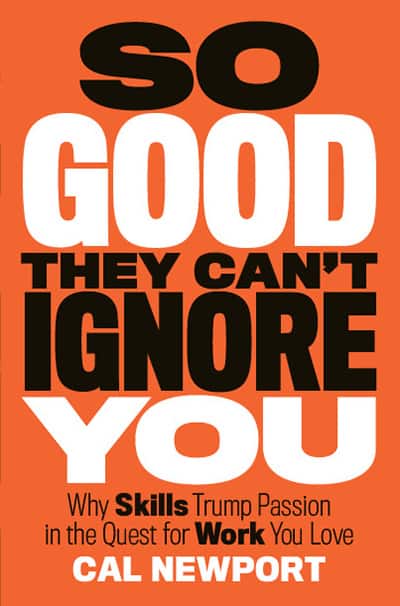
Cal Newport is the author of So Good They Can't Ignore You: Why Skills Trump Passion in the Quest for Work You Love (2012). In the video from the 2012 World Domination Summit, he dispels the "follow your passion" advice so many of us have been given and passed on to others. This video made the rounds on Facebook for a while - I am just now getting around to sharing it here.

Here is the blurb for his book:
In this eye-opening account, Cal Newport debunks the long-held belief that "follow your passion" is good advice. Not only is the cliché flawed-preexisting passions are rare and have little to do with how most people end up loving their work-but it can also be dangerous, leading to anxiety and chronic job hopping.

After making his case against passion, Newport sets out on a quest to discover the reality of how people end up loving what they do. Spending time with organic farmers, venture capitalists, screenwriters, freelance computer programmers, and others who admitted to deriving great satisfaction from their work, Newport uncovers the strategies they used and the pitfalls they avoided in developing their compelling careers.

Matching your job to a preexisting passion does not matter, he reveals. Passion comes after you put in the hard work to become excellent at something valuable, not before.
In other words, what you do for a living is much less important than how you do it.

With a title taken from the comedian Steve Martin, who once said his advice for aspiring entertainers was to "be so good they can't ignore you," Cal Newport's clearly written manifesto is mandatory reading for anyone fretting about what to do with their life, or frustrated by their current job situation and eager to find a fresh new way to take control of their livelihood. He provides an evidence-based blueprint for creating work you love.

SO GOOD THEY CAN'T IGNORE YOU will change the way we think about our careers, happiness, and the crafting of a remarkable life.
Cal Newport is an Assistant Professor of Computer Science at Georgetown University, who specializes in the theory of distributed algorithms. He previously earned his Ph.D. from MIT in 2009 and graduated from Dartmouth College in 2004.

In addition to his academic work, Newport is a writer who focuses on contrarian, evidence-based advice for building a successful and fulfilling life in school and after graduation.

'Follow Your Passion' Is Wrong: Cal Newport speaks at World Domination Summit 2012

Published on Jan 29, 2013


"The path to a passionate life is often way more complex than the simple advice 'follow your passion' would suggest."
You've been told you should follow your passion, to do what you love and the money will follow. But how sound is this advice? Cal Newport argues that it's astonishingly wrong.

You can find out more in his book, So Good They Can't Ignore You: Why Skills Trump Passion in the Quest for Work You Love.

Wednesday, January 01, 2014

Awakening the Dreamer: Changing the Dream


This is kind of cool - a little inspiration to begin the new year. There is about 90 minutes total in the two parts of the video - the creators designed the series (actually 6 modules) to be viewed all at once.


Awakening the Dreamer: Changing the Dream

Part 1

Part 2

The Awakening the Dreamer Symposium awakens future game changers to the need for, and opportunity of, bringing forth a new future for everyone. The half-day program with skilled facilitators takes place in-person around the United States and in 77 other countries, and is also available via video that can be watched at your convenience. In this workshop, you will have the opportunity to take a stand for the sustainable, just, and fulfilling future you want to see.


Wake up to your own role in creating a new future. This new perspective of the current state of our planet features top scientific, indigenous and activist minds from around the world. Now available for the first-time ever on video, The Awakening the Dreamer, Changing the Dream Symposium empowers participants to respond to the urgency and the opportunity of our times with action and informed, grounded optimism. Taped live, the Symposium features leading-edge information, inspiring multimedia and transformative exercises for an experience like none other. Together, we can change the world.

Worksheets: Personal Plan for Getting Into Action / Declaration Card

Sunday, October 13, 2013

The Daily Show Exclusive - Malala Yousafzai Extended Interview


By now, most people have seen at least parts of these videos and/or read excerpts of Malala Yousafzai's comments to Jon Stewart (who is genuinely humbled by the wisdom and courage of this 16-year-old girl) about her experiences as an advocate for education in Pakistan and the assassination attempt that brought her international attention - and got her out of Pakistan to continue sharing her message of peace and hope.

Her new book is called, I Am Malala: The Girl Who Stood Up for Education and Was Shot by the Taliban.

Here is the full, unedited interview she did with Jon Stewart a few days ago on The Daily Show. She is an amazing and inspiring human being.

Exclusive - Malala Yousafzai Extended Interview Pt. 1

Tuesday October 8, 2013

In this exclusive, unedited interview, "I Am Malala" author Malala Yousafzai remembers the Taliban's rise to power in her Pakistani hometown. (06:17)


Exclusive - Malala Yousafzai Extended Interview Pt. 2

Tuesday October 8, 2013

In this exclusive, unedited interview, Malala Yousafzai describes the beauty of her homeland and the cruelty of the Taliban. (05:29)


Exclusive - Malala Yousafzai Extended Interview Pt. 3

Tuesday October 8, 2013

In this exclusive, unedited interview, Malala Yousafzai offers suggestions for Americans looking to help out overseas and stresses the importance of education. (04:10)

Friday, January 25, 2013

What Would You Be Willing to Sacrifice?


Very cool video from the On Being blog.

What Would You Be Willing to Sacrifice?

BY TRENT GILLISS | FRIDAY, APRIL 20, 2012

"This project isn't about making images. It's not about creating the world's largest camera. It's about doing what you love. If you had been searching your whole life for something you love, what would you be willing to sacrifice?" ~ Ian Ruhter, from Silver & Light
I can't remember watching something so heart-breakingly gorgeous, unswerving in its emotional sway, inspirational to the point of forcing me to wonder about my current station in life. What am I doing here?

Thursday, November 22, 2012

Ed and Deb Shapiro - What Are You Grateful For?


Contrary to what I have been hearing in the media, at the gym, or among my clients, today is NOT turkey day . . . it's Thanksgiving. It's NOT a day to get together with our friends and families and drink too much, revive ancient wounds, and eat until we fall into a carbohydrate induced coma . . . it's a day to share our gratitude and thankfulness for friends, family (if one is grateful for them), and all the good things in our lives. It's a day when the glass is always half full, when we count our blessings, and when we try to see the best in other people.

Obviously, for many people in this country, there is little to be grateful for - homes have been lost, unemployment is still exceptionally high even as corporations bring in record profits, there is illness and disease and war and violence and addictions and any other kind of suffering one can imagine. And yet, we are alive . . . until they put me in the ground and roll my box into the furnace, I hold on to the hope that things will be better tomorrow, or tomorrow, or tomorrow. And even if we have nothing, tomorrow things may change . . . and while work toward that better day, we can be grateful for those who help us along the way, for strangers who smile as they pass, for anything that touches our hearts.


Friday, October 19, 2012

Peter Buffett - The Possibility of Transformation


Utne Reader recently posted this article from Peter Buffett, son of billionaire Warren Buffett, on how a single musical experience changed his life. The musician who played that night was William Ackerman, one of the originators of the acoustic guitar New Age music genre (co-founder of Windham Records).

Here is a video of Ackerman, with one of the greatest guitarists to ever pick up the instrument, Michael Hedges, playing "Hawk Circle," a song Ackerman originally performed with pianist George Winston.


It's easy to see how a young aspiring musician might be inspired and transformed by this music. I have included one of Buffett's videos at the bottom - not my style, but not bad music.

The Possibility of Transformation

 
Peter Buffett, son of billionaire investor Warren Buffett, is an Emmy Award-winning composer, NY Times best-selling author and noted philanthropist. Currently, he is releasing socially-conscious music and touring his "Concert & Conversation" series in support of his book Life Is What You Make It.

butterfly

This is a song about transformation. While that may not be readily apparent by listening, it's the story behind it that explains why this is so:

“Butterfly” by Peter Buffett

I grew up in a house with an upright piano. As soon as I could stand tall enough to reach the keys, I would bang out expressions. Thunder on the low keys, rain on top. Soon these turned into little melodies. Or I would use the keyboard to try and decipher the mystery behind what made a good song so good.

I was taking lessons by the time I went into the first grade. But after learning the basics of scales and correct fingering, I started to get frustrated at all those black dots and lines on the page. It was a lot more fun to make things up; to try and capture the ideas I heard in my head.
By the time I was in high school, I was playing four-handed piano with a friend and soon realized that my skills were limited. I just couldn't hear the kinds of things he was hearing. I couldn't seem to sense what complexities lay beneath the simple melodies and harmonic structure that came naturally to me. And while I never really considered that music would be any more than a pleasant diversion, this greater awareness of my limitations sealed the deal.

I went off to college without a clear idea of what would come of it. Taking everything that ended in 101 or -ology, I enjoyed learning a little about a lot of things. But nothing reached in and said, "This is your life!"

I was fortunate to have a little money set aside that allowed me to buy a portable piano and a 4-track reel to reel tape recorder. So I would continue to play and write songs when I wasn't in school. It was also around this time that my continual wish that I could play the guitar came into full bloom. Oh how nice it would be to grab a guitar and head to the beach and play. Somehow, strapping a piano to my back just wasn't an option.

College progressed and there was no clear path in sight.

One night, a friend suggested I come over to his dorm and check out a local guitar player that was coming by to perform. I did, and it changed my life.

Here was someone—William Ackerman, to be specific—who was sitting on the floor playing from his heart. Simple melodies that spoke so much more than any complex chord or harmonic structure could ever do.

I raced home and started to create songs that were both new, and that I knew by heart. From that point forward music would be the driving force in my life. I wish I could say precisely what that moment triggered in me. But I do know that it took every aspect of my life up until that point to make that moment what it was. I couldn't have planned it. And I couldn't have made it happen any sooner. All the experiences and frustrations—smart choices and wrong directions—lead me right to the perfect place.

Since then, I've still always wanted to play the guitar. To be able to sit down and just let my heart speak through the strings. But ultimately, I never had the discipline to learn.

So now, as of the latest download of the latest version of "this really sounds like a guitar," I can sit at the piano and let my hands believe they are holding a guitar and my fingers believe that they are playing the strings.

This song is about the beginning of my journey into a life of music. And the completion of one part I wasn't so sure would ever be possible: to create the sounds I would make if I just sat down with a guitar and free associated as I would if I could really play one.

Like a butterfly, my fingers would light where they would and then move on. I wonder if the butterfly remembers the comfort of its cocoon? And what made it too uncomfortable to stay there? There's the possibility of transformation in each of us. What will it take? Too much discomfort with the old? Or a path as clear as a guitar player playing from his heart?
 
What do you think? Share your story at changeourstory.com . Visit www.peterbuffett.com to learn more and Change Our Story to join the conversation on how we all can become active participants in shaping our future.


Image courtesy of Randy Read, licensed under Creative Commons. 

Monday, June 18, 2012

Big Think - Henry Rollins: The One Decision That Changed My Life Forever


This is an excellent post from my favorite punk philosopher, Henry Rollins, on taking risks to get the life we want. He risked giving up a steady job as a young man to try being a punk rock singer - the band that invited him to sing was Black Flag, and the rest is music history.

Henry Rollins is a musical icon, a speaks-his-mind philosopher, and a political progressive - I love that combination. Among his many endeavors (author, poet, comedian, DJ, musician, publisher, and actor [season two of Sons of Anarchy, a great show]), Rollins has also campaigned for various political causes in the United States, including promoting LGBT rights, World Hunger Relief, and an end to war in particular, and tours overseas with the United Service Organizations to entertain American troops.

It's never too late - until they put you in the ground - to follow our dreams in small or large ways. When I die, I don't want to regret all the risks I did not take in order to live a safe life.


Henry Rollins: The One Decision That Changed My Life Forever


What's the Big Idea? 

Black-flag1There's a lot of talk in the business-self-help sphere these days about risk and failure being essential to success. There is "fail camp." There is this book.

As Nobel Laureate psychologist Daniel Kahneman told us recently, the thing about risk is that it's risky. The economy may benefit from the handful of startups that survive their first five years, but at the level of the individual, there are a lot of casualties. This is true in the arts, too, which is another kind of entrepreneurship. According to Kahneman (warning: bummer approaching), aspiring at age 20 to be an actor is a significant predictor of unhappiness at age 40. I wonder whether aspiring to nothing at age 20 is a significant predictor of mild, glassy-eyed contentment in later life . . .

So what's a young hopeful to do? Well, there are basically two options: find a more or less "safe," all-consuming career path that you can live with (there seem to be fewer and fewer of these all the time), or accept the uncertainty, pick a direction, and charge full steam ahead. And maybe work a restaurant job or two along the way.

In the case of Henry Rollins, a serial artistic entrepreneur and iconic self-made man, the decisive moment was especially stark.


What's the Significance? 

Rollins didn't have an easy childhood. He struggled through high school with hyperactivity and extreme anger issues, dropped out of college after a year because it was too expensive, and supported himself in young adulthood by delivering livers for transplants. By 1980, at age 19, Rollins had risen to manager of Haagen Dazs, a hard-earned job he took seriously.

He was pals with the band Black Flag. At a show in New York, the band let Rollins jump in for one song. Ironically, he sang "Clocked In:"
i have this problem every morning
i gotta' face the clock;
punch in, punch out, it makes me so pissed off
one of these days i'm gonna smash it off the wall!
Unbeknownst to Rollins, Black Flag was looking for a new lead singer. A couple of days later, they phoned and asked him to audition formally for the job.
Henry Rollins: I looked at the ice cream scoop in my hand...my chocolate-bespattered apron...and my future in the world of minimum wage work...or I could go up to New York and audition for this crazy band who was my favorite. What's the worst that's gonna happen to me? I miss a day of work...ooh, there goes 21 bucks. 
In the audition, he sang every song the band had ever written, improvising most of the lyrics. Then came the scary part: he got the job.
Henry Rollins: They said 'Ok, you're in." I said "What do you mean?" They said "you're the singer in Black Flag." I said "So what do I do?" They said: "*snort* you quit your job, you pack your gear, you meet us on the road. Here's the tour itinerary. Here's the lyrics."  
That was 30 years ago. The years Rollins spent in Black Flag launched his career as a musician, writer, and performer. He seized the opportunity, ran with it, and numerous albums, books, films and tv shows later, he's still running. Rollins says of the Black Flag audition that he "won the lottery." Ok, the timing was lucky. But it was Rollins' energy as part of the DC punk scene (while working those day jobs) that earned him Black Flag's friendship, which got him the guest-spot, which got him the audition. And a less humble, hardworking guy might very well have burned out after a year on tour and ended up at rehab, then back at Haagen Dazs.

Instead, Rollins took calculated risk and decisive action at the right moment, then committed fully to making the most of the life he'd chosen for himself. And instead of resting on his laurels, he's continued to learn, grow, and reinvent himself. That's what makes him heroic. What Kahneman's studies don't tell us is which of those once-aspiring actors worked tirelessly to create, then seize opportunity, nor how many of those failed entrepreneurs picked themselves up and went on to succeed in other bold ventures.

What we do know is that more or less anybody who has ever done anything newsworthy can cite, as Rollins can, some turning point at which they made a risky decision that paid off, and a lifelong sense of mission not easily derailed by minor failures.

Follow Jason Gots (@jgots) on Twitter

Image credit: Punkstory.com

Friday, May 11, 2012

TEDxCalgary - Louise Gallagher - Lessons in Love: How Volunteering Saved My Life

I often encourage my clients (both therapeutic and personal training) to make time to volunteer if at all possible. There is something very healing about giving of ourselves to serve others. I just had this conversation with a client the other day.


So it seems a bit of synchronicity that Louise Gallagher sent me an email to let me know about her talk at TEDxCalgary on how volunteering saved her life. She is the author of The Dandelion Spirit (available through her blog).


TEDxCalgary - Louise Gallagher - Lessons in Love: How Volunteering Saved My Life
Louise Gallagher has a remarkable personal story that has turned tragic circumstances into a life filled with passion and joy. Her book The Dandelion Spirit was turned into a documentary for the Oprah Network and has touched people's lives across North America.

Louise's work at the Calgary Drop-In Centre includes inspiring efforts like the development of the Possibilities Project that uses art in its many forms to keep people of the streets.

She has the soul of a warrior poet and her story is transformative.

Thursday, April 28, 2011

Bon Jovi's New Restaurant Is Pay-What-You-Can

Good for Jon - nice that he can offer this format. Maybe others who are not in it for the profit (and/or don't need the profit) will do something similar. Featured at Take Part: Inspiration to Action.

Bon Jovi's New Restaurant Is Pay-What-You-Can

By Megan Bedard

Hungry for Change
jbj

For anyone who's living on a prayer—or looking to give love a good name—a new opportunity is springing up in Red Bank, New Jersey: it's Jon Bon Jovi's Soul Kitchen, a restaurant where patrons pay what they can afford and volunteers help run the restaurant.

The Soul Kitchen, which will enjoy a grand opening this Spring, is founded on the principle that a healthy meal can feed the soul. Diners can pick any item on the menu and pay what they're able. Patrons who don't have money can volunteer an hour of their time in the kitchen to cover the cost of their meal, and anyone who can afford to give a little more than the recommended donation of $10 will be helping to feed someone with less means.

Most importantly, stresses the Kitchen's website, the restaurant is a place for conversation and community. Volunteer staff serve diners with respect and friendliness, and patrons are encouraged to meet and greet new friends.

Check out the Soul Kitchen's video.


Thursday, February 17, 2011

TED Talks: Jacqueline Novogratz - Inspiring a life of immersion

From TED Talks: We each want to live a life of purpose, but where to start? In this luminous, wide-ranging talk, Jacqueline Novogratz introduces us to people she's met in her work in "patient capital" -- people who have immersed themselves in a cause, a community, a passion for justice. These human stories carry powerful moments of inspiration.

Why You Should Listen to Her:

One of the most innovative players shaping philanthropy today, Jacqueline Novogratz is redefining the way problems of poverty can be solved around the world. Drawing on her past experience in banking, microfinance and traditional philanthropy, Novogratz has become a leading proponent for financing entrepreneurs and enterprises that can bring affordable clean water, housing and healthcare to poor people so that they no longer have to depend on the disappointing results and lack of accountability seen in traditional charity and old-fashioned aid.

The Acumen Fund, which she founded in 2001, has an ambitious plan: to create a blueprint for alleviating poverty using market-oriented approaches. Indeed, Acumen has more in common with a venture capital fund than a typical nonprofit. Rather than handing out grants, Acumen invests in fledgling companies and organizations that bring critical -- often life-altering -- products and services to the world's poor. Like VCs, Acumen offers not just money, but also infrastructure and management expertise. From drip-irrigation systems in India to malaria-preventing bed nets in Tanzania to a low-cost mortgage program in Pakistan, Acumen's portfolio offers important case studies for entrepreneurial efforts aimed at the vastly underserved market of those making less than $4/day.

It's a fascinating model that's shaken up philanthropy and investment communities alike. Acumen Fund manages more than $20 million in investments aimed at serving the poor. And most of their projects deliver stunning, inspiring results. Their success can be traced back to Novogratz herself, who possesses that rarest combination of business savvy and cultural sensitivity. In addition to seeking out sound business models, she places great importance on identifying solutions from within communities rather than imposing them from the outside. “People don't want handouts," Novogratz said at TEDGlobal 2005. "They want to make their own decisions, to solve their own problems.”

In her new book, The Blue Sweater: Bridging the Gap Between Rich and Poor in an Interconnected World, she tells stories from the new philanthropy, which emphasizes sustainable bottom-up solutions over traditional top-down aid.


Tags: , , , , , , , , , , , , , ,

Wednesday, February 11, 2009

Seed - Nepal: Wireless in the Mountains

I liked this brief article from Seed Magazine on efforts to transform a small Nepalese village with WiFi and hydropower generated internet connections. Very cool what a few caring human beings can do for other human beings who just need a little assistance.

A home WiFi kit and a solar-powered relay station transform healthcare and education for a remote village in western Nepal.

by Gaia Vince

There is no road to Nangi. Reaching this remote mountain village in western Nepal involves a full day's hike up near vertical paths from the nearest town, Beni. I set off at first light with my guide, Mahabir Pun, a former teacher from Nangi, and it's not long before my pack is straining my shoulders and my legs are complaining. We see no other Westerners, just local people commuting up and down between villages, and traders carrying impossibly large baskets of oranges from the higher slopes to the markets below.

As we climb, stopping frequently to rest and admire the view while snacking on peanuts and sweet oranges, we chat in panting bursts. Mahabir, something of a celebrity in these parts, despite his grubby outfit and self-effacing manner, tells me about his lifelong quest to transform his tribe's villages through the unlikely medium of WiFi. Nangi village, home to around 800 people, has no telephone line or cell phone receptivity. Most of its residents are subsistence vegetable farmers, yak herders, and those who leave to seek their fortune as Gurkha soldiers. Mahabir first used a pen and paper in seventh grade, at age 13, and a textbook in eighth grade; he knew he wanted better for himself and for his village. It took two years of writing daily application letters to universities and institutes in America before he was finally accepted with full scholarship on a degree course at the University of Nebraska in Kearney.

"I knew I wanted to change things in our villages. I wanted to bring an income in and better education and medical facilities," he says. Twenty-odd years after arriving in America, he returned to Nangi with his dream and an equally important folio of contacts.

It is dusk and 2,500 meters higher up by the time we are greeted with the excited "Namaste! Namaste!" of children who present us with garlands of sweet-scented golden flowers and escort us the last few yards to Nangi village. I meet people by candlelight and share a tasty curry of homegrown vegetables before falling into exhausted sleep in the thatched roundhouse.

In the morning Mahabir leads me through the small village, past women grinding masala spices and kneading dough for chapatis on wood and stone, past a circle of community leaders and elders sitting cross-legged and deep in discussion on the cold ground, to the school. Our short walk is sprinkled with smiles and greetings — everyone is glad to see Mahabir. At the far side of a rectangular patch of mud that serves as the football pitch and general assembly area for the Pun tribe is a row of low, wooden school huts.

I'm not sure what I was expecting, but this gleaming array of computers and monitors flanking both long walls is a pretty startling sight. Children, many barefoot, are hard at work, the only sound the clatter of keyboards. "You want to check your email?" Mahabir asks me, grinning at my surprise. At a school in London, these computer and internet facilities would be unusual — here, they are astonishing.

At the far end of a line of regular hardware, I spot something a little different — a couple of wooden boxes housing circuit boards. "Ah, these are the first computers that I built with recycled parts donated from old computers, because we couldn't afford new computers," Mahabir explains, adding that the village built a hydropower generator in the stream at the bottom of the village to power them. In 1997 Australian students donated the four adjacent computers, and people in the US and Europe sent over the rest in subsequent years.

With no telephone line, no way of funding a satellite phone link, and with the country in the grip of insurgency, Mahabir realized that to bring 21st-century communications facilities to his village, he would have to leapfrog the conventional technology route. In 2001 he wrote to a BBC radio show asking for help in using the recently developed home-WiFi technology to connect his village to the internet. Intrigued listeners emailed with advice and offers of assistance.

Backpacking volunteers from around the world smuggled in wireless equipment from the US and Britain after the Nepalese government banned its import and use during the insurgency, and suspicious Maoist rebels tried to destroy it. By 2003, with all the parts in place, Mahabir had linked Nangi to its nearest neighbour, Ramche, installed a solar-powered relay station (TV antennae fixed to a tall tree on a mountain peak) and from there sent the signal more than 20 kilometers away to Pokhara, which had a cable-optic connection to Kathmandu, the capital. Nangi was online.

Mahabir says he used a home WiFi kit from America that was recommended for use within a radius of 4 meters. "I emailed the company and told them that I had done 22 kilometers with it," he says. "I was hoping they might donate some equipment — but they didn't believe what I told them."

More than 40 other remote mountain villages (60,000 people) have now been networked and connected to the internet by Mahabir and his stream of enthusiastic volunteers, and many more are in the pipeline. The villagers are now able to communicate with people in other villages and even with their family members abroad by email and using VOIP (voice over internet protocol) phones, he says. Using the local VOIP system, they can talk for free within the village network.

As we embark on another full day's climb up to Relay No. 1 with spare parts to fix a broken component, Mahabir explains that email and phones are simply the means of achieving his goal of providing better education, health facilities, and an income to villagers. It's already working: Mahabir's "teleteaching" network allows the few good teachers in the region to train others and to provide direct instruction to students in any connected village school. Children surfing the net are learning about a whole world of opportunity outside of their isolated village. And Mahabir is developing an e-library of educational resources that will be free to use.

The technology has improved commerce, allowing yak farmers several days' walk away to talk to dealers and their families, and enabling people to sell everything from buffalo to homemade paper, jams, and honey. And the villages, many located on beautiful but little-visited trekking routes by the Annapurna range of mountains, are advertising their facilities for tourists. "We are setting up secure credit-card transaction facilities using the internet so that more tourists will come and provide an income stream to help finance the education and health projects," Mahabir says.

Telemedicine, via webcam, is now linking village clinics with a teaching hospital in Kathmandu. And nurses are getting trained in reproductive medicine and child care.

Mahabir, the one-man revolutionary, has still more plans to transform his village -including a yak crossbreeding farm in the mountains. He intends to cross the yaks, which can't live below 3,000 meters, with cows to produce a useful pack animal that is hardy, can live at lower elevations and also produces good milk. It hasn't been easy. The first 16 cows were lost to snow leopards; the yaks are now under more careful guard. Cattle are vital for the villagers because they produce dung that is used to fertilize the poor mountain soils, enabling their crops to grow.

But the cattle need food — ideally, something other than the villagers' crops. In another of his inspired projects, while all the villages around have been destroying their sparse forests for firewood, agricultural use, and building, Mahabir has fostered a substantial nursery from which he plants about 15,000 trees a year in Nangi, and more than 40,000 a year in the surrounding area. It provides the villagers with firewood and the cattle with fodder.

As Mahabir calls instructions to a guy at the top of a swaying tree who is working to fix the relay equipment, I realize that development in these remote rural villages need not be hostage to a failed government — all it takes is a true visionary with determination.

You can donate to Mahabir's project or find out about volunteer projects in the villages at: Nepalwireless.net.
Saturday, February 07, 2009

TED Talks - Sherwin Nuland: A meditation on hope

A nice TED Talk lecture from a man who is better know for his medical knowledge than his feelings about "softer" ideas.
Surgeon and writer Sherwin Nuland meditates on the idea of hope -- the desire to become our better selves and make a better world. It's a thoughtful 12 minutes that will help you focus on the road ahead.

Nuland was a practicing surgeon for 30 years and treated more than 10,000 patients. Now he is an author and speaker on topics no smaller than life and death, our minds, our morality, aging and the human spirit.

His 1995 book How We Die: Reflections on Life's Final Chapter demythologizes the process of dying. Through stories of real patients and his own family, he examines the seven most common causes of death: old age, cancer, AIDS, Alzheimer’s, accidents, heart disease and stroke, and their effects. The book, one of 10 he has written, won the National Book Award and spent 34 weeks on the New York Times best-seller list. His latest book is The Art of Aging: A Doctor's Prescription for Well-Being.

"He’s delved deeply into his sense of wonder at the human body’s capacity to sustain life and to support our pursuits of order and meaning."
National Public Radio


Friday, February 06, 2009

Rep. Ackerman on Madoff Fraud

This is what all of our representatives should be doing - this guy is my new hero. This comes after the Madoff whistle-blower testified about how many briefs he had filed (over 9 years) and how each of them fell on deaf ears.

First the whistle-blower:


Now the interrogation by Ackerman of those involved.

This morning, the House Financial Services Subcommittee on Capital Markets, Insurance, and Government Sponsored Enterprises is holding a hearing to assess the alleged $50 billion investment fraud engineered by Mr. Bernard L. Madoff. This is the second in a series of hearings that will help to guide the work of the Financial Services Committee and the Capital Markets Subcommittee in the 111th Congress in undertaking the most substantial rewrite of the laws governing the U.S. financial markets since the Great Depression. Rep. Gary Ackerman questioned witnesses from the Securities and Exchange Commission.

Learn more at: http://www.speaker.gov/blog/?p=1676


Thursday, January 22, 2009

In What Do You Have Faith?


Belief or Doubt?

"Doubt is most often the source of our powerlessness. To doubt is to be faithless, to be without hope or belief. When we doubt, our self-talk sound like this: 'I don't think I can. I don't think I will.' …To doubt is to have faith in the worst possible outcome. It is to believe in the perverseness of the universe, that even if I do well, something I don't know about will get in the way, sabotage me, or get me in the end."

~ Blaine Lee

Tuesday, January 20, 2009

Obama's Inauguration Speech

I thought it was a good speech - no soaring rhetoric or lofty ideals, but realistic, and grounded in the challenges - and opportunties - that face us in the coming years.

Here is the video, from MSNBC, via AlterNet (full text at the link).


Michael Gerson, who authored President George W. Bush's first and second inaugural addresses, wasn't impressed - the word "cliche" is used.

CJ Smith, however (not that he carries the name recognition of Gerson), was impressed.

Robert Schlesinger, at the US News and World Report blog, also liked the speech, seeing in it a classic theme in inaugural speeches.


Wednesday, December 24, 2008

Ego Development - 24 Truths to Remember

A little bit of wisdom to start the day, courtesy of Ego Development, a personal development blog. The post offers 24 nuggets of wisdom, but I am only posting a few of them here.

14) There are moments in life when you miss someone so much that you just want to pickhope them from your dreams and hug them for real! Hope you dream of that special someone.

15) Dream what you want to dream; go where you want to go; be what you want to be, because you have only one life and one chance to do all the things you want to do.

16) May you have enough happiness to make you sweet, enough trials to make you strong, enough sorrow to keep you human, enough hope to make you happy and enough money to buy me gifts!!

17) Always put yourself in others’ shoes. If you feel that it
hurts you, it probably hurts the person too.

18) A careless word may kndle strife; a cruel word may wreck a life; a timely word may level stress; a loving word may heal and bless.

19) The beginning of love is to let those we love be just
themselves and not twist them with our own image -otherwise; we love only the reflection of ourselves we find in them.

20) The happiest of people don’t necessarily have the best of
everything; they just make the most of everything that comes along their way.

21) Happiness lies for those who cry, those who hurt, those who have searched, and those who have tried, for only they can appreciate the importance of people who have touched their lives.

22) Love begins with a smile, grows with a kiss and ends with a tear.

23) The brightest future will always be based on a forgotten past, you can’t go on well in life until you let go of your past failures and heartaches.

24) When you were born, you were crying and everyone around you was smiling. Live your life so that when you die, you’re the one who is smiling and everyone around you is crying…

Go read the rest them.


Saturday, December 20, 2008

Global Orgasm for Peace - December 21, 2008


It's time for the third annual Global Orgasm for Peace event, as if we need a reason.
Global Orgasm

Welcome to the 3rd Annual
Global Orgasm for Peace

This year we’re synchronizing in the two-hour period around the Solstice, which falls on Sunday December 21 at 12.04 p.m. (four minutes after noon) Greenwich Mean Time. So in the U.K., Global-O time will be from 11 a.m. to 1 p.m.

Check the Global-O Time in your country

The world is celebrating the election of the new USA President, Barack Obama, and the hope for change that he has stirred in our hearts. We are riding the wave of joy and renewal, which gives us a flying start for this year’s Global O! It’s the Global OOObama Factor!

So let’s not waste this energy. Let’s send a wave of positive intention into the quantum field of the Earth. We will spike the charts at the Global Consciousness Project and lay a foundation for the ‘Mindful Alpha Male’ President to build on, to begin healing the damage done to the planet and all its species.

WHO? All Men and Women, you and everyone you know.

WHERE? Everywhere in the world, but especially in countries with weapons of mass destruction and places where violence is used in place of mediation.

WHEN? December 21st,
at 12:04 Universal Time (GMT)

WHY? To effect positive change in the energy field of the Earth through input of the largest possible instantaneous surge of human biological, mental and spiritual energy.

Wednesday, December 03, 2008

TED's Chris Anderson Talks Big Ideas with Alain de Botton

Cool discussion.

TED's Chris Anderson talks big ideas with Alain de Botton

TED curator Chris Anderson appears on BBC Radio 4's "iPM: Share What You Know" to discuss a provocative topic: Is the age of big ideas over? Chris debates the notion with philosopher Alain de Botton, the author of How Proust Can Change Your Life.

Here is the podcast from the BBC.

What's the big idea?

  • Jennifer Tracey
  • 28 Nov 08, 04:40 PM

Are there any original ideas left? What makes an idea unique and where do great ideas come from?

Entrepreneur and curator of TED talks Chris Anderson

Chris Anderson

and philosopher and writer Alain de Botton

Alain de Botton

discuss why 'big ideas' often get stuck and why we need to get out of our normal routine to let our imagination flow.

Add IPM Radio4's channel to your page

Visit the TED talks website for ideas and more on the TED event in Oxford.


Saturday, November 15, 2008

Bono's Letter to Obama

Interesting, posted at Jim Wallis's blog.

God's Politics

Obama’s Harmony of Intellect and Intuition

by Bono 11-07-2008

Mr. President, Barack,

Every room I have ever been in with you was a much easier room for your presence.

It’s rare to meet a person like you, where intellect and intuition make such a perfect rhyme.

Your intuition tells you that the well-being of the American people, spiritually as well as physically, is connected with America’s role in the world. I know you know that the prosperity of your fellow Americans, though hard fought, is less fulfilling knowing there is so much more that can be done to alleviate poverty and suffering in the developing world. You know that less than 1 percent of government income as a contribution from the world’s richest economy to the world’s poorest is not a fair tithe — even in times like these — which is why you have promised to double foreign assistance. As with our own personal sojourn, so it is with country and community -– we discover who we are in service to others.

I know your intellect — fashioned in the halls of Harvard and on the floor of the United States Senate — has weighed up the evidence on how effective American tax dollars are, when converted into smart, targeted, focused aid. Putting children into school where they can think freely of freedom. Giving farmers on the parched land seed varieties that double the size of their crop yields. Giving mothers 20 cent immunizations to protect their newborns from the deadly viruses that they pass on through childbirth. I know your intellect has taken in the data and seen the analysis on the transformative power of effective aid in places where the United States flag is currently not one smiled at. I know you know how much cheaper it is to make friends of potential enemies than to defend yourself at a later date. I know you know all this stuff.

My prayer for you is that your instinct and intellect stay in harmony in the difficult months and triumphant years ahead.

Bono is lead singer of U2 and co-founder of The ONE Campaign.