The Effect of Relationships on the Evolution of the Brain
posted on: April 10th, 2014
Your brain is the product of 3.5 billion years of intense evolutionary pressure, including 2.7 million years as tool-using hominids and over 100,000 years as homo sapiens.
Human DNA is about 98-99% identical to chimpanzee DNA. But that crucial 1-2% difference is mainly the genetic factors affecting the brain – especially for its relationship functions. In fact, the latest science suggests that the evolution of the brain was driven in two steps having to do with the survival benefits of strong relationships.
First, among vertebrates, many bird and mammal species developed pair bonding as a way to raise children who survived. (Remember that fish and reptiles generally do not raise their young and may in fact eat them if they happen upon them soon after they hatch.)
The “computational requirements” of choosing a good mate, working things out together, and then raising young to survive – hey, it’s just sparrow and squirrel couples, but anyone who has raised kids knows what I’m talking about – required larger brains than those of reptiles or fish that dealt with similar environmental challenges but made their way in life on their own.
By the way, it may be a source of satisfaction to some that polygamous species usually have the smallest brains.
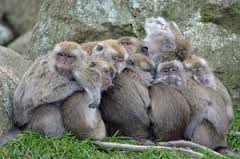
Second, building on this initial jump in brain size, among primate species, the larger the social group, the bigger the brain. (And the key word here is social , since group size alone doesn’t create a big brain; if it did, cattle would be geniuses.)
In other words, the “computational requirements” of dealing with lots of individuals – the alliances, the adversaries, all the politics! – in a baboon or ape troupe pushed the evolution of the brain.
In sum: More than learning how to use tools, more than being successful at violence, more than adapting to moving out of the forest into the grasslands of Africa, it was learning how to love and live with each other that drove human evolution!
Showing posts with label family. Show all posts
Showing posts with label family. Show all posts
Friday, April 11, 2014
Rick Hanson, PhD, The Effect of Relationships on the Evolution of the Brain
This is a brief but cool little article from Rick Hanson's blog - and this may be preaching to the choir, but it felt worth sharing.


Thursday, February 27, 2014
Family Problems Experienced in Childhood and Adolescence Affect Brain Development

Family problems are now recognized as a contributing factor for mental illness - and there is brain imaging research to support what many therapists have known for decades.
Using brain imaging technology to scan teenagers aged 17-19, the researchers in this study found that those who experienced mild to moderate family difficulties between birth and 11 years of age had a smaller cerebellum, which is an area of the brain associated with skill learning, stress regulation, and sensory-motor control. The researchers suggest that a smaller cerebellum may be a risk indicator of psychiatric disease later in life, as it is consistently found to be smaller in virtually all psychiatric illnesses.
So when you hear that parents divorced for the kids (rather than staying together for the kids), there is evidence that they did the correct thing. Other more specific research has identified parental discord as a risk factor for children developing behavioral and mental health issues. And this is only one of many possible forms of "family problems."
Family problems experienced in childhood and adolescence affect brain development
Date: February 19, 2014
Source: University of East Anglia
Summary:
New research has revealed that exposure to common family problems during childhood and early adolescence affects brain development, which could lead to mental health issues in later life. The study used brain imaging technology to scan teenagers aged 17-19. It found that those who experienced mild to moderate family difficulties between birth and 11 years of age had developed a smaller cerebellum, an area of the brain associated with skill learning, stress regulation and sensory-motor control. The researchers also suggest that a smaller cerebellum may be a risk indicator of psychiatric disease later in life, as it is consistently found to be smaller in virtually all psychiatric illnesses.
Areas in blue are brain regions shown to be smaller as a result of childhood adversities occurring aged 0-11, and regions in orange are shown to be larger as a result of exposure to negative life events aged 14. Credit: Image courtesy of University of East Anglia
New research has revealed that exposure to common family problems during childhood and early adolescence affects brain development, which could lead to mental health issues in later life.
The study led by Dr Nicholas Walsh, lecturer in developmental psychology at the University of East Anglia (UEA), used brain imaging technology to scan teenagers aged 17-19. It found that those who experienced mild to moderate family difficulties between birth and 11 years of age had developed a smaller cerebellum, an area of the brain associated with skill learning, stress regulation and sensory-motor control. The researchers also suggest that a smaller cerebellum may be a risk indicator of psychiatric disease later in life, as it is consistently found to be smaller in virtually all psychiatric illnesses.
Previous studies have focused on the effects of severe neglect, abuse and maltreatment in childhood on brain development. However the aim of this research was to determine the impact, in currently healthy teenagers, of exposure to more common but relatively chronic forms of 'family-focused' problems. These could include significant arguments or tension between parents, physical or emotional abuse, lack of affection or communication between family members, and events which had a practical impact on daily family life and might have resulted in health, housing or school problems.
Dr Walsh, from UEA's School of Psychology, said: "These findings are important because exposure to adversities in childhood and adolescence is the biggest risk factor for later psychiatric disease. Also, psychiatric illnesses are a huge public health problem and the biggest cause of disability in the world.
"We show that exposure in childhood and early adolescence to even mild to moderate family difficulties, not just severe forms of abuse, neglect and maltreatment, may affect the developing adolescent brain. We also argue that a smaller cerebellum may be an indicator of mental health issues later on. Reducing exposure to adverse social environments during early life may enhance typical brain development and reduce subsequent mental health risks in adult life."
The study, which was conducted with the University of Cambridge and the Medical Research Council Cognition and Brain Sciences Unit, Cambridge, is published in the journal NeuroImage: Clinical.
The 58 teenagers who took part in the brain scanning were drawn from a larger study of 1200 young people, whose parents were asked to recall any negative life events their children had experienced between birth and 11 years of age. The interviews took place when the children were aged 14 and of the 58, 27 were classified as having been exposed to childhood adversities. At ages 14 and 17 the teenagers themselves also reported any negative events and difficulties they, their family or closest friends had experienced during the previous 12 months.
A "significant and unexpected" finding was that the participants who reported stressful experiences when aged 14 were subsequently found to have increased volume in more regions of the brain when they were scanned aged 17-19. Dr Walsh said this could mean that mild stress occurring later in development may 'inoculate' teenagers, enabling them to cope better with exposure to difficulties in later life, and that it is the severity and timing of the experiences that may be important.
"This study helps us understand the mechanisms in the brain by which exposure to problems in early-life leads to later psychiatric issues," said Dr Walsh. "It not only advances our understanding of how the general psychosocial environment affects brain development, but also suggests links between specific regions of the brain and individual psychosocial factors. We know that psychiatric risk factors do not occur in isolation but rather cluster together, and using a new technique we show how the general clustering of adversities affects brain development."
The researchers also found at that those who had experienced family problems were more likely to have had a diagnosed psychiatric illness, have a parent with a mental health disorder and have negative perceptions of their how their family functioned.
Story Source: The above story is based on materials provided by University of East Anglia. Note: Materials may be edited for content and length.
Journal Reference:
Nicholas D. Walsh, Tim Dalgleish, Michael V. Lombardo, Valerie J. Dunn, Anne-Laura Van Harmelen, Maria Ban, Ian M. Goodyer. General and specific effects of early-life psychosocial adversities on adolescent grey matter volume. NeuroImage: Clinical, 2014; 4: 308 DOI: 10.1016/j.nicl.2014.01.001

Friday, January 17, 2014
A First-Person Account of Schizophrenia and Recovery
From Salon, this is an interesting first-person account of one man's descent into and recovery from schizophrenia.
I thought I was a prophet
After my schizophrenic break, I couldn't even trust my own mind -- and it would be a long road back from the abyss
Friday, Aug 2, 2013 | Michael Hedrick
A photo of the author.
On the day I realized I was a prophet, I left my home in Colorado and began to hitch-hike to the U.N. I needed to save the world from its various evils. And I needed to go — now.
I spent the next several days wandering around the northeast, trying to decipher messages. I found codes in places where codes didn’t exist. I finally found my way back home, thanks to a quiet and generous woman who lived somewhere in rural Massachusetts, and when I got back, I explained to my parents that I was on a mission and this was God’s will. I’m sure there was some stuff about aliens and conspiracies in there, too.
And so, a week after my adventure began, I woke up in the psych ward of Boulder Community Hospital, and I spent the next seven days condemned to a hospital bed with waterproof sheets in a ward with eight other people who either didn’t talk or rambled so incoherently that it was impossible to understand them.
My parents came every day at 2 o’clock, when visiting hours began, and they brought me pillows and a down comforter and my favorite hoodie. Anything to make me more comfortable. Still, their visits were marred by hour-long screaming and crying matches in which I accused them of throwing me in a mental hospital to rot. Why was it so hard for them to understand? I was a prophet, and this was my magnum opus.
My parents didn’t know what had happened to their son. For that matter, I didn’t know what had happened to me either. And all of us wondered: Would I ever make it back?
Four and a half percent of all adults in the United States suffer with a serious mental illness. That equates to 14,125,500 people who struggle, day in and day out, not sure if they can trust their own thoughts. Many find support and do recover, but many more don’t. They become homeless, they languish on the fringes of society where they aren’t given the slightest thought, let alone assistance. I could have been one of them.
When I got out of the hospital, nobody knew what to do with me. (And I certainly didn’t know what to do with myself.) I moved back into my parents’ house and was treated with nervous caution. Mental illness was a foreign concept to them. Before I broke, they had blamed my strange behavior on marijuana. Now, they regarded me with a silence reserved for things they feared. And they were probably right to fear me. I was still sick and dangerously delusional.
It’s hard to explain the logic of a cracked mind, but I found personal threat in every tiny action or event. Once, I was seated at the piano, and my mother reached over me to lower the register, her hand brushing my lower stomach, and I was convinced she was trying to molest me. Another time, my dad and I were in the garage, trying to put new brake pads on my car, when I decided he was going to sabotage me so that I would lose control of my car, crash into a tree and die.
My mistrust of people was intense. Sometimes it felt like they existed only to harm me.
For instance, I was certain my psychiatrist was a quack. This is the psychiatrist who, over the course of the next six years, would guide me into stability, but when I first walked into his office I knew it was a ruse designed by my parents to convince me I was crazy. He wasn’t a real doctor. This was a set with props and actors. I remember being in the waiting room, seeing those magazines that stretched back two years, listening to the calm music and the sound of ocean waves on the speakers, sitting in the couches that seemed so real, looking at the diagnostic surveys and medicine prescriptions, and thinking: “Wow, they really pulled out all the stops with this one.”
Slowly it dawned on me: My thoughts were not real.
My initial diagnosis was bipolar. (Later it would be changed to schizoaffective disorder, and then schizophrenia with periods of depression.) And we began the long and frustrating battle to pinpoint the right medication. The first medication I tried gave me akathisia, a side effect in which you have an intense and extremely uncomfortable urge to move at all times. For weeks, I stayed in this particular hell, and I would spend hours on the treadmill or walking around the neighborhood in an attempt to shake the feeling that I could rip off my skin at any point.
We switched that, and switched it again, a process that took years. Eventually, we found a medication that worked on my mind, though sadly, not with my body. I gained about 100 pounds, took up smoking and was too tired most days to get out of bed.
My parents became a source of strength during this time. They began attending support groups and integrating themselves into the local mental illness community. They fought bureaucracy and headaches to secure me government assistance.
I moved into my own place, and for years I kept my diagnosis a secret. I still longed to live a normal life, even as I struggled with my paranoia. So I spent my time alone. I was afraid to leave my house, afraid to go into stores, because I was so quick to interpret random comments as criticism and ostracism. I just knew everyone was saying nasty things about me. I couldn’t even order a pizza without worrying that the delivery guy would get back into his car, think about that one expression I made, and tell all his friends what a freak I was.
To be unsure of your own mind is a prison, one that can break some of us. It simply becomes easier to slip into homelessness or drug abuse, but I fought against that. I began studying normal behavior. I read books on psychology, body language, dating technique — anything that would help me build a repertoire of healthy social interactions and somehow guide me into acting like a functioning human being.
I got better. Sometimes, I’m so much better that I question if I really have any illness. I’ll have a good month — no paranoia, no depression, lots of joking around — and I think, have I nipped this in the bud? Am I the first person in the history of medicine to cure myself of schizophrenia? The seductive thought arises: Maybe I could skip my meds tonight and see how I feel in the morning. The meds make me so miserable. Maybe I could actually be free of this stuff.
Those are the nights when I feel empowered enough to go to some bar where hipsters are trying to have sex with one another, but in every conversation I start to worry that the other person has found something wrong with the way I look, or the way I move, or the way I talk. I get so overwhelmed that I have to go outside and smoke, and I think: God, I just want to go home. And then when I get home I take my meds and go to bed — the habit that will keep me sane — and when I wake up in the morning I feel fine, and that’s pretty much all I can ask. The truth is, the meds make me feel OK, and OK is always better than bat-shit insane.
I’m pretty stable these days. I have good health care and a good family who watch out for my red flags. I have the semblance of a career. I do wish my prospects for love were better. Every piece of romantic advice says you should just be yourself, but it’s hard to do that when your self is a 400-pound schizophrenic. I’ve been on dates before, but it’s hard to snuff out the fear that everyone in the café is laughing at me. I don’t know if I’ll ever get over that hurdle, but I hurt for companionship. I want someone besides my mom to rub my shoulders when I’m tense, to talk me down from my scary thoughts, to give me a hug when I feel low.
My parents tell me, “It’ll happen if it’s meant to be.” So maybe it isn’t meant to be. I can live with that, I guess, though it still stings when I see my friends getting married on Facebook or when I catch a rom-com on TV. But I’ve had to adjust a lot of my expectations for having a normal life. I realize that my challenge, ultimately, is to simply be all right by myself.
The only cure for paranoia is self-assurance, which comes from an intense and radical self-acceptance. You have to learn to accept yourself and everything you fear. You should try it sometime. You don’t have to be schizophrenic to find it useful.
It isn’t easy to be crazy. But my seven years on this path have taught me that people with mental illness are some of the most resilient and courageous people there are. They don’t pretend to be someone else. They have a raw authenticity that can scare people, and I see why. They show you their warts — demonic voices and all.
The media hasn’t helped in portraying mental illness as something to fear. After any massacre or inexplicable tragedy, you can count on a slew of pieces that explain how the killer was a quiet man who kept to himself and exhibited some strange behavior in the past. But endless studies have shown that people with major mental illness are much more likely to be victims of senseless crimes than to be perpetrators. Still, we struggle with the idea that we are monsters.
Maybe it’s up to me, and articles like this, to change minds.
~ Michael Hedrick is a writer and photographer based in Boulder, CO. He is currently a regular contributor for Thought Catalog but dreams of being paid to write a regular column for some big publication. His book "Schizophrenic Connections" is available here.
More Michael Hedrick.

Sunday, December 15, 2013
Holding the Sun (A Family Deals with Schizophrenia)

Via Documentary Heaven, this is a disturbing and sad account of one family's struggles with how to support and cope with a schizophrenic son. I want to add, however, that Aaron's violence is not typical of schizophrenics or of any other form of non-drug-induced psychosis. It's sad, but it is not common.
Holding the Sun
In Holding the Sun we get to look into a Canadian family’s struggle to save their son from schizophrenia and cope with the consequences of the condition. The Millar family was torn apart when on May 30th, 1997, Ruth Millar’s son Aaron came calmly up behind her and stuck a sword through her heart. Earlier that morning Ruth wrote to her husband about Aaron’s schizophrenia. She said he was looking quite psychotic these days, not in a harmful way but simply because he lives in his own world. She explained that he would not let her show any affection towards him and had changed from the once warm loving Aaron into a person she hardly knew.
Ruth’s husband of 28 years, Ramsay Millar, says that above all people simply need to be educated about this disease. He says it is more important than money or anything that causes more fear and less compassion. Christine Millar, Aaron’s older sister discusses how she has had to cope with her mother’s death as well as caring for Aaron. It is difficult to balance the anger of what he did to her mother with knowing it wasn’t his fault and that he now has to live with that every day. Christine won’t leave him, as difficult as it is; she doesn’t want Aaron to end up on the streets like so many people do with mental illnesses. The documentary follows the Millars’ story of how they tried to access mental health care for Aaron and how his life has returned to reality once he gets the proper treatment they were seeking for him. The past two years brought devastation to their family and Holding the Sun shines a light on the difficult situation that many families who have a child with schizophrenia can relate to.
Monday, September 30, 2013
Breaking Bad Is Over and Everyone Has an Opinion
Last night was the final 75 minutes of one of the most compelling television shows in my lifetime. I can not remember and show whose final episodes has engendered such a profusion of opinions, assessments, analysis, or explication. Many bloggers and critics are reading this series as one might read a novel . . . and employing many of the same tools of exegesis.
ALL of the articles listed below were written before the airing of the final episode, so none of them have the advantage of knowing the whole story, yet they still have a profound need to write, including at least one plea for Walt's death.
I'm just posting a little taste of these articles - follow the links to read the whole of any article(s) about which you are curious. Here they are, in no particular order.
ALL of the articles listed below were written before the airing of the final episode, so none of them have the advantage of knowing the whole story, yet they still have a profound need to write, including at least one plea for Walt's death.
I'm just posting a little taste of these articles - follow the links to read the whole of any article(s) about which you are curious. Here they are, in no particular order.
Why You’re Hooked On Breaking Bad
The show developed legions of fans thanks to deft writing, superb acting and the miracles of binge-watching
By Eric Dodds
Sept. 28, 2013

Though the premise for Breaking Bad — a high school chemistry teacher transforms himself into a meth kingpin — might sound far-fetched, the explanation for Walter White’s rapid ascension to the top of the drug game is not. He has the best product, the best distribution and the best reputation. In the landscape of television dramas, the same is true of Breaking Bad show-runner Vince Gilligan.
Since its debut in 2008, Breaking Bad has arguably been the best drama on television — not unlike Heisenberg’s blue meth. Of course, there are plenty of other reasons why the show has become so incredibly popular over the last year (we’ll get to those in a bit), but that popularity begins and ends with the fact that Breaking Bad is simply better than its peers. That superiority is thanks, in large part, to Gilligan, who was a writer for the X-Files prior to creating Bad. His vision for the show (taking Mr. Chips and turning him into Scarface) has been unwavering since the beginning, but what’s far more impressive is the way in which he has realized that vision without veering off into the convoluted plot twists and unnecessary melodrama that afflicted so many of Bad‘s contemporaries.
* * * * *
“Breaking Bad”: Walter White must be punished – America, finally, needs to see someone pay
We'll be rooting for justice because there's so little of it: Jamie Dimon walks free but whistleblowers face prison
By Colin McEnroe

Jamie Dimon, Walter White, James Clapper (Credit: AMC/Ursula Coyote/Reuters/Gary Cameron/Jason Reed)
You may be aswim with doubts about the real-world efficacy of punishment, the usefulness of the “war on drugs” and the morality of the death penalty, but I’m betting you expect to see Walter White die in the final episode of “Breaking Bad.” I’m betting you even need that.
Maybe it’s a little easier because Walt is dying from cancer anyway. He’s a pre-digested protein. He’ll zoom through Death’s intestines like a kid on a water park slide.
We all have strong ideas about the fates of Walt and the people around him partly because – here in real life — crime and punishment seem more disjointed from one another than ever before. You’re more likely to be prosecuted for lying to Congress about steroids and strikeouts than for bald-faced perjury about the wholesale government espionage directed at all of its citizens. You can run a major investment bank using the handbook from a pirate ship and never face criminal indictment. Blow the whistle about war crimes, and you could be looking at serious prison time.
And it’s not just the crimes. There’s something in Walt’s self-righteous tone and his indifference to the little people who get hurt that we recognize from today’s news. In 2010, Charlie Munger, number two guy at Berkshire Hathaway, was asked if bailout money should have gone to beleaguered homeowners instead of to big banks. His answer: “At a certain place, you’ve got to say to people: Suck it in and cope, Buddy. Suck it in and cope.” And this week AIG CEO Robert Benmosche told the Wall Street Journal the public caterwauling about bonuses for executives at bailed-out banks was “just as bad and just as wrong” as the lynchings decades ago in the Deep South.

* * * * *
The hidden clues to “Breaking Bad’s” meaning
The show's many visual "Easter eggs" reveal its deeper message
By Michael Darnell

Aaron Paul as Jesse Pinkman in "Breaking Bad" (Credit: AMC/Ursula Coyote)

At the end of “Breaking Bad’s” five-season run, I, like so many others, have turned to the Internet to squeeze every last drop of enjoyment from this remarkably rich series. Redditors in particular have long been poring over the subtle callbacks and visual motifs that have become “Breaking Bad’s” signature, compiling a virtual archive of many details that I, for one, missed on my first viewing. (This piece is much indebted to the Redditors’ keen eyes.) Much has been made, for example, of Season 2′s pink teddy bear, which, having fallen in the wreckage of Wayfarer 515, haunts the show as a constant reminder of the chaos wrought by Walter White. These Easter eggs are a reward to dedicated fans and a boon to television theorists who read them as messages from Vince Gilligan himself. But they’re also invitations for an ethical interpretation of a show based around the effects of violence.
“Breaking Bad’s” main ethical dilemma challenges the viewer to decide at what point Walter White ceases to be the hero and starts to be the villain of his own story; and implicit to this question are still stickier ones. What acts of violence are we prepared to accept as somehow not bad enough to deserve our contempt? And why are we willing to condone our protagonist’s violence while condemning the violence of others?
The pink teddy bear invites us to consider these questions by subtly connecting three seemingly unrelated acts of violence with the visual of a half-destroyed face. The charred bear initially signals Walt’s indirect blame for the death of Jesse Pinkman’s girlfriend Jane when he chooses not to save her from a fatal overdose. His inaction ultimately leads Jane’s grieving father, an air traffic controller, to cause the midair collision where we first see the bear. Two seasons later, after we’ve forgotten Wayfarer 515 and the telltale teddy bear, the symbol returns as the mangled face of drug lord Gus Fring who, himself guilty of several grisly murders, is justifiably (apparently) killed by Hector Salamanca at Walt’s behest. And most recently, Jesse’s face is similarly mutilated after Walt hands him over to the Aryan Brotherhood for going to the DEA.
The One Who Knocked First
From start to finish, Breaking Bad has echoed the uncannily similar—and equally good—cop show The Shield.
By Mark Peters

Michael Chiklis on The Shield and Bryan Cranston on Breaking Bad. Photos courtesy FX, AMC
My favorite TV show is a Shakespearean tragedy in which the antihero’s sins, spinning out from a fatal decision he makes in the pilot, slowly destroy everyone around him. The main character insists he’s doing it all for his family—but he’s lying, especially to himself. There’s a lot of collateral damage, but this murderer’s worst crime might be the corruption of his vulnerable younger partner. The show maintains a remarkable level of quality throughout its run, and helped put its network on the map. It was largely carried by a great performance from its lead actor, a man previously known mainly for comedy who transformed himself into an Emmy-winning badass.
Of course, I’m talking about The Shield.
As Breaking Bad winds down, conventional wisdom says it’s a contender for Best Show Ever, along with The Wire and The Sopranos. No argument there. But major argument here: The Shield should be in that conversation, too. Shawn Ryan’s saga of Vic Mackey (Michael Chiklis) and the Strike Team, which aired on FX from 2002 to 2008, remains—pardon the expression—criminally underrated. It was every bit as riveting and consistent as Breaking Bad. And the two shows are also remarkably similar. In many ways, The Shield was Breaking Bad before Breaking Bad.
* * * * *
Breaking Bad Is TV’s Best Medical Drama, Ever
Not that there’s a lot of worthy competition.
By Haider Javed Warraich

Jesse Pinkman (Aarol Paul) in Breaking Bad | Courtesy of AMC
Breaking Bad is about a lot of things—the contextualization of evil, the blind bond of family, the consequences of lifelong repression—and of course, the macro and micro-economics of the methamphetamine industry. But wrapped within all of this is a medical drama unlike any other, possibly the best medical drama on TV, ever.
Not that current medical dramas offer any meaningful competition. Personal disclaimer: As a physician, I can’t stand watching medical dramas. They are inaccurate, over the top, and give a very poor representation of the environments we work in, the nature of the work, and the people involved. But my wife sees enough, leaving me to explain that not every shower taken in the hospital involves collateral canoodling à la Grey’s Anatomy or that it’s impossible for me to simultaneously do both surgery and cardiac catheterization and run all my own lab tests à la House. Even when there are interesting subplots, deeper themes, or stellar performances, the lack of overall believability makes it hard for me to become engrossed or to separate the medical setting from the drama.
* * * * *
Jesse Pinkman: One Sorry Individual
Every single bad thing that's happened to Breaking Bad’s saddest soul.
By Andrew Bouvé
Breaking Bad comes to an end Sunday after five grueling seasons, and no one has had a harder time than poor Jesse Pinkman. Here is our video goodbye.
* * * * *
Breaking Bad Has a Pinkman Problem
By Jessica Winter

In the pilot episode of Breaking Bad, Jesse Pinkman is sprinting away from the fearsome drug dealers Emilio and Krazy 8 when he trips and falls eye-socket-first onto a rock in the New Mexico desert. When he wakes up, he’ll have a scone-shaped shiner the color of a Marie Schrader accent wall. But for the moment, he’s out cold, and Emilio can’t resist kicking him—hard, spitefully, once in the side—when he’s down.
As goes Emilio, so goes Breaking Bad. This show has never passed up an opportunity to kick Jesse Pinkman when he’s down. It’s forever endeavoring to find new, more vigorous techniques for kicking him when he’s down—through pirouettes of plot and calisthenics of character development—and new, pliant body regions to kick or, when the kicking is done, punch or stomp or split open bleeding. What horrible thing hasn’t happened to Jesse, perhaps repeatedly, over the last five seasons? Psycho Tuco beat him bad enough to put him in the hospital. Psycho Hank beat him bad enough to put him in the hospital again. He awoke one morning to find his beloved Jane dead beside him. He feels responsible for the deaths of Jane and Combo and Tomás. He is responsible for the death of Gale, although Walter was the one really pulling the strings. He’s been rejected by his biological family, and lost his adopted one—Andrea and Brock—around the time that Walter decided the best plan of action for preserving his meth empire was to poison a small child and later plant a ricin cigarette in Jesse’s Roomba, just to reinforce one more time (but not one last time) what a stupid worthless junkie imbecile Jesse is, because that’s always been Walter’s favorite topic of discussion—his go-to when the cocktail chatter is flagging.
However difficult this may be to watch, Jesse’s ongoing abasement served a narrative purpose. Jesse evolved from bratty burnout to, for a time, the show’s most complex and interesting character—a “bad” kid who increasingly, desperately wanted to be good, without knowing that in the pitiless Breaking Bad universe, no good deed goes unpunished.
* * * * *
Breaking Bad: I Want Walter White to Survive the Finale
How wrong is it that some fans want this evil person to get away with his crimes?
By Charlotte Alter Sept. 27, 2013

Walter White (Bryan Cranston) | Frank Ockenfels/AMC
Unless you’re decomposing in a barrel of acid, you are likely aware that Breaking Bad ends this Sunday.
And unless you’re one of the 15% of Americans who don’t have Internet, you must also have come across some of the endless back-and-forth about how the show will end, and why. Who shall live, and who shall die; who by ricin and who by Uncle Jack; who shall be degraded and who shall be mourned.
But for some TV critics and active tweeters, the question of Breaking Bad’s ending has become as much a moral question as an artistic one. And while I love the back-and-forth, it’s getting a little sanctimonious for my taste.
You see, I want Walt to get away with all the horrible things he’s done. So sue me.
I’d like to see him drive across the desert with little Holly and a truck full of cash, off to start a new life somewhere like Mike and his granddaughter might have done. Skyler, I have a lot of respect for you, and I wish you the best. Walter Jr., whatever.
* * * * *
The World According to Team Walt
By ROSS DOUTHAT
Published: September 28, 2013
ACROSS five seasons of riveting television, the antihero of AMC’s “Breaking Bad,” Walter Hartwell White, has committed enough crimes to earn several life sentences from any reasonable jury. He has cooked crystal meth in bulk, hooking addicts from his native Albuquerque all the way to Prague. He has personally killed at least seven people and is implicated in the deaths of hundreds more. He has poisoned an innocent child, taken out a contract on his longtime partner, and stood by and watched a young woman choke to death.
But one thing he hasn’t done, as this weekend’s series finale looms, is entirely forfeit the sympathies of his audience. As a cultural phenomenon, this is the most striking aspect of “Breaking Bad” — the persistence, after everything he’s done, of a Team Walt that still wants him to prevail. In the online realms where hit shows are dissected, critics who pass judgment on Walt’s sins find themselves tangling with a multitude of commenters who don’t think he needs forgiveness. And it isn’t just the anonymous hordes who take his side. “You’d think I’d bear Walt some serious ill will considering he sat there and watched Jane die,” the actress who played his vomit-choked victim wrote for New York magazine last week, “but I’m still rooting for everything to work out for the guy.”
* * * * *
The Psychology of Becoming Walter White
Six reasons why breaking bad is easier than it looks
Published on September 28, 2013 by Thomas Hills, Ph.D. in Statistical Life

Vince Gilligan, creator of Breaking Bad, said that his goal with Walter White was to turn Mr. Chips into Scarface. Take a regular person, like you—assume you’re regular for a second—and then make you nice and evil, like a witch in a gingerbread house. Is that really even possible? Could you become another Walter White?
I’m inclined to believe that most of us still think some people are good and some people are bad, and never the twain shall meet. Despite the lessons we learned from Buffy the Vampire Slayer, we still think that good and evil belong in different people. Walter clearly shows that it doesn’t. And he demonstrates this with so many good psychological reasons—reasons that experimental psychologists observe in ‘normal’ people on a daily basis.
What are these reasons and do they apply to you? See for yourself.
* * * * *
Walter White’s sickness mirrors America
"Breaking Bad" strikes such a nerve because Walt's ills of body and soul are also those of our country
By David Sirota

Bryan Cranston as Walter White in "Breaking Bad" (Credit: AMC/Frank Ockenfels 3)
It is safe to say that as “Breaking Bad” comes to a close, Vince Gilligan’s series is the moment’s Best Show In the History of Television. Incredibly, the show isn’t even over yet, and it is already a cult classic, with all the attendant prop fetishization and tourism industries that come with such a designation. But as we approach the final episode, there’s an unanswered question: What makes the show so historically important?
Critics have rightly lauded the series for, among other things, its cinematography, its dialogue, its character development and its carefully constructed plot twists. Yet, in this much-vaunted new Golden Age of TV, there are plenty of programs with great visuals, terrific conversations, nuanced personalities and enticing stories — but most never achieve the same notoriety as the life of Walter White. Similarly, “Breaking Bad” is part crime drama, part satire of the legal system and part commentary on family dysfunction — but those narrative vectors are hardly unexplored territory in television. So what makes the story of Walter White so special?
Here’s a theory: Maybe “Breaking Bad” has ascended to the cult firmament because it so perfectly captures the specific pressures and ideologies that make America exceptional at the very moment the country is itself breaking bad.Whew . . . and that was only the ones that showed up in my feeds the last couple of days.
Saturday, June 29, 2013
The Loving Brain - Tools for Real Issues (Free Telecourse Hosted by Rick Hanson, PhD)
Rick Hanson, PhD, is hosting another free telecourse, this time through en*theos, the latest and continuously expanding project of Brian Johnson (founder of the now-defunct social-networking site, Zaadz [purchased then shut down by Gaiam]).
This particular course is called The Loving Brain: Tools for Real Issues. Rick will be speaking with Harville Hendrix and Helen LaKelly Hunt, Tara Brach, Paul Gilbert, Geneen Roth, Paul Zak, Sara Gottfried, MD, Christine Carter, and Rick Hanson.
This particular course is called The Loving Brain: Tools for Real Issues. Rick will be speaking with Harville Hendrix and Helen LaKelly Hunt, Tara Brach, Paul Gilbert, Geneen Roth, Paul Zak, Sara Gottfried, MD, Christine Carter, and Rick Hanson.
July 15 - September 2, 2013
Join neuropsychologist Rick Hanson and 7 top-tier academics, clinicians, and teachers as they apply new research, ancient wisdom, and powerful clinical insights to the messy, high stakes issues many people face in their work, family, friendship, and romantic relationships.
Mouse over the images to learn more about each speaker and their session! (at the site, not here)
Harville Hendrix and Helen LaKelly Hunt
Tara Brach
Paul Gilbert
Geneen Roth
Paul Zak
Sara Gottfried, MD
Christine Carter
Rick HansonYOUR HOST
Rick Hanson, Ph.D., is a neuropsychologist and author of Hardwiring Happiness: The New Brain Science of Contentment, Calm, and Confidence (coming in October 2013), Buddha’s Brain: The Practical Neuroscience of Happiness, Love, and Wisdom, and Just One Thing: Developing a Buddha Brain One Simple Practice at a Time. Founder of the Wellspring Institute for Neuroscience and Contemplative Wisdom and Affiliate of the Greater Good Science Center at UC Berkeley, he’s been an invited speaker at Oxford, Stanford, and Harvard, and taught in meditation centers worldwide.
An authority on self-directed neuroplasticity, Dr. Hanson’s work has been featured on the BBC, NPR, Fox Business, Consumer Reports Health, U.S. News and World Report, and O Magazine. He edits the Wise Brain Bulletin, and his weekly e-newsletter – Just One Thing – has over 73,000 subscribers, and also appears on Huffington Post, Psychology Today, and other major websites. He has several audio programs with Sounds True, and his first book was Mother Nurture: A Mother’s Guide to Health in Body, Mind, and Intimate Relationships.
A summa cum laude graduate of UCLA, Dr. Hanson is a trustee of Saybrook University. He also served on the board of Spirit Rock Meditation Center for nine years, and was President of the Board of Family Works, a community agency. He began meditating in 1974, trained in several traditions, and leads a weekly meditation gathering in San Rafael, CA. He enjoys rock-climbing and taking a break from emails. He and his wife have two adult children.
For more information about Rick, please go to www.RickHanson.net


Friday, February 08, 2013
Jim And Jamie Dutcher: "The Hidden Life of Wolves"

This is a cool segment from the Diane Rehm Show yesterday morning - an interview with Jim And Jamie Dutcher who have spent years of their lives living with and studying wolves. Their new book is The Hidden Life of Wolves. Here is a description of the book:
The photography is stunningly beautiful and the insights that Jim and Jamie Dutcher share with us opens a world of understanding into wolf behavior." –Apogee Photo Magazine
Delve into amazingly intimate wolf photography by Jim and Jamie Dutcher, a couple who spent many years living with a pack of wolves at the edge of Idaho's Sawtooth Wilderness, observing their complex social hierarchy. Here is the alpha pair, leaders of the pack, often the only couple that mate. Here are the pups, born with eyes shut in the spring, tousled by their mother through the first six weeks of life. Here is the omega wolf, lowest ranking wolf in the pack, whose subservience, often playful, alleviates pack tension. Here are moments of cooperation and moments of snarling dominance, moments of communication and affection. Here, too, are heartwarming moments of connection between the Dutchers and the wolves, caught in pictures that remind us how close the links are between wolves in the wild and the beloved family dog.
Short chapters introduce the wolves as individuals, describe the Dutchers' years of coming to know them, and address the complex conservation issues surrounding the near-extinction and now replenishment of the species in the wild. Sidebars explore myths about wolves, including Native American spirit stories, European fairy tales, and modern ranching hearsay.
For animal lovers, nature lovers, environmentalists, and especially dog lovers, this book shares the new understanding gained by six years of the authors' living intimately with wild wolves. Created to complement a traveling exhibition that makes its debut at Chicago's Field Museum in March 2013, it will also appeal to those unable to see the show.Enjoy the discussion.
Jim And Jamie Dutcher: "The Hidden Life of Wolves"
Puppies maintain and develop their own pup hierarchy for their first few years of life, and their ranks are established early. (Photo by Jim and Jamie Dutcher/National Geographic Stock p. 85)
LISTEN
From 1990 to 1996, Jim and Jamie Dutcher lived among a pack of gray wolves just outside Idaho's Sawtooth Wilderness. During these years of observation, the Dutchers say they found these often misunderstood animals to be highly social, communicating and bonding with family in a way humans could easily understand. Their new book, accompanied by Jim's photography, documents their findings and argues that the gray wolf should not have been removed from the endangered species list.
Guests
- Jim Dutcher, author and photographer, "The Hidden Life of Wolves." Jim is an Emmy Award-winning filmmaker and cinematographer.
- Jamie Dutcher, co-author and co-producer, "The Hidden Life of Wolves." Jamie worked in the animal hospital of the National Zoo in Washington, D.C.
Related Items
The Hidden Life of Wolves
Jim And Jamie Dutcher's Wolf Photography
Published with permission of the National Geographic Society from the book The Hidden Life of Wolves by Jim and Jamie Dutcher. Copyright ©2013 Jim Dutcher and Jamie Dutcher. All rights reserved.


Watch The Hidden Life Of Wolves
Read An Excerpt
Published with permission of the National Geographic Society from the book The Hidden Life of Wolves by Jim and Jamie Dutcher. Copyright ©2013 Jim Dutcher and Jamie Dutcher. All rights reserved.
Monday, December 31, 2012
My Favorite Books of 2012 - From Hallucinations and Psychopaths to Better Angels and the Age of Insight

Here are my favorite books from this past year, with the publisher blurb to give you the overview of the book. These are in no particular order. Many of these books appeared in this blog in the form of reviews written for other publications.
To be clear, I am not claiming these are the best books of the year, but rather, that these are the books I enjoyed reading or challenged my thinking in some ways. And as you might guess, the list is heavy with neuroscience and psychology books, but also one work of fiction and three books of poetry. There were some excellent books this year - please share some of your favorites in the comments.
[UPDATE] Somehow, when I did this list last night, I managed to forget one of the best and one of my favorite books from the list, which is now at the top. Thanks to Christian for reminding me of this book. (Technically, it came out in 2011, but I did not read it until 2012 when a friend gifted me with it - Thanks Tom!)
Thinking, Fast and Slow, Daniel Kahneman
- Selected by the New York Times Book Review as one of the best books of 2011
- A Globe and Mail Best Books of the Year 2011 Title
- One of The Economist’s 2011 Books of the Year
- One of The Wall Steet Journal's Best Nonfiction Books of the Year 2011
- Winner of the 2011 Los Angeles Times Book Prize for Current Interest
Daniel Kahneman, recipient of the Nobel Prize in Economic Sciences for his seminal work in psychology that challenged the rational model of judgment and decision making, is one of our most important thinkers. His ideas have had a profound and widely regarded impact on many fields—including economics, medicine, and politics—but until now, he has never brought together his many years of research and thinking in one book.
In the highly anticipated Thinking, Fast and Slow, Kahneman takes us on a groundbreaking tour of the mind and explains the two systems that drive the way we think. System 1 is fast, intuitive, and emotional; System 2 is slower, more deliberative, and more logical. Kahneman exposes the extraordinary capabilities—and also the faults and biases—of fast thinking, and reveals the pervasive influence of intuitive impressions on our thoughts and behavior. The impact of loss aversion and overconfidence on corporate strategies, the difficulties of predicting what will make us happy in the future, the challenges of properly framing risks at work and at home, the profound effect of cognitive biases on everything from playing the stock market to planning the next vacation—each of these can be understood only by knowing how the two systems work together to shape our judgments and decisions.
Engaging the reader in a lively conversation about how we think, Kahneman reveals where we can and cannot trust our intuitions and how we can tap into the benefits of slow thinking. He offers practical and enlightening insights into how choices are made in both our business and our personal lives—and how we can use different techniques to guard against the mental glitches that often get us into trouble. Thinking, Fast and Slow will transform the way you think about thinking.
* * * * *
The Social Conquest of Earth, E.O. Wilson
From the most celebrated heir to Darwin comes a groundbreaking book on evolution, the summa work of Edward O. Wilson's legendary career.
Where did we come from? What are we? Where are we going? In a generational work of clarity and passion, one of our greatest living scientists directly addresses these three fundamental questions of religion, philosophy, and science while “overturning the famous theory that evolution naturally encourages creatures to put family first” (Discover magazine). Refashioning the story of human evolution in a work that is certain to generate headlines, Wilson draws on his remarkable knowledge of biology and social behavior to show that group selection, not kin selection, is the primary driving force of human evolution. He proves that history makes no sense without prehistory, and prehistory makes no sense without biology. Demonstrating that the sources of morality, religion, and the creative arts are fundamentally biological in nature, Wilson presents us with the clearest explanation ever produced as to the origin of the human condition and why it resulted in our domination of the Earth’s biosphere.
* * * * *
Far from the Tree, Andrew Solomon
From the National Book Award–winning author of The Noonday Demon: An Atlas of Depression comes a monumental new work, a decade in the writing, about family. In Far from the Tree, Andrew Solomon tells the stories of parents who not only learn to deal with their exceptional children but also find profound meaning in doing so.
Solomon’s startling proposition is that diversity is what unites us all. He writes about families coping with deafness, dwarfism, Down syndrome, autism, schizophrenia, multiple severe disabilities, with children who are prodigies, who are conceived in rape, who become criminals, who are transgender. While each of these characteristics is potentially isolating, the experience of difference within families is universal, as are the triumphs of love Solomon documents in every chapter.
All parenting turns on a crucial question: to what extent parents should accept their children for who they are, and to what extent they should help them become their best selves. Drawing on forty thousand pages of interview transcripts with more than three hundred families, Solomon mines the eloquence of ordinary people facing extreme challenges. Whether considering prenatal screening for genetic disorders, cochlear implants for the deaf, or gender reassignment surgery for transgender people, Solomon narrates a universal struggle toward compassion. Many families grow closer through caring for a challenging child; most discover supportive communities of others similarly affected; some are inspired to become advocates and activists, celebrating the very conditions they once feared. Woven into their courageous and affirming stories is Solomon’s journey to accepting his own identity, which culminated in his midlife decision, influenced by this research, to become a parent.
Elegantly reported by a spectacularly original thinker, Far from the Tree explores themes of generosity, acceptance, and tolerance—all rooted in the insight that love can transcend every prejudice. This crucial and revelatory book expands our definition of what it is to be human.
* * * * *
Hallucinations, Oliver Sacks
Have you ever seen something that wasn’t really there? Heard someone call your name in an empty house? Sensed someone following you and turned around to find nothing?
Hallucinations don’t belong wholly to the insane. Much more commonly, they are linked to sensory deprivation, intoxication, illness, or injury. People with migraines may see shimmering arcs of light or tiny, Lilliputian figures of animals and people. People with failing eyesight, paradoxically, may become immersed in a hallucinatory visual world. Hallucinations can be brought on by a simple fever or even the act of waking or falling asleep, when people have visions ranging from luminous blobs of color to beautifully detailed faces or terrifying ogres. Those who are bereaved may receive comforting “visits” from the departed. In some conditions, hallucinations can lead to religious epiphanies or even the feeling of leaving one’s own body.
Humans have always sought such life-changing visions, and for thousands of years have used hallucinogenic compounds to achieve them. As a young doctor in California in the 1960s, Oliver Sacks had both a personal and a professional interest in psychedelics. These, along with his early migraine experiences, launched a lifelong investigation into the varieties of hallucinatory experience.
Here, with his usual elegance, curiosity, and compassion, Dr. Sacks weaves together stories of his patients and of his own mind-altering experiences to illuminate what hallucinations tell us about the organization and structure of our brains, how they have influenced every culture’s folklore and art, and why the potential for hallucination is present in us all, a vital part of the human condition.
* * * * *
Incognito: The Secret Lives of the Brain, David Eagleman
If the conscious mind--the part you consider to be you--is just the tip of the iceberg, what is the rest doing?
In this sparkling and provocative book, renowned neuroscientist David Eagleman navigates the depths of the subconscious brain to illuminate its surprising mysteries. Why can your foot move halfway to the brake pedal before you become consciously aware of danger ahead? Is there a true Mel Gibson? How is your brain like a conflicted democracy engaged in civil war? What do Odysseus and the subprime mortgage meltdown have in common? Why are people whose names begin with J more like to marry other people whose names begin with J? And why is it so difficult to keep a secret?
Taking in brain damage, plane spotting, dating, drugs, beauty, infidelity, synesthesia, criminal law, artificial intelligence, and visual illusions, Incognito is a thrilling subsurface exploration of the mind and all its contradictions.
* * * * *
The Wisdom of Psychopaths, Kevin Dutton
In this engrossing journey into the lives of psychopaths and their infamously crafty behaviors, the renowned psychologist Kevin Dutton reveals that there is a scale of “madness” along which we all sit. Incorporating the latest advances in brain scanning and neuroscience, Dutton demonstrates that the brilliant neurosurgeon who lacks empathy has more in common with a Ted Bundy who kills for pleasure than we may wish to admit, and that a mugger in a dimly lit parking lot may well, in fact, have the same nerveless poise as a titan of industry.
Dutton argues that there are indeed “functional psychopaths” among us—different from their murderous counterparts—who use their detached, unflinching, and charismatic personalities to succeed in mainstream society, and that shockingly, in some fields, the more “psychopathic” people are, the more likely they are to succeed. Dutton deconstructs this often misunderstood diagnosis through bold on-the-ground reporting and original scientific research as he mingles with the criminally insane in a high-security ward, shares a drink with one of the world’s most successful con artists, and undergoes transcranial magnetic stimulation to discover firsthand exactly how it feels to see through the eyes of a psychopath.
As Dutton develops his theory that we all possess psychopathic tendencies, he puts forward the argument that society as a whole is more psychopathic than ever: after all, psychopaths tend to be fearless, confident, charming, ruthless, and focused—qualities that are tailor-made for success in the twenty-first century. Provocative at every turn, The Wisdom of Psychopaths is a riveting adventure that reveals that it’s our much-maligned dark side that often conceals the trump cards of success.
* * * * *
Subliminal: How Your Unconscious Mind Rules Your Behavior, Leonard Mlodinow
Leonard Mlodinow, the best-selling author of The Drunkard’s Walk and coauthor of The Grand Design (with Stephen Hawking), gives us a startling and eye-opening examination of how the unconscious mind shapes our experience of the world and how, for instance, we often misperceive our relationships with family, friends, and business associates, misunderstand the reasons for our investment decisions, and misremember important events.
Your preference in politicians, the amount you tip your waiter—all judgments and perceptions reflect the workings of our mind on two levels: the conscious, of which we are aware, and the unconscious, which is hidden from us. The latter has long been the subject of speculation, but over the past two decades researchers have developed remarkable new tools for probing the hidden, or subliminal, workings of the mind. The result of this explosion of research is a new science of the unconscious and a sea change in our understanding of how the subliminal mind affects the way we live.
Employing his trademark wit and lucid, accessible explanations of the most obscure scientific subjects, Leonard Mlodinow takes us on a tour of this research, unraveling the complexities of the subliminal self and increasing our understanding of how the human mind works and how we interact with friends, strangers, spouses, and coworkers. In the process he changes our view of ourselves and the world around us.
* * * * *
The Ravenous Brain, Daniel Bor
Consciousness is our gateway to experience: it enables us to recognize Van Gogh’s starry skies, be enraptured by Beethoven’s Fifth, and stand in awe of a snowcapped mountain. Yet consciousness is subjective, personal, and famously difficult to examine: philosophers have for centuries declared this mental entity so mysterious as to be impenetrable to science.
In The Ravenous Brain, neuroscientist Daniel Bor departs sharply from this historical view, and builds on the latest research to propose a new model for how consciousness works. Bor argues that this brain-based faculty evolved as an accelerated knowledge gathering tool. Consciousness is effectively an idea factory—that choice mental space dedicated to innovation, a key component of which is the discovery of deep structures within the contents of our awareness.
This model explains our brains’ ravenous appetite for information—and in particular, its constant search for patterns. Why, for instance, after all our physical needs have been met, do we recreationally solve crossword or Sudoku puzzles? Such behavior may appear biologically wasteful, but, according to Bor, this search for structure can yield immense evolutionary benefits—it led our ancestors to discover fire and farming, pushed modern society to forge ahead in science and technology, and guides each one of us to understand and control the world around us. But the sheer innovative power of human consciousness carries with it the heavy cost of mental fragility. Bor discusses the medical implications of his theory of consciousness, and what it means for the origins and treatment of psychiatric ailments, including attention-deficit disorder, schizophrenia, manic depression, and autism. All mental illnesses, he argues, can be reformulated as disorders of consciousness—a perspective that opens up new avenues of treatment for alleviating mental suffering.
A controversial view of consciousness, The Ravenous Brain links cognition to creativity in an ingenious solution to one of science’s biggest mysteries.
* * * * *
Phi: A Voyage from the Brain to the Soul, Giulio Tononi
From one of the most original and influential neuroscientists at work today, here is an exploration of consciousness unlike any other—as told by Galileo, who opened the way for the objectivity of science and is now intent on making subjective experience a part of science as well.
Galileo’s journey has three parts, each with a different guide. In the first, accompanied by a scientist who resembles Francis Crick, he learns why certain parts of the brain are important and not others, and why consciousness fades with sleep. In the second part, when his companion seems to be named Alturi (Galileo is hard of hearing; his companion’s name is actually Alan Turing), he sees how the facts assembled in the first part can be unified and understood through a scientific theory—a theory that links consciousness to the notion of integrated information (also known as phi). In the third part, accompanied by a bearded man who can only be Charles Darwin, he meditates on how consciousness is an evolving, developing, ever-deepening awareness of ourselves in history and culture—that it is everything we have and everything we are.
Not since Gödel, Escher, Bach has there been a book that interweaves science, art, and the imagination with such originality. This beautiful and arresting narrative will transform the way we think of ourselves and the world.
* * * * *
The Self Illusion, Bruce Hood
Most of us believe that we are an independent, coherent self--an individual inside our head who thinks, watches, wonders, dreams, and makes plans for the future. This sense of our self may seem incredibly real but a wealth of recent scientific evidence reveals that it is not what it seems--it is all an illusion.
In The Self Illusion, Bruce Hood reveals how the self emerges during childhood and how the architecture of the developing brain enables us to become social animals dependent on each other. Humans spend proportionally the greatest amount of time in childhood compared to any other animal. It's not only to learn from others, Hood notes, but also to learn to become like others. We learn to become our self. Even as adults we are continually developing and elaborating this story, learning to become different selves in different situations--the work self, the home self, the parent self. Moreover, Hood shows that this already fluid process--the construction of self--has dramatically changed in recent years. Social networking activities--such as blogging, Facebook, LinkedIn, and Twitter--are fast becoming socialization on steroids. The speed and ease at which we can form alliances and relationships are outstripping the same selection processes that shaped our self prior to the internet era. Things will never be the same again in the online social world. Hood offers our first glimpse into this unchartered territory.
Who we are is, in short, a story of our self--a narrative that our brain creates. Like the science fiction movie, we are living in a matrix that is our mind. But Hood concludes that though the self is an illusion, it is an illusion we must continue to embrace to live happily in human society.
* * * * *
The Ego Trick, Julian Baggini
Are you still the person who lived fifteen, ten or five years ago? Fifteen, ten or five minutes ago? Can you plan for your retirement if the you of thirty years hence is in some sense a different person? What and who is the real you? Does it remain constant over time and place, or is it something much more fragmented and fluid? Is it known to you, or are you as much a mystery to yourself as others are to you?
With his usual wit, infectious curiosity and bracing scepticism, Julian Baggini sets out to answer these fundamental and unsettling questions. His fascinating quest draws on the history of philosophy, but also anthropology, sociology, psychology and neurology; he talks to theologians, priests, allegedly reincarnated Lamas, and delves into real-life cases of lost memory, personality disorders and personal transformation; and, candidly and engagingly, he describes his own experiences. After reading The Ego Trick, you will never see yourself in the same way again.
* * * * *
The Emotional Life of Your Brain, Richard Davidson
This long-awaited book by a pioneer in brain research offers a new model of our emotions- their origins, their power, and their malleability.
For more than thirty years, Richard Davidson has been at the forefront of brain research. Now he gives us an entirely new model for understanding our emotions, as well as practical strategies we can use to change them.
Davidson has discovered that personality is composed of six basic emotional "styles," including resilience, self-awareness, and attention. Our emotional fingerprint results from where on the continuum of each style we fall. He explains the brain chemistry that underlies each style in order to give us a new model of the emotional brain, one that will even go so far as to affect the way we treat conditions like autism and depression. And, finally, he provides strategies we can use to change our own brains and emotions-if that is what we want to do.
Written with bestselling author Sharon Begley, this original and exciting book gives us a new and useful way to look at ourselves, develop a sense of well-being, and live more meaningful lives.
* * * * *
The Age of Insight, Eric Kandel
A brilliant book by Nobel Prize winner Eric R. Kandel, The Age of Insight takes us to Vienna 1900, where leaders in science, medicine, and art began a revolution that changed forever how we think about the human mind—our conscious and unconscious thoughts and emotions—and how mind and brain relate to art.
At the turn of the century, Vienna was the cultural capital of Europe. Artists and scientists met in glittering salons, where they freely exchanged ideas that led to revolutionary breakthroughs in psychology, brain science, literature, and art. Kandel takes us into the world of Vienna to trace, in rich and rewarding detail, the ideas and advances made then, and their enduring influence today.
The Vienna School of Medicine led the way with its realization that truth lies hidden beneath the surface. That principle infused Viennese culture and strongly influenced the other pioneers of Vienna 1900. Sigmund Freud shocked the world with his insights into how our everyday unconscious aggressive and erotic desires are repressed and disguised in symbols, dreams, and behavior. Arthur Schnitzler revealed women’s unconscious sexuality in his novels through his innovative use of the interior monologue. Gustav Klimt, Oscar Kokoschka, and Egon Schiele created startlingly evocative and honest portraits that expressed unconscious lust, desire, anxiety, and the fear of death.
Kandel tells the story of how these pioneers—Freud, Schnitzler, Klimt, Kokoschka, and Schiele—inspired by the Vienna School of Medicine, in turn influenced the founders of the Vienna School of Art History to ask pivotal questions such as What does the viewer bring to a work of art? How does the beholder respond to it? These questions prompted new and ongoing discoveries in psychology and brain biology, leading to revelations about how we see and perceive, how we think and feel, and how we respond to and create works of art. Kandel, one of the leading scientific thinkers of our time, places these five innovators in the context of today’s cutting-edge science and gives us a new understanding of the modernist art of Klimt, Kokoschka, and Schiele, as well as the school of thought of Freud and Schnitzler. Reinvigorating the intellectual enquiry that began in Vienna 1900, The Age of Insight is a wonderfully written, superbly researched, and beautifully illustrated book that also provides a foundation for future work in neuroscience and the humanities. It is an extraordinary book from an international leader in neuroscience and intellectual history.
* * * * *
The Archaeology of Mind, Jaak Panksepp
A look at the seven emotional systems of the brain by the researcher who discovered them.
What makes us happy? What makes us sad? How do we come to feel a sense of enthusiasm? What fills us with lust, anger, fear, or tenderness? Traditional behavioral and cognitive neuroscience have yet to provide satisfactory answers. The Archaeology of Mind presents an affective neuroscience approach—which takes into consideration basic mental processes, brain functions, and emotional behaviors that all mammals share—to locate the neural mechanisms of emotional expression. It reveals—for the first time—the deep neural sources of our values and basic emotional feelings.
This book elaborates on the seven emotional systems that explain how we live and behave. These systems originate in deep areas of the brain that are remarkably similar across all mammalian species. When they are disrupted, we find the origins of emotional disorders:
- SEEKING: how the brain generates a euphoric and expectant response
- FEAR: how the brain responds to the threat of physical danger and death
- RAGE: sources of irritation and fury in the brain
- LUST: how sexual desire and attachments are elaborated in the brain
- CARE: sources of maternal nurturance
- GRIEF: sources of non-sexual attachments
- PLAY: how the brain generates joyous, rough-and-tumble interactions
- SELF: a hypothesis explaining how affects might be elaborated in the brain
The book offers an evidence-based evolutionary taxonomy of emotions and affects and, as such, a brand-new clinical paradigm for treating psychiatric disorders in clinical practice.
* * * * *
The next two books here are ones I think are god and should be read, so I included them. However, as I read them I found myself disagreeing quite often, especially with Haidt.
The Righteous Mind, Jonathan Haidt
Why can’t our political leaders work together as threats loom and problems mount? Why do people so readily assume the worst about the motives of their fellow citizens? In The Righteous Mind, social psychologist Jonathan Haidt explores the origins of our divisions and points the way forward to mutual understanding.
His starting point is moral intuition—the nearly instantaneous perceptions we all have about other people and the things they do. These intuitions feel like self-evident truths, making us righteously certain that those who see things differently are wrong. Haidt shows us how these intuitions differ across cultures, including the cultures of the political left and right. He blends his own research findings with those of anthropologists, historians, and other psychologists to draw a map of the moral domain, and he explains why conservatives can navigate that map more skillfully than can liberals. He then examines the origins of morality, overturning the view that evolution made us fundamentally selfish creatures. But rather than arguing that we are innately altruistic, he makes a more subtle claim—that we are fundamentally groupish. It is our groupishness, he explains, that leads to our greatest joys, our religious divisions, and our political affiliations. In a stunning final chapter on ideology and civility, Haidt shows what each side is right about, and why we need the insights of liberals, conservatives, and libertarians to flourish as a nation.
* * * * *
The Better Angels of Our Nature, Steven Pinker
A provocative history of violence—from the New York Times bestselling author of The Stuff of Thought and The Blank Slate
Believe it or not, today we may be living in the most peaceful moment in our species' existence. In his gripping and controversial new work, New York Times bestselling author Steven Pinker shows that despite the ceaseless news about war, crime, and terrorism, violence has actually been in decline over long stretches of history. Exploding myths about humankind's inherent violence and the curse of modernity, this ambitious book continues Pinker's exploration of the essence of human nature, mixing psychology and history to provide a remarkable picture of an increasingly enlightened world.
* * * * *
To wrap things up, the next three books are poetry. Just because.
Poems 1962-2012, Louise Glück
It is the astonishment of Louise Glück’s poetry that it resists collection. With each successive book her drive to leave behind what came before has grown more fierce, the force of her gaze fixed on what has yet to be imagined. She invented a form to accommodate this need, the book-length sequence of poems, like a landscape seen from above, a novel with lacunae opening onto the unspeakable. The reiterated yet endlessly transfigured elements in this landscape—Persephone, a copper beech, a mother and father and sister, a garden, a husband and son, a horse, a dog, a field on fire, a mountain—persistently emerge and reappear with the dark energy of the inevitable, shot through with the bright aspect of things new-made.
From the outset (“Come here / Come here, little one”), Gluck’s voice has addressed us with deceptive simplicity, the poems in lines so clear we “do not see the intervening fathoms.”
From within the earth’s
bitter disgrace, coldness and barrenness
my friend the moon rises:
she is beautiful tonight, but when is she not beautiful?
To read these books together is to understand the governing paradox of a life lived in the body and of the work wrested from it, the one fated to die and the other to endure.
* * * * *
Collected Poems, Jack Gilbert
Gathered in this volume readers will find more than fifty years of poems by the incomparable Jack Gilbert, from his Yale Younger Poets prize-winning volume to glorious late poems, including a section of previously uncollected work.
There is no one quite like Jack Gilbert in postwar American poetry. After garnering early acclaim with Views of Jeopardy (1962), he escaped to Europe and lived apart from the literary establishment, honing his uniquely fierce, declarative style, with its surprising abundance of feeling. He reappeared in our midst with Monolithos (1982) and then went underground again until The Great Fires (1994), which was eventually followed by Refusing Heaven (2005), a prizewinning volume of surpassing joy and sorrow, and the elegiac The Dance Most of All (2009). Whether his subject is his boyhood in working-class Pittsburgh, the women he has loved throughout his life, or the bittersweet losses we all face, Gilbert is by turns subtle and majestic: he steals up on the odd moment of grace; he rises to crescendos of emotion. At every turn, he illuminates the basic joys of everyday experience.
Now, for the first time, we have all of Jack Gilbert’s work in one essential volume: testament to a stunning career and to his place at the forefront of poetic achievement in our time.
* * * * *
A Thousand Mornings, Mary Oliver
Mornings with the Pulitzer Prize-winning poet Mary Oliver
In A THOUSAND MORNINGS, Mary Oliver returns to the imagery that has come to define her life’s work, transporting us to the marshland and coastline of her beloved home, Provincetown, Massachusetts. In these pages, Oliver shares the wonder of dawn, the grace of animals, and the transformative power of attention. Whether studying the leaves of a tree or mourning her adored dog, Percy, she is ever patient in her observations and open to the teachings contained in the smallest of moments.
Our most precious chronicler of physical landscape, Oliver opens our eyes to the nature within, to its wild and its quiet. With startling clarity, humor, and kindness, A THOUSAND MORNINGS explores the mysteries of our daily experience.
Subscribe to:
Comments (Atom)