Thursday, June 28, 2012

Compassion and the Shadow by John Stanley & David Loy

This article is from Ecological Buddhism, a cool blog focused on "A Buddhist Response to Global Warming." Here is a key quote:
Today they have become institutionalized: our economic system institutionalizes greed, militarism is institutionalized ill will and our powerful media mega-corporations institutionalize delusion. They are the main ways our collective shadow operates today.

Indeed. If this does not change, we will be destroyed by our institutionalized shadow.

EDITORIAL: Compassion and the Shadow
by John Stanley & David Loy

timetide.jpg
Time & Tide by Vic Nicholas
 
We need more understanding of human nature, because the only real danger that exists is man himself. He is the great danger. And we are pitifully unaware of it. We know nothing of man ... far too little. His psyche should be studied -- because we are the origin of all coming evil.
~ C.G. Jung

Compassion and love are not mere luxuries. As the source both of inner and external peace, they are fundamental to the continued survival of our species.
~ The Dalai Lama

Humans are wired for empathy, love and cooperation. Because we are psychological animals, however, one recurring factor undermines many of our actions. Our "shadow," as C.G. Jung called the repressed (hidden and often projected) aspect of the personality, tends to assume a life of its own because it is composed of the parts of myself I don't acknowledge and therefore can't integrate into my conscious life. What makes this shadow even more problematic is that it isn't only an individual matter. Our shadows can fuse together, as often happens in wartime, for example, when the enemy comes to symbolize everything evil and despicable about our human nature.

Cognitive neuroscience has discovered that the human brain possesses mirror neurons that automatically enable us to share and enact the experiences of others. Looking at someone else eat a juicy piece of fruit on a hot day, I "virtually" experience those flavours and textures, as well as the refreshment of the person eating it. Looking at television footage of tsunami survivors stirs a deep emotional identification with their devastated choices. Mirror neurons are one of the main drivers of empathy, an automated response over which we have limited control. We may choose or fail to act on empathy, but except for a small percentage of us -- those we call psychopaths -- nobody is immune to another's situation. It has even been suggested that mirror neurons may save the human species because they might inspire an emerging pattern of compassionate response to the on-going global cascade of extreme weather disasters, high-tech accidents and geophysical events such as earthquakes.

On our digitally connected planet, we now easily share information without geographical limitation through the Internet, mobile phones and other social media tools. As climate chaos disasters unfold, we might witness a sustained rise in collective compassion, leading to genuine international cooperation and unity of the human species. The invigoration of democracy and social justice in the Middle East might be an early example of this trend.

But there's also our shadow. Neuroscientist V. S. Ramachandran points out that humans are sometimes called the "Machiavellian primate" because of our ability to "read minds" in order to predict other peoples' behaviour and then outsmart them. Indeed, apes and humans may be so good at reading others' intentions because we share a specialized brain module that helps us understand others' motivations and anticipate their behaviour. Does that give us insight into how our "mental environment" has become a vast network of infotainment empires (such as the aptly named News Corporation) focused on collective manipulation? And how did mass advertising become the greatest unregulated social engineering experiment in human history?

The Buddha said little about evil per se but he had a lot to say about the three "roots of evil": greed, ill will and delusion. Today they have become institutionalized: our economic system institutionalizes greed, militarism is institutionalized ill will and our powerful media mega-corporations institutionalize delusion. They are the main ways our collective shadow operates today.

We cannot yet know whether the wave of natural disasters that has begun to change the face of the Earth will drive us to a social tipping point that prioritizes collective compassion. Could it unify the environmental and social justice movements? Primatologist Frans de Waal asks why natural selection designed our brains so that we are so much in tune with our fellow beings as to feel distress and pleasure along with them. If exploitation of others were all that matters, evolution would never have gotten into the empathy business.

We have choices to make. High-tech social manipulation is failing humanity. It restricts us to an economic model based on perpetual growth -- essentially a global Ponzi scheme that robs our children and grandchildren in order to feed its pathological greed. To look clearly and deeply at this collective shadow requires the inner focus, courage and strength of sustained meditation. It is a spiritual task that Buddhists and others can no longer avoid.

The shadow can overwhelm us when the conscious mind is shocked or confused. This can happen collectively, providing the context for "disaster capitalism" as described by Naomi Klein in The Shock Doctrine. Jung referred to the story of Dr. Jekyll and Mr. Hyde, stating that if Jekyll (the conscious personality) fails to identify the shadow, it will become its slave -- subject to compulsions it cannot understand, its capacity to act paralyzed. In just such a manner, surely, do we collectively ignore the loudly ringing alarm bells of climate science, population biology, oceanography and resource depletion.

Nowadays, contemplative practices are needed to clarify our values, so that we may communicate them effectively. Compassion for all life, human and non-human, is the only thing left that can make a human future possible. As the Dalai Lama points out, such love is not a mere luxury. It is fundamental to the continued survival of our species.

August 2011

Documentary - Our World: Bone Diggers - The Lost Predator


This is more entertaining than anything else, but it's cool enough to share. I did not know there had been predatory marsupials - it's hard to image a kangaroo hunting me down. This film changes my understanding.


Our World : Bone Diggers - The Lost Predator

Australia is known for its cute marsupials, the koala, the kangaroo and the wombat among others. Very few people are aware that there was once a marsupial that was a deadly "creep up and get ya" predator that was more ferocious than a sabre tooth tiger. It was Thylacoleo Carnifex -- the Marsupial Lion Australia's lost predator.

The Nullarbor Plain is a remote treeless desert resting between the Great Australian Bight and the Great Sandy Desert. It is hard, stony country...flat and featureless.

In May of 2002 an group of cavers, in an Indiana Jones style operation, discovered three caves, which had never been entered by man. The entrance to one of the caves was mere shoulder-width, vertical tube that rapidly expanded to cathedral proportions. In the first cave their head torches illuminated a sight that caused scientific wonderment and a world-wide media frenzy.

At the far end of a side tunnel the cavers discovered the pristine and complete skeleton of the fabled marsupial lion, Thylacoleo. It lay there as if it had died only a year ago. The skeleton was bleach white against the red earth and not a speck of dust on it. Their immediate reaction was to take a photo and get out - their main concern was to preserve the site for scientific analysis.

The photo of Thylacoleo and the cave coordinates ended up on the desk of Dr John Long, vertebrate palaeontologist a world renowned Bone Digger with the Western Australian Museum. Within a matter of weeks funding and an expedition to recover the remains had been arranged. It would prove a journey full of surprises both during the expedition and later as the remains were studied. The first surprise to take John and his team by surprise was the age of the remains. He was sure the skeleton could only be about 40,000 years old -- several dating techniques later and a shattering date of at least 500,000 years suddenly propelled the find into mega-star status.

Bone Diggers - Mystery of a Lost Predator is the amazing story of the dangerous recovery mission and how the remains of the marsupial lion allowed science a unique opportunity to reconstruct the beast and it's behaviour.

From recreating its brain to morphological analysis, the life and form of Thylacoleo began to take shape - this is science at its best!

A co-production between Storyteller Media and the Western Australian Museum

Wednesday, June 27, 2012

Upaya Dharma Podcasts - Shinzan Palma: The Wisdom in Doing Nothing


Another cool dharma podcast from Upaya Zen Center - and this is one I need to learn for myself. I have a hard time with doing nothing. Giving over a whole day to uninterrupted meditation would be excruciating for me - there is so much to read and so much to write. And at the same time, I can see how valuable it would be for me to do this from time to time.

Shinzan Palma: 06-23-2012: The Wisdom in Doing Nothing

Speaker: Shinzan Palma

Recorded: Saturday Jun 23, 2012

Episode Description: A daylong silent meditation retreat provides us with the experience of deep periods of uninterrupted meditation. We do sitting and walking meditation throughout the day, one hour of work practice, three informal meals and dharma talk by the teacher in the afternoon. In this dharma talk Shinzan provides motivation and direction for our day.

Bio: Shinzan Jose Manuel Palma was born in Veracruz, Mexico. He has been practicing Zen since 1996. He met his former teacher, Korean Zen Master Samu Sunim in Mexico City and trained under his guidance for 8 years. He did a residential training for 4 years at the Zen Buddhist Temple in Toronto, Canada and was ordained as a novice priest by Samu Sunim in 2004. After leaving Canada, he was invited by Roshi Joan Halifax to come to Upaya in 2006. Shinzan asked Roshi to be her student and he was re-ordained as a Priest in 2007 by Roshi Joan Halifax. Since then, he has been at Upaya practicing with the community. He is now the Head Monk and Tenzo, giving guidance to the residents on Zen training. He became Dharma holder on March, 2010. He has a sincere and strong heart committed to the Dharma.

Play

Martin LeFevre - Experiencing Timeless Being

Martin LeFevre posted this article on timeless being at Ovi Magazine a few days ago - it's an interesting subjective account of his experience.


Experiencing Timeless Being
by Martin LeFevre
2012-06-21 

Overhanging the gorge are great angular outcroppings of volcanic rock—solid and sharp-edged protrusions from some long-ago eruption of Lassen or some other volcano in the area. 

In many places, the sheer sides of the gorge have huge slabs balanced on top of them--some looking like a giant stonemason had placed them there. Other large formations, with deep fissures where they meet the canyon wall, sit vertically in precarious positions, awaiting the next major earthquake to send them tumbling into the stream below.

Beyond the gorge, gently sloping grasslands ascend to the base of the sheer cliffs that form the perimeter of the canyon. Perched near the precipice under one of the plentiful oaks in the area, I can hear the rushing of the stream at the bottom of the glistening gorge, which stretches for hundreds of meters down and away.

The grasses around me are so dry that they break at the touch, and appear golden from even a meter away. Directly across, beyond the narrow gorge within the relative sanctuary of the large, fan-shaped canyon, are the majestic cliffs, rising hundreds of meters into a cloud-scudded sky.

Big buzzards, masters of the air in their own right, appear as lumbering leviathans next to smaller, more agile woodland hawks that follow in their wake, screeching as they wheel and dive into the trees at the foot of the cliffs.

Psychological time ends, and the mind, anchored in the present, ranges briefly over the past. The people who once lived in this beautiful place come to mind, and to heart. Is something of their essence still here?

Native Americans loved this canyon, and revered it as sacred. They were wiped out, driven off, and assimilated into a dominant culture that thought of the land only in terms of profit. But listening deeply in the meditative state, one seems to hear whispers across the land of their lives. Is it imagination, or actuality?

The undirected mind in meditation is like a laser effortlessly boring through the strata accumulated in content-consciousness—not only from one’s own life, but also from the lives of all previous generations. Through such openings the light of the cosmos pours into one, and one participates, however briefly, in the infinite intelligence beyond thought.

Even for adept meditators, indeed perhaps even for ‘enlightened’ people, the meditative state is not a constant, but a quality of consciousness that one has to ignite each day by making space for undivided attention. Nature is crucial to the process, though a mindful, silent walk through a park in the middle of a city, followed by a half hour’s sitting in one’s residence with the light flooding in as the bustle goes on below, can be sufficient to generate a radical shift in consciousness.

Spiritual knowledge is the easiest thing to fake, but meditative states are much harder to feign. The world is full of followers, and only a few stand alone. Any clever man or woman can put on wisdom robes and pass himself or herself off as an enlightened guru. There’s an entire industry of such charlatans now, willing to sell you their books, DVD’s, retreats, or whatever.

The supposedly enlightened ones mislead people, telling them how they can get from here to there, from this consciousness to the next. Becoming sells, especially with regard to enlightenment, because time is all we know, in one form or another.

But one does not ‘attain’ illumination; one enters that dimension through the back door, quietly and anonymously. There’s nothing to reach as an end; there’s only growth through negation, though that sounds like a contradiction in terms.

Our consciousness is based on time. Not chronological time, but psychological time--becoming this or becoming that. We’re nearly always looking forward to something, or back at our memories.

To some degree looking forward to things is healthy, but when time-based consciousness is all one knows, one is a slave to becoming and memory. That mode prevents one from growing as a human being.

Time is obviously necessary for carrying out tasks, but are time and evolution involved in radical change and revolution in consciousness?
 
Astronomers continually tell us that when we look out at a distant star or galaxy, we’re seeing it as it was many light years ago, since it took the light from the object a hundred or a thousand or a million light years to reach us. But if you think about it, that is nonsensical. It simply means that every instant of the past is enfolded in the present.

Psychological time is antithetical to transmutation and revolution. Spiritual growth only occurs when time as the past, projected into the future, ends.

It’s therefore a confusion of the highest order to talk about ‘conscious evolution.’ When we are really changing, we aren’t conscious of it until later, and then only fleetingly, like looking in a rear view mirror while driving down the highway.

Though I haven’t completely mastered time within myself, I’ve experienced how timeless consciousness can function in the field of time, but time-based consciousness has no relationship to the timeless.

But if this shift happens spontaneously, does one even know when psychological time stops? Yes, because the mind no longer looks forward or back; it just effortlessly remains with what is.

However long that lasts by the clock, one is forever changed in experiencing timeless being. My question is: why does time-bound consciousness return? 

Tuesday, June 26, 2012

Buddhist Geeks 259: Mapping the Mindful Brain w/ Judson Brewer

Another great episode of the Buddhist Geeks podcast, especially for neuroscience geeks. In this episode, Vince talks with Dr. Judson Brewer of Yale about his work studying the effects of meditation on the brain.

Buddhist Geeks 259: Mapping the Mindful Brain

Episode Description:

BG 259: Mapping the Mindful BrainDr. Judson Brewer is an assistant professor at Yale in psychiatry and a contemplative scientist studying the effects of meditation on the brain. He and his colleagues believe they have found a way to use FMRI to give meditators real time feedback on their mindfulness practice. This feedback has led to increased efficacy and efficiency in mindfulness practice. Since making these discoveries, Brewer has joined the Contemplative Development Mapping Project in hopes of creating a common language between meditation traditions to more easily discern progress in meditation practice.
In this episode, Brewer describes to Vincent Horn how his work in addiction treatment led to these discoveries. They discuss the difficulty in objectively marking progress on the path to awakening, how that led to his participation in the Contemplative Development Mapping Project, and how using FMRI to understand mindfulness practice may eventually affect Buddhists and non-Buddhists alike.

Global Workspace Theory and the Future Evolution of Consciousness, Part One


Bernard Baars's Global Workspace Theory (GWT) has been around in its current (and still evolving) form since the 1990s (originally proposed in 1982 in its "beta" version, although Baars attributes the model to cognitive modelling groups led by Alan Newell and Herbert A. Simon). Over the last decade, it seems to be getting a much wider acceptance, mainly because it offers an elegant and simple explanation for the emergence of human consciousness - the purpose of consciousness is to find and implement adaptations to environmental problems to ensure survival. That is the macro picture, but it's even more interesting at the micro level.

In this post, I want to introduce and explicate a little bit of the model; in part two I will discuss a paper that employs this model to understand the future evolution of consciousness. There are elements in this model and in that paper that support aspects of integral theory, as well offering a more comprehensive and detailed model of consciousness than integral theory has been willing or able to account for.

* * * * * * *

In a 2011 paper ("Biology of Consciousness" In Frontiers in Consciousness Research), Baars, Gerald Edelman, and Joseph Gally offer this brief definition of GWT:
This Global Workspace theory hypothesizes that a number of brain components constitute an integrative workspace that serves to reconcile the narrow momentary capacity of conscious contents with a widespread recruitment of unconscious brain functions, including long-term memory.

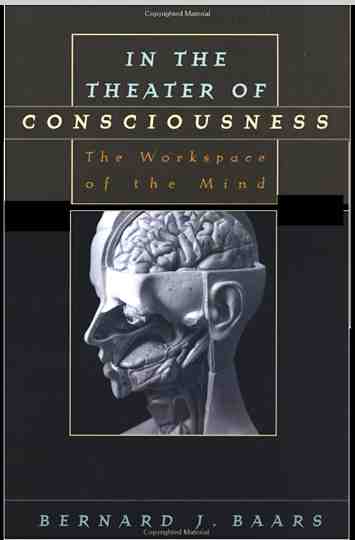
Baars uses a theater metaphor - the theater of consciousness - to explain how consciousness functions (this is the subject of his book, In the Theater of Consciousness: The Workspace of the Mind, but it's also in this 1997 paper, "In the Theatre of Consciousness: Global Workspace Theory, A Rigorous Scientific Theory of Consciousness," published in the Journal of Consciousness Studies). [The first two chapters of the book are available as a PDF.]


He suggests that the architecture of the brain can best be understood as a working theater:
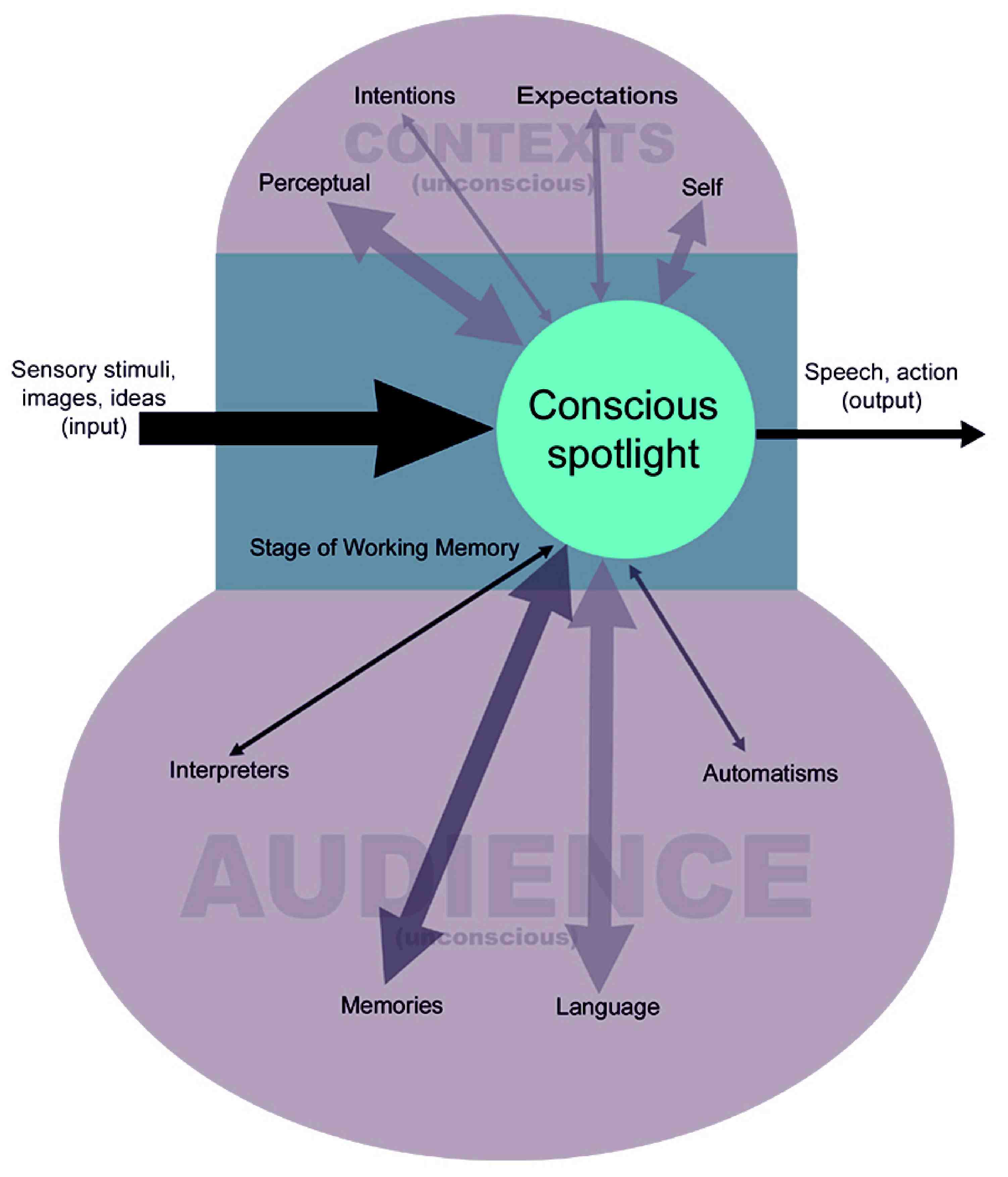
In the working theatre, focal consciousness acts as a ‘bright spot’ on the stage, directed there by the selective ‘spotlight’ of attention. The bright spot is further surrounded by a ‘fringe,’ of vital but vaguely conscious events (Mangan, 1993). The entire stage of the theatre corresponds to ‘working memory’, the immediate memory system in which we talk to ourselves, visualize places and people, and plan actions.

Information from the bright spot is globally distributed through the theatre, to two classes of complex unconscious processors: those in the darkened theatre ‘audience’ mainly receive information from the bright spot; while ‘behind the scenes’, unconscious contextual systems shape events in the bright spot.
Baars notes that consciousness - in this sense we may also think of it as awareness - is largely identified with the "‘limited capacity’ aspects of the brain," those features of our brain that impose limits on what we can experience in consciousness. These "limited capacity mechanisms" include:
  • immediate memory
  • the selectivity of attention
  • our inability to do two demanding voluntary actions at the same time
These are the brain/mind functions that Daniel Kahneman calls Type 2 (in Thinking, Fast and Slow), the slow thinking functions of which we seem to have some voluntary control. A lof of our cognitive and psychological models deal with this element of brain function.

However, as Baars notes (and Kahneman discusses as Type 1 thinking), the brain is much more efficient in its "unconscious" functioning.
It seems to be a massive collection of neural nets, layers and connections, each specialized in some specific task analysing visual shapes, maintaining body temperature, or mapping body space. The great bulk of these specialized nets operate all at once, in parallel with each other, as one great society. Their joint capacity is enormous. They are mostly unconscious, and very effective at executing routine tasks. 
This is the part of the brain that makes many more of our decisions than we are aware of, which is why so many neuroscientists deny free will - they argue that much of our brain function is unconscious and our sense of free will is a comforting illusion. This prompts the big question from Baars:
The big puzzle is, why is the conscious aspect so limited, and the unconscious part so vast? What is the meaning of this odd conjunction?
Baars identifies some of the limits of our consciousness, as well as the larger systems of the unconscious mind (important note from Baars: "What is rarely remarked, however, is that we
can create access to any part of the brain using consciousness
"):

The narrow limits of conscious capacity
1. Working memory
2. Selectivity: consciousness is limited to only one dense stream of input

A vast collection of unconscious processes: the brain
1. The mental lexicon, meaning and grammar
2. Autobiographical memory

As noted above we can control many (most?) of these unconscious processes. Centuries of meditation practice and research has offered mostly anecdotal evidence (until the last two decades or so) that this is possible. Baars agrees:
Consciousness is a gateway to vast domains of knowledge and control In sum, it seems that consciousness gives us vast access to billions of neurons in the brain and body, to the mental lexicon, and to an inestimably large source of autobiographical memories. Mere unaided consciousness may be sufficient to create rapid learning and accurate recognition. Consciousness is also needed to trigger a great number of automatic routines that make up specific actions. All these effects of consciousness are unconscious. Consciousness may be considered as the gateway to these unconscious sources of knowledge.
One of the final pieces of this model is how it explains or accounts for subjectivity, the awareness that we are aware. He deals with this, at least in part, in "Understanding Subjectivity: Global Workspace Theory and the Resurrection of the Observing Self" (Journal of Consciousness Studies, 1996).

He recalls that Oxford philosopher Gilbert Ryle (in The Concept of Mind, 1949) rejected the idea of "the self as observer" - often known as the observer self, the aware ego, or the Self - and for decades afterward neuroscience discounted the whole idea of a self as the ghost in the machine.

Baars rejects this position, however:
The only trouble with Ryle's impossibility proof is that some notion of self is indispensable and not noticeably problematic in daily life, and indeed in much contemporary psychology and brain science. Ryle's impossibility proof applies only if the concept of self is not decomposed into cognitive or brain entities that are better understood than the word 'self'. 

And . . .
Consider William James' 'self as observer'. It is hard to see anything impossible about it if we think of observers as pattern recognizers. Many brain systems 'observe' the output of another, and we now know a great deal about pattern recognizers in the brain. There seems to be plentiful brain and psychological evidence regarding self-systems.

All that is not to deny the existence of genuine mysteries about self. But there seem to be aspects of self that are not beyond human understanding. If they were, we would have an awfully difficult time dealing with ourselves or other people. As we understand more of the details of the cortical self system, Rylean doubts may begin to sound more and more dated.

Oddly enough, in the sensorimotor area on top of the cortex there are four maps of a little upside-down person, distorted in shape, with every bit of skin and muscle represented in detail. This upside-down map is called the sensorimotor homunculus, the little human. The nervous system abounds in such maps, some of which appear to serve as 'self systems', organizing and integrating vast amounts of local bits of information. The anatomy of the brain looks like a physical refutation of Ryle's position.

After laying out a little history of the idea of subjectivity ("'subjectivity' originated in the concept of being a subject, including being the subject of a reigning king"), which eventually came to mean having a sense of self.

One of the things that I find attractive about this model is that it accounts for our multiplicity - it incorporates a variety of inherent self-models, which also allows for unique parts to arise as a product of experience. Remember back to the top, consciousness exists to help develop novel adaptive responses to our life conditions (this also supports Clare Graves's model of new developmental stages arising to cope with more complex life conditions). Here is what Baars offers about multiplicity:
For example, there seems to be a close connection between the sense of subjectivity and what Michael Gazzaniga has called the 'left-brain interpreter', the part of the brain that maintains a running commentary about our experience. In split-brain patients, where transfer of information between the two hemispheres is blocked, the left side can be shown to maintain a narrative account of its reality that can be quite different from the right side's story. But the left-hemisphere system is clearly not the only 'self-system' in the brain. There is good evidence for a sensorimotor self, an emotional and motivational self probably represented in the right hemisphere, a social self-system, and perhaps an appetitive self. All these self-systems ordinarily work in reasonable coordination with each other, though they can be in conflict at times. (Baars, 1996)
Finally, over the last decade he has been working with other theorists, including Gerald Edelman (Dynamic Core theory, proposing that a dynamic core is "generated by a neural process, reentry, to link dispersed cortical and thalamic areas and account for the relation between perception and conscious memory"), and Stan Franklin's LIDA model (Learning IDA, where IDA is an Intelligent Distribution Agent). According to Wikipedia, LIDA offers an integrated model of cognitive function:
Comprising a broad array of cognitive modules and processes, the LIDA architecture attempts to implement and flesh out a number of psychological and neuropsychological theories including Global Workspace Theory,[12] Situated Cognition,[13] perceptual symbol systems,[14] Working Memory,[15] memory by affordances,[16] long-term working memory,[17] and the H-CogAff architecture.[18]
Global Workspace may be the closest thing I have seen to an integral model of consciousness in that it incorporates brain structures in detail, and accounts for the interaction of brain/mind and environment to shape the self-system. Furthermore, it accounts for subjectivity as more than a by-product of brain function, allows for multiplicity of self-systems, and incorporates the reality of self-awareness (meditation, mindfulness, introspection) to shape and expand our sense of consciousness - all of which contribute to evolutionary mechanisms for increasing levels of consciousness.

In part two, I will discuss a paper that proposes a model for consciousness evolution.

Monday, June 25, 2012

Paul Zak & Edwin Rutsch: How to Build a Culture of Empathy with Oxytocin

Ed Rutsch manages the Center for Building a Culture of Empathy and it's corresponding Facebook page. He recently interview Dr. Paul Zak, one of the leading figures in the study of oxytocin and its role in human health and behavior, and author of The Moral Molecule: The Source of Love and Prosperity.


Empathy ExpertsVideo and Links:  Paul Zak


Paul J. Zak is Professor of Economics and Department Chair, as well as the founding Director of the Center for Neuroeconomics Studies at Claremont Graduate University.

He is author of: The Moral Molecule: The source of love and prosperity which explores the relationship between Oxytocin, empathy, compassion, trust, etc.

"The Moral Molecule is a first-hand account of the discovery of a molecule that makes us moral. It reveals that compassion  [and empathy] is part of our human nature, why loneliness can kill you, and why your neighbor may be a psychopath."


Links 

Paul Zak & Edwin Rutsch: Dialogs on How to Build a Culture of Empathy with Oxytocin
 

Transcripts:(transcription pending)
Video Transcriptions: If you would like like to take empathic action and create a transcription of this video, check the volunteers page.  The transcriptions will make it easier for other viewers to quickly see the content of this video.)

Observations on The Ego Trick, Part Four

This is part four of many installments in my process/review of Julian Baggini's The Ego Trick: What Does It Mean to Be You? There is as much personal reflection in this as there is review of the book, and there are also philosophical reflections on the material.

Part one and Part two and Part three are at these links.

I was reading Julian Baggini's The Ego Trick during transit days on my European adventure. At first I thought maybe I was musing more philosophical due to being tired on the plane trip over, but it has continued since I've been here, so maybe it's the continent.

I've been jotting some random thoughts as I read the book, and here is the fourth installment. Although I am back to my normal life, I plan to continue this process as much as I am able, so if this is at all interesting to you, please stay tuned.

* * * * * * *


As I mentioned in the previous section, I am in the midst of a nine hour flight from London to Dallas as I return home after ten days in Europe. I began this . . . what, meditation? . . . on the flight over to Budapest, where my journey began. At that point, I was physically and emotionally exhausted - and my sense of cohesion was beginning to diminish.

I spend a good portion of each day when I am home helping other people NOT come completely undone, not become fragmented. The irony is that this work leaves the clinician feeling shattered some days - in the absence of good self-care.

Following three years of school and a new job as a trauma therapist, I had reached that point. As I began this trip I felt myself coming undone.

For most of eleven days, I have not thought about my clients or worried about work, or money, or the dogs, or any of the multitude of daily concerns. I did miss Jami, my girlfriend, and wish she could have shared this adventure with me. Other than missing her, I really needed to get away from my life.

And then there is always the return.

As I am in liminal space, no longer in central Europe and not yet home - betwixt and between - I perceive myself differently than before I left Tucson. I don't know how to quantify it. I've seen people, cities, and countries all new to me, not to mention new foods and drinks. Each day was different, new, and not in my control. Many of those things that are uncomfortable to me in the self I usually inhabit, so then who is this self who felt at home in strange places, who purposely got lost by himself one night in Prague, who sought out foods and drinks completely new to him? Which one is the "real" Bill?

Maybe the Bill that now wants to live in Budapest or Prague is who I would be without the life I have created . . . and the life that has created me?

Maybe my brief time in Europe was an initiation of sorts - an opening to other possibilities, other needs in my life. At this moment, I no longer feel content with who I have been, the Bill I have settled for most days. I want more than just my small life in Tucson, but I want Jami and the pups to be a part of it. That much I know - when you find the Beloved, do not let her go. 


* * * * * * *

Love . . . . Where does this emotion fit into the nature of the self? Is there one self only, one I-position, who loves Jami?

It's easier to know there are times, when specific I-positions or ego states hijack the brain that I do not feel this love - I feel anger, or frustration, or rejected - but I know at some level, or some part of me knows, that those moments are temporary state experiences in my body-brain that do not reflect the gestalt of my selves.

Who or what is the part of me that knows such I-positions are temporary?

This is where some people get into confusion in proposing there must be some higher self, or Witness, or even soul that stays calmly in the center of things, immovable and immaterial. Richard Schwartz, the founder of Internal Family Systems therapy calls it the Self, likening it to Atman, buddha-nature, soul, Christ-consciousness' and so on.

When Schwartz experiences this part in himself or his clients, it presents with a collection of traits that he calls the eight Cs of Self: compassion, clarity, courage, confidence, curiosity, calmness, centered, and creative. He believes that this part, which exists in all of his clients, no matter how dysfunctional they are (and he includes pedophiles and schizophrenics), is our natural state when we are free from the effects of "manager" parts, "exiled" parts, and the "firefighters" who leap into action (often in the form of some addictive or other self-destructive behavior). I have experienced this "state" myself, as well as having seen it in clients. But what to make of it if we do not hold a dualistic worldview or believe in an isolated, autonomous soul or self?

I don't know. 


What I do know is that when I surrender myself to love of another, either passionate love of Jami or Platonic love of a friend or client, those eight Cs are there and my usual sense of self is not fully present - I feel expansive, without boundaries between myself and the other, embedded in the fabric of the cosmos.

The feeling of love - of woman or man, of nature, of country, of god(s) - has prompted many poets to celebrate the soul, for only the soul can, it is believed, love so fully and so purely. Fortunately, Baggini dismisses easily with notions of the soul and their primary contemporary proponent, Richard Swineburne.

Excluding the notion of a soul, or an immortal essence, I am not sure what to make of this experience of self-transcendence, how to conceptualize it without falling into dualism - maybe Baggini will address this in the book.

6.17.2012
_____


I have little to say about chapter six of The Ego Trick - in this chapter Baggini looks at the nature of the social and cultural self, another topic of which I am fond. But rather than trying to clean up and correct Baggini, I will refer the interested reader to Kenneth Gergen, Rom Harre, Ciaran Benson, Jerome Bruner, Charles Taylor, Lev Vygotsky, and George Lackoff, authors who will provide a good start.


6.17.2012
_____


Finally, we begin to get to the point of the book - just what is this ego trick?


Very succinctly, we are unified, material constructions, a formulation that he admits is vague at best, despite the preceding chapters (or maybe because of). He proposes to explicate this statement through three postulates:

1. The unity of self is psychological - but the unity of experience does not require or prove the existence of something having that experience. There is no unified self, no place in the brain where it all coheres into a singular identity - quite the opposite.

The unity we experience, which allows us legitimately to talk of "I," is a result of the Ego Trick - the remarkable way in which a complicated bundle of mental events, made possible by the brain, creates a singular self, without there being a singular thing underlying it.
2. We are no more than, but more than just, matter - we are made of nothing other than matter, but we need more than a materialist vocabulary to describe our nature. We cannot describe human beings purely in the language of biological science, but there is nothing non-biological about us.

This perspective, according to Baggini, is called non-reductive physicalism, but it requires three additional truths: (1) thoughts, emotions, and feelings are real; (2) whatever thoughts and emotions there are, they are not conventionally physical (you can't see feelings under a microscope); and (3) there is no stuff in the universe other than the stuff of physics. All of which leads to the conclusion that "mental events emerge from physical ones, without being strictly identical with them."

Baggini offers a cool phrase here: "'I' is a verb dressed as a noun."

In the remainder of this section, he looks at the historical rejection of the body in favor of rational reason - ratiocentrism. In Western culture, mind and reason have been identified with the masculine, while body and emotion have been identified with the feminine. This resulted, since the Canon of philosophy is ALL male, in the rejection of the body and its messiness as distinctly feminine and therefore non-rational.

How silly to think we can divorce mind from body or reason from emotions. Antonio Damasio has launched the best empirical critique of this perspective.

3. Identity is not what matters - because identity is not the correct term, although he has been using it himself thus far. “Identity”’ comes in two main forms: quantitative and qualitative.

Two or more things are qualitatively identical when interchanging them would make no difference. For instance, if you have two qualitatively identical bowling balls, it makes no difference which one you pick up when you attempt a strike.

Quantitative identity is governed by a strict logic, summed up in what has become known as Leibniz’s law. In essence this says that if x and y are the same object, then what is true of x at any given time is also true of y at that same time. This is why two merely qualitatively identical bowling balls are not the same ball. If it is true of the first that it is on top of the second, then it cannot also true of the second that it is on top of the first. If, however, I am told that ball x has the same size, weight, colour, composition and location as ball y, at the same time, then I know ball x is ball y.
The point of this distinction is that we must think clearly about our past and future selves, and to do this we must choose whether we are concerned with being essentially the same person over time, perhaps in terms of character or personality (qualitative), or if we are concerned with being a physical self that persists through time (quantitative).

If we remember the discussion about Iris Murdoch’s dementia, she is quantitatively the same person, her physical body remains consistent through time, but her personality is gone, as are the shared memories and familiar character traits. Is this the same person? Objectively, from a materialist perspective, she is still Iris Murdoch. However, subjectively, the self or identity – that unique collection of traits and talents that made her Iris and no one else – is no longer present.

Baggini addresses this issue, and identifies two distinct questions [numbers added]:

(1) There is a logical question about the identity of objects and (2) the existential question about what matters to us about our survival and the survival of those we care about.
If we are concerned about the physical identity, then animalism – “the idea we started Chapter One with, that our identity is a matter of being a particular biological animal” – might be the correct answer, but the question might be wrong. It’s possible that the only way we can be clear about the logical identity of persons over time is to define ourselves as biological animals.

So then, being in the same body (for the purposes of this discussion) through the passage of time, how do I relate to past, present, and future versions of me? The body ages some, but the experiential subjectivity of being “Bill” changes considerably over time. The existential issue remains unresolved with this definition.

Baggini refers to Paul Ricouer as a philosopher who understands the philosophical knot we face, “a philosopher who seems to appreciate the unsuitability of applying logical identity to persons.” He references Ricouer’s book, Oneself as Another, and identifies a couple of places where Ricouer supports his argument.

His central idea is captured in the phrase ‘selfhood is not sameness’. Ricoeur uses the Latin terms idem and ipse to distinguish between sameness and selfhood. Sameness, idem, is unique and recurrent: one thing continuing to exist as exactly the same thing over time. In other words, idem is what we have called quantitative identity. But selves do not have this sameness over time. It is in their nature to change, never exactly the same from one day to the next. The trouble is that we tend to use the word ‘identity’ in relation to persons, unclear as to whether we mean sameness (idem) or selfhood (ipse). What we need to be clear about is that persons retain a sense of selfhood over time, but this is not a precise sameness.
Ricouer offers this explanation for his choice in these terms:
The second philosophical intention, implicitly present in the title in the word "self," is to distinguish two major meanings of "identity"…, depending on whether one understands by "identical" the equivalent of the Latin ipse or idem. ... Identity in the sense of idem unfolds an entire hierarchy of significations.... In this hierarchy, permanence in time constitutes the highest order, to which will be opposed that which differs, in the sense of changing or variable. Our thesis throughout will be that identity in the sense of ipse implies no assertion concerning some unchanging core of the personality. … The equivocalness of identity concerns our title through the partial synonymy, in French at least, between "same" (meme) and "identical." In its diverse uses, "same" (meme) is used in the context of comparison; its contraries are "other," "contrary," "distinct," "diverse," "unequal," "inverse." The weight of this comparative use of the term "same" seems so great to me that I shall henceforth take sameness as synonymous with idem-identity and shall oppose to it selfhood (ipseity), understood as ipse-identity. (p. 3)
A crucial point here is that Ricouer in making this distinction views the idem-identity as the “other” in his title. Oneself as Another – there is some word play in the title. One’s self as an other – he elaborates:
Oneself as Another suggests from the outset that the selfhood of oneself implies otherness to such an intimate degree that one cannot be thought of without the other, that instead one passes into the other, as we might say in Hegelian terms. To "as" I should like to attach a strong meaning, not only that of a comparison (oneself similar to another) but indeed that of an implication (oneself inasmuch as being other).
Ricouer says above that his thesis in the book is that identity (in the sense of ipse-identity) does not make any assertions about an “unchanging core of the personality.” Baggini seems to agree with that conclusion.
The idea that we are creatures without a definite identity over time is the third and least-noticed aspect of the Ego Trick. The unity of sense of self it creates is so compelling that it becomes natural to think of ourselves as beings with clear boundaries in time and space, whose existence over time is all-or-nothing. This is false. We are fluid, ever-changing, amorphous selves.
In practical terms, we do remain similar enough from day to day, month to month, year to year that we can maintain a sense of consistency through time, but we need only consider our infancy and toddler years, or our future as elderly adults perhaps losing our faculties, to know this is only a comfortable illusion.

And that is the question that remains – if the ego trick is true [First, the unity of the self is psychological. Second, we are no more than, but more than just, matter. And third, our identity is not what matters.], then isn’t this whole idea of a self an illusion?

6.17.2012 and 6.24.2012

What I'm Reading, Part Two: Causal Pluralism


Somehow, while I was down the complex adaptive systems rabbit hole, I stumbled across another new term, causal pluralism. A quick and easy definition comes from Peter Godfrey-Smith (Harvard University):
Causal pluralism is the view that causation is not a single kind of relation or connection between things in the world. Instead, the apparently simple and univocal term "cause" is seen as masking an underlying diversity.
Leen De Vreese (Centre for Logic and Philosophy of Science; Ghent University, Belgium) argues that the field is still relatively new (as of early 2007), but the term “causal pluralism” already has accrued a variety of meanings, which he feels leads to confusion. In his paper, Disentangling Causal Pluralism, he tries to sort the threads of pluralistic approaches to causation and to identify the different perspectives held by their adherents.

I wonder if he sees the irony in trying to identify the individual ideas and perspectives that constitute the pluralist origins of causal pluralism?
Full Citation:
De Vreese, L, Weber, E. (2008). Disentangling Causal Pluralism. Robrecht Vanderbeeken, (ed.), Worldviews, Science, and Us: Studies of Analytical Metaphysics. A Selection of Topics From a Methodological Perspective. Singapore: World Scientific Publishing Company.
De Vreese identifies three basic kinds of causal pluralism:
  • conceptual causal pluralism
  • metaphysical causal pluralism
  • epistemological-methodological causal pluralism
Each of these positions has an opposite stance in the monistic causation camp.

However, his primary agenda in the paper is to reduce the (perceived) confusion in the field of causal
pluralism by identifying the perspectives being taken in relation to metaphysical causal pluralism. In essence, are there metaphysical reasons to accept causal pluralism, or is causal pluralism only a conceptual matter

He proposes three "central metaphysical questions" about causation to achieve this goal.
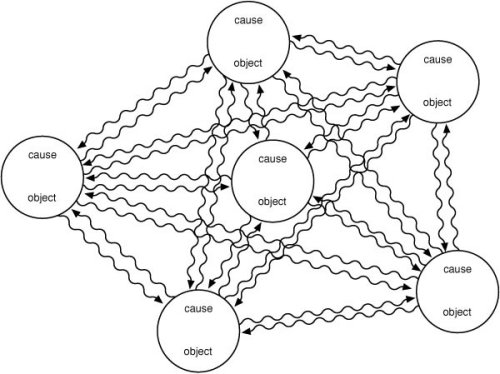
  • Firstly, is causation a realistic notion, or is it a mental construct? 
  • Secondly, does causation only occur as a real relation at the fundamental level of reality, or does it also occur as a real relation between objects at higher levels of reality? 
  • And lastly, does causation consist in a single empirical relation, or does it consist in diverse empirical relations deserving the label “causal”?
In answering these questions, he proposes four types of metaphysical perspectives regarding causation:
  • metaphysical causal constructivism
  • strong metaphysical causal pluralism
  • weak metaphysical causal pluralism 
  • metaphysical causal monism
He concludes his paper by making a clear distinction between conceptual and metaphysical causal pluralism from a third variation on causal pluralism, which he terms "epistemological-methodological causal pluralism." He is referring to "the importance of a pluralistic view on causation for our scientific knowledge in general on the one hand, and for assembling causal knowledge in specific domains of science on the other hand."

While he maintains that an epistemological-methodological approach to causation is still intimately related to conceptual and metaphysical causal pluralism, he feels it's still important to value this line of approach as different from the others, maintaining that "certain questions become utterly important for the sake of our knowledge."

That is one view of causal pluralism, but there are as many variations as there are authors, or at least that is how it seems to a new reader in the field.

In an article more specifically relevant to my work, Julian Reiss (Erasmus University Rotterdam, the Netherlands) published Causation in the Social Sciences: Evidence, Inference, and Purpose in Philosophy of the Social Sciences (2009).
Full Citation:
Reiss, J. (2009, Mar). Causation in the Social Sciences: Evidence, Inference, and Purpose. Philosophy of the Social Sciences, Volume 39(1); 20-40. doi: 10.1177/0048393108328150
Abstract:
All univocal analyses of causation face counterexamples. An attractive response to this situation is to become a pluralist about causal relationships. “Causal pluralism” is itself, however, a pluralistic notion. In this article, I argue in favor of pluralism about concepts of cause in the social sciences. The article will show that evidence for, inference from, and the purpose of causal claims are very closely linked.
This is definitely worth the read.

In an oft-cited paper, Christopher Hitchcock's Of Humean Bondage, he offers a classification scheme for the various forms of causal pluralism. He clarifies up front that he is interested in a pluralism of causation, not a pluralism of causes (which he claims all philosophers already accept). This paper relies more on classical logic arguments in assigning causation, but it is still useful.

Finally, Cognitive Psychology (2010) published Causal–explanatory pluralism: How intentions, functions, and mechanisms influence causal ascriptions by Tania Lombrozo, for which this is the abstract:
Both philosophers and psychologists have argued for the existence of distinct kinds of explanations, including teleological explanations that cite functions or goals, and mechanistic explanations that cite causal mechanisms. Theories of causation, in contrast, have generally been unitary, with dominant theories focusing either on counterfactual dependence or on physical connections. This paper argues that both approaches to causation are psychologically real, with different modes of explanation promoting judgments more or less consistent with each approach. Two sets of experiments isolate the contributions of counterfactual dependence and physical connections in causal ascriptions involving events with people, artifacts, or biological traits, and manipulate whether the events are construed teleologically or mechanistically. The findings suggest that when events are construed teleologically, causal ascriptions are sensitive to counterfactual dependence and relatively insensitive to the presence of physical connections, but when events are construed mechanistically, causal ascriptions are sensitive to both counterfactual dependence and physical connections. The conclusion introduces an account of causation, an ‘‘exportable dependence theory,” that provides a way to understand the contributions of physical connections and teleology in terms of the functions of causal ascriptions.
It's probably indicative of my geekiness that I am looking forward to reading this one.


Here are a few other papers, all of which are freely available online.

Sunday, June 24, 2012

What I'm Reading, Part One: Complex Adaptive Systems Theory


An article was posted recently on the Social Science Research Network that employed a theoretical model with which I was totally unfamiliar - Complex Adaptive Systems Theory. Many of the leading theorists of this model are out of the Sante Fe Institute, including Fabrizio Lillo, Murray Gell-Mann, Mark Pagel, and John Holland (who coined the term). At the bottom of the page I have included a list of other centers and institutes that are related to this work - many of them offer open-access papers.

The article that sparked my interested is called "What Can Neuroscience Tell Us About Religious Consciousness? A Complex Adaptive Systems Framework for Understanding the Religious Brain," by Aaron Burgess.

So I looked it up in Google and found this resource: the Complex Adaptive Systems Group. From there I downloaded some working papers from the Sante Fe Institute, some more papers from Google Scholar, and then began to read (still only scratching the surface, I got distracted with another theory - see Part Two of this post).

From the CAS-wiki:
A Complex Adaptive System (CAS) is a special case of a complex system which is also adaptive, i.e. it has the ability to change and adapt itself to the environment. Typically it consists of a large number of interacting adaptive agents. CASs are used to understand events, objects, and processes in their relationship with each other. They are 'complex' - they are diverse and made up of multiple interconnected elements - and 'adaptive' - they have the capacity to change and learn from experience. They are systems where a lot of individual adaptive agents interact and communicate with each other: complex MAS with adaptive agents. The agents of a CAS learn and change as they interact with each other. The name complex adaptive systems has been coined at the interdisciplinary Santa Fe Institute (SFI), by John H. Holland, Murray Gell-Mann and others. John H. Holland is one of the inventors of evolutionary computation and genetic algorithms, Nobel Prize laureate Murray Gell-Mann discovered quarks.
I think you can see why someone interested in integral theory might also be interested in this approach to systems (which also includes, as a tangent of sorts, emergence theory). One of the cool things about this model is that it is very scalable, so that it is useful at the molecular levels of disease (for example), the neural level of brain circuits, the etiology of mental illness, the societal level of politics or economics, and the macro level of weather and ecosystems.

When we add in various forms of emergence theory, especially when it's informed by causal pluralism (more on this in another post), the possibilities are vast. This is my kind of rabbit hole.

Also from the wiki, here is a little more on the properties of CAS:
Properties

As Robert Eisenstein, the former president of the SFI said in the SFI Bulletin from Winter 2004 Vol. 19 No. 1, "despite differences in substrate, there are common principles and mechanisms that underlie the processes by which nature organizes complex systems and how they behave. In other words, there is often simplicity within complexity." These common principles are for example universal scaling laws, similar underlying small-world or scale-free networks in complex networks, or similar forms of emergence, co-evolution and self-organization.

Simon A. Levin (2002) mentions diversity, localization and autonomy as the essential properties of a CAS:
  • diversity and individuality of components,
  • localized interactions among those components, and
  • an autonomous process that uses the outcomes of those interactions to select a subset of those components for replication or enhancement.
According to Stephanie Forrest (1994), the term CAS refers to a system with the following properties:
  • Multi-Agent System A collection of primitive components, called "agents"
  • INTERACTION Interactions among agents and between agents and their environments
  • Emergence Unanticipated global properties often result from the interactions
  • Adaptation Agents adapt their behavior to other agents and environmental constraints
  • Evolution As a consequence, system behavior evolves over time
The essential property that distinguishes a complex adaptive system from a merely complex one is certainly adaptation. Adaptive means agents or populations of agents are able to learn. Either individual agents learn or the population learns, i.e. the population is subject to a process of mutation and competitive selection. In any case, learning agents are able to modify their rules according to their previous success in reacting to the environment. The more successful rules are selected, whereas the less successful rules are deleted.
Wikipedia also has an entry on this model - it offers the following general properties and sets of characteristics from two different versions of the model:

General properties

What distinguishes a CAS from a pure multi-agent system (MAS) is the focus on top-level properties and features like self-similarity, complexity, emergence and self-organization. A MAS is simply defined as a system composed of multiple interacting agents. In CASs, the agents as well as the system are adaptive: the system is self-similar. A CAS is a complex, self-similar collectivity of interacting adaptive agents. Complex Adaptive Systems are characterised by a high degree of adaptive capacity, giving them resilience in the face of perturbation.
Other important properties are adaptation (or homeostasis), communication, cooperation, specialization, spatial and temporal organization, and of course reproduction. They can be found on all levels: cells specialize, adapt and reproduce themselves just like larger organisms do. Communication and cooperation take place on all levels, from the agent to the system level. The forces driving co-operation between agents in such a system can, in some cases be analysed with game theory.

Characteristics

Complex adaptive systems are characterized as follows[3] and the most important are:
  • The number of elements is sufficiently large that conventional descriptions (e.g. a system of differential equations) are not only impractical, but cease to assist in understanding the system, the elements also have to interact and the interaction must be dynamic. Interactions can be physical or involve the exchange of information.
  • Such interactions are rich, i.e. any element in the system is affected by and affects several other systems.
  • The interactions are non-linear which means that small causes can have large results.
  • Interactions are primarily but not exclusively with immediate neighbours and the nature of the influence is modulated.
  • Any interaction can feed back onto itself directly or after a number of intervening stages, such feedback can vary in quality. This is known as recurrency.
  • Such systems are open and it may be difficult or impossible to define system boundaries
  • Complex systems operate under far from equilibrium conditions, there has to be a constant flow of energy to maintain the organization of the system
  • All complex systems have a history, they evolve and their past is co-responsible for their present behaviour
  • Elements in the system are ignorant of the behaviour of the system as a whole, responding only to what is available to it locally
Axelrod & Cohen[4] identify a series of key terms from a modeling perspective:
  • Strategy, a conditional action pattern that indicates what to do in which circumstances
  • Artifact, a material resource that has definite location and can respond to the action of agents
  • Agent, a collection of properties, strategies & capabilities for interacting with artifacts & other agents
  • Population, a collection of agents, or, in some situations, collections of strategies
  • System, a larger collection, including one or more populations of agents and possibly also artifacts.
  • Type, all the agents (or strategies) in a population that have some characteristic in common
  • Variety, the diversity of types within a population or system
  • Interaction pattern, the recurring regularities of contact among types within a system
  • Space (physical), location in geographical space & time of agents and artifacts
  • Space (conceptual), “location” in a set of categories structured so that “nearby” agents will tend to interact
  • Selection, processes that lead to an increase or decrease in the frequency of various types of agent or strategies
  • Success criteria or performance measures, a “score” used by an agent or designer in attributing credit in the selection of relatively successful (or unsuccessful) strategies or agents.
Looks cool, eh?

Here are some of the articles I was able to find on this model (or related to it) that are freely available online (in no particular order):

Related Papers:
Groups and Institutes. International research groups and institutes exploring complex systems:
  • SFI Santa Fe Institute
  • CSCS Center for the Study of Complex Systems
  • CCSR Center for Complex Systems Research
  • CASOS Center for Comp. Analysis of Social and Org. Systems
  • ICES Institute for Complex Engineered Systems
  • NECSI New England Complex Systems Institute
  • NICO Northwestern Institute on Complex Systems
  • ECCO Evolution, Complexity and Cognition group

Dzigar Kongtrül Rinpoche - Searching for the Self

This brief excerpt from Dzigar Kongtrül Rinpoche's It's Up to You: The Practice of Self-Reflection on the Buddhist Path comes from the Tricycle Wisdom Collection. I like this passage for what it says about the nature of the self (I've grown weary of the "authentic self" and the "unique self," both of which are comforting fictions, as near as I can tell), but also for the brief section on identifying with the body or with feelings, which then become our sense of identity.

Searching for Self

Dzigar Kongtrül Rinpoche offers advice for facing up to our egos.


© Atta Kim
Holding to an ordinary notion of self, or ego, is the source of all our pain and confusion. The irony is that when we look for this "self" that we're cherishing and protecting, we can't even find it. The self is shifty and ungraspable. When we say "I'm old," we're referring to our body as self. When we say "my body," the self becomes the owner of the body. When we say "I'm tired," the self is equated with physical or emotional feelings. The self is our perceptions when we say "I see," and our thoughts when we say "I think." When we can't find a self within or outside of these parts, we may then conclude that the self is that which is aware of all of these things—the knower or mind.

But when we look for the mind, we can't find any shape, or color, or form. This mind that we identify as the self, which we could call ego-mind, controls everything we do. Yet it can't actually be found—which is somewhat spooky, as if a ghost were managing our home. The house seems to be empty, but all the housework has been done. The bed has been made, our shoes have been polished, the tea has been poured, and the breakfast has been cooked.

The funny thing is that we never question this. We just assume that someone or something is there. But all this time, our life has been managed by a ghost, and it's time to put a stop to it. On one hand, ego-mind has served us—but it hasn't served us well. It has lured us into the suffering of samsara and enslaved us. When ego-mind says, "Get angry," we get angry; when it says, "Get attached," we act out our attachments. When we look into the "slavish" arrangement we have with our ego-mind, we can see how it pressures us, plays tricks on us, and causes us to do things that bring undesirable consequences.

If you want to stop being the slave of a ghost, you must demand that ego-mind show its face. No true ghost will show up when it hears this! You can practice this simple meditation throughout the day. Whenever you don't know what to do with yourself, challenge your ego-mind to show its face. When you're cooking your dinner or waiting for the bus, challenge your ego-mind to show its face. Do it especially when ego-mind overwhelms you, when you feel threatened, fearful, or enslaved by it. Just straighten your posture and challenge ego-mind. Don't be gullible, wiggly, or spineless. When you challenge ego-mind, be firm but gentle, penetrating but never aggressive. Just say to your ego-mind, "Show me your face!" When no mind shows up saying, "Here I am," ego-mind will begin to lose its hold on you and your struggles will lighten up. See if this isn't true. Of course, maybe your mind does have a face and your experience will be different. But if you don't find a mind with a face, you won't take your struggles so seriously, and all of your pain and suffering will lessen.

When we question ego-mind directly, it is exposed for what it is: the absence of everything we believe it to be. We can actually see through this seemingly solid ego-mind, or self. But what are we left with then? We are left with an open, intelligent awareness, unfettered by a self to cherish or protect. This is the primordial wisdom mind of all beings. Relaxing into this discovery is true meditation—and true meditation brings ultimate realization and freedom from suffering.

From It's Up to You © 2005 by Dzigar Kongtrül Rinpoche. Reprinted by arrangement with Shambhala Publications, Inc., www.shambhala.com.

TEDxCHUV - Henry Markram - Understanding the Human Brain: A test of global collaboration


Interesting  talk - The Human Brain Project is pretty cool, an effort to integrate everything known about the brain into computer models and use those models to simulate the actual working of the brain. Partly, they want to develop AI, and partly they want to find gaps in our knowledge where more research is needed.
Ultimately, it will attempt to simulate the complete human brain. The models built by the project will cover all the different levels of brain organisation – from individual neurons through to the complete cortex. The goal is to bring about a revolution in neuroscience and medicine and to derive new information technologies directly from the architecture of the brain.

The challenges facing the project are huge. Neuroscience alone produces more than 60'000 scientific papers every year. From this enormous mass of information, the project will have to select and harmonise the data it is going to use – ensuring that data produced with different methods is fully comparable.

The data feeding the project's simulation effort will come from the clinic and from neuroscience experiments. As we try to fit all the information together, we will discover many of the brain's fundamental design secrets: the geometry and electrical behaviour of different classes of neurons, the way they connect to form circuits, and the way new functions emerge as more and more neurons connect. It is these principles, translated into mathematics that will drive the project's models and simulations.
Here is the TEDx talk from Henry Markham.


TEDxCHUV - Henry Markram - Understanding the Human Brain: A test of global collaboration
Knowledge of the brain is highly fragmented and we have no way to prioritize the many experiments needed to fill the gaps in our understanding. It is time for a strategy of global collaboration, where scientists of all disciplines work together to solve this problem. We propose building a platform to catalyze efforts, integrate knowledge, and use supercomputers to simulate what is known about the brain, to predict gaps in our knowledge of the brain, and to test hypotheses about how it works.

Henry Markram is the Coordinator of the Human Brain Project, a proposed international effort to understand the human brain. His research career started in medicine and neuroscience in South Africa, then at the Weizmann Institute in Israel, at NIH and UCSF in the United States, and the Max-Planck Institute in Germany. In 2002, he joined the EPFL, where he founded the Brain Mind Institute. His career has spanned a wide spectrum of neuroscience research, from whole animal studies to gene expression in single cells. He is best known for his work on synaptic plasticity. In the past 15 years he has focused on the structure and function of neural microcircuits -- the basic components in the architecture of the brain. In 2005, he launched the Blue Brain Project: the first attempt to begin a systematic integration of all biological knowledge of the brain into unifying brain models for simulation on supercomputers. The strategies, technologies and methods developed in this pioneering work lie at the heart of the Human Brain Project.