Showing posts with label experience. Show all posts

Wednesday, December 25, 2013

Preliminary Thoughts on a New Nomenclature of Psychotherapeutic Diagnosis and Practice

 
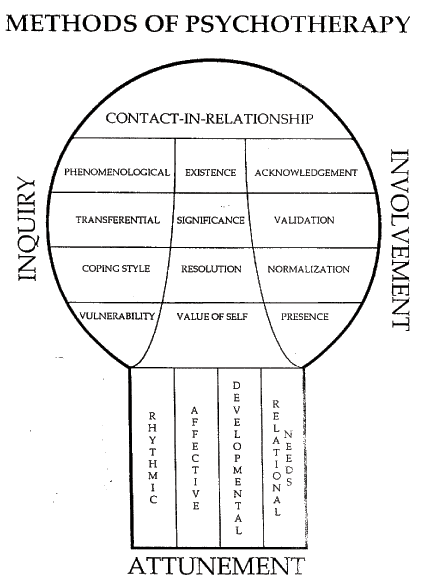
Above is one model of integrative psychotherapy (Erskine and Trautmann, 1996). What follows below are some preliminary thoughts on how I practice as a therapist and how I might change the existing nomenclature to reflect a more client-centered, relational model that rejects pathologizing language and structures (i.e., the DSM).

Premise: 


What counselors and psychotherapists have been taught to identify as symptoms of a corresponding condition pejoratively defined as "mental illness" should rather be understood as adaptations to experience.

All adaptations are at their genesis the best available mechanism for survival. As a person ages, these adaptations become either skillful (healthy) or unskillful (not supporting physical, emotional, mental, and spiritual health).

Disclaimer:


Short-term responses to challenging situations are not, in general, to be seen as adaptations to that experience (i.e., normal human emotional responses to life events such as death of a loved one, losing a job or promotion, surviving an accident, and so on). If, however, there are several similar experiences over a person's lifetime, with a corresponding response pattern that has solidified into what Carl Jung defined as a "complex," then this then can be seen as an adaption and not a response. 

Diagnosis:


When we join a new client on their healing journey, our task is to identify with them the somatic symptoms, affect dysregulation, cognitive distortions, lost spirituality, the core beliefs, and each domain's corresponding defense mechanisms that block an integrative experience of full health.

An integrative approach assesses from (at least) five domains, four of which are addressed by specific models of psychotherapy that contend their model is the only necessary model:
  • Body - somatic symptoms and unconscious behaviors
  • Affect - ability to regulate affect and for affect to match verbal and behavioral expression
  • Cognitive - possessing rational and non-distorted self-concepts, lack or pervasive thinking errors, or other forms of unskillful cognitive and behavioral scripts
  • Spiritual - a sense of purpose and meaning in one's life whether it's religious, spiritual, or atheist/humanist
The fifth domain is the Core Beliefs a person holds about who s/he is and what other people believe about him or her. These beliefs are deeply held and generally unconscious. They tend to originate in infancy and early childhood, making them difficult to uproot in order to plant new seeds for healthier core beliefs. Further, core beliefs tend to manifest in each of the four other domains listed above.

Multiplicity


We are all born (barring organic defects) with a whole and healthy Self-seed (our genetic and characterological template) that will become a mature sense of Self. However, no one escapes childhood without that Self being compromised in some way. Some children are so abused and/or neglected that they never develop a solid sense of self.

Consequently, parts of the self that are either overwhelming (emotional responses to trauma), unsafe (natural behaviors that are punished by caregivers), or not nurtured (for example, capacity for compassion or generosity) are split off from the Self and become self-fragments, ego states, parts, or subpersonalities that often remain unconscious and tend to show up in various forms of projection.

For each split off part, there is a part or parts that manages the outside world in some way to keep those "exiled" parts out of consciousness. Some of the common "managers" are the Pusher (focused on achievement and constant movement toward the next goal), Perfectionist (all or nothing thinking, a need for personal perfection, the failure of which brings intense shame), Pleaser (often middle children or first children who try to make everyone else happy, often at the expense of their own happiness), and the Inner Critic (a part who seeks to ensure the client is never criticized by others by being so hyper-critical of the client that any other criticism will be avoided). 

In order for splitting to become "hard-wired," there must be repeated episodes of the experiences that lead to the splitting. Normal misattunement between child and caregiver will not lead to splitting and, in fact, such misattunements are necessary for the development of resilience when they are quickly repaired by the caregiver.

Worldviews or Reality Frames


It is incumbant upon the therapist to be "experience near" (Kohut) with the client and be able to identify their basic worldview or reality model. This does not mean that the therapist necessarily supports the client's worldview, however, but it does require that the therapist be able to work within that reality frame.

It's also important that a client's worldview be held lightly - different parts of the client will possess alternate worldviews with anywhere from slight to profound variations.

Likewise, when a therapist encounters a new client whose worldview is unfamiliar (for example, someone from another country, or members of Tribal Nations, and so on), it is essential that therapists educate themselves as best they can and that they inquire with the client when they start to make assumptions about the client's experience that may not fit their reality frame.

Models of Psychotherapy


Successful therapeutic interventions require the all five domains are addressed. Here are a few examples of the therapeutic models that address the various domains:

Body - nutrition, exercise, somatic therapies (Somatic Experiencing, Bioenergetics, Yoga Therapy), behavioral psychotherapies, mindfulness-based therapies, Internal Family Systems Therapy (IFS - "parts work"), Hakomi, Eye Movement Desensitization, and Reprocessing (EMDR)
Affect - affective neuroscience, interpersonal neurobiology, intersubjective and relational psychotherapies, mindfulness-based therapies, IFS
Cognitive - cognitive behavioral therapies (CBT), dialectical behavioral therapy (DBT), neurolinguistic programming (NLP), rational emotive behavioral therapy (REBT), script analysis (Transactional Analysis), existential psychotherapy, narrative therapy, IFS
Spiritual - transpersonal psychotherapy, Jungian Analytical Psychotherapy, contemplative practices, meta-narrative therapies, existential psychotherapy, IFS (developing "Self-Leadership"), expressive therapies
Core Beliefs - cognitive therapies, relational psychotherapies, IFS, narrative therapies, creative visualization, soul retrieval, expressive therapies

Undoubtedly, there are other models I am not familiar with or that have slipped my mind at the moment, so this list should not be taken as my final position on this topic.

Goals of Psychotherapy


First rule: Do No Harm. Second rule: It's not the therapy, it's the relationship.

If therapists can successfully follow these two rules, and hold a belief in the inherent ability of the client to heal, as well as a belief in the client's ability to know what therapeutic pace and which interventions are best for them, then the client becomes his or her own healer and the therapist simply "midwife" that process with them.

The goal is never to impose a therapist's sense of "mental health" but, rather, to explore with the client what their own sense of mental health looks like and feels like in their lives. Having done so, then it becomes easier for the therapist to identify with the client which areas or domains of their life are not functioning optimally.

Areas of less-than-optimal function are the adaptations defined as unskillful that therapy seeks to minimize while also helping the client learn skillful adaptations to replace those being minimized.

***

Okay then, that is my first-pass at a new model. Please share your thoughts, comments, and criticisms in the comments section here or at Facebook.

Sunday, December 01, 2013

8 TED Talks About Memory (with Daniel Kahneman and Elizabeth Loftus, among others)

Yesterday I posted on new research demonstrating how the hippocampus labels memories with a "geotag" to identify spatial information related to the memory. To go along with that, here are 8 TED Talks on the subject of memory. The best talk, hands down, is the one from Daniel Kahneman, of course, but the talk by Elizabeth Loftus from TEDGlobal 2013 is also very good.

Follow the links to watch the videos at the TED site.

8 TED Talks About Memory


Posted by: Kate Torgovnick
November 22, 2013


Peter Doolittle introduces us to working memory at TED University at TEDGlobal 2013. Photo: Bret Hartman

Experiences we have all had: walking into a room with a tremendous sense of purpose, only to realize that you have completely forgotten what the purpose was. Talking to someone in a restaurant and losing the thread of your conversation because you’re distracted by the juicier one at the table next door. Slowing down as you walk because you’re thinking about how to phrase a text message.

 
In today’s talk, educational psychologist Peter Doolittle shares how each of these phenomena is related to working memory, that thing which allows us to store and process our immediate experiences and mix them with long-term memories.

“Life comes at us, and it comes at us very quickly,” says Doolittle. “What we need to do is take the amorphous flow of experience and somehow extract meaning from it with a working memory that is about the size of a pea.”

Watch Doolittle’s talk for some helpful strategies for improving your working memory’s ability to hold on to information. And here, a few more TED Talks related to memory. Just make sure to actually store what’s said in them, m’kay? 
___


Joshua Foer: Feats of memory anyone can do

Journalist Joshua Foer never thought he had a particularly good memory. So how did he win the U.S. Memory Championship? By working hard to master a centuries-old technique for remembering long lists: building a “memory palace” full of striking images, located sequentially in a space you know very well. 
___


Steve Ramirez and Xu Liu: A mouse. A laser beam. A manipulated memory

In their lab at MIT, Steve Ramirez and Xu Liu planted a memory of fear in a mouse’s brain. Why, you ask, would they do this? In this unexpectedly hilarious talk at TEDxBoston, they share the big idea behind their work: that it may actually be possible to edit our memories. (Read the TED Blog post: 9 classic movies about memory manipulation, and how they inspire real neuroscience.) 
___


Gabriel Barcia-Colombo: Capturing memories in video art

TED Fellow Gabriel Barcia-Colombo loves to collect things. In this short and fun talk from the TED Fellows pre-conference, he shows how he is collecting memories by creating video sculptures of his friends in jars. The point: to preserve his memories of these people for all time. 
___


Elizabeth Loftus: The fiction of memory

You remember things exactly as they happened, right? Not necessarily. In this talk from TEDGlobal 2013, Elizabeth Loftus shares a body of work that shows how memories are susceptible to suggestion. This quote says it all: “Many people believe memory works like a recording device … This just isn’t true. Our memories are constructive. They’re reconstructive. Memory works a bit more like a Wikipedia page.” (Read more on Loftus’ work.) 
___


Jeff Hawkins: How brain science will change computing

Jeff Hawkins, the creator of the Palm and the Treo, is taking unusual inspiration for new technology: the human brain. In this classic talk from TED2003, Hawkins shares what he’s learned from studying brains. Mainly, that they are complex memory storage systems that are highly adept at sorting and predicting what will happen next. 
___


Daniel Kahneman: The riddle of experience vs. memory

What is happiness? Behavorial economist Daniel Kahneman shares how this is a complicated question, because we perceive things in two ways: as the “experiencing self” and as the “remembering self.” The experiencing self makes assessments in the moment, but the remembering self creates a coherent story in retrospect about them. Kahneman shares how powerful the remembering self is, helping us make decisions going forward and, ultimately, determining how satisfied we are with our lives.
___


Cesar Kuriyama: One second every day

Cesar Kuriyama has a cool idea for anyone who is concerned about remembering the little wonderful moments of their life. In this talk from TED2012, he introduces us to an app called One Second Every Day that allows you to record moments and stitch them together into a continuous video. Kuriyama plans to do this for the rest of his life, to make sure memories don’t just slip away.

Friday, March 15, 2013

Paul Horwich - Was Wittgenstein Right?


Following up on the previous post, a film biography of Wittgenstein by Derek Jarman, this article by Paul Horwich at the New York Times philosophy column, The Stone, looks at Wittgenstein's conception of the essential problems of philosophy, and his claims that,
there are no realms of phenomena whose study is the special business of a philosopher, and about which he or she should devise profound a priori theories and sophisticated supporting arguments. There are no startling discoveries to be made of facts, not open to the methods of science, yet accessible “from the armchair” through some blend of intuition, pure reason and conceptual analysis. Indeed the whole idea of a subject that could yield such results is based on confusion and wishful thinking. 
This attitude is in stark opposition to the traditional view, which continues to prevail. Philosophy is respected, even exalted, for its promise to provide fundamental insights into the human condition and the ultimate character of the universe, leading to vital conclusions about how we are to arrange our lives. It’s taken for granted that there is deep understanding to be obtained of the nature of consciousness, of how knowledge of the external world is possible, of whether our decisions can be truly free, of the structure of any just society, and so on — and that philosophy’s job is to provide such understanding.
These are not popular views - and Wittgenstein has definitely fallen out of favor, despite having been named in one poll as the most important philosopher of the 20th Century.

NOTE: A response to this post by Michael P. Lynch, Of Flies and Philosophers: Wittgenstein and Philosophy, was published in The Stone later that week.

Was Wittgenstein Right?

By PAUL HORWICH
March 3, 2013


The singular achievement of the controversial early 20th century philosopher Ludwig Wittgenstein was to have discerned the true nature of Western philosophy — what is special about its problems, where they come from, how they should and should not be addressed, and what can and cannot be accomplished by grappling with them. The uniquely insightful answers provided to these meta-questions are what give his treatments of specific issues within the subject — concerning language, experience, knowledge, mathematics, art and religion among them — a power of illumination that cannot be found in the work of others.

Admittedly, few would agree with this rosy assessment — certainly not many professional philosophers. Apart from a small and ignored clique of hard-core supporters the usual view these days is that his writing is self-indulgently obscure and that behind the catchy slogans there is little of intellectual value. But this dismissal disguises what is pretty clearly the real cause of Wittgenstein’s unpopularity within departments of philosophy: namely, his thoroughgoing rejection of the subject as traditionally and currently practiced; his insistence that it can’t give us the kind of knowledge generally regarded as its raison d’être.

Wittgenstein claims that there are no realms of phenomena whose study is the special business of a philosopher, and about which he or she should devise profound a priori theories and sophisticated supporting arguments. There are no startling discoveries to be made of facts, not open to the methods of science, yet accessible “from the armchair” through some blend of intuition, pure reason and conceptual analysis. Indeed the whole idea of a subject that could yield such results is based on confusion and wishful thinking.

Free Press, Ludwig Wittgenstein

This attitude is in stark opposition to the traditional view, which continues to prevail. Philosophy is respected, even exalted, for its promise to provide fundamental insights into the human condition and the ultimate character of the universe, leading to vital conclusions about how we are to arrange our lives. It’s taken for granted that there is deep understanding to be obtained of the nature of consciousness, of how knowledge of the external world is possible, of whether our decisions can be truly free, of the structure of any just society, and so on — and that philosophy’s job is to provide such understanding. Isn’t that why we are so fascinated by it?

If so, then we are duped and bound to be disappointed, says Wittgenstein. For these are mere pseudo-problems, the misbegotten products of linguistic illusion and muddled thinking. So it should be entirely unsurprising that the “philosophy” aiming to solve them has been marked by perennial controversy and lack of decisive progress — by an embarrassing failure, after over 2000 years, to settle any of its central issues. Therefore traditional philosophical theorizing must give way to a painstaking identification of its tempting but misguided presuppositions and an understanding of how we ever came to regard them as legitimate. But in that case, he asks, “[w]here does [our] investigation get its importance from, since it seems only to destroy everything interesting, that is, all that is great and important? (As it were all the buildings, leaving behind only bits of stone and rubble)” — and answers that “(w)hat we are destroying is nothing but houses of cards and we are clearing up the ground of language on which they stand.”

Associated Press, Bertrand Russell, one of Wittgenstein’s early teachers, at his home in London in 1962.

Given this extreme pessimism about the potential of philosophy — perhaps tantamount to a denial that there is such a subject — it is hardly surprising that “Wittgenstein” is uttered with a curl of the lip in most philosophical circles. For who likes to be told that his or her life’s work is confused and pointless? Thus, even Bertrand Russell, his early teacher and enthusiastic supporter, was eventually led to complain peevishly that Wittgenstein seems to have “grown tired of serious thinking and invented a doctrine which would make such an activity unnecessary.”

But what is that notorious doctrine, and can it be defended? We might boil it down to four related claims.

The first is that traditional philosophy is scientistic: its primary goals, which are to arrive at simple, general principles, to uncover profound explanations, and to correct naïve opinions, are taken from the sciences. And this is undoubtedly the case.

The second is that the non-empirical (“armchair”) character of philosophical investigation — its focus on conceptual truth — is in tension with those goals. That’s because our concepts exhibit a highly theory-resistant complexity and variability. They evolved, not for the sake of science and its objectives, but rather in order to cater to the interacting contingencies of our nature, our culture, our environment, our communicative needs and our other purposes. As a consequence the commitments defining individual concepts are rarely simple or determinate, and differ dramatically from one concept to another. Moreover, it is not possible (as it is within empirical domains) to accommodate superficial complexity by means of simple principles at a more basic (e.g. microscopic) level.

The third main claim of Wittgenstein’s metaphilosophy — an immediate consequence of the first two — is that traditional philosophy is necessarily pervaded with oversimplification; analogies are unreasonably inflated; exceptions to simple regularities are wrongly dismissed.

Therefore — the fourth claim — a decent approach to the subject must avoid theory-construction and instead be merely “therapeutic,” confined to exposing the irrational assumptions on which theory-oriented investigations are based and the irrational conclusions to which they lead.

Consider, for instance, the paradigmatically philosophical question: “What is truth?”. This provokes perplexity because, on the one hand, it demands an answer of the form, “Truth is such–and-such,” but on the other hand, despite hundreds of years of looking, no acceptable answer of that kind has ever been found. We’ve tried truth as “correspondence with the facts,” as “provability,” as “practical utility,” and as “stable consensus”; but all turned out to be defective in one way or another — either circular or subject to counterexamples. Reactions to this impasse have included a variety of theoretical proposals. Some philosophers have been led to deny that there is such a thing as absolute truth. Some have maintained (insisting on one of the above definitions) that although truth exists, it lacks certain features that are ordinarily attributed to it — for example, that the truth may sometimes be impossible to discover. Some have inferred that truth is intrinsically paradoxical and essentially incomprehensible. And others persist in the attempt to devise a definition that will fit all the intuitive data.

But from Wittgenstein’s perspective each of the first three of these strategies rides roughshod over our fundamental convictions about truth, and the fourth is highly unlikely to succeed. Instead we should begin, he thinks, by recognizing (as mentioned above) that our various concepts play very different roles in our cognitive economy and (correspondingly) are governed by defining principles of very different kinds. Therefore, it was always a mistake to extrapolate from the fact that empirical concepts, such as red or magnetic oralive stand for properties with specifiable underlying natures to the presumption that the notion of truth must stand for some such property as well.

Wittgenstein’s conceptual pluralism positions us to recognize that notion’s idiosyncratic function, and to infer that truth itself will not be reducible to anything more basic. More specifically, we can see that the concept’s function in our cognitive economy is merely to serve as a device of generalization. It enables us to say such things as “Einstein’s last words were true,” and not be stuck with “If Einstein’s last words were that E=mc2, then E=mc2; and if his last words were that nuclear weapons should be banned, then nuclear weapons should be banned; … and so on,” which has the disadvantage of being infinitely long! Similarly we can use it to say: “We should want our beliefs to be true” (instead of struggling with “We should want that if we believe that E=mc2, then E=mc2; and that if we believe … etc.”). We can see, also, that this sort of utility depends upon nothing more than the fact that the attribution of truth to a statement is obviously equivalent to the statement itself — for example, “It’s true that E=mc2” is equivalent to “E=mc2”. Thus possession of the concept of truth appears to consist in an appreciation of that triviality, rather than a mastery of any explicit definition. The traditional search for such an account (or for some other form of reductive analysis) was a wild-goose chase, a pseudo-problem. Truth emerges as exceptionally unprofound and as exceptionally unmysterious.

This example illustrates the key components of Wittgenstein’s metaphilosophy, and suggests how to flesh them out a little further. Philosophical problems typically arise from the clash between the inevitably idiosyncratic features of special-purpose concepts —true, good, object, person, now, necessary — and the scientistically driven insistence upon uniformity. Moreover, the various kinds of theoretical move designed to resolve such conflicts (forms of skepticism, revisionism, mysterianism and conservative systematization) are not only irrational, but unmotivated.The paradoxes to which they respond should instead be resolved merely by coming to appreciate the mistakes of perverse overgeneralization from which they arose. And the fundamental source of this irrationality is scientism.

As Wittgenstein put it in the “The Blue Book”:
Our craving for generality has [as one] source … our preoccupation with the method of science. I mean the method of reducing the explanation of natural phenomena to the smallest possible number of primitive natural laws; and, in mathematics, of unifying the treatment of different topics by using a generalization. Philosophers constantly see the method of science before their eyes, and are irresistibly tempted to ask and answer in the way science does. This tendency is the real source of metaphysics, and leads the philosopher into complete darkness. I want to say here that it can never be our job to reduce anything to anything, or to explain anything. Philosophy really is “purely descriptive.
These radical ideas are not obviously correct, and may on close scrutiny turn out to be wrong. But they deserve to receive that scrutiny — to be taken much more seriously than they are. Yes, most of us have been interested in philosophy only because of its promise to deliver precisely the sort of theoretical insights that Wittgenstein argues are illusory. But such hopes are no defense against his critique. Besides, if he turns out to be right, satisfaction enough may surely be found in what we still can get — clarity, demystification and truth.


Paul Horwich is a professor of philosophy at New York University. He is the author of several books, including “Reflections on Meaning,” “Truth-Meaning-Reality,” and most recently, “Wittgenstein’s Metaphilosophy.”
The Stone features the writing of contemporary philosophers on issues both timely and timeless. The series moderator is Simon Critchley. He teaches philosophy at The New School for Social Research in New York. To contact the editors of The Stone, send an e-mail to opinionator@nytimes.com. Please include “The Stone” in the subject field.

Thursday, December 20, 2012

Wade Davis - The Wayfinders: Why Ancient Wisdom Matters in the Modern World


Interesting talk about the loss of knowledge as we progressively destroy the few remaining indigenous cultures around the planet. This is one of several videos being pout up online from the Creative Innovation 2012 conference in Australia.


The Wayfinders: Why Ancient Wisdom Matters in the Modern World. Wade Davis


Wade Davis is an Explorer-in-Residence at the National Geographic Society. An ethnographer, writer, photographer, and filmmaker, Davis holds degrees in anthropology and biology and received his Ph.D. in ethnobotany, all from Harvard University. In this talk at the Creative Innovation 2012 conference, Davis speaks about the world's at-risk indigenous cultures, and the vast archive and knowledge and expertise that they represent, and how we can learn from them. November 2012.

Tuesday, October 23, 2012

Examining the Role of Media in the Human Experience | The New School


As media - in all of its forms - shapes more and more of our experience of the world (if we let it, and most people do, knowingly or unknowingly), this talk is highly relevant. How much of our experience do want to have shaped by forces and values far removed from our lived reality?

Unfortunately, not enough people are asking these questions.

Examining the Role of Media in the Human Experience | The New School


On Thursday, October 18th 2012, Our Humanity Matters (OHM) held its first panel discussion at The New School titled, "Examining the Role of Media in the Human Experience." The goal of this talk was to build the framework for a continuing debate around one of the most important subjects facing humanity today -- media. "Mass media has become part of our nervous system," says Tanja A. W., director of OHM. "Therefore, if we hope to build a sustainable future and culture of wholeness where interconnectedness with all would be seen as an intelligent and enlightened way of being, then we must address this very fundamental issue."

OHM is a non-profit organization designed to further the understanding of humanity and its spiritual and existential challenges in mass media culture. The panel included leading cultural and media theorist, Douglas Kellner, George Kneller Chair in the Philosophy of Education at UCLA; Politics and Aesthetics, Ecology and Technology expert Verena Conley, Long-Term Visiting Professor of Comparative Literature and of Romance Languages and Literatures at Harvard University; and The New School's own, award winning composer, Barry Salmon, Associate Professor at the New School for Public Engagement; and moderator Tanja A.W., director of Our Humanity Matters.

THE NEW SCHOOL

Location: Theresa Lang Community and Student Center, Arnhold Hall
10/18/2012 2:00 p.m. - 3:30 p.m.

Monday, May 14, 2012

Dr. Leslie Tolbert - The Plastic Brain


This is a nice talk on brain plasticity from Dr. Leslie Tolbert of the University of Arizona who, among all of her administrative roles, is a professor of neuroscience.


The Plastic Brain
On March 2, 2010, Dr. Leslie Tolbert presented "The Plastic Brain" as part of the University of Arizona College of Science Mind and Brain Lecture Series. http://cos.arizona.edu/mind/ Dr. Tolbert is Vice President for Research, Graduate Studies, and Economic Development; Regents Professor and Professor of Neuroscience, and Cell Biology & Anatomy.

The human brain is the most complex object known to us. It contains roughly a trillion nerve cells, each of which may make thousands of connections, in immense networks of circuitry that control our sense of self and our appreciation of and interaction with the world around us. In the last half century we learned that we are born with raw circuitry that quickly tunes itself to the environment we encounter. Now we are learning that the properties that allow nerve cells to achieve this plasticity in response to the early environment are controlled by the very same genes that drive learning and memory in adults.

The human brain, and the mind it creates, is enormously complex. Everything we do, feel and think emerges from billions of nerve cells and their interconnections. Brain development is shaped by evolution and genetics, but is also greatly affected by experience. The mind takes shape through exposure to individuals and cultures, and becomes a constructive and predictive device. It creates inner worlds past, present and future that allow us to behave in highly adaptive ways, if we so choose. It also allows us to engage in risky behavior and make bad decisions.

Wednesday, May 02, 2012

Beyond Human Nature: How Culture and Experience Shape our Lives by Jesse Prinz

Sounds like an interesting new book from philosopher Jesse Prinz - reviewed by Simon Blackburn at The New Statesman. It looks like Amazon has it for the Kindle, but the hardcover has to be ordered from other vendors. The U.S. version is not out until November - but it can be pre-ordered.


Beyond Human Nature: How Culture and Experience Shape our Lives

By Jesse Prinz


Beyond Human Nature: How Culture and Experience Shape our Lives
Jesse Prinz
Allen Lane, 416pp, £22

It is astonishing how quickly nature has gone into retreat. Until five or ten years ago, the dominant story was that our genes were our fate. Our fixed endowments in the shape of unlearned capacities, innate modules, biologically hard-wired dispositions and evolutionary inheritances from the savannah dominated the scene, with culture and history relegated to mere bit players.

The first cracks in the consensus appeared with the realisation that genes work differently in different environments. For example, it was discovered that if rats were separated into two groups, one of which received maternal care and love while the other did not, parts of the brain grew better in the former group and they were less likely to flood themselves with stress hormones such as cortisol. So, if you want a laid-back rat, mother it properly. Epigenetic factors began to muscle in on the DNA monopoly.

Of course, in human beings we already knew - didn't we? - that such environmental factors affected children's characters. And it didn't take much guessing to suppose that it did this by making some difference to their brains. But somehow it took the addition of brain scans and neurophysiological and endocrinal data from rats to make such beliefs respectable again, so that anthropology could begin to claw back ground from biology.

Jesse Prinz, a philosopher at the City University of New York, has written an excellent guide to the current state of play. Prinz is admirably cautious about the nature-nurture dispute, which always has to come down to matters of detail and degree. His interest is in human flexibility, although he freely admits that "we need very sophisticated biological resources to be as flexible as we are". Nevertheless, it is clear where his sympathies lie. Early in the book he tells us that only "a tiny fraction of articles in psychology journals take culture into consideration". So it is time to redress the balance, and Prinz does it with insight, learning and above all a wonderful eye for the weaknesses in biological reductionist arguments.

Prinz lays out his case by first considering the difference between colour vision, which is a natural capacity with a well-understood biological underpinning, and the capacity to play baseball, which requires putting together a number of general capacities in a way that takes a great deal of nurture to develop. The question, then, is the size of the innate inventory of capacities, rules, dispositions and tendencies, shaped over time by evolution, and themselves constituting adaptations to older environments. Are they large, computationally fixed and relatively inflexible, like colour vision? Or is it more a matter of general-purpose abilities (running, balancing, throwing, remembering) exquisitely tuned by culture and learning into one form or another, like baseball?

In the former camp we have evolutionary psychologists, nativists and those who like a picture of the mind as a kind of Swiss Army knife: an aggregation of dedicated modules rigidly shaped by evolution. In the latter camp, we have those who stress general purpose learning capacities, which in one environment might enable you to become a cricketer, but in another a baseball player. At the dawn of the scientific revolution, the philosophical ancestors of the first group were rationalists such as Descartes and Leibniz, who saw the mind as ready-furnished by God with a nice array of innate capacities. The ancestors of the second group were the empiricists, who thought that we needed no such interior designer. Experience could do the furnishing all by itself.

Ever since the work of Noam Chomsky in the middle of the 20th century, our capacities with language have been one of the major battlegrounds. The trump card of Chomsky and his followers is the "poverty of stimulus" argument. This alleges that empiricism cannot account for language learning. We learn too much, too quickly, making too few mistakes, extrapolating what we learn too accurately, for this to be the result of any general empirical learning process. Out of all the myriad possible patterns linguistic systems might implement, the infant almost miraculously picks up the right one, with far too little experience or correction to explain the unfolding capacities. Only a few theorists have dared to challenge this Chomskyan consensus. And Chomskyans are certainly right that the infant cannot be doing it by consciously formulating rules, since even expert linguists often cannot do as much.

Prinz makes a strong, detailed case that statistical learning, the poster child of empiricism, can account for everything we know about language learning. Children do not just imitate, they extrapolate. They try things out. They take patterns they hear and extend them experimentally. They are unconsciously nudged into shape by the regularities in the data sets to which they are exposed. And this makes sense: the brain is designed to pick up on patterns in the environment, whether they indicate edibility in food, change in the weather, the passage of a predator, the way to cook a squirrel, or the acceptability of a new sentence. Instead of arriving packed with innate universal grammars, we come ready to pick up whatever the world is going to throw at us. The quicker we learn its ins and outs, the better.

The example may sound dry, but there is a vital humanistic lesson in the book. It has been all to easy to cite "innate" differences as justifications of the social status quo, when too often it is the social status quo that generates the illusion of the innate differences. For example, the belief that girls are naturally girlish and boys naturally boyish ignores the ubiquitous pressures to conform to the acceptable pattern, starting well before birth and reinforced throughout life. Prinz writes well about this, too. Similar remarks apply, of course, to those who, themselves belonging to the supposedly superior group, put different IQ scores or arithmetical or musical ability down to differences of race, before reflecting on the social and cultural environments of those who are being compared.

Prinz's final chapter is about sex, but I shall not spoil the plot. Suffice it to say that we are not naturally polygamous, or monogamous, or anything else, except perhaps naturally inclined to bend the truth on questionnaires. "Those who want to understand our preferences will learn more from history books than from chimpanzee troops in the Gombe," Prinz tells us. "[B]iology can help explain why we are more likely to flirt with a person than a potato, but that's just where the story begins."

From start to finish this book is a fine, balanced, enormously learned and informative blast on the trumpet of common sense and humane understanding. The story is largely optimistic but also reminds us that when things go wrong around us, we are all capable of going wrong with them.

Simon Blackburn is Bertrand Russell professor of Philosophy at Cambridge. His most recent book is "Practical Tortoise Raising and Other Philosophical Essays" (Oxford University Press, £25)

Friday, April 06, 2012

The First Big Love: Exploring the Neurobiology of Parent-Child Bonding


This is a nice talk on the bonding and attachment process with Thomas Insel (director of National Institute of Mental Health) and Myron Hofer, a leader in mother-child bonding and the long-term impact of attachments.

As a bonus, I am including an event from 2010 at the Center on Children and Families at Brookings and the Center for the Study of Poverty and Inequality at Stanford University on early experience and childhood development.

Thomas Insel & Myron Hofer - The First Big Love: Exploring the Neurobiology of Parent-Child Bonding


Uploaded by on Mar 14, 2012
 
Thomas Insel, Myron Hofer, The Rockefeller University: Research on the biology of parent-child attachment has yielded intriguing findings--for example, the complex role that the hormone oxytocin plays in activating feelings of trust and emotional commitment. The winter 2011 Parents & Science program featured THOMAS INSEL, a leading behavioral neurobiologist who heads the National Institute of Mental Health, and MYRON HOFER, a psychobiologist who has pioneered the study of the infant-mother relationship and its long-term impact.

The Impact of Early Experience on Childhood Brain Development


On April 13, 2010, the Center on Children and Families at Brookings and the Center for the Study of Poverty and Inequality at Stanford University sponsored an event that focused on the science of early brain development and the role that chronic stress early in life plays in the arrested development of children raised in risky situations. The policy implications of these and similar findings were discussed.

Speakers were Ron Haskins, Senior Fellow at Brookings; Jack P. Shonkoff, Director, Center on the Developing Child, Harvard University; Gary Evans, Professor, Cornell University; Nathan A. Fox, Professor, University of Maryland; and the Honorable Ruth Kagi, Representative, 32nd District, Washington State Legislature. (Each segment is also available separately.) 

Saturday, February 18, 2012

Jonathan Rowson - The Six Habits of Highly Empathic People


Jonathan Rowson posted this cool article on how to be or become more empathic - it's actually a brief summary of a recent talk at the RSA by Roman Krznaric:
Drawing on his new book, 'The Wonderbox: Curious Histories of How to Live', cultural thinker Roman Krznaric reveals how empathy - the art of stepping into the shoes of another person and seeing the world from their perspective - can not only enrich your own life but also help create social change by helping us challenge prejudices and overcome social divides.

Drawing on everything from the empathy experiments of George Orwell to developments in industrial design, from the struggle against slavery in the eighteenth century to the Middle East crisis today, Roman explores six different ways we can expand our empathic potential.

As soon as the audio is available, I will share it here.

The Six Habits of Highly Empathic People

February 16, 2012 by
At lunchtime I chaired an event with Roman Krznaric that will soon be available to download from our website. In light of the event’s intriguing title, and my current oppressive workload, I wanted just to list the six habits (from scribbles of shifting slides, so not verbatim), and add a little thoughtlet on each of them.

1) Develop curiosity about strangers
Who are all these people? Roman mentioned that people inclined towards empathy typically look for things that bring people together, rather than those that separate them. The next time you see a stranger who looks like a radically different creature, consider the abundance of things you must have in common, by virtue of being human, but also allow yourself to be pleasantly surprised by the differences.

2) Move beyond limiting assumptions
As my mother in law once told me: When we assume, we make an ‘ass’ out of ‘u’ and ‘me’.

3) Play ‘extreme sports’ i.e. take time to experience the lives of others.
As my mother in law once told me: When we assume, we make an ‘ass’ out of ‘u’ and ‘me’. Roman gave examples of people who had taken extreme measures to learn what it might feel like to be others. Once recent example, close to my heart, is what it feels like to be diabetic.

Another, not mentioned by Roman, was the eighties film ‘Soul Man‘ in which a white student takes tanning pills in order to become eligible for a scholarship reserved for Black students to get into Harvard Law School. There is a great scene near the end, when the whole charade has blown up in which the (Black) professor says: “You have learnt something I could never teach you. You have learnt what it is like to be Black.” To which the chastened student says: “No sir, I don’t really know what it’s like. If I didn’t like it, I could always get out.” To which the professor says: “You have learnt a great deal more than I thought.” I watched that scene over and over when I was about 12 and it made a big impression on me.

4) Cultivate the art of conversation
It’s not completely straightforward to talk to people you don’t know, but I agree that there is an ‘art’ to it…a way of creating a shared adventure without being too intrusive. As with most forms of expertise, practice is no doubt important- the more we do it, the easier it becomes.

5) Inspire Mass Action and Social Change
Roman seemed to be saying that empathy is no mere afterthought, but something that should be at the heart of our social, economic and political decisions. One example he used was climate change, where empathy with those more immediately and directly effected was urgently needed.

6) Be Ambitiously Imaginative.
I forget the heart of this point, but I think it was about not limiting yourself to cultivating empathy in safe and predictable ways e.g. with neighbours or colleagues, but rather to challenge yourself and try to do it with people who are radically different and whom you may not particularly like.

It was a great talk, and well worth a listen when it becomes available.

Thursday, January 05, 2012

Thanissaro Bhikkhu - What Do Buddhists Mean When They Talk About Emptiness?

Nice bit of dharma from Tricycle's "Back to Basics" special edition.

Back to Basics: What Do Buddhists Mean When They Talk About Emptiness?

Thanissaro Bhikkhu

Emptiness is a mode of perception, a way of looking at experience. It adds nothing to, and takes nothing away from, the raw data of physical and mental events. You look at events in the mind and the senses with no thought of whether there's anything lying behind them.

This mode is called emptiness because it is empty of the presuppositions we usually add to experience in order to make sense of it: the stories and worldviews we fashion to explain who we are and the world we live in. Although these stories and views have their uses, the Buddha found that the questions they raise—of our true identity and the reality of the world outside—pull attention away from a direct experience of how events influence one another in the immediate present. Thus they get in the way when we try to understand and solve the problem of suffering.

Say, for instance, that you're meditating, and a feeling of anger toward your mother appears. Immediately, the mind's reaction is to identify the anger as "my" anger, or to say that "I'm" angry. It then elaborates on the feeling, either working it into the story of your relationship to your mother or to your general views about when and where anger toward one's mother can be justified. The problem with all this, from the Buddha's perspective, is that these stories and views entail a lot of suffering. The more you get involved in them, the more you get distracted from seeing the actual cause of the suffering: the labels of "I" and "mine" that set the whole process in motion. As a result, you can't find the way to unravel that cause and bring the suffering to an end.

If, however, you adopt the emptiness mode—by not acting on or reacting to the anger but simply watching it as a series of events, in and of themselves—you can see that the anger is empty of anything to identify with or possess. As you master the emptiness mode more consistently, you see that this truth holds not only for such gross emotions as anger, but also for even the most subtle events in the realm of experience. This is the sense in which all things are empty. When you see this, you realize that labels of "I" and "mine" are inappropriate, unnecessary, and cause nothing but stress and pain. You can drop them. When you drop them totally, you discover a mode of experience that lies deeper still, one that's totally free.

To master the emptiness mode of perception requires firm training in virtue, concentration, and discernment. Without this training, the mind stays in the mode that keeps creating stories and worldviews. And from the perspective of that mode, the teaching of emptiness sounds simply like another story or worldview with new ground rules. In terms of the story of your relationship to your mother it seems to be saying that there's really no mother, no you. In terms of your worldview, it seems to be saying either that the world doesn't really exist, or else that emptiness is the great undifferentiated ground of being from which we all came and to which someday we'll all return.

These interpretations not only miss the meaning of emptiness but also keep the mind from getting into the proper mode. If the world and the people in the story of your life don't really exist, then all the actions and reactions in that story seem like a mathematics of zeros, and you wonder why there's any point in practicing virtue at all. If, on the other hand, you see emptiness as the ground of being to which we're all going to return, then what need is there to train the mind in concentration and discernment, since we're all going to get there anyway? And even if we need training to get back to our ground of being, what's to keep us from coming out of it and suffering all over again? So in all these scenarios, the whole idea of training the mind seems futile and pointless. By focusing on the question of whether or not there really is something behind experience, they entangle the mind in issues that keep it from getting into the present mode.

Now, stories and worldviews do serve a purpose. The Buddha employed them when teaching people, but he never used the word emptiness when speaking in these modes. He recounted the stories of people's lives to show how suffering comes from the unskillful perceptions behind their actions, and how freedom from suffering can come from being more perceptive. And he described the basic principles that underlie the round of rebirth to show how bad intentional actions lead to pain within that round, good ones lead to pleasure, while really skillful actions can rake you beyond the round altogether. In all these cases, these teachings were aimed at getting people to focus on the quality of the perceptions and intentions in their minds in the present—in other words, to get them into the emptiness mode. Once there, they could use the teachings on emptiness for their intended purpose: to loosen all attachments to views, stories, and assumptions, leaving the mind empty of all the greed, anger; and delusion, and thus empty of suffering and stress. And when you come right down to it, that's the emptiness that really counts.

Thanissaro Bhikkhu is the abbot of Metta Forest Monastery in Valley Center, California. His most recent book is The Wings to Awakening (Dhamma Dana Publications).


Saturday, September 24, 2011

Our SUBJECTIVE Experience EXPLAINED by Shinzen Young ....as only he can


I was sent to this video by my buddy C4Chaos - good stuff as usual from Shinzen Young. He is one of the few teachers I know of who has done extensive training in all three of the major Buddhist meditative traditions: Vajrayana, Zen and Vipassana.
During a morning session at an April 2011 retreat, Shinzen Young thoroughly explains the SUBJECTIVE EXPERIENCE - as he outlines his "Focus In" (i.e. "See In/Hear In/Feel In) technique - as well as strategies for how to gain skill that helps you in your daily life.

Stephanie Nash just happened to have a camera (which she quickly pulled out when she realized he was 'in the zone') and thus this is handheld with no microphone or lights - but Shinzen's brilliance comes through quite clearly.


For info of Shinzen's Teachings: www.basicmindfulness.com

For info of Stephanie's Teachings & Non-Profit: www.MindfulnessArts.org


Thursday, June 30, 2011

TED Talks - Daniel Kahneman: The Riddle of Experience vs. Memory

http://tedconfblog.files.wordpress.com/2010/02/2010_s1_daniel.jpg?w=525&h=349

This TED Talk with Daniel Kahneman is from 2010, but I'm pretty sure I never saw it. Maybe many of you have, so to make this visit worth your while, I am including an hour long talk/conversation held at UC Berkeley in 2007.

Daniel Kahneman: The riddle of experience vs. memory

Using examples from vacations to colonoscopies, Nobel laureate and founder of behavioral economics Daniel Kahneman reveals how our "experiencing selves" and our "remembering selves" perceive happiness differently. This new insight has profound implications for economics, public policy -- and our own self-awareness.


In this video, Dr. Kahneman talks about the research that won him the 2002 Nobel Prize.
Conversations with History: Daniel Kahneman

"Conversations with History" host Harry Kreisler welcomes Princeton Psychology Professor Daniel Kahneman for a discussion of his Nobel prize winning research on intuition and decision making. [4/2007]


Thursday, June 16, 2011

Jason Silva - We are information experiencing information: An experimental essay in "Intertwingularity"

http://blogs.miis.edu/petershaw/files/2011/02/intertwingled1.jpg

Fascinating . . . . or curious . . . . or intriguing. This experimental article is a guest post by Jason Silva, it comes from Big Think.

We are information experiencing information: an experimental essay in "Intertwingularity"

Parag and Ayesha Khanna on June 4, 2011

Createreality

GUEST POST BY JASON SILVA

"Intertwingularity" is a term coined by Ted Nelson to express the complexity of interrelations in human knowledge.

He wrote:

"EVERYTHING IS DEEPLY INTERTWINGLED. In an important sense there are no "subjects" at all; there is only all knowledge, since the cross-connections among the myriad topics of this world simply cannot be divided up neatly..."

And on that note, here are a bunch of “cross connections among a myriad of topics” that are very much not divided up neatly.

The Noosphere and IDEA SEX:

This "all knowledge" that Nelson refers to, akin to an invisible compendium of our collective intelligence, was coined by Pierre Teilharrd de Chardin as "the noosphere", the 'thinking' layer of reality, sitting above the biosphere.

If you want to experience this Noosphere directly, this trippy, numinous, truth-composite of the human species, all you have to do is visit a typical museum: art is the mirror we hold up to ourselves: yet more so than ordinary mirrors that only reflect our physical anatomy, museums reflect our psychic mind, our extended selves, they are a physical aggregate of the human species talking to itself at the highest levels, in real time. Our minds come alive in the dance between the vast galleries of art which talk to us in paint or shape , graphics or words, scratching, probing, aching to affect us and engage us. "Wake up" they scream: 6 billions humans are engaged in an informational exchange at every moment: massively fascinating parallel patterns and connections are emerging: complexificaton is no longer limited to DNA and sexual reproduction: the thought-sphere now has "idea-sex" via "techno-social wormholes" that fold time and space and accelerate complexity! Magic exists. It has been engineered!

Chris Anderson, curator of The TED Conference, recently spoke about the human mind, the power of imagination and the life-form Teilhard called the "noosphere". Though he didn't use the word Noosphere directly, he did refer to the world of ideas as a "lifeform":

"I am talking about the talent which some would call... imagination or invention or innovation. It is the remarkable ability first of all to model some aspect of the external world inside our heads... and secondly to play with that mental model until suddenly... bingo... you find a a way to rearrange it so that it's actually better... This is the amazing engine that underpins both technology, the T of TED, and Design, the D of TED. It is this skill that has made possible the human progress of the last 50,000 years...

It's really astonishing that we can do this. For almost the entire period of life on earth, the appearance of design has been driven differently. By random trial and error. Like a drunkard lumbering through a dark maze of passages, life has lurched its way forward. For every evolutionary step forward there have been countless dead ends. In a single lifetime, change was not detectable. It happened slowly, painfully over millions of years. Yet somehow in our species the light came on. We actually found a way to model the future before lumbering into it. That... changed... everything.

Viewed from a different perspective, you could say our brains became the ecosystems for a new kind of life, a life that replicated and transformed itself at a rate hitherto unknown in our corner of the universe. The thrilling life of the world of ideas. TED is devoted to nurturing this life form."

HUMANS ARE AN ANTI-ENTROPIC PHENOMENON:

"The physical is inherently entropic, giving off energy in ever more disorderly ways. The metaphysical is anti-entropic, methodically marshalling energy. Life is antientropic."

- R. Buckminster Fuller

Humans are anti-entropic. We are an exception to the second law of thermodynamics, which is slowly simplifying almost everything in the universe. Life, conversely, is getting more complex, more organized, and more sophisticated.

Pierre Teilhard de Chardin, a Jesuit Priest and scientist, had an unrelenting desire to find common ground between his first rate scientific mind and his guttural urge to dance with the divine.

His central thesis is fundamentally that life is anti-entropic: that there is, in the evolutionary process, a direct progression from the simplest structures (for instance, atoms) to single-celled organisms, to multi-cellular organisms, to ever more complex organisms, until the stage of "evolutionary organization known as man" is reached. Accompanying this growing complexity of structure is an ever-increasing complexity of consciousness, crossing a critical threshold at the dawn of man. "Thinking, feeling, striving man is the cutting edge of biological synthesis," he said. The type of complex self-awareness and rich, symbolic inner world characterized by man, whether triggered by the synesthetic ecstasy of "mind-manifesting" mushrooms, or something else, is the point where we effectively switched from biological evolution, to self-directed, technological evolution.

An article in Wired said this: "Teilhard went on to argue that there have been three major phases in the evolutionary process. The first significant phase started when life was born from the development of the biosphere. The second began at the end of the Tertiary period, when humans emerged along with self-reflective thinking. And once thinking humans began communicating around the world, along came the third phase. This was Teilhard's "thinking layer" of the biosphere, called the noosphere (from the Greek noo, for mind). Though small and scattered at first, the noosphere has continued to grow over time, particularly during the age of electronics. Teilhard described the noosphere on Earth as a crystallization: "A glow rippled outward from the first spark of conscious reflection. The point of ignition grows larger. The fire spreads in ever-widening circles, he wrote, "till finally the whole planet is covered with incandescence."

As futurist Ray Kurzweil has said, "this makes us very important” because, “...It turns out that we are central, after all. Our ability to create models--virtual realities--in our brains, combined with our modest-looking thumbs, has been sufficient to usher in another form of evolution: technology. That development enabled the persistence of the accelerating pace that started with biological evolution. It will continue until the entire universe is at our fingertips.”

Kevin Kelly, founding editor of Wired Magazine, goes even further back, referring to technological evolution as following the momentum begun at the big bang- he has stated: "...there is a continuum, a connection back all the way to the Big Bang with these self-organizing systems that make the galaxies, stars, and life, and now is producing technology in the same way."

He also points out the complementary relationship between this accelerating 'complexification' and the amount of energy harnessed:

"The energies flowing through these things are, interestingly, becoming more and more dense. If you take the amount of energy that flows through one gram per second in a galaxy, it is increased when it goes through a star, and it is actually increased in life...We don't realize this. We think of the sun as being a hugely immense amount of energy. Yet the amount of energy running through a sunflower per gram per second of the livelihood, is actually greater than in the sun... Animals have even higher energy usage than the plant, and a jet engine has even higher than an animal. The most energy-dense thing that we know about in the entire universe is the computer chip in your computer. It is sending more energy per gram per second through that than anything we know. In fact, if it was to send it through any faster, it would melt or explode. It is so energy-dense that it is actually at the edge of explosion.”...

AND, this anti-entropic complexification is accelerating exponentially, bootstrapping on its own progress. The computer in your pocket today is a million times smaller, a million times cheaper and a thousand times more powerful than a 60 million dollar supercomputer was 40 years ago.

Kelly continues, his interpretations increasingly poetic and beautiful:

"Look what is coming: Technology is stitching together all the minds of the living, wrapping the planet in a vibrating cloak of electronic nerves, entire continents of machines conversing with one another, the whole aggregation watching itself through a million cameras posted daily. How can this not stir that organ in us that is sensitive to something larger than ourselves?"

Ultimately, we can extrapolate a move towards infinity in all directions: infinite creativity, infinite consciousness, infinite intelligence.

I really love this summation by Kelly:

"The story and game begin at the beginning. As the undifferentiated energy at the big bang is cooled by the expanding space of the universe, it coalesces into measurable entities, and, over time, the particles condense into atoms. Further expansion and cooling allows complex molecules to form, which self-assemble into self-reproducing entities. With each tick of the clock, increasing complexity is added to these embryonic organisms, increasing the speed at which they change. As evolution evolves, it keeps piling on different ways to adapt and learn until eventually the minds of animals are caught in self-awareness. This self-awareness thinks up more minds, and together a universe of minds transcends all previous limits. The destiny of this collective mind is to expand imagination in all directions until it is no longer solitary but reflects the infinite."

REACTIONS TO ACCELERATING COMPLEXITY:

Ahhhhhhhhhhhhhhh the urge to experience this type of freewheeling romantic insight wrapped in unfolding bliss and ecstatic awe is ever-present. I get SAD if I get distracted by anything less than this. I want god-head all the time, I want freedom from fear and freedom from death. Immortality-now: An Ecstatic continuity of self feeding on transcendent stimuli, an emergence of patterns and a ballooning, euphoric self-referenciality.

The fact that we can see this hypertechevolution taking shape should make us feel euphoric!

Albert Camus said life should be lived to the point of tears- Poet Roland Barthes says that 'fulfillment' is to overflow, to literally exceed totality, to spill over. We are told to suck the marrow out of life, to live each moment so intensely that we bleed awe.

It has been said that "art is the lie that reveals the truth"- I think I understand what this means: we are the directors and our life is a film, and like a director, we imbue life's precious moments with poetry by highlighting these moments and enhancing them with music and words and wine and most importantly our attention.

Using different elements, we combine our intention, auditory+ visual media, and diverse environments in order to radically engage our senses in a form of synesthetic ecstasy and emotional catharsis- Albert's Camus' tears of ecstasy, or Roland Barthe's overflowing fulfillment.

TUNING IN, TURNING ON, PLUGGING IN:

Today, with portable devices such as ipods we can create custom soundtracks resulting in what MoMa Curator Paola Antonelli calls "Existenz Maximum" - or perhaps what Ortega once described as "The beaming forth of a favorable atmosphere".

The more custom-engineered our reality becomes, the more we transcend all thoughts of helplessness and death. We are made closer to immortal as we are amplified by our technologically-extended minds.

We all long to experience the world through a lens untainted by bitterness or repetition, a lens not fogged by familiarity and exhaustion, not jaded by the mundane or ravaged by the passing of time.

We must step out of the familiar. An recent esquire magazine article used sailing as metaphor for our desire to transcend familiarity:

"Sailing lifts people out of their normal parameters of understanding; it makes them question their place in the world, because their feet and their brains need time to adjust to their new reality. For some people, the idea is too much to bear, and their sensory systems become overloaded and they throw up their lunch. For other people, the feeling becomes addictive. They learn to love the sensation of being just a little off-balance. It's as though they can find the truth about themselves only when they can't find their feet."

Marijuana, for others, is a way we might "find the truth" or sharpen our 'realitybubble'.

A former beat poet was once asked to describe the psychological merits of the marijuana experience. He answered in no ironic terms:

"You want to know what it is?

John: Chapter 9: verse 25: "Where as once I was blind, now I can see.."

In other words we need to practice side-stepping our reality tunnel. "The real voyage of discovery consists not in seeking new lands but seeing with new eyes."

Writer Alain de Botton, for one, gravitates towards the sublime and lifting power of technology and aeronautics to quench his thirst for lightness:

"With what ease our seemingly entrenched lives might be altered, were we to walk down a corridor and on to a craft that in a few hours would land us in a place of which we had no memories and where no one knew our names. How pleasant to hold in mind, through the crevasses of our moods, at three in the afternoon when lassitude and despair threaten, that there is always a plane taking off for somewhere, Baudelaire's Anywhere! Anywhere!

But this begs the question: Are we willing to let go of the comforts of familiarity? Perhaps we must accept that in order to find our way, first we must get lost. Indeed in our search for this sense of elation and elevation one might be led to conclude that:

"One does not discover new continents without consenting to lose sight of the shore for a very long time."

****

JUMP-ROPING ACROSS REALITY TUNNELS:

Here’s the headspace I want to be in: a "reality tunnel" that sees rapture everywhere, the space of the divine wow, the vantage point of the uncompromising child-voyager who sees nothing but wonder and drinks nothing but awe.

The artist has a compulsive need to pay tribute to what he has experienced. The ecstatic surrender, the aesthetic arrest, the rapturous awe, is felt, and upon returning to ordinary consciousness, the residual feeling compels one to honor it in words.

This relentless urge becomes what fuels many of us: The Imaginary Foundation says that to "imbue our artistic work with even a twinkle of that reverence," (felt during the ecstatic moment), is enough to give our lives purpose.

I believe one must be willing to explore oneself while in the ecstatic state, to maintain enough executive function to describe vividly what is felt so deeply.

One must be willing to record oneself having idea sex in real time- we're talking about RECORDING the bursting forth of Aha.

Pierre Teilhard de Chardin wrote, "The living world is constituted by consciousness clothed in flesh and bone." He argued that the primary vehicle for increasing complexity consciousness among living organisms was the nervous system. It is our responsibility to put it to good use!

Jason Silva is a media personality and a Fellow at the Hybrid Reality Institute

Tuesday, June 29, 2010

Sara Lippincott Reviews "101 Theory Drive: A Neuroscientist's Quest for Memory" by Terry McDermott

In the LA Times, Sara Lippincott Reviews 101 Theory Drive: A Neuroscientist's Quest for Memory by Terry McDermott.

Review: '101 Theory Drive'

The author gets us a lot closer to the problem of how the brain records experience.

Terry  McDermott

This Illustration is for Sara Lippencott's Review of Terry McDermott's "101 Theory Drive," a look into memory research. (Joseph Daniel, For The Times / June 20, 2010)

101 Theory Drive: A Neuroscientist's Quest for Memory
Terry McDermott
Pantheon: 272 pp., $25.95

There's a cartoon on my office wall captioned, "How our brain recalls things." It shows an old galoot (overalls, baseball cap) in a stockroom, leaning on the drawer of a filing cabinet, one hand draped across the folders, the other holding up a sheet of paper. A phone receiver is tucked under his chin, and he seems to be relaying the extracted information to someone upstairs.

It's a satisfying metaphor for a process that neuroscientists have struggled to pin down for decades. In "101 Theory Drive," Terry McDermott gets us a lot closer to the problem of how the brain records experience. The intrepid McDermott, a former national reporter for The Times with no background in neuroscience, does this by embedding himself in the lab of Gary Lynch, a leading memory researcher and one of the field's most radical practitioners. "101 Theory Drive" is the lab's address at UC Irvine.

Hard-drinking, cigar-chomping and potty-mouthed, Lynch — described by one colleague as "the hippie of neurobiology" — is nothing if not good copy. In December 2004, when McDermott met him, he was 61 and "had a reputation for being exceptionally, even stupidly, pugnacious, but also … uncannily right about a lot of things." Lynch had spent half his life pursuing the physical manifestation of memory in the brain, phantoms that must nevertheless exist, since, as McDermott aptly states, "If memory left no mark, then there could be no such thing as memory, no such thing as a personal past, no learning, no store of … knowledge." To a great extent, he writes, "our memories constitute our selves."

How is a memory — a single event, among countless such events in any one day (or in any one five minutes, for that matter) — captured within the human brain's 100 billion neurons, each with dozens of dendrites (branches) and communicating via synapses, electrochemical exchanges numbering "anywhere from 100 trillion to many quadrillion"? The collection of brain neurons you're born with is, after some pruning, by and large with you for life; therefore, McDermott notes, "[i]f new information does not come in new cells, the old ones have to change."

For Lynch, the change — the memory trace — is effected by a process called long-term potentiation (LTP), which strengthens interneuronal communication. When he began pursuing this notion in the 1970s, he was scoffed at; nowadays, LTP's role is widely accepted. Experimenters in his Irvine lab have found the resulting shape changes in neurons — shape changes encoding a memory in neuronal networks. Of course, this is putting it simply: You're looking for changes at the postsynaptic sites, the spines of dendrites; each of the dozens of dendrites on a single neuron has thousands of spines. You're working with a wee slice of rat hippocampus (the "you" here is not Lynch himself, who is allergic to rats), measuring actions on millisecond time scales. The rat brain has something like a trillion synapses. McDermott notes that its use in neuroscience labs (and also the use of fruit flies, worms and sea slugs) is "a daily expression of absolute trust in evolution as a fact of human history.... Even as debates raged in the broader society over the idea that human beings are descended from apes, the routine use of animals to model human beings in biology labs around the world was an affirmation … that human antecedents go back way past the apes to the flies and beyond."

McDermott is good at detailing the tedious and slippery bench work that the search for memory entails. Sometimes you're attacking not sliced rat brain but a single dissociated neuron, puncturing its membrane with an electrode, "creating a tiny electrical circuit." Once you've managed that, you "introduce changes to the chemical composition of the cell's interior" and measure the results. People in Lynch's lab, McDermott reports, spend "hours at a sitting, days or weeks in succession — staring at graphical renderings of those results on computer screens … unmoving except for the occasional precise note written in a lab journal." The lab, he says, is "quiet."

He is also good on the sociology of neuroscience: He contrasts the "wild man" Lynch, fond of sniping at the "pygmies" in his department, with his gentlemanly counterpart, Columbia's Eric Kandel, who proposed protein synthesis as the biochemical basis of long-term memory. "Lynch thought the emphasis was wrongheaded, but he could do little to overcome it," McDermott writes. "Kandel, for his part, had nothing but nice things to say about Lynch." Kandel probably typifies the neuroscientific establishment; Lynch, at least while his LTP research was being ignored, "largely absented himself from the numerous academic conferences and symposia at which neuroscience findings are presented and debated and, not insignificantly, reputations are made and maintained."

In 1978, Lynch co-founded a biotech company called Cortex to capitalize on discoveries made in his lab (a not uncommon practice in the neurosciences; Kandel established one called Memory Pharmaceuticals), specifically to develop ampakines, drugs that enhance communication between neurons. The supreme ambition of all such work is to wipe out Alzheimer's disease, an outcome currently only a blip on the horizon. Biology is not an exact science. McDermott nicely characterizes the human organism as "a magnificent contraption, a sackful of accidents." He concludes at the end of his long stint at 101 Theory Drive: "We are compromised, full of repurposed parts, always building on top of what was already there. The human brain, by any definition, is a kluge. It's amazing it works at all."

~ Lippincott is a freelance editor specializing in science.

Tags: , , , , , , , , , ,