Showing posts with label coherence. Show all posts

Saturday, March 01, 2014

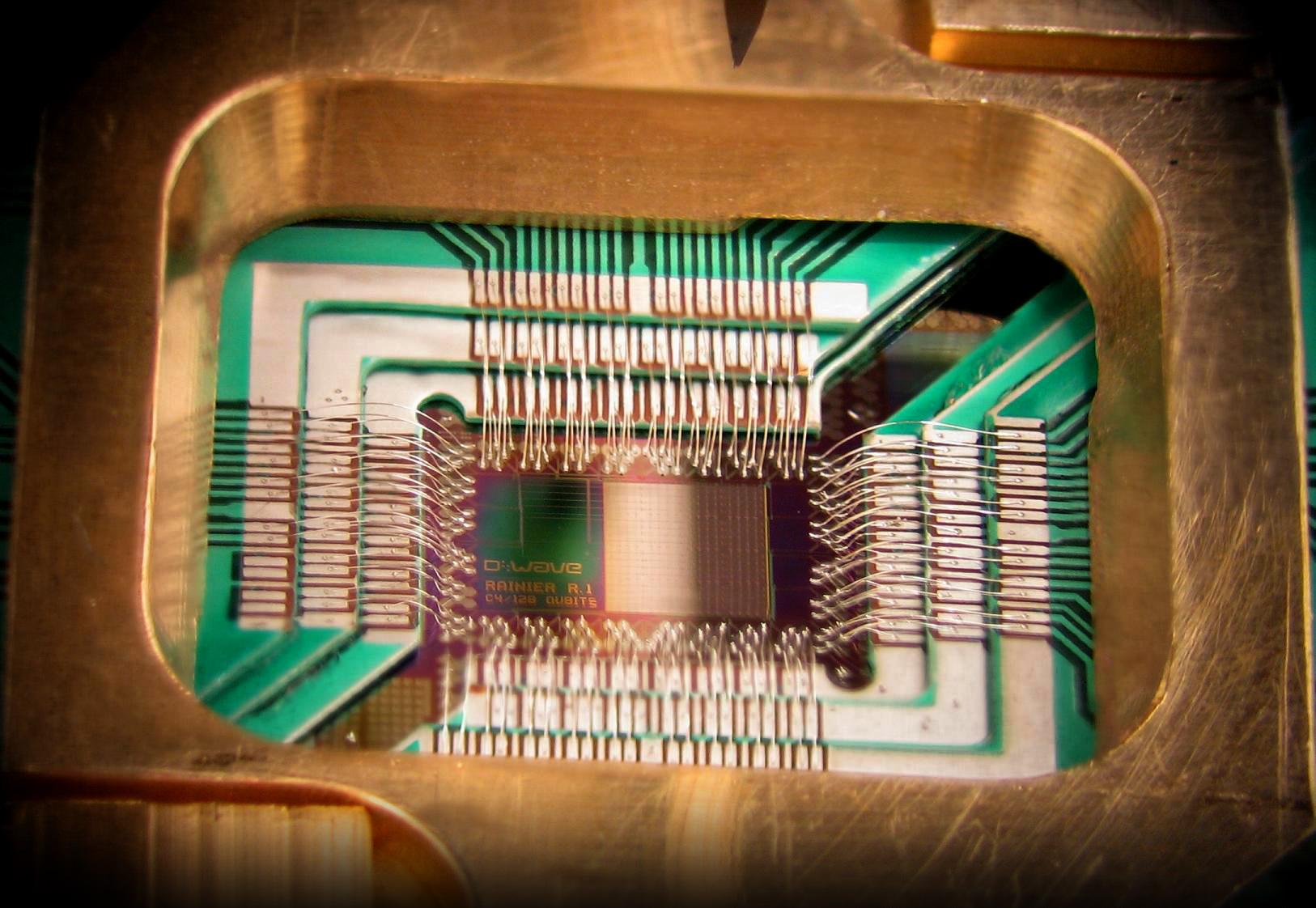
John Martinis, "Design of a Superconducting Quantum Computer"


This Google Tech Talk is way on the geeky side, but as much of it as I could follow was really interesting.

Tech Talk: John Martinis, "Design of a Superconducting Quantum Computer"

Published on Feb 28, 2014 


John Martinis visited Google LA to give a tech talk: "Design of a Superconducting Quantum Computer." This talk took place on October 15, 2013.

Abstract:

Superconducting quantum computing is now at an important crossroad, where "proof of concept" experiments involving small numbers of qubits can be transitioned to more challenging and systematic approaches that could actually lead to building a quantum computer. Our optimism is based on two recent developments: a new hardware architecture for error detection based on "surface codes" [1], and recent improvements in the coherence of superconducting qubits [2]. I will explain how the surface code is a major advance for quantum computing, as it allows one to use qubits with realistic fidelities, and has a connection architecture that is compatible with integrated circuit technology. Additionally, the surface code allows quantum error detection to be understood using simple principles. I will also discuss how the hardware characteristics of superconducting qubits map into this architecture, and review recent results that suggest gate errors can be reduced to below that needed for the error detection threshold.

References

[1] Austin G. Fowler, Matteo Mariantoni, John M. Martinis and Andrew N. Cleland, PRA 86, 032324 (2012).
[2] R. Barends, J. Kelly, A. Megrant, D. Sank, E. Jeffrey, Y. Chen, Y. Yin, B. Chiaro, J. Mutus, C. Neill, P. O'Malley, P. Roushan, J. Wenner, T. C. White, A. N. Cleland and John M. Martinis, arXiv:1304:2322.

Bio:

John M. Martinis attended the University of California at Berkeley from 1976 to 1987, where he received two degrees in Physics: B.S. (1980) and Ph.D. (1987). His thesis research focused on macroscopic quantum tunneling in Josephson Junctions. After completing a post-doctoral position at the Commisiariat Energie Atomic in Saclay, France, he joined the Electromagnetic Technology division at NIST in Boulder. At NIST he was involved in understanding the basic physics of the Coulomb Blockade, and worked to use this phenomenon to make a new fundamental electrical standard based on counting electrons. While at NIST he also invented microcalorimeters based on superconducting sensors for x-ray microanalysis and astrophysics. In June of 2004 he moved to the University of California, Santa Barbara where he currently holds the Worster Chair. At UCSB, he has continued work on quantum computation. Along with Andrew Cleland, he was awarded in 2010 the AAAS science breakthrough of the year for work showing quantum behavior of a mechanical oscillator.

Wednesday, September 04, 2013

TEDxPortsmouth - Dr. Alan Watkins - Being Brilliant Every Single Day


This rare two-part TEDx Talk by Alan Watkins, from TEDxPortsmouth, is better than the title might suggest. He speaks on performance, coherence, and controlling our organism. If you think deep breathing is the way to calm the body, he suggests you are wrong (thanks to Mark Walsh for the heads up on this).

Watkins advocates a slower, more rhythmic breathing cycle that seems to generate more brain coherence (according to his machine). Their model seeks to control all of the factors below the water-line (as seen above) in order to generate better results for the two factors above the water-line.

TEDxPortsmouth - Dr. Alan Watkins - Being Brilliant Every Single Day


Published on Mar 13, 2012 in (2 Parts)

Alan is the founder and CEO of Complete Coherence Ltd. He is recognised as an international expert on leadership and human performance. He has researched and published widely on both subjects for over 18 years. He is currently an Honorary Senior Lecturer in Neuroscience and Psychological Medicine at Imperial College, London as well as an Affiliate Professor of Leadership at the European School of Management, London. He originally qualified as a physician, has a first class degree in psychology and a PhD in immunology.

Website: http://www.complete-coherence.com

Part One:


Part Two:


This is the "About" statement from the Complete Coherence website. Of interest to integral folks, perhaps, because Diane Hamilton is one of their practitioners.

Complete Coherence is powered by compassion.


Our purpose is to develop more enlightened leaders.

Compassion is what gets us all out of bed every single day. We have a strong desire to reduce the suffering that comes from the poor decision making of leaders across the globe. We believe that there is an urgent need to develop more enlightened leadership in organisations. We are also very optimistic about the potential of human beings and what is possible. We delight in helping leaders, executive teams and multi-national organisations develop themselves and deliver much better results even in tough conditions.

Our approach is very bespoke. It is driven by our ability to precisely diagnose the critical issues which, when resolved, will cause a significant improvement in performance. Using a range of high definition diagnostic processes we ensure we understand your issues deeply before intervening. Our interventions integrate the most recent advances from multiple scientific fields including; complexity theory, human performance, neuroscience, evolutionary biology, team dynamics, organisational development, medical technology and many others.

We distinguish “horizontal” development, which is effectively the acquisition of knowledge, skills and experience from “vertical” development. Vertical development enables individuals, teams and organisations to move to a more sophisticated level of performance. Such a distinction is, in our view, critical to delivering sustainable change. We also believe in scientifically measuring the improvements created and sharing the results with you.

Founder and CEO Dr Alan Watkins BSc MBBS PhD is a one of a team of outstanding consultants who are supported by a superb back office who are incredibly friendly and keep us on track to ensure we all deliver Brilliance Every Day!

Tuesday, August 13, 2013

Surge of Neurophysiological Coherence and Connectivity in the Dying Brain

This study is probably the first step in explaining the elusive nature of the near-death-experience (NDE). For years, many neuroscientists have believed that these NDEs were the result of brain activity at the moment of and in the moments following cardiac arrest.
The researchers analyzed the recordings of brain activity called electroencephalograms (EEGs) from nine anesthetized rats undergoing experimentally induced cardiac arrest. Within the first 30 seconds after cardiac arrest, all of the rats displayed a widespread, transient surge of highly synchronized brain activity that had features associated with a highly aroused brain. 
Furthermore, the authors observed nearly identical patterns in the dying brains of rats undergoing asphyxiation.
Interesting and important research . . . but only that. More research and better models are needed.

Near-Death Experiences Verified? Dying Brains Show Electrical Signatures Of Consciousness

By News Staff | August 12th 2013

Near-death experiences may have found a new grounding in science.

Whether and how the dying brain is capable of generating conscious activity has been vigorously debated but the near-death experiences reported by cardiac arrest survivors worldwide may be verifiable, according to a new paper.

Approximately 20 percent of cardiac arrest survivors report having had a near-death experience during clinical death. These visions and perceptions have been called "realer than real" but it remains unclear whether the brain is capable of such activity after cardiac arrest.

A new paper found that shortly after clinical death, in which the heart stops beating and blood stops flowing to the brain, rats display brain activity patterns characteristic of conscious perception.

"This study, performed in animals, is the first dealing with what happens to the neurophysiological state of the dying brain," says lead study author Jimo Borjigin, Ph.D., associate professor of molecular and integrative physiology and associate professor of neurology at the University of Michigan Medical School. "It will form the foundation for future human studies investigating mental experiences occurring in the dying brain, including seeing light during cardiac arrest.

"We reasoned that if near-death experience stems from brain activity, neural correlates of consciousness should be identifiable in humans or animals even after the cessation of cerebral blood flow."

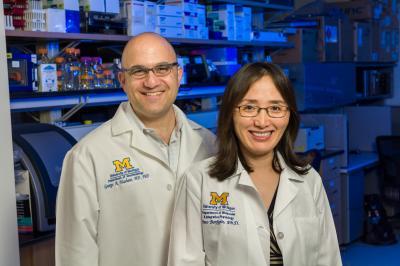
University of Michigan researchers George Mashour, M.D., Ph.D., and Jimo Borjigin, Ph.D., form the foundation for investigating mental experiences occurring in the dying brain, including seeing the light during cardiac arrest. Credit: University of Michigan Health System

The researchers analyzed the recordings of brain activity called electroencephalograms (EEGs) from nine anesthetized rats undergoing experimentally induced cardiac arrest. Within the first 30 seconds after cardiac arrest, all of the rats displayed a widespread, transient surge of highly synchronized brain activity that had features associated with a highly aroused brain.

Furthermore, the authors observed nearly identical patterns in the dying brains of rats undergoing asphyxiation.

"The prediction that we would find some signs of conscious activity in the brain during cardiac arrest was confirmed with the data," says Borjigin, who conceived the project in 2007 with study co-author neurologist Michael M. Wang, M.D., Ph.D., associate professor of neurology and associate professor of molecular and integrative physiology at the University of Michigan.

"But, we were surprised by the high levels of activity," adds study senior author anesthesiologist George Mashour, M.D., Ph.D., assistant professor of anesthesiology and neurosurgery. " In fact, at near-death, many known electrical signatures of consciousness exceeded levels found in the waking state, suggesting that the brain is capable of well-organized electrical activity during the early stage of clinical death."

The brain is assumed to be inactive during cardiac arrest. However the neurophysiological state of the brain immediately following cardiac arrest had not been systemically investigated until now.

"This study tells us that reduction of oxygen or both oxygen and glucose during cardiac arrest can stimulate brain activity that is characteristic of conscious processing," says Borjigin. "It also provides the first scientific framework for the near-death experiences reported by many cardiac arrest survivors."

Full Citation: 
Jimo Borjigin, UnCheol Lee, Tiecheng Liu, Dinesh Pal, Sean Huff, Daniel Klarr, Jennifer Sloboda, Jason Hernandez, Michael M. Wang, and George A. Mashour, (2013, Aug 12). Surge of neurophysiological coherence and connectivity in the dying brainPNAS, doi:10.1073/pnas.1308285110
Abstract
The brain is assumed to be hypoactive during cardiac arrest. However, the neurophysiological state of the brain immediately following cardiac arrest has not been systematically investigated. In this study, we performed continuous electroencephalography in rats undergoing experimental cardiac arrest and analyzed changes in power density, coherence, directed connectivity, and cross-frequency coupling. We identified a transient surge of synchronous gamma oscillations that occurred within the first 30 s after cardiac arrest and preceded isoelectric electroencephalogram. Gamma oscillations during cardiac arrest were global and highly coherent; moreover, this frequency band exhibited a striking increase in anterior–posterior-directed connectivity and tight phase-coupling to both theta and alpha waves. High-frequency neurophysiological activity in the near-death state exceeded levels found during the conscious waking state. These data demonstrate that the mammalian brain can, albeit paradoxically, generate neural correlates of heightened conscious processing at near-death.

Friday, July 13, 2012

Wolf Singer - Consciousness: Unity in Time Rather Than Space?


In this talk from the recent Evolution and Function of Consciousness Summer School ("Turing Consciousness 2012"), Wolf Singer looks at the neuronal correlates of consciousness - Consciousness: Unity in Time Rather Than Space?  Wolf's talk offers support for the Baars' Global Workspace Theory, as well as suggesting that consciousness results from coherence in time (temporal convergence, phase coherence).
 
Here is the abstract for his talk:

Wolf Singer - Consciousness: Unity in Time Rather Than Space?

Abstract: The search for neuronal correlates of consciousness (NCC) often relies on comparisons between neuronal activation patterns associated with conscious and non-conscious processing, respectively, of physically identical stimuli. This strategy is known as the subtraction method and thought to isolate neuronal processes specific for conscious experience. However, this approach does not allow one to clearly separate the NCC proper from processes that just permit access to consciousness such as fluctuations in excitability at early stages or from processes that follow conscious experience such as storage of perceived items in working memory and response preparation. This problem can be reduced but not eliminated by considering the precise temporal sequence of events, using methods that capture brain activity with high temporal resolution such as time frequency analysis and event related potentials extracted from EEG or MEG signals.
    
Applying these methods we find as an early NCC a brief burst of oscillatory activity in the beta/gamma frequency range that occurs about 180 ms after stimulus presentation and is synchronized across a widely distributed network of cortical areas. This suggests as NCC not the activation of a particular, higher order cortical area but a dynamic state that is characterized by the coherent activation of a widely distributed network. This agrees with Baars and Dehaene's hypothesis of a work space and also with Sherrington's view that the unity of conscious experience does not require convergence in space (anatomical convergence) but results from coherence in time (temporal convergence, phase coherence). Indications for a special role of precisely synchronized oscillatory responses in the high frequency range have been obtained previously in animal experiments, using the paradigm of binocular rivalry.

      Fries, P., Roelfsema, P.R., Engel, A.K., Koenig, P., and Singer, W. (1997) Synchronization of oscillatory responses in visual cortex correlates with perception in interocular rivalry. Proceedings of the National Academy of Sciences of America. 94(23), 12699-12704 http://www.pnas.org/content/94/23/12699.full.pdf+html
      Singer, W. (1998) Consciousness and the structure of neuronal representations. Phil. Trans. R. Soc. Lond. B 353: 1829-1840 http://www.ncbi.nlm.nih.gov/pmc/articles/PMC1692413/pdf/9854255.pdf
      Engel, A.K., P. Fries, P.Koenig, M. Brecht, and W. Singer (1999) Temporal binding, binocular rivalry, and consciousness. Consciousness and Cognition 8: 128-151 http://www.ini.ethz.ch/~peterk/OwnPapers/engel.cc.99.pdf 
      Engel, A.K., P. Fries, P. Koenig, M. Brecht, and W. Singer (1999) Concluding Commentary. Does time help to understand consciousness? Consciousness and Cognition 8: 260-268 
      Melloni, L., C. Molina, M. Pena, D. Torres, W. Singer, and E. Rodriguez (2007) Synchronization of neural activity across cortical areas correlates with conscious perception. The Journal of Neuroscience 27(11): 2858-2865 http://www.jneurosci.org/content/27/11/2858.full.pdf+html
      Melloni, L. and W. Singer (2010) Distinct characteristics of conscious experience are met by large-scale neuronal synchronization. In: E. Perry, D. Collerton, F. LeBeau and H. Ashton (Eds.). New Horizons in the Neuroscience of Consciousness. Advances in Consciousness Research 79. John Benjamins, B.V., Amsterdam 2010, 17-28
      Aru, J., T. Bachmann, W. Singer and L. Melloni (2012) Distilling the neural correlates of consciousness. Neuroscience and Biobehavioral Reviews 36(2): 737-746