Showing posts with label OCD. Show all posts

Thursday, January 02, 2014

Steven Handel - 5 Scientific Reasons You Should Believe in Free Will

http://www.amazon.com/gp/product/0060988479/ref=as_li_ss_tl?ie=UTF8&camp=1789&creative=390957&creativeASIN=0060988479&linkCode=as2&tag=integraloptio-20 

Without free will, there seems little point in making a New Year's resolution. After all, why bother if we have no conscious control of our behaviors and their outcomes? While there are many philosophers and neuroscientists who dismiss the notion of free will as fantasy or illusion, the best research suggests that, on average, about 80-90% of what our brain does is outside of our awareness, while 10-20% is based in conscious choice.

The first type of brain activity is known as fast thinking (Type I), essentially automated processes that are performed without conscious thought. The second type of brain activity is known as slow thinking (Type II), actions based in deliberation. Daniel Kahneman's outstanding book, Thinking, Fast and Slow, outlines and explicates these ideas.

What often does not get discussed in philosophical or neuroscientific dismissals of free will is that we can increase the percentage of brain function that is slow thinking through mindfulness practices (especially learning to be mindful of emotions that can often generate reactive responses rather than thoughtful or deliberative responses). 

Dr. Jeffrey Schwartz advocates for something he calls “self-directed neuroplasticity,” the ability to rewire your brain with your thoughts. While he employs this to help those suffering from obsessive-compulsive disorder (OCD) regain control of their behaviors, it also supports the idea that we can develop greater degrees of free will. The foundation for self-directed neuroplasticity is mindfulness.

Scientific Foundation

Neuroscientist Edmund Rolls had revealed, in a largely overlooked study, that the orbitalfrontal cortex (OFC) acts as an error detection circuit. After reading Rolls' study, Schwartz suggested that the caudate nucleus, a tail-shaped structure near the OFC that serves as the habit center of the brain, might also be involved of OCD rituals and compulsions. 
 The caudate nucleus, he thought, might act as a kind of nexus for OCD — a traffic hub where rational thinking in the cerebral cortex meets the more primitive, emotion-ruled centers of the brain’s limbic system. It would be a natural ground zero for the noxious brew of repetition and terror to collide.
This is where Schwartz brought in his interest in mindfulness:
In this sense, OCD reflects a key aspect of mindfulness meditation — granting the patient a detached perspective from his or her own thoughts. Schwartz speculated that this awareness could enable a mindfulness-based treatment strategy. After all, if the point of mindfulness is to stand back dispassionately from all our ideas and impulses, couldn’t an OCD patient use mindfulness to step back even from mortal fears and compulsions? Perhaps mindfulness could help rewire the OCD circuit in the brain.
Schwartz asked his group of people dealing with OCD to try to recognize an OCD-related thought as soon as possible and relabel it as unreal — merely a symptom of their OCD — without giving in to it. Doing so would allow them to experience the goal of directed mindfulness, to gain experiential distance from their symptoms.

As Schwartz initial work with the OCD group progressed, the subjects did gain more control, but they still experienced the intrusive thoughts. When one of the members mentioned this, Schwartz showed them the brain scans of the OFC and the caudate nucleus, what he calls the OCD circuit:
“This region of the brain is hugely overactive,” he said, and then Pop! He saw a change in his patient’s face and the excitement in everyone listening. Paula was one of the patients who experienced this eureka moment and felt liberated. These strange thoughts about her boyfriend’s drug addiction were no longer a sign of insanity. They were no longer even a product of her self. They were just the faulty transmissions of a malfunctioning brain.
Schwartz called this process reattribution - defining the symptom as something non-useful or unimportant, just a product of faulty brain wiring.

The next step was to help the group members replace the OCD thoughts with something more healthy, such as going for a walk gardening (refocusing). It helped. The final step, then, was the reframe the OCD thoughts as unimportant (revaluing).

So Schwartz had his four-step model: relabel, reattribute, refocus, and revalue.

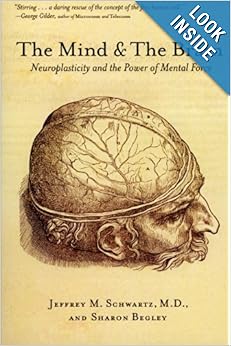
We do not have to have OCD to use this model to gain more control of our thoughts and actions, thereby increasing our experience of free will. You can learn more about this model and the research behind it in Schwartz's books, Brain Lock: Free Yourself from Obsessive-Compulsive Behavior and The Mind and the Brain: Neuroplasticity and the Power of Mental Force.

Okay, I did not intend to get so far off track here, since the point of this post is a new article by Steven Handel at The Emotion Machine blog on 5 scientific reasons to believe in free will.

5 Scientific Reasons You Should Believe in Free Will 
December 30th, 2013
by Steven Handel


One of the most popular philosophical debates is the question of “free will” vs. “determinism.”

Free will is the belief that you have free choice over your actions, while determinism is the belief that your actions are influenced by your biology and environment.

As with most philosophical questions, I find the answer to be somewhere in the middle. It’s true that our biology and environment play a large role in how we choose to act, but I believe it’s also true that we have some degree of choice within these circumstances.

Most psychologists and neuroscientists seem to take a similar compatibilist approach, which seeks to find a healthy middle ground between both “free will” and “determinism.”

Recent studies show that some belief in free will is very important for our psychology and mental health. Here are 5 scientific reasons you should believe in free will.

  1. It gives you more self-control – One study found that weakening an individual’s belief in free will led to a decrease in self-control and willpower.
  2. It makes you more pro-social – Another study found that disbelief in free will can also lead to an increase in aggression and reduction in helpfulness toward others.
  3. It improves job performance – A recent study also shows that a belief in free will predicts better career attitudes and overall job performance.
  4. It makes you more honest – Another study shows that weakening a belief in free will leads to more dishonesty and cheating.
  5. It makes your brain less automatic – One interesting study reveals that a belief in free will makes our brains less automatic.
These are just a few examples of how not believing in free will can negatively influence your behavior. Whether you want to debate about the existence of free will or not, there are definitely some practical benefits to holding this belief.

Think about it: if you believe you have no real control over your circumstances then there’s nothing motivating you to try to do something positive. You just sit back and passively watch life happen.

Overall, a belief in free will is very important in taking more responsibility, power, and control over your behaviors, and the results you get in life.

Friday, October 04, 2013

Catherine Ayers, PhD - Hoarding in Older Adults - Research on Aging


Catherine Ayers, PhD discusses the treatment of hoarding disorder in older adults. Learn about new interventions and how to help those with hoarding behaviors. UC San Diego Health Sciences Series: "Stein Institute for Research on Aging" [10/2013].

Hoarding is generally considered an anxiety disorder, although more honestly it is an obsessive-compulsive disorder (OCD) according to the nation's leading expert in this field, Dr. Randy Frost (Smith College), who, along with Gail Steketee (co-author with Frost on several books), leads the hoarding division of the International OCD Foundation.

Here is the "About Hoarding" section of the above website:

What is hoarding, and how does it differ from collecting?

Two behaviors characterize hoarding: acquiring too many possessions and difficulty discarding or getting rid of them when they are no longer useful or needed.

When these behaviors lead to enough clutter and disorganization to disrupt or threaten a person’s health or safety, or they lead to significant distress, then hoarding becomes a “disorder." Simply collecting or owning lots of things does not qualify as hoarding.

A major feature of hoarding is the large amount of disorganized clutter that creates chaos in the home.  Such as:

  • Rooms can no longer be used as they were intended
  • Moving through the home is difficult
  • Exits are blocked
Collectors typically keep their possessions well-organized, and each item differs from other items to form an interesting and often valuable collection. Further, an important purpose of collecting is to display the special items to others who appreciate them. People who hoard are seldom able to accomplish such goals.

What kinds of things do people who hoard typically save?

It may appear that people who hoard save only trash or things of no real value.  In fact, most people who hoard save almost everything. Often this includes things that have been purchased but never removed from their original wrapper.

The most frequently saved items are:

  • clothes
  • newspapers
Other commonly hoarded items include:

  • containers
  • junk mail
  • books
  • craft items

What contributes to the development of hoarding?

People who hoard often have deficits in the way they process information.  For example, they are often easily distracted and show symptoms of Attention Deficit Hyperactivity Disorder (ADHD). These symptoms make it difficult for them to concentrate on a task without being distracted by other things.

Most of us live our lives in categories. We put our possessions into categories and use organizing systems to store and find them easily. But using categories is hard for people who hoard. Their lives seem to be organized by sight and space.


The electricity bill might go on the 5-foot high pile of papers in the living room to keep it in sight as a reminder to pay the bill. The hoarder tries to keep life organized by remembering where that bill is located. When they need to find it, they search their memory for the location it was last seen. Instead of relying on a system of categories where one only has to remember where the entire group of objects is located, each object seems to have its own category. This makes the process of finding things very difficult once a critical mass of things has been collected.

Do all people who hoard save things for the same reason?

No. But, there are some general themes, such as:

Not Wasting Things


The most frequent reason for hoarding is to avoid wasting things that might have value. Often people who hoard believe that an object may still be useable or of interest or value to someone. Thinking about whether to discard it leads them to feel guilty about wasting it.

”If I save it”, reasons the hoarder, “I might not ever need it but at least I am prepared in case I do.”

Fear of Losing Important Information


The second most frequent reason for saving is a fear of losing important information. Many hoarders describe themselves as "information junkies" who save newspapers, magazines, brochures, and other information-laden papers. They keep large quantities of newspapers and magazines so that when they have time, they will be able to read and digest all the useful information they imagine to be there. Each newspaper contains a wealth of opportunities. Discarding it means losing those opportunities. For such people, having the information at hand seems crucial, whereas knowing that the information exists on the internet or in a library does little to help them get rid of their often out-of-date papers. Hoarders are often intelligent and curious people for whom the physical presence of information is almost an addiction.

Emotional Meaning of Objects


A third reason for saving is that the object has an emotional meaning. This takes many forms, including the sentimental association of things with important persons, places, or events, something most people experience as well, just not to the same degree. Another common form of emotional attachment concerns the incorporation of the item as part of the hoarder’s identity—getting rid of it feels like losing part of one’s self.

Characteristics of Objects

Finally, some people hoard because they appreciate the way objects look, especially their shape, color, and texture. Many people who hoard describe themselves as artists or craftspeople who save things to further their art. In fact, many are very creative with their hands. Unfortunately, having too many supplies gets in the way of living and the art projects never get done.


Why can’t people who hoard control their urges?

Understanding this requires knowing what happens at the moment the person decides to acquire or save something. At the time of acquisition, people who hoard often experience a sort of “high” or very good sensation during which their thoughts center on how wonderful it would be to own the object sitting in front of them. These thoughts are so pleasant that they dominate thinking, crowding out information that might curb the urge to acquire.

For instance, they forget that they don’t have the money or space for the item, or that they already have 3 or 4 of the same thing. When faced with the idea of throwing it away, hoarders have different thoughts than most other people. All their thoughts center on what they will lose (e.g., opportunity, information, identity) or how bad they will feel (e.g., distress, guilt) while none of the thoughts focus on the benefits of getting rid of the item. Saving the item, or putting off the decision, allows them to escape this bad experience. In this way people become conditioned to hoard.

How much truth is there to the common wisdom of hoarding being a response to deprivation?

Although some people attribute their hoarding to living through a period of extreme deprivation, our research has failed to find a link between being deprived of things early in life and later hoarding behavior. We do suspect there is a connection between hoarding and traumatic experiences or chaotic or disruptive living circumstances earlier in life.

Hoarding has been considered to be a kind of obsessive compulsive disorder (OCD), but are there any differences?

Yes. In fact, only about 1 in 5 people with hoarding problems report any significant OCD symptoms like checking or cleaning rituals. There are also some other important differences.

In OCD, obsessions are experienced as intrusive and unwanted, and the symptoms are always accompanied by distress. But in hoarding, owning things often produces pleasant feelings of safety and comfort, and acquiring can even produce euphoric feelings. In fact, the distress we see in hoarding comes from the accumulated clutter as a whole or from thinking about discarding things. There also appear to be differences in the brains of people with hoarding problems compared to those who suffer from OCD.

For these reasons, many scientists who study hoarding have recommended that it be classified as a distinct disorder separate from OCD.


Is it true that depression is a common problem for hoarders?

Yes. In our research we find that more than half of people with hoarding problems are clinically depressed. However, the depression does not seem to cause the hoarding, although it might be a result of hoarding, especially when the clutter interferes with people’s ability to function and they feel embarrassed and ashamed.
Among the useful and interesting books available on this topic, including Stuff: Compulsive Hoarding and the Meaning of Things (2011), probably the best non-clinical overview of hoarding I have seen, and of course it is by Frost and Steketee. They are also the authors of Compulsive Hoarding and Acquiring: Therapist Guide (2006 - new version due in November) and  Compulsive Hoarding and Acquiring: Workbook (2006).

Hoarding in Older Adults - Research on Aging


A hoarding fact sheet:

The Psychology of Hoarding

Saturday, August 31, 2013

$1.99 Kindle Book - OBSESSED: The Compulsions and Creations of Dr. Jeffrey Schwartz


This looks good (just downloaded my copy). Dr. Jeffrey Schwartz has changed the way we treat obsessive-compulsive disorder (OCD) for the better. Some older treatments, as described in Brain Lock: Free Yourself from Obsessive-Compulsive Behavior [1997] and The Mind and the Brain: Neuroplasticity and the Power of Mental Force [2003], were essentially humiliating and not helpful.

This book from Steven Volk looks at his life and work as the background that shaped his innovations.

In OBSESSED: The Compulsions and Creations of Dr. Jeffrey Schwartz, author Steve Volk ventures deep into the mind of Jeffrey Schwartz, a controversial, often combative psychiatrist and expert on obsessive-compulsive disorder (OCD).

Schwartz is best known to the public as the man who coached Leonardo DiCaprio for his Oscar-nominated role as the OCD-afflicted billionaire Howard Hughes in The Aviator. But his extraordinary professional contribution, achieved through a lifetime of obsessive work, is a breakthrough therapy that has helped free thousands of OCD sufferers from their habitual behaviors, compulsions and irrational fears.

Considered a pariah among his academic peers, Schwartz’s unconventional treatment methods draw on his fascination with the Holocaust, his experience with Buddhist meditation and his pioneering work documenting the neural circuitry of OCD. By teaching his adult patients to willfully rewire their brains and reverse their disease, Schwartz has challenged the prevailing view in neuroscience that free will is dead.

Veteran journalist Steve Volk, a senior writer at Philadelphia Magazine, skillfully balances the groundbreaking research of a philosopher-scientist with the story of a man battling demons of his own. Schwartz’s most pressing battle may actually be the one he fights against his compulsions and social awkwardness in his quest to find some accurate, workable definition of humanity that can help us overcome our darkest, most primitive selves.

Tuesday, June 11, 2013

Compulsive Behaviour Triggered and Treated (from Nature)

Scientists have discovered how to create and then stop compulsive behavior in mice simply by using pulses of light to turn off or on brain cells, a process known as optogenetic. Very cool research - and yet I wonder how targeted it is and if there side effects we might not see in mice models.

This article comes from Nature News.

Compulsive behaviour triggered and treated

Pulses of light start and stop obsessive grooming in mice


Kerri Smith
06 June 2013

Compulsive grooming in mice such as is seen here is regulated in part by a region of the cerebral cortex located behind the eyes, optical stimulation has shown. - JENNIFER SAURA/TIMOTHY SPELLMAN/SCIENCE AAAS

Researchers have both created and relieved symptoms of obsessive-compulsive disorder (OCD) in genetically modified mice using a technique that turns brain cells on and off with light, known as optogenetics. The work, by two separate teams, confirms the neural circuits that contribute to the condition and points to treatment targets. It also provides insight into how quickly compulsive behaviours can develop — and how quickly they might be soothed. The results of the studies are published in Science 1, 2.

Brain scanning in humans with OCD has pointed to two areas — the orbitofrontal cortex, just behind the eyes, and the striatum, a hub in the middle of the brain — as being involved in the condition's characteristic repetitive and compulsive behaviours. But “in people we have no way of testing cause and effect”, says Susanne Ahmari, a psychiatrist and neuroscientist at Columbia University in New York who led one of the studies.

It is not clear, for example, whether abnormal brain activity causes the compulsions, or whether the behaviour simply results from the brain trying to hold symptoms at bay by compensating. “There’s been a big debate in the field,” says Satinder Kaur Singh of Yale University in New Haven, Connecticut, who studies molecules involved in OCD-like disorders but was not involved in the new studies. “What the Ahmari paper shows is that it is causative.”
Off switch

Ahmari’s team wanted to see if optogenetics could prompt repetitive grooming in mice — a commonly used equivalent sign of an OCD-like condition in animal models. The team injected viruses into the orbitofrontal cortex carrying genes for light-sensitive proteins. Certain nerve cells then began to produce the protein and became sensitive to light. The researchers then inserted an optical fibre to shine a light on these cells for a few minutes a day. It was only after a few days that they started to see the compulsive behaviour.

“Beforehand, I thought that we would immediately see repetitive behaviours when the light was turned on,” Ahmari says. Rather, it seemed to be chronic activity in these networks that sets off the abnormal grooming. That could have implications for how these patterns of behaviour develop in humans.

In the second study, researchers at the Massachusetts Institute of Technology (MIT) in Cambridge used a mouse model of repetitive behaviour in which the mice carried a mutation in a gene involved in creating neuronal connections. The researchers conditioned both mutant and control mice to groom when water was dripped on their foreheads. After a series of trials, the mutants began to groom even without a water drop.

The team then used optogenetics to stimulate neurons in the orbitofrontal cortex that feed into the striatum. This is a similar but not overlapping group of cells to the neural circuit studied by Ahmari's team.

“Within a matter of a second or two, a behavioural change occurs,” says Ann Graybiel, who co-authored the MIT study. The abnormal grooming disappeared, leaving behind only the normal reaction to the water drop. “It’s phenomenal to watch,” Graybiel says.

She was doubly surprised that the cortex — the area associated with executive, even conscious control of behaviour — could be at the root of such an automatic response. “Everybody has thought that when we get these compulsive behaviours or really strong habits, then these behaviours reel off by themselves,” she says. Instead, the orbitofrontal cortex can send a ‘stop’ signal to other brain regions concerned with more automatic movements.

Such a rapid relief from symptoms contrasts with how long it took the Columbia team to create the symptoms in their mice. This could have been related to the fact that the types of mice used by the two teams were different, Ahmari says, and that they examined slightly different circuits, albeit within the same broad areas.

Graybiel hopes that the results will help to make therapies for OCD, such as deep-brain simulation with electrodes, more precise.

Ahmari thinks that the findings could be harnessed to help vanquish repetitive behaviours more quickly. She says that knowing how the brain changes over time to create repetitive behaviours could lead to better treatments. Nobody is suggesting, though, that humans should have optogenetic-enabling viruses injected into their brains as a therapy. “We’re not quite ready for that,” quips Graybiel.

Nature doi:10.1038/nature.2013.13144

References

  • Ahmari, S. M. et al. Science 340, 1234–1239 (2013). Article | PubMed | ChemPort 
  • Burguière, E., Monteiro, P., Feng, G. & Graybiel, A. M. Science 340, 1243–1246 (2013). Article | PubMed | ChemPort 

Related stories and links


From nature.com
From elsewhere

Monday, November 05, 2012

Culture Lab - Is There an Upside to Anxiety?


This is a brief review of a new book by Jeffrey P. Kahn, Angst: Origins of Anxiety and Depression, that suggests social anxiety and depression may have evolutionary benefits. As someone who has lived with SA for my whole life, I find this questionable, so I will likely have to read the book.

Here is the publisher's description of the book:

Some twenty percent of us are afflicted with common anxiety and depressive disorders--not just brief bouts of nervousness or sorrow, but painful dysfunctions without obvious benefit. Why do so many people suffer from angst?

In this path-breaking volume, engagingly written for the general public, psychiatrist Jeffrey Kahn reveals that angst ultimately results from our transformation, over tens of thousands of years, from biologically shaped, almost herd-like prehistoric tribes, to rational and independent individuals in modern civilization. Kahn looks at five basic types of modern-day angst--Panic Anxiety, Social Anxiety, OCD, Atypical Depression, and Melancholic Depression--and shows how each derives from primeval social instincts that once helped our ancestors survive. For instance, the "panic disorder" which prevents some people from flying may have originally evolved to keep our tribal ancestors from traveling dangerously far from home. Likewise, the increased emotional sensitivity to social rejection that now triggers episodes of "atypical depression" may have helped maintain polite behavior and social harmony in our ancestors. Our distinctly human civilization and rational consciousness lets us defy these social instincts. But those over-ridden instincts can resurface as stressful emotional disorders. Kahn notes that some of us painfully tackle this distress head-on, in ways that can advance intellectual creativity, social performance and productivity. He also describes the interplay of instinct with the advance of civilization, and on how evolutionary perspective explains why modern treatments work.

Ranging from Darwin and Freud to the most cutting-edge medical and scientific findings--drawing from ancient writings, modern humor and popular lyrics, and with many amusing cartoons--Angst offers us an exciting new slant on some of the most pervasive mental health issues of our time.
The review suggests that the book is a little too filled with jargon and psychiatric lingo for the average reader, but those of us in the field can deal with that.

angst.jpg Samantha Murphy, contributor


Social anxiety and depression are miserable, but they may have evolutionary benefits

DEPRESSION and anxiety are easily two of the most commonly diagnosed psychiatric ailments. But if they are so prevalent across so many cultures and societies, where did they come from? Are we experiencing an epidemic? Or is it simply a case of mislabelling a common, though unpleasant, life experience as a disorder in order to medically whisk away the tough bits of what it means to be human?

In psychiatrist Jeffrey Kahn's new book, Angst, he examines the origins of depression and anxiety and, using current research in psychology and evolutionary biology, carefully applies a unique anthropological perspective for why these conditions exist.

He reasons, for example, that social anxiety - the fear of interactions with strangers - may have evolved to enable a natural social ranking system in which some people feel most comfortable towards the bottom of the totem pole. This natural shuffling would have made for a less aggressive, more survivable living situation and reduced fighting for leadership.

Alcohol, Kahn goes on to argue, may well be the "first widely used psychopharmacological medication" - given its ability to "lubricate" a socially anxious person. It is no secret that alcohol can allow us to disregard our varying degrees of social anxiety and pursue endeavours that we may otherwise avoid. Kahn suggests this, too, has an evolutionary purpose: for a person who is normally withdrawn, "beer muscles" can provide a chance to get socially involved, or contribute to their community in a way they might not otherwise.

Viewing depression and anxiety as a form of survival strategy is novel, and as yet the practical application of these theories remains elusive. One possible conclusion is that people with such conditions should not be medicated because, in spite of the personal struggles they may endure, there are hidden evolutionary benefits.

But Kahn is not endorsing the idea that we stop treating people with medication, and the book falls short on applications in a real-world context. As a result, the usefulness of these new perspectives feels limited.

The book is written for a wide audience, but Kahn's valiant attempt to break down the points with colourful examples, quotes and case studies, is mired by psychiatric lingo and jargon. Consequently, the book reads like a well-researched bar chat between off-duty psychiatrists bantering about how maybe, just maybe, angst isn't such a bad thing after all.
Book information
Angst: Origins of anxiety and depression by Jeffrey P. Kahn
Oxford University Press
£22.50/$34.95

Saturday, June 23, 2012

Athena Staik, Ph.D. - Four Steps to Rewire Your Brain With Your Mind and Conscious Action


Dr. Athena Staik offers a regular column at Psych Central - Neuroscience and Relationships - on neuroscience, relationships, and methods of rewiring the brain. In this particular entry, she offers a four-step model for rewiring the brain through conscious attention and action.

The model she offers here is based on the work of UCLA neuroscientist Dr. Jeffrey Schwartz, who developed this "cognitive-biobehavioral self-treatment" in working with OCD clients (obsessive-compulsive disorder [the Axis I disorder, not the Axis II personality disorder, which is quite different]). This program is to be performed by the client between sessions with the therapist.

Dr. Staik adapts this model for use in a variety of other situations where intrusive thoughts are a problem, something I see daily in those who suffer from PTSD. It's mostly a cognitive-behavioral model, but as an adjunct to more depth-oriented sessions with a therapist, this is a very useful tool.


True, the mystery and complexity of the mind and brain may remain an ever present reality. Thanks in large part to advanced methods of studying the brain, however, recent findings in neuroscience have come a long way to unravel numerous puzzles.

Safe to say, many operations of the brain and body are governed by scientific laws as real as the Law of Gravity. Unquestionably, there is less mystery.

One of the laws discovered by recent findings is the ability of the brain to restructure and heal itself throughout life. This discovery alone tossed out centuries of scientific creeds, which previously held that we cannot do much about the damage caused by trauma and certain set patterns such as those labeled mental or behavioral “disorders.”

Known as neuroplasticity, findings show you have an innate ability to restructure the gray matter of your brain, literally speaking, with your mind and conscious action. When you change what you think, say or do in response to an event or situation, you change inner emotional states. As emotions are molecules that transmit the “what” to fire and wire” messages, whenever your felt experience of an event changes, accordingly, this physically restructures the gray matter of your brain.

More and more, psychological treatment is less guesswork and mystery, and more application of proven science.

Even deeply entrenched behavior problems, such as addictions, post-traumatic stress disorder (PTSD) or obsessive-compulsive disorder (OCD) have been shown to respond to treatment that follows proven methods of rewiring the brain by altering current thought-response patterns. For OCD, for example, neuroscientist Dr. Jeffrey Schwartz has developed four steps in a ‘response prevention” cognitive-biobehavioral approach.

It makes sense. Most emotional issues have to do with rigid patterns of thinking associated with the body’s fear response.

What follows are  four steps to rewire your brain to think and feel a different way, which can be applied to enhance your behavior or thought patterns overall. With more serious issues, seek the support of a professional.

Dr. Staik offers these four steps - based on the OCD model but made more universal to be applicable in a variety of situations - that are discussed in more detail at the original post:
1. See your automatic response patterns as learned brain-strategies.
2. Re-frame a behavior as a problem located outside of who you are as a person.
3. Set clear life vision to refocus your energies on what you consciously prioritize and most value.
4. Take action to express your commitment to this new priority or value.
By way  of comparison, here are the four steps as presented by the UCLA group - and you can read a much more detailed article on they work with OCD at this link.

QUICK SUMMARY OF THE FOUR STEPS
OF COGNITIVE BIOBEHAVIORAL SELF-TREATMENT FOR OCD

Step 1: RELABEL
Recognize that the intrusive obsessive thoughts and urges are the RESULT OF OCD.

Step 2: REATTRIBUTE
Realize that the intensity and intrusiveness of the thought or urge is CAUSED BY OCD; it is probably related to a biochemical imbalance in the brain.

Step 3: REFOCUS
Work around the OCD thoughts by focusing your attention on something else, at least for a few minutes: DO ANOTHER BEHAVIOR.

Step 4: REVALUE
Do not take the OCD thought at face value. It Is not significant in itself.

Wednesday, October 05, 2011

OCD Recovery by Sandra Kiume at Channel N

This is an interesting video of people with OCD talking about their disease, their treatment, and their recovery. The video was posted by Sandra Kiume at Channel N, a PsychCentral production. It's short at less than 10 minutes, so give it a look.

OCD Recovery

By Sandra Kiume


Living with Obsessive Compulsive Disorder
Four people describe what it’s like to have OCD, describing their symptoms and how things changed in recovery.

Length: 00:08:36
Video Link:
http://youtu.be/rkQIDCKbFus