Showing posts with label All in the Mind. Show all posts

Monday, November 03, 2014

Dreams—The Lucid Experience

http://humanityhealing.omtimes.netdna-cdn.com/wp-content/uploads/2010/11/humanityhealing_lucid-Dreams.jpg

From Australia's  Radio National All in the Mind, this is an interesting discussion of lucid dreaming.

Dreams—the lucid experience


Sunday 2 November 2014
Presenter: Lynne Malcolm

Image: Your dreams can take you anywhere (Paula Danielse, Getty Images)

Have you ever had a dream in which you are aware that you are dreaming? These seemingly altered states of consciousness are called lucid dreams. If you’re not sure of what they are they can be disturbing, but many people use them to solve the problems of their waking lives, or even just for fun. We’ll hear about this experience from a couple of dreamers, and find out about the science of lucid dreaming from one of the world’s leading researchers in the field.

Joining in? We'd love to hear about your own lucid dream experience. Has it had an impact on your waking life?

Transcript Show

Guests
  • Stephen La Berge: Founder, Lucidity Institute 
  • Paul Davies: AM Director of the Beyond Center, Arizona State University 
  • Nano Daemon: Author: 'Fate or destiny?'
Publications

  • Lucid Dreaming: A Concise Guide to Awakening in Your Dreams and in Your Life by Stephen La Berge (01 Feb 2008)
  • Exploring the World of Lucid Dreaming by Stephen La Berge, Howard Rhinegold (27 Oct 1990)
  • The Goldilocks Enigma: Why is the Universe just Right for Life? by Paul Davies (27 Oct 2006)
  • The Eerie Silence: Renewing our Search for Alien Intelligence by Paul Davies (27 Oct 2010)
  • Fate or Destiny? by Nano Daemon (11 Jul 2014)
Further Information 

Friday, October 10, 2014

All in the Mind - Schizophrenia—New Clues


This was last week's episode of the All in the Mind podcast from Radio National (ABC) in Australia.

Schizophrenia—New Clues

Sunday 5 October 2014 
As part of Mental Health Week, we discuss some of the intensive research efforts trying to uncover the mysteries of the devastating brain disease of schizophrenia.

Guests

Wednesday, June 25, 2014

The Forces that Shape Us - All in the Mind


http://img1.imagesbn.com/p/9781594204548_p0_v1_s260x420.JPG

In this week's episode of All in the Mind (ABC's Radio National) looks at the ways objects and colors and other elements of our environment can shape how we feel and how we behave. Cool topic.

The Forces that Shape Us


The hidden forces that shape our thoughts, feelings, and behaviour. What if your name could predict your future career, if your culture could influence your judgement of distance, or the physical appearance of your chess opponent could determine whether you win or lose? Everyday, as we move about the world there are many subconscious forces that massively influence our decisions - and how people relate to us.

Guests 
  • Dr Adam Alter - Associate professor of marketing and psychology, New York University

Publications

Sunday, June 22, 2014

Building a Brain - All in the Mind


A couple of weeks ago, on ABC's Radio National (Australia), All in the Mind featured a discussion about new technologies in "building" a brain that is comparable to a human brain. Most of the research seems to be taking a bottom-up approach, building from neurons to networks to modules.

I'm skeptical.

Perhaps we build simulation circuits, but a whole brain is not likely in my opinion. Even if we could build a brain, we could never build a mind - mind is an emergent property for which a brain is necessary but not sufficient. Mind requires somatic sensory input, interpersonal relationships, all of which is embedded in environmental and temporal space.

Building a Brain

Sunday 8 June 2014 | Lynne Malcolm
The international race is on to build a bionic brain, so that scientists can more deeply understand it, and develop new treatments for brain disease.  But where do you start?  Some are working on the cells and neurons and how they communicate, others on the technologies  and supercomputing power required, and then there’s the mind bending question of consciousness. We hear from the world’s top brain builders on this complex and exciting challenge.  

Guests 
  • Professor Henry Markram - Professor at École Polytechnique Fédérale de Lausanne, Director of The Blue Brain Project and the Human Brain Project 
  • Professor Bob Williamson - Past Secretary for Science Policy at the Australian Academy of Science, Honorary Senior Principal Fellow of the Murdoch Institute, University of Melbourne and Monash University 
  • Professor Ralph Greenspan - Associate Director, Kavli Institute for Mind and Brain
Further Information  

Tuesday, May 27, 2014

The Hard Data of Soft Emotions - All in the Mind


This week's podcast from All in the Mind (Australia) focused on how the internet and social media can be harnessed for everything from taking the emotional pulse of the nation to suicide prevention.

The hard data of soft emotions

Lynne Malcolm | Sunday 25 May 2014


With the rise of smart phones, GPS devices and social media we leave ‘digital breadcrumbs’ wherever we go. Many fear the power of big data and technology in the wrong hands but there's a growing movement to harness this wealth of information and use the power of the collective to better our society. We hear about what the new science of social physics tells us about human connection, how Twitter can check the emotional pulse of a nation, and how sharing personal stories through social media is an effective suicide prevention campaign.

Guests 

Ehon Chan: Social entrepreneur; Founder of Soften the Fck up
Professor Helen Christensen: Executive Director of the Black Dog Institute
Professor Alex Pentland: Toshiba Professor of Media, Arts, and Sciences; Director of Media Lab Massachusetts Institute of Technology; Author

Publications

Social Physics: How Good Ideas Spread, Lessons from a New Science by Alex Pentland

Further Information  

Tuesday, May 13, 2014

The Psychopath Within - All in the Mind

 
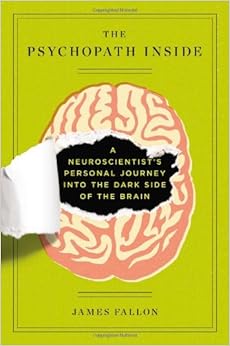
When James Fallon's The Psychopath Inside: A Neuroscientist's Personal Journey into the Dark Side of the Brain (2013) was published, he and the book received a lot of attention, mostly good (The Smithsonian, NPR's Science Friday, The Atlantic), but also some strong criticisms from people in the neuroscience community and elsewhere.

Even Publisher's Weekly was not impressed: "Fallon’s memoir of realizations is emotionally flat (which is perhaps unfair criteria to judge a psychopath by), lazily assembled, and amounts to little more than a confessional booth’s enumeration of sins."

Neurocritic wonders if he completed the Psychopathy Checklist and score over 30? Otherwise, are we to believe that he made this diagnosis from a simple pet scan of his brain?


the fallacy of reverse inference, confusing correlation with causation, and the confirmation bias.

Finally, Jordan Smoller, in the Los Angeles Review of Books, says, "If most psychopaths have a Y chromosome (that is, they are men), and I have a Y chromosome, then I’m likely to be a psychopath inside. If I told you this, you would easily see the error of my logic. But, surprisingly, the neuroscientist James Fallon bases his new book on just this kind of premise."

Be that as it may (criticism is often ignored when it attempts to make popular science conform to the rigors of "real" science), the book has legs. In last week's All in the Mind from Australia's Radio National, Fallon was the guest, along with Mark Dadds.

The Psychopath Within

Sunday 4 May 2014 | Lynne Malcolm
 

When neuroscientist James Fallon was studying the brain scans of serial killers he noticed that his own scan looked remarkably like one of his psychopathic subjects. When you hear about some of his character traits, and his seemy family background – it begins to make sense. Plus, can we prevent so-called 'callous and unemotional' kids from becoming psychopathic adults?

Guests 
  • Professor James Fallon, Professor of psychiatry , neuroscience, human behaviour & neurobiology at the University of California, Irvine
  • Professor Mark Dadds, Professor of Clinical Child Psychology at the University of N.S.W, Director of the Child Behaviour Research Clinic at the University of N.S.W.
Publications

The Psychopath Inside: A Neuroscientist's Personal Journey into the Dark Side of the Brain, by James Fallon

Further Information

Friday, April 25, 2014

Teenage Brainstorm (Dr. Dan Siegel) - All in the Mind


Last weekend's episode of All in the Mind featured an interview with author and neuropsychiatrist Dr. Daniel Siegel, talking about his most recent book on the teenage brain, Brainstorm: The Power and Purpose of the Teenage Brain (2104).

Teenage Brainstorm

Sunday 20 April 2014
All in the Mind | Lynne Malcolm

When you’re a teenager, life is on fire, wildly exciting with limitless possibilities. It can also be overwhelming and dangerous. In the past raging hormones have been blamed – but we’re now learning that it’s down to the very particular and important way that the adolescent brain develops. Professor Dan Siegel has researched the brain and emotional development of children and now he focuses on the emerging adolescent mind during the years between 12 and 24. With a new understanding of the science and purpose behind this stage of development he suggests ways for young people to capture the positive essence of adolescence, based on mindful awareness techniques.

Audio: Hear about the Wheel of Awareness practice, one of Dr Dan Siegel’s mindsight exercises | Download MP3 (2.9MB)

Guests 

Professor Daniel J. SiegelClinical professor of psychiatry, University of California Los Angeles, Author

Publications

Brainstorm: The Power and Purpose of the Teenage Brain
Daniel J. Siegel (2014)
An Inside-Out Guide to The Emerging Adolescent Mind, Ages 12 to 24

Mindsight: The New Science of Personal Transformation
Daniel J. Siegel (2010)
Change your brain and your life

Further Information  


Monday, December 23, 2013

Racing Minds - Adult ADHD


I undoubtedly had ADHD as a child, but it was not diagnosed until I was 40 years old and going back to school for a second masters degree. While ADHD is still listed as a disorder, and treated with meds (which have helped for me), I prefer to see my fast brain as a developmental adaptation to a FAST world (see here, here, and here). Neurodiversity, eh?!

This is from Australia's ABC Radio National program, All in the Mind, with Lynne Malcolm.

Racing Minds


Hosted by Lynne Malcolm
Sunday 22 December 2013


Impulsive, impatient, easily bored, chaotic and need to multi-task? Attention deficit /hyperactivity disorder is a neurodevelopmental condition which begins in childhood but three to five per cent of adults continue to have the symptoms. Many don’t even realise they have the condition until they encounter life’s challenges as an adult, away from the supervision of parents and teachers. Jess tells of her life with a fast mind and we hear about effective management and treatment strategies.

Guests 
  • Jessica Morrison, Experiences ADHD as an adult 
  • Dr Craig Surman, Assistant Professor of Psychiatry, Harvard Medical School; Scientific coordinator for the Adult ADHD Research Program, Massachusetts General Hospital 
  • Dr Caroline Stevenson, Clinical Psychologist, NSW Institute of Psychiatry; Addults with ADHD (NSW) Inc, A non-funded voluntary organisation for Adults with ADHD
  • PO Box 22
    Epping NSW 1710
    Ph: 02 - 9806 9960
    fax: 02 9806 9940
    email: info@add.org.au

Publications

Fast Minds - How to thrive if you have ADHD (or think you might have) - Craig Surman, Tim Bilkey, with Karen Weintraub 

Further Information

Tuesday, December 17, 2013

The Mind at Rest (All in the Mind) - On Sleep and Dreams

Nice conversation on this week's All in the Mind podcast, hosted by Lynne Malcolm.

The Mind at Rest

Sunday 15 December 2013


The surprising science of sleep and daydreaming. Letting your mind wander involves complex brain activity and facilitates problem solving, creativity and even enhances our sense of identity. Also, scientific sleep studies are showing that our memory can be enhanced and we can learn new things ... all while we’re quietly snoozing. This program looks at the benefits of zoning out.

Guests

Dr Muireann Irish, Senior Research Officer, Neuroscience Research Australia
Penelope Lewis, Neuroscientist, University of Manchester

Publications

The Secret World of Sleep, by Penelope A. Lewis 

Further Information