Tuesday, April 17, 2012

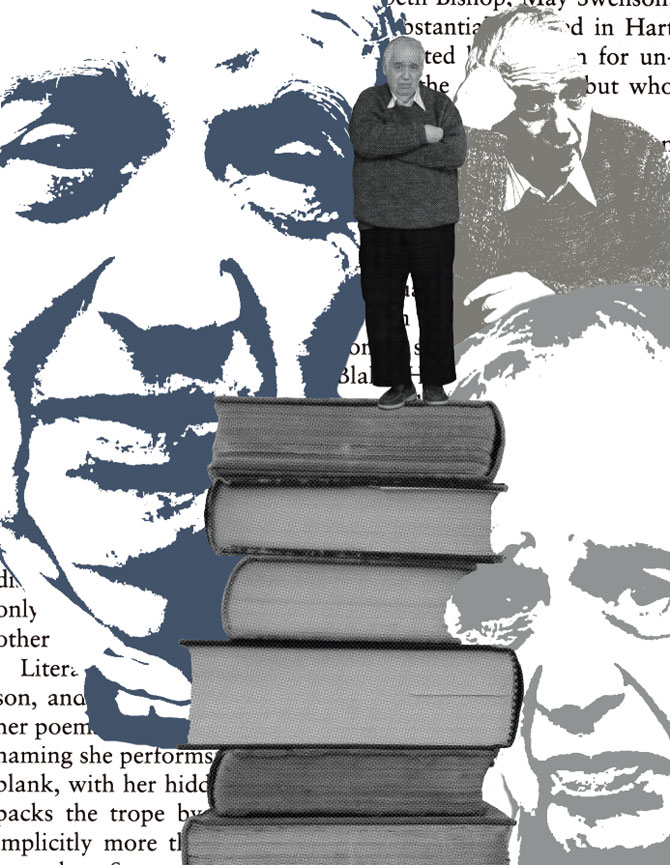
Harold Bloom: Criticism and Self-Influence


Harold Bloom is one of the two or three greatest living literary critics, Sterling Professor of the Humanities at Yale University, and a former Charles Eliot Norton Professor at Harvard. His more than thirty books include The Best Poems of the English Language, The Art of Reading Poetry, and The Book of J. He is a MacArthur Prize Fellow, a member of the American Academy of Arts and Letters, and the recipient of many awards and honorary degrees, including the Academy's Gold Medal for Belles Lettres and Criticism, the International Prize of Catalonia, and the Alfonso Reyes Prize of Mexico.

FORA.tv hosted a two-part lecture from Harold Bloom called "Criticism and Self-Influence."

Part One:


Part Two:


Summary
The Ph.D. Program in Comparative Literature is proud to announce the launch of its series Critical Theory Today with two major talks by preeminent literary scholar and critic Harold Bloom. Professor Bloom, who is Sterling Professor of Humanities at Yale University, will deliver lectures on two consecutive Mondays, March 19 and March 26.

Titled "Criticism and Self-Influence," focusing on his readings of Whitman in his first lecture and of Shakespeare in his second, these lectures are contributions to Bloom's intellectual biography. They will give a sense of how Harold Bloom reads, what stirs his mind, what he looks for, and what he projects on a text. With so impressive a list of works to his credit, Bloom will assess not only his impact on the world of literary criticism, but also his vision as a man of letters who has taught us how to think about that one subject that will always challenge our ability to think: art.

Matthew Hutson - What Doesn't Kill You (in Salon)

The 7 Laws of Magical Thinking: How Irrational Beliefs Keep Us Happy, Healthy, and Sane

What do we mean when we talk about luck? Karl Teigen, a psychologist at the University of Tromsø in Norway, has concluded that, most of the time, “lucky” events are not terribly pleasant. When we feel lucky to be alive, it's generally because something really bad just happened and, somehow, we did not die (as odds might suggest we should have).

In this article from Matthew Hutson (writing at Salon),he takes a look at the neuroscience of luck - it's an interesting excerpt from his new book, The 7 Laws of Magical Thinking: How Irrational Beliefs Keep Us Happy, Healthy, and Sane.

What doesn’t kill you

When we escape death, we feel lucky and purposeful. Now science is explaining why.

near_death
 (Credit: Sven Bannuscher via Shutterstock)
This article was adapted from the new book "The 7 Laws of Magical Thinking", from Hudson Street Press. 
One morning in August 1944, a German Doodlebug exploded in London, disturbing a butterfly and causing it to flap its wings. No one seemed to notice the tiny breeze.

A year later, on the morning of August 9, 1945, the wings of Bockscar lifted it into the air. The B-29, loaded with a five-ton atomic bomb named “Fat Man,” took off from Tinian, an island 1,500 miles southeast of Japan. The United States had dropped “Little Boy” over Hiroshima on August 6, immediately killing tens of thousands of people, but Japan had not yet surrendered World War II. Around 9:30 a.m., the weather scout plane Up an’ Atom reported a few clouds but decent conditions over the next target. Clear for bombing.

Oh, but what’s that? The year-old turbulence of a butterfly halfway around the world? By the time Bockscar passed over its target at 10:44 a.m., the city was covered in haze. According to the pilot’s flight log, “Two additional runs were made, hoping that the target might be picked up after closer observation. However, at no time was the aiming point seen.” So the crew left the city of Kokura and made their way over to their second choice, Nagasaki.


Matthew Hutson, a former editor at Psychology Today, has a B.S. in cognitive neuroscience from Brown University and an M.S. in science writing from MIT. He has written for Wired, Discover, Popular Mechanics, Scientific American Mind, the Boston Globe and the New York Times Magazine. He lives in New York City.   More Matthew Hutson

Monday, April 16, 2012

Elaine Pagels Reads "The Book of Revelation" as Political Commentary

Jami and I just watched a National Geographic show about the Book of Revelation, one of the strangest and most controversial books of the New Testament. Its authorship is still a bit of mystery according to the show we saw (it's NOT John the Baptist, John the Apostle, nor John of the Gospel), but there is no reason to doubt his name was John.

In her new book, Revelations: Visions, Prophecy, and Politics in the Book of Revelation, Elaine Pagels reads "The Book of Revelation" as political commentary - anti-Roman propaganda.

The Last Trumpet - ‘Revelations,’ by Elaine Pagels

By DALE B. MARTIN
Published: April 6, 2012

Many people mistakenly call the last book of the Christian Bible “Revelations.” It is actually the (one) Revelation to John. Elaine Pagels may be playing on that common error with the title of her latest book, “Revelations,” though in this case it is accurate: she ­places the biblical Book of Revelation in the context of other ancient narratives of visions and prophecy. Her account highlights several prophetic works and visionaries, from Ezekiel to Paul to the ancient sect of prophesying Christians called the Montanists, and others. Pagels also discusses the afterlife of Revelation in the Christianity of late antiquity through the fourth century. Her thesis is that apocalyptic literature — visions, prophecies, predictions of cataclysm — has always carried political ramifications, both revolutionary and reactionary, liberal and conservative, from the very beginning up until today, as seen in conservative iterations of millennial dispensationalism and the hugely popular “Left Behind” series of novels about the end of the world. The apocalyptic is political. 

St. Michael Fighting the Dragon, woodcut by Albrecht Dürer, 1498.

REVELATIONS: Visions, Prophecy, and Politics in the Book of Revelation
By Elaine Pagels
246 pp. Viking. $27.95.

Related: The Bible

“Revelation” is from the Latin translation of the Greek word apocalypsis, which can designate any unveiling or revealing, fantastic or ordinary. Scholars also refer to the document as the Apocalypse of John. And that same Greek word provides the label for all sorts of ancient literature that scholars call “apocalyptic.” The biblical text purports to relate a real vision experienced by an otherwise unknown Jew named John — not the Apostle John, nor the same person as the anonymous author of what we call the Gospel of John. But we have no reason to doubt that his name was really John. It wasn’t an unusual name for a Jew. 

John wrote his vision, prefaced with messages to seven churches in Asia Minor (modern western Turkey), from the island of Patmos in the Aegean Sea. We may imagine John, Pagels suggests, as an old Jew who had lived through the Jewish war with Rome, during which Jerusalem was decimated and the Temple destroyed in the year 70. He may have seen the thousands of Jews killed and thousands of others carried to Rome as slaves. Bitter about the dominating imperial power, he may have wandered through Syria and Asia Minor, along the way meeting other followers of the crucified prophet Jesus, other “cells” of worshipers of the Jewish Messiah who was killed and mysteriously raised from the dead. 

But when he gets to western Asia Minor, he comes across many gentile Christians, quite possibly in churches founded by the now dead Apostle Paul. Unlike John, they seem to be relatively well off. They usually get along fine with their non-Christian neighbors. They may be prospering from the Pax Romana, the “peace” sustained by Roman domination. They are marrying and having children, running their small businesses, ignoring the statues, temples and worship of other gods that surround them. 

For John, this Christian toleration of Rome and its idols is offensive. This is not a benign governmental power. It is the Whore of Babylon, arrogantly destroying the earth. John writes (in this theory) to warn the churches, and he relates his vision to provoke alarm at the Evil Empire. That vision predicts the destruction of Rome by angelic armies, followed by the salvation of faithful disciples of the bloody, horned warrior-lamb Jesus. Those who resist will, in the end, be rewarded.
The Apocalypse, the Revelation to John, has over the centuries been read by many Christians to predict events that might happen in their own time. In the 1980s, journalists discussed President Ronald Reagan’s statements that biblical prophecies might be fulfilled in our days, when other nations would attack Israel and a great war would end with the Second Coming of Christ. But Reagan was just one in a long line bringing John’s prophecy into our times. 

Pagels, the author of “The Gnostic Gospels,” details how Revelation and other apocalyptic writings have frequently urged fear and hatred of ruling powers, if not so often armed revolt. Revelation was originally anti-Roman propaganda. Two centuries earlier, around 164 B.C., a Jew wrote down another series of visions in order to incite resistance against Hellenizing Jewish leaders in Jerusalem and their patron king, Antiochus IV Epiphanes, ruler of the Greco-Syrian Seleucid empire. That book, published in the Old Testament under the pseudonym Daniel, is one of the earliest ancient apocalypses, and it influenced Jewish and Christian literature thereafter. Around A.D. 100, another Jew, not a Christian, recorded his own visions, nowadays known as 4 Ezra, also stoking the fires of anti-Roman hatred and prophesying Rome’s destruction. As Pagels illustrates, apocalyptic visions have been put to political purposes throughout history, down to the armies on both sides of the Civil War, echoed for Northern soldiers in “The Battle Hymn of the Republic” but also inspiring Southern generals. 

One of the significant benefits of Pagels’s book is its demonstration of the unpredictability of apocalyptic politics. Christians in the second and third centuries wrote “hidden” books that promoted a rather quietistic form of scholarly Christianity, more adventurous in its theology and mythology than what was coming to be called “orthodoxy.” Many of the texts discovered in 1945 near Nag Hammadi, Egypt, sometimes called “Gnostic” scriptures, narrate “secret” revelations. Other Christians, who were winning the battle to own the label “orthodox,” used Revelation to oppose Christians they labeled “heretics.” They interpreted the “beast” it describes to be some arch-heretic or Satan as the inventor of heresies. The Whore of Babylon was no longer Rome, but a heretical opponent of orthodoxy. Revelation wasn’t depoliticized. Its politics had shifted. 

Once the empire had a Christian patron in Constantine, the meaning of Revelation changed again. For Constantine, after his own “vision,” he himself was the conquering ruler for good, and the “dragon” of Revelation referred not only to Satan but also to Constantine’s human rivals for the throne. Constantine later took heretics, schismatics within the church and eventually even Jews to be the embodiment of the Evil One. Revelation had not lost its political power, but its political use had changed. 

Pagels’s book does contain a few minor historical mistakes. The apostate Jew Alexander, who rose to high political office in Egypt, was not the uncle of the Jewish philosopher Philo, but his nephew. Galatia is the name of a region, not a city. More important, Pagels sometimes makes ancient people and concepts too familiar to us. It is anachronistic, I believe, to portray the appeals for toleration made by Tertullian, a second-century Christian, or by Jews earlier, as anything like the Enlightenment principle of the separation of politics and religion. That is to take distinctly modern ideas into the ancient world, where they don’t belong. 

But such missteps do nothing to mar the story Pagels tells. The meaning of the Apocalypse is ever malleable and ready to hand for whatever crisis one confronts. That is one lesson of Pagels’s book. Another is that we all should be vigilant to keep some of us from using the vision for violence against others. 

~ Dale B. Martin’s latest book, “New Testament History and Literature,” has just been published.

Richard P Bentall - A proposal to classify happiness as a psychiatric disorder


My Facebook friend, Duff (he blogs at Beyond Growth), shared a link to this article a few days ago. It may seem like it's from The Onion, but it is legitimate, cited in PubMed and everything. If it weren't so accurate, it would be a lot more funny.


A proposal to classify happiness as a psychiatric disorder

Richard P Bentall, Liverpool University

Author's abstract
It is proposed that happiness be classified as a psychiatric disorder and be included in future editions of the major diagnostic manuals under the new name: major affective disorder, pleasant type. In a review of the relevant literature it is shown that happiness is statistically abnormal, consists of a discrete cluster of symptoms, is associated with a range of cognitive abnormalities, and probably reflects the abnormal functioning of the central nervous system. One possible objection to this proposal remains - that happiness is not negatively valued. However, this objection is dismissed as scientifically irrelevant.

Citation:
Bentall, R.P. (1992). A proposal to classify happiness as a psychiatric disorder. Journal of medical ethics, 18; 94-98.

Shrink Rap Radio #300 On The Neuroscience of Dreaming with Robert Hoss


Nice discussion on the neuroscience of dreaming. Your host, Dr. David Van Nuys, speaks with Robert Hoss, M.S., author of the book, Dream Language: Self-understanding Through Imagery and Color.

Shrink Rap Radio #300 On The Neuroscience of Dreaming with Robert Hoss


Robert Hoss, M.S., is author of the book Dream Language. He is also a Director and Past President of the International Association for the Study of Dreams, faculty at Haden Institute for Dream Leadership Training, and former adjunct faculty for dream studies at such institutions as Sonoma State University, Richland College and Scottsdale College.
A former corporate executive, scientist and researcher, with training in Gestalt and Humanistic psychology, he now devotes his skills to dream studies, for which he has been a frequent guest on radio and TV, and an internationally acclaimed lecturer and instructor for over 30 years. His unique, simple but powerful dreamwork approach is based on his training in Gestalt therapy and background in Jungian studies, the neurobiology of dreaming, plus his pioneering research on the significance of color in dreams.
He is also conference manager for the upcoming 29th annual conference of the International Association for The Study of Dreams “Sailing on the Sea of Dreams” at the Berkeley Marina Doubletree, June 22 – 26, 2012, and you are invited to attend!

Check out the following Psychology CE Courses based on listening to Shrink Rap Radio interviews:


Get our iPhone/Android app!

A psychology podcast by David Van Nuys, Ph.D.


Sunday, April 15, 2012

Open Culture - Martin Scorsese’s Very First Films: Three Imaginative Short Works

It's always interesting to see the beginning of a great artist's career, and with filmmakers, we often have more opportunity to see the arc of their careers from their first short (often film school) experiments to the great films for which they know them.

Open Culture offered up three of Martin Scorsese's first experimental films.

Martin Scorsese’s Very First Films: Three Imaginative Short Works

April 12th, 2012

Last week we featured the first three films of Stanley Kubrick. Today we focus on the first three by Martin Scorsese. Although the two men were about the same age when they ventured into filmmaking, and faced similar constraints, their earliest films are strikingly different.

Kubrick and Scorsese had both grown up in New York City and gone to high school in the Bronx, but their circumstances were worlds apart. Kubrick failed to get into college after high school because of bad grades but, as he put it, “backed into a fantastically good job at the age of seventeen” working as a staff photographer for Look magazine. Scorsese went to college and studied the history and aesthetics of cinema. When Kubrick decided to try his hand at motion pictures he was driven by a sense of economic urgency. His strategy was to get a foothold in the marketplace by beating the newsreel industry at its own game. Scorsese, on the other hand, was sheltered from economic worries. He was moved instead by the vivacity and inventiveness of French New Wave cinema, among other influences, and wanted to assert himself as the next great auteur.

As a severely asthmatic child, Scorsese went to the movies often. When high school graduation was approaching he thought about becoming a priest, and briefly considered studying literature. But then something caught his eye: a catalog for the New York University film school. He went to an NYU orientation session, where the various department heads took turns describing their programs to a room filled with prospective students. When the head of the Department of Television, Motion Pictures and Radio stood up–a man named Haig Manoogian–the young Scorsese was instantly impressed. “He had such energy, such passion,” Scorsese tells Richard Schickel in Conversations with Scorsese. “I said to myself, That’s where I want to be, with this person.”

Manoogian took the art of film very seriously. When Scorsese was a freshman in 1960 he attended Manoogian’s once-a-week class on the history of film. Each session included a lecture and the screening of a film. In Conversations with Scorsese the filmmaker remembers Manoogian’s ruthlessness in dealing with students who attended only to watch movies. “He’d say, okay, you don’t come back, you don’t come back,” says Scorsese, “‘because some of you must think because we’re showing movies, it’s fun. Get out.’”

As Scorsese moved through the program, he gradually began learning a few basic skills in the mechanics of making a movie. By junior year, each student was expected to collaborate in the making of a short film. So in 1963 Scorsese took Manoogian’s summer workshop, where he found that not every student got to direct. “He’d say, Okay, you’re director, you’re grip, you’re camera, whatever,” Scorsese tells Schickel. “So there were a lot of people who were very unhappy.” He quickly figured out that Manoogian was assigning the role of director to students who had their own screenplay. “What I did was write a script and get it to him as soon as possible, and he okayed it, so I was given a crew, and they all knew that they had to do what I wanted.”

Scorsese and his crew took one of the school’s old 16mm Bell & Howell Filmo cameras and shot a one-reel comedy in a week. He would later describe the film as “nine minutes of visual nonsense.”  What’s a Nice Girl Like You Doing in a Place Like This?, as it is called, (see above) adopts the surreal comic sensibility Scorsese admired in the work of Mel Brooks and Ernie Kovaks, along with narrative technique he picked up watching French New Wave films, particularly those of François Truffaut. As he tells Schickel:

My little film had all the tricks and fun of just putting pictures together in slow motion and fast motion and stills, and intercutting with mattes the way Truffaut would do in Jules and Jim. It had no depth at all, but it was a lot of fun. And it won me a scholarship, so my father was able to use it for the tuition for the next year. And then that led me to doing another short film in my junior year, the second semester, and that became It’s Not Just You, Murray!

It’s Not Just You, Murray! part one:


It’s Not Just You, Murray! part two:


It’s Not Just You, Murray! (above), completed in 1964, is a much more ambitious film. It tells the story of a pair of Italian-American gansters. “The two characters, Murray and Joe,” Scorsese tells Michael Henry Wilson in Scorsese on Scorsese, “are close friends, but the sort who are constantly stealing from each other, pinching their whisky and their girls. They live the way I myself was living with my buddies–relationships that contain as much hate as love.”

Scorsese chose not to present Murray as a gangster at the beginning of the film, because he wanted to make a wider statement about American life. “I grew up in Little Italy,” he tells Wilson, “I’ve seen corruption up close, I’ve seen it operating every day. After that you can’t take the Establishment seriously. It’s all a fraud.” The two-reel film is like a preliminary sketch for some of Scorsese’s most famous later films. When Schickel tells Scorsese he had never seen It’s Not Just You, Murray!, he is surprised by the filmmaker’s description. “It was basically Goodfellas,” Scorsese says. “Huh,” says Schickel?

It’s Goodfellas. I did it in 1964. Murray was a big epic, as much as I could manage, of two guys who were friends in the underworld, from my old neighborhood. but I did it with very New Wave techniques. It was also a cross with The Roaring Twenties, an attempt at that sort of scale which led eventually to Mean Streets, which led ultimately to Goodfellas, and to Casino and Gangs of New York–the scale of it, the excessive nature of it. I mean, in Murray there’s just a hint of it. We didn’t have the money.

The Big Shave:


After Scorsese received his bachelor’s degree from NYU in 1964, he began work on his first feature film, Who’s That Knocking at My Door? It took him over two years to make, and in 1967 he still hadn’t found a distributor. At that time he received a grant from the Cinémathèque de Belgique to make a short film. The result was the third film by Scorsese to be released, and his first in color: The Big Shave (above). “In a bathroom that may represent the American Psyche haunted by the Vietnam war,” writes Wilson in a synopsis of the film, “the daily ritual of shaving turns into a scene of horror.”

As Scorsese tells Mary Pat Kelly in Martin Scorsese: The First Decade, “It grew out of my feelings about Vietnam. But in reality something else was going on inside of me, I think, which really had nothing to do with the war.” Scorsese was experiencing a number of professional and personal setbacks, and was deeply depressed at the time. “After separating from my wife,” he tells Wilson, “I was camping out in empty, creepy apartments.” He continues:

When I wrote the script, I was very serious, but while we were shooting it we never stopped laughing. Watching the rushes, we were doubled up. It was only afterwards that I tried to rationalize what I had done. I almost convinced myself that it was a film against the Vietnam war, that this guy who shaves so meticulously and ends up cutting his throat represented the average American of his day. It was because of these political implications that I used Bunny Berigan’s original 1939 version of “I Can’t Get Started” for the soundtrack. I even wanted to end with archival images of Vietnam, but I didn’t need them. The Big Shave was really a fantasy, a strictly personal vision of death.

You can find the Scorsese films mentioned above in our collection of Free Movies Online.

Philosopher's Zone - A Dangerous Method


This week's episode of the Philosopher's Zone looks at the relationship of Sigmund Freud and Carl Jung, two men not generally thought of as philosophers who nonetheless shaped a great deal of philosophical thinking in the 20th century.

Host Alan Saunders speaks with Michael Robertson about the film. I wish they had talked more about the reality of the Freud / Jung relationship and not just how the film depicted it.

A Dangerous Method

Broadcast: Sunday 15 April 2012

This week on the Philosopher’s Zone, we’re looking at a couple of people you might not think of as philosophers at all. One of them aspired to be a scientist of the mind.  The other, though, was something of a philosopher, something of a mystic and something of a shaman.  His name was Carl Gustav Jung and his relationship with an older man, Sigmund Freud, is the subject of A Dangerous Method, a new film directed by David Cronenberg, written by Christopher Hampton  and starring Michael Fassbender as Freud, Viggo Mortensen as Jung and Keira Knightley as the woman who presence proves to be something of a catalyst in their relationship.

Saturday, April 14, 2012

Bookforum Omnivore - How We View Human Evolution

Bookforum's Omnivore posted a nice collection of links on human evolution and how we assemble the family tree of our ancestors. Enjoy!


Emotional Maturation, Resilience, and the Aging Brain

All four of these videos deal in some way with how we age, mature, and thrive through resilience. Barring unfortunate circumstances, we all age - so the question is How Will We Age? Will we age well, with grace and maturity, or will we decline in function, become less resilient, and suffer cognitive decline?

Professor Lorraine Tyler - The Resilient Brain: Cognition and Aging

"The Resilient Brain: Cognition and Aging", this year's British Academy/British Psychological Society Lecture, was given by Professor Lorraine Tyler FBA at the Royal Society, London, on Thursday 22 September 2011 at the Royal Society.

Professor Tyler discussed some research that takes a positive view of changes across the lifespan, and in doing so is starting to overturn existing stereotypes of ageing.


Exploring the Crossroads of Attention and Memory in the Aging Brain: Views from the Inside

Dr. Adam Gazzaley studies the neural mechanisms of memory and attention, how these processes change with normal aging and dementia, and how we might intervene therapeutically to alleviate memory and attention deficits. Series: "UCSF Osher Mini Medical School for the Public" [4/2012]


The Aging but Resilient Brain: Keeping Neurons Happy

Joel Kramer, UCSF Professor of Neuropsychology and the Director of the Memory and Aging Center Neuropsychology program. He explores the underlying biological mechanisms of cognitive aging, and interventions that may optimize cognitive functioning as we age. Series: "UCSF Osher Mini Medical School for the Public" [4/2012]


How Our Emotional Lives Mature: Changes and New Strengths

Robert Levenson, UC Berkeley Department of Psychology, explores the changes in emotion that occur with age. Much of his research focuses on the nature of human emotion, in terms of its physiological manifestations, variations in emotion associated with age, gender, culture, and pathology, and the role emotion plays in interpersonal interactions. Series: "UCSF Osher Mini Medical School for the Public" [4/2012]


Open Culture - Celebrate Samuel Beckett’s Birthday with Waiting For Godot (the Film)


Yesterday was the 106th anniversary of the birth of Samuel Beckett, one of my favorite novelists and certainly my favorite playwright. During my first year after grad school (the first time) I read everything by Beckett that I could get my hands on - for a while I tried to write plays, but I realized I was just trying to write Beckett for the late 20th century.


Celebrate Samuel Beckett’s Birthday with Waiting For Godot (the Film)

Samuel Beckett's pared-down prose and plays are among the greatest achievements of late modernism.

At a young man Beckett moved to Paris, where he befriended another Irish exile, James Joyce. As a writer, Beckett realized early on that he would never match Joyce’s “epic, heroic” achievement. Where Joyce was a synthesizer, Beckett once said, he was an analyzer. “I realized that my own way was impoverishment,” he said, “in lack of knowledge and in taking away, subtracting rather than adding.”

To celebrate Beckett’s birthday we bring you a pair of videos, including an excellent 2001 film version (above) of the most famous of his enigmatic creations, Waiting for Godot. It’s the centerpiece of Beckett on Film, a series of adaptions of all 19 of Beckett’s plays, organized by Michael Colgan, artistic director of the Gate Theatre in Dublin. The film features Barry McGovern as Vladimir, Johnny Murphy as Estragon, Alan Stanford as Pozzo and Stephen Brennan as Lucky. It was directed by Michael Lindsay-Hogg, who describes Waiting for Godot as being “like Mozart–too easy for children, too difficult for adults.” He goes on:
The play is what it is about. Samuel Beckett would have said it’s about two men waiting on the side of the road for someone to turn up. But you can invest in the importance of who is going to turn up. Is it a local farmer? Is it God? Or is it simply someone who doesn’t show up? The important thing is the ambiguity–the fact that it doesn’t really state what it is. That’s why it’s so great for the audience to be part of–they fill in a lot of the blanks. It works in their imaginations.
You can order the 19-film boxed set of Beckett on Film here, and read the full text of Waiting for Godot while listening to a CBC audio recording of the play, read by the Stratford Festival Players, starting here.

For fans of Harold Pinter, there is also a film clip of him talking about his first meeting with Beckett, his mentor and friend.

Friday, April 13, 2012

Marilynne Robinson - "The locus of the human mystery is perception of this world"

Marilynne Robinson intrigues me. She is a religious person, and by that I mean she believes in God, who is very fond of science and the sciences. She is a philosopher who is best known as a novelist (her second novel, Gilead, was awarded the Pulitzer Prize, and she teaches at the prestigious University of Iowa MFA program). Her 2011 book, Absence of Mind: The Dispelling of Inwardness from the Modern Myth of the Self (The Terry Lectures Series), was one of the better philosophy books of the year and an eloquent defense of human subjectivity.

This essay, which appeared in February in The Chronicle Review (from The Chronicle of Higher Education) is an excerpt from her book When I Was a Child I Read Books, in which it appears as "Freedom of Thought." The book was be published by Farrar, Straus & Giroux in March 2012. It's a long essay, but it's also very thought-provoking . . . . She defends the religious sensibility, not so much religion itself, that sees sacredness in the world around us.

Reclaiming a Sense of the Sacred

A writer contemplates religion, science, art, and the miraculous

Reclaiming a Sense of the Sacred 1
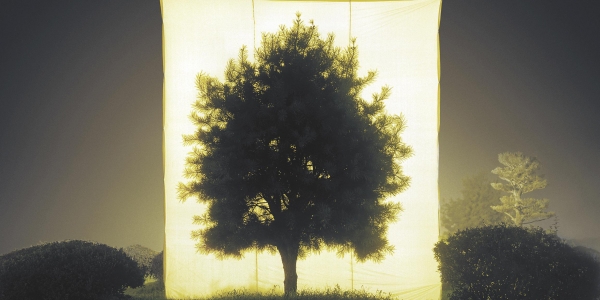
Myoung Ho Lee, courtesy Yossi Milo Gallery, New York
Over the years of writing and teaching, I have tried to free myself of constraints I felt, limits to the range of exploration I could make, to the kind of intuition I could credit. I realized gradually that my own religion, and religion in general, could and should disrupt these constraints, which amount to a small and narrow definition of what human beings are and how human life is to be understood. And I have often wished my students would find religious standards present in the culture that would express a real love for human life and encourage them also to break out of these same constraints.

For the educated among us, moldy theories we learned as sophomores, memorized for the test and never consciously thought of again, exert an authority that would embarrass us if we stopped to consider them. I was educated at a center of behaviorist psychology and spent a certain amount of time pestering rats. There was some sort of maze-learning experiment involved in my final grade, and since I remember the rat who was my colleague as uncooperative, or perhaps merely incompetent at being a rat, or tired of the whole thing, I don't remember how I passed. I'm sure coercion was not involved, since this rodent and I avoided contact. Bribery was, of course, central to the experiment and no black mark against either of us, though I must say, mine was an Eliot Ness among rats for its resistance to the lure of, say, Cheerios.

I should probably have tried raising the stakes. The idea was, in any case, that behavior was conditioned by reward or its absence, and that one could extrapolate meaningfully from the straightforward demonstration of rattish self-interest promised in the literature, to the admittedly more complex question of human motivation. I have read subsequently that a female rat is so gratified at having an infant rat come down the reward chute that she will do whatever is demanded of her until she has filled her cage with them. This seems to me to complicate the definition of self-interest considerably, but complexity was not a concern of the behaviorism of my youth, which was reductionist in every sense of the word.

It wasn't all behaviorism. We also pondered Freud's argument that primordial persons, male, internalized the father as superego by actually eating the poor fellow. Since then we have all felt bad—well, the male among us, at least. Whence human complexity, whence civilization. I did better on that exam. The plot was catchy.

The situation of the undergraduate rarely encourages systematic doubt. What Freud thought was important because it was Freud who thought it, and so with B.F. Skinner and whomever else the curriculum held up for our admiration. There must be something to all this, even if it has only opened the door a degree or two on a fuller understanding. So I thought at the time. And I also thought it was a very bleak light that shone through that door, and I shouldered my share of the supposedly inevitable gloom that came with being a modern.

In English class we studied a poem by Robert Frost, "The Oven Bird." The poem asks "what to make of a diminished thing." That diminished thing, said the teacher, was human experience in the modern world. Oh dear. Modern aesthetics. We must learn from this poem "in singing not to sing." To my undergraduate self I thought, "But what if I like to sing?" And then my philosophy professor assigned us Jonathan Edwards's Doctrine of Original Sin Defended, in which Edwards argues for "the arbitrary constitution of the universe," illustrating his point with a gorgeous footnote about moonlight that even then began to dispel the dreary determinisms I was learning elsewhere. Improbable as that may sound to those who have not read the footnote.

At a certain point I decided that everything I took from studying and reading anthropology, psychology, economics, cultural history, and so on did not square at all with my sense of things, and that the tendency of much of it was to posit or assume a human simplicity within a simple reality and to marginalize the sense of the sacred, the beautiful, everything in any way lofty. I do not mean to suggest, and I underline this, that there was any sort of plot against religion, since religion in many instances abetted these tendencies and does still, not least by retreating from the cultivation and celebration of learning and of beauty, by dumbing down, as if people were less than God made them and in need of nothing so much as condescension. Who among us wishes the songs we sing, the sermons we hear, were just a little dumber? People today—television—video games—diminished things. This is always the pretext.

Simultaneously, and in a time of supposed religious revival, and among those especially inclined to feel religiously revived, we have a society increasingly defined by economics, and an economics increasingly reminiscent of my experience with that rat, so-called rational-choice economics, which assumes that we will all find the shortest way to the reward, and that this is basically what we should ask of ourselves and—this is at the center of it all—of one another. After all these years of rational choice, brother rat might like to take a look at the packaging just to see if there might be a little melamine in the inducements he was being offered, hoping, of course, that the vendor considered it rational to provide that kind of information. We do not deal with one another as soul to soul, and the churches are as answerable for this as anyone.

If we think we have done this voiding of content for the sake of other people, those to whom we suspect God may have given a somewhat lesser brilliance than our own, we are presumptuous and also irreverent. William Tyndale, who was burned at the stake for his translation of the Bible, who provided much of the most beautiful language in what is called by us the King James Bible, wrote, he said, in the language a plowboy could understand. He wrote to the comprehension of the profoundly poor, those who would be, and would have lived among, the utterly unlettered. And he created one of the undoubted masterpieces of the English language. Now we seem to feel beauty is an affectation of some sort. And this notion is as influential in the churches as it is anywhere. The Bible, Christianity, should have inoculated us against this kind of disrespect for ourselves and one another. Clearly it has not.
For me, at least, writing consists very largely of exploring intuition. A character is really the sense of a character, embodied, attired, and given voice as he or she seems to require. Where does this creature come from? From watching, I suppose. From reading emotional significance in gestures and inflections, as we all do all the time. These moments of intuitive recognition float free from their particular occasions and recombine themselves into nonexistent people the writer and, if all goes well, the reader feel they know.

There is a great difference, in fiction and in life, between knowing someone and knowing about someone. When a writer knows about his character, he is writing for plot. When he knows his character, he is writing to explore, to feel reality on a set of nerves somehow not quite his own. Words like "sympathy," "empathy," and "compassion" are overworked and overcharged—there is no word for the experience of seeing an embrace at a subway stop or hearing an argument at the next table in a restaurant. Every such instant has its own emotional coloration, which memory retains or heightens, and so the most sidelong, unintended moment becomes a part of what we have seen of the world. Then, I suppose, these moments, as they have seemed to us, constellate themselves into something a little like a spirit, a little like a human presence in its mystery and distinctiveness.

Two questions I can't really answer about fiction are (1) where it comes from, and (2) why we need it. But that we do create it and also crave it is beyond dispute. There is a tendency, considered highly rational, to reason from a narrow set of interests, say survival and procreation, which are supposed to govern our lives, and then to treat everything that does not fit this model as anomalous clutter, extraneous to what we are and probably best done without. But all we really know about what we are is what we do. There is a tendency to fit a tight and awkward carapace of definition over humankind, and to try to trim the living creature to fit the dead shell.

The advice I give my students is the same advice I give myself—forget definition, forget assumption, watch. We inhabit, we are part of, a reality for which explanation is much too poor and small. No physicist would dispute this, though he or she might be less ready than I am to have recourse to the old language and call reality miraculous. By my lights, fiction that does not acknowledge this at least tacitly is not true. Why is it possible to speak of fiction as true or false? I have no idea. But if a time comes when I seem not to be making the distinction with some degree of reliability in my own work, I hope someone will be kind enough to let me know.

When I write fiction, I suppose my attempt is to simulate the integrative work of a mind perceiving and reflecting, drawing upon culture, memory, conscience, belief or assumption, circumstance, fear, and desire—a mind shaping the moment of experience and response and then reshaping them both as narrative, holding one thought against another for the effect of affinity or contrast, evaluating and rationalizing, feeling compassion, taking offense. These things do happen simultaneously, after all. None of them is active by itself, and none of them is determinative, because there is that mysterious thing the cognitive scientists call self-awareness, the human ability to consider and appraise one's own thoughts. I suspect this self-awareness is what people used to call the soul.

Modern discourse is not really comfortable with the word "soul," and in my opinion the loss of the word has been disabling, not only to religion but to literature and political thought and to every humane pursuit. In contemporary religious circles, souls, if they are mentioned at all, tend to be spoken of as saved or lost, having answered some set of divine expectations or failed to answer them, having arrived at some crucial realization or failed to arrive at it. So the soul, the masterpiece of creation, is more or less reduced to a token signifying cosmic acceptance or rejection, having little or nothing to do with that miraculous thing, the felt experience of life, except insofar as life offers distractions or temptations.

Having read recently that there are more neurons in the human brain than there are stars in the Milky Way, and having read any number of times that the human brain is the most complex object known to exist in the universe, and that the mind is not identical with the brain but is more mysterious still, it seems to me this astonishing nexus of the self, so uniquely elegant and capable, merits a name that would indicate a difference in kind from the ontological run of things, and for my purposes "soul" would do nicely.

Perhaps I should pause here to clarify my meaning, since there are those who feel that the spiritual is diminished or denied when it is associated with the physical. I am not among them. In his Letter to the Romans, Paul says, "Ever since the creation of the world [God's] invisible nature, namely, his eternal power and deity, has been clearly perceived in the things that have been made." If we are to consider the heavens, how much more are we to consider the magnificent energies of consciousness that make whomever we pass on the street a far grander marvel than our galaxy? At this point of dynamic convergence, call it self or call it soul, questions of right and wrong are weighed, love is felt, guilt and loss are suffered. And, over time, formation occurs, for weal or woe, governed in large part by that unaccountable capacity for self-awareness.

The locus of the human mystery is perception of this world. From it proceeds every thought, every art. I like Calvin's metaphor—nature is a shining garment in which God is revealed and concealed. As we perceive we interpret, and we make hypotheses. Something is happening, it has a certain character or meaning which we usually feel we understand at least tentatively, though experience is almost always available to reinterpretations based on subsequent experience or reflection. Here occurs the weighing of moral and ethical choice. Behavior proceeds from all this, and is interesting, to my mind, in the degree that it can be understood to proceed from it.

We are much afflicted now by tedious, fruitless controversy. Very often, perhaps typically, the most important aspect of a controversy is not the area of disagreement but the hardening of agreement, the tacit granting on all sides of assumptions that ought not to be granted on any side. The treatment of the physical as a distinct category antithetical to the spiritual is one example. There is a deeply rooted notion that the material exists in opposition to the spiritual, precludes or repels or trumps the sacred as an idea. This dichotomy goes back at least to the dualism of the Manichees, who believed the physical world was the creation of an evil god in perpetual conflict with a good god, and to related teachings within Christianity that encouraged mortification of the flesh, renunciation of the world, and so on.

For almost as long as there has been science in the West, there has been a significant strain in scientific thought which assumed that the physical and material preclude the spiritual. The assumption persists among us still, vigorous as ever, that if a thing can be "explained," associated with a physical process, it has been excluded from the category of the spiritual. But the "physical" in this sense is only a disappearingly thin slice of being, selected, for our purposes, out of the totality of being by the fact that we perceive it as solid, substantial. We all know that if we were the size of atoms, chairs and tables would appear to us as loose clouds of energy. It seems to me very amazing that the arbitrarily selected "physical" world we inhabit is coherent and lawful. An older vocabulary would offer the word "miraculous." Knowing what we know now, an earlier generation might see divine providence in the fact of a world coherent enough to be experienced by us as complete in itself, and as a basis upon which all claims to reality can be tested. A truly theological age would see in this divine providence intent on making a human habitation within the wild roar of the cosmos.

But almost everyone, for generations now, has insisted on a sharp distinction between the physical and the spiritual. So we have had theologies that really proposed a "God of the gaps," as if God were not manifest in the creation, as the Bible is so inclined to insist, but instead survives in those dark places, those black boxes, where the light of science has not yet shone. And we have atheisms and agnosticisms that make precisely the same argument, only assuming that at some time the light of science will indeed dispel the last shadow in which the holy might have been thought to linger.

Religious experience is said to be associated with activity in a particular part of the brain. For some reason this is supposed to imply that it is delusional. But all thought and experience can be located in some part of the brain, that brain more replete than the starry heaven God showed to Abraham, and we are not in the habit of assuming that it is all delusional on these grounds. Nothing could justify this reasoning, which many religious people take as seriously as any atheist could do, except the idea that the physical and the spiritual cannot abide together, that they cannot be one dispensation.

We live in a time when many religious people feel fiercely threatened by science. O ye of little faith. Let them subscribe to Scientific American for a year and then tell me if their sense of the grandeur of God is not greatly enlarged by what they have learned from it. Of course many of the articles reflect the assumption at the root of many problems, that an account, however tentative, of some structure of the cosmos or some transaction of the nervous system successfully claims that part of reality for secularism. Those who encourage a fear of science are actually saying the same thing. If the old, untenable dualism is put aside, we are instructed in the endless brilliance of creation. Surely to do this is a privilege of modern life for which we should all be grateful.

For years I have been interested in ancient literature and religion. If they are not one and the same, certainly neither is imaginable without the other. Indeed, literature and religion seem to have come into being together, if by literature I can be understood to include pre-literature, narrative whose purpose is to put human life, causality, and meaning in relation, to make each of them in some degree intelligible in terms of the other two. I was taught, more or less, that we moderns had discovered other religions with narratives resembling our own, and that this discovery had brought all religion down to the level of anthropology. Sky gods and earth gods presiding over survival and procreation. Humankind pushing a lever in the hope of a periodic reward in the form of rain or victory in the next tribal skirmish. From a very simple understanding of what religion has been, we can extrapolate to what religion is now and is intrinsically, so the theory goes. This pattern, of proceeding from presumed simplicity to a degree of elaboration that never loses the primary character of simplicity, is strongly recurrent in modern thought.

I think much religious thought has also been intimidated by this supposed discovery, which is odd, since it certainly was not news to Paul, or Augustine, or Thomas Aquinas, or Calvin. All of them quote the pagans with admiration. Perhaps only in Europe was one form of religion ever so dominant that the fact of other forms could constitute any sort of problem. There has been an influential modern tendency to make a sort of slurry of religious narratives, asserting the discovery of universals that don't actually exist among them. Mircea Eliade is a prominent example. And there is Joseph Campbell. My primary criticism of this kind of scholarship is that it does not bear scrutiny. A secondary criticism I would offer is that it erases all evidence that religion has, anywhere and in any form, expressed or stimulated thought. In any case, the anthropological bias among these writers, which may make it seem free of all parochialism, is in fact absolutely Western, since it regards all religion as human beings acting out their nature and no more than that, though I admit there is a gauziness about this worldview to which I will not attempt to do justice here.

This is the anthropologists' answer to the question, why are people almost always, almost everywhere, religious. Another answer, favored by those who claim to be defenders of science, is that religion formed around the desire to explain what prescientific humankind could not account for. Again, this notion does not bear scrutiny. The literatures of antiquity are clearly about other business.

Some of these narratives are so ancient that they clearly existed before writing, though no doubt in the forms we have them they were modified in being written down. Their importance in the development of human culture cannot be overstated. In antiquity people lived in complex city-states, carried out the work and planning required by primitive agriculture, built ships and navigated at great distances, traded, made law, waged war, and kept the records of their dynasties. But the one thing that seems to have predominated, to have laid out their cities and filled them with temples and monuments, to have established their identities and their cultural boundaries, to have governed their calendars and enthroned their kings, were the vivid, atemporal stories they told themselves about the gods, the gods in relation to humankind, to their city, to themselves.

I suppose it was in the 18th century of our era that the notion became solidly fixed in the Western mind that all this narrative was an attempt at explaining what science would one day explain truly and finally. Phoebus drives his chariot across the sky, and so the sun rises and sets. Marduk slays the sea monster Tiamat, who weeps, whence the Tigris and the Euphrates. It is true that in some cases physical reality is accounted for, or at least described, in the terms of these myths. But the beauty of the myths is not accounted for by this theory, nor is the fact that, in literary forms, they had a hold on the imaginations of the populations that embraced them which expressed itself again as beauty. Over time these narratives had at least as profound an effect on architecture and the visual arts as they did on literature. Anecdotes from them were painted and sculpted everywhere, even on household goods, vases, and drinking cups.

This kind of imaginative engagement bears no resemblance whatever to an assimilation of explanatory models by these civilizations. Perhaps the tendency to think of classical religion as an effort at explaining a world otherwise incomprehensible to them encourages us to forget how sophisticated ancient people really were. They were inevitably as immersed in the realm of the practical as we are. It is strangely easy to forget that they were capable of complex engineering, though so many of their monuments still stand. The Babylonians used quadratic equations.

Yet in many instances ancient people seem to have obscured highly available real-world accounts of things. A sculptor would take an oath that the gods had made an idol, after he himself had made it. The gods were credited with walls and ziggurats, when cities themselves built them. Structures of enormous shaped stones went up in broad daylight in ancient cities, the walls built around the Temple by Herod in Roman-occupied Jerusalem being one example. The ancients knew, though we don't know, how this was done, obviously. But they left no account of it. This very remarkable evasion of the law of gravity was seemingly not of great interest to them. It was the gods themselves who walled in Troy.

In Virgil's Aeneid, in which the poet in effect interprets the ancient Greek epic tradition by attempting to renew it in the Latin language and for Roman purposes, there is one especially famous moment. The hero, Aeneas, a Trojan who has escaped the destruction of his city, sees a painting in Carthage of the war at Troy and is deeply moved by it and by what it evokes, the lacrimae rerum, the tears in things. This moment certainly refers to the place in classical civilization of art that pondered and interpreted the Homeric narratives, which were the basis of Greek and Roman religion. My point here is simply that pagan myth, which the Bible in various ways acknowledges as analogous to biblical narrative despite grave defects, is not a naïve attempt at science.

It is true that almost a millennium separated Homer and Virgil. It is also true that through those centuries the classical civilizations had explored and interpreted their myths continuously. Aeschylus, Sophocles, and Euripides would surely have agreed with Virgil's Aeneas that the epics and the stories that surround them and flow from them are indeed about lacrimae rerum, about a great sadness that pervades human life. The Babylonian Epic of Gilgamesh is about the inevitability of death and loss. This is not the kind of language, nor is it the kind of preoccupation, one would find in a tradition of narrative that had any significant interest in explaining how the leopard got his spots.

The notion that religion is intrinsically a crude explanatory strategy that should be dispelled and supplanted by science is based on a highly selective or tendentious reading of the literatures of religion. In some cases it is certainly fair to conclude that it is based on no reading of them at all. Be that as it may, the effect of this idea, which is very broadly assumed to be true, is again to reinforce the notion that science and religion are struggling for possession of a single piece of turf, and science holds the high ground and gets to choose the weapons.

In fact there is no moment in which, no perspective from which, science as science can regard human life and say that there is a beautiful, terrible mystery in it all, a great pathos. Art, music, and religion tell us that. And what they tell us is true, not after the fashion of a magisterium that is legitimate only so long as it does not overlap the autonomous republic of science. It is true because it takes account of the universal variable, human nature, which shapes everything it touches, science as surely and profoundly as anything else. And it is true in the tentative, suggestive, ambivalent, self-contradictory style of the testimony of a hundred thousand witnesses, who might, taken all together, agree on no more than the shared sense that something of great moment has happened, is happening, will happen, here and among us.

I hasten to add that science is a great contributor to what is beautiful and also terrible in human existence. For example, I am deeply grateful to have lived in the era of cosmic exploration. I am thrilled by those photographs of deep space, as many of us are. Still, if it is true, as they are saying now, that bacteria return from space a great deal more virulent than they were when they entered it, it is not difficult to imagine that some regrettable consequence might follow our sending people to tinker around up there. One article noted that a human being is full of bacteria, and there is nothing to be done about it.

Science might note with great care and precision how a new pathology emerged through this wholly unforeseen impact of space on our biosphere, but it could not, scientifically, absorb the fact of it and the origin of it into any larger frame of meaning. Scientists might mention the law of unintended consequences—mention it softly, because that would sound a little flippant in the circumstances. But religion would recognize in it what religion has always known, that there is a mystery in human nature and in human assertions of brilliance and intention, a recoil the Greeks would have called irony and attributed to some angry whim of the gods, to be interpreted as a rebuke of human pride if it could be interpreted at all. Christian theology has spoken of human limitation, fallen-ness, an individually and collectively disastrous bias toward error. I think we all know that the earth might be reaching the end of its tolerance for our presumptions. We all know we might at any time feel the force of unintended consequences, many times compounded. Science has no language to account for the fact that it may well overwhelm itself, and more and more stand helpless before its own effects.

Of course science must not be judged by the claims certain of its proponents have made for it. It is not in fact a standard of reasonableness or truth or objectivity. It is human, and has always been one strategy among others in the more general project of human self-awareness and self-assertion. Our problem with ourselves, which is much larger and vastly older than science, has by no means gone into abeyance since we learned to make penicillin or to split the atom. If antibiotics have been used without sufficient care and have pushed the evolution of bacteria beyond the reach of their own effectiveness, if nuclear fission has become a threat to us all in the insidious form of a disgruntled stranger with a suitcase, a rebuke to every illusion of safety we entertained under fine names like Strategic Defense Initiative, old Homer might say, "the will of Zeus was moving toward its end." Shakespeare might say, "There is a destiny that shapes our ends, rough-hew them how we will."

The tendency of the schools of thought that have claimed to be most impressed by science has been to deny the legitimacy of the kind of statement it cannot make, the kind of exploration it cannot make. And yet science itself has been profoundly shaped by that larger bias toward irony, toward error, which has been the subject of religious thought since the emergence of the stories in Genesis that tell us we were given a lavishly beautiful world and are somehow, by our nature, complicit in its decline, its ruin. Science cannot think analogically, though this kind of thinking is very useful for making sense and meaning out of the tumult of human affairs.

We have given ourselves many lessons in the perils of being half right, yet I doubt we have learned a thing. Sophocles could tell us about this, or the book of Job. We all know about hubris. We know that pride goeth before a fall. The problem is that we don't recognize pride or hubris in ourselves, any more than Oedipus did, any more than Job's so-called comforters. It can be so innocuous-seeming a thing as confidence that one is right, is competent, is clear-sighted, or confidence that one is pious or pure in one's motives.

As the disciples said, "Who then can be saved?" Jesus replied, "With men this is impossible, but with God all things are possible," in this case speaking of the salvation of the pious rich. It is his consistent teaching that the comfortable, the confident, the pious stand in special need of the intervention of grace. Perhaps this is true because they are most vulnerable to error—like the young rich man who makes the astonishing decision to turn his back on Jesus's invitation to follow him, therefore on the salvation he sought—although there is another turn in the story, and we learn that Jesus will not condemn him. I suspect Jesus should be thought of as smiling at the irony of the young man's self-defeat—from which, since he is Jesus, he is also ready to rescue him ultimately.

The Christian narrative tells us that we individually and we as a world turn our backs on what is true, essential, wholly to be desired. And it tells us that we can both know this about ourselves and forgive it in ourselves and one another, within the limits of our mortal capacities. To recognize our bias toward error should teach us modesty and reflection, and to forgive it should help us avoid the inhumanity of thinking we ourselves are not as fallible as those who, in any instance, seem most at fault. Science can give us knowledge, but it cannot give us wisdom. Nor can religion, until it puts aside nonsense and distraction and becomes itself again.

~ Marilynne Robinson is a professor of creative writing at the University of Iowa. This essay is an excerpt from her book When I Was a Child I Read Books, in which it appears as "Freedom of Thought." The book will be published by Farrar, Straus & Giroux in March 2012. © 2012 Marilynne Robinson.

TED Blog - Reason vs. Compassion: Rebecca Newberger Goldstein and Steven Pinker at TED2012

Interesting discussion between Steven Pinker (linguist/psychologist) and Rebecca Newberger Goldstein (philosopher/novelist), who are husband and wife, that also includes Stewart Brand, Seth Godin, Chris Anderson, and Ken Robinson. Other than a TED event, there are not a lot of other places a conversation like this might happen (Edge being the other place).

Enjoy.

Reason vs. Compassion: Rebecca Newberger Goldstein and Steven Pinker at TED2012

Photo: James Duncan Davidson

Steven Pinker is a linguist and psychologist. Rebecca Newberger Goldstein is a philosopher and novelist. The pair are also married, and they have taken to the TED stage, in front of a dinner table with several luminaries, to have a very public argument, or, in their rather more academic terms, a Socratic dialogue. An edited version of the conversation follows.

Rebecca Newberger Goldstein: Reason appears to have fallen on hard times. Popular culture plumbs new depths of dumb; political discourse has become a race to the bottom. We live in an era of scientific creationism, 9/11 conspiracy theories, psychic hotlines and an insurgence of religious fundamentalism. People who think too well are often accused of elitism. Even in the academy there are attacks on logocentrism, the crime of letting logic dominate our thinking.

Steven Pinker: Is this necessarily a bad thing? Maybe reason is over-rated? Maybe it’s dominated by overeducated policy wonks, like the best and brightest who dragged us into the quagmire of Vietnam. They threatened our way of living with weapons of mass destruction. Perhaps compassion and conscience, not a whole-hearted calculation, will save us. My fellow psychologists have shown we live by our bodies and emotions; they use a teeny power of reason to rationalize feelings after the fact. Wasn’t it no less a thinker than your fellow philosopher, David Hume, who famously wrote: “reason is, and ought to be, only the slave of the passions?” Perhaps  if irrationality is inevitable, we should lie back and enjoy it?

RNG: Alas, poor Hume. He implied no such thing. How could a reasoned argument logically entail the ineffectiveness of reasoned arguments. You’re trying to persuade us of reason’s impotence. You’re not threatening us or bribing us asking us to resolve the issue with a beauty contest or a show of hands. By the act of trying to reason us into your position, you’re conceding reason’s potency. Reason isn’t up for grabs here. It can’t be.

SP: But can reason lead us in directions that are good or decent or moral? You pointed out that reason is a means to the end and the end depends on the reasoners’ passions. Can reason lead to peace and harmony if the reasoner wants peace and harmony just as reason can lay out a roadmap to conflict and strife? Can reason force a reasoner to want less cruelty and waste?

RNG: On its own, the answer is no. But it doesn’t take much to switch it to yes. You need two conditions: firstly, that reasoners all care about their own well-being, and secondly that we are members of a community of reasoners who can affect people’s messages and reasoning. That is certainly true of our gregarious and loquacious species. Combine self-interest and socialism with reason and you arrive a morality that requires you to take others’ interests into account. Suppose I say “please get off my foot” or “don’t stab me with a steak knife because you are curious to see how I’ll react.” My appeal to you can’t privilege my wellbeing over yours if I want you to take me seriously. I can’t say my well-being matters because I’m me and you’re not. Any more than I can persuade you that the spot I stand on is always somehow special because wherever I stand I get to say “I’m here and everyone else is there.” You’d be very quick to point out the inconsistency, not to speak of the lunacy of my position. You could counter with the same argument, only substituting yourself for me. There is complete parity: logical and moral.

SP: That sounds good in theory, but it hasn’t worked that way in practice. In particular, the momentous historical development: we seem to be getting more humane. Centuries ago, our ancestors burnt cats alive, knights waged war on each other by trying to kill as many peasants as possible. Governments killed people for frivolous reasons, like stealing a cabbage. Executions were designed to be prolonged and painful as possible: crucifixion, disembowlment, on the wheel. Respectable people kept slaves. For all of our flaws, we have lost these practices.

RNG: So human nature has changed?

SP: Not exactly. We still harbor instincts that can erupt in violence like greed, tribalism, sadism,m but we have instincts that steer ourselves away: we also have empathy, fairness, what Abraham Lincoln referred to as the “better angels of our nature.” Our circle of empathy has expanded. Years ago, we used to empathize with blood relations and a small circle of allies. With expansion of literacy and travel, that’s expanded to include race, nation, perhaps eventually all humanity.

RNG: Can hard-headed scientists really give so much credit to soft-hearted empathy?

SP: They can and they do. Empathy emerges early in life, perhaps before the age of one. And books on empathy have become best sellers, like The Age of Empathy.

RNG: I’m all for empathy. Who isn’t? But all on its own, it’s a feeble instrument for making moral progress. For one thing it’s innately biased toward blood relation, toward babies or warm fuzzy animals. Outsiders can go to hell. Even our best efforts to remain connected with others fall miserably short, a sad truth of human nature. Take Adam Smith, who wrote: “if he was to lose his little finger tomorrow, he would not sleep tonight; but provided he never saw them, he would snore with the most profound security over the ruin of a hundred million of his brethren.”

SP: So if empathy wasn’t enough to make us more humane, what else was there?

RNG: One of our most effective better angels might be reason. Reason has muscle. Reason provides the push to widen that circle of empathy. Every one of the humanitarian developments you mention originated with thinkers who gave reasons for why some practice was indefensible. They demonstrated that the way people treated some particular group of others was logically inconsistent with the way they insisted on being treated themselves.

SP: Are you saying reason can actually change people’s minds? Don’t people stick with the convictions that serve their interests or conforms to the cultures they grew up in?

RNG: Here’s an fascinating fact: contradictions bother us. At least, when we are forced to confront them, which is just another way of saying we are susceptible to reason. Look at the history of moral progress; trace a direct pathway to changing the way we actually feel. Time and again, people lay out an argument as to why some practice is indefensible, irrational, inconsistent with values already held. The essay would go viral, be translated into many languages, get debated at pubs, coffee houses, at salons and dinner parties, and influence leaders, legislators, popular opinion. Eventually their conclusions get absorbed into the common sense of decency. Few of us today feel the need to put forth rigorous philosophical argument about why slavery is wrong, or public hangings or beating children. By now these things feel wrong. But just those arguments had to be made, and they were, in centuries past.

SP: Are you saying that people needed a step by step argument to know why there was something a wee bit wrong with burning heretics at the stake?

RNG: Oh, they did. The Frenchman Sebastian Castellio wrote precisely on this topic.

SP: And of cruel and unusual punishment like breaking people on the wheel?

RNG: Look at a pamphlet circulated in 1764 by the Italian jurist, Cesare Beccaria: “That a punishment may produce the effect required, it is sufficient that the evil it occasions should exceed the good expected from the crime.”

SP: But surely anti-war movements depended on demonstrations and catchy tunes by folk artists and wrenching photographs of the human costs of war?

RNG: No doubt, but modern anti-war movements reach back to a long chain of thinkers who had argued as to why we ought to mobilize our emotions against war.

SP: But everyone knows the abolition of slavery depended on faith and emotion, and was driven by Quakers. It only became popular when Harriet Beecher Stowe‘s novel, Uncle Tom’s Cabin became a best-seller.

RNG: Yes, but the ball got rolling a century before. John Locke bucked the tide of millennia that had regarded slavery as perfectly natural. He argued that it was inconsistent with principles of rational government.

SP: Sounds familiar. Where have I heard this before? Oh yes, Mary Astell extended this plight to women and the family.

RNG: The logic is the same. Once that’s hammered home it becomes increasingly uncomfortable to ignore the inconsistency. Look at the 1960s, with civil rights, gay rights, children’s right, even animal rights. But fully two centuries before the enlightened thinker Jeremy Bentham had exposed the sensibility of insensible practices such as cruelty to animals and the persecution of homosexuals.

SP: Still, in every case it took at least a century for the arguments of these great thinkers to trickle down to the population as a whole. Could there be practices we take for granted where the argument is against us for all to see but nonetheless we persist in them?

RNG: You mean, will our great grandchildren be as appalled by some of our practices as we are by slave owning heretic burning gay-bashing ancestors?

SP: I’m sure everyone here could think of an example. The imprisonment of non violent drug offenders or tolerance of rape in prisons? The possession of nuclear weapons?

RNG: The appeal to religion to justify the unjustifiable such as the ban on contraception?

SP: What about religious faith in general? So, I have been convinced that reason is the better angel that holds the greatest hope for the moral progress our species will enjoy and holds out the greatest hope for the future.

RNG: And if there’s a flaw in our argument, you’ll be depending on reason to point it out.
That ended the talk, but the discussion then moved back to the dinner table. Chris Anderson invited the participants to ask questions.

Stewart Brand: Now what? This removes the tragic theory of history from the stage of history. That is an astounding thing to do?

SP: To the extent that history is driven by ideas, the ideas are changing. The debate over gay marriage is raging, but it used to be whether it was legal at all. We often forget the progress that’s been made.

Stewart Brand: Is that progress irreversible?

SP: No, there can be unexpected surprises, but that is the drift. Even though some parts of the world are behind the curve, they get caught up. My favorite example is the abolition of slavery.

Seth Godin: Mass movements involve lots and lots of people. But reason isn’t interpreted in the same way by all people at all times. A lot of what goes into a mass movement doesn’t have much to do with the idea at the center, but with the perception of what our neighbors think, and things like that. Is reason really the driving force?

RNG: I have a great deal of confidence in people’s reason. When those arguments are out there it penetrates. It takes a long time. It’s fascinating what’s happening with animals. You can see the ideas moving, people are becoming more accepting of vegetarians and vegans.

Seth Godin: But none of that has to do with reason.

Chris Anderson: My impression was that the argument is that reason is the slow burn that wins the day. It’s not the only part of the story. Is there another question?

Ken Robinson: Slavery is illegal now, but there are more people in slavery than any time in history. (The audience applauds, in recognition that it’s an important topic to discuss.)

SP: Percentagewise it’s at an all-time low.

Ken Robinson: But if you’re one of them. Now, there wasn’t much talk about religion, which is often seen as a place where emotion and compassion come together. There was a debate recently between Richard Dawkins and the Archbishop of Canterbury (so not very enlightening), and the Archbishop at the end admitted that some other animals may have souls. The headline read: “Monkeys may have souls, says primate.”

Chris Anderson: And that’s why you invite Sir Ken to dinner.