Saturday, April 24, 2010

Elisha Goldstein - Change Your Brain, Change Your Pain

http://www.rah.sa.gov.au/psychology/grafix/chronic.gif

Since Jami started working in the chronic pain track at Sierra Tucson, I have been more interested in pain and how it functions, as well as how to deal with and live with it. This article offers a little insight into how meditation can help change the brain, and therefore change our experience of the pain. This is something Jami struggles sometime to get her clients to accept and do for themselves.

Mindfulness and Psychotherapy

Change Your Brain, Change Your Pain

By Elisha Goldstein, Ph.D.

I often say that there are two things that are unavoidable in life besides death and taxes and those are stress and pain. Pain is prevalent, be it physical pain and/or emotional pain. So we can all relate. But what if we could use our minds to change our brains and actually relieve our perception of pain this way.

Jeffrey Schwartz is a psychiatrist and researcher in the field of neuroplasticity and has written on Mindfulness and Obsessive Compulsive Disorder. In a 2006 article titled “Plasticity in Brain Processing and Modulation in Pain” with Donald Price and Nicholas Verne, they said:

When sufficient attention is focused on the experience of pain relief, the associated brain circuitry becomes dynamically stable. This acute effect of focused attention can then enable the well-validated principle of Hebb (1955), namely that repeated patterns of neural activity can cause neuroplastic changes and new connectivities to form in well-established neural circuits (‘‘cells that fire together wire together’’). This type of attention-based mechanism of neuroplastic change has been termed self-directed neuroplasticity to emphasize that alterations in CNS function can be readily driven by and dynamically modified by willfully directed mental events (Schwartz and Begley, 2002; Schwartz et al., 2005). As was stated above, mental events change the activity of the brain in a dynamic manner. Basic principles of contemporary physics now enable us to place this empirically well-validated fact within theoretically coherent, scientifically grounded, and technically described context.

Mindfulness-Based Stress Reduction (MBSR) was first designed as a systematic program to work with Chronic Pain. Perhaps the people who have taken that course actually changed their brains so that their perception of their pain has changed. That would be truly amazing, and if that’s true, we can all take a step back, pause and sit in awe that we have the power to change our brains.

Here’s the rub: In a recent post Neuroplasticity: The Good, The Bad & The Ugly, I discussed how we can also place our attention in ways that change our brains in the direction where we perceive greater pain. In other words, what and how we place our attention affects the growth of our brain, which then automatically shifts our minds and vice versa in a cycle.

So when it comes to our pain, it’s important to pay attention to how we’re paying attention to our pain. Are we damning it or trying to ignore it? Research has shown that bringing the attitudes of mindfulness (e.g. beginner’s mind, non-striving, letting be, etc. …), all serve to change our perception of pain. So can this then, in effect, change the way our neurons fire automatically so the perception of pain lessens? That’s what neuroscientists are saying.

What do you think? Please share your thoughts, stories and questions below. Your interaction provides a living wisdom for us all to benefit from.


Hubble Space Telescope Turns 20 Years Old

Wow, 20 years of amazing images. This video offers some of the most amazing images as of 2007.


Here are a few classic images (with explanations) from Starts with a Bang, where you can read more and see more pictures in honor of the 20the birthday of the Hubble Space Telescope.

lores.jpeg

1.) SN 1987a. In 1987, a supernova went off in the Large Magellanic Cloud. As far as we can tell, that's the closest supernova to us since 1604! The image above is what that supernova remnant looks like as of 2007, the most spectacular image of a recent supernova ever taken!

ngc2818_hheritage.jpeg

2.) Planetary Nebulae. When our Sun dies, it's going to blow off its outer layers of gas and collapse into a white dwarf. Thanks to the Hubble Space Telescope, we have unprecedented pictures of what these planetary nebulae look like. Some are asymmetric, such as NGC 2818 (above), while others are almost perfectly spherical, like the Ring Nebula (below).

See Explanation.  Clicking on the picture will  download%0A the highest resolution version available.jpeg

There are even other cases too, like the famous Cat's Eye Nebula (below), which is maybe the most spectacular one to my eye.

See Explanation.  Clicking on the picture will  download%0A the highest resolution version available-1.jpeg

Tags: , , , , ,

Friday, April 23, 2010

New Integral Blog - Beams and Struts: An Integral Inquiry into the Post-Postmodern Age

Chris Dierkes and friends (7 people in total, so far, including Chris, TJ Dawe, Juma Wood, Trevor Malkinson, Scott Payne, Andrew Baxter, and one other person who has not posted anything that I can find) have launched a new integral site (seems like the first one is ages): Beams and Struts: An Integral Inquiry into the Post-Postmodern Age.

Here is the About Us statement:
Beams and Struts is an experiment in collective intelligence. We're seven writers who've come together to pool and share our knowledge. Each person is the head of a site domain appropriate to their emerging field of expertise. Each writer intends to one day be a leader in their respective field, and we see the site as a place to hone and develop our crafts together. The long form essays are at the heart of the site. We did this in order to explore topics with appropriate depth and nuance; we also wanted to counter some of the tendencies of the internet world that slide too far towards the rapid and the superficial. The essays are written over a two month period and go through an extensive internal editing process before they are published. The Nuts and Bolt Editorial Blog is where we’ll be writing ongoing short pieces. Here again writers will be exploring topics and issues that intersect with their field of expertise.

We at Beams and Struts are interested in creating the future. This site is about trying to understand the complexity of our world so that we can transform it. With each writer adding a few beams and a couple of struts to the picture, we hope to slowly build an edifice that reveals the world at once understandable, glorious and precious. Soon, a section for Guest Articles will open where practitioners like you can contribute ideas from a wide range of fields. With the accumulation of articles and with your considered commentary, we'll create a picture of this changing world that none of us alone could've painted. Together we can struggle in joy to birth the newest phase in humanity’s long evolutionary journey.

Most of us here have been powerfully moved by integral theory and practice. We’ll all be letting the integral map guide us in our investigations of the world; however, no previous knowledge of integral is necessary here. If we use terms or concepts, they'll be defined. Instead, we are confident that we can show in our work the important intelligence that's contained in an integral worldview. For a more technical yet delicate unpacking of our website’s subtitle, please see the piece below written by our Chris Dierkes. Thanks for being with us; we look forward to the ongoing journey together.

*********

The subtitle of the website is: An Integral Inquiry Into The Post-Postmodern World.

The site takes the form of inquiry, an intellectual, moral, and spiritual search in which our intention is to hold to a space of creativity allowing emergent wisdom to arise.

It is an inquiry into the post-postmodern world. It is not the only or final inquiry into post-postmodernity.

It is integral. Integral refers to the practice and theory known as integral theory, commonly held by all of us. Integral, however, also points to the integration we seek through collective meditation on each other’s work. First we seek to bring integration to our domains and then (meta)integrate those integrations through connection with each other.

Into suggests exploration and immersion, like going into the water or into the unknown, a place on the edge of being and becoming.

While this is an inquiry, it is the post-postmodern world. The ‘the’ in the post-postmodern world suggests a certain reality, a solid “there-ness” to this whole endeavor, preventing it from disappearing into the mists.

The post-postmodern world is the world (coming to be) at the end of postmodernity. For here, it is sufficient to say that the post-postmodern world is a rising culture, a coming worldview, a new bodily and technological way of being alive, and constitutes a different felt experience of life.

Our way is one of inquiry guided by the insights of integral into that arising worldspace. At this point, it is simply The Beams and The Struts of this being built post-postmodern world.

Looks like good stuff to me. We need a blog like this in the integral world - so check it out and add it to your feeds (you call also follow them on Twitter and Facebook).


Dharma Quote - Khenchen Thrangu Rinpoche on Desires


ESSENTIAL PRACTICE
Lectures on Kamalashila's Stages of
Meditation in the Middle Way School

by Khenchen Thrangu Rinpoche
translated and introduced
by Jules B. Levinson

more...

Dharma Quote of the Week

Q: Does every kind of desire lead to pain?

A: Not all desire leads directly to pain. However, the very word expresses the sense of sticking to something. It does not permit freedom. It binds. When attached and fastened to something, we cannot move far away. It is as if the desired object pulls us back, and we cannot free ourselves from it. For this kind of desire we use a term meaning attachment. So long as we are attached, we stick there and cannot achieve liberation. However, this does not necessarily entail chaos and pain.

Q: Does that mean that some desire is actually beneficial?

A: In the Tibetan language, desire names an attachment that harms ourselves and others. The source of benefit for ourselves and others receives a different name; we call that "longing."

--from Essential Practice: Lectures on Kamalashila's Stages of Meditation in the Middle Way School by Khenchen Thrangu Rinpoche, translated and introduced by Jules B. Levinson, published by Snow Lion Publications


NEWS

Thrangu Monastery in Tibet Destroyed by Devastating Quake, plus Update

#

It's free. It's filled with great articles and dharma news.
And you can read it now.
The new edition of
Snow Lion: The Buddhist Magazine and Catalog
now available on line.


Tags: , , , , , , ,

A Peer-to-Peer Approach to Psychotherapy? Co-Counseling and Beyond

http://www.lifesized.net/images/p2pmemeMap.jpg

An interesting article from Michael Bauwens at the P2P Foundation blog. He includes material from John Heron and Independent Practitioners Network. I am actually familiar with one element of this idea, the Co-Counseling program, which is a very effective way for people trained in the model to work on their issues in dyads or small groups.

Here is John Heron's entry on Co-Counseling from the P2P Wiki:

This is a form of peer-to-peer self-help psychotherapy originated by the late Harvey Jackins in the USA in the 1960s and 1970s. Jackins called the method Re-evaluation Counselling, and subsumed the peer process of reciprocal counselling - in which two people take turns as client and counsellor - within an authoritarian cult. In 1974, John Heron and Dency Sargent founded the distinct Co-counselling International (CCI) to affirm the peer principle in mental health liberated from authoritarian constraints. CCI now embraces independent peer organizations in Australia, Belgium, Canada, Germany, Holland, Hungary, Iceland, Ireland, New Zealand, Spain, Switzerland, UK, USA. The following Definition and Principles are currently those adopted by the membership of CCI.

A Definition of Co-counselling International

CCI is a planet-wide association of individuals and local networks committed to affirm a core discipline of co-counselling while encouraging, on an international and co-operative basis, the advancement of sound theory, effective practice, network development and planetary transformation. Local networks of co-counsellors within CCI are independent, self-governing peer organizations, exploring ways of being effective social structures while avoiding all forms of authoritarian control.

Any person and network is a member of CCI if :

• they understand and apply the principles of co-counselling given below

• they have had at least 40 hours training from a member of CCI

• they grasp, in theory and practice, the ideas of pattern, discharge and re-evaluation

The Principles of Co-counselling

1. Co-counselling is usually practised in pairs with one person working, the client, one person facilitating, the counsellor, then they reverse these roles. In every session each person spends the same time in the role of both client and counsellor. A session is usually on the same occasion, although sometimes people may take turns as client and counsellor on different occasions.

2. When co-counsellors work in groups of three or more, members take an equal time as client, each client either choosing one other person as counsellor, or working in a self-directing way with the silent, supportive attention of the group. For certain purposes, the client may request co-operative interventions by two or more counsellors.

3. The client is in charge of their session in at least seven ways:

• trusting and following the living process of liberation emerging within

• choosing at the start of the session one of three contracts given below

• choosing within a free attention or normal contract what to work on and how

• being free to change the contract during their session

• having a right to accept or disregard interventions made by the counsellor

• being responsible for keeping a balance of attention

• being responsible for working in a way that does not harm themselves, the counsellor, other people, or the environment.

4. The client's work is their own deep process. It may include, but is not restricted to:

• discharge and re-evaluation on personal distress and cultural oppression

• creative thinking at the frontiers of personal belief

• visualizing future personal and cultural states for goal-setting and action-planning

• extending consciousness into transpersonal states

CCI takes the view that the first of these is a secure foundation for the other three.

5. The role of the counsellor is to:

• give full, supportive attention to the client at all times

• intervene in accordance with the contract chosen by the client

• inform the client about time at the end of the session and whenever the client requests

• end the session immediately if the client becomes irresponsibly harmful to themselves, the counsellor, other people, or the environment

6. The counsellor's intervention is a behaviour that facilitates the client's work. It may be verbal, and/or nonverbal through eye contact, facial expression, gesture, posture or touch.

7. A verbal intervention is a practical suggestion about what the client may say or do as a way of enhancing their working process within the session. It is not a stated interpretation or analysis and does not give advice. It is not driven by counsellor distress and is not harmful or invasive. It liberates client autonomy and self-esteem.

8. The main use of nonverbal interventions is to give sustained, supportive and distress-free attention: being present for the client in a way that affirms and enables full emergence. This use is the foundation of all three contracts given below. Nonverbal interventions can also be used to elaborate verbal interventions; or to work on their own in conveying a practical suggestion; or, in the case of touch, to release discharge through appropriate kinds of pressure, applied movement or massage.

9. The contract which the client chooses at the start of the session is an agreement about time, and primarily about the range and type of intervention the counsellor will make. The three kinds of contract are:

• Free attention. The counsellor makes no verbal interventions and only uses nonverbal interventions to give sustained, supportive attention. The client is entirely self-directing in managing their own working process.

• Normal. The counsellor is alert to what the client misses and makes some interventions of either kind to facilitate and enhance what the client is working on. There is a co-operative balance between client self-direction and counsellor suggestions.

• Intensive. The counsellor makes as many interventions as seem necessary to enable the client to deepen and sustain their process, hold a direction, interrupt a pattern and liberate discharge. This may include leading a client in working areas being omitted or avoided. The counsellor may take a sensitive, finely-tuned and sustained directive role.

10. Counsellors have a right to interrupt a client's session if they are too heavily restimulated by what the client is working on and so cannot sustain effective attention. If, when they explain this to the client, the client continues to work in the same way, then they have a right to withdraw completely from the session.

11. Whatever a client works on in a session is confidential. The counsellor, or others giving attention in a group, do not refer to it in any way in any context, unless the client has given them explicit, specific permission to do so. It is, however, to be taken into account, where relevant, by the counsellor in future sessions with the same client.

More information on Co-Counseling:

John Heron, Catharsis in Human Development,1998 revision, online at www.human-inquiry.com/catharsi.htm and at www.co-counselling.org.uk/resources/catharsis.html

John Heron, Original Theory of Co-Counselling & the Paradigm Shift, 1995, online at www.co-counselling.org.uk/practice/paradigmshift.html

The most comprehensive website is www.co-counselling.org.uk See also www.co-counselling.info

John Heron, Helping the Client: A Creative, Practical Guide, Chapter 16 ‘Co-counselling’, London, Sage Publications, 2001.

A basic manual for the trainee co-counsellor. This is also available online at www.co-counselling.org.uk/resources/manual.html

John Heron’s Teachers’ Manual (for trainee co-counselling teachers) and Teacher Trainers’ Manual (for trainers of co-ounselling teachers), 1998 revisions, are online respectively at www.co-counselling.org.uk/resources/teachers-manual.html and www.co-counselling.org.uk/resources/teacher-trainers-manual.html

Manuals by other authors are also online at www.co-counselling.org.uk/resources/manuals.html

I kind of like the basic premise - and I have the basic manual for Co-Counseling and find it useful. In fact, I'd forgotten about it until reading this.

Here is the entry on P2P Psychotherapy from P2P Wiki:

P2P Psychotherapy

From P2P Foundation

Contents

Commentary by John Heron

Extracts from Chapter 14 "Forum of Voices: Rising to the Challenge" in Shouldn't I Be Feeling Better By Now: Client Views of Therapy, edited by Yvonne Bates, London: Palgrave Macmillan, 2006.

Several leading writers and theorists in the field were invited to offer suggestions as to how a meaningful collaborative discussion about the future of therapy may be initiated, and how clients can become more involved in the shaping and development of therapeutic theory, practice and policy-making in general.

John Heron writes:

"I believe that clients have a fundamental human right to participate co-operatively in any process that purports to promote their mental well-being. This can best be done in psychotherapy if the therapy is reconstrued as training in emotional and interpersonal competence. And if:

- the principles on which the training is based are made explicit, and applied with the informed consent of the client;

- the client becomes appropriately and progressively more involved in decisions about the actual focus and structure of the training;

- the training extends into concurrent self-directed action research in the client's daily life;

- there are periodic sessions of client-practitioner `peer review' in which the client is encouraged to have somewhat more than equal status in raising issues both of satisfaction and dissatisfaction with what is going on; and in which attention is given to co-operative decisions about the termination or continuation of the sessions;

- the client has access, when the programme with the practitioner is finished, to trained peer self-help networks for continued emotional and interpersonal flour-ishing.

Particularly important in all this is that the dynamic of transference is demystified and made plain as the unaware projection onto others of unprocessed emotions, in ways that distort behaviour. The training offered makes available to the client practical principles of emotional self-management for dealing with these emotions, both within the sessions, and within daily life. And the dynamic of any transference from practitioner to client within the sessions is openly and appropriately addressed and managed. For an account of the kind of practitioner community consonant with this whole approach, see Heron (1997).

More Information

See our entries on the Independent Practitioners Network, a network of UK-practitioners and on the P2P self-help psychotherapy movement called Co-Counselling

Self-generating Practitioner Community: this is a very important article by John Heron, which applies not just to the constitution of peer-based professional communities of therapists, but generally to the governance of peer groups. Strongly recommended.

Heron, J. (1997) 'A self-generating practitioner community' in Implausible Professions: Arguments for Pluralism and Autonomy in Psychotherapy and Counselling, edited by Richard House and Nick Totton, Ross-on-Wye: PCCS Books. (Other papers of interest in this anthology are Nick Totton, 'The Independent Practitioners' Network: A New Model of Accountability'; and John Heron, 'The Politics of Transference'.)

More Key Books to Read

  1. Forum of Voices: Rising to the Challenge" in Shouldn't I Be Feeling Better By Now: Client Views of Therapy, edited by Yvonne Bates, London: Palgrave Macmillan, 2006.

See commentary by John Heron above.

Ethically Challenged Professions

  1. Ethically Challenged Professions: Enabling Innovation and Diversity in Psychotherapy and Counselling, edited by Yvonne Bates and Richard House, Ross-on-Wye: PCCS Books, 2003.

An extract from the Foreword in which John Heron writes:

"An ethically questionable degree of control characterises the current dominant world order: the control of commodities and services by large corporations; the control of valid knowledge by academic establishments; the legitimization of professional practice by statutory regulation; and so on. Such control is out of tune with the emerging values of what seems to be a new kind of civilisation, one that is essentially peer to peer. Peer-to-peer developments are afoot, notably on the internet; but also in manufacturing, in politics and social change, in psychological growth, in spiritual unfoldment, and in research and knowledge generation.

In all of these emerging fields, the interdependent values of personal autonomy and social co-operation are paramount; and hierarchy - thinking on behalf of, and proposing social structures and standards for, other people - is validated solely by its ability to enhance these prior values. A key distinction here is between hierarchy that controls autonomy and co-operation in a restrictive way, and hierarchy that provides forms for their liberation and continuous development.

This forthright book is poised very precisely on the leading edge of that distinction, exploring issues where controlling hierarchy and empowering hierarchy confront each other in the field of psychotherapy and counselling. This field provides a crucial test-bed for clarifying and enacting ethically appropriate ways of exercising empowering hierarchy."

This comes from The Independent Practitioners Network: Here is their statement of purpose:
What is IPN?

The Independent Practitioners Network offers an authentic model of best practice accountability through open, committed relationships with peers. We are a nationwide, network of practitioners of equal status rather than a hierarchical organisation. We work together in linked groups to offer each other mutual support and challenge. We believe that high quality ethical practice is grounded in honesty, integrity and transparency. We welcome counsellors, psychotherapists, educators, growth workers and allied practitioners.

IPN structure

Non-hierarchical, low bureaucracy. IPN is inclusive of more or less qualified or registered members, since we recognise that there are many routes to being an effective practitioner. The structure is horizontal and multi-centred rather than vertical and pyramidal. There is no central, standardised code of practice, each peer group creates and circulates its own.

Freedom of practice

We are committed to defending freedom of practice, and to creating a culture of openness and challenge. The Network grows out of the belief that no centralised organisation has the right or the ability to decide who should practise therapy, facilitation or equivalent skills.

Open definitions

Has a commitment to encouraging diverse forms of practice, training or therapeutic relationship, since we value a richly pluralistic and multi-skilled ecology.

The structure provides for:

  • A powerfully effective means of supporting the interests of both client and practitioner.
  • Self and peer assessment and accreditation through a continuing process of accountability.
  • An exciting, stimulating and creative context for ongoing practitioner development.
  • Willingness to own mistakes and take responsibility for constructive approaches to improving situations that may result from them.

Peer validation

The unit of membership is a group of at least five practitioners who know and stand by each others work; who take responsibility for supporting each others good practice and the good practice of other groups in the Network; and who address any problems or conflicts in their work.

The group seeks to establish the quality of its members work through personal ongoing interaction - consistent with our belief that this most effectively facilitates authentic practice. A full member group is required to have formed cross-links with other groups, through which the process of peer support and challenge is widened and deepened.
The material Bauwens posted comes from A peer-to-peer network approach to civic accountability for psychological work. An eIpnosis article by Denis Postle April 2010:

This article introduces The Independent Practitioners Network [IPN] as a thriving example of a peer-to-peer [P2P] organization. It is not an official IPN narrative, no one is entitled to speak for IPN but anyone may speak from IPN.

The article begins with a brief account of the political context out of which IPN emerged and moves on to outline the IPN process of holding civic accountability.1 This is followed by accounts of how network coherence and cohesion are sustained and IPN’s basic protocols. How IPN provides civic accountability for psychological work is described, along with some of the values that inform IPN. I conclude with a short account of an IPN group meeting, some consideration to what I might have left out, and end with a Q&A listing.

UK psychopolitics

Ten years ago I published a series of drawings of the psychological landscape of the UK. Today I see this landscape as a ‘psychological commons’ featuring innumerable ways of working with the delights and vicissitudes of the human condition.

The increasing professionalization of sectors of this psychological commons was represented by some simple animations that showed the commons being fenced off into what I described then, and later, as ‘walled gardens of professional expertise’, literally the ‘professions’ of counselling, psychotherapy and psychoanalysis. Following Max Boisot (ref), these can be seen as ‘fiefdoms’ clustered together in ‘clans’. These clans were and continue to be characterized by intense personal relations and loyalty to hierarchical leadership, practitioners and schools, which compete with each other in a market for trainees and clients.

Around twenty years ago, two options emerged for the evolution of these fiefdoms and clans: one was to seek state regulation, i.e. government recognition and endorsement for them as professions that would put them on a par with psychiatry and medicine. While many practitioners welcomed this, others saw it as an unacceptable colonization of the psychological commons by vested interests. However, the status quo of deference to often very hierarchical forms of training meant that, until recently, for many practitioners the notion that they were supporting exclusive ownership of parts of the psychological commons remained on the margins of awareness.

Origins of IPN

A second option saw the diversity of the Psychological Commons as an essential strength that brought mutual nourishment to practitioners and public alike. For practitioners who saw state regulation of the psychological commons as anathema, a vital piece of innovation by Em Edmondson, supported by Nick Totton, provided a viable alternative.

Em Edmondson proposed the establishment of small autonomous groups of independent practitioners linked together as a network. Founded in 1995, the Independent Practitioners Network, as it came to be called, continues to flourish, gaining in importance now that the reluctant UK state, after much prompting from within the psy field, is attempting to impose a highly codified form of regulation on the counselling, psychotherapy and psychoanalytic clans.

The IPN civic accountability process

In honour of the diversity of the psychological commons, the basic level of involvement with IPN is ‘participation’, and this is open to any practitioner.

IPN is a mix of formal and informal structures; formally it consists of groups of between 5 and 9 practitioners who informally take whatever time and methods of inquiry are necessary to get to know each other so that they can ‘stand by’ each other as practitioners.

Any participant is entitled to gather others together to form a group, or participants may join an existing group. At any point in time there may be a number of ‘forming groups’ going through the process of moving towards being able to ‘stand by’ each other as practitioners.

When the ‘standing by’ process is accomplished, the group is formally required to develop and publish to the network a statement of what they jointly assert is their ethical stance vis a vis clients; in other words, how they define civic accountability. At this point they have become an ‘IPN member group’.

Now another formal IPN requirement comes into play: that the group establishes ‘links’ with two other groups. Their task is to validate the process through which standing by each other is upheld and sustained. In practice this means joint group meetings and/or visits by participants to their link group meetings which feature a mix of support and challenge.

When two ‘links’ are established and the ‘standing by’ process is validated, the group is entitled to describe itself as full member IPN group and group participants, may if they choose, describe themselves as accredited through the IPN process.

Network coherence and cohesion

Network-wide coherence in IPN is expressed mainly through attendance at thrice yearly national Gatherings open to anyone. Developments and difficulties are shared at these usually residential meetings, and newcomers are welcomed.

As I have come to see it, the IPN network runs on high levels of trust founded in high levels of sustained face-to-face rapport in the participating groups. Although primarily an oral culture, theoretical or intellectual communication is conducted via a newsletter, NetCom, published following each Gathering.

The IPN protocols,

The IPN protocols, formal statements of agreed ‘principles and procedures’, required several years of intense consensus based negotiation, and then settled down as a mix of formal non-hierarchical governance and informal local initiatives. As I said earlier, no one is entitled to speak for IPN, however anyone is entitled to speak from their experience of IPN. In recent times IPN has had some significant influence in the processes of resisting state intervention in the psychological commons, not least because of how it has been researching and modeling a potentially exemplary non-statist approach to civic accountability.

IPN values

IPN values that are strongly and consistently expressed include:

• That diversity of practice is vital in sustaining the quality of client experience.

• That governance is by consensus alongside short term local hierarchies of expertise and experience.

• That while innovation is encouraged and supported, network adoption of substantial changes to the formal aspects of IPN requires presentation and agreement of proposals at a Gathering, and for the most part ratification by a later Gathering. However Gatherings are entitled to decide to take any action that is seen as immediately necessary and that would be judged as not requiring ratification by another gathering.

The purposes of IPN

In recent years I have come to see the main purpose of IPN as holding civic accountability for the client experience. A social process that draws on what we know about our own and others’ behaviour so as to minimize, through continuing scrutiny, the likelihood of client/practitioner boundary violations. In contrast to the professional field in which a one-time qualification entitles life-long endorsement, the IPN process holds practitioners in an ongoing but supportive scrutiny that include those dimensions of their personal life that might diminish or distort the client experience.

IPN Live

Outline accounts of organization tend towards dullness and generality. In an attempt to bring this account to life, I’ll end with a brief account of a meeting of the IPN group of which I am a member. Keep in mind that it is a fiction, a composite of multiple actualities.

The door bell rings and S, last of the six people who will show up today locks his bike and comes in to the sunny room over-looking the river where we are meeting. U, K and N have come on journeys of around two hours to be here. For other meetings we travel to them. One person H, is missing.

I provide tea for those who want it, and after an initial flutter of chat about the journey, everyone settles down, and we ease back into a moment of silence, prelude to a check-in routine. Each of us speaks of the current mix of how we are and what has been happening for us, coupled with a more general update on where we are in our lives. Accounts vary in length and intensity, and while none of this is mandatory, a refusal or inability to say anything would very likely merit a lot of attention. A tendency for check-in statements to drift toward discussion is deprecated. Since, as usual, it is around six weeks since we last met, everyone has usually has quite lot to say.

When we have all been heard we move on to gather into an agenda for the remaining four hours of the meeting, any needs that have been expressed, along with other pending issues. When this has been listed, we bring out a picnic lunch and fall on the houmous, salad, bread, and chocolate, usually nourished by back channel gleanings from the grapevine.

The agenda for the afternoon includes: two people who want to raise supervision issues; a report on professional developments in a professional association’s subsection that may be relevant to the IPN network as a whole; and news of the dissolution of one of the groups with which we are linked. Beginning to plan for a new iteration of our chosen route to ‘standing by’, self and peer assessment. News of legal moves challenging the validity of the government appointed regulator. And also, dates for future meetings and money (we share the costs of travel to the meetings). At the point when this seems settled J calls for an additional item: discussion of how we can stop letting anxieties about regulation swamp our meetings.

After lunch has been eaten and cleared we begin to work our way through the list of topics, allowing each item/person whatever time the issue merits. After several people have taken space, we realize that the agenda feels a bit congested and we agree some time limits.

Note that none of this has required an organizer or a facilitator, and the rest of the event proceeds through consensus. If new concerns emerge, we try to find time for them.

Travelling two hours for an afternoon meeting has often seemed a wearing prospect but some 15 years on, I have yet to find the mutuality and depth of rapport of an IPN meeting other than enlivening.

Conclusion

What might I have left out of this account? The first thing that comes to mind is that I believe that sustained cohesion of IPN groups may depend on what I see as an adequate level of emotional competence that enables a capacity for both support and confrontation.

Alongside this, some prior experience or education that favoured self-directed learning and peer evaluation over hierarchical teaching seems important.

While IPN includes a very wide range of practitioners, I have been inclined to see it as attracting people who share an predominantly optimistic yet non-naïve view of human nature; for whom trust is an achievable interpersonal and social option; who are intolerant of duress or coercion; and who entirely reject rule by fiat. This combination of attributes presently seems to attract more practitioners from the human potential, humanistic psychology, and person centered counselling communities, than say, from psychoanalysts or cognitive-behavioural approaches to human condition work. However IPN welcomes people from all approaches provided they are happy to work within its protocols and values.


Ryan Andrews - Ask Yourself 4 Questions

Ryan Andrews has a great post up at Precision Nutrition - one of the best nutritional information sites on the web.

Ask Yourself 4 Questions

Feeling overwhelmed by all the nutrition and fitness advice out there? Here’s an easy 4-question guide to help you hack through the jungle of “information noise”.

Question #1: What qualities do I enjoy in food?

Think about taste qualities, colours, textures, amounts, where you get it, how much you spend on it, how it’s prepared, etc.

Question #2: How do I want to look and feel?

Be specific with this one. For example:

  • Do you value a lean and muscular body?
  • Do you want to prevent lifestyle related diseases?
  • Do you want to get out of bed every morning with lots of energy and no pain?
  • Do you want the immediate stimulation from processed foods?
  • Do you want to feel confident in your own skin?

Question #3: What do I value in life?

For example:

  • Do you value fair trade products?
  • Do you value a healthy body weight and blood pressure?
  • Do you value animal welfare?
  • Do you value a long life with family members?
  • Do you value your career and volunteer commitments?
  • Do you value competing in endurance or strength sports?

Question #4: Do my answers to the first three questions agree with each other?

These 4 questions and answers will:

  • Help you figure out exactly why you are living the way you live
  • Help you figure out why you choose the foods you choose each day
  • Tell you why you exercise or skip it on a regular basis
  • Tell you why your sleep schedule shapes up the way it does
  • Help you figure out why you eat the volume of food you eat each day

Lying tshirt smile

Here’s an example of how these questions might play out:

Question #1: What qualities do I enjoy in food?

I enjoy food that:

  • Doesn’t come from animals
  • Is produced in a sustainable manner
  • Contains lots of nutrients
  • Tastes good and is satisfying

Question #2: How do I want to look and feel?

I want to:

  • Feel energetic each day
  • Feel light and not weighed down with food
  • Look lean and fit
  • Feel strong and flexible

Question #3: What do I value in life?

I value:

  • Animal welfare and non-violence
  • Our planet
  • My health
  • Feeling good
  • Sleeping well each night
  • Preventing lifestyle related diseases

Question #4: Are my answers to the first three questions in agreement?

Yes.

A value-driven life

It’s possible to live according to our values. This is when we are living an honest life — a life with integrity. We are being true to ourselves and what we care about. We are authentic.

When we match up our values and actions, it’s hard to gripe about how life is unfair. When we know what we want, we need to achieve it, plain and simple.

If someone enjoys eating cheap food in high quantities, but they also say that they value sustainable agriculture and a healthy body, well, things aren’t matching up. They’d best do some reconciliation. Don’t you think?

Here’s an example of how these questions play out for someone who isn’t aligning their values and actions.

Question #1: What qualities do I enjoy in food?

I enjoy:

  • Food from fast food restaurants
  • Eating until I am extremely full
  • Food that is very sweet and salty
  • Food that is cheap
  • Alcohol

Question #2: How do I want to look and feel?

I want to:

  • Be “contest ready” with my physique
  • Feel light and in shape
  • Have ripped abs

Question #3: What do I value in life?

I value:

  • My body
  • My health
  • A long life with my spouse and kids
  • Sustainable agriculture

Question #4: Are my answers to the first three questions in agreement?

Ummm, not at all.

Biggest loser

Is it more important to watch healthy people on TV or live a healthy life?

In the previous example, you can see how this person’s values don’t match up with how they want to look and feel, nor what they enjoy in food.

Someone who really enjoys eating high amounts of food from fast food restaurants and drinking alcohol probably won’t have a lean and healthy body. They won’t be promoting sustainable agriculture or living a long life with their spouse and kids. This person should probably step back and reconcile. They are either confused or dishonest with one of their answers.

Remember, we choose our values. We choose what’s important to us. We can live in accordance with this each day. Moreover, allow your values to evolve – they’ll always be in flux.

So – in the end, it comes down to:

1. What do you like to eat?
2. What do you want your body to do?
3. What do you want the world to do?
4. Reconcile as needed

Is it time for adjustments?

“Integrity is what we do, what we say, and what we say we do.” – Don Galer


Thursday, April 22, 2010

Random Theory Fragment - There is no mind/body problem

I have all these scraps of paper with notes that I've jotted while reading various books. Some of them are fodder for blog posts, some of them are half-baked theories, and most of them are just sitting there in a pile collecting dust.

So my new plan is to record them here so I can develop them more or at least throw the scraps of paper away - a series of "Random Theory Fragments"

________________________________________

So this scrap came up in response to The Problem of the Soul: Two Visions of Mind and How to Reconcile Them by Owen Flanagan. He is essentially arguing against the idea of the soul, or any other dualism-based conception of consciousness and arguing for a reductionist version of mind = brain.
Framing the conflict in terms of two dominant visions of the mind--the "manifest image" of humanistic philosophy and theology, and the scientific image--Owen Flanagan demonstrates that there is common ground, and that we need not give up our ideas of moral responsibility and personal freedom in order to have an empirically sound view of the human mind. This is a profoundly relevant work of philosophy for the common reader.
His "common ground" is scientific materialism. I have no really issue with that viewpoint, but I do object to his equation of mind and brain being one and the same.

The mind is the sum of the brain, the central nervous system (which is actually the brain, spinal cord, the retina, and all associated nerves), the peripheral nervous system (somatic nervous system and the autonomic nervous system; some textbooks also include sensory systems) the enteric nervous system, the skin, and every other sensory aspect - or more simply, the mind is the body in its entirety. But it's more than that - it's also interpersonally, culturally, environmentally, and temporally located and embodied.

Even if one takes the broader definition of brain as the entire central nervous system (as does Daniel Siegel), there is still is much missing from the definition. But Siegel takes his definition of mind much further:
The Mind:

A Definition – The mind can be defined as an embodied process that regulates the flow of energy and information. Regulation is at the heart of mental life, and helping others with this regulatory balance is central to understanding how the mind can change. The brain has self-regulatory circuits that may directly contribute to enhancing how the mind regulates the flow of its two elements, energy and information.

Mind Emergence – The mind emerges in the transaction of at least neurobiological and interpersonal processes. Energy and information can flow within one brain, or between brains. Naturally other features of our world, nature and our technological environment, can also impact on how the mind emerges. Within psychotherapy, we can see that relationships with another person profoundly shape the flow of energy and information between two people, and within each person.

Mind Development
– The mind develops across the lifespan as the genetically programmed maturation of the nervous system is shaped by ongoing experience. We now know that about one third of our genome directly shapes the connections within our brains. Though genes are extremely important in development, we also know that experience shapes our neural connections as well. When neurons become active they have the potential to stimulate the growth of new connections among each other. With one hundred billion neurons and an average of ten thousand synaptic connections linking one neuron to others, we have trillions of connections within our brains. These synaptic linkages are created by both genes and by experience. Nature needs nurture. Experience shapes new connections among neurons by how genes are activated, proteins produced, and interconnections established within our spider-web like neural system.
I like his definition of mind because it includes both the intrapersonal and the interpersonal. Yet this definition - which is excellent considering that Siegel is working mostly in the neuroscience field now (interpersonal neurobiology) - still misses all of the other elements I think are necessary to a full understanding of mind.

I am beginning to once again think about an argument I made 20+ years ago in a college philosophy class. In response to an essay question about the mind/body problem on the final exam, I argued for something I called Singularism, which is the definition of mind I gave above.

Singularism is a unitary definition of consciousness.

Premises:
Mind and consciousness are entwined
Consciousness is the experience of mind

Mind is the sum total of . . .
Or more simply, the mind is the body in its entirety

But it's more than that - it's also interpersonally, culturally, environmentally, and temporally located and embodied.

In this model, experience is both top-down and bottom-up. The body-brain is a feed-forward and feedback loop - with information flowing in both directions, which is why is more appropriate to see it as a single system rather as two entities.

* * *

Damasio offers a good definition of the self within the boundaries of the skin, and while he acknowledges the important of the external world on the development and experience of the self, I feel his model is lacking. But since he is very good with the neural part, I want to present his perspective.

In Antonio Damasio's model of the neural self (see The Feeling of What Happens), the proto self is comprised of all the basic nervous systems of the body (pre-conscious and sensory-based), and the core self then maps all the data coming up from the proto self. In Damasio's newest conception, however, the core self also monitors the autobiographical self, which draws on permanent (though modifiable) memories as well as mapping responses and directions from the reflective self (the element of self or consciousness that is able to reflect on thought, emotion, and all other objects of awareness).

Another way to think about these levels of self is like this:
Core consciousness has a single level of organization and remains stable across the lifetime of the organism. It is not exclusively human and does not depend upon memory, reasoning, or language. In contrast, extended consciousness has several levels of organization. It evolves across the lifetime of the organism and depends upon both conventional and working memory. It can be found in a basic form in some nonhumans, but only attains its highest peak in language-using humans. According to Damasio, these two kinds of consciousness correspond to two kinds of self. He calls the sense of self that emerges in core consciousness core self and refers to the more elaborate sense of self provided by extended consciousness as autobiographical self.(23) From a developmental perspective, there are little more than simple states of core self in the beginning, but as experience accrues, memory grows and the autobiographical self can be deployed.(24)

[Zahavi, D. (2007). Self and other: The limits of narrative understanding. Published in D.D. Hutto (eds): Narrative and Understanding Persons. Royal Institute of Philosophy Supplement 60. Cambridge: Cambridge University Press: 179-201.]
In Damasio's newest iteration of his "neural self" model, the brainstem acts a neural process and not just a relay as previously thought. His model serves to integrate the body and brain into a single unit, even though he likes to discuss them as separate.

While this vision of the "self" is better (less reductionist) than people like Dan Dennett, Damasio expands his model with the following definitions:

Mind: objects/events inside and outside the body in perception and in recall, often in the form of images.
Self: (1) organization of images in mind, (2) assembly of neural surrogate of organism toward which images are oriented - serves homeostatic needs - perceives, protagonist = autobiographical self.

Images come in three forms: (1) internal structure and state, interoceptive, (2) other aspects of organism, body, proprioceptive, (3) external world, exteroceptive.

For Damasio, consciousness is the integration of self processes into an awake mind, a sense of ownership of the mind. Mind's contents are constructed in service of the mind's perspective - agency.

Consciousness takes three or four perspectives: (1) Introspection, (2) Behavior, (3) Brain Events, and sometimes a (4th) Evolutionary View.

All of this is very cool - and yet it fails to accommodate most of the socio-cultural elements on which both George Lakoff and Jerome Bruner place enormous importance. There is also the whole aspect of narrative selves (plural) - and which I will have more to say about in a later post (including a possible explanation in terms of body-centered metaphor).


Russell Collins: Daniel Siegel and the New Supermind

http://www.supermindevolutionsystem.com/images/key.jpg

I've never heard of Noozhawk, but this is an interesting look at the work of Dan Siegel in terms of Sri Aurobindo's Supermind theory. This is essentially a book review and event promotion all in one - the book is Mindsight: The New Science of Personal Transformation, Siegel's newest book, and maybe the one most accessible to the general reader.

Russell Collins: Daniel Siegel and the New Supermind

The scientist, a pioneer in the emerging field of interpersonal neurobiology, will speak next month at the Lobero

By | Published on 04.21.2010

Along the disputed frontier between religion and science, there have always been the peacemakers looking for a way to bridge the gap, or at least to minimize the collateral damage of battle. One method for achieving this is just better cartography — a more definite line of demarcation between the two domains, and more solid agreements about staying on your own side of the fence.

Russell Collins
Russell Collins

Biologist Stephen Jay Gould proposed the terminology “non-overlapping magisteria” for such a peaceful church-and-state coexistence between the two domains. But for most of the Earth’s population, the idea that spirit and matter can be so neatly divided is … unsatisfying, at least.

A second alternative to taking sides in the often vitriolic dispute (see Galileo vs. The Inquisition and, more recently, biologist Richard Dawkins vs. God) is a philosophy that softens the boundaries between religion and science by identifying a sort of no-man’s land where they overlap. Out there on the mysterious far frontiers of human knowledge, this second camp says, science and spirit may be one. A recent philosopher of this school was Sri Aurobindo, the Cambridge-educated Indian psychologist of the early 20th century who coined the term “Supermind.”

Supermind, according to Aurobindo, was to be the end product of Darwinian evolution, a super-integration of human mental activity that would bring the world to a new level of consciousness and community.

While the idea of an evolutionary endpoint — implying an overarching design — isn’t widely accepted by 21st century biologists, a new coalescence of science and spirituality has been quietly brewing, epicentered around the Dalai Lama, but involving highly respected scientists (physicists, neuroscientists and biologists, primarily) and religious people of many stripes.

Prominent among those scientists is Daniel Siegel, one of the founding pioneers of an emerging field of neuroscience called interpersonal neurobiology, which shares some theoretical turf with Aurobindo’s Supermind. Siegel is careful to define his work as strictly scientific, but he is clearly in the camp that values the cross-pollination of ideas from the two domains. And his thinking has expanded dramatically from the purely biological and psychological investigations of his books in the ‘90s (e.g. The Developing Mind) to something that sounds — happily, I think — more like a vision for the future of humanity.

“From a scientific perspective, the sense of our interconnectedness is blossoming in a wide array of research areas — from social network studies to quantum physics” is how Siegel put it when I asked him about this. “I usually don’t use the term ‘spiritual’ unless I am quoting someone else.” He prefers to think of his work as “consilient” with spiritual wisdom, meaning that they drill down toward the same deep discoveries about experience and reality, but from different disciplines or domains. Rather than “spirit,” Siegel has adapted the biological term “transpiration” to represent the expansion of personal identity from a sense of “I,” as he explains it, to a “‘we’ that is larger than even our interpersonal relationships.“

It’s understandable, I think, that Siegel would want to distinguish his research into interpersonal neurobiology from religious practices. Still, the story of “mindsight,” as he has come to call it, began with an epiphany and is being spread by him with evangelical zeal.

The epiphany occurred when Siegel was at Harvard Medical School. He speaks movingly of it in a new book, Mindsight: The New Science of Personal Transformation.

Siegel describes the moment in a lecture hall called, appropriately, the Ether Dome. As the accretion of two years of lectures and interactions with his professors pressed down on him in his chair, he suddenly felt the deadening impact upon his psyche of the medical worldview of the time. “Perhaps this was my teachers’ way of dealing with the overwhelming feelings of facing illness and death every day,” he writes, “of feeling helpless at times, incompetent, or not in control.” Whatever the origin, the outcome was a reductionist approach to medicine, where the deepest currents of human experience were ignored. Patients’ “feelings and thoughts, their hopes and dreams and fears” just didn’t figure into the medical equation. Prefiguring an awakening that has occurred across many domains of medicine since then, Siegel was struck by the realization that medical worldview being presented in the top universities of the country was just wrong.

Siegel’s alternative, developed in the intervening years in collaboration with neuroscientists at his UCLA Mindfulness Awareness Research Center, is a concept that features integration of these subjective aspects of experience — thoughts and feelings — with the biological aspects that have traditionally been the focus of medicine.

Further, Siegel is blazing new trails in the understanding of “the integration of integrative domains,” as he calls it, or how my body and mind can be tuned in to your body and mind, and how this attunement expands out to the community and even to the global level Siegel calls this essential flow “mindsight.” Mindsight enables integration, he told me, which “is the way we link different elements to one another to create harmony. Integration is the essence of health — and mindsight enables us to create well-being in our internal and interpersonal lives.”

At the core of his highly readable Mindsight is an idea that Siegel believes is important for the world to hear. I asked him to boil the concept down to a sentence or two (Siegel is an entertaining and charismatic speaker, by the way, and a master at making complex ideas understandable), and this was his reply: “On one level, mindsight is the way we can see the mind in ourselves and in others. On a deeper level, mindsight is the ability to perceive patterns of energy and information flow as they are shared among people in relationships, as they move within the structure of the nervous system, and as they are regulated by the mind itself.”

As I understand it, mindsight is a human capability that allows us to witness our own physical and mental processes — to notice them unfolding inside us — while at the same time having the capacity to accurately perceive them unfolding in others. The term mindsight originated from Siegel’s neurobiological investigation of empathy and insight, but it has come to mean, for him, something larger, something almost ... redemptive.

Several years ago, Siegel was asked by the Dalai Lama to advance humanity’s understanding of compassion and kindness through his work in interpersonal neurobiology. His answer was mindsight, which he’s described as a “movement,” and a “way of transforming not just your personal life but our whole social life in the communities we live in and for the larger global village.” In Siegel’s words I hear a message of planetary harmony and well-being. It’s a message with which, in their best moments, both science and religion can be fully aligned.

Siegel will speak at the Mind/Supermind event at 7:30 p.m. Monday, May 10 at the Lobero Theatre.

— Russell Collins is a Santa Barbara psychotherapist and divorce mediator. Click here for more information.


Dr. Thomas W. Meeks & Dr. Dilip V. Jeste: Model Tracks Neurobiology of Wisdom

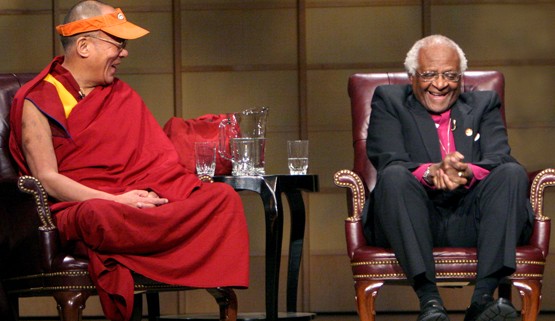
http://upload.wikimedia.org/wikipedia/commons/archive/c/c1/20090428173332!Dalai_Lama_and_Bishop_Tutu._Carey_Linde.jpg

This sounds interesting, although I am not sure that it can tell us anything about wisdom or wise people. As much as it's nice to see the neural correlates of abstract ideas or functions, I do not believe we can reduce something as complex as "wisdom" to a handful of brain networks. What about experience, cultural shaping, spiritual practice, and all the other things - such as failure - that go into making someone wise?

Anyway, this press releases comes from Elsevier Global Medical News.
Model Tracks Neurobiology of Wisdom

By Patrice Wendling
Elsevier Global Medical News

FT. LAUDERDALE, Florida (EGMN) –The wisdom of Mahatma Gandhi and Nelson Mandela is widely recognized, but little is known about the neural correlates that so exquisitely orchestrated this complex psychological trait. Researchers in California are tackling the daunting task of identifying the neurobiology of wisdom, and have proposed a speculative model that involves frontostriatal and frontolimbic circuits and monoaminergic pathways.

The first step was to search some 200 papers in the literature for definitions and descriptions of wisdom by clinical investigators. The search yielded 10 major definitions from which six key subcomponents were identified by study coauthors Dr. Thomas W. Meeks and Dr. Dilip V. Jeste, both of the division of geriatric psychiatry at the University of California, San Diego (Arch. Gen. Psychiatry 2009;66:355-65).

They are: prosocial attitudes and behaviors, social decision making and pragmatic knowledge of life, emotional homeostasis, reflection and self-understanding, value relativism and tolerance, and acknowledgment of and dealing effectively with uncertainty. Interestingly, a separate study of the Bhagavad Gita by Dr. Jeste and Dr. Ipsit Vahia revealed that the modern descriptions of wisdom were remarkably similar to those found in this sacred Hindu scripture written centuries ago (Psychiatry 2008;71:197-209).

“This idea that the construct of wisdom had really not changed significantly over centuries or geographic boundaries suggested to us that wisdom is a biologically rooted concept and that probably there are specific sites in the brain involved in wisdom,” Dr. Jeste said during a workshop on wisdom and successful aging at the annual meeting of the American College of Psychiatrists.

The authors then reviewed biological studies including those using functional magnetic resonance imaging of the brain or focusing on neurotransmitters and genetics. Again, some common themes emerged that might help explain how interactions between distinct brain regions might contribute to the subcomponents of wisdom, said Dr. Jeste, chief of the geriatric psychiatry division and a distinguished professor of psychiatry and neurosciences.

Broadly stated, the lateral/dorsolateral prefrontal cortex interacts with the anterior cingulate cortex and on occasion the orbitofrontal cortex and medial prefrontal cortex to regulate the activities of brain areas such as the amygdala and ventral striatum associated with emotionality and immediate rewards. In doing so, these connections serve to promote the subcomponents of social decision making and pragmatic life knowledge, emotional homeostasis, value relativism, and dealing with uncertainty.

An interaction between the medial and lateral prefrontal cortex is thought to be critical for self-reflection, while several regions of the brain, most notably the medial prefrontal cortex, promote the prosocial behaviors of empathy, social cooperation, and altruism, said Dr. Jeste, who is also director of the university’s Sam and Rose Stein Institute for Research on Aging. In addition, genetic studies have reported that prosocial behaviors, including altruism, are heritable in up to 60% of cases. Although the data on neurotransmitters were limited, there appears to be a role for dopamine, serotonin, and the neuropeptides vasopressin and oxytocin in prosocial attitudes and behaviors, he said.

Dr. Jeste suggested that these neurobiologic pathways help balance the phylogenetically older portions of the brain such as the limbic cortex with the more recently evolved prefrontal cortex. This prompted a discussion during the workshop on whether aging facilitates wisdom. Some attendees noted that Mr. Gandhi was at his wisest in his 40s and 50s, and that Leo Tolstoy was less wise in his 70s and 80s than when he wrote “War and Peace.”

“Wisdom is not restricted to aging but can increase with experience,” Dr. Jeste said. “Aging should facilitate wisdom, but this is not always the case.”

Attendees also questioned whether people who are mentally ill or those who do not traverse developmental milestones can possess wisdom. It was noted that a 4-year-old can exhibit altruism in the sand box, while research just a decade ago reported that sociopaths could be empathetic. Cognition was the focus of wisdom research during the 1970s and 1980s, but now the discussion includes emotion and related characteristics unique to wisdom such as the use of knowledge for the common social good and the integration of knowledge with affect, Dr. Jeste said.

A recent review of functional and structural neuroimaging studies related to intelligence and reason identified areas of the brain that overlap with those in the proposed model of wisdom such as the anterior cingulate and dorsal prefrontal cortex, but this network in the brain, coined the Parieto-Frontal Integration Theory, did not feature areas such as the limbic cortex, striatum, and medial prefrontal cortex involved with wisdom (Behav. Brain Sci. 2007;30:135-54). “What sets the wise person apart is behavior,” Dr. Jeste said.

Dr. Jeste has received research support from the U.S. National Institute of Mental Health, the U.S. National Institute on Aging, the U.S. Health Resources and Services Administration, and the Stein Institute for Research on Aging at the University of California, San Diego. AstraZeneca, Bristol-Myers Squibb, Eli Lilly & Co., and Janssen Pharmaceuticals donate antipsychotic medications to his research.