27th September 2014
Today we have something a little different, a very nicely illustrated mapping project reflecting on p2p values and spirituality by Andrius Kulikauskas.
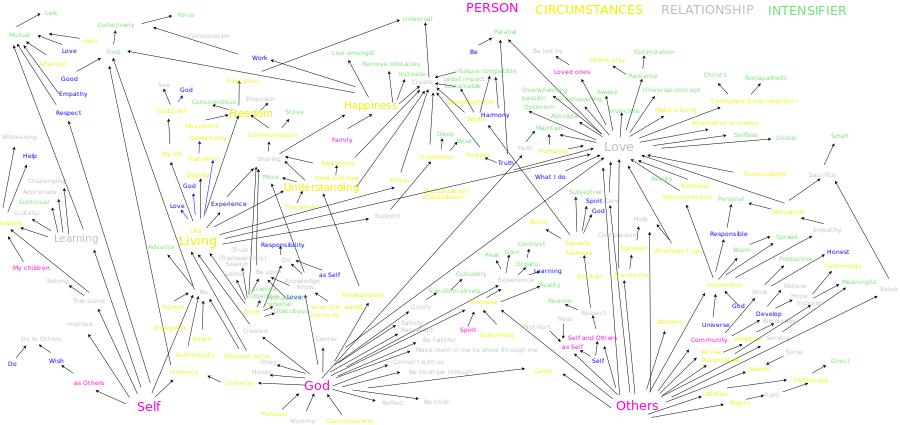
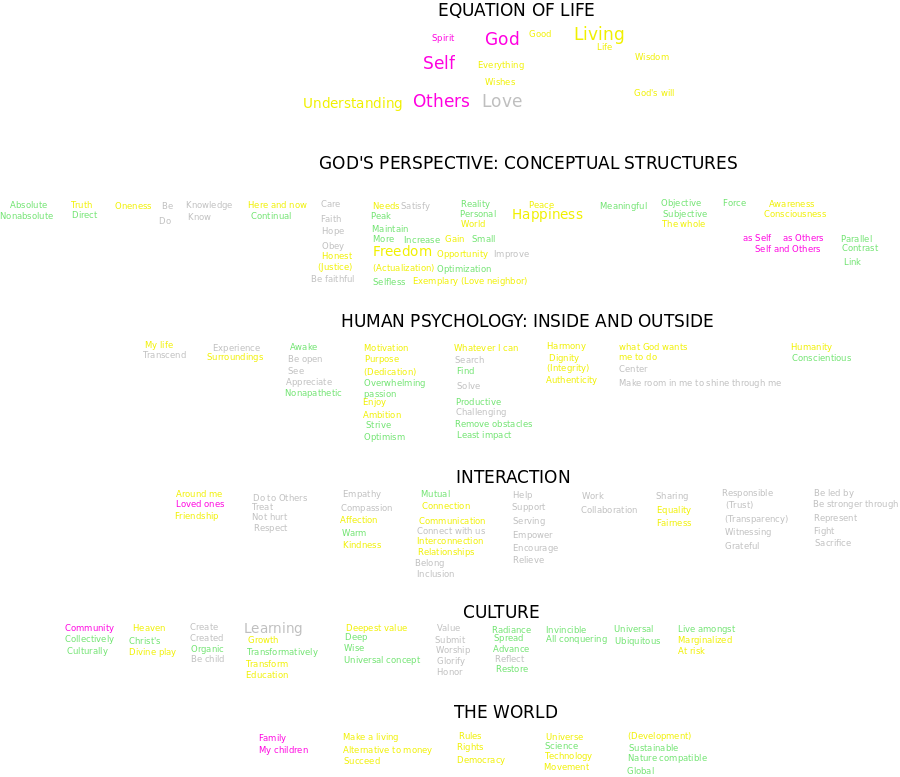
The peer-to-peer movement values relative truth with a passion that is practically absolute. I believe that individual perspectives have the potential to discover the universal truth, at least enough of it so as to make the peer-to-peer movement viable. The path from relative to absolute truth is the subject of my e-book, The Truth, from Relative to Absolute.I think the most practical concept from my book is a person’s deepest value. In 2004, I wondered how my online laboratory Minciu Sodas might organize a Yahoo! group around Franz Nahrada and openly support his many projects. We needed a single concept that summarized what he cared about. For him, it was Global Villages. He later expressed his deepest value in life as optimal interplay. From 2004 to 2010, I organized more than twenty such discussion groups, including Janet Feldman’s Holistic Helping, Pamela McLean’s Learning From Each Other, Samwel Kongere’s Mendenyo (“men without food”, motivation through sacrifice), John Roger’s Cyfranogi (“participate”, participatory society) and my own group Living by Truth. Here is an excerpt from my book:Truth is inside of us, deeper than words. Ask people what they know firsthand:What do they value? What is their deepest value in life which includes all of their other values?They may not have an answer. Or they may feel it but not yet have words for it. Or they may have already thought it through. As the ancient Greeks would say, they know themselves.Their values are all uniquely beautiful: Holistic Helping, Learning From Each Other, Participatory Society, Serving Others, Fighting Peacefully, Synergy, Freedom, Faith, Family, Unity, Love…If two people give the same answer such as Family, and you ask them what they mean by that, they will give you different answers.Their deepest value is their spiritual name, like a Native American name. They will almost always let you share it.It is how they hope to think of themselves. In practice, it is their strong point but also their blind spot. It is what we should have them be in charge of.It is how they are happy to be categorized, how you can empathize with them and hold them accountable.It is their soul, the essence of their personality, their principle which they substitute for themselves, their name which is written in the Book of Life, what is truly eternal.They are thus like stars in the sky, seeing the entire sky from their particular position. As Jesus says, they are born again of the Spirit. They are Allah’s holy names.Their deepest values are all aspects of love, which is surely God’s deepest value. They address what they each think is the problem with this world, the lack of love they feel. It is how they integrate their many values as they clash in daily life.They invest themselves in their deepest value, which does not change but rather grows ever more clear to them. As they know themselves, they dare to go beyond themselves and ask what they do not know.What do they seek to know? What is a question that they don’t know the answer to, but wish to answer?In 10 years, I collected deepest values and investigatory questions from hundreds of people. I think it would be very fruitful to work together to collect many more. They might serve as the basis for appreciating the greatest variety of perspectives and discovering what amongst them might actually be universal.I am working on a map of deepest values and related concepts. I’ve noticed that often a value such as my own “living by absolute truth” breaks do wn into one concept that is given (in my case, “the absolute truth”), and another concept that depends on my choice (“living” that truth). Others value “living by harmony”, “living as a creation of God” and such variations are the basis for my map.I’ve noticed that some values presume very little and might make sense from an abstract God’s point of view. Others, however, are psychological and distinguish internal thinking and external actions as with motivations, obstacles and solutions. There are values which presume two or more beings as with empathy and collaboration. Community, education, glory suppose an entire culture. Family, children, technology, democracy, money, making a living, sustainability and the Bible all depend on the details of the world as we know it. I’d love to work together to sort through the underlying presumptions. I’m also interested in related art projects. I share a letter about my research in English and I’m working on it in Lithuanian.
Showing posts with label P2P. Show all posts
Showing posts with label P2P. Show all posts
Tuesday, September 30, 2014
P2P Truth: A Map of Deepest Values by Andrius Kulikauskas
This comes from the P2P Foundation blog. Andrius Kulikauskas offers a unique values of P2P.


Saturday, May 10, 2014
LeveVei - Episode 90: Peer to Peer in Governance, Production and Knowledge Distribution (Michel Bauwens)
This is an older episode of LeveVei with Michel Bauwens of the P2P Foundation as the guest. I have been a tremendous fan of Bauwens' work for around ten years or so now. Below the introduction to the interview, I have included one of the essays linked to at the end of the post, a personal favorite of mine.
Here is an excellent and favorite essay by Bauwens, which is linked to above:Episode 90: Peer to peer as an approach to governance, production and distribution of knowledge
Posted by James Alexander Arnfinsen (redaktør) × January 6, 2014
Podcast: Play in new window | Download (Duration: 48:45 — 44.6MB)

In this episode I´m joined by Michel Bauwens, who is the founder of P2P-foundation which works to promote, research and develop different forms of peer to peer practices. He starts out by describing his engagement with civic entrepreneurship, where the P2P-foundation is one example of this kind of relational dynamic. He then explains in detail what peer to peer actually entails, while also placing this trend in a historical context in relation to how people have organized different forms of transaction and value creation.
An interesting point here, regarding work, is how we have moved from a division of labour to the distribution of tasks. Peer to peer implies a very different method of organizing and controlling how people engage in a project or in the production of complex social artifacts (such as Wikipedia and Linux). He also points to how peer to peer production is codependent on the conventional and existing system today, mainly capitalism, and how this new form of organizing value creation is emerging from within the old system while at the same time transcending many of the constraints found in the the old paradigm. An important distinction is the idea of “the commons”, and Bauwens points out that peer to peer production is often organized around some kind of communally shared value where the participants contribute so as to uphold and maintain the common asset (couchsurfing is only one example)
Another interesting point is how peer to peer can create a space for both cooperation and market-based competition. Further on in our conversation Bauwens describes how it´s possible to upscale the relational dynamics of peer to peer and apply it to larger societal change processes. He is currently engaged in a project in Ecuador and he uses this initiative as a case in point, explaining how Ecuador, through peer to peer practices, is trying to move into an open commons based knowledge society. An interesting point here is how knowledge can be understood as an infinite resource, and with the advent of 3D-printing and local micro production facilities, this could have dramatic effects on how a society sustains itself. We also discuss how innovation often will come from the periphery, and not necessarily from the center stage, so maybe Ecuador can play an important role in global change processes? Another theme we bring up is how to understand peer to peer from an integral perspective, with reference to the work of for instance Ken Wilber and Susan Cook-Greuter. A poignent question here circles around if and how peer to peer presuppose higher stages of consciousness? Towards the last section of the interview Bauwens speaks to his hopes for the future development of peer to peer practice.
If you feel inspired or provoked by our conversation feel free to add your comments after the interview. You can also send in a written piece of work and get it published together with this episode. Further details can be found here.Episode links:
- Michel Bauwens (bio)
- P2P-foundation
- What is an interesting life in the p2p era?, short article by Michel Bauwens
- Defining P2P as the relational dynamic of distributed networks, an informative overview of P2P
- P2P and Human Evolution: Peer to peer as the premise of a new mode of civilization, an extensive essay by Michel Bauwens

Defining P2P as the relational dynamic of distributed networks
2.1.A. Defining P2P as the relational dynamic of distributed networks
Alexander Galloway in his book Protocol makes an important and clear distinction between centralized networks (with one central hub where everything must pass and be authorized, as in the old telephone switching systems), decentralized systems, with more than one center, but these subcenters still being authorative (such as the airport system in the U.S. centered around hubs where planes must pass through), from distributed systems, where hubs may exist, but are not obligatory (such as the internet). In distributed networks, participants may freely link with each other, they are fully autonomous agents. Hence the importance to clearly distinguish between our usage of the concepts 'decentralized' vs. 'distributed'. Peer to peer is specifically the relational dynamic that arises in distributed networks.
So: what is peer to peer? Here’s a first tentative definition: It is a specific form of relational dynamic, is based on the assumed equipotency of its participants, organized through the free cooperation of equals in view of the performance of a common task, for the creation of a common good, with forms of decision-making and autonomy that are widely distributed throughout the network. This is of course a strong definition and statement, subject to a lot of refining and caveats.
P2P processes are not structureless, but are characterized by dynamic and changing structures which adapt themselves to phase changes. It rules are not derived from an external authority, as in hierarchical systems, but generated from within. It does not deny ‘authority’, but only fixed forced hierarchy, and therefore accepts authority based on expertise, initiation of the project, etc… P2P may be the first true meritocracy. The threshold for participation is kept as low as possible. Equipotency means that there is no prior formal filtering for participation, but rather that it is the immediate practice of cooperation which determines the expertise and level of participation. Communication is not top-down and based on strictly defined reporting rules, but feedback is systemic, integrated in the protocol of the cooperative system. Techniques of 'participation capture' and other social accounting make automatic cooperation the default scheme of the project. Personal identity becomes partly generated by the contribution to the common project. As we will see, this is part and parcel of a widespread transformation to a mode of being which we call 'cooperative individualism'. P2P is not a return to earlier forms of community, but something new.
P2P is a network, not a pyramidal hierarchy (though it may have elements of it); it is 'distributed', though it may have elements of hierarchy, centralization and 'decentralization'; intelligence is not located at any center, but everywhere within the system. Assumed equipotency means that P2P systems start from the premise that ‘it doesn’t know where the needed resource will be located’, it assumes that ‘everybody’ can cooperate, and does not use formal rules in advance to determine its participating members. Acceptance in P2P projects is not based on formal credentials, since it is no longer believed that skills can be reflected in such formal documents, and they are therefore 'anti-credentialist'. Equipotency, i.e. the capacity to cooperate, is verified in the process of cooperation itself. Such an equipotency is widely differentiated, as complex projects need a vastly differentiated skillset. Thus, competition is limited, and replaced by complementarity. This is also why authority is widely distributed and subject to change. Validation of knowledge, acceptance of processes, are determined by the collective. Cooperation must be free, not forced, and not based on neutrality (i.e. the buying of cooperation in a monetary system). It exists to produce something. It enables the widest possible participation. These are a number of characteristics that we can use to describe P2P systems ‘in general’, and in particular as it emerges in the human lifeworld. Whereas participants in hierarchical systems are subject to the panoptism of the select few who control the vast majority, in P2P systems, participants have access to holoptism, the ability for any participant to see the whole. Further on we will examine more in depth characteristics such as de-formalization, de-institutionalization, de-commodification, which are also at the heart of P2P processes.
Whereas hierarchical systems are based on creating homogeneity amongst its 'dependent' members, distributed networks using the P2P dynamic regulate the 'interdependent' participants preserving heterogeneity. It is the 'object of cooperation' itself which creates the temporary unity. Culturally, P2P is about unity-in-diversity, or 'difference-in-unity': it is concrete 'post-Enlightenment' universalism predicated on common goals and projects; while hierarchy is predicated on creating sameness through identification and exclusion, and is associated with the abstract universalism of the Enlightenment.
To have a good understanding of P2P, I suggest the following mental exercise, think about these characteristics, then about their opposites. So doing, the radical innovative nature of P2P springs to mind. Though P2P is related to earlier social modes, those were most in evidence in the early tribal era, and it now emerges in an entirely new context, enabled by technologies that go beyond the barriers of time and space. After the dominance during the last several millennia, of centralized and hierarchical modes of social organization, it is thus in many ways now a radically innovative emergence, and also reflects a very deep change in the epistemological and ontological paradigms that determine behavior and worldviews.
An important clarification is that when we say that peer to peer systems have no hierarchy or are not centralized, we do not necessarily mean the complete absence of such characteristics. But in a P2P system, the use of hierarchy and centralization, serve the goal of participation and many-to-many cooperation, and are not used to prohibit or dominate it. This means that though P2P arises in distributed networks, not all distributed networks exhibit P2P processes. Many distributed bottom-up processes, such as the swarming behavior of insects, of the behavior of buyers and sellers in market, are not true P2P processes, to the degree that they lack holoptism, or do not promote participation. Insects in a swarm, do not have information about the whole, they follow markers that determine their individual behaviour. And a market is not equipotent since it excludes those without purchasing power. P2P, as a uniquely human phenomenon integrates moral and intentional aspects. When distributed meshworks, for example interlinking boards of directors, serve a hierarchy of wealth and power, and are based on exclusion rather than participation, this does not qualify as a full P2P process.
P2P can be a partial element of another process; or it can be a full process. For examples, the technological and collaborative infrastructure build around P2P principles, may enable non-P2P processes. In the example just above, it is the infrastructure of Empire, but it can also enable new types of marketplaces, gift/sharing economy practices. Where P2P is a full process, we will argue that it is a form of communal shareholding producing a new type of Commons.
Wednesday, February 05, 2014
What Is P2P? Michel Bauwens Interviewed by Julie Tran from MakeChangeTV

Nice interview with Michel Bauwens, and a nice introduction to P2P for those not familiar with the peer-to-peer movement, which now incorporates nearly every human field. Below the video I am including some material from the P2P Foundation website as an additional source of information for those interested in a deeper understanding of P2P - I encourage you to explore the P2P Foundation website, as there is a literal ton of useful information there.
Openness, a necessary revolution into a smarter world
Our current political economy has the weirdest DNA. It considers nature to be a perpetually abundant resource, i.e. it is based on a false notion of material abundance; on the other hand, it believes that intellectual, scientific and technical exchange should be subject to strong proprietary constraints, and subjects innovation to internet restrictions. Thus the paradoxical but also dramatic contradiction of the present system: while it is rapidly overburdening the carrying capacity of the planet, at the same time it inhibits the solutions that humanity might find for it.
Luckily, the emergence of peer producing communities that share knowledge, code and design for the common good of humanity using open licensing arrangements that enable and facilitate universal sharing are showing the way for a fundamental reorganisation into a smarter world.
First, the value is created in global open design communities that easily outcooperate and outcompete single corporations, no matter how big or rich they are, as no isolated can be smarter than a globally networked collective intelligence. Second, this collaborative value creation is enabled and protected by for-benefic organisations, the FLOSS Foundations such as the Apache Foundation and many others. These are mostly democratically run by contributors to the common pool. Thirdly, entrepreneurial coalitions make and sell the products, improving them in the process, which have been designed (and are perpetually and continuously improved) by the contributor communities, creating a vibrant economy around the commons (think of the free software economy, or the Arduino economy as examples).
«Global open communities can outcooperate and outcompete single corporations, as no isolated can be smarter than a globally networked collective intelligence»This new way does not only enable perpetual sharing of innovation, but also ensures sustainability, as communities do not have vested interests in artificial scarcity. Hence, if you design as a corporation for the market, you design for scarcity, but if you design as a community, you naturally design for sustainability. If you build and sell sustainable designs, then you are becoming a sustainable market players, abandoning the pernicious pursuit of planned obsolescence.
There is one missing player in this picture, the overall society, i.e. the polis. This polis must transform from the current market state — which privileges extractive corporations that deplete the commons, endanger the biosphere and oppose innovation sharing ? into a partner state which enables and empowers the social production of sustainable value by creating civic infrastructures that facilitate its emergence in strong ecosystems. Through public-commons partnerships and the commonification of public services, a new productive matrix is created, which guarantees a smarter planet that combines the recognition of the necessarily sustainability of material resources with the infinite innovation capabilities of global knowledge commons.
So here is some info on P2P for those who are interested.
1.A. What this essay is about
The following essay describes the emergence, or expansion, of a specific type of relational dynamic, which I call peer to peer. It’s a form of human network-based organization which rests upon the free participation of equipotent partners, engaged in the production of common resources, without recourse to monetary compensation as key motivating factor, and not organized according to hierarchical methods of command and control. It creates a Commons, rather than a market or a state, and relies on social relations to allocate resources rather than on pricing mechanisms or managerial commands.
Thus we have three important aspects that are essential for P2P processes to occur in a full-blown manner: 1) peer production as a mode of production; 2) peer governance as a mode of governance; 3) universal common property as a mode of distribution and access. But P2P can also occur in a partial manner wherever resources are distributed.
Thus underlying our description of P2P processes, it will be useful to distinguish between four different levels.
- One level is the phenomenological level, i.e. the different ways in which the P2P forms emerges in different social fields. Here we get the peer to peer relational dynamic in distributed systems, and how it expresses itself in the internet structure, the writeable Web 2.0, peer circles or what have you. This I propose to call ‘diffuse P2P’. Such P2P emergence is easy to integrate within the existing system, and can be instrumentalised by authoritarian social forces, as in Al Qaeda using the internet. It is ‘immanent’ to the system.
- The second level is when integration occurs. The different P2P forms in this case do not exist independently, but start reinforcing one another. This ‘integrated P2P’ involving such social processes as peer production, peer governance, and universal common property regimes, become transcendent to the system, because they cannot be contained within the current production schemes (market pricing and corporate hierarchy), governance schemes (corporate hierarchy or state bureaucracy or even representational democracy), or property regimes. They create an emerging new social reality, which is today dominated by the existing social economy, but that is a contingent situation which could change in the future. I’m not saying “it will happen", but definitely “it can happen" and whether it happens also depends on our human intentionality.
- Now, why is all this happening. Because, before social practices and technological artifacts are invented or emerge, it must be conceived in the human mind, and it must become acceptable as a social practice. Thus P2P emerges out of changes in the ‘ground state’ of humanity, i.e. deep changes in the ontology/epistemology/axiology, or in easier words: new ways of feeling and being, of knowing, and new constellations of values. That is the third level which occurs as a spontaneous social process, not directed, not necessarily consciously desired but part of the evolution of the ‘social imaginary’. It is this level which has been so beautifully captured by John Heron’s recapitulation of the evolution of participation, which I have cited on occasion. Broadly conceived, such a deep level of human change is also outside the scope of recuperation.
- The fourth level occurs when we become conscious of these changes, and make it an object of our human intentionality: in other words, we not only see it happening (level 1 to 3), but we want it to happen and seek out others with similar values in the hope of interconnecting our efforts. This is the object of my own work, and I hope it can become the basis of a broad social and political movement as more and more people, from their own particular perspective, come to their own conclusions. At this point, P2P becomes a normative ethos for a new kind of life on earth, and definitely outside the scope of any recuperation, though there is no guarantee of its success.
At the diffuse format of level 1, the P2P format is emerging throughout the social field: as a format of technology (the point to point internet, filesharing, grid computing, the Writeable Web initiatives, blogs), as a third mode of production which is also called Commons-based peer production (neither centrally planned nor profit-driven), producing hardware, software (often called Free Libre Open Sources Software or FLOSS) and intellectual and cultural resources (wetware) that are of great value to humanity (Wikipedia), and as a general mode of knowledge exchange and collective learning which is massively practiced on the internet. It also emerges as new organizational formats in politics, spirituality; as a new ‘culture of work’. This essay thus traces the expansion of this format, seen as a “isomorphism" (= having the same format), in as many fields as possible. The common format in which the peer to peer dynamic emerges is the format of the "distributed network", which, according to the definition of A. Galloway in his book Protocol, differs both from the centralized network (all nodes have to pass through one single hub), and from the decentralized network (all nodes have to pass through hubs). In a distributed network the nodes, as autonomous agents, can connect through any number of links. Hubs may exist, but are not obligatory.
The essay tries not only to describe, but attempts to provide an explanatory framework of why it is emerging now, and how it fits in a wider evolutionary framework (not in the sense of an inevitable natural evolution, but as an intentional moral breakthrough).
The underlying logic of development in which the emergence of P2P is best understood, may be by viewing 'participation' as the key variable, seeing how it intensifies historically in various social formations.
This idea was best expressed by John Heron in a personal communication:
"There seem to be at least four degrees of cultural development, rooted in degrees of moral insight and not in an evolutionary logic:Note that within the first four sections, the organization is as follows: the first subsection is descriptive, the second is explanatory, and the third is historical. In the latter, I use the triune distinction premodernity/modernity/postmodernity, well aware that it is a simplification, and that it collapses many important distinctions, say between the tribal and the agrarian era. But as an orienting generalization that allows the contrasting of the changes occurring after the emergence of modernity, it remains useful. Thus, the concept of ‘premodern’, means the societies based on tradition, before the advent of industrial capitalism, with fixed social roles and a social organization inspired by what it believes to be a divine order; modern means essentially the era of industrial capitalism; finally, the choice of the term postmodern does not denote any specific preference in the ‘wars of interpretation’ between concepts such as postmodernity, liquid modernity, reflexive modernity, transmodernity etc.. It simple means the contemporary period, more or less starting after 1968, which is marked by the emergence of the informational mode of capitalism. I will use the term cognitive capitalism most frequently in my characterization of the current regime, as it corresponds to the interpretation, which is the most convincing in my view. The French magazine Multitudes is my main source for such interpretations. It's essential meaning is the replacement of an older 'regime of accumulation', centered on machines and the division of labor corresponding to them; and one centered on being part of a process of accumulation of knowledge and creativity, as the new mainspring of power and profit. Finally, note that in the accompanying graphs of figures, I sometimes use the "early modern/late modern/P2P era" framework. In this way, the current time frame can be distinguished from a hypothetical coming situation where P2P is more dominant than it is today, and what that would change in the characteristics of such a society.
(1) autocratic cultures which define rights in a limited and oppressive way and there are no rights of political participation;
(2) narrow democratic cultures which practice political participation through representation, but have no or very limited participation of people in decision-making in all other realms, such as research, religion, education, industry etc.;
(3) wider democratic cultures which practice both political participation and varying degree of wider kinds of participation;
(4) commons p2p cultures in a libertarian and abundance-oriented global network with equipotential rights of participation of everyone in every field of human endeavour".
I will conclude my essay with the conclusion that P2P is nothing else than a premise of a new type of civilization that is not exclusively geared towards the profit motive.
What I have to convince the user of is that
- 1) a particular type of human relational dynamic is growing very fast across the social fields, and that such combined occurrence is the result of a deep shift in ways of feeling and being (ontology), of knowing (epistemology), and of core value constellations (axiology)
- 2) That it has a coherent logic that cannot be fully contained within the present ‘regime’ of society.
- 3) that it is not an utopia, but, as ‘an already existing social practice’, the seed of a likely major transformation to come. I will not be arguing that there is an 'inevitable evolutionary logic at work', but rather that a new and intentional moral vision, holds the potential for a major breakthrough in social evolution, leading to the possibility of a new political, economic, and cultural 'formation' with a new coherent logic.
Implicit in my interpretation of peer to peer as a social formation, is that it is accompanied by a nascent socio-political movement, much as industrial class relations triggered a labor movement. In the case of the 'peer to peer movement' this movement concerns itself with the promotion and defense of the Commons, i.e. the existence of a common-property regime that exists alongside the state and the market, but which is also under threat by a frenetic movement to privately appropriate common resources. This P2P movement has three components: first, the participatory movement, which is not necessarily political in the old sense, and includes all efforts to widen participation in human processes (for example Web 2.0 engineering efforts); second, the "open" movement in its various guises: open sources, open access, open money. This movement works on the conditions necessary for P2P processes to occur: without free access to information, i.e. the distribution of information, no P2P can occur; third, the Commons movement, which is concerned by protecting and developing the institutional format for P2P to thrive in: by avoiding private appropriation of commonly produced knowledge products, the motivation for P2P behaviour is strengthened. These are the explicit P2P movements in my mind, respectively focusing on peer governance, peer production, and peer property modes, but the movement is larger than that, as I will argue in the political section.
Such a large overview will inevitably bring errors of interpretation concerning detailed fields. I would appreciate if readers could bring them to my attention. But apart from these errors, the essay should stand or fall in the context of its most general interpretative point: that there is indeed a isomorphic emergence of peer to peer throughout the social field, that despite the differences in expression, it is the same phenomena, and that it is not a marginal, but a 'fundamental' development. It is on this score that my effort should be judged. If the effort is indeed judged to be successful, I then would hope that this essay inspires people from these different fields to connect, aware that they are sharing a set of values, and that these values have potential in creating a better, but not perfect or ideal, society.
How does the explanatory framework which I will provide for P2P, differ from the use of the earlier metaphor of the network society, described by Manuel Castells and many others, and lately in particular by the network sociality concept proposed by Andreas Wittel? The best way to differentiate the approaches is to see P2P as a subset of network conceptions.
If you would have been a social scientist during the lifetime of Marx and witnessed the emergence and growth of the factory-based industrial model, and you would then have arrived at the equivalent of what social network theory is today, i.e. an analysis of mainstream society and sociality. This is what the network sociality model of Andreas Wittel provides. But at the same time that the factory system was developing, a reaction was created as well. Workers were creating cooperatives and mutualities, unions and new political parties and movements, which would go on to fundamentally alter the world. Today, this is what happens with peer to peer. Whereas Castells and Wittel focus on the general emergence of network society and society, and describes the networks overall and the dominant features of it, I want and tend to focus on the birth of a counter-movement, centered around a particular format of sociality based in distributed networks, where the focus is on creating participation for all, and not the buttressing of the 'meshworks of exploitation'. As the dominant forces of society are mutating to networked forms of organizing the political economy (called Empire by Toni Negri), a bottom-up reaction against this new alienation is occurring (alienated, because in Empire, the meshwork are at the service of creating ever more inequality), by the forces of what Negri and Hardt call the multitude(s). These forces are using peer to peer processes, and a peer to peer ethos, to create new forms of social life, and this is what I want to document in this essay.
* * * *
2.1.A. Defining P2P as the relational dynamic of distributed networks
Alexander Galloway in his book Protocol makes an important and clear distinction between centralized networks (with one central hub where everything must pass and be authorized, as in the old telephone switching systems), decentralized systems, with more than one center, but these subcenters still being authorative (such as the airport system in the U.S. centered around hubs where planes must pass through), from distributed systems, where hubs may exist, but are not obligatory (such as the internet). In distributed networks, participants may freely link with each other, they are fully autonomous agents. Hence the importance to clearly distinguish between our usage of the concepts 'decentralized' vs. 'distributed'. Peer to peer is specifically the relational dynamic that arises in distributed networks.
So: what is peer to peer? Here’s a first tentative definition: It is a specific form of relational dynamic, is based on the assumed equipotency of its participants, organized through the free cooperation of equals in view of the performance of a common task, for the creation of a common good, with forms of decision-making and autonomy that are widely distributed throughout the network. This is of course a strong definition and statement, subject to a lot of refining and caveats.
P2P processes are not structureless, but are characterized by dynamic and changing structures which adapt themselves to phase changes. It rules are not derived from an external authority, as in hierarchical systems, but generated from within. It does not deny ‘authority’, but only fixed forced hierarchy, and therefore accepts authority based on expertise, initiation of the project, etc… P2P may be the first true meritocracy. The threshold for participation is kept as low as possible. Equipotency means that there is no prior formal filtering for participation, but rather that it is the immediate practice of cooperation which determines the expertise and level of participation. Communication is not top-down and based on strictly defined reporting rules, but feedback is systemic, integrated in the protocol of the cooperative system. Techniques of 'participation capture' and other social accounting make automatic cooperation the default scheme of the project. Personal identity becomes partly generated by the contribution to the common project. As we will see, this is part and parcel of a widespread transformation to a mode of being which we call 'cooperative individualism'. P2P is not a return to earlier forms of community, but something new.
P2P is a network, not a pyramidal hierarchy (though it may have elements of it); it is 'distributed', though it may have elements of hierarchy, centralization and 'decentralization'; intelligence is not located at any center, but everywhere within the system. Assumed equipotency means that P2P systems start from the premise that ‘it doesn’t know where the needed resource will be located’, it assumes that ‘everybody’ can cooperate, and does not use formal rules in advance to determine its participating members. Acceptance in P2P projects is not based on formal credentials, since it is no longer believed that skills can be reflected in such formal documents, and they are therefore 'anti-credentialist'. Equipotency, i.e. the capacity to cooperate, is verified in the process of cooperation itself. Such an equipotency is widely differentiated, as complex projects need a vastly differentiated skillset. Thus, competition is limited, and replaced by complementarity. This is also why authority is widely distributed and subject to change. Validation of knowledge, acceptance of processes, are determined by the collective. Cooperation must be free, not forced, and not based on neutrality (i.e. the buying of cooperation in a monetary system). It exists to produce something. It enables the widest possible participation. These are a number of characteristics that we can use to describe P2P systems ‘in general’, and in particular as it emerges in the human lifeworld. Whereas participants in hierarchical systems are subject to the panoptism of the select few who control the vast majority, in P2P systems, participants have access to holoptism, the ability for any participant to see the whole. Further on we will examine more in depth characteristics such as de-formalization, de-institutionalization, de-commodification, which are also at the heart of P2P processes.
Whereas hierarchical systems are based on creating homogeneity amongst its 'dependent' members, distributed networks using the P2P dynamic regulate the 'interdependent' participants preserving heterogeneity. It is the 'object of cooperation' itself which creates the temporary unity. Culturally, P2P is about unity-in-diversity, or 'difference-in-unity': it is concrete 'post-Enlightenment' universalism predicated on common goals and projects; while hierarchy is predicated on creating sameness through identification and exclusion, and is associated with the abstract universalism of the Enlightenment.
To have a good understanding of P2P, I suggest the following mental exercise, think about these characteristics, then about their opposites. So doing, the radical innovative nature of P2P springs to mind. Though P2P is related to earlier social modes, those were most in evidence in the early tribal era, and it now emerges in an entirely new context, enabled by technologies that go beyond the barriers of time and space. After the dominance during the last several millennia, of centralized and hierarchical modes of social organization, it is thus in many ways now a radically innovative emergence, and also reflects a very deep change in the epistemological and ontological paradigms that determine behavior and worldviews.
An important clarification is that when we say that peer to peer systems have no hierarchy or are not centralized, we do not necessarily mean the complete absence of such characteristics. But in a P2P system, the use of hierarchy and centralization, serve the goal of participation and many-to-many cooperation, and are not used to prohibit or dominate it. This means that though P2P arises in distributed networks, not all distributed networks exhibit P2P processes. Many distributed bottom-up processes, such as the swarming behavior of insects, of the behavior of buyers and sellers in market, are not true P2P processes, to the degree that they lack holoptism, or do not promote participation. Insects in a swarm, do not have information about the whole, they follow markers that determine their individual behaviour. And a market is not equipotent since it excludes those without purchasing power. P2P, as a uniquely human phenomenon integrates moral and intentional aspects. When distributed meshworks, for example interlinking boards of directors, serve a hierarchy of wealth and power, and are based on exclusion rather than participation, this does not qualify as a full P2P process.
P2P can be a partial element of another process; or it can be a full process. For examples, the technological and collaborative infrastructure build around P2P principles, may enable non-P2P processes. In the example just above, it is the infrastructure of Empire, but it can also enable new types of marketplaces, gift/sharing economy practices. Where P2P is a full process, we will argue that it is a form of communal shareholding producing a new type of Commons.
* * * *
3.3.C. Beyond Formalization, Institutionalization, Commodification
Observation of commons-based peer production and knowledge exchange, unveils a further number of important elements, which can be added to our earlier definition and has to be added to the characteristic of holoptism just discussed in 3.4.B.
In premodern societies, knowledge is ‘guarded’, it is part of what constitutes power. Guilds are based on secrets, the Church does not translate the Bible, and it guards its monopoly of interpretation. Knowledge is obtained through imitation and initiation in closed circles.
With the advent of modernity, and let’s think about Diderot’s project of the Encyclopedia as an example, knowledge is from now on regarded as a public resource which should flow freely. But at the same time, modernity, as described by Foucault in particular, starts a process of regulating the flow of knowledge through a series of formal rules, which aim to distinguish valid knowledge from invalid one. The academic peer review method, the setting up of universities which regulate discourse, the birth of professional bodies as guardians of expertise, the scientific method, are but a few of such regulations. An intellectual property rights regime also regulates the legitimate use one can make of such knowledge, and which is responsible for a re-privatization of knowledge. If original copyright served to stimulate creation by balancing the rights of authors and the public, the recent strengthening of intellectual property rights can be more properly understood as an attempt at ‘enclosure’ of the information commons, which has to serve to create monopolies based on rent obtained through licenses. Thus at the end of modernity, in a similar process to what we described in the field of work culture, there is an exacerbation of the most negative aspects of the privatization of knowledge: IP legislation is incredibly tightened, information sharing becomes punishable, the market invades the public sphere of universities and academic peer review and the scientific commons are being severely damaged.
Again, peer to peer appears as a radical shift. In the new emergent practices of knowledge exchange, equipotency is assumed from the start. There are no formal rules to prohibit anyone from participation, a characteristic that could be called 'anti-credentialism' . (unlike academic peer review, where formal degrees are required ). Validation is a communal intersubjective process. It often takes place through a process akin to swarming, whereby large number of participants will tug at the mistakes in a piece of software or text, the so-called 'piranha effect', and so perfect it better than an individual genius could. Many examples of this kind are described in the book 'The Wisdom of Crowds', by James Surowiecki. Though there are constraints in this process, depending on the type of governance chosen by various P2P projects, what stands out compared to previous modes of production is the self-selection aspect. Production is granular and modular, and only the individuals themselves know exactly if their exact mix of expertise fits the problem at hand. We have autonomous selection instead of heteronomous selection.
If there are formal rules, they have to be accepted by the community, and they are ad hoc for particular projects. In the Slashdot online publishing system which serves the open source community, a large group of editors combs through the postings, and there’s a complex system of ratings of the editors themselves; in other systems every article is rated creating a hierarchy of interest which pushes the lesser-rated articles down the list. As we explained above, in the context of knowledge classification, there is a move away from institutional categorization using hierarchical trees of knowledge, such as the bibliographic formats (Dewey, UDC, etc..), to informal communal ‘tagging’, what some people have termed folksonomies. In blogging, news and commentary are democratized and open to any participant, and it is the reputation of trustworthiness, acquired over time, by the individual in question, which will lead to the viral diffusion of particular ‘memes’. Power and influence are determined by the quality of the contribution, and have to be accepted and constantly renewed by the community of participants. All this can be termed the de-formalization of knowledge.
A second important aspect is de-institutionalization. In premodernity, knowledge is transmitted through tradition, through initiation by experienced masters to those who are validated to participate in the chain mostly through birth. In modernity, as we said, validation and the legitimation of knowledge is processed through institutions. It is assumed that the autonomous individual needs socialization, ‘disciplining’, through such institutions. Knowledge has to be mediated. Thus, whether a news item is trustworthy is determined largely by its source, say the Wall Street Journal, or the Encyclopedia Brittanica, who are supposed to have formal methodologies and expertise. P2P processes are de-institutionalized, in the sense that it is the collective itself which validates the knowledge.
Please note my semantic difficulty here. Indeed, it can be argued that P2P is just another form of institution, another institutional framework, in the sense of a self-perpetuating organizational format. And that would be correct: P2P processes are not structureless, but most often flexible structures that follow internally generated rules. In previous social forms, institutions got detached from the functions and objectives they had to play, became 'autonomous'. In turn because of the class structure of society, and the need to maintain domination, and because of 'bureaucratization' and self-interest of the institutional leaderships, those institutions turn 'against society' and even against their own functions and objectives. Such institutions become a factor of alienation. It is this type of institutionalization that is potentially overcome by P2P processes. The mediating layer between participation and the result of that participation, is much thinner, dependent on protocol rather controlled by hierarchy.
A good example of P2P principles at work can be found in the complex of solutions instituted by the University of Openness. UO is a set of free-form ‘universities’, where anyone who wants to learn or to share his expertise can form teams with the explicit purpose of collective learning. There are no entry exams and no final exams. The constitution of teams is not determined by any prior disciplinary categorization. The library of UO is distributed, i.e. all participating individuals can contribute their own books to a collective distributed library . The categorization of the books is explicitly ‘anti-systemic’, i.e. any individual can build his own personal ontologies of information, and semantic web principles are set to work to uncover similarities between the various categorizations .
All this prefigures a profound shift in our epistemologies. In modernity, with the subject-object dichotomy, the autonomous individual is supposed to gaze objectively at the external world, and to use formalized methodologies, which will be intersubjectively verified through academic peer review. Post-modernity has caused strong doubts about this scenario. The individual is no longer considered autonomous, but always-already part of various fields, of power, of psychic forces, of social relations, molded by ideologies, etc.. Rather than in need of socialization, the presumption of modernity, he is seen to be in need of individuation. But he is no longer an ‘indivisible atom’, but rather a singularity, a unique and ever-evolving composite. His gaze cannot be truly objective, but is always partial, as part of a system can never comprehend the system as a whole. The individual has a single set of perspectives on things reflecting his own history and limitations. Truth can therefore only be apprehended collectively by combining a multiplicity of other perspectives, from other singularities, other unique points of integration, which are put in ‘common’. It is this profound change in epistemologies which P2P-based knowledge exchange reflects.
A third important aspect of P2P is the process of de-commodification. In traditional societies, commodification, and ‘market pricing’ was only a relative phenomenon. Economic exchange depended on a set of mutual obligations, and even were monetary equivalents were used, the price rarely reflected an open market. It is only with industrial capitalism that the core of the economic exchanges started to be determined by market pricing, and both products and labor became commodities. But still, there was a public culture and education system, and immaterial exchanges largely fell outside this system. With cognitive capitalism, the owners of information assets are no longer content to live any immaterial process outside the purview of commodification and market pricing, and there is a strong drive to ‘privatize everything’, education included, our love lives included Any immaterial process can be resold as commodities. Thus again, in the recent era the characteristics of capitalism are exacerbated, with P2P representing the counter-reaction. With ‘commons-based peer production’ or P2P-based knowledge exchange more generally, the production does not result in commodities sold to consumers, but in use value made for users. Because of the GPL license, no copyrighted monopoly can arise. GPL products can eventually be sold, but such sale is usually only a credible alternative (since it can most often be downloaded for free), if it is associated with a service model. It is in fact mostly around such services that commercial open source companies found their model (example: Red Hat). Since the producers of commons-based products are rarely paid, their main motivation is not the exchange value for the eventually resulting commodity, but the increase in use value, their own learning and reputation. Motivation can be polyvalent, but will generally be anything but monetary.
One of the reasons of the emergence of the commodity-based economy, capitalism, is that a market is an efficient means to distribute ‘information’ about supply and demand, with the concrete price determining value as a synthesis of these various pressures. In the P2P environment we see the invention of alternative ways of determining value, through software algorhythms. In search engines, value is determined by algorhythms that determine pointers to documents, the more pointers, and the more value these pointers themselves have, the higher the value accorded to a document. This can be done either in a general matter, or for specialized interests, by looking at the rankings within the specific community, or even on a individual level, through collaborative filtering, by looking at what similar individuals have rated and used well. So in a similar but alternative way to the reputation-based schemes, we have a set of solutions to go beyond pricing, and beyond monetarisation, to determine value. The value that is determined in this case is of course an indication of potential use value, rather than ‘exchange value’ for the market.
Friday, April 05, 2013
Michel Bauwens - Proposed Next Steps for the Emerging P2P and Commons Networks

From Michel Bauwens' P2P Blog, here are his proposals for "Next Steps" in the emerging P2P and Commons networks.
Proposed Next Steps for the emerging P2P and Commons networks
Michel Bauwens
2nd April 2013
In short, we need a alliance of the commons to project civil and political power and influence at every level of society; we need phyles to strengthen our economic autonomy from the profit-maximizing dominant system; and we need Chambre of the Commons to achieve territorial policy; legal and infrastructural conditions for the alternative, human and nature-friendly political economy to thrive. Neither alone is sufficient, but together they could be a powerful triad for the necessary phase transition.Michel Bauwens:
The recent success of a global mobilization (500+ participants and collectives in 23 countries and over 50 cities) to collaborative map P2P-driven, commons-oriented, collaboration/sharing-based initiatives in hispanic countries, has shown a grassroots hunger for more mutual coordination to enhance the capacity to initiate social change. I would like to add the hypothesis that what is in the making is not just a new social imaginery, but also a potential new political subject. To build and obtain more civic infrastructures to enable and empower autonomous social production, I believe we must move to mutualize our forces and create a new set of political, social and economic institutions which can have ‘transitional’ effects, i.e. prepare the ground for a phase-transition to a political economy and civilization in which socially and environmentally friendly free association between autonomous producers and citizens become the norm.
I believe the time is there to start constructing the following three institutional coalitions:
* The civic/political institution: The Alliance of the Commons
An alliance of the commons is an alliance, meeting place and network of p2p-commons oriented networks, associations, places; who do not have economic rationales. These alliances can be topical, local, transnational, etc … An example is the initiative Paris Communs Urbains which is attempting to create a common platform for urban commons intiatives in the Paris region; another Parisian/French example is the freecultural network Libre Savoirs, which is developing a set of policy proposals around digital rights. (both examples were communicated to me by Lionel Maurel).
An alliance of the commons is a meeting place and platform to formulate policy proposals that enhance civic infrastructures for the commons.
* The economic institution: the P2P/Commons Globa-local « Phyle »
A phyle (as originally proposed by lasindias.net) is a coalition of commons-oriented, community-supportive ethical enterprises which trade and exchange in the market to create livelyhoods for commoners and peer producers engaged in social production. The use of a peer production licence keeps the created exchange value within the sphere of the commons and strengthens the existence of a more autonomous counter-economy which refuses the destructive logic of profit-maximisation and instead works to increase benefits for their own, but also the emerging global commons. Phyles created integrated economies around the commons, that render them more autonomous and insure the social reproduction of its members. Hyperproductive global phyles that generate well-being for their members will gradually create a counterpower to the hitherto dominant MNO’s.
* The political-economy institution: The Chamber of the Commons
In analogy with the well-known chambers of commerce which work on the infrastructure for for-profit enterprise, the Commons chamber exclusively coordinates for the needs of the emergent coalitions of commons-friendly ethical enterprises (the phyles), but with a territorial focus. Their aim is to uncover the convergent needs of the new commons enterprises and to interface with territorial powers to express and obtain their infrastructural, policy and legal needs.
In short, we need a alliance of the commons to project civil and political power and influence at every level of society; we need phyles to strengthen our economic autonomy from the profit-maximizing dominant system; and we need Chambre of the Commons to achieve territorial policy; legal and infrastructural conditions for the alternative, human and nature-friendly political economy to thrive. Neither alone is sufficient, but together they could be a powerful triad for the necessary phase transition.
Monday, March 04, 2013
Why I Support Open Access Publishing - How Corporations Score Big Profits By Limiting Access To Publicly Funded Academic Research

Recently I was doing some research through Google Scholar and found a couple of articles relevant to what I was searching for, only to discover that they were behind a paywall. Generally, the hard sciences are more easily available to the public (i.e., open access) while the social sciences are not.

Anyway, here is the fee for one article (from SciVerse: Science Direct [Elsevier]):
Brain microglia constitutively express β-2 integrins
Journal of Neuroimmunology, Volume 30, Issue 1, November 1990, Pages 81-93
H. Akiyama, P.L. McGeer
If you do not have a Username and Password, click the "Register to Purchase" button below to purchase this article.Here is the required fee for another article (ingentaconnect):
Price: US $ 31.50
Endogenous Regulators of Adult CNS NeurogenesisTo get these two articles would cost me nearly $100. In many cases, the article fee is for 24 hours only, so you are essentially renting the article for $30 to $60. This is only the consumer side of things. Authors pay to get their manuscripts published, and they often pay more--a lot more--if they want to allow open access to their work. The institutions where the authors are doing their research (universities, most times) then have to pay enormous subscription fees to have the journals in their libraries, and even if they opt for digital only, the costs continue to increase.
Theo Hagg,
Current Pharmaceutical Design, Volume 13, Number 18, June 2007 , pp. 1829-1840(12)
Buy and download full text article:
Price: $63.10 plus tax
Here is an in-depth look at this issue from Think Progress.
How Corporations Score Big Profits By Limiting Access To Publicly Funded Academic Research
By Andrea Peterson on Mar 3, 2013
"Red and blue liquids inside graduated test tubes" by Horia Varlanused under a Creative Commons Attribution 2.0 license
Here’s how the academic publishing industry works: Academics do research (frequently supported by public funds) and submit that research to journals, often paying “$600-$2,000 to either the publisher or the academic society that owns the journal” for the privilege of publication. Then journals send the research back out to other academics to be reviewed (typically pro-bono–a 2008 study estimated the worldwide worth of unpaid peer review was £1.9 billion a year), and the (often for-profit) journal publishers sell access to the published research, mostly to the academic institutions who do the majority of basic research.
The system is big business: The largest of the for profit academic publishers, Elsevier, reportedly earned over $1 billion in profits in 2011 with a profit margin around 35 percent and 71 percent of their revenue coming from academic customers like university libraries.
But the rapid inflation of journal subscription prices–the per subscription cost rose by 215% between 1986 and 2003–has left many of those universities struggling to keep up. In a statement last spring, the Harvard Faculty Council called rising costs to maintain access to scholarly works “untenable” and the University of California San Francisco Library spends 85 percent of their collection budget on journal subscriptions, but “[d]espite cancelling the print component of more than 100 journal subscriptions in 2012 to keep up with a budget reduction, [their] costs still increased by 3 percent.”
This major disconnect between how much of this research is funded and produced and who controls the final product has led to a flourishing Open Access movement with broad support among private and public academic institutions, focused on using technological innovations to democratize access to scholarly research and correct what they see as imbalances in the current system through reform on local and national levels. One such national reform they welcomed was the White House Office of Science and Technology Policy memorandum outlining a plan to open up access to research to some federally funded research.
ThinkProgress’ coverage of that announcement drew criticism from an executive at Elsevier:
When reached for comment, Elsevier head of Corporate Relations Tom Reller agreed with her comment and confirmed Smith is VP for Global Internal Communications for Reed Elsevier subsidiary Elsevier, but referred questions about the company’s support of Open Access movement to its website and a recent statement of support for the White House’s proposal. Elsevier’s website says the company “will continue to identify access gaps, and work towards ensuring that everyone has access to quality scientific content anytime, anywhere.”
But their parent company’s lobbying disclosures in 2012 and members of the Open Access community suggest a very different position. When asked over email if they have seen Elsevier and many of the for-profit academic publishers actively cooperate with the Open Access movement on advancing public access to federally funded research, Heather Joseph, the Executive Director of the Scholarly Publishing & Academic Resources Coalition (SPARC), balked at the suggestion:
Quite the opposite. SPARC and the Open Access community spent the first eight weeks of 2012 fighting The Research Works Act (H.R 3699) — a bill introduced into the House of Representatives with the sole aim of overturning the highly successful NIH Public Access Policy, and prohibiting other Federal Agencies from enacting similar policies. Elsevier and the American Association of Publishers were two of only three organizations who publicly endorsed the bill.If this was the first time they took this tactic, I might be tempted to cut them some slack. But it was a repeat performance; in 2008, they tried the same thing with “The Fair Copyright in Research Works Act (H.R. 801)” — a bill that tried to amend U.S. copyright code to make the NIH Policy — and policies like it — illegal.According to the U.S. Senate Lobbying Database, Elsevier’s parent company Reed Elsevier spent $1,420,000 lobbying the U.S. government in 2012. Reed Elsevier’s in-house lobbying team disclosures and those from the Podesta Group listing Reed Elsevier as a client corroborate Wilson’s comments about their support for The Research Works Act — only withdrawingsupport after a boycott of from academic communities, according to news reports. That boycott continues today, and has attracted over 13,000 scholars and academics who object to Elsevier’s business practices.
Reed Elsevier lobbied OSTP on “[c]opyright issues related to scientific, technology, and medical publications” during the run up to the White House’s Open Access announcement and their in-house lobbying team reported working on “[i]ssues related to science, technical, medical and scholarly publications” and on “all provisions” of the Federal Research Public Access Act (FRPAA)–a proposal similar to the recently introduced Fair Access to Science and Technology Research Act (FASTR) that would have required federal agencies with annual extramural research budgets of $100 million or more to provide the public with online access to research manuscripts stemming from funded research no later than six months after publication in a peer-reviewed journal.
Elsevier was one of 81 publishers to sign a Association of American Publishers (AAP) letter opposing FRPAA, with AAP President and CEO Tom Allen calling it “little more than an attempt at intellectual eminent domain, but without fair compensation to authors and publishers.” Remember, these publishers claiming to be concerned about “fair compensation to authors,” are the same ones often charging them publication fees.
As Reller noted to ThinkProgress, the sum total of Reed Elsevier’s 2012 lobbying expenditures represents the all lobbying done in support of their business ventures and their disclosures list a number of bills unrelated to Open Access. Companies are not required to disclose what proportion of their total lobbying is spent on which topics. We do know that Elsevier, the corporate subsidiary involved with academic publishing, accounted for over 47 percent of Reed Elsevier’s adjusted operating profits in 2011.
While AAP released a statement in support of the White House’s plan Open Access memorandum, their comments praised how the plan only included guidelines for releasing research, not mandates, saying the policy’s success is dependent on “how the agencies use their flexibility to avoid negative impacts” on the current system and calling it fair “[i]n stark contrast to angry rhetoric and unreasonable legislation offered by some” — a reference to the Open Access movement. Elsevier’s similar response to the plan praised it for promoting “gold open access funded through publishing charges and flexible embargo periods for green open access” and dismissed Open Access legislative proposals, saying they would like “open-access advocates [to] withdraw their support from unnecessary and divisive open access legislation now introduced in the US at federal level.”
There’s ample room to credit the academic publishing industry’s history of serving as the shepherds of scholarly research — but technology has dramatically changed researchers’ ability to share knowledge without intermediaries. There is an ideological debate at hand, and it’s about if the public is better served by expanding access to the research they fund or protecting the interests of companies who have a substantial financial stake in limiting that access.


Wednesday, January 23, 2013
Jonathan Rowson - Who owns information: The defining battle of our time?

I am HUGE proponent of open access/Creative Commons publishing, especially for news and research (in all fields). If we are ever to have a true cultural commons, then we should have access to the information for which (many times) our tax dollars pays.
As the quote from Alan Swartz (below) makes clear, knowledge is power, but it is only power by keeping access controlled tightly so that others cannot have that same knowledge, thereby neutralizing the power.
This excellent article comes from Jonathan Rowson at The RSA.
Who owns information: The defining battle of our time?
January 22, 2013 by Jonathan Rowson
If you have an apple and I have an apple and we exchange these apples then you and I will still each have one apple. But if you have an idea and I have an idea and we exchange these ideas, then each of us will have two ideas. - George Bernard ShawCould our major problems have a discernible ‘form’ that is somehow more fundamental than their content? If there is some sort of pattern, wouldn’t it make sense to target the pattern as a whole, rather than individual issues piecemeal? Marxists might say that Capitalism as such is the underlying problem, but I don’t think we have to endorse that view to look for what Bateson once called “the pattern that connects“.
We will shortly be publishing a report examining Iain McGilchrist’s work that argues there is a discernible pattern relating to the distinctive phenomenologies of the two brain hemispheres. The claim is that many of our major problems relate to the fact that the ‘inferior’ (though definitely important) left hemisphere is slowly usurping the (wiser but more tentative) right hemisphere at a cultural level, with the consequence that we live increasingly virtual and instrumental lives, and may not even realise what we are losing. The details of that discussion are coming soon to a screen near you, but there are other ways to conceive the form of the problem.
Who controls information?
“Information is power. But like all power, there are those who want to keep it for themselves.” – Alan Swartz.When you start to think deeply about our major challenges – including climate change – you quickly run into various vested interests that get in the way of solutions, and many such vested interests are preserved through unequal access to information – academic, technological, legal, environmental, political, financial and so forth. Information should be a public good, and benefits larger numbers when it is shared, but perhaps the main way that vested interests perpetuate their power is through the control and protection of information. For instance what do Shell tell us about their research into drilling in the Arctic, and how can we know it represents full disclosure? What if a doctor prescribes you medicine and you can’t access the relevant primary research because you run into a pay wall? What if the most promising components needed for a technological breakthrough on clean energy are patented by a small group, and therefore thousands of scientists can’t follow that path of inquiry?
“(American) politics is filled with easy cases that we get wrong. The scientific consensus on global warming is overwhelming, but we abandon the Kyoto Protocol. Nutritionists are clear that sugar is unhealthy, but the sugar lobby gets it into dietary recommendations. Retroactive copyright extensions do nothing for society, but Congress passes them over and over.Such control of information is deeply related to financial dependency. Those who control information are supported in their control by law and lawyers. An excerpt from a talk by Harvard academic and activist Lawrence Lessig captures the centrality of this point.
Similar errors are made in other fields that have the public trust. Studies of new drugs are biased towards the drug companies. Law professors and other scholars write papers biased towards the clients they consult for.
Why? Because the trusted people in each case are acting as dependants. The politicians are dependent on fundraising money. They are good people, but they need to spend a quarter of their time making fundraising calls. So most of the people they speak to our lobbyists and they never even hear from the other side. If they were freed from this dependence they would gladly do the right thing.
The scientists get paid to sign on to studies done by the drug companies. The law professors get paid to consult.
How do we solve it? We need to free people from dependency. But this is too hard. We should fight for it, but politicians will never endorse a system of public funding of campaigns when they have so much invested in the current system. Instead, we need norms of independence. People need to start saying that independence is important to them and that they won’t support respected figures who act as dependants. And we can use the Internet to figure out who’s acting as dependants.”
At the risk of simplification, the underlying problem is that the inequality in power is perpetuated by the unequal access to information, and this is a self-perpetuating problem because those with power based on information use it to create dependants, and these dependants thereby develop a vested interest in protecting the information that forms their livelihood.
Why did nobody tell me about Aaron Swartz?
I started to think about this when I realised, sadly, that I never knew the pioneering cyber activist Alan Swartz while he was alive. He recently ended his own life at the age of 26 under enormous legal and political pressure, but is viewed by many as a hero of our times who was driven over the edge by an excessively zealous witch hunt. He was known for being prodigious and hyper-intelligent, but is perhaps best known and admired for the way he swiftly conjured enormous political capital to prevent the SOPA (Stop online piracy act) law in the US which he speaks about so clearly and compellingly here (highly recommended viewing). In essence he prevented the passing of a law that would have radically undermined people’s capacity to connect and share information online, and the way he did so is inspiring, because it looked like he was facing impossible odds.
A friend and former RSA colleague Jamie Young remarked that if I was going to write about Alan Swartz, I should also mention the UK’s Chris Lightfoot who was a similar character fighting a similar kind of battle – a broadly political fight about who rightfully controls information- and also took his life at a young age. The RSA has raised similar questions before, for instance by hosting Evgeny Mozorov who’s talk on why Dictators love the internet was turned into an RSAnimate.
What follows?
What all these thinkers share is a belief that the access to information has much wider implications that people typically realise. As Professor Shamad Basheer puts it in the Spicy IP Blog We live in “a world where the powers that be conspire time and again to reassert hegemony and re-establish control in a digital world whose essential DNA is one of openness and sharing.”
The main take-home point for me lies in the gap between the social norms of sharing and openness online, with the economic and legal norms relating to the perpetuation of property rights and power that have been formed before the digital age. In Aaron Swartz’s case, this battle unfolded in his heart and mind to a tragic extent, but the more I think about it, the more it seems like an enormously important battle between the public good and private ownership that will be defined largely by the political will of the relevant institutions – which in turn is shaped by us (that’s what Lessig was getting at above about the need to shape social norms).
It may not make sense to ‘take sides’ as such, and there are certainly ways to protect intellectual property that are more canny and proportionate. (As an author of three books, all of which have been PDFed and sold cheaply by Xerox merchants online, I am also a kind of ‘dependant’ with a vested interest here).
Whatever you think, I would ask you to reflect on the opening quotation by George Bernard Shaw. Ideas need each other to flourish, but they can’t meet when they are help in captivity, and they will ultimately need some form of power to free them.
Subscribe to:
Posts (Atom)