Showing posts with label journals. Show all posts

Saturday, August 23, 2014

Manufacturer-Funded Research Compromises Patient Care

How interesting to see Forbes run a story on the way Big Pharma is manipulating research to support their drugs, but every effort to expose this dangerous and possibly criminal behavior on the part of these mega-companies is welcome.


How Manufacturer-Funded Research Compromises Patient Care


7/24/2014

To improve patient care, doctors rely on research and published information.

According to an American Medical News report, professional journals are still the most popular source of up-to-date medical information among doctors.

These medical publications inform physicians on new drugs and treatments, and they contain peer-reviewed studies that both physicians and patients assume are scientifically accurate.

But all too often, research findings aren’t as scientific as they should be. And some are flat-out biased.

Research Studies Confirm Bias In Research

In 2012, the report “Industry sponsorship and research outcome” concluded that studies sponsored by a drug or device company lead to “more favorable results and conclusions” about the products studied than independently sponsored ones.

And a recent study from the Harvard Medical School on plastic surgery outcomes concluded, “Studies authored by groups with conflicts of interest are significantly associated with reporting lower surgical complications and therefore describing positive research findings.”

This was especially true when manufacturer-marketed products were used in the study, according to the study’s abstract.

Perhaps the most damning study comes by way of the National Center for Biotechnology Information.

In it, the authors identified 24 peer-reviewed studies published in highly respected medical journals. Each study compared two different types of suction devices that help wounds heal faster.

One device uses a sponge-type material while the other relies on a gauze-wound interface.

The researchers asked five independent surgeons to read all 24 papers and determine which product was judged as better in each study.

The conclusion: Seven papers seemed to favor the first treatment, 15 favored the second and 2 didn’t reach a definitive judgment.

Now, Here’s The Kicker

Of the 24 studies, 19 were funded by a manufacturer of one of the two devices. Lo and behold, based on determinations made by the independent surgeons, 18 of those 19 papers recommended the product made by the manufacturer who funded the research. Just one manufacturer-funded study was deemed to have a neutral conclusion.


Research advances medicine but conflicts of interest can corrupt outcomes and compromise patient care. (Photo credit: Wikipedia)

From a statistical perspective, this is nearly an impossible outcome.

Flip a coin 19 times and there’s a 1 in 524,288 chance it comes up heads each time.

We might expect that if the two alternative products were relatively equivalent and the research truly unbiased, the product sold by the non-funding company should come out on top about half the time. To have no study go against the funding company yields nearly impossible odds.

And if they are not equivalent, the better product should be identified in nearly all studies, regardless of the source of the researcher’s funding.

There is no way to interpret these results, except to assume the researchers themselves were biased based on who paid for their work.

Biased outcomes like these would raise red flags in any other context. They would have signaled some sort of inappropriate influence. The scientific results would have been rejected by medical journals.

But not under these circumstances.

How Bias Gets By In Medical Research

No manufacturer is foolish enough to demand that investigators reach a specific conclusion in their research. Discovery of such a quid pro quo relationship could result in a major scandal for the company and the termination of the researchers.

The origin of bias in these manufacturer-funded studies may be subconscious, but no less effective.

Researchers and research sponsors interact at events and meetings during the time the work itself is being performance and during subsequent clinical trials.

And social science literature has clearly demonstrated people have a strong desire to reciprocate a gift.

At a minimum, grateful researchers unconsciously want to “return the favor” to their funding organizations.

And given the constant pressure in academia to “publish or perish,” this bias could be more overt as researchers fear losing funding – even if a threat is never explicitly conveyed.

Regardless of the etiology, research bias and skewed results are real when medical companies fund studies on their products. And whether it’s conscious or unconscious, bias is inappropriate in any scientific context.

Curbing Bias In Medical Research

Over the past decades, attempts have been made to limit the inappropriate influence of bias in research.

Today, authors of peer-reviewed articles and presenters at accredited meetings are required to disclose any personal financial benefit from the research. They must also disclose financial dealings with the manufacturer – but not any of the details.

Researchers receiving federally funded grants must register their trials on clinicaltrials.gov and publish their results even when findings don’t favor the funding organization.

The days of sponsors suppressing unfavorable outcomes or helping investigators write their papers before submission are largely behind us.

But as the data demonstrate, today’s system is far from effective at ensuring scientific integrity.

The Negative Consequences of Manufacturer-Funded Research

Physicians rely on published data to determine the best treatment for their patients. When it is contaminated by inappropriate influence, doctors can’t provide the best possible care.

As a result, patients end up with lower quality care, increased complications and higher costs.

Public and private entities could take a number of big steps to curb medical research bias.

For starters, peer-reviewed journals could refuse to publish articles funded by a single company.

If manufacturers wanted to advance medical knowledge, competing drug and device companies could contribute to a common, independent research fund for their particular industry. This would eliminate the manufacturer-researcher relationship from a study’s equation.

Alternatively, a small fee could be added to the sales price of medical devices and drugs to fund independent research. Organizations like the National Institute of Health (NIH) could oversee the distribution of these dollars.

Of course, we should expect manufacturers to resist such changes. After all, drug and device companies aspire to drive product sales, not produce unbiased research.

But the problems created by the current system are far too serious to accept the status quo.

We need to stop hiding our heads in the sand. The data is clear. Change is essential.

~ Dr. Robert Pearl is the CEO of The Permanente Medical Group, a certified plastic and reconstructive surgeon, and Stanford University professor. Follow him on Twitter: @RobertPearlMD.

Thursday, March 20, 2014

New Issue - Integral Review: Volume 10, No. 1, March 2014


A new issue of Integral Review is online and free to read. This issue features articles by Sara Nora Ross, Bonnitta Roy, and a book review by Zak Stein. An article by Kevin J. Bowman, "Correcting Improper Uses of Perspectives, Pronouns, and Dualities in Wilberian Integral Theory: An Application of Holarchical Field Theory," sounds particularly interesting.

Integral Review
Volume 10, No. 1
March 2014


Page 
Links
Editorial
Jonathan Reams
1
Peer Reviewed


The Complexity of the Practice of Ecosystem-Based Management
Verna G. DeLauer, Andrew A. Rosenberg, Nancy C. Popp, David R. Hiley, and Christine Feurt
4


Correcting Improper Uses of Perspectives, Pronouns, and Dualities in Wilberian Integral Theory: An Application of Holarchical Field Theory
Kevin J. Bowman

Beyond Social Exchange Theory: An Integrative Look at Transcendent
Mental Models for Engagement
Latha Poonamallee and Sonia Goltz

63
A Developmental Behavioral Analysis of Dual Motives’ Role in Political Economies of Corruption
Sara Nora Ross

91
Editorially Reviewed

A Brief Overview of Developmental Theory, or What I Learned in the FOLA Course
Jonathan Reams

122
An Exploration of the Meaning-making of Vehement Hardliners in Controversial Social Issues: Reactions to Youth Unrest in Suburbs of Gothenburg Sweden.
Thomas Jordan

154
Book Review: On Spiritual Books and their Readers: A Review of Radical Kabbalah by Marc Gafni, 2012   
Reviewed by Zachary Stein

168
Book Review: Business Secrets of the Trappist Monks: One CEO's Quest for Meaning and Authenticity, by August Turak, 2013
Reviewed by Jonathan Reams

179
Born in the Middle: The Soteriological Streams of Integral Theory and Meta-Reality
Bonnitta Roy

187

Thursday, June 06, 2013

Speculations IV, June 2013 Is Now Online

The new, June 2013, issue of Speculations (IV) is now available online, and is free as always under its Creative Commons license. Below is the Table of Contents and a brief section of the first full essay.


Speculations IV, June 2013, ISBN: 978-0615797861

If philosophy begins in wonder, then where does it end? What is its end? Aristotle said that while it begins in wondrous questioning, it ends with “the better state” of attaining answers, like an itch we get rid of with a good scratch or a childhood disease that, once gotten over, never returns. How depressing! Why can’t a good question continue being questionable or, in a more literal translation of the German, “question-worthy?” As Heidegger puts it, “philosophical questions are in principle never settled as if some day one could set them aside.” Couldn’t we learn from questions without trying to settle them, resolve ourselves to not resolving them? Couldn’t wisdom be found in reconciling ourselves to its perpetual love, and never its possession? Wittgenstein once wrote that “a philosophical problem has the form: ‘I don’t know my way about,’” which was the symptom of the deep confusion that constituted philosophy for him. But Heidegger loved wandering aimlessly in the woods, following Holzwege or paths that lead nowhere, stumbling onto dead-ends which could also be clearings.

--Lee Braver, "On Not Settling the Issue of Realism"


--TABLE OF CONTENTS--


Editorial Introduction

PART I: REFLECTIONS


On Not Settling the Issue of Realism
Lee Braver

Politics and Speculative Realism
Levi R. Bryant

The Current State of Speculative Realism
Graham Harman

Weird Reading
Eileen A. Joy

A Very Dangerous Supplement: Speculative Realism, Academic Blogging, and the Future of Philosophy
Adam Kotsko

Speculative Realism: Interim Report with Just a Few Caveats
Christopher Norris

The Future of an Illusion
Jon Roffe

Realism and Representation: On the Ontological Turn
Daniel Sacilotto

PART II: PROPOSALS


"The World is an Egg": Realism, Mathematics, and the Thresholds of Difference
Jeffrey A. Bell

Ontological Commitments
Manuel DeLanda

The Meaning of "Existence" and the Contingency of Sense
Markus Gabriel

Post-Deconstructive Realism: It's About Time
Peter Gratton

Points of Forced Freedom: Eleven (More) Theses on Materialism
Adrian Johnston

Realism and the Infinite
Paul M. Livingston

How to Behave Like a Non-Philosopher, or, Speculative Versus Revisionary Metaphysics
John Mullarkey

"The Horror of Darkness": Toward an Unhuman Phenomenology
Dylan Trigg

Monday, March 04, 2013

Why I Support Open Access Publishing - How Corporations Score Big Profits By Limiting Access To Publicly Funded Academic Research


Recently I was doing some research through Google Scholar and found a couple of articles relevant to what I was searching for, only to discover that they were behind a paywall. Generally, the hard sciences are more easily available to the public (i.e., open access) while the social sciences are not.


Anyway, here is the fee for one article (from SciVerse: Science Direct [Elsevier]):
Brain microglia constitutively express β-2 integrins
Journal of Neuroimmunology, Volume 30, Issue 1, November 1990, Pages 81-93
H. Akiyama, P.L. McGeer
If you do not have a Username and Password, click the "Register to Purchase" button below to purchase this article.
Price: US $ 31.50
Here is the required fee for another article (ingentaconnect):
Endogenous Regulators of Adult CNS Neurogenesis
Theo Hagg,
Current Pharmaceutical Design, Volume 13, Number 18, June 2007 , pp. 1829-1840(12)

Buy and download full text article:
Price: $63.10 plus tax
To get these two articles would cost me nearly $100. In many cases, the article fee is for 24 hours only, so you are essentially renting the article for $30 to $60. This is only the consumer side of things. Authors pay to get their manuscripts published, and they often pay more--a lot more--if they want to allow open access to their work. The institutions where the authors are doing their research (universities, most times) then have to pay enormous subscription fees to have the journals in their libraries, and even if they opt for digital only, the costs continue to increase.

Here is an in-depth look at this issue from Think Progress.

How Corporations Score Big Profits By Limiting Access To Publicly Funded Academic Research

By Andrea Peterson on Mar 3, 2013


"Red and blue liquids inside graduated test tubes" by Horia Varlan 
used under a Creative Commons Attribution 2.0 license

Here’s how the academic publishing industry works: Academics do research (frequently supported by public funds) and submit that research to journals, often paying “$600-$2,000 to either the publisher or the academic society that owns the journal” for the privilege of publication. Then journals send the research back out to other academics to be reviewed (typically pro-bono–a 2008 study estimated the worldwide worth of unpaid peer review was £1.9 billion a year), and the (often for-profit) journal publishers sell access to the published research, mostly to the academic institutions who do the majority of basic research.

The system is big business: The largest of the for profit academic publishers, Elsevier, reportedly earned over $1 billion in profits in 2011 with a profit margin around 35 percent and 71 percent of their revenue coming from academic customers like university libraries.

But the rapid inflation of journal subscription prices–the per subscription cost rose by 215% between 1986 and 2003–has left many of those universities struggling to keep up. In a statement last spring, the Harvard Faculty Council called rising costs to maintain access to scholarly works “untenable” and the University of California San Francisco Library spends 85 percent of their collection budget on journal subscriptions, but “[d]espite cancelling the print component of more than 100 journal subscriptions in 2012 to keep up with a budget reduction, [their] costs still increased by 3 percent.”

This major disconnect between how much of this research is funded and produced and who controls the final product has led to a flourishing Open Access movement with broad support among private and public academic institutions, focused on using technological innovations to democratize access to scholarly research and correct what they see as imbalances in the current system through reform on local and national levels. One such national reform they welcomed was the White House Office of Science and Technology Policy memorandum outlining a plan to open up access to research to some federally funded research.

ThinkProgress’ coverage of that announcement drew criticism from an executive at Elsevier:


When reached for comment, Elsevier head of Corporate Relations Tom Reller agreed with her comment and confirmed Smith is VP for Global Internal Communications for Reed Elsevier subsidiary Elsevier, but referred questions about the company’s support of Open Access movement to its website and a recent statement of support for the White House’s proposal. Elsevier’s website says the company “will continue to identify access gaps, and work towards ensuring that everyone has access to quality scientific content anytime, anywhere.”

But their parent company’s lobbying disclosures in 2012 and members of the Open Access community suggest a very different position. When asked over email if they have seen Elsevier and many of the for-profit academic publishers actively cooperate with the Open Access movement on advancing public access to federally funded research, Heather Joseph, the Executive Director of the Scholarly Publishing & Academic Resources Coalition (SPARC), balked at the suggestion:
Quite the opposite. SPARC and the Open Access community spent the first eight weeks of 2012 fighting The Research Works Act (H.R 3699) — a bill introduced into the House of Representatives with the sole aim of overturning the highly successful NIH Public Access Policy, and prohibiting other Federal Agencies from enacting similar policies. Elsevier and the American Association of Publishers were two of only three organizations who publicly endorsed the bill. 
If this was the first time they took this tactic, I might be tempted to cut them some slack. But it was a repeat performance; in 2008, they tried the same thing with “The Fair Copyright in Research Works Act (H.R. 801)” — a bill that tried to amend U.S. copyright code to make the NIH Policy — and policies like it — illegal.
According to the U.S. Senate Lobbying Database, Elsevier’s parent company Reed Elsevier spent $1,420,000 lobbying the U.S. government in 2012. Reed Elsevier’s in-house lobbying team disclosures and those from the Podesta Group listing Reed Elsevier as a client corroborate Wilson’s comments about their support for The Research Works Act — only withdrawingsupport after a boycott of from academic communities, according to news reports. That boycott continues today, and has attracted over 13,000 scholars and academics who object to Elsevier’s business practices.

Reed Elsevier lobbied OSTP on “[c]opyright issues related to scientific, technology, and medical publications” during the run up to the White House’s Open Access announcement and their in-house lobbying team reported working on “[i]ssues related to science, technical, medical and scholarly publications” and on “all provisions” of the Federal Research Public Access Act (FRPAA)–a proposal similar to the recently introduced Fair Access to Science and Technology Research Act (FASTR) that would have required federal agencies with annual extramural research budgets of $100 million or more to provide the public with online access to research manuscripts stemming from funded research no later than six months after publication in a peer-reviewed journal.

Elsevier was one of 81 publishers to sign a Association of American Publishers (AAP) letter opposing FRPAA, with AAP President and CEO Tom Allen calling it “little more than an attempt at intellectual eminent domain, but without fair compensation to authors and publishers.” Remember, these publishers claiming to be concerned about “fair compensation to authors,” are the same ones often charging them publication fees.

As Reller noted to ThinkProgress, the sum total of Reed Elsevier’s 2012 lobbying expenditures represents the all lobbying done in support of their business ventures and their disclosures list a number of bills unrelated to Open Access. Companies are not required to disclose what proportion of their total lobbying is spent on which topics. We do know that Elsevier, the corporate subsidiary involved with academic publishing, accounted for over 47 percent of Reed Elsevier’s adjusted operating profits in 2011.

While AAP released a statement in support of the White House’s plan Open Access memorandum, their comments praised how the plan only included guidelines for releasing research, not mandates, saying the policy’s success is dependent on “how the agencies use their flexibility to avoid negative impacts” on the current system and calling it fair “[i]n stark contrast to angry rhetoric and unreasonable legislation offered by some” — a reference to the Open Access movement. Elsevier’s similar response to the plan praised it for promoting “gold open access funded through publishing charges and flexible embargo periods for green open access” and dismissed Open Access legislative proposals, saying they would like “open-access advocates [to] withdraw their support from unnecessary and divisive open access legislation now introduced in the US at federal level.”

There’s ample room to credit the academic publishing industry’s history of serving as the shepherds of scholarly research — but technology has dramatically changed researchers’ ability to share knowledge without intermediaries. There is an ideological debate at hand, and it’s about if the public is better served by expanding access to the research they fund or protecting the interests of companies who have a substantial financial stake in limiting that access.

Thursday, January 10, 2013

Integral Leadership Review - January 2013


A new issue of the Integral Leadership Review is online and available for your reading pleasure - table of contents here. This is a special issue focusing on Leadership in Italy, with guest editor Antonio Marturano. If you want to read an overview of the essays in the new issue to help you decide which articles are best for you, be sure to check out Particles, edited by Jeannie Carlisle.

There are some excellent articles in this new issue, but I am slightly saddened to read Russ Volckmann's CODA to this issue. He is moving to an Executive Editor role and handing the day-to-day Editor reigns over to Mark McCaslin. I have no doubt Mark will continue the excellence that is ILR, but it's simply a little sad to see a friend "experience some little deaths in relation to this publication that started as an opportunity to share my early thinking about integral leadership."

One of his new directions is to keep ILR free, which means finding some funding. If you can afford to donate, please do so.

Coda: Transitions

Download article as PDF

How can we not think about transitions at this time of year? We have just gone through the transitions of the Mayan calendar to a new era. And we have transitioned into the beginning of a new year according to the Gregorian calendar. In a week from writing this we have a full moon in the United States, foreshadowing the entry into a new lunar cycle. According to the Hijri or Muslim calendar, the new year began in 2012 on November 15, 2012. Then the next will be November 4, 2013. So I missed that transition. Nevertheless, I like this graphic representing the lunar cycle for the 2013 Muslim New Year. Well, the point is… transitions.

Muslim New Year Poster

I remember when I attended a Bill Bridges workshop on “the journey.” He was transitioning out of his role as English professor at Mills College in the years before publishing his best selling book, Transitions. The highlight of the workshop was at the end. We rubbed each others feet with salt. This is apparently a tradition in the Middle East when a traveler arrives in your home.

Some transitions are full of hope and others feel like someone is rubbing salt into our wounds. When we get a new job that we wanted or start on a new educational program or a new relationship, we experience transitions that are usually full of hope for the future while we celebrate the joy of the present. Other transitions can induce fear as we feel we are about to step into a dark room with little assurance that there is a floor there. Too many people have these experiences when others seem to be in control of their destinies. Still other transitions can be filled with pain: a separation, an illness, a death.

Stanley Kellerman, the somatic therapist in Berkeley, California, wrote about little deaths in his wonderfully insightful book, Living Your Dying. It has been years since I have read it, but it has served to remind me that every transition involves a little death. We give up something in order to take on something new. We get lots of practice for dealing with “big” deaths.

My life has been full of little deaths. As I have gotten older I have felt the loss of grandparents, parents, friends, classmates, favorite entertainers, authors, even politicians, who have entered the big deaths. They are missed. Still, as I reflect on my life, the little deaths overwhelm the big ones in numbers and often in impact on how I realize my self and my life.

2012 and 2013 involve an important transition for Integral Leadership Review and for me. As we enter the 14th year of publishing, Mark McCaslin is moving into the role of Editor. While I will continue to play an active role for the foreseeable future as Executive Editor, I am having to let go, to experience some little deaths in relation to this publication that started as an opportunity to share my early thinking about integral leadership.

I welcome many of these little deaths, because they free me to focus my attention on other projects that are important to me. These other projects include aspects of publishing Integral Leadership Review. For example, in service of continuing to have ILR be free to all readers, I need to find some additional sponsors. I have issued pleas for gifts to ILR by the readers and their inclusion in “Friends of ILR”. Some have responded very generously and some have given modest amounts that I value as highly. Every gift is a message that what we are doing is important and worthwhile. If you are part of an organization that would be willing to help us finance this publication, we would welcome sponsorship and/or ads on our welcome page and in ILRPartices. If you are willing to give a gift to ILR you can do so on the Welcome page: “Support ILR”.

But this is not intended to be a fund raising plea. It is about transitions. While there are little deaths associated with passing a lot of responsibility over to Mark McCaslin, this is a transition that is also filled with joy for me. I am so grateful to Mark for bringing his knowledge, skill and wisdom to the task of perpetuating and growing the value of ILR and with being willing to put up with me in the little dying processes of the transition. Mark is an individual for whom I have huge respect. If you have been reading any of his material in the pages of ILR, you no doubt share this respect.

This transition is also filled with excitement. Mark has a solid understanding of integral and transdisciplinary. He is an academic, a researcher, an original thinker. He has a deep appreciation for the hard work and energy it takes to implement and address challenges in communities, organizations and in life. You will learn much more about him in the issues coming down the road.

For now, I am not quite ready for my feet to be rubbed with salt. But the time is coming. And I do hope you all find great value in ILR as it unfolds in the months and years to come.

Russ Volckmann

Thursday, November 08, 2012

Integral Leadership Review - October 2012 Table of Contents

Now online and free to read . . . There are some good articles, as always, in this new edition. Be sure to check out Russ Volckmann's conversation with Jeff Klein on conscious capitalism, conscious business, conscious leadership. Also be sure to read Marilyn Hamilton's "Leadership to the Power of 8: Leading Self, Others, Organization, System and Supra-System."


October 2012 Table of Contents


Leading Comments

  • Russ Volckmann - Check out ilrParticles


Leadership Coaching Tips

  • Getting to the Next Level of Greatness… - Judith E. Glaser
  • How to Idiot-Proof Excellence - Amiel Handelsman


Fresh Perspective

  • Russ Volckmann - Integral Consulting with Michael McElhenie
  • Russ Volckmann - Jeff Klein and Conscious Capitalism, Conscious Business. Conscious Leadership


Feature Articles

  • Nick Ross - Epoch of Transformation: Towards a Practice of Interpersonal Leadership: Part 2
  • Oliver Ngodo - Expanding the Boundaries of Our Capacities through Working toward Experiencing Transformative Learning in Service
  • Martina Danilova - Integral Coaching as a Tool for Transformational Change
  • Marilyn Hamilton - Leadership to the Power of 8: Leading Self, Others, Organization, System and Supra-System
  • Nancy Southern Sylvia Gafney and Bernice Moore - Leaning into Complexity: Supporting Leaders Through Transformative Learning
  • John Renesch - The Conscious Organization: Workplaces for the Self-Transcended
  • Marc Gafni - Three Steps to the Democratization of Enlightenment
  • Kenton Hyatt and Cheryl De Ciantis - Values Driven Leadership
  • Michel Saloff-Coste - Why “DESIGN ME A PLANET”
  • Tom Christensen - “Game is Over. You are Enlightened.”


Book Reviews

  • Michael McElhenie - SQ21: The Twenty-One Skills of Spiritual intelligence by Cindy Wigglesworth
  • Keith Bellamy - The God Problem by Howard Bloom


Column

  • Lisa Norton - Integral Design Leadership: “Envisioning Pure Land @Taiwan”
  • Mark McCaslin - Integral North: Dispelling the Leader Myth
  • Alfonso Montuori - Transdsciplinary Reflections: Transdisciplinarity as Play and Transformation


Notes from the Field

  • Jeff Klein - A Brief Review of the 2012 Conscious Capitalism CEO Summit
  • Rafael Nasser - Don Beck and the New Face of Philanthropy
  • Giorgio Piacenza Cabrera - Emerging Integral Thinking South of the Border
  • Marilyn Hamilton - Integral City EXPO & eLaboratory
  • Jon Freeman - SDi Confab: Are you an app?
  • Sergej van Middendorp Kazuma Matoba and Barton Buechner - SIETAR Forum 2012+38 in Berlin
  • Russ Volckmann - Spiral Dynamics in Action: the Momentous Leap: The Confab 13, 9/6-9
  • Michael Stern and Michael Pergola - Working with the Deeper Field of Evolutionary Potential – A Week of Events with Stephen Busby


Learner Papers

  • Giorgio Piacenza Cabrera - Inca Wisdom and Integral Theory
  • Diane Meyer - Interpreting Along the Deckled Edge: The Artist’s Place in Leadership

Leadership Emerging

  • Barbara Maria Stafford, Ed. Bridging the Humanities-Neuroscience Divide: A Field Guide to a New Meta-Field.
  • Bob Vanourek and Gregg Vanourek. Triple Crown Leadership: Building Excellent, Ethical, and Enduring Organizations.
  • Ryan Caradonna and Jake Caines. Debunking the Leadership Myth: The Story of Conscious Leadership.
  • Stephen Brookes and Keith Grint, Eds. - The New Public Leadership Challenge.
  • Thomas E. Cronin and Michael A. Genovese - Leadership Matters: Unleashing the Power of Paradox.
  • Howard J. Leonhardt - Top 10 Takeaways from Conscious Capitalism Summit

Coda

  • Russ Volckmann - Health, Poverty and More

Thursday, October 04, 2012

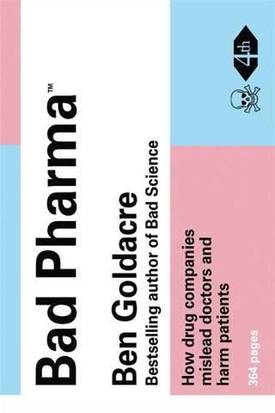
Pick Your Pill Out of a Hat - "Bad Pharma" by Ben Goldacre


Ben Goldacre's new book, Bad Pharma: How Drug Companies Mislead Doctors and Harm Patients, hasn't been released in the U.S. yet (due out January 8, 2013 according to Amazon), but it's getting a lot of attention in England. This is important stuff. Big Pharma has been lying to us and killing us (for our own good) for far too long - and with the FDA's tacit approval.

In his first book, Bad Science: Quacks, Hacks, and Big Pharma Flacks, Goldacre went on the attack against fringe health practices such as homeopathy, ear candles, Reiki, and various other non-scientific healing approaches (more kindly known as alternative medicine).

Pick your pill out of a hat


They might do you some good, with luck
 
Bad Pharma. By Ben Goldacre. Fourth Estate; 430 pages; £13.99. To be published in America in January by Faber and Faber; $28. 

DOCTORS like to project an air of authority when making their clinical decisions. Patients like it too, for it is reassuring to think that one’s health is in the hands of an expert. It would be unsettling if, upon prescribing you a drug, your doctor admitted that the scientific research about what exactly the drug did, and how effective it was at doing it, was patchy and distorted, sometimes to the point where nobody has any real idea of what effects the drugs they are prescribing are likely to have on their patients.

But that is the reality described in “Bad Pharma”, Ben Goldacre’s new book. A British doctor and science writer, he made his name in 2008 with “Bad Science”, in which he filleted the credulous coverage given in the popular press to the claims of homeopaths, reiki therapists, Hopi ear-candlers and other purveyors of ceremonious placebos. Now he has taken aim at a much bigger and more important target: the $600-billion pharmaceutical industry that develops and produces the drugs prescribed by real doctors the world over.

The book is slightly technical, eminently readable, consistently shocking, occasionally hectoring and unapologetically polemical. “Medicine is broken,” it declares on its first page, and “the people you should have been able to trust to fix [its] problems have failed you.” Dr Goldacre describes the routine corruption of what is supposed to be an objective scientific process designed to assess whether new drugs work, whether they are better than drugs already on the market and whether their side effects are a price worth paying for any benefits they might convey. The result is that doctors, and the patients they treat, are hobbled by needless ignorance.

So, for instance, pharmaceutical companies bury clinical trials which show bad results for a drug and publish only those that show a benefit. The trials are often run on small numbers of unrepresentative patients, and the statistical analyses are massaged to give as rosy a picture as possible. Entire clinical trials are run not as trials at all, but as under-the-counter advertising campaigns designed to persuade doctors to prescribe a company’s drug.

The bad behaviour extends far beyond the industry itself. Drug regulators, who do get access to some of the hidden results, often guard them jealously, even from academic researchers, seeming to serve the interests of the firms whose products they are supposed to police. Medical journals frequently fail to perform basic checks on the papers they print, so all sorts of sharp practice goes uncorrected. Many published studies are not written by the academics whose names they bear, but by commercial ghostwriters paid by drug firms. Doctors are bombarded with advertising encouraging them to prescribe certain drugs.

The danger with a book like this is that it ends up lost in abstract discussion of difficult subjects. But Dr Goldacre illustrates his points with a plethora of real-world stories and examples. Some seem almost too breathtaking to be true—but every claim is referenced and backed up by links to research and primary documents. In scenes that could have come straight from a spy farce, the French journal Prescrire applied to Europe’s drug regulator for information on the diet drug rimonabant. The regulator sent back 68 pages in which virtually every sentence was blacked out.

And of course, the upshot of all this is anything but abstract: doctors are left ignorant about the drugs they are prescribing, and which will make their patients sick or get well, or even live or die. Statins, for instance, lower the risk of heart attacks, and are prescribed to millions of adults all over the world. But there are several different sorts of statin. Because there is little commercial advantage to be gained by comparing the efficacy of the different varieties, no studies have done so in a useful way.

Bereft of guidance, doctors must therefore prescribe specific statins on the basis of little more than hunches or personal prejudice. As Dr Goldacre points out, if one drug is even a shade more effective than its competitors, then thousands of people prescribed the inferior ones are dying needlessly every year for want of a bit of simple research. That is a scandal. Worse, the bias and distortions that brought it about are repeated across the entire medical industry. This is a book that deserves to be widely read, because anyone who does read it cannot help feeling both uncomfortable and angry.

Wednesday, August 15, 2012

Academics are Revolting: The open access frontier


From Mean Land, an excellent article on the scam that is academic publishing. Where else can you make people (or institutions) pay to get their articles published and then make those same institutions pay incredible sums to have that journal in their library, and then make individuals like me pay between $10 and $50 dollars for access to the article (which is generally time limited, so I am not buying it so much as renting it)?

Open access fixes the problem, although now journals offer an open access option that costs the authors even more money then to get their article published - something needs to change. 

Academics are Revolting: The open access frontier

Posted at Friday 08 Jun
by Catherine Moffat.

Here’s the deal. You work hard to produce something, then sell it for a pittance. Perhaps you even give it away. The buyer ‘adds value’ and sells it back to you at an enormous profit. It’s standard sweatshop practice.

It can also be, in some cases, standard publishing practice. Authors and creators, keen to add the ‘value’ and prestige of a publisher to their work, or just excited that someone – anyone, is interested in publishing them, often give their work away with little thought of remuneration or what’s happening to their copyright.

Of course, publishers rightly argue they have the costs of editing, producing, advertising and distribution, not to mention the financial risks. It’s about adding value.

The rush to publish in ‘quality’ journals at any cost is particularly true of academic publishing. Academics are driven by a ‘publish or perish’ mandate where promotion and tenure is largely reliant on publishing and citation counts in accredited peer reviewed publications. Check out what’s happening at Sydney University (and coming soon to a university near you) where a retrospective performance marker of four research publications in the last three years is being used as one criteria to cull the ‘non performing’.

Of course, academics, unlike your average author, generally have the benefit of an income that is independent of their publications. As Louise Adler pointed out in The Australian last year, authors and creators not publishing in academia are probably in more actual danger of perishing, given, ‘the average annual income of Australian writers has declined in the past decade from $23,000 to a character-building $11,000.’
But while non-academic authors might be teetering on the breadline, operating outside of academic publishing models does provide the opportunity (and probably a more immediate incentive) to experiment with new modes of production.

In a recent appearance at the Sydney Writer’s Festival on a panel discussing the implications of the Protect Intellectual Property Act (PIPA) and the Stop Online Piracy Act (SOPA), Jeff Jarvis stressed the need for authors to develop new business models. While this may be good advice, many authors, and academic authors in particular, risk becoming trapped in their existing arrangements, relying on proving their publication record in traditional formats.

But as the cost of academic journals rise, many are asking who benefits most from the current model? Philip Soos in a piece on the Conversation, ‘The Great Publishing Swindle’, argues that what was intended as a public good has become a publishing monopoly.

Danny Kingsley, also writing on The Conversation about the US Research Works Act – A Small Bill in the US, a Giant Impact for Research Worldwide breaks it down like this:

‘Publicly funded research being undertaken by researchers who are often themselves (in Australia almost exclusively) also publicly funded, is written up and submitted to a publisher. The publisher sends it back out to the academic community to peer review the work, for no charge. Many of the editors of journals are also academics who again are doing the work gratis. The publisher then adds the journal design to the article and publishes it, charging disproportionally large subscription fees for access to the work. These fees are paid by university libraries, again, with public funding.’

And they are big fees. Each year university libraries pay millions of dollar to give scholars the right to access material that in the main has been provided by the same scholars, free of charge. Prices continue to increase while University budgets diminish and as Adam Habib outlines, developing countries are priced out of the market.

While authors are using the internet to experiment with new ways to reach their audience, many academics are also revolting and choosing open access publishing models that offer the same peer reviewed guarantee while allowing anyone who wants, access to their work.

Take a look at this open-access.net clip for a really simple overview:


Most users of the web, including authors and creators, aren’t interested in all this closed/open access and copyright stuff. Authors put their work on the internet and users take it for free if they can. Many people don’t realise that the internet is governed by the same copyright laws that exist in physical space. Others don’t care. But if you’ve been yawning behind your hand, consider this: One of the really interesting things about all the new google/facebook and other whizz gadgetry that allows your every move to be traced, is the potential to make it really easy to track the use of copyright material.

Unless you’re Kim.Dotcom making an estimated $175 million from alleged illegal filesharing, it’s unlikely you’ll find the FBI on your doorstep any time soon. I can’t help thinking, however, that we’ve been living in the digital equivalent of a frontier town, and sooner or later, for good or ill, the lawmen ride in and the frontier gets tamed.

Big Copyright has been slow to mobilize and grasp the monetary potential of the web, but it’s starting to lumber to its feet, and when it gets there you can be sure the 99% are going to be left hanging. PIPA and SOPA, the Research Works Act, extensions to copyright embedded in free trade agreements and similar actions are indications that the giant is awake now.

Copyright is like superannuation and interest rates – something no one pays attention to until they have to. But it’s important for authors and creators to think about how they want others to access their work. If you want others to access your work freely, make it clear. If you want them to pay, make it easy for them to do so. Read the contracts you sign. Because the reality is, if you don’t think about what’s happening to your copyright, someone else will.

Sunday, June 10, 2012

Integral Leadership Review - June 2012 Issue Now Online


The June 2012 issue of the Integral Leadership Review is now online, and as usual it contains a plethora of wonderful material. If you have limited time and would like a synopsis of this issue, then be sure to check out the current issue of Particles, the "cliff notes" for the new edition.

Thursday, March 22, 2012

March 2012 Integral Leadership Review Now Onlne


The March 2012 issue of the Integral Leadership Review is now online, featuring some excellent articles and reviews, including my review of Gary Stamper's new book, Awakening the New Masculine: The Path of the Integral Warrior (Berrett-Koehler Publishers, March 2012) - but also new articles from Eugene Pustoshkin, Mark Walsh, Michael Craig, and Don Beck.


March 2012 Table of Contents

Feature Articles

Book Reviews

Column

Notes from the Field

Leadership Emerging

Coda
  • Russ Volckmann: CODA


Thursday, January 12, 2012

January, 2012 Issue of the Integral Leadership Review Is Online

The new issue of the Integral Leadership Review is out and online, with a special supplement on Integral in Africa.


January 2012 Table of Contents

Leading Comments
Nicholas Shannon - Leading Comments: Some British Contributions to Integral Leadership


Leadership Coaching Tips
Graham Ward - Leadership Coaching Tip


Fresh Perspective
Nicholas Shannon - Fresh Perspective: Anthony Grayling on Educating for Leadership


Russ Volckmann - Fresh Perspective: James O’Dea – Peace and Sanity


Feature Articles
Simon Western - Analytic-Network Coaching©: Coaching for Distributed ‘Eco’ Leadership and Organizational Change


Nick Ross - Epoch of Transformation: An Interpersonal Leadership Model for the 21st Century–Part 1


John Tuite - Getting Back to the Body: Leadership Lessons on Power from the Martial Arts and Somatic Tradition


Andrew Munro - Leadership Wisdom and the Perspective of Time


Donna Ladkin - Perception, Reversibility, “Flesh”: Merleau-Ponty’s Phenomenology and Leadership as Embodied Practice


Scott Lichtenstein The Role of Values in Leadership: How Leaders’ Values Shape Value Creation


Maretha Prinsloo - Towards an Integrated Assessment of Leadership Potential 


Retrospective
Keith Rice - Retrospective: Summit on the Future of Great Britain – 2009


Book Reviews
Nicholas Shannon - Book Review: Buffalo Maps


John Rowan - Book Review: Integral Psychotherapy and With a Commentary on Ken Wilber’s AQAL and Types


Column
Mark McCaslin - Column: Journeys into the Integral North


Supplement
Etim Omini African Integral Development Network (AIDEN) with a New Approach to Effective Leadership for Africa


Lillian Enyang Oyama - Integral Life Practice


Oliver Ngodo - International Leadership Conference and Integral Leadership Education Program in Nigeria 


Notes from the Field
Alexander Savkin and Philipp Guzenuk - International Integral Journey with Coach Institute, Russia


Robin Reinach and Barbara Larisch - Martin Ucik, Author of Integral Relationships, in Discourse with Integral New York


Dmitry Baranov - Russian December: The Layers of Protests in Russia


David Holzmer - The 13th Annual International Leadership Association Global Conference, October 2011 in London, England


Ola Solawe - The 4th Integral Meeting: Mindful Mind, Conscious Life – Gdańsk, Poland


Michael Stern - The Spiral Dance of Spiritual Growth: Navigating the Whitewater of Individuation and Belonging


Leadership Emerging
Russ Volckmann - Leadership Emerging


Coda
Russ Volckmann - Coda: Change is on My Mind

Wednesday, November 02, 2011

Integral Leadership Review - October 2011

A new issue of the Integral Leadership Review is out - you can see the full Table of Contents for the October 2011 issue by following the link.

Here is section of Russ Volckman's Leading Comments: Interesting Times.


This issue of ILR – and perhaps this applies to most if not all of them – has occurred in interesting times. Personally, this has been one of the busiest and challenging work and personal periods of my life. I have been learning a lot, feeling a lot, caring a lot – and the process will probably be as intense in the next few months as it has been in the last. And we have received and are sharing with you a lot of valuable and interesting material.

Imagine! Interviews with both Don Beck and Ken Wilber in the same issue! Also, there is a subtheme of articles having to do with women and integral leadership, including an article by Marilyn Hamilton. There is an excellent article by Integral Leadership Council member Alain Gautier with another by Don Dunoon (In the Leadership Mode) and Ellen Langer, each dealing with development of individuals for leader roles. And I highly recommend “Spiral Dynamics Integral in Action in a Roma Community in Romania” by Alexandre (Rico) de Faria for a truly exceptional case study.

There are a number of reviews of varying depth. I call your attention to James L. Ritchie-Dunham”s review of Maureen Metcalf and Mark Palmer, Innovative Leadership Fieldbook. This very recent publication has already been drawing attention.

Finally, I am excited that we are able to provide you with Barrett C. Brown’s “Complexity Leadership: An Overview and Key Limitations.” This is one of a number of Barrett’s papers we hope to publish in the future, papers he wrote in his PhD program (hence, it’s inclusion as a “Learner Paper”). Barrett has since completed his PhD, but we believe his work has been so valuable that we want to share as much of it as we can with you

I hope you find many things to enjoy about this issue and our innovations.

Saturday, August 20, 2011

New Issue of the Integral Leadership Review

The August issue of the Integral Leadership Review is now online, and as always, there is a great collection of articles. There are reviews of two excellent books - The Postconventional Personality and Dialogical Self Theory.

Table of Contents — August 2011


Notes from the Field
Articles
Leadership Cartoon: Mark Hill
Book Reviews