Showing posts with label steroids. Show all posts

Thursday, September 05, 2013

Chuck Klosterman - There Are No Sound Moral Arguments Against Performance-Enhancing Drugs


In the New York Times recently, in the Ethicist column, Chuck Klosterman responded to a reader's question on the hypocrisy of making PEDs illegal while other forms of performance enhancement are not illegal. Klosterman argues that there is no sound moral argument against PED use, but he does offer an ethical argument.

He believes that morality is a personal choice, but that ethics are a contextual and socially constructed set of rules. Therefore, a sport (like a religion or a board game) can have a set of rules upon which most people have agreed. However, he also acknowledges that the lines drawn in sports are  capricious - why is a shot of Toradol okay for an injured player but not a shot of testosterone, when both offer healing benefits?

I reject the ethical argument as well - and below this article I offer a brief outline of my own views on PEDS. For another excellent argument relative to the hypocrisy of making these substances illegal, see this column by Miami Herald reporter Dan La Batard.

There Are No Sound Moral Arguments Against Performance-Enhancing Drugs

By CHUCK KLOSTERMAN
Published: August 30, 2013

Q: The argument against performance-enhancing drugs in sports is that the drugs give players an unfair advantage. But how do P.E.D.’s differ from Tommy John surgery? Or pre-emptive Tommy John surgery? What about rich kids? Is their access to superior coaching, facilities and equipment a similarly unfair advantage? In a society that embraces plastic surgery, Botox injections, Viagra and all kinds of enhancements, what moral line do P.E.D.’s cross? 
~ LYNN MOFFAT, SLEEPY HOLLOW, N.Y.

The hypocrisy you recognize is undeniable. Virtually all moral arguments against P.E.D.’s involve contradictions. The presumption of competitive unfairness could be applied to any two human experiences that aren’t identical. The notion that P.E.D.’s are “unnatural” isn’t that distant from making the same argument against elbow surgery or insulin or eyeglasses. Any impulse to criminalize steroids in the name of player safety is absurd (collision sports are more dangerous than the illegal drugs used within them). Some will insist that athletes have a unique responsibility as role models, but that claim evaporates the moment you question the assumptions therein. (Why are people who happen to run fast and jump high the best models for behavior? Can someone be forced to be a role model against his or her will?) There are no sound moral arguments against P.E.D.’s.

There is, however, an ethical argument.

Morality is about personal behavior. Ethics are more contextual. They create the framework for how a culture operates. Sports, unlike life, need inflexibly defined rules. Any game (whether it’s the World Cup or Clue) is a type of unreality in which we create and accept whatever the rules happen to be. Even the Super Bowl is fundamentally an exhibition. So how do we make an unreal exhibition meaningful? By standardizing and enforcing its laws, including the ones that don’t necessarily make sense. Three strikes constitute an out; four balls constitute a walk. In order for baseball to have structural integrity, we all have to agree that this is the system we’re using. Success or failure at baseball is measured against a player’s ability to perform within the framework that defines what baseball is; the logic behind that framework is almost a secondary concern.

For a variety of reasons — statistical tradition, illegality, fear — there’s a social consensus that P.E.D.’s are bad for sports. The lines have been drawn capriciously, but the lines exist. Though it’s difficult to explain why, we’ve collectively agreed it’s O.K. for an injured football player to take a shot of Toradol to help ignore an injury, but not a shot of testosterone to help that injury heal faster. Now, you can certainly argue there’s no moral justification for that dissonance. But morality is not the motive here. The motive is to create a world — or at least the illusion of a world — where everyone is playing the same game in the same way. P.E.D.’s are forbidden because that’s what our fabricated rules currently dictate. In real life, that’s a terrible, tautological argument. But in sports, arbitrary rules are necessary. The rules are absolutely everything, so the rules are enough.

E-mail queries to ethicist@nytimes.com, or send them to the Ethicist, The New York Times Magazine, 620 Eighth Avenue, New York, N.Y. 10018, and include a daytime phone number. 
Okay, here are my views on PEDs, which I have posted in various forms over the years (this is a slight revision of the comments I left at Debate.com on the PED in sports topic).
All performance enhancing drugs should be legalized for use under a doctor's supervision - for athletes, for you, for me. Athletes whose income (in the tens of millions of dollars) depends on producing statistics and being able to play as many games as possible (performance incentives) are going to do whatever it takes to stay on the field or in the game/race. The real benefit of HGH and testosterone (and all of their derivatives, as well as other drugs), are that they speed recovery from injury or simply from the wear and tear of the game (soccer, rugby, football).

The bottom line with PEDs is that they are simply another form of technology - like top of the line basketball shoes, the insanely lightweight bikes used at the Tour de France, the knee braces worn by NFL linemen, or the high-tension tennis racquets used on the pro tours. The list could go on and on.

In the 1940s and 1950s, just as an example, NFL players only had food as a "sports supplement," or maybe some dessicated liver pills (which you can still get, incidentally). Now all athletes have access to whey protein (quicker recovery and better immune health), creatine (strength and muscular endurance), a variety of amino acid supplements (l-tyrosine for alertness, l-leucine for muscle building, BCAAs for recovery), nutrient repartitioning supplements (ursolic acid, CLA), and even basic post-workout supplements specifically designed to aid recovery (containing a 2:1 carb to protein ratio with hydrolyzed whey, extra l-leucine, and other insulin potentiating substances). PEDs are in this same category, only more effective when used correctly.

Which is why they should require a doctor's supervision. With testosterone one needs to avoid the conversion into estrogen (so we also need an aromatase inhibitor), the increase in LDL cholesterol (so we need fish oil and other healthy lipids), or, with oral steroids, liver damage (so we need alpha lipoic acid, curcumin, and/or milk thistle extract).

PEDs can be used safely and effectively, but that will not happen as long as they are banned and/or illegal.

Sunday, September 02, 2012

Alva Noë - Doping: It's Just Part Of The Game


In his most recent column for NPR's 13.7 Cosmos and Culture blog, philosopher Alva Noë takes a pragmatic view of doping in sports. In his previous column, Making Peace with Our Cyborg Nature, he suggested (to much derision it appears) that performance enhancing drugs are simply another technology in the "extended self" model of human life (i.e., technologies are extensions of mind and body), another tool that extends our abilities and our experiences.

It seems the readers could not grasp that argument - to them, it's just cheating, plain and simple, black and white. So this week, he tries a different approach. Yes, doping is cheating, "but it is cheating that is intelligible and motivated internal to the game, it is cheating that is consistent, in so many ways, with the spirit of self-actualization, creativity, and achievement that is the mark of all sports."

In this argument, doping is cheating in the same way that a base runner takes down the catcher at home base to dislodge the ball, or the same way that a Nascar driver bumps a competitor to get past him (or her), or the same way that a striker goes down as though he was shot with the slightest contact from a defender in a soccer match. These are not the "best moments" of the sport, but they are part of the sport . . . just as PEDs are part of cycling, football, and so many other sports.

I totally agree.

Are performance enhancing drugs just part of the game, proscribed by the rules but understood by all to be a gray area open to interpretation, like a tough call by a referee or umpire?

I would like to begin by thanking readers, so many of whom took the effort to express their outrage at my suggestion, posted here last week, that perhaps the widespread criticism of Lance Armstrong, and other athletes who have been caught doping, is a symptom that we, the public at large, have not come to terms with something basic about ourselves, namely, that we are extended beings whose boundaries depend on the innovative use of technology as much as they depend on anything more intrinsic to our ourselves.

"It's about the cheating, dummy!" I think that fairly sums up what so many of you thought about my proposal. Maybe I had a good thought about technology, the extended mind, and the like. But, many of you believe, this has nothing to do with the matter at hand. The matter at hand is cheating.
Actually, I disagree. The matter at hand is not really cheating. Cheating is simple. Black and white. But there's nothing black and white about the current situation. Drug use in sports is widespread. Outrage against drug use is widespread. What's going on? Why are we so upset? Why are we unable to get athletes to stop doping? And why do we care so much? Why the outrage?

Let's notice, right off the bat, that organized sports have rules, but that not all rules are of the same standing. Some rules are constitutive of the activities they govern. If you take a bus to the finish line, or take short cuts through back yards, you are breaking the rules of road running in such a way that, really, you aren't even competing. At best you are perpetrating a fraud. Putting a piece of metal in your boxing glove, starting running before the pistol fires, using a motor to drive your bicycle through the Alps — theses violations are such as to remove you from any claim even to have participated.

But not all rules are defining in this way. The differences between the rules of NBA basketball and that of international or college play are substantial; but they are different ways of playing the same game, basketball. And baseball has changed many rules over the years — introducing the foul-strike rule, for example — without thereby destroying the game. The game has merely evolved.

Rules governing what athletes may eat, drink, or otherwise consume, and how they may legitimately train for competition, these fall into this second category of non-constitutive rules. You can't compare breaking a rule of this kind with breaking a rule of the first kind. Taking a drug to improve your performance is nothing like slipping a drug into your opponent's breakfast cereal. Eating a banned substance is nothing like using a motor in a bicycle race. It is just sloppy reasoning — equivocating between the different kinds of rules involved — to suggest that it is. Cheating comes in different varieties.

The thing about the first kind of rule, the constitutive ones, is that they define the limits of the game. They let you say this is inside and anything else is outside. Running across the diamond from first to third is excluded in baseball. According to the rules, it falls outside.

But this isn't true of the second kind of rule. The interesting thing about these rules is that they get formulated not at the boundaries of the game, but within it. And they remain, always, within the sport, areas of live concern and contention.

Consider: you can't drug an opponent to win a game. That's excluded by the basic, constitutive rules. But what about throwing the ball at a batter's head, or ramming into a defending catcher so hard that you threaten to hurt him in an effort to get him to drop the ball, as happened (for the umpteenth time) this past week? There are rules against this sort of thing as well. But note, although the rules proscribe these actions, the actions in question are not exactly excluded. The interesting thing here is not merely that players routinely pitch to intimidate, or slide to take out a defender. The interesting thing is that it actually belongs to the culture of the game to dispute whether such play is legitimate or not. The controversy happens not at the limits of the game, but at its heart.

And to test those internal limits, to be willing to give your all even at the risk of injury to yourself and to others, is actually what is required of any player who aims at excellence.

Now my proposal is this: doping is a violation of this latter kind. Doping does not put you outside the game in the way that driving to the finish line of a running race would. Doping is more like the unclean slide or the bean ball. It may be cheating, but it is cheating that is intelligible and motivated internal to the game, it is cheating that is consistent, in so many ways, with the spirit of self-actualization, creativity, and achievement that is the mark of all sports. Any athlete committed to being the best he or she can be, to going to new heights, is going to need to be willing to take risks of this kind.

One benefit of this proposal is that it explains why doping persists despite the efforts to ban it. Asking an athlete not to dope is like asking him to hold back while running the bases. There's good reasons to make that request. And good reasons for it to be disregarded.

I think it also explains why passions run so high. If doping were merely a matter of violating constitutive rules, then we'd simply disqualify the players and get on with it. But doping, like unclean slides in baseball, or roughness in hockey, but also, perhaps, like zone defense in basketball, is a hot topic, a controversial gray area, an area where we have strong feelings and are drawn to take a stand. These are open controversies that belong to the life of the games in question. We debate these questions on the inside.

The important point is this. From the standpoint of the athlete — and as fans we identify with the athlete — doping isn't cheating any more than sliding hard is cheating. Doping doesn't put you outside the game any more than sacrificing your marriage or getting up at 3:30 every morning so that you can get time at the ice rink puts you outside the game. Athletes are in it for the achievement. Athletes will not say No.

And that's why sports matter to us. We are not outsiders looking down on life. We are players. We can never take the rules of life for granted. We are learning them, or figuring them out, or making them up, or, sometimes, trying to change them, as we go along. If sports were merely about the moves that can be made in the space defined by the rules, I don't think we'd find sports that interesting. Sports are about living a life as a player. And players, like the rest of us, test the limits. At least if they are ambitious. They don't say no. And they don't fear going outside normal play. Because they understand — again, this is why sports matter — that, from their point of view, there is no outside.

You can keep up with more of what Alva Noë is thinking on Facebook and on Twitter: @alvanoe

Saturday, April 16, 2011

Alva Noë - In Defense Of Barry Bonds In The Face Of History

http://alt.coxnewsweb.com/shared-blogs/austin/golden/upload/2010/01/sammy_sosa_before_after.jpg
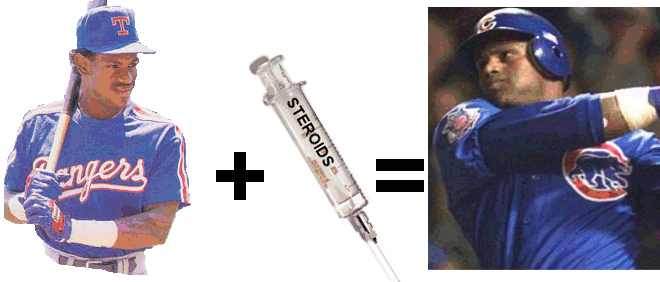
Sammy Sosa at around 240 lbs and in his youth at about 165 lbs

Alva Noë has written a column at NPR's 13.7 Cosmos and Culture blog in support of Barry Bonds - or at least in support of the idea that sports statistics are relative. He does, however, make a crucial point about Bonds's
records and achievements as a hitter (not to mention 7-time MVP) - he was by far the best hitter among a whole generation of great hitters (Mark McGuire, Sammy Sosa, Alex Rodriguez, Jose Canseco, Rafael Palmeiro, Lenny Dykstra, Chuck Knoblauch, David Justice, Mo Vaughn, Eric Gagne, and Jason Giambi - as well as pitchers Roger Clemons and Andy Pettitte) all of whom were taking steroids and/or growth hormone.

And just to point out something Noe didn't, for most of the 60s and 70s steroids were legal and probably being used at least a little bit by baseball players. We do know that amphetamines (greenies) were rampant in the game - a drug that increases reaction times and focus when used in appropriate doses. In fact, currently, at least 10% of players have exceptions for ADHD, allowing them to test positive for amphetamines.

The idea that baseball didn't get dirty until the "steroid era" is nonsense. Just legalize the damn things again as it was prior to the 1980s and require a doctor's supervision. Otherwise, people will continue to find ways to cheat in order to perform better and make more money.

In Defense Of Barry Bonds In The Face Of History

San Francisco's Barry Bonds follows through on his 756th career home run on Aug. 7, 2007. The home run put Bonds in sole possession of first place for Major League Baseball's all-time home run record.
Enlarge Ben Margot/AP

San Francisco's Barry Bonds follows through on his 756th career home run on Aug. 7, 2007. The home run put Bonds in sole possession of first place for Major League Baseball's all-time home run record.

Babe Ruth hit 29 home runs in 1919. This was a new record and it electrified a baseball world that was also in shock over that year's Black Sox scandal. In response, baseball's owners decided to introduce a change that would radically alter the game.

Prior to 1920, a single ball was used for the length of an entire game, or for as long as possible. Fans were expected to return foul balls to play. As cricket is still played today, the condition of the ball was a significant factor in the course of play. Skilled pitchers, after all, use the scratches, smudges and build-up to influence the ball's action and so to befuddle hitters.

What happened in 1920 is this: baseball introduced a new practice of removing balls from play as soon as they acquired the least imperfection. This practice, which continues to the present day, had the effect of substantially shifting the balance of power from pitchers to batters; the clean-ball rule seems alone to have launched the era of the "live ball." Babe Ruth hit 59 home runs the very next season, and then 60 in 1927, a record that stood until Roger Maris hit 61 home runs in 1961.

Baseball traditionalists insist that Maris' record should come with an asterisk, because he managed his feat in a lengthened baseball season. Question: Did Maris achieve less in hitting 61 home runs, than Ruth did in hitting 60, because it took him longer to do it?

But wait a second. Does not Ruth's achievement also deserve an asterisk? This much is true: If we want to understand what Ruth accomplished, we need to take into consideration the fact that Ruth, but not an earlier generation of athletes, was playing in the era of the shiny ball. He couldn't have achieved what he did if not for changed circumstances.

Traditionalists take Babe Ruth's accomplishment as baseline, and against this baseline they mark, or put an asterisk, next to Maris' record. But the decision to treat Maris's performance as the marked case, and Ruth's as unmarked, is entirely arbitrary.

To appreciate this, consider that we might very well mark all pitching achievements prior to the 1969 season with an asterisk. After all, in that season Major League Baseball lowered the pitching mound. This came in the aftermath of the 1968 season in which Bob Gibson and other pitchers so totally dominated batters that it was felt something needed to be done to raise the level of hitting. The mound was lowered to achieve precisely this outcome.

Surely the biggest change of all to transform baseball was the decision to allow non-white players to compete with whites. Was Babe Ruth the best player of his generation? Maybe, but one thing we know for sure: black athletes were prohibited from competing against him and Ruth was prohibited from testing himself against them. We also know that Ruth's lifetime record of 714 career home runs was eclipsed within a few decades by an African-American, Hank Aaron.

Why do we mark Maris' achievement, but not that of white players before integration, or pitchers before 1969? There are probably many factors influencing our feelings about the game and its history. But crucially what we are left with, in the end, are just feelings, or prejudices.

And this brings me to my real point. As we all know by now, the U.S. Government has successfully inflicted humiliating punishment on Barry Bonds. He is now a convicted felon. They didn't try to prosecute him for illegal drug use. And they were unable to convict him of perjuring himself during his 2003 grand jury testimony in connection with the BALCO case. But they did get him for being evasive in his response to questions about his own training practices and this, in the minds of the jury anyway, rose to the level of obstruction of justice.

A reasonable person might be tempted to think that the Federal Government was after Bonds all along, that the real purpose of his compelled testimony before the grand jury may very well have been to put him in a situation in which he would feel forced, or at least sorely tempted, to lie or evade. A reasonable person might be tempted to think that Bonds had been a target all along.

But whatever you think about this to me frightening display of state power, this much is clear: Barry Bonds towered over baseball during his career. He towered over a generation of players many of whom, like him, were high-paid and maybe even drug enhanced. The idea that his accomplishments can be explained by steroids is about as silly as the idea that Babe Ruth's depended on the clean ball, or that Nolan Ryan's depended on the lowered mound.

Landscapes shift. Situations change. People adapt. And they achieve.

The point is not that we cannot make comparisons across eras in sports. Of course we can, and should. Nor is the point simply that numbers never tell the whole story of a human being's achievement, even in a sport like baseball where statistics are highly refined, although that is certainly true.

The point is that there aren't single-metrics for understanding human achievement, and the idea that you can explain why someone is so good at what they do by appealing to a single factor such as a lowered mound, or a shiny clean ball, or the absence of non-white competition, or the use of performance enhancing drugs, is, well, silly.

Barry Bonds deserves a place in the Hall of Fame, right there beside Babe Ruth and Hank Aaron. Even if he did use steroids.

Thanks to John Protevi for helpful conversation, and to the baseball writings of Stephen Jay Gould, on which I relied.


Sunday, November 21, 2010

Alva Noe - Doping And Performance In Focus

http://www.thenoseonyourface.com/wp-content/uploads/2007/07/bonds.JPG

Alva Noe is one of my favorite philosophers, and here he tackles one of the hot topics is sports - doping and performance enhancement. Amphetamine, steroids, and growth hormone in baseball. EPO and its derivatives, steroids, and blood doping in cycling. Steroids and growth hormone in football, track and field, and many other sports. If you are the best in your sport, more than likely you have used performance enhancing drugs (legal or not).

Noe poses the opinion that I hold in this area:
Under the right conditions — that is, with the right kind of research support and medical supervision — use of drugs by athletes might actually improve their health and safety by, for example, helping their bodies cope better with the extraordinarily brutal wear and tear of professional sports.
Make the drugs legal, and have them administered and monitored by a professional. Athletes will heal better from injuries, play better with the physical stress they endure, and we all get to see 500 ft home run blasts. Win win. Drugs are technology just like better shoes, better bats, better bikes, or - as Noe explains - better physical mechanics.

Are all four of a horses hooves off the ground at the same time when it gallops?

They say the answer to this question was not known before Eadweard Muybridge’s pioneering work in stop-motion photography in the 1870s. It doesn’t surprise me that painters might have inaccurately depicted the galloping horse, but I find it almost impossible to believe that people working closely with horses — cowboys, cavalry officers, dressage competitors — would not have known the answer to this question.

Muybridge's Galloping Horse

Freeze frame photos set to motion capture the fancy footwork of a racehorse.


I thought of this recently when I read, in the New York Times, that some sports teams are now using new motion-capture technologies — of the sort used, for example, in the making of computer-animated films — to help train athletes. The idea is that by constructing accurate 3D models of a given athlete’s motion, they can help him (or her) avoid injury, speed up recovery, and, in general, optimize overall performance. Some baseball teams, according to the article, have secret programs in this area in the hope that they can get a competitive edge.

I want to pose a question today that may at first sight strike you as silly. Why is this sort of use of technology any better than, or in principle any different from, the use by athletes of steroids (or other so-called performance enhancing drugs)? The goals are certainly the same: to avoid injury, to speed up recovery, to optimize performance, to gain a competitive edge.

Many people have a strong conviction that drug use in sports is bad. It is bad in a special way. My question is, why?

Well, you might say, doping is prohibited in most sports (professional and amateur). It’s cheating to use a banned substance. End of story.

Granted.

But this actually begs the issue (that is, it presupposes a stand on precisely what we are trying to figure out). The question is not: Are they banned? The question is: Ought they to be banned? Presumably, steroids in sports are not bad because they are banned. They are banned because they are bad. And the question is, why?

One answer goes like this: “Steroids and other performance enhancing drugs are harmful! They destroy your body. We reserve a special contempt for drug use in sports because sports celebrates the beauty, grace and power of the healthy, trained body. Doping kills.”

This statement is clear, and to the point. But it isn’t persuasive.

Steroids may be dangerous. But almost everything about sports, at both professional and amateur levels, is dangerous. Athletes pay a very high price to do what they do. Find me a professional athlete in his 40s who has not had four or more surgeries to repair serious damage to his knees or hips or shoulders!

Concussion, premature arthritis, multiple surgeries, chronic pain, even premature death — this is the lot of the successful athlete. It’s hard to see how steroid use, or the use of other drugs to improve performance, changes the equation.

I grant that the use of banned substances in sports is dangerous. The image of major league athletes shooting each other up in toilet stalls is appalling. But what if teams had drug specialists as part of their training programs, just as some of the teams now, apparently, have digital motion-capture graphics specialists on the payroll? Under the right conditions — that is, with the right kind of research support and medical supervision — use of drugs by athletes might actually improve their health and safety by, for example, helping their bodies cope better with the extraordinarily brutal wear and tear of professional sports.

Would we stand back from our opposition to drugs in sports if we could find a way to make them safe for the athletes, if we found that they actually improved the lives of athletes?

I think I hear you shouting (as you jump up and down): But what about the kids! Do we want to send our kids the message that to play sports at a competitive level they need to do drugs?

To this I say, let’s not lie to our kid or ourselves. A life in sports is a lot like a life in the military. You join a club. You get gear and a uniform. You have the chance to learn, travel, grow. You run the risk of killing. You run the risk of getting maimed or killed.

Don’t get me wrong. I love sports. But sports, like life, requires sacrifice.

The ideal of the gentleman amateur, like that of the renaissance man, is long dead (if it ever really lived). And forget about sound mind in sound body. Sports is a jealous mistress and demands full commitment and specialization. And hip-replacement surgery before age 40 and early onset dementia as a result of head trauma are live risks. If we aren’t squeamish about surgery and dementia, why are we squeamish about doping?

So let’s ask ourselves again: What is it about drug use in sports that seems so repellent? Why the deep moral disapprobation? Why the outrage?

Here’s what I think is going on. We think of drug use in sports as a kind of plagiarism. We don’t view an athlete’s performance under conditions of drug use as authentically his (or her) performance.

When an athlete trains, we think he improves himself, and we think that his performance flows from and gives truthful expression to this improved self. When an athlete works with scientists and uses imaging and modeling technologies to improve his performance, we think that he gains knowledge, and we believe that this knowledge enhances him as a person and as an athlete, and so we believe that he has achieved his improved performance and he deserves our admiration.

But when an athlete takes drugs, we feel, he does not so much enhance himself, as he artificially augments himself. An athlete on drugs has made himself an unnatural creature, a cyborg, a monster. The very being of such a person, we feel, is a cheat.

So the outrage that many people feel when Barry Bonds is credited with being the Home Run King stems not from the fact that he had a supposedly unfair advantage when compared to Babe Ruth or Hank Aaron. No, the source of the outrage is the feeling that Barry Bonds allegedly didn’t do anything. He didn’t hit home runs. He hit sham home runs. To reward him for his accomplishments is like rewarding a person for having assembled a stamp collection when, in fact, he inherited it.

Now consider this: Barry Bonds’ home runs are not like artificial boobs. You pay for the latter, and the surgeon does the work. The home runs, however, are not simply purchased for the price of taking the medicine. The drugs only bring about their effects when integrated intelligently into the training regimen and practice of the athlete. Bonds is one of the greatest athletes ever to play the game of baseball and that fact has nothing to do with alleged steroid use.

Performance enhancing drugs are best compared with performance enhancing footwear, or bathing suits, or training techniques. They are a tool in the arsenal of the athlete. They do not suffice, all alone, for excellent performance in the way that the plastic surgeon’s work, all on its own, suffices for the bosom.

Our sense that drugs make a sham of what we accomplish, whereas bathing suits and training regimens simply enable our enhanced performance, is without justification. As I have argued here previously, there is no sharp line to be drawn between myself (say) and what I can do, on the one hand, and my environment and what it allows and affords me, on the other. This is because, in general, there is no sharp line to be drawn between mechanisms and their enabling conditions.

Pills, like meals, sneakers and bathing caps, are on par — they are tools. And like all tools, they hold out the possibility of expanding not only our bodies, but our selves. (As well as the possibility of being abused or misused.)

For the record: I am not writing in support of doping. A strong case can be made that the quality of play in my favorite sport — baseball — has improved since the stricter enforcement of the drugs ban. But I also find the contempt and disrespect shown to athletes who are suspected of using performance enhancing drugs hypocritical and mean-spirited.

But what really motivates me to write this essay is the conviction that underlying our moralizing and outrage in the face of drugs in sports is an unreflected on and ultimately implausible conception of the self as the entirely internal, self-sufficient source of outflowing action.


Tuesday, February 10, 2009

The Case for Steroids


Everyone has their panties in a bunch over A-Rod admitting he took steroids to "live up to expectations" when he played in Texas (at a record $25 million/year). Those were some high expectations, and he DID live up to them. So what if he needed a little "help" to play in an average of 161 games over those three years?

Looking at the above images, I see no real difference between 2003 (left) and 2008 (right). But then again, A-Rod might be lying about his doping and he was still juiced in 2008. There's no reason to believe he couldn't beat the system - it's designed to be beaten by those who choose to do so.

BFD. I'll bet nearly every "star" in baseball has used steroids or HGH at some point. Not everyone, of course, but many. The playing field is pretty level in that respect. Are we really that uptight about baseball, while we don't really care about the NFL or pro wrestling?

Over at Big Think, one author makes a (flawed) case for steroid use.

The Case For Steroids

Over the last hundred years of sports, technological advancements have enhanced athlete’s performance. In so doing, the records of today’s athletes cannot realistically be compared to those of the past.

For instance, Michael Phelps’ bathing suit, “The Fastskin,” cannot compare to the speedo that Mark Spitz had to wear. Many swimmers used to shave their bodies for every little natural speed enhancement they could get. Did you check out Phelps at the Olympics? He had leg and chest hair. His Fastskin simply blew any previous type of swimsuit out of the water, shaved legs or no. Why aren’t we railing about how this technology has changed sports unfairly? What is the nature of competition and what are we trying to preserve?

It seems to me that the focus of the steroid debate has been far too focused on the inherent unfairness of them (though if everybody can take them, they aren’t unfair) rather than the larger issue of what they do to the body.

Sean Assael, author of “Steroid Nation,” explains that there are many health problems associated with steroids. Check it out.

Actually, used wisely and in the proper cycles, steroids are not harmful. The health risks arise when people use high doses for extended periods, without estrogen inhibitors or appropriate periods off of the drugs.

Most of the baseball players using steroids are doing so for strength and healing (aside from Canseco, who seemed to have a size fetish), so the doses are lower, while still being effective. My guess is that they are not using year around.

As I have noted before, steroids are a technology, like any other, and should be legalized for everyone, not just athletes.


Thursday, June 05, 2008

Bigger, Stronger, Faster - Steroids in America

[Body by Anabolics, Growth Hormone, Insulin, Etc]

I've written before on drugs in sports -- essentially I'm a libertarian in this realm, favoring a complete decriminalization of steroid use and doctor-supervised sanctioning of use by athletes.

A new movie - Bigger, Stronger, Faster - takes a somewhat ambivalent look at the use of steroids by athletes, which is completely understandable given the climate of condemnation in this country. The movie has a 100% rating at Rotten Tomatoes after 29 reviews.
Synopsis: In America, we define ourselves in the superlative: we are the biggest, strongest, fastest country in the world. Is it any wonder that so many of our athletes take performance-enhancing drugs? Director Christopher Bell explores America’s win-at-all-cost philosophy by examining the way his two brothers became members of the steroid subculture in an effort to realize their American dream. Ingeniously beginning the film by harkening back to the mentality of the 1980s, where the heroes were Rambo, Conan, and Hulk Hogan, Bell recounts how these role models led him and his brothers into powerlifting and dreams of becoming all-star wrestlers. Those dreams were soon shattered by the realization that success in those fields required the use of performance-enhancing drugs. Bell uses his personal story as an entree into analyzing the bigger issues that surround these drugs: ethics in sports; the health ramifications, both physical and psychological; as well as the mentality that fuels it all. Bigger, Stronger, Faster* combines crisp editing of hilarious archival footage with priceless family revelations, as well as interviews with congressmen, professional athletes, medical experts, and everyday gym rats. The power of the film is the way Bell stays away from preconceptions and stereotypes and digs deeper to find the truth and concoct a fascinating, humorous, and poignant profile of one of the side effects of being American. --© Sundance Film Festival
Bigger, Stronger, Faster - Reviewed in The Chicago Tribune
A 2002 trip to the Dominican Republic should have left me with a sense of guilt over the squalid conditions in San Pedro de Macoris, Sammy Sosa's hometown.

Instead I was left with skepticism: No way Sosa, whom I had been covering as the Cubs' beat writer, could have plumped to 230 pounds au naturel. Every other native Dominican was built like a marathoner.

Then I asked myself: If going on a "juice" diet was Sosa's only way off this island, could I blame him? A terrific new documentary called "Bigger, Stronger, Faster" asks similar questions. While it's easy for politicians to brand steroids as the devil's potion, the film presents their use as a moral tightrope, perhaps not that different than the use of legal stimulants, Viagra, beta blockers, altitude chambers, cortisone shots, even Lasik eye surgery.

"So it's OK to enhance your performance if you're a pilot, porn star, a musician or a student," director/writer Christopher Bell explains, "but if your job is to play professional baseball, somehow that makes you a cheater."

Bell grew up in the '80s, a self-described "fat, pale kid from Poughkeepsie" who idolized Hulk Hogan, Sylvester Stallone and Arnold Schwarzenegger. Bell is crushed to learn that all three are frauds, having injected their way to fame, riches and (for Schwarzenegger) a path to the governor's mansion of California.

But Bell cannot demonize steroid use, in part because of a family secret. Bell's older brother, nicknamed "Mad Dog," began taking steroids while playing football at the University of Cincinnati. His younger sibling, nicknamed "Smelly," pledges to quit after winning a competition with a 705-pound bench-press.

Bell confronts Smelly, labeling him a cheater. But he also sympathizes with him, explaining, "There is a clash in America between doing the right thing and being the best."
Two other views:

Bigger, Stronger, Faster* left me convinced that the steroid scandals will abate as the drugs are reluctantly accepted as inevitable products of a continuing revolution in biotechnology.
~Stephen Holden, New York Times

A foreboding look at our conception of the human being: as a mechanism that can be sculpted, doped, enhanced, and perfected because, well, because we all want to be powerful and attractive.
~ Brett McCracken, Christianity Today

There is a real disconnect here between doping for sports (physiological enhancement) and the rest of our culture. My guess is that people who wouldn't think twice about getting a little "work done," referring to plastic surgery, would be totally opposed to athletes using growth hormone to speed healing of injuries or general recovery, or to athletes using testosterone to build a little more muscle to make themselves more competitive,

I'd bet these same people would have no issue with taking Prozac for depression or giving their kids Ritalin for ADD. I'll bet some of them have tattoos, or pierced ears, or permanent eye-liner. At what point is body (and brain) modification alright, and at what point is it a crime?

There's absolutely no reason for anabolic steroids to be illegal, other than politics. The drugs were legal until the early 1980s. You can still go into pharmacies in many countries and buy steroids over the counter.

With proper supervision, the health risks are minimal. Clearly, those who do not have fully developed hormonal systems shouldn't be using these drugs (that means kids). But proper control, regulations, and availability would take the drugs off the black market and make them much safer (thus also removing a whole line of work for criminals).

The reality of steroid use in America is much different than you might think:
Studies in the United States have shown anabolic steroid users tend to be mostly middle-class heterosexual men with a median age of about 25 who are noncompetitive bodybuilders and non-athletes and use the drugs for cosmetic purposes.[68] Another study found that non-medical use of AAS among college students was at or less than 1%.[69] According to a recent survey, 78.4% of steroid users were noncompetitive bodybuilders and non-athletes while about 13% reported unsafe injection practices such as reusing needles, sharing needles, and sharing multidose vials,[70] though a 2007 study found that sharing of needles was extremely uncommon among individuals using anabolic steroids for non-medical purposes, less than 1%.[71] Anabolic steroid users often are stereotyped as uneducated "muscle heads" by popular media and culture; however, a 1998 study on steroid users showed them to be the most educated drug users out of all users of controlled substances.[72] Another 2007 study found that 74% of non-medical anabolic steroid users had secondary college degrees and more had completed college and less had failed to complete high school than is expected from the general populace.[71] The same study found that individuals using Anabolic steroids for non-medical purposes had a higher employment rate and a higher household income than the general population.[71] Anabolic steroid users also tend to research the drugs they are taking more than any other group of users of controlled substances.
The real problem here is that the drugs are illegal and stigmatized, so even though the users do a great deal of research, they don't tell their primary care physicians about their use:
Moreover, anabolic steroid users tend to be disillusioned by the portrayal of anabolic steroids as deadly in the media and in politics.[73] According to one study, AAS users also distrust their physicians and in the sample 56% had not disclosed their AAS use to their physicians.[74] Another 2007 study had similar findings, showing that while 66% of individuals using anabolic steroids for non-medical purposes were willing to seek medical supervision for their steroid use, 58% lacked trust in their physicians, 92% felt that the medical communities knowledge of non-medical anabolic steroid use was lacking and 99% felt that the public has an exaggerated view of the side effects of anabolic steroid use.[71]
So what is to be done?

Legalize the drugs for prescription use. Allow athletes to use the drugs under a doctor's supervision. Crack down on internet sales that target minors -- in this case under the age of 21.

The only other solution is to completely change our culture so that success, winning, strength and speed, and physical attractiveness are not so highly valued that people are willing to go to illegal means to achieve those things. Good luck with that.

Thursday, December 13, 2007

Steroids in Baseball - Yawn

Senator Mitchell's report came out today, as was covered by nearly every paper and news report in America. My comments below.

Roger Clemens, who won the Cy Young award a record seven times, and seven players who won baseball’s most valuable player award were among dozens of players named Thursday in the former Senator George J. Mitchell’s report on his investigation into the use of performance-enhancing drugs in the sport.

“For more than a decade there has been widespread anabolic steroid use,” Mr. Mitchell said in a news conference announcing the results of a 20-month investigation he led at the behest of Major League Baseball. He said the use of performance-enhancing substances “poses a serious threat to the integrity of the game.”

Clemens was the most prominent name in the report, along with the Most Valuable Player award-winners Barry Bonds, Ken Caminiti, José Canseco, Jason Giambi, Juan Gonzalez, Mo Vaughn and Miguel Tejada.

The report also includes the names of three of the top 10 home-run leaders of all time: Bonds, Mark McGwire and Rafael Palmiero.

Mr. Clemens was among several players named in the report from the Yankees championship teams of the late 1990s, which put together one of the most dominant performances in baseball, winning three consecutive World Series from 1998 to 2000. Others from those teams included Andy Pettitte, David Justice and Chuck Knoblauch. Other players named included Gary Sheffield, Kevin Brown, Lenny Dykstra, Denny Neagle, Todd Hundley, Mike Stanton, Paul Lo Duca and Eric Gagné.

“Each of the 30 clubs had a player or players involved in taking illegal substances,” at one time or another, Mr. Mitchell said. He called the years on which he focused his investigation “the Steroids Era.”

“If there are problems, I wanted them revealed,” said Bud Selig, baseball’s commissioner since 1992. “His report is a call to action, and I will act.”

The evidence against the players includes receipts, checks and e-mail, much of it provided by Kirk Radomski, a former New York Mets clubhouse attendant who has pleaded guilty to federal charges for selling steroids from 1995 through 2005. Mr. Radomski cooperated with Mr. Mitchell as part of his plea bargain. Other evidence came from Brian McNamee, a former trainer for Mr. Clemens and Mr. Pettitte and from an investigation led by the Albany County district attorney into Signature Pharmacy.


I've been clear on this blog about my feelings regarding performance enhancing drug use in sports. In addition to this new report, Marion Jones admitted her use of drugs and was recently stripped by the IOC of the five medals she won in the 2000 Olympics. Certainly, there will be others.

Focusing just on baseball for a minute, this "investigation" is big pile of bullshit. Everyone in baseball knew about anabolic steroid use and growth hormone use among players, not to mention amphetamine use which has been going on for decades (and amphetamines aren't even banned in the NHL). All the big heads looked the other way because the increase in size and strength, and the resulting higher level of play -- not to mention the lengthening of careers -- brought back a lot of fans who had left the sport following the strike year of 1994.

Baseball isn't alone in its hypocrisy on drug use. The NFL testing program is so predictable that athletes know when they will be tested, which allows them to use fast-acting (and fast-clearing) drugs, knowing they can beat the test.

While N.F.L. officials are proud of their program, antidoping experts say the framework and timing of N.F.L. testing allows players ample room to outmaneuver the tests, particularly if they are using amphetamines and fast-acting steroids that can be quickly flushed from the body.

A well-known steroid expert comments:

“Testing catches the careless and the stupid,” said Charles E. Yesalis, a professor of sports science at Penn State University. “If you believe only 1 to 2 percent use drugs, that is incredibly naïve. Drug use is the greatest problem facing elite sports, and testing creates the facade that everyone is clean.”

The New York Times article concludes with this from Yesalis:

Yesalis, who has studied drug use by athletes for the last 30 years, said he recently came to the conclusion that drug testing was doing more harm than good.

“The major breakthroughs have come from law enforcement, not by any testing,” he said. “Testing is there to provide the fan, who is already disinterested in drug use, with plausible deniability because the leagues tell the fans the athletes are clean because they have drug testing.”


It's worth noting that only the International Olympic Committee has a fully functioning testing program, and they test Olympic athletes in conjunction with the United States Anti-Doping Agency, but none of the professional sports leagues in this country have been willing to contract with the USADA to test their athletes.

This is a telling fact. Why wouldn't these leagues do EVERYTHING in their power to be sure their sports are clean? The answer, as always, is money.

It's not in the best interest of the sports or the athletes to lose the best players as a result of positive drug tests. Despite what fans may say about drug testing, they want to see the best athletes doing things that seem super-human. If football players were only marginally better than the average athlete, or if the baseball season didn't produce several players with 30-50 home runs, or if we didn't have aging players like Roger Clemons to cheer for, who would want to spend more than $100 to take a family of four to a ballgame?

The reality is, as always, that people will do whatever they have to do to be successful, especially when there is BIG money on the line. And this includes using performance enhancing drugs. With this as a fact, there will always be chemists coming up with the next new undetectable drug, athletes who will use them, and owners/managers/coaches who look the other way.

There are two real options in solving this problem, since drug testing will NEVER be 100% effective.

1) Make performance enhancing drugs legal again, but require that doctors supervise their use and administration. In this view, drugs are just another technology -- like ultra-light bikes in cycling, or tracksuits among sprinters, and so on. Various technologies have revolutionized sports like golfing, why not allow drugs to serve the same purpose, as they already have.

2) Limit the pay that any athlete in any sport can make per season. The extravagant money that might normally be paid could be put into retirement programs for athletes so that they are well taken care of when their relatively short careers are over. I would propose that no athlete is worth (or needs) more than a million dollars a year. Alex Rodriguez will make 27.5 million dollars a year for the next 10 years, plus performance incentives. With money like this on the table for the best athletes, no wonder they are willing to use drugs to get that extra edge over other players. Take away that insane money, and you take away the incentive to use drugs.

Of course, neither of these things will happen, and the hypocrisy will continue.


Wednesday, August 08, 2007

Drugs In Sports

The issue of drugs in sports has gotten a lot of press in the past couple of years. Floyd Landis lost his Tour de France title after testing positive for testosterone following a stage in which he blew away the competition. Barry Bonds just surpassed Hank Aaron on the all-time home run list, and everyone thinks he doped. Sammy Sosa was once a skinny little 165 pound player, but a couple of years ago he was up to a ripped 240 pounds. Ben Johnson, back in the 1990's, tested positive for steroids at the Olympics, and later admitted that everyone uses drugs, but that someone spiked his sample.

I'm going to go out on a VERY thick limb and say drugs in sports is not the exception -- it's the rule. Back in 2001, Malcolm Gladwell wrote an excellent article on drugs in sports for The New Yorker. Among the many good quotes (all quotes here are from that article), here is one relevant to the Barry Bonds situation:
An aging baseball star, for instance, may realize that what he needs to hit a lot more home runs is to double the intensity of his weight training. Ordinarily, this might actually hurt his performance. "When you're under that kind of physical stress," Charles Yesalis, an epidemiologist at Pennsylvania State University, says, "your body releases corticosteroids, and when your body starts making those hormones at inappropriate times it blocks testosterone. And instead of being anabolic--instead of building muscle--corticosteroids are catabolic. They break down muscle. That's clearly something an athlete doesn't want." Taking steroids counteracts the impact of corticosteroids and helps the body bounce back faster. If that home-run hitter was taking testosterone or an anabolic steroid, he'd have a better chance of handling the extra weight training.

This is the reality of the situation - steroids enhance recovery allowing an athlete to train harder and heavier and build more muscle. If you don't think it works (and until the early 1980's, doctors said steroids did nothing - despite 25+ years of evidence to the contrary among athletes and bodybuilders), check this out:


Or this:


[image source]

When Sosa and Bonds came into the league, they were both very thin (Sosa was actually smaller). As their careers passed age 30, both of them began to grow in size and strength (Sosa went from 165 as a rookie to about 240 the year he was battling a naturally huge Mark McGuire for the single season home run title, although McGuire was also using PEDs).

Charlie Francis, who trained disgraced sprinter Ben Johnson (for the record, no trainer would have his athlete on the steroid Johnson tested positive for - everyone knows it stays in the body for months or even a year - he was set up), makes a compelling case for why he put his athletes on drugs:

Francis was driven and ambitious, eager to give his athletes the same opportunities as their competitors from the United States and Eastern Europe, and in 1979 he began discussing steroids with one of his prize sprinters, Angella Taylor. Francis felt that Taylor had the potential that year to run the two hundred metres in close to 22.90 seconds, a time that would put her within striking distance of the two best sprinters in the world, Evelyn Ashford, of the United States, and Marita Koch, of East Germany. But, seemingly out of nowhere, Ashford suddenly improved her two-hundred-metre time by six-tenths of a second. Then Koch ran what Francis calls, in his autobiography, "Speed Trap," a "science fictional" 21.71. In the sprints, individual improvements are usually measured in hundredths of a second; athletes, once they have reached their early twenties, typically improve their performance in small, steady increments, as experience and strength increase. But these were quantum leaps, and to Francis the explanation was obvious. "Angella wasn't losing ground because of a talent gap," he writes; "she was losing because of a drug gap, and it was widening by the day." (In the case of Koch, at least, he was right. In the East German archives, investigators found a letter from Koch to the director of research at V.E.B. Jenapharm, an East German pharmaceutical house, in which she complained, "My drugs were not as potent as the ones that were given to my opponent Brbel Eckert, who kept beating me." In East Germany, Ungerleider writes, this particular complaint was known as "dope-envy.") Later, Francis says, he was confronted at a track meet by Brian Oldfield, then one of the world's best shot-putters: "When are you going to start getting serious?" he demanded. "When are you going to tell your guys the facts of life?" I asked him how he could tell they weren't already using steroids. He replied that the muscle density just wasn't there. "Your guys will never be able to compete against the Americans--their careers will be over," he persisted.
The problem of drug use will never be defeated:
The basic problem with drug testing is that testers are always one step behind athletes. It can take years for sports authorities to figure out what drugs athletes are using, and even longer to devise effective means of detecting them.

And:
"The bottom line is that only careless and stupid people ever get caught in drug tests," Charles Yesalis says. "The elite athletes can hire top medical and scientific people to make sure nothing bad happens, and you can't catch them."

So obviously, we need to take another look at this whole issue.

Steroids are a form of technology, just like low-weight aerodynamic bikes in the Tour de France, just like high-tech drivers in golf, just like composite materials used in poles for the pole vault, among many examples. If we don't ban other forms of technology, why ban steroids?

It may be a moot point. In reality, steroids will soon be obsolete. Gene doping is the new frontier. Within five years I suspect that athletes will be able to turn off the myostatin gene that limits muscle growth. Cows born without this gene grow enormous (and lean), so you end up with animals that look like this:


One bodybuilder (Ronnie Coleman, pictured here) is already suspected of having done gene doping to limit myostatin production. He was already a phenomenal physical specimen, but he changed the nature of bodybuilding by competing at nearly 300 pounds with a minimal 4% bodyfat.


The only real question in seeing drug use or gene doping as technology and not as cheating is the health of the athletes. Many bodybuilders have died from improper use of diuretics and from overuse of steroids. As long as drugs are black market and illegal, it will be impossible for many athletes to get doctor supervision to make sure they are not hurting themselves. Elite athletes can afford the doctors, many others can't.

If we simply accept that drugs are a technology, and allow their use under doctor supervision, we eliminate all the hysteria around performance and records, and we protect the athletes from hurting themselves to stay competitive.

Most sports employs a 6:1 testosterone to epitestosterone ratio to determine if someone is using testosterone, while the average is 1:1; pro cycling uses a hematocrit (a measure of red blood cell density in blood) of 50 to limit EPO use, which thickens the blood with oxygen-carrying red blood cells, allowing better performance in endurance races, while the normal range is 36-48. These numbers recognize that drugs are being used, but put limits on their abuse, which to me seems reasonable.

As long as there is big money to be made in sports, athletes will seek ways to improve their performance. Let's make it legal, and let's make it as safe as possible. And let there be no * next to anyone's performance.