
In an article a couple of weeks ago in The New Yorker, Malcolm Gladwell [author of, among others, The Tipping Point: How Little Things Can Make a Big Difference (2000), Blink: The Power of Thinking Without Thinking (2005), and Outliers: The Story of Success (2008)], reviews two relatively recent books on sports performance.
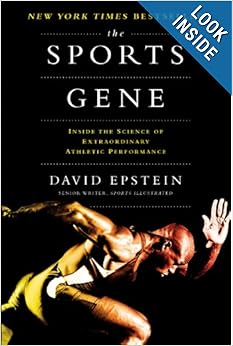
In the fist book, The Sports Gene: Inside the Science of Extraordinary Athletic Performance (2013), David Epstein offers a wide-ranging account of how biological and environmental factors can create amazing athletes. In the other book Gladwell looks at, The Secret Race: Inside the Hidden World of the Tour de France (2013 paper edition), former professional cyclist and Lance Armstrong teammate Tyler Hamilton offers an in-depth and brutally honest account of his career in cycling and his use of performance enhancing drugs.

Man and Superman
In athletic competitions, what qualifies as a sporting chance?
by Malcolm Gladwell
September 9, 2013
Élite sports is a contest among athletes with an uneven set of genetic endowments and natural advantages. Illustration by Barry Blitt.Toward the end of The Sports Gene (Penguin/Current), David Epstein makes his way to a remote corner of Finland to visit a man named Eero Mäntyranta. Mäntyranta lives in a small house next to a lake, among the pine and spruce trees north of the Arctic Circle. He is in his seventies. There is a statue of him in the nearby village. “Everything about him has a certain width to it,” Epstein writes. “The bulbous nose in the middle of a softly rounded face. His thick fingers, broad jaw, and a barrel chest covered by a red knit sweater with a stern-faced reindeer across the middle. He is a remarkable-looking man.” What’s most remarkable is the color of his face. It is a “shade of cardinal, mottled in places with purple,” and evocative of “the hue of the red paint that comes from this region’s iron-rich soil.”
Mäntyranta carries a rare genetic mutation. His DNA has an anomaly that causes his bone marrow to overproduce red blood cells. That accounts for the color of his skin, and also for his extraordinary career as a competitive cross-country skier. In cross-country skiing, athletes propel themselves over distances of ten and twenty miles—a physical challenge that places intense demands on the ability of their red blood cells to deliver oxygen to their muscles. Mäntyranta, by virtue of his unique physiology, had something like sixty-five per cent more red blood cells than the normal adult male. In the 1960, 1964, and 1968 Winter Olympic Games, he won a total of seven medals—three golds, two silvers, and two bronzes—and in the same period he also won two world-championship victories in the thirty-kilometre race. In the 1964 Olympics, he beat his closest competitor in the fifteen-kilometre race by forty seconds, a margin of victory, Epstein says, “never equaled in that event at the Olympics before or since.”
In “The Sports Gene,” there are countless tales like this, examples of all the ways that the greatest athletes are different from the rest of us. They respond more effectively to training. The shape of their bodies is optimized for certain kinds of athletic activities. They carry genes that put them far ahead of ordinary athletes.
Epstein tells the story of Donald Thomas, who on the seventh high jump of his life cleared 7' 3.25"—practically a world-class height. The next year, after a grand total of eight months of training, Thomas won the world championships. How did he do it? He was blessed, among other things, with unusually long legs and a strikingly long Achilles tendon—ten and a quarter inches in length—which acted as a kind of spring, catapulting him high into the air when he planted his foot for a jump. (Kangaroos have long tendons as well, Epstein tells us, which is what gives them their special hop.)
Why do so many of the world’s best distance runners come from Kenya and Ethiopia? The answer, Epstein explains, begins with weight. A runner needs not just to be skinny but—more specifically—to have skinny calves and ankles, because every extra pound carried on your extremities costs more than a pound carried on your torso. That’s why shaving even a few ounces off a pair of running shoes can have a significant effect. Runners from the Kalenjin tribe, in Kenya—where the majority of the country’s best runners come from—turn out to be skinny in exactly this way. Epstein cites a study comparing Kalenjins with Danes; the Kalenjins were shorter and had longer legs, and their lower legs were nearly a pound lighter. That translates to eight per cent less energy consumed per kilometre. (For evidence of the peculiar Kalenjin lower leg, look up pictures of the great Kenyan miler Asbel Kiprop, a tall and elegant man who runs on what appear to be two ebony-colored pencils.) According to Epstein, there’s an evolutionary explanation for all this: hot and dry environments favor very thin, long-limbed frames, which are easy to cool, just as cold climates favor thick, squat bodies, which are better at conserving heat.
Distance runners also get a big advantage from living at high altitudes, where the body is typically forced to compensate for the lack of oxygen by producing extra red blood cells. Not too high up, mind you. In the Andes, for example, the air is too rarefied for the kind of workouts necessary to be a world-class runner. The optimal range is six to nine thousand feet. The best runners in Ethiopia and Kenya come from the ridges of the Rift Valley, which, Epstein writes, are “plumb in the sweet spot.” When Kenyans compete against Europeans or North Americans, the Kenyans come to the track with an enormous head start.
What we are watching when we watch élite sports, then, is a contest among wildly disparate groups of people, who approach the starting line with an uneven set of genetic endowments and natural advantages. There will be Donald Thomases who barely have to train, and there will be Eero Mäntyrantas, who carry around in their blood, by dumb genetic luck, the ability to finish forty seconds ahead of their competitors. Élite sports supply, as Epstein puts it, a “splendid stage for the fantastic menagerie that is human biological diversity.” The menagerie is what makes sports fascinating. But it has also burdened high-level competition with a contradiction. We want sports to be fair and we take elaborate measures to make sure that no one competitor has an advantage over any other. But how can a fantastic menagerie ever be a contest among equals?
During the First World War, the U.S. Army noticed a puzzling pattern among the young men drafted into military service. Soldiers from some parts of the country had a high incidence of goitre—a lump on their neck caused by the swelling of the thyroid gland. Thousands of recruits could not button the collar of their uniform. The average I.Q. of draftees, we now suspect, also varied according to the same pattern. Soldiers from coastal regions seemed more “normal” than soldiers from other parts of the country.The culprit turned out to be a lack of iodine. Iodine is an essential micronutrient. Without it, the human brain does not develop normally and the thyroid begins to enlarge. And in certain parts of the United States in those years there wasn’t enough iodine in the local diet. As the economists James Feyrer, Dimitra Politi, and David Weil write, in a recent paper for the National Bureau of Economic Research:
Ocean water is rich in iodine, which is why endemic goiter is not observed in coastal areas. From the ocean, iodine is transferred to the soil by rain. This process, however, only reaches the upper layers of soil, and it can take thousands of years to complete. Heavy rainfall can cause soil erosion, in which case the iodine-rich upper layers of soil are washed away. The last glacial period had the same effect: iodine-rich soil was substituted by iodine-poor soil from crystalline rocks. This explains the prevalence of endemic goiter in regions that were marked by intense glaciation, such as Switzerland and the Great Lakes region.After the First World War, the U.S. War Department published a report called “Defects Found in Drafted Men,” which detailed how the incidence of goitre varied from state to state, with rates forty to fifty times as high in places like Idaho, Michigan, and Montana as in coastal areas.
The story is not dissimilar from Epstein’s account of Kenyan distance runners, in whom accidents of climate and geography combine to create dramatic differences in abilities. In the early years of the twentieth century, the physiological development of American children was an example of the “fantastic menagerie that is human biological diversity.”
In this case, of course, we didn’t like the fantastic menagerie. In 1924, the Morton Salt Company, at the urging of public-health officials, began adding iodine to its salt, and initiated an advertising campaign touting its benefits. That practice has been applied successfully in many developing countries in the world: iodine supplementation has raised I.Q. scores by as much as thirteen points—an extraordinary increase. The iodized salt in your cupboard is an intervention in the natural order of things. When a student from the iodine-poor mountains of Idaho was called upon to compete against a student from iodine-rich coastal Maine, we thought of it as our moral obligation to redress their natural inequality. The reason debates over élite performance have become so contentious in recent years, however, is that in the world of sport there is little of that clarity. What if those two students were competing in a race? Should we still be able to give the naturally disadvantaged one the equivalent of iodine? We can’t decide.
Epstein tells us that baseball players have, as a group, remarkable eyesight. The ophthalmologist Louis Rosenbaum tested close to four hundred major- and minor-league baseball players over four years and found an average visual acuity of about 20/13; that is, the typical professional baseball player can see at twenty feet what the rest of us can see at thirteen feet. When Rosenbaum looked at the Los Angeles Dodgers, he found that half had 20/10 vision and a small number fell below 20/9, “flirting with the theoretical limit of the human eye,” as Epstein points out. The ability to consistently hit a baseball thrown at speeds approaching a hundred miles an hour, with a baffling array of spins and curves, requires the kind of eyesight commonly found in only a tiny fraction of the general population.
Eyesight can be improved—in some cases dramatically—through laser surgery or implantable lenses. Should a promising young baseball player cursed with normal vision be allowed to get that kind of corrective surgery? In this instance, Major League Baseball says yes. Major League Baseball also permits pitchers to replace the ulnar collateral ligament in the elbow of their throwing arm with a tendon taken from a cadaver or elsewhere in the athlete’s body. Tendon-replacement surgery is similar to laser surgery: it turns the athlete into an improved version of his natural self.
But when it comes to drugs Major League Baseball—like most sports—draws the line. An athlete cannot use a drug to become an improved version of his natural self, even if the drug is used in doses that are not harmful, and is something that—like testosterone—is no more than a copy of a naturally occurring hormone, available by prescription to anyone, virtually anywhere in the world.
Baseball is in the middle of one of its periodic doping scandals, centering on one of the game’s best players, Alex Rodriguez. Rodriguez is among the most disliked players of his generation. He tried to recover from injury and extend his career through illicit means. (He has appealed his recent suspension, which was based on these allegations.) It is hard to think about Rodriguez, however, and not think about Tommy John, who, in 1974, was the first player to trade in his ulnar collateral ligament for an improved version. John used modern medicine to recover from injury and extend his career. He won a hundred and sixty-four games after his transformation, far more than he did before science intervened. He had one of the longest careers in baseball history, retiring at the age of forty-six. His bionic arm enabled him to win at least twenty games a season, the benchmark of pitching excellence. People loved Tommy John. Maybe Alex Rodriguez looks at Tommy John—and at the fact that at least a third of current major-league pitchers have had the same surgery—and is genuinely baffled about why baseball has drawn a bright moral line between the performance-enhancing products of modern endocrinology and those offered by orthopedics.
The other great doping pariah is Lance Armstrong. He apparently removed large quantities of his own blood and then re-infused himself before competition, in order to boost the number of oxygen-carrying red blood cells in his system. Armstrong wanted to be like Eero Mäntyranta. He wanted to match, through his own efforts, what some very lucky people already do naturally and legally. Before we condemn him, though, shouldn’t we have to come up with a good reason that one man is allowed to have lots of red blood cells and another man is not?
“I’ve always said you could have hooked us up to the best lie detectors on the planet and asked us if we were cheating, and we’d have passed,” Lance Armstrong’s former teammate Tyler Hamilton writes in his autobiography, “The Secret Race” (co-written with Daniel Coyle; Bantam). “Not because we were delusional—we knew we were breaking the rules—but because we didn’t think of it as cheating. It felt fair to break the rules.”
“The Secret Race” deserves to be read alongside “The Sports Gene,” because it describes the flip side of the question that Epstein explores. What if you aren’t Eero Mäntyranta?Hamilton was a skier who came late to cycling, and he paints himself as an underdog. When he first met Armstrong—at the Tour DuPont, in Delaware—he looked around at the other professional riders and became acutely conscious that he didn’t look the part. “You can tell a rider’s fitness by the shape of his ass and the veins in his legs, and these asses were bionic, smaller and more powerful than any I’d ever seen,” he writes. The riders’ “leg veins looked like highway maps. Their arms were toothpicks. . . . They were like racehorses.” Hamilton’s trunk was oversized. His leg veins did not pop. He had a skier’s thighs. His arms were too muscled, and he pedalled with an ungainly “potato-masher stroke.”
When Hamilton joined Armstrong on the U.S. Postal Service racing team, he was forced to relearn the sport, to leave behind, as he puts it, the romantic world “where I used to climb on my bike and simply hope I had a good day.” The makeover began with his weight. When Michele Ferrari, the key Postal Service adviser, first saw Hamilton, he told him he was too fat, and in cycling terms he was. Riding a bicycle quickly is a function of the power you apply to the pedals divided by the weight you are carrying, and it’s easier to reduce the weight than to increase the power. Hamilton says he would come home from a workout, after burning thousands of calories, drink a large bottle of seltzer water, take two or three sleeping pills—and hope to sleep through dinner and, ideally, breakfast the following morning. At dinner with friends, Hamilton would take a large bite, fake a sneeze, spit the food into a napkin, and then run off to the bathroom to dispose of it. He knew that he was getting into shape, he says, when his skin got thin and papery, when it hurt to sit down on a wooden chair because his buttocks had disappeared, and when his jersey sleeve was so loose around his biceps that it flapped in the wind. At the most basic level, cycling was about physical transformation: it was about taking the body that nature had given you and forcibly changing it.
“Lance and Ferrari showed me there were more variables than I’d ever imagined, and they all mattered: wattages, cadence, intervals, zones, joules, lactic acid, and, of course, hematocrit,” Hamilton writes. “Each ride was a math problem: a precisely mapped set of numbers for us to hit. . . . It’s one thing to go ride for six hours. It’s another to ride for six hours following a program of wattages and cadences, especially when those wattages and cadences are set to push you to the ragged edge of your abilities.”
Hematocrit, the last of those variables, was the number they cared about most. It refers to the percentage of the body’s blood that is made up of oxygen-carrying red blood cells. The higher the hematocrit, the more endurance you have. (Mäntyranta had a very high hematocrit.) The paradox of endurance sports is that an athlete can never work as hard as he wants, because if he pushes himself too far his hematocrit will fall. Hamilton had a natural hematocrit of forty-two per cent—which is on the low end of normal. By the third week of the Tour de France, he would be at thirty-six per cent, which meant a six-per-cent decrease in his power—in the force he could apply to his pedals. In a sport where power differentials of a tenth of a per cent can be decisive, this “qualifies as a deal breaker.”
For the members of the Postal Service squad, the solution was to use the hormone EPO and blood transfusions to boost their hematocrits as high as they could without raising suspicion. (Before 2000, there was no test for EPO itself, so riders were not allowed to exceed a hematocrit of fifty per cent.) Then they would add maintenance doses over time, to counteract the deterioration in their hematocrit caused by races and workouts. The procedures were precise and sophisticated. Testosterone capsules were added to the mix to aid recovery. They were referred to as “red eggs.” EPO (a.k.a. erythropoietin), a naturally occurring hormone that increases the production of red blood cells, was Edgar—short for Edgar Allan Poe. During the Tour de France, and other races, bags of each rider’s blood were collected in secret locations at predetermined intervals, then surreptitiously ferried from stage to stage in refrigerated containers for strategic transfusions. The window of vulnerability after taking a drug—the interval during which doping could be detected—was called “glowtime.” Most riders who doped (and in the Armstrong era, it now appears, nearly all the top riders did) would take two thousand units of Edgar subcutaneously every couple of days, which meant they “glowed” for a dangerously long time. Armstrong and his crew practiced microdosing, taking five hundred units of Edgar nightly and injecting the drug directly into the vein, where it was dispersed much more quickly.
“The Secret Race” is full of paragraphs like this:
The trick with getting Edgar in your vein, of course, is that you have to get it in the vein. Miss the vein—inject it in the surrounding tissue—and Edgar stays in your body far longer; you might test positive. Thus, microdosing requires a steady hand and a good sense of feel, and a lot of practice; you have to sense the tip of the needle piercing the wall of the vein, and draw back the plunger to get a little bit of blood so you know you’re in. In this, as in other things, Lance was blessed: he had veins like water mains. Mine were small, which was a recurring headache.Hamilton was eventually caught and was suspended from professional cycling. He became one of the first in his circle to implicate Lance Armstrong, testifying before federal investigators and appearing on “60 Minutes.” He says that he regrets his years of using performance-enhancing drugs. The lies and duplicity became an unbearable burden. His marriage fell apart. He sank into a depression. His book is supposed to serve as his apology. At that task, it fails. Try as he might—and sometimes he doesn’t seem to be trying very hard—Hamilton cannot explain why a sport that has no problem with the voluntary induction of anorexia as a performance-enhancing measure is so upset about athletes infusing themselves with their own blood.
“Dope is not really a magical boost as much as it is a way to control against declines,” Hamilton writes. Doping meant that cyclists finally could train as hard as they wanted. It was the means by which pudgy underdogs could compete with natural wonders. “People think doping is for lazy people who want to avoid hard work,” Hamilton writes. For many riders, the opposite was true:
EPO granted the ability to suffer more; to push yourself farther and harder than you’d ever imagined, in both training and racing. It rewarded precisely what I was good at: having a great work ethic, pushing myself to the limit and past it. I felt almost giddy: this was a new landscape. I began to see races differently. They weren’t rolls of the genetic dice, or who happened to be on form that day. They didn’t depend on who you were. They depended on what you did—how hard you worked, how attentive and professional you were in your preparation.This is a long way from the exploits of genial old men living among the pristine pines of northern Finland. It is a vision of sports in which the object of competition is to use science, intelligence, and sheer will to conquer natural difference. Hamilton and Armstrong may simply be athletes who regard this kind of achievement as worthier than the gold medals of a man with the dumb luck to be born with a random genetic mutation.


